STRUCTURING THE SPECIAL PURPOSE VEHICLE FOR THE DELIVERY OF BEST VALUE OBJECTIVES IN MALAYSIAN PPP INFRASTRUCTURE PROJECTS Christy P. Gomez1 and Muhammad M. Gambo2
1,2
Department of Construction and Property Management, Universiti Tun Hussein Onn Malaysia, 86400,Parit Raja, Batu Pahat, Malaysia
ABSTRACT
The rapid human population growth rate coupled with the need for improved delivery in infrastructure projects has necessitated the need for the private sector participation in the delivery of much needed infrastructure facilities and services. Public Private Partnerships (PPP) is one of such private sector driven procurement approach which has evolved to solve the infrastructure deficits, and Malaysia is not left out in the adoption of this innovative procurement approach. However, its practice is bedevilled with issues related to the ineffective structuring of the private sector body that is responsible for delivering the infrastructure project through the public private partnership approach. This paper is the result of a preliminary study undertaken as part of a funded research to establish operational strategy indicators (performance measures) to be matched with relevant VfM outcomes using a Balanced Scorecard (BSC) approach linking cause to effect. Initial results indicate a tendency towards high business strategy rather than service. Data was collected from a series of semi structured interviews that were conducted with PPP practitioners. Additionally, using critical approach, based on document analysis it is clear that current policy and practice with regard to the structuring the Special Purpose Vehicle (SPV), aimed at achieving Value for Money (VfM) objectives are lacking. The findings of the research indicates that prioritised VfM strategies according to pre-construction, construction and post-construction phases based on using the BSC as a management system together with comprehensive policies that can serve towards structuring a more effective SPV project organization can enhance the delivery of PPP infrastructure projects in Malaysia.
Keywords: balanced scorecard, public private partnerships, special purpose vehicle, value for money.
INTRODUCTION
With annual investment needs which stands at $165 billion, it is a fact that the developing countries in South East Asia face a huge deficit of basic amenities and essential public infrastructure (Yepes, 2005). The need for effective infrastructure facilities cannot be over emphasized, as effective infrastructure plays a major role in determining the success of the key sectors of every economy; wherein the provision of such needed infrastructure facilities in housing, water, energy and transport are critical in achieving improved standard of living and also helps towards poverty reduction (Sanghi, et al., 2007).
As governments are challenged by the demands of increasing urbanization, the rehabilitation requirements of aging infrastructure and the need to provide new infrastructure is becoming more pertinent. Hence, these governments face an ever increasing need to find sufficient financing to develop and maintain infrastructure required to support growing populations. Primarily, this has been the reason for the private sector participation in resolving the infrastructure challenges facing the public sector (Pongsiri, 2006; Cheung and Kajewski, 2010); which was originally initiated under the banner of Privatisation and Private Finance Initiative (PFI).
Private sector involvement in infrastructure provision and services delivery is not an entirely new approach in Malaysia, but had been in existence since 1983 but basically in the form of privatization then, whereby the public users pay for the services of the economic infrastructure projects rendered in the form of such projects as toll roads, ports, and independent power producers (IPPs), sewerage systems etc (Salleh and Siong, 2008). In 2006, after a period of 22 years, the privatization policy of the private sector’s role in infrastructure delivery was metamorphosized into the PPP as the mechanism for the private sector’s role in infrastructure delivery. And the PPP was formally defined Under the Ninth Malaysia plan report (2006), as ‘the transfer to the private sector the responsibility to finance and manage a package of capital investment and services including the construction, management, maintenance, refurbishment and replacement of the public sector assets which creates a standalone business. The private sector will create the asset and deliver a service to the public sector client. In return, the private sector will receive payment commensurate with the levels, quality and timeliness of the service provision throughout the concession period’ (Ninth Malaysia Plan 2006).
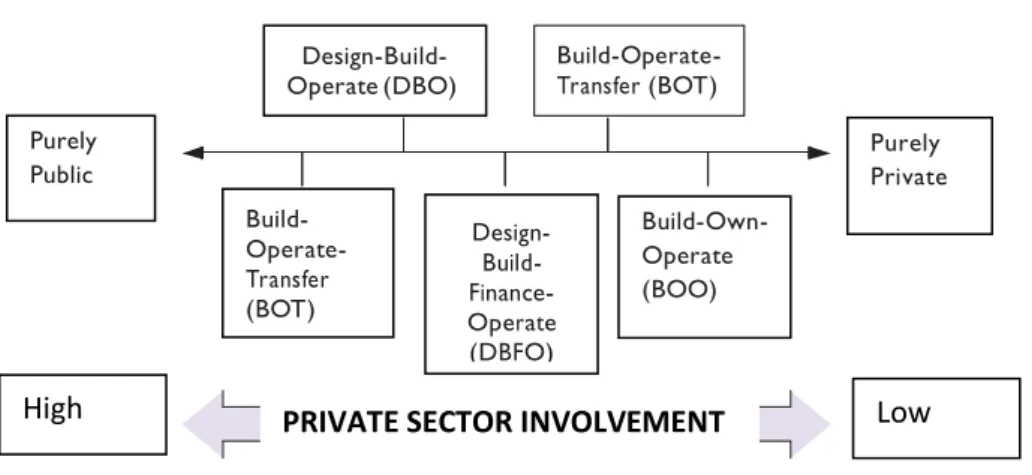
Figure 1: Continuum of Types of PPP (source: Kwak et al., 2009)
The concept of Public Private Partnership (PPP) has since progressed from the earlier approaches of just focusing mainly on private finance to take on a wider perspective of also bringing in key strengths available within the private sector (see Figure 1) requiring greater private sector involvement. Hence, PPP is seen as a system which is primarily aimed at achieving the best output possible by pulling together and mobilizing funds, technologies, managerial skills, operational efficiencies and facilitating innovations that exists in the private sector (Akintoye et al., 2005; Huang et al., 2005).
SITUATING THE RESEARCH
Despite the widespread adoption PPP for delivering infrastructure projects in Malaysia, the implementation policy and the achievement of the VfM objectives in the procurement approach has been the subject of critiques; as the VFM objectives with regards to the achievement of the end user’s expectations in the Malaysian practice of PPP for infrastructure projects are not adequately met (Takim, et al., 2009; Ismail, et al., 2011). This paper takes into account the work of Yuan et al., (2009), Zhang (2006) and Takim et al., (2011), in situating the context of performance measurement in
Design-Build-
Operate (DBO) Build-Operate- Transfer (BOT) Purely Public Purely Private Build-Own- Operate (BOO) Design-Build- Finance-Operate (DBFO) Build-Operate- Transfer (BOT)
relation to the SPV. They attempt to identify performance objectives and key performance indicators in PPP projects resulting in a conceptual framework of KPIs for the performance of PPP projects. It is evident that their conceptual framework and performance measurement models are structured in a fundamentally similar manner to that of the Balanced Scorecard Model. This paper attempts to bring the PPP research debate into the broader Business and Management field, and as such draws attention to the work of Kaplan and Norton (1996) on the Balanced Scorecard (BSC). The BSC is seen as being more than adequate to be adapted for the purpose of establishing a comprehensive systemic framework that can translate the SPV’s vision and strategy (the VfMs) into a coherent set of performance measures.
From reviewing extant literature, it is evident that the dominant criteria within performance frameworks for achieving VfM in PPP projects have been financial aspects; innovation; whole life cost; incentive and monitoring; health, safety and environment, appropriate risk allocation; acquisition of facilities management services; market interest and compliance to specifications. PPP researchers have tended to offer
variations in categorizing these dominant VfM criteria. Zhang (2006) classified the criteria into four essential packages that are supposed to effectively measure the bidders’ capability. They are: financial package (optimum whole life cost); technical package (innovation of all aspects); safety, health and environmental package and managerial package (risk management, dispute and contractual aspects). Whilst Yuan et al. (2009) drew up 5 different classifications of VFM evaluation criteria that include: (i) Physical characteristic of projects (design, technology, bidders knowledge & capabilities, risk allocation); (ii) Financing & marketing; (iii) Innovation & learning; (iv) Stakeholder’s indicator (client satisfaction) (v) Process indicator (facilities management, resources utilization, health & environment and time management). On the other hand, the BSC translates mission and strategy into objectives and measures, organized into four different perspectives: financial; customer; internal business process; and learning and growth.
Besides clearly identifying the specific dominant criteria for achieving VfM, researchers have emphasized the importance of providing specific guidelines according to each stage of a PPP project lifecycle (Broadbent et al., 2003; Khadaroo, 2008; Takim et al., 2011). However, not much work has progressed in this area, and these recommendations have not materialized in practice, at least as is evident in the Malaysian case. Takim et al., (2011), propose a VfM Assessment Process based on four stages: (i) The Strategy Formulation Phase; (ii) The Procurement Phase; (iii) The Construction Phase; and the (iv) Completion Phase, and each phase containing the relevant dominant assessment criteria.
Here, it is concluded that mainstream PPP research on performance measurement models has tended to view PPP as rather a form of an ‘industry-specific-and-cross-sector partnership organization’ and as such has catapulted a search for unique performance-measurement model solutions, failing to take into account the work of Kaplan and Norton on the Balanced Scorecard and other similar previous work. However, as this paper contends; the outcome of such research has served amongst other things, to affirm the outcome of the study undertaken by Kaplan and Norton (1996) in the development of their BSC performance-measurement model as having cross-industry applicability. In forwarding this argument, this paper will not attempt to ingeniously fit all the KPIs developed by Yuan et al. (2009) into the four BSC perspectives of: Financial, Customer, Internal Business Process and Learning and
Growth according to the three different construction phases in order to justify the above contentions.
An additional issue addressed in this paper, is that current research on PPPs seems to be mainly concerned with examining PPPs at a broad social or organizational level, whilst lacking in the management of inter-organizational relationships and process control (see Yuan et. al., 2009). Following Noble and Jones (2006), the focus of this research is on micro-management analysis and stage-specific analysis. Thus, this paper focuses on the pre-construction stage of PPP projects, specifically aimed at addressing the issues identified within current practice focused on the internal measures of critical business processes, innovation, and learning and growth (the external measures according to BSC are for ‘shareholders and customers’). Utilizing the concept of structuration, this paper attempts to review the current contextual rules that seem lacking; giving rise to weak structural properties of the systemic context, leading to a weak structural properties of the PPP project organization (see Manning, 2008). RESEARCH STRATEGY
The approach towards addressing this issue of the weak organizational structuring of the SPV has been undertaken based on a critical analytical perspective, using deconstructive theory to revisit phenomena (framed based on document analysis) and existing assumptions surrounding their construction. This has been undertaken based on the focus on the concept of institutional logics and structuration theory (ST). The theory of structuration (see Giddens, 1976) holds that all human action is performed within the context of a pre-existing social structure which is governed by a set of norms and/or laws which are distinct from those of other social structures. Therefore, all human action is at least partly predetermined based on the varying contextual rules under which it occurs. However, the structure and rules are not permanent and external, but sustained and modified by human action over time (Wanyama and Zheng, 2010). It is in this sense, that the PPP policies and guidelines are seen as being the formal contextual rules under which the Special Purpose Vehicle (SPV) is realized. Thus, this paper proposes that a triangulation methodology be employed; wherein analysis of the National PPP policies and guidelines are analysed to indicate the extent to which the SPV structure directly serves to operationalize strategies with respect to the accepted notion of Value for Money (VfM). Whilst primary data collection is undertaken via interviews with PPP practitioners to triangulate and confirm initial findings of the research.
Initial document analysis reveals a lack of comprehensive SPV ‘organizational structure alignment contextual rules’ with VfM objectives. Indepth interviews with PPP practitioners clearly confirms this. The interview respondents were identified through convenient sampling and were drawn from the pool of experts who had been directly involved in the planning and executioning of PPP infrastructure projects in Malaysia. The interview respondents all have a minimum of five years experience in the implementation of PPP in the construction industry, are holders of at least a degree and are all senior executives or holding management positions in their respective organizations. Out of the seven respondents that participated in the survey, three belonged to the private sector, while the remaining four belonged to public sector related organizations that are involved in the procuring and the subsequent operation and management of infrastructure projects using the PPP.
RESEARCH FINDINGS
PPP infrastructure projects required skills sets/competencies – the practice perspective
PPP as an infrastructure delivery approach is considered an innovative form of collaboration between the public and private sectors in the delivery of infrastructure facilities by which the need for unique skills and competencies to effectively manage such collaboration is an issue of great importance. This is considering the wide range of interlinking relationships and agreements that does exists between the various stakeholders concerned, the risk allocation mechanism that characterizes the approach and more over the long term commitment involved with respect to the concessioning period of the PPP implementation (Mistarih et al., 2012).
As achieving the VfM objective (strategic) is an integral component of the implementation of the PPP, such objectives can only be achieved if the needed skills and competencies (high level operational indicators from a practice perspective) are considered to be important by the parties involved in the delivery of the infrastructure approach through the PPP. Hence, this research tends to elucidate on these needed PPP skills/competencies with respect to its role in delivering the much needed VfM objectives and the overall effective implementation of the PPP in infrastructure delivery.
Ranking of the PPP infrastructure projects’ required skills sets/competencies
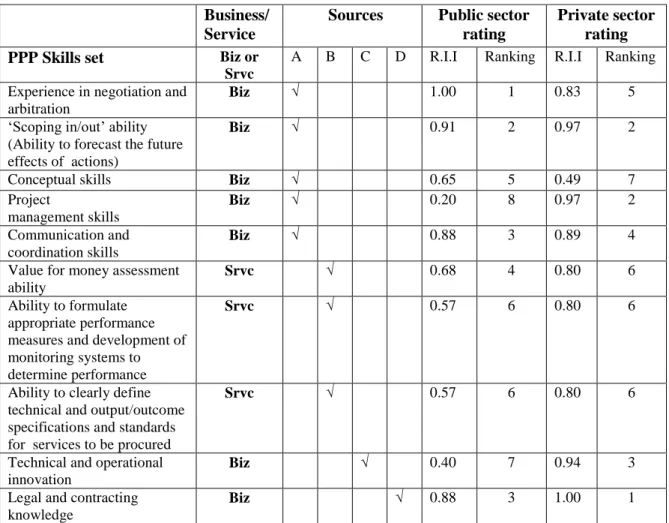
From the PPP skill sets/competencies obtained from previous literature as shown in the Table 1.0 below, the respondents were asked to identify which of the stakeholders in the PPP implementation matches up with these competencies, and moreover rate the importance of these skills in the 5 point Likert scaling where; 5 = Highly important, 4 = Important, 3 = Moderately important, 2 = mildly important, 1 = Less important. The skills sets/competencies were rated in the order of their importance based on two stakeholder categorization: the public sector in the form of the government and the private sector in the form of the SPV.
The ratings were provided by the respondents using the five point Likert scale were combined and then converted into relative importance indices for each of the skill sets/competencies, using the relative importance index (RII) ranking technique.
Where W: Summation of the weighting to each skill set/competency, A: Highest ranking (5) and N: Total number of respondents for that skill/competency
Table 1.0: PPP Skills Sets/Competencies ranking
Sources of Literature Legend
A = (Mistarih, et al. 2012), B = (Quium, 2011), C = (CCPPP, 2012), D = (Mizrachi and Attar,2011)
The VfM objectives can be classified into financial and non-financial, or in this instance as Business-related and Service-related with respect to the internal processes that are required in order to achieve the objectives. Based on a cause and effect relationship, the necessary skill sets identified through literature review relevant to the particular internal processes for delivering the VfM objectives are treated as the respective operational indicators (that are amenable to being studied through this methodology, which it is acknowledged has its limitations in not being exhaustive). It is evident from Table 1.0 that both the private and the public sector consider the service skill sets to be ranked rather low whilst business skill sets to be of more importance. Hence, it is concluded that there is a tendency to focus on a high business strategy rather than service.
The challenges/issues facing the SPV’s in their quest to achieving the VfM objectives for PPP infrastructure projects in Malaysia
1) Lack of effective policies to guide the SPV’s towards delivering the VfM objectives: The lack of effective guideline policies were identified as a major challenge facing the SPV’s towards delivering the VfM objectives in the Malaysian implementation of PPP infrastructure projects. The respondents maintained the fact
Business/ Service
Sources Public sector rating
Private sector rating
PPP Skills set Biz or
Srvc
A B C D R.I.I Ranking R.I.I Ranking
Experience in negotiation and arbitration
Biz √ 1.00 1 0.83 5
‘Scoping in/out’ ability (Ability to forecast the future effects of actions)
Biz √ 0.91 2 0.97 2
Conceptual skills Biz √ 0.65 5 0.49 7
Project management skills Biz √ 0.20 8 0.97 2 Communication and coordination skills Biz √ 0.88 3 0.89 4
Value for money assessment ability
Srvc √ 0.68 4 0.80 6
Ability to formulate appropriate performance measures and development of monitoring systems to determine performance
Srvc √ 0.57 6 0.80 6
Ability to clearly define technical and output/outcome specifications and standards for services to be procured
Srvc √ 0.57 6 0.80 6
Technical and operational innovation
Biz √ 0.40 7 0.94 3
Legal and contracting knowledge
that the current laws and regulations towards the delivery of the VfM objectives as stipulated in the concession agreements are not effective enough and does not enable the “effective successful” achievement of the VfM objectives in the Malaysian PPP projects.
2) The lack of appropriate skilled personnel to effectively deliver the VfM objectives in the Malaysian practice of PPP infrastructure projects:
Skilled personnel are considered basic requirements that are required in order to drive the effective implementation of the PPP in the delivery of infrastructure projects, and the lack of it will go a long way in preventing the PPP from realizing its full potential of providing the expected advantages that the innovative collaboration between the public and private sectors tends to offer. The respondents pointed out the fact that there is a paucity of the availability of skilled and experienced personnel in the industry, by which this continues to be a challenge bedevilling the effective delivery of the VfM objectives and the overall implementation of the PPP in the delivery of infrastructure facilities. This finding concurs with that of Ismail and Yusof (2008) and Abdulrashid (2009), where they identified the lack of competent and skilled personnel as an issue facing the Malaysia’s practice of PPP in the delivery of infrastructure projects.
3) Change of personnel or SPV ownership:
In the instance where the SPV sells off its stake in the PPP concession agreement to another SPV or there is a change of the personnel in the SPV organization, then such project is likely to face challenges with regards to the achievement of the VfM objectives in the infrastructure delivery through PPP.
The nature of the current regulations and guidelines with respect to the setup and operation of spv towards achieving the VfM objectives of the PPP infrastructure projects
Regarding this, the majority of the respondents unanimously agreed to the fact that there are no specific and purposefully tailored laws/regulations governing the set up and operation of the SPV’s towards achieving the VfM objectives in the PPP infrastructure projects in the industry. Special mention was made of the fact that the existing laws and regulations are basically for the purpose of implementing the PPP project in its entirety, but not specifically related to that of guiding the set up and the subsequent operations of the SPV’s towards delivering the VfM objectives in the PPP infrastructure projects. One of the respondents categorically stated with respect to this, that even with the government’s full declaration of the adoption of the PPP as stated in the Ninth Malaysia Plan, the government had not made much effort towards enacting specific laws and regulations to guide the setting and operation of the SPV’s towards delivering the needed VfM objectives in the PPP implementation in the industry. Aspects by which regulations can be further improved, and actions that need to be taken in order to facilitate the better set up and operation of SPV’s towards enabling them to deliver their VfM objectives and consequently the overall improved delivery of PPP infrastructure projects in Malaysia.
a) The regulations governing the implementation of PPP infrastructure projects in Malaysia should be enhanced to ensure that only experienced, capable and financially stable SPV’s are selected during the PPP tendering processes.
b) Drafting an effective and proper best practice procedure to guide the SPV’s in the delivery of the VfM objectives in the PPP project operation stages.
c) The regulations regarding the minimum paid up capital required of the SPV’s should be changed from that of a fixed amount to that of a percentage proportion of the expected total cost of the PPP project.
d) More stringent regulations should be made in order to prevent the indiscriminate selling off of the equity of the participating shareholders in the SPV, so as to ensure the continued commitment of the SPV shareholders during the PPP project implementation.
e) Relevant experts that are conversant with the technical aspects of specific PPP infrastructure projects should be engaged in the drafting of the terms and conditions of the concession agreements.
The special purpose vehicle (SPV) decision making processes involved towards delivering the vfm objectives in the PPP infrastructure project operation stages. With regards to the SPV’s decision making processes involved towards delivering the VfM objectives in the PPP infrastructure project operation stages, the respondents stated the fact that there exists no specifically tailored guides as to delivering the VfM objectives during the operation stages but they do merely only comply with the operation and maintenance (O&M) and other asset management technical schedules that were agreed upon during the signing of the concession agreement. This finding envisages the fact that during the operation stages of the PPP infrastructure projects in Malaysia, the SPV’s are only focused on the basic maintenance of the built facility rather than also ensuring that the end users do benefit from the VfM objectives that is expected to be delivered in the operation stages of the constructed PPP infrastructure facility.
The Lagging VfM Agenda of PPP Projects in MALAYSIA – the Policy Perspective: A Critical Analysis
It is noted by Takim et al., (2011) that undeniably the concept of VfM in PPP is the ultimate goal for most developing countries in delivering, what is considered as being public projects. However, this paper argues that in Malaysia, there is a fundamental issue in terms of provision of the contextual rules that can deliver future performance, which is enshrined in terms of the VfM strategy. Utilization of the Public Sector Comparator (PSC) is glaringly absent in any formal sense. According to the PPP Guidelines in Malaysia, it is noted that the main driver of the PPP Programme is Value for Money (VfM), defined as ‘the optimal combination of whole life cost and quality to meet the users’ requirements’.
Generally, VfM is broadly stated to be achieved through (these do not constitute the systemic contextual rules that can contribute to strong structural properties of the SPV for intended purposeful action):
Sectors;
long term nature of contracts (which embodies whole life costing); the use of output specification which allows bidders to innovate; competition that provides fair value of the project;
performance-based payment mechanism; private sector management expertise and skills.
It is clearly stated in the PPP Guideline that VfM is to be optimised through efficient allocation of risks; whole life service approach; private sector innovation and management skills as well as synergies from inter-linking the design, finance, construction and operations. However, there is a complete absence of contextual rules which is affirmed by the statement in the Malaysian PPP Guideline, which clearly states that the “Private sector determines the required inputs to achieve the specified output”.
Whilst acknowledging that VFM assessment is being used extensively across the world, Takim et al., (2011) note that there is still much debate regarding its use. It is highlighted that “much of the literature and study on VFM has deliberated on the financial aspects with little attention being focused on how PPP bids are actually evaluated for VFM [especially, in the Malaysian case]”. They emphasize that it is crucial to distinguish the criteria used to evaluate PPP bids for VFM because PPP performance expectations are normally transformed into binding legal agreements – clearly this is a reference to what is understood as systemic structuration properties under Structuration Theory (ST). They make reference to the fact that there is little actual detailed guidance that has been presented on what VFM is and how it should be achieved.
Currently, in Malaysia there is no clear VfM Assessment Process outlined, to say the least, as is evident in a comparative sense from that which is available in some countries (see Figure 1). What is further lacking is that of the provision of more specific guidelines for clear phased target performance setting with respect to VfM objectives. This has prompted attempts by researchers such as Takim et al., (2011) to develop comprehensive VfM Assessment Methods for PPP projects in Malaysia (according to the PPP project lifecycle). Whilst based on the Malaysian PPP Guideline published by the PPP Unit of the Prime Ministers Department there is no evidence of having addressed this issue, as yet.
The Public Sector is seen to essentially provide the contextual rules for the structuration of the SPV through contractual (legally binding) and policy (imposed practice guidelines) and work culture (practice), which essentially is lacking. This has contributed to the weak organizational structure of the SPV, which currently is devoid of performance monitoring (especially at the preconstruction stage). This paper focuses on the policy and practice perspective, as these two perspectives are considered to be more amenable to be studied in a general theorising sense.
In terms of current policy impacting on practice (contextual rules), evidenced from various National PPP Policy documents, it is clear that the public sector or host government body is rendered with the obligation to provide: (i) appropriate legal/regulatory frameworks and conducive financial investment environment (ii) Coordinating central high-powered authority (iii) state credibility to ensure continued
support for private sector interests (iv) Provision of flexible project-specific guarantees against economic risks in terms of: minimum revenue stream; foreign exchange; repatriation of projected revenues; guarantees against high inflation and interest rates; provision for setting up offshore escrow account; tax holidays, tax relief and exemptions, relaxation of taxes of imported materials and equipment; government input component into project equity; government compensation if changes occur in current monetary laws or new regulations affecting the investment; extension of concession period in case of force majeure; subordinated loans and emergency loan facilities; property development rights and utilization of existing facilities; tariffs/tolls adjustment mechanism; no second competitive facility guarantee; guarantees of raw material supply; guarantee of utility product purchase (Australian PPP Guidelines). Cross-sector partnerships are promoted on the assumption of primarily cooperative behaviour between the major entities (the partners), but this assumption may be mistaken (Boardman and Vining, 2012). Instead partnerships may suffer from competing institutional logics (Friedland and Alford, 1991). That is, the key interests, values, assumptions and practices of the key individuals and the organisations in the partnership network may be at variance. They may be in conflict and may compete. Therefore these key interests, values, assumptions and practices play an important role and are a key constraint (Bryson et al., 2006) in cross-sector joint venture collaboration.
Participants from the private sector typically assume a combination of corporate and market based strategies (Thornton and Ocasio, 1999) aimed at increasing the size of the firm and generating efficient transactions in a competitive environment. By way of contrast it is often assumed that the state sector generally follows strategies that are aimed at the notion of the common good or maximising social value, although as noted by Boardman and Vining (2012) this assumption may be false as government actors may be trying to maximise short-run political self-interest. In either case, the coexistence of different logics between the sectors creates challenges for public-private partnership collaboration as new logics based on corporate and market strategies seek to change existing public sector practices. It is noted by Saz-Carranza and Longo (2012), that the management of these different logics is central to partnership success. CONCLUSIONS
It is worth noting the fact that in the rankings, the skills that are related to the achievement of the VfM objectives in the PPP implementation such as ‘’ Value for money assessment ability’’; ‘’ Technical and operational innovation’’ and ‘’Ability to formulate appropriate performance measures and development of monitoring systems to determine performance’’ were all not given much importance by both the key stakeholder parties involved in the PPP project implementation, and this is even more pertinent with respect to the private sector. This indicates the overlying emphasis of the private sector towards achieving their business strategy objective rather than delivering the much needed VfM objectives in the PPP implementation in Malaysia. This is a justification for the necessity to structure the SPV based on structuration theory, and hence putting in place the necessary structuring systemic contextual rules to enable more efficient service delivery. The VfM strategic objectives are to be then translated into a coherent set of operational indicators and performance measures in the form of skills set and outcomes using the BSC approach. Thus, providing for a greater focus on the process of delivering the outcomes.
The current focus is mainly in terms of output, whilst very little attention is focused on the process. Hence, this paper proposes for more research to be undertaken in terms of the “internal processes”, and so as not to reinvent the wheel, to have this work framed based on the existing principles of the Balanced Scorecard approach in order to achieve Best Value and not just Value for Money, as VfM seems to imply greater focus on financial and business logics.
.
REFERENCES
Abdulrashid, K., 2009. Understanding Private Finance Initiative. 1st ed. Selangor : Scholarmind Publishing.
Akintoye, A., Edwards, P.J. & Hardcastle, C., 2005. The allocation of risk in PPP/PFI construction projects in the UK. International Journal Of Project
Management, pp.25-35.
Boardman, A.E., and Vining, A.R. (2012), ‘The political economy of public-private partnerships and analysis of their social value’, Annals of Public and Cooperative Economics, 83 (2), pp 117-141.
Broadbent, J., Gill, J. and Laughlin, R. (2003). Evaluating the Private Finance Initiative in the National Health Service in the UK. In Accounting, Auditing and Accountability Journal. 16 (3), 2003, pp 95– 114.
Bryson, J.M., Crosby, B.C. and Stone, M.M. (2006), ‘The design and implementation of cross-sector collaborations: propositions from the literature,’ Public Administration Review, 66 pp 44-55.
Cheung, E. & Kajewski, S., 2010. The Researcher’s Perspective on Procuring Public Works. Structural Survey, 28(4), pp.300-13.
Friedland, R. and Alford, R.R. (1991), ‘Bringing society back in: symbols, practices and institutional contradictions’, pp 232-266, in The new institutionalism in organizational analysis, by Powell, W. and DiMaggio, P.J. University of Chicago Press: Chicago.
Giddens, A. (1976). New Rules of Sociological Method: A Positive Crutique of InterpretativeSociologies, London: Hutchinson.
Huang, T., Shen, L.Y., Yam, C.H. & Zhao, Z.Y., 2005. An analysis to the existing practice of managing government-invested project in China. Construction Economics, pp.16-20.
Ismail, K., Takim, R. & Nawawi, A.H., 2011. The Evaluation Criteria of Value for Money (VFM) of Public Private Partnership (PPP) bids. In International Conference on Intelligent Building and Management. Singapore, 2011.
Ismail, S. & Aminah, Y., 2008. Understanding of the Conceptual and Philosophical of Malaysia's Version of PFI in the Provision of Public Infrastructure. In 7th MiCRA Conference. Kuala Lumpur , 2008.
Kaplan, R.S. and Norton, D.P. (1996). Translating Strategy into Action: The Balanced Scorecard. Harvard Business School Press: USA.
Khadaroo, I (2008). The actual evaluation of school PFI bids for value for money in the UK public sector. In Critical Perspectives on Accounting, 19(8), 2008. Manning, S. (2008). Embedding Projects in Multiple Contexts – a Structuration
Perspective. In International Journal of Project Management. Vol. 26 (2008), pp. 30-37.
Mistarih, A.M., Al Refai, M.S., Al Qaid, B.A. & Qeed, M.A., 2012. Competency Requirements for Managing Public Private Partnerships. International Journal of Business and Management, 7(12), pp.60 - 73.
Ninth Malaysia Plan (2006-2010). Retrieved April 12, 2012, http://www.epu.jpm.my/rm9/html/english.htm
Noble, G. and Jones, R. (2006). The role of boundary- spanning managers in the establishment of partnerships. In Public Administration, 84(4), 891– 917.
Pongsiri, M., 2002. Regulation And Public Private Partnerships. International Journal Of Project Sector Management, 15(6), pp.487-95.
Salleh, D. & Siong, H.C., 2008. The Involvement of Private Sector in Local
Infrastructure Development In Malaysia. Jurnal Alam Bina, Vol 11 (2), pp.74 - 100.
Sanghi, A., Sundakov, A., Hankinson, D., 2007. Designing and Using Public-Private Partnership Units in Infrastructure: Lessons from Case Studies Around the World. World Bank, Washington, DC. Assessed 6 September 2012
https://openknowledge.worldbank.org/handle/10986/10644
Saz-Carranza, A. and Longo, F. (2012), ‘Managing competing institutional logics in public-private joint ventures’, Public Management Review, Vol. 14 (3), pp 331-357.
Takim, R., Ismail, K. & Nawawi, A.H..&.J.A.., (2009). The Malaysian private finance initiative and value for money. Asian Social Science, 5(3), pp.103 - 111.
Takim, R., Ismail, K. and Nawawi, A.H. (2011). A value for money assessment method for Public Private Partnership: A lesson from Malaysian approach. In International Conference on Economics and Finance Research, IPEDR Vol. 4 (2011) © (2011) IACSIT Press, Singapore.
Thornton, P. and Ocasio, W. (1999), ‘Institutional logics and the historical contingency of power in organizations: executive succession in the higher education
publishing industry, 1958-1990’, American Journal of Sociology, 105:3, pp 801-843.
Wanyama, I. and Zheng, Q. (2010). Organizational Culture and Information Systems Implementation: A Structuration Theory Perspective. In IEEE, pp.728–35. Yepes, T., 2005. Expenditure on Infrastructure in East Asia Region, 2006-2010.
Report paper. World Bank ,Washington, DC.
Yuan, J., Zeng, A.Y., Skibniewski, M.J. and Li Q. (2009). Selection of Performance Objectives and Key Performance Indicators in Public-Private Partnership Projects to Achieve Value for Money. In Construction Management and Economics, Vol. 27, pp. 253-270.