A Comparative Study
of Teacher Preparation
and Qualifications
in Six Nations
Edited by Richard M. Ingersoll
ABOUT CPRE
The Consortium for Policy Research in Education (CPRE) unites seven of the nation’s top research institutions in an exciting venture to improve student learning through research on policy, finance, school reform, and school governance. The members of CPRE are the University of
Pennsylvania, Teachers College Columbia University, Harvard University, Stanford University, the University of Michigan, the University of Wisconsin-Madison, and
Northwestern University.
CPRE is currently examining how alternative approaches to reform— such as new accountability policies, teacher compensation, whole-school reform approaches, and efforts to contract out instructional services— address issues of coherence, incen-tives, and capacity.
To learn more about CPRE, visit our web site at www.cpre.org or call (215) 573-0700, and then press 0 for assistance.
CPRE Research Report Series
Research Reports are issued by CPRE to facilitate the exchange of ideas among policymakers, practi-tioners, and researchers who share an interest in education policy. The views expressed in the reports are those of individual authors, and not necessarily shared by CPRE or its institutional partners.
A Comparative Study of Teacher Preparation
and Qualifications in Six Nations
By
Richard M. Ingersoll, United States
With
Ding Gang and Sun Meilu, People’s Republic of China (PRC)
Kwok Chan Lai, Hong Kong
Hidenori Fujita, Japan
Ee-gyeong Kim, Republic of Korea
Steven K. S. Tan and Angela F. L. Wong, Singapore
Pruet Siribanpitak and Siriporn Boonyananta, Thailand
CPRE
Consortium for Policy Research in Education
University of Pennsylvania / Teachers College - Columbia University
Harvard University / Stanford University
University of Michigan / University of Wisconsin-Madison
Northwestern University
Table of Contents ...i
List of Tables ...iv
List of Figures ...v
About the Authors...vi
Acknowledgments ...vii
Chapter 1. A Comparative Study of Teacher Preparation and Qualifications in Six Nations...1
Introduction ...1
The Research Project ...4
1.) What are the Preparation Requirements and Standards to Become a Teacher? ...5
2.) What are the Levels of Qualifications of the Current Teaching Force? ...6
3.) What Proportions of Teachers are Not Qualified in the Subjects They Teach? ...6
Data and Methods...6
Teacher Preparation Requirements and Standards ...7
Governance ...7
Education Requirements ...8
Professional Training Requirements ...9
Selectivity of Programs, Caliber of Candidates and Attractiveness of Careers ...9
The Qualifications of the Teaching Force ...11
Teaching Assignments and Out-of-Field Teaching...12
Overview ...12
Reasons for Out-of-Field Teaching ...13
Implications ...14
References ...17
Chapter 2. The Qualifications of the Teaching Force in China ...19
Introduction ...19
Teacher Preparation Requirements and Standards ...21
Data and Measures ...22
The Qualifications of the Teaching Force ...22
Out-of-Field Teaching ...25
Implications and Conclusions ...25
References ...27
Chapter 3. The Qualifications of the Teaching Force in the Hong Kong Special Administrative Region, China ...29
Introduction ...29
The Education System ...29
The Teacher Education System...30
The Changing Policy Context ...30
Teacher Preparation Requirements and Standards ...31
Professional Training Requirements ...31
Academic Qualifications Requirements ...32
Data and Measures ...33
The Qualifications of the Teaching Force ...34
Out-of-Field Teaching ...35
Retreat on Professional Training ...37
One Quest for High Quality ...38
References ...40
Chapter 4.
The Qualifications of the Teaching Force in Japan ...41
Introduction ...41
Teacher Preparation Requirements and Standards ...42
Data and Measures ...46
The Qualifications of the Teaching Force ...46
Out-of-Field Teaching ...47
The Teaching Profession in Japan ...47
Job Conditions and Retention Rate ...47
Teachers’ Perceptions of Their Profession in Japan in Comparison with China and the United Kingdom ...48
Impacts of Recent Education Reform on Teachers’ Perceptions ...49
Teachers’ Perceptions of Their Work Lives in Japan in Comparison With China and the United Kingdom ...50
Implications and Conclusions ...52
References ...54
Chapter 5. The Quality and Qualifications of the Teaching Force in the Republic of Korea ...55
Introduction ...55
Teacher Preparation...57
Teacher Preparation System ...57
Teacher Preparation Curriculum ...59
Teacher Certification System ...62
Overview ...62
Data on Teachers’ Qualifications ...64
Out-of-Field Teaching ...64
Conclusions...69
References ...70
Chapter 6. The Qualifications of the Teaching Force: Data from Singapore...71
Introduction ...71
Overview of the Singapore Education System ...72
Primary Education ...72
Secondary Education ...72
Teacher Preparation, Requirements and Standards ...72
Role of the Ministry of Education ...74
Academic Qualifications Required for Teaching ...74
Role of the National Institute of Education in Teacher Training ...75
Programs Offered by NIE to Train Teachers ...75
Data and Measures ...76
The Qualifications of the Teaching Force ...76
Levels of Qualifications of the Current Teaching Force in Singapore ...77
Secondary-Grade-Level Teachers’ Subject Qualifications and Subjects Taught in School ...78
Issues of Out-of-Field Teaching and Underqualified Teachers ...80
Conclusions and Implications ...81
References ...83
Chapter 7. The Qualifications of the Teaching Force in Thailand ...85
Introduction ...85
Formal Education...85
Nonformal Education ...85
Informal Education ...85
Educational Administration and Management ...86
Administration and Management of Education by the State ...86
Administration and Management of Education by Local Administration Organizations ...87
Administration and Management of Education by the Private Sector...87
Teachers’ Salary Structure ...87
Teacher Preparation Requirements and Standards ...88
Data and Measures ...89
The Qualifications of the Teaching Force ...90
Out-of-Field Teaching ...91
Implications and Conclusions ...91
References ...93
Chapter 8. The Preparation and Qualifications of the Teaching Force in the United States ...95
Introduction ...95
Teacher Preparation Requirements and Standards ...97
Data and Measures ...98
The Qualifications of the Teaching Force ...100
Out-of-Field Teaching ...101
Implications ...104
References ...106
List of Tables (by chapter)
Chapter 1
Table 1 Average Mathematics and Science Achievement of Eighth-Grade Students for Nations Participating in the Third International Math and Science Study, 1999 ...4 Table 2 Teacher Preparation Requirements and
Standards, by System ...8 Table 3 Percent School Teachers, by Highest Degree Earned, and by Teaching Certificate, by System...11 Table 4 Percent Secondary School Teachers in Four
Academic Fields Without a Major in the Field Taught, by System...12 Table 5 Percent Secondary School Teachers in Four
Academic Fields Without a Teaching Certificate or
License in the Field Taught, by System ...13 Chapter 2
Table 1 Numbers of Schools, Students, Teachers
in China by Educational Level (2004)...20 Table 2 Numbers of Students, Graduates in China
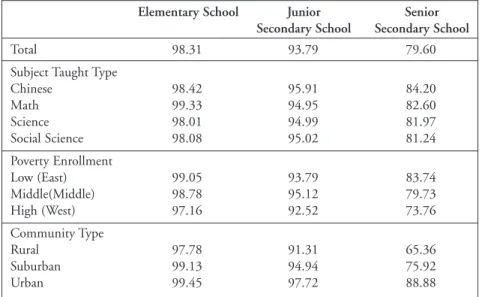
by Educational Level for Teacher Preparation, 2004 ...20 Table 3 Qualified Rate of Record of Formal Schooling of Elementary, Junior Secondary, Senior Secondary Teachers in China by Type of Subject Taught,
Type of School, in percentages, 2004 ...22 Table 4 Percentage of Record of Formal Schooling of ELEMENTARY School Teachers in China, by Type of School , by Type of Subject Taught, 2004...23 Table 5 Percentage of Record of Formal Schooling of JUNIOR Secondary School Teachers in China, by Type of School, by Type of subject Taught, 2004...23 Table 6 Percentage of Record of Formal Schooling
of Senior SECONDARY School Teachers in China, by Type of School, by Type of subject Taught, 2004 ...24 Table 7 Percentage of Different Types of Teachers in
ELEMENTARY Schools in China, by
Type of School, 2004...24 Table 8 Percentage of Different Types of Teachers in
SECONDARY Schools
in China, by Type of School, 2004 ...25 Chapter 3
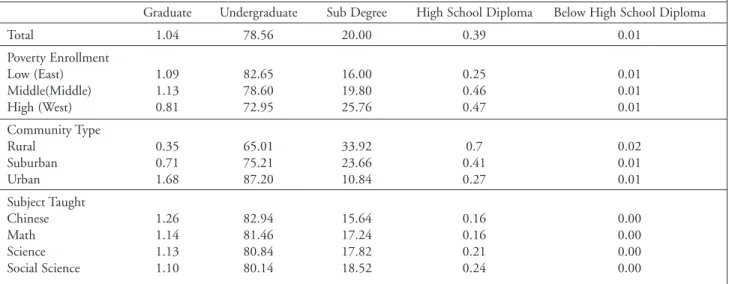
Table 1 Number of Teachers in Hong Kong by Academic Qualifications/Training, 2005 ...34 Table 2 Number of Teachers by Academic and Teacher Training Qualifications, 2005 ...34 Table 3 Distribution of Teachers by Subject Taught by Whether Teaching Out-of-field, 2005 ...36
Chapter 4
Table 1 Types of Teacher’s Certificates in Japan...43 Table 2 Types of Teacher Training Programs in Japan ...44 Table 3 Highest Degrees Held by All Fulltime Teachers at Different Levels of Education in Japan (%), 2004 ...46 Table 4 Percentage of Secondary School Classes
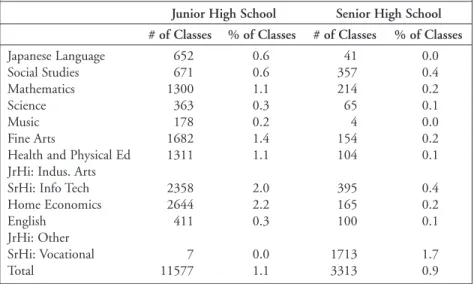
Taught by a teacher without a Certificate in the Field, by subject, 2004 ...47 Table 5 Percentage of Secondary School Teachers
Who Teach Classes Without a Certificate in the Field, by Subject, 2004 ...47 Table 6 Percentage of Retired Teachers in Japan,
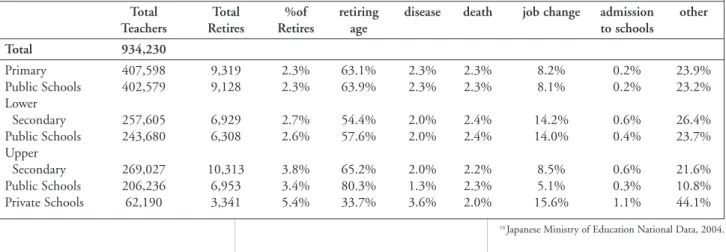
by Reason of Retirement, 2004 ...48 Table 7 Percentage of School Teachers in Japan,
by Monthly Salary (Unit: 10T=100,000), 2004 ...48 Table 8 Teachers’ Perceptions of the Teaching Profession – Percentage of those who answered “accurate” or
“accurate to some degree”. ...49 Table 9 Teachers’ perceptions of their work lives –
percentage of those who answered “Yes” or “Sometimes” ....49 Table 10 Determinants of the feeling of “authority
of teachers is declining” ...51 Table 11 Determinants of the feeling of “happy to have become a teacher” ...51 Table 12 Determinants of the feeling of “want to quit teaching” ...51 Chapter 5
Table 1 Secondary Teacher Training Institutions with Freshmen Quota, 2005 ...57 Table 2 Number of Vacancies and Employment Rate (Elementary), 1999-2005 ...58 Table 3 Ratio Between Preparation and Employment, Secondary School Teacher, 1999-2005. ...59 Table 4 Credit Hours Assigned to Curricular Domains in the Universities of Education ...60 Table 5 Types and Required Credit Hours of Practice Teaching, University of Education...62 Table 6 The Summary of Teacher Certification System...63 Table 7 Teachers’ Academic Qualification, by Location, School Level, and School Type, 2005 ...64 Table 8 Teaching Certificate Holders, 2005 ...65 Table 9 Percentage of Secondary Teachers in Korea
in the Core Academic Fields Without a Teaching Certificate (Major) in the Field by
List of Figures (by chapter)
Table 10 Percentage of Secondary Teachers in Korea in the Core Academic Fields Without a Teaching Certificate (Major or Minor) in the Field by Type of School, 2005...67 Table 11 Percentage of Secondary Teachers in Korea in the Core Academic Fields Without a Teaching Certificate (Major, Minor or Minor Acquired through In-service Training) in the Field by Type of School, 2005...67 Table 12 Percentage of Secondary Teachers in Korea in the Core Academic Fields Without an Undergraduate or Graduate Major in the Field by Type of School, 2005 ...68 Table 13 Percentage of Secondary Teachers in Korea in the Core Academic Fields Without an Undergraduate or Graduate Major or a Minor in the Field by Type of School, 2005 ...69 Chapter 6
Table 1 Summary Statistics of Teachers in Schools, 2006....76 Table 2 Percentage of Teachers in Singapore by
Academic Qualification by Level of Schools, 2006 ...77 Table 3 Percentage of Vice-Principals and Principals in Singapore by Academic Qualification by Level
of Schools, 2006 ...78 Table 4 Matching Teaching Subjects (Fields) with
Subjects (Majors) offered by Universities and
Curriculum Studies Assigned in NIE ...79 Table 5 Summary Statistics on Teaching Subjects
of Secondary School Teachers, 2005 ...80 Chapter 7
Table 1 New Teacher Classification Framework, 2004 ...88 Table 2 Previous Teacher Classification Framework...88
Table 3 Percentage and Number of Elementary and Secondary School Teachers in Thailand by Highest Degree Earned, and Types of School, ( Academic Year) 2004 ...89 Table 4 Percentage of Secondary Grade Level Teachers in Thailand in the Core Academic Fields Without an Undergraduate or Graduate Major or Minor in the
Field, by Types of School, (Academic Year) 2004 ...90 Table 5 Percentage of Secondary Grade Level Teachers in Thailand in the Core Academic Fields Without an Undergraduate or Graduate Major in the Field,
by Types of School, (Academic Year) 2004...90 Chapter 8
Table 1 Percentage of Elementary and Secondary School Teachers in the United States, by Highest Degree Earned, and by Highest Type of Teaching Certification or
License, by Type of School, 2003-2004...101 Table 2 Percentage of Secondary Grade Level Teachers in the United States in the Core Academic Fields Without an Undergraduate or Graduate Major or a Minor in
the Field, by Type of School, 1999-2000 ...102 Table 3 Percentage of Secondary Grade Level Teachers in the United States in the Core Academic Fields Without an Undergraduate or Graduate Major
in the Field, by Type of School, 1999-2000 ...103 Table 4 Percentage of Secondary Grade Level Teachers in the United States in the Core Academic Fields Without a Teaching Certificate or License in the Field, by Type of School, 1999-2000 ...104
Chapter 2
Figure 1 China’s Formal Educational System and Institutions...19 Chapter 5
Figure 1 Elementary Teacher Training Institutions with Freshmen Quota, 2005 ...57 Chapter 6
Figure 1 Structure of Schooling in Singapore by Education Level, Typical Age and Years of Schooling, 2006 ...73 Chapter 7
Figure 1 The Thai Education System, 2006 ...86 Figure 2 Educational Administration and Management Structure, 2006 ...87 Chapter 8
Richard M. Ingersollis a Professor of Education and Sociology at the University of Pennsylvania in the United States. His research is concerned with the management and organization of elementary and secondary schools and the character and problems of the teaching occupation. He has published widely on the problems of teacher shortages and underqualified teachers.
Ding Gangis a Professor and Dean of
School of Education Science, East China Normal University of the Peoples Republic of China. His research is concerned with the culture and social development of education and the change of teacher education and Teacher Professional Development. He has published numerous books and papers in the research areas.
Sun Meiluis a lecturer in the School of
Education Science, East China Normal University of the Peoples Republic of China. Her research is concerned with vocational and adult education and human resources development. She has published numerous papers in the research areas.
Kwok Chan Laiis the Head of
Strategic and Academic Planning at the Hong Kong Institute of Education and responsible for the Institute’s academic planning, strategic planning and academic manpower planning. He had been the Head of Department of Social Studies of the Institute. His research interests include teacher education, teacher demand and supply, teacher professionalisation, environmental education and geographical education.
Hidenori Fujita, Ph.D., Professor,
International Christian University (ICU)
He received his Ph.D. from Stanford University in 1978. Before moving to ICU in 2003, he had taught sociology of education as a professor at the University of Tokyo for 17 years and served as a dean of Graduate School of Education there from 2000 to 2003. He is Professor Emeritus of the
University of Tokyo, member of Science Council of Japan and Chief Researcher of Japan Society for the Promotion of Science. He was the President of Japanese Association of Educational Sociology (2000-03) and served on the National Commission on Education Reform (2000) and Central Council for Education (2005).
Ee-gyeong Kimserves as the Director
of Teacher Policy Research at the Korean Educational Development Institute. She has directed several research projects on teacher issues that have greatly influenced the formulation and implementation of teacher policies of the Republic of Korea. She has written books and articles on
educational decentralization and on the quantity and quality of teachers. Her recent research interests include the evaluation and professional development of teachers and school administrators.
Steven K. S. Tanis associate professor
and associate dean (professional development) of the National Institute of Education, Nanyang Technological University in Singapore. He has been involved in the teaching, development and review of both pre-service and professional development curriculum since 1995. His research interests are in educational reform and initiatives, and the induction and socialization of beginning teachers.
Angela F. L. Wongis an associate
professor with the Learning Sciences and Technologies Academic Group, National Institute of Education (NIE), Nanyang Technological University. She also is the Associate Dean for Practicum and School Matters in the Foundation Programmes Office. She lectures in instructional technology and classroom management modules. Her research interests are in learning environments, instructional technology and
practicum-related issues in teacher education.
S. Gopinathanis Professor of
Education at the National Institute of Education, Nanyang Technological University. His research interests are in teacher and higher education, and in education-society relationships. He is co-editor of the Asia Pacific Journal of Education and a founder member of the Educational Research Association of Singapore.
About the Authors
Kim Chuan Gohis associate dean and has been involved in teacher education curriculum review and management, and student development and liaison since 2000. He has written on teacher and teacher education issues. Currently he is leading a team to conduct "a longitudinal study of teacher preparation and professional
development in Singapore", funded by the Ministry of Education.
Isabella Y. F. Wongis an Assistant
Professor at the National Institute of Education, Nanyang Technological University. Her research interests are in teacher professional development and she has a long-standing interest in the preparation and induction of new teachers.
Kong Hong Ongis a Vice Principal in
a secondary school in Singapore. His prior experience includes research and corporate planning at the Ministry of Information, Communication and the Arts, as well as education policy and human resource development at the Ministry of Education. During his stint in Personnel Division in the Ministry of Education, he worked closely with the National Institute of Education to look at the recruitment and training of teachers to meet the needs of Singapore schools.
Pruet Siribanpitakis an Associate
Professor and Dean of the Faculty of Education at Chulalongkorn University in Thailand. He is also served as the President of the Thailand Education Deans Council. His research is concerned with the policy and development strategy of teacher education. He has published widely on the development strategy of teacher education and education for sustainable development.
Siriporn Boonyanantais the Deputy
Secretary-General of the Education Council, Ministry of Education and Honorary Advisor to the National Parliament’s Committee on Youths, the Disadvantaged, and Women’s Affairs. Her vast experience comprises 20 years as curriculum development specialist at the Ministry of Education and part-time lecturer in graduate schools of many leading universities in Thailand.
This report is based on research by the authors with the support of the Consortium for Policy Research in Education (CPRE) and funded by the Institute of Education Sciences, U.S. Department of Education, under Grant No. R308A960003. Opinions expressed in this publication are those of the authors and do not necessarily reflect the views of the Institute of Education Sciences, the U.S. Department of Education, CPRE, or its institutional partners.
Acknowledgements
Introduction
Across the educational systems of the world, few issues have received more attention in recent years than the problem of ensuring that elementary-and secondary-school classrooms are all staffed with adequately qualified teachers (Mullis, et al., 2000; OECD, 1994, 2005; Wang, et al., 2003). Even in nations where students routinely score high on international exams, the issue of teacher quality is the subject of much concern. This is not surprising. Elementary and secondary schooling is mandatory in almost all nations and children are legally placed in the care of teachers for a significant portion of their lives. It is widely believed that the quality of teachers and teaching are among the most important factors shaping the learning and growth of students. Moreover, this impact goes beyond student academic achievement. Across the world, observers routinely tie the performance of teachers to numerous, larger societal goals and problems—economic
competitiveness and productivity, juvenile delinquency, moral and civic culture, and so on. In addition, the largest single component of the cost of education in any country typically is teacher compensation. Along with
a general consensus among many nations that the quality of teachers and teaching is a vital resource, there is accordingly much concern surrounding how equitably this resource is distributed within educational systems. Indeed, some nations suffer from an apparent paradox—that despite an overall overproduction and oversupply of new teachers, there nevertheless appear to be substantial numbers of students without access to qualified teachers.
Such concern has resulted in a steady stream of commissions, reports, and studies all targeting teacher quality as one of the central problems facing school systems. In many nations this concern has resulted in new legislation and policy. Foremost among these have been widespread efforts to increase the entry standards and preparation requirements for teachers. Hong Kong, for instance, initiated in 1997 an “all graduate, all trained” policy requiring new primary- and secondary-school teachers to have bachelor’s degrees and to be
professionally trained. In Japan there has been an active reform movement to increase teacher preparation requirements and increase evaluation and accountability of teachers. In the United States this concern surfaced
within a massive new piece of legislation in 2002, the federal law known as the No Child Left Behind Act, which in addition to new standards for student achievement, set a new and unprecedented goal— to ensure that elementary and secondary students in the United States are all taught by highly qualified teachers. In addition to, or perhaps because of, recognition of its importance, the issue of teacher quality also is a source of debate and disagreement in many nations.
Perhaps nowhere is this debate more pronounced and more divisive than in the United States. In recent years, the quality of elementary and secondary teachers and teaching has been widely criticized in the United States, both by those inside and outside the educational sector (e.g., Levine, 2006). However, while there is widespread agreement that teacher quality is a problem in the United States, there is little consensus and much disagreement, often
acrimonious, in regard to the sources and reasons behind the purportedly low quality of teaching in American schools and, hence, the best strategies to improve teacher quality.
One of the most prominent viewpoints in this debate holds that the problem of low-quality teaching can be traced to inadequate and
C
HAPTER
1
A Comparative Study of Teacher
Preparation and Qualifications
in Six Nations
Richard M. Ingersoll
University of Pennsylvania
insufficient pre-employment training and licensing or certification of prospective teachers. In this view, the preparation of teachers in college or university teacher education programs, and government certification standards, all too often lack adequate rigor, breadth and depth, resulting in high levels of underqualified teachers and low student performance. Accordingly, the solution, from this viewpoint, lies in making the entry and training requirements for teaching more restrictive, deeper and more rigorous. The examples this view looks to emulate are the traditional higher prestige professions, such as medicine, academia and law. To this group, the surest way to upgrade the quality of teaching is to upgrade the qualifications standards required of new teachers (see, e.g., National Commission on Teaching and America’s Future 1996, 1997). Low-level standards and requirements for entry into teaching have long been considered a factor maintaining teaching as a low-status occupation and having a low level of
professionalization.
On the other side of this debate are those who argue for deregulating entry into teaching. This viewpoint also holds that the quality of teacher education and certification is poor. But, rather than increasing requirements, this opposing view holds that entry into the teaching occupation already is plagued by unusually restrictive and
unnecessarily rigid bureaucratic entry barriers (e.g., Finn, et al., 1999; Hanushek & Rivkin, 2004; Ballou, 1996). From this viewpoint, traditional teacher preparation and state certification requirements, in particular, are akin to monopolistic practices. These critics argue that there is no solid empirical research documenting the value of such entry
requirements. These regulations, they charge, are motivated less by an interest in protecting the public and more by a desire to protect the interests of those in the occupation. As a result, this view holds, large numbers of high-quality candidates are discouraged from getting into the occupation. By doing away with these regulatory impediments, this argument concludes, schools could finally recruit the kinds and numbers of candidates they deem best and this would solve the quality problems that plague teaching.
There are different variants of this deregulation perspective. One of the more popular variants favors a training model analogous to that utilized for entrance to
post-secondary academic careers. The pre-employment preparation of
professors in the United States usually includes little formal training in pedagogical and instructional methods. Similarly, from this viewpoint, having an academic or subject-matter degree in a subject is sufficient to be a qualified school teacher in that subject. Content or subject knowledge—knowing what to teach—is considered of primary importance for a qualified teacher. Formal professional training in pedagogical and methodological knowledge and skills—knowing how to teach—is considered less necessary or even irrelevant (e.g., Finn, et al., 1999).
Another variant of the
deregulation perspective is motivated by concern for the demographic diversity of the elementary and secondary teaching force. From this viewpoint, teaching’s entry
requirements have resulted in reduced numbers of candidates from minority racial or ethnic groups entering the occupation, either because the requirements are themselves racially or ethnically
biased, or because they screen out otherwise worthwhile candidates who are unable to pass over particular hurdles because of an underprivileged background (e.g., Villegas & Lucas, 2004).
Proponents of variants of the de-regulation perspective have pushed a range of initiatives, most of which involve a loosening of the traditional occupational entry gates. Among the most widespread of these reforms are alternative certification programs, whereby college graduates can postpone formal education training, obtain an emergency teaching certificate, and begin teaching immediately. It is important to note that proponents of these deregulation reforms claim the same rationale as proponents of upgrading existing entry standards and programs—the enhanced recruitment of high-quality candidates into teaching.
Because this debate is highly politicized and often acrimonious in the United States, advocates of one side or another are prone to exaggerated claims and counter-claims–making it difficult for neutral observers and policymakers to separate rhetoric from reality. One way to shed light is to place such debates and claims in context, and one useful context is
cross-occupational. How does teaching, its entry requirements, and their value compare to those in other lines of work?
In the United States, teaching as an occupation has an unusually ambivalent character. Compared with other occupations and professions, teaching is relatively complex work, with relatively low pre-employment entry requirements, but nevertheless with relatively high scrutiny and skepticism of the requirements that do exist.
Among those who study work, organizations and occupations in
general, teaching has traditionally been classified as a relatively complex form of work, characterized by uncertainty, intangibility and ambiguity and requiring a high a degree of initiative, thought, judgment and skill to do well (e.g., Bidwell, 1965; Lortie, 1975; Cohen, Raudenbush, & Ball 2003). For example, in a classic comparative study of a number of occupations, Kohn and Schooler (p. 68, 1983) concluded that secondary teaching involved greater substantive complexity than the work of
accountants, salespersons, machinists, managers and officials in service industries and in the retail trade.
Despite its complexity, from a cross-occupational perspective, teaching has long been characterized as an easy-entry occupation. Compared with other occupations and with the traditional professions in particular, teaching has a relatively low entry bar, and a relatively wide entry gate (Etzioni, 1969; Lortie, 1975; Ingersoll, 2001). Indeed, teaching is unusual in the United States in that most of those who desire to enter the occupation are free to do so–individuals choose the occupation, not vice versa. In contrast, the opposite prevails in many occupations and most traditional professions, such as law, medicine, engineering, architecture, dentistry, and academia. Especially in the latter career fields, entry is highly selective, occupational gatekeepers have a large say in choosing new members and not all who desire to enter succeed in doing so. Hence, placed in this context, entry to teaching does not appear especially restrictive or burdensome.
Finally, although teaching’s entry training and licensing requirements are lower than those for many other lines of work in the United States, they are subject to far more
skepticism and evaluation than for other lines of work. For most occupations and professions there has been little, if any, empirical research done assessing the value-added of practitioners having a particular credential, license or certification (Kane, 1994; American Educational Research Association/American Psychological Association/National Council on Measurement in Education, 1999). Such research can be difficult to undertake; if licensure is mandatory in an occupation, it is impossible to compare the
performance of those licensed with those who are unlicensed.
Nevertheless, occupational entry requirements, whether enforced by precedent or by law, are common. Indeed, it is illegal to do many lines of work, from plumbing and hairstyling to law and medicine, without a license. For example, almost all universities and colleges in the United States require a doctorate degree for full-time professorial positions. There is, of course, a growing secondary labor market in academia in which those without doctoral degrees are hired for various instructional or research positions, usually as nonpermanent
employment. However, there are very few examples of a “professor effects” literature examining whether professors’ qualifications have a positive effect on outcomes, such as student achievement, or on research quality (e.g., Pascarella & Terenzini, 1991). In other words, in most occupations and professions in the United States, it typically is taken as a given that particular credentials are necessary to practice particular kinds of work.
In contrast, there is an extensive body of empirical research, going back decades, devoted to evaluating the effects of elementary and secondary teacher qualifications on
teacher performance. Typically such studies try to assess the relationship between various measures of teacher preparation and various measures of student performance (for an earlier review see, e.g., Murnane & Raizen, 1988). And, contrary to the skeptics, a number of studies have indeed found teacher education and preparation, of one sort or another, to be significantly related to increases in student achievement. This is a telling finding given the widespread criticism from both insiders and outsiders that teacher education is of low quality in the United States. For example, in a review of 60 empirical studies on the effects of teacher education, Greenwald, Hedges, and Laine (1996) concluded that teachers’ degree levels consistently showed “very strong relations with student achievement ...” in “a wide variety of studies over a three decade period” (pp. 284-285). Some studies have looked closely at the amount and effects of subject-specific teacher education. For example, in a multilevel analysis of data from the 1992 National Assessment of Educational Performance (NAEP), Raudenbush, Fotiu, and Cheong (1999) found teacher education in mathematics (as measured by a major in math or in math education) to be “consistently positively and highly significantly related to math
proficiency” in eighth-grade students. Similarly, a recent analysis of 2000 NAEP data found that eighth-grade students whose math teachers had a regular teaching certificate in math, or had a major or minor in math or math education scored significantly higher on the eighth-grade math test (Greenberg, Rhodes, Ye, &
Stancavage, 2004). Accurately isolating and capturing the effects of teacher’s qualifications on their students’ achievement is difficult, however, and
not surprisingly, the results of such research are, at times, mixed and contradictory. Moreover, there also are large gaps in this research (for a recent review, see Allen, 2003), further fueling the ongoing debate and fostering a large interest in further pursuit of this line of research. But, placed in a cross-occupational context, the mixed and limited quality of research
documenting the value of entry requirements for teaching is not unusual; what is unusual is the existence of any such empirical research at all.
While perhaps more extreme and visible in the United States than other nations, similar concerns and debates have been occurring across the world. Hence, besides adopting a cross-occupational perspective, another way to shed light and place such debates and issues in context is through cross-national comparisons. Policy research can provide a useful function by comparing teaching’s entry and training requirements among different countries. How do the qualifications of teachers differ between nations? This is the subject of this study.
The Research Project
The objective of this report is to present the results from a
collaborative, comparative study that sought to address some of the above issues by examining the preparation and qualifications of elementary and secondary teachers in six nations and one autonomous region: China, Hong Kong , Japan, South Korea, Singapore, Thailand, and the United States. This project was begun in 2003 under the auspices of the larger Eight Nations Educational Research Program, a consortium devoted to comparative education research based
at the University of Pennsylvania since 1993 and directed by Susan Fuhrman.
The selection of the seven systems in this study was not a result of any particular analytic strategy; their participation was simply a function of their membership in the existing Eight Nations consortium. However, the seven educational systems in our study do represent a
wide range, providing useful contrasts. On one end of the range lies Singapore, a small city-state with about 500,000 students enrolled in 360 elementary and secondary schools. On the other end lies China, with over 212 million students enrolled in 485,000 elementary and secondary schools. Our seven systems also represent a wide range in terms of international student performance
Table 1
Average Mathematics and Science Achievement of Eighth-Grade Students for Nations Participating in the Third International Math and Science Study, 19991
Mathematics Science
Nation Score Nation Score
Singapore 604 Chinese Taipei 569
Korea, Republic of 587 Singapore 568
Chinese Taipei 585 Hungary 552
Hong Kong SAR 582 Japan 550
Japan 579 Korea, Republic of 549
Belgium-Flemish 558 Netherlands 545
Netherlands 540 Australia 540 Slovak Republic 534 Czech Republic 539
Hungary 532 England 538 Canada 531 Finland 535
Slovenia 530 Slovak Republic 535 Russian Federation 526 Belgium-Flemish 535
Australia 525 Slovenia 533 Finland 520 Canada 533
Czech Republic 520 Hong Kong SAR 530
Malaysia 519 Russian Federation 529
Bulgaria 511 Bulgaria 518 Latvia 505 United States 515
United States 502 New Zealand 510
England 496 Latvia 503 New Zealand 491 Italy 493 Lithuania 482 Malaysia 492 Italy 479 Lithuania 488 Cyprus 476 Thailand 482 Romania .472 Romania 472 Thailand 467 Israel 468 Israel 466 Cyprus 460 Tunisia 448 Jordan 450 Turkey 429 Iran, Islamic Republic of 448
Jordan 428 Indonesia 435 Iran, Islamic Republic of 422 Turkey 433
Indonesia 403 Tunisia 430 Chile 392 Chile 420 Philippines 345 Philippines 3.45
Morocco 337 Morocco 323 South Africa 275 South Africa 243
Average of 38 nations 487 Average of 38 nations 488
assessments. Students from a number of the Asian systems in our study, such as Singapore, Japan, Korea, and Hong Kong, typically perform well above average on most international assessments in math, science and reading literacy. In contrast, students from Thailand often perform below average on international assessments in math and science. For instance, as shown in Table 1, data from the Third International Math Science Study (TIMSS) on eighth-grade science and math student performance indicate four of our systems (Japan, Singapore, Hong Kong, and Korea) are well above average, while Thailand is below average. U.S. students typically perform slightly above average. But, there are exceptions to the latter. For instance, in the Progress in
International Reading Literacy Study, fourth-grade American students perform better than students in almost all of the other 34 nations tested, including Hong Kong and Singapore (Mullis, et al., 2003).
Our study was undertaken by a team of scholars and senior education officials. Members of the project team were Richard Ingersoll and Rebecca Maynard of the University of Pennsylvania in the United States; Ding Gang of East China Normal University in Shanghai, China; Kwok Chan Lai of the Hong Kong Institute of Education; Hidenori Fujita of the International Christian University in Tokyo, Japan; Ee-gyeong Kim of the Korean Educational Development Institute, Seoul, Korea; Steven Tan and Angela F. L. Wong of the National Institute of Education, Nanyang Technological University, Singapore, Ong Kong Hong, of the Ministry of Education in Singapore; Pruet Siribanpitak of Chulalongkorn University in Bangkok, Thailand and Siriporn Boonyananta of the Office of The Education Council in
Thailand.
Team members met four times in the course of this project. A first meeting was held in Philadelphia, sponsored by the University of Pennsylvania, in November, 2003. A second meeting was held in
Shanghai, sponsored by the East China Normal University, in June, 2004. A third meeting was held in Tokyo, sponsored by the
International Christian University, in March, 2005. A fourth meeting was held in Bangkok, sponsored by the Thai Ministry of Education, in November, 2005. Meetings focused on determining the project
objectives, defining common measures and methods, and working out the all important issues of data and indicator comparability. Data collection, analysis and writing for each system proceeded throughout the entire project.
Unlike other recent cross-national teacher studies, this project adopted a relatively specific focus on one key issue linked to the performance and quality of teachers—the
qualifications and preparation of teachers. Our objective was not to assess or to evaluate the links between teacher qualifications, teaching quality, and student achievement. We did not seek to prove that the qualifications required of teachers in any system are, or are not, beneficial or do, or do not, add value. Our study began with the premise, widely shared among the nations involved, that teacher qualifications are important. But, we did not presume a particular definition of a qualified teacher. Our objective was to compare how each system itself defines teacher
qualifications and standards and then to address the question: how well are the different educational systems succeeding in ensuring all students are taught by qualified teachers? The
study addressed this overarching issue by examining comparative data from each of the seven educational systems on three specific sets of research questions:
1.) What are the Preparation Requirements and Standards to Become a Teacher?
In each system, what are the requirements to become a teacher and do they differ according to grade level? Do candidates need to
complete both educational and professional preparation
requirements? The former refers to the general level of post-secondary education—the courses and degrees—required of teaching candidates. The latter refers to occupation-specific or professional preparation and training
requirements–the subject
coursework, pedagogical coursework, practice teaching, and tests–for those entering teaching. Are teachers normally required to have completed a baccalaureate degree? Are teachers normally required to obtain some kind of government-issued teaching certificate or license? What are the criteria and requirements to obtain a certificate or license? Is some kind of testing of prospective teachers involved? What level of government decides on the pre-employment education and training requirements for elementary-level and secondary-level teachers? Is decision-making for each educational system, in general, and for teacher policy, in particular, centralized or decentralized? How many teacher preparation institutions are there in each system?
Regardless of such formal requirements, how selective and competitive is entry into the teaching occupation in each system? How does the caliber and ability of those entering teaching compare to those preparing for, or entering, other
fields? How attractive is the job and career of teaching compared to other careers in each nation?
2.) What are the Levels of Qualifications of the Current Teaching Force?
What proportion of the existing teaching force is qualified, that is, what portion meets the above described requirements and
standards? Is there a gap between the rule and the reality? What proportion of the teaching force holds a
baccalaureate degree? What proportion holds a graduate-level degree, such as a master’s degree or higher? What proportion holds a teaching certificate or license or the equivalent?
In addition, we were interested in understanding differences, inequities and gaps in teacher qualifications within and across the educational systems. Specifically, we sought to answer these questions: Are there differences in the proportions of teachers holding the above
qualifications across different kinds of schools in each system? Is there a maldistribution of qualified teachers? Do teachers in schools serving higher-poverty or low income communities have fewer
qualifications than teachers in schools in lower-poverty or higher-income areas? Do teachers in elementary schools have fewer qualifications than teachers in secondary schools? Do teachers in urban or rural schools have fewer qualifications than teachers in suburban schools?
3.) What Proportions of Teachers are Not Qualified in the Subjects They Teach?
Do schools in each system have difficulties ensuring that all classrooms are staffed with teachers qualified in the actual subject taught? Along with inadequate preparation,
one possible source of underqualified teachers is the practice of out-of-field teaching or misassignment—teachers assigned to teach subjects that do not match their fields of preparation (Ingersoll, 1999). This is a crucial factor because highly qualified teachers may actually become highly unqualified if, once on the job, they are assigned to teach subjects for which they have little background. Teachers prepared, for example, in social studies may be unlikely to have a solid understanding of math or how to teach it.
Our study tried to obtain data on levels of out-of-field teaching in each system and the extent to which these levels vary among different kinds of schools. In which educational systems does this problem exist? Are there differences, inequities and gaps in out-of-field teaching within and across the educational systems? Are there cross-school differences in the proportions of classes taught by teachers not holding qualifications in the field taught? Are classes in higher-poverty schools more likely to be taught by underqualified teachers than classes in lower-poverty schools? Are there differences according to whether the school is urban, rural or suburban? Finally, what are the reasons for out-of-field teaching in these systems? Why do some teachers end up teaching subjects for which they have little background preparation?
Our objective was to compare each educational system using these three sets of data indicators to understand each system’s standards for teacher preparation and how well each system is succeeding in
achieving a qualified teaching force and in ensuring all students are taught by qualified teachers.
Data and Methods
Our study addressed the above sets of research questions by collecting comparative data from each of the seven educational systems. We focused on elementary and secondary level teachers from both public and private schools. Briefly, the data sources for each system were:
China:China Education Yearbook
2005and Educational Statistics
Yearbook of China 2004.
The former is annually edited and issued by the Ministry of Education, and the latter is issued by the Department of Development and Planning of the Ministry of
Education. The data on teachers’ qualifications were drawn from school administrative records of all teachers in the nation.
Hong Kong:Statistics on Primary
and Secondary School Teachers,
2004/05published by the Education
and Manpower Bureau of Hong Kong. Teacher statistics are collected yearly by the government through a Web-based e-services system through schools to all 50,000 primary and secondary teachers.
Japan:The data on teachers’
qualifications were drawn from school administrative records compiled in 2004 by the Ministry of Education. The data on out-of-field teaching are drawn from the administrative records compiled for Nigata Prefecture by its Board of Education. (Japan has 47 prefectures, which are the equivalent of states.)
Korea:The data on teachers’
qualifications were drawn from the
2005 Annual Report on Educational
Statistics. This annual compilation of
school administrative records is issued by the Korean Educational Development Institute and based on data collected by the Ministry of Education and Human Resources Development. The data on
field teaching were obtained by a 2005 survey questionnaire sent to a nationally representative stratified sample of 2,000 secondary school teachers. The response rate was 71.2%.
Singapore:Data on teachers are
derived from the Education Statistics
Digest 2006. These data are compiled
by the Management Information and Research Branch, Planning Division, Ministry of Education and published in July each year. The data on teachers’ qualifications were drawn from school administrative records.
Thailand:The data on teachers’
qualifications were drawn from school administrative records compiled by the Office of Basic Education Commission of the Ministry of Education in academic year 2004. The data on out-of-field teaching were from a 2004 survey of officials in the 175 local education service agencies in Thailand conducted by the Office of the Education Council of the Ministry of Education. The latter data for public schools were collected from 64% of the local service agencies; the data for private schools were collected from 37% of the local service agencies.
United States: The data come
from the nationally representative Schools and Staffing Survey (SASS) conducted by the National Center for Education Statistics, the statistical arm of the U.S. Department of Education. This is the largest and most comprehensive source of information and data on teachers in the United States. The SASS data are collected from random samples stratified by state, sector, and school level. SASS is a large survey; in each cycle the sample sizes are about 5,000 school districts, 11,000 schools and 52,000 teachers. Data on teachers’ qualifications were collected in 2003-04; data on out-of-field teaching were collected in 1999-2000.
For our set of questions on out-of-field teaching, our project team encountered serious difficulties in obtaining measures that were defined in a sufficiently similar manner to make reasonable comparisons across systems. Hence, the data presented here on out-of-field teaching must be interpreted with caution. Previous studies have used a number of different measures of out-of-field teaching, representing a range of definitions and standards (Ingersoll, 1999). Some measures focus on whether teachers have a teaching certificate in the fields they teach; others focus on whether teachers have an undergraduate or graduate degree. Measures of out-of-field teaching also vary according to whether they choose to focus on the numbers of teachers out of field or the numbers of students exposed, according to which fields and subjects are examined, how those fields are defined and also according to which grade levels are investigated.
Our measures focus on teachers at the secondary level (grades 7-12 grades) who were departmentalized, that is, they teach the same subjects to different classes of students, rather than multiple subjects to the same students throughout the day. Moreover, we focus only on those teaching the four core academic subjects—first language, mathematics, science, and social studies/social science.
We used two measures:
• Percentage of secondary-level (grades 7-12) teachers in four core fields without an undergraduate or graduate major in the field. • Percentage of secondary-level
(grades 7-12) teachers in four core fields without a full teaching certificate or license in the field.
Below, this chapter summarizes the results from the study as a whole. Following this overview chapter, there are separate chapters for each of the seven educational systems. The latter chapters provide more detailed presentations on teacher preparation and qualifications in each system and more detailed information on the data sources and methods.
Teacher Preparation
Requirements and Standards
Governance
In our study we found that decision-making and governance for our educational systems, in general, and for teacher policy, in particular, are highly centralized. In all but one of the seven systems in this study, the central or national government sets, oversees and implements
qualifications and preparation standards for the teaching occupation (also see OECD, 1995, 1998).
The exception to this
centralization of teacher policy and governance is the United States, though there has been a steady increase of federal involvement in education over the past half century. This culminated in the 2002 No Child Left Behind Act–the largest and most comprehensive federal educational reform effort to
date.This trend toward centralization and consistency clashes with a historic tradition of decentralization and local control of education and as a result, the education system in the United States is in a state of flux. Nevertheless, and despite these changes, the U.S. educational system remains in many ways relatively decentralized compared with other nations. It is, for example, the responsibility of each of the 50 individual states to regulate entry
into the teaching occupation in their respective state school systems, and the states have retained wide latitude in how they interpret and implement the teacher quality regulations of the central government. As a result, the scope and content of the
requirements to become a teacher vary widely among the states.
Like the United States, most of the Asian nations have three or four tiers of educational governance— national, regional, local and school levels—but in those countries, unlike the United States, the national government dominates teacher-policy decision-making. As a result, the scope and content of official governmental requirements to becoming a teacher are highly consistent across regions and localities within each system. At one end lies Singapore with a central Ministry of Education that sets all
teacher policy and has one teacher training institution that produces virtually all of Singapore’s teachers. Although vastly larger, China also has a highly centralized system that dominates teacher-policy decision-making across the nation, with the exception of Hong Kong. As noted above, Hong Kong is considered a special semi-autonomous region in China and has its own internally centralized educational system.
The number of teacher-training schools, colleges or institutions in each system is telling: Singapore has one; Hong Kong has four; Thailand has 56, Korea has 381, China has 618, Japan has 850. The United States stands out with the highest— 1,206—almost double that of China, despite having about one quarter the students.
Education Requirements
All of the educational systems, regardless of their degree of centralization, require prospective teachers to complete both educational and professional preparation requirements.
On the issue of education requirements, a four-year bachelor’s or undergraduate degree is typically the standard for all of the systems. But, the different systems vary both within and across as to the level and years of education required, as shown in the column in Table 2 on minimal years of post-secondary education. In Hong Kong, teachers can gain entry with the equivalent of a two-year sub- or associate degree. In two systems–China and Singapore—the education required of elementary teachers is lower than that for secondary teachers–although in both
Table 2
Teacher Preparation Requirements and Standards, by System.*
Educational Qualifications Professional Qualifications
High Associate or Bachelor’s Minimum Subject-Area Certification Test Training School Sub-Degree Degree Years Post- and and/or or Exam During
Diploma Secondary Pedagogy License or After
Education Degree China Elementary X 0 X X X Both L. Secondary X 2 X X X Both U. Secondary X 4 X X X Both Hong Kong Elementary X 2-4 X Both Secondary X 2-3 X Both Japan Elementary X 4 X X X* Both Secondary X 4 X X X* Both Korea Elementary X 4 X X X* During Secondary X 4 X X X* Both Singapore Elementary X 2 X X Both Secondary X 4+1 X X Both Thailand Elementary X 4+1, 5 X X X* Both Secondary X 4+1, 5 X X X* Both United States Elementary X 4 X X X Both Secondary X 4 X X X Both
* Test or exam not required for license, but upon employment
of these systems there is movement to bring elementary teachers up to par with secondary teachers. For instance, in China a high school diploma is the minimum level necessary to enter elementary teaching, while upper secondary teachers must have a four-year college degree. In Singapore an elementary-level teacher can gain entry with the equivalent of a two-year sub- or associate degree, while at the secondary-level, Singapore requires teachers to complete a five-year program that includes a bachelor’s degree plus a year of further coursework. In contrast, the other systems have similar degree standards for elementary and secondary. For instance, a five-year program is the standard in Thailand for both elementary and secondary teachers. In the United States, teachers at both levels are required to hold a
bachelor’s degree.
Professional Training
Requirements
Beyond basic levels of education required, all of the systems have professional, or occupation-specific, requirements to enter teaching. Each educational system has different variations in the sequencing and organization of its professional preparation. One variation merges professional preparation and licensing within a bachelor degree program; hence, educational and professional preparation are completed
concurrently. Another variation separates the two; the degree is completed first, with the professional preparation and certification
subsequent. In the United States, the latter is referred to as a “fifth-year program”—a post-baccalaureate one-year teacher-preparation program leading to a teaching certificate. But
only two systems—the United States and Hong Kong—have what is referred to as alternative certification routes into teaching, where
candidates are not required to have completed professional preparation prior to employment, and where, for instance, the uncertified can begin teaching before or during their preparation and training.
All of the systems, with the exception of Hong Kong, require candidates to obtain a government-issued certificate or license signifying that a candidate has completed required professional preparation and training. Interestingly, in all systems the professional preparation requirements include both subject-matter and pedagogical
preparation—expertise in both the “what” and the “how” of teaching— is required. In all of the systems, professional preparation includes a period in the field of supervised practice or student teaching prior to employment. As a result, in none of these systems do the rules stipulate that those with only a subject-matter degree (e.g., a degree in mathematics) are qualified to teach. Also, all of the systems with the exception of Hong Kong and Singapore require some kind of exam or test for prospective teachers. In some systems, these tests are administered as part of a teacher-preparation program; in others, they are administered by the school upon employment.
Again, because of its unusually decentralized character, there is some cross-state variation in these patterns in the United States. The No Child Left Behind Act requires that all teachers be “highly qualified.” The latter is defined as someone who has a bachelor’s degree, who holds a regular or full state-approved teaching certificate or license and who is competent in each of the academic subjects they teach. But,
the 50 individual states have leeway in the means by which teachers can establish “competency” in a subject. For example, some states require tests of prospective teachers while others do not, and the contents of tests vary, as do the minimum scores necessary to pass. Moreover, the federal requirements do not apply to teachers employed in private schools and some states themselves do not require teachers in the private sector to hold a state license or certificate. However, as will be shown later in the chapter on the United States, the majority of teachers in private schools do in fact hold a regular teaching certificate. This is an instance, as in Hong Kong, where the reality exceeds the rule; that is, the level of preparation of the teaching force is above the official minimum required (more on this point in a later section).
Selectivity of Programs,
Caliber of Candidates and
Attractiveness of Careers
Listing the educational and professional requirements to become a teacher does not tell us a great deal of the rigor of these requirements, nor of the quality of these qualifications. Hence, our team examined data, where available, on the selectivity and competitiveness of entry, on the relative caliber and ability of those who enter teaching, and on the attractiveness, status and prestige accorded to teaching compared to other occupations. In some cases our data sources were not highly comparable in the measures and metrics used and, hence, our conclusions are limited. But in general we found that the different educational systems varied
dramatically in these areas. In the United States the
requirements to become an
elementary or secondary-level teacher have never been considered especially rigorous, and teaching has long been characterized as a relatively non-competitive, easy-in occupation. Compared with other occupations in the United States and, in particular with high-status professions, teaching has a relatively low entry “bar” and a relatively wide entry “gate” (Lortie, 1975). As measured by college-entrance examination scores, those entering teaching in the United States tend to be in the average to low range compared with other college graduates (Henke, Chen, & Geis, 2000). To facilitate entry, the states early in the last century created large numbers of low-cost, dispersed, and nonrigorous teacher-training institutions and colleges. Ease of access remains the case; as the data reported earlier show, the United States has far more teacher training institutions than any of the other nations in this study.
Moreover, compared with the more prestigious traditional professions, teaching has been considered a less attractive and less desirable line of work. This has been especially true for males; the majority of teachers are female. Historically female-dominated occupations have tended to have less prestige, lower pay and less authority (Hodson & Sullivan, 1995). Teachers rank in the middle range in surveys of
occupational prestige, well below traditional higher-status
professionals, such as physicians, scientists, engineers, architects, dentists and attorneys, and well above blue collar occupations such as, police, barbers, bakers, plumbers and carpenters. There also is a striking status hierarchy within the realm of teaching itself, broadly defined. At the low end are pre-school and kindergarten teachers,
then elementary teachers, followed by secondary-level teachers, and finally far above are those who teach in post-secondary institutions – professors (Ingersoll, 2001).
Many Asian nations have a tradition of respect for teachers. However, like the United States many Asian systems have a status hierarchy within teaching, with elementary teachers at the low end, followed by secondary-level teachers, and professors at the high end. In Singapore, teacher-education students are among the top third in the nation academically. Relatively high salaries, comprehensive training, and full pay while undergoing training all make teaching an attractive career option in Singapore. In Hong Kong, teaching is ranked relatively high in occupational stature by senior-secondary school
students—above accountants, engineers, scientists, doctors and artists (Lai, et al., 2005). However, the quality of new entrants to teaching has been a matter of concern in the Hong Kong. The occupation does not attract
candidates with the highest academic achievement; the examination grades of new students admitted to teacher education programs in the
comprehensive universities generally are lower than those admitted to other disciplines (University of Hong Kong, 2007).
In China, teachers also rank relatively high in surveys of occupational prestige—above, for example, fashion designers, corporate managers and mid-level military officers (Li, et al., 2004). However, because teachers’ salaries are low in China relative to other occupations, and especially low in rural areas, the occupation is not as attractive as some others. In Thailand, teaching is not considered to be an especially
attractive occupation. Although there have been efforts to upgrade teacher salaries, they have been low when compared with professions—about 25% of physicians’ and engineers’ salaries. It is common in Thailand for teachers to work extra part-time jobs, resulting in inadequate attention to their teaching. As a result, among many of those enrolled in teacher education institutions in Thailand, teaching is a second career choice. In Korea, teaching is a relatively sought-after occupation because of its job security and its high social status standing. Relatively competitive individuals aspire to enter teaching and the rate of teacher turnover is very low because most teachers remain in teaching until the point of retirement. In Japan, teaching is an attractive option to college students, is relatively well paid, enjoys respect, job autonomy, and a collaborative community with colleagues that affords chances to grow and develop as educators. Not surprisingly, turnover and quit rates have traditionally been low.
But in Japan and Korea as in the United States, teachers have come under increasing criticism in recent years (Fujita, 2000a; Ingersoll, 2003). A recent study of teachers’
comparative status in Japan, China and the United Kingdom revealed that an overwhelming majority of teachers perceived their authority to be in decline. Moreover, less than half of teachers in Japan reported they enjoyed “high social status.” This was far higher than in the United Kingdom where only 17% reported this, but far lower than China, where fully 70% of teachers reported high social status (Fujita, 2006).
The Qualifications of the
Teaching Force
Interestingly, the actual levels of education and professional training of the teaching force in each system are not necessarily predicted by official standards. (see Table 3) In a number of systems, such as China, the official rules exceed the reality. Sometimes, this results because veteran teachers who were qualified at the time they first entered the classroom, do not meet newly upgraded standards.
On the other hand, in Hong Kong, reality exceeds the rule. While Hong Kong does not require entrants to hold a four-year baccalaureate degree, nevertheless most employed teachers do so. Sixty-six percent of elementary and 90% of secondary teachers hold a bachelor’s degree or
higher. Moreover, in Hong Kong the majority of teachers hold a teaching certificate, even though this is not required by law. There appear to be at least two incentives behind these high levels–credential-based salary incentives for teachers, and societal expectations and pressures on school administrators to hire university graduates, even if they cost more.
In the United States, reality exceeds the rule in some cases. Moreover, in other cases, it exceeds the rhetoric. As mentioned earlier, the majority of teachers in private schools hold a teaching certificate, even though one is not necessarily required. Moreover, over nine in 10 public school teachers hold a teaching certificate, even though the conventional wisdom, trumpeted by the media and school reformers, is that there are significant numbers of
uncertified teachers, especially in schools serving low-income, high-poverty communities.
For most of the seven systems, there is an elementary-secondary gap in teachers’ qualifications, parallel to the elementary-secondary gap in standards, as discussed in the previous section. Elementary teachers often are less likely to hold a
baccalaureate degree or a master’s degree than are secondary teachers. In contrast, at the secondary level in most of the systems, at least 90% of the teachers hold a bachelor’s degree. For instance, in Singapore only 48 percent of elementary teachers have a bachelor’s degree, while about 89% do in secondary schools. It is important to note that teachers in Singapore who do not have bachelor’s degrees nevertheless are required to undertake substantial
Table 3
PERCENT School Teachers, by Highest Degree Earned, and by Teaching Certificate, by System.
Educational Qualifications Professional Qualifications Both Bachelor’s Less than Bachelor’s Master’s No Less-than Full Degree and Full Bachelor’s Degree Degree or Cerifiication Full Certification Certification
Degree Higher Certification
China Elementary 95 5 0 0 2 98 5 L. Secondary 71 29 .2 0 6 94 29 U. Secondary 21 79 1 0 20 80 80 Hong Kong Elementary 27 73 7 5 0 95 70 Secondary 8 92 25 5 0 95 88 Japan Elementary 15 82 3 0 15 85 85 Secondary 3 82 15 0 3 97 97 Korea Elementary 14 70 16 0 0 100 86 Secondary .5 70 29 0 0 100 99 Singapore Elementary 52 46 2 0 0 100 48 Secondary 11 82 7 0 0 100 89 Thailand Elementary 8 88 4 0 8 92 92 Secondary 2 65 33 0 2 98 98 United States Elementary 1 54 44 4 6 89 89 Secondary 3 49 49 5 8 87 85