Automating Workload Management for
Enterprise-Scale Business Intelligence Systems:
Old Problems
Just
Won’t Go Away
Umeshwar Dayal
[email protected]
Harumi Kuno, Janet Weiner, Kevin Wilkinson,
Abhay Mehta, Chetan Gupta
Intelligent Information Management Lab
Hewlett-Packard Labs
Palo Alto, CA, USA
Stefan Krompass , Alfons Kemper (TU Munich),
Archana Ganapathi (UC-Berkeley)
Outline
•
Context: Next Generation Business Intelligence
•
Workload Management Challenges
•
Predicting Query Performance
•
Managing Batch Workloads
•
Managing Interactive Workloads
•
Experimental Framework for Studying Mixed Workload
Business Intelligence Today
Technologies, tools, and practices for collecting, integrating, analyzing, and presenting large volumes of information to enable better decision making
• Strategic decision making: analytics by experts • Off-line, serial pipeline: batch ETL
(Extract-Transform-Load)
• Workloads run in isolation on different platforms
• BI is the #1 technology priority for CIO’s 2006-2008 • Market for BI is huge and growing (2006 numbers)
Business analytics market: $19B, 10.3% growth Data warehouse platform software market: $5.7B, 12.5% growth
BI services market (data integration, DW design, and vertical solutions): $31B
Analysis Operational System Operational System Operational System Reporting Applications ETL
Next-Generation BI: Operational BI
•
Bringing BI into the “mainstream”
Operational System High Ingest
Analysis
Systems, Sensors, External feeds, Structured & Unstructured info, with
near-real time extraction and integration
Model Building Models Operational System RT Model Execution Operational System Data Access Analytic Applications •
A change in concurrency,
reliability, workload profile
•
Yesterday: Small
number of back office
power users
•
Tomorrow: 10,000
users perform
business actions…
dozens of times a day
•
Near real-time: no end-to-end
latency
•
Mixed workloads
•Robust, predictable
performance
•
Integrate structured &
less-structured data
•
Gartner: 90% of Global
2000 will have
mission-critical DW applications in
place in the next 5 years
Operational BI: Research Challenges
Extraction & Integration
Analytics
Online Analytic Applications
OLTP External Feeds Streams/Events
Operational data store
Online Operational Systems
Transactional Storage Manager Relational Query Processor
Parallel Data Warehouse
Operational BI Platform
Delivery and Interaction
Self-managing: automated design, tuning, and
maintenance
Highly parallel computer architectures, multi-core
processors, storage hierarchies “Low latency” data integration pipeline
End-to-end optimization
Integration of structured and less structured data
Visual interaction and collaboration interfaces
Robust, stable performance Highly scalable & available
Mixed Workloads Continuous, on-line updates Complex batch and ad hoc
queries
Massively scalable analytics
Outline
•
Context: Next Generation Business Intelligence
•
Workload Management Challenges
•
Predicting Query Performance
•
Managing Batch Workloads
•
Managing Interactive Workloads
•
Experimental Framework for Studying Mixed Workload
Mixed Workload Performance Management
•
Enterprise Data Warehouses are very
complex and expensive to manage.
•
Hundreds of ‘knobs’
•
Workloads are becoming
increasingly complex and dynamic
(especially for operational BI)
•
Some queries run in seconds,
some take hours
•
Mixed workloads
•
Batch (rollups, reports), interactive
(ad hoc queries)
•
Different performance objectives
•
Some are urgent, some have
lower priority
•
Automation is needed
"An Enterprise Data Warehouse must service a wide spectrum of queries: from simple, sub-second lookups, to complex multi-hour rollups. An EDW is expected to
provide the best response time for on-demand queries while simultaneously meeting deadlines for batch queries. All of this must be done without overloading (or under-loading) the system, and with effective controls for rogue queries. This is a difficult problem. Managing the query workload effectively is one of the major challenges in running an EDW.“
Managing data warehouse performance is like
juggling feathers, golf balls, bowling balls, …
Through 2010, mixed workload performance will remain the single most important performance issue in data warehousing [Gartner].
Workload Management Problems
•
How long should this query take?
•
With other queries running concurrently?
•
What resources will it consume?
•
Should we allow this query into the system?
•
When should we start the query?
•
Will this query ever finish? When?
•
What should we do if it is taking too long?
•
Wait?
•
Kill it?
•
Kill it and restart it? When?
•
Kill some other query? Which one?
performance
prediction
progress
indicator
execution
control
admission control
workload
scheduling
Workload Management Approach
•
Machine learning models for predicting performance of queries and
workloads
•
Predict query run times under load
•
Simultaneously predict multiple performance metrics:
cpu time, memory usage, message bytes, disk I/O, ...
•
Experimental Framework
•
Create a taxonomy of problem queries and operational BI
workloads
•
Simulate system configurations, workload execution & workload
management policies
•
Systematically study the ability of workload management policies to
deal with problem workloads
4. Early Warning System
Load
2. Query Workload Management
SLAs SLOs E X E C U T I O N E N G I N E S L A M A N A G E R Workload Scheduler Q U E R I E S Query Queue 1 Queue 2 Queue k Execution Manager
1. Prediction of Query Runtime
Query Optimizer
Workload + Query Optimizer Cost Estimates
Workload +Dynamic Query Cost Estimates
System Load
Execution Cost
Control
Workload
System Load and Execution Cost
3. Query Progress Indicator
Admission Control
Workload Management Architecture
Statement Name:Query_101 18%
Query Progress Indicator Elapsed Time:53.22
Current Time (t*):25th August 2006 16:24:40 Estimated Cost:352 dop Query Execution Speed (at t*):1.2 dop/min Estimated Query Time Left:4:09:20
Outline
•
Context: Next Generation Business Intelligence
•
Workload Management Challenges
•
Predicting Query Performance
•
Managing Batch Workloads
•
Managing Interactive Workloads
•
Experimental Framework for Studying Mixed Workload
Currently, no good way to estimate
execution time*
Cost as a predictor of Execution time
(559 HPIT Canned reports and Yotta generated queries)
y = 0.2206x + 13.067 R2= 0.0766 0 10 20 30 40 50 60 70 80 90 100 0 5 10 15 20 25 30 Cost Time Taken
RMS Error = 26.70
Prediction of Query Run Time (PQR)
•
Predict the execution time of a query,
allowing the user to trade off accuracy
and precision.
• Learn from execution histories
• Understand the problem as that of
classification with unknown classes.
• At the heart of this approach is a machine
learning model called PQR Tree (Prediction
Of Query Runtime).
• Approach:
• From historic data extract features that describe the query plan and the system load.
• Train a PQR Tree on these features.
• For a new query extract its plan and load
features.
• Apply the PQR Tree on these features to
predict the time range of the new query.
A. Mehta, C. Gupta, U. Dayal, “PQR: Predicting Query
Execution Times for Autonomous Workload Management” Proc. Intl Conf on Autonomic Computing, 2008.
Historic Queries Extract Features Plan & Load Vectors P1, P2: Construct Tree PQR Tree New Query Extract Features Plan & Load Vectors P3: Apply Tree [Predicted execution time range] Obtaining a PQR Tree Obtaining a time range for a new query Historic Queries Extract Features Plan & Load Vectors P1, P2: Construct Tree PQR Tree New Query Extract Features Plan & Load Vectors P3: Apply Tree [Predicted execution time range] Obtaining a PQR Tree Obtaining a time range for a new query Historic Queries Extract Features Plan & Load Vectors P1, P2: Construct Tree PQR Tree PQR Tree New Query Extract Features Plan & Load Vectors P3: Apply Tree [Predicted execution time range] Obtaining a PQR Tree Obtaining a time range for a new query
PQR Tree
• A PQR Tree, denoted by Ts, is a binary
tree such that:
1. For every node u of Ts, there is an associated 2-class classifier fu.
2. The node u contains examples Eu, on which the classifier fu is trained.
3. fu is a classifier that decides for
each new query q with execution
time tq in [tua , tub], if q should go to
[tua,tua+•) or [tua+•, tub], where •
lies in (0, tub-tua).
4. For every node u of Ts, there is an
associated accuracy, where
accuracy is measured as the percentage of correct predictions made by fu on the example set Eu.
5. Every node and leaf of the tree
corresponds to a time range.
N1: fu= Classification Tree, [1 – 2690] 93.5% N11: fu= Classification Tree [1 – 170) N12: fu= Classification Tree [170 – 2690) 100% 84.6% 87.5% N111:= [1 – 13) N112 [13 – 170) N121 [170 – 1000) N122:fu= Tree [1000 – 2690) N1221 [1000 – 1629) N1222 [1629 – 2690)
Feature Vectors
•
Query Plan Vector
• Select features through enumeration,
construction and domain expertise.
• Bushiness, Disk Partition Parallelism, Process
Parallelism, Number of IOs, IO Cardinality, IO Cost, Non-IO Cost, Number of Joins, Join Cardinality, Number of Probes, Table Count, Number of Sorts, Sort Cardinality, Total Cost, Total Estimated Cardinality, etc.
•
Load Vector
• The CPU characteristics tend to be erratic and
unpredictable.
• ``Stretch’’ of a query is a good indicator of the load the query experiences while running.
• MPL is a determining factor for stretch and a
good variable for prediction. Hence the new load vectors:
• Query Stretched Cost, Query Stretched Process Parallelism, Query Stretched Operator Cost, Process stretched cost, Process stretched Process parallelism, Process stretched Operator Cost
SELECT n.name
FROM tbNation n, tbRegion r WHERE n.region = r.region
AND r.name = 'EUROPE' ORDER BY n.name; root exchange sort split split partitioning partitioning file_scan file_scan [ tbNation ] [ tbRegion ] nested_join
Creating the PQR Tree
•
Recursively create nodes till one of the
termination conditions
is met:
•
Time range is too small.
•
Number of training examples is too small in a node.
•
Accuracy of prediction falls below a threshold.
•
To
create
a node:
•
Take all the queries in the training set and arrange them in ascending order
of running time. Each running time is a potential point at which the time
range for the node can be split.
•
For every classifier in a fixed set of classifiers compute accuracy for each
potential split point.
•
Chose the combination of classifier and the split that has the highest
accuracy on the test set.
•
Enhancements:
•
Top K
: Compute the percentage change between successive values in this
list. Chose some fixed number of largest changes. They are potential split
points.
•
Skip Split Points
: Skip
n
skippercent points from both ends of an interval as
Applying PQR Tree
•
Predict
the time interval for the execution time of a new query.
•
Decompose the query and the system load into the feature vector
described earlier.
•
Apply the classifier at each node to this feature vector, to determine
whether this new query belongs to the left or the right child.
•
Do this recursively at each node until we reach a leaf of the PQR
tree.
•
The leaf has a time range associated with it and this becomes the
predicted execution time of the new query.
•
As the range of execution times becomes narrower corresponding to a
greater depth in the tree, the prediction accuracy will be lower. This
approach allows the user to choose a time range they are comfortable
with.
Resulting Prediction of Query Runtime
(PQR) Model – Loaded system
N1: F = Classification Tree, [1 – 2690] 93.5% N11: F = Classification Tree [1 – 170) N12: F = Classification Tree [170 – 2690) 100% 84.6% 87.5% N111: Tree [1 – 13) N112: Tree [13 – 170) N121: Tree [170 – 1000) [1000 – 2690)N122: Tree N1221 [1000 – 1629) N1222 [1629 – 2690) 37.1% Total Opera tor Cost 55.9% Static PQR 86.5% 36.5% Accura cy Prediction of Query Runtime (PQR) Optimi zer Cost
PQR Results – TPC-H
MPL = 10 MPL= 8 MPL = 6 MPL = 4
Accuracy Buckets Accuracy Buckets Accuracy Buckets Accuracy Buckets Test 1 85.585586 6 89.344262 6 88.571429 5 91.176471 6 2 80 9 73.831776 9 83.157895 11 88.888889 9 3 84 5 84.210526 6 85.714286 8 87.610619 8 4 85.185185 9 87.5 3 80.869565 10 88.461538 10 5 75.490196 11 88.043478 8 82.653061 9 79.381443 8 6 88.77551 7 84.090909 10 87.5 7 91.304348 9 7 81.632653 6 92.66055 9 80.412371 10 84.782609 8 8 75.247525 6 67.567568 8 85.542169 10 90.425532 7 9 85.454545 8 81.132075 9 91.891892 5 89.07563 6 10 75.229358 8 87.628866 7 81.521739 5 82.978723 6 Avg 81.6600558 7.5 83.601001 7.5 84.7834407 8 87.4085802 7.7
Results on a real customer workload
Accuracy vs Time Ranges for Customer X Database (Workload # 2)
0 2 4 6 8 10 12 0 10 20 30 40 50 60 70 80 90 100 Accuracy
Number of Time Ranges
Accuracy vs Time Ranges for Customer X Database (Workload # 3)
0 2 4 6 8 10 12 14 16 18 0 10 20 30 40 50 60 70 80 90 100 Accuracy
Number of Time Ranges
Accuracy vs Time Ranges for Customer X Database (Workload # 2)
0 2 4 6 8 10 12 0 10 20 30 40 50 60 70 80 90 100 Accuracy
Number of Time Ranges
Accuracy vs Time Ranges for Customer X Database (Workload # 3)
0 2 4 6 8 10 12 14 16 18 0 10 20 30 40 50 60 70 80 90 100 Accuracy
Number of Time Ranges
Beyond Run-time Prediction: Predicting
Multiple Performance Metrics
•
Goal:
•
For a specific machine configuration …
•
Predict performance of a query run at MPL=1
•
Using only the query and compiler output
•
Predict execution time, cpu time, message bytes, disk i/o,…
•
Predict performance of a workload run at given MPL > 1
•
Applications:
•
Initial sizing
•
What system configuration for a given workload?
•
Capacity planning
•
What happens to performance when workload or configuration
changes?
•
Workload management
•
What to expect from queries, workload?
SELECT n.name
FROM tbNation n, tbRegion r
WHERE n.region = r.region
AND r.name = 'EUROPE'
ORDER BY n.name;
root
exchange
sort
split
split
partitioning
partitioning
file_scan
file_scan
[ tbNation ]
[ tbRegion ]
nested_join
4.5 2 2 5 1 5 1 4.5 2 2 5.00 1 7.02 2 5.00 1 split sort root partitioning nested_join file_scan exchange 4.5 2 2 5 1 5 1 4.5 2 2 5.00 1 7.02 2 5.00 1 split sort root partitioning nested_join file_scan exchange N u m ber of instances of the operator in query Sum of cardinalities for each instance of the operatorCreate Query Vector from Compile-Time
features for input to prediction
Query Plan Projection
Performance Projection 0 LP PL 0 LL 0 0 PP A B = A BMatrices showing
similarity of query
pairs using a
Gaussian kernel
function
2E4 23E5 80E2 1.4E4 Op2 Op1 Query Plan Query Plan Feature Matrix Statistics Elapsed Time Execution Time I/Os …Training (through Kernel Canonical
Correlation Analysis - KCCA)
Compile-time features
Run-time features
Performance Feature Matrix 7.3E3 23839 27E2 4.3E7 … I/O Time 1 … N 1 : N Query Plan Similarity Matrix 1 … N 1 : N Performance Similarity MatrixCo-locate
queries based
on plan AND
performance
features
L
P
L X A
P X B
KCCA
Query Plan
Projection
Performance
Projection
Query Plan
3E 80E 1.4ECompile-time Feature
Vector
nearest
neighbors
Predicted
Performance
Vector
8E 25792 1280.01 0.1 1 10 100 0.01 0.1 1 10 100
KCCA predicted elapsed time
actual elapsed time
Under-estimated
records accessed
disk i/o
estimate
too high
1 hour
1 second
1 minute
1 second
1 minute
1 hour
Perfect
prediction
Results: Predicted vs. Actual Elapsed Time
Actual elapsed time
0.0001 0.01 1 100 10000 0.0001 0.01 1 100 10000 Optimizer Cost
Actual Elapsed Time
Cost estimate
10x away from
best fit
Line of best fit
Cost estimate
100x away from
best fit
Optimizer Cost Estimates
Optimizer Cost Estimates
Actual Elapsed Time
1 hour
1 second
1 minute
Cost estimate
100x away from
best fit
1.00E+00 1.00E+01 1.00E+02 1.00E+03 1.00E+04 1.00E+05 1.00E+06 1.00E+07 1.00E+08 1.00E+0 0 1.00 E+01 1.00E+021.00E+0 3 1.00E+0 4
1.00E+051.00E+061.00E+0
7
1.00E+0
8
KCCA predicted records used
actual records used
Perfect prediction Under-estimated
records accessed
Performance Prediction Summary
•
Predict performance for queries AND workloads
• Train and predict for a given configuration (hardware / software / MPL)
• Predict using only query plan features of new queries.
•
Test results show good prediction accuracy
• Predict multiple aspects of performance: cpu time, memory usage, message bytes,
disk I/O, ...
• Multiple metrics useful: explain inaccuracies; Suggest which queries to run together
(complementary use of memory, disk) •
Training is time-consuming
• Many hours to run queries and workloads; Few hours to train models
•
But prediction is fast: only 10-15 seconds per query
•Continuous retraining will be needed
A. Ganapathi, H. Kuno, U. Dayal, J.Wiener, A. Fox, M. Jordan. D. Patterson, “Predicting Multiple Metrics for Queries: Better Decisions Enabled by Machine Learning.” Proc. ICDE 2009.
Outline
•
Context: Next Generation Business Intelligence
•
Workload Management Challenges
•
Predicting Query Performance
•
Managing Batch Workloads
•
Managing Interactive Workloads
•
Experimental Framework for Studying Mixed Workload
Batch Workload Management
•
Maximize the throughput of BI batch
workloads (while protecting against
underload and overload)
•
Intuition
:
•
Find a good ‘
manipulated variable
’.
•
Make the system stable over a wide
range of this ‘manipulated variable’.
•
Target somewhere in the middle of
the range
•
MPL
has been used but:
•
The optimal mpl is a lower number
for resource-intensive queries,
whereas the optimal mpl is higher
for less intensive queries.
•
A typical BI workload can fluctuate
rapidly between long, resource
intensive queries and short, less
*MPL = Number of concurrent streamsMPL
Throughput
Under-load Overload (thrashing) Optimal range LARGE WORKLOAD MEDIUM WORKLOAD TargetPeak Memory Consumption – A Better
Manipulated Variable
SF100
SF400
SF200
Abhay Mehta, Chetan Gupta and Umeshwar Dayal, BI batch manager: A system for managing batch workloads on enterprise data-warehouses. EDBT 2008: 640-651, Nantes, France.
PGM (Priority Gradient Multiprogramming)
•
‘m’ concurrent streams (MPL=m)
•
Each running at an equal priority (eg
148)
•
‘m’ concurrent streams (MPL = m)
•
Each running at a DIFFERENT priority
(eg 148, 146, 144, 142,…, 148-2(m-1))…
…
Priority Gradient Multiprogramming
PGM
Equal Priority Multiprogramming
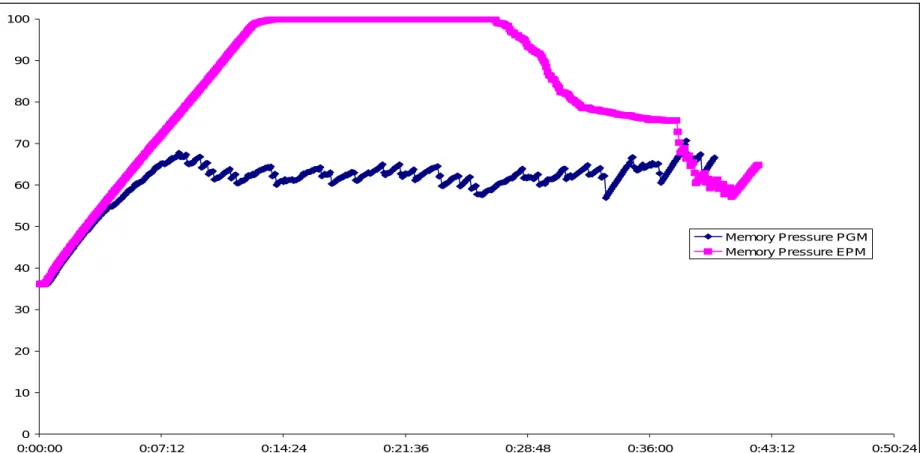
33 0 10 20 30 40 50 60 70 80 90 100 0:00:00 0:07:12 0:14:24 0:21:36 0:28:48 0:36:00 0:43:12 0:50:24 Memory Pressure PGM Memory Pressure EPM
Figure : Memory Pressure Curves for EPM and PGM Schemes
PGM Protects Against Overload…..
•
PGM is stable and exhibits saw-tooth pattern of acquisition, consumption and
release.
•
EPM shows the concurrent buildup of memory resulting in overflow.
…. Hence, stabilizes execution across
memory prediction errors
1F
1/kF
kF
PGM PGM PGM EPM EPM EPM SF100 SF200 SF400Reasons for stability:
- PGM is unfair
- Quick release
Complex Workload - Q4 0 20 40 60 80 100 120 140 0 2 4 6 8 10 12 14 16 Memory Throughput MPL SF 100 MPL SF 200 MPL SF 400Outline
•
Context: Next Generation Business Intelligence
•
Workload Management Challenges
•
Predicting Query Performance
•
Managing Batch Workloads
•
Managing Interactive Workloads
•
Experimental Framework for Studying Mixed Workload
Interactive Workloads: Scheduling
49 51 ART = 74.50 AS = 1.48 51 49 ART = 75.50 AS = 1.52 1 99 ART = 50.50 AS = 1.00 ART = 99.50 AS = 50.50 1 99OLTP
BI
a)
b)
c)
d)
49 51 ART = 74.50 AS = 1.48 49 51 ART = 74.50 AS = 1.48 51 49 ART = 75.50 AS = 1.52 51 49 ART = 75.50 AS = 1.52 1 99 ART = 50.50 AS = 1.00 1 99 ART = 50.50 AS = 1.00 ART = 99.50 AS = 50.50 1 99 ART = 99.50 AS = 50.50 1 99OLTP
BI
a)
b)
c)
d)
0 5000 10000 15000 20000 25000 30000 0.1 1 10 100 1000 10000Query Size (Seconds)
Frequency
Stretch = (p
i+ w
i)/p
iDesign a strategy for the online scheduling of queries on
an Enterprise Data Warehouse.
Criteria for a ‘good’ Online Scheduler
FEED
•
F
air
•
Avoid starvation of queries
•
Lower the ‘max’, or the ‘variance’ of query times
•
E
ffective
•
The majority of queries should do well
•
Lower the ‘average’
•
E
fficient
•
The strategy should be lightweight
•
Computational complexity of implementation should be sub-linear
•
D
ifferentiated
•
Different service levels should give differentiated performance
without unduly penalizing the overall avg and max.
How our scheduler works
•
Maintain a queue of queries ordered by their ‘rank’.
•
When a new query is submitted, compute its ‘rank’, and
insert it into the queue in the order of its ‘rank’.
•
Run the queries in the order of their ‘rank’, with ‘Highest
Rank First’
DBMS
DBMS
rank?
Ordered by
decreasing ‘rank’
How is rank computed?...
Design the ‘rank’ function using the
FEED criteria
1.
Start with a proven ‘effective’ algorithm (SJF) :
r = 1/p
, w
here ‘
p
’ is the estimated cost of the query
2.
Add a wait component that achieves ‘fairness’:
r = 1/p + Kw
,
where
K
is a constant, and
w
is the wait
time of the query
3.
Include a component that allows differentiation between
service levels:
r = •/p + Kw
,
where
•
indicates the service level
4.
Implementing this function as a queue has a sub-linear
computational complexity
Computing the Parameters
•
Based on the value K, rank function (
r = •/p + Kw
) generalizes known
scheduling functions:
•
SJF: K=0
•
FIFO: K > 1 -1/• where
• is the execution time of the longest query
•
Tradeoff between fairness and effectiveness
•
0 < K < 1 -1/•
•
Derive a value for K
•
With this value, provably does not cause starvation
•
Mapping Service Levels: The ratio
r
of stretches of a query of size p
with service level • and 1 can be computed as:
•
For Pareto Distribution:
1, , , , / p p p p
T
T
p
r
T
T
p
∆ ∆ ∆ ∆+
+
=
+
+
1 (r 1)(N ln p N ln p p) N N ∆ ∆ − + + +∆ =
21
K
ψ
=
Experimental Setup
•
Model workloads
•
Pareto Distributions
•
Optimizer Cost Estimate
•
Actual Processing Time
•
Study L
2norm for Stretch
•
Study differentiation: Two models for
rFEED
:
rFEED
1&
rFEED
10•
Compare with an optimal resource slicing system
RS
OPT•
Study Peak Load and Steady State Load
L 2 = (p12 + p
Execution Time With Pareto Distribution
(Steady State)
L2Norm for Pareto Distribution with Steady State Load
0 0.5 1 1.5 2 2.5 3 3.5
Overall Highest SL Medium SL Lowest SL
Metric
Ratio
RSopt rFeed1 rFeed10
Execution Time with Optimizer Estimate
(Peak Load)
L2Norm for Cost with Peak Load
0 5 10 15 20 25 30 35 40
Overall Highest SL Medium SL Lowest SL
Metric
Ratio
RSopt rFeed1 rFeed10
Outline
•
Context: Next Generation Business Intelligence
•
Workload Management Challenges
•
Predicting Query Performance
•
Managing Batch Workloads
•
Managing Interactive Workloads
•
Experimental Framework for Studying Mixed Workload
Experimental Framework for Workload
Management
•
It’s non-trivial to gauge the
impact of system configuration
and workload on a BI system’s
performance . . .
Gives you knobs to control:
• Workload characteristics: problem queries,
variance
• Workload Management policies: admission
control, scheduling, execution controls
• Multi-programming levels
• Resource models and behavior
So you can see:
• Impact of admission control, scheduling,
and execution control policies policies
• Impact of problem queries
• Impact on different objectives (e.g.,
complete 100% workload, minimize makespan, maximize useful work
Workload Management Actions
Execution Control Actions
Workload Management Policies
Execution Controller
Database Execution control Fuzzy Controller 0,5 0,75 0,25 0 1 0, 5 0,75 0,25 1 Current State Query n Query 1 ... data actionsRuntime statistics & Query information
Execution engine
IF relExecTime IS high AND (Progress IS low OR
Progress IS medium)
THEN cancel IS applicable
IF relExecTime IS high AND (Progress IS high
Preliminary Results from Experimental
Framework
•
Huge variance in query sizes and resource demands
•
Short queries: wait time can outweigh execution time
•
Long queries: even a few can significantly slow system
•
Admission control is effective when execution cost estimates ore accurate
•
When execution costs are underestimated, threshold-based execution
control actions have to be taken
•
But need guidelines for setting thresholds
•
Corrective actions against long-running queries can help, but
•
Overly aggressive actions can hurt performance
•
Simple actions (kill, resubmit) about as effective as newly proposed
actions (suspend/resume)
S. Krompass, H. Kuno, U. Dayal, A. Kemper, “Juggling Feathers and Bowling Balls” VLDB 2007. S. Krompass, H.Kuno. J.Wiener, U. Dayal, K.Wilkinson, A Kemper, “Managing Long Running Queries.” HPL Tech Report, 2008.
Example of Experimental Results
Impact of problem queries
Impact of control actions
Interactive jobs