China’s Sovereign Wealth Fund:
Weakness and Challenges
Abstract: The establishment of sovereign wealth funds in large developing countries has
generated hot debate among participants in the international financial market. When accumulated foreign exchange reserves surpass a sufficient and an appropriate level, the costs, risks and impacts on the macro-economy of countries holding reserves need to be considered. The Chinese Government established China Investment Corporation (CIC) in 2007 to diversify its investment of foreign reserves and to raise investment income. However, because of certain conflicts of interest and institution-design caveats, CIC possesses some internal weakness, including a vague orientation, mixed investment strategies and inefficient bureaucratic style. Although the subprime crisis has softened certain regulations and lessened rejection by the USA of CIC potential investments, the increased volatility and uncertainty of the market means that CIC is facing some new challenges in terms of its investment decisions. Moreover, CIC is competing with other Chinese investment institutions for injections of funds from the Chinese Government.
Keywords: CIC, external challenge, internal weakness, foreign exchange reserve management, sovereign wealth fund
JEL codes:F21, F55, H11 Dec. 20, 2008 www.rcif.org.cn 张明 [email protected] 何帆 [email protected] Working Paper No. 0823
2
I. Introduction
China established its own sovereign wealth fund (SWF), the China Investment Corporation (CIC), on 29 September 2007. With an initial capital fund of US$200bn, CIC fast became one of the most prominent SWF in the world. Since its initiation, CIC has aroused suspicion and apprehension. What is its motivation and likely behavior? Is it an aggressive white shark or an amiable blue whale?
Sovereign wealth funds are state-owned investment funds set up to invest excess foreign exchange reserves or natural resource export surplus. SWFs are part of the large collection of sovereign investment tools, including state-owned pension funds. Before the establishment of CIC, the State Administration of Foreign Exchange (SAFE), under the People’s Bank of China (PBOC), was the only management authority of Chinese foreign exchange reserves. The establishment of CIC has provided another avenue through which China can invest its growing foreign exchange reserves both at home and abroad.
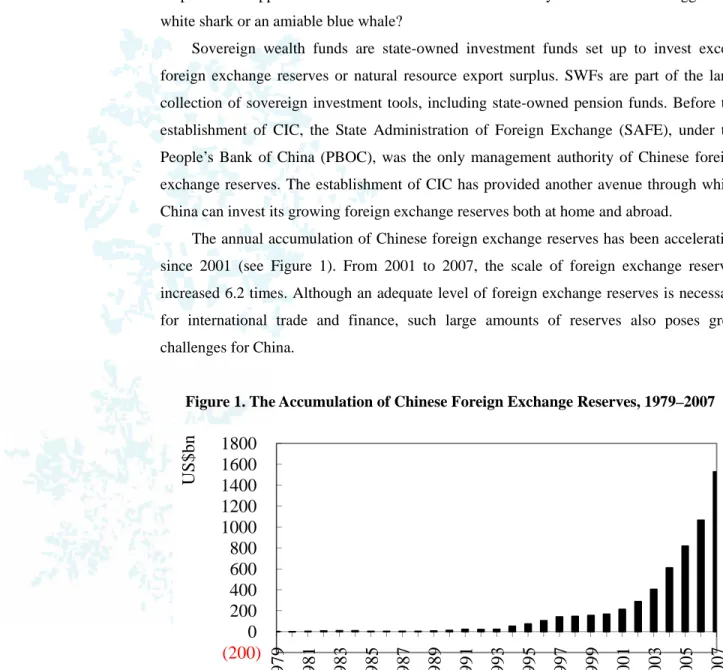
The annual accumulation of Chinese foreign exchange reserves has been accelerating since 2001 (see Figure 1). From 2001 to 2007, the scale of foreign exchange reserves increased 6.2 times. Although an adequate level of foreign exchange reserves is necessary for international trade and finance, such large amounts of reserves also poses great challenges for China.
Figure 1. The Accumulation of Chinese Foreign Exchange Reserves, 1979–2007
(200)
0
200
400
600
800
1000
1200
1400
1600
1800
1979
1981
1983
1985
1987
1989
1991
1993
1995
1997
1999
2001
2003
2005
2007
US$bn
Source: SAFE (2008).3
First, the opportunity cost of holding foreign exchange reserves is mounting up. China invests the lion’s share of its foreign exchange reserves in US treasury and agency bonds, which are highly liquid and safe but provide relatively low returns. For example, from 2001 to 2007, the interest rate of US 10-year treasury bonds fluctuated around 3–6 percent (Federal Reserve of the US, 2008). However, China also receives a large amount of foreign direct investment (FDI) inflows every year. According to a World Bank investigation on 12 400 foreign enterprises in 120 cities of China, the average annual return on investment reached 22 percent in 2005 (Xinhua Agency, 2006). The gap between the high yield of FDI in China and the low yield of Chinese foreign exchange investment could be regarded as the opportunity cost of holding foreign exchange reserves.Second, the exchange rate risk might cause a tremendous potential loss of the international purchasing power of China’s foreign exchange reserves. By the end of March 2008, Chinese foreign exchange reserves had reached US$1.68tn (SAFE, 2008). If the nominal exchange rate of US$ to RMB were to depreciate by 10 percent, the domestic value of Chinese foreign exchange reserves would suffer a loss of US$168bn, which is equivalent to 5 percent of the 2007 Chinese GDP. Since the reform of the RMB exchange rate regime in July 2005, the RMB has been gradually appreciating against the US dollar. With the subprime crisis, the US dollar might continue to fall, and, therefore, cause further wealth losses for China.
Third, the massive accumulation of foreign exchange reserves has resulted in excess liquidity in China’s financial market. To offset the inflationary impact of dollar purchase, the Peoples’ Bank of China (PBOC), China’s central bank, has had to issue central bank bills for sterilization. However, this practice is not sustainable. The interest rate that the PBOC has to pay for the central bank bills has been increasing, indicating that the PBOC has to run a loss.
How can the Chinese Government cope with these challenges? One approach is to limit further accumulation of foreign exchange reserves, which requires an exchange rate policy that allows the RMB more flexibility and further appreciation. This would be contingent on the support of structural reform encouraging domestic demand and changing the pro-export and pro-FDI policies. The second approach is to manage the foreign exchange reserves in a more active way and pursue higher returns. Currently, most excess funds are used to purchase US Treasury bills. However, China’s foreign exchange reserve investment should be more diversified. More should be invested in stock, commodity, real
4
estate and other financial products. The successful example of other SWFs, such as the Government Investment Corporation (GIC) and Temasek in Singapore encouraged China to establish its own SWF in 2007. CIC is responsible for actively managing Chinese foreign exchange reserves, and tends to undertake more aggressive investment than SAFE, to maximize returns with controllable risk. SAFE continues to play its role by undertaking traditional low-risk and high-liquidity investment, especially through the purchase of government bonds.The rest part of the paper is organized as follows. Section II depicts the structure and operation of the CIC. Sections III and IV analyze the internal weakness and external challenges of the CIC, respectively. Section V concludes the paper.
II. Structure and Operation of China Investment Corporation
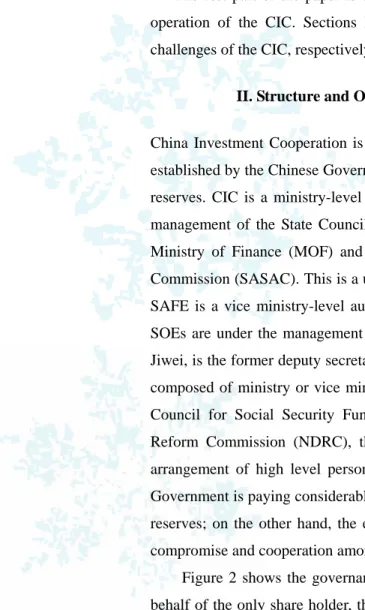
China Investment Cooperation is a semi-independent, quasigovernmental investment firm established by the Chinese Government to invest a portion of the nation’s foreign exchange reserves. CIC is a ministry-level state-owned enterprise (SOE), and it is under the direct management of the State Council, which means that CIC is parallel with the PBOC, the Ministry of Finance (MOF) and the State-owned Asset Supervision and Administration Commission (SASAC). This is a unique circumstance: CIC is the only ministry-level SOE. SAFE is a vice ministry-level authority that belongs to the PBOC. All the national large SOEs are under the management of the SASAC. The chairman of the board of CIC, Lou Jiwei, is the former deputy secretary-general of the State Council. The board of directors is composed of ministry or vice ministry-level officials from the State Council, the National Council for Social Security Fund (NCSSF), the MOF, the National Development and Reform Commission (NDRC), the Ministry of Commerce, the PBOC and SAFE. The arrangement of high level personnel in CIC reflects that, on the one hand, the Chinese Government is paying considerable attention to the active management of foreign exchange reserves; on the other hand, the establishment and operation of CIC is in fact a result of compromise and cooperation among various government institutions.
Figure 2 shows the governance structure of CIC. The board of directors operates on behalf of the only share holder, the State Council, which is responsible for making crucial decisions. The management committee is in charge of the operational activities of CIC, which is under the control of the board of directors. There is also a supervisory board, which supervises the function of not only the board of directors but also the management committee. The market does not know what roles the board of directors and the Communist
5
Party of China (CPC) committee play in CIC, which makes the corporate governance of CIC more sophisticated.Figure 2. The Governance Structure of China Investment Cooperation
Note: CPC, Communist Party of China.
From August to December 2007, the MOF issued eight terms of special government bonds, accounting for RMB1.55bn. Then the MOF undertook asset swap deal with the PBOC to exchange the RMB1.55bn funds for approximately US$200bn in foreign exchange reserve assets. Finally, the MOF injected the US$200bn foreign exchange reserve assets into CIC, which constitute the initial pool of money that CIC could manage.
Li Yong, the Vice Minister of the MOF and a non-executive director of the CIC, outlined the future allocation of US$200bn: one-third would be used to purchase the Central Huijin Investment Company (Central Huijin) from the PBOC, another one-third would be used to inject capital into China Development Bank (CDB) and the Agricultural Bank of China (ABC), and the rest would be invested in overseas capital markets (Xinhua Agency, 2007). However, according to Gao Xiqing, the General Manager of CIC, the money used for overseas investment would rise from US$66bn to US$90bn, an increase of more than 30 percent. CIC changed its allocation because the Chinese Government reduced the amount needed to restructure some state-owned financial institutions, in particular, ABC (Xie, 2008).
At the end of 2007, it took CIC US$67bn to purchase Central Huijin from the PBOC, which became a 100-percent subsidiary company owned by CIC. Central Huijin was established in December 2003. Its role is to inject capital into state-owned commercial banks and securities companies to facilitate the process of business restructuring and overseas listing. Table 1 summarizes the investment portfolio of Central Huijin since its
State Council
CPC Committee Board of Directors Supervisory Board
6
establishment. After the successful listing of the Bank of China, China Construction Bank and the Industrial and Commercial Bank of China on H-share and A-share markets, Central Huijin has earned huge profits, amounting to US$161.7bn by 28 October 2008 (Li H., 2008).Table 1. The Investment Portfolio of Central Huijin
Time Company Amount (US$bn)
December 2003 Bank of China 22.50
December 2003 China Construction Bank 20
December 2003 China Jian Yin Investment 2.50
June 2004 Bank of Communications 0.36a
April 2005 Industrial and Commercial Bank of China 15
June 2005 China Galaxy Securities Company 1.21a
August 2005 Shenyin and Wanguo Securities Company Limited
0.31a
August 2005 Guotai Junan Securities 0.12a
August 2005 China Galaxy Financial Holding Company 0.68a
September 2005 China Everbright Bank 2.47a
December 2006 China Development Bank 20
Source: Wikipedia (2008a).
Note:aThis represents an RMB injection, which is calculated in terms of the US dollar by using the exchange rate at the end of the month of capital injection.
There are two channels for CIC to pursue to undertake overseas investment. The first channel is to employ external fund managers to manage the overseas portfolio on behalf of CIC. CIC employs both fixed income investment managers and equity investment managers. The second channel is to conduct overseas investment directly, or to invest in certain offshore investment funds. From May 2007 to September 2008, CIC conducted four investments directly, and one investment through overseas private equity funds (see Table 2). Because of the current investment uncertainty brought about by the subprime mortgage crisis, the market value of CIC’s investment in Blackstone and Morgan Stanley has fallen dramatically, which has aroused strong doubt and criticism among the Chinese public. As a result, the management of CIC is facing considerable pressure.
7
Table 2. China Investment Cooperation’s Overseas Investment
Company Time Amount (US$bn) Type
The Blackstone Group May 2007 3.0 Pre-IPO, shares, 9.4% stake
China Railway Group November 2007
0.1 Pre-IPO, shares
Morgan Stanley December
2007
5.0 Convertible bond,
9.9% stake, 9% annual
return before conversion
VISA March 2008 0.1 Pre-IPO, shares
JC Flowers PE Fund April 2008 3.2 US PE fund, 80%
ownership
Source: SWF Institute (2008a).
Note: IPO, initial public offering.
III. Internal Weakness of China Investment Cooperation
As a SWF owned by the largest developing country, CIC has received continuous attention from all over the world. Governments of developed countries, especially those of the USA and European countries, have suspected that the investment decisions of CIC might be dominated by Chinese national interest, and that CIC might try to control their domestic strategic industries. Global investors fear that the participation of CIC in overseas financial markets will amplify market volatility, not only because CIC is an immature institutional investor and provides poor disclosure of its spending, but also because CIC has a tremendous pool of money. Moreover, the Chinese public doubts CIC’s ability to make money in overseas markets. The market value loss of CIC’s investment in Blackstone aggravated this doubt. Indeed, the doubts and fears from outside and inside China are reasonable to some extent, because CIC has several internal weaknesses, evident since its establishment.
1. Vague Orientation
There is a “capital myth” regarding the CIC. Is the US$200bn the capital of CIC? Most people would say yes, but this might not be the truth. The reason for this is that CIC must pay interest on its US$200bn assets to the MOF. As mentioned previously, US$200bn in foreign exchange reserves was purchased from the PBOC by the MOF, and the RMB1.55tn paid by the MOF was collected by issuing special government bonds. However, the MOF is not the shareholder of CIC, and the MOF requires CIC to pay the interest for the special government bonds. According to Lou Jiwei, the chairman of CIC, CIC needs to make a
8
profit of RMB300m every day to meet the interest of the bonds and operational costs. CIC should make its first interest payment for the bonds in February 2008, which amounted to RMB12.9bn (Li L., 2008). If the CIC should pay interest for the special government bonds, it is obvious that the US$200bn is not the capital, but the debt of CIC. Therefore, the MOF is the creditor rather than the shareholder of the CIC.The capital myth of the CIC reflects its vague orientation. There are two types of orientation for SWFs in the world. The first type is as a fund manager, such as the Government of Singapore Investment Corporation (GIC). GIC does not own the funds it manages, but manages them on behalf of its clients, the Government of Singapore and the Monetary Authority of Singapore. The Singapore MOF represents the government in dealing with GIC (GIC, 2008). The second type is an investment fund, such as the Stabilization Fund of the Russian Federation (SFRF). SFRF accumulates revenue from export duties and tax on oil mining when the price for Urals oil exceeds the set cut-off price. The capital of the fund may be used to cover the federal budget deficit and for other purposes, if its balance exceeds 500bn rubles (Wikipedia, 2008b). As a fund manager, the fund is neither the capital nor the debt of SWF, and SWF is a pure fund manager. As an investment fund, the fund is the capital of SWF. For both types of fund, SWF does not have debt, and need not pay any interest.
China Investment Cooperation’s orientation is very awkward, because it is neither a fund manager like GIC, nor a real fund like SFRF. We do not know how much capital CIC owns. We do not know who the real shareholder is of the CIC. What we do know for sure is that CIC has a huge debt amounting to US$200bn. CIC has been facing great pressure to pay the principal and interest since it was established. The unique orientation of the CIC might be its “original sin”.
China Investment Cooperation’s vague orientation leaves it with the following disadvantages. First, CIC has to pay interest for special government bonds. To make a profit after disbursing interest, CIC will be forced to engage in more risky high-income investments. In other words, the heavy debt burden limits CIC’s free portfolio allocation for longer-term diversified assets. Second, as we will discuss in the next subsection, to mitigate the pressure of paying interest on special government bonds, CIC merged Central Huijin, and the latter became a whole-owned subsidiary of the CIC. As a result, the role of CIC as a typical financial investor has been ruined. Naturally, CIC is facing more criticism and regulations, and is even being rejected by some developed countries because it is classified as a strategic investor.
9
The vague orientation of the CIC might be a compromise reached by the PBOC and the MOF in the competition for foreign exchange management. In most developed countries, the MOF is the owner of foreign exchange reserves, and manages them directly, or empowers other institutions to manage reserves, such as the central bank. However, the PBOC owns and manages these foreign exchange reserves in China. In order to actively manage foreign exchange reserves, the PBOC could establish a new subsidiary institution to undertake diversified investment, and leave SAFE to take care of traditional investment. However, the MOF injected money into the CIC by issuing special government bonds, which revealed the MOF’s desire to participate in the management of foreign exchange reserves. The MOF has not become a shareholder of CIC because the central government has tried to create a balance in the competition between the PBOC and the MOF.2. Mixed Investment Strategies
There are mainly two kinds of institutional investors: financial investors and strategic investors. Financial investors tend to maximize investment income and have little interest in controlling the objective company. Strategic investors tend to play a more influential role in the management of the objective company. For example, strategic investors often require seats in the board of directors of the objective company.
Because SWF have a strong government background, most of SWFs choose to behave as a financial investor to mitigate the potential doubt and rejection of the countries that receive their investments. A typical example is the Global Government Pension Fund of Norway. This fund owns shares in approximately 3500 companies, and it usually holds small stakes, typically below 1 percent (Lyons, 2007). In contrast, a generally recognized strategic investor among global SWFs is Temasek. In Singapore, Temasek is a holding company of dozens of enterprises in the industries such as financial service, telecommunications and media, transportation and logistics, real estate etc. Temasek is also an active investor in the overseas market, and its overseas portfolio includes the Bank of China, China Construction Bank, Hana Financial Group (South Korea), ICICI Bank (India) and Shin Corporation (Thailand). (Temasek Holdings, 2008). In September 2007, Temasek purchased 17.22 percent of the shares in Standard Chartered Bank (Lyons, 2007).
Although CIC is trying to be depicted as a pure financial investor, it is regarded as a strategic investor to a large extent. One of the most important reasons for this is that Central Huijin, CIC’s subsidiary company, is a typical domestic strategic investor. The role of Central Huijin is to promote the restructuring and listing of state-owned financial
10
institutions, and its capital came from the PBOC before it was merged by the CIC. Central Huijin was able to buy the shares of state-owned commercial banks at very low prices, which meant that, after the successful listing of these banks, Central Huijin is able to make huge profits. However, Central Huijin’s profits come from its monopolistic position and political background, not from its competitiveness.China Investment Cooperation purchased Central Huijin so that it could use the profit of Central Huijin to pay the interest of special government bonds. For example, on 25 March 2008, Central Huijin transferred its 3 billion shares in the Bank of Communications to the MOF without payment. This can be interpreted by the market as CIC paying the interest of bonds by asking Central Huijin to transfer some holding shares to the MOF (Zhang, 2008a). Purchasing Central Huijin alleviated CIC’s pressure to pay interest, but it put CIC into hot water. Because of the strategic nature of Central Huijin, CIC is deemed to be a strategic investor. Although CIC did not require any seat in the board of directors in making the deal with Blackstone or Morgan Stanley, it is still widely believed to execute mixed investment strategies.
3. Bureaucratic Management
As mentioned above, the CIC management team is composed of government officials, most of them lacking professional skills and market experience. For these officials, being an executive of CIC is only a temporary job. They will return to positions in government in the future. Because of pressure from other bureaucratic institutions, compensation received by the CIC management team does not reach the level received by other executives in the industry. If the compensation received by members of the management team is rather low, it is difficult for CIC to offer competitive compensation to global first-class fund managers. According to Li et al. (2008), the annual package for the market traders in CIC is approximately US$100 000, which is much lower than the industry level.There might be some patriotic and excellent Chinese fund managers who are glad to work for CIC for relatively low compensation. However, if they do not receive full trust and empowerment, they might choose to leave after a short time.
To regulate the overseas investment of SWFs established by developing countries, US Treasury is working with the IMF and the OECD to formulate a best practice model for SWFs, the objective of which is to make SWFs more transparent, predictable, and accountable to their own citizens and government andcitizens and governments in host countries (Truman, 2008). On 20 March 2008, US Treasury reached an agreement with Abu
11
Dhabi Investment Authority (ADIA) from the United Arab Emirates and GIC from Singapore on the principles for SWF investment (US Treasury, 2008). We believe that this agreement would be a good reference for working out a best practice model for SWFs.However, CIC has not been actively involved in the formulation of an international best practice model. According to Gao Xiqing, the General Manager of the CIC, the formulation of best practice for SWF is unnecessary, because it is irrational, and might upset the Chinese people (Feng and Qiu, 2008). Obviously, CIC lacks a pragmatic attitude toward SWF best practice. In the process of international negotiation and bargaining, what CIC really needs is a pragmatic philosophy, not bureaucratic management. CIC should actively participate in the formulation of a best practice model for global SWFs and try to maximize its own interest.
IV. Major Challenges for China Investment Cooperation 1. Volatility and Uncertainty in the Global Market
The subprime mortgage crisis broke out in the summer of 2007, just before the establishment of CIC. The crisis amplified the volatility of global financial markets and brought more uncertainty to the world economy. With the surge in default rates of subprime mortgage loans, some financial institutions that have bought securitization products based on subprime mortgages, such as Mortgage-Backed Securities and Collateralized Debt Obligations, have been suffering huge losses. As for those financial institutions relying on leverage and value at risk (VAR) management, they begin the deleveraging process upon suffering a loss, which means that they are forced to sell off other financial assets in their balance sheet to achieve liquidity. If all financial institutions start selling off assets simultaneously, the capital market will fall in value. Furthermore, it will cause a liquidity squeeze and a credit crunch. During such a bear market, the current portfolios of SWFs would also endure significant falls in market value. For example, after CIC invested in Blackstone, the market value of the company dropped over 50 percent. CIC has become a serious victim of the subprime mortgage crisis
However, the crisis has also created some new opportunities for SWFs to invest in Wall Street financial institutions that have suffered great loss during the crisis. The deleveraging institutions have sought new shareholders to inject additional capital, which can help to enhance capital adequacy ratios. Table 3 summarizes the SWFs cash injections into Wall Street banks. From March 2007 to April 2008, the total cash injections from
12
SWFs reached approximately US$44.9bn. Unfortunately, even after receiving capital injections from SWFs, Citigroup, Merrill Lynch and UBS still disclosed more potential loss. If the SWFs have invested in those institutions half a year later, the former might have got a much lower price.Table 3. Injections of Sovereign Wealth Funds into US Banks, March 2007–April 2008
Company Investor Stake (%)
Investment value (US$m)
Securities type
Citigroup Abu Dhabi Investment
Authority 4.9 7500
New convertible
units Citigroup Government of Singapore
InvestmentCorporation 3.7 6880
New convertible
units Citigroup Kuwait Investment Authority 1.6 3000
New convertible
units Merrill
Lynch Kuwait Investment Authority 3.0 2000
New convertible
units Merrill
Lynch Korea Investment Corporation 3.0 2000
New convertible
units Merrill
Lynch Temasek Holdings 9.4 4400
New convertible
units Morgan
Stanley China Investment Corporation 9.9 5000
New convertible
units Barclays
PLC Temasek Holdings 1.8 2005 Common stock
Credit
Suisse Qatar Investment Authority 1.0 603 Common stock UBS Government of Singapore
Investment Corporation 9.8 9750
New convertible
units UBS Saudi Arabian Monetary
Agency 2.0 1800
New convertible
units
Source: SWF Institute (2008b).
As a newcomer, it is more difficult for CIC to determine appropriate objective companies and the appropriate time to invest when the market is volatile and subject to uncertainty.
13
2. More Strict Control by the Host Country
The developed countries fear that SWF in large developing countries (such as China and Russia) might purchase their sensitive enterprises and take control of energy, biotechnology, finance, aviation and other strategic industries. Therefore, the USA and European countries are trying to apply strictly control to the investment of SWFs from the developing world. The specific measures include the following. First, SWFs in developing countries are required to increase their levels of transparency. For example, they should disclose annual financial statements audited by independent accounting firms to facilitate host countries’ understanding of the investment strategies, the corporate governance and the risk management of developing countries’ SWF. Second, for any company in a developed country, there is an upper limit of shares to be purchased by developing country SWFs, of only 20 percent. Third, the developing country that owns the SWF should reach a reciprocal agreement with the host country. If the developing country requires the developed economy to open its financial market and to give SWF national treatment, the developing country should also do the same. Fourth, the source of the SWF fund should be checked. If the fund comes from the accumulation of reserves by manipulating the exchange rate (such as China), or comes from the national resources by manipulating the price of resources (such as OPEC and Russia), those countries must take the initiative to get rid of the above manipulations (Garten, 2007).
As mentioned before, the US Treasury, the IMF and the OECD are working together to formulate a best practice model for global SWFs. Edwin Truman developed a scoreboard to evaluate the structure, governance, accountability, transparency and behavior of SWFs. In the 34 non-pension SWFs, CIC ranks 21st (Truman, 2008). Table 4 shows the comparison of specific scores of selected SWFs. The rank of CIC is lower than the SWFs from developed countries, East Asian countries and Russia, but higher than the SWFs from some OPEC countries such as Qatar and the United Arab Emirates. As for the specific items, CIC did fairly well in structure and governance, but poorly in accountability, transparency and behavior.
14
Table 4. Score Board of Non-pension Sovereign Wealth Funds
Country Fund Structure Governance Accountability and
transparency
Behavior Total
USA
(Alaska) Alaska Permanent Fund 100 80 100 83 94
Norway Government Pension Fund
Global 94 100 100 67 92
Korea Korea Investment
Corporation 75 60 45 25 51
Russia Reserve Fund and
National Welfare Fund 72 40 50 33 51
Singapore Temasek Holding 50 50 61 0 45
Singapore Government of Singapore
Investment Corporation 63 40 39 17 41
China China Investment
Corporation 50 50 14 17 29
Qatar Qatar Investment
Authority 34 0 2 0 9
United Arab Emirates
Abu Dhabi Investment
Authority and Council 25 0 4 8 9
Source: Truman (2008).
The SWF Institute located in California of the USA has developed a Linaburg–Maduell transparency index to evaluate the transparency of global SWFs. Figure 3 demonstrates the ranks of some major SWFs. Among the global top SWFs, the transparency score of CIC is the lowest. Therefore, there is still a long way to go for CIC to catch up with the average level.
Figure 3. The Rank of Linaburg–Maduell Transparency Index
Source: SWF Institute (2008c). Note: GIC, Government Investment Corporation; ADIA, Abu Dhabi Investment Authority; CIC, China Investment Corporation.
15
The poor score reflects CIC’s weakness in transparency, behavior, governance and structure. Therefore, CIC tends to be a target of criticism and is subject to restrictions from developed host countries.3. Domestic Competition Pressure
China Investment Cooperation is not the only Chinese sovereign entity that diversifies its investment portfolio in the global financial market. After the establishment of CIC, SAFE also accelerated its investment in equity in foreign companies. In December 2007, a Hong Kong-based subsidiary of SAFE bought minority stakes of less than 1 percent in three Australian commercial banks: ANZ Bank, the Commonwealth Bank of Australia and the National Australia Bank. The total amount value of these investments was US$176m (Johnston, 2008). In April 2008, SAFE purchased a 1.6-percent stake in Total SA, Europe’s third largest oil company, at a cost of US$2.8bn (Wang, 2008). In the same month, SAFE acquired a stake of nearly 1 percent in BP, Britain’s largest company, for approximately £1bn (Chen, 2008). The unusual investment activities undertaken by SAFE demonstrate that SAFE is trying to prove that it can also participate in more risky investment using foreign exchange reserves. Given that SAFE employs many experienced professionals who have been managing reserve assets for a long time, SAFE will become a powerful competitor of CIC if SAFE continues to diversify its overseas portfolio aggressively.
Besides SAFE, CIC is also facing competition from other state-owned institutions, such as CDB, the NCSSF and even some state-owned monopoly companies, such as PetroChina and Sinopec. CDB purchased a 3.1-percent stake in Barclay, for £1.45bn pounds in July 2007, and it further injected £136m pounds into Barclay in June 2008 (Zhang, 2008b). Since its establishment in 2000, the NCSSF has been actively managing its portfolio in both domestic and overseas markets. It employs overseas fund managers to undertake its overseas investment. The market value of the assets managed by the NCSSF had reached RMB516bn by the end of 2007 (SSF, 2007). In addition, if CIC expands its overseas investment to the global oil companies, it will face competition from the Chinese oil giants, such as PetroChina and Sinopec.
In the arena of overseas investment of sovereign institutions, CIC is facing intensive competition from the NCSSF, SAFE, CDB and state-owned monopoly companies. The current performance of CIC might determine whether the Chinese Government will inject
16
new funds into CIC in the future. Therefore, if the performance of CIC drops behind that of SAFE or the NCSSF, the management of CIC will undoubtedly encounter great pressure.V. Conclusions
In the face of global imbalances, China has accumulated large amounts of foreign exchange reserves. When the scale of foreign reserves surpassed a sufficient and appropriate level, the costs, risks and impacts to the macro-economy of holding too much in foreign exchange reserves became a hot issue. The CIC was established to diversify the investment of China’s foreign exchange reserves and to raise returns on investment.
As a result of the competition between the PBOC and the MOF to obtain control of foreign exchange reserves, CIC become a sole state-owned enterprise controlled directly by the State Council. The most important internal weakness of the CIC lies in its orientation. CIC has to pay interest on the US$200bn injected capital, which indicates that this US$200bn is a CIC’s liability. To help CIC to repay the interest on special government bonds, the Chinese Government asked CIC to make Central Huijin a subsidiary. Although Central Huijin boosts CIC’s financial status, it impairs CIC’s image as a financial investor because Central Huijin is a typical strategic investor, it is difficult for CIC to become a purely financial investor. Therefore, CIC is facing more strict regulations and even rejection from certain host countries.
Since the emergence of the subprime crisis, deleveraging US financial institutions have suffered great losses and have been thirsty for capital injection. Therefore, the US Government has become more open to investments by SWFs from emerging markets and developing countries, including CIC. However, in a volatile international financial market full of uncertainty, CIC should be very cautious in making new investments.
China Investment Cooperation is not the only Chinese sovereign institution with an overseas portfolio. CIC is competing with the NCSSF, SAFE, and other financial institutions for more injections of funding from Chinese Government. Whether the Chinese Government injects more funds into CIC will depend on CIC’s performance and the performance of other Chinese sovereign investment institutions.
References
Chen, Hao, 2008, “It is said that SAFE had purchased 1 percent stake of BP with US$ 2 billion” [online; cited 16 April 2008]. Available from: http://www.cs.com.cn/wh/02/200804/t20080416_1431884.htm.
17
Federal Reserve of the USA, 2008, Database of Federal Reserve of the USA [online; cited30 June 2008]. Available from: http://www.federalreserve.gov/releases/h15/data/Monthly/H15_TCMNOM_Y10.txt.
Feng, Yuqing and Huo Qiu, 2008, “CIC committed not to control any company,” Diyi Caijing Ribao (Chinese Business News) [online; cited 7 April 2008]. Available from: http://finance.people.com.cn/GB/7085489.html.
Garten, Jeffrey, 2007, “We need rules for sovereign funds,” Financial Times, 27 August [online; cited 30 June 2008]. Available from: http://www.ft.com/cms/s/0/1a968284-44fd-11dc-82f5-0000779fd2ac.html.
GIC, 2008, “Is GIC a private company or a government body?” Frequently Asked Questions [online; cited 2 July 2008]. Available from: http://www.gic.com.sg/faq.htm#01.
Johnston, Tim, 2008, “Beijing buys into leading Australian banks,” International Herald Tribune, 4 January [online; cited 2 July 2008]. Available from: http://www.iht.com/articles/2008/01/04/business/safe.php.
Li, Hongbin, 2008, “To calculate the profit and loss of Central Huijin and CIC,” Nanfang Zhoumo (Southern Weekly), 30 October, p. C15.
Li, Jing, Ning Yu and Huawei Ling, 2008, “The problem of US$200 billion,” Caijing, 8 March [online; cited 29 June 2008]. Available from: http://www.caijing.com.cn/2008-03-08/100051417.html.
Li, Liming, 2008, “CIC: the troubles accompany with growing,” Jingji Guancha (The Economic Observer) [online; cited 25 February 2008]. Available from: http://www.eeo.com.cn/eobserve/eeo/jjgcb/2008/02/25/92735.html.
Lyons, Gerald, 2007, “State capitalism: The rise of sovereign wealth funds,” Thought Leadership, Standard Chartered, 15 October.
SAFE (State Administration of Foreign Exchange), 2008, “Forex reserves,” Data and Statistics [online; cited 30 June 2008]. Available from: http://www.safe.gov.cn.
SSF (Social Security Fund), 2007, Annual Report of SSF 2007 [online; cited 30 June 2008]. Available from: www.ssf.gov.cn.
SWF (Sovereign Wealth Fund) Institute, 2008a, “China Investment Corporation [online; cited 7 July 2008].” Available from: http://www.swfinstitute.org/fund/cic.php.
SWF Institute, 2008b, “Subprime Report – Cash infusion,” Statistics and Research [online;
cited 7 July 2008]. Available from: http://www.swfinstitute.org/research/subprimereport.php.
18
SWF Institute, 2008c, “Linaburg-Maduell Transparency Index,” Statistics and Research[online; cited 8 July 2008]. Available from: http://www.swfinstitute.org/research/transparencyindex.php.
Temasek Holdings, 2008, “Our portfolio – major investments” [online; cited 30 June 2008].
Available from: http://www.temasekholdings.com.sg/our_portfolio_portfolio_highlights_major_investm
ents.htm.
Truman, Edwin M., 2008, “A blueprint for sovereign wealth fund best practices,” Policy Brief, No. 08-3, Peterson Institute for International Economics, Washington, DC.
US Treasury, 2008, “Treasury reaches agreement on principles for sovereign wealth fund investment with Singapore and Abu Dhabi,” 20 March, US Treasury.
Wang, Tao, 2008, “It takes SAFE US$ 2.8 billion to buy 1.6 percent stake of TOTAL” [online; cited 10 April 2008]. Available from: http://www.chinasecurities.xinhua.org/cqzk/13/200804/t20080410_1425534.htm.
Wikipedia, 2008a, “Central Huijin Investment Company Limited” [online; cited 2 July
2008]. Available from: http://zh.wikipedia.org/wiki/%E4%B8%AD%E5%A4%AE%E6%B1%87%E9%87%91
%E6%8A%95%E8%B5%84%E6%9C%89%E9%99%90%E8%B4%A3%E4%BB%BB %E5%85%AC%E5%8F%B8.
Wikipedia, 2008b, “Stabilization fund of the Russian Federation” [online; cited 5 July
2008]. Available from: http://en.wikipedia.org/wiki/Stabilization_Fund_of_the_Russian_Federation.
Xie, Xiaodong, 2008, “The overseas portfolio of CIC maybe increase US$30 billion,” Shanghai Zhengquanbao (Shanghai Securities News) [online; cited 26 April 2008].
Available from: http://www.chinasecurities.xinhua.org/xwzx/03/200804/t20080426_1442489.htm.
Xinhua Agency, 2006, “World Bank: The returns on investment of foreign enterprises in China reached 22 percent” [online; cited 11 November 2006]. Available from: http://news.xinhuanet.com/fortune/2006-11/11/content_5317841.htm (in Chinese).
Xinhua Agency, 2007, “China Investment Corporation unveils investment plan” [online;
cited 7 November 2007]. Available from: http://news.xinhuanet.com/english/2007-11/07/content_7029738.htm. (in Chinese).
Zhang, Ming, 2008a, “CIC paid its interest through Central Huijin,” FTChinese.com [online; cited 27 March 2008]. Available from:
19
http://bank.cnfol.com/080327/136,1569,3959783,00.shtml (in Chinese).Zhang, Ming, 2008b, “Why CDB reinvested Barclay,” FTChinese.com [online; cited 27 June 2008]. Available from: http://www.ftchinese.com/story.php?storyid=001020233 (in Chinese).
声明:本报告非成熟稿件,仅供内部讨论。报告版权为中国社会科学院世界经济 与政治研究所国际金融研究中心所有,未经许可,不得以任何形式翻版、复制、 上网和刊登。