©2018 David J. Wright ALL RIGHT RESERVERED
THROUGH THE AGE OF AUGUSTUS by
DAVID J. WRIGHT
A dissertation submitted to the School of Graduate Studies
Rutgers, The State University of New Jersey In partial fulfillment of the requirements
For the degree of Doctor of Philosophy Graduate Program in Classics Written under the direction of
Leah Kronenberg And approved by ________________________________ ________________________________ ________________________________ ________________________________
New Brunswick, New Jersey OCTOBER 2018
Giants, Titans, and Civil Strife in the Greek & Roman World down through the Age of Augustus
By DAVID J. WRIGHT
Dissertation Director: Leah Kronenberg
This project explores the myth of the Gigantomachy leading up to and during the age of Augustus. Scholarship often reads the myth as an allegory of order triumphing over chaos, or “civilization” over “barbarism,” and the myth is often thought to represent Greece’s conflict with foreign entities. In this study, I highlight some of the themes, both inherent in the myth and highlighted by poets and artists, that undermine this simplistic binary. In fact, I examine many examples when the myth signifies a conflict that may not be foreign at all, but rather a conflict from within. By the time the myth appears in Augustan poetry, it has strong connotations of civil war. Though the more traditional view of the myth might align with the agenda of various political propagandists in Rome’s civil wars, poets such as Vergil and Propertius draw attention to complicating elements in the myth to undermine any overly simplistic interpretations of these conflicts.
Chapter 1 explores the Gigantomachy and Titanomachy in the Archaic period in both poetry and sculpture. I address some of the “traditional” interpretations in the poetry of Hesiod and Pindar, as well as some complications to the simplistic “order vs. chaos” binary. I also treat some of the myth’s connections to civil strife in visual art and poetry.
Chapter 2 examines the myth in the 5th and 4th century Athens. While the image of the
Gigantomachy on the Parthenon is often cited as being emblematic of Greece’s victory over
foreign enemies, I highlight the myth’s problematic elements and its connection to civil strife in tragedy, comedy, and Plato.
Chapter 3 considers the Gigantomachy in the Hellenistic era. During this period, the myth has connotations of a victory of the “civilized” over “uncivilized” due to court poets like Callimachus, who attempt to make Macedonian kings seem more legitimate through likening their victories over foreign people to the Olympians over the Giants. At the same time, I show that the Great Altar of Pergamum, a monument which is also cited as
emblematic of this traditional viewpoint, has problematic elements that complicate an “order vs. chaos” meaning. Other later Hellenistic poets also exploit ambiguous elements of the Gigantomachy to subtly criticize powerful figures such as Philip V and Rome itself.
Chapter 4 analyzes the significance of the myth in the middle and late Roman Republic. During the early Republic, the Romans occupied an uncertain space on the “civilized vs. uncivilized” spectrum. The presentation of the Gigantomachy in the poetry of Naevius reflects this uncertainty. The myth in the poetry of Ennius may suggest that fraternal strife was at the very outset of the Annales. During the Late Republic, civil war was painfully frequent throughout Italy, and the Gigantomachy becomes a fitting allegory for this type of conflict.
In Chapter 5, this dissertation reaches its culmination: the Gigantomachy myth in the Augustan era, a time in which the myth is especially prominent. While, on the one hand, Augustan propaganda might resonate with the more “traditional” interpretation of the myth, Augustan poets subtly draw attention to some of the more troubling aspects of
Gigantomachy. Given the time period’s fatigue with civil war, the Gigantomachy is an apt myth to process the chaotic violence of the civil wars of the late first century BCE.
Laurae animae dimidio meae atque memoriae matris carissimae
ACKNOWLEDGMENTS
I heartily thank my committee members, Tim Power, Corey Brennan, and Leah Kronenberg, for their thoughtful guidance throughout this entire project. Tim’s suggestions and endless knowledge of scholarly works to consider have been incredibly fruitful for this project, and Corey’s supportive enthusiasm and insights have provided a motivating force that has been immensely helpful throughout my time at Rutgers. Leah went above and beyond in her role as a supervisor. Without Leah’s untiring scholarly and emotional support, this dissertation simply would not have come together. I also would like to thank the Rutgers Classics Department, their faculty, and graduates for creating the supportive environment that allowed me to pursue this project. I am particularly grateful to the Rutgers Classics Department for awarding me an affiliated fellowship at the American Academy in Rome, where a considerable portion of this project came to life. I am also thankful to the many colleagues throughout the Classics field, such as Jim O’Hara, who have greatly influenced this work and continue to influence my thinking on Greco-Roman poetry.
This dissertation is dedicated to two very important women in my life, my mother and my partner Laura. I thank Laura for believing in me and for being an excellent around-the-clock editor and an ever thoughtful listener. As always, my mother’s memory also kept me going when times were especially difficult.
TABLE OF CONTENTS
PRELIMINARY SECTION ABSTRACT... ii DEDICATION ... iv ACKNOWLEDGEMENTS ... v TABLE OF CONTENTS ... vi INTRODUCTION ... 1 TERMINOLOGY ... 2PREVIOUS STUDIES OF THE GIGANTOMACHY ... 5
GIGANTOMACHY AS ASYMBOLIC BATTLE BETWEEN ORDER AND CHAOS ... 7
CONCEPT OF CIVIL WAR ... 8
THEMES OF THE GIGANTOMACHY ...10
CHAPTER OVERVIEWS ...14
CHAPTER1:ANTI-OLYMPIANMYTHSINTHEARCHAICPERIOD ...17
THEOGONY ...17 ARCHAIC SCULPTURE ...25 XENOPHANES ...30 PINDAR ...31 BACCHYLIDES ...35 CONCLUSION ...44 vi
CHAPTER2:GIGANTOMACHYINTHECLASSICALERA ...45
THE PARTHENON ...45
SEVEN AGAINST THEBES...47
EUMENIDES ...49 PROMETHEUS BOUND ...52 PLOUTOI ...56 HECUBA...57 HERCULES FURENS ...59 BIRDS ...60 ION ...64 PLATO ... 71 CONCLUSION ...73
CHAPTER3:GIGANTOMACHYINTHEHELLENISTICERA ...75
CALLIMACHUS ...76
GREAT ALTAR OF PERGAMUM ...81
LATER HELLENISTIC POETS ...90
CONCLUSION ...94
CHAPTER4:GIGANTOMACHYDURINGTHEMIDDLEANDLATEREPUBLICOF ROME ...95
NAEVIUS ...96
ENNIUS ... 103
ACCIUS ... 106
GIGANTIC ELEMENTS IN THE ROMULUS AND REMUS MYTH ... 108
CATULLUS ... 111
LUCRETIUS ... 112
CONCLUSION ... 121
CHAPTER5:THEYMIGHTBEROMANS:THEGIGANTOMACHYANDCIVIL CONFLICTINTHEAGEOFAUGUSTUS ... 123
GIGANTOMACHY,GEOGRAPHY, AND CIVIL WAR ... 124
GIGANTOMACHY AS FAMILIAL CONFLICT IN PROPERTIUS ... 127
THE GEORGICS ... 132 THE AENEID ... 138 CONCLUSION ... 152 CONCLUSION ... 154 BIBLIOGRAPHY ... 162 viii
INTRODUCTION
The Gigantomachy was a widely popular theme in both literary and visual media throughout the Greek and Roman world. Featuring the pivotal battle in which Zeus solidifies his place as the ultimate lord of the cosmos,1 the myth was frequently associated with the
concept of order’s triumph over chaos. Previous comprehensive studies of the Gigantomachy have not diverged from this interpretation.2 In this dissertation, I demonstrate that such an
uncompromising view is overly simplistic. The Gigantomachy was a complex myth with immense ambiguity that was often exploited by poets and artist. Throughout this project, I examine components of the myth that undermine the traditional interpretation in order to reveal how literary voices used the myth to bring meaning to the trauma, uncertainty, and manipulation of civil conflict.
Scholarship has embraced the notion that the myth was viewed as a metaphor for the Greeks’ victory over foreign peoples.3 I illuminate an aspect of this myth that is not often
discussed: its connection to civil strife. This association with civil strife complicates a clean “Chaos vs. Order” dichotomy. Earlier studies examined the myth exclusively in the Greek world,4 or solely in the Roman world. A significant portion of this study explores the
Gigantomachy in Greek sources, but this project ultimately looks forward to the Augustan
1 Though there are inklings of other potential rebellions. The Iliad seems to record a tradition that Hera and
Zeus’ children conspired to overthrow him. For threads of this story, see Il.1.396-406, 1.587-94, 12.442-9, and 15.18-24. Lang (1983: 147-8) pieces together this myth.
2 The main comprehensive studies are Mayer (1887), Vian (1952), Fontenrose (1959) and Hardie (1986).
Chaudhuri (2014) examines the related myth, the Theomachy, or the rebellion against the gods, a category in which the Gigantomachy is included.
3 Henringon (1959: 60-62); Castriota (1992: 138-43). 4 Vian (1952); Vian (1952); Fontenrose (1959).
era, a period when this myth was particularly popular.5 I argue that this popularity is in part
due to the Gigantomachy’s association with civil war, which made the myth a fitting lens through which to process Rome’s civil conflicts of the 1st century BCE.
Terminology
This dissertation treats three divine wars: the Titanomachy, the Typhonomachy, and the Gigantomachy.
The Titanomachy is the war between the Olympians and the Titans, usually occurring not long after Zeus overthrows his father Cronus. The first extant record of this conflict is in Hesiod (Th. 617-719). The conflict appears to be in northern Greece, per Hesiod’s indication that the Titans fought at Mt. Othrys (638). After Zeus’ eventual and inevitable victory, the immortal Titans earn imprisonment in Tartarus for all eternity.
The Titans are largely depicted in an anthropomorphic form. Surprisingly, we do not have many images of the Titans in visual art or descriptions by writers, but we know that the Hundred-Handers – close relatives of the Titans within the same generation – appear as hybrid creatures with many hands, as their name implies. We also have very few images of the Titanomachy – one such image is a bronze crater listed in the Lindian chronicle that is said to have shown a scene of the Titanomachy.6 Could this lack of representation of the
Titanomachy be because the Titans are so closely related to the Olympians, and thus an image of family members committing violence would be too difficult to handle?7
5 The theme appears in Horace, Propertius, and Vergil. The theme is particularly important for the Aeneid as
Hardie (1986), O’Hara (1994 and 2007), and I explore. For its prominence in the Augustan period generally, see Hardie (1986: 87).
6 The bronze crater is known from Xenagoras (FGrH 240 F 14). The two other examples are uncertain. One of
them is an Attic Hydria. The other is a pediment from a temple at Corcyra. See LIMC, s.v. Titanes.
Hesiod is our also earliest extant literary account for the Typhonomachy, a cosmic battle in which Typhon, a hybrid monster and son of Gaia (of Hera in other versions), threatens to bring down the hegemony of Zeus not long after the Titanomachy (Hes. Th. 820-880). This battle takes Typhon from his cave dwelling in Cilicia (Pi. P. 1.15-17) to scenes all over the Mediterranean. The battle eventually takes the two combatants to northern Greece (just as with the Titanomachy), where Zeus cuts Typhon and blood splashes upon a Mt. Haemus, thus giving the mountain its name (Apollod. 1.63). The battle usually culminates in Sicily with Zeus placing Mt. Aetna on Typhon as a prison. In Hesiod’s Theogony, Typhon is the last threat to Zeus’ control over the universe. From the onset, Typhon is described by Hesiod in monstrous terms, with one hundred snakes emerging from his body (Th. 824-826). Vase paintings additionally depict him as a creature with a serpentine lower half and wings.8
Following Zeus’ fight with the Titans, the Gigantomachy is the next major rebellion in which the Giants, also sons of Gaia, attempt to overthrow the rule of Zeus. Literary sources on the Gigantomachy are largely absent in the Archaic period. In Homer, the
Aloadae present as Giant-like figures when they launch an assault on Mt. Olympus by piling Mt. Ossa upon Mt. Pelion. (Od. 11.313-16). In Hesiod, he mentions Giants, but does not treat their war against Zeus. Later sources will place these figures like the Aloadae in the ranks of the Giants. Some versions of the myth place this battle in Pallene in Chalcidice – another cosmic battle in northern Greece (Apollod. 1.6.1). The Gigantomachy myth is also sometimes placed in Campania in Italy (Lyc. 697). Apollodorus provides the earliest comprehensive extant treatment of this myth (1.6.1-2). In all of these battles, Zeus and the
Olympians are victorious. The Giants are mortal (unlike their Titanic brethren), and thus die off when they lose.
Visually, the Giants undergo a transformation throughout the Greek world. In the Archaic period, they often appear as hoplites. Hesiod implies this by indicating that they were born fully armed and clad in armor (Th. 185-6).9 It is not until the time of the Persian
Wars that the Giants are presented with animal skins, torches, and stones, and it is not until the late 4th or early 3rd century BCE that they are depicted in anguiped form. The first
example occurs on an Apulian vase painting dating to the first quarter of the 4th century
BCE.10 The most famous examples of anguiped Giants appear on the Great Altar of
Pergamum. In the Roman era, the Giants frequently appear in hybrid or anguiped form. In the Archaic period, the Titanomachy, Typhonomachy, and Gigantomachy are distinct conflicts. The majority of this dissertation does not observe a distinction between these figures and wars because, since the 5th century BCE at least, the Titans, Giants, Typhon
and their respective conflicts with Zeus were conflated into one battle.11 This generalization
likely emerged because they are all essentially tales of “Anti-Olympians.” Indeed, the Giants, Titans, and Typhon are all closely connected, given their shared status as the Chthonic
children of Gaia. The Titans are aptly referred to as “earthly” (χθονίους, Th. 697). Even Chthonic monsters not normally associated with the Gigantomachy are sometimes considered Giant-like participants in the battle. Creusa, for example, claims that the Gorgon fought in this battle in Euripides’ Ion (988-9). Sometimes, Centaurs are also part of this battle.12 By the
9 For examples of the Giants wearing hoplite armor in visual art, see the frieze of the Siphinian treasury (see
Chapter 1) and vase painting (See LIMC s.v., Gigantes 114-382).
10 LIMC s.v., Gigantes 389.
11 E. Hec. 466-74, IT 222-4, Ion 989. See Vian and Moore (1998: 195-117) and Vian (2005). 12 Naevius, fr. 4. Strzelecki, Hor. Carm 3.4.55.
Age of Augustus, these battles had long been conflated enough that Augustan poets would have been drawing from all of these conflicts collectively.
For this dissertation, my analysis of the Archaic period makes distinctions between these different wars, but, in later periods, I will primarily use the term “Gigantomachy” as a sweeping, inclusive term.
Previous Comprehensive Studies of the Gigantomachy
Mayer (1887) gives us the first comprehensive look at the Gigantomachy and
Titanomachy. Like many 19th century dissertations, he attempts to find the “true meaning” of
the Giants and Titans. He often focuses on the philological analysis of names and makes the claim that many of the Giants and Titans are just epithets of Olympian gods that eventually became different figures.13 He is also concerned with the meaning of the names, which lends
to somewhat limiting conclusions, such as the Hundred-Handers’ many arms being symbols of the arms of the Aegean (Mayer 1887: 121).
Another seminal work is Vian’s La Guerre des Géants: le Mythe avant l’Époque Hellénistique (1952a). He puts a strong focus on the representations of the myth in material culture and seeks to find the myth’s origin in the Chalcidice. Vian also attempts to find an archaic Gigantomachy epic from which sculptors drew inspiration. His work was essential in establishing that there was a clear distinction between the Gigantomachy and Titanomachy in the Archaic period. Moreover, his research was crucial in establishing the Gigantomachy’s connection with the Peisistradian Panathenaea (Vian 1952a: 246-279). The scope of Vian’s project is limited to the time periods before the Hellenistic era. In this dissertation, the art and
literature of the Hellenistic Gigantomachy period will be crucial for my study of the myth in the Roman period.
None of these works focus on the myth’s connection to civil war, and neither seeks to point out any complications in the myth. Both Mayer and Vian overall suggest that myth inherently suggests a “Chaos vs. Order” theme. Fontenrose (1969) examines the myth of Apollo’s acquisition of the sanctuary at Delphi by vanquishing the Python – a myth which can be seen a doublet of the Titanomachy, Typhonomachy, and Gigantomachy. Fontenrose rightly notes a pattern: sometimes the combatants in these myths share similar characteristics, a point which will be relevant to my study as a whole (1969: 470-2).14
Hardie (1986) gives a comprehensive study of the myth in the poetry of Vergil and argues that the poet uses the myth to symbolize order’s triumph over chaos.15 In Hardie’s
view, the Olympians’ victory over the Giants and Titans is a perfect symbol of
“civilization’s” victory over “barbarism” – an interpretation that surely would have resonated with the Trojans’ victory over the Italians in the Aeneid. But I argue that the myth is more than a simplistic story of “civilization” triumphing over chaos. I am aided by the work of O’Hara, who argues that Vergil makes use of variations in the Gigantomachy myth to create ambiguous feelings about the war in Latium as a whole (1994).16 By looking back and
examining the earlier Greek sources for the myth, I expose versions in which the myth is morally complicated and I show how Vergil and other poets made use of that complexity to allegorize uncomfortable political situations.
14 Ogden (2013: Ch. 6) furthers some of these ideas.
15 According to Hardie (1986: 154), “The Gigntomachy places [Aeneas] on the side of the gods, re-enacting the
primitive vicroty of order over disorder.”
Chaudhuri (2014) examines the broader category of the Theomachy, the battle against the gods that is quite similar to the Gigantomachy’s story of the Giants’ rebellion against the Olympians. His study, however, draws from a broader range of figures who defy gods, such as Capaneus, who is part of the myth of the “Seven Against Thebes.” Chaudhuri ultimately sees this theme of Theomachy as an evolving discourse about the distinction between god and man that culminates in the age of the divine princeps, a time in which this distinction is blurred. He briefly treats the theme in Greek poetry, Lucretius, and Vergil, but the focus of his study is the poetry of the Imperial era. My study provides a complement to Chaudhuri’s work by treating the foundational eras that lead up to his study. While Chaudhuri notes the layers of complications in this myth, he does not examine its complicated themes of chaos and order that form a central focus of my study.
Gigantomachy as a Symbolic Battle Between Order and Chaos
Many scholars associate all of these battles against the Olympians with the theme of a black-and-white “Chaos vs. Order” dichotomy. Like other scholars, Vian (1952: 10-15) proposed that the Gigantomachy myth symbolizes Zeus’ victory over figures of disorder in the universe. Pollitt (1972: 12) suggests that the Giants became associated with the Persians after the Persian Wars. According to him, the Athenian Acropolis, as an analogue to Mt. Olympus, endured the assaults of the Giant-like Persians in 480 BCE.17 Vian, however,
strongly denies that there is a connection between Giants and Persians following the Persian Wars of the 5th century, stating that there is no evidence for the connection between the figures, and that Pheidias was merely following the precedent of the earlier representations of
the Gigantomachy on the “Old Athena Temple” (1952: 288-89). Perhaps one of the most foundational works is Hardie’s Virgil’s Aeneid: Cosmos and Imperium (1986). He argues that the myth conveys this concept of “Chaos vs. Order,” and that it is especially present in the Aeneid of Vergil. To argue this view, he makes ample use of the imagery of the
Gigantomachy on the Great Altar of Pergamum, but Whitaker (2005) reveals that this
monument’s depiction of the Gigantomachy is not so straightforward and comes with deeper hints of far greater complexity. Whitaker shows that the monument contains ambiguities that distort the distinction between Olympian and Giant and provide a sympathetic portrayal of the Giants. In my own analysis, I will further show how this frieze is not the best example of the Gigantomachy representing “Chaos vs. Order.” Through some of the themes that I survey below, I will show how often the Gigantomachy does not convey such an unequivocal
dichotomy, and how often poets and artists specifically employ the myth to suggest
subversive interpretations of conflict that undermine propagandistic elements of the myth.
The Concept of Civil War
Civil war forms a significant part of my study. Agamben in his book on Stasis observes, “there is a ‘polemology,’ a theory of war, and ‘irenology,’ a theory of peace, but there is no ‘stasiology,’ no theory of civil war” (2015: 2). Armitage, in his recent book (2017), explores the concept of civil war from antiquity to the present. He, too, laments that there is no “Civil War Theory” available; yet, he also claims that it is not his “aim to provide an overarching theory of civil war.” Though both scholars claim not to be proposing a theory for civil war, the framework that they collectively put forth is helpful in understanding why the Gigantomachy frequently became an allegory for civil war. I employ several of the
fundamental points from their studies in my own analysis of the Gigantomachy myth and civil war.
One important claim made by Agamben and Armitage is that a key component of civil war is the inherent breakdown of the distinction between friend and enemy.18 Over time,
the Gigantomachy myth was used less as a tale about “Us vs. Them” and more as an
introspective story of “Us vs. Us.” Furthermore, as Agamben (2015: 24) and Armitage (2017: 16, 26) discuss in their studies, all wars eventually become civil.19 This is certainly true for
the Romans. As Rome extended its power over the “known world,” their foreign wars increasingly came to be seen as conflicts that were more like civil wars taking place within their very own territory.20
Ultimately, I demonstrate how the Gigantomachy is an apt myth for civil war, and how the myth’s association with civil strife further complicates the traditional view of a wide gulf between those who are “civilizing” and those who are to be “civilized.” While Loraux (1997: 22) may argue that stasis can be seen as an essential component of civilized society, I follow Agamben (2015: 13-17) and disagree with Loraux’s suggestion. Louraux suggest that stasis resides at the heart of the household (1997: 44). Agamben, however, argues that stasis renders family members and foreign entities indistinguishable. Civil war is antithetical to “civilized” society because, during stasis, the very foundations of the oikos and polis break down.
18 Agamben (2015: 13-15); Armitage (2017: 12). They both follow the earlier theory of Carl Schmitt (1996). 19 Price also suggests this his study of stasis in the Thucydides (2001: 69ff.)
20 This blurring of foreign and civil war is especially the case in Silius Italicus (though not treated in this
dissertation). Though his poem is about the Punic Wars, the Punica is replete with the language of civil wars. See Ahl, Davis, and Pomeroy (1986: 2518); Marks (2010); Tipping (2010: 35-44); and Augostakis (2010).
Themes of the Gigantomachy
In my study, seven themes reoccur throughout the different iterations of the
Gigantomachy. With a close look, we will see poets and artists highlighting these key themes that undermine the simplistic “Chaos vs. Order” binary that is so commonly applied to the Gigantomachy myth.
Familial Strife
One of these central, alternative motifs is the presence of interrelated familial strife. The Olympians were closely related to the Titans, and they were technically related to the Giants as well. In the Greco-Roman world, the family was seen as the microcosm of the state.21 Rome, during the 2nd and 1st centuries BCE, was particularly sensitive to these issues
because of the unfortunate frequency of civil violence and civil wars. The legends of
Romulus and Remus’ fratricide,22 the early Romans’ conflict with their in-laws the Sabines,23
and the Theban cycle are emblematic of their own civil wars.
Confusion of Friend and Foe
In the Gigantomachy, it is often difficult to decipher which figures are on the side of the Giants and which are on the side of the Olympians. This confusion is sometimes the effect of the “twinning” of the Giants and Olympians. The Olympians are often represented
21 For the family as microcosm for the state in the Greek world, see Brock 2013: 25-42. For the Roman world,
see Bannon (1997: 158-159)
22 Bannon (1997: 158-159) 23 Brown (1995)
with Giant-like characteristics or in combat with weapons that are similar to those of the Giants. Some of these figures even switch sides immediately before or during battle. This type of confusion is a common trope in the civil war narrative, as mentioned above. This phenomenon is especially relevant during Rome’s civil wars of the 1st century BCE.
Hill Assault and Siege
Typically presented as attacking Mt. Olympus, the fighting Giants have clear associations with hill assault. The Athenians perhaps drew comparisons between the Giants and the Persians, since the Persians assaulted their sacred and most important hill in 480 BCE. This analogy will also be applied to the Celts when they attack Delphi on Mt.
Parnassus in 279 BCE. In the Roman world, the Capitoline and Palatine become analogues for Mt. Olympus. They had their own Gallic assault in 390, but this assault transforms into a civil one in the 1st century BCE when Remus’ attack on the Palatine becomes a metaphor for
civil war and Roman generals begin to lay siege to the Capitoline Hill.
Civil Conflict as Cyclical
After Zeus defeats the Titans, Typhon, and the Giants, his rule over the universe seems to be finalized. At times, however, the texts hint of a possibility that these figures might escape from their prisons and wreak havoc upon the world. This concern is a common one in civil war when fighting parties are aware that their opposition is not likely to ever truly dissolve, and that the cycle of violence will likely see no end. Indeed, Armitage remarks in his comprehensive study that civil war is often cyclical (2017: 68-69).
Violence in the Gigantomachy
Extreme violence is a key component of the Gigantomachy. The Giants are often characterized as bestial figures whose unchecked violence brings about their downfall. At the same time, Zeus uses violence to subdue the Giants. Some sources characterize this violence as “justified.”24 Other traditions stress that the Olympians used Metis over violence.25 But
Zeus uses violence that is indistinguishable from the Giants. His thunderbolt is quite similar to the fire that Typhon breathes (and, in some versions, other Giants breathe). And in some versions of the myth, Zeus even brings the hybrid, brutish Hundred-Handers over to his side, despite the reputation that they hold as the embodiment of excessive violence. Interestingly, in other versions of the myth, these Hundred-Handers are on the side of the Giants/Titans (Eumelos, fr. 2 K = Schol. Apollon. 1165). These enemies of the Olympians often have animalistic traits. Typhon has many serpentine heads and the Giants are later represented with serpentine legs.26 These bestial characteristics suggest animalistic violence. At the same
time, poets and artists present the Olympians in these conflicts with beast-like characteristics (e.g., calling Dionysus “βρίοµιος” in the Ion, 216) or highlight that they are helped by their animal attendants (e.g., Athena’s snake on the Great Altar of Pergamum).
Gigantomachy in Art and Rhetoric
24 Hor. Carm. 3.4.65-66. 25 A. PV. 205-213.
26 On the Great Altar of Pergamum, some of the Giants have other bestial characterstics; one giant has the head
As stated above, the Gigantomachy was a frequent theme in visual art. Ancient poets and artists were aware that art – both poetic and visual – is inherently deceptive. This concept is especially highlighted by ecphrases, which are essentially descriptions of works of art. Often, poets create a scenario in their literature in which some of their characters who are viewing artistic representations of the Gigantomachy will misinterpret these works of art or craftily interpret them to suit their own agenda. In the poetry of Aeschylus, Euripides, Naevius, and Vergil, the Gigantomachy appears in the medium of visual art and this artistic representation is usually polysemous. In rhetoric too, the use of the Gigantomachy is not straightforward. Poets position some of their characters to speak of the Gigantomachy myth in such a way that manipulates other characters or convinces them to align with their own political needs. This use of the Gigantomachy in rhetoric fits seamlessly with the idea of civil conflict: Thucydides tells us in his treatise on stasis that, during these civil conflicts, the meanings of words change to reinforce individuals’ agendas in the conflicts (3.82.4).
Giants as Sympathetic or Positive Figures
In early representations, it is common for the Giants to be presented as demon-like, bestial figures. There are some representations, however, that portray them in a sympathetic light, such as the image of their mother, Gaia, mourning; Gaia (and the Earth) mourning for Typhon in the Theogony (858); and Prometheus expressing pity for Typhon in Prometheus Bound following his unfortunate death at the hands of Zeus’ tyranny (351-54). On the Great Altar of Pergamum, scholars have also noticed the sympathetic portrayal of Gaia as she
mourns her sons.27 While the Giants are traditionally styled as categorical “antagonists” in
this divine conflict, we will see them eventually becoming even positive figures.
Chapter Overviews Chapter 1
In Chapter 1, I examine the theme of the Gigantomachy in Hesiod, other Archaic poets, and visual art. Though the Gigantomachy myth itself is absent from extant poetry, I examine the similar Titanomachy and Typhonomachy myths, and the Gigantomachy themes that are present. Though there is no overt reference to civil strife in Hesiod, we will examine the basis of anti-Olympian myth and identify noteworthy themes that make it easily
identifiable with civil strife. Towards the end of the Archaic period, we will see a more direct connection to civil strife in poets like Pindar, Xenophanes, and Bacchylides. The
Gigantomachy also appears in the art of the Archaic period and we will again observe its fitting connection to civil strife there.
Chapter 2
The next chapter reviews the Gigantomachy as a frequent theme of tragedy and comedy in Athens. Since Athens was a city known for its stasis and Greek drama was so closely connected to Athenian politics, we will see complicated Gigantomachic themes present in narratives that reflect the civil strife of the era. This is present even despite the fact that this is a time period when Athens proudly gloated about its victory over the Persians – a
victory that one might imagine would be likened to the more traditional interpretation of the “Us vs. Them” version of the Gigantomachy.
Chapter 3
Chapter 3 examines the myth in Hellenistic literature and art. At times, it signifies Greek victory over invading “barbarians” as it did during the times of the Persian Wars. This is unsurprising since there were many groups in the Hellenistic period who wished to display their “Greekness” by presenting themselves as defenders of Greece against invaders. At the same time, however, during this time period, the line between Greek and non-Greek begins to blur historically. This shift is seen in representations of the Gigantomachy as well, as Hellenized peoples begin to be cast as Giants, and as the Gigantomachy begins to serve as a lens for paradigms of familial conflicts. During this era, the attempt to claim that the
Gigantomachy myth signifies “civilized vs. uncivilized” becomes much more complicated. This chapter shows how easily the charge of being “Giant-like” can be cast – in particular against the Romans, who will be of interest in later chapters.
Chapter 4
Chapter 4 treats the myth during the time of the Middle and Late Republic. When the Romans adopted the myth, it was under similar complicated circumstances. During the Middle Republic, the Romans were just beginning to establish themselves as a “civilizing” force in the Mediterranean. Their interactions involved conflicts with their Greek neighbors, the previous harbingers of “civilization.” During the Punic Wars and the wars in Greece, the Greeks were both allies and enemies of Rome. This made it quite difficult to determine who was “civilized” and who was not. In this time period, the Giants become positive figures for the first time.
Chapter 5
During the Augustan period, the traditional association of the Gigantomachy and “Chaos vs. Order” completely breaks down. This dissertation concludes at the Augustan era, the point at which the Gigantomachy is used almost exclusively as a myth about civil strife. On the surface, the Augustan poets’ use of the Gigantomachy myth does convey the original meaning of order triumphing over disorder, but this superficial presentation of the myth is reflective of the discomfort in the time when these poems were produced and the unspoken need to seemingly align with the political propaganda of those currently in power. Regimes sought to delegitimize their political opponents by styling civil wars as foreign ones. But with a closer look, we can see that the poets are subtly activating the complicating themes of the Gigantomachy that showcase it as myth of civil strife. During the 1st century BCE, the
Romans were acutely aware of their problem with civil strife. Rome’s civil wars became controversial enough that any mention of them was often suppressed (see the Res Gestae). By using the myth of the Gigantomachy to talk about their civil wars, the Augustan poets were able to accomplish two ends: they could give the impression that the recent wars were like foreign wars in order to appease political expectations of the time, and they could simultaneously process the violence of their civil wars through the relatable medium of the Gigantomachy and its intrafamilial conflict.
CHAPTER 1
ANTI-OLYMPIAN MYTHS IN THE ARCHAIC PERIOD
Beginning in the Archaic period, the myths of the Titanomachy, Typhonomachy, and Gigantomachy provide glimpses into the view of divine war and how questions of rebellion, order, chaos, and the right to rule were treated in literature. Since each of these myths were understood to be uniquely separate myths during this time period, this chapter will keep them distinct and examine them individually. At their very core, they all represent a threat to the power of Zeus – a common thread that essentially merges them into one story in later traditions. This chapter sheds light on some of the core elements of each of these myths that will occur again in later time periods’ representations of the overarching “Anti-Olympian myth.”
Anti-Olympians in the Theogony
Though there are brief references to the war with the Titans and Giant-like figures in the Iliad and Odyssey, the first full treatment of this type of divine war occurs in Hesiod’s Theogony.28 In this poem, Zeus overthrows his father Cronus and leads a battle in which he
and the gods defeat the rival Titans and claim power over the universe. While the
Gigantomachy does not appear in the Theogony – other than in brief allusions to the birth of the Giants (Th. 185-7) – the poem is our earliest extant literary account of the Titanomachy and the Typhonomachy, both of which are very similar to the Gigantomachy in their conflicts
28 Briareus (also called “Aegaeon”), the Giant-like Hundred-Hander appears as an ally of Zeus in Iliad 1.401-3.
Gaia mourning the death of Typhon also appears in the Iliad (2.781-3). The Titans, their war, and their subsequent imprisonment are mentioned several times in the Iliad (8.478-81, 14.203-4, 14.274-9, 15.224-5). In
the Odyssey, Otus and Ephialtes pile up mountains in their assault on Mt. Olympus (11.305-320). Later literary
and threats that they pose to Zeus’ order. The Theogony serves as our earliest comprehensive source of such “Anti-Olympian” conflicts.
Many scholars have commented that this poem is emblematic of the “Chaos vs. Order” trope.29 Indeed, Cronus eats his children and earns the reputation of an uncivilized
monster (Th. 459). The Titans are painted as excessively hubristic: ὑβριστὴν δὲ Μενοίτιον εὐρύοπα Ζεὺς
εἰς ἔρεβος κατέπεµψε βαλὼν ψολόεντι κεραυνῷ εἵνεκ' ἀτασθαλίης τε καὶ ἠνορέηςὑπερόπλου.
Wide-seeing Zeus sent violent Menoitius down to Erebus striking him with the sooty thunderbolt because of his reckless and his over-bearing prowess. (Hes. Th. 514-16).30
Typhon is called “lawless” and “guilty of hubris” (ὑβριστήν τ' ἄνοµόν, 307) by the poet himself. Typhon’s hybrid form and association with animals also suggest that he is
“uncivilized” with his one hundred serpentine heads (825), his part-snake body (825), and the sounds he emits that resemble a bull (832), a lion (833), and a dog (835). Hesiod catalogues the details of these strange sounds that Typhon makes:
φωναὶ δ' ἐν πάσῃσιν ἔσαν δεινῇς κεφαλῇσι, παντοίην ὄπ' ἰεῖσαι ἀθέσφατον· ἄλλοτε µὲν γὰρ φθέγγονθ' ὥς τε θεοῖσι συνιέµεν, ἄλλοτε δ' αὖτε ταύρου ἐριβρύχεω µένος ἀσχέτου ὄσσαν ἀγαύρου, ἄλλοτε δ' αὖτε λέοντος ἀναιδέα θυµὸν ἔχοντος, ἄλλοτε δ' αὖ σκυλάκεσσιν ἐοικότα, θαύµατ' ἀκοῦσαι, ἄλλοτε δ' αὖ ῥοίζεσχ', ὑπὸ δ' ἤχεεν οὔρεα µακρά.
There were sounds on all the terrible heads that sent forth an ungodly voice. For sometimes they made sounds such as for the gods to understand, at other times they uttered the voice of a wild, stately bull, intractable in its rage, at other times the voice of lion who has a shameless heart, at other times like puppies, a wonder to hear, at other times they whistled, and the great mountains echoed from their base. (Th. 829-835)
29 Solmnsen (1949: 9); Blickman (1987); Goslin (2012); Lombardi (2012).
Scholars refer to his unusual sounds as an indicator of his disorderly nature.31 This disorderly
noise is in direct contrast to the harmony created by Zeus’ daughters, the Muses, who serenade the audience in the introduction to the Theogony (Goslin 2012: 140-141).
Commonalities Among Enemies in the Theogony
There are certain elements of the Titanomachy and Typhonomachy in the Theogony that make a “Chaos vs. Order” reading difficult to sustain. At times, Zeus seems a double of his Chthonic opponents. This is particularly apparent when he receives significant help from Gaia, the mother of Zeus’ enemies. Gaia had nursed Zeus after his mother Rhea saved him from being devoured by his father (Hes. Th. 479-484). And she is the one who gives Zeus the idea to release the Hundred-Handers, who go on to become the allies that help Zeus
eventually defeat the Titans (Hes. Th. 624-628). Ultimately, Gaia switches sides to stand as an opponent to Zeus later in the poem when she gives birth to Zeus’ final rival: Typhon (821). Beyond the aid that he receives from his earthly grandmother, there is another aspect of Zeus that is Chthonic: where he was raised. Hesiod tells us that Zeus was brought up in a cave: …. τὸν µέν οἱ ἐδέξατοΓαῖα πελώρη Κρήτῃ ἐν εὐρείῃ τρεφέµεν ἀτιταλλέµεναί τε. ἔνθά µιν ἷκτο φέρουσα θοὴν διὰ νύκτα µέλαιναν, πρώτην ἐς Λύκτον· κρύψεν δέ ἑ χερσὶ λαβοῦσα ἄντρῳ ἐν ἠλιβάτῳ, ζαθέηςὑπὸκεύθεσιγαίης, Αἰγαίῳ ἐν ὄρει πεπυκασµένῳ ὑλήεντι.
… and huge Earth received him (Zeus) in broad Crete to nurse him and rear him up. There she came first to Lyctus, carrying him through the swift black night; taking him in her hands she concealed him in a deep cave, under the hidden places of the holy earth, in the Aegean mountain abounding with forests … (Hes.Th. 479-484)
In addition to its earthen setting, this passage contains lexical connections to two other lines in the Theogony. When Hesiod describes the flesh-eating monster Echidna, he uses the exact same language: “under the hidden places of the holy Earth” (ζαθέης ὑπὸ κεύθεσι γαίης, 300). This formula is almost exactly repeated less than 200 lines later in the passage cited above. The formula again appears at line 334 where Hesiod describes a monstrous snake “in the hidden places of the dark Earth” (ἐρεµνῆς κεύθεσι γαίης). West (1966 ad loc.) notes the verbal resonances between these passages, but gives no interpretation. I argue that these verbal echoes suggest parallels between Zeus and the two other serpentine figures. Zeus needs to have Chthonic power if he is going take on his Chthonic opponents.
Other scholars have noted some similarities between Zeus and Typhon. Fontenrose (1949: 470ff.) points out many similarities between Zeus and Typhon, particularly the resemblance in their weapons of choice: Typhon breathes fire while Zeus wields the fire-like thunderbolt. As Brockliss (2018: 135) notes, Zeus’ thunderbolt has disorderly origins. It comes from the disorderly Cyclopes (Th.139-46). Ogden (2013: Ch. 6) also treats this topic and gives a comprehensive overview of this twinning of weaponry throughout Greek myth. Such Chthonic associations – through his close connection to Gaia and through these verbal echoes – further suggest a twinning of Zeus with his Chthonic opponents.
Zeus is also associated with disorder in this poem through the noises he makes via his thunderbolt. When he battles the Titans, a great amount of cacophony is created:
ἀµφὶ δὲ γαῖα φερέσβιος ἐσµαράγιζε καιοµένη, λάκε δ᾽ ἀµφὶ πυρὶ µεγάλ᾽ ἄσπετος ὕλη. ἔζεε δὲ χθὼν πᾶσα καὶ Ὠκεανοῖο ῥέεθρα πόντος τ᾽ ἀτρύγετος: τοὺς δ᾽ ἄµφεπε θερµὸς ἀυτµὴ Τιτῆνας χθονίους, φλὸξ δ᾽ αἰθέρα δῖαν ἵκανεν ἄσπετος, ὄσσε δ᾽ ἄµερδε καὶ ἰφθίµων περ ἐόντων αὐγὴ µαρµαίρουσα κεραυνοῦ τε στεροπῆς τε. καῦµα δὲ θεσπέσιον κάτεχεν Χάος: εἴσατο δ᾽ ἄντα
ὀφθαλµοῖσιν ἰδεῖν ἠδ᾽ οὔασιὄσσανἀκοῦσαι αὔτως, ὡς εἰ Γαῖα καὶ Οὐρανὸς εὐρὺς ὕπερθε πίλνατο: τοῖος γάρ κε µέγας ὑπὸ δοῦπος ὀρώρει τῆς µὲν ἐρειποµένης, τοῦ δ᾽ ὑψόθεν ἐξεριπόντος: τόσσος δοῦπος ἔγεντο θεῶν ἔριδι ξυνιόντων. σὺν δ᾽ ἄνεµοι ἔνοσίν τε κονίην τ᾽ ἐσφαράγιζον βροντήν τε στεροπήν τε καὶ αἰθαλόεντα κεραυνόν, κῆλα Διὸς µεγάλοιο, φέρον δ᾽ ἰαχήν τ᾽ ἐνοπήν τε ἐς µέσον ἀµφοτέρων: ὄτοβος δ᾽ ἄπλητος ὀρώρει σµερδαλέης ἔριδος, κάρτος δ᾽ ἀνεφαίνετο ἔργων.
The life-giving earth crashed around in burning, and the vast wood crackled loud with fire all about. [695] All the land seethed, and Ocean's streams and the unfruitful sea. The hot vapor lapped round the earthborn Titans: flame unspeakable rose to the bright upper air: the flashing glare of the thunderstone and lightning blinded their eyes for all that they were strong. [700]
Astounding heat seized Chaos: and to see with eyes and to hear the sound with ears it seemed even as if Earth and wide Heaven above came together; for such a mighty crash would have arisen if Earth were being hurled to ruin, and Heaven from on high were hurling her down; [705] so great a crash was there while the gods were meeting together in strife. Also the winds brought rumbling earthquake and duststorm, thunder and lightning and the lurid thunderbolt, which are the shafts of great Zeus, and carried the clangor and the wild cry into the midst of the two hosts. A horrible uproar [710] of terrible strife arose (Th. 693-710. Trans. Evelyn-White)
Hesiod, however, does not attribute this disorderly noise to the Titans. Brockliss (2018: 136-7) remarks that the sound that the thunderbolt makes is indistinguishable from the disorderly noises that the Titans make. Zeus fosters a similar type of noisy disorder when he fights Typhon as well. As noted above, Typhon is characterized as disorderly though the type of noise that he makes. Zeus makes parallel noises through his use of the thunderbolt to defeat Typhon: σκληρὸν δ᾽ ἐβρόντησε καὶ ὄβριµον, ἀµφὶ δὲ γαῖα σµερδαλέονκονάβησε καὶ οὐρανὸς εὐρὺς ὕπερθε πόντος τ᾽ Ὠκεανοῦ τε ῥοαὶ καὶ Τάρταρα γαίης. ποσσὶ δ᾽ ὕπ᾽ ἀθανάτοισι µέγας πελεµίζετ᾽ Ὄλυµπος ὀρνυµένοιο ἄνακτος: ἐπεστενάχιζε δὲ γαῖα. καῦµα δ᾽ ὑπ᾽ ἀµφοτέρων κάτεχεν ἰοειδέα πόντον βροντῆς τε στεροπῆς τε, πυρός τ᾽ ἀπὸ τοῖο πελώρου, πρηστήρων ἀνέµων τε κεραυνοῦ τε φλεγέθοντος.
ἔζεε δὲ χθὼν πᾶσα καὶ οὐρανὸς ἠδὲ θάλασσα: θυῖε δ᾽ ἄρ᾽ ἀµφ᾽ ἀκτὰς περί τ᾽ ἀµφί τε κύµατα µακρὰ ῥιπῇ ὕπ᾽ ἀθανάτων, ἔνοσις δ᾽ ἄσβεστος ὀρώρει: 850τρέε δ᾽ Ἀίδης, ἐνέροισι καταφθιµένοισιν ἀνάσσων, Τιτῆνές θ᾽ ὑποταρτάριοι, Κρόνον ἀµφὶς ἐόντες, ἀσβέστουκελάδοιο καὶ αἰνῆς δηιοτῆτος.
But he [Zeus] thundered hard and mightily: and the earth around [840] resounded terribly and the wide heaven above, and the sea and Ocean's streams and the nether parts of the earth. Great Olympus reeled beneath the divine feet of the king as he arose and earth groaned thereat. And through the two of them heat took hold on the dark-blue sea, [845] through the thunder and lightning, and through the fire from the monster, and the scorching winds and blazing thunderbolt. The whole earth seethed, and sky and sea: and the long waves raged along the beaches round and about at the rush of the deathless gods: and there arose an endless shaking. [850] Hades trembled where he rules over the dead below, and the Titans under Tartarus who live with Cronos, because of the unending clamor and the fearful strife. (Th. 840-852. Trans. Evelyn-White)
Goslin (2012: 363-6) sees Zeus’ noise as a sort of sonic response to Typhon. According to Goslin, Zeus’ response is a more orderly statement of power that contrasts with the confusion of Typhon. Brockliss (2018: 142-143), however, reminds us of the monstrous origins of Zeus’ thunderbolt and points out how the lines at the end of this passage fail to distinguish who is creating the noise that causes the earthquake. Zeus essentially creates disorder through clamors that nearly destroy the universe.
At the outset of the poem, Hesiod directly contrasts the disorder of Zeus with the order that the Muses creates. In the same line, he describes Zeus as “loud thudding”
(ἐριγδούποιο, 41), and the Muses as “lily voices” (ὀπὶ λειριοέσσῃ, 41).32 The location of this
juxtaposition suggests that the poet wishes to imply that this contrast will exist throughout the poem. This disorder that Zeus creates further contributes to Hesiod’s presentation of him as a “twin” of his opponents.
In addition to this twinning of opponents and the confusion of antagonist and
protagonist in the Gigantomachy, the myth also presents itself in such a way that it is difficult to know who is on the side of the Olympians and who is on the side of the Titans. The
Olympians have many figures on their side who seem like they might belong on the side of the Giants or Titans. In the Theogony, Zeus has a special relationship with the Titan Styx, for example. Before the war between the Olympians and Titans begins, Zeus makes offers to the Titans to fight in the coming war on the side of the Olympians (Th. 383-99). Styx, clearly a Titanic/Chthonic figure, joins the Olympian side. Styx is the consort of Pallas, a Titan. In the forthcoming war, she and her children will be fighting against members of their own
immediate family.33 In terms of Zeus’ strategy to recruit those who might be considered his
opponents, Hesiod indicates that Styx was the “first” (πρώτη, 395), implying that there were more like herself who switched to the side of Zeus, though the poet leaves the audience to wonder. Finally, it is significant that Styx brings her children with her. This, as Clay (2003: 22) argues, is how Zeus wins the war: by incorporating gods of the earlier generation into his own regime.
Styx and her children are not the only allies of Zeus who seem like they are on the wrong side. Zeus frees the Cyclopes, whose skill with the forge proves instrumental as they help craft Zeus’ game-changing thunderbolt (Th. 501-5). Their monstrous appearance and close familial connection to Gaia might more naturally connect them to the Titans. In a
33 Pallas shares the same name as a Giant and they may have eventually been identified with one another. In the
Gigantomachy, this Pallas is usually paired against Athena and is one of the proposed origins of her epithet. In Apollod. 1.6.2, Athena defeats Pallas, flays him, and his skin becomes her Aegis. For a Roman source for Pallas as a Giant, see the fragment from Accius’ Eriphyla (fr. 326 apud Prisc. G.L. 2.236.5).West (1966 ad 376) questions whether or not we can see a connection between the Giant Pallas or Attic king who was uncle Theseus and became the progenitor of the Arcadians in Italy. Considering how easily the Giants and Titans were conflated by the 5th century, I do not see how the Roman would not see them as connection. Furthermore,
we should not that Theseus’ battle with Pallantids, the sons of Pallas (and his cousins) was styled as a Gigantomachy (Soph. fr. 24.6-8). On the darker implications of this epithet of Athena, see Deacy 2016.
similar way, Zeus also frees the Hundred-Handers, whose hybrid, monstrous elements might connote the Giants and Titans rather than the Olympians (Th. 617-626). Their weapons of choice are large rocks (714-717), which are the typical weapon of the Giants.34 The poet of
the lost epic Titanomachia places two of these figures, Briareus (also known as Aegaeon) and Cottus, on the side of the Titans and Giants (Eumelos, fr. 2 K = Schol. Apollon. 1165c). One wonders if these figures were placed on the side of the Titans in part because it is simply confusing to have these monstrous, violent figures on the side of the Olympians. The
Hundred-Handers seem like they should be on the side of the Titans, and this is perhaps why the poet of the Titanomachia puts him on that side. Prometheus is another figure who
changes allegiance during this war. Hesiod curiously does not mention whose side he was on during the war with the Titans – only that he was punished for giving fire to man (Th. 507-584). Prometheus Bound, however, creates a setting in which he switches to the side of Zeus just before the war (A. PV. 197-241).
Hesiod also presents the death of Typhon in a sympathetic manner. With the death of Zeus’ final threat to power, the audience gains an image of Earth, his mother, in mourning. Hesiod presents her as mourning twice: once before Zeus sets out to kill Typhon
(ἐπεστονάχιζε δὲ γαῖα, 843), and later after Zeus deals Typhon the death blow (στονάχιζε δὲ γαῖα πελώρη, 858). Here, Hesiod plays with the ambiguities of the meaning of words: “the earth groaned.” This is perhaps because the fight created significant noise, or it could be a more anthropomorphic interpretation that capitalizes the gamma in γαῖα: “mother earth lamented,” as στονᾶχειν and its cognates can mean “groan” or “lament” (OLD s.v. στοναχέω).
Gigantomachy in Archaic Sculpture
While the image of the Gigantomachy in sculpture is often presented as an analogue for the Panhellenic conflict with the Persians, many sculptural projects containing the Gigantomachy predate the Persian Wars. Our first extant examples of the Gigantomachy occur in visual art of the Archaic period. In these cases, the Gigantomachy connotes stasis. In the 6th century, the tyrant Peisistratus took over the Athenian state by means of civil strife
(Hdt.1.59-64). The Peisistratids used this imagery in their architectural program. One of the pediments on the “Old Athena Temple” presents Athena fighting Enceladus (see Figure 1).
Figure 1: Athena on the "Old Athena Temple" (Image Source: By Fcgsccac - Own work, CC BY-SA 4.0, https://commons.wikimedia.org/w/index.php?curid=37814182).
The fragments we have also suggest the use of violent force on the part of the gods against the Giants. Athena, as she faces off against one of the Giants, extends one of the snakes from her aegis towards the Giant.35
35 In Attic vase paintings of the early 5th century, Giants are “barbarized” by being depicted with animal-skins.
This imagery of the Gigantomachy on the “Old Athena Temple” is often seen as a reference to the Peisistratids’ reorganization of the Greater Panathenaea. One of the aitia of the Panathenaea was that the festival was in honor of Athena’s victory over the Giants.36 A
central focus of this festival was the presentation of the ceremonial peplos that would be placed on the olive wood Athena statue. On this peplos were woven images of the Gigantomachy.37 It seems that, as Boardman (1972:57-72) argues, the Peisistratids used
Gigantomachic imagery in their propaganda. By suggesting a connection to Heracles, the Peisistrids justified the violence to take over Athens, just as Heracles aided the Olympians in their defeat of the Giants.38 This political imagery becomes more complicated when the
Tyrannicides decided to enact their assassination plot during the Panathenaic festival.39
Similarly, the Alcmaeonids, the aristocratic family that was expelled from Athens as a result of Peisistratus’ coup, financed the temple to Apollo at Delphi, which also depicts a Gigantomachy that is famously described in the chorus of Euripides’ Ion (205-219).
Barbanera (1995: 89-91) views this building program as a response to the Peisistratids’ own Gigantomachic project. Through the sculptural programs on these respective temples, the Peisistratids and Alcmaeonids present the conflict in Athens as a stasis through the imagery of the Gigantomachy.
The north frieze of the Siphnian treasury at Delphi also presents the Gigantomachy. Neer (2001) argues that this sculpture group is indicative of the class struggles on Siphnos in the latter half of the 6th century caused by the great wealth of the island’s mines. I offer two
36 Some scholars think the festival was a celebration of Athena’s birthday. For a summary of the discussion, see
Ridgeway 1992: 127.
37 Schol. ad E. Hec. 446-474; Ar. Eq. 566; Plat. Euthyph. 6b; Verg. App. Cir. Suid.s.v. peplos.
38 For the connection of the Gigantomachy and the Peisistratids, see Boardman (1975) and Ferrari (1994). 39 Thuc. 6.56.2; [Arist.] Ath.Pol. 18.2
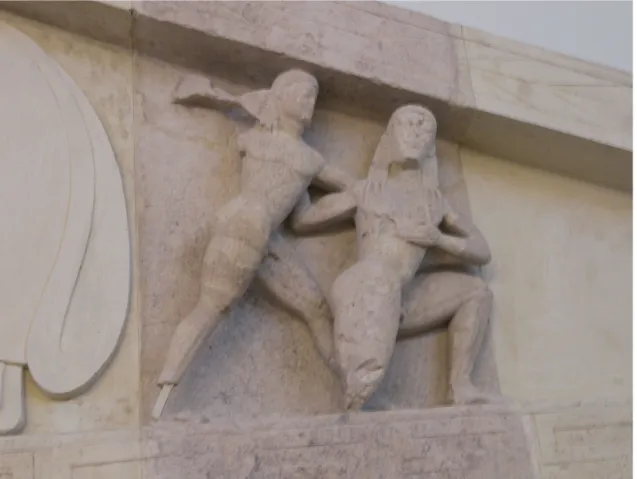
new points to further support Neer’s theory. On the east pediment of this treasury, we see an image of Apollo and Heracles struggling over the Delphic tripod (see Figure 2).
Figure 2: Apollo and Heracles Fighting Over Tripod, East Pediment of the Siphnian Treasury (Image Source: David J. Wright).
Scholars have interpreted this image in various ways. Parke and Boardman (1957) have read it as a reference to the First Sacred War. Heracles, since he tries to steal Apollo’s oracular seat, is an allegory for Crisa. Apollo represents the Amphictyony and the tripod is Delphi itself. Boardman (1978: 231) later changes his mind and suggests, in line with Peisistratus’ Heraclean propaganda in Athens, that Heracles represents Peisistratus on this pediment.40 I
suggest another interpretation: in agreement with Neer’s theory that the images on this treasury reflect civil unrest on Siphnos, I posit that the conflict between Apollo and Heracles can be read as fraternal. Indeed, Apollo and Heracles are half-brothers. The fraternal nature of this struggle is highlighted by the fact that their father, Zeus, stands between them to stop
40 Watrous (1982: 167-8) sees this scene as Delphic propaganda. Heracles represents Peisistratus (and Athens).
Apollo stands for Delphi. The tripod equals whatever they happen to be fighting over. Neer (2001: 293) rightfully dismisses this and Boardman’s views as Athenocentrism.
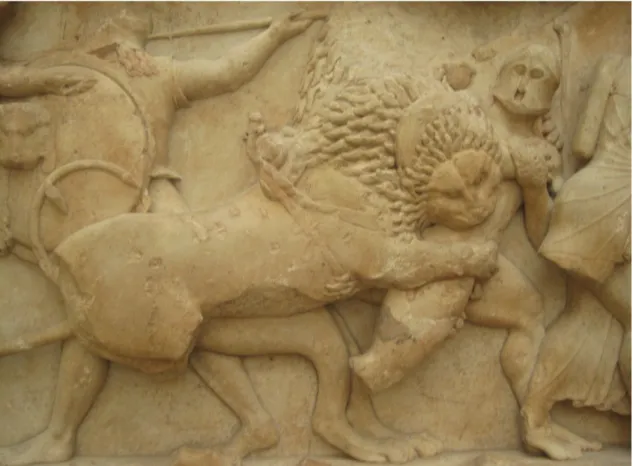
their fight. I also add that the gods, as in the case of Athena on the “Old Athena Temple,” use extreme violent force when fighting the Giants (see Figure 3).
Figure 3: Lion Bites Giant on North Frieze of the Siphnian Treasury (Image Source: David J. Wright).
In this image, a lion from Themis’ chariot brutally bites one of the Giants. Beast-like violence is often characteristic of the Giants themselves, so it seems odd here that the artist has the gods enacting this type of violence. This bestial violence is contrasted by the “civilized” image of the Giants in hoplite armor.41 I suggest that this imagery of fraternal
conflict and animalistic violence heavily connotes civil strife.
This association of the Gigantomachy and civil strife also appears on the temple of Artemis at Corcyra. This pediment contains perhaps one of the few visual depictions of a
41 For the hoplite and “civilization,” see Carpenter (2003: 23-4). Watrous (1982) views the Gigantomachy’s
hoplite armor as anti-Athenian propaganda. It also seems significant that this frieze is the only of a phalanx in Archaic sculpture (Stewart 1997: 89).
Titanomachy. On the right side of the pediment is an image of a beardless Zeus assailing another figure with a thunderbolt (see Figure 4).
Figure 4: Zeus about attack a Titan (or a Giant?) on the West Pediment of the Temple to Artemis at Corcyra (Image Source: By Dr.K. - Own work, CC BY-SA 3.0,
https://commons.wikimedia.org/w/index.php?curid=16642167).
Some scholars have suggested that the attacked figure is a Titan. If this is the case, we would have the image of Zeus assaulting one of his close relatives. Other scholars have posited that the figure is perhaps a Giant.42 In either scenario, it is a violent image. Even before the
famous bouts of stasis catalogued by Thucydides (3.81-3), Corcyra was a city famous for its internal conflict. The myth-history of the city-state confirms this. Corcyra was a colony of Corinth, and it is clear from its myth-history that Corcyra did not exist in harmony with its mother city. According to Herodotus, Periander, tyrant of Corinth, exiles his son Lycophron
to rule Corcyra after Periander kills his wife, Lycophron’s mother, Melissa (3.50-53). Shortly after his unwelcome arrival, the Corcyrans murder their new ruler Lycophron. In retaliation, Periander sends all of the sons of the Corcyrean nobles to Sardis to become eunuchs (3.48). In a later time period in the 6th century, Corcyra defeats its mother city in a prolonged naval
battle. Given the strained relationship and this ongoing existence of tension, it is unsurprising to see an image of familial strife on the pediments of one of Corcyra’s more impressive temples.43
Gigantomachy in Xenophanes
The association of these divine wars with civil conflict is more directly implied in other cases. Looking back to the 6th century BCE, we can observe this connotation of the
myth in a fragment of Xenophanes. In this fragment, which may be almost an entire poem, the speaker shares the rules of the symposium. Towards the end of the fragment, he lists the poetic topics that will be appropriate for this gathering:
χρὴ δὲ πρῶτον µὲν θεὸν ὑµνεῖν εὔφρονας ἄνδρας εὐφήµοις µύθοις καὶ καθαροῖσι λόγοις, σπείσαντάς τε καὶ εὐξαµένους τὰ δίκαια δύνασθαι πρήσσειν· ταῦτα γὰρ ὦν ἐστι προχειρότερον, οὐχ ὕβρεις· πίνειν δ' ὁπόσον κεν ἔχων ἀφίκοιο οἴκαδ' ἄνευ προπόλου µὴ πάνυ γηραλέος· ἀνδρῶν δ' αἰνεῖν τοῦτον ὃς ἐσθλὰ πιὼν ἀναφαίνει, ὡς ἦι µνηµοσύνη καὶ τόνος ἀµφ' ἀρετῆς, οὔ τι µάχας διέπειν ΤιτήνωνοὐδὲΓιγάντων οὐδὲ <τι> Κενταύρων, πλάσµα<τα> τῶν προτέρων, ἢ στάσιαςσφεδανάς· τοῖς οὐδὲν χρηστὸν ἔνεστιν·
It is necessary first for men of good disposition to compose a hymn to a god with reverent stories and clean accounts, making libations and praying to be capable of enacting justice. In fact, these things, not acts of violence, are more pressing: to drink as much as one can and make it home without an attendant unless he is elderly. And
43 For the sculptural program possible connection to Corcyra’s turbulent relationship with Corinth, see Macroni
(it is necessary) to praise this man who, drinking, offers up what is good so that there might be a recollection of and striving for arête, not to be engaged in the battles of the Titans and Giants, not at all of the Centaurs, the fictions of those before us, or violent stasis. For there is nothing useful in this. (fr. 1.13-23)
The connection between Gigantomachy and civil strife is made explicit by listing stasis (line 23) in the same categories as these types of divine conflicts. Xenophanes does not want these types of stories for his symposia since he is seeking to foster a necessary component of a good symposium: εὐνοµία. Ford (2002: 56-57) suggests there is an association in this poem between these types of battles and civil strife. He sees this poem in conjunction with other sympotic poetry that warns against topics of civil strife, particularly that of Alcaeus, whose poetry is rife with language of stasis.44 He argues that the struggles in heaven provide a
“mythic paradigm for aristocratic infighting.”
Gigantomachy in Pindar
In Pindar, the association of the Gigantomachy with themes of “Chaos vs. Order” is a strong one. In Pythian 1, the poet extols the athletic achievements of Hieron of Aetna. At the beginning of the poem, the speaker praises the power of his lyre which can calm the violence of Zeus and Ares. He then reviews the Muses’ song, which can frighten even the opponents of Zeus, including Typhon:
ὅς τ᾽ ἐν αἰνᾷ Ταρτάρῳ κεῖται, θεῶν πολέµιος, Τυφὼς ἑκατοντακάρανος: τόν ποτε Κιλίκιον θρέψεν πολυώνυµον ἄντρον: νῦν γε µὰν ταί θ᾽ ὑπὲρ Κύµας ἁλιερκέες ὄχθαι Σικελία τ᾽ αὐτοῦ πιέζει στέρνα λαχνάεντα: κίων δ᾽ οὐρανία συνέχει, νιφόεσσ᾽ Αἴτνα, πάνετες χιόνος ὀξείας τιθήνα: τᾶς ἐρεύγονται µὲν ἀπλάτου πυρὸς ἁγνόταται
44 For a list of passages from sympotic poetry treating stasis, see (Ford 2002: 65n50). Ford follows Bowra
(1938: 362) and Herter (1956: 45-47) with the interpretation here that the Gigantomachy and Titanomachy connote stasis in this Xenophanes fragment. He argues against Gentili and Prato (1979: ad loc.) who see is as reflecting poetic genre.
ἐκ µυχῶν παγαί: ποταµοὶ δ᾽ ἁµέραισιν µὲν προχέοντι ῥόον καπνοῦ αἴθων᾽: ἀλλ᾽ ἐν ὄρφναισιν πέτρας φοίνισσα κυλινδοµένα φλὸξ ἐς βαθεῖαν φέρει πόντου πλάκα σὺν πατάγῳ. κεῖνο δ᾽ Ἁφαίστοιο κρουνοὺς ἑρπετὸν δεινοτάτους ἀναπέµπει: τέρας µὲν θαυµάσιον προσιδέσθαι, θαῦµα δὲ καὶ παρεόντων ἀκοῦσαι, οἷον Αἴτνας ἐν µελαµφύλλοις δέδεται κορυφαῖς καὶ πέδῳ, στρωµνὰ δὲ χαράσσοισ᾽ ἅπαν νῶτον ποτικεκλιµένον κεντεῖ.
Who lies in dreadful Tartarus, the enemy of the gods, Typhon with the hundred heads. At one point a Cilician cave with many names reared him. Now the sea-girt banks beyond Cumae and Sicily weigh down upon his shaggy breast. A celestial pillar holds him down: snowy Aetna, a year-round nurse of swift snow. Most sacred streams of terrible fire are belched forth from its caverns. During the day, the rivers bring forth a shimmering flow of smoke. But in the darkness a red flame hurling rocks into the deep plain of the sea brings with a clash. That beast sends up most wondrous streams of Hephaestus. The marvel is wondrous to behold. And it is also a wonder for those present to hear it. Such a thing is bound in the dark-leaved peaks and plain of Aetna. His bed scratches and goads his entire stretched-out back. (Pind. Pi. 1.15-28)
This image of the disorderly monster kept in check by the Muses’ song and, more practically, by the masses of Cumae and Sicily is contrasted with the image of order created by Pindar’s lyre at the beginning of the ode (lines 1-14). The poem praises the athletic achievement of Hieron I, tyrant of Syracuse. In addition to his success in chariot racing, it also celebrates the Syracusan victory over the Carthaginians and Etruscans in 474. This can be seen as a way for the Syracusans – who were Western Greeks who therefore held a marginalized status in the Greek world – to prove their “Greekness.” Protecting Greece from invading “barbarians” was seen as a way of expressing Hellenic identity. The speaker makes an explicit reference to war with a foreign enemy later in the ode:
λίσσοµαι νεῦσον, Κρονίων, ἅµερον ὄφρα κατ᾽ οἶκον ὁ Φοίνιξ ὁ Τυρσανῶν τ᾽ ἀλαλατὸς ἔχῃ, ναυσίστονον ὕβριν ἰδὼν τὰν πρὸ Κύµας: οἷα Συρακοσίων ἀρχῷ δαµασθέντες πάθον, ὠκυπόρων ἀπὸ ναῶν ὅ σφιν ἐν πόντῳ βάλεθ᾽ ἁλικίαν, Ἑλλάδ᾽ ἐξέλκων βαρείας δουλίας. ἀρέοµαι πὰρ µὲν Σαλαµῖνος, Ἀθαναίων χάριν,