Project Performance International
http://www.ppi-int.com/newsletter/SyEN-035.php
SYSTEMS ENGINEERING NEWSLETTER
brought to you by
Project Performance International (PPI)
SyEN 49 – October 30, 2012
Dear Colleague,
SyEN is an independent free newsletter containing informative reading for the technical project professional, with scores of news and other items summarizing developments in the field, including related industry, month by month. This newsletter and a newsletter archive are also available at www.ppi-int.com.
Systems engineering can be thought of as the problem-independent, and solution/technology-independent, principles and methods related to the successful engineering of systems, to meet stakeholder requirements and maximize value delivered to stakeholders in accordance with their values.
If you are presently receiving this newsletter from an associate, you may receive the newsletter directly in future by signing up for this free service of PPI, using the form at www.ppi-int.com. If you do not wish to receive future SE eNewsletters, please reply to the notifying e-mail with "Remove" in the subject line, from the same email address. Your removal will be confirmed, by email.
We hope that you find this newsletter to be informative and useful. Please tell us what you think. Email to: [email protected].
WHAT’S INSIDE:
Quotations to Open OnRead More…
Feature Article
Active Knowledge Architecture: What Systems Engineering Need to Embrace
Read More…
Systems Engineering News
Guide to the Systems Engineering Body of Knowledge (SEBoK) V1.0 Released and Available Worldwide New and Improved IIBA Certification Exam Delivery
INCOSE MBSE Workshop 2013
Systems Engineering Certification Program (SE-ZERT®) SESA Forms Energy Transition Working Group
INCOSE Systems Engineering Journal Editor-in-Chief Search ACM SIGSIM M&S Knowledge Repository (MSKR)
Read More…
International Society of Automation (ISA)
Read More…
INCOSE Technical Operations
INCOSE Agile Systems and Systems Engineering Working Group INCOSE Model-Based Concept Working Grouping
Read More…
Systems Engineering Tools News
Rommana 12.2 Released inteGREAT 8 Launched Innoslate
Read More…
Systems Engineering Books, Reports, Articles, and Papers
Measuring Security in Requirements Engineering
Special Issue of the Journal of Visual Languages and Computing Systems Engineering – Practice and Theory
Reliability Engineering
Systems Engineering Cost Estimation with COSYSMO
Economic Systems Analysis and Assessment: Intensive Systems, Organizations and Enterprises
The Economics of Human Systems Integration: Valuation of Investments in People’s Training and Education, Safety and Health, and Work Productivity
Verification, Validation, and Testing of Engineered Systems Simulation-Based Engineering of Complex Systems Software Requirements 2
The Return on Investment from Better Requirements
A Ten Point Guide for Streamlining Product Development with Systems Engineering
Read More…
Conferences and Meetings Read More…
Education and Academia
The Institute for Systems Research, University of Maryland, USA
SDM Pulse: Newsletter of the MIT System Design and Management Program MIT Engineering Systems Division (ESD)
John Hopkins University/Applied Physics Laboratory Alexander Kossiakoff Scholarship Stevens Institute of Technology, USA - Director of Systems Engineering Position ENSTA, ParisTech – Associate Professor
United States Naval Academy – Tenure-Track Assistant Professor – Systems Engineering
Read More…
Some Systems Engineering-Relevant Websites Read More…
Standards and Guides
International Electrotechnical Commission (IEC) 61508: Functional Safety of Electrical/Electronic/Programmable Electronic Safety-related Systems
ISO 26262: Road Vehicles - Functional Safety
CENELEC EN 50126:1999 Railway Applications - The Specification and Demonstration of Reliability, Availability, Maintainability and Safety (RAMS)
CENELEC EN 50128:2011 Railway Applications: Communication, Signaling and Processing Systems - Software for Railway Control and Protection Systems
CENELEC EN 50129:2003 Railway Applications: Communication, Signaling and Processing Systems - Safety Related Electronic Systems for Signaling
Defence Standard 00-56 Safety Management Requirements for Defence Systems SDL-News: Progress on Z.109 (2012) Amd.1
Status of ITU Study Group 17 Standards (OSI-related)
Read More…
Definition to Close On – Functional Safety Read More… PPI News Read More… PPI Events Read More…
Quotations to Open On
These days, unless you devote an enormous amount of time to anticipating the future, you won't have any future. -- Ron Chernow
If we knew what it was we were doing, it would not be called research, would it? -- Albert Einstein
Feature Article
Active Knowledge Architecture: What Systems Engineering Need to Embrace
Frank Lillehagen, John Krogstie and Sobah Abbas Petersen
Commitment AS, Postbox 534, 1366 Lysaker, Norway NTNU, IDI, Høgskoleringen 1, 7491 Trondheim Norway
frank.lillehagen (at) commitment.no, krogstie (at) idi.ntnu.no, sap (at) idi.ntnu.no
Keywords: Active Knowledge Modelling, Architecture-driven Systems Engineering, Agile Approach, Emergent Enterprise Architecture, and Holistic Design
Abstract: This article introduces an agile approach to holistic design of products and systems. The approach is based on Active Knowledge Architecture (AKA) developed by applying Active Knowledge Modeling (AKM) methods and tools [1,2]. Architecture-driven workplaces, methods and services for Emergent Enterprise Architecture [3], supporting design and execution, have been prototyped. Collaborative systems engineering, as well as design of smart adaptive products and systems, can be realized by developing an AKA. Effective experimentation with alternative solutions and management of adaptive life-cycle services are just some of the many benefits that systems engineering can harvest.
The AKM technology has since 1997 been applied for experimenting with new ideas, approaches and methods for project and product design. An AKA will capture the core knowledge of any enterprise and product, enabling effective collaboration and communication across disciplines and project stages. AKA methods for modeling enterprise knowledge spaces and workspaces have been invented and prototyped as being a more effective means of process and knowledge management. Dynamic viewing, knowledge sharing and effective reuse are inherent AKA properties.
Introduction
Systems engineering and product design are recognizing limitations in current methods and growing challenges, such as escalating complexity and demand for effective in-use repair and maintenance. AKA-driven workspaces [2] for distributed design and collaborative engineering have been piloted. AKA-driven means that architecture models are actively used in designing, executing and managing workplaces and system solutions.
Properties of mental models, such as reflection and repetition are easily supported in an AKA, allowing users to combine the powers of mental and digital models. Simple graphic languages enable users to build work environments, where processes and dependencies are modeled as adaptive task-patterns. User workplaces, services and application models can be reconstructed and adapted at any time in the life-cycle of products and systems.
Systems Engineering Practices. There is consensus in the Systems Engineering (SE) community [3,4] about what SE is and how it should be performed. However, little is published about how SE will meet the challenges facing the designers, engineers and users of future networked enterprises. The dominant SE thinking is System of Systems (SoS). In SoS each system is designed with the same set of activity break-down structured processes. Each system has its separate data model and services. Design, engineering, integration and interoperation is a matter only for the SE processes and the integrating ICT architecture.
In SoS, humans are considered and modeled as any other stable system component. This means that the powerful methods of comparison, handling of alternatives and team reasoning, and the inherent properties of mental models are lost. These methods and properties cannot be expressed in natural language alone, nor by present SE modeling and coding methods. So work-centric context and local ways of working or acting cannot be captured and applied to manage dependencies and local events and practices. Interaction among mental and digital models is the only known way for capturing adaptive methods (task-patterns) and local working context.
The overall SE process, the SIMILAR model [3,4], has no common product design information model, and no user services to capture and balance system properties and parameters for managing dependencies. The model is an abstracted perspective of a theoretical workflow, or document and diagrammatic model flows. Comparing and managing alternatives is very resource consuming, and decisions cannot be traced.
Challenges and Needs. Most applications use computing purely to improve efficiency in processes and ways of working originating from layered sequential flows. The growth in bureaucracy and user communities applying spreadsheets and slides is evidence that little new thinking, knowledge sharing, and learning and innovation are taking place. There are many public application areas where we are not able to support or improve capabilities and services because practical experience, competence, contexts and tacit knowledge cannot be captured and shared. Examples besides industrial design and development are reconstruction of crime and incident modeling in police investigation, military missions and operations, and management of nature- and man-made crisis and disasters.
To meet these and other challenges designers, architects and users must adopt an agile approach to emergent Enterprise Architecture (eEA) and systems development, enabling them to capture and share knowledge about actors, events and situations. Architects and designers must be able to respond to growing variances, emergence and complexity in markets, customer demands, competences and capabilities. They must be able to concurrently work with alternative solutions, share knowledge and reiterate tasks.
The needs faced when participating in multiple global projects can only be mastered by an agile approach to holistic design and access to role-oriented execution and management services. Collaborative innovation and learning, role and competence transfer, capabilities replication, and dynamic networked enterprise execution and management is enabled by an AKA. The Active Knowledge Modeling approach supports tacit knowledge explication.
What is Active Knowledge Modeling?
Active Knowledge Modeling is an approach to enhance computing. The approach is best summarized as “using visual modeling rather than software coding to capture global as well as local context” [2]. Another key characteristic is that role-oriented workspaces support users in capturing and handling situations and complex dependencies.
AKM means that as users execute tasks assigned, they are provided architecture-driven tasks to capture data and practice in the architecture, thus creating local work-centric contexts to facilitate new working methods. As work progresses, new aspects are emerging as is the knowledge to be shared among users. The key innovations validated by prototypes can be summarized in the following statements:
Enterprise knowledge exists in multi-dimensional knowledge spaces, interlaced and interacting through properties and their parameter-structures.
1.
Work-generative knowledge has these intrinsic properties; reflective views, repetitive task-patterns, recursive flows, and replicable templates. 2.
Agile workplaces for performing tasks in a collaborative setting require role-specific workspaces with strong viewing and communication services.
3.
Data, work-centric information, and knowledge must belong to the owners of the data, the industrial users. 4.
The knowledge world is not alone object-oriented. Our mental models are role, task, view and concept driven. 5.
Work-sensitive role-oriented knowledge, reflective and common models and views, are the only true enterprise integrators. 6.
Enterprise knowledge spaces are created by disciplines and roles responsible for calculating and deciding the main properties of a product. Structures of product, organization, process and system aspects and their mutual dependencies are decided by global properties and their parameter-trees. These parameter sets decide the object structures and their relationships. Collaborative balancing should therefore be done by disciplines before parameters are decided and embodied in object-class structures.
Multi-dimensional knowledge spaces, role-oriented organizations, and the AKM methodologies and principles are further explained in our AKM book and blog [1, 2]. Two of the major concepts are defined in the following sections.
Holistic Design. Holistic design and management of situations must embrace active architecture to support collaborative learning and innovation, capturing new design and working methods and tasks. Holistic design implies working top-down, bottom-up, and middle-out, focusing on perspective views and views specific to any workspace.
Figure 1: Holistic design: top-down, bottom-up and middle-out approaches
Holistic design is top-down decomposition of objects and tasks, bottom-up aggregation of parameter values and dependencies, and middle-out balancing of parameter values between disciplines and components. Finally, parameter values are compared with life-cycle values and values specified by customers, suppliers and the manufacturing process.
Planning, economy and quality control, and other management aspects employ methods that are mostly based on top-down decomposition, e.g. Business Process Management [6]. Practical dependencies, decision-making and work processes in general are decided by bottom–up aggregated parameter values. Engineering methods work middle-out balancing discipline specific values of alternative component configurations.
What is Active Knowledge Architecture?
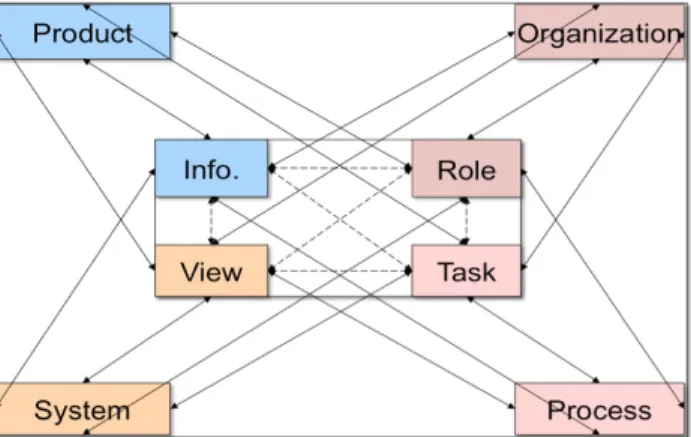
Holistic design must be performed in teams with enterprise architects, methodology experts, and leading users, supported by agile architecting methods and practitioner-driven approaches. The many kinds of models are integrated in and reused from a visual, role-oriented Active Knowledge Architecture (AKA). An AKA is built by teams and emerges as leading users express knowledge of roles and their workspaces. Architects govern principles and create modeling constructs to allow as much work-centric knowledge as possible to be captured. Modeling in practical contexts, capturing both approach and execution, allows users to express work-centric knowledge that would otherwise remain tacit and even be lost. Context-rich workspace models are created using the Information, Role, Task and View (IRTV) language.
Figure 2: Enterprise knowledge spaces and workspaces are built by teams involving leading users applying the IRTV methodology giving executable models
The models are composed of contents that focus on dependencies among and between roles (R), their main tasks (T), supporting views (V) and relevant information elements (I), as illustrated in Figure 2. Models created using this approach can automatically generate workspaces for the specific roles. Users can affect the model through their workspaces to automatically update the model.
Example from Practice
Industrial pilots have been developed that verify the AKM approach and validate the user benefits. A pilot example from an oil and gas field engineering project is presented. Its focus is on the design of a selected piping system platform area and three roles involved.
Figure 3: The crude oil piping area and eight engineering disciplines were modeled
Figure 3 shows an AKA with just the application model visible. The two workplaces generated by the AKA provide tasks for users to enhance the model and build new ones. Workplace models are composed of content specific to roles, their main tasks, supporting views and relevant information elements. The three workplaces shown in figure 4 were modeled, embedded in, and configured by tools and models embedded in the AKA.
Figure 4: The model-based workplaces of the engineering project pilot, from left: - the piping engineer, the piping area manager, and the methodology manager
The objectives of improved visual collaboration and coordination to improve work planning, reporting and execution were met in a few weeks. Practitioners must collaborate to design and apply variant, modularization, and design rules. Tasks being executed and new tasks are captured in task-patterns. These may later contribute to improved processes for design, coordination, traceability, predictability and reusability. New design principles and methodologies are developed [8], including modeling principles and services for composing modeling languages to be used in life-cycle maintenance and support. Common understanding of operations and tasks, roles and responsibilities, interoperability and information exchange, and business and engineering data was achieved. Support for user and other stakeholder involvement in modeling and architecture development and management was facilitated, as was continuous learning and innovation.
AKA Benefits. The advantages of developing an AKA to capture the approach, emerging architectures, and enterprise evolution are: Enable model-based, AKA-driven execution,
Support work in context, modeling knowledge spaces, Support role-oriented, architecture-driven workspaces, Capture local nuances, practices and rules, and rich context, Giving users control over data, information flows and viewing, Closing the gap between design and execution,
Allow users to extend networking platforms to invite new users, Extend and integrate the method base with pragmatics, Integrate and provide role-specific operational views, Give control of IT solutions and services to practitioners,
Implement new methods by combining mental and digital models, and Produce event- and situation-driven communications and views. AKA-driven knowledge bases support holistic design and portfolio management.
Towards Agile Visual Landscapes
Agility and emergence can be achieved by model-based, architecture-driven workplaces, providing capabilities for extending and modifying the Active Knowledge Architecture (AKA), and to reflect operations across stages, roles and workspaces.
Architecture-driven Collaboration. Industrial companies and public institutions are struggling to provide effective and efficient ICT support to develop and deliver services to customers, partners and suppliers. The current approaches and supporting ICT solutions are schematic, fragmented, and non-interoperable, focusing formal methods and standardized data modeling. Local work-centric context, pragmatic methods, and tacit knowledge are lost, making conceptual design, collaborative engineering, adaptive solutions, and innovation and learning from experience hard to implement. Role-oriented workspaces and architecture-driven workplaces must be developed by collaborative teams of designers, architects and users. Development should be based on visual modeling of core competence roles, working with architecture-driven workplaces, involving stakeholders and users. An AKA captures the enterprise core competence. This is a bottom-up approach and could be performed in parallel with a top-down approach modeling visions, stakeholder concerns, and business goals.
Continuous Innovation and Learning. In order to improve innovation, users must be able to share and manage data as knowledge. Computing systems and solutions must self-adapt to local situations, simplify evolution and change management, and provide roles with role- and task-specific views. This means creating a network of self-adapting mental and digital models, and providing powerful viewing and management of dependencies and shared views. As work evolves, digital models change, so mental models must also adapt, and that can only happen through situated at-the-workplace innovation and learning.
Enterprises are becoming increasingly dependent on global collaboration, on human ability to engage and motivate people, and on pursuing opportunistic business ventures. Knowledge sharing, competence transfer, and continuous innovation and learning must be supported in order for this to become a reality.
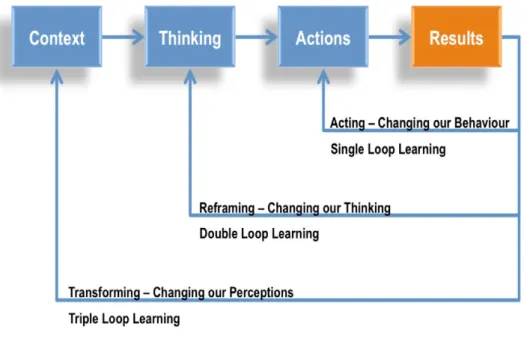
Figure 5: Rich-context digital workspaces will open new horizons for our mental models
In physical work environments humans are able to benefit from double-loop learning. Agile visual landscapes will allow designers, architects and users to engage in Open Innovation [7] and in continuous Life-cycle Learning. An AKA gives the human mind access to role-specific workspaces, where reflective views, repetitive task-patterns, and replicable methods are managed. This enhances human creativity, problem-solving capacity, and opens for triple- and even multiple-loop learning. Much more tacit knowledge can be externalized and shared. This will also make design, engineering and manufacturing processes simpler and raise the quality of products, systems and services. People assigned to roles can work with alternatives, and test and compare their capabilities before agreeing on the alternatives to produce and deliver.
Collaborative Product and Systems Design
The future will require customers and suppliers to rapidly engage in collaborative working environments, inviting partners to contribute to negotiations and results. This can be achieved by architecture-driven collaborative workspaces, and enhanced methods.
Agile approaches to emergent EA will further enable partners and suppliers and their users to align and manage business and project objectives, and enable knowledge sharing and competence transfer. Qualifying for and taking on roles, and engaging in collaboration with partners and suppliers will be performed at-the-workplace.
Company roles in multiple networked enterprises will vary and effective participation will increase in complexity. Future networked enterprises and their products and systems will need to be continuously designed, modeled and managed by visual collaboration.
Architecture-Driven Systems Engineering. We should focus on an agile approach for designing, executing and managing networked enterprises, defining teams that collaborate and share knowledge through experimentation with alternative solutions and views.
We believe the core enterprise design teams to be:
Conceptual Design Team - developing new design ideas, business models, solution concepts, performing conceptual and holistic product design, and expressing product and system specific new graphic artifacts and design rules.
Architecting Team - building, extending and adapting the active architectures and the integrating emergent EA, creating and adapting model-based graphic languages and application templates, and maintaining reference models.
Organization Team - defining and aligning new roles and responsibilities, workspaces and services, model-based workplaces, access rights and security, and recruiting and training personnel to take on roles.
Methodology Team - developing and adapting design methodology for networked Enterprise Design and Development (ED&D), holistic product and system design, systems engineering and collaboration and application models.
Applications Team - developing and assessing applications, models and services, and experimenting with alternative approaches, methods and solutions, and solutions for continuous learning and innovation.
Management Team - planning, performing and following up on work /tasks, situations and actions, and supporting decision-making, and the services and views required to execute tasks and maintain common performance views.
Knowledge Management Team - developing and managing project and domain knowledge bases, portfolios, product families, categories and classes, and providing services to support the building of new enterprises and emerging architectures.
These are not all the teams, but are the core teams needed to implement an agile approach to emergent EA. Agile processes and systems must be supported by agile architecting. The many individual roles and tasks of these teams should be modeled to help us develop a new approach and collaborative workspaces for designing, executing and managing networked enterprises and their emergent architecture.
Impact on Knowledge Economy. For ICT to provide networked business and enterprise platforms to make industry more competitive we need to take the benefits out of new innovations. We also need to rethink some of the concepts and components that are the foundations of present systems design and development.
Summary
Active knowledge architecture, work-centric knowledge and architecture-driven solutions will be decisive for future networked enterprises and for sustainable competitive industries.
The initiatives for developing agile approaches to emergent Enterprise Architecture [9] must invite practitioners to also support holistic design and execution of the networked enterprise. It is key user competence and data that are the main integrators of networked enterprises.
References
[1] Lillehagen, F. & Krogstie, J. Active Knowledge Modelling of Enterprises, Springer 2008. [2] The AKM website, see http://activeknowledgemodelling.com/.
[3] A. Terry Bahill, University of Arizona and Frank F. Dean, Sandia National Laboratories, “What is Systems Engineering”, see http://sie.arizona.edu /sysengr/whatis/whatis.html.
[4] The INCOSE website, see http://www.incose.org/practice/whatissystemseng.aspx.
[5] NASA System Engineering Handbook, see http://ntrs.nasa.gov/archive/nasa/casi.ntrs.nasa.gov/20080008301_2008008500.pdf
[6] Havey, M., Essential Business Process Modelling, O'Reiley Media 2005.
[7] Chesbrough, H. Open Services Innovation. Rethinking your business to growth and compete in a new era, San Francisco, CA: Jossey-Bass 2011. [8] Krogstie J, Lillehagen F; Methodologies for Active Knowledge Modelling. In: Halpin T, Proper E, Krogstie J (eds), Innovation in Information Systems Modelling: Methods and Best Practices. IGI 2008.
[9] AOGEA website and the California chapter, see https://www.globalaea.org/.
Systems Engineering News
Guide to the Systems Engineering Body of Knowledge (SEBoK) V1.0 Released and Available Worldwide
This key deliverable of the BKCASE Project, initiated three years ago by the US DoD and SERC (Systems Engineering Research Center), is a university partnership between the Stevens Institute of Technology and the Naval Postgraduate School. The project scope is to define a Systems Engineering Body of Knowledge and use it to develop an Advanced Graduate Reference Curriculum for Systems Engineering (GRCSE, pronounced "Gracie").Seventy contributors from around the world authored the SEBoK. Several hundred reviewers provided comments.
INCOSE and IEEE are the two key sponsors of BKCASE and will jointly ensume the stewardship of SEBoK and GRCSE beginning in 2013.
More information
New and Improved IIBA Certification Exam Delivery
The International Institute of Business Analysis (IIBA) has announced that, effective January 1, 2013, it will be working with Prometric for the delivery and administration of IIBA® certification exams. Prometric is a worldwide provider of test development and delivery solutions with over 20 years of experience, and is used by organizations such as the Project Management Institute (PMI) and INCOSE.
As of January 1, 2013, Certification of Competency in Business Analysis™ (CCBA®) and Certified Business Analysis Professional™ (CBAP®) candidates will be able to take their exams online at any of Prometric’s 8000 test centers located in more than 160 countries.
INCOSE MBSE Workshop 2013
INCOSE has invited engineering professionals to join the Model-based Systems Engineering (MBSE) Workshop on Saturday and Sunday, January 26-27, 2013 as part of the INCOSE International Workshop (IW) in Jacksonville, Florida, USA. This 2 day workshop provides an opportunity to learn about the latest MBSE activities, and to network with others involved in MBSE. The theme continues to emphasize the role of systems modeling in a multi-disciplinary engineering environment. The Workshop includes a combination of in-depth presentations, and facilitated break-out sessions. The presentations focus on systems modeling applications and the integration with hardware and software design modeling and engineering analysis models. The breakout sessions focus on high-interest and high-value topical areas including system of systems modeling, systems modeling and requirements flow down, model management, as well as usability considerations associated with MBSE. MBSE continues to be a major trend towards the advancement of the practice of systems engineering.
Additional information on the INCOSE MBSE Initiative can be found at the MBSE Wiki: http://www.omgwiki.org/MBSE/doku.php?id=start
Registration for the MBSE Workshop will be available when the INCOSE IW 2013 online registration is open at: http://www.incose.org/newsevents /events/details.aspx?id=167
More information
Systems Engineering Certification Program (SE-ZERT®)
A systems engineering certification program (SE-ZERT®) was successfully launched in Germany by the INCOSE chapter, GfSE, earlier this year. Shortly after the launch, the first certified system engineers were prepared for the exam Certified Systems Engineer "Level C" (CSE-C) and certified by
TÜV Rheinland.
More information (in German)
SESA Forms Energy Transition Working Group
The Systems Engineering Society of Australia, which is the Australian Chapter of INCOSE, has formed an Energy Transition Working Group to define, using a systems engineering approach, a transition plan for transition by 2030 from coal-based electricity generation in Australia. The Working Group will also participate with the INCOSE Energy and Power Working Group; see http://www.incose.org/practice/techactivities/wg/pande/. Convener of the SESA Energy Transition Working Group is Mike O'Keefe.
More Information
INCOSE Systems Engineering Journal Editor-in-Chief Search
The Board of Directors of the International Council on Systems Engineering (INCOSE) is soliciting nominations for Editor-in-Chief of the journal Systems Engineering. Published quarterly by Wiley Blackwell on behalf of INCOSE (www.incose.org), the journal is currently in its fifteenth volume. This position is a four-year, renewable term beginning January 1, 2013.
Systems Engineering is a primary source of multidisciplinary information for the systems engineering and management of products and services, and processes of all types.
The journal emphasizes strategic and program management of these, and the information and knowledge base for knowledge principles, knowledge practices, and knowledge perspectives for the engineering of systems..
Further information about the journal can be obtained from the journal home page: http://eu.wiley.com/WileyCDA/WileyTitle/productCd-SYS.html
Nominations should include (1) a resume of individual qualifications demonstrating experience that includes systems engineering research execution and publication, (2) the names of three individuals who can provide a reference, and (3) a brief (less than 300 words) position statement outlining a vision for the journal.
Self-nominations are encouraged. Nominations will be accepted until October 31, 2012.
More information
ACM SIGSIM M&S Knowledge Repository (MSKR)
The ACM Special Interest Group on SImulation and Modeling (ACM SIGSIM) is launching a new website; the vision is to make the website a key resource for all things modeling and simulation.
The initiative includes:
Development of an action plan;
Development (already underway) of professionally-made content which will provide an overview of M&S and its application areas; and Development of a video sourcing strategy; and
Development of short education/learning videos (less than five minutes in duration) that are more technical than the overview and cover topics ranging from "Gaussian distribution" and "Petri nets" to "Agent-Based M&S".
If you are interested in contributing expertise to the video development effort first contact the Associate Editors of the SIGSIM M&S Knowledge Repository - Saikou Y. Diallo (sdiallo (at) odu.edu) or Navonil Mustafee (navonil.mustafee (at) gmail.com) – with the topic/list of topics for which you would be interested in creating videos.
If you are an M&S consultant or are involved in marketing/development of M&S software and you are interested in developing the short videos, contact either the Editor-in-Chief of the SIGSIM M&S Knowledge Repository Osman Balci (balci (at) vt.edu) or contact Chairman, ACM SIGSIM Paul Fishwick (fishwick (at) cise.ufl.edu).
More information
International Society of Automation (ISA)
The International Society of Automation (ISA) was founded in 1945. It is a global, member-based nonprofit organization that aims to set the standard for automation by helping over 30,000 worldwide members and other professionals solve difficult technical problems, while enhancing their leadership and personal career capabilities. Based in Research Triangle Park, North Carolina, ISA develops standards; certifies industry professionals; provides education and training; publishes books and technical articles; and hosts conferences and exhibitions for automation professionals. ISA is the founding sponsor of the Automation Federation (www.automationfederation.org).
Mission and Vision
The mission of the ISA is to become the standard for automation globally by certifying industry professionals; providing education and training; publishing books and technical articles; hosting conferences and exhibitions for automation professionals; and developing standards for industry. The vision of the ISA is to work in partnership with members, customers, and subject-matter experts to disseminate the highest quality, unbiased automation information worldwide.
Activities of the ISA
Automation Standards - ISA has published more than 150 standards, recommended practices, and technical reports through the efforts of a network of industry experts. ISA member can view ISA standards online, free of charge, for your personal use.
Free Web Seminars - ISA members receive unlimited, free access to a library of over 40 online pre-recorded web seminars covering relevant topics. Technical Library - Members have access to unlimited downloads of ISA's library of more than 2,500 technical papers published at ISA conferences and symposia.
InTech Magazine - Members receive a free, qualified subscription to InTech magazine for automation professionals, and a free subscription to Automation Weekly newsletter.
Technical Divisions - ISA operates Technical Divisions, each a network of automation professionals who share technical interests. Members get two free memberships, one for the Automation and Technology Department and one from the Industries and Sciences Department. Technical Divisions are:
Aerospace Industries Division;
Chemical and Petroleum Industries Division; Construction and Design Division;
Food and Pharmaceutical Industries Division; Mining and Metals Industries Division; Power Industry Division;
Pulp and Paper Industry Division; Water and Wastewater Industries Division; Analysis Division;
Automatic Control Systems Division; Computer Technology Division; Management Division;
Process Measurement and Control Division; Robotics and Expert Systems Division; Safety Division;
Telemetry and Communication Division; and Test Measurement Division.
ISA Transactions - Members receive free online access to current and past articles covering the latest advances in the science and engineering of measurement and automation.
Leadership Development - ISA provides to members a free online Leadership Development Certificate Program.
Certification and Licensure - ISA operates a professional certification programs. ISA offers the Certified Automation Professional® (CAP®) and Certified Control Systems Technician® (CCST) programs, and supports the development of the Control Systems Engineer (CSE) licensure program. Mentoring Program - ISA provides a vehicle for connecting online with, and learning from, experienced professionals and practitioners.
Email Lists - ISA provides open forums for discussions on automation topics Conferences, Exhibitions, and Symposia
ISA Standards Committees
ISA operates more than a hundred standards committees. Of these, the following are most closely connected to systems engineering: ISA50.6, System and Network Management;
ISATAG65A, System Aspects;
ISA67.16WG1, EMI/RFI Design Requirements; ISA67.16WG4, Digital System Design Guide; ISA98, Personnel Certification Standards Committee; ISA101, Human-Machine Interface; and
ISA106, Procedural Automation for Continuous Process Operations.
Governance
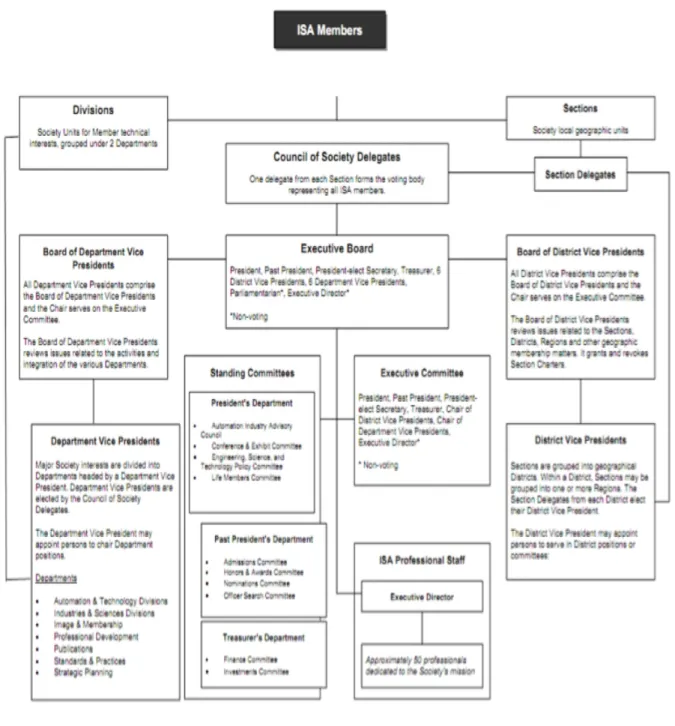
The ISA is governed via a comprehensive structure of Boards, Committees, Divisions, Departments and Sections, illustrated in the figure below. The Society has a professional staff of over 50.
Figure 1: ISA Organization
More information
INCOSE Technical Operations
INCOSE Agile Systems and Systems Engineering Working Group
Purpose
The purpose of this working group is to identify and develop a body of knowledge that will inform systems engineering and related processes which require agile system capability. Agile systems of interest to this working group include both systems engineering processes and systems-engineered systems.
This working group views agility as a sustainable system capability, enabled and constrained fundamentally by system architecture. This architecture delivers agile capability as reconfiguration, augmentation, and evolution of system functionality, after deployment, enabling the system to respond to new and immediate situational requirements effectively. Effectiveness of response is measured in response time, response cost, response quality, and response scope sufficient to sustain the system’s functional intent.
Need
The need to understand sustainably agile system design and project management concepts exists on multiple INCOSE-relevant fronts:
Agile Systems-Engineering development processes have become of interest to the corporate advisory board (CAB) companies, and they are asking that INCOSE develop appropriate guidance.
Defense organizations have an interest in how agile system concepts might inform agile acquisition processes.
Quick Reaction Capability (QRC) has been a defense acquisition need for some time and would benefit from an agile response capability by suppliers, yet generally QRC is achieved today by the employment of costly and error-prone overtime work and the increased risk of relaxing formal systems engineering processes.
Both commercial and governmental organizations are finding that the pace of technology and growing user expectations are reducing the effective life time of deployed systems.
Confusion exists in the relevance of agile software development processes to more general systems development processes, and in the relationship of lean concepts to agile concepts. This confusion needs clarifying perspective.
A large body of experience and a variety of beneficial process approaches now exists in the area of Agile Software Development (ASD). In the growing interest for more general agile system project management processes these ASD processes appear to many to be a model for more general systems engineering development, but they are tailored to the specifics of the software development environment, and exist in a variety of different approaches more akin to brand-specific practice – such as Scrum and XP to name only two.
In a very general interpretation, Lean values efficiency of operation and achieves this mainly through process principles; Agile values effective response ability and achieves this mainly through architectural principles. To be sure, both are concerned with operational effectiveness. Since the two have a different means for achieving different ends they are not necessarily in one-or-the-other conflict – but can be. When efficiency dominates the requirements, a lean Concept of Operations (ConOps) should dominate; taking additional value from Agile if and only if Lean requirements (as required by stakeholders) are not adversely compromised, and stakeholder requirements recognize some value from Agility. Vice versa, when an Agile ConOps is called for by stakeholder requirements, the design focus goes to architecture; streamlining process with Lean principles if and only if dominating Agile requirements are not adversely compromised. A useful set of requirements will make the nature of Lean vs. Agile design trade-off clear, when trade-off is unavoidable. In general, an Agile design should be as efficient as possible, and a Lean design should be as Agile as possible; but focus and values are found in the requirements.
More information
INCOSE Model-Based Concept Working Group
Purpose
The purpose of this working group is to advance the body of knowledge and practice of systems engineering (SE) through the development and application of model-based systems engineering (MBSE) methodologies to the exploratory research and concept stages of systems engineering.
Scope
Activities cover current and future model-based concept engineering theory, practice and education. The working group’s focus is on the Exploratory Research and Concept Stages of the generic life-cycle defined by INCOSE. However, the working group will also consider how model-based concept engineering influences and is influenced by other life-cycle stages.
Model-based concept engineering definition
Model-based concept engineering (MBCE) is the application of MBSE to the exploratory research and concept stages of the generic life-cycle defined by INCOSE and more specifically to the following activities:
Identify stakeholders’ needs; Explore ideas and technologies; Refine stakeholders’ needs; Explore feasible concepts; and Propose viable solutions.
Systems Engineering Tools News
Rommana 12.2 Released
Rommana, an integrated lifecycle management methodology and tool, has been released in version 12.2. Rommana 12.2 consists of the following components: Requirement Management, Test Management, Project Management, Use Case Management, Issue Management, Release and Iteration Management, Document Management, Collaboration Management, and Change Management.
The tool maintains integration between these components to eliminate common causes of project failures.
More information
inteGREAT 8 Launched
inteGREAT 8 is a requirements lifecycle management platform that leverages the capabilities of Visual Studio Team Foundation Server 2012 as its application server. inteGREAT 8 delivers a set of functionality for requirements development that aims to ensure that requirements are developed right the first time.
More information
Innoslate
Innoslate™ is a cloud-based web application developed by SPEC Innovations. This is an application made specifically for systems engineers, and is stated to provide the first systems engineering tool on the cloud that supports the full lifecycle from requirements definition and management to operations and support.
Innoslate is said to take the next step in software as a service implementation of new and classic systems engineering principles and practices to address today’s and future systems of system level problems.
SPEC Innovations states that Innoslate provides a secure, transparent, and automatically upgraded environment to reduce IT costs and enhance collaboration on small and large problems. Innoslate is the first tool to implement the new lifecycle modeling language (LML). This language was developed to simplify the elements, relationships, attributes and diagrams used in systems engineering and project management.
More information
Systems Engineering Books, Reports, Articles and Papers
Measuring Security in Requirements Engineering
by S. Besrour and I Ghani
Abstract. “The aim of this paper is to measure the security and related verification method in requirements engineering (RE). There are a few existing approaches to measure RE performance like IEEE Software Requirements Specification (SRS) and Security Quality Requirements Engineering (SQUARE). However, these existing approaches have some limitations such as lack of flexibility and require long implementation period. In order to address these issues, this paper intends to propose a new set of tools. First is the Effective Security Check List (ESCL), which is a check list with security questions that should be considered for measuring security. Secondly, the Traceability Matrix (TM), which is a two dimensional matrix to measure security during RE. Thirdly, Requirement Engineering Assessment Document (READ), which is a tool containing all statistical information about security performance during RE. The combination of presented approaches had been implemented in a case study. The outcome results are encouraging and illustrated integrated outcomes within existing RE model. The security level had also been properly measured.”
More Information
Special Issue of the Journal of Visual Languages and Computing (JVLC)
Overview
Diagrams are an integral part of many visual languages, and include graphs, UML diagrams, Euler diagrams, and a whole range of others. For diagrams to be an effective and efficient means of communication, visualization often has to be produced, either automatically or by hand, from data sets that include little or no geometric information. The resulting layout has significant impact on the ability of users to accurately interpret the information contained in the diagrams. Sometimes multiple diagrams are required to solve problems and layout algorithms may need to take into account diagrams that have already been drawn.
Moreover, information visualization can be substantially influenced by aesthetic qualities, design decisions and the use of visual elements. In order to fully realize the benefits of diagrams for information communication, research on diagram representation and layout needs to be informed by
aesthetics, cognitive and perceptual principles.
The purpose of this special issue is to bring together original contributions on both diagram layout and diagram aesthetics into a single collection, which will be a highly useful resource for researchers working in this area.
The publishers will consider submissions that focus on any type of diagram and whose primary contribution is on layout and/or aesthetics.
Submissions
The publishers solicit papers consisting of original research contributions. Submitted papers that extend previously published conference papers should be submitted with a cover note to the editors explaining the contribution beyond the earlier version. It is expected that substantial new material be included in the submission to the special issue.
Submissions can be submitted using EasyChair: https://www.easychair.org/conferences/?conf=dial2014
All papers will be subject to full peer review in line with standard JVLC practice.
Important Dates
Abstract submission: February 14, 2013.
Paper submission: February 28, 2013.
Publication date (tentative): August, 2014.
Systems Engineering - Practice and Theory
Edited by Boris Cogan
ISBN: 9789535103226
Format: Hardcover
Publication Date: 16 March 2012
Book Description (from InTech web site):
The book "Systems Engineering: Practice and Theory" is a collection of articles written by developers and researches from all around the globe. Mostly they present methodologies for separate Systems Engineering processes; others consider issues of adjacent knowledge areas and sub-areas that significantly contribute to systems development, operation, and maintenance. Case studies include aircraft, spacecraft, and space systems development, post-analysis of data collected during operation of large systems etc. Important issues related to "bottlenecks" of Systems Engineering, such as complexity, reliability, and safety of different kinds of systems, creation, operation and maintenance of services, system-human communication, and management tasks done during system projects are addressed in the collection. This book is for people who are interested in the modern state of the systems engineering knowledge area and for systems engineers involved in different activities of the area. Some articles may be a valuable source for university lecturers and students; most of the case studies can be directly used in Systems Engineering courses as illustrative materials. More information
Reliability Engineering
by K. C. Kapur ISBN: 978111814067 Format: HardcoverPublication Date: June 2013
This book presents an integrated approach for the design, engineering and management of the reliability activities throughout the life cycle of a product which includes concept, research and development, design, manufacturing, assembly, sales and service. The coverage explains how to integrate reliability methods and techniques in the Six Sigma Process and Design for Six Sigma. It also discusses relationships between warranty and reliability, as well as legal and liability issues. This is a useful guide to effectively distribute key reliability practices throughout an organization.
More information
Systems Engineering Cost Estimation with COSYSMO
by R. Valerdi ISBN: 9780470195499
Format: Hardcover
Publication Date: September 2012
Book Description (from the Amazon web site):
This book introduces the only systems engineering parametric cost model available, an industry-calibrated model known as the Constructive Systems Engineering Cost Model (COSYSMO). Lack of such a model in the past has caused systems engineering costs to be bundled with other program management costs. Its use will allow for sufficiently quantifiable justification for properly assigning systems engineering costs.
More information
Economic Systems Analysis and Assessment: Intensive Systems, Organizations and Enterprises
by A. P. Sage and W. B. Rouse
ISBN: 9780470137956
Format: Hardcover
Publication Date: April 2011
Book Description (from the Wiley web site):
This volume fills the need for a textbook on the fundamentals of economic systems analysis and assessment, illustrating their vital role in systems engineering and systems management. The book is comprised of five major parts: microeconomics, program management economics, cost estimation, strategic investments in an uncertain world and contemporary perspectives.
Also discussed in this book are normative or welfare economics and behavioral economics; COCOMO I and II and COSYSMO as examples of a cost model; and options-based valuation models and valuation of information technology intensive enterprises.
More information
The Economics of Human Systems Integration: Valuation of Investments in People’s Training and Education,
Safety and Health, and Work Productivity
ISBN: 9780470486764
Format: Hardcover
Publication Date: August 2010
Book Description (from the Wiley web site):
Human Systems Integration (HSI) is a new and fundamental integrating discipline designed to help move business and engineering cultures toward more human-centered systems. Integrating consideration of human abilities, limitations, and preferences into engineering systems yields important cost and performance benefits that otherwise would not have been accomplished. In order for this new discipline to be effective, however, a cultural change—starting with organizational leadership—is often necessary.
The book explains the difficulties underlying valuation of investments in people's training and education, safety and health, and work productivity. It provides an overview of how the field of economics addresses these difficulties, focusing on human issues associated with design, development, production, operations, maintenance, and sustainment of complex systems.
The set of thought leaders recruited as contributors to this volume collectively provides a compelling set of data and principles for assessing the economic value of investing in people, not just in general but in specific investment situations.
More information
Verification, Validation, and Testing of Engineered Systems
by A. Engel
ISBN: 9780470527511
Format: Hardcover
Publication Date: July 2010
Book Description (from the Wiley web site):
Systems' Verification, Validation and Testing (VVT) are carried out throughout systems' lifetimes. Notably, quality-cost expended on performing VVT activities and correcting system defects consumes about half of the overall engineering cost.
This book provides a comprehensive compendium of VVT activities and corresponding VVT methods for implementation throughout the entire lifecycle of an engineered system. In addition, the book strives to alleviate the fundamental testing conundrum, namely: What should be tested? How should one test? When should one test? And, when should one stop testing? In other words, how should one select a VVT strategy and how can it be optimized?
Simulation-Based Engineering of Complex Systems
by J. R. Clymer
ISBN: 9780470401293
Format: Hardcover
Publication Date: April 2009
Book Description (from the Wiley web site):
This book covers the basic principles of complex systems through the use of hands-on experimentation using an icon-based simulation tool. Utilizing the accompanying software tool ExtendSim, which works with the OpEMCSS library, readers are invited to engage in simulation-based experiments that demonstrate the principles of complex systems with an emphasis on design, analysis, and evaluation. A number of real-world examples are included to demonstrate how to model complex systems across a range of engineering, business, societal, economic, and scientific disciplines.
More information
Software Requirements 2
by K. Wiegers
ISBN: 9780735618794
Format: Paperback
Publication Date: March 2003
Book Description (from the Amazon web site):
Without formal, verifiable software requirements—and an effective system for managing them—the programs that developers think they’ve agreed to build often will not be the same products their customers are expecting. In the second edition, requirements engineering authority Karl Wieger amplifies the best practices presented in his original award-winning text now a mainstay for anyone participating in the software development process.
This book presents effective techniques for managing the requirements engineering process all the way through the development cycle—including dozens of techniques to facilitate that all-important communication between users, developers, and management. This updated edition features new case examples, anecdotes culled from the author’s extensive consulting career, and specific next steps for putting the book’s process-improvement principles into practice.
The Return on Investment from Better Requirements
by K. Wiegers
This article at blog.jamasoftware.com looks at return on investment from better requirements.
“Managers often ask what return on investment (ROI) they can expect from the money they spend on training, process improvement, and tools for requirements engineering. can’t give them a nice, tidy answer. As with so many questions in software, the correct answer is, “It depends.” In this article I discuss some of the factors that contribute to determining what ROI an organization can expect from better requirements.
If you want to determine the ROI from any activity, you need to track both what you invested in the activity and the benefits—reduced costs, accelerated schedules, increased sales, whatever—you enjoyed as a result. Unfortunately, few software organizations collect this sort of data. It’s not hard to track the money and time your organization spends developing improved requirements. Measuring the payback is trickier.
Following are some of the actions you might take to improve your requirements processes and hence the product requirements themselves. Track what you spend on these activities to determine your investment.”
More information
A Ten Point Guide for Streamlining Product Development with Systems Engineering
by J. Brown
Tech-Clarity research shows that manufacturers have grown the amount of software in their products, the importance of product software, and the level of innovation driven by software over the last five years. Products that combine mechanical, electrical, and software are compelling, but they add tremendous product development complexity leading to quality issues, poor productivity, and delayed time to market. Tech-Clarity offers the following ten tips to help companies overcome these challenges by streamlining product development using systems engineering best practices:
Start with requirements; Take time for conceptual design; Optimize the architecture; Reuse at all levels of design; Simulate the system; Manage change; True transparency; Track and trace it all;
Validate and verify with the V; and Manage configurations continuously.
More information
Conferences and Meetings
Human Factors and Ergonomics Society HFES 2012 Annual Meeting October 22 - 26, 2012, Boston, MA, USA
More information
The World Congress on Engineering and Computer Science 2012 October 24 - 26, 2012, San Francisco, USA
More information
The 14th IEEE International Symposium on High Assurance Systems Engineering (HASE 2012) October 25 - 27, 2012, Omaha, NE, USA
More information
8º Congresso Brasileiro de Sistemas
October 25 - 26, 2012, campus da PUC Minas em Poços de Caldas, MG, Brasil
More information
The 19th International Conference on Industrial Engineering and Engineering Management October 27 - 29, 2012, ChangSha, China
More information
Building Business Capabilities (BBC) 2012
October 28 - November 2, 2012, Fort Lauderdale, FL, USA More information
International Conference on Complex Systems (ICCS’12) November 5 - 6, 2012, Agadir, Morocco
More information
Physics-Based Modeling In Design & Development for U.S. Defense Conference November 5 - 8, 2012, Denver, CO, USA
More information
12th Annual CMMI Technology Conference and User Group November 5 – 8, 2012, Denver, USA
More information
INCOSE UK Annual Systems Engineering Conference 2012 November 7 - 8, 2012, London, UK
More information
Systems Engineering Day 2012 (TdSE 2012)
November 7 - 9, 2012, Paderborn, Heinz Nixdorf Museums Forum, Germany.
More information
14th International Conference on Formal Engineering Methods (ICFEM 2012) November 12 - 16, 2012, Kyoto Research Park, Kyoto, Japan
More information
IBM Systems and Software Engineering Symposium November 13, 2012, Dearborn, MI, USA
More information
Complex Adaptive Systems Conference
November 14 – 16, 2012, Washington D.C., Dulles, USA
More information
24th IFIP Int. Conference on Testing Software and Systems November 19 - 21, 2012, Aalborg, Denmark
More information
PapersModel Based Systems Engineering 2012 Symposium November 27 – 28, 2012, Edinburgh, South Australia
International Joint Conferences on Computer, Information, and Systems Sciences, and Engineering (CISSE 12) December 7 - 9, 2012, Bridgeport, CT, USA
More information
3rd International Conference on Complex Systems Design & Management (CSD&M 2012) December 12 - 14, 2012, Cité Internationale Universitaire, Paris (France)
More information
Operations Research Society of New Zealand (ORSNZ) Conference Includes a Systems stream: ‘Systems Thinking, Systems Modelling and Systems Practice’
December, 10 - 11, 2012, Wellington, New Zealand
More information
MESM'2012 The 13th annual International Middle Eastern Simulation and Modelling Conference December 10 - 12, 2012, Muscat, Oman
More information
IEEE 2012 International Conference on Industrial Engineering and Engineering Management December 10 - 13, 2012, Hong Kong
More information
System-of-Systems Workshop: An NIE Experience January 22 - 25, 2013, El Paso, TX, USA
More information
Seventh International Workshop on Variability Modelling of Software-Intensive Systems (VaMoS) January 23 - 25, 2013, Pisa, Italy
More information
INCOSE International Workshop IW2013 January 26 - 29, 2013, Jacksonville, Florida USA
More information
Conference Digital Enterprise Design & Management (DED&M 2013) February 11 - 12, 2013, Paris, France
More information
International Conference on Model-Driven Engineering and Software Development - MODELSWARD 2013 February 19 - 21, 2013, Barcelona, Spain
More information
29th Annual Test and Evaluation Conference and Displays February 25 - 28, 2013, Charlotte, NC, USA
More information
International Symposium on Engineering Secure Software and Systems (ESSoS) February 27 – March 3, 2013, Paris, France
More information
Integrated-EA Conference
March 4 - 6 2013, London, United Kingdom
More information
INCOSE IL 2013
March 5 – 6, 2013, Daniel Hotel Herzlia
More information
ASTEC 2013, Asian Simulation Technology Conference March 7 - 9, 2013, Shanghai, China
More information
2013 INCOSE LA Mini-Conference March 16, 2013, Los Angeles, CA, USA
More Information
The Requirements Engineering Track - 6th Edition at The 28th Annual ACM Symposium on Applied Computing (SAC 2013) March 18 - 22, 2013, Coimbra, Portugal
More information
11th Annual Conference on Systems Engineering Research (CSER 2013) March 19 – 22, 2013, Atlanta, Georgia, USA
More information
EMO 2013 - the 7th International Conference on Evolutionary Multi-Criterion Optimization March 19 - 22, 2013, Sheffield, UK
More information
Spring Simulation Multi-Conference (SpringSim'13) April 7 - 10, 2013, San Diego, CA, USA
More information
3rd International Workshop on Model-driven Approaches for Simulation Engineering part of the Symposium on Theory of Modeling and Simulation (SCS SpringSim 2013) April 7 - 10, 2013, San Diego, CA, USA
Call for Papers closes November 1, 2012
More information
YoungOR 18new
April 9 – 11, 2013, University of Exeter, Exeter, Unoted Kingdom
More information
International Conference on Manufacturing Systems Engineering (ICMSE 2013) April 14 - 15, 2013, Venice, Italy
More information
ECEC'2013, 20th European Concurrent Engineering Conference April 15 - 17, 2013, Lincoln, United Kingdom
More information
SysCon 2013
April 15 - 18, 2013, Orlando, FL, USA
More information
SETE 2013
April 29 – May 1, 2013, Canberra, ACT, Australia
Test Instrumentation Workshop: T&E on a Sustainment Budget May 14 - 17, 2013, Las Vegas, NV, USA
More information
ISC'2013, 11th Annual Industrial Simulation Conference May 22 - 24, 2013, Ghent, Belgium
KIM2013 Knowledge and Information Management Conference June 4 - 5, 2013, Meriden, United Kingdom
More information
13th International Conference on Process Improvement and Capability dEtermination (SPICE) June 4 – 6, 2013, University of Bremen, Germany
More information
10th International Conference on integrated Formal Methods (iFM 2013) June 10 - 14, 2013, Turku, Finland
More information
26th International Congress of Condition Monitoring and Diagnostic Engineering Management (COMADEM 2013) June 11 - 13, 2013, Helsinki, Finland
More information
81st MORS (Military Operations Research Society) Symposium June 17 - 20, 2013, United States Military Academy in West Point, NY, USA
More information
The Tenth International Conference on Condition Monitoring (CM 2013) June 18 – 20, 2013, Krakow, Poland
More information
Swiss Requirements Day 2013 June 19, 2013, Zürich, Switzerland
ASEE 120th Annual Conference & Exposition June 23 - 26, 2013, Atlanta, Georgia, USA
More information
12th International Symposium of the Analytic Hierarchy Process/Analytic Network Process (ISAHP 2013) June 23 – 26, 2013, Kuala Lumpur, Malaysia
More information
IS 2013 – Philadelphia
June 24 – 27, 2013, Philadelphia, Pennyslvania USA
More information
ISSS 2013: The 57th World Conference of the International Society for the Systems Sciences July 14 – 19, 2013, Hai Phong City, Viet Nam
More information
15th International Conference on Human-Computer Interaction 2013 (HCI International 2013) July 21 – 26, 2013, Las Vegas, Nevada, USA
Incorporating:
10th International Conference on Engineering Psychology and Cognitive Ergonomics 7th International Conference on Universal Access in Human-Computer Interaction 5th International Conference on Virtual, Augmented and Mixed Reality
5th International Conference on Cross-Cultural Design
5th International Conference on Online Communities and Social Computing 7th International Conference on Augmented Cognition
4th International Conference on Digital Human Modeling and applications in Health, Safety, Ergonomics and Risk Management 2nd International Conference on Design, User Experience and Usability
1st International Conference on Distributed, Ambient and Pervasive Interactions 1st International Conference on Human Aspects of Information Security, Privacy and Trust
More information
The Sixteenth SDL FORUM - SDL2013 Date and location to be determined, 2013
More information
ASME 2013 International Design Engineering Technical Conference and Computers and Information in Engineering Conference (IDETC/CIE2013)
August 4 - 7, 2013, location TBA, USA
More information
OR55 Annual Conference of the OR Society
September 3 - 5, 2013, Exeter University, Exeter, United Kingdom
International Conference on Operations Research September 3 - 6, 2013, Rotterdam, The Netherlands
More information
APCOSE 2013
September 9 - 11, 2013, Keio University in Japan
More information
SIMEX'2013
September 10 - 13, 2013, Brussels, Belgium
More information
30th Annual International Test and Evaluation Symposium September 16 - 20, 2013, Denver, CO, USA
More information
27th European Simulation and Modelling Conference - ESM'2013 October 2013, Lancaster, UK
More information
ASTEC 2014
March 2014, Digipen Institute of Technology, Singapore ISC'2014
June 11 - 13, 2014, Skövde, Sweden
More information
19th World Congress of the International Federation of Automatic Control (IFAC 2014) August 24 - 29, 2014, Cape Town, South Africa
More information SIMEX'2014
September 2014, Brussels, Belgium
INCOSE Europe, Middle East & Africa (EMEA) Sector: 1st EMEA Systems Engineering Conference 2014 (formerly EuSEC) October 2014, Cape Town, South Africa
ASTEC'2015, Asian Simulation Technology Conference March 2015, Japan
ISC'2015 13th Annual Industrial Simulation Conference June 2015, St.Petersburg, Russia
SIMEX'2015
September 2015, Brussels, Belgium
ISC'2016 14th Annual Industrial Simulation Conference June 2016, Bucharest, Romania
Education and Academia
The Institute for Systems Research, University of Maryland, USA
The University of Maryland, USA Institute for Systems Research (ISR) is home to cross-disciplinary research and education programs in systems engineering and sciences. It is committed to developing basic solution methodologies and tools for systems problems in a variety of application domains.
ISR is a permanent, interdisciplinary research unit within the A. James Clark School of Engineering at the University of Maryland. ISR is home to about 100 faculty and other researchers. Its basic research has resulted in new algorithms and sophisticated models for decision making and control (the sense-decide-actuate lifecycle), communications, and computing needed to model and design engineering systems that are highly automated, autonomous and distributed. New approaches to the planning and multi-objective optimization-based design of engineering systems also have been developed.
Because large-scale science requires systems engineering and, conversely, systems engineering and implementation of modern real-world systems doesn’t occur without good systems science, ISR develops both basic solution methodologies and tools for systems problems in a variety of different areas. ISR’s current main research areas are:
Communication systems and networks; Control systems and methodologies; Neuroscience and biology-based technology;