VIRTUAL
TESTING
AND
PERCEPTION
STUDIES
Prof. Dr. Andras Kemeny
Department Manager, Technical Center for Simulation
Renault Engineering Development Systems
Technocentre, Sce 67260, API : AVA 013
Art et Métier ParisTech CNRS, Le2i, Institut Image, 71100 Chalon-sur-Saône
Abstract
The use of driving simulation for vehicle design and driver perception studies is expanding progressively for the last ten years. Simulation saves indeed vehicle engineering cost and time and can be used for studies of road and traffic safety as well as human-vehicle interactions. The question - how applicable driving simulator is to the studied subjects - remains however still open because of several limitations in the fidelity to describe the studied phenomena.
On the one hand, the available computational modeling may be only a limited approximation of the studied vehicle behavior, because of the non-linear characteristics of the road contact (tires) or of the different vehicle systems and components (ex. Power-train, and aerodynamics),
On the other hand, psychophysical studies have revealed an important role of vestibular cues in speed and acceleration perception as well as steering which is still often out of reach for high-fidelity rendering.
In spite of these limitations driving simulation is expected to gain a major role in both vehicle design and perception studies. The recent advent of a dramatically different approach in vehicle engineering and driving (electric and hybrid vehicles, ecological driving, environment friendliness) will make necessary the use of driving simulation technology and methods for the rapid and cost efficient vehicle design.
Résumé
L’utilisation des simulateurs de conduite pour le développement des véhicules et les études de perception humaine n’a cessé de s’élargir depuis une dizaine d’années. La simulation permet de réduire les délais et les coûts d’ingénierie de véhicule et peut être utilisée pour des études sur la sécurité de la route et du trafic ainsi que sur les interactions humain-véhicule. La question - dans quelle mesure la simulation de conduite est applicable aux sujets d’étude - est cependant ouverte en raison des limitations dans la capacité des simulateurs à restituer les phénomènes étudiés de façon représentative.
D’une part, les modèles de calcul disponibles peuvent être une approximation limitée du comportement du véhicule étudié, à cause des caractéristiques non-linéaires du contact au sol (pneus) ou des différents organes du véhicule (ex. GMP et aérodynamique).
D’autre part, des études psychophysiques ont montré l’important rôle joué par les stimuli vestibulaires dans la perception de la vitesse, de l’accélération ainsi que de la direction dont le rendu reste encore souvent inaccessible à un niveau de fidélité satisfaisant.
Malgré ces limites, la simulation de conduite devrait gagner un rôle majeur aussi bien dans l’ingénierie automobile que dans les études de perception humaine. En effet, l’avènement d’une approche radicalement différente, dans la conception et dans la conduite des voitures
(véhicules électriques, conduite écologique, conception environnementale), rendra nécessaire l’utilisation de la technologie et des méthodes de simulation de conduite pour une ingénierie rapide et efficace.
Motion perception and vehicle driving
Vehicle driving is a task which is generally considered as essentially visual. Nevertheless it is well-established that other sensory information such as that provided by the vestibular and proprioceptive channels also contribute to the perception and control of self motion (Kemeny A. and Panerai F., 2003).
A psychophysical theory of perception was proposed in the first half of the XXth century (Gibson J.J and Gooks L.E, 1938) for automobile driving, defining a field of space, in the middle of which the driver is aiming to drive. Gibson described the visual perception of space (Gibbon J.J., 1950) as based on visual depth, distance or orientation stimuli available. Optic flow, one of the most important visual cues he proposed, is defined as a result of driving represented by the dynamic pattern of information available in the optic array along a moving pairs of viewpoints, playing a dominant role in the control of heading (Lappe et al., 1999) and collision detection (Lee N.D., 1976; Tresilian J.R., 1999).
Gibson’s theory also included a definition of the perceptual field of the space itself, bringing to the driver kinesthetic and tactile cues. The underlying ideas were applied to driving simulation from the 1980s (Nordmark S. et al., 1984; Drosdol J. et al., 1985) and since then many simulator experiments have been carried out for vehicle design (Panerai F. et al., 2001; Burns P.C et al., 1999; Boer R. et al., 2001) and driver perception studies (Cavallo V. et al., 2001; Reymond G. et al., 2001).
Simulation fidelity and vestibular cues
A critical issue in driving simulation experiments and virtual testing is simulation fidelity. When driving tasks and handling are not in the focus of the experiments, relative perceptual fidelity, allowing relative comparison between the virtual and real conditions, might be acceptable. Training, driver station ergonomics and driver alertness or other human factors studies are examples of such relative fidelity simulation experiments. Absolute simulation fidelity may be needed on the contrary when human perception or handling is studied as a function of road, visibility vehicle or traffic conditions. In these latter cases, a careful analysis of the complete set of perceptual variables is necessary.
The type of equipment used in a given simulator configuration is then crucial. For example, speed perception was studied in foggy conditions, first with a limited field-of-view monitor, using reduced image contrast, showing increased drivers’ speeds while driving (Snowden et al., 1998). Other studies with larger field-of-view driving simulators, using exponential
luminosity attenuation for fog rendering found, on the contrary, that driving speed was reduced accordingly to the fog density (Pretto et al., 2008). Furthermore, as Gibson has already pointed out, kinesthetic cues also strongly influence the perception of speed. Many other studies (Wierwille W.W. et al., 1983; Siegler et al., 2001) emphasized the importance of vestibular cues in driver perception of speed, acceleration or steering control.
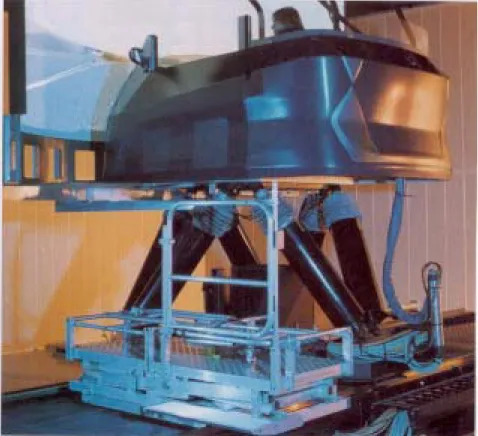
Motion cueing can be produced using motion platforms. Traditional hexapod configurations, also known as Stewart platforms (Fig. 1) are composed of 6 hydraulic or electromechanical linear actuators. They generate angular accelerations in three rotational axes (roll, pitch and yaw) which can be used for the simulation of linear accelerations thanks to the principle of gravito-inertial equivalence. It can also generate linear motions along the x, y and z axes, but the duration of the generated vestibular (otholitic) stimuli are usually too low for a significant perception of braking or lane changes.
Figure 1. The high fidelity Ultimate driving simulator of Renault with a Stewart platform and additional X, Y linear actuators
High fidelity driving simulators use for this reason, additional large amplitude linear x, y actuators.
Visual cues
Driving simulators provide most but not all the visual information perceived by the driver during real driving. Optic flow, resulting from the continuous movement of the generated images of the scene, is present, however, binocular cues, as well as motion parallax
information, aregenerally absent in simulators. Stereoscopic view is usually not considered as essential for distance perception when observing distant objects in the scene, where other visual cues are also present (Von Hofsten, C., 1978). However motion parallax (Rogers, B. and Graham, M., 1979), the differential motion of point of points because of their different depths relative to the fixation point and to the motion of observer, provides robust estimates of absolute egocentric distances when combined with information about the observer’s head movements.
Both stereoscopic and motion parallax information are often absent in driving simulators, except head mounted display equipped simulators, because of the cost and the complexity involved. However, even when motion parallax information is available, its proprioceptive integration with may reveal difficult to carry out with satisfactory transport delays in the different acquisition and rendering computation phases in order to avoid discrepancies between visual and vestibular information.
Virtual testing
Once the level of relative or absolute simulation fidelity is defined, driving simulator experiments can be carried out efficiently for vehicle design or perceptual studies. The use of driving simulators as virtual prototypes in comparison of physical prototypes may save significant cost and delay and enhance engineering design robustness. Virtual prototypes can be efficiently used for advanced vehicle design in the research phase or for vehicle synthesis in the vehicle engineering design phase and allow significant time and cost savings thanks to faster validation of vehicle systems.
The limits of the use of virtual prototypes lie in the validity of the used vehicle system modeling computer aided engineering tools, availability of vehicle or material data in the different domains of vehicle design engineering (vehicle behavior, acoustics, heating/cooling, consumption, reliability, vehicle architecture, on-board electronics and aerodynamics). Extensive vehicle measurement and simplified models may complete the usability of driving simulators as a virtual testing tool. Three examples of virtual prototypes, used at Renault, can illustrate virtual testing.
Headlight simulation
Headlight driving simulators are used at Renault since more than 10 years (Fig. 2.), based on the simulation of headlight illumination, thanks to supplier provided computational data (Lux). The simulator allows the validation of headlight design (Lecocq P. et al., 1999; Dumont et al., 2004) in driving conditions in a virtual test track environment (duplicated from
a real test track in Aubevoye, France), easy and fast headlight illumination characteristics modifications (pitch of lamps, light distribution and range, lighting in different weather conditions, etc.).
Figure 2. Headlight simulation in foggy conditions with Renault’s headlight simulator
Vehicle architecture simulation
Vehicle architecture experiments are carried out at Renault since 5 to 6 years, using Renault’s Augmented Reality (AR) simulator (Fig. 3). This simulator is allowing the comparison of CAD (Catia previously V4, presently V5) provided vehicle architecture data with real vehicle architecture as observed by the experimenters using AR Head Mounted Display (HMD) systems (Kemeny et al., 2008).
Simulation of driver aid and active safety systems
Driver aid and active safety systems, such as ABS, ESP, EPS, are the latest domains of virtual prototyping applications using high fidelity driving simulators equipped with large amplitude linear actuators or very large hexapod motion platforms (Chapron et al., 2008; Kemeny A., 2008). The limits of validation of the different tire, power train and vehicle suspension models, makes difficult a valid representation of the studied vehicle systems using driving simulation. Nevertheless, the use of scale factors, controlled experimentation scenarios and relative simulation validity makes possible to reduce significantly engineering design and specification validation and testing using driving simulators. If Renault is using since 3 years its Ultimate high performance driving simulator for active safety system validation (Fig. 1.), this domain is to be further developed in the next few years.
Conclusion
Driving simulation for virtual testing and perception studies becomes largely used, allowing efficient and fast vehicle engineering vehicle design and perceptual studies. Commercial off-the-shelf systems are already available and permit experimentations with relative simulation validity. Further future works will make possible the every day use of high fidelity driving simulators in the next years.
References
Berthoz, A. et al. (1982) Linear self-motion perception. In Tutorials on Motion Perception
(Wertheim, A.H. et al., eds), 157-199, Plenum Press
Blakemore, M.R and Snowden, R.J. (1999) The effect of the contrast upon perceived speed: a general phenomenon? Perception 28, 33-48
Blakemore, M.R and Snowden, R.J. (2000) Texture backgrounds alter perceived speed.
Vision Res. 40, 629-638
Boer, E .R., Girshick, A.R., Yamamura,T., Kuge, N. (2000) Experiencing the same road twice : a driver comparison between simulation and reality. Proc. Driving Simulation Conf.
DSC 2000, Paris France, 33-55
Burns, P.C., Saluäär, D. (1999) Intersection between driving in reality and virtual reality (VR)
Proc. Driving Simulation Conf. DSC 1999, Paris, France, 153-164
Cavallo, V. et al. (2001) Distance perception of vehicle rear lights in fog. Hum. Factors 43, 442-451
Chapron T. and Collinot J.P. (2007) The new PSA Peugeot-Citroën Advanced Driving simulator: Overall design and motion cue algorithm. Proc. Driving Simulation Conf. DSC NA
2007, Iowa, US
Chatziastros, A. et al.(1999) In The Effect of Field of View and Surface Texture on Driver Steering Performance (Gale, A.E. et al., eds), 253-259, Elsevier
Dagdelen, M., Berlioux, J.C., Panerai, F., Reymond, G., Kemeny, A.(2006) Validation process of the ULTIMATE high_performance driving simulator Proc. Driving Simulation
Conf. DSC Europe 2006, Paris, France, 37-47
Drosdol, J., Panik, F. (1985) The Daimler-Benz driving simulator, a tool for vehicle development. SAE Technical Paper. 940227 Warrendale, PA : Society of Automobile Engineers
Dumont E., Paulmier G., Lecocq P., Kemeny A. (2004) Computational and experimental assessment of real-time front-lighting simulation in night-time fog. Proc. Driving Simulation
Conf. DSC Europe 2006, Paris, France. 197-208
Gegenfurtner, K.R et al. (1999) Seeing movement in the dark. Nature 398, 475-476
Gibson, J.J (1950) The Perception of the Visual World, Houghton Mifflin
Gibson, J.J and Crooks, L.E. (1938) A theoretical field-analysis of automobile-driving. Am. J.
Psychol. 51, 453-471
Groen, E.L et al. (2000) Psychophysical threshold associated with the simulation of linear acceleration. Am. Inst. Aeronaut. Astronaut. 1, 4294-4302
Jamson, H. (2000) Driving simulation validity: issues of field of view and resolution. Proc.
Driving Simulation Conf. DSC 2000, Paris, France
Kemeny, A. and Panerai, F. (2003) Evaluating perception in driving simulation experiments.
Trends Cogn. Sci., 7(1):31-376
Land, M. and Horwood, J. (1995) Which parts of the road guide steering? Nature 377, 339-340
Land, M.F (1992) Predictable eye-head coordination during driving. Nature 359, 318-320
Land, M.F and Lee, D.N (1994) Where we look when we steer. Nature 369, 742-744
Lappe, M. et al. (1999) Perception of self-motion from visual flow. Trends Cogn. Sci., 3, 99-107
Lecocq P., Kelada J.M. and Kemeny A. (1999) Interactive Headlight Simulation. Proc.
Lee, D.N (1976) A theory of visual control of braking based on information about time-to-collision. Perception 5, 437-459
Nordmark, S. et al. (1984) Moving base driving simulator with wide angle visual system. SAE
Technical Paper Series 845100, Warrendale, PA: Society of Automobile Engineers
Panerai, F. et al. (2002) Contribution of extra-retinal signals to the scaling of object distance during self-motion. Percept. Psychophys. 64, 717-731
Panerai, F., Droulez, J., Kelada, J.M., Kemeny, A., Balligand, E., Favre, B(2001) Speed and safety distance control in truck driving: comparison of simulation and a real-world environment. Proc. Driving Simulation Conf. DSC 2000, Paris France, 91-107
Pretto, P., Chatziastros, (2006) A. Changes in optic flow and scene contrast affect the driving speed. Proc. Driving Simulation Conf. DSC Europe 2006, Paris, France, 263-272
Pretto, P. Chatziastros, A., Vidal, M. (2008) Why fog increases the perceived speed? Proc.
Driving Simulation Conf. DSC Europe 2008, Monte Carlo, Monaco, 223-235
Reymond, G., Kemeny, A., Droulez, J. Berthoz, A. (2001) Role of lateral acceleration in curve driving Simulator. Hum. Factors 43, 483-495
Rogers, B. and Graham, M. (1979) Motion parallax as an independent cue for depth perception. Perception 8, 125-134
Siegler I., Reymond G., Kemeny A., Berthoz A. (2001) Sensorimotor integration in a driving simulator : contributions of motion cueing in elementary driving tasks. Proc. Driving
Simulation Conf. DSC 2000, Paris, France, 33-55, 21-32
Snowden, R.J et al. (1998) Speed perception fogs up as visibility drops. Nature 392, 450
Takeuchi, T. and De, V. (2000) Velocity discrimination in scotopic vision. Vision Res. 40, 2011-2024
Tresilian, J.R (1999) Visually timed action: time out for ‘tau’? Trends Cogn. Sci. G, 301-310
Von Hofsten, C. (1976) The role of convergence in visual space perception. Vis. Res. 16, 193-198
Wertheim, A.H (1994) Motion perception during self-motion: the direct versus inferential controversy revisited. Behav. Brain Sci. 17, 293-355
Wertheim, A.H., Reymond, G. (2007) Neural noise distorts perceived motion: the special case of the freezing illusion and the Pavard and Berthoz effect. Exp. Brain Res. 180(3): 569-576
Wierville, W.W. et al. (1983) Driver steering reaction time to abrupt-onset crosswinds, as measured in a moving-base driving simulator. Hum. Factors 25, 103-116