Georgia Educational Research Association Conference
Oct 17th, 1:45 PM - 3:00 PM
Gifted and At-Risk
Steven Littles
Rose Prejean-Harris Ph.D.
Follow this and additional works at:https://digitalcommons.georgiasouthern.edu/gera
This presentation (open access) is brought to you for free and open access by the Conferences & Events at Digital Commons@Georgia Southern. It has been accepted for inclusion in Georgia Educational Research Association Conference by an authorized administrator of Digital Commons@Georgia Southern. For more information, please [email protected].
Recommended Citation
Littles, Steven and Prejean-Harris, Rose Ph.D., "Gifted and At-Risk" (2014).Georgia Educational Research Association Conference. 55.
Gifted and At-Risk
Steven Littles and Rose Prejean-Harris
As professionals, teachers are responsible for instructing varied sets of students
assembled in dissimilar classrooms. Therefore, differentiated delivery of curricula is needed in order to meet the various needs and abilities of any given population. The passage of No Child Left Behind ushered in an era of accountability. The unasked question became, “Accountability for whom?” The assumed answer was, “those who are struggling to consistently master the content.” As a result, a major effort was launched to identify and rescue those who were failing or close to failing, numerically, according to standardized test scores. Curricula needed to be differentiated in order to meet the needs of those found in need of them. In the true essence of education, all students were in need of differentiated curricula. However, only those with insufficient numerical scores were targeted for additional assistance. Although gifted students were thought to be able to hold their own academically, they were in need of these differentiated curricula as well. Access to differentiated curricula provides for maximization of gifted students’ learning potential, while helping to deflect the effects of other issues which surface as a result of being academically gifted.
“Giftedness” can be a double-edged sword. Being different is often devalued as a “liability” or a “burden,” especially among peers, while giftedness is appreciated as an “asset,” especially among adults (Robinson, 1997). This giftedness is easily masked by underachievement (Chism, 2012).
Literature Review
Gifted learners have varied experiences in the academic realm (Brewer, 2010; Carper, 2002; Kunjufu, 1986, 2000; Marotta-Garcia, 2011; Swanson, 2006; Taylor, 2007; Yoo & Moon, 2006). However, the at-risk gifted learners’ experiences tended to have longer lasting negative effects in regard to academic success. This review of relevant literature revealed identification practices, social hierarchy of school, advocacy for the gifted learner, life’s occurrences, and achievement and rigor as key factors in gifted students’ progressions through their educational processes, resulting in experiences far different from their peers in general and special education groupings.
Practice of placement
Much energy is devoted to sorting and selection instead of providing more resources for curriculum development that results in the engagement and challenging of learners. Swanson (2006) inquired about what happened when the focus shifts from identifying gifted students to curriculum and instruction for all? Research revealed that identification of gifted students in high poverty, high-minority schools was difficult due to the teachers’ attitudes and beliefs about students in these areas. The ideal student was the standard. Very little effort and resources went toward improving teachers’ knowledge of indicators of giftedness. Therefore, teachers’
assumptions and practices perpetuated the lack of opportunity for certain students to achieve at high levels. These beliefs also had negative effects on students’ motivation. In essence, teachers served as gatekeepers for gifted programs. In turn, this lack of access to rigorous, challenging curricula prevented high achievement and overall academic success. Above all, the true potential of certain individuals was never realized (Swanson, 2006)
Yoo & Moon (2006) noted how much attention was directed toward the notion that being gifted was an asset. Very little attention was directed toward the fact that being gifted was a huge burden as well. There was a lot of stress that accompanied being different. As a result, there was much less research available on how to meet socio-emotional needs of gifted learners and much more research on how to meet their academic needs (Yoo & Moon, 2006).
Social hierarchy of school
All school settings have a particular hierarchy. Carper (2002) talked about this order when addressing how at-risk gifted students felt about their educational process. It was noted that gifted students who dropped out of school felt they could not fit in socially in large schools. They felt alienated (Carper, 2002). Other research revealed that gifted students feel detached, isolated, and had problems with self-regulation. (Yoo & Moon, 2006)
Kunjufu (2000) adds to the conversation by stating, as a result of feelings of loneliness, the institution that emerged as the greatest competitor to the family was the peer group. The peer group rose in rank because the other institutions didn’t have the time, interest or capacity to relate to young people (Kunjufu, 2000). When students were younger, the peer group in educational settings did not exert as much influence. According to Kunjufu (1986), primary grades tended to be more nurturing environments than the upper grades. In the early grades, most of the activity was based on interaction between the child and the teacher, and there was a great deal of interaction among children. In the upper grades, the classroom environment was
transformed from socially interactive to competitive and individualistic. Learning was not so much of a social activity (Kunjufu, 1986).
Advocacy in the school
In Carper’s (2002) research on how at-risk gifted students felt about their educational process, the issue of advocacy surfaced. Gifted students who dropped out of school had not established a productive relationship with any of the adults. They felt the overcrowded conditions prevented the establishment of such relationships. The students said they felt
unimportant and unnoticed (Carper, 2002). Their feelings were legitimized by the assertion that for most children, it only takes one person to show interest in the well-being of the child in order for academic and socialization performance to improve (Kunjufu, 2000).
Life issues
As at-risk gifted students opened up about how they felt about their educational process (Carper, 2002), typical and extraordinary occurrences of life were considered as well. As early as elementary, events in students’ lives had tremendous impacts on their achievement. Major issues were health problems, dysfunctional families, and poor decision-making regarding peers (Carper 2002). In addition to life’s occurrences, gifted students had to deal with their own unique set of issues. When confronted with problems associated with their giftedness, counseling needed to increase as learners grew older. Adolescents were in the highest amount of need (Yoo & Moon, 2006).
Achievement and rigor
Taylor (2007) investigated whether ability grouping helped gifted and academically advanced students improve standardized test scores. It was found that gifted and academically advanced students made the smallest gains compared to other students. Advanced and gifted students were not being challenged enough, especially in math and language arts (Taylor, 2007). Factors which contributed to the problem were overcrowding, which led to feelings of
disengagement, which led to boredom in class, followed by underachievement, and resulted in dropping out (Carper, 2002). Kunjufu (1986) revealed, through his research on Black males, there was a consistent decline in academic achievement with the increase in age.
Marotta-Garcia (2011) studied what differentiation looked like in heterogeneous
classrooms. The study showed the impact of accountability since achievement was linked to its overall function. Teachers were under pressure to raise test scores. As a result, teachers found themselves focusing on underachieving students. Due to concerns with minimal competency, the quality of general education and the gifted curriculum were at risk (Marotta-Garcia, 2011).
While similar to the situations of all learners, the impacts of factors prevalent in gifted learners’ scholarly lives were unique to their cohort (Brewer, 2010; Carper, 2002; Kunjufu, 1986, 2000; Marotta-Garcia, 2011; Swanson, 2006; Taylor, 2007; Yoo & Moon, 2006). In particular, at-risk gifted students have taken the hardest hits. The topics of this literature review were presented in isolation. However, later sections will investigate if, indeed, identification, social hierarchy, advocacy, life issues, and rigor played significant roles simultaneously in the life of a youth who is considered gifted and at-risk.
Case Study: Freddy
The purpose of this case study is to explore the social emotional, intellectual, academic, and physiological development of a gifted black male identified as at-risk. At this stage in the research, at-risk is defined as a student who is an identified with challenges due to
socio-economic status, school disciplinary issues, and academic underperformance. In DeKalb County School District, a student is identified as gifted if three of four of the following criteria are met:
1. The mental ability criteria requires a student to score 96% or above on any area of the CoGAT or a standardized test of mental ability.
2. The achievement criteria require a student to score 90% or above on any area of a norm referenced standardized achievement test such as the ITBS.
3. The creativity criteria require 90% or above on the total battery of a standardized creativity test such as Renzulli.
4. The motivation criteria require 90% or above on the total battery of a standardized characteristics rating scale or a 3.5 GPA in core courses over the previous two school years.
Research Question(s)
The main research questions to be answered are:
1. What is the impact of the label of giftedness on young, black males who are also at-risk? 2. What are the social emotional and intellectual impacts of the label of giftedness on
young, black males?
3. How do educators, family, and peers impact the development of young, black males identified as gifted?
Rationale/Significance Statements
The concepts explored in this study serve two purposes. The first is a requirement in the current advocacy course. Qualitative studies add richness in contextual data that may otherwise be lost in a quantitative study. The second purpose of this study is to explore the factors that affect the gifted, black male students who also have identified risk-factors such as discipline issues and low socioeconomic status. As educators, we focus on the practical applications of this study to give us insight on how to best serve students who have very high potential, but are not fully producing academically. However, as parents of gifted, black male students—this study becomes more personal. It represents our willingness to view the different dynamics of what it really means to be “gifted”. From a theoretical stance, we frame this case study through a postmodern perspective with a pragmatic lens to assess “what works?” and “what data proves it?” The concept of “gifted” is situational and constantly changes based on the institution, the district, and the state. Through this study, we hope to gain insight on how to adjust professional practices of teachers through critical pedagogy and to support those young, black, and gifted male students who are often caught between social inequities and the intellectual fight to survive.
Definition of Terms
At-risk: factors such as low socioeconomic status, academic or behavioral issues, or unstable home environments that results in the academic underperformance of a student.
Giftedness: students who meet at least three out of four criteria in mental ability, academic achievement, creativity, and motivation as defined by school system policy.
Methodology
Setting
Turnpike Middle School is located in the southeastern region of the United States. The surrounding community members are very active participants in the local schools and politics of the district. The school became Title I approximately five years ago and the demographics of the student population is changing due to the decreasing economic stability of the state and country. The current student population is 70% Black, 15% White, 10% Hispanic, and 5% Asian with 67% enrolled identified as economically disadvantaged. The school is also experiencing an ESOL population increase with the continued growth of Hispanic students and the rise in the number of Asians due to the relocation of refugees from politically unstable countries like Burma. In addition, the school also has large special education and gifted populations, which comprises 10% and 15% respectively. The selection of Turnpike Middle School was due to the nature of the established relationship between one of the researchers and the student participant.
Participant
The participant in this case study is currently an eighth grade student at Turnpike Middle School. Freddy was identified as a gifted student in first grade and is still currently receiving gifted services despite the fluctuation in his academic performance in the past few years.
Data Collection Method
An in-depth analysis of Freddy’s academic and discipline record was conducted prior to the interview to generate a list of semi-structured interview questions. The researchers developed questions based upon an exploratory model of research inquiry. The researchers also took into consideration the research literature when formulating the questions. After receiving parental consent, the researcher used the questions to conduct an interview with Freddy. The researchers
did not submit an IRB request since the information for this study is for in-class purposes only. Additionally, the researchers will not publish any information from this case study.
Method of Analysis/Interpretation
The recorded participant interview was conducted by one researcher, and then sent to the second researcher for member checking (Creswell, 2007). The transcribed interview was placed into a coding chart for side-by-side theme analysis using priori-coding techniques. The defined themes of interest included academic development and social emotional relationships—with peers, teachers, and family. After the initial coding, the transcribed interview was reviewed for other possible emerging themes. The coded statements were then placed into a coding matrix for further review to help identify possible patterns, discrepancies, and insight. To help increase validity of the research, the student demographic profile was reviewed as an additional artifact to determine standardized test achievement scores, grades, attendance, and discipline records.
Findings
Analysis/Interpretation
The preliminary results of the study centers on two major themes: (a) Academic Development and (b) Social Emotional Development. Priori coding techniques were used to analyze the data. The following is a summary of the results for academic achievement and social emotional development.
Academic development: Freddy academic growth shows great potential in first through third
grade. In the interview he noted that during this time, he felt a great sense of belonging among his peers as well as the nurturing influence of his teachers. The greatest influence in his
elementary school years was that of another African-American male student in his class. Freddy states, “School was fun for me in first through third grade. I had this friend who I competed with
during class. We made it a game to see who could finish the fastest and who had the most correct answers.” Throughout the interview, Freddy continued to mention this friend as a support system because they had so much in common. In addition, Freddy spoke about the supportive nature of his teachers. He stated, “My elementary school teachers help to keep me organized and on task. They always encouraged me to do more, to read, and to do my best. I felt like they cared about me.”
The following figures represent Freddy’s academic achievement from grades 1-7. Figure 1 is a summary of his letter grades earned/ Note that Freddy earned all A’s in grades 1-3. Fourth through sixth grade results show a major decrease in academic achievement. However, Freddy experienced some success in seventh grade.
Figure 1: Letter Grades
0
2
4
6
8
A
B
C
D
F
Grade 1
Grade 2
Grade 3
Grade 4
Grade 5
Grade 6
Grade 7
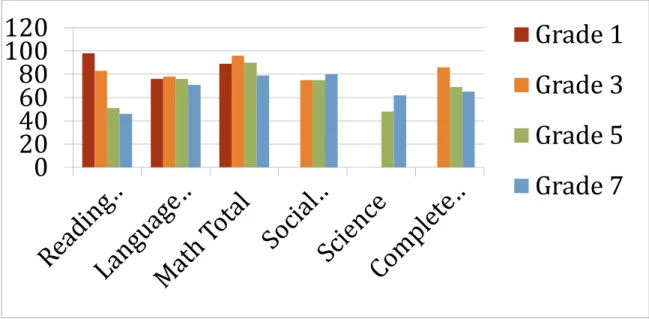
Figures 2 and 3 represent Freddy’s performance on standardized tests. Figure 2 is a summary of his Georgia Criterion Referenced Competency tests (CRCT) in reading, English/language arts, mathematics, science, and social studies. At all grade levels Freddy consistently exceeded the standard level of proficiency in reading and English/language arts. It is also interesting to note that Freddy best performance on the CRCT occurred in fourth grade, which began a period of instability in his classroom performance levels. In contrast, Figure 3 represents Freddy’s scores on the norm referenced Iowa Test of Basic Skills (ITBS). Although he received qualifying scores for the gifted program in first and third grade, Freddy failed to achieve qualifying scores in fifth and seventh grade. This is an interesting development because clearly Freddy has the cognitive ability to perform well on standardized test, but his fifth and seventh grade ITBS scores fall well below his average performance range in first and third grade, especially in reading. Figure 2: CRCT Scores
0
200
400
600
800
1000
Grade 1
Grade 2
Grade 3
Grade 4
Grade 5
Grade 6
Grade 7
Figure 3: ITBS Scores
Academically, Freddy performed well above his other peers in the classroom setting and according to standardized test scores. However, as much of the research on the self-efficacy of black males in the school setting shows, a drastic change in performance level occurred after third grade (Kunjufu, 1986). The interview with Freddy revealed aspects of his social and emotional growth had a major impact on his motivation to achieve academically.
Social Emotional Development: During the interview, Freddy revealed a moment in his
academic career that changed is outlook on school. He stated, “ I remember standing at the awards program the last day of school with my little metal, while all the other kids that received all A’s had a trophy. My teacher that year decided to give me an N in conduct because my friends and I liked to giggle during class. So even though I earned all A’s, that N in conduct stopped me from getting a trophy. I felt so bad. I was mad.” For Freddy, this moment changed his outlook on school. His teacher that year was his first male instructor, who also happened to
0
20
40
60
80
100
120
Grade 1
Grade 3
Grade 5
Grade 7
be black. To be fair and to paint a complete picture of Freddy’s life after third grade, it is important to note that other monumental changes also occurred in his home life.
Fourth grade represented a year of instability and change for Freddy. During this school year, he switched schools three times. He describes the impact of the movement like this: “It was hard moving from school to school that year. I lost my friends that I had since first grade. I loss part of my routine each time I moved that year. It’s not that the work was difficult, I was just disorganized. ” Freddy also revealed that he did not have a true sense of belonging with his peer group. He stated that this continued throughout fourth grade and beyond.
For Freddy, the discourse continued into middle school. He talked about how difficult it was to transition from fifth grade to sixth grade. He stated, “I was just not ready for all the changes in sixth grade. The changing of the classes, the workload, and the expectation of the teachers was difficult for me. I was all over the place. I could not figure it out. I would lose my work and my books. To top things off, in sixth grade the number of kids was much larger. I felt lost.” Through the conversation, an ongoing theme of isolation appeared as Freddy spoke about his relationship with his peers and is teachers. “I don’t have friends in my gifted classes. They look at me and think that I can’t do it. Even when we are in groups, the other kids will just do my part because they do not want to get a bad grade. I don’t feel like I have any friends in my gifted classes.”
Summary/Conclusion
This study sought to examine the social emotional, intellectual, and academic
development of a gifted black male identified as at-risk. The researchers sought to answer the following questions:
1. What is the impact of the label of giftedness on a young, black male who is also at-risk? 2. What are the social emotional and intellectual impacts of the label of giftedness on
young, black males?
3. How do educators, family, and peers impact the development of young, black males identified as gifted?
In the preliminary findings of this case study, Freddy stated that being in gifted classes has allowed him to stay ahead of his peers. He finds that he has more exposure to higher levels of teaching. For instance, he states, “I like the gifted classes because we get to do more activities. I remember doing plotting and graphing during challenge classes in third grade. However, it was not introduced to us again until seventh grade.” In addition, he feels like being in gifted classes has kept him out of trouble. He states, “If I was in regular classes, I probably would be kicked out of school by now. I know I would really get in trouble with some of the other kids in those classes.” However, Freddy says that the downside is that he really does fit in with the gifted kids. “Many times, I feel alone and like nobody really likes me. But, I have friends from my apartment complex that come to school here. I know that they have my back. They are not fake and talk to me no matter who they are with at the time.”
In this study, Freddy also mentions that what teachers think and how they treat him means the world of difference in his academic performance. He states, “Mrs. Concern really helped me to stay on track in seventh grade. She helped me keep up with homework and class assignments. She told me that I can do it and encouraged me to stay in control. I really felt like she cared about me and my work in school.” In addition, Freddy was also part of GREAT group because of his discipline issue. He revealed that this group facilitated by a school counselor and a local police officer helped him to stay focus. Freddy states, “ In GREAT group, Mrs. Dancer
keeps track of our discipline referrals. If she sees that I am having a hard time then she calls me in to speak with me individually. During the group, we talk about the things that have made us successful in staying out of trouble. Mrs. Dancer keeps a big chart for us to see our referrals. We get rewards if the number of referrals that we receive goes down.”
In summary, Freddy revealed a number of issues in the social emotional arena that has affected his academic performance in school. Although, he is highly capable of producing academic work equal to and above his peers, he has experienced low grades and average test scores on norm-references test. Freddy notes that his feeling of isolation in his peer group and the lack of confidence in his ability from some of his teachers contributed to this performance level.
References
Creswell, J. W. (2007). Qualitative inquiry and research design: Choosing among five approaches. Thousand Oaks, CA: Sage Publications.
Carper, A. B. (2002). Bright students in a wasteland: The at-risk gifted. A qualitative study of fourteen gifted dropouts. (Dissertation). Retrieved from http://proxy.mercer.edu /login?url=http://search.proquest.com.proxy.mercer.edu/docview/305512849
Chism, D. T. (2012). The effects of the achievement gap on students formally identified as gifted. Does giftedness prevail?(Dissertation). Retrieved from http://proxy.mercer.edu/
login?url=http://search.proquest.com.proxy.mercer.edu/docview/1011329860 Kunjufu, J. (1986). Motivating and preparing black youth for success. Chicago, Il: African
American Images.
Kunjufu, J. (2000). Developing positive self-images and discipline in black children. Chicago, Il: African American Images.
Marotta-Garcia, C. (2011). Teachers use of a differentiated curriculum for gifted students.
(Dissertation). Retrieved from http://proxy.mercer.edu/login?url=http://sear ch.proquest.com.proxy.mercer.edu/docview/901460589
Swanson, J. D. (2006). Breaking through assumptions about low-income, minority gifted students. The Gifted Child Quarterly, 50(1), 11-16.
Taylor, M. L. (2007). The effects of ability grouping on gifted and academically advanced students in rural schools. (Dissertation). Retrieved from http://proxy.mercer.edu/ login?url=http://search.proquest.com.proxy.mercer.edu/docview/304730852 Wink, J. (2011). Critical pedagogy: Notes from the real world. Upper Saddle, NJ: Pearson
Yoo J. E. & Moon, S. M. (2006). Counseling needs of gifted students: An analysis of intake forms at a university-based counseling center. The Gifted Child Quarterly, 50(1), 52-81.
Appendix A
Semi-Structured Interview Questions 1. Tell me about your first school experiences.
2. Can you remember an instance that changed your perception of school? 3. How would you describe the work in school—hard or easy and why? 4. Describe your transition from elementary to middle school.
5. How do it make you feel to be labeled gifted? Does it make a difference?
6. If you had to pick a teacher that influenced you the most, who would that teacher be and why?
7. Do you feel like you have a support system in the school? 8. How is your relationship with peers within your class?
9. Is your family/life at home supportive about your school life?
10. Magic Wand: If you had a magic wand and could change anything, what would you change and why?