Volume 3 Issue 2 Article 2
GOT! Care: Preparing the Emerging Healthcare Workforce for
GOT! Care: Preparing the Emerging Healthcare Workforce for
Interprofessional Collaborative Practice: A Pilot Study
Interprofessional Collaborative Practice: A Pilot Study
Millicent MalcolmUniversity of Connecticut School of Nursing, [email protected] Juliette Shellman
University of Connecticut School of Nursing, [email protected] Joy Elwell
University of Connecticut School of Nursing, [email protected] Catherine Rees
Middlesex Hospital, [email protected]
Recommended Citation Recommended Citation
Malcolm, M, Shellman, J, Elwell, J, Rees, C. (2017). GOT! Care: Preparing the Emerging Healthcare Workforce for Interprofessional Collaborative Practice: A Pilot Study. Health, Interprofessional Practice & Education 3(2):eP1116.
Available at: https://doi.org/10.7710/2159-1253.1116
© 2017 Malcolm et al. This open access article is distributed under a Creative Commons Attribution License, which allows unrestricted use, distribution, and reproduction in any medium, providing the original author and source are credited.
Acknowledgements and Funding Acknowledgements and Funding
“This project is supported by the Health Resources and Services Administration (HRSA) of the U.S. Department of Health and Human Services (HHS) under grant number HRSA-14-070 Nurse Education, Practice, Quality and Retention-Interprofessional Collaborative Practice for $1,400,688 with no other nongovernmental funding. This information or content and conclusions are those of the author and should not be construed as the official position or policy of, nor should any endorsements be inferred by HRSA, HHS or the U.S. Government.”
This educational strategy is available in Health, Interprofessional Practice & Education: https://commons.pacificu.edu/hip/vol3/iss2/2
GOT! Care: Preparing the Emerging Healthcare Workforce
for Interprofessional Collaborative Practice: A Pilot Study
Millicent Malcolm
D.N.P., G.N.P.- B.C., A.P.R.N. School of Nursing, University of ConnecticutJuliette Shellman
PhD, APHN-BCSchool of Nursing, University of ConnecticutJoy Elwell
DNP, FNP-BC, FAANP, FAANSchool of Nursing, University of ConnecticutCatherine Rees
MPH Director, Middlesex HospitalAbstract
The call for the development of interprofessional educational programs that train healthcare professionals is cited by the National Center for Interprofessional Education as essential for improving quality of care and patient outcomes, and reducing healthcare costs. Geriatric Outreach and Training with Care (Got Care!) is a geriatric education and practice model designed to develop a cadre of healthcare providers skilled in interprofessional, geriatric care. Unique hands-on opportunities are provided for interprofessihands-onal students to learn together in the didactic arena and then reach out with geriatric expert faculty to conduct interprofessional home visits to older adults with multiple chronic conditions and high emergency use. The purpose of this paper is to describe the development and implementation of GOT Care!. Evaluation of the team’s collaborative practice strengths and weaknesses, and students’ levels of collaborative practice skills are presented. Recommendations and direction for the continuation of the program are discussed.
Received: 07/18/2016 Accepted: 12/12/2016
© 2017 Malcolm et al. This open access article is distributed under a Creative Commons Attribution License, which allows unrestricted use, distribution, and reproduction in any medium, provided the original author and source are credited.
Introduction
The United States expects the age 65+ population to more than double from 40 million in 2010, to a projec-tion of 88 million in 2050 (Federal Agency Forum on
Aging, 2012). With this dramatic population rise, there exists a shortfall of healthcare professionals with geriat-ric expertise ready to meet the complex needs of older adults (IOM, 2008). Furthermore, the care of older adults is multi-faceted requiring an interprofessional approach with coordinated care to address multiple is-sues at once. The National Center for Interprofessional Education (NCIPE, 2016) and the World Health Or-ganization (Gilbert, Yan, & Hoffman, 2010) call for the development of interprofessional healthcare educational programs as essential requisites for reducing costs, while improving quality of care and patient outcomes. Despite the appeal for interprofessional geriatric educa-tion to adequately prepare the workforce, barriers to training program implementation persist and include: a) previous attitudes and experience toward inter-professional geriatric training and care, b) academic constraints, c) insufficiently trained educators, and d) underwhelming interest of the students in working with older adults (Bardach& Rowles, 2012; Partnership for Health in Aging, 2014). Effective design and implemen-tation of innovative clinical practice models are neces-sary to overcome these barriers. Resnickrecommends the development of innovative models with “real world” clinical experiences to enable students from different disciplines to experience working with and learning from each other. Geriatric Outreach and Training with Care (Got Care!) is an exemplar of a comprehensive geriatric education and practice model designed to de-velop a cadre of healthcare providers skilled in interpro-fessional geriatric care. A team of clinical faculty with geriatric expertise from nursing, medicine, dentistry, pharmacy, physical therapy, social work, and public health came together to develop this program, which included a didactic training program, followed by an interprofessional geriatric assessment and management clinical home visit and case conference experience. The purpose of this paper is to describe the development, pilot implementation, and evaluation of the GOT Care! Program.
Background
The Institute of Medicine (IOM) Report, Retooling for an Aging America: Building the Healthcare Workforce
(2008), documents the reality of current and pro-jected shortages for well-trained healthcare profes-sionals in the specialty of geriatrics. In 2008, the IOM reported less than 1% of pharmacists and registered nurses were certified in geriatrics, and only 4% of social workers specialized in the care of older adults. There were 7,128 physicians certified in geriatric medicine, however, this number falls short of the projected need for 36,000 geriatricians by the year 2030. In addition, only 1% of all registered nurses and 4% of all advanced practice nurses in the na-tion were certified in gerontological nursing for their practice level.
Furthermore, the IOM voiced the critical need to enhance education and training for the entire health-care workforce in the important principles, skills, and best practices for geriatric care (IOM, 2008). Despite this statement by the IOM, it has been shown that there continues to be few interprofessional educa-tion programs focused specifically on geriatric care (Partnership for Health in Aging, 2014).
Geriatric Outreach and Training with Care
The Geriatric Outreach and Training with Care (GOT Care!) Program was developed to help meet the need for a better prepared, emerging health care workforce, by imparting important principles, skills, and best practices for geriatric care to those in training. This innovative, nurse-led-PRogram was propelled with federal funding from the Health Resource and Service Administration (HRSA) Nurs-ing Education, Practice, Quality and Retention (NEPQR)-Interprofessional Collaborative Practice Program. This project strongly embraces the IPCP core competencies(Interprofessional Education Collaborative, 2014) as a pedagogical underpinning to strengthen preparation of students and residents in nursing, medicine, dental medicine, pharmacy, physical therapy, social work, and public health for team care toward improving healthcare outcomes of older adults. This project provides unique opportuni-ties for interprofessional students to learn together in the didactic arena, then reach out with geriatric expert faculty for interprofessional clinical learn-ing and practice to a population of older adults with multiple chronic conditions (MCC) and high emer-gency department (ED) use.
Needs Assessment
The local health system, and clinical partner for the GOT Care! Project, is located in a mixed suburban and rural county in the Northeast. The county service area is designated as a medically underserved area/population (HRSA, 2012). Vulnerable populations are at high risk for poor health outcomes due to their poor integration into our health care system related to factors such as racial or ethnic minority status, geographic or economic barriers, cultural differences, or significant medical needs including disabilities and multiple co-morbid conditions(Urban Institute, 2012). During the local health system’s last community health needs assessment, a vulnerable population of 65+ and 85+ age groups from the county service area were found to heavily rely on services from emergency departments for ambula-tory care sensitive (ACS) conditions and drug-related mental disorders indicating potential poly-pharmacy (University of New England Center for Health Policy, 2008). These results emphasized an opportunity for im-provement in access and coordination of geriatric ser-vices in the county service area, which might ultimately translate into reduced inappropriate ED utilization and improved quality of care for vulnerable older adults with MCC. This opportunity for improvement, coupled with the university’s goal to increase interprofessional educa-tion opportunities for its students, propelled this pro-gram as an ideal service-learning opportunity. Led by a geriatric nurse practitioner with a doctorate in nursing practice, with extensive involvement by a community hospital MPH stakeholder, GOT! Care was developed and launched. The overall mission for the GOT Care! Project is to increase the skills of the interprofessional geriatric workforce with team based education and clinical practice, outreach to a vulnerable population of older adults with faculty experts, and help improve health care outcomes in this population.
Purpose
The purpose of this pilot study was twofold: a) to evalu-ate the feasibility of the Geriatric Training with Care (GOT Care!) Program, and b) to evaluate the effective-ness of the geriatric outreach and training experience on the team’s collaborative practice. This evaluation was conducted during the first two semesters of implemen-tation. The questions that guided the evaluation of the pilot program were: 1) what were the challenges and benefits of the implementing GOT Care! Program, and
2) what is the effectiveness of the GOT! Care Program on the team’s collaborative practice?
Conceptual Framework
The conceptual framework for the Geriatric Outreach and Training with Care (GOT Care!) Program fol-lows the Interprofessional Education for Collaborative Patient-centered Practice (IECPCP) Model(D’Amour & Oandasan, 2005). In this model professionals use a systematic approach with consistent sharing of infor-mation and collaboration, reconciliation of differences between members of the team, and required engage-ment of the patient/family or population to optimize health care outcomes. The IECPCP Model integrates the concept of interprofessionality, as described by D’Amour & Oandasan(2005). With interprofessionality
professionals from different disciplines come together to reflect on and address the complex health care needs of a patient/family or population in a collective man-ner. This concept provides a mechanism to illustrate the factors and practices which can influence, enhance, and link interprofessional IP education and practice, and ultimately provide a more unified effort to improve outcomes. According to D’Amour & Oandasan(2005), this concept differs from the concept of “interdisciplin-ary” which involves combined, but still fragmented, knowledge obtained from multiple disciplines. Instead,
interprofessionality, provides an all-encompassing structure to link the important processes of IP col-laboration at the micro level of teaching, learning, and professional practice to the meso, or organizational, level. The meso level connection provides a seamless link for IP educational processes within the health care organization for IP practice. The concept of interpro-fessionality further links the meso level connections to
macro level activity such as the influencing of political, socio-economic, and cultural systems.
As IP education, followed by the IP practice experience at the health care organization level, are the essences of the experiences of GOT Care!, it is clear this program embraces the concept of interprofessionality and the IECPCP model in a comprehensive way. For example, the GOT Care! team utilizes several outcome measures to evaluate the program’s effectiveness at the micro,
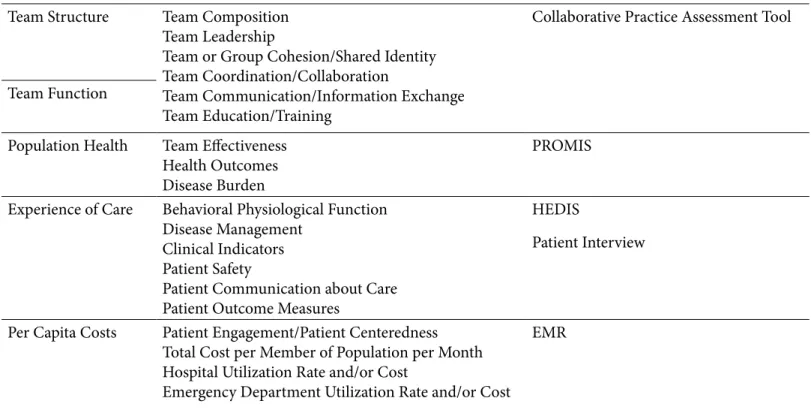
meso, and macro system levels. These outcome mea-sures include a) team structure and function, b) popu-lation health, c) experience of care, and d) per capita costs. The outcome measures with the respective core
domains of the ICPCP and measurement tools utilized to track outcomes are outlined in Table 1.
GOT Care! Interprofessional Practice Model
In order to work toward the project aim of improv-ing access and coordination of care for the vulnerable
geriatric population seen by the student and faculty teams during the outreach portion of the program, a GOT Care! Interprofessional Practice Model (Mal-colm, 2014) was developed. Figure 1depicts the overall coherence synchronization, and shared efforts of the GOT Care! Interprofessional Practice Model(Malcolm & French, 2014). Through this model, a well‐trained
IPCP Outcome Core Domains Measurement
Team Structure Team Composition
Team Leadership
Team or Group Cohesion/Shared Identity Team Coordination/Collaboration
Team Communication/Information Exchange Team Education/Training
Collaborative Practice Assessment Tool
Team Function
Population Health Team Effectiveness
Health Outcomes Disease Burden
PROMIS
Experience of Care Behavioral Physiological Function
Disease Management Clinical Indicators Patient Safety
Patient Communication about Care Patient Outcome Measures
HEDIS
Patient Interview
Per Capita Costs Patient Engagement/Patient Centeredness
Total Cost per Member of Population per Month Hospital Utilization Rate and/or Cost
Emergency Department Utilization Rate and/or Cost
EMR
Table 1. Interprofessional Collaborative Practice Outcomes and Measurement Tools
interprofessional healthcare team connects to an older adult and their foundational support system, including family, caregivers, community supports, and primary care, with the caring “heart”. This model illustrates a harmonious collaboration, with the intent to prepare and enhance the interprofessional geriatric health care workforce, while simultaneously improving healthcare outcomes for the older adult. Within the center of this model is the bright pink circle depicting the older adult. This vibrant circle stands out among the other muted circles of the model, to highlight the older adult as “the pulse of” and vital focus for the GOT Care! Project.
Organization and Implementation of the GOT Care! Project
Extensive coordination was required to develop this new IPCP education and practice model, including consultation with authorities from each of the repre-sented health care education programs from the uni-versity, and our clinical partner to satisfy all affiliation, regulatory, liability, and HIPPA requirements for both the faculty and student teams. A separate affiliation agreement, that covered faculty practice and clini-cal experiences for the full range of interprofessional students, was developed by the Program Director, in conjunction with the Attorney General’s Office for the university and authorities from the clinical agency. Coordination and validation for credentialing and ori-entation as required by the clinical agency was carried
out with each of the university health care programs involved. This project was determined to be exempt by both the University and Hospital IRB boards, as it was found to be a quality improvement project, and not human subject research.
Interprofessional Faculty and Student Recruit-ment
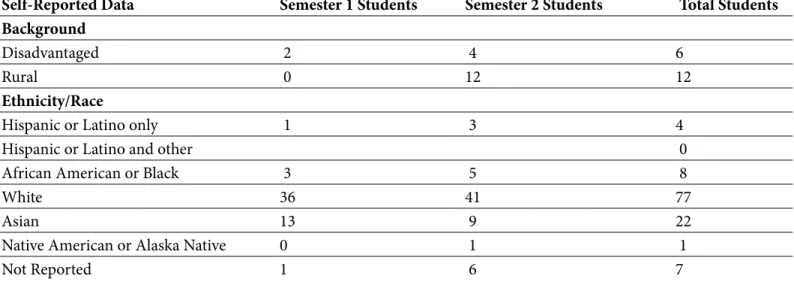
The Project Director, in collaboration with the Deans and Directors from each of the represented health care programs and the Family Medicine Residency, and Home Care agency of the hospital involved, identified and assembled faculty members from each discipline for work on the GOT Care! Program. Faculty from each of the disciplines of medicine, dental medicine, pharmacy, physical therapy, social work, and public health were invited to participate, and no limit was placed on the number of interdisciplinary students recruited for the training, but teams for the outreach program were limited to two per discipline to not overwhelm the patients. During the first two semesters 129 students and 25 faculty participated in the GOT! Care Program. The student cohort was comprised of undergraduate students from nursing (n=21) and public health (n=1) and graduate students from nurs-ing (n=27), pharmacy (n=21), medicine (n=6), physi-cal therapy (n=13), dental medicine (n=35) and social work (n=5). Other pertinent student demographic data is presented in Table 2.
Self-Reported Data Semester 1 Students Semester 2 Students Total Students
Background
Disadvantaged 2 4 6
Rural 0 12 12
Ethnicity/Race
Hispanic or Latino only 1 3 4
Hispanic or Latino and other 0
African American or Black 3 5 8
White 36 41 77
Asian 13 9 22
Native American or Alaska Native 0 1 1
Not Reported 1 6 7
Curriculum Development
The curriculum was designed to provide opportunities for IPCP team-based education and clinical collabora-tion experiences for a diverse pool of undergraduate/ pre-licensure and advanced practice graduate students representing diverse health sciences, and their cor-responding interprofessional faculty. One of the major objectives for the GOT Care! Project was to prepare our emerging IPCP health care workforce for collabor-ative team-based approaches to improving healthcare outcomes for populations and communities.
Work toward accomplishing this objective included faculty preparation, planning and development of the curriculum, training and outreach program, evalu-ation methods, and overall preparevalu-ation for merging multiple health care students and faculty together for a common clinical outreach program.
Faculty Preparation
All faculty participated in faculty development and orientation for a better understanding of the aims and objectives for the project, project phases, IPCP com-petencies, and overall responsibilities for the project. Both the faculty and student training was developed and executed by a team of five health educators with a specialty focus in IPCP education and training. This training was built on the Framework for the Develop-ment of Interprofessional Education Values and Core Competencies(Interprofessional Education Collabora-tive, 2014). Training for faculty and students included IPCP competency development and team building activities for participation in the IPCP program.
Curriculum Planning, Training and Outreach Design
Once the faculty was fully prepared for the IPCP focus of the team, work began to develop a curriculum and program for training students in IPCP, culturally com-petent, evidence-based geriatric care, including target-ed assessment of older adults who have servtarget-ed in the military. To design a strong curricular framework for the program, the program director and curriculum de-velopment team developed a foundational curriculum matrix to link the Clinical Prevention and Population Health Curriculum Framework (Meyer, et al., 2013) and Core Competencies for Interprofessional Collab-orative Practice (Interprofessional Education
Col-laborative, 2014) with specific learning objectives and learning activities for the GOT Care! Program. Several meetings were held with faculty individually and as a group to provide orientation for the project, and share the basic outline for the curriculum and training program. Faculty were asked to select topics to present in conjunction with other faculty team members and use an interactive presentation method to engage the students. The faculty had several meetings (in small groups and with the entire team) to fully develop and finalize the curriculum and training program. At the end of the process, the IPCP faculty team met for a full day workshop to finalize and approve the curriculum and training program. During the workshop the team videotaped the GOT Care! Interprofessional Home Visit as a simulation activity for use in the training program and rehearsed the interprofessional case con-ference to be carried out by our faculty for the student participants during the training days. These activities were selected by the faculty to perform as a group, to best role model IPCP and excellence in geriatric care for our students during the training.
As the curriculum and training were being developed, the IPCP faculty team also worked simultaneously to plan the clinical collaboration experience includ-ing the analysis and determination of methods and procedures for the in-home Comprehensive Geriatric Assessment (CGA) and follow up. Each of the faculty members was asked to provide input on the interpro-fessional CGA, as well as the documentation tool to be used electronically. After a number of individual and group team meetings, the final processes and pro-cedures for the outreach program were approved by all of the members of the faculty team. Our outreach clinical collaboration program was reviewed using the IPCP competencies via a crosswalk, to make sure these competencies were fully integrated for this experience for our patients, students, and faculty.
Training Workshop Description
The training program is a two-day, workshop-style program held at the beginning of each academic se-mester to introduce health care students to the com-petencies for interprofessional practice and culturally competent, evidence-based geriatric care. Special focus is placed on the targeted assessment for those older adults who have served in the military, with elements from the American Association of Nursing’s
Module One: Interprofessional Collaborative Practice Participants will:
Enhance their knowledge about interprofessionality and interprofessional collaborative care. Understand the components of interprofessionality.
Identify the four core competency domains recommended for interprofessional collaborative practice. Identify characteristics and behaviors essential for interprofessional collaborative practice.
Begin the process of developing GOT Care! learner teams. Module Two: Health Research and Policy for Older Persons Participants will:
Discuss how a local healthcare system used a community health needs assessment for strategic planning and practice purposes for the older adult target population.
Explain national trends in aging and health including demographic projections, common chronic health conditions in the older population, differences between Medicare and Medicaid, and ethical principles relevant to the care of older adults.
Module Three: Orientation to Home Care and Care of Older Persons and Hospital Specific Orientation to Privacy and Compliance
Participants will:
Participants will: Carry out safe and professional practice, with respect for patients and their environment, with strict adherence to Middlesex Hospital’s Privacy and Compliance Policies.
Module Four: Cultural Competencies for Geriatric Care Participants will:
Increase self-awareness and understanding of cultural competence in interactions with older adults. Analyze the multilevel challenges of cultural competence.
Develop an understanding of the intersection of cultural issues, interprofessional collaborative practice, and primary health care.
Module Five: Advancing Care for Veterans Participants will:
Integrate concepts of the hidden variable of military service, factors that potentially impact health and function of all older persons, and case coordination strategies to promote health and function of veterans and all older persons. Module Six: Case Studies in Interprofessional Geriatric Care
Participants will:
Analyze topics for the care of older persons including approach and communication, special assessment and care consid-erations, geriatric syndromes and presentations, risk reduction and wellness promotion.
Experience and perform elements of the comprehensive geriatric assessment within the context of the interprofessional team outreach program, with adherence to Middlesex Hospital’s Privacy and Compliance Policies.
(2011) “Have You Ever Served?” Campaign. There is a wrap up day at the end of the semester for debriefing on the program and program evaluation. Instructional Format and Activities
The program description, learning modules, learning objectives, and educational activities were formulated with Bloom’s Taxonomy (Clark, 1999). A total of seven modules with 16 learning objectives were presented in the two-day training program. Activities included multimedia lecture and video presentations (Bloom’s Cognitive Domain), small group discussions (Bloom’s Affective Domain), live mock case conference with au-dience participation (Cognitive Domain and Affective Domain), demonstration of specific assessment tools (Psychomotor Domain), hands on activity with “Have You Ever Served? (American Association of Nursing, 2011) card (Affective Domain and Psychomotor Do-main); live Benefits Check Up case study (Psychomotor Domain), case study breakouts with small group with report out to large group (Cognitive Domain and Af-fective Domain). Learning Modules and objectives are listed in.
Outreach Program
Once the training was complete, students participated as part of the interprofessional team in the outreach home visit program for vulnerable older adults with multiple chronic conditions and high emergency department use. During these outreach days, interpro-fessional groups were assembled to meet the needs of the patients we planned to visit and to meet the learn-ing needs of the students involved for the day. The day began with a pre-conference, followed by scheduled home visits, then a post-conference. Students, mentored by their faculty, carry out the role of the health care professional from their discipline during the inter-professional conferences and home visit, and had the opportunity to shadow other disciplines. Following the post-conference for the visit by students and faculty, an interprofessional problem list was generated and rec-ommendations were made to the patient’s primary care provider to reduce their patients’ risks for hospitaliza-tion and instituhospitaliza-tionalizahospitaliza-tion, medicahospitaliza-tion use, as well as functional, cognitive, and social status.
Evaluation Methods
Our evaluation plan tracks process and outcome mea-sures throughout the GOT Care! project period. Process
measures include assessments of training effectiveness as perceived by students, faculty, and primary care pro-viders and periodic documentation of student partici-pation, training program delivery, and in-home patient visits (formative evaluation). Outcome measurements are collected at the beginning and end of each semester. For the purpose of this pilot study, we utilized a demo-graphic form and the Collaborative Practice Assess-ment Tool (Schroeder et al., 2011) to assess the team’s strengths and areas for improvement.
Demographic Form
The demographic form developed by the research team consisted of self-report items regarding age, gender, race, ethnic group that they identify with, highest level of education completed, discipline and specialty, and prior experience in the geriatric home care setting.
Collaborative Practice Assessment Tool
The Collaborative Practice Assessment Tool (CPAT) (Schroeder et al., 2011) is a reliable and valid 56-item tool with a 7-point Likert-type scale. The purpose of the tool is to assess a team’s collaborative practice strengths and weaknesses. The tool has eight subscales: a) mis-sion, meaningful purpose and goals, b) general relation-ships, c) team leadership, d) general role, responsibili-ties and autonomy, e) communication and information exchange, and f) community linkages and coordination of care, g) decision‐making and conflict management and h) patient involvement. Item examples include; a) our team’s level of respect for each other enhances our ability to work together, b) members of our team share information relating to community resources, and c) our team meetings provide an open, comfortable, safe place to discuss concerns. The respondents are asked to rank each item from the perspective of the GOT! Care team’s collaborative practice. The responses range from strongly disagree (1) to strongly agree (7). In addition, there are three open-ended questions at the end of the survey to identify the GOT! Care team’s collaborative practice strengths and weaknesses. Cronbach alpha scores for the subscales range from .67-.89(Schroeder et al., 2011). In this study. Cronbach alpha scores ranged from .50-.95. The lowest alpha score (.50), calculated for the Community Linkage Scale, may be related to the low number items (4) because the number of items in a factor has been shown to impact reliability scores (Nun-nally, 1993).
Data Analysis
Demographic characteristics and descriptive data were analyzed using IBM SPSS 20.
The CPAT scores did not meet the assumption for normality, therefore, the Wilcoxon Signed Rank Test was utilized to compare means of the Collaborative Practice Assessment Tool pre-and post-GOT! Care experience. Contextual data were analyzed using an immersion-crystallization approach as described by Borkan(1999). The approach involves a systematic iterative process, a going back and forth of text in-terpretation and categorization. The PE and gradu-ate assistant reviewed all the available texts. First, the texts were separated in separate groups of faculty and students to account for the varying levels of clinical experience between the two groups. Second, meaning-ful segments were extracted from the contextual data, coded, and organized into themes.
Pilot Study Results
The first question, what were the challenges and ben-efits of implementing GOT Care! for the university and the healthcare institution?, was answered using the CPAT open ended questions from faculty and stu-dents after participating in the training and outreach program. The questions and themes are presented in Table 4.
These data gave the GOT! Care Team insight into program strengths such as the overall respect shown among the team members and the strong focus on patient-centered care. Other contextual data reflected challenges such as time, needed resources and lo-gistical issues. Consequently, the GOT! Care Team adjusted the training and outreach program to ensure student learning and improve patient outcomes. The action items listed in Table 4 identify how GOT Care! Team members will continue to facilitate program strengths and make modifications for program im-provement.
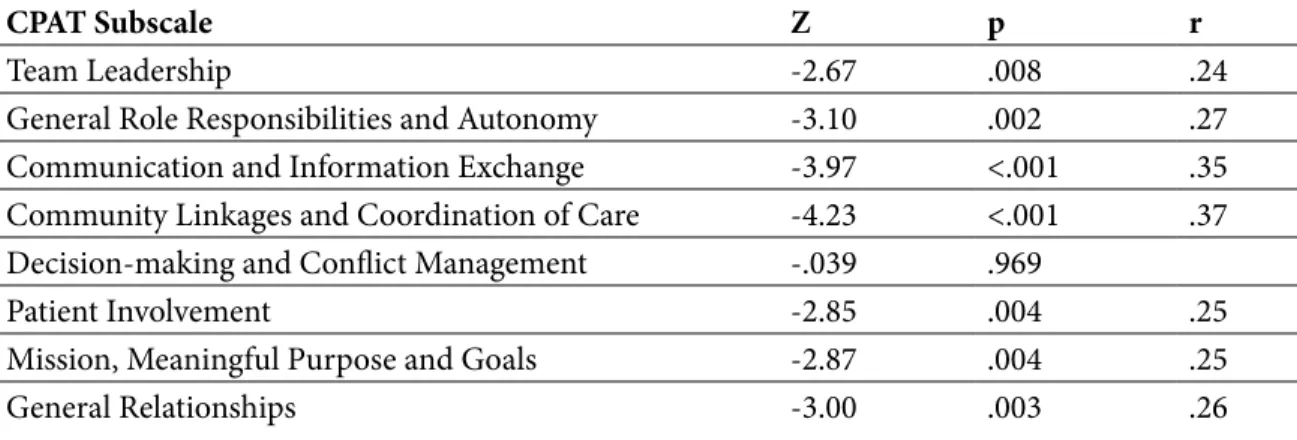
The second question, what is the effectiveness of the GOT! Care Training and Outreach Program on the team’s collaborative practice?, was answered by admin-istering the CPAT pre and post training and outreach experience. As can be seen in Table 5, statistically sig-nificant improvements in collaborative practice skills were found in seven of the eight subscales. Using
Co-hen’s guidelines(1988) effect sizes ranged from small
r=.24 (Team Leadership) to medium r=.37 (Commu-nity Linkages and Coordination of Care).
Discussion
The geriatric outreach and training program is a federally funded collaboration between a university and a hospital system serving a large population of older adults with multiple chronic illnesses. The GOT Care! Project is poised to break down many of the barriers to geriatric education noted by Bardach and Rowles (2012), by providing opportunities for inter-professional students to learn together in a two-day didactic training program focused on IPCP, culturally competent, evidence-based geriatric care. Following the training, teams of interprofessional students and geriatric faculty from nursing, pharmacy, medicine, physical therapy, social work, and dental medicine work jointly with the hospital and their home care agency provide outreach to older adults with special needs in their homes to provide a Comprehensive Ge-riatric Assessment (CGA) and a follow up visit three weeks later. Students have the unique opportunity to develop skills and critical knowledge for risk reduc-tion and health promoreduc-tion for older adults. These collaborative experiences are consistent with the IPEC recommendation for interactive learning for students from multiple health disciplines, working together from pre-licensure to practice.
Evaluation of the GOT! Care curriculum and the team’s collaborative practice skills provide encouraging data and direction for the continuation of the program. Students made positive comments regarding program implementation. For example, comments included: a) learning about roles and responsibilities of other pro-fessionals on the team, b) the patient-centered focus of the team, and c) learning to link patients to community resources. The barriers identified by students included: a) issues with scheduling visits to patient, b) more hands-on experiences, and c) logistical issues such as space and time. These data were helpful to the faculty in making program adjustments to improve students’ experiences. For instance, during the first semester of the program students reported their need for increased hands-on experiences with patients. The project direc-tor, because of the feedback, worked with faculty to rearrange the schedule to increase student involvement with geriatric assessment and reporting during
inter-Table 4. Student and Faculty Intercollaborative Practice Formative Evaluation Results
Table 5. Student Levels of Collaborative Practice Skills Pre and Post GOT! Care
CPAT Subscale Z p r
Team Leadership -2.67 .008 .24
General Role Responsibilities and Autonomy -3.10 .002 .27
Communication and Information Exchange -3.97 <.001 .35
Community Linkages and Coordination of Care -4.23 <.001 .37
Decision-making and Conflict Management -.039 .969
Patient Involvement -2.85 .004 .25
Mission, Meaningful Purpose and Goals -2.87 .004 .25
General Relationships -3.00 .003 .26
Question Theme Action
What does your GOT! Care team do well with regards to collaborative practice?
1. High degree of mutual respect for team members.
2. Patient-centered team members. 3. Strong desire to collaborate together.
4. Networking with other agencies to link patients with appropriate services.
1. Continue with interprofessional education training programs that emphasize patient centered care and the core principles of ICPE. 2. Continue to foster relationships with community services in the Middletown service area. 3. Continue evaluation of our collaborative practice.
In your GOT! Care practice, what are the most difficult challenges to collaboration?
1. Time and scheduling
2. More hands on experiences for students
3. Environmental challenges.
1. Changed training session site to accommodate faculty and students. 2. Students provided with increased opportunities for assessment and reporting in interprofessional team meetings.
What does your Got! Care team need help with to improve collaborative practice?
1. Need for a designated point person for follow-up care. 2. Team members without hospital e-mails yet. Hinders communications, and timely follow-up.
3. Create a pointed question intake form to identify most important patient needs.
1. Nurse Navigator role expanded. 2. Google site for documentation completed.
3. Geriatric Assessment Form revised to prioritize patient needs.
professional team meetings. Consequently, the second cohort of student voiced no dissatisfaction with the outreach portion of the program.
Pre and post experience measurement of the GOT! Care team’s collaborative practice revealed significant improvement in seven of the eight subscales of the Collaborative Practice Assessment Tool. The statisti-cally significant improvement in the seven subscales reflect the team’s efforts related to careful curriculum planning and training based on the Framework for the Development of Interprofessional Education Values and Core Competencies(Interprofessional Education Collaborative, 2011). In addition, as noted by students, faculty served as leaders in interprofessional collabora-tive practice during the home visits and case confer-ences. The major strength of the GOT! Care Program is providing the opportunity for students to apply the IPE values and core competencies in practice after the didactic training sessions. The Robert Wood Johnson Foundation White Paper on Interprofessional Collab-orative Practice(RWJF, 2015) stresses the importance of training students in interprofessional teams while caring for patients. This intentional team clinical train-ing provides students with the opportunity to hone important interprofessional behaviors and skills which they will carry into their professional careers. Specifi-cally teaching students how to practice interprofession-ally will enhance teamwork and communication skills to promote patient safety, break down professional silos, increase professionalism and professional satisfaction among disciplines. These future clinicians will be more likely to practice interprofessional collaborative care with mutual respect for other team members leading to improved patient outcomes.
The decision making and conflict management subscale was the only area not showing significant improvement. As noted by students, this may be attributed by the high level of respect shown between members of the team and strong desire to collaborate to improve patient care at the start of the program.
Implications and Future Directions
Results from this pilot study have implications for aca-demic and health care institutions.
Thus far, the GOT! Care Program is showing that train-ing the future geriatric workforce requires careful plan-ning, an inclusive approach, high level of collaboration
and commitment between institutions involved, strong leadership by the project director and her team, and a trained faculty committed to the curriculum and objec-tives of the program. Moreover, including a clinical component to the training program enables student to apply the IPE values and core competencies in practice increasing student levels of collaborative practice in geriatric care.
This pilot study demonstrated that interprofessional education and training in geriatric care can be imple-mented when academic institution and a hospital sys-tem partner with the ultimate goal of improving patient care, as recommended in the IECPCP Model (D’Amour & Oandasan, 2005), and integrates the model’s concept of interprofessionality, at the micro level with IP teach-ing and practice, and meso level, with integration of IP teaching and practice in the real world clinical environ-ment. The infrastructure of the GOT! Care Program is in place and prepared to continue to develop a cadre of healthcare providers skilled in interprofessional, geriat-ric care. The next step in the process for the GOT! Care Team is to focus on our mutual goal of improving care to a population of older adults with multiple chronic conditions and high emergency department use. Future directions include the examination of patient out-comes including the effect of the GOT! Care Program on decreasing emergency department visits and Triple Aim outcomes such as population health, experience of care, and cost of care. Outcomes from these areas, coupled with outcomes from this pilot IP training and practice experience, are intended to add to the body of evidence on how IPE and IPCP can improve the deliv-ery of healthcare in a patient-centered, quality focused, efficient and cost effective manner, hopefully impacting and influencing the macro level healthcare system with-in the political, socio-economic, and cultural spheres.
Acknowledgements
This project is supported by the Health Resources and Services Administration (HRSA) of the U.S. Depart-ment of Health and Human Services (HHS) under grant number HRSA-14-070 Nurse Education, Practice, Quality and Retention-Interprofessional Collaborative Practice for $1,400,688 with no other nongovernmental funding. This information or content and conclusions are those of the author and should not be construed as the official position or policy of, nor should any endorsements be inferred by HRSA, HHS or the U.S.
References
American Academy of Nursing’s Military & Veterans Health Expert Panel (2011). Have you ever served in the military? Re-trieved from http://www.haveyoueverserved.com/about.html
Bardach, S. H., & Rowles, G. D. (2012). Geriatric education in the health professions: Are we making progress? The Gerontologist, 1–12.
Borkan J. (1999). Immersion/crystallization. In: B. Crabtree & W. Miller, eds. Doing Qualitative Research. 179-194. Thousand Oaks, CA: Sage.
Clark, D. R. (1999). Bloom’s Taxonomy of Learning Domains. Re-trieved from http://www.nwlink.com/~donclark/hrd/bloom.html. Cohen J. (1998). Sustained power analysis for the behavioral
sci-ences. Hillsdale, NJ: Erlbaum.
D’Amour, D. & Oandasan, I. (2005). Interprofessionality as the field of interprofessional practice and interprofessional education: An emerging concept. Journal of Interprofessional Care, 19 (Sup-plement 1), 8-20. https://doi.org/10.1080/13561820500081604
Federal Agency Forum on Aging Related Statistics (2012). Re-trieved from http://www.agingstats.gov/agingstatsdotnet/Main_
Site/Data/2012_Documents/Docs/EntireChartbook.pdf.
Gilbert, J. H., Yan. J., & Hoffman, S. J. (2010). A WHO report: framework for action on interprofessional education and collab-orative practice. Journal of Allied Health, 39 Supplement 1:196-197.
Health Resource and Service Administration (2012). Available at
http://muafind.hrsa.gov/index.aspx. Retrieved May 10, 2016.
Institute of Medicine. Retooling for an Aging America. Washing-ton, DC: National Academies Press, 2008.
Interprofessional Education Collaborative Expert Panel. (2011). Core competencies for interprofessional collaborative practice: Report of an expert panel. Retrieved from http://bit.ly/j56wKu
Malcolm M. (2014). Geriatric outreach and training with care (GOT! Care) Interprofessional collaborative practice model. Retrieved from http://gotcare.uconn.edu/geriatric-outreach-and-training-with-care-got-care-interprofessional-practice-model/
Malcolm M, & French C. (2014). Geriatric outreach and training with care (GOT! Care) interprofessional collaborative practice model depiction. Retrieved from http://nursing.uconn.edu/wp-content/uploads/sites/939/2015/07/GotCare_Description.pdf
Meyer, S., Garr, D. R., & Evans, C. (2013). Advancing Interpro-fessional Clinical Prevention and Population Health Education Curriculum Development Guide for Health Professions Faculty. Washington, D.C.: Association for Prevention Teaching and Research.
National Center for Interprofessional Practice and Education (2015). Retrieved from https://nexusipe.org/
Nunnally, J. C. (1978). Psychometric theory (2nd ed.). New York: McGraw-Hill.
Partnership for Health in Aging Workgroup on Interdisciplinary Team Training in Geriatrics (2014). Position statement on inter-disciplinary team training in geriatrics: An essential component of quality care for older adults. Journal of the American Geriatric
Society, 62: 961-965. https://doi.org/10.1111/jgs.12822
Resnick, B. (2015). Interdisciplinary education and practice: Where are we with all that? Geriatric Nursing, 36(3):175-176.
https://doi.org/10.1016/j.gerinurse.2015.04.001
Schroder, C., Medves, J., Paterson, M., Byrnes, V., Chapman, C., O’Riordan, A., … Kelly, C. (2011). Development and pilot testing of the collaborative practice assessment tool. Journal of
Interpro-fessional Care, 25:189-195. https://doi.org/10.3109/13561820.201
0.532620
Urban Institute. (2012). Vulnerable populations. Health policy center. Retrieved from http://www.urban.org/health_policy/vul-nerable_populations/index.cfm
University of New England Center for Health Policy, Planning, and Research, (2008). A Community Health Assessment for Middlesex County, Connecticut; commissioned by and prepared for Middlesex Health System, Inc., Middletown, CT. Journal
Interprofessional Care, 25:189-195.
Robert Wood Johnson Foundation (2015). Lessons from the Field, Promising Interprofessional Collaboration Practices. Retrieved fromhttp://www.rwjf.org/content/dam/farm/reports/
reports/2015/rwjf418568.
Corresponding Author
Millicent Malcolm D.N.P., G.N.P.- B.C., A.P.R.N. School of Nursing Augustus Storrs Hall 231 Glenbrook Road Storrs, CT 06269-4026 [email protected]