By
Takaedza Munangatire
Thesis presented in partial fulfilment of the requirements for the degree Master of Philosophy
in
Health Science Education (MPhil in HSE)
in the
Faculty of Health Sciences at
Stellenbosch University
Supervisor: Estelle Smuts Co-supervisor: Dawn Ernstzen
i
Declaration
By submitting this thesis electronically, I Takaedza Munangatire declare that the entirety of the work contained therein is my own, original work, that I am the authorship owner thereof (unless to the extent explicitly otherwise stated) and that I have not previously in its entirety or in part submitted it for obtaining any qualification.
Date: 29 September 2014
Copyright © 2014 Stellenbosch University All rights reserved
ii
Abstract
Introduction and Background
High fidelity simulation (HFS) refers to a mannequin that is modeled to represent a human and is programmed to produce physiologic functions such as palpable pulses, voices and abdominal sounds through computer interfaces. Recent introduction of HFS for learning nursing skills like critical thinking and problem solving in the developing world (Lesotho) has generated debate. The debate is centered on the acceptability of HFS, its effectiveness as a learning strategy compared to its high cost, especially in resource limited settings. Its acceptability in the developing world to date is mixed, affecting its ultimate utilization. Therefore contextual differences between developing and developed countries suggest that research findings on the evaluation of acceptability of HFS in the two places could be different. Additionally, health sciences education is a highly complex discipline with huge differences in practices within and across classes, schools, sites and countries, making it difficult to generalize findings from other settings to the setting of Lesotho.
Aim
The purpose of this study was to explore third year diploma in nursing students’ perceptions and experiences of HFS use in learning nursing skills.
Methods
A qualitative descriptive design was utilized to investigate HFS use at a school of nursing. Sixteen participants took part in three separate focus group discussions in two groups of five, and one group of six participants. The data was analyzed thematically.
Results
Students had mixed perceptions, positive and negative, based on the nature of their experiences which were both fulfilling and frustrating. This study revealed five key themes that shaped students experiences, hence perceptions of using HFS in learning. The themes are authentic learning environment, unique learning opportunities, access, contextual factors and transfer of skills.
iii
Discussion
Student nurses had both positive and negative experiences of using HFS in learning. They believe that HFS is a valuable learning strategy but that it needs to be better utilized. Student nurses perceive HFS as providing an authentic learning environment which allows learning of complex skills like critical thinking and problem solving. On the other hand, they believe that learning can be improved if HFS is more accessible for use by students and if supervisors are adequately trained and students are better oriented on the use of HFS in learning.
Conclusions
HFS is viewed as an effective learning strategy among nursing students in resource limited settings, although there in need to improve its utilization for better learning experiences and outcomes.
iv
Opsomming
Inleiding en Agtergrond
Hoëtrou-simulasie (HTS) verwys na ’n pop wat gemodelleer is om ’n mens te verteenwoordig en geprogrammeer is om fisiologiese funksies soos tasbare polse, stemme en abdominale klanke te lewer deur rekenaar-koppelvlakke. Onlangse bekendstelling van HTS in die aanleer van verpleegvaardighede soos kritiese denke en probleemoplossing in die ontwikkelende wêreld (Lesotho) het debat laat ontstaan. Die debat sentreer om die aanvaarbaarheid van HTS en sy effektiwiteit as ’n leerstrategie in vergelyking met sy hoë koste, veral in hulpbronbeperkte omgewings. HTS se aanvaarbaarheid op verskillende plekke in die ontwikkelende wêreld tot op datum is gemeng, wat die uiteindelike gebruik daarvan raak. Daarom dui kontekstuele verskille tussen ontwikkelende en ontwikkelde lande aan dat navorsingsbevindings oor die beoordeling van aanvaarbaarheid van HTS in die twee omgewings kan wissel. Bykomend is opleiding in die gesondheidswetenskappe ’n uiters komplekse dissipline met groot verskille in praktyke binne en oor klasse, skole, omgewings en lande, wat dit moeilik maak om bevindings van ander omgewings tot die omgewing van Lesotho te veralgemeen.
Doel
Die doel van hierdie studie was om derdejaar-diplomaverpleegstudente se persepsies en ervarings van die gebruik van HTS vir die aanleer van verpleegvaardighede te ondersoek.
Metodes
’n Kwalitatiewe gevallestudieontwerp is benut om die verskynsel van HTS by Paray Verpleegkundeskool te ondersoek. Sestien deelnemers het aan die verskillende fokusgroepbesprekings deelgeneem in twee groepe van vyf, en een groep van ses deelnemers. Die data is ontleed met die gebruik van die konstante vergelykingsanalise-model.
Resultate
Studente het gemengde waarnemings, positief en negatief, ervaar, gebaseer op die aard van hul ondervindings wat sowel vervullend as frustrerend was. Hierdie studie het vyf sleuteltemas geopenbaar wat studente se ondervindings, en sodoende hul waarnemings van die gebruik van HTS in opleiding gevorm het. Die temas is outentieke leeromgewing, unieke leergeleenthede, toegang, kontekstuele faktore en oordrag van vaardighede.
v
Bespreking
Studentverpleegsters aanvaar die gebruik van HTS om verpleegvaardighede te leer. Hulle glo dat HTS ’n waardevolle leerstrategie is, wat egter beter benut moet word. Studentverpleegsters beskou HTS as ʼn verskaffer van ʼn outentieke leeromgewing wat die aanleer van komplekse vaardighede soos kritiese denke en probleemoplossing toelaat. Aan die ander kant glo hulle dat opleiding verbeter kan word indien HTS meer toeganklik is vir gebruik deur studente en indien toesighouers voldoende opgelei is en studente beter voorgelig word in die gebruik van HTS as opleidingsmiddel.
Gevolgtrekkings
HTS is ʼn aanvaarbare leerstrategie onder verpleegstudente in omgewings met beperkte hulpbronne, hoewel daar ʼn behoefte is om die benutting daarvan vir beter leerervarings en uitkomstes te verbeter.
vi
Acknowledgements
My heartfelt thanks to my wife, Nyarai and son Austin whose constant love, encouragement, sacrifice; and thoughtfulness allowed me the space and time to complete this study. I owe a debt of gratitude to my supervisors, Estelle Smuts and Dawn Ernstzen whose challenges helped me to discover the story that needed to be told, and who helped me to embark upon this process with courage and confidence. I am thankful to SURMEPI for financial support to make this study a reality.
I am also extremely grateful to colleagues who offered support and guidance during my research endeavours. Finally, I have to thank the participants who gave their time and shared their experiences of high fidelity simulation. Their willingness to describe their experiences and share their perceptions enabled me to begin to see the possibilities and the challenges of learning through high fidelity simulation.
vii
Table of Contents
Declaration ... i Abstract ... ii Opsomming ... iv Acknowledgements ... vi List of Figures ... ix List of Abbreviations... xGlossary and Definition of Terms ... xi
Chapter 1: Introduction to the Study ... 1
1.1 Introduction ... 1
1.2 Background ... 2
1.3 Motivation for the Study ... 3
1.4 Problem Statement ... 4
1.5 Research Question ... 5
1.6 Statement of Purpose and Aim ... 5
1.7 Objective of the study ………...5
1.8 Assumptions ... 5
1.9 Envisaged Contribution of the Study ... 6
1.10 Report Outline ... 6
Chapter 2: Literature Review ... 8
2.1 What is HFS? ... 8
2.2 Simulation as a Learning Pedagogy: Underpinning Learning Theories ... 8
2.2 Use of HFS in Teaching and Learning: Theoretical Framework ... 9
2.4 Perceptions and Experiences of HFS as a Teaching and Learning Strategy ... 11
Chapter 3: Research Methodology ... 14
3.1 Research Design ... 14
3.2 Research Setting ... 14
3.3 Role of the Researcher ... 15
3.4 Research Question ... 15
3.5 Ethical Considerations ... 15
viii 3.7 Selection of Subjects ... 16 3.8 Sampling ... 16 3.9 Instruments ... 17 3.10 Data Collection ... 17 3.11 Data Analysis ... 18 3.12 Trustworthiness ... 19 Chapter 4: Findings ... 21 4.1 Introduction ... 21 4.2 Demographics………..21
4.3 Authentic Learning Environment ... 21
4.4 Unique Learning Opportunities... 22
4.5 Access to HFS ... 23
4.6 Contextual Factors ... 23
4.7 Transfer of Skills ... 24
Chapter 5: Discussion, Conclusion and Recommendations ... 26
5.1 Discussion ... 26
5.2 Limitations ... 30
5.4 Recommendations ... 31
5.3 Conclusion ... Error! Bookmark not defined. References ... 32
Appendix A: Focus Group Interview Schedule ... 40
Appendix B: Budget ... 42
Appendix C: Project Timetable 2014... 43
Appendix D: Consent Form ... 44
Appendix E: Confidentiality Clause ... 47
Appendix F: Focus Group Transcriptions ... 48
ix
List of Figures
Figure 2.1 Nursing Education Simulation Framework 9
x
List of Abbreviations
The following is a list of frequently used abbreviations and acronyms.
HFS High fidelity simulation
NEPI Nursing Education Partnership Initiative NESF Nursing Education Simulation Framework OSCE Objective Structured Clinical Examination
PEPFAR United States President’s Emergency Plan for AIDS Relief
SURMEPI Stellenbosch University Rural Medical Education Partnership Initiative FGD Focus Group Discussion
xi
Glossary and Definition of Terms
Clinical attachment. Refers to learning of students in the actual place of practice, like the hospital or clinic through self-practice or observation (ROSE 2014)
Fidelity. Fidelity describes the extent to which a simulation represents reality (Durham, Baker & Moore, 2009).
Focus group interview. It is a data collection technique used in qualitative research to explore the views and opinions of participants on a particular topic. Participants are purposively selected due to their common characteristics (Rabiee, 2004).
High fidelity simulation. A HFS is the process whereby a mannequin that is modeled to represent humans and is programmed to produce physiologic functions such as palpable pulses, voices and abdominal sounds through computer interfaces (McGovern et al., 2013; Bux 2009).
High fidelity simulator. A computer driven mannequin (manikin) with a degree of physiologic response that mimics real patients (Ober 2009).
Low fidelity simulation. Refers to the use of static and non-responsive mannequins in teaching and learning of skills (Tosterud, Hedelin & Hall-Lord 2013).
Mannequin/Manikin. Life-sized anatomical human model used in clinical education (Durham, Baker & Moore 2009)
Perceiving. It is a process whereby individuals give meaning to sensations or impressions of objects or events in the world around them (Ballard 2002).
Perceptions. Refers to what people think they see in a given situation (Morris, Dillon 1997). Simulation. Simulation is the art and science of recreating a clinical scenario in an artificial
setting (simulation laboratory) to allow for deliberate teaching and learning of clinical skills (Hicks, Coke & Li 2009).
1
Chapter 1: Introduction to the study
1.1 Introduction
Nurses training at entry qualification come from different educational levels, ranging from certificate to degree level. In most settings there are clearly defined roles for each level of nurse. In some cases, however, it is difficult to separate the roles of different nurses WHO 2013). In the developing world, the majorities of nurses are trained at diploma level and carry the burden of delivering quality nursing care (WHO 2013). To fulfil this expectation, nurses are expected to master a lot of knowledge, skills and attitudes and integrate them in delivering nursing care in all settings of care. Unfortunately most of the teaching at the school of nursing under study promotes learning of these skills separately. When students graduate, they have to integrate these skills, think critically, and solve problems (Morgan 2006).These skills are needed, but classroom learning, traditional simulation practice, and work based learning without a deliberate goal of integration of skills may not be good enough to produce a competent nurse (Morgan 2006). Therefore, students start integration of skills after graduation, putting a lot of pressure on them and possibly leading to mistakes that may harm both the nurse and the patient (WHO 2013). By introducing high fidelity simulation in the training of nurses these key skills of integration of knowledge, skills and attitudes, critical thinking and problem solving may be deliberately learnt in the simulation laboratory and could lead to better equipped nurses (Thidemann & Söderhamn 2013).
The introduction of high fidelity simulation (HFS) has generated debate on its suitability as a teaching and learning strategy (Davies & Alinier 2011). This debate is based on a lack of evidence to prove that HFS can improve learning outcomes better than low to medium fidelity simulation which has been in use in training of nurses for a long time (Kuznar 2007). In addition, HFS is expensive and complicated to use as compared to other forms of simulation. Yuan, Williams and Fang (2012) and Schiavenato (2009) strongly argue that simulation in general has not been validated as a teaching and learning strategy that could ultimately improve the level of skills of graduating nurses. Therefore, embarking on more expensive and complicated types of simulation like HFS could be seen as an unnecessary complication in the training of nurses.
A number of studies have been conducted to validate and evaluate HFS as a teaching and learning strategy, with the majority of these studies coming from the developed world, and only
2
a few from developing countries (Davies & Alinier 2011). Validation of HFS in the developing world could yield different results due to a number of reasons. First, HFS is very expensive and having HFS may be considered a waste of scarce resources, and hence unacceptable (Jeffries 2007). Second, having simulators alone is not enough; there is need for a dedicated and secure simulation laboratory and other supporting equipment required for HFS, further increasing the cost (Hicks, Coke & Li 2009). Third, HFS is a new strategy in nursing and is driven by complex technology which educators and students from developing countries may find challenging to cope with. Contextual differences between developing and developed countries suggest that the research findings on evaluation of HFS in the two areas could be different.
Health sciences education is a highly complex discipline with huge differences in practices within and across classes, schools, sites and countries, making it difficult to generalize findings from other settings to the setting of Lesotho (Ringsted, Hodges & Scherpbier 2011). In this context there is a need to evaluate HFS use in learning in Lesotho so as to improve its use as well as justify its future use and the high cost associated with it (Jeffries 2007). Therefore, the researcher proposes to evaluate HFS as a teaching and learning strategy using the Kirkpatrick model of evaluation of training (Kirkpatrick 1996).
1.2 Background
The school of nursing in this study integrated HFS into the training of nurses in 2012. This followed the setting up of a clinical skills laboratory and procurement of high fidelity simulators such as Susie, a product of Gaumard through the Nursing Education Partnership Initiative (NEPI 2012). This project is funded by the United States President’s Emergency Plan for AIDS Relief (PEPFAR) and was initiated through the Ministry of Health of Lesotho in 2011. Through the NEPI, Lesotho seeks to train 2,625 nurses and midwives to meet the nurse - midwife density of 1.73 per 1000 people by 2015 (NEPI 2011). This is aimed at addressing the nursing shortage, high maternal mortality rate and the HIV/AIDS disease burden facing the country. In this regard, there has been a general increase in nursing colleges’ enrollments in the country, including the school in this study, which increased its intake from twenty students in 2009 to fifty students in 2011 in the diploma in nursing programme. However, this initiative just increases the quantity of nurses without necessarily ensuring their competence. The NEPI has therefore also embarked on a lecturer’s capacity building, preceptorship and mentorship programme that includes clinical simulation (NEPI 2012)
3
With regard to simulation use, students are expected to be enrolled in the simulation laboratory for one week prior to each clinical attachment; there are six one month long clinical attachments per academic year. During the attachment in the simulation laboratory students learn using low fidelity, medium fidelity and high fidelity simulators. The simulation laboratory is open for students to use in their own time, but they have access to high fidelity simulators only when there is a supervisor to assist them. The researcher facilitates learning during this attachment and has been using HFS for two years.
With simulation taking a significant part of students’ clinical placement time, there is a need to show that students’ outcomes are improved by using HFS (Berragan 2011). The extent to which competence using HFS can be transferred into the real clinical area or how HFS experience compares with real clinical experience in developing students’ competence is not well known (Hicks, Coke & Li 2009). In this context further studies are needed to assess the effectiveness of simulation based education and clarify what works for whom and under what circumstances (Jansson, Kääriäinen & Kyngäs 2012 ; Cook et al 2013).
1.3 Motivation for the Study
As a nurse educator in the diploma in the nursing programme, the researcher has a key interest in the quality of graduates from the school of nursing. The investment in a simulation laboratory, and HFS in particular, provided an opportunity to improve student acquisition of key skills required to ensure competent practitioners (Thidemann & Söderhamn 2013). Skills such as the ability to integrate knowledge, skills and attitudes through critical thinking and problem solving could possibly be enhanced through the use of HFS (Wang, Fitzpatrick & Petrini 2012). However, for HFS to improve student competence, the strategy should be well designed and effectively utilized (Weller et al. 2012).
While the design of simulation could be learnt from other settings with established HFS facilities, utilization involves a number of contextual factors like acceptability of HFS and coping with its complex technology which differ from place to place. Due to these differences there is a need to explore people‘s reaction to HFS introduction from place to place. This exploration took the form of an evaluation based on Kirkpatrick’s model of evaluation of training.
According to Kirkpatrick (1996) training can be evaluated at four levels; reaction, learning, behavior and results level. First, evaluation of reaction is about how learners felt, and their personal reactions to the training or learning experience. Second, evaluation of learning is the
4
measurement of the increase in knowledge, skills and attitudes after the learning experience. Third, evaluation of behavior is the extent to which the trainees applied the learning and changed their behavior. Lastly, evaluation of results is the effect on the output resulting from the improved performance of the trainee.
In this study the researcher deliberately chose to evaluate HFS using the first level, namely learning at the level of reaction. This is based on the fact that studies have shown that HFS set-ups face challenges ranging from poor planning, to underutilization or improper use, resulting in failure to realize its true value as a learning strategy (Weller et al. 2012). Consequently, it would be unfair to evaluate HFS at the level of learning of Kirkpatrick’s model without fully understanding how well HFS is being used in learning in Lesotho. Based on Kirkpatrick’s model of evaluation of teaching strategies, the perceptions and experiences of student nurses’ represent students’ reaction to HFS use in learning. This reaction was important in getting a deeper understanding of how well HFS was accepted and hence utilized in Lesotho (Van Tartwijk & Driessen 2009). If well accepted and effectively utilized, then evaluation of HFS at higher levels of Kirkpatrick‘s model can be conducted.
1.4 Problem Statement
Generally, current teaching and learning strategies fall short of producing competent nurses who possess critical thinking and problem solving skills and can integrate knowledge, psychomotor and affective skills (Banning 2005). The continued production of increasing numbers of inadequately trained nurses is a waste of scarce resources and may culminate in the collapse of the health care delivery system of the country. In light of this, Lesotho has introduced a number of innovative teaching and learning strategies, including HFS, to improve graduating nurses’ skills. Although HFS is being regarded as one of the most innovative teaching and learning strategies that can improve nurses training outcomes (Jeffries 2007), it has not been used in Lesotho in any field; therefore its implementation is experimental.
The current group of nurse educators, clinical instructors and student nurses has never used HFS in their training in nursing or nursing education, yet they are expected to accept and effectively implement it in learning nursing skills. Even though studies in the developing world have shown that HFS is favorably received by students, there are contextual factors that may result in different findings in the developing world. Ringsted, Hodges and Scherpbier (2011) support this by arguing that health sciences education is a highly complex discipline with huge
5
differences in practice within and across classes, schools, sites and countries, making it difficult to generalize findings from one setting to the other.
1.5 Research Question
The research question formulated for this study is:
What are the third year nursing students’ perceptions and experiences of HFS use as a learning strategy at Paray School of Nursing?
1.6 Statement of Purpose and Aim
The purpose of this study was to evaluate HFS as a learning strategy at level one (reaction to the strategy) of Kirkpatrick’s model of evaluating the effectiveness of training (Kirkpatrick 1996). This was done through exploration of third year diploma in nursing students’ perceptions and experiences of HFS use in learning nursing skills in a case study at a school of nursing in Lesotho.
1.7 Objective of the study
The objective of this study is to describe nursing students’ perceptions and experiences of HFS use.
1.8 Assumptions
The focus of this study was on the use of HFS as a learning strategy that student nurses in limited resource settings have been exposed to. The students had to adjust to the opportunities and challenges presented by HFS in learning nursing skills in their quest to become competent. Understanding their perceptions and experiences of using HFS in learning can assist lecturers and administrators to devise strategies that maximize learning opportunities and reduce the challenges presented by HFS.
It was assumed that participants were adult learners who would freely express themselves during focus group discussions with the researcher, despite the researcher being a lecturer at the school. This assumption was made on the basis that the researcher was not facilitating learning to this particular group of participants who were third year students, and therefore the authority gradient between participants and researcher may not have been an inhibiting factor. The other assumption was that participants understood and answered each focus group and
6
debriefing question without bias and responded to the best of their ability while interpreting the items as intended (Gilje, Klose & Birger 2007).
1.9 Envisaged Contribution of the Study
The findings from this study are important in improving utilize of HFS by both nurse educators and students. An understanding of students’ perceptions and experiences of HFS use in learning will help improve the design and delivery using this strategy. An effectively utilized HFS strategy forms the basis for the evaluation of the extent of transferability of simulation competence to actual clinical competence. Since HFS is still a new teaching and learning strategy in nursing in Lesotho and other developing countries, there is a lack of evidence to support its suitability for use in the developing world setting (Davies & Alinier 2011). According to Jeffries (2007) simulation is very expensive, requires special training and extra time to develop effective simulation experiences for students. Justification for the value of high fidelity simulation as a teaching and learning strategy is necessary. Therefore findings of this research are significant to:
1. nursing educators in terms of supporting students in learning clinical skills using HFS and linking HFS with the idea of evidence based practice;
2. curriculum developers so they can make informed decisions on how to integrate HFS into the nursing curriculum;
3. funders of HFS in Lesotho (PEPFAR) to know the measure of effectiveness of HFS use in developing student competence and justifying future investments in HFS in the developing world.
1.10 Report Outline
Chapter one gives an orientation to the study which includes an introduction, the background and motivation for the study, problem statement, research question, aims of the study and the theoretical assumptions to the study.
Chapter two presents the literature review which includes a description of HFS, simulation as a learning pedagogy, use of HFS in teaching and learning and students’ perceptions and experiences of HFS use in learning.
7
Chapter three focuses on research methodology, including a discussion on the case study, and a detailed description of all the steps followed to complete this study.
Chapter four gives a detailed description of the results from the focus group discussions.
Chapter five concludes with a discussion of the results, conclusions and recommendations from the study.
8
Chapter 2: Literature Review
2.1 What is HFS?
Simulation is the art and science of recreating a clinical scenario in an artificial setting (simulation laboratory) to allow for deliberate teaching and learning of clinical skills (Hicks, Coke & Li 2009). Simulation can take the form of low, medium and high fidelity simulation. The form of simulation is determined by the type of simulator in use. An HFS is a mannequin that is modeled to represent humans and is programmed to produce physiologic functions such as palpable pulses, voices and abdominal sounds through computer interfaces (Bux 2009; McGovern et al. 2013). The mannequins can be manipulated to resemble human beings through feeding scenarios into the computer. This use of technologically advanced mannequins in teaching and learning nursing skills is referred to as high fidelity simulation (Cook et al. 2013; Kuznar 2007; McCaughey & Traynor 2010; Solnick & Weiss 2007). The use of responsive mannequins in HFS differentiates HFS from low fidelity simulation which uses static and non-responsive mannequins in teaching and learning psychomotor skills (Tosterud, Hedelin & Hall-Lord 2013).
In Lesotho, high fidelity simulators come in the form of Susie, a Gaumard product. Susie’s physiologic states are controlled by a wireless personal computer at distances of up to three hundred meters. The physiologic functions of Susie include respiratory, cardiovascular, ocular and gastrointestinal responses. However, Susie does not respond to pharmacological therapy (Good et al. 2013). The presence of Susie and other simulators in nursing schools in Lesotho has promoted the use of HFS as pedagogy.
2.2 Simulation as a Learning Pedagogy: Underpinning Learning Theories
High fidelity simulation has become a common pedagogical approach in nursing programmes (McGovern et al. 2013; Paige & Daley 2009). In HFS use, learning occurs through the creation of clinical scenarios that students are expected to study and solve on their own. The teacher takes an observer’s role as the students work on the clinical scenario and gives feedback to the students after the process. Students have opportunities to try different ways of solving the clinical scenario without any risk to the simulator (Bux 2009). When students have mastered solving the clinical scenario, then they can go to the actual clinical area where they will deal with actual clinical situations and patients. Such learning experience is a shift from teacher centered approaches to a student centered approach because the students are actively involved in the
9
learning process (Berragan 2011; Maran & Glavin 2003). By going through the clinical scenarios several times, students experientially learn and discover the right skills required to solve a scenario. This type of learning is supported by the theory of constructivism, experiential learning and situated cognition (Paige & Daley 2009).
These learning theories support HFS as a learning strategy which is student centered because students learn by doing and self-discovery. In constructivism students learn by constructing meaning (clinical scenario learning outcome), thus meaning is constructed in a context or situation (HFS in simulation laboratory). However, for learning to take place, several situations and contexts (different scenarios) need to be understood, hence students need to undergo experiential learning (several attempts to solve a scenario) (Berragan 2011). Having mastered several nursing learning outcomes in the simulation laboratory, there is need for situated cognition where students transform and reinvent the learned experiences and apply them to another context, the clinical area (Paige & Daley 2009). Therefore HFS allows nursing students to achieve competence in critical thinking, decision making, problem solving, team work and communication skills, and to practice the integration of these skills (Jeffries 2007; Tosterud, Hedelin & Hall-Lord 2013).
2.2 Use of HFS in Teaching and Learning: Theoretical Framework
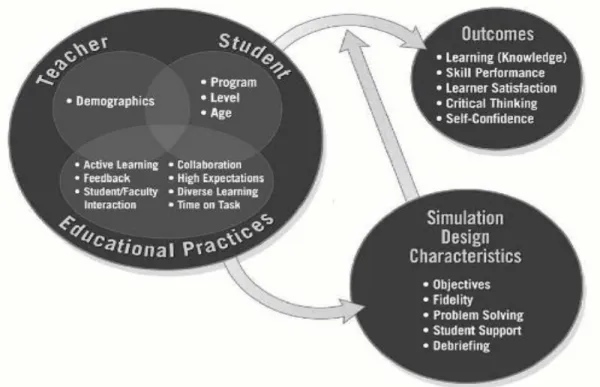
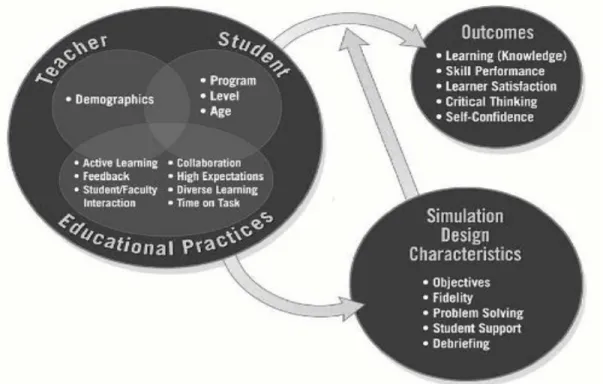
The Nursing Education Simulation Framework (NESF) defines simulation education variables and provides an organized guide for simulation use in teaching and learning (Jeffries 2005). It consists of six constructs; teacher, student, educational practices, outcomes, and simulation design characteristics. Variables associated with the teacher, student, and educational practices components are related and interact to facilitate an effective teaching and learning environment (Jeffries 2005, 2007). The first construct of this framework is teacher factors, which include faculty preparation and decisions related to the instructor’s role during the simulation. The second construct is student factors, which include consideration of the students’ age, type of nursing program, and level within the program. The third construct is educational practices which are based on seven pedagogical principles thought to improve student performance and promote learning (Chickering, Gamson 1987; Jeffries 2007). These seven principles are active learning, high expectations, prompt feedback, student faculty interaction, collaborative learning, diverse learning, and time on task (Chickering, Gamson 1987). The fourth concept in the Jeffries (2005) framework is scenario design characteristics, which include objectives, fidelity, problem solving, and debriefing. The final step in NESF is outcomes evaluation (Jeffries 2007)
10
which includes knowledge, skills performance, learner satisfaction, critical thinking and self-confidence.
The constructs interplay as shown in Figure 2.1; hence the role of the perception of the students is important to determine the outcomes of the teaching and learning using simulation (Groom, Henderson & Sittner 2013).
Figure 2.1: The Nursing Education Simulation Framework (NESF), Jeffries (2007)
The model has been utilized in many studies on simulation in nursing. Schlairet (2011) and Young and Shellenbarger (2012) in their studies found NESF to be useful in the evaluation of HFS utilize in nursing. Issenberg et al. (2005) further suggested that the use of this framework improves HFS as a teaching and learning strategy if utilized under the right conditions. These right conditions are feedback, repetitive practice, curriculum integration, range of difficulty level, variety of clinical conditions/scenarios, controlled learning environment, provision for individualized and team learning, clearly defined outcomes and assurance of the validity of a manikin as a teaching and learning tool.
11
In this study the student’s perceptions and experiences are considered in reaction to HFS use as a learning strategy. These perceptions will be elicited using the NESF (Jeffries 2007), which is regarded as the best guide for the design, utilize and evaluation of simulation (Harris et al., 2013). Students’ perceptions will be explored with regard to learning outcomes, educational practices, teaching and the design characteristics of simulation.
2.4 Perceptions and Experiences of HFS as a Teaching and Learning Strategy
High fidelity simulation has been perceived to impact on students’ level of confidence in performing nursing skills during simulation assessments and objective structured clinical examination (OSCE) in a number of studies. Students who experience HFS perceive it to have increased their level of confidence in performing clinical skills during assessments (Burns, O'Donnell & Artman 2010; Reid-Searl et al. 2012; Reilly & Spratt 2007; Rodgers 2007; Smith, Roehrs 2009; Wang, Fitzpatrick & Petrini 2013). However, it is not conclusive if students’ levels of confidence are superior in HFS to other learning strategies (Blum, Borglund & Parcells 2010). The perception of HFS having the ability to improve students’ confidence in practicing nursing skills is important as it influences the students’ likelihood to practice clinical skills within the simulation laboratory (O'Donnell & Artman 2010). Even though this is the case, perception of having high levels of confidence after HFS experience in the simulation laboratory cannot easily be translated into high confidence in the real clinical situation (Gore et al. 2011). In addition, simulation in general reduces levels of anxiety according to Tiffen, Graf and Corbridge (2009), hence it improves confidence, but when faced with the reality of the actual clinical situation the anxiety levels may rise, reducing the students’ level of confidence.
The ability of HFS to motivate students to practice clinical skills in the simulation laboratory helps to promote students participation in the learning process (Butler, Veltre & Brady 2009).
Students perceive HFS to be a teaching and learning pedagogy with that unique ability to promote active learning which is important in the acquisition of knowledge and skills that can contribute to the development of competence (Johannesson 2012; Reid-Searl et al. 2012; Weaver 2011). Active learning in HFS is a result of students actually performing activities that lead to discovery of the right knowledge, skills and attitudes required to solve a clinical scenario. According to Butler, Veltre & Brady (2009), Johannesson (2012), Kuznar (2007) and Weaver (2011), students regard HFS to closely approximate the real clinical situation or the human being, giving them a sense of reality and safety when learning in the simulation laboratory. Students value a safe practicing environment as it allows them to fully express and engage in
12
the teaching and learning process (Johannesson 2012; Reilly & Spratt 2007; Weaver 2011). With full engagement in practicing skills the students’ sense of preparedness to practice the skills in real clinical situation increases (Reid-Searl et al. 2012). Consequently, students believe that HFS experience can improve the safety of their practice on real patients due to its greater approximation to the real clinical situation (McCaughey & Traynor 2010).
HFS is perceived to be a very important method of learning clinical skills by nursing students (McCaughey & Traynor 2010). They believe that HFS has a strong, positive impact on their problem solving skills as it allows them to face different clinical scenarios, and think how they can deal with the situations so as to improve patient outcomes (Butler, Veltre & Brady 2009). Furthermore, some feel that HFS can limit the time required in the real clinical situation as well as allow for practice of procedures and simulation of clinical scenarios that are rare in the clinical area (Weaver 2011). This supports students’ high level of perception of their satisfaction and acceptance of learning using HFS (Bux 2009; Crouch 2010; Kuznar 2007; Rodgers 2007; Tosterud, Hedelin & Hall-Lord, 2013; Weaver 2011; Wang Fitzpatrick & Petrini 2013). Such positive perception of HFS can be a result of the realities experienced where the number of patients in the clinical area is dwindling against an expanding enrolment of students. Therefore, instead of students being allocated to a clinical rotation where there are limited opportunities to learn, they are attached in the simulation laboratory with HFS, providing them with a highly realistic opportunity to attain competence.
Students’ perceptions of their ability to transfer simulation competence into real clinical area competence are mixed. In some instances, students have negative perceptions about their ability to turn simulation competence into clinical competence (Gordon & Buckley 2009). This could be true considering that transferability of clinical skills from the simulation laboratory to the clinical area has not yet been fully established. In some cases students felt that they can apply their psychomotor, problem solving skills and confidence gained in the simulation laboratory to the clinical area (Hope, Garside & Prescott 2011; Radhakrishnan, Roche & Cunningham 2007). Such findings are difficult to contest since perceptions of the ability to do something do not necessarily translate into the actual ability, but are just an indicator of the likelihood of the ability to be replicated. Evidence on the perception of transferability and the actual transferability of HFS competence into the clinical area remains inconclusive, raising the need to further explore this aspect (Cant & Cooper 2010).
13
According to Adamson (2010) and Ober (2009) students perceive a good orientation to HFS, a well-organized teaching experience and integration of the simulation into their curriculum as well as trained instructors as helpful in promoting the use of HFS. On the other hand, students perceive insufficient instructions on the use of HFS in solving a clinical scenario and lack of full realism of the simulators as barriers to the use of HFS (Longworth 2013; McKenna et al. 2011). There is sufficient evidence to support HFS use as a teaching and learning strategy in nursing. Theories of constructivism, experiential learning and situated cognition strongly support HFS as pedagogy. Furthermore, the NESF provides a clear guideline on how it can be used in facilitating learning of nursing skills, with research showing positive results in its use as a guideline for HFS implementation (Young & Shellenbarger 2012). However, the evidence on the perceptions and experiences of HFS use in learning shows a mixed reaction, suggesting that HFS may not be well received in certain situations or is not effectively used; hence students have negative experiences and perceptions about it. Therefore, in order to add to the existing evidence, the researcher embarked on a case study to get a deeper understanding of nursing students’ perceptions and experiences of HFS use in learning at a school of nursing in a developing country.
14
Chapter 3: Research Methodology
3.1 Research Design
A descriptive qualitative design was used to conduct this study. The study sought to investigate third year diploma in nursing students’ perceptions and experiences of HFS as a learning strategy at a nursing school in Lesotho. This study therefore describes the nursing students’ perceptions and experiences of HFS use in teaching and learning. The study provided description of how participants felt and thought and reasons for their feelings and thoughts with regard to HFS use in learning, making a descriptive qualitative design a suitable strategy (Lambert & Lambert 2013) . This allowed the researcher to describe in depth students’ experiences and perceptions of using HFS in learning. Furthermore, the study exposed the complex realities of implementing HFS and its results within this particular school (Somekh, Lewin, & Hungler 2005; Polit 1999). Since qualitative descriptive studies a specific case, students’ perspectives in this study are very specific to this case; generalizability to a larger population should be based on individual judgment on the quality of evidence presented because a good description can relate to situations beyond a case under study (Parlett & Malcolm 1972; Lambert & Lambert 2013). The reader can recognize aspects of their own experiences or contexts in the described case and generalize them (Stake 1995).
3.2 Research Setting
The study took place at a school of nursing in Lesotho, a developing country where teaching and learning resources are limited; for example, there is a shortage of teaching staff and teaching and learning materials. The acquisition of HFS may be seen as contradictory in a resource limited environment and therefore it is important to acknowledge that HFS was a donation through the Ministry of Health of Lesotho partners. Given the option, the researcher believes that the school would have invested the money in other basic resources required by the nursing school rather than in HFS.
This school of nursing offers a diploma in nursing and a certificate in nursing assistance. The former is a three year programme while the latter is a one year and three months programme. The diploma in nursing is offered on a block release system where students attend classes and do simulation and clinical practice alternatively. In the third year of study students are expected to learn the complex skills of nursing that include critical thinking, problem solving and
15
integration of knowledge, skills and attitudes in nursing care. This makes strategies like HFS ideal in their learning situation.
With regard to HFS use, students are enrolled in the simulation laboratory for one week prior to each clinical attachment; there are six one month long clinical attachments per academic year. During the attachment in the simulation laboratory, students learn using low fidelity, medium fidelity and high fidelity simulators, with HFS reserved for clinical scenarios and rare or other procedures that cannot be performed using other forms of simulation, for example, resuscitation and blood transfusion, skills ideal for third year students. The simulation laboratory is open for students to use in their own time, but for access to high fidelity simulators there must be a supervisor to assist them.
3.3 Role of the Researcher
This site was selected because of the researcher‘s desire to improve the use of HFS through understanding and insight into participants’ perspectives on the use of HFS in learning. Furthermore, the site was convenient to the researcher and offered easy accessibility for data collection as the researcher is a nurse educator at the school. The researcher also facilitates learning during simulation attachment and has been using HFS for two years, although the researcher was not currently facilitating learning to the group of participants.
3.4 Research Question
“What are the nursing students’ perceptions and experiences of HFS use as a teaching and learning strategy?
3.5 Ethical Considerations
Permission was sought from the school of nursing’s research portfolio while ethical clearance was obtained from the Lesotho Ethics Committee (ethics reference - ID38-2014) and Stellenbosch University Human Research Ethics Committee (ethics reference - S14/02/029) Participation in this study was voluntary and participants were requested to sign a consent form to participate. There was no direct benefit for participation in the study financially or otherwise, although participants were given refreshments in the form of drinks and sandwiches after the interviews because the interviews took place during their meal time. It is normal practice at the school to provide students with refreshment when they take part in activates that are not directly related to their day to day learning activities. The proposed study findings were anticipated to cause no harm to participants or the community.
16
Privacy and confidentiality in this study were maintained through a number of measures (Kitzinger & Barbour 1999). First, ground rules were set during focus group discussions where interviewees were given identifiers during the interview, so that responses cannot be linked to any particular participant. Second, the researcher assistant, who also transcribed the data, signed a confidentiality clause (See Appendix E). Third, the transcribed data are stored in password protected folders with access restricted to the researcher only. Fourth, for five years all written information and digital voice recorder files of the study are kept in a locked and secure place determined by the researcher. After the five-year period all material written or recorded will be destroyed. Lastly, the researcher will take care to present findings of this study based on actual facts stated in the interviews and no false information or accusations are included in this report.
3.6 Study Population
The study population for this case study was sixteen third year diploma in nursing students in 2014 at a school of nursing in Lesotho. The researcher deliberately selected this population due to its potential to provide rich data for the study, as the students had experience in using HFS.
3.7 Selection of Subjects
In recruiting participants, the researcher met with the study population to explain the topic and procedures to be followed to participate in the study. This was followed by the hand delivery of information documents and consent forms to potential participants. After a week those willing to participate met with the researcher to clarify any issues before signing the declaration forms. The whole population of sixteen agreed to take part in the study.
3.8 Sampling
A purposive sample of sixteen third year diploma in nursing students who used HFS in learning clinical skills at the school of nursing was selected. The sample was divided into three groups, two groups of five students and one group of six students for the focus group discussions. Although Morgan and Krueger (1993) contend that it is generally acceptable to use a group size of six to twelve participants, Krueger (1995) accepts the use of smaller groups in cases where participants have specialized experience on the phenomenon under study. In this study participants had unique experience in being the first group to use HFS in learning in the school, having previously had experience of using low fidelity simulation.
17
Focusing on the group discussion, Rabiee (2004) recommends that a focus group is composed of selected individuals that are not necessarily representative, but have a common cause. Therefore the composition of each focus group was randomly formed among the participants since all had a common experience (Onwuegbuzie et al. 2009). The common experiences of the participants created a homogeneity that assisted in generating beneficial data (Kitzinger 1995). Additionally, third year nursing students had most experience of learning with HFS. The reason for this is that utilization of HFS in learning gradually increases as students progress from first year to third year, making them the most informed participants.
The inclusion criteria was all students in the class with the most experience of using HFS, willing to participate, had time to be interviewed and able to express their thoughts in a group. The exclusion criteria was participants all students who were not in the third year diploma in nursing programme, or were unable to attend focus group discussions or could not express their thoughts in a group.
3.9 Instruments
A focus group interview schedule was used in data gathering (see Appendix A). An interview schedule (see Appendix A) was used to allow the researcher to focus and assist in controlling the discussion in the focus group interviews. Krueger and Casey’s (2001) guidelines on designing and conducting a focus group interview were used in providing the structure of the interview schedule. Then the NESF and literature on perceptions and experiences of educational experiences were utilized to create the questions of the interview schedule.
3.10 Data Collection
The researcher chose focus group discussion for data collection because it allows exploration of experiences and interaction that elicits rich experiential data more than can be achieved in a one on one interview (Krueger 2009). The researcher and the assistant prepared the venues and seating arrangement in a semi-circle to promote interaction. The researcher moderated the focus group discussions, while the assistant moderator managed digital voice recorders and took notes. Three once off focus group discussions which lasted between 45 and 55 minutes were conducted. Although Morgan (1997) suggests that a focus discussion lasts between one and two hours, in this study the duration was limited by group saturation, when participants started repeating the same perceptions and experiences shared before (Onwuegbuzie et al. 2009). Furthermore, selected participant numbers reflected the range of participants that made
18
up the population under study, making it possible to reach saturation (Corbin & Strauss 2008;
Lincoln & Guba 1986; Monnette, Sullivan & DeJong 2005; Sandelowski 2000).
3.11 Data Analysis
While focus group discussion yields different types of data, including transcription data, non-verbal data and moderator notes, Krueger and Casey (2001) recommend analysis of transcription data for less experienced moderators like the researcher in this study. The data recordings were transcribed by the research assistant and given to the researcher together with notes taken during the interviews. The researcher organized the data into paper records to make it easy for the thematic analysis.
Thematic analysis is a method for identifying, analysing and reporting patterns within data which are presented as themes that are vital to describe the case under study (Daly et al. 1997; Braun, Clarke 2006 ;Rice, Ezzy 1999). The researcher chose thematic analysis because it’s not closely tied to any specific theory so it suits the descriptive qualitative study which is also not tied to any specific theory allowing for flexibility in analysis resulting in detailed description of data.
Data analysis in this study was an iterative and reflexive process to ensure richness of the analysis (Tobin, Begley 2004). Data collection and analysis stages in this study were done simultaneously to ensure that the developing themes were grounded in the original data. The analysis commenced by the coding process which involved recognizing (seeing) an important moment and encoding it (seeing it as something) prior to a process of interpretation (Boyatzis 1998). The encoding organized the data in such a way that themes can be identified and developed. Encoding process resulted in the development of the codebook (See Appendix G) which served as a data management tool for organizing segments of similar or related text to assist in interpretation. Basically the code book was written following (Boyatzis 1998) guideline of developing a code book; code name, the definition of the code and a description of how to know when the code occurs (See Appendix G). As a way of testing the reliability of the codes I invited my supervisors to code the transcripts too who agreed to the codes (Boyatzis 1998). Following this each transcript was read and summarized by outlining information given by participants during the discussion so as to identify the emerging themes. Then the codes from the code book were applied to the text so as to come up with meaningful units of text that aligns with the codes.
19
The codes were then connected through the discovery of themes and patterns emerging from the data (Crabtree, Miller 1999). Here the researcher relooked at the transcripts to ensure that emerging themes were correlating with the initially assigned codes. The themes were then drawn and described based on the meaning underpinning each theme. Five core themes emerged that gave a rich description of the participants’ perceptions and experiences based on
3.12 Trustworthiness
Several measures were taken to ensure the trustworthiness of this study. According to Guba and Lincoln (1994), a qualitative study’s trustworthiness can be ensured by taking into
consideration the constructs of credibility, transferability, dependability and conformability. Credibility
Credibility refers to the extent to which a study measures what it is intended to measure (Polit & Beck 2012). Credibility in this study was enhanced by several measures. First, the study utilized focus group discussion as the data collection method, a well-established method in studies seeking experiences and perceptions (Krueger 2009). Second, the researcher, being a member of the community, had a prolonged engagement through facilitating the participants learning using HFS in year two of their study (Lincoln & Guba 1994). Third, all the participants were asked to consent to participation and recording of the interviews. Fourth, to allow for full expression, the participants were given an option to choose where they feel comfortable to conduct the focus group discussion. This allowed participants to accurately express their perceptions and experiences without any distractions. Lastly, following transcription, researcher took the transcripts to the participants to read through so as to and verify the accuracy focus group discussions data.
Dependability
Dependability refers to the extent to which similar results would be obtained if the study were repeated in the same context using the same methods with the same participants (Polit & Beck 2012). The data collection method in this study allows for an easy audit trail process on how the data were collected and analyzed. This was made possible by presentation of clearly described methods that can be easily followed from what was planned and what was executed, making it possible for anyone to replicate the study.
20
Transferability refers to the extent to which study findings can be applied to other situations (Burns & Grove 2010). This was ensured by purposive selection of the study sample made up of participants that provided the maximum range of detailed information possible. Also, the researcher gave a detailed description of the context of this study, as well as the participants, to allow others to compare their contexts and use findings from this study (Guba & Lincoln 1994).
The description included the school where the study was done, the limitations of the study, methods employed, length of data collection, sessions and time over which data were collected. Conformability
Conformability refers to the extent to which research findings are a true reflection of the experiences and ideas of informants rather than the researcher’s perceptions (Burns & Grove 2010). In this study accuracy of findings was enhanced by recording interviews and transcribing them verbatim so as to ensure an accurate reflection of the participants’ views. As the researcher’s beliefs and values might impact the research due to its interpretivistic nature, these aspects were declared throughout the theses.
In summary, this chapter served to discuss the research design used in the study, the research instruments used to generate data, the ethical considerations, as well the issues of trustworthiness. The results of this study are presented and discussed in the subsequent chapters.
21
Chapter 4: Findings
4.1 Introduction
The purpose of the study was to determine student nurses’ experiences and perceptions of using HFS in learning. In order for students to effectively use HFS they must believe or perceive that it promotes their learning better than alternative learning methods. The results may be useful in restructuring the use of HFS in teaching and learning for educators and manufacturers of HFS. A number of key themes emerged from the student focus group discussions data. Students had mixed perceptions, positive and negative, based on the nature of their experiences which were both fulfilling and frustrating. This study revealed five key themes that shaped students’ experiences and hence their perceptions of using HFS in learning. The themes are authentic learning environment, unique learning opportunities, access, contextual factors and transfer of skills. Largely students believed that HFS is a valuable learning strategy and felt strongly that its use in learning could be improved for better learning outcomes.
4.2 Demographic data
The participants’ demographics were not explicitly elicited in this study. Basically there were sixteen participants, fifteen females and one male. All participants were in the third year in diploma in nursing programme at this school where the study was conducted.
4.3 Authentic Learning Environment
Students overwhelmingly perceived HFS as real, hence creating an authentic learning environment which challenged them to practice as they would do in areal clinical area. This helped students improve their knowledge, understanding, practical skills and confidence in performing tasks.
‘And the way we handle me’ Susie is just like the way you can handle a real patient/ human’.
FGD 2, P1
This explains the repeated statements by different participants that Susie is helpful. They found learning with HFS giving them a sense of reality, which is a feeling of working with a real patient in practice hence striving to perform their skills as if they were in actual practice.
22
‘….it is helping us because we are able to build confidence’. FGD3, P1
On the other hand, the high level of realism scared off some students, thereby compromising their learning. The unexpected responses by Susie were either easily recognised by students who became afraid or were not recognised at all because students never thought a manikin could respond to their care like a human being. This kind of fear can be expected of students who lack a lot of exposure to complex technology because of a poor background.
‘Sometimes I am scared of me’ Susie’ FGD 1, P1
4.4 Unique Learning Opportunities
In this study participants appreciated the unique learning opportunities presented by HFS. HFS made it possible to learn critical thinking, problem solving and certain practical skills that were not easy to learn outside the clinical area without HFS. Such opportunities gave students a valued or satisfying learning experience. These are skills students were expected to have, but didn’t have a chance to acquire, hence the description of HFS as having improved their skills.
‘Susie can be manipulated to any condition that we have to manage so it gives more skills.’
FGD 3, P3
Additionally, just like with most forms of simulation, students perceive HFS as providing a safe learning environment allowing deliberate practice where students can make mistakes without harm to the patients. This promotes experiential learning among students which can ultimately improve students learning. Also this kind of learning where mistakes can be made without consequences and different scenarios can be created using state of the art technology to imitate human beings stimulate students making learning interesting.
‘That was a satisfying experience because was able to make mistakes and have a chance to see where I can improve.’
23 FGD3, P5
‘Learning has become more interesting with Susie...’ FGD 1, P5
4.5 Access to HFS
Most students bemoaned the lack of practicing opportunities using HFS since it is not easily accessible. This decreases their level of satisfaction in using HFS in learning and negatively impacts on their perception of HFS as a learning tool.
‘We are not allowed. It is restricting us on some of the things we want to do.’ FGD2, P4
Lack of access to Susie for a school of nursing in a resource limited setting, is not surprising since there may be fear of repairing costs if this expensive gadgets breaks down. Unfortunately this is done at the expense of students learning, the purpose of why Susie was bought in the beginning. When students have gained access to Susie for practice, there should always be supervisor to monitor their practice. This can restrict students use of HFS in learning as they may raise students level of anxiety hence fail to fully take advantage of learning opportunities provided by Susie. Students feel that learning with HFS they should get more time to learn using HFS without anyone restricting the extent to which they manipulate HFS, since this restriction does not promote experiential and self-directed learning, the principles upon which HFS is based on.
4.6 Contextual Factors
The effectiveness of HFS as a learning strategy is influenced by contextual factors as learning occurs in a specific context. Key factors reported in this study are HFS continuous monitoring and training on HFS use and rules and regulations. Participants expressed a need for training or orientation for both students and educators on how HFS is used in teaching and learning. Students found HFS to be a complicated device to use in learning, therefore lack of adequate skills to use it affect learning negatively since effective use of HFS depends on its manipulation in creating scenarios. In the end HFS may well be used as low fidelity simulation. The participants and their educators are all experiencing HFS for the first time; therefore it is not surprising that they are struggling to use HFS.
24
‘It’s as if we can be taught how to manipulate Susie.’ FGD 2, P2
While participants appreciated supportive supervision from their educators and because it helps make learning authentic through manipulation of Susie, they also feel that they need to practice alone without any form of surveillance. There should be a balance between practice without educator’s supervision and practice with supervision.
‘The supervision is helpful, but sometimes we think that we should do it alone without the presence of supervisors, but when they are there, they are very helpful.’ FGD 2, P4
The rules and regulations governing the use of Susie are believed to be too restricting on the students, making them uncomfortable about using HFS in their learning. Such restriction supports the idea that there is lack of understanding about Susie and the fear for breaking Susie is too costly compared to underutilising it.
‘…we were given the rules; I find them much more complicated than the ones we were using in the old demonstration room with me’ Joyce.’
FGD 2, P1
4.7 Transfer of Skills
Most participants realised that performing skills on Susie is not the same as on a real patient. They reported that when working with real patients, it is a different challenge.
’I think it’s more important to do on the real patient than on me’ Susie because the challenges that you can meet with a real patient are different from challenges you can get to me’ Susie. At the end of the day the challenges that you need to be competent in are the ones of real patients not, for me’ Susie.’
FGD3, P5
While Susie approximates a human being, she still lacks all the challenges presented by an actual human being, hence students have to adjust when faced with real patients. This adjustment has been found to be not any easy one, therefore compromising the value of HFS in ultimately improving competence.
25
‘On my side, even though, I have practiced on me’ Susie, but sometimes I am still struggling to help patients like inserting a cannula, to me’ Susie, I can see her veins are very clear, but when I get to the real patient sometimes I struggle’.
FGD 1, P4
Only a few participants reported a different experience, finding it relatively easier when practicing the same skills learnt on Susie, on real patients. Such students experiences may need to be critically looked it since they offer hope for better utilization of HFS in learning because students’ ultimate competence is measured in actual practice.
‘The procedures we have practiced on Susie, we have found it better when practicing on real patients.’
FGD3, P4
In conclusion, this study revealed that student nurses perceive HFS as a strategy that makes learning nursing skills realistic and makes learning of rare skills possible. The effectiveness of HFS as a learning strategy as perceived by student nurses can be affected by access to simulators and other contextual factors like the level of training of supervisors and nurse educators.