Seanicaa Edwards 204 Lloyd-Ricks, West Wing Dept of Agricultural Economics MSU, Mississippi State, MS-39762 Phone: (662) 325 7984; Fax: (662) 325 8777
E-mail: [email protected]
Albert J. Allen
215 G Lloyd-Ricks, West Wing Dept of Agricultural Economics MSU, Mississippi State, MS-39762 Phone: (662) 325 2883; Fax: (662) 325 8777
E-mail: [email protected]
Saleem Shaik1
215 E Lloyd-Ricks, West Wing Dept of Agricultural Economics MSU, Mississippi State, MS-39762 Phone: (662) 325 7992; Fax: (662) 325 8777
E-mail: [email protected]
Selected Paper prepared for presentation at the American Agricultural Economics Association Annual Meeting, Long Beach, California, July 23-26, 2006
Copyright 2005 by Seanicaa Edwards, Albert J. Allen and Saleem Shaik. All rights reserved. Readers may make verbatim copies of this document for non-commercial purposes by any means, provided that this copyright notice appears on all such copies.
Abstract
Use of efficiency measures as a proxy for performance to test the market structure-conduct-performance (SCP) hypothesis is explored. Utilizing Battese and Coelli
specification, we estimate stochastic frontier production function and SCP equations with output and efficiency measures as endogenous variables. An empirical application to U.S. trucking carries over the period 1994-2003 with emphasis on the agricultural commodity and refrigerated food products carriers is examined. Results reveal that the variables average haul, average load and market concentration significantly affected the efficiency of firms with 2-8 number of years within each firm.
Market structure conduct and performance (SCP) framework was derived from the neo-classical analysis of markets. The SCP paradigm was the brain child of the Harvard school of thought and popularized during 1940-60 with its empirical work involving the identification of correlations between industry structure and performance. This SCP hypothesis has lead to the implementation of most anti-trust legislation. This was followed by the Chicago school of thought from 1960-80. They emphasized on the rational for firms becoming big, price theory and econometric estimation. During 1980-90 game theory took center stage with emphasis on strategic decision making and Nash equilibrium concept. After 1990, empirical industrial organization with the use of economic theory and econometrics lead to complex empirical modeling of technological changes, merger analysis, entry-exit and identification of market power.
There are two competing hypotheses in the SCP paradigm: the traditional “structure performance hypothesis” and “efficient structure hypothesis”. The structure performance hypothesis states that the degree of market concentration is inversely related to the degree of competition. This is because market concentration encourages firms to collude. More specifically, the standard SCP paradigm asserts that there is a direct relationship between the degree of market concentration and the degree of competition among firms. This hypothesis will be supported if positive relationship between market concentration (measured by concentration ratio) and performance (measured by profits)
exist, regardless of efficiency of the firm (measured by market share). Thus firms in more concentrated industries will earn higher profits than firms operating in less concentrated industries, irrespective of their efficiency.
The efficiency structure hypothesis states that performance of the firm is positively related to its efficiency. This is because market concentration emerges from competition where firms with low cost structure increase profits by reducing prices and expanding market share. A positive relationship between firm profits and market structure is attributed to the gains made in market share by more efficient firms. In turn these gains lead to increased market concentration. That is, increased profits are assumed to accrue to more efficient firms because they are more efficient and not because of collusive activities as the traditional SCP paradigm would suggest (Molyneux and Forbes, 1995).
Traditionally, these hypotheses have been examined using the traditional measures of profit/profit margin as indicator of performance. In the
efficiency/productivity literature there is increased emphasis on the use of efficiency as a measure to examine the economies of scale, economies of scope and both economies of scale and scope, accounting for risk, and policy implications. In this paper, we explore the use of stochastic frontier efficiency measures as a proxy for performance to test the SCP hypothesis and efficient structure hypothesis. Specifically, we will estimate stochastic frontier production function and SCP equation with output and efficiency measures as endogenous variables. An empirical application to U.S. trucking carries as a
group and by individual segments over the period 1994-2003 with emphasis on the agricultural commodity and refrigerated food products carriers is examined.
Literature Overview
A number of studies relevant to the procedure used in this study have been conducted for various industries and commodities and products. The general objective of these studies was to investigate the factors that affect the structure conduct performance of the specific industries. These studies provided the basic background information needed to formulate the model used in this analysis.
In December 2005, Byeongyong and Weiss, tested the traditional structure-conduct-performance model and the efficiency structure hypothesis to examine the relationship among market structure and performance in property-liability insurers. The efficiency terms in this analysis were estimated using a stochastic frontier analysis. This analysis supported the efficiency structure hypothesis. The results found that efficient firms charged lower prices than competitors causing them to capture larger market shares which lead to increased concentration.
Positive correlations between market concentration and profitability can be explained by the structure performance hypothesis or the efficient structure hypothesis. Berger and Hannan (1989) used price information collected by the Federal Reserve System on banking institutions to examined price-concentration relationships instead of the profit concentration relationship in order to eliminate the efficient structure
hypothesis as an alternative explanation of the results. The results of this analysis support the structure performance hypothesis.
Smirlock et al.(1984) tested the structure performance hypothesis and efficiency hypothesis using OLS regression of the firm’s profitability against the traditional
hypothesis with a proxy for relative efficiency. The firm’s profitability was measured by Tobin’s q which is the firm’s market value divided by replacement costs of its assets, the variables used to represent the traditional hypothesis were concentration, entry barrier, and growth rates, and the proxy used for relative efficiency was the firm’s market share. The results of this analysis strongly supported the efficient structure hypothesis.
Maudos (1998) analyzed the relationship between market structure and
performance within the Spanish banking industry. Three different stochastic measures of efficiency were used (based on three alternative distributional assumptions for
inefficiency: half-normal, normal-truncated and exponential). The results obtained support the efficient structure hypothesis and showed that market share was an inadequate proxy for efficiency.
Wilson A. Alley (1993) tested the hypothesis that Japanese banking performance is a result of efficiency and should be identified by the efficiency structure hypothesis instead of the SCP hypothesis. In the model he estimated the degree of collusion in the Japanese banking industry and found that there is a significant degree of collusion. The finding of his analysis supports the structure conduct performance hypothesis as a better means of describing the Japanese banking industry.
Kari, Jaafar, Allen, and Couvillion (2002) investigated the relationship between profitability and market power in the trucking industry that transported agricultural commodities. The aim of that investigation was to determine if the Motor Carrier Act of 1980 had produced the desired market structure. The research method was based on the SCP paradigm. Results of this study indicated that efficiency is the driving force behind performance of firms. These results suggest that the 1980 Motor Carrier Act of 1980 had produced its intended purpose in the agricultural commodities transport industry.
The general objective of a study by Allen, Shaik, Myles, and Muhammad (2005) was to estimate whether the market structure, market share, and profits of the
agribusiness commodity and refrigerated food products truck carriers in the South were based on the traditional SCP hypothesis or the efficient structure hypothesis. Overall, results reveal that the profits made by the carriers were based on them being more efficient than their competitors rather than them participating in collusive activities. Thus, the results of this study support the efficient structure hypothesis and reject the SCP hypothesis. Therefore, both public and private market evaluators and watchers of the trucking industry can use the results of this analysis to find the basic economic forces that affect profits of the various firms that comprise the industry at the conduct level. Also, managers and owners of the various firms can formulate strategies to take
advantage of the weaknesses of their competitors and the strengths of their firms to make profits. Therefore, the results of this study provide users with information that can be used to take advantages of opportunities in the trucking industry to meet unmet needs of shippers.
In the next section, the theoretical model to jointly estimate the efficiency
measure and SCP equation is presented. This is followed by the data and construction of the variables to be used in the empirical model. The empirical application and results are presented in the next section followed by conclusions.
Theoretical Model of Structure, Conduct and Performance - Efficiency
Traditionally, the SCP hypotheses have been examined using the traditional measures of profit/profit margin as indicator of performance. This can be represented as:
(1) Performance= f X Z( , )
where X is set of SCP variables and Z are other associated variables.
The studies by Ahmed and Khababa (1999), Eriotis, Frangouli, and Ventoura-Neokosmides (2002), McDonald (1999), Ganesan (2001), Kambhampati and Parika (2003), Lee, Lee, and Lee (2000), Frech, III and Mobley (2000), and Clow and Wilson (1998) investigate the factors that affect the performance of various industries in the context of market structure and conduct. A study by Allen and Shaik (2005) revealed that the variable market share had a statistically significant impact on the net profit margin for the agricultural commodity carrier of the trucking industry in the United States.
In the efficiency/productivity literature there is increased emphasis on the use of efficiency as a measure to examine the economies of scale, economies of scope and both economies of scale and scope, accounting for risk, and policy implications. In this paper, we explore the use of efficiency measures as a proxy for performance to test the SCP hypothesis. Specifically, we simultaneous estimate stochastic frontier model and SCP
model with output and efficiency measures as endogenous variables. To represent efficiency in the primal approach for a firm i i, =1,...,I, the basic form of the model can be represented as
(2) y= f x( ; )β ⋅ −v u
where v representing firm or time specific random error which are assumed to be iid and
normally distributed variable with mean zero and variance 2 V
σ ; u representing the
technical efficiency which must be positive hence absolutely normally distributed variable with mean zero and variance 2
U
σ ; and , y x and β are the output, input and
parameter coefficients respectively.
Comprehensive literature reviews [Forsund, Lovell and Schmidt (1980), Schmidt (1986), Bauer (1990), Greene (1993), and Kumbhakar and Lovell (2000)] on the use of stochastic frontier analysis has been evolving since it was first proposed by Aigner, Lovell and Schmidt; Meeusen and van den Broeck; and Battese and Corra in the same year, 1977. The past decade has witnessed a surge in the extension of the parametric techniques to efficiency measurement. Furthermore within the primal framework, there has been progress made on the ability to handle multiple outputs and inputs via the distance functions, adjusting for time series properties, incorporating autocorrelation and heteroskedasticity, and finally the use of Bayesian techniques in the parametric efficiency measures. Here, we utilize the Battese and Coelli model (1995) to estimate the efficiency and SCP equations.
The simultaneous estimation of stochastic frontier production function model and market structure model with output and efficiency measures as endogenous variables to examine the SCP hypothesis can be represented as
(3) ( ; ) ( , ) y f x v u u f X Z β = ⋅ = −
where u representing the technical efficiency is used as measures of performance in SCP model.
Data and Construction of the Variables
The variables used to satisfy the objective of this paper are obtained from TTS Blue Book of Trucking Companies for the years 1994-2003. The data for the input variables was
divided into labor; capital, operating variable costs and operating fixed costs. The labor variables include (1) the number of drivers and helpers, (2) number of cargo handlers, (3) number of officers, supervisors, clerical and administrative staff, and (4) total number of other laborers. Capital variables include (1) number of tractors owned, (2) number of trucks owned, (3) number of tractors leased, (4) number of trucks leased, and (5) other equipment. Operating variable costs include (1) fuel, oil, and lubricants and (2) total maintenance. The operating fixed cost category is composed of (1) total operating taxes and licenses; (2) total insurance; and (3) depreciation and amortization. The output variable consists of total ton-miles, which is the measurement most commonly used according to Caves et al (1980), McGeehan (1993) and Cantos et al. (1999), given that these demand related measure of output, allow an assessment of the level of user
consumption and the value they place on the service. This ton-mile output measurement assumes little or no government control on the provision of the service, otherwise
measures that isolate the government regulatory measures like truck-miles, which represent the degree of capacity or service level supplied by the trucking company, are more suitable for this type of analysis Cantos et al. (2000).
Market share (mshare) is the share of firm i in time period t. The proportion of
the market that the firm is able to capture can measure the firm’s performance relative to competitors. This proportion is referred to as the firm’s market share. Market share is often associated with profitability and thus many firms seek to increase their sales relative to competitors. Market share is estimated by dividing individual firm’s revenue with the total industry revenue.
The market concentration (mconc) of firms in an industry is of interest to
economists, business strategists, and government agencies. Here, we discuss one of the two most commonly used methods of measuring industry concentration: the
Concentration Ratio. The other commonly used method to compute the concentration ratio is the Herfindahl-Hirschman Index (HHI). The concentration ratio is the percentage of market share owned by the largest m firms in an industry, where m is a specified
number of firms, often 4, but sometimes a larger or smaller number. In our study we used the 10-firm concentration ratio. The concentration ratio often is expressed as CRm, for example, CR10. The concentration ratio can be expressed as: CRm = s1 + s2 + s3 + … .. + sm, where si = market share of the ith firm.
Long-term Debt-to-Equity (LRisk) variable is obtained from TTS data. TTS calculates this variable by dividing long-term liabilities by total equity and represents long term risk. . This variable represents the total long-term portion of borrowed money
and measures the indebtedness of a company relative to invested capital (TTS). The long-term debt of carriers is those debts that are longer than a year. If a large proportion of the total liabilities are non-current, then the amount of security needed by the firm would not be as large as would be required if they were mostly current (Clow and Wilson, 1988).
CAR is total equity divided by total assets. The equity/asset ratio measures the proportion of a company’s total assets which are financed by the owner’s capital rather than through debt, and therefore indicates financial position. The higher the ratio value, the more total capital has been supplied by the owner and less by creditors (Langemeier, 2005).
Average length of haul (Ahaul) variable is obtained from the TTS data. TTS calculates this variable by dividing total ton-miles by total tons. This variable shows how far the unit travels (one way) each time it is dispatched. The ability of trucking firms to carry agricultural commodities to long-distance markets has an impact on the competitive activity of firms. In addition, the ability of truckers to carry products to distant markets can help suppliers and truckers to find profitable and rewarding markets. Further, the shorter the distance the carrier might have to travel implies that the local or short-distance markets are sufficient for the firms to make profits by satisfying their customers.
Average load (Aload) variable is obtained from TTS data. TTS calculates this variable by dividing ton-miles-highway service by total highway miles operated. This variable is an index of the use of productive capacity. In addition, this index indicates the number of tons of agricultural commodities transported by each unit dispatched.
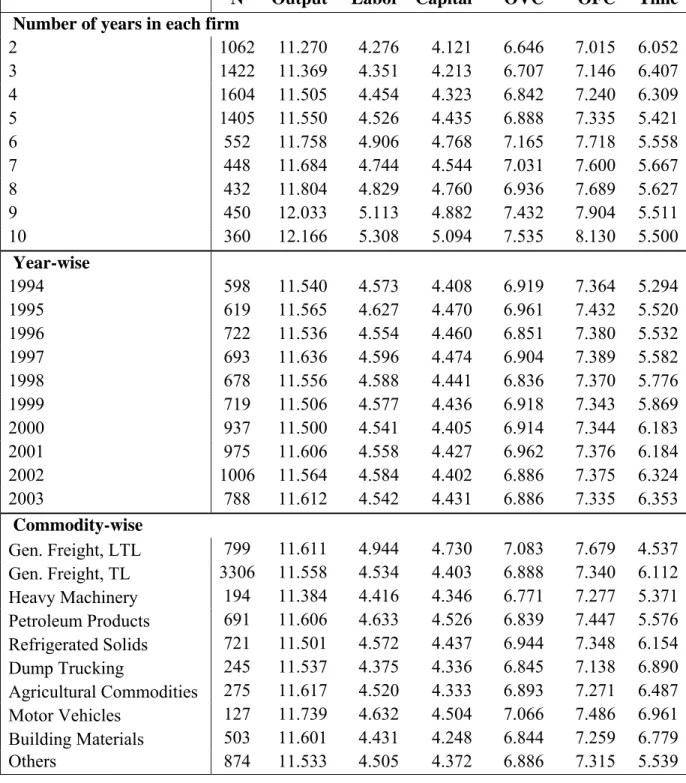
Table 1 presents the number of observations and the mean of the variables (logs) used in the stochastic frontier analysis by number of years of data for each firm; year-wise and commodity-year-wise. As the number of years of data for each firm increases we observe increasing trend in all the variables except the number of observations (N). In contrast over the time period, 1994-2003 and across commodity groups the mean of the output, labor, capital, OVC, and OFC remain relatively constant.
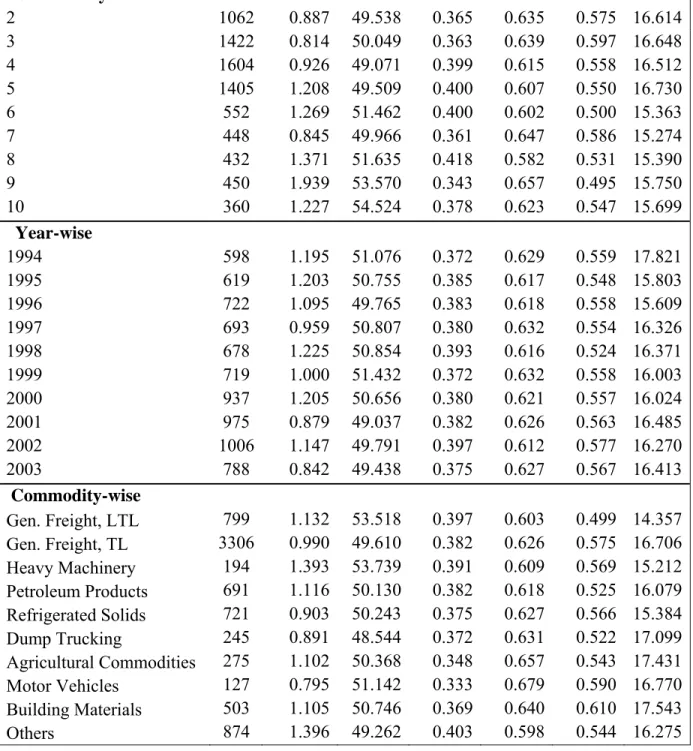
Table 2 represents the number of observations and the mean of the variables used in the structure-conduct-performance (SCP) analysis by number of years of data for each firm; yearly and by commodity group. As the number of years of data in each firm increases the average load decrease, while the market share, market concentration, CAR, long-term risk, and average haul remain relatively constant. Similar pattern of relatively constant mean is indicated for all the variables both over time and across commodity groups.
Empirical Application and Results
To estimate the production function and examine the importance of market SCP variables in explaining efficiency the Battese and Coelli specification is estimated using Frontier software. The model can be represented as:
(4) 1 1,1 1,2 1,3 2,4
2 2,1 2,2 2,3 2,4 2,5 2,6 2
y Labor Capital OVC OFC v u
u Mshare Mconc CAR LRisk Ahaul Aload
α β β β β
α β β β β β β
= + + + + + −
= + + + + + + +ε
where, y represents production, β represents parameter coefficients, X1 represents labor, X2 represents capital, X3 represents operating variable costs, and X4 represents operating fixed costs, and ε represents efficiency and random variables.
One of the requirements to estimate equation (4) using the Battese and Coelli specification is the presence of panel data. So, we grouped firms based on the number of years of data available in each firm. This lead to the estimation of firms with two-years, three-years, four-years, five-years, six-years, seven-years, eight-years, nine-years and a maximum of ten-years of balanced panel data.
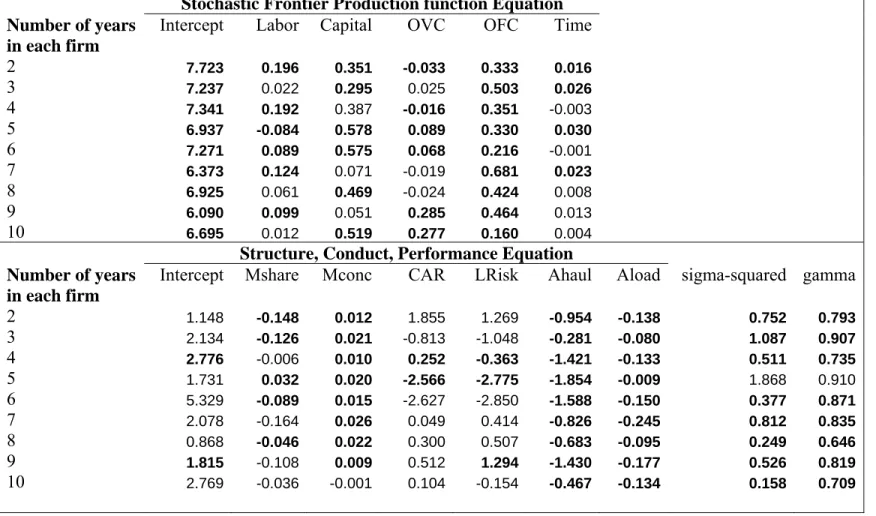
Parameter coefficients and the significant variables indicated by bold font are presented in Table 3. Labor variable with a positive sign indicates with more labor -truck drivers and cargo handlers more output -tons per mile are realized. This was positive with the exception of the firms with 5 years of data. Capital and operating fixed cost was positive for all the firms, irrespective of the number of years of data within each firm. Operating variable cost was positive related to output with the exception of group of firms with two-, four-, seven- and eight-years of data. Time trend variable was positively related to output with the exception of group of firms with four- and six-years of data.
Table 3 reports the results of the model that show the effects of market structure, conduct and performance variables on the dependent variable efficiency. The estimated variables are generally statistically significant at the 5% level. More specifically, average haul and load are the variables that significantly different from zero at the 5% level for all grouped firms. These results imply that these variables are major factors affecting the efficiency of firms in the industry.
The results further show that the market concentration variable significantly affected the efficiency of all firms except firms with 9 and 10 years of data. While the
market share variable significantly impacted all firms except firms with 4, 7, 9 and 10 years of data. Results further show that long-term risk (CAR) significantly affected the efficiency of firms with 4, 5, and 9 (4 and 5) years of data. Overall results reveal that the variables average haul, average load and market concentration significantly affected the efficiency of firms with 2-8 years of data in each firm.
Finally, the summary statistics of the efficiency measures estimated from equation (4) is aggregated by number of years of data available in each firm; year-wise and
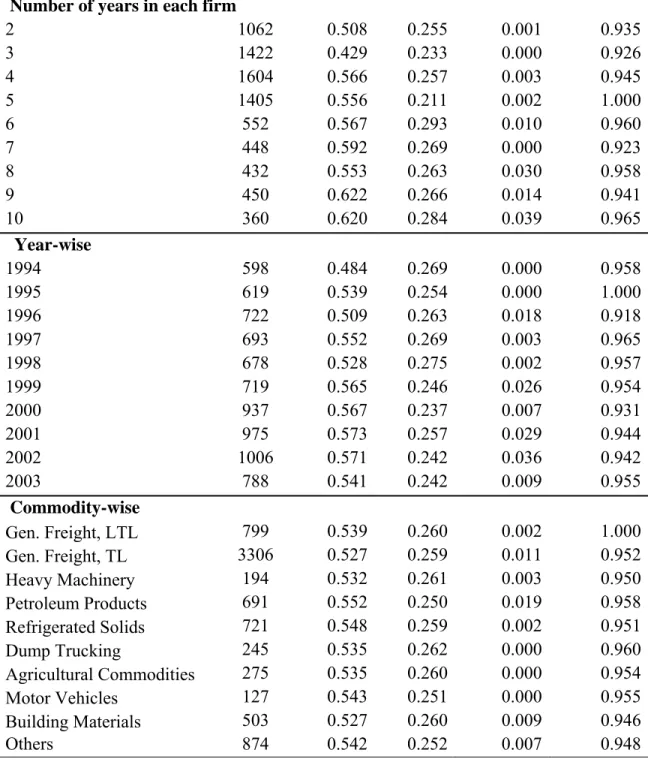
commodity-wise are presented in Table 4. Results by the number of years of data available in each firm indicate an increasing trend in the efficiency measures more number of years. This result indicates with less number of years of data and experience firms realize lower average efficiency measures. While with more experience and number of years of data higher efficiency measures are realized. On the lower end 42 and 50 percent efficiency is realized compared to 62 percent on the higher end with more number of years of data. Also with more number of years, we observe an increase in the standard deviation of the efficiency measures. For the ten year period higher efficiency measures of 56 and 57 percent were realized during 1999-2002. While the average efficiency measures was 48 and 54 percent in 1994 and 2003 respectively. Commodity-wise the efficiency measures do not seem to be different with agribusiness trucking firms realizing the second highest efficiency scores of 54.8 percent.
Summary and Conclusions
The overall objective of this study was to assess the production function and the market structure, conduct and performance (profitability) of the trucking industry in the United States by using panel data for the period 1994-2003. To accomplish the objective of this study, we estimate stochastic frontier production function and SCP model with output and efficiency measures as endogenous variables with Battese and Coelli specification to test the effects of several variables, including but not limited, to risk, concentration, market shares of the firms, and fuel expenses, on the profitability of the firms measured in terms of efficiency.
The basic premise underlying this research is that firm financial and operating performance data can be used as representative indicators of the determinants that constitute the essence of profitability from the efficiency paradigm. Therefore, each variable included in this analysis was represented by a financial and/or operating statistic. Data and information needed to accomplish the objective of this study came from the electronic copy of the Blue Book of Trucking Companies published by the Transportation Technical Services and other secondary sources.
Results from this study indicate that several variables in this study have statistically significant impact on the efficiency measures. For example, the results indicate average haul, average load and market concentration significantly affected the efficiency of firms with 2-8 years of data in each firm. The production function variables were positive related to the output with few exceptions.
References
Ahmed, Abdulkader Mohamed and Nourredine Khababa. “Performance of the Banking Sector in Saudi Arabia.” Journal of Financial Management and Analysis Vol.12,
Issue 2 (1999) :30-36.
Aigner, D.J., Lovell, C.A.K. and Schmidt, P. (1977), “Formulation and Estimation of Stochastic Frontier Production Function Models”, Journal of Econometrics, 6,
21-37.
Allen, Albert J. and Saleem Shaik, “Performance of the Agricultural Commodity Trucking Sector in the United States,” Paper presented at the Southwestern Economics Association Annual Meeting, March 23-26, 2005, New Orleans, LA. Allen, Albert J., Saleem Shaik, Albert E. Myles, and Safdar Muhammad, “The Structure
Performance Hypothesis and The Efficient Structure Performance Hypothesis-Revisted: The Case of Agribusiness Commodity and Food Products Truck Carriers in the South,” Paper presented at the Southern Agricultural Economics Association Annual Meetings, Little Rock, Arkansas, February 5-9, 2005. Allen, Albert J., Jeanne Reeves, and Gerald Mumma. “Structure, Conduct, and
Performance Changes in the U.S. Agricultural Commodity Trucking Industry.”
Journal of Food Distribution Research Volume 1 (1999): 31-44.
Alley, Wilson A. “Collusion versus Efficiency in the Japanese Regional Banking Industry,” Economic Studies Quarterly, 1993, Volume 44, p206-215
Battese, G. E. and T. J. Coelli (1992), “Frontier Production Functions, Technical
Efficiency and Panel Data: With Application to Paddy Farmers in India”, Journal of Productivity Analysis, 3, 153-169.
Battese, G.E. and Corra, G.S. (1977), “Estimation of a Production Frontier Model: With Application to the Pastoral Zone of Eastern Australia”, Australian Journal of Agricultural Economics, 21, 169-179
Bauer, P.W. (1990), “Recent Developments in the Econometric Estimation of Frontiers”,
Journal of Econometrics, 46, 39-56.
Beilock, Richard and Jose Del Ciello, “Refrigerated Trucking Revisited,” Journal of the Transportation Research Forum, Volume 43, Number 1, Spring 2004, Pp. 39-53.
Berger, Allen N. and Timothy H. Hannan, “The Price Concentration Relationship in Banking,” Review of Economics and Statistics, May 1989, Volume 71, p291-299.
Byeongyong , Paul Choi and Mary A. Weiss. “An Empirical Investigation of market structure, efficiency, and performance in property-liability insurance,” Journal of Risk and Insurance, 2005, Volume 72, p635(39).
Cantos P., Pastor J., and Serrano L. “Efficiency Measures and Output Specification: The Case of European Railways” Journal of Transportation and Statistics,
USDOT-BTS Volume 3, Numero 3, December 2000.
Cantos, P., J.M. Pastor, and L. Serrano. 1999. Productivity, Efficiency and Technical Change in the European Railways: A Non-Parametric Approach. Transportation
Clow, Bradley B. and William W. Wilson. Financial and Operating Performance of Cooperative Unit-Train Shippers in North Dakota. Agricultural Economics
Report No. 234, Department of Agricultural Economics, Agricultural Experiment Station, North Dakota State University, Fargo, North Dakota.
Eriotis, Nikolaos P., Zoe Frangouli, and Zoe Ventoura-Neokosmides. “Profit Margin and Capital Structure: An Empirical Relationship.” The Journal of Applied Business Research Volume 18, Number 2 (2002) : 85-88.
Feitler, Jane N. Measuring Firm Strategic Change in the Regulated and Deregulated Motor Carrier Industry: An Eighteen Year Evaluation. Ph. D. Dissertation,
University of Maryland, 2995.
Frech, H.E., III, and Lee Rivers Mobley. “Efficiency, Growth, and Concentration: An Empirical Analysis of Hospital Markets.” Economic Inquiry, Vol. 38, No.3 (2000) 369-384.
Forsund, F.R., Lovell, C.A.K. and Schmidt, P. (1980), “A Survey of Frontier Production Functions and of their Relationship to Efficiency Measurement”, Journal of Econometrics, 13, 5-25.
Ganesan, P. “Determinants of Profits and Profitability of Public Sector Banks in India: A Profit Function Approach.” Journal of Financial Management and Analysis 14 (1):(2001): 27-37.
Greene, W.H. (1993), “The Econometric Approach to Efficiency Analysis”, in Fried, H.O., Lovell, C.A.K. and Schmidt, S.S.(Eds), The Measurement of Productive Efficiency, Oxford University Press, New York, 68-119.
Kambhampati, Uma S. and Ashok Parikh. “Disciplining Firms: the impact of trade reforms on profit margins in Indian Industry.” Applied Economics 35 (2003):
461-470.
Kari, Fatimah, Abdul H. Jaafar, Albert J. Allen, and Warren C. Couvillion, “Market Structure, Market Share, and Profits in the Surface Freight Industry,” Paper presented at the American Agricultural Economics Association Annual Meetings, Long Beach, CA, July 28-31, 2002.
Kumbhakar, S. and K. Lovell, Stochastic Frontier Analysis, Cambridge University Press,
Cambridge, 2000.
Lahiri, Kajal and Wenxiong Yao, “ A Dynamic Factor Model of the Coincident Indicators for the US Transportation Sector,” Applied Economic Letters, 2004,
Volume 11, Pp. 595-600.
Langemeier, Michael R., Financial Ratios Used in Financial Management, Financial
Management Guide, MF 270,Department of Agricultural Economics, Kansas State Univeristy Agricultural Experiment Station and Cooperative Extension Service, October, 2005.
Lee, Jong-Wha, Young Soo Lee, and Byung-Sun Lee. “The Determination of Corporate Debt in Korea.” Asian Economic Journal, Vol. 14, No. 4 (2000): 333-356.
Marathon, Nick, Tamera VanWechel, and Kimberly Vachal. Transportation of U.S. Grains A Modal Share Analysis, 1978-2000.United States Department of
Agriculture, Agricultural Marketing Service, Transportation and Marketing Programs, Transportation Services Branch, October 2004
Maudos, Joaquin. “Market structure and performance in Spanish banking using a direct measure of efficiency,” Applied Financial Economics, 1998, Volume 8.
p.191-200.
McDonald, James Ted. “The Determinants of Firm Profitability in Australian Manufacturing.” The Economic Record, Vol. 75, No. 229, (1999): 115-26.
Meeusen, W. and van den Broeck, J. (1977), “Efficiency Estimation from Cobb-Douglas Production Functions With Composed Error”, International Economic Review,
18, 435-444.
Molyneux, Phil and William Forbes, “Market Structure and Performance in European Banking,” Applied Economics, 1995, Volume 27, Pp. 155-159.
Quesada, Alina M., Albert J. Allen, and Jeanne Reeves. “Financial Characteristics of Refrigerated Food Products Trucking Firms in the U.S.” Journal of Food Distribution Research (1997): 74-81.
Schmidt, P. (1986), “Frontier Production Functions”, Econometric Reviews, 4, 289-328.
Smirlock, Micheal, Gilligan, Thomas and Marshall, William, “Tobin’s q and the
Structure-Performance Relationship,” American Economic Review, 1984, Volume
74, p1050-60.
Stephenson, Jr., Frederick J. Transportation USA, Addison-Wesley Publishing Company,
Inc., Reading, Massachusetts, 1987
Technical Transportation Services, Inc., TTS Blue Book of Trucking Companies, New York, NY, 1994-2004.
Transportation Technical Services, Inc. TTS Blue Book of Trucking Companies,
Table 1. Mean of the Production Function Variables by Number of
years in each firm; by Year and by Commodity
N Output Labor Capital OVC OFC Time
Number of years in each firm
2 1062 11.270 4.276 4.121 6.646 7.015 6.052 3 1422 11.369 4.351 4.213 6.707 7.146 6.407 4 1604 11.505 4.454 4.323 6.842 7.240 6.309 5 1405 11.550 4.526 4.435 6.888 7.335 5.421 6 552 11.758 4.906 4.768 7.165 7.718 5.558 7 448 11.684 4.744 4.544 7.031 7.600 5.667 8 432 11.804 4.829 4.760 6.936 7.689 5.627 9 450 12.033 5.113 4.882 7.432 7.904 5.511 10 360 12.166 5.308 5.094 7.535 8.130 5.500 Year-wise 1994 598 11.540 4.573 4.408 6.919 7.364 5.294 1995 619 11.565 4.627 4.470 6.961 7.432 5.520 1996 722 11.536 4.554 4.460 6.851 7.380 5.532 1997 693 11.636 4.596 4.474 6.904 7.389 5.582 1998 678 11.556 4.588 4.441 6.836 7.370 5.776 1999 719 11.506 4.577 4.436 6.918 7.343 5.869 2000 937 11.500 4.541 4.405 6.914 7.344 6.183 2001 975 11.606 4.558 4.427 6.962 7.376 6.184 2002 1006 11.564 4.584 4.402 6.886 7.375 6.324 2003 788 11.612 4.542 4.431 6.886 7.335 6.353 Commodity-wise Gen. Freight, LTL 799 11.611 4.944 4.730 7.083 7.679 4.537 Gen. Freight, TL 3306 11.558 4.534 4.403 6.888 7.340 6.112 Heavy Machinery 194 11.384 4.416 4.346 6.771 7.277 5.371 Petroleum Products 691 11.606 4.633 4.526 6.839 7.447 5.576 Refrigerated Solids 721 11.501 4.572 4.437 6.944 7.348 6.154 Dump Trucking 245 11.537 4.375 4.336 6.845 7.138 6.890 Agricultural Commodities 275 11.617 4.520 4.333 6.893 7.271 6.487 Motor Vehicles 127 11.739 4.632 4.504 7.066 7.486 6.961 Building Materials 503 11.601 4.431 4.248 6.844 7.259 6.779 Others 874 11.533 4.505 4.372 6.886 7.315 5.539
Table 2. Mean of the SCP Variables by Number of years in each firm;
by Year and by Commodity
N Mshare Mconc CAR Risk3 Ahaul Aload
Number of years in each firm
2 1062 0.887 49.538 0.365 0.635 0.575 16.614 3 1422 0.814 50.049 0.363 0.639 0.597 16.648 4 1604 0.926 49.071 0.399 0.615 0.558 16.512 5 1405 1.208 49.509 0.400 0.607 0.550 16.730 6 552 1.269 51.462 0.400 0.602 0.500 15.363 7 448 0.845 49.966 0.361 0.647 0.586 15.274 8 432 1.371 51.635 0.418 0.582 0.531 15.390 9 450 1.939 53.570 0.343 0.657 0.495 15.750 10 360 1.227 54.524 0.378 0.623 0.547 15.699 Year-wise 1994 598 1.195 51.076 0.372 0.629 0.559 17.821 1995 619 1.203 50.755 0.385 0.617 0.548 15.803 1996 722 1.095 49.765 0.383 0.618 0.558 15.609 1997 693 0.959 50.807 0.380 0.632 0.554 16.326 1998 678 1.225 50.854 0.393 0.616 0.524 16.371 1999 719 1.000 51.432 0.372 0.632 0.558 16.003 2000 937 1.205 50.656 0.380 0.621 0.557 16.024 2001 975 0.879 49.037 0.382 0.626 0.563 16.485 2002 1006 1.147 49.791 0.397 0.612 0.577 16.270 2003 788 0.842 49.438 0.375 0.627 0.567 16.413 Commodity-wise Gen. Freight, LTL 799 1.132 53.518 0.397 0.603 0.499 14.357 Gen. Freight, TL 3306 0.990 49.610 0.382 0.626 0.575 16.706 Heavy Machinery 194 1.393 53.739 0.391 0.609 0.569 15.212 Petroleum Products 691 1.116 50.130 0.382 0.618 0.525 16.079 Refrigerated Solids 721 0.903 50.243 0.375 0.627 0.566 15.384 Dump Trucking 245 0.891 48.544 0.372 0.631 0.522 17.099 Agricultural Commodities 275 1.102 50.368 0.348 0.657 0.543 17.431 Motor Vehicles 127 0.795 51.142 0.333 0.679 0.590 16.770 Building Materials 503 1.105 50.746 0.369 0.640 0.610 17.543 Others 874 1.396 49.262 0.403 0.598 0.544 16.275
Table 3. Parameter Coefficient of the Production function - SCP Equation by Number of years
Stochastic Frontier Production function Equation
Intercept Labor Capital OVC OFC Time
Number of years in each firm 2 7.723 0.196 0.351 -0.033 0.333 0.016 3 7.237 0.022 0.295 0.025 0.503 0.026 4 7.341 0.192 0.387 -0.016 0.351 -0.003 5 6.937 -0.084 0.578 0.089 0.330 0.030 6 7.271 0.089 0.575 0.068 0.216 -0.001 7 6.373 0.124 0.071 -0.019 0.681 0.023 8 6.925 0.061 0.469 -0.024 0.424 0.008 9 6.090 0.099 0.051 0.285 0.464 0.013 10 6.695 0.012 0.519 0.277 0.160 0.004
Structure, Conduct, Performance Equation
Intercept Mshare Mconc CAR LRisk Ahaul Aload sigma-squared gamma
Number of years in each firm 2 1.148 -0.148 0.012 1.855 1.269 -0.954 -0.138 0.752 0.793 3 2.134 -0.126 0.021 -0.813 -1.048 -0.281 -0.080 1.087 0.907 4 2.776 -0.006 0.010 0.252 -0.363 -1.421 -0.133 0.511 0.735 5 1.731 0.032 0.020 -2.566 -2.775 -1.854 -0.009 1.868 0.910 6 5.329 -0.089 0.015 -2.627 -2.850 -1.588 -0.150 0.377 0.871 7 2.078 -0.164 0.026 0.049 0.414 -0.826 -0.245 0.812 0.835 8 0.868 -0.046 0.022 0.300 0.507 -0.683 -0.095 0.249 0.646 9 1.815 -0.108 0.009 0.512 1.294 -1.430 -0.177 0.526 0.819 10 2.769 -0.036 -0.001 0.104 -0.154 -0.467 -0.134 0.158 0.709
Table 4. Summary Statistics of the Efficiency measures by Number of
years in each firm; by Year and by Commodity
N Mean Std Dev Minimum Maximum
Number of years in each firm
2 1062 0.508 0.255 0.001 0.935 3 1422 0.429 0.233 0.000 0.926 4 1604 0.566 0.257 0.003 0.945 5 1405 0.556 0.211 0.002 1.000 6 552 0.567 0.293 0.010 0.960 7 448 0.592 0.269 0.000 0.923 8 432 0.553 0.263 0.030 0.958 9 450 0.622 0.266 0.014 0.941 10 360 0.620 0.284 0.039 0.965 Year-wise 1994 598 0.484 0.269 0.000 0.958 1995 619 0.539 0.254 0.000 1.000 1996 722 0.509 0.263 0.018 0.918 1997 693 0.552 0.269 0.003 0.965 1998 678 0.528 0.275 0.002 0.957 1999 719 0.565 0.246 0.026 0.954 2000 937 0.567 0.237 0.007 0.931 2001 975 0.573 0.257 0.029 0.944 2002 1006 0.571 0.242 0.036 0.942 2003 788 0.541 0.242 0.009 0.955 Commodity-wise Gen. Freight, LTL 799 0.539 0.260 0.002 1.000 Gen. Freight, TL 3306 0.527 0.259 0.011 0.952 Heavy Machinery 194 0.532 0.261 0.003 0.950 Petroleum Products 691 0.552 0.250 0.019 0.958 Refrigerated Solids 721 0.548 0.259 0.002 0.951 Dump Trucking 245 0.535 0.262 0.000 0.960 Agricultural Commodities 275 0.535 0.260 0.000 0.954 Motor Vehicles 127 0.543 0.251 0.000 0.955 Building Materials 503 0.527 0.260 0.009 0.946 Others 874 0.542 0.252 0.007 0.948