Dissertation and Thesis Guidelines
Office of Research and Graduate Studies University of Arkansas at Little Rock Administration North Bldg – 3rd Floor 2801 South University Little Rock, AR 72204
Style ... 1
Using Journal Articles as Chapters or Sections ... 2
Final Projects ... 2 Form ... 2 Margins ... 2 Line Spacing ... 3 Fonts ... 3 Illustrative Material ... 4
Arrangement and Numbering of Pages ... 4
Distribution and Binding ... 7
Deadlines of Theses and Dissertations ... 8
Graduation Applications ... 9
Other Policy Issues ... 9
Protocols for Research Involving Human or Animal Subjects or Biohazardous Material ... 9 Plagiarism ... 10 Intellectual Property ... 10 Submission to ProQuest ... 10 Copyright Registration ... 11 Expenses ... 11
Summary of Required Steps for Submitting Thesis/Dissertations ... 12
Example pages ... 13 ii
Dissertation and Thesis Guidelines
(Revised December 2008)
All candidates for advanced degrees should confer with their advisors and members of their graduate advisory committees to learn about any special departmental requirements for preparing graduate degree documents. In general, students should demonstrate their abilities to conduct scholarly investigation at an advanced level in theses or dissertations. Details of the project and the means for pursuit should be determined jointly by the student, faculty advisor, and graduate advisory committee.
Students must submit a completed ―Appointment of Supervisory Committee‖ form to the Graduate School at the beginning of their projects. When projects are completed, the students’ advisors/graduate coordinators must submit a completed ―Supervisory or Examining Committee Report‖ form; students should be sure that this form has been filed with the Graduate School. Faculty advisors can access both forms only through their graduate coordinators.
Style
The thesis or dissertation must be prepared in accordance with nationally recognized standards for formatting, which differ widely in the sciences, the humanities, and the social sciences. Most academic programs at UALR will recommend a nationally recognized style manual and format guidelines for your discipline. As a courtesy to outside members of your committee, you should indicate in a note which style manual you used.
Candidates are free to choose a style suitable to their disciplines, as long as it complies with the format and content guidelines given in this publication. Only the most recent editions of style manuals should be used, and the thesis or dissertation style must be consistent throughout. Where style manuals conflict with the UALR Dissertation and Thesis Guidelines, the style elements outlined in this publication take precedence.
If you need assistance in citing references or choosing the right style manual for your field, go to: http://library.ualr.edu/research/. You can find on-line style manuals there as well as RefWorks, a program that will cite references in the proper format for you when you enter information.
Using Journal Articles as Chapters or Sections
In some departments, theses/dissertations may include articles that have been or will be submitted to journals for publication. Individual articles serving as chapters might not all have the same internal structure. Instead, each chapter may be presented in the style appropriate to the refereed journal. The usual requirements for margins, figures, tables, and other items covered in this guide will apply to the thesis/dissertation. References will follow the style of the journal to which you submitted the article. Continuous pagination is required throughout the body of the manuscript (preliminary pages require numbering in Roman numerals as noted in the subsequent section on
―Arrangement and Numbering of Pages‖).
A ―Preface‖ must be included in your manuscript stating to which journals the articles have been submitted for publication. The student must be the first author of each article submitted.
Final Projects
These guidelines may also be used for final projects, though formal approval of the Graduate Dean does not apply. There are no institutional requirements for bound copies of final projects other than theses or dissertations, so
submission deadlines to the Graduate School do not apply. Students completing final projects other than theses and dissertations should check with their graduate coordinators for specific instructions and deadlines.
Form
Margins
1.5‖ left margin
1.0‖ top, right, and bottom
Right margins should NOT be justified.
Paragraph format should be consistent throughout, using indentions for paragraphs
A new paragraph begun at the bottom of a page must have at least two full lines of type before a page break occurs. If too little room remains at the bottom of the page to accommodate two lines, the entire
paragraph must begin on the following page. The preceding page may be shorter to allow for this adjustment.
A paragraph ended at the top of a page must have at least two full lines of type. The preceding page may be shorter to allow for this adjustment.
Line Spacing
Double-space all material, including Table of Contents and
References, except for special pages such as the Title page, Signature page, Copyright page, Fair Use page, etc. Examples of these pages are given at the end of this document.
Footnotes or endnotes may be single spaced in styles requiring footnote or endnote citations.
Do NOT hyphenate words at the end of a line. Fonts
Thesis and dissertation materials must be printed in all black using a letter-quality or laser printer on one side of the page only. You may choose one font for headings and subheadings and a different font for text. However, the fonts you choose should be consistent throughout the manuscript. You should select an embedded TrueType font that will upload easily to ProQuest (see ―Submission to ProQuest‖). Examples of TrueType fonts include:
Arial (example of a sans serif font) Century
Courier New
Garamond Georgia
Microsoft Sans Serif
Tahoma
Times New Roman (example of a serif font)
Trebuchet MS Verdana
Note that serif fonts have small decorative lines (―serifs‖) added as embellishment to the basic form of characters, while sans serif fonts are ―without serifs.‖ Sans serifs are easily read, especially in electronic forms. In order to ensure that your document can be microfilmed clearly, choose a font with no more than 10 or 12 characters per inch. Script fonts may not be used.
Use 12-point fonts for regular text. Headings may be 14- or 16-point.
Embedded tables, figures, captions, etc. may be smaller points (preferably at least 10-point). Symbols and Greek letters may be used in equations,
formulae, and other non-text presentations. Italics may be used for special emphasis, foreign words, and citation of titles of books, magazines (journals), or newspapers.
Illustrative Material
Charts, graphs, tables, and other illustrative material should be in black ink. Since theses and dissertations will be microfilmed and posted on the
University Microfilms International (UMI) site, colors should not be used for shading or in graphs; instead, colors should be replaced with labeling or cross-hatching. Photographs are preferred in high-contrast black and white and should be affixed with dry-mounting tissue or high-quality glue.
Remember that many theses/dissertations will be photocopied and
microfilmed in black and white, so text must adequately clarify any information dependent on color in photographs. Where color is essential, students should choose colors that will remain distinguishable when converted to black and white. Over-sized material may be used if carefully folded to 8½‖ by 11‖. Arrangement and Numbering of Pages
(See example pages at end of document)
Preliminary pages, preceding the main text body, should use lower-case Roman numerals (ii, iii, iv, etc.), one-inch from the bottom and centered (except pages which do not require numbering, as noted in the table which follows).
Arabic numbers (1, 2, 3, etc.) should be used in the remainder of the document, placed one-inch from the paper’s edge in the upper right-hand corner. (Page numbers should be placed one-half inch from top of pages, and text body should begin one-inch from top of page.)
Page numbers on landscape figures or tables should be placed in the same right-hand corner and oriented as page numbers for other pages. (Note: The top of landscape pages should face the left side of the page where the margin is 1.5‖.) See following example.
Example of page numbering for landscape page
All page numbers listed on the Table of Contents (or List of
Figures, List of Tables, etc.) in preliminary pages should show page numbers aligned flush with the right-hand margin. (See Table of Contents in this document for an example.) You may use ―dot leaders‖ or lines between the titles of document parts and corresponding page numbers in the Table of Contents.
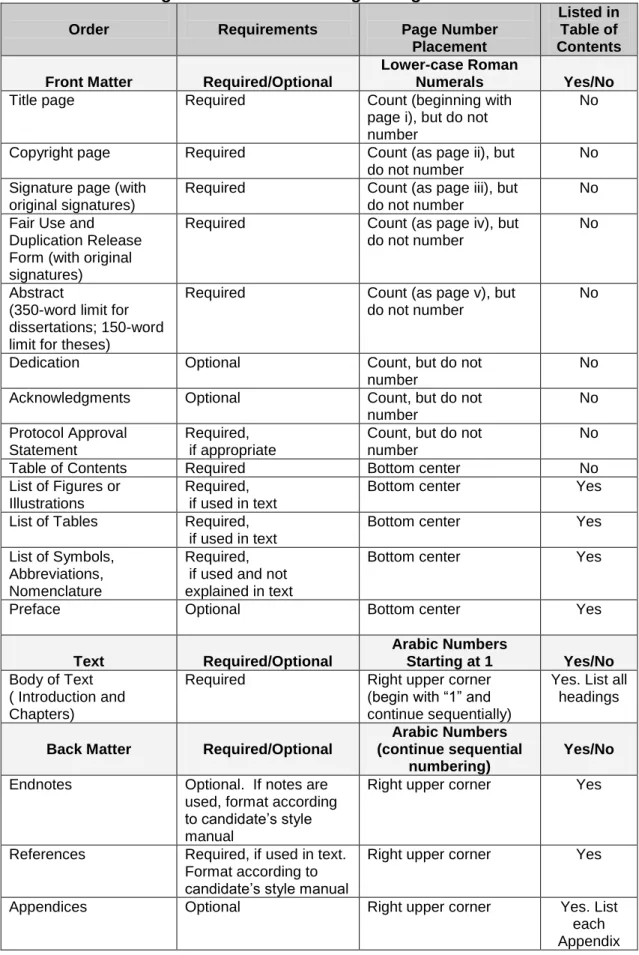
Page numbering should be consistent throughout, with lower-case Roman numerals on preliminary pages (front matter) and Arabic numbers starting with ―1‖ on text material (consecutive through appendixed material). See following table for specific arrangement and numbering of pages.
When combining Word documents to upload to ProQuest, you may need to insert a ―Section Break‖ after front pages in order to change placement of the numbering from Roman numerals centered at the bottom to Arabic numbers in the upper right-hand corner.
Table 1. Arrangement and Numbering of Pages
Order Requirements Page Number Placement
Listed in Table of Contents Front Matter Required/Optional
Lower-case Roman
Numerals Yes/No
Title page Required Count (beginning with
page i), but do not number
No
Copyright page Required Count (as page ii), but
do not number
No Signature page (with
original signatures)
Required Count (as page iii), but
do not number
No Fair Use and
Duplication Release Form (with original signatures)
Required Count (as page iv), but
do not number
No
Abstract
(350-word limit for dissertations; 150-word limit for theses)
Required Count (as page v), but
do not number
No
Dedication Optional Count, but do not
number
No
Acknowledgments Optional Count, but do not
number No Protocol Approval Statement Required, if appropriate
Count, but do not number
No
Table of Contents Required Bottom center No
List of Figures or Illustrations
Required, if used in text
Bottom center Yes
List of Tables Required,
if used in text
Bottom center Yes
List of Symbols, Abbreviations, Nomenclature
Required, if used and not explained in text
Bottom center Yes
Preface Optional Bottom center Yes
Text Required/Optional Arabic Numbers Starting at 1 Yes/No Body of Text ( Introduction and Chapters)
Required Right upper corner
(begin with ―1‖ and continue sequentially)
Yes. List all headings
Back Matter Required/Optional
Arabic Numbers (continue sequential
numbering)
Yes/No
Endnotes Optional. If notes are
used, format according to candidate’s style manual
Right upper corner Yes
References Required, if used in text.
Format according to candidate’s style manual
Right upper corner Yes
Appendices Optional Right upper corner Yes. List
each Appendix
Distribution and Binding
The Graduate School requires three copies of your thesis/dissertation (four copies for joint programs) printed on 24lb. bond, acid-free, white paper (note: paper does NOT need to be 100% cotton; 24-lb, bond, acid free, white paper can be purchased in the UALR Bookstore and at local office supply businesses) and an electronic copy in PDF form uploaded on ProQuest. (See subsequent heading, “Submission to ProQuest.”)
Students should submit one, original, unbound copy with the correct number of signature pages (three, or four for joint programs) signed by all committee members to the Graduate School for final review. If students also wish to obtain original signatures for pages in personal copies, they should bring the appropriate number for the Graduate Dean’s signature. The Graduate School will contact each student and advise if revisions are necessary or if the
thesis/dissertation can be picked up and copied for submission. (You may pick up your unbound copy with the Graduate Dean’s signature in the Graduate School office from 8 a.m. to 5 p.m., Monday through Friday.) All copies must include a signature page with signatures of your
thesis/dissertation advisor, thesis/dissertation committee members, program coordinator, and Graduate Dean and must be submitted by the noted
deadline. (See “Deadlines for Theses and Dissertations” below.) If the Graduate School asks for revisions, students do not need to resubmit an original, unbound copy to the Graduate Dean before making copies; however, if the requested revisions are not made, all copies of the thesis or dissertation will be returned unsigned.
Students have two options for binding:
Option 1: Deliver unbound copies to the Graduate School by the deadline, and pay binding fees at the cashier’s office to cover binding costs. (See “Expenses” at the end of this document.) Separate copies with colored paper when delivering to the Graduate School. If you would like additional bound copies for your personal use, please supply the additional number of unbound copies and pay expenses to cover pertinent binding charges. The Graduate School will send unbound copies to a bindery and notify you when bound copies are ready for you to pick up.
Option 2: Students may also elect to bind their own theses/dissertations in accordance with UALR requirements. In which case, three (or four, if a joint program) bound copies must be delivered to the Graduate School by the noted deadline. This will require students to plan ahead since signature pages and unbound copies will need to be delivered to the Graduate School earlier. Students should allow time for scheduling defenses and corrections to documents and binding when choosing Option 2.
Theses/dissertations will not be accepted if they do not comply with UALR requirements. If you choose to bind your own thesis/dissertation, be sure that hard covers are black only. Vertical, gold lettering on the spine should
include two lines: one with your name, degree, and graduation year with a 3-inch space at the bottom for library cataloging, and one with the thesis or dissertation title. Note that a 3-inch space at the bottom for library cataloging also needs to be included in the title line. If titles are too long to include in the space on the spine, they should be truncated, using ellipses (see example below). The front cover of the book should include the full thesis/dissertation title. If the book is not wide enough to accommodate two lines of print, the title should be omitted on the spine, but full title should be included on the front cover. Please contact the Graduate School (569-8661) with questions before binding.
Example of printing on book spine: Line 1 - Name, degree, date; Line 2 - Title
Deadlines for Theses and Dissertations
Note that deadlines for bound copies when students choose to bind their own theses/dissertations are the same as deadlines for unbound copies when students choose to have the university handle binding. Students are
encouraged to bring their original copy for the Graduate Dean’s signature as early as possible so that copies can be made and submitted by deadlines. Graduate School reviews will usually be completed within 48 hours.
GRADUATING SEMESTER BINDING OPTION 1 BINDING OPTION 2 Unbound copies, complete signature pages, and payment for binding due in Graduate School
Unbound copy and complete signature page due in Graduate School
Bound copies due in Graduate School
Fall December 1 November 1 December 1
Spring May 1 April 1 May 1
Summer August 1 July 1 August 1
Mary A. Smith, M.S. 2007
Graduation Applications
In addition to meeting the above deadlines for theses and dissertations, students must also apply for graduation by logging onto their BOSS accounts to complete an application. For specific graduation application deadlines, check http://ualr.edu/rec_reg/grad_info/appdead.asp, but generally,
applications must be submitted at the beginning of the semester in which a student expects to graduate. Applications submitted after the deadline may not be processed prior to the conferral date. Also, if students do not meet requirements for the original graduation date, they must reapply. For
example, if a student applies for Spring graduation by the Spring application deadline yet does not finish graduation requirements in Spring, the student must reapply for Summer graduation by the Summer semester application deadline date. Graduate program coordinators must also complete all appropriate sections for each graduation application.
Other Policy Issues
Protocols for Research Involving Human or Animal Subjects or Biohazardous Material
Candidates using surveys, experiments, etc. involving human subjects or animals should contact the Office of Research and Sponsored Programs (ORSP) early in their graduate degree programs, before they begin their research. (See http://www.ualr.edu/orsp/irb.shtml for IRB information.) Research involving human or animal subjects must be reviewed by the Institutional Review Board (IRB) or Institutional Animal Care and Use Committee (IACUC), even to document that IRB approval is not needed for the research design.
Likewise, research involving recombinant DNA, radioisotopes, or other hazardous materials must receive prior approval from the Environmental Health and Safety Committee (EHSC) or Radiation Safety Committee (RSC); contact your faculty advisor early for the appropriate action if your research involves biohazardous materials.
After your project has been approved by the IRB, IACUC, EHSC, or RSC a Protocol Approval Statement must be included in your thesis or dissertation (see appropriate order placement in the table above), giving the name of your project, committee name, approval date, and protocol number.
Plagiarism
Always give credit where credit is due! Claiming the exact words, paraphrases, ideas, arguments, or thoughts of another as your own is plagiarism, and UALR Policies may require disciplinary action (including dismissal) and/or grade adjustments for this offense. Quotation marks should be used to indicate the exact words of another. Each time you paraphrase the words of another (such as in summarizing passages, rearranging sentence order, or changing words), you should credit the source in your writing. Most style manuals define plagiarism and cite examples, telling how to avoid it. For more information about plagiarism, you can also go to: http://library.ualr.edu/research/ or www.ualr.edu/copyright/?ID=2 . Intellectual Property
If your project involves an invention or idea that could be patented, your faculty advisor must submit a UA Invention Disclosure Form to the UALR Patent and Copyright Committee. If you believe your ideas may be
patentable, speak to your project advisor immediately about privacy issues. The circulation of your thesis or dissertation as well as your project defense can be affected pending the Committee’s examination. For more information, go to: http://www.uark.edu/ua/techip/inventors/handbook.html.
Submission to ProQuest
Candidates must upload a PDF version of their dissertations or theses to ProQuest, which can be accessed on the Graduate School website
(www.ualr.edu/gradschool), and pay the appropriate fees to ProQuest before UALR confers degrees. (See “Expenses” below.) Uploads must take place within three days of final submissions to the Graduate School. ProQuest makes it possible for scholars throughout the world to consult your
dissertation or thesis through University Microfilms International (UMI). Students should follow directions for ―Preparing Your Manuscript for Submission to ProQuest/UMI‖ at
http://www.proquest.com/products_umi/dissertations/UMI_PreparingYourMan uscriptGuide.pdf . The ProQuest site also has instructions for submitting supplementary material to theses or dissertations on CD or DVD.
After you upload your thesis or dissertation and pay fees, ProQuest will notify the UALR Graduate School Administrator for review and approval before posting the text on UMI.
Copyright Registration
ProQuest also offers to register your dissertation/ thesis copyright with the Library of Congress Copyright Office. (See “Expenses” below.) As you decide whether to register your copyright, you should know that any work of original authorship is protected by copyright, even without registration. However, you may not be able to collect damages from someone who infringes on your copyright unless you have registered it with the Library of Congress. You may register your copyright yourself at any time within five years of the completion of your thesis/dissertation. If you choose to have ProQuest/UMI register the copyright for you at the time you upload your thesis/dissertation, please pay the appropriate fee ―with copyright option‖ on the ProQuest site. For more information on copyrights, go to
http://www.ualr.edu/copyright/?ID=2 .
If you have used journal articles in your thesis or dissertation that have been published or submitted for publication elsewhere, please note that the
ProQuest site allows you to place an ―embargo‖ or ―restriction‖ on your publication so that it is not distributed on the UMI site.
Expenses
Item Required/optional Amount Payment method
ProQuest thesis Required $55 Payable on
ProQuest site
ProQuest dissertation
Required $65 Payable on
ProQuest site
Copyright expenses Optional $65 Payable on
ProQuest site
Binding Required (but
students have the option of using their own binderies)
$18 per copy Payable at the UALR
Cashier’s Office – Adm. North Bldg.
Summary of Steps and Required Forms for
Submitting Thesis/Dissertation
What? When? Where?
1. Deliver ―Appointment of Supervisory Committee‖ form
At beginning of project
(Obtain form and signatures from College Program and Graduate Coordinators)
Graduate School
2. Apply for Graduation
At beginning of graduating term. See
http://ualr.edu/rec_reg/grad_info/appdead.asp
Office of Records and Registration and at https://boss.ualr.edu
3. Schedule Thesis/Dissertation Defense
Approximately one month before submission to the Graduate School. Dates should be set early to allow for revisions required by Committees.
Faculty Advisor and Committee
4. Deliver one, original copy of thesis/dissertation and correct number of signature pages (minimum three)
As soon as possible before deadline dates. Graduate School will advise about revisions or release document for copying onto 24-lb. paper. Original signature pages for the Graduate Dean’s signature should be submitted on 24-lb. paper. Graduate School 5. Deliver correct number of unbound copies (paying binding expenses) or deliver correct number of bound copies
By deadline dates in graduating semester Graduate School
6. Pay all bindery expenses
At delivery of final, unbound,
thesis/dissertation copies to the Graduate School UALR Cashier 7. Deliver ―Supervisory or Examining Committee Report‖ form
At delivery of final, unbound or bound, thesis/dissertation copies to the Graduate School
(Obtain form from College Graduate Coordinator with appropriate signatures)
Graduate School
8. Upload
thesis/dissertation on ProQuest
Within 3 days of approval by the Graduate Dean of final thesis/dissertation copy
See ProQuest at www.ualr.edu/gradsch ool/
9. Pay all expenses for ProQuest upload and copyright or embargo (if applicable)
Example Pages
The following are full-page examples of a Title page, Signature page, Fair Use and Duplication page, and Abstract page that must be included at the beginning of your thesis or dissertation. The word ―thesis‖ is used in the examples, but if you are writing a dissertation, you should insert the word ―dissertation‖ in place of ―thesis.‖ The version that you create and format must have the exact same wording and spacing with your name, title, and
graduation year, etc. replacing the [bracketed] information.
Note: On the title page, be sure your formal degree is listed and correct. For example, use ―Doctor of Philosophy‖ and not ―PhD,‖ or use ―Master of Arts‖ and not ―Master’s degree.‖ Check with your Program Coordinator if you are unsure of the formal title of your degree.
If your college requires the signature of your college dean on the signature page, you should also include a name and signature line for the college dean before the Graduate Dean’s signature line. Please check with your advisor and graduate coordinator if you have questions about required signatures in your college.
Note: When creating a name and signature line for advisor, committee members, program coordinator, and Graduate Dean on the signature page, do not include the titles ―Dr., Mr., or Ms.‖ before the name and do not include academic degree, such as ―PhD, MS, MD,‖ etc., after the name. Use only first and last name on the first line and academic rank and department, such as ―Professor of History; Associate Professor of Mathematics,‖ etc., on the second line.
[TYPE THE COMPLETE TITLE OF YOUR DOCUMENT HERE. ALL CAPS]
A Thesis Submitted to the Graduate School
University of Arkansas at Little Rock
in partial fulfillment of requirements for the degree of
[TYPE YOUR FULL DEGREE TITLE IN CAPS] in [Type your Program Title]
in the Department of [Type Department Name] of the College of [Type College Name]
[Type Month and Year of Graduation]
[Type your full name as it appears on University records]
© Copyright by
[Type your Full Name as it appears in University records] [Type the year of your degree]
This thesis, ―[Type the complete title of your document here],‖ by [Type your full name here as it appears on University records], is approved by:
Thesis Advisor:
[Full name of Thesis Advisor] (For example, Bob Smith)
[Academic Rank and Department] (For example, Professor of Chemistry)
Thesis Committee:
[Full name of Committee member] (For example, Mary Miller)
[Academic Rank and Department] (For example, Professor of Biology)
[Full name of Committee member] [Academic Rank and Department]
[Full name of Committee member] [Academic Rank and Department]
Program Coordinator:
[Full name of Program Coordinator] [Academic Rank and Department]
Graduate Dean:
[Full name of Graduate Dean]
(For example, Johanna Miller Lewis) [Academic Rank and Department] (For example, Professor of History)
Fair Use
This thesis is protected by the Copyright Laws of the United States (Public Law 94-553, revised in 1976). Consistent with fair use as defined in the Copyright Laws, brief quotations from this material are allowed with proper acknowledgment. Use of this material for financial gain without the author’s express written permission is not allowed.
Duplication
I authorize the Head of Interlibrary Loan or the Head of Archives at the
Ottenheimer Library at the University of Arkansas at Little Rock to arrange for duplication of this thesis for educational or scholarly purposes when so
requested by a library user. The duplication will be at the user’s expense.
Signature
I refuse permission for this thesis to be duplicated in whole or in part.
[TYPE THE FULL TITLE OF YOUR THESIS OR DISSERTATION IN CAPS] by [Type Your Name as it appears on University records], [Type
graduation date]
ABSTRACT
[Type the body of your abstract here; double-space throughout. Abstracts for dissertations cannot exceed 350 words, and in most cases, they should be no longer than one page. Abstracts for theses cannot exceed 150 words. Use only text in an abstract—no tables, figures, pictures, formulae, etc. Do not justify right-hand margin. Count, but do not number the Abstract page at the bottom.]