P C I - E
X P R E S S
G
E N
1 , G
E N
2 , & G
E N
3 Q
U A D
O
U T P U T
C
L O C K
G
E N E R A T O R
Features
Applications
Description
The Si52144 is a spread-spectrum enabled PCIe clock generator that can source four PCIe clocks. The device has four hardware output enable pins for enabling the outputs, and one hardware pin to control spread spectrum on PCIe clock outputs. In addition to the hardware control pins, I2C programmability is also available to dynamically control skew, edge rate and amplitude on the true, compliment, or both differential signals on the PCIe clock outputs. This control feature enables optimal signal integrity as well as optimal EMI signature on the PCIe clock outputs.
Refer to AN636 for signal integrity and configurability. Measuring PCIe clock jitter is quick and easy with the Silicon Labs PCIe Clock Jitter Tool. Download it for free at www.silabs.com/pcie-learningcenter.
Functional Block Diagram
PCI-Express Gen 1, Gen 2, Gen 3, and Gen 4 common clock compliant
Gen 3 SRNS Compliant
Supports Serial ATA (SATA) at 100 MHz
Low power, push-pull HCSL compatible differential outputs
No termination resistors required
Dedicated output enable hardware pins for each clock output
Dedicated hardware pin for spread spectrum control
Four PCI-Express clocks
25 MHz crystal input or clock input
Signal integrity tuning
I2C support with readback capabilities
Triangular spread spectrum profile for maximum electromagnetic interference (EMI) reduction
Industrial temperature –40 to 85 °C
3.3 V power supply
24-pin QFN package
Network attached storage
Multi-function printer
Wireless access point
Routers
Control RAM
Control & Memory
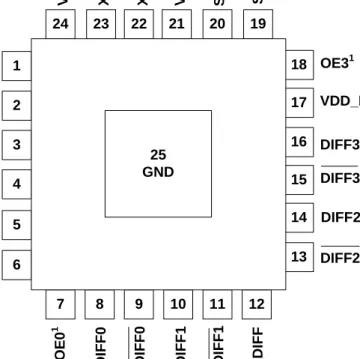
XIN/CLKIN XOUT SCLK SDATA SSON OE [3:0] DIFF1 DIFF3 DIFF0 PLL (SSC) Divider DIFF2 Patents pending Ordering Information: See page 18 Pin Assignments VDD_DIFF OE11 SSON2 VSS VDD_DIFF OE21 VSS_ C O R E X IN/ CL KI N XO U T 1 2 3 4 5 6 24 23 22 21 20 19 7 8 9 10 11 12 18 17 16 15 14 13 OE 0 1 D IFF0 DIFF 0 DI F F 1 DI F F 1 V DD_ DI F F V DD_ CO RE S DAT A SC L K OE31 VDD_DIFF DIFF3 DIFF3 DIFF2 DIFF2 Notes:
1. Internal 100 kohm pull-up. 2. Internal 100 kohm pull-down.
25 GND
T
A B L E
O F
C
O N T E N TS
Section
Page
1. Electrical Specifications . . . 4
2. Functional Description . . . 7
2.1. Crystal Recommendations . . . 7
2.2. OE Pin Definition . . . 8
2.3. OE Assertion . . . . 8
2.4. OE Deassertion . . . 8
2.5. SSON Pin Definition . . . 8
3. Test and Measurement Setup . . . 9
4. Control Registers . . . 11
4.1. I2C Interface . . . . 11
4.2. Data Protocol . . . 11
5. Pin Descriptions: 24-Pin QFN . . . 16
6. Ordering Guide . . . 18
7. Package Outline . . . 19
8. Land Pattern . . . 20
4 Rev. 1.4
1. Electrical Specifications
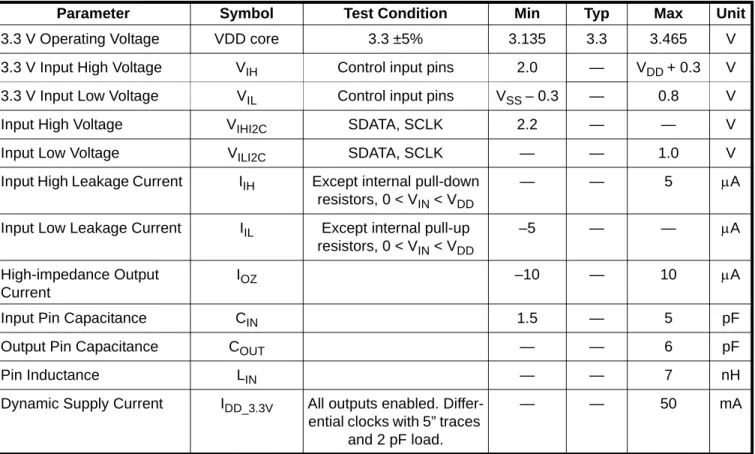
Table 1. DC Electrical Specifications
Parameter Symbol Test Condition Min Typ Max Unit
3.3 V Operating Voltage VDD core 3.3 ±5% 3.135 3.3 3.465 V
3.3 V Input High Voltage VIH Control input pins 2.0 — VDD + 0.3 V
3.3 V Input Low Voltage VIL Control input pins VSS – 0.3 — 0.8 V
Input High Voltage VIHI2C SDATA, SCLK 2.2 — — V
Input Low Voltage VILI2C SDATA, SCLK — — 1.0 V
Input High Leakage Current IIH Except internal pull-down resistors, 0 < VIN < VDD
— — 5 A
Input Low Leakage Current IIL Except internal pull-up
resistors, 0 < VIN < VDD
–5 — — A
High-impedance Output Current
IOZ –10 — 10 A
Input Pin Capacitance CIN 1.5 — 5 pF
Output Pin Capacitance COUT — — 6 pF
Pin Inductance LIN — — 7 nH
Dynamic Supply Current IDD_3.3V All outputs enabled. Differ-ential clocks with 5” traces
and 2 pF load.
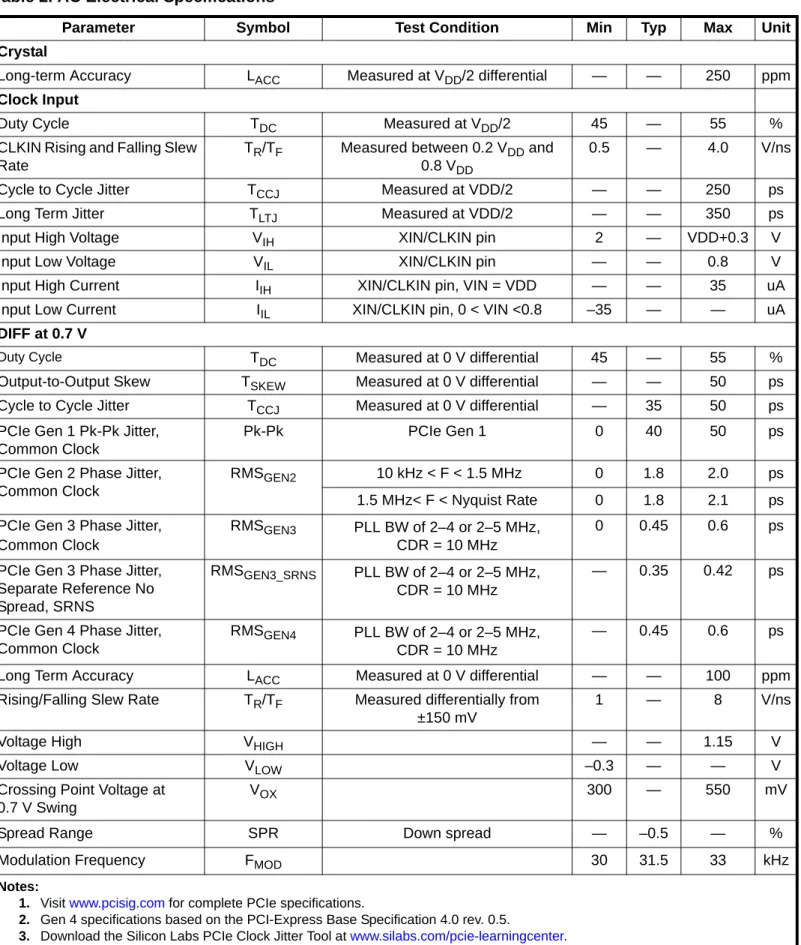
Table 2. AC Electrical Specifications
Parameter Symbol Test Condition Min Typ Max Unit
Crystal
Long-term Accuracy LACC Measured at VDD/2 differential — — 250 ppm
Clock Input
Duty Cycle TDC Measured at VDD/2 45 — 55 %
CLKIN Rising and Falling Slew Rate
TR/TF Measured between 0.2 VDD and 0.8 VDD
0.5 — 4.0 V/ns
Cycle to Cycle Jitter TCCJ Measured at VDD/2 — — 250 ps
Long Term Jitter TLTJ Measured at VDD/2 — — 350 ps
Input High Voltage VIH XIN/CLKIN pin 2 — VDD+0.3 V
Input Low Voltage VIL XIN/CLKIN pin — — 0.8 V
Input High Current IIH XIN/CLKIN pin, VIN = VDD — — 35 uA
Input Low Current IIL XIN/CLKIN pin, 0 < VIN <0.8 –35 — — uA
DIFF at 0.7 V
Duty Cycle TDC Measured at 0 V differential 45 — 55 %
Output-to-Output Skew TSKEW Measured at 0 V differential — — 50 ps
Cycle to Cycle Jitter TCCJ Measured at 0 V differential — 35 50 ps
PCIe Gen 1 Pk-Pk Jitter, Common Clock
Pk-Pk PCIe Gen 1 0 40 50 ps
PCIe Gen 2 Phase Jitter, Common Clock
RMSGEN2 10 kHz < F < 1.5 MHz 0 1.8 2.0 ps
1.5 MHz< F < Nyquist Rate 0 1.8 2.1 ps
PCIe Gen 3 Phase Jitter, Common Clock
RMSGEN3 PLL BW of 2–4 or 2–5 MHz,
CDR = 10 MHz
0 0.45 0.6 ps
PCIe Gen 3 Phase Jitter, Separate Reference No Spread, SRNS
RMSGEN3_SRNS PLL BW of 2–4 or 2–5 MHz, CDR = 10 MHz
— 0.35 0.42 ps
PCIe Gen 4 Phase Jitter, Common Clock
RMSGEN4 PLL BW of 2–4 or 2–5 MHz,
CDR = 10 MHz
— 0.45 0.6 ps
Long Term Accuracy LACC Measured at 0 V differential — — 100 ppm
Rising/Falling Slew Rate TR/TF Measured differentially from
±150 mV
1 — 8 V/ns
Voltage High VHIGH — — 1.15 V
Voltage Low VLOW –0.3 — — V
Crossing Point Voltage at 0.7 V Swing
VOX 300 — 550 mV
Spread Range SPR Down spread — –0.5 — %
Modulation Frequency FMOD 30 31.5 33 kHz
Notes:
1. Visit www.pcisig.com for complete PCIe specifications.
2. Gen 4 specifications based on the PCI-Express Base Specification 4.0 rev. 0.5.
6 Rev. 1.4
Enable/Disable and Setup
Clock Stabilization from Power-up
TSTABLE Measured from the point when both VDD and clock input are valid.
— — 1.8 ms
Stopclock Set-up Time TSS 10.0 — — ns
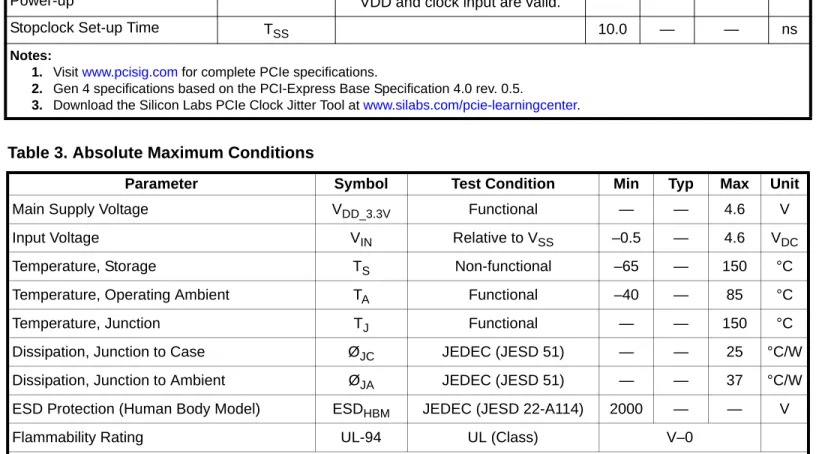
Table 3. Absolute Maximum Conditions
Parameter Symbol Test Condition Min Typ Max Unit
Main Supply Voltage VDD_3.3V Functional — — 4.6 V
Input Voltage VIN Relative to VSS –0.5 — 4.6 VDC
Temperature, Storage TS Non-functional –65 — 150 °C
Temperature, Operating Ambient TA Functional –40 — 85 °C
Temperature, Junction TJ Functional — — 150 °C
Dissipation, Junction to Case ØJC JEDEC (JESD 51) — — 25 °C/W
Dissipation, Junction to Ambient ØJA JEDEC (JESD 51) — — 37 °C/W
ESD Protection (Human Body Model) ESDHBM JEDEC (JESD 22-A114) 2000 — — V
Flammability Rating UL-94 UL (Class) V–0
Note: While using multiple power supplies, the voltage on any input or I/O pin cannot exceed the power pin during power-up. Power supply sequencing is not required.
Table 2. AC Electrical Specifications (Continued)
Parameter Symbol Test Condition Min Typ Max Unit
Notes:
1. Visit www.pcisig.com for complete PCIe specifications.
2. Gen 4 specifications based on the PCI-Express Base Specification 4.0 rev. 0.5.
2. Functional Description
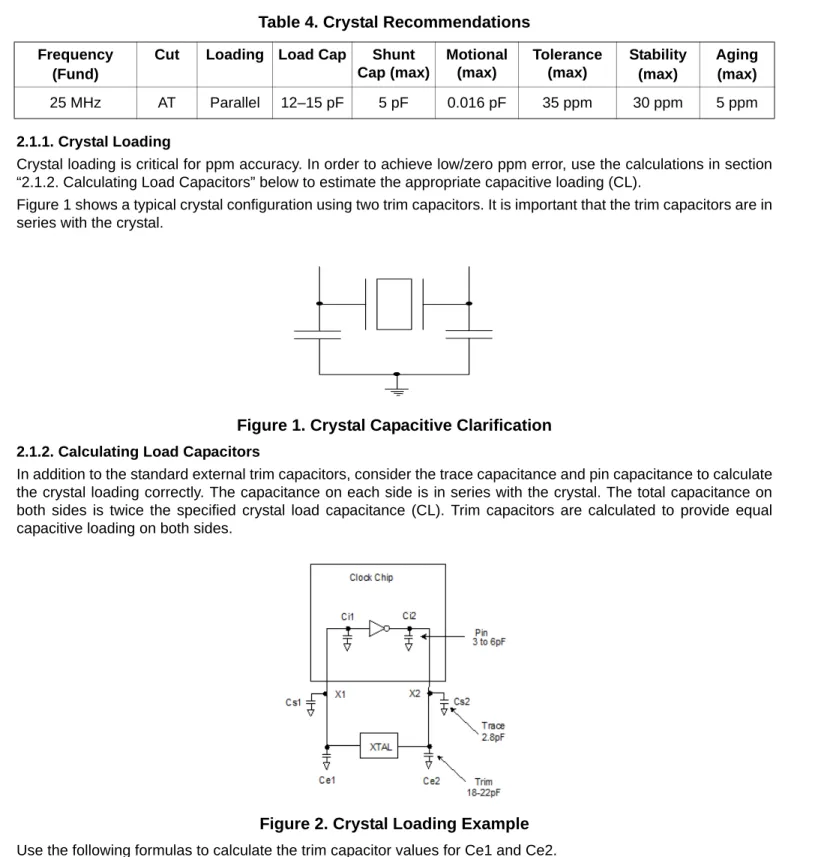
2.1. Crystal Recommendations
If using crystal input, the device requires a parallel resonance 25 MHz crystal.
2.1.1. Crystal Loading
Crystal loading is critical for ppm accuracy. In order to achieve low/zero ppm error, use the calculations in section “2.1.2. Calculating Load Capacitors” below to estimate the appropriate capacitive loading (CL).
Figure 1 shows a typical crystal configuration using two trim capacitors. It is important that the trim capacitors are in series with the crystal.
Figure 1. Crystal Capacitive Clarification
2.1.2. Calculating Load Capacitors
In addition to the standard external trim capacitors, consider the trace capacitance and pin capacitance to calculate the crystal loading correctly. The capacitance on each side is in series with the crystal. The total capacitance on both sides is twice the specified crystal load capacitance (CL). Trim capacitors are calculated to provide equal capacitive loading on both sides.
Figure 2. Crystal Loading Example
Use the following formulas to calculate the trim capacitor values for Ce1 and Ce2.
Table 4. Crystal Recommendations
Frequency (Fund)
Cut Loading Load Cap Shunt Cap (max) Motional (max) Tolerance (max) Stability (max) Aging (max) 25 MHz AT Parallel 12–15 pF 5 pF 0.016 pF 35 ppm 30 ppm 5 ppm
8 Rev. 1.4
CL: Crystal load capacitance
CLe: Actual loading seen by crystal using standard value trim capacitors
Ce: External trim capacitors
Cs: Stray capacitance (terraced)
Ci: Internal capacitance (lead frame, bond wires, etc.)
2.2. OE Pin Definition
The OE pins are active high inputs used to enable and disable the output clocks. To enable the output clock, the OE pin needs to be logic high and the I2C output enable bit needs to be logic high. There are two methods to disable the output clocks: the OE is pulled to a logic low, or the I2C enable bit is set to a logic low. The OE pins is required to be driven at all time and even though it has an internally 100 k resistor.
2.3. OE Assertion
The OE signals are active high input used for synchronous stopping and starting the DIFF output clocks respectively while the rest of the clock generator continues to function. The assertion of the OE signal by making it logic high causes stopped respective DIFF output to resume normal operation. No short or stretched clock pulses are produced when the clock resumes. The maximum latency from the assertion to active outputs is no more than two to six output clock cycles.
2.4. OE Deassertion
When the OE pin is deasserted by making its logic low, the corresponding DIFF output is stopped cleanly, and the final output state is driven low.
2.5. SSON Pin Definition
SSON is an active input used to enable –0.5% spread on all DIFF outputs. When sampled high, –0.5% spread is enabled on all DIFF outputs. When sampled low, the DIFF output frequencies are non-spread.
Load Capacitance (each side)
Total Capacitance (as seen by the crystal)
Ce = 2 x CL – (Cs + Ci) Ce1 + Cs1 + Ci1 1
+
Ce2 + Cs2 + Ci2 1(
)
1=
CLe3. Test and Measurement Setup
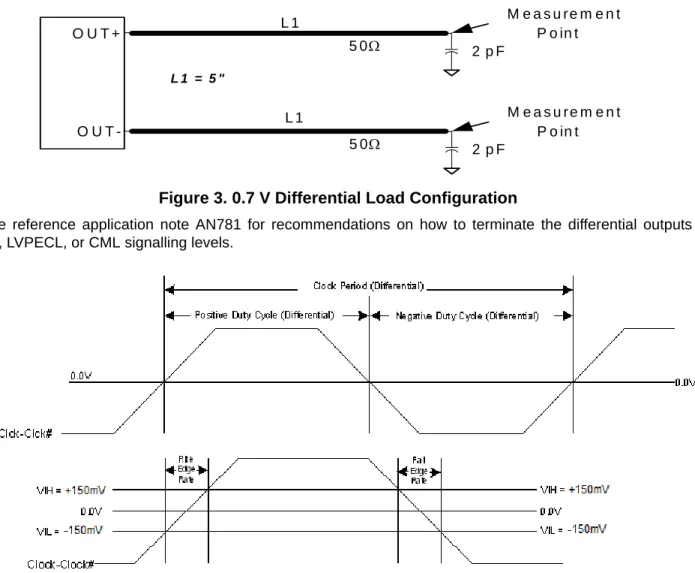
Figure 3 shows the test load configuration for the differential HCSL clock outputs.
Figure 3. 0.7 V Differential Load Configuration
Please reference application note AN781 for recommendations on how to terminate the differential outputs for LVDS, LVPECL, or CML signalling levels.
Figure 4. Differential Measurement for Differential Output Signals
(for AC Parameters Measurement)
M e a s u r e m e n t P o in t 2 p F 5 0 M e a s u r e m e n t P o in t 2 p F 5 0 L 1 L 1 = 5 " O U T + O U T - L 1
10 Rev. 1.4
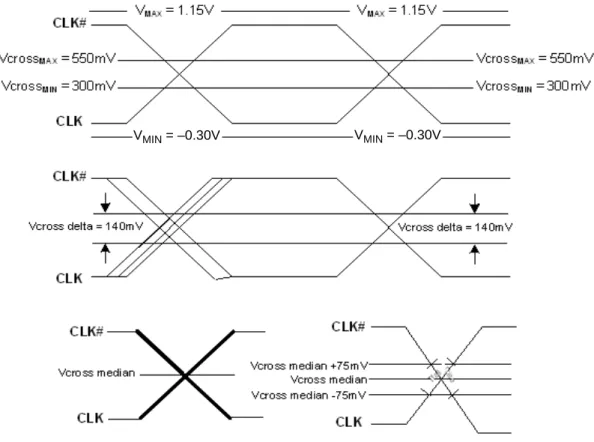
Figure 5. Single-Ended Measurement for Differential Output Signals
(for AC Parameters Measurement)
4. Control Registers
4.1. I
2C Interface
To enhance the flexibility and function of the clock synthesizer, an I2C interface is provided. Through the Serial Data Interface, various device functions, such as individual clock enablement. The registers associated with the I2C Interface initialize to their default setting at power-up. The use of this interface is optional. Clock device register changes are normally made at system initialization, if any are required. Power management functions can only be programed in program mode and not in normal operation modes.
4.2. Data Protocol
The clock driver I2C protocol accepts byte write, byte read, block write, and block read operations from the controller. For block write/read operation, access the bytes in sequential order from lowest to highest (most significant bit first) with the ability to stop after any complete byte is transferred. For byte write and byte read operations, the system controller can access individually indexed bytes.
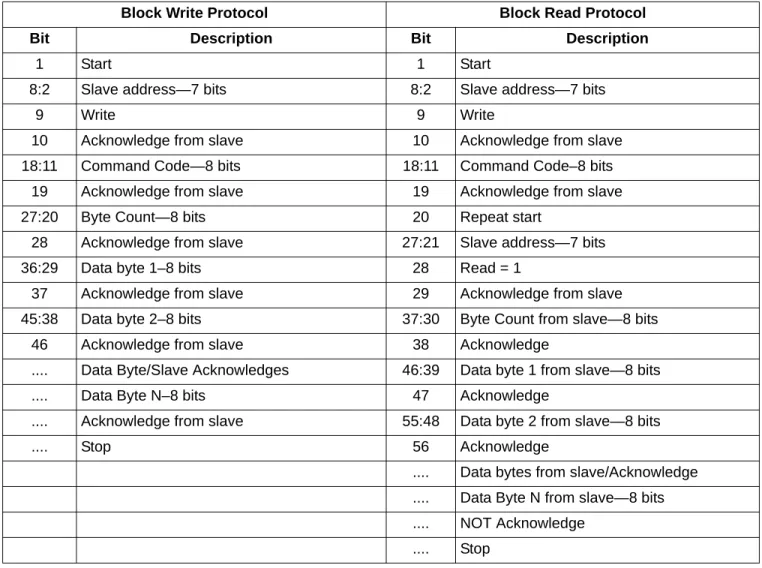
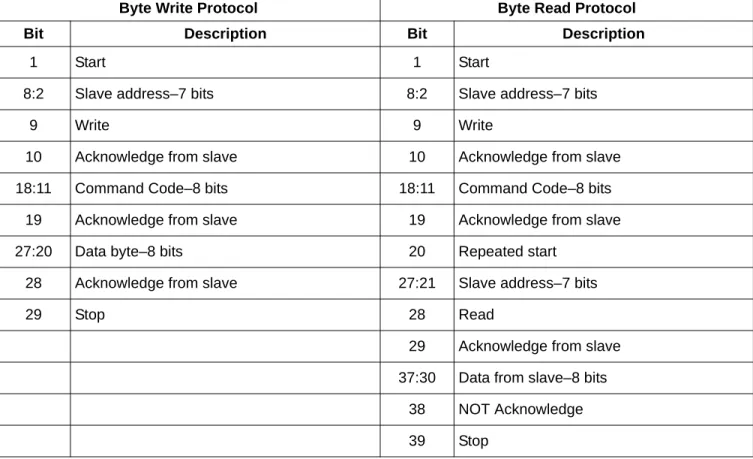
The block write and block read protocol is outlined in Table 5 while Table 6 outlines byte write and byte read protocol. The slave receiver address is 11010110 (D6h).
Table 5. Block Read and Block Write Protocol
Block Write Protocol Block Read Protocol
Bit Description Bit Description
1 Start 1 Start
8:2 Slave address—7 bits 8:2 Slave address—7 bits
9 Write 9 Write
10 Acknowledge from slave 10 Acknowledge from slave
18:11 Command Code—8 bits 18:11 Command Code–8 bits
19 Acknowledge from slave 19 Acknowledge from slave
27:20 Byte Count—8 bits 20 Repeat start
28 Acknowledge from slave 27:21 Slave address—7 bits
36:29 Data byte 1–8 bits 28 Read = 1
37 Acknowledge from slave 29 Acknowledge from slave
45:38 Data byte 2–8 bits 37:30 Byte Count from slave—8 bits
46 Acknowledge from slave 38 Acknowledge
.... Data Byte/Slave Acknowledges 46:39 Data byte 1 from slave—8 bits
.... Data Byte N–8 bits 47 Acknowledge
.... Acknowledge from slave 55:48 Data byte 2 from slave—8 bits
.... Stop 56 Acknowledge
.... Data bytes from slave/Acknowledge .... Data Byte N from slave—8 bits
.... NOT Acknowledge
12 Rev. 1.4
Table 6. Byte Read and Byte Write Protocol
Byte Write Protocol Byte Read Protocol
Bit Description Bit Description
1 Start 1 Start
8:2 Slave address–7 bits 8:2 Slave address–7 bits
9 Write 9 Write
10 Acknowledge from slave 10 Acknowledge from slave
18:11 Command Code–8 bits 18:11 Command Code–8 bits
19 Acknowledge from slave 19 Acknowledge from slave
27:20 Data byte–8 bits 20 Repeated start
28 Acknowledge from slave 27:21 Slave address–7 bits
29 Stop 28 Read
29 Acknowledge from slave
37:30 Data from slave–8 bits
38 NOT Acknowledge
Reset settings = 00000000
Reset settings = 00000101
Control Register 0. Byte 0
Bit D7 D6 D5 D4 D3 D2 D1 D0
Name
Type R/W R/W R/W R/W R/W R/W R/W R/W
Bit Name Function
7:0 Reserved
Register 1. Byte 1
Bit D7 D6 D5 D4 D3 D2 D1 D0
Name DIFF0_OE DIFF1_OE
Type R/W R/W R/W R/W R/W R/W R/W R/W
Bit Name Function
7:3 Reserved
2 DIFF0_OE Output Enable for DIFF0.
0: Output disabled. 1: Output enabled.
1 Reserved
0 DIFF1_OE Output Enable for DIFF1.
0: Output disabled. 1: Output enabled.
14 Rev. 1.4 Reset settings = 11000000 Reset settings = 00001000 Reset settings = 00000110 Register 2. Byte 2 Bit D7 D6 D5 D4 D3 D2 D1 D0
Name DIFF2_OE DIFF3_OE
Type R/W R/W R/W R/W R/W R/W R/W R/W
Bit Name Function
7 DIFF2_OE Output Enable for DIFF2.
0: Output disabled. 1: Output enabled.
6 DIFF3_OE Output Enable for DIFF3.
0: Output disabled. 1: Output enabled.
5:0 Reserved
Register 3. Byte 3
Bit D7 D6 D5 D4 D3 D2 D1 D0
Name Rev Code[3:0] Vendor ID[3:0]
Type R/W R/W R/W R/W R/W R/W R/W R/W
Bit Name Function
7:4 Rev Code[3:0] Program Revision Code.
3:0 Vendor ID[3:0] Vendor Identification Code.
Register 4. Byte 4
Bit D7 D6 D5 D4 D3 D2 D1 D0
Name BC[7:0]
Type R/W R/W R/W R/W R/W R/W R/W R/W
Bit Name Function
Reset settings = 11011000
Control Register 5. Byte 5
Bit D7 D6 D5 D4 D3 D2 D1 D0
Name DIFF_Amp_Sel DIFF_Amp_Cntl[2] DIFF_Amp_Cntl[1] DIFF_Amp_Cntl[0]
Type R/W R/W R/W R/W R/W R/W R/W R/W
Bit Name Function
7 DIFF_Amp_Sel Amplitude Control for DIFF Differential Outputs.
0: Differential outputs with Default amplitude.
1: Differential outputs amplitude is set by Byte 5[6:4].
6 DIFF_Amp_Cntl[2]
DIFF Differential Outputs Amplitude Adjustment.
000: 300 mV 001: 400 mV 010: 500 mV 011: 600 mV 100: 700 mV 101: 800 mV 110: 900 mV 111: 1000 mV
5 DIFF_Amp_Cntl[1]
4 DIFF_Amp_Cntl[0]
16 Rev. 1.4
5. Pin Descriptions: 24-Pin QFN
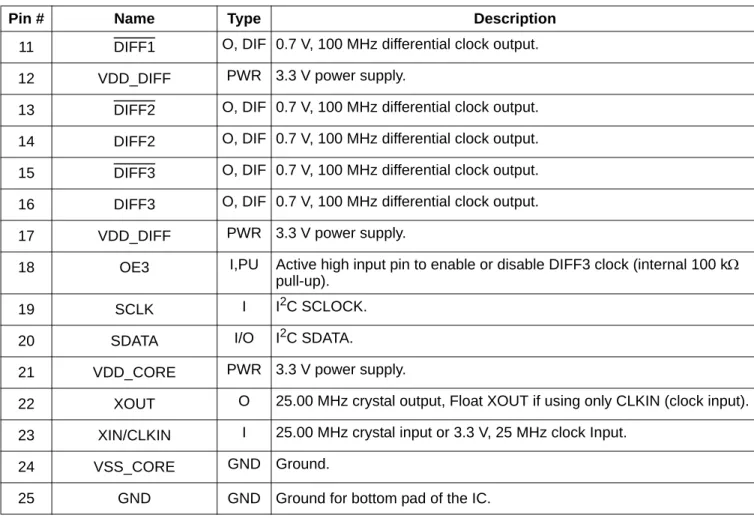
Table 7. Si52144 24-Pin QFN Descriptions
Pin # Name Type Description
1 VDD_DIFF PWR 3.3 V power supply.
2 OE1 I,PU Active high input pin to enable or disable DIFF1 clock (internal 100 k
pull-up).
3 SSON I,PD 3.3 V input for Spread Control (internal 100 k pull-down).
4 VSS GND Ground.
5 OE2 I,PU Active high input pin to enable or disable DIFF2 clock (internal 100 k
pull-up).
6 VDD_DIFF PWR 3.3 V power supply.
7 OE0 I,PU Active high input pin to enable or disable DIFF0 clock (internal 100 k
pull-up).
8 DIFF0 O, DIF 0.7 V, 100 MHz differential clock output.
9 DIFF0 O, DIF 0.7 V, 100 MHz differential clock output.
10 DIFF1 O, DIF 0.7 V, 100 MHz differential clock output.
VDD_DIFF OE11 SSON2 VSS VDD_DIFF OE21 VSS _CO R E XI N/ CLKI N XO UT 1 2 3 4 5 6 24 23 22 21 20 19 7 8 9 10 11 12 18 17 16 15 14 13 OE 0 1 DI FF0 DI FF0 DI FF1 DI FF1 V D D_DI FF VDD _ CO RE S DATA SCL K OE31 VDD_DIFF DIFF3 DIFF3 DIFF2 DIFF2 Notes:
1. Internal 100 kohm pull-up. 2. Internal 100 kohm pull-down.
25 GND
11 DIFF1 O, DIF 0.7 V, 100 MHz differential clock output.
12 VDD_DIFF PWR 3.3 V power supply.
13 DIFF2 O, DIF 0.7 V, 100 MHz differential clock output.
14 DIFF2 O, DIF 0.7 V, 100 MHz differential clock output.
15 DIFF3 O, DIF 0.7 V, 100 MHz differential clock output.
16 DIFF3 O, DIF 0.7 V, 100 MHz differential clock output.
17 VDD_DIFF PWR 3.3 V power supply.
18 OE3 I,PU Active high input pin to enable or disable DIFF3 clock (internal 100 k
pull-up).
19 SCLK I I2C SCLOCK.
20 SDATA I/O I2C SDATA.
21 VDD_CORE PWR 3.3 V power supply.
22 XOUT O 25.00 MHz crystal output, Float XOUT if using only CLKIN (clock input).
23 XIN/CLKIN I 25.00 MHz crystal input or 3.3 V, 25 MHz clock Input.
24 VSS_CORE GND Ground.
25 GND GND Ground for bottom pad of the IC.
Table 7. Si52144 24-Pin QFN Descriptions (Continued)
18 Rev. 1.4
6. Ordering Guide
Part Number Package Type Temperature
Lead-free
Si52144-A01AGM 24-pin QFN Industrial, –40 to 85C
7. Package Outline
Figure 6 illustrates the package details for the Si52144. Table 8 lists the values for the dimensions shown in the illustration.
Figure 6. 24-Pin Quad Flat No Lead (QFN) Package
Table 8. Package Diagram Dimensions
Symbol Millimeters
Min Nom Max
A 0.70 0.75 0.80 A1 0.00 0.025 0.05 b 0.20 0.25 0.30 D 4.00 BSC D2 2.60 2.70 2.80 e 0.50 BSC E 4.00 BSC E2 2.60 2.70 2.80 L 0.30 0.40 0.50 aaa 0.10 bbb 0.10 ccc 0.08 ddd 0.07 Notes:
1. All dimensions shown are in millimeters (mm) unless otherwise noted.
2. Dimensioning and Tolerancing per ANSI Y14.5M-1994.
3. This drawing conforms to JEDEC outline MO-220, variation VGGD-8. 4. Recommended card reflow profile is per the JEDEC/IPC J-STD-020
20 Rev. 1.4
8. Land Pattern
Figure 7. QFN Land Pattern
Table 9. Land Pattern Dimensions
Dimension Unit mm C1 4.0 C2 4.0 E 0.50 BSC X1 0.30 X2 2.70 Y1 0.80
Y2 2.70
Notes:
General
1. All dimensions shown are in millimeters (mm) unless otherwise noted. 2. This land pattern design is based on the IPC-7351 guidelines.
Solder Mask Design
3. All metal pads are to be non-solder mask defined (NSMD). Clearance between the solder mask and the metal pad is to be 60 m minimum, all the way around the pad.
Stencil Design
4. A stainless steel, laser-cut and electro-polished stencil with trapezoidal walls should be used to assure good solder paste release.
5. The stencil thickness should be 0.125 mm (5 mils).
6. The ratio of stencil aperture to land pad size should be 1:1 for all perimeter 7. pads.
8. A 2x2 array of 1.10 mm x 1.10 mm openings on 1.30mm pitch should be used for the center ground pad.
Card Assembly
9. A No-Clean, Type-3 solder paste is recommended.
10. The recommended card reflow profile is per the JEDEC/IPC J-STD-020 specification for Small Body Components.
Table 9. Land Pattern Dimensions (Continued)
22 Rev. 1.4
D
OCUMENT
C
HANGE
L
IST
Revision 0.1 to Revision 1.0
Updated Features on page 1.
Updated Description on page 1.
Updated Table 1 on page 4.
Updated Table 2 on page 5.
Updated Section 2.1 on page 7.
Updated Section 2.1.1 on page 7.
Updated Section 4.1 on page 11.
Updated Section 4.2 on page 11.
Updated Pin Descriptions on page 16.
Revision 1.0 to Revision 1.1
Removed Moisture Sensitivity Level specification from Table 3.
Revision 1.1 to Revision 1.2
Updated Table 2.
Updated Section 3.
Revision 1.2 to Revision 1.3
Updated Features on page 1.
Updated Description on page 1.
Updated specs in Table 2, “AC Electrical Specifications,” on page 5.
Revision 1.3 to Revision 1.4
February 22, 2016 Added test condition for TSTABLE in Table 2 on page 5.
Silicon Laboratories Inc. 400 West Cesar Chavez Austin, TX 78701
Energy-Friendly
Products
www.silabs.com/products www.silabs.com/qualityQuality Support and Communitycommunity.silabs.com
Disclaimer
Silicon Laboratories intends to provide customers with the latest, accurate, and in-depth documentation of all peripherals and modules available for system and software implementers using or intending to use the Silicon Laboratories products. Characterization data, available modules and peripherals, memory sizes and memory addresses refer to each specific device, and "Typical" parameters provided can and do vary in different applications. Application examples described herein are for illustrative purposes only. Silicon Laboratories reserves the right to make changes without further notice and limitation to product information, specifications, and descriptions herein, and does not give warranties as to the accuracy or completeness of the included information. Silicon Laboratories shall have no liability for the consequences of use of the information supplied herein. This document does not imply or express copyright licenses granted hereunder to design or fabricate any integrated circuits. The products are not designed or authorized to be used within any Life Support System without the specific written consent of Silicon Laboratories. A "Life Support System" is any product or system intended to support or sustain life and/or health, which, if it fails, can be reasonably expected to result in significant personal injury or death. Silicon Laboratories products are not designed or authorized for military applications. Silicon Laboratories products shall under no circumstances be used in weapons of mass destruction including (but not limited to) nuclear, biological or chemical weapons, or missiles capable of delivering such weapons.
Trademark Information
Silicon Laboratories Inc.® , Silicon Laboratories®, Silicon Labs®, SiLabs® and the Silicon Labs logo®, Bluegiga®, Bluegiga Logo®, Clockbuilder®, CMEMS®, DSPLL®, EFM®, EFM32®, EFR, Ember®, Energy Micro, Energy Micro logo and combinations thereof, "the world’s most energy friendly microcontrollers", Ember®, EZLink®, EZRadio®, EZRadioPRO®, Gecko®, ISOmodem®, Precision32®, ProSLIC®, Simplicity Studio®, SiPHY®, Telegesis, the Telegesis Logo®, USBXpress® and others are trademarks or registered trademarks of Silicon Laborato-ries Inc. ARM, CORTEX, Cortex-M3 and THUMB are trademarks or registered trademarks of ARM Holdings. Keil is a registered trademark of ARM Limited. All other products or brand names mentioned herein are trademarks of their respective holders.