Strategies for finding and
developing a dissertation topic
What will I learn in this chapter?
Strategies for finding a successful topic
● ●
Ways to check out whether the topic will succeed
● ●
How to audit my own desires, motivations and skills
● ●
The common habits of high achievers
● ●
How to audit my time and make time to complete a dissertation
● ●
2.1 introduction
Many students look on the choosing of a dissertation topic with excitement and enthusiasm – but they also feel quite a bit of dread and worry. Choosing the right topic area and developing the proposal is a vital part of completing the dissertation. If you get this process substantially correct, the rest of your work will be enjoyable and fulfilling. This chapter aims to guide you through the stages required to start a dissertation.
The best way to use this chapter is to start at the beginning and work your way through each of the ideas, worked examples and activities. By the end of the chapter you should have a very workable dissertation topic.
2.2 strategies for finding a topic
It is quite possible to stumble into a good dissertation topic. But by adopting a more systematic approach, you should find a topic that can be completed, that is suitable for your degree award, and that should be enjoyable to complete. Set out in the following sections is a range of strategies together with the benefits and drawbacks of each strategy. The list is not exhaustive but it does cover the main approaches to finding a suitable topic.
the burning desire strategy
The Burning Desire strategy is based on an issue or a problem that you have wanted to investigate for a long time. The topic is important to you, although you may at the same time think it not specially important to the academic world or the professional world.
Typical topics include:
an investigation into stress relief at work
● ●
research into the length of holiday time in relation to work motivation
● ●
a statistical analysis of retirement age and gender
● ●
a study of sexual orientation and work commitment.
● ●
These are all worthy topics to investigate and a dissertation could be completed on each of them – but they do not feature in any list of important academic or practical problems. The topic area could be more closely specified and the aims and objectives could be developed to the point where the dissertation could go ahead, and with the normal care and commitment would return results and eventually become a dissertation that would pass the requirements for a higher degree. So if your topic is not very central to an academic discipline but is important to you, then proceed to develop it – it is an academic right to pursue any area of life or work.
‘pets’ and ‘stress’
r
e
fl
e
c
ti
v
e
a
c
ti
v
it
y
Use a search engine with the following two terms: ‘pets’ and ‘stress’. How many hits did you find? If you are able to use Athens™, carry out an advanced search using the same two terms – filter the output to scholarly outputs.
How many articles did you find? Reflect on why there were so many search engine hits but so few journal hits!
There is a whole range of issues and problems to be addressed with this strategy, as there is with all the strategies here. Perhaps the largest hurdle that will occur – and it will occur early – is the lack of relevant literature dealing with your chosen topic. In the Reflective Activity you probably found that there was very little scholarly work relating to either topic, but quite a lot of website hits. This is an indication that there is very little academic interest or theory in the topic area. To solve this problem you would have to use more general theory relating maybe to stress, and interpret the theory to your chosen area. This is not impossible to do, but it does take time
and is a slightly more demanding task than working in a well-established area of research. Another area of difficulty may be your supervisor’s lack of knowledge or interest in your topic. This can be solved by communicating clearly and developing the areas of your dissertation more fully before your supervisor is invited to give feedback. There may also be some difficulty in getting your supervisor to sign off on the topic (see the section on supervision if you are unsure of this process).
Don’t be too despondent if you intend to follow this strategy, for it has one huge advantage. Because the topic is something you have wanted to do for a long time, your motivation to get the investigation completed will outweigh a lot of the problems you will encounter.
the replication strategy
The Replication strategy works by finding some published research in an area that interests you or your organisation, and adjusting the scope and context, and then repeating the research. This is a fairly common approach in commercial and academic research because it directly builds on existing knowledge and data and represents a saying that is often heard in academia: ‘standing on the shoulders of giants’.
The one drawback with this strategy is that your own personal motivation to complete the research may not be as high as it would be with the Burning Desire strategy above.
There are a number of positives aspects to this strategy, including: The literature is well defined.
● ●
The literature is well critiqued.
● ●
The method may have been developed and tested.
● ●
The possible lines of analysis are already established.
● ●
A survey instrument or a set of interview questions may already exist.
● ●
The research data can be compared with other studies.
● ●
Access and ethical issues will have been investigated.
● ●
There will be some work to be completed in adjusting the existing study to your own context, and the scope of the research will have to be realigned with your access arrangements.
Meaning:
Using the understanding gained by major thinkers who have gone before in order to make intellectual progress.
Origin: Twelfth century AD (in Latin)
The best-known use of this phrase is by Isaac Newton in a letter to his rival Robert Hooke, in 1676.
the career goals strategy
The Career Goals strategy requires you to do some analysis of where you think your career path will lead in the next five years, and to develop a dissertation that will assist that career. When using this strategy, it is also worth discussing with your line supervisor the developmental potential of any study you may undertake. In some circumstances your work organisation may have a very particular area of its business that needs research to be carried out. Researching an organisational problem may also gain some useful support from your employer, frequently in the form of time away from your normal duties or of finance to assist with the research costs.
Many of the difficult-to-solve issues around carrying out research are avoided using this strategy. Access to most or all parts of your organisation should be granted once you have organisational support. The support your employer can provide will prove invaluable in finding the time and motivation to complete the research. You may well receive assistance from your colleagues and superiors in dealing with the practical and intellectual issues around the research.
c
a
s
e
s
tu
d
y
Alison was interested in looking at examination anxiety. She searched the Athens database and found the following article: Ravi Chinta (2007) ‘Influencers of exam performance: an empirical replication in the Middle East’, Journal of American Academyof Business, Cambridge, Vol. 10, Issue 2,
March; 177.
She quickly discovered that this article was a replication of an earlier study:
David J. Burns (2004) ‘Anxiety at the time of the final exam: relationships with expectations and performance’, Journal of
Education in Business, No. 80 (November/
December); 119–24.
This gave her confidence that the topic was a sound and well-researched area, and she decided that her dissertation would replicate these two studies but in her own university. She read the article several times and made copious notes relating to:
● the literature ● the method
● past research in the area
● critique of the method and areas of difficulty,
mainly around the self-reporting aspect
● the five hypothesis that were used in the
Chinta study.
She noted the data analysis approach and the results, and the limitations of the study as expressed by the author. She also imported the bibliography into her bibliographic index.
One problem still remained in that the questionnaires that were used in the study were not included in the article. She tracked down the author using Google™ and sent him an email asking if she could look at the questionnaires and possibly use them in her study. Some days later he replied, saying he was pleased that she would be carrying out a similar study, attaching the two questionnaires and asking her to send him the dissertation when it was completed. After thinking about this study and considering how she would carry out the study in her own university, she wrote a dissertation proposal incorporating a number of the elements above. Her tutor was very pleased with it and gave her the OK to proceed with the research.
She still had some worries about the ethical position and made a note to see her tutor later about these.
There are, on the other hand, some significant downsides to this strategy that must be weighed against the benefits. Your dissertation performance will quickly become part of your role and may well be assessed along with your work performance. This is fine if all is going well – but research tends to have a life and path of its own. Your workplace line manager may well be looking for scope and results beyond what can be delivered in a dissertation. The outcomes expected by the university for the award of a higher degree may be substantially different from the outcomes expected by your organisation.
the practical problem strategy
Practical organisational problems exist everywhere and can provide useful dissertation topics. These topics may relate to your own organisation or may be represented in the professional press. Practical problems generated from within your own organisation may have many characteristics of those aimed at by the Career Goals strategy, and should benefit from the advantages of following that strategy. There is one major issue to be overcome with basing your dissertation on a practical problem from your own organisation, and that is the need to untangle the problem and place it in a theoretical context. This clarifying, untangling, and placing in theoretical context is vital if the dissertation is to succeed in fulfilling the requirements of your degree. If you follow this strategy, you must allow for a substantial amount of time in the proposal development stage to address this issue. If the practical problem derives from professional literature, then the authors of the published work will have already completed much of the contextual grounding. There may also be supporting material related to critical theory, method, analysis and data. The outstanding issue then becomes one of access to carry out the research. Practical problems outside of your own organisation can present serious issues of access because many practical organisational problems are of a personal or commercially confidential nature. (See also the strategy below.)
the convenient access strategy
This strategy focuses on securing one of the most difficult aspects of dissertations first and then fitting the research around the access you have acquired. The routes to access are many and varied, and include:
a family member or acquaintance who has a senior position in an organisation
● ●
organisations where you have previously worked and with which you have
● ●
maintained good contacts
the organisation in which you currently work
● ●
organisations that have traditionally been used for research – schools, hospitals,
● ●
universities
family-owned organisations in general
● ●
your own university (often used as the access of last resort)
● ●
access through your personal networks to organisations.
● ●
The Convenient Access strategy always requires some compromises in relation to the research as planned from a theoretical or practical standpoint. You may be able to get access to look at reward management in general, but not access to data about individual rewards. As a general rule, the more confidential aspects of organisations and employees will be restricted. This requires that you follow the strategy as stated, in that you negotiate the access rights and then develop the research proposal.
the tutor-driven strategy
Your supervising tutor will probably be involved in a number of research areas and will generally be responsive to developing those areas through your dissertation. There is also scope to do replication studies from the tutor’s research or a former student’s research. Tutors who are managing research studies will also be responsive to developing dissertations on some aspect of the funded research. This strategy requires you to know the possible supervisors in the department and be aware of their research areas. You can find out this information from their website entries and also by taking note of their teaching areas.
As with all the strategies, there are benefits from this approach and probably some downsides. The main advantage to this strategy is that the tutor will know the research area very well and will be able to guide you quickly and efficiently towards the appropriate literature, method and techniques of analysis. The tutor will also have a personal interest in your research and will be fully motivated to assist you in completing the study. However, this approach can sometimes feel like a tutor-set assignment, with the topic substantially driven by the tutor, and it is very possible to become demotivated by the apparent lack of personal control.
the development of earlier work strategy
This strategy builds on work you have already completed. The topic for the dissertation is a development of earlier work by the student – possibly:
a development of an undergraduate project or dissertation
● ●
an assignment from either undergraduate work or higher-degree work.
● ●
The advantage to this approach is that some of the early tasks – such as reviewing the literature, investigating the method, the collection of some data, and some data analysis – may have taken place. Most of these areas will have to be revisited and improved upon, but the basic groundwork will have been done. Dissertations developed along these lines can sometimes become boring and tedious because the work can seem like mere duplication of what has been done previously.
the important problem strategy
The final strategic approach to finding a dissertation topic is to investigate one of the important problems of the time. The notion of ‘the important problem’ changes quite quickly, and one way to discover what is regarded as important to academics and professionals is to scan the professional journals, such as:
People Management ●
●
The Economic Journal ●
●
the
●
● British Journal of Management The
●
● Sociological Review
the
●
● British Journal of Sociology Applied Psychology
● ●
Entrepreneurship Theory and Practice ●
● .
Or the websites of such professional societies as: the Royal Economic Society (http://www.res.org.uk/)
● ●
the Chartered Institute of Personnel and Development (http://www.cipd.co.uk/
● ●
default.cipd)
the Chartered Institute of Marketing (http://www.cim.co.uk/cim/index.cfm)
● ●
the Institute of Directors (http://www.iod.com/is-bin/INTERSHOP.enfinity/eCS/
● ●
Store/en/-/GBP/IODContentManager-Start;sid=35OpRl4hB5B95Bkytpqj0PbhTeP a4A1npD4=?TemplateName=homePage%2eisml)
the Chartered Management Institute (http://www.managers.org.uk/)
● ●
the Association of Chartered Certified Accountants (http://www.accaglobal.com/
● ●
publicinterest/about/).
You will quickly discover a range of issues that concern each of the groups represented by these journals and websites. The national press business pages also present a selection of important issues of the time.
If you have worked through this section, you should now have a good idea of the type of strategy you will adopt to find your topic. You should also have the area of interest decided. The next section looks at some areas of your emerging dissertation
c
a
s
e
s
tu
d
y
Priya was interested in looking at something that was currently important.
She took a look in People Management magazine and discovered an article about talent management and what Coca-Cola was doing in its assessment centre in simulating senior roles.
This set her thinking about talent
management. Further investigation showed that ‘the war for talent’ was a very important issue for many companies.
She used Athens™ to search for journal articles relating to talent management, and printed out the eight articles that seemed most important. Having read them, she decided that this was the topic for her dissertation.
Using the eight articles as a literature base she was able to set out the main elements of a dissertation proposal. This she submitted to her supervisor, who approved the topic for her to proceed with.
the important problem strategy: a
worked example
that will be investigated. If the outcomes of these investigations are mostly positive, it will then be time to move on to writing a dissertation proposal – this is covered in Chapter 4.
2.3 checking out the topic idea
searching for similar work
Regardless of the strategy you have adopted for finding your dissertation topic, you will have to carry out early investigations into work of a similar nature. The following areas should yield useful evidence of whether your research topic will work.
Theory
All research is driven by theory, and at this early stage you have to discover the areas of theory that have been used by other researchers in completing their work. If your topic area is a general one, then the first place to search for theory is in the relevant textbooks. Locate the topic in a general chapter, and then read the chapter noting down the main theories that could apply. A good approach is to do this in different textbooks continuing until three or four of the main textbooks have been consulted.
At the end of each chapter you will find a reference list extending the reading for most parts of the chapter. Study this list and ‘follow the academic trail’ through the articles you find there. At this stage there should be an increasing volume of literature and theory that relates, or could be related, to your research topic.
Carry on with the investigation of available theory by carrying out a database search using key words – see the ‘pets’ and ‘stress’ Reflective Activity at the beginning of this chapter. This search should add a considerable amount of theory that is relevant to your topic area. By this stage, you should have begun to develop an approach to keeping track of the sources and ideas you have read. See Chapter 5 for approaches to recording this reading.
Finally, search the Web for commercial research that relates to your topic. This will reveal the main theoretical drivers of the research. You may also find websites dedicated to your research area, and these may have links to the underlying theory related to your topic.
Empirical research
Most topic areas will have had some research carried out. You can find this research on websites and represented in journal articles. For very important topics, textbooks will have some representation of the main research in the area. The aim in this search is to find maybe three to six research studies relating to your topic, and to make some record of these studies. The detail of the study will give you a general idea of:
theory relating to the topic
● ●
methods used to study the topic
● ●
types of data the research found
● ●
general conclusions of the research.
● ●
These headings would be useful in recording the main details about each study you discover.
what if i cannot find any of these things?
For most topics, you will be able to find the details of theory and other research. If you cannot find this type of information, it is an indicator that your research area may not be viable. In this case, you will have to rethink your topic and refocus it in such a way that you can find theory and other research relating to it. Some of the strategies outlined above may lead to areas that do not have very much theory or other research. In these circumstances you may have to spend time considering how to relate your proposed study to theory that will support and ‘drive’ your research.
the attributes of a good dissertation topic
The following checklist is designed to answer the question, ‘How do I know if my topic area will work?’
A good dissertation topic tends to display the following features: It relates to theory.
It is tightly defined and can be expressed as a research problem or hypothesis. It relates to individuals, groups or organisations.
It is small enough to be carried out in five to six months. It does not involve many costs.
It interests me.
It allows for access to participants. It meets university requirements.
If you can tick all of these boxes, you are on the way to a successful dissertation.
carrying out a resources audit
At this early stage of developing your dissertation project, you will have to check that you have the resources available to complete the research. The required resources will vary with each project, and the list below sets out only some of those required.
Finance
All research has some costs attached, and these costs can mostly be managed on a student income. They include costs for:
paper and printing
● ● postage ● ● specialist software ● ●
travel and transport
● ●
an interview-recording device and media to store data on
● ●
specialist books and articles.
● ●
Time
Research takes time – how much time will depend on the topic area and the method that is adopted. At this stage you will have to calculate how much time you can give over to the project. This will depend on your student circumstances, your family circumstances and your work circumstances. Full-time students have more time to devote to their research than part-time students who must balance the time required for research with the time required for work and family commitments.
Quantitative methods take a lot of time in setting up the questionnaire and much less time in collecting and analysing the data. Qualitative methods take less time in setting up the interview questions, but take considerably longer to conduct the interviews and analyse the data. Qualitative interviews, while being recorded as they take place, may have to be transcribed for analysis. This is a time-consuming process. Some other methods such as ‘participant observation’ may be unsuited to dissertations because of the huge amount of time involved. At this stage, consider the method you are most likely to use and whether you will be able to find the time to complete the research using that method.
Skills
Later in this chapter, there is an opportunity to audit your skill level in relation to a set of skills necessary for carrying out dissertation research. However, there may be an important skill that you do not yet have but that you require to conduct your research. If so, it has to be identified early and provision made so that you are proficient in that skill by the time you need to use it. Such skills are most commonly those of being able to use specific software or statistical measures. If the method you have chosen at this stage requires specialist knowledge, it is wise to check that you can get this training.
early access issues
One of the major problem areas for dissertation research is access to an organisation or to a group of people to carry out the research. Access arrangements must be considered at a very early stage, therefore, and if necessary, negotiations for access will have to be put in hand. An early analysis of the likelihood of gaining access will have to be carried out, and if it suggests that access will not be granted, then the topic area may have to be changed or adapted.
Access issues vary depending on the strategy chosen to find and develop the topic area. The Burning Desire, Replication and Important Problem strategies often require a researcher to approach organisations and groups in a ‘cold-calling’ manner. Cold-calling requires time and persistence for access to be granted. At this stage draw up a list of possible organisations in which the research could be carried out, and make the initial contacts. Many organisations respond best to a well-drafted formal letter on university-headed notepaper and supported by your tutor. Modern organisations generally respond to email contacts and telephone calls, but you will have to discover just who is the right person in the organisation to contact. Whatever form your first contact takes, the following points should be emphasised:
Provide a clear account of your intended research, the purpose and the type of
● ●
access you want.
Clearly state why the research is important, in general, and to the organisation.
● ●
Use language and an approach suitable for the form of the communication and
● ●
the organisation you are contacting. Make replying easy.
● ●
Establish your credibility using only the words of the letter, email or telephone call.
● ●
c
a
s
e
s
tu
d
y
Desmond had carried out quite a lot of projects that required numerical abilities andhe was somewhat bored with them, so he determined that he wanted his dissertation to be more involved with people and their views. He decided that his primary method of data collection would be in-depth interviews, and he realised that he would have a lot of narrative data to analyse. He spoke to his dissertation supervisor, who suggested that a useful software package was NVivo, which was particularly useful when analysing qualitative data. She referred him to the research department, who arranged for him to join a one-day intensive training day on the NVivo software.
The training covered the following areas:
● an overview of the software, its interface
and functions
● concepts necessary to handle data ● setting up a new project
● creating or importing sources ● organising and coding data
● using basic queries, models and reports.
After this training, he felt much more confident – and he went on to produce an excellent dissertation on ‘Employee perceptions of reward at a major UK bank’.
Your main aim is to get a meeting with a person who can grant access. ●
●
early methodology issues
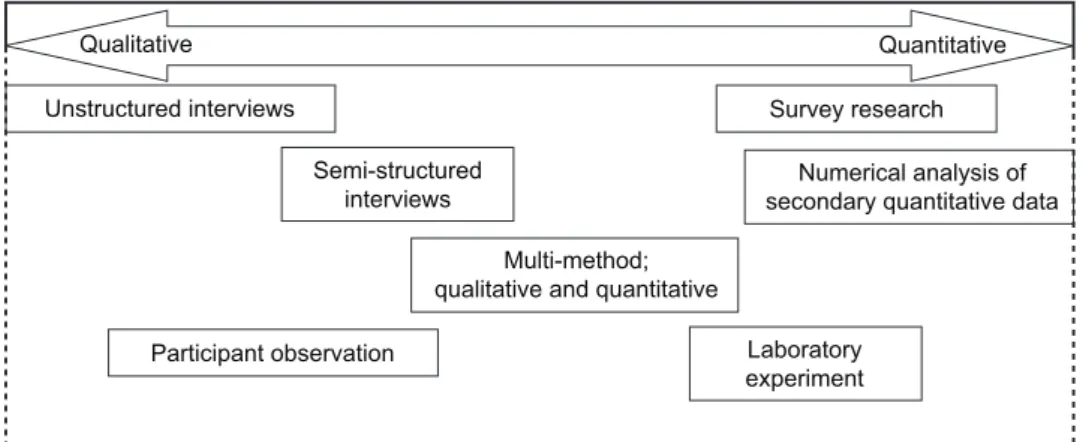
The chosen method will make or break most dissertations. It is therefore worth considering and reconsidering your method before you complete a dissertation proposal. All research fits on a continuum between fully qualitative methods and fully quantitative methods.
Figure 1 The research methods continuum
It is worth considering whether your chosen method will fit in with your own abilities and motivations and those of your university department and your supervisor. If you find it difficult interacting with people on a one-to-one basis, it might be best to avoid using in-depth interviews. On the other hand, if you are skilled with manipulating numbers and statistics, a quantitative method may suit you well.
It is worth becoming familiar with your possible research supervisors because that will give you an indication of whether they favour qualitative or quantitative research. Many supervisors are experienced and skilled in both areas, but some will supervise only one or the other.
2.4 considering your own desires and motivations
Your performance at university – and in completing a dissertation – is dependent on three things:direction (doing the right thing at the right time) ●
●
skills (having the right skills to achieve your goals) ●
●
motivation (having the drive and energy to achieve your goals). ● ● Unstructured interviews Semi-structured interviews Survey research Multi-method; qualitative and quantitative
Laboratory experiment Participant observation
Numerical analysis of secondary quantitative data
This section looks at two of these things – skills and motivation – in detail. Your ability to organise and plan (direction) is examined in a later chapter.
auditing your existing skills
Successful dissertations require a range of skills, some of which you will already have whereas others will need further development. Spend some time filling in the skills audit below. This is a self-audit, so don’t exaggerate your skills or underplay them. An accurate assessment of your skills at this stage will enable you to work on the weak areas in a systematic manner. Any area of your skills audit that is rated at 3 or below will require some developmental work – your tutor or skills co-ordinator should be able to help in this respect.
You may also need to develop skills in specific areas related to your dissertation. Many universities have a research methods module that investigates most of the main skills required to complete a dissertation. A university may also arrange for training sessions in the more specific skills of research. Some of the main areas in which training sessions are carried out are:
interviewing techniques
● ●
quantitative software – SPSS™, snap™
● ●
generating research questions
● ●
qualitative software – Nudist™, NVivo™
● ●
analysing and representing data
● ●
selecting research methods
● ●
academic writing.
● ●
For each of the skills listed below rate your ability on a scale of 1 to 6, in which a rating of 1 means you have no experience in using this skill, and a rating of 6 means your use of this skill is already excellent.
In the box below each skill rating add some brief evidence of why you have rated your experience as you have.
1 Planning and organising 1 2 3 4 5 6
Evidence to support this rating:
2 Time management 1 2 3 4 5 6
Evidence to support this rating:
skills audit
3 Reading for different purposes 1 2 3 4 5 6
Evidence to support this rating:
4 Literature retrieval 1 2 3 4 5 6
Evidence to support this rating:
5 Literature organisation 1 2 3 4 5 6
Evidence to support this rating:
6 Numerical skills 1 2 3 4 5 6
Evidence to support this rating:
7 Critically reviewing the literature 1 2 3 4 5 6
Evidence to support this rating:
8 Making academic judgements (evaluation) 1 2 3 4 5 6
Evidence to support this rating:
9 Structuring writing 1 2 3 4 5 6
investigating your motivation
Motivation is extremely important when it comes to completing a dissertation. There is no external source of motivation – it must come from within you.
Motivation could be defined as:
The internal energy to start and persist towards a goal until that goal is achieved.
Everyone is different in how they motivate themselves to set and achieve goals. One way to avoid disappointment in life is to set no goals or only easily achievable goals. Because you have embarked on completing a dissertation, you have already marked yourself out as someone who sets challenging goals – well done. But how will you motivate yourself to finish the dissertation? No one can answer this for you – but it is possible to investigate the habits of high achievers.
10 Creative problem-solving 1 2 3 4 5 6
Evidence to support this rating:
11 Carrying out research 1 2 3 4 5 6
Evidence to support this rating:
12 Analysing data 1 2 3 4 5 6
Evidence to support this rating:
13 Drawing conclusions 1 2 3 4 5 6
The common habits of high achievers
One goal
● ●
All tasks, no matter how complicated, are achieved one goal at a time. Setting too many goals and goals that are a long way ahead will end up demotivating you. Set one task at a time, and when that is achieved, set another. You will be surprised how quickly you can achieve big things with little goals.
Start with a small step
● ●
Even when you do not feel like doing anything towards your dissertation, start with a very small step. For instance: look in the library at other dissertations.
Avoid negativity
● ●
Negative habits hold us back all the time. You must recognise your negative behaviour for what it is and turn it around to positive behaviour. Perhaps the worst negative behaviour is procrastination. ‘Oh, I haven’t got enough time to get started on that today!’ Whenever you find yourself saying this, stop! Then carry out a very small task towards your goal. In a short time you will stop saying those words and start achieving your goals.
Dream about the benefits
● ●
Higher degrees normally bring huge workplace benefits in the form of new and better-paid jobs. Dream about these new jobs and experiences – they will motivate you.
Visualise your goal
● ●
Your main goal should always be visible to you. Write down your main goal and place a copy of it in all the places you go regularly – your office space, the toilet, your car, the inside of your briefcase or handbag. If a picture can be used to capture your goal, then leave that picture in all the places you go.
Be enthusiastic
● ●
Create enthusiasm for your main goal by talking to others about it. You can also create enthusiasm by reading about your goal and how others achieved the same goal.
Find inspiration
● ●
Finding inspiration to achieve is about finding and understanding how others have been successful. Talk to successful students and read accounts on the Web of successful people. Success breeds inspiration.
Think about your main goal daily
● ●
It is easy to forget what you are aiming for. Avoid this by thinking about your main goal every day. Ask the question, ‘What can I do today towards achieving that goal?’
Create support networks
● ●
Dissertations can be lonely things to complete. Create support networks from family and friends, and also with other students. These networks will be a source of motivation.
Understand your own ebb and flow
● ●
You need to understand your own ebb and flow for each day, week and month. Everyone works best at some point in the day, week or month. Find the best times
for you and plan the major tasks to coincide with your most effective periods of time.
auditing your time
There are many aspects to time management, but at this point it may be helpful to look at just one theory: the Sweet Jar theory of time management.
Imagine a large sweet jar – the kind you find in old-fashioned sweet shops. They are about 41 centimetres (16 inches) high and about 20 centimetres (8 inches) in diameter. Take the jar and put as many whole chocolate oranges in the jar as will fit (so that you can still get the lid on). Now the jar is full. Correct – nothing else will fit in.
Now take the full jar and put as many chocolate M&Ms into the jar as you can. Really shake the jar and settle those sweets into it until you cannot get another one in. The jar is surely full now.
Or is it?
Take a bag of sugar and tip in as much sugar as you can. You may need a second bag. Fill the jar to the brim. Now it is full.
But now take that full jar and pour as much water into it as you can. Water will still go in. Then the jar is full – so screw on the lid and take a look at that jar.
What does this exercise tell us about time?
Well, the chocolate oranges could represent the important tasks to be completed. We also have a number of other quite important tasks to do each day/week/year – these are represented by the chocolate M&Ms. The sugar represents all the other smaller things that must get done every day/week/year, like buying food and milk. Finally, the water gets everywhere and gums up the works with a sticky sugary mess, and represents all the things that are not our priorities but the priorities of other people. The sugar and the water will combine so that you cannot see the sugar – it is dissolved in the water. So when you are busy on the major tasks (chocolate oranges), you may find there is no food in the fridge or milk for a cup of tea.
None of the items in the jar are bad things, and we will want a balance of things to do – it would be no use having only large, important things to do. But somehow we have to get the large items completed in order to say that we have had a productive and effective day/week/year.
What does this little exercise tell us about time management?
We only have room for so many whole chocolate oranges – high priority. ●
●
Low-priority work should fit in around the high-priority ones. ●
●
If you don’t put the chocolate oranges in first, you won’t be able to get them in at ●
● all.
If you start with water in the jar, you will be able to get nothing else in. ●
Some items combine and we lose sight of them – the sugar and the water – but
● ●
they still use time.
Large goals can be broken down into smaller goals – the chocolate oranges are
● ●
themselves made up of segments.
If we organise our lives to follow the Sweet Jar theory, we must plan to complete the high-priority items first and then be selective about the other things that we choose to do, and we must never, never let our lives be filled with other people’s priorities.
What is your personal time profile?
There are many ways in which we can investigate how we use time, but building a personal time profile will indicate the main areas on which we spend time. The first step in this process is to keep an activity log. For the next week, keep a close track of every activity in every day. You can keep an activity record in any way that works for you, but a common format is shown below.
Day Start
time Finish time Minutes on task ACTIVITY
Mon 07.20 07.30 10 Get washed and dressed Mon 07.30 08.10 40 Eat breakfast and read papers Mon 08.10 08.35 25 Drive to the university Mon 08.35 08.55 20 Do some reading in the library Mon 09.00 10.00 60 Economics lecture
Mon 10.00 10.15 15 Coffee break
Mon 10.15 11.15 60 Economics tutorial
activity log
At the end of the week you will have a lot of data about how you spent your time over the previous week. The next step is to put the data in a format by which you can see a graphic representation of your time profile. The companion website for this text contains an Excel file marked ‘My Time Profile’. This will help you organise your data and give you a visual readout of your week. But before you can enter the data, you will need a set of categories that reflect the activities you have done in the week you have just ‘captured’. You will also have to add up the total number of hours in each category.
Common categories for My Time Profile Sleeping ● ● Studying ● ● Childcare ● ● Travel ● ● Leisure ● ● Formal lectures ● ● Eating ● ● Socialising ● ● Working ● ● Exercising ● ● Family time ● ● Shopping – essential ● ● Shopping – pleasure ● ● Household chores ● ●
No activity undertaken – spare time
● ●
Once you have decided on the categories you need to cover your week of activity, you can enter the detail into the ‘My Time Profile’ spreadsheet that is on the companion website.
student comment
I was a bit sceptical about the Time Profile idea, but I kept the log, and put the data into the spreadsheet. However, I was really amazed when I saw my profile – 22% of my week was spare time! I was just doing nothing. I was also
a bit surprised that I had spent 42% of my time in bed.
After that I really took an interest in what I was doing with my time.
Once you have a pictorial representation of your current time usage, it will be possible to investigate ways to use time differently and find the time to complete a dissertation. ‘How long will a dissertation take to complete?’ is a question often heard by supervisors, and is almost impossible to answer due to the huge variation in dissertation approaches and the personal motivations that people bring to research. Most dissertations are completed over a period of three to nine months. The fastest completions tend to be by students in full-time study, and the slower completions tend to be from those who combine study with work. The average student who completes a dissertation in a period of six months will have spent approximately 20 to 25 hours per week progressing the work. The final stages of writing up and submitting are likely to absorb more time than this.
● Finding a successful dissertation topic
may be easier if you adopt one of the following approaches:
– the Burning Desire strategy – the Replication strategy – the Career Goals strategy – the Practical Problem strategy – the Convenient Access strategy – the Tutor-Driven strategy – the Development of Earlier Work
strategy
– the Important Problem strategy.
● Once you have a topic area, it is worth
checking out some aspects of the topic to ensure that it will be successful: – the availability of sufficient theory – research conducted in the broad
area of your topic
– the presence of the attributes of a good dissertation topic
– financial support for producing the dissertation
– the time resources required to complete the work
– your own skills for carrying out research
– early access issues – early methodology issues.
● At this early stage it is worth
investigating your own desires and motivations:
– auditing your existing skills – investigating your motivation – understanding the habits of high
achievers – auditing your time.
k
e
y
l
e
a
r
n
in
g
p
o
in
ts
summary
explore further
Cairo, J. (1997) Motivation and Goal Setting. Aldershot: GowerLevin, P. (2008) Skilful Time Management. Milton Keynes: Open University Press
A really useful time management primer
Partington, D. (ed.)(2002) Essential Skills for Management Research. London: Sage A collection of chapters addressing a range of ideas around the philosophy and process of conducting research
N E
W