Race classification using gaussian-based weight K-nn algorithm for face recognition
Sasan Karamizadeh and Shahidan M Abdullah
Advanced Informatics School (AIS), Universiti Teknologi Malaysia(UTM), Kuala Lumpur,54100, Malaysia Corresponding author: [email protected]
ABSTRACT
One of the greatest challenges in facial recognition systems is to recognize faces around different race and illuminations. Chromaticity is an essential factor in facial recognition and shows the intensity of the color in a pixel, it can greatly vary depending on the lighting conditions.
The race classification scheme proposed which is Gaussian based-weighted K-Nearest Neighbor classifier in this paper, has very sensitive to illumination intensity. The main idea is first to identify
the minority class instances in the training data and then generalize them to Gaussian function as concept for the minority class. By using combination of K-NN algorithm with Gaussian
formula for race classification. In this paper, image processing is divided into two phases. The first is preprocessing phase. There are three preprocessing comprises of auto contrast balance,
noise reduction and auto-color balancing. The second phase is face processing which contains six steps; face detection, illumination normalization, feature extraction, skin segmentation, race
classification and face recognition. There are two type of dataset are being used; first FERET
dataset where images inside this dataset involve of illumination variations. The second is Caltech dataset which images side this dataset contains noises.
Keywords: Face recognition, illumination, skin segmentation, Filters and FERET and Caltech datasets.
INTRODUCTION
The face recognition technology has grown rapidly in recent years, and it has been utilized in various areas. There are various obstacles in the multifaced recognition systems in real-time particularly in the populated regions; however, key challenges posed by this system is the issues with
computation time, illumination conditions, and the increasing rates of misclassification due to low quality of face image streams (S. Karamizadeh, Abdullah, & Zamani, 2013). This paper addresses
these issues but the multifaced recognition technology using the current real-time normally needs an environment that is controlled. In environments that cannot be controlled, the light changes in various locations and in short intervals are a prominent barrier to the system of face recognition. An even further challenge in the face recognition is illumination and in distinguishing the images of faces that look alike. An essential trait of the human face is skin segmentation, which is also distinguishable for many subjects; it is also quite dynamic and responds to the geometric changes of facial pattern (Gross & Brajovic, 2003) . A crucial hindrance in applications using real time is the face recognition utilizing various illuminations (Baker, Sim, & Bsat, 2003). The program known as the Face Recognition Technology or FERET was created to set up a massive facial images database that was independently collected from the developers of algorithms (Alexandre, 2010). Chromaticity is an essential factor in facial recognition and shows the intensity of the color in a pixel, it can greatly vary depending on the lighting conditions. Therefore people with
different race can appear to have similar features. Variations in the conditions of lighting, a growing quantity of targets in an environment and streams of low-quality can have an adverse effect on the performance of the system. This paper proposes novel algorithm for multi face recognition system
in real time. This algorithm establishes a technique of race classification utilized to filter out the dataset to reduce the rates of misclassification and used computation duration. The engine for
face recognition utilized in this paper is built according to the Hidden Markov Model using the features of (Choudhary & Goel, 2013; S. Karamizadeh, Abdullah, Halimi, Shayan, & javad Rajabi, 2014). The next sections, will discuss about related work, methodology and experimental results discussion and comparative study.
Related Works
In this section, we have reviewed some papers related to our paper. Many current works have
been carried out on the processing of illumination in face recognition (Baradarani, Wu, & Ahmadi, 2013; Kao, Hsu, & Yang, 2010; Lian & Er, 2012). (Land & McCann, 1971) proposed the Retinex approach to retrieve the reflectance element out of the image through the model of illumination reflectance (Jobson, Rahman, & Woodell, 1997). The Retinex approach (Jain & Learned-Miller, 2010; Jobson et al., 1997) presents the Single Scale Retinex (SSR) in processing the illumination
variations. The Discrete Cosine Transform or DCT is an invertible linear transformation that can
relate data points at a finite sequence based on the sum of cosine functions that oscillate at various
frequencies (Najan & Phadke, 2012). The direct DCT transform is applied to convert the original signal to the frequency domain and it is able to convert back the signal that is transformed to the original domain by utilizing a DCT transform that is inverse. Following the transformation of the
original signal, its DCT coefficients reveal the significance of the frequencies which are found within (Azam, Anjum, & Javed, 2010). At a specific angle of illumination, the face image contains
a light area that is covered by two dark areas; the light area is known as the specialized light area. Likewise, a dark area is covered by two light areas known as the specialized dark area. There is a statistical machine learning technique known as the Gaussian mixture models (GMM) (Reynolds,
2015) . The GMM classifier is more accurate as it uses the estimation of maximum likelihood to train the classifier (Ng & Pun, 2012a). According to (Y. Wang & Yuan, 2001), face detection of
humans is based on color images under complex situations involving arbitrary image backgrounds. They utilized an evolutionary computation method to group the color pixels that are skin-like and segment off every face-like area. Following the location of the face-like area, each area is applied with the wavelet decomposition to detect the potential facial elements and to identify if an eye is
present in the area. When an eye is detected in an area or the facial elements reveal a face-like model, then it is identified as a human face. The study by Yao and Gao (Yao & Gao, 2001) implemented
a form of transformation coordinate that enhances the lips and skin’s chrominance. They proposed
that using the coordinates it was possible to implement a face identification approach in terms of
transformations of lip chrominance and skin chrominance to manage the changing object’s pose
and a complicated background (Kakumanu, Makrogiannis, & Bourbakis, 2007).In Table.1 related
Table1. Shows different algorithms are compared in term of advantage and disadvantage
Algorithms ADVANTAGE DISADVANTAGE
SSR (i). The scale of an SSR increases, its color reli-ability features improve. (i). Includes halo artifacts. (ii). SSRs have different dynamic range compression characteris-tics according to the scale.
(iii). The SSR does not run good tonal execution.
M
SR (i). Works effectively with images that are grayscale. (i). Histogram equalization is utilized to improve the color of the images. This may result in a change in the color scale causing the artifacts and having an imbalance in the color of the images. ASR (i). Restores the image faster while retaining
the performance of comparable dazing. (i). Extended significantly.(ii). Weak outcomes between pixels that contain small variations.
HOM
O
(i). The features cause the link with the low frequency of the image with illumination and the high frequency with reflection.
(i). Discrete feature in attractive aspects between contiguous dis-crete scales that may not be found at the output.
DCT (i). This filter advantages the decrease in the face space dimension while maintaining low, mid and high frequencies of coefficients.
(i). DCT does not have the time frequency localization because on average they are over the allotted time.
WA
VELE
T
(i). This requires no training images. Never-theless, they cannot get rid of casted shadows completely as they lack adaptability in pre-serving the discontinuities effectively.
(i). This cannot be implemented as there are more mature and faster algorithms for wavelet transformation.
ISO
-TRO
-PIC (i). Is able to preserve edges of image and is
able to reduce noise at the same time. (i). It is insensitive to orientation and symmetric, resulting in blurred edges.
STEER
-ABL
E
(i). The dynamics in various frames for par-ticular individuals can be learned to assist in subject recognition.
(i) .Requires a lot of features
NO
N –L
OCAL
(i) . Operates at the level of preprocessing and reveals several critical advantages that make it the more preferred selection when designing a robust face recognition technique.
(i). It has poor de-noising ability in the constant areas.
AD AP TIV E NO N-L OCA -ON L
(i) . The applications that include segmenta-tion, Relaxometry, or Tractography might make use of the improved data that is created after applying the proposed filtering.
(i) . This technique does not reduce the difficulty of the algorithm significantly while only decreasing slightly the accuracy of filter-ing. M OD IFIED ANISO TR
O-PIC (i). Filtration technique can be categorized as a single scaled spatial filter and some multi scale approaches in other domains.
(i) . It is slower than the schemes of set theoretic morphology. (ii) . Has dissipative features including blurring of discontinuities.
DoG (i). Does not require any prior information of the light sources or 3D shape, or a lot of samples for training. Thus, it can be applied di-rectly to a single image for training per person.
(i) .Based on texture: utilizing spatial information (ii). Linking of edges: too much segmentation (iii).Based on image: only has a low-level characteristic
Research Methodology
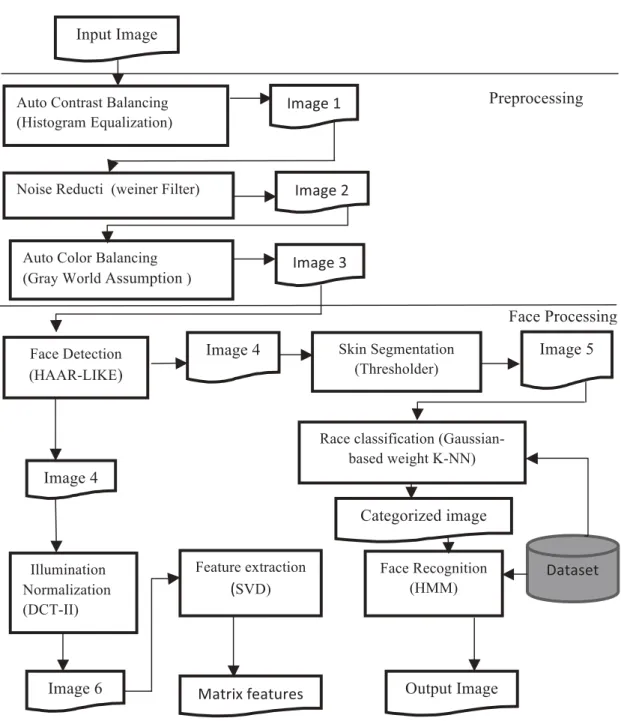
The steps used in this paper can be classified into two steps: preprocessing and face processing
in Figure 1. Auto contrast is designed to adjust the overall contrast in an image without adjusting its color. After auto contrast balancing is applied on the image, we need to reduce the noise on
the input image, such as salt and pepper and speckle noises, can affect the algorithms› efficiency. Therefore, the Weiner filter is applied on the input image to reduce noises. Weiner filter used mean and variance statistical measure for filtering.
The preprocessing step is continued by the application of auto color balancing. Auto color balancing improve the colorcast in an image, in order to stretch out the intensity range. This method is useful when the image information is poor that is foreground and background both are dark or over exposed. The auto color balancing helps the proposed scheme improve the accuracy in the segmentation technique that adaptive thresholding technique method to extract skin pixels. The next step in the proposed scheme is the facial detection technique. The algorithm proposed is employed to detect multiple faces in an image frame. The method extracts the Haar-like features
that are combined to form a classifier in the training images. After the training phase, the classifier
can be used to detect faces.
The next step in our scheme is to recognize the faces detected by the scheme. To do so, there
are two parts including the race classification and illumination normalization. Most of facial recognition methods use geometrical features, which are efficient, but there are still rooms to improve in misclassification. It is a common problem in facial recognition systems due to the
similarity of the features between different people, especially when the face image lacks quality, this is the case when a detected face is far from the camera, or when the size of the subject in the
dataset increases, both factors increasing the rate of misclassification. We handle these problems by introducing a race classification method. The results of this method are further used eliminate irrelevant samples from the dataset, in order to avoid misclassification of the images.
In the next step, the proposed face processing scheme adopts the Discrete Cosine Transform (DCT-II) normalization algorithm to enhance the image for the feature extraction method. DCT-II algorithm omits the effect of illumination variation, which is a common problem in current facial recognition algorithms. To extract facial features, we used a Singular Value Decomposition (SVD) feature extraction technique, and these extracted features will then be utilized to train a Hidden
Markova Model (HMM) classifier.
The race classification scheme proposed in this paper, has very sensitive to illumination
intensity. Hence low or high illumination density can affect the result dramatically and since the
classification performance depends on the proposed method, an extra monitoring step is required to decrease misclassification rate. the FERET and Caltech databases is being used. FERET dataset
contains images with illumination and minimum noise, and Caltech includes images with certain degree of noise. So, color images containing noise and different lightning conditions are required for extracting features.
Fig 1. Research Framework
Auto Contrast Balancing
In this step, the proposed scheme tries to balance color channels using the Color Histogram Equalization method. The entire histogram is distributed with range of pixel intensity values which is balanced by histogram equalization. By modifying the histogram in such a way, it can distribute the intensities over the scale of values available and could possibly extend the histogram with zero
as the lowest intensity and the highest intensity as the maximum value(S. Wang, Zhang, Deng, & Zhou, 2011).
Histogram equalization is a non-linear process. Channel splitting and equalizing each channel separately is incorrect. Equalization involves intensity values of the image, not the color components. So, for a simple RGB color image, histogram equalization cannot be applied directly
on the channels (S. Wang et al., 2011). It needs to be applied in such a way that the intensity values are equalized without disturbing the color balance of the image. So, the first step is to convert the
color space of the image from RGB into one of the color spaces that separates intensity values from color components. YCbCr is preferred as it is designed for digital images. Perform histogram equalization on the intensity plane Y. Now convert the resultant YCbCr image back to RGB (Bae,
Jang, & Ra, 2010).
Noise Reduction
In second step, we discussed the method adopted to reduce ambient noise, especially noises created as an effect of Auto Contrast Balance mentioned in the previous section. After auto contrast balancing is applied on the image, in this paper we need to reduce the noise on the input image,
such as salt and pepper and speckle noises, can affect the algorithms› efficiency. Therefore, the Weiner filter is applied on the input image to reduce noises (Kashyap & Shantaiya, 2011). Weiner filter used mean and variance statistical measure for filtering. The Wiener low pass filter is the
best performance for image restoration. Its primitive assumption for all systems is the existence of speckle noise (Rogowska & Brezinski, 2002). As a matter of fact, the algorithm is useful for
removing speckle noises. The Wiener filter uses a pixel-wise adaptive Wiener method based on the
statistics estimated from a local neighborhood of each pixel.
Auto Color Balancing
In third step, the proposed scheme tries to balance the color channels using the Gray World balancing method. Low computation is one of the advantages of the GW method. It provides a
good image performance if the image is equally balanced with high color variation. However, the
suitability is limited and is no longer efficient when the image comes with a large range of uniform
color and heavy colorcast (Kwok et al., 2011). This process can be looped to try to force the average color to a neutral gray. Usually, this is too extreme, and is an indication that the gray world assumption is generally incorrect. A photo of the ocean can be used to illustrate this phenomenon. However, despite this problem, it is still capable of providing a rough estimate of the illumination
(Adams Jr, Hamilton Jr, Gindele, & Pillman, 2003).
Face Detection
This paper utilizes the Haar Cascades face detection technique. The Haar characteristics are
the key portion of the Haar Cascade classifiers in a face detection (Whitehill & Omlin, 2006).
The Haar characteristics are utilized to detect the existence of these features in an image. Each feature is appointed a single value that is measured by subtracting the total amount of pixels in the white rectangle out of the total amount of pixels in the black rectangle. The features
that resemble Haar are the rectangle features used to for fast detection of the face (Wilson &
Illumination Normalization
In this paper, we utilized the DCT-II normalization approach in this paper to remove the effects of illumination variations. The DCT-based approach for normalization sets up the quantity
of DCT-II coefficients that corresponds to the low frequencies until zero and following these, it aims to achieve the illumination invariance (S. Karamizadeh, Abdullah, Zamani, & Kherikhah,
2015). DCT-II is utilized for a pre-process of features extraction techniques in various studies on face recognition (Najan & Phadke, 2012). The features of the DCT-II are adopted in a holistic local appearance-based or like appearance-based approach, which does not consider the spatial
information when performing the classification. The DCT-II is recognized as a strong method of
transformation in applications including face recognition, coding of images, and others. The DCT-II is based on the data as the entire sum of the cosine function for decreased size of data. The key
idea for using DCT-II is that illumination variations can be significantly reduced by truncating low-frequency discrete cosine transform (DCT-II) coefficients in the logarithm DCT-II domain (Podilchuk & Zhang, 1996).
Skin Color Segmentation
An essential criterion of the human faces is the skin segmentation. There are several benefits to
utilizing skin segmentation as a feature in detecting faces. There is a consistent color on the human skin that is distinguishable from most other materials and it is highly dynamic to the face pattern’s geometric variations. Color permits quick processing and is impartial to scale, face orientation, maintains stability during occlusions, and not dependent of a person. It has been proven that skin
color is a beneficial and dynamic feature for face detection, tracking, and localization. The two
methods of building the model for skin segmentation model include the non-parametric skin modeling technique (the histogram model)(Gross & Brajovic, 2003) and the parametric approach (single Gaussian and a combination of Gaussians models)(Khan, Hanbury, Stöttinger, & Bais,
2012). The non-parametric techniques are quick in classification and training, and independent of
the shape of distribution. The parametric techniques can also be quick as they possess the capability of interpolating and generalizing a non-completed training data. Nevertheless, they can also be rather slow (as in the combination of Gaussians) in both work and training, and their performance is strongly dependent on the shape of the skin distribution (Phung, Bouzerdoum, & Chai, 2005).
This paper aims to detect the facial skin and extracting skin pixels. Firstly, in order to do this, the frame of face image is transformed into: YCbCr,
The image of the transformed YC_b C_r is carried on to the following step to extract the skin
pixels. The following equation is used to extract the skin pixels:
{(77≤C_b≤127 133≤C_r≤173)}
Race Classifier
In this step race classifier, which is an enhanced combination of Gaussian based-KNN algorithm is a non-parametric method employed in many papers for classifications and
regressions. K-NN algorithm involves estimating the similarity between the input instance and the K-nearest available instances in the featured space. Each feature has a class label; therefore,
the algorithm counts the number of instances belonging to each class. The classification result is
the class with the maximum number of assigned instances. It should also be pointed out that all “K” encountered instances have equal votes. The weighted K-NN algorithm employs a similarity
method to estimate the value of each instance›s vote to improve the classification performance in
the following manner,
f (x,y) Function estimates the value of every feature vote and δ(i,j) function represents the
Kronecker Delta functionality which is described as shown in the following:
f (x,y) is described as shown in the following:
Whereby x represents the input instance, and y represents the feature instance. Thus, x and y
are RGB vectors (R, G, B). Thus, the formula for the weighted K-NN is improved as shown in the following
In this system, skin data will be detected using a thresholding procedure in YCbCr color
system, so first we convert the photo to this color system then omits all pixels that are out of a predefined range of data. The mean of the extracted pixels is calculated (the result is a vector (R, G, B)). This color vector is later passed to k-NN classifier. In this paper weight K-NN was selected because weight K-NN is a very efficient classifier for small datasets since it does not need to be trained. Also, it is simple and reliable, the K-NN classifier calculate Euclidean distance of the color
vector and all samples inside the database, where K is set to 10, the K determined based on trial-and-error. Then it sorts the distances ascending order. Further, it chooses the k nearest distances. The Gaussian-based scoring system calculate a Gaussian value based on the sample distance from the vector, the scheme calculates all the scores for each class label separately. The class label with highest score is chosen to be the sample›s label. The outcome of this step is categorized image which represent one of the race category Negroid, Mongoloid or Caucasoid.
Feature Extraction
The singular value decomposition (SVD) is adapted for the extraction of features utilized to identify the wide range of dataset faces. Three main perspectives are available in dealing with the features of the SVD (i)SVD assumed as to be a technique used to transform the correlating
variables into a set of non-correlating ones thus more efficiently exposing the different relations
among the original data items.(ii)SVD is a technique to recognize and order the dimensions of the data where the data points display the maximum number of variations.(iii)After identifying the location of the most variations, the best possible approximation of the original data points can be found. Thus, the SVD is viewed as an approach to reduce data (F. Karamizadeh, 2015).
Face Recognition
The Hidden Markov Model (HMM) is utilized in this paper, to perform the face recognition. A Hidden Markov model (HMM) (Assadi & Behrad, 2010; Tolba, El-Baz, & El-Harby, 2006) represents a statistical Markov model where the system that is modelled is assumed to be a Markov process with unobserved or hidden states. The observer can view the state directly in a normal Markov model; hence, the probabilities of the state transition are the only parameters. The state is not visible directly however the output that depends on the state is visible in the hidden Markov model. Every state contains a distribution probability over the possible sequence output. Thus, the output sequence that is generated by the HMM provide certain information regarding the states’ sequence. Therefore, the objective of the HMM as a learning tool is to locate the best set of output probabilities and state transition for the set sequence output. The term ‹hidden› here, describes the sequence state where the model passes through, and not the model’s parameters. The HMM needs the sequence of the 1D observation hence a 2D image is changed into either a sequence of 1D temporal or 1D spatial. The HMM estimates the parameters’ maximum likelihood per a set of sequences output. Following the trained HMM, the probability output of an observation decides on the class that it belongs to. An effective approach to gaining the vector of observation for
face extraction is through the utilization of the Karhunen-Loave transform (Haig, 1986) employed
using lightening differences.
Experimental Results and Discussion
In our technique of verification of the FERET and Caltech datasets. The color images in these
datasets involve of illumination variations and noise, ten people in 64 different lighting situations for nine poses are utilized in the databases. As we are only focusing on the problem of illumination and noise in this paper, the frontal face images under differing security lighting conditions are
employed. We adopted the F-measure performance indicators; it can be adopted as a unique
measurement for characterizing the level of the biometric system.
Different amounts of training data are used to test the algorithm to examine the algorithm’s
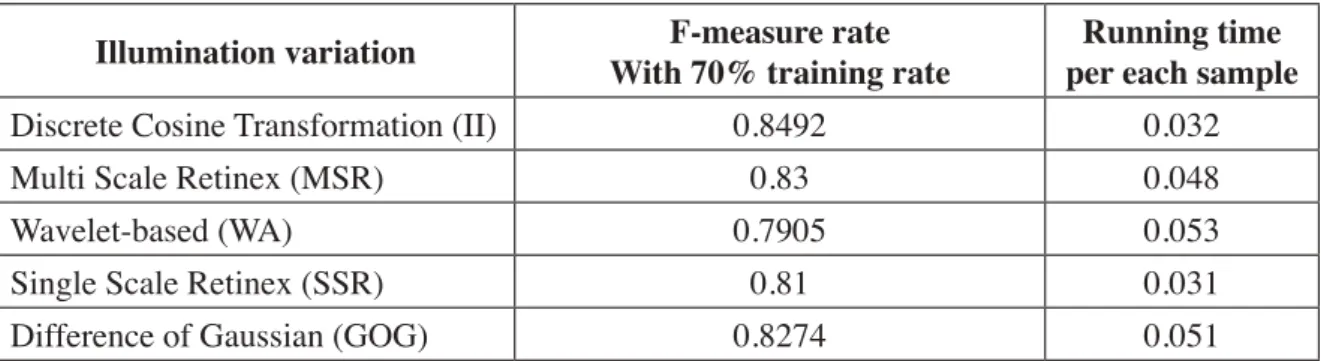
convergence. The algorithm is examined using five variations of training data rate as displayed in Table 2. The algorithm reveals enhancements when the training data rate increases to 70% and the
rate of the testing data increases to 30%. Nevertheless, the rate of accuracy is reduced when the
rate of training data is more than 70%. In addition, it reveals only a small change when the rate of training goes beyond 50%. For this experiment, the optimum training rate is established at 70% revealing approximately 84% F-measure rate.
Table2. Shows result of illumination normalization algorithms
Illumination variation With 70% training rateF-measure rate per each sampleRunning time
Discrete Cosine Transformation (II) 0.8492 0.032
Multi Scale Retinex (MSR) 0.83 0.048
Wavelet-based (WA) 0.7905 0.053
Single Scale Retinex (SSR) 0.81 0.031
Difference of Gaussian (GOG) 0.8274 0.051
As previously mentioned, the algorithm possesses the illumination normalization to avoid illumination variations. These next illumination normalization algorithms are examining to determine the technique with the highest performance using this algorithm namely, (i) MSR, (ii)
DCT, (iii) SSR, (iv) WA, and (v) DOG. The rates of the F-measure are calculated with the entire
algorithms for illumination variation as shown in Table 1. DCT (II) and MSR reveal results that are better compared to the others as observed in Table 1. The SSR and DCT(II) possess the minimum time for computation in comparison with the other techniques as observed in Table1, however, since the DCT(II) algorithm reveals a better performance, we utilized the DCT as the illumination normalization.
Fig 2. Performance is evaluated with and without race classifier
As previously mentioned, the algorithm uses a novel race classifier to improve the algorithm’s
rate of F-measure and to decrease the computation time. Figure 2 shows the performance of the
algorithm being assessed using with and without race classifiers.
As it is shown in Figure.2, the best training mark is achieved by 70% which shows the highest F-measure rate reached best possible result with race classifier and misclassification is minimum in 70% rate. Among all training values, experiment for classifier shows the worst result with
20% training rate. In 20 percent dataset training, the result was not conclusive. Based on our experiments, training datasets should be 30% or higher to get conclusive and reliable results. If
we have more training, testing data is not sufficient or not reliable in 20% or lower percentage of dataset training, in different tests, the variance of results is very high due to insufficient training
dataset, so the results of 20% and lower are not reliable. Data for testing is not enough for testing.
Due to inadequate on training data, the latter shows wide fluctuation. In addition, it can be caused by low number of training cases per race classifier. Since, systems select training images randomly, might be another contributing factor for less accurate classifier. In other words, it might be caused by less available training images per race classifier in experiments. After 20 times experiments, the results prove that 70% training rate is achieved the best results consistently.
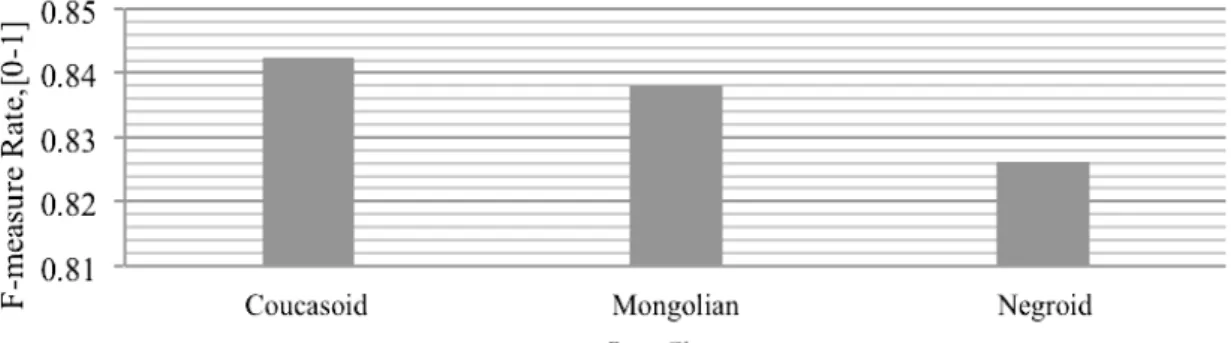
Fig 3. Shows the F-measure rate for each race class
Classification of skin segmentation is another component of this algorithm that influences the
rate of the F-measure. Three skin colors are established as skin classes in this paper. After that, the
three different classifiers are separately trained for the three skin classes. Every face image input is handed over to the classifier with the same skin class to be identified. The rate of accuracy for every
skin class is observed in Figure 3. Table 3. the confusion matrix for the test data in three classes’ skin color are shown. Each subject in the test has 100 images.
Table 3. Confusion matrix for face data
Gaussian-based
K-NN yellow white Black
Yellow 83 7 10
White 6 84 10
Black 15 3 82
In Table 3, a row represents the number of times a subject is recognized as one of the other subjects. As may be seen, the diagonal entries are the largest values with some confusion due to the
extreme lighting and skin color. We can observe that white color skin can be recognized with high accuracy around 84 percent, but black color skin is easily confused with others.
Comparative of Experiment Step by Step in Caltech Dataset
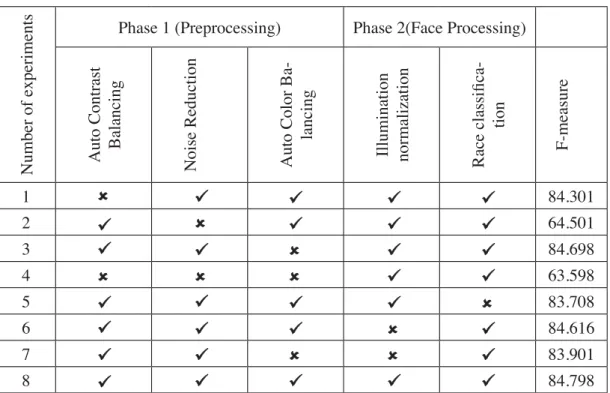
Table 4 shows the result of experiment step by step, before and after applying the filters on
Table 4. Result of the experiment step by step
Number of experiments
Phase 1 (Preprocessing) Phase 2(Face Processing)
Auto Contrast Balancing Noise Reduction Auto Color Ba
-lancing
Illumination normalization Race classifica
-tion F-measure 1 84.301 2 64.501 3 84.698 4 63.598 5 83.708 6 84.616 7 83.901 8 84.798
As it is shown in first row of the Table 4, F-measure before applying auto contrast was 84.301, while after applying the function, F-measure has improved by 0.497%. In the next row, we avoid to
apply the noise reduction algorithm. As it is shown in the table noise reduction algorithm improves
our F-measure significantly by around 20 percent from 64.501 to 84.798. Third row shows that when we do not apply auto color balancing the performance of F-measure is 84.698. Auto color balancing has the lowest F-measure improvement rate among all filters. In the next experiment,
we removed all the preprocessing steps. The outcome shows preprocessing steps can improve
the F-measure by 21.2%. In the next round of experiment, we removed race classification, which
is a face recognition step. The result show 1.09% decline in F-measure performance. Including
illumination normalization this step alone improves the F-measure performance by 0.182%. On
the seventh round of our experiment, we examined the role of auto color balancing combined with
illumination normalization. Including these steps improve our F-measure by 0.897%. On the final round of our experiment we applied all the filters. All filters combined give the highest F-measure improvement. Our final result show 84.798 percent improvement on F-measure.
Comparative of Experiment Step by Step in FERET Dataset
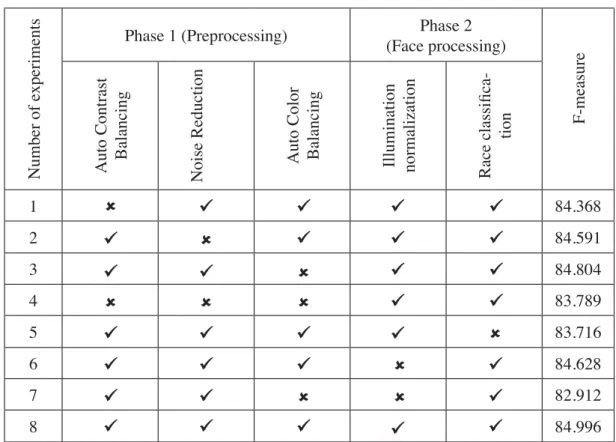
Table 5. shows the experimental results of combination of preprocessing and face recognitions in step by step manner. It helps to compare and release their impact in overall.
Table 5. Result of experiment step by step
Number of experiments
Phase 1 (Preprocessing) (Face processing)Phase 2
F-measure
Auto Contrast Balancing Noise Reduction Auto Color Balancing Illumination normalization Race classifica
-tion 1 84.368 2 84.591 3 84.804 4 83.789 5 83.716 6 84.628 7 82.912 8 84.996
Table 5. shows the Auto contrast is designed to adjust the overall contrast in an image without
adjusting its color. As it is shown in the table, F-measure before applying auto contrast was 84.368, while after applying the function, F-measurehas improved by 0.628%. In the next row, we avoid
to apply the noise reduction algorithm. As it can be seen in the table noise reduction algorithm
improves our F-measurefrom 84.591 to 84.996 by 0.405%. The third row shows that when we did not apply auto color balancing the performance of F-measureis 84.804 because this preprocessing
function remove colorcasts and color spectrum of the image. In our proposed scheme we apply all
these three preprocessing including auto color balancing with outcome of F-measure 84.996 which
is equivalent to 0.19% improvement. Auto color balancing has the lowest F-measure improvement
rate among all filters. In the next experiment, we removed all the preprocessing steps. The outcome shows preprocessing steps can improve the F-measureby 1.207%. In the next round of experiment, we removed race classification, which is a face recognition step. The result show 1.28% decline in F-measure performance. This outcome acknowledges a common misclassification problem
in face recognition systems. Low quality samples and images with different size increase the feature similarity, as a result feature extraction become inaccurate. Illumination normalization illumination normalization methods extracts the information which may disturb by low or high
illumination intensity. Adding this step alone improves the F-measure performance by 0.368%. On
the seventh round of our experiment, we examined the role of auto color balancing combined with illumination normalization. The outcome shows the largest proportion of improvement by this two
steps. Adding these steps improve our F-measure by 2.084%. On the final round of our experiment we applied all the filters. All filters combined give the highest F-measure improvement. Our final result show 84.996 percent improvement on F-measure.
Comparative Study
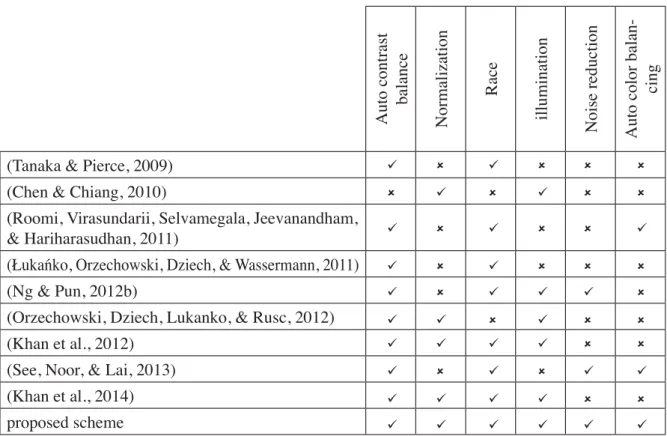
We have compared the proposed scheme with most other popular schemes to find out its competitiveness. The (56x46) Lena test images were utilized for assessing the schemes to find out
their performance. A comparison of the outcomes among the nine face recognition schemes with the improvements of the F-measure is presented in Table 6 below.
Table 6. Comparative study
Auto contrast balance Normalization
Race
illumination Noise reduction
Auto color balan
-cing
(Tanaka & Pierce, 2009) (Chen & Chiang, 2010)
(Roomi, Virasundarii, Selvamegala, Jeevanandham, & Hariharasudhan, 2011)
(Łukańko, Orzechowski, Dziech, & Wassermann, 2011)
(Ng & Pun, 2012b)
(Orzechowski, Dziech, Lukanko, & Rusc, 2012) (Khan et al., 2012)
(See, Noor, & Lai, 2013)
(Khan et al., 2014)
proposed scheme
Table.6 presents a comparison results between nine available enhancements of F-measure
of face recognition schemes We have compared the proposed scheme with most other popular schemes to find out its competitiveness. The 56X46 Lena test images were utilized for assessing the schemes to find out their performance. A comparison of the outcomes among the nine face
recognition schemes with the improvements of the F-measure is presented in Table 4 below; our
proposed scheme along with (Chen & Chiang, 2010; Khan et al., 2012; Khan et al., 2014; Łukańko
et al., 2011; Ng & Pun, 2012a; Orzechowski et al., 2012; Roomi et al., 2011; See et al., 2013; Tanaka & Pierce, 2009).
(Tanaka & Pierce, 2009) used a RGB-CoCr model for human face detection. This model utilizes the additional hue and chrominance information of the image on top of standard RGB properties to improve the discriminately between skin pixels and non-skin pixels. In this method, they do not have any prepressing in their research. However, they cannot check images with illumination. Additionally, other researchers such as (Roomi et al., 2011) used the Face region extracted from
the input image using Viola Jones Appearance based method to tackle this issue.(Chen & Chiang,
2010) introduced new algorithms for dynamic face recognition using illumination impartiality in the domain of non-sub-sampled contour let transform (NSCT). (Ng & Pun, 2012a) Face detection
module is the local Successive Mean Quantization Transform (SMQT) features and split up sparse
network of winnows classifier. This method performs a face detection in order to measure the
face position and amount on image, and then analyze each face’s illumination feature. According these parameters, these methods classify the skin pixel and generate skin probability map, and
finally fetch out a prefect skin mask for skin segmentation.(Łukańko et al., 2011; Orzechowski et
al., 2012), used fusion algorithms PCA and LDA for face recognition. (PCA) is based on general features of face, whereas Linear Discriminant Analysis (LDA) focuses on unique features of image. Therefore, the fusion of these two algorithms may give better results than these methods used separately drawback of this research is High order dependencies still exist in PCA analysis and it is very time consuming. (Khan et al., 2012; Khan et al., 2014) examined and analyzed i) the impact of transformation of color space on the performance of skin detection and discovered the right skin detection color space, ii) a color space’s illuminance component role, iii) the right skin color modelling technique based on pixel, and lastly, iv) the impact of algorithms of color
constancy on classification of color-based skin. They merged various color space channels linearly
revealing it as a process of fusion. The objective of fusing the various color space channels was to gain impartiality over the differing conditions of illumination and imaging. (See et al., 2013) Introduced the hybrid technique for face detection with images of low quality and various face positions which is a complicated function to perform.
In this paper image processing is divided into two phases in this paper. In the phase of pre-processing, auto contrast balance is used on the image to balance out the image’s brightness, continuing after that with auto color balancing. The image normalization is used on the image when it enters the phase for face detection to carry out feature extraction. Moreover, skin segmentation
and after that classification of race is carried out in tandem to optimize the algorithm’s running
time.
CONCLUSIONS
This paper aimed to enhance the accuracy of the illumination variation face recognition. In pre-proceeding stage, the gary world assumption was utilized for auto color balancing to separate the colors from 0 to 255 and reduction of noise was used to lower the images’ noise in addition to the technique of histogram equalization that was utilized for the auto contrast balancing. The Haar Cascades approach was utilized face detection; the DCT-II was utilized for illumination normalization of the face. In the face recognition stage, in this paper, we proposed a new formula
for race classification using a Gaussian-based weight K-NN algorithm and lastly the HMM was
utilized for face recognition. The face recognition experiment used a large face database of 1035
images of 100 people taken from the FERET and Caltech datasets. F-measure is 84.9 percent and 84.7 percent for proposed algorithm. The excrement results show that the best result is achieved
REFERENCES
Adams Jr, J. E., Hamilton Jr, J. F., Gindele, E. B., & Pillman, B. H. (2003). Method for automatic white balance of digital images: Google Patents.
Alexandre, L. A. (2010). Gender recognition: A multiscale decision fusion approach. Pattern Recognition Letters, 31(11), 1422- 1427.
Assadi, A., & Behrad, A. (2010). A new method for human face recognition using texture and depth information. Paper presented at the Neural Network Applications in Electrical Engineering (NEUREL), 2010 10th Symposium on.
Azam, M., Anjum, M. A., & Javed, M. Y. (2010). Discrete cosine transform (DCT) based face recognition in hexagonal images. Paper presented at the Computer and Automation Engineering (ICCAE), 2010 The 2nd International Conference on.
Bae, Y., Jang, J. H., & Ra, J. B. (2010). Gamut-adaptive correction in color image processing. Paper
presented at the Image Processing (ICIP), 2010 17th IEEE International Conference on.
Baker, S., Sim, T., & Bsat, M. (2003). The CMU pose, illumination, and expression database. IEEE Transaction on Pattern Analysis and Machine Intelligence, 25(12), 1615- 1618.
Baradarani, A., Wu, Q. J., & Ahmadi, M. (2013). An efficient illumination invariant face recognition framework via illumination enhancement and DD-DTCWT filtering. Pattern Recognition, 46(1), 57-72. Chen, Y. M., & Chiang, J.-H. (2010). Face recognition using combined multiple feature extraction based
on Fourier-Mellin approach for single example image per person. Pattern Recognition Letters, 31(13),
18331841-.
Choudhary, K., & Goel, N. (2013). A review on face recognition techniques. Paper presented at the International Conference on Communication and Electronics System Design.
Gross, R., & Brajovic, V. (2003). An image preprocessing algorithm for illumination invariant face recognition. Paper presented at the International Conference on Audio-and Video-Based Biometric Person Authentication.
Haig, N. D. (1986). Investigating face recognition with an image processing computer Aspects of face processing (pp. 410- 425): Springer.
Jain, V., & Learned-Miller, E. G. (2010). Fddb: A benchmark for face detection in unconstrained settings. UMass Amherst Technical Report.
Jobson, D. J., Rahman, Z.-U., & Woodell, G. A. (1997). Properties and performance of a center/surround retinex. Image Processing, IEEE Transactions on, 6(3), 451- 462.
Kakumanu, P., Makrogiannis, S., & Bourbakis, N. (2007). A survey of skin-color modeling and detection methods. Pattern Recognition, 40(3), 1106 -1122.
Kao, W.-C., Hsu, M.-C., & Yang, Y.-Y. (2010). Local contrast enhancement and adaptive feature extraction for illumination-invariant face recognition. Pattern Recognition, 43(5), 1736-1747.
Karamizadeh, F. (2015). Face Recognition by Implying Illumination Techniques–A Review Paper. Journal
of Science and Engineering; Vol, 6(01), 001- 007.
Karamizadeh, S., Abdullah, S. M., Halimi, M., Shayan, J., & javad Rajabi, M. (2014). Advantage and drawback of support vector machine functionality. Paper presented at the Computer, Communications, and Control Technology (I4CT), 2014 International Conference on.
Karamizadeh, S., Abdullah, S. M., & Zamani, M. (2013). An overview of holistic face recognition.
IJRCCT, 2(9), 738-741.
Karamizadeh, S., Abdullah, S. M., Zamani, M., & Kherikhah, A. (2015). Pattern Recognition Techniques:
Studies on Appropriate Classifications Advanced Computer and Communication Engineering Technology (pp. 791-799): Springer.
Kashyap, K. L., & Shantaiya, S. (2011). Noise Removal of Facial Expression Images using Wiener Filter.
Paper presented at the National Conference on Emerging Trends in Computer Science and Information Technology (ETCSIT).
Khan, R., Hanbury, A., Stöttinger, J., & Bais, A. (2012). Color based skin classification. Pattern Recognition
Letters, 33(2), 157- 163.
Khan, R., Hanbury, A., Stöttinger, J., Khan, F. A., Khattak, A. U., & Ali, A. (2014). Multiple color space channel fusion for skin detection. Multimedia tools and applications, 72(2), 1709-1730.
Kwok, N., Wang, D., Jia, X., Chen, S., Fang, G., & Ha, Q. (2011). Gray world based color correction and intensity preservation for image enhancement. Paper presented at the Image and Signal Processing (CISP), 2011 4th International Congress on.
Land, E. H., & McCann, J. (1971). Lightness and retinex theory. JOSA, 61(1), 1- 11.
Lian, Z., & Er, M. J. (2012). Local relation map: A novel illumination invariant face recognition approach.
Łukańko, T., Orzechowski, T. M., Dziech, A., & Wassermann, J. (2011). Testing fusion of LDA and PCA algorithms for face recognition with images preprocessed with Two-Dimensional Discrete Cosine
Transform. Paper presented at the Proceedings of the 15th WSEAS international conference on Computers. Najan, A., & Phadke, M. A. (2012). DCT Based Face Recognition. IJEIR, 1(5), 415 -418.
Ng, P., & Pun, C.-M. (2012a). Skin segmentation based on human face illumination feature. Paper presented
at the Web Intelligence and Intelligent Agent Technology (WI-IAT), 2012 IEEE/WIC/ACM International
Conferences on.
Ng, P., & Pun, C.-M. (2012b). Skin Segmentation Based on Human Face Illumination Feature. Paper
presented at the Proceedings of the The 2012 IEEE/WIC/ACM International Joint Conferences on Web
Intelligence and Intelligent Agent Technology-Volume 03.
Orzechowski, T. M., Dziech, A., Lukanko, T., & Rusc, T. (2012). The Use of Selected Transforms to Improve the Accuracy of Face Recognition for Images with Uneven Illumination. Paper presented at the Mobile Multimedia Communications.
Phung, S. L., Bouzerdoum, A., & Chai, D. (2005). Skin segmentation using color pixel classification: analysis and comparison. IEEE transactions on pattern analysis and machine intelligence, 27(1), 148154-.
Podilchuk, C., & Zhang, X. (1996). Face recognition using DCT-based feature vectors. Paper presented at the Acoustics, Speech, and Signal Processing, 1996. ICASSP-96. Conference Proceedings., 1996 IEEE International Conference on.
Reynolds, D. (2015). Gaussian mixture models. Encyclopedia of biometrics, 827-832.
Rogowska, J., & Brezinski, M. E. (2002). Image processing techniques for noise removal, enhancement and segmentation of cartilage OCT images. Physics in medicine and biology, 47(4), 641.
Roomi, S. M. M., Virasundarii, S., Selvamegala, S., Jeevanandham, S., & Hariharasudhan, D. (2011). Race Classification Based on Facial Features. Paper presented at the Computer Vision, Pattern
Recognition, Image Processing and Graphics (NCVPRIPG), 2011 Third National Conference on.
See, Y. C., Noor, N. M., & Lai, A. C. (2013). Hybrid face detection with skin segmentation and edge detection. Paper presented at the Signal and Image Processing Applications (ICSIPA), 2013 IEEE International Conference on.
Tanaka, J. W., & Pierce, L. J. (2009). The neural plasticity of other-race face recognition. Cognitive, Affective, & Behavioral Neuroscience, 9(1), 122- 131.
Tolba, A., El-Baz, A., & El-Harby, A. (2006). Face recognition: A literature review. International Journal of
Signal Processing, 2(2), 88103-.
Wang, S., Zhang, Y., Deng, P., & Zhou, F. (2011). Fast automatic white balancing method by color histogram stretching. Paper presented at the Image and Signal Processing (CISP), 2011 4th International Congress on.
Wang, Y., & Yuan, B. (2001). A novel approach for human face detection from color images under complex background. Pattern Recognition, 34(10), 1983- 1992.
Whitehill, J., & Omlin, C. W. (2006). Haar features for facs au recognition. Paper presented at the Automatic
Face and Gesture Recognition, 2006. FGR 2006. 7th International Conference on.
Wilson, P. I., & Fernandez, J. (2006). Facial feature detection using Haar classifiers. Journal of Computing
Sciences in Colleges, 21(4), 127- 133.
Yao, H., & Gao, W. (2001). Face detection and location based on skin chrominance and lip chrominance transformation from color images. Pattern Recognition, 34(8), 1555- 1564.
Submitted: 12/10/2016 Revised : 26/03/2017