c
SEMANTIC MODELING OF THE NATURAL LANGUAGE OF WIKIPEDIA ANNOTATIONS
BY JIAQI MU
THESIS
Submitted in partial fulfillment of the requirements
for the degree of Master of Science in Electrical and Computer Engineering in the Graduate College of the
University of Illinois at Urbana-Champaign, 2016
Urbana, Illinois Advisers:
Professor Pramod Viswanath
ABSTRACT
Knowledge bases (KB) store relational facts and constitute a significant resource for a variety of natural language processing (NLP) tasks. Improving their cover-age and refining the relations is a basic and pressing research effort. In this thesis we propose a novel approach towards this canonical task by using the unstruc-tured Wikipedia corpus: we extract low-dimensional embeddings for title pages of the Wikipedia corpus and show that they can be used to significantly outperform state-of-the-art approaches on a variety of metrics in three concrete tasks: mea-suring semantic relatedness, solving semantic analogies, and KB completion and refinement. A central feature of our work is a new log-linear discriminative model for theannotations inside a Wikipedia document that we name IBOE (isotropic bag-of-entities): we hypothesize that the parameters of the model satisfy a geo-metric symmetry property (isotropy). We show that the isotropy property leads to self-normalization allowing for the design of an efficient parameter estimation algorithm that we christen wiki2vec. The self-normalization property of IBOE is validated empirically on the Wikipedia corpus and is also of independent mathe-matical interest.
ACKNOWLEDGMENTS
First and foremost, I would like to express my gratefulness to my advisor Profes-sor Pramod Viswanath for his guidance, support, trust and encouragement through this master’s thesis. Pramod made himself a role model of a good researcher – think sharply, obtain brilliant intuition, and live an exciting life. I also thank Pro-fessor Suma Bhat for being my co-advisor and sharing ideas with me. Suma was tremendously patient and without her I could never have completed this thesis.
I am deeply indebted to my labmates: Peter Kairouz, Shaileshh Bojja Venkatakr-ishnan, Tarek Sakakini, Weihao Gao and Hongyu Gong for the stimulating and exciting discussions on research topics. I learned a lot from them and was in-spired by them every day. My thanks go to Sitao Huang. His company made my life in Champaign-Urbana so much more fun.
Finally, I am extremely grateful to my parents. Their support, understanding and love have always been and will always be my source of confidence. I will be fearless having them on my side.
TABLE OF CONTENTS
CHAPTER 1 INTRODUCTION . . . 1
CHAPTER 2 PRIOR WORK . . . 4
2.1 Distributed Word Representation . . . 4
2.2 Semantic Relatedness . . . 5
2.3 Knowledge Base Embedding . . . 5
CHAPTER 3 A DISCRIMINATIVE MODEL AND ALGORITHM . . . 6
3.1 A Log-linear Discriminative Model . . . 7
3.2 Major Challenges . . . 8 3.3 Property of Isotropy . . . 9 3.4 Computational Implication . . . 9 3.5 Informational Implication . . . 10 3.6 Training algorithm . . . 11 3.7 Parameter Learning . . . 11 3.8 Model Validation . . . 11 CHAPTER 4 EXPERIMENTS . . . 13 4.1 Semantic Relatedness . . . 13 4.2 Semantic Analogy . . . 14
4.3 Knowledge Base Completion . . . 16
4.4 Relation Disambiguation . . . 18
CHAPTER 5 CONCLUSION . . . 23
APPENDIX A PROOF OF THEOREM 3.3 . . . 24
APPENDIX B PROOF OF THEOREM 3.4 . . . 28
CHAPTER 1
INTRODUCTION
Knowledge bases (KB) store complex structured information by organizing en-tities in a directed graph: each node represents one entity, and two entities are connected by arelation, e.g., (Harry Potter, instance of,Novel Series). Popular KBs include Freebase [1], WordNet [2], BabelNet [3], and Wikidata [4]. By their very nature, these KBs are incomplete and, at times, coarse/ambiguous. Given the central utility of KBs in NLP and IR tasks, completion and refining of KBs are first order issues. These issues are addressed via harvesting relational facts via crowdsourcing, collating information across existing KBs [5, 6, 7], and unsuper-visedextraction of relational facts directly fromunstructuredresources. The last approach is very promising (due to its lack of expert human intervention) but also very challenging algorithmically. This thesis addresses the major challenges of this approach, where we extract facts from Wikipedia.
The title of each page represents the concepts in Wikipedia and has strong inter-section with the entities in KBs; in the rest of thesis we will use the word “entity” to refer to both a concept in Wikipedia and an entity in KBs. In this thesis we pro-pose a novel solution to extend KBs from the unstructured articles associated with each entity by extracting the low-dimensional representations for entities from annotations and reasoning the relations between those in an unsupervised man-ner – our effort is a conceptual departure from YAGO, which relies on harnessing thestructuredinformation in Wikipedia (e.g. categories, infoboxes, and redirects) [8, 9, 10] with the same end-goal.
The ambiguous nature of words is the very essence of natural language [11]. A solution to resolve this ambiguity is to represent words by multiple vectors, each corresponding to its unique sense [12, 13]. In this study, we observe that just like words, relations between entities defined in KBs can be ambiguous as well. Our approach to unsupervised entity representations suggests an innovative un-supervised solution to disambiguate relations via clustering triples. This leads to an immediate unsupervised and automatic refinement of the KB – an unexpected
outcome of entity embeddings – and one of the important findings of this thesis. A large number of the entity mentions in Wikipedia are explicitly annotated to their corresponding documents through the use of links. We find the annotations to be “natural language” of semantics, and we learn a set of entity representations by parsing the annotations. This is a significant departure from prior work on en-tity representations, which have focused on reasoning the relatedness of entities from either their co-occurrence statistics (such as word-document co-occurrence) or their hyperlink structure from the extensive network of cross-references in Wikipedia [14, 15, 16, 11]. We improve upon these works by observing a tan-talizing connection between the annotation process and natural language: both are generated by humans for human consumption. In particular, we observe that the distributional hypothesis [17] for natural language holds for annotations as well: an entity is characterized by the company it keeps. Motivated by the ability of word2vec to capture analogies by the difference vectors of two word represen-tations [18], we treat relational facts in KB as generalized analogies and ask if the corresponding entity representations can capture relatedness and relational facts as well. The fact that they do is a centralconceptual findingof this thesis.
To obtain the entity representations, we study annotations via a log-linear dis-criminative model, isotropic bag-of-entities (IBOE). Motivated by empirical ob-servations of the natural language of annotations, we hypothesize that the param-eters of the log-linear discriminative model are isotropic – and show that such models areself-normalizingfor almost every generative process. Here normaliza-tion refers to the computanormaliza-tionally cumbersome step of ensuring the model outputs valid probability distributions (and this is the computational burden in the other-wise success-story of log-linear models for language modeling [19, 20, 18], ma-chine translation [21], and speech recognition [22]). Self-normalization refers to the fact that the log-linear model outputs valid probability distributions despite no effort to explicitly normalize the outputs (explored in recent works [23]). Our re-sult explains self-normalization in the context of a large class of log-linear models and represents the main mathematical contribution of this thesis; this result is also of independent mathematical interest. Given that IBOE is self-normalizing, we propose a weighted least square regression (christenedwiki2vec) to estimate the parameters – the entity embeddings – using standard adaptive gradient descent. The resulting entity representations strongly capture semantic relatedness and we demonstrate this by evaluating its performance on two well-defined tasks. First, we study the semantic relatedness task, where one is asked to measure the
similarity between entities: wiki2vec outperforms state-of-the-art entity represen-tations on the KORE-20 dataset. An analogy task involves predictingedgivenea,
eb, andecsuch that ea is toeb asecis to ed, i.e., ea : eb :: ec : ed. This assumes
ea and eb are to be linked by the same relation used to link ec and ed. Second, we study wiki2vec on the semantic analogy dataset in [18] and show improved coverage of the questionsand better prediction results. Finally, we demonstrate strong KB completion, via performing link prediction tasks on FB15k [6], and on a custom-built KB dataset derived from Wikidata. We conclude from this perfor-mance that it is possible to encode and refinelink information contained in a KB in anunsupervisedway, despite that the KB is a highly supervised and structured dataset created entirely via (expert) human annotation; this is the mainempirical contributionof this thesis.
CHAPTER 2
PRIOR WORK
Our work can be situated at the intersection of the following areas: • Distributed word representation
• Semantic relatedness
• Knowledge base embedding
2.1
Distributed Word Representation
Distributed word representation captures the similarities between words by the distance or angle of the vectors assuming that “a word is characterized by the company it keeps” [17]. The vector representation can be constructed via various models. One method is to use word vectors that explicitly represent co-occurrence statistics [24]. Its variants are collectively referred to as vector space models (VSMs) [25]. Another class of methods is the neural network language models (NNLMs) [26, 20, 27, 18, 28] where each vector is the input of the neural network and is trained to predict the correct word from the given context. Both approaches are good at modeling word similarity, and NNLMs are famous for their ability to model relations between pairs of words. Our work is similar to distributed word representations but our object is to represent entities, rather than words. In-stead of keeping the syntactic structure which makes word sequences well-defined sentences, we extracted a corpus of documents, where sentences only retain the necessary semantic information.
2.2
Semantic Relatedness
Semantic relatedness is the study of the semantic relatedness between entities. The classic approach measured the relatedness by the overlap tokens between the document/glosses about the two entities [11]. Latent semantic analysis [15] leveraged co-occurence statistics by low-dimension factorization. Gabrilovich et al. represented words as their td-idf coefficients in the corpus and represented the entity by the weighted average of words in its description document, respectively [14]. Our work introduces nonlinear operations and weighted hyperparameters in processing the co-occurrence statistics. Witten et al. studied the relatedness from the overlap of neighbors in the reference graph [16]. Hoffart et al. claimed that entities are usually represented as phrases instead of single words [29]. They use the phrase-level co-occurrence statistics to measure the semantic relatedness between entities. We use the hyperlink information differently. Other than treating it as a cross-reference graph, we keep the order as it is in the document and model the entity by the context around it, not by its neighbors in the graph.
2.3
Knowledge Base Embedding
KB embedding is to represent the structured multi-relational data in vector space, where entities represented by vectors and relations are represented by operations. Bordes et al. mapped the relations to the left and the right matrix, which operate on the head and the tail entities respectively [5]. Chen et al. constructed a neural tensor network to reason over the relations [7]. Wang et al. [30] and Toutanova et al. [31] jointly embedded text and KBs by optimizing a probabilistic model of text and a probabilistic model of link triples in KBs. TransE modeled relations as translation from head to tail entities, which fits into the algebraic structure that PMI-based methods preserve [6]. Unlike [32], which generates the KB from Wikipedia infobox, which is a template to summarize the document, our algorithm generates relations from plain text which do not have an explicit indication (such as the attribute-value pairs in the infobox) for the relations. Unlike [7, 5, 6, 30], who used a KB to represent relations by operations, we use the corpus to obtain the entity representations and then define the relations by the difference vectors of the head and tail entity.
CHAPTER 3
A DISCRIMINATIVE MODEL AND
ALGORITHM
Many entity mentions in Wikipedia are explicitly annotated to their corresponding documents through the use of hyperlinks. Leveraging these links, we can generate asense annotatedcorpus with Wikipedia entities by only retaining the annotations and getting rid of all the other words – each document is about a title entityand consists of a set of context entities. We call the document the annotation docu-ment, and the corpus the annotation corpus. The extraction process is illustrated in Figure 3.1, where entity mentions are colored in blue and entities are colored in red. We are interested in the generation process of the annotation corpus: Which entities are annotated in the document about the title entity?
A series of many [[genres|Genre]], including [[fantasy|
Fantasy]], [[drama|Drama]], [[coming of age|Coming of age]] and the Bri=sh [[school story|School story Mystery fic=on]] (which includes elements of [[mystery|Mystery fic=on]], [[thriller|Thriller
(genre)]], [[adventure|Adventure fic=on]], [[horror|Horror and terror]] and [[romance|Romance novel]]), it has many cultural meanings and references.[6] According to Rowling, the main [[theme|
Theme (narra=ve)]] is death.[7] There are also many other themes in
the series, such as prejudice, corrup=on, and madness.[8]
Genre Fantasy Drama Coming_of_age School_story Mystery_fic=on Thriller_(genre) Adventure_fic=on Horror_and_terror Romance_novel
Theme_(narra=ve)
Figure 3.1: Extracting the annotation corpus from the Wikipedia dump corresponding to a sample document titled “Harry Potter”.
To answer the above question, we hypothesize that this annotation corpus be-haves like a corpus of natural language retaining only the necessary semantic in-formation, by interpreting the distributional hypothesis in another way: a (title) entity is characterized by the (annotation) company it keeps. Following are three
snippets of annotation documents extracted from three documents in Wikipedia about Harry Potter. The ambiguity stems from this entity-mention being a novel series, a character, and a movie series.
• Genre Fantasy Drama Coming of age School story Mystery fiction Thriller (genre) Adventure fiction Horror and terror Romance novel Theme (narrative)
• Title character Magician (fantasy) Hogwarts Albus Dumbledore Fic-tional universe of Harry Potter Lord Voldemort Lily Potter James Potter
• Film series Warner Bros. Fantasy film List of highest-grossing films David Heyman Daniel Radcliffe Rupert Grint Emma Watson
It can be observed here that even though each of these items is not grammatically a well-defined sentence, enough semantic information is preserved to inform us that the first is about a novel series, the second is about a character and the third is about a film. Motivated by this observation, we extract low-dimensional repre-sentations for entities by proposing a log-lineardiscriminativemodel of the anno-tation document associated with a given title entity, which we christen isotropic bag-of-entities(IBOE), and explicitly avoid a generative model of title entities of each annotation document.
3.1
A Log-linear Discriminative Model
Isotropic bag-of-entities (IBOE) is a probabilistic model of the annotation docu-ment about entityetitle:
1. Choose the length of the annotation documentM ∼ Poisson(λ), whereλ
represents the average number of annotations per document.
2. For each of the M entities, choose em with P(e|etitle) independently for
m = 1,2, ..., M via a parametric log-linear model:
P(e|etitle) = 1 Z(˜ve)exp v T ev˜etitle . (3.1)
HereE is the vocabulary for entities,v(e)∈Rdis the vector representation fore, ˜
v(e)is an`2-normalized vector (i.e.,v˜(e) = v(e)/kvk) and the partition function
Z(u) := X e∈E
exp(vTeu). (3.2)
This discriminative model is inspired by analogous ones for natural language mod-eling and word embeddings [33, 18, 34], but differs in crucial ways:
• Connection to latent Dirichlet allocation (LDA):Words in one document are both generated independently from a document-specific distribution. The distribution is defined differently: in LDA [33], the distribution is de-fined as a mixture of various topics parameterized by a latent document-specific topic distribution θ; in ICOE, the distribution is parameterized by ˜
vetitle.
• Connection to RAND-WALK:Words are both generated via a log-linear model given a discourse vector representing the topic. The definition of the discourse vector is conceptually different in two models: in RAND-WALK [34] the discourse vectors are generated via a slowly moving random walk on a unit sphere while in our model we do not assume an underlying generative model for the discourse vector, but use existing information (title of the articles) to directly model the topic.
• Connection to skip-gram: We both use a log-linear classifier to predict to context word (resp. entity) from the current word (resp. entity). In the skip-gram model in word2vec [18], the current word and its context are defined via a sliding window, while in our model the current entity and the context entity are directly modeled as the title and its main text in the article.
3.2
Major Challenges
Inferring the parameters in IBOE, ve for each entity e ∈ E, involves two major challenges, one computational and the other informational: (a) normalizing by the partition function in (3.2) is computationally intensive; (b) the discriminative data (on average onlyλannotated entities per title-entity) seems insufficient to robustly inferve’s: the number of(e, etitle)pairs is around80|E|, while the parameter space
One of the important findings of this thesis is a demonstration that both these issues get resolved when the parameters satisfy a geometric symmetry property, which we will later validate empirically. This finding is the major mathematical contribution of this thesis and of independent interest. Such a property has also been recently studied in [34], but in the context of a latent variable generative model.
3.3
Property of Isotropy
The crucial hypothesis we make in our setting is that the entity vectors are dis-tributed uniformly in space. Formally:
Definition 3.1. (Isotropic measure) Letting µ be a probabilistic Borel measure on Ω ⊂ Rd, we define µ to be isotropic iff for any norm preserving operation
t : Ω→Ω, any measurable setS ⊂Ω,
• t(S) = {t(s) :s∈S}is measurable; • µ(S) = µ(t(S)).
Assumption 3.2. Now we can formalize the assumptions on the entity vectors: There exists an isotropic measure µ on Ω ⊂ Rd such that for any measurable subsetSofΩ, 1 |E| X e∈E 1ve∈S →µ(S), (3.3)
uniformly in the limit of large|E|.
3.4
Computational Implication
The deterministic isotropy property ofve’s guarantees the concentration ofZ(u) as shown in Theorem 3.3. This phenomenon is called self-normalization and can help tremendously reduce the computational complexity associated with log-linear models [23]. The following result provides a concrete scenario when self-normalization occurs (and answers an important question raised in [23]): Forany generative modelfor the context of fixed norm, the isotropy property ofve’s makes
self-normalization happen almost surely. The proof of Theorem 3.3 is in Ap-pendix A.
Theorem 3.3. LetΩbe a bounded subset inRd, andµbe a isotropic probabilistic measure on Ωsuch that Z = Ev∼µ(exp(vTu0)) < ∞, where u0 = (1,0, ...,0).
Under Assumption 3.2, for anyusuch thatkuk= 1, the partition function defined in(3.2)satisfies
1
|E|Z(u)→Z, (3.4)
in the limit of large|E|.
3.5
Informational Implication
To address the challenge of insufficient data, we estimate the parameters from lower-order statistics of the entities from the annotation corpus. This approach is supported by Theorem 3.4.
Theorem 3.4. Under Assumption 3.2, the probability that entities e1, ..., eK ap-pear inanyone document satisfies
logP(e1, ..., eK) + (K−1) log|E|
→ PK k=1vek 2 2d −KlogZ±O˜ K d . (3.5)
We choose pairwise statistics (K = 2) as a trade-off between the model com-plexity and the sparsity of data. To simplify the notations, we ignoreO˜(K/d)in the rest of this thesis, which is the same as O(K/d)up to polylogarithmic terms in K/d. Letting K = 1,2, (3.5) suggests the unigram and bigram distributions respectively:
logP(e) = kvek
2
2d −logZ
logP(e1, e2) + log|E|=
kve1 +ve2k
2
2d −2 logZ.
between two entities is approximately equal to the inner product, i.e., pmi(e1, e2) = 1 dv T e1ve2 −log|E|. (3.6)
This property matches the intuition behind word2vec and GloVe [34, 35], and motivates our estimation algorithm below.
3.6
Training algorithm
Motivated by (3.6) and a series of works on word embeddings [28, 34, 36], we train the parameters to fit the co-occurrence statistics by minimizing the weighted least square regression overveand a constant shiftc:
X e,e0 f(Xe,e0) log(pmi(e1, e2)−vT eve0−c 2 , (3.7)
where pmi(e, e0) is the empirical PMI from the data and f(Xe,e0) is a truncated
count, i.e.,f(X) = min{Xmax, X}. We call this objectivewiki2vec.
3.7
Parameter Learning
We minimize the objective function in (3.7) over an annotation corpus derived from the English Wikipedia dump dated 09/15. We remove entities that appear fewer than 5 times in the corpus, and the vocabulary size is around 3,500,000. We setXmaxto be 100, and the dimensiondto be 300. We train the entity
represen-tations by optimizing (3.7) using AdaGrad [37] with initial learning rate of 0.05 and 200 iterations.
3.8
Model Validation
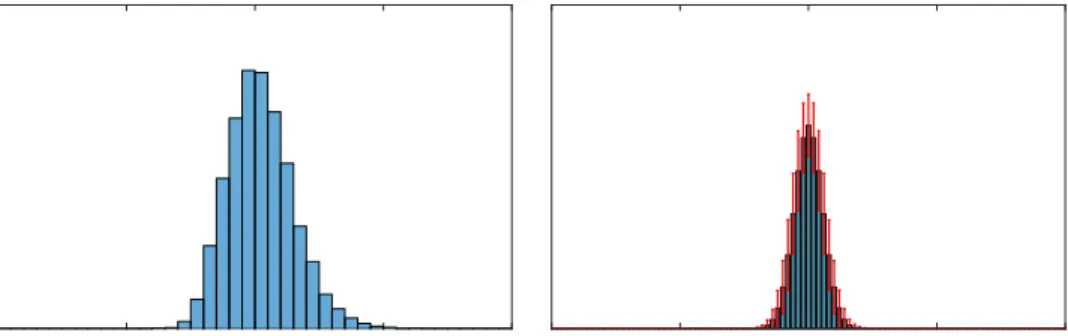
To validate that the derived entity embeddings obey the isometry property at the heart of the IBOE model, we empirically see the concentration of the partition functionZ(u)in Figure 3.2(a), the histogram of Z(u)for 10,000 randomly cho-sen u from a unit sphere in Rd. We observe that the values are concentrated in
the range [0.8, 1.2]. Finally, we validate the isotropy property by plotting the histogram of the cosine similarity
CosSim(u, ve) :=
uT1ve ku1kkvek
,
via randomly generated 10,000 unit vectorsuin Figure 3.2(b), where we see from the average counts and the deviations on each bin that the histogram remains the same for different vectorsu.
0 0.5 1 1.5 2
(a) The histogram of the partition function.
-1 -0.5 0 0.5 1
(b) The average histogram of cosine similar-ity.
CHAPTER 4
EXPERIMENTS
The standard approach to evaluate entity representations involves studying their ability to infer the relatedness between the corresponding entities. The entity rep-resentations from wiki2vec strongly outperform state-of-the-art word embeddings on the semantic relatedness task on KORE-20 [29], which is discussed in detail in the first study below.
Encoding, extracting and refining relational facts in KB are more fine-grained tasks than inferring plain relatedness between entities. We further demonstrate that wiki2vec can capture different types of relatedness between entities using Google’s semantic analogy dataset [18] for both its coverage and its accuracy, which we discuss in detail in the second study below.
Finally, we demonstrate the performance of wiki2vec on KB completion, where it outperforms state-of-the-art KB embeddings on several metrics on FB15k [6]. In addition, we create a much sparser KB dataset from Wikidata, WD, and use it to show that wiki2vec can also capture the semantic information that does not exist in current KBs. This performance validates the fact that it is possible to encode and refine relational facts in a KB in an unsupervised way. We discuss this in detail in the third study below.
4.1
Semantic Relatedness
The task is as follows: given a pair of entities, the algorithm assigns a measure of relatedness between a pair of entities. The degree to which this measure agrees with human judgment (in terms of Spearman’s rank correlation coefficient) is an index of the algorithm’s performance.
We use the KORE-20 dataset to evaluate the performance of wiki2vec. The KORE-20 dataset contains 20 seed entities from four different categories: IT com-panies, Hollywood celebrities, video games, and television series. Each seed
en-tity has 20 enen-tity candidates whose semantic relatedness to the seed enen-tity ranges from closely related to remotely related, and which are ranked based on their re-latedness to the seed entity.
The algorithm ranks the given 20 entities based on the cosine similarities be-tween the candidate entity and the seed entity. In our setting, we compute the relatedness between entities by the cosine similarity between the vectors. We then compare the average Spearman’s rank correlation coefficient between human rank and the algorithm among the 20 entities. For a comparative evaluation, we com-pare the performance of wiki2vec with related prior work on the cross-reference graph-based method that also uses Wikipedia, WM [16], as well as the work on the phrase-level co-occurrence statistics-based method KORE [29].
As seen from the results in Table 4.1 on computing entity relatedness, wiki2vec performs better than the traditional algorithms (MW and KORE) in categories IT company, TV series and Chuck Norris, and comparable in Hollywood but slightly worse in video games. We hypothesize that the ineffectiveness of wiki2vec in representing video games is due to the observed rarity of video game entities in the annotation corpus. Even though the small dataset does not allow performing a meaningful significance test, the results still show that wiki2vec captures the entity relatedness better than the state of the art.
Table 4.1: Comparative performance of wiki2vec with related prior works on the entity relatedness task using KORE-20, where the average frequencies are in the bracket.
Domain wiki2vec MW KORE IT (5,981) 76.4 72.1 76.4 Hollywood (1,012) 65.8 66.7 64.6 TV (957) 69.0 62.8 51.9 Video Games (340) 69.9 43.1 78.0 Chuck Norris (438) 65.4 57.1 58.5 Average 70.0 61.0 67.3
4.2
Semantic Analogy
The task is to find, given three entitieswa, wb andwc, the wordwdsuch thatwdis related towc in the same way thatwb is related towa. We use the semantic
anal-ogy dataset from [18], which contains nine different semantic categories: capital-world, currency, capital-common-countries, city-in-state, basketball, newspaper, ice-hockey, airline and people-companies. Of these, the first four are word-level analogies, and the last five are phrase-level analogies.
To clarify our algorithm, we introduce some notations. LetMbe the set of all entity mentions,M :M →2E be the mapping from the entity mentions to all the entities its refer to, and m :M → E be the mapping from the entity mentions to the most frequent entity. Since words can be thought of as entities as well, we use the mapping mentioned here to transform a word into its corresponding entity.
In our setting, we find the entity ed maximizing the cosine similarity between
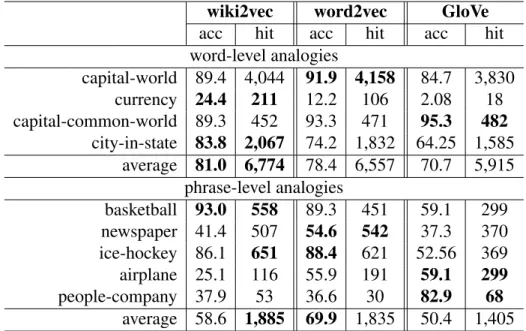
v(m(wb))−m(a(wa)) +v(m(wc))andv(ed). We counteˆdas a hit ifeˆd∈M(wd), wherewdis the answer. We do not use an exact match of entity mentions because unlike words, entities are uniquely coded as Wikipedia titles, which can contain modifiers to disambiguate the entity. As an example, the entity “yen” has no exact match with any Wikipedia entity, but occurs as Japanese yen. We do not use the most frequent sense because many entities are mapped to their redirect pages, e.g., US, USA, America all refer to the entity United States, and will redirect to United States. Following the evaluation methodology in [18], we calculate accuracy as the hit ratio over all questions that are covered. Due to the significant influence of the coverage on accuracy, we list the absolute hit count in addition to accuracy. We compare wiki2vec with the original word2vec and GloVe on the entity analogy task and summarize the results in Table 4.2.
• Word-Level Analogy: Our results show that wiki2vec shows significantly better hit counts (and accuracy) than word2vec and GloVe (the improvement comes from the semantic categoriesCurrencyandCity-in-state).
• Phrase-Level Analogy: From our experiments, we notice while word2vec and GloVe have approximately 80% coverage on all phrase-level questions, wiki2vec has a coverage of 99% (with only one missing entity in newspa-per: waco tribune herald). Our results show that wiki2vec outperforms word2vec and GloVe on hit counts, too. The higher coverage of wiki2vec, however, negatively impacts its accuracy resulting in somewhat lower ac-curacies compared to word2vec and GloVe in average. These results show the ability of wiki2vec to capture the relationship between entities by their difference vectors, and to represent phrases in the continuous space using entity embeddings.
Table 4.2: Semantic analogy on nine semantic datasets. Four of them are word-level analogy and the other five are phrase-level analogy.
wiki2vec word2vec GloVe
acc hit acc hit acc hit
word-level analogies capital-world 89.4 4,044 91.9 4,158 84.7 3,830 currency 24.4 211 12.2 106 2.08 18 capital-common-world 89.3 452 93.3 471 95.3 482 city-in-state 83.8 2,067 74.2 1,832 64.25 1,585 average 81.0 6,774 78.4 6,557 70.7 5,915 phrase-level analogies basketball 93.0 558 89.3 451 59.1 299 newspaper 41.4 507 54.6 542 37.3 370 ice-hockey 86.1 651 88.4 621 52.56 369 airplane 25.1 116 55.9 191 59.1 299 people-company 37.9 53 36.6 30 82.9 68 average 58.6 1,885 69.9 1,835 50.4 1,405
4.3
Knowledge Base Completion
To validate that we can extract relational facts from Wikipedia, we perform the link prediction task, an important component of KB completion. The task is to predict the tail ˆt(resp. head ˆh) given the head entityh(resp. tail t) and relation
r. We follow the evaluation method proposed in [6]. The algorithm first gives ten possible predictions and counts the output as a hit if the correct answer h (resp.
t) is one of the ten predictions. Since one headh (resp. tailt) and a relation can correspond to many tails t (resp. heads h), we introduce a “filtered” version of the output as done in [6]. This results in filtering out all triples (h, r, t0) (resp, (h0, r, t)) observed in the training, validation, and test sets that share the common headh(resp. tailt) and relationr.
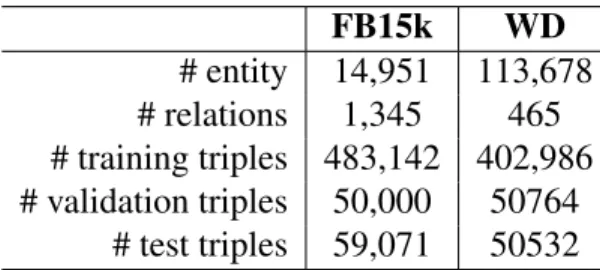
For the purpose of evaluation we use the FB15k dataset in [6], whose statistics are in Table 4.3. The entities in this dataset are specific to Freebase and need a mapping to the corresponding entities in Wikipedia (which are the entities that we have annotations for). We use the property “freebase identifier” (P646) in Wikidata to map a freebase entity to the corresponding Wikidata entity, and then map the Wikidata entity to the Wikipedia one.
We evaluate the performance on the entity linking task using a second dataset. Since the previous dataset was extracted from Freebase, and not all freebase
enti-ties have a mapping to Wikipedia, we construct our own dataset (WD) extracted from Wikidata. We select a subset of entities that (a) have been mentioned at least 100 times in the Wikipedia corpus, and (b) are connected to at least three other entities in Wikidata. We divide all triples in the subset into three parts: 80% of them form the training set, 10% of them form validation set and the rest of them form the test set. The statistics are also in Table 4.3. Compared to FB15k, WD is sparser. This is because with a comparable number of training triples in the two datasets, the number of entities in WD is nearly eight times that in FB15k.
Table 4.3: Statistics for the Freebase dataset (FB15k) and our own wikidata based dataset (WD). FB15k WD # entity 14,951 113,678 # relations 1,345 465 # training triples 483,142 402,986 # validation triples 50,000 50764 # test triples 59,071 50532
In our setting, we first derive the vector representation for relationrby averag-ing all difference vectors betweenhandtthat have a relationr, i.e.,
v(r) = P
(h,r,t)∈Ltrain[v(h)−v(t)]
|{(h, r, t)∈Ltrain}|
.
Given a link triple(h, r, t), we score an entityebeing the head (resp. tail) by the cosine similarity between the entity vector and the estimated answer vector.
shead(e;r, t) = CosSim(v(e), v(t) +v(r))
(resp.stail(e;h, r) = CosSim(v(e), v(h)−v(r))
The algorithm ranks the scores and outputs ten entities with the highest scores. To reduce the computational complexity, in this task, we limit the vocabulary by choosing entities occurring with frequencies larger than 100.
Just as in the entity analogy task where we counted accuracy over the covered questions, in this task too we count the accuracy on the covered triples, since not all Freebase entities in FB15k can be mapped to Wikipedia entities, and not all Wikipedia entities are modeled in vector space. We compare the performance of wiki2vec with that of TransE [6] on the FB15k dataset (taking the results from
their paper). We also report the comparative performance on the wikidata-based dataset (WD). We use TransE in its default setting1to train and evaluate the model. The results are listed in Table. 4.4.
Table 4.4: Overall performances on link prediction. wiki2vec TransE
raw filter raw filter FB15k 35.7 42.6 34.9 47.1
WD 23.3 24.6 – 3.4
While the performance of wiki2vec on FB15k is comparable to that of TransE, wiki2vec outperforms TransE on WD. A plausible explanation is that KB embed-ding methods, such as the method in TransE, rely on the KB’s graph structure to train a robust model. The robustness of the model is likely affected when the graph structure is sparse as in the case of WD. The observation is in turn validated by the fact that a KB is inherently incomplete, and therefore training on existing KBs alone might not guarantee robust performance on the task of knowledge base completion. Wiki2vec, however, without its reliance on the graph structure, infers the structure from the implicit semantic structure of the annotation corpus.
4.4
Relation Disambiguation
(a) capital of (b) country of citizenship (c) occupation
Figure 4.1: The two-dimensional PCA projections of difference vectors for each relation cluster.
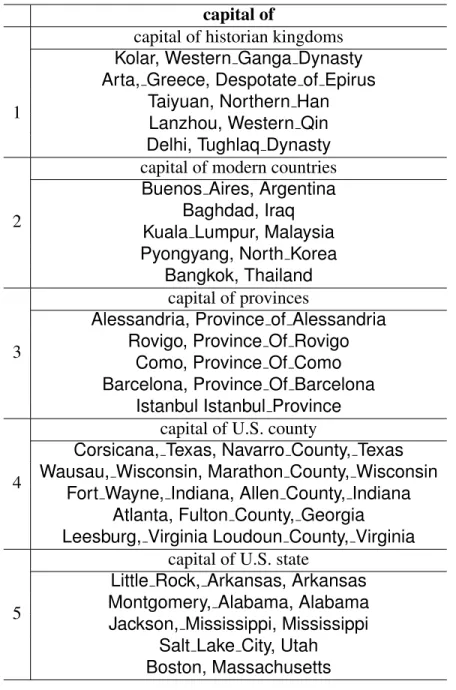
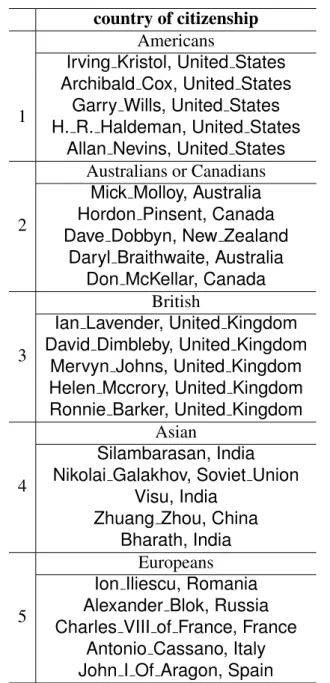
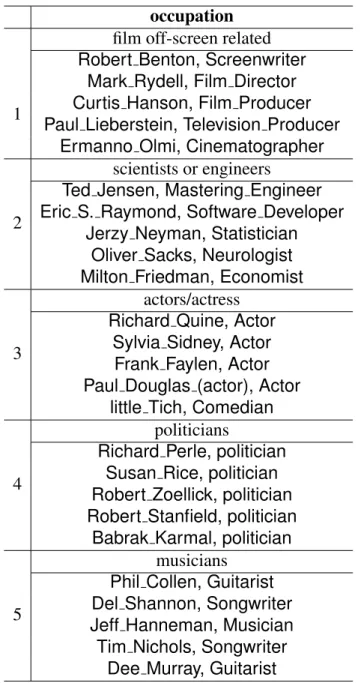
In the context of our experiments we observe that ambiguity is not just a prop-erty of words and entities, but can also be a propprop-erty of relationships defined in a KB. For example, the property “occupation” (P106) in Wikidata could be seen as a coarse property potentially encompassing classes of professions (e.g., film-related, technical, politician). In order to detect overloaded Wikidata properties, we cluster the difference vectors between the head and tails connected byrusing the k-means algorithm into 5 clusters, for every relationr. We infer from this clus-tering stage that the points representing each head/tail pair naturally form groups that can be thought of as having a common relation, which is a refinement of the original relation. Figure 4.1 shows the two-dimensional PCA projection of the dif-ference vectors in two relations in Wikidata, where we can observe clearly those vector clusters. Tables 4.5, 4.6 and 4.7 provide details of the head/tail clusters of the two relations (three top head/tail pairs). This clustering property provides an approach to refine a KB in an unsupervised manner, which could be beneficial in applications like named entity disambiguation and question answering.
Table 4.5: Clusters based on difference vectors in “capital of” as an example. capital of
capital of historian kingdoms
1
Kolar, Western Ganga Dynasty Arta, Greece, Despotate of Epirus
Taiyuan, Northern Han Lanzhou, Western Qin Delhi, Tughlaq Dynasty
2
capital of modern countries Buenos Aires, Argentina
Baghdad, Iraq Kuala Lumpur, Malaysia Pyongyang, North Korea
Bangkok, Thailand
3
capital of provinces
Alessandria, Province of Alessandria Rovigo, Province Of Rovigo
Como, Province Of Como Barcelona, Province Of Barcelona
Istanbul Istanbul Province
4
capital of U.S. county
Corsicana, Texas, Navarro County, Texas Wausau, Wisconsin, Marathon County, Wisconsin
Fort Wayne, Indiana, Allen County, Indiana Atlanta, Fulton County, Georgia
Leesburg, Virginia Loudoun County, Virginia
5
capital of U.S. state
Little Rock, Arkansas, Arkansas Montgomery, Alabama, Alabama Jackson, Mississippi, Mississippi
Salt Lake City, Utah Boston, Massachusetts
Table 4.6: Clusters based on difference vectors in “country of citizenship” as an example.
country of citizenship Americans
1
Irving Kristol, United States Archibald Cox, United States
Garry Wills, United States H. R. Haldeman, United States
Allan Nevins, United States
2
Australians or Canadians Mick Molloy, Australia Hordon Pinsent, Canada Dave Dobbyn, New Zealand
Daryl Braithwaite, Australia Don McKellar, Canada
3
British
Ian Lavender, United Kingdom David Dimbleby, United Kingdom
Mervyn Johns, United Kingdom Helen Mccrory, United Kingdom Ronnie Barker, United Kingdom
4
Asian
Silambarasan, India Nikolai Galakhov, Soviet Union
Visu, India Zhuang Zhou, China
Bharath, India
5
Europeans Ion Iliescu, Romania Alexander Blok, Russia Charles VIII of France, France
Antonio Cassano, Italy John I Of Aragon, Spain
Table 4.7: Clusters based on difference vectors in “occupation” as an example. occupation
film off-screen related
1
Robert Benton, Screenwriter Mark Rydell, Film Director Curtis Hanson, Film Producer Paul Lieberstein, Television Producer
Ermanno Olmi, Cinematographer
2
scientists or engineers
Ted Jensen, Mastering Engineer Eric S. Raymond, Software Developer
Jerzy Neyman, Statistician Oliver Sacks, Neurologist Milton Friedman, Economist
3
actors/actress Richard Quine, Actor
Sylvia Sidney, Actor Frank Faylen, Actor Paul Douglas (actor), Actor
little Tich, Comedian
4
politicians
Richard Perle, politician Susan Rice, politician Robert Zoellick, politician Robert Stanfield, politician
Babrak Karmal, politician
5
musicians Phil Collen, Guitarist Del Shannon, Songwriter Jeff Hanneman, Musician Tim Nichols, Songwriter
CHAPTER 5
CONCLUSION
In this study, we proposed a log-linear discriminative model, IBOE, for Wikipedia entity annotations. The underlying isotropic assumption ensures self-normalization of IBOE allowing an efficient algorithm, wiki2vec, to estimate the entity embed-dings. The embeddings are useful in a variety of semantic inference tasks in NLP (including the ability of the entity representations to capture entity relatedness, to solve entity analogy questions, and to infer the structure of a KB). The em-beddings also empirically match the isotropic property hypothesized in the IBOE model, fitting a theme recently discovered in natural language [34]. It is of ba-sic empirical and scientific interest to discover why such a property is satisfied in these canonical NLP corpora, and is a question for future research.
Looking ahead, it is interesting to explore the potential of entity representations to solve entity linking tasks [38], where one not only uses the semantic infor-mation captured by the representations to disambiguate entity mentions, but also introduces the semantic information on the words that are eliminated in the anno-tation corpus by jointly embedding words and entities.
APPENDIX A
PROOF OF THEOREM 3.3
Letnbe the size ofE, i.e.,n=|E|, letk · kbe an`2norm and letSd−1 denote the
unit sphere in Rd, i.e.,
Sd−1 = {v ∈ Rd : kvk = 1}. To prove Theorem 3.3, we first partitionΩinto countably many subsetsSk(u), where
Sk(u) = v ∈Ω : exp vTu∈ k N, k+ 1 N ,
where N ∈ N+. Notice that Sk(u) is measurable for all k since exp(vTu) is a continuous function (thus measurable function) forv fromΩ→R, andNk,kN+1
is measurable inR. SinceΩis bounded, one has
M = sup v∈Ω,u∈Sd−1
exp(vTu)<∞.
As a result, one has that Sk(u)’s are disjoint, Sk(u) = ∅ for allk > N M, and Ω = ∪N M k=0Sk(u). We can rewriteZ(u)by 1 nZ(u) = 1 n X e∈E exp(veTu) = N M X k=0 1 n X e:ve∈Sk(u) exp(veTu). (A.1)
Step 1: We study the limit behavior of (A.1) in the limit of large n. We prove that for any >0,
N M X k=0 k Nµ(Sk(u))− 1 2M(N M−1)≤ 1 nZ(u) ≤ N M X k=0 k+ 1 N µ(Sk(u)) + 1 2M(N M + 1). (A.2)
The inner summation of (A.1) can be bounded by k N 1 n X e∈E 1ve∈Sk(u) < 1 n X e∈E 1ve∈Sk(u)exp(v T eu)< k+ 1 N 1 n X e∈E 1ve∈Sk(u).
Letting >0, by Assumption 1, we know there exists an0 ∈N, such that for any
n > n0, anyk ∈N, µ(Sk(u))− 1 n X e∈E 1ve∈Sk(u) < .
In the regime when n → ∞, we can assume n > n0. From here one can further
bound it by k N(µ(Sk(u))−)< 1 n X e∈E 1ve∈Sk(u)exp(v T eu)< k+ 1 N (µ(Sk(u)) +). (A.3)
Plugging (A.3) into (A.1), one has N M X k=0 k N(µ(Sk(u))−)≤ 1 nZ(u)≤ N M X k=0 k+ 1 N (µ(Sk(u)) +).
Equivalently, (A.2) is proved.
Step 2: We show that 1nZ(u)converges toZ, i.e., lim
n→∞
1
nZ(u) =Z, (A.4)
where Z = Ev∼µexp(vTu0) and u0 = (1,0, ...,0). Since u0 andu are both of
unit norm, there exists an orthogonal matrix Qsuch that QTu = u
0. We define
inverse ist−1(v) = Qv. Therefore, Sk(u0) = v : exp vTu0 ∈ k N, k+ 1 N , v ∈Ω = v : exp vTQTu ∈ k N, k+ 1 N , v ∈Ω = v : exp (t−1(v))Tu∈ k N, k+ 1 N , v ∈Ω = t(v) :v ∈Ω,exp vTu∈ k N, k+ 1 N , v ∈Ω ={t(v) :v ∈Sk(u)}=t(Sk(u)).
Due to the isotropy property ofµ, one has
µ(Sk(u0)) =µ(Sk(u)), ∀k
Together with (A.2), one can conclude that 1 nZ(u)− 1 nZ(u0)≤ N M X k=0 k+ 1 N µ(Sk(u)) + 1 2M(N M + 1) ! − N M X k=0 k Nµ(Sk(u0))− 1 2M(N M −1) ! =M2N , 1 nZ(u)− 1 nZ(u0)≥ N M X k=0 k+ 1 N µ(Sk(u))− 1 2M(N M + 1) ! − N M X k=0 k Nµ(Sk(u)) + 1 2M(N M −1) ! =−M2N .
Equivalently, one has
−M2N ≤ 1 nZ(u)− 1 nZ(u0)≤M 2N . (A.5)
To prove (A.5), it suffices to show lim M→∞ N M X k=0 k Nµ(Sk(u)) =Z <∞. (A.6)
This is obvious due to the definition of integral w.r.t. Lebesgue measureµ. There-fore, both n1Z(u)and n1Z(u0)are bounded. By choosing=o(1/M2), (A.2) and
(A.6) can conclude
lim
n→∞Z(u0) =Z, (A.7)
APPENDIX B
PROOF OF THEOREM 3.4
Notice that each entity serves as the title for exactly one document. The probabil-ity thatK entitiese1, ..., eK appear in any one document satisfies
P(e1, ..., eK) = X etitle∈E P(e1, ..., eK|etitle) = X etitle∈E K Y k=1 P(ek|etitle) = 1 nK X etitle∈E exp PK k=1vek T ˜ vetitle 1 nZ(˜vetitle) K . (B.1)
Step 1: We show thatv˜etitleis uniformly distributed over a unit sphere. Formally
there exists an isotropic measureγsuch that 1
n
X
etitle∈E
1v˜etitle →γ(S), (B.2)
for any measurable S ⊂ Sd in the limit of large n. Let γ be a measure on Sd−1 induced byµ, i.e. for any Borel measurable setS ⊂ Sd−1,
γ(S) =µ v ∈Ω : v kvk ∈S ,
where the set on the right-hand side is measurable because kvvk is a continuous function forv 6= 0. Due to the definition ofγ, it is obvious that the convergence in (B.2) happens. Thus, it is sufficient to proveγ is isotropic on the unit sphere, i.e.,
for any norm preserving operatort,γ(t(S)) =γ(S). This is validated by showing γ(S) =µ t v : v kvk ∈S, v∈Ω =µ t(v) : v kvk ∈S, v ∈Ω =µ t(v) : v kt(v)k ∈S, v ∈Ω =µ v0 : v 0 kv0k ∈t(S), v 0 ∈ Ω =γ(t(S)).
Step 2: We study the limit ofP(e1, ..., eK), i.e.,
lim n→∞n K−1P(e 1, ..., eK) = 1 ZKE˜v∼γexp K X k=1 vek !T ˜ v . (B.3) From (B.1), one has
nK−1P(e1, ..., eK) = 1 n X etitle∈E exp PK k=1vek T ˜ vetitle 1 nZ(˜vetitle) K .
By Theorem 3.3 we already have that n1Z(˜vetitle) converges to Z; it suffices to
show that lim n→∞ 1 n X etitle∈E exp K X k=1 vek !T ˜ vetitle =E˜v∼γexp K X k=1 vek !T ˜ v . (B.4) Following the same logic as in proving (A.7), one can prove (B.4), and thus prove (B.3).
Step 3: Lettingv = PKk=1vek, it suffices to studyEv˜∼γexp(v
Tv˜). Arora et al.
have already made this clear by their Lemma A.5 in [34], where they prove under the assumption thatkvk=O(√d). Here in our casekvk=O(K√d),
logE˜v∼γexp(vTv˜) = kvk2
where= ˜O(K d).
REFERENCES
[1] K. Bollacker, C. Evans, P. Paritosh, T. Sturge, and J. Taylor, “Freebase: A collaboratively created graph database for structuring human knowledge,” in Proceedings of the 2008 ACM SIGMOD International Conference on Man-agement of Data. ACM, 2008, pp. 1247–1250.
[2] G. A. Miller, “Wordnet: A lexical database for English,”Communications of the ACM, vol. 38, no. 11, pp. 39–41, 1995.
[3] R. Navigli and S. P. Ponzetto, “Babelnet: Building a very large multilin-gual semantic network,” in Proceedings of the 48th annual meeting of the association for computational linguistics. Association for Computational Linguistics, 2010, pp. 216–225.
[4] D. Vrandeˇci´c and M. Kr¨otzsch, “Wikidata: A free collaborative knowledge-base,”Communications of the ACM, vol. 57, no. 10, pp. 78–85, 2014. [5] A. Bordes, J. Weston, R. Collobert, and Y. Bengio, “Learning structured
embeddings of knowledge bases,” in Conference on Artificial Intelligence, no. EPFL-CONF-192344, 2011.
[6] A. Bordes, N. Usunier, A. Garcia-Duran, J. Weston, and O. Yakhnenko, “Translating embeddings for modeling multi-relational data,” in Advances in Neural Information Processing Systems, 2013, pp. 2787–2795.
[7] D. Chen, R. Socher, C. D. Manning, and A. Y. Ng, “Learning new facts from knowledge bases with neural tensor networks and semantic word vectors,” arXiv preprint arXiv:1301.3618, 2013.
[8] F. M. Suchanek, G. Kasneci, and G. Weikum, “Yago: A core of semantic knowledge,” in Proceedings of the 16th international conference on World Wide Web. ACM, 2007, pp. 697–706.
[9] J. Hoffart, F. M. Suchanek, K. Berberich, and G. Weikum, “Yago2: A spa-tially and temporally enhanced knowledge base from wikipedia,” Artificial Intelligence, vol. 194, pp. 28–61, 2013.
[10] F. Mahdisoltani, J. Biega, and F. Suchanek, “Yago3: A knowledge base from multilingual wikipedias,” in 7th Biennial Conference on Innovative Data Systems Research. CIDR Conference, 2014.
[11] M. Lesk, “Automatic sense disambiguation using machine readable dictio-naries: how to tell a pine cone from an ice cream cone,” inProceedings of the 5th Annual International Conference on Systems Documentation. ACM, 1986, pp. 24–26.
[12] E. H. Huang, R. Socher, C. D. Manning, and A. Y. Ng, “Improving word representations via global context and multiple word prototypes,” in Pro-ceedings of the 50th Annual Meeting of the Association for Computational Linguistics: Long Papers-Volume 1. Association for Computational Lin-guistics, 2012, pp. 873–882.
[13] S. Rothe and H. Sch¨utze, “Autoextend: Extending word embeddings to em-beddings for synsets and lexemes,”arXiv preprint arXiv:1507.01127, 2015. [14] E. Gabrilovich and S. Markovitch, “Computing semantic relatedness us-ing wikipedia-based explicit semantic analysis,” inIJCAI, vol. 7, 2007, pp. 1606–1611.
[15] S. T. Dumais, “Latent semantic analysis,”Annual Review of Information Sci-ence and Technology, vol. 38, no. 1, pp. 188–230, 2004.
[16] I. Witten and D. Milne, “An effective, low-cost measure of semantic related-ness obtained from wikipedia links,” inProceedings of AAAI Workshop on Wikipedia and Artificial Intelligence: An Evolving Synergy. AAAI Press, Chicago, USA, 2008, pp. 25–30.
[17] J. R. Firth, “A synopsis of linguistic theory, 1930-1955,”Studies in Linguistic Analysis, pp. 1–32, 1957.
[18] T. Mikolov, K. Chen, G. Corrado, and J. Dean, “Efficient estimation of word representations in vector space,”arXiv preprint arXiv:1301.3781, 2013. [19] R. Rosenfeld, “A maximum entropy approach to adaptive statistical language
modeling,”Computer, Speech and Language, vol. 10, pp. 187–228, 1996. [20] A. Mnih and G. Hinton, “Three new graphical models for statistical language
modelling,” inProceedings of the 24th International Conference on Machine Learning. ACM, 2007, pp. 641–648.
[21] J. Devlin, R. Zbib, Z. Huang, T. Lamar, R. M. Schwartz, and J. Makhoul, “Fast and robust neural network joint models for statistical machine trans-lation,” in Proceedings of the 52nd Annual Meeting of the Association for Computational Linguistics, 2014, pp. 1370–1380.
[22] A. Graves, N. Jaitly, and A.-R. Mohamed, “Hybrid speech recognition with deep bidirectional LSTM,” in Automatic Speech Recognition and Under-standing (ASRU), 2013 IEEE Workshop on. IEEE, 2013, pp. 273–278.
[23] J. Andreas and D. Klein, “When and why are log-linear models self-normalizing,” inProceedings of the Annual Meeting of the North American Chapter of the Association for Computational Linguistics, 2014.
[24] O. Levy, Y. Goldberg, and I. Ramat-Gan, “Linguistic regularities in sparse and explicit word representations,” inCoNLL, 2014, pp. 171–180.
[25] P. D. Turney, P. Pantel et al., “From frequency to meaning: Vector space models of semantics,” Journal of Artificial Intelligence Research, vol. 37, no. 1, pp. 141–188, 2010.
[26] Y. Bengio, H. Schwenk, J.-S. Sen´ecal, F. Morin, and J.-L. Gauvain, “Neu-ral probabilistic language models,” in Innovations in Machine Learning. Springer, 2006, pp. 137–186.
[27] R. Collobert, J. Weston, L. Bottou, M. Karlen, K. Kavukcuoglu, and P. Kuksa, “Natural language processing (almost) from scratch,” The Jour-nal of Machine Learning Research, vol. 12, pp. 2493–2537, 2011.
[28] J. Pennington, R. Socher, and C. D. Manning, “Glove: Global vectors for word representation,” inEMNLP, vol. 14, 2014, pp. 1532–1543.
[29] J. Hoffart, S. Seufert, D. B. Nguyen, M. Theobald, and G. Weikum, “KORE: Keyphrase overlap relatedness for entity disambiguation,” in Proceedings of the 21st ACM International Conference on Information and Knowledge Management. ACM, 2012, pp. 545–554.
[30] Z. Wang, J. Zhang, J. Feng, and Z. Chen, “Knowledge graph and text jointly embedding,” inEMNLP. Citeseer, 2014, pp. 1591–1601.
[31] K. Toutanova, D. Chen, P. Pantel, H. Poon, P. Choudhury, and M. Gamon, “Representing text for joint embedding of text and knowledge bases,” in EMNLP, 2015.
[32] F. M. Suchanek, G. Kasneci, and G. Weikum, “Yago: A large ontology from wikipedia and wordnet,” Web Semantics: Science, Services and Agents on the World Wide Web, vol. 6, no. 3, pp. 203–217, 2008.
[33] D. M. Blei, A. Y. Ng, and M. I. Jordan, “Latent Dirichlet allocation,”Journal of Machine Learning Research, vol. 3, pp. 993–1022, 2003.
[34] S. Arora, Y. Li, Y. Liang, T. Ma, and A. Risteski, “Rand-walk: A latent variable model approach to word embeddings,” arXiv preprint arXiv:1502.03520, 2015.
[35] O. Levy and Y. Goldberg, “Neural word embedding as implicit matrix fac-torization,” in Advances in Neural Information Processing Systems, 2014, pp. 2177–2185.
[36] K. Stratos, M. Collins, and D. Hsu, “Model-based word embeddings from decompositions of count matrices,” inProceedings of ACL, 2015.
[37] J. Duchi, E. Hazan, and Y. Singer, “Adaptive subgradient methods for online learning and stochastic optimization,”The Journal of Machine Learning Re-search, vol. 12, pp. 2121–2159, 2011.
[38] X. Han, L. Sun, and J. Zhao, “Collective entity linking in web text: a graph-based method,” inProceedings of the 34th international ACM SIGIR Confer-ence on Research and Development in Information Retrieval. ACM, 2011, pp. 765–774.