Modular Interpreted Systems over ATL
Michael Köster and Peter Lohmann
Impressum
Publisher: Institut für Informatik, Technische Universität Clausthal Julius-Albert Str. 4, 38678 Clausthal-Zellerfeld, Germany Editor of the series: Jürgen Dix
Technical editor: Federico Schlesinger Contact: [email protected]
URL: http://www.in.tu-clausthal.de/forschung/technical-reports/
ISSN: 1860-8477
The IfI Review Board
Prof. Dr. Jürgen Dix (Theoretical Computer Science/Computational Intelligence) Prof. i.R. Dr. Klaus Ecker (Applied Computer Science)
Prof. Dr. Sven Hartmann (Databases and Information Systems) Prof. i.R. Dr. Gerhard R. Joubert (Practical Computer Science) apl. Prof. Dr. Günter Kemnitz (Hardware and Robotics) Prof. i.R. Dr. Ingbert Kupka (Theoretical Computer Science)
Prof. i.R. Dr. Wilfried Lex (Mathematical Foundations of Computer Science) Prof. Dr. Jörg Müller (Business Information Technology)
Prof. Dr. Niels Pinkwart (Business Information Technology) Prof. Dr. Andreas Rausch (Software Systems Engineering) apl. Prof. Dr. Matthias Reuter (Modeling and Simulation)
Prof. Dr. Harald Richter (Technical Informatics and Computer Systems) Prof. Dr. Gabriel Zachmann (Computer Graphics)
Prof. Dr. Christian Siemers (Embedded Systems)
PD. Dr. habil. Wojciech Jamroga (Theoretical Computer Science) Dr. Michaela Huhn (Theoretical Foundations of Computer Science)
Interpreted Systems over ATL
Michael Köster and Peter Lohmann
Computational Intelligence Group, Clausthal University of Technology Julius-Albert-Str. 4, 38678 Clausthal-Zellerfeld, Germany
Theoretical Computer Science, Leibniz University Hannover Appelstr. 4, 30167 Hannover, Germany
Abstract
We present an abstraction technique for model checking multi-agent sys-tems given as modular interpreted syssys-tems (MIS) (introduced by Jamroga and Ågotnes). MIS allow for succinct representations of compositional systems, they permit agents to be removed, added or replaced and they are modular by facilitating control over the amount of interaction. Spec-ifications are given as arbitrary ATL formulae: We can therefore reason about strategic abilities of groups of agents.
Our technique is based on collapsing each agent’s local state space with handcrafted equivalence relations, one per strategic modality. We present a model checking algorithm and prove its soundness: This makes it pos-sible to perform model checking on abstractions (which are much smaller in size) rather than on the concrete system which is usually too complex, thereby saving space and time. We illustrate our technique with an ex-ample in a scenario of autonomous agents exchanging information.
1
Introduction
Multi-agent systems (MAS) and their logical frameworks have attracted some attention in the last decade. Agent logics have been used to reason about knowledge, time, strategic abilities, coordination and cooperation [13, 10, 1]. An important technique for verifying properties of a system is model check-ing [5], which has been refined and improved over the last years.
While an important feature of a MAS is its modularity, e.g., removing, re-placing, or adding an agent, only a few of the existing compact representa-tions are both modular, computationally grounded [22] and allow the sys-tem designer to represent knowledge and strategic ability. Among these few
Introduction
approaches are Modular Interpreted Systems (MIS) [17], which we modify a bit, and use it to apply our abstraction techniques. MIS are inspired by in-terpreted systems [12, 13] but achieve a modularity and compactness prop-erty much like concurrent programs [18], i.e., they are modular, compact and computationally grounded while allowing at the same time to represent strategic abilities.
Although explicit models (and symbolic representations [21, 20]) achieve the second part very well (because the semantics are defined over them) some problems arise with the first part: Usually temporal models have an expo-nential number of states and, in addition, they do not support modularity since there is no easy way to remove or replace an agent. Interpreted sys-tems [12, 13], however, have a modular state space. But they use a joint tran-sition function for modelling temporal aspects of the system and are thus not modular wrt actions. In contrast, concurrent programs [18] are both modular and compact not only wrt the states but also wrt the actions. How-ever, in the context of a MAS it is important that actions can have side ef-fects on the states of other agents as well and this behaviour is difficult to model with concurrent programs ([17] contains a detailed comparison). Fi-nally, our choice of using MIS to model MAS is, although motivated by the above reasons, still arbitrary to some extent and our techniques could cer-tainly be used with other formalisms as well.
A major obstacle to model checking real systems is the state explosion problem. As model checking algorithms require a search through the state space of the system, the efficiency of any algorithm highly depends on the size of this state space. While for small problems this is still feasible, for larger state spaces it soon becomes intractable. We therefore need to eliminate ir-relevant states by using appropriate abstraction techniques [4] which guar-antee that the property to be verified holds in the original system if it holds for the abstract system. We present such an abstraction technique for MIS. More precisely, we reduce the local state space of each agent in a MIS. We do this by using handcrafted equivalence relations because, clearly, there can-not be a generic automatizable abstraction technique: Model checking ATL for MIS isEXPTIME-complete, therefore in the worst case there are instances where no abstraction technique at all is applicable.
While abstraction of reactive systems for temporal properties is a lively re-search area [2, 3, 7, 19], there are only a few approaches when it comes to MAS and even fewer concerning an abstraction technique for dealing with strategic abilities. One interesting approach by Cohen et al. [6] achieves an abstraction that preserves temporal-epistemic properties. However, the ab-straction is based on an interpreted system to model the MAS and therefore limits the modularity of the MAS. Several other abstraction approaches for epistemic properties (cf. [8, 11]) are either not computationally grounded or use an explicit representation of the model.
for symbolic model checking of alternating-timeµ-calculus formulae over MAS given as alternating transition systems. Their technique is quite similar to ours but still more restricted in an important way. They assume that there are only two agents present and then use a single abstraction to model check the whole formula. Our approach allows for multiple agents and for many abstractions (one per strategic operator). Hence, we allow for a much finer control over what information is abstracted away but still preserve sound-ness of our model checking algorithm.
Note that we will assume the existence of handcrafted equivalence rela-tions, e.g. generated from manual annotations of program code, since any automatic abstraction generation or refinement (as in [14] for two-player games) can only work in typical cases but not in the worst case. That is also the rea-son why we do not work out how our algorithms can be implemented fully symbolically: In the worst case it will be as bad as a non-symbolical algo-rithm. We are not trying to neglect the usefulness of either of those tech-niques but our focus lies on something else: a provable upper bound for the runtime which is exponential in the sum of the sizes of the abstract systems but linear in the size of a succinct representation of the concrete system (see Theorem 6.1). The exponential part of this is not as worse as it sounds be-cause, as argued above, our technique allows for more than one abstraction and therefore each abstraction can be quite small and still much of the rele-vant information of the whole concrete system can be preserved for the over-all model checking process.
Finally, the abstraction for MIS which we present in this paper is moti-vated by the idea of an IT ecosystem [9], i.e., a system composed of a large number of distributed, decentralized, autonomous, interacting, cooperat-ing, organically grown, heterogeneous, and continually evolving subsystems. In such an ecosystem, which can be seen as a MAS, it is important to ver-ify safety, fairness and liveness properties in order to control the stability of it. A non-trivial demonstrator (mentioned in [9]) describes one instance of such a system by introducing a fictional scenario, namely a smart airport. In that airport there exist many agents doing different things, e.g., carry-ing your bags, buycarry-ing flight tickets or exchangcarry-ing pictures about the travel destination. Among many other things some agents at the airport want to share some information with other agents. Assuming that no direct agent-to-agent connection is possible, the agents have to send the information to some middleman that forwards the message. Obviously this communica-tion protocol raises some quescommunica-tions about safety, fairness and liveness prop-erties. While examining these properties, i.e., model checking the whole system (consisting of many agents and therefore many states), is intractable, model checking a MIS allows us to concentrate on just the agents that have to communicate. Using our abstraction method it is sufficient to model-check a fairly small subset of the original system. We will use this scenario as a running example throughout the paper.
Modular Interpreted Systems
The structure of the paper is as follows: First we present the background of our work. Section 2 recalls the MIS framework and describes our modifi-cations. We extend this section by formulating the communicating agents example as a MIS. In Section 3 we introduce the logic ATL. The main contri-butions of this paper are in Section 4, Section 5 and Section 6: We design an abstraction technique for MIS, then construct a model checking algorithm based on this technique and conclude with a soundness proof as well as a complexity analysis of the algorithm. Section 7 illustrates the abstraction technique by an example. Finally, Section 8 summarizes the results and dis-cusses future work.
2
Modular Interpreted Systems
We model multi-agent systems in the framework of Modular Interpreted Sys-tems (MIS) [17]. Each agent is described by a set of possible local states, i.e., states it can be in, and a function that calculates the available actions in a certain state. A local transition function specifies how an agent evolves from one local state to another. States are labeled with a set of propositional sym-bols by an associated labeling function. Finally, an agent is equipped with a function that defines the possible influences of an agent’s action on its environment, i.e. the other agents, and a function for the influence of the environment on this particular agent.
Definition 2.1. AModular Interpreted System (MIS)is a tupleS = (Agt,Act, In)whereAct is the set of actions all agents can perform. In is called in-teraction alphabet. It describes the inin-teraction between the agent and its environment. Finally,Agt ={a1, . . . , ak}is a set of agents where an agent is a
tupleai= (Sti, di, outi, ini, oi,Πi, πi)with
• Stiis the local state space. It is a non-empty set of possible local states
for agentai.
• di : Sti →P(Act)defines for each state inStithe available actions for
agentai.
• outi : Sti ×Act → P(In)defines the possible influences (one is then
chosen non-deterministically) of agentai’s action (executed in a
cer-tain local state) on its environment.1 Intuitively, this describes the
ex-ternal effect of an action which agentaiis executing.
• ini :Sti× Ink−1 →P(In)defines the possible influences (one is then
chosen non-deterministically) of its environment on this agent.1 It
1This is different from the original MIS definition in so far as we have a set of possible
in-fluences and the authors had one deterministic influence symbol; it is changed to cope with possible ambiguities when doing abstraction later.
maps the external effects of the actions of all other agents to the in-fluence these actions might have on the agent in a particular state. • oi : Sti×Act× In → P(Sti)is a local (non-deterministic) transition
function.2.
• Πiare the local propositions, whereΠiandΠjare disjoint wheni6=j.
• πi:Sti→P(Πi)is a valuation (local labeling function) of these
propo-sitions.
The global state space is defined asSt:=St1× · · · ×Stk.
Example 2.2. We consider a system with several autonomous agents which can gather information about their environment and share that information between each other if they are in communication range. We consider groups of them working together as teams.
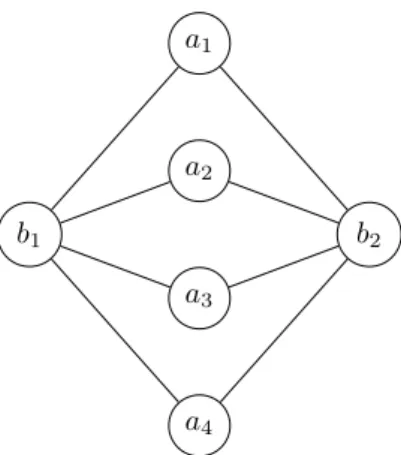
Our example consists of six agents{a1, a2, a3, a4, b1, b2}partitioned in two
teamsA = {a1, a2, a3, a4}andB = {b1, b2}and where the agents’ locations
are such that each agentai can reach each agentbj but no two agents from
the same team can reach each other (see Figure 1). Agents of teamA can send a message (if they already know it) tob1orb2or choose to do nothing.
Agents of teamB, however, are not allowed to send a message back to its sender agent. Once an agentaisent a message to an agentbj the agentbj
is not allowed to send it toaiin any future round. Additionally, if an agent
bj has received a message fromai then it has to send it to some agentak in
the following round (unless this contradicts the former rule) and if possible
khas to be greater thani.
Now agenta1has learned something and wants to communicate its newly
gathered knowledge to its team membera4. The difficulty is that the message
has to pass through an agent of the other team. But we will see that it is still possible for teamAto ensure thata4will know the message eventually.
Formally we have the following MIS
S:= (Agt ={a1, a2, a3, a4, b1, b2},Act ={sendx|x∈Agt} ∪ {noop}, In ={nothing,ma1,ma2,ma3,ma4}
∪P({maibj|i∈ {1, . . . ,4}, j∈ {1,2}})) withai:= (Stai, dai, outai, inai, oai,Πai, πai)where
• Stai ={k(nown), u(nknown)}
• Πai={knownai,unknownai}
• πai: k 7→ {knownai}, u7→ {unknownai}
2Non-deterministic as opposed to in the original definition; it inherits the non-determinism
Modular Interpreted Systems a1 a2 a3 a4 b1 b2
Figure 1: Communication graph of the six agents • dai: k 7→ {sendb1,sendb2,noop}, u7→ {noop} • outai : (k,sendbj) 7→ {{maibj}}
(k,noop) 7→ {nothing}
(u,noop) 7→ {nothing} for allj∈ {1,2}, • inai : (s, γ1, . . . , γ5) 7→ {mai} ifmai ∈ {γ1, . . . , γ5} {nothing} else for alls∈Stai,γ1, . . . , γ5∈ In, • oai : (k, α, γ) 7→ {k} (u, α,nothing) 7→ {u} (u, α,mai) 7→ {k} for allγ∈ Inandα∈Act.
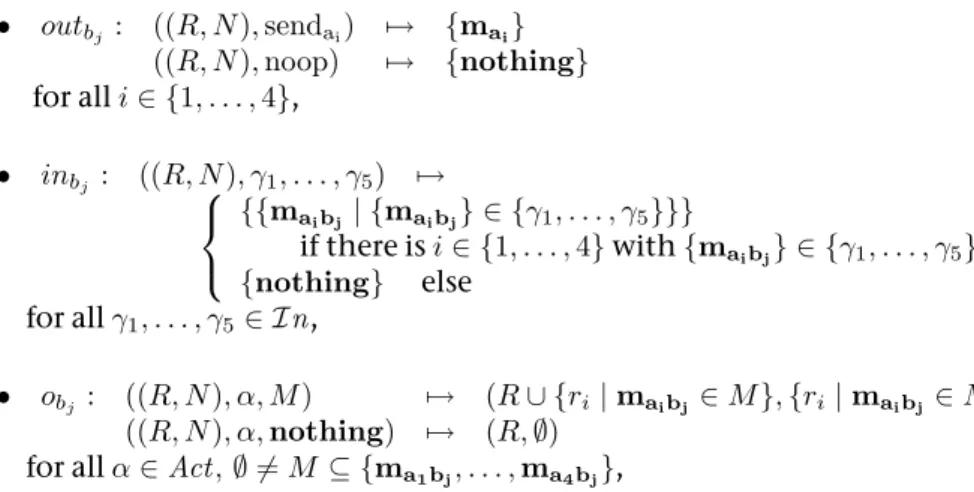
For the agentsbjwe havebj:= (Stbj, dbj, outbj, inbj, obj,Πbj, πbj)where
• Stbj = P({r1, . . . , r4})×P({n1, . . . , n4}), • Πbj = {knownbj,unknownbj}, • πbj : (R, N) 7→ {knownbj} ifR6=∅ {unknownbj} else , • dbj : (R, N) 7→ {noop} ifR=∅ sendai ri ∈/ Rand there is nok≥i: nk ∈Nand∃` > k:r`∈/R ∪ {noop} ifN =∅orR={r1, . . . , r4} ∅ else else ,
• outbj : ((R, N),sendai) 7→ {mai} ((R, N),noop) 7→ {nothing} for alli∈ {1, . . . ,4}, • inbj : ((R, N), γ1, . . . , γ5) 7→ {{maibj | {maibj} ∈ {γ1, . . . , γ5}}} if there isi∈ {1, . . . ,4}with{maibj} ∈ {γ1, . . . , γ5} {nothing} else for allγ1, . . . , γ5∈ In, • obj : ((R, N), α, M) 7→ (R∪ {ri|maibj∈M},{ri|maibj ∈M}) ((R, N), α,nothing) 7→ (R,∅)
for allα∈Act, ∅ 6=M ⊆ {ma1bj, . . . ,ma4bj},
for all(R, N)∈Stbj.Rstands for “received (now or some time ago)” whileN
means “receivednow”.
Figure 2 shows the agenta1. Each arrow is denoted by an action and an
in-coming interaction symbol. Outgoing symbols and propositions are omit-ted for ease of representation. Nevertheless stateushould be labeled with
unknowna1andkwithknowna1. The agentsaiare fairly simply structured, they
consist of two states representing whether the agent knows the message (k) or it does not know it (u). In the former case the agent can send the message to one of the opponents or just do nothing. In the latter case it has to wait for some agent of teamBsending the message to it.
The structure of the agentbjhowever is more complex since it consists of
256 states. Every state is labeled withknownbj if the state name contains at least oneri, i.e., the agent received some time ago the message from agent
ai. Consequently, states that do not have anyri are marked asunknownbj. Intuitively, while the agent is waiting for a message it does nothing. When it receives a message, i.e., the state contains aniit has to send the message to
one of the opponents with a higher number theniand with the condition that this agent did not send it tobjbefore. If the state contains allr1tor4the
agent does nothing.
We will come back to this concrete example when presenting the logic and the model checking algorithm.
u k noop,ma1 noop,nothing sendb1, γ sendb2, γ noop, γ
Specification Logic ATL
3
Specification Logic ATL
After having outlined the framework with which we model our MAS, we now have to specify a logic to talk about strategic properties of such a system. We recall the syntax of ATL, define some abbreviations and sketch the semantics of ATL for MIS.
Definition 3.1. Alternating-time temporal Logic (ATL) [1] is a logic that en-ables reasoning about temporal and strategic abilities of multi-agent systems. The syntax of plain ATL is inductively defined by the following BNF (with
A⊆Agt)
ϕ::=p| ¬ϕ|ϕ∨ϕ| hhAiiXϕ| hhAiiGϕ| hhAiiϕUϕ.
Informally,hhAiiXϕmeans that agentsAhave a collective strategy to en-force that in the next stepϕholds. The operatorXis read “in the next state”, the symbolGmeans “globally” andU“until”. Other Boolean operators are defined by macros in the usual way.
For the model checking algorithm presented in Section 5 we need to split a formula into subformulae.
Definition 3.2. For an ATL formulaϕwe writeqsf(ϕ)for the multiset of all subformulae ofϕwhich start with a quantifierhhAii.
Note that identical formulae occurring in two different places insideϕ oc-cur twice inqsf(ϕ)and ifϕitself begins with a quantifier it is in the multiset as well.
Finally, we need the following notions.
Definition 3.3. For a formulaϕ=hhAiiψwe writeJϕKfor the setAof agents. For an arbitrary formulaϕand an arbitraryψ∈qsf(ϕ)letϕ(ψ, w)denote the formula resulting fromϕby replacingψwith the new propositionw.
Example 3.4. Considering the communicating agents example (cf. Exam-ple 2.2) we can ask the following question: Is it possible for teamAto ensure thata4will know the message eventually? Written in ATL this corresponds
to the question whether
S,q|=hhAii(>Uknowna4)
withA = {a1, a2, a3, a4}andqis the global state wherea1 is in statek, all
other agents from teamAare in stateuand the agents from teamB are in state(∅,∅), i.e. where onlya1knows the message.
3.1
Semantics of ATL for MIS
Modular Interpreted Systems can be easily transformed intoconcurrent game structures(CGS, cf. [1]) as shown for deterministic CGS in [17]. The notion of a CGS is a very universal formalism to model MAS but it comes at the cost of not being modular, i.e., CGS have an unstructured global state space. Also, just as MIS, they have for every agentia functiondi : St → Act
ex-pressing which actions are available to agentiin a certain global state. The global transition function of a CGS takes as input a global state and for every agent a permissible action and outputs a set of possible successor states (one is then chosen non-deterministically), i.e., the influences of an agent on its environment are implicitly given and there is no way to measure or limit that influence in the framework of CGS.
Definition 3.5. For a MISS = ({a1, . . . , ak},Act,In)withai = (Sti, di, outi,
ini, oi,Πi, πi)(1≤i ≤k) the corresponding (non-deterministic) concurrent
game structurencgs(S) = (Agt0, St0,Π0, π0,Act0, d0, o0)is defined as follows: • Agt0:={1, . . . , k} • St0 := k Q i=1 Sti • Π0 := Π1∪ · · · ∪Πk • π0(p) :={(q1, . . . , qi, . . . , qk)|qi∈πi(p)} • Act0:=Act • d0i((q1, . . . , qk)) :=di(qi) • δ0((q1, . . . , qk), α1, . . . , αk) := {(q0 1, . . . , q0k)| ∀1≤i≤k: qi0 ∈oi(qi, αi, γi)for aγi∈ini(qi, γ1, . . . , γi−1,
γi+1, . . . , γk)for someγ1, . . . , γi−1, γi+1, . . . , γkwithγj∈outj(qj, αj)}
Note that our concurrent game structures extend the definition from [1] in two ways. Firstly we use labeled actions instead of plain numbers. Sec-ondly we allow the transition relation to be non-deterministic. The seman-tics of a formulahhAiiϕover a non-deterministic CGS is defined with the non-determinism working against the agents inA. The rationale behind this is thathhAiiϕmeans ”the agentsAhave a combined strategy which enforces
ϕ“. Now, to enforceϕthis strategy needs to ensure that in each of the pos-sible runs of the system – determined by the other agents’ choices and the non-deterministic branching – the formulaϕholds.
Model checking ATL for deterministic MIS isEXPTIME-complete as stated in [16] and for deterministic CGS it isPTIME-complete as stated in [1]. These results still hold for the non-deterministic versions of the structures. This is
Abstraction for MIS
because in the model checking algorithm from [1, Chapter 4.1] introducing non-determinism only changes the functionPre(A, ρ)(which for a given set
ρof system states and a given setAof agents outputs the set of system states from which the agentsAcan enforce that the next state in any run will lie inρ). And computingPredoes not get more difficult with non-determinism because even in the case of deterministic systems it is already necessary to take into account all transitions in order to computePre.
Having defined MIS and ATL we can now present our new abstraction technique.
4
Abstraction for MIS
In general, multi-agent systems have large associated state spaces and even if they are symbolically represented it is infeasible to verify properties by con-sideringallreachable states. Nevertheless, interesting properties often only refer to parts of a system. Under this assumption it makes sense to reduce the state space by removing irrelevant states and/or by combining them. Due to the modularity of MIS, we can in a first step easily remove the obviously non-relevant parts of the global state space by removing particular agents while keeping the others. Secondly, we reduce the state space of each agent by abstraction. As in [4] and [6] we do this by partitioning the state space into equivalence classes: Each class collects all concrete states that are equivalent and forms one new abstract state. This new state is labeled by those propo-sitions which are shared by all concrete states. We define the local transi-tion functransi-tions of the abstract system in such a way that it behaves just as the concrete one. The set of available actions in an abstract state is decreased so that it only contains actions available in every one of the equivalent con-crete states. Finally we show how to handle the interaction with an agents’ environment. We start by introducing the definition of an abstraction rela-tion.
Definition 4.1. Anabstraction relationfor a MIS is a product≡=≡1× · · · × ≡k
where each≡i⊆Sti×Stiis an equivalence relation for the statesStiof agent
ai.
Forq∈Sti, we write[q]≡ifor the equivalence class of the local stateqwith
respect to≡i. And forq∈St=St1×· · ·×Stk, we write[q]≡for the equivalence
class of the global stateq.
An abstraction relation as in Definition 4.1 defines for each agent of the MIS, which local states are equivalent and therefore can be condensed to one abstract state. Note that this definition does not say anything about how to define the equivalence, because this depends on the concrete system that is model checked. Therefore these relations have to be handcrafted when modeling a system.
Using the definition of a MIS and Definition 4.1 we can now specify the abstraction of a system:
Definition 4.2. For a MISS= (Agt,Act,In), an abstraction relation≡forS
and a set offavoredagentsA⊆Agtwe define theabstractionofSwith respect to≡andAas the MIS
S≡A:= (Agt0,Act,In) whereAgt0 :={a01, . . . , a0k}anda 0 i = (St0i, d0i, out0i, ini0, o0i,Π0i, πi0)with i) St0i := {[q]≡i |q∈Sti} ii) d0i([q]≡i) := ( T q0∈[q] ≡idi(q 0) fora i∈A S q0∈[q]≡ idi(q 0) fora i∈/ A iii) out0i([q]≡i, α) := S q0∈[q]≡ i outi(q0, α) iv) in0i([q]≡i, γ1, . . . , γk−1) := S q0∈[q]≡ i ini(q0, γ1, . . . , γk−1) v) o0i([q]≡i, α, γ) := S q0∈[q]≡ i {[q00]≡i |q 00∈o i(q0, α, γ)} vi) Π0i := Πi∩ {pi| ∀q∈πi(pi) : ∀q0∈[q]≡i : q 0∈π i(pi)} vii) π0 i(pi) := {[q]≡i|q∈πi(pi)}
for allq∈Sti,α∈Act,γ, γ1, . . . , γk∈ Inandpi∈Π0i.
Note that there might bei ∈ {1, . . . , k}andq ∈ Stisuch thatd0i([q]≡i) =
∅. As this would paralyse the system we will from now on assume that the abstraction relation is chosen in such a way that this does not happen.
Formula i) defines a partition of the local state space by using the hand-crafted equivalence relation of this agent. We reduce all equivalent states to just one. Function ii) then computes for this element the available ac-tions by giving agents inAfewer choices and the opponents more choices than before. Due to this construction if a propertyhhAiiϕ(withϕ proposi-tional) holds in the abstract system it also holds in the concrete one, since we restricted the actions of the protagonists and extended the set of actions of the antagonists. The possible influences of these actions concerning the environment are calculated by the resulting function iii). It takes for the ac-tionαthe union of all resulting influence symbols of all states in the equiv-alence class, i.e., collecting all influence symbols that are an outcome of ex-ecuting actionαin each stateq0 of the equivalence class[q]
≡i. Taking the
union is motivated by the fact that executing the same action in equivalent local states results in an equivalent influence on the environment. iv) is de-fined the same way: We just use the union ofinifor each state in the
The Model Checking Algorithm
the protagonists as well as the antagonists because they do not introduce de-liberate choices by the agents but instead introduce nondeterminism which will – as we will see in Section 5 – always work against the formula which is to be verified. The local transition function v) has to be modified to cope with equivalence classes: It gets as input an abstract state, an action and one (nondeterministically chosen) influence symbol. The output is the set of all equivalence classes that are successors. To determine this we unfold both equivalence classes and check whether there is a connection between a con-crete state of the first equivalence class to another concon-crete state of the sec-ond equivalence class.
Finally, we have to define how to label the abstract states (cf. vi) and vii)). We do this by assigning a proposition to an abstract state if all concrete states in the equivalence class are labeled with that proposition. If a proposition only holds in some states of the class we remove it from set of propositions. This ensures that if a proposition is true in an abstract state it is also true in all concrete ones.
In the next section we describe how to evaluate whether a formula holds in a system.
5
The Model Checking Algorithm
Our algorithm takes as input a MISS, a setinitof global states ofS(the initial states), an ATL formulaϕand for eachψ∈qsf(ϕ)an abstraction relation≡ψ.
The algorithm either returnstrueor it returnsunknownbut it will never return
false. If it returnstrueit is guaranteed thatS, q |=ϕfor allq ∈ init. But if it
returnsunknownwe do not know whetherSsatisfiesϕor not.
This behaviour is due to the way model checking is done here: Several ab-stractions ofS(generated out of the abstraction relations≡ψ) are used each
to model check a part ofϕ. And as usual with handcrafted abstractions there can be false negatives. The important point is that there are no false posi-tives, i.e. if the abstractions fulfillϕthen so does the concrete system.
Before we can present the algorithm we need the technical notion of a pseudo-MIS which will be used in it.
Definition 5.1. Apseudo-MIS is a MIS together with a setΠofglobal proposi-tions(which is disjoint to each set of local propositions) and a global labeling functionπ:St→P(Π). Note that every MIS can be viewed as a pseudo-MIS withΠ =∅.
The algorithm now works as follows. Details about efficiently implement-ing some of the steps are given in the proof of Theorem 6.1.
Algorithmmodelcheck(S, init, ϕ,(≡ψ)ψ∈qsf(ϕ)):
• λis a monotone Boolean formula, i.e.λis composed of conjunctions and disjunctions only,
• θ1, . . . , θnare arbitrary ATL formulae each beginning with a quantifier
or a negation directly followed by a quantifier, i.e. eachθiis of the form
hhBiiθi0or¬hhBiiθi0(in the latter case we will still write≡θiandJθiK in-stead of≡hhBiiθ0
iandJhhBiiθ
0
iK), and
• `1, . . . , `m are literals, i.e. atomic propositions or negations of atomic
propositions.
1) For alli∈ {1, . . . , n}do: i) SetWi:=label(θi,≡θi).
ii) SetS := S(wi, Wi), i.e.Sis from now on viewed as a pseudo-MIS, a
new global propositionwiis introduced inSand it is labeled exactly
in the states inWi.
2) IfS, s |= λ(w1, . . . , wn, `1, . . . , `m)for alls ∈ initthen returntrue.
Other-wise returnunknown.
Note that for this step the algorithm only has to locally check the labeling of the statess∈initasλ(w1, . . . , wn, `1, . . . , `m)is an entirely propositional
formula.
Algorithmlabel(ψ,≡): Letψ=¬ψhhAiiYλ(θ
1, . . . , θn, `1, . . . , `m)where
• ¬ψis¬ifψbegins with a negation and it is the empty string elsewise,
• Y∈ {X,G,U},
• λis a monotone Boolean formula,
• θ1, . . . , θnare arbitrary ATL formulae each beginning with a quantifier
or a negation directly followed by a quantifier, and • `1, . . . , `mare literals.
1) Construct the abstraction
S0:=
(
SJψK
≡ ifψdoes not begin with a negation SAgt\JψK
≡ ifψdoes begin with a negation
We will viewS0as a pseudo-MIS in the following steps. 2) For alli∈ {1, . . . , n}do:
Complexity and Soundness of the Algorithm
i) SetWi:={[q]≡| ∀q0∈[q]≡: q0 ∈label(θi,≡θi)}.
ii) SetS0:=S0(wi, Wi).
3) Compute the setW0of global states ofS0(note that these are global states of the system abstracted with≡) satisfyingψ, i.e.W0:=
{[q]≡|S0,[q]≡ |=¬ψhhAiiYλ(w1, . . . , wn, `1, . . . , `m)},
by translating S0 to a non-deterministic CGS and then using the ATL model checking algorithm from [1, Chapter 4.1]. As already pointed out in Section 3.1 their algorithm is only given for deterministic CGS but can be easily adapted to also handle non-deterministic systems.
There is, however, a caveat here. Because additional non-determinism might be introduced by abstracting the system we have to make sure that the non-determinism works “against the formula” because we want to avoid false positive outputs of our algorithm. This is the reason why we have to interpret the non-determinism as workingforthe agents inAif ¬ψ =¬and workingagainstthem otherwise. If we always had it working
against them (which seems natural as argued in Section 3.1) then in the former case it could happen that the algorithm comes to the conclusion thatS0,[q]≡ |=ψalthoughS, q6|=ψ– a false positive. The reason for this would be non-determinism present inS0and absent inSthat would pre-sumably prevent agentsAto have a winning strategy inS0although they do have one inS.
4) ReturnW :={q∈St|[q]≡∈W0}.
6
Complexity and Soundness of the Algorithm
The following theorem shows that our model checking algorithm runs in time linear in the size of a succinct representation of the concrete system as well as linear in the length of the formula and exponential in the sum of the sizes of the abstract systems. Now, since there is a special abstraction for each modality, the abstractions should be very small and therefore this should be a huge improvement over theEXPTIME-completeness of model checking MIS without abstractions.
Theorem 6.1. Algorithmmodelcheck(S, init, ϕ,(≡ψ)ψ∈qsf(ϕ))runs in time
O(|init|+|S| · |ϕ|)·2 O P ψ∈qsf(ϕ) ˛ ˛ ˛S JψK ≡ψ ˛ ˛ ˛ !
where|S|denotes the size of theMISSin a compact representation. The cardinal-ity of the global state space ofSmay then be upto2Θ(|S|).
Proof. The crucial implementation detail is that it is not possible to explic-itly enumerate the set returned in step 4 oflabel()because the set may be as large as the global state spaceStofS. Instead, bothlabel()andmodelcheck()
have to save and pass on computed sets of global states in a symbolic way, i.e. by refering to the modular structure ofSand to the abstraction relation’s equivalence classes. This technique is needed in step 1 ofmodelcheck()and in steps 2i and 4 oflabel().
Also, in step 2i oflabel()it is not possible to check the condition for each
[q]≡ ∈St0by enumerating through allq0 ∈[q]≡because a single equivalence
class may already be as large as the global state space. Hence, the algorithm has to construct the equivalence relation≡0 :=≡ ∩ ≡
θi (which is a
refine-ment of both≡and≡θi) and computeWias the set{[q]≡ | ∀[q
0]≡0 ⊆ [q]≡ : [q0]≡0 ⊆label(θi,≡θ
i)}. This can be done in timeO(|S
JψK
≡ | · |S≡JθθiiK|).
Step 3 oflabel()runs in time2O “
|SJψK ≡ |
”
·O(|ψ|)because the translation to a CGS may involve an exponential blow-up in the system size. All other steps are easy to implement – when keeping in mind the symbolic handling of state sets.
Finally,label()is executed at most|ϕ|times. Altogether this gives the claimed upper bound on the runtime.
The following theorem shows that our algorithm is sound. It is, however, not complete because, as usual for abstraction techniques, the capability of the algorithm to show the truth of a formula depends on choosing a suitable abstraction. It should, anyhow, be possible to find good abstractions since it is possible to define a specific abstraction for each strategic operator. Of course that problem could be overcome by an automatic abstraction refine-ment technique but this, on the other hand, would make a provable upper bound on the runtime in the form of Theorem 6.1 impossible.
Theorem 6.2. Algorithmmodelcheckis sound, i.e. ifmodelcheck(S, init, ϕ, (≡ψ)ψ∈qsf(ϕ))outputstruethenS, q|=ϕfor allq∈init.
Proof. (Sketch) First note that if we skipped step 1 of thelabel()algorithm and simply ran the algorithm without constructing any abstractions we would exactly run the bottom-up, subformula labeling, model checking algorithm from [1, Chapter 4.1].
Hence we only have to argue why the abstractions do not lead the algo-rithm to produce more positive answers than without them. The crucial ob-servation is that for each modalityhhAiiYthe aspects which are of an exis-tentially quantifying nature, i.e. the actions available to agentsA, can only be restricted by an abstraction but never extended and for the aspects of uni-versally quantifying nature, i.e. the actions available to agentsAgt\Aas well as the non-deterministic branching of the system, it is the other way around.
Communicating Agents Example
Thus it is ensured that if a formulahhAiiYϕis true in an abstraction it is also true in the original system.
Furthermore, for formulae of the form¬hhAiiYϕthe abstraction is con-structed the other way around, i.e. extended choices forA and restricted choices forAgt\A, to ensure that if the agentsAdo not have a winning strategy in the abstraction then neither do they have one in the original sys-tem.
The non-determinism, however, is extended even in this case. As already discussed in step 3 of the algorithm we therefore have to change the meaning of the non-determinism to be of existential rather than of universal nature. The sacrifice we have to make is that if the original system is already non-deterministic and this non-determinism ensures some property¬hhAiiYϕ
then the algorithm will returnunknown.
7
Communicating Agents Example
Consider the example of the six agents again (Example 2.2 and Example 3.4). We will now apply the model checking algorithm to the example using the formula
S,q|=hhAii(>Uknowna4)
withA={a1, a2, a3, a4}andqis the global state in which onlya1knows the
message (cf. Example 3.4). The formulaϕdescribes the following question: “Is it possible for teamAto always ensure thata4will know the message
even-tually?” The algorithm takes the formulaϕand constructs for all quantifier subformulae an abstract system by using the specific abstraction relation for that quantifier. The multisetqsf(ϕ)of quantified subformulae consists just of the formulaϕ. Therefore, we have to define only one abstraction forϕ.
Before we give the abstraction relation we note thatb2is not necessary for
the property we want to verify and therefore we can temporarily delete it from the system. As abstraction forϕwe do not abstract the agentsaiat all
and for agentb1we use the equivalence relation given by the following
par-tition of its local state space:
Si := {(R, N)| ∅ 6=R⊆ {r1, . . . , ri}, ni∈N} \S i−1
j=1Sj fori= 1, . . . ,3
Srest := {(R, N)|(R, N)∈/S1∪ · · · ∪S3}
Now, the agentsairemain unchanged and the abstracted agentb1looks like
the following: b01= (St0b 1, d 0 b1, out 0 b1, inb1, o 0 b1,Πb1, π 0 b1) where • St0b 1 = {S1, S2, S3, Srest}
• πb0
1 : Si 7→ {knownb1} fori= 1, . . . ,3
Srest 7→ {knownb1,unknownb1}
• d0b
1(Si) = {sendx|x∈ {ai+1, . . . , a4}} fori= 1, . . . ,3
d0
b1(Srest) = {sendx|x∈ {a1, . . . , a4}} ∪ {noop} • out0b
1 : (Srest,noop) 7→ {nothing}
(s,senda1) 7→ {mb1a1} (s,senda2) 7→ {mb1a2} (s,senda3) 7→ {mb1a3} (s,senda4) 7→ {mb1a4} for all s∈St0b 1, • o0b
1 : (Srest, α,nothing) 7→ {Srest}
(Srest, α,{majb1}) 7→ {Srest, Sj}
(Si,sendaj,nothing) 7→ {Srest}
(Si,sendaj,{maj0b1}) 7→ {Sj0}
(Si,sendaj,{ma4b1}) 7→ {Srest}
for allα∈Act, γ∈ In, i, j0∈ {1,2,3}andj∈ {1,2,3,4}.
Now, everything is specified so that the algorithm modelcheck(S, init, ϕ,(≡ψ)ψ∈qsf(ϕ))can be started. Sis the MIS mentioned
in Section 2,init={q},ϕas above and(≡ψ)ψ∈qsf(ϕ)contains all abstraction
relations for the quantified subformulae. Since the formulaϕonly consists of one quantifier, by invoking the algorithmmodelcheck()we get the quanti-fier subformulaeθ1:=ϕ. The algorithm takes thenϕand computesW1by
ex-ecuting the labeling algorithmlabel(ϕ,≡ϕ). Now, we construct the
pseudo-MISS0
ϕ := SJ ϕK
≡ϕ for the favored agentsa1, a2, a3, a4. Step 2i) of the labeling
algorithm is skipped since there is no further quantified subformula forϕ. This is the moment when the recursion stops and we start to label the states in a bottom-up order. W1 := {[q]≡ϕ | S
0
ϕ,[q]≡ϕ |= ϕ}is computed by
creat-ing the non-deterministic CGS and apply the model checkcreat-ing algorithm for ATL.
Now we are almost finished. In themodelcheck()algorithm we setS0 := S0(w1, W1). The last step is to evaluate whetherS, s|=ϕholds and we
there-fore answer withtrue.
8
Conclusion and Future Work
While in the MAS community model checking agent systems already has attracted some attention there has not been much work on abstraction tech-niques for reducing the state space. In this paper, we presented a technique to cope with the state explosion problem which opens the way to reduce
Conclusion and Future Work
the state space of a MAS so that model checking might get tractable. Clearly, there cannot be a generic automatizable abstraction technique: Model check-ing ATL for MIS isEXPTIME-complete, therefore in the worst case, there are instances where no abstraction technique at all is applicable.
Consequently we focused on handcrafted abstraction relations and proved that the presented model checking algorithm is sound, i.e., if the algorithm claims that a property holds then it really does. Of course, using abstraction always leads to losing completeness. However, abstraction still has its ben-efits because without reducing the state space many problems could not be model checked at all. Defining different abstraction relations for each quan-tifier allows to shrink the state space as needed for each subformula. Usu-ally a MAS consists of more than two teams and the agents are more com-plex than in our example which increases our speedup factor significantly. In fact, we believe that most real problems carry with them a rich structure which allows the abstraction technique to be successfully applied, especially when using the possibility to use more than one abstraction for a single for-mula.
We decided to take MIS as the modelling framework and argued that for any framework the modularity is important not only because of the nature of MAS but also due to the ability of reducing the state space by replacing or re-moving agents that are not necessary when checking a certain property. We therefore introduced a modified version of a MIS and defined an abstraction over it.
The need to have a compact, modular and grounded representation was motivated by the idea of an IT ecosystem, i.e., a system composed of a large number of distributed, decentralized, autonomous, interacting, cooperat-ing, organically grown, heterogeneous, and continually evolving subsystems. An example for such a system is a smart city that contains agents for cars, traffic lights, cameras, etc. In such an IT ecosystem, new agents are intro-duced, other agents are removed and others again are modified. If we nev-ertheless want to ensure some safety, liveness or fairness properties we need a framework that on the one hand enables theoretical analysis and on the other hand supports modularity.
An IT ecosystem in general is the topic of a large research project consist-ing of 17 professors and 33 scientists in total collectconsist-ing knowledge in dif-ferent research areas: multi-agent systems, organic computing, ambient in-telligence, software engineering and embedded systems. Together we try to solve the contradiction of having a continually evolving and highly hetero-geneous system on the one side and still controlling this system by ensuring some properties on the other side.
We are currently implementing our abstraction technique in a first proto-type and will use it for a concrete, non-trivial demonstrator scenario [9]. The application will run on a smartphone and will send properties to be checked to a server that will then model check it. Users will get feedback if the
for-mula holds or if it is unknown and can then decide whether they want to take part in the IT ecosystem. For this implementation it will, of course, be very useful to develop some heuristics and automatic refinement methods to generate abstractions.
For the future, we plan to put some effort in developing parallel model checking methods for this system and using a logic that facilitates the use of probabilities.
9
Acknowledgments
This work was funded by the NTH Focused Research School for IT Ecosys-tems. NTH (Niedersächsische Technische Hochschule) is a joint university consisting of Technische Universität Braunschweig, Technische Universität Clausthal, and Leibniz Universität Hannover.
References
[1] Alur, R., Henzinger, T.A., Kupferman, O.: Alternating-time temporal logic. J. ACM 49(5), 672–713 (2002)
[2] Ball, T., Rajamani, S.: Boolean programs: A model and process for soft-ware analysis. Tech. Rep. 2010-14 (2000)
[3] Clarke, E.M., Grumberg, O., Jha, S., Lu, Y., Veith, H.: Counterexample-guided abstraction refinement for symbolic model checking. J. ACM 50(5), 752–794 (2003)
[4] Clarke, E.M., Grumberg, O., Long, D.E.: Model checking and abstrac-tion. ACM Trans. Program. Lang. Syst. 16(5), 1512–1542 (1994)
[5] Clarke, E., Grumberg, O., Peled, D.: Model checking. Springer (1999) [6] Cohen, M., Dam, M., Lomuscio, A., Russo, F.: Abstraction in model
checking multi-agent systems. In: AAMAS (2). pp. 945–952 (2009) [7] Das, S., Dill, D.: Successive approximation of abstract transition
rela-tions. In: Logic in Computer Science, 2001. Proceedings. 16th Annual IEEE Symposium on. pp. 51–58. IEEE (2002)
[8] Dechesne, F., Orzan, S., Wang, Y.: Refinement of kripke models for dy-namics. In: Fitzgerald, J., Haxthausen, A., Yenigun, H. (eds.) Theoret-ical Aspects of Computing - ICTAC 2008, Lecture Notes in Computer Science, vol. 5160, pp. 111–125. Springer Berlin / Heidelberg (2008),
References
[9] Deiters, C., Köster, M., Lange, S., Lützel, S., Mokbel, B., Mumme, C., (eds.), D.N.: DemSy - A Scenario for an Integrated Demon-strator in a SmartCity. Tech. Rep. 2010/01, NTH Focused Research School for IT Ecosystems, Clausthal University of Technology (May 2010), http://www.gbv.de/dms/clausthal/H_BIB/IfI/NTH_ CompSciRep/2010-01.pdf
[10] Emerson, E., Halpern, J.: "Sometimes" and "not never" revisited: on branching versus linear time temporal logic. Journal of the ACM (JACM) 33(1), 151–178 (1986)
[11] Enea, C., Dima, C.: Abstractions of multi-agent systems. In: Burkhard, H.D., Lindemann, G., Verbrugge, R., Varga, L. (eds.) Multi-Agent Sys-tems and Applications V, Lecture Notes in Computer Science, vol. 4696, pp. 11–21. Springer Berlin / Heidelberg (2007),http://dx.doi.org/ 10.1007/978-3-540-75254-7_2
[12] Halpern, J., Fagin, R.: Modelling knowledge and action in distributed systems. Distributed computing 3(4), 159–177 (1989)
[13] Halpern, J., Fagin, R., Moses, Y., Vardi, M.: Reasoning about knowledge. Handbook of Logic in Artificial Intelligence and Logic Programming 4 (1995)
[14] Henzinger, T.A., Jhala, R., Majumdar, R.: Counterexample-guided con-trol. In: ICALP. Lecture Notes in Computer Science, vol. 2719, pp. 886– 902. Springer-Verlag (2003)
[15] Henzinger, T.A., Majumdar, R., Mang, F.Y.C., Raskin, J.F.: Abstract inter-pretation of game properties. In: Proceedings of the 7th International Symposium on Static Analysis. pp. 220–239. SAS ’00, Springer-Verlag, London, UK (2000),http://portal.acm.org/citation.cfm?id= 647169.718154
[16] Jamroga, W., Ågotnes, T.: Modular interpreted systems: A preliminary report. Tech. Rep. IfI-06-15, Clausthal University of Technology (2006) [17] Jamroga, W., Ågotnes, T.: Modular interpreted systems. In: Durfee,
E.H., Yokoo, M., Huhns, M.N., Shehory, O. (eds.) AAMAS. p. 131. IFAA-MAS (2007)
[18] Kupferman, O., Vardi, M.Y.: An automata-theoretic approach to mod-ular model checking. ACM Trans. Program. Lang. Syst. 22, 87–128 (Jan-uary 2000),http://doi.acm.org/10.1145/345099.345104
[19] Kurshan, R.: Computer-aided verification of coordinating processes: the automata-theoretic approach. Princeton Univ Press (1994)
[20] McMillan, K.: Applying sat methods in unbounded symbolic model checking. In: Brinksma, E., Larsen, K. (eds.) Computer Aided Verifi-cation, Lecture Notes in Computer Science, vol. 2404, pp. 303–323. Springer Berlin / Heidelberg (2002),http://dx.doi.org/10.1007/ 3-540-45657-0_19
[21] McMillan, K.: Symbolic model checking: An Approach to the State Ex-plosion Problem. Kluwer Academic Publishers Norwell, MA, USA (1993) [22] Wooldridge, M.: Computationally grounded theories of agency.