EVALUATING THE IMPACT OF ORGANIZATIONAL MODELS
FOR NON-CORE PROCESSES MANAGEMENT:
A CLASSIFICATION FRAMEWORK
Andrea Fornasier, Mattia Montagner, Fabio Nonino, Gianluca Zanutto
Management Engineering Laboratory, Department of Electrical, Managerial and Mechanical Engineering, University of Udine, via delle Scienze 208 33100 Udine (UD), Italy
Email: [email protected] - Tel. +39 0432 558273 Email: [email protected] Tel. +39 0432 558273 Email: [email protected] - Tel. +39 0432 558043
Email: [email protected] - Tel. +39 0432 558296
ABSTRACT
The paper investigates the impact of different organizational models in the management of non-core processes. The analysis of literature empirical evidences has allowed to identify a total of 11 organizational models consequence of five different strategic approaches. The authors propose a comprehensive classification framework of the strategies and organizational models on the basis of two dimensions. The first one refers to organizational role of non-core processes manager (called facility manager), while the second one on the typology of non-core process/service provider. The framework allows to identify and to explain the main advantages and disadvantages of each strategy and to highlight how a company should coherently choose organizational model on the basis of (a) complexity of the non-core processes, (b) its inclination to outsourcing and (c) the desired level of autonomy in the non-core activities management.
Keywords: Organizational models, Non-core processes, Facility Management
INTRODUCTION
In the past, organizations managed the majority, or even the totality, of internal non-core processes, which support core operations and were carried out by the organization’s own personnel and resources. The design, planning and management of all non-core support processes necessary for an effective and efficient execution of the company’s core activities is named facility management (FM) (De Toni et al., 2007). Non-core internal processes includes, for instance, maintenance and technical assistance, but also courier service, mail distribution, industrial transportation, etc.
Nevertheless, in the last decades the trend has changed. Organizations tend to concentrate their resources in the core business. According to the outsourcing paradigm, many organizations decide to outsource not only non-core activities and products, but also non-core support processes. The outsourcing of the provision and management of critical or non critical processes to specialized companies is defined business process outsourcing (BPO) (Johnson, 2006). BPO is viewed by companies as a cost-effective way to gain competitive advantage. Consequently, organizations outsource more and more often to external service providers and to the so-called facility management companiesto obtain specific non-core support processes.
In literature no substantial theoretical frameworks are available to identify the organizational models and strategies to be adopted for non-core service management. Therefore, this study aims at bridging this gap.
The first part of the paper deals with the different strategies adopted by companies in non-core process management highlighted in an analysis of literature empirical evidences. Subsequently, 11 different organizational models for non-core process management are reported. In the third section, the organizational models are classified in a framework which allows to link them with non-core service management strategies. Finally main advantages and disadvantages of each organizational model are explained with the aim to identify the more coherent with companies’ strategy.
STRATEGIES FOR NON-CORE PROCESS MANAGEMENT
Facility management deals with the optimization of non-core support processes/services management through vertical integration or process outsourcing, depending on the strategy adopted by the company.
Vertical integration and outsourcing are the extremes of a range of potential business configurations (Romano and Danese, 2006). Vertically integrated companies have a direct control over the processes of non-core service provision. The reasons for this organizational configuration are to be found in the need for keeping under control the uncertainty affecting the relationship to providers. On the contrary, companies resort to outsourcing for two major motives, i.e. increased efficiency and cost reduction. Such benefits can be obtained through the optimization of activities and good management of internal resources.
In literature the variables adopted to depict the non core support processes/service management models refer to facility management organizations (FMO) (Alexander, 1996; Barrett and Baldry, 2003; Grimshaw, 1999; Price, 2002). The FMO classification by Kaya (2005) envisages the introduction of new group classes beside those already available in literature (Becker 1990; Davis et al. 1985; Price, 2004; Brochner 2000; Williams, 1996; Varcoe, 2000) introducing a forth group class which considers the occupancy profile. Solely Bernard (1996) tries to identify some practical approaches to facility management through the analysis of facility procurement options. Nevertheless no substantial theoretical frameworks are available to identify and to link the strategies with the organizational models to be adopted for non-core processes/service management.
The management of non-core processes can be kept within the company through the use of internal resources. In particular, large enterprises have a facility management division. This functional division is usually administrated by a so-called facility manager who is in charge of managing and coordinating the execution of all non-core internal operations. The facility manager can be:
a manager of the organization;
a consultant.
When facility manager belongs to the organization, an in house management strategy is adopted while the engagement of a consultant refers to managing agent strategy (Alexander, 1996). More and more often small and large companies alike outsource to companies which are specialized in facility management and can therefore ensure the efficient provision of the required non-core processes/services. As a result, these companies shift from vertical integration to the outsourcing of non-core services. Outsourcing can refer to only a few processes or to many of them and can involve one or more service suppliers.
In literature different typologies of providers related to service outsourcing can be identified. Services can be either provided to the client organization by the so-called general contractor,
namely the company or the temporary joint enterprises which win the tender, or by sub-contractors. In the latter case, the facility management service provider acts as a manager, integrator and coordinator of the sub-contractor network. As a result, service providers can belong to two different typologies, according to the level of service diversification or integration:
specialized providers, which focuses in a single process/service. The customer needs to turn to diversified providers to obtain the required services;
integrated providers, which supply different processes/services in an integrated manner through specialized provision business units.
When a company decides to outsource and manage different specialized providers adopts a
direct outsourcing strategy. Turning to diversified providers has two major advantages: (1) provision risks are distributed among different individuals and (2) the provider’s bargaining power is reduced. On the contrary, outsourcing to integrated providers is called managing contractor strategy and it means relying on a sole interface for contacts and control procedures over operations. Moreover, integrated providers better respond to the customer’s needs, by virtue of their larger dimension.
Another difference between facility management providers is their specialization in a certain field of expertise. In particular, three typologies of providers can be identified, namely partial, sectorial and large facility management operators. Partial operators’ experience is limited to some specific activities. They operate in a little organizational structure and their offers are basically operative. Sectorial operators have a deep knowledge of their business field and a large number of resources. Finally, large facility management operators provide the customer with an extremely wide range of coordinated and integrated services. Partial operators are engaged by a company in direct outsourcing while sectorial operators in managing contractor strategy. When a company outsources all support non-core processes/services to a large facility management operator adopts an integratedfacility management strategy.
ORGANIZATIONAL MODELS FOR NON-CORE PROCESS MANAGEMENT
Organizational models for non-core process management can be grouped according to their related strategies. 11 organizational models are put forward. They were identified through a literature review on service management, business process outsourcing and, in particular, the practices adopted in the FM business sector. Consequently each organizational model is validated by the empirical data referring to the FM market. In the figures hereunder the following symbols are used:
Facility Manager Workforce Functional unit Contract
Control
Service provider
Coordination
Temporary Joint Enterprise Service provision Company
FM Company/ Service Provider
FM Company/ Service Provider
Figure 1 – Symbols in the figures
Organizational models for the in-house Management strategy
The I organizational model (Figure 2 – I organizational model) refers to the situation in which functional units are able to provide non-core processes without the help of a facility manager. A typical example of this model is when the cleaning activities in the manufacturing unit are assigned to the single operators. When the organization has own employee dedicated to non-core processes, a coordinator is usually envisaged within the organization, the so-called facility manager. This situation is typical of small-medium enterprises (SMEs) and the facility manager does not only deal with the management of non-core activities (see Figure 2 – II organizational model). The I and II organizational models are extremely frequent in SMEs. As awareness about the correct management of non-core supporting processes grows, so a special business unit (see Figure 2 – III model) is created within the company to provide such activities. The business unit
Rabobank and ING Bank adopted this organizational model (Krumm, 1988). Also National Park Service owns a business unit in charge of facility management activities. The I, II and III organizational models are characterized by an internal non-core service management and their underlying strategy is In-House Management.
Top Management Functional Unit 1 Functional Unit 2 Functional Unit 3 Functional Unit 4 I Organizational model Top Management Functional Unit 1 Functional Unit 2 Functional Unit 3 Functional Unit 4 II Organizational model FM Unit Top Management Functional Unit 1 Functional Unit 2 Functional Unit 3 Functional Unit 4
III Organizational model
Figure 2 – Organizational models for in-house management strategy
Organizational model for the management by agent strategy
If the company does not prove to have the necessary abilities and know-how to manage and coordinate non-core processes autonomously, efficiently and effectively, it can choose to appoint an external consultant who can perform facility management activities (see Figure 3 – IV model). The resulting organizational model is associated to the so-called managing by agent
strategy. As a matter of fact this strategy envisages the presence of a managing agent (Atkin and Brooks, 2005) who is employed by the company with a middle or long-term agreement and acts as a consultant. Indeed, the managing agent supports the company in the management and monitoring of non-core processes supply units. For instance, Morson International and Atkins are two consulting firms which provide their customers with managing agent services, too.
Top Management Functional Unit 1 Functional Unit 2 Functional Unit 3 Functional Unit 4 IV Organizational model
Figure 3 – Organizational model for management by agent strategy
Organizational models for the direct outsourcing strategy
As non-core services become more and more specialized and complex, the customer may decide to turn to non-core service providers in a non-integrated outsourcing. Companies, company groups or temporary joint enterprises are all potential providers. Non-core service outsourcing leads to both a reduction in the company internal resources, an increase in the internal
organizational flexibility and a stronger control over the costs for each single service. If the facility manager is absent or alternatively she/he is a customer’s employee (V and VI models), the relevant strategy is the direct outsourcing. For instance, the V organizational model shows that the customer may turn to three different specialized service providers. The highly diversified providers offer a sole typology of services to one or more customer’s business units. For instance, the Azienda per i Servizi Sanitari n.1 in Trieste (Medical Service Authority) adopted this organizational model. The company is not supported by an internal facility manager and has therefore outsourced to different providers cleaning, catering and maintenance services (De Toni
et al., 2007). Top Management Functional Unit 1 Functional Unit 2 Functional Unit 3 Functional Unit 4 V Organizational model Top Management Functional Unit 1 Functional Unit 2 Functional Unit 3 Functional Unit 4 VI Organizational model Figure 4 – Organizational models for Direct Outsourcing strategy
Alternatively, the company may employ a facility manager who would be in charge of the outsourced provider coordination and management optimization. The organizational model for this configuration is the VI model (see Figure 4). For instance, the Hewlett-Packard Company (Kniery, 2002) adopted the VI model, according to which facility operations and maintenance are outsourced but internally managed by a facility manager. The Alcatel Italia company is also representative of this organizational model: the company has an internal facility manager but it outsourced the management of records, mail, maintenance and logistics.
Organizational models for the management by contractor strategy
The observations made for the IV model (see Figure 3) can concern also the VII model. According to the configuration depicted in the VII model (see Figure 5), service provider coordination may be assigned to an external consultant. For instance, this kind of service is provided by the consulting firm Gordian Group.
Top Management Functional Unit 1 Functional Unit 2 Functional Unit 3 Functional Unit 4
VII Organizational model
Top Management Functional Unit 1 Functional Unit 2 Functional Unit 3 Functional Unit 4
VIII Organizational model Figure 5 – Organizational models for managing contractor strategy
service providers, such as the Italian Consorzio Nazionale Servizi, Coopservice, Ocè Business Service Italia and REAG Real Estate Advisory Group (IFMA Italian chapter, 2007). The non-core service management strategy related to the two organizational models is the management by contractor strategy, since the role played by the facility manager within these models was defined manager by contractor by some authors (Atkin and Brooks, 2000).
Organizational models for the integrated facility management strategy
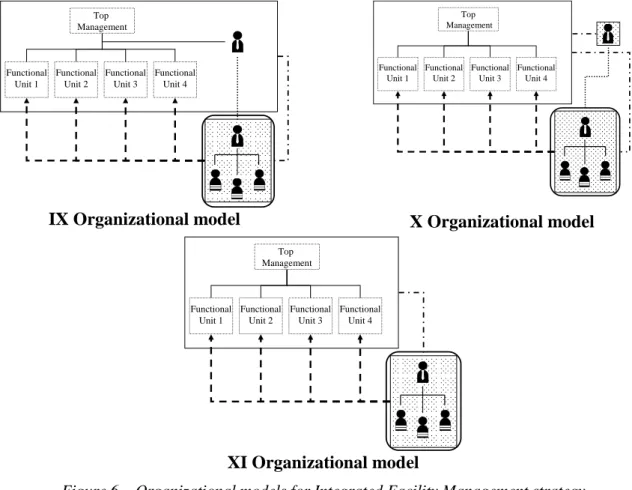
The last organizational models might be grouped within a single strategy for non-core service management, which is called integrated facility management. Integrated facility management refers to the case in which the customer company assigns service management to companies which are able to provide services in a coordinated, integrated and autonomous manner. Non-core integrated outsourcing providers follow the models hereunder (IX, X and XI, see Figure 6).
Top Management Functional Unit 1 Functional Unit 2 Functional Unit 3 Functional Unit 4 IX Organizational model Top Management Functional Unit 1 Functional Unit 2 Functional Unit 3 Functional Unit 4 X Organizational model Top Management Functional Unit 1 Functional Unit 2 Functional Unit 3 Functional Unit 4 XI Organizational model
Figure 6 – Organizational models for Integrated Facility Management strategy
In particular, the IX model envisages an internal facility manager who works for the customer and acts as an interface between the customer and the service provider’s facility manager. According to this model, the service provider manager plays the role of an account manager, too, and is therefore in charge of the external relations to the customer. It is an in-between position: the account manager is half a sales manager dealing with customer agreements and half a technician (project manager) in charge of project implementation. The X model envisages an outsourced facility manager who does not work for the customer, nor for the non-core service provider. Finally, according to the XI model, the service provider is fully in charge of the management and coordination of non-core services. The last three organizational models might be alternatively adopted by the most popular facility management companies, such as Cofathec Servizi, Elyo Italia, ENI Servizi, Gemmo, Ingest Facility, Johnson Controls, Manutencoop Facility Management, Nazca and Pirelli & C. Real Estate Facility Management (IFMA Italian chapter, 2007), which operate in Italy.
A CLASSIFICATION FRAMEWORK FOR ORGANIZATIONAL MODELS AND STRATEGIES
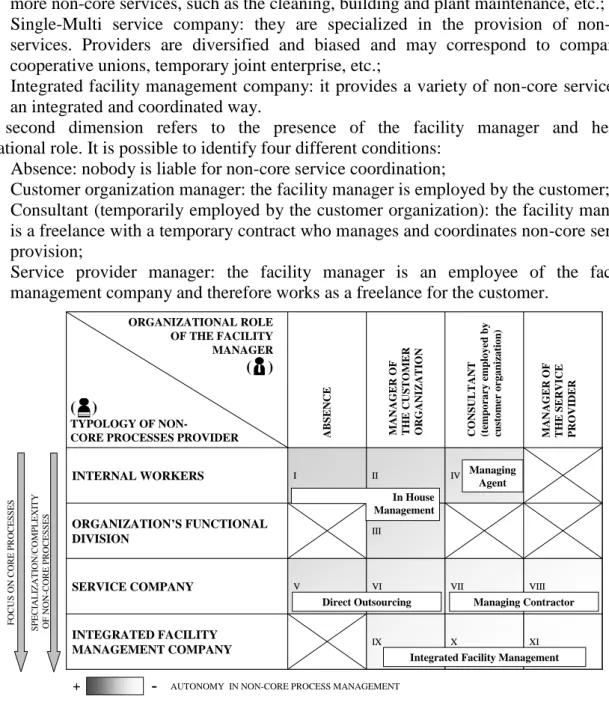
As highlighted above, different business strategies are paired up with different organizational models. In literature no substantial theoretical frameworks are available to identify the organizational models and strategies to be adopted for non-core service management. Consequently we derived and selected two dimensions which allow a comprehensive classification of organizational models: (1) the typology of non-core service provider and (2) the organizational role of the facility manager.
Service providers can be:
Internal workers (e.g. when the machine operator do the cleaning or maintenance during its working time);
Organization’s functional division: it is a specialized unit for the provision of one or more non-core services, such as the cleaning, building and plant maintenance, etc.;
Single-Multi service company: they are specialized in the provision of non-core services. Providers are diversified and biased and may correspond to companies, cooperative unions, temporary joint enterprise, etc.;
Integrated facility management company: it provides a variety of non-core services in an integrated and coordinated way.
The second dimension refers to the presence of the facility manager and her/his organizational role. It is possible to identify four different conditions:
Absence: nobody is liable for non-core service coordination;
Customer organization manager: the facility manager is employed by the customer;
Consultant (temporarily employed by the customer organization): the facility manager is a freelance with a temporary contract who manages and coordinates non-core service provision;
Service provider manager: the facility manager is an employee of the facility management company and therefore works as a freelance for the customer.
VIII VII VI V SERVICE COMPANY XI III ORGANIZATION’S FUNCTIONAL DIVISION INTEGRATED FACILITY MANAGEMENT COMPANY IX X IV II I INTERNAL WORKERS VIII VII VI V SERVICE COMPANY XI III ORGANIZATION’S FUNCTIONAL DIVISION INTEGRATED FACILITY MANAGEMENT COMPANY IX X IV II I
INTERNAL WORKERS Managing
Agent
Managing Contractor
Integrated Facility Management Direct Outsourcing In House Management S P EC IA LI ZAT ION /C OMP L EX ITY OF NO N -C ORE P R OC ESS ES F OCUS ON C ORE P R O C ESS E S
AUTONOMY IN NON-CORE PROCESS MANAGEMENT
A BSEN C E M A N A GER OF THE C U STOM ER OR GA N IZ A TI ON C ON SU LTA N T (tem po ra ry em pl o y ed by cus to m er o rg a ni za ti o n ) M A N A GER OF THE SER V IC E P R OV ID ER ORGANIZATIONAL ROLE OF THE FACILITY MANAGER ( ) ( ) TYPOLOGY OF
NON-CORE PROCESSES PROVIDER
+
-Figure 7 – Non-core processes management strategies and organizational models
implemented in non-core processes management. As a matter of fact, in literature no representative example of the organizational models (see crossed boxes hereunder) is given. Within the framework, the five non-core process management strategies indicated above has been identified. The same strategy in the non-core process management can lead to different organizational models with different managerial and operational structures.
Hereunder the different organizational models are compared and their major advantages and disadvantages are discussed.
The in-house management strategy envisages the use of internal resources to carry out activities, coordinate and manage human resources. The I model is adopted when non-core services are not too specialized and interventions are not too frequent. As frequency, complexity, activity specialization or the need for special equipment grow, the organizational model shows some limits, which are basically due to the lack of service coordination. The II and III model aim at organizing and improving resource coordination, by enhancing the efficacy and effectiveness of facility activities. The authority over business units derives from the hierarchical nature of the organizational structure. The internal facility manager holds a top management position, which gives him/her the authority to settle potential disputes among business units, just as in “strong matrix” organizational structure for project management.
The management by agent strategy allows to receive an unbiased and professional advice on the activities carried out by business units and envisages the opportunity to outsource some activities. As a result, the client company has the opportunity to choose between internal provision and service outsourcing (Alexander, 1996). According to the IV model, which is adopted for this strategy, non-core processes are carried out by the company staff. If compared to the II model, the IV model enables to boost service quality; however, it leads to higher expenses, as it envisages the presence of an outsourced consultant (Tronconi et al., 2002). The II and IV models present a basic difference in the company-facility manager relationship.
According to the IV and III organizational models, i.e. management by agent and in-house management, respectively, the facility manager is in charge of coordinating the different business units activities. By sharing tools and company equipment among different functional units, efficiency can be enhanced. There is a direct relationship between the solution’s success and the outsourced consultant’s expertise and authority. The company runs the risk to lose his/her organizational expertise in the field of non-core service management, although she/he keeps her/his operational resources within the business units.
Regarding the direct outsourcing strategy, the V and VI organizational models envisage the management and subsequent coordination of a large number of providers. Like the in-house management strategy, in the VI model the customer might employ a facility manager to coordinate outsourced providers and optimize management. The facility manager acts as a single interface between the company and service providers, thus promoting exchanges between these actors.
The managing contractor strategy is implemented in the VII and VIII models, in which the company usually turns to both non-core service providers and an outsourced facility manager. According to this strategy, the facility manager (manager by contractor) autonomously selects and manages the single non-core service providers, i.e. sub-contractor (service providers), thus allowing the customer company to concentrate his/her resources on his/her core business. Both models imply that contracts are signed by the customer company and the facility manager selected for service management and coordination. The facility manager also signs agreements with different sub-contractors who do not need to contact the customer, as they have a sole interface: the facility manager himself.
The integrated facility management strategy outsources all support non-core processes/services to large facility management companies. In the IX model the double role played by the facility manager on the one hand leads to higher expenses, on the other hand, it
enables the customer company to keep its expertise and know-how in non-core outsourced services. This is a relevant factor for the company which needs to renegotiate service supply contracts at regular intervals. Turning to outsourced non-core service providers for both operational and coordination and management processes/services (model X and XI) might be critical for the company which risks losing its ability to evaluate costs, intervention time and quality standards related to facility management services in the middle or long-term. As a result, if the company needs to modify plans or to send a reminder, will turn to the service provider’s
account manager.
According to Atkin and Brooks (2005), the XI organizational model’s transaction costs (Williamson, 1985) are the cheapest among all models. This is due to the lack of sub-contractors which leads to a lower number of levels in the facility management network and therefore to a streamlining of management. However, it is worth stressing that the lack of trust-worthy professionals controlled by the customer in non-core service management (in the X and XI models, facility managers are either employees or freelance) expose the customer to the previously quoted risks, just like management contractor strategies.
Finally the framework explains the different strategies and the organizational models on the basis of (a) complexity of the non-core processes, (b) the inclination of the company to outsourcing and (c) the desired level of autonomy in the non-core activities management.
CONCLUSIONS
The paper presents a comprehensive classification of the organizational models for non-core service management. The existing classifications available in literature were inadequate for strategic research purposes. The paper identifies and describes all the potential business strategies for non-core activity management. In particular, the following strategies are outlined:
in-house management;
management by agent;
direct outsourcing;
managing contractor;
integrated facility management.
Each strategy is paired up with the organizational models which can be adopted by a company. 11 models were identified and validated through empirical research. Afterwards, they were classified in a framework, according to the following variables:
the typology of non-core service provider;
the facility manager’s organizational role.
The proposed classification framework ensures an accurate positioning of the organizational models and allows to compare their strategic and operative advantages and disadvantages. It also allows to identify the organizational model which best suits the company’s strategy.
Finally, it is worth saying that more than one organizational model can be developed by a company. The company might therefore entrust single functional unit to perform a non-core activity, outsource a complex service to a qualified company, and finally outsource to an integrated facility management company the remaining processes/services. The choice of the relevant organizational model is made on the basis of the complexity of the service or group of non-core processes/services, the company focus on core processes and its inclination to outsourcing. Therefore, the choice should be made not on the “best organizational model”, but on the model which best suits the company’s business environment and strategy.
Atkin, B. and Brooks, A. (2000), Total Facilities Management, 1st edition, Blackwell Science, Oxford. Atkin, B. and Brooks, A. (2005), Total Facilities Management, 2nd edition, Blackwell Publishing, Oxford. Barrett, P. and Baldry, D. (2003), Facilities Management: Towards Best Practice, Blackwell Publishing, London.
Becker, F. (1990), The Total Workplace: Facilities Management and the Elastic Organization, Van Nostrand Reinhold, New York, NY.
Bernard, W. (1996), “Cost-effective facilities management: a practical approach”, Facilities, Vol. 14, No. 5/6, pp. 26-38.
Brochner, J. (2000), “Understanding service qualities in facilities management: a transaction cost approach”, CIB W70 International Symposium on Facilities Management and Maintenance, Brisbane, pp. 455-459.
Davis, G., Becker, F., Duffy, F. and Sims, W. (1985), ORBIT-2, Harbinger Group, Norwalk, CT.
De Toni, A.F., Fornasier, A., Montagner, M. and Nonino, F. (2007), “A performance measurement system for facility management: the case study of a medical service authority”, International Journal of Productivity and Performance Management, Vol. 56, No. 5/6, pp. 417-435, Emerald Group Publishing Limited, Bradford, UK. Grimshaw, R. (1999), “Facilities management: the wider implications of managing change”, Facilities, Vol. 17, No. 1/2, pp. 24-30.
Johnson, L.K. (2006), “Successful business process outsourcing”, MIT Sloan Management Review, Vol. 47, n. 2, pp. 5-6.
Kaya, S. (2004), “Relating building attributes to end user's needs: ‘the owners-designers-end users’ equation”, Facilities, Vol. 22, No. 9/10, pp. 247-252.
Kniery, D. (2002), “Facility management: how a virtual model enabled a breakthrough for a high-tech company”, Journal of Facilities Management, Vol. 1, No. 1, pp. 16-30.
Krumm, P.J.M.M. (1998), “Consequences of modern banking on facilities and corporate real estate management”, Facilities, Vol. 16, No. 3/4, pp. 93-98.
Price, I. (2002), “Can FM evolve? If not, what future”, Journal of Facilities Management, Vol. 1, No.1, pp. 56-69. Price, I. (2004), “Business Critical FM”, Facilities, Vol. 22, No. 13/14, pp. 353-358.
Romano, P. and Danese, P. (2006), Supply chain management (in Italian), McGraw-Hill, Milan.
Tronconi, O., Ciaramella, A. and Pisani, B. (2002), Asset, Property e Facility Management (in Italian), IlSole24Ore, Milan.
Varcoe, B. (2000), “Implications for facility management of the changing business climate”, Facilities, Vol. 18, No. 10, pp .383-391.
Williams, B. (1996), “Cost-effective facilities management: a practical approach”, Facilities, Vol. 14, No. 5, pp.26-38.
Williamson, O.E. (1985), The economic institutions of capitalism. Firms, markets, relational contracting, Free Press, New York.
References on organizational models available on the web (last access: 10/04/07)
Atkins (2007), “Managing Agent for Highways Agency Area 6”, available on
http://www.atkinsglobal.com/skills/engineering/geotechnicalengineering/services/managingagent/
IFMA Italian chapter (2007), “Facility Management online guide”, available on http://www.ifma.it/guida.php
Department of the Interior (2004), “Departmental Manual”, Series: organization, part 145: National Park Service, chapter 8: Associate Director for Park Planning, Facilities, and Lands, available on
http://elips.doi.gov/app_dm/act_getfiles.cfm?relnum=3648
Morson International (2007), “Global Human Resourcing Solutions - Managing Agent”, available on
http://www.morson.com/div_manageagent.asp
Pedrali R. (2007), "Alcatel Italia, outsourcing scelta vincente", available on
http://kopieermachine.oce-nederland.nl/it/pressroom/case_study/case_alcatel.htm
The Gordian Group (2007), “Our Services - Facilities & Real Estate Consulting”, available on