for
En
vi
ron
m
ental
Mana
geme
nt
o
f M
il
itar
y
Lan
d
s
Guide to Sampling Soil
Compaction Using Hand-Held
Soil Penetrometers
CEMML TPS 04-1
CENTER FOR ENVIRONMENTAL MANAGEMENT OF MILITARY LANDS Colorado State University
Fort Collins, CO 80523-1490 January 2004
1
Guide to Sampling Soil Compaction Using
Hand-Held Soil Penetrometers
1Prepared by
Dave Jones and Matt Kunze
Center for Environmental Management of Military Lands (CEMML) Colorado State University
Fort Collins, Colorado 80523-1490
INTRODUCTION...1
COMPACTION ISSUES ...2
TYPES OF CONE PENETROMETERS ...2
STATIC CONE PENETROMETERS...2
DYNAMIC CONE PENETROMETERS...3
DROP CONE PENETROMETERS...4
COMPACTION SAMPLING GUIDELINES...7
CONCLUSIONS ...7
REFERENCES ...8
Introduction
Vehicle traffic and foot trampling in military training areas can result in varying levels of soil compaction, depending on uses, climate, soil properties, and soil moisture at time of impact. Increased soil compaction results in higher soil bulk density (mass/unit volume), which can reduce water infiltration, reduce soil surface strength, increase runoff and erosion potential, and reduce site productivity (Braunack 1986, Thurow et al. 1995). The loss of macro-pore space via compaction has the greatest impact on water and air movement. Shrink-swell and freeze-thaw action typical of soils high in certain clays can significantly reduce surface soil compaction, but the most common remedy applied to highly compacted soils in relatively small areas is soil ripping using a chisel plow pulled by a tractor or bulldozer. Renewed root growth can also reduce soil compaction. Minimization of compaction is best achieved by confining traffic to specific areas, avoiding sensitive soils, and avoiding driving off-road when soils are excessively wet.
Soil compaction is most often characterized by changes in soil bulk density, typically expressed in Mg/m3 or g/cc. Soil density is also related to soil resistance, which can be measured using a
penetrometer much more rapidly that bulk density samples can be obtained (Miller et al. 2001). Some soils such as stony, light-textured, or highly friable soils are difficult to sample consistently
1Funding for this report was provided under the Land Condition-Trend Analysis (LCTA) Technical Support Contract administered by
using hammer type bulk density samplers using corers or rings. Cone penetrometers are thus commonly used to measure soil compaction because of their easy, rapid, and economical operation (Perumpral, 1987). The purpose of this guide is to briefly discuss the advantages/disadvantages of hand operated static, dynamic, and drop cone penetrometers. Specifications and vendor information for selected penetrometers are also presented.
Compaction Issues
The level of compaction and the thickness of compacted layers can vary with soil depth and across the area of interest. Military training areas affected by compaction include assembly/administrative areas, bivouac areas, heavy equipment training areas, and off-road maneuver areas. Understanding the effects of compaction within the soil profile is essential for developing land repair and mitigation efforts. The follow key issues influence both the measurement and treatment of compaction (adapted from Rooney et al. (undated)):
• Intensity – How compacted is the soil relative to unimpacted soils? Slight compaction may not cause management problems and may heal over time. • Extent – Is the compaction across the entire training/disturbed area or
concentrated in specific areas?
• Depth – At what depth does the highest compaction occur?
• Thickness – How thick is the compacted layer, and does the thickness vary considerably across the site?
• Seasonality – How, if at all, does compaction change over the course of a year?
In general, an increase in compaction, as indicated in increased resistance to penetration, indicates reduced air and water movement within the soil, less favorable conditions for plant growth, and increased erosion potential.
Types of Cone Penetrometers
There are two general types of hand-held cone penetrometers: static penetrometers and dynamic penetrometers. Both measure soil resistance to vertical penetration of a probe or cone. The distinction between the two penetrometers lies in how force is applied to the cone. Static penetrometers subject to a constant hydraulic, mechanical, or electric power (via truck, tractor, or other motorized source) record data deep into the soil profile using digital data acquisition. These mechanical penetrometers work well to document compaction profiles due to the constant penetration rate, but are expensive and often limited to road-accessible sites. The drop cone penetrometer is considered a type of dynamic penetrometer, and will also be briefly discussed.
Static Cone Penetrometers
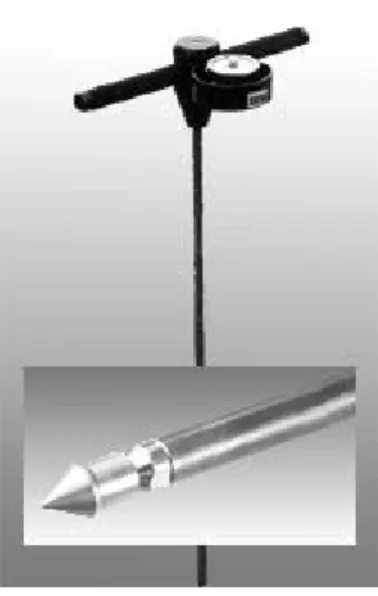
Static cone penetrometers measure the force required to push a metal cone through the soil at a constant velocity (Figure 1). The force is usually measured by a load cell or strain gauge (e.g., proving ring) coupled with an analog dial or pressure transducer for readout (Herrick and Jones, 2002). The force is commonly expressed in kilopascals (kPa), an index of soil strength referred to as the cone index (ASAEa, 1999), or as Kg/cm2 or PSI. As the operator pushes down on the
penetrometer, the note keeper records cone index values for each depth increment to evaluate the degree, depth, and thickness of compacted layers. Cone indices depend on cone properties (angle and size) and soil properties (e.g., bulk density, texture, and soil moisture) (ASAEb,
3
1999; Herrick and Jones, 2002). A static cone penetrometer with a 30o cone has been recommended by the American
Society of Agricultural Engineers (ASAE) as the standard measuring device for characterizing the penetration resistance of soils (ASAEa, 1999). While this configuration may work in a wide variety of soils, it is not critical that all instruments adhere to these standards, since results are generally relative to one another at a particular time and place.
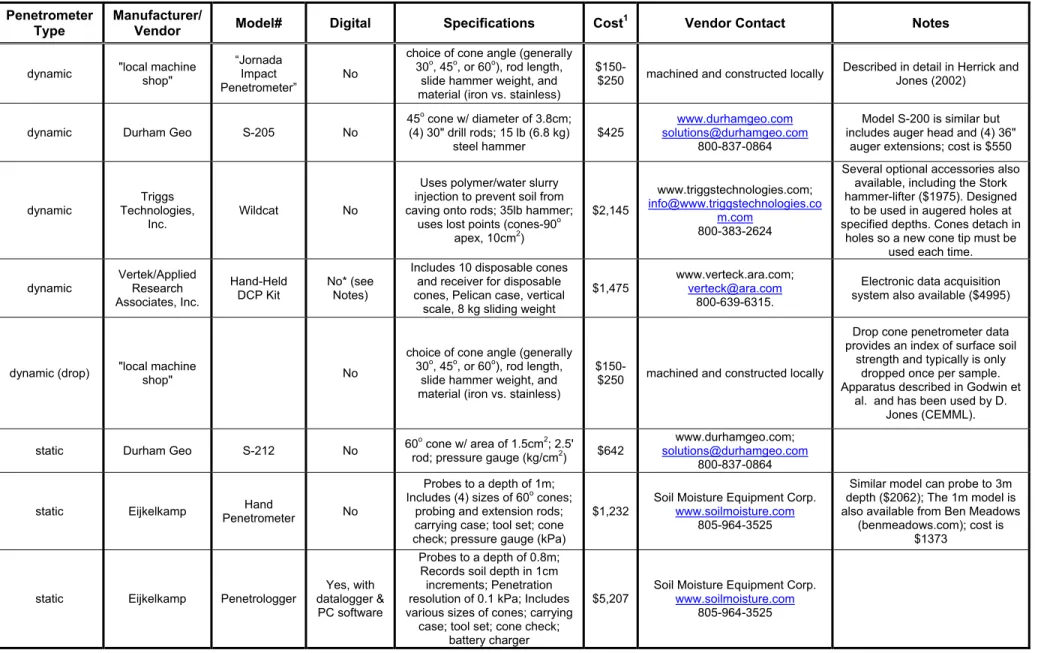
Although the methods for static cone penetrometer operation have been standardized, there are several limitations which may limit their use for monitoring (Herrick and Jones, 2002). Static penetrometers can be relatively expensive (≥$600), particularly for models with digital recording capability (Table 1). More importantly, since static penetrometers must be moved through the soil at a constant velocity (i.e., pressure), different rates of insertion by different observers can yield variable results and affect repeatability (Herrick and Jones, 2002). Even the pressure exerted by a single operator can be difficult to apply at a constant and repeatable rate. Operator strength may also limit the use of static penetrometers in dry soils. Recalibration to the operator is recommended to optimize
repeatability. Repeatability and difficulties sampling hard or dry soils are the primary drawbacks of this type of penetrometer. Advantages of static cone penetrometers over dynamic cone penetrometers include well-documented and standardized methods and ease of use.
Dynamic Cone Penetrometers
Dynamic cone penetrometers (DCPs) apply a known amount of kinetic energy to the cone, which causes the penetrometer to move a distance through the soil (Herrick and Jones, 2002). Dynamic penetrometers do not rely on constant penetration velocity, as most dynamic penetrometers use a slide hammer of fixed mass and drop height to apply consistent energy with each blow (Figure 2). Either the number of blows required to penetrate a specified depth, or the depth of penetration per blow are measured, and results can be calculated as a cone index described above. The weight of the hammer, slide distance, and cone angle influence the energy delivered and can be adjusted to local conditions (e.g., soft vs. hard soils). Measurements are taken by placing the cone on the soil surface with the shaft upright. To minimize variability in starting depth, the cone is pressed into the soil until the soil is level with the base of the cone. The slide hammer is raised until it touches the collar and is released. The depth of penetration is recorded for each blow until a maximum or desired depth is
reached. Penetrometers driven to depths greater than approximately 30 cm may be difficult to remove from the soil (Herrick and Jones 2002). Soil resistance for each soil depth interval is
Figure 1.Example of hand held static cone penetrometer. Photo courtesy Durham Geo Corp.
Figure 2. Example of dynamic cone penetrometer showing slide hammer (left), extension rods (center) and cone attachment (upper right). Photo courtesy Durham Geo Corp.
calculated using standard equations that account for differences in hammer drop distance, weight, and cone size.
DCPs tend to yield much more consistent results and have a greater range of repeatability because they are not subject to operator variability (Herrick and Jones, 2002). Dynamic penetrometers have fewer limitations in dry soils and tend to be less expensive than static penetrometers (Table 1). Because of these reasons, the DCP is well suited for soil compaction monitoring on military lands. The design and application of a low-cost ($150-$200) DCP is described by Herrick and Jones (2002).
Drop Cone Penetrometers
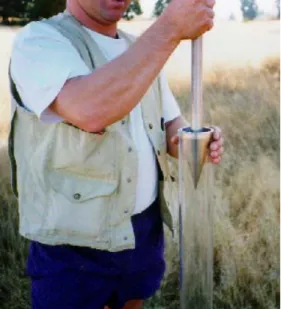
A drop-cone penetrometer is used to estimate surface soil strength (Figure 3). It has been used to estimate compaction effects associated with cattle grazing (Paul Ayers, unpublished data) and military vehicles (Jones 2000). The drop cone used in the aforementioned studies was constructed based on design information provided by Godwin et al. (1991) and advice from Dr. Paul Ayers2. The drop-cone technique is rapid and precise, allowing many samples to be
obtained in a short period of time. The device consists of a 30 degree metal cone and lifting rod with a combined weight of 2.0 kg, a 1 m long PVC or acrylic guide tube, and an aluminum millimeter ruler inlaid in the holding rod. The cone is machined with a collar to ensure that it falls perpendicularly through the guide tube. To take a measurement, the base of the guide tube is placed on the ground surface and the cone is lifted until its top is flush with the top of the tube. The cone is released and penetrates the ground surface. Penetration depth is recorded at the top of the guide tube by reading the ruler inlaid in the holding rod.
This apparatus is inexpensive, easy to use, rapid, and highly repeatable. The disadvantage of this penetrometer is that only surface soil resistance is measured and nothing can be inferred about the underlying soil profile.
2 Former professor of Chemical and Bioresources Engineering, Colorado State University, Fort Collins,
Colorado; currently at the University of Tennessee at Knoxville.
Figure 3. Drop cone penetrometer held in release position.
5
Table 1. Specifications and vendor information for hand-held cone penetrometers for measuring soil compaction. Listing of a vendor does not constitute promotion of their products.
Penetrometer
Type Manufacturer/ Vendor Model# Digital Specifications Cost1 Vendor Contact Notes
dynamic "local machine shop"
“Jornada Impact Penetrometer”
No
choice of cone angle (generally 30o, 45o, or 60o), rod length,
slide hammer weight, and material (iron vs. stainless)
$150-$250 machined and constructed locally
Described in detail in Herrick and Jones (2002)
dynamic Durham Geo S-205 No
45o cone w/ diameter of 3.8cm; (4) 30" drill rods; 15 lb (6.8 kg) steel hammer $425 www.durhamgeo.com [email protected] 800-837-0864
Model S-200 is similar but includes auger head and (4) 36"
auger extensions; cost is $550
dynamic Technologies, Triggs Inc.
Wildcat No
Uses polymer/water slurry injection to prevent soil from caving onto rods; 35lb hammer;
uses lost points (cones-90o
apex, 10cm2) $2,145 www.triggstechnologies.com; [email protected] m.com 800-383-2624
Several optional accessories also available, including the Stork hammer-lifter ($1975). Designed
to be used in augered holes at specified depths. Cones detach in
holes so a new cone tip must be used each time. dynamic Vertek/Applied Research Associates, Inc. Hand-Held DCP Kit No* (see Notes)
Includes 10 disposable cones and receiver for disposable cones, Pelican case, vertical
scale, 8 kg sliding weight
$1,475
www.verteck.ara.com; [email protected]
800-639-6315.
Electronic data acquisition system also available ($4995)
dynamic (drop) "local machine shop" No
choice of cone angle (generally 30o, 45o, or 60o), rod length,
slide hammer weight, and material (iron vs. stainless)
$150-$250 machined and constructed locally
Drop cone penetrometer data provides an index of surface soil
strength and typically is only dropped once per sample. Apparatus described in Godwin et
al. and has been used by D. Jones (CEMML).
static Durham Geo S-212 No 60
o cone w/ area of 1.5cm2; 2.5'
rod; pressure gauge (kg/cm2) $642
www.durhamgeo.com; [email protected]
800-837-0864
static Eijkelkamp Penetrometer Hand No
Probes to a depth of 1m; Includes (4) sizes of 60o cones;
probing and extension rods; carrying case; tool set; cone check; pressure gauge (kPa)
$1,232
Soil Moisture Equipment Corp. www.soilmoisture.com
805-964-3525
Similar model can probe to 3m depth ($2062); The 1m model is also available from Ben Meadows
(benmeadows.com); cost is $1373
static Eijkelkamp Penetrologger datalogger & Yes, with PC software
Probes to a depth of 0.8m; Records soil depth in 1cm
increments; Penetration resolution of 0.1 kPa; Includes various sizes of cones; carrying
case; tool set; cone check; battery charger
$5,207 Soil Moisture Equipment Corp. www.soilmoisture.com 805-964-3525
Penetrometer Type
Manufacturer/
Vendor Model# Digital Specifications Cost
1 Vendor Contact Notes
static Geneq, Inc. H-4210 No 60o cone w/ area of 1.5cm2; 2.5'
rod; pressure gauge (kg/cm2) $823 [email protected]800-463-4363
static Technologies, Spectrum Inc. Field Scout (SC-900) Yes, with datalogger & PC software
Weighs 2.75 lbs; Records soil depth in 1" increments; Penetration resistance in PSI or
kPa; GPS port
$1,495 [email protected] 800-248-8873
Identical to Investigator below
static Suppliers, Inc. Forestry
The Investigator Soil Compaction Meter Yes, with datalogger & PC software
Weighs 2.75 lbs; Records soil depth in 1" increments; Penetration resistance in PSI or
kPa; GPS port
$1,395 [email protected] 800-647-5368
Identical to Spectrum's Field Scout
7
Compaction Sampling Guidelines
The following guidelines are provided to assist in the development of compaction sampling protocols and optimize data analysis opportunities:
• Develop written sampling objectives to direct data collection and evaluate success of
the monitoring and management efforts. Include specific attributes such as intensity, depth, extent, etc. For example, “Estimate the mean penetrometer resistance of 0-10cm, 10-20cm, and 20-30cm soil depths with 90% confidence that the estimate is within 10% of the mean. These assessments will be performed every two years in high-use areas where soil compaction is a management concern”.
• Develop a standardized sampling design and methodology for use in areas of
interest.
• Because soil strength is highly influenced by soil moisture, sampling of a site should
take place over a short period of time to minimize potential effects of changing soil moisture. If comparison of different sites or analysis over time is desired, it is recommended to sample when soils are at or near field capacity (Miller et al. 2001).
• Sample adjacent “control” or reference areas to provide a benchmark for comparison
with impacted sites. Reference areas should be relatively close to damaged areas and have a similar soil type.
• Due to the effects of soil moisture on penetration resistance, measurements should
be analyzed as relative values at a particular time and place. Differences in soil texture, rainfall patterns, and sunlight exposure can affect soil moisture across the landscape.
• Sample size necessary to meet desired precision should be determined using pilot
sampling. Approximately 15-25 samples are often adequate but results will depend on site heterogeneity.
• Sampling designs should be stratified if appropriate. Bias in selection of sampling
locations must be minimized through the a priori selection of locations or the use of additional sampling rules of thumb. Navigation to random or systematic grid points (with a random start point) or navigation using pacing and compass are both acceptable approaches to minimize subjectivity.
• Soil moisture content and soil texture classification could be collected and recorded
as corollaries to compaction.
• Repeated attempts may be necessary where stones are encountered, indicated by a
distinct sound and or penetrometer vibration. In stony soils, penetrometer resistance may be poorly correlated with bulk density (Miller et al. 2001).
• Additional vegetation, disturbance, groundcover/biological crust, erosion, or other data can be collected at compaction sample points and the data can be analyzed to infer the causes of compaction, its effect on natural resources, and the effectiveness of compaction mitigation efforts.
Conclusions
A variety of types and models of hand held penetrometers are available, and present a relatively low cost and expedient alternative to collecting bulk density samples for measuring soil compaction. Following the lead of Herrick and Jones (2002), the slide hammer type DCP is recommended for sampling compacted soil areas on military installations. While DCP results are not necessarily comparable across sites and over time due to differences in soil moisture
and other factors, the procedure is highly repeatable and rapid, and addresses the key issues of compaction intensity, extent, depth, and thickness. The penetrometer can be purchased commercially from several vendors or constructed to ASAE standards using a local machine shop.
References
ASAE (American Society of Agricultural Engineers). 1999a. Soil Cone Penetrometer. ASAE Standard S313.3. American Society of Agricultural Engineers: St. Joseph, MI.
ASAE (American Society of Agricultural Engineers). 1999b. Procedures for Using and Reporting Data with the Soil Cone Penetrometer. ASAE Standard EP542. American Society of Agricultural Engineers: St. Joseph, MI.
Braunack, M.V. 1986. The residual effects of tracked vehicles on soil surface properties. Journal of Terramechanics 23(1): 37-50.
Godwin, R.J., N.L. Warner, and D.L. Smith. 1991. The development of a dynamic drop-cone device for the assessment of soil strength and the effects of machinery traffic. J. Agric. Engineering Res. 48:123-131.
Herrick, J.E. and T.L. Jones. 2002. A dynamic cone penetrometer for measuring soil penetration resistance. Soil Science Society of America Journal 66: 1320-1324.
Jones, D.S. 2000. Impacts of the M1A1 Abrams Tank on Vegetation and Soil Characteristics of a Grassland Ecosystem at Fort Lewis, Washington. CEMML TPS 00-1. Center for Environmental Management of Military Lands, Colorado State University, Fort Collins CO.
Miller, R.E., J. Hazard, and J. Howes. 2001. Precision, Accuracy, and Efficiency of Four Tools for Measuring Soil Bulk Density or Strength. USDA Forest Service Pacific Northwest Research Station Gen. Tech Report PNW-RP-532, April 2001.
Perumpral, J.V. 1987. Cone penetrometer applications: A review. Transactions of the American Society of Agricultural Engineers 30: 939-944.
Rooney, D., M. Stelford, and D. Landolt. Undated. Site-Specific Soil Compaction Mapping Using a Digital Soil Penetrometer. Site-Specific Management Guidelines (SSMG) – 34. Potash and Phosphate Institute (http://www.ppi-far.org/ssmg).
Thurow, T.L., S.D. Warren, and D.H. Varlson. 1995. Tracked vehicle effects on the hydrological characteristics of Central Texas rangeland. Transactions of the ASAE 36(6):1645-1650.