WO R K I N G PA P E R S E R I E S
N O. 4 2 7 / J A N U A RY 2 0 0 5
INTERLINKING
SECURITIES
SETTLEMENT SYSTEMS
A STRATEGIC
COMMITMENT?
ECB-CFS RESEARCH NETWORK ON CAPITAL MARKETS AND FINANCIAL INTEGRATION IN EUROPE
In 2005 all ECB publications will feature a motif taken from the €50 banknote.
W O R K I N G PA P E R S E R I E S
N O. 4 2 7 / J A N U A RY 2 0 0 5
This paper can be downloaded without charge from http://www.ecb.int or from the Social Science Research Network electronic library at http://ssrn.com/abstract_id=634022.
ECB-CFS RESEARCH NETWORK ON CAPITAL MARKETS AND FINANCIAL INTEGRATION IN EUROPE
INTERLINKING
SECURITIES
SETTLEMENT SYSTEMS
A STRATEGIC
COMMITMENT?
1by Karlo Kauko
2© European Central Bank, 2005 Address
Kaiserstrasse 29
60311 Frankfurt am Main, Germany Postal address
Postfach 16 03 19
60066 Frankfurt am Main, Germany Telephone +49 69 1344 0 Internet http://www.ecb.int Fax +49 69 1344 6000 Telex 411 144 ecb d All rights reserved.
Reproduction for educational and non-commercial purposes is permitted provided that the source is acknowledged. The views expressed in this paper do not necessarily reflect those of the European Central Bank.
The statement of purpose for the ECB Working Paper Series is available from the ECB website, http://www.ecb.int.
ECB-CFS Research Network on
“Capital Markets and Financial Integration in Europe”
This paper is part of the research conducted under the ECB-CFS Research Network on “Capital Markets and Financial Integration in Europe”. The Network aims at stimulating top-level and policy-relevant research, significantly contributing to the understanding of the current and future structure and integration of the financial system in Europe and its international linkages with the United States and Japan. After two years of work, the ECB Working Paper Series is issuing a selection of papers from the Network. This selection is covering the priority areas “European bond markets”, “European securities settlement systems”, “Bank competition and the geographical scope of banking activities”, “international portfolio choices and asset market linkages” and “start-up financing markets”. It also covers papers addressing the impact of the euro on financing structures and the cost of capital.
The Network brings together researchers from academia and from policy institutions. It has been guided by a Steering Committee composed of Franklin Allen (University of Pennsylvania), Giancarlo Corsetti (European University Institute), Jean-Pierre Danthine (University of Lausanne), Vítor Gaspar (ECB), Philipp Hartmann (ECB), Jan Pieter Krahnen (Center for Financial Studies), Marco Pagano (University of Napoli “Federico II”) and Axel Weber (CFS). Mario Roberto Billi, Bernd Kaltenhäuser (both CFS), Simone Manganelli and Cyril Monnet (both ECB) supported the Steering Committee in its work. Jutta Heeg (CFS) and Sabine Wiedemann (ECB) provided administrative assistance in collaboration with staff of National Central Banks acting as hosts of Network events. Further information about the Network can be found at http://www.eu-financial-system.org.
The joint ECB-CFS Research Network on "Capital Markets and Financial Integration in Europe" aims at promoting high quality research. The Network as such does not express any views, nor takes any positions. Therefore any opinions expressed in documents made available through the Network (including its web site) or during its workshops and conferences are the respective authors' own and do not necessarily reflect views of the ECB, the Eurosystem or CFS.
C O N T E N T S
Abstract 4
Non-technical summary 5
1 Introduction 7
1.1 Securities settlement systems and links 7
1.2 The securities market as a network industry 8
1.3 Outline of the paper 9
2 Assumption of the basic model 10
2.1 Agents 10
2.2 Investor behaviour 11
2.3 Cross-border settlement 13
2.4 Costs 14
2.5 Fees collected by the CSDs 15
2.6 Order of moves 16
3 Solving the model 16
3.1 Secondary market trading volumes 16
3.2 Competition between IFs 17
3.2.1 Domestic securities and domestic
customers 17
3.2.2 Domestic customers and foreign
securities 18
3.2.3 Pricing by the custodian IF 18
3.3 Pricing by the CSDs 20
3.3.1 Prices for secondary market services 20
3.3.2 Prices for primary market services 21
4 Commitment to profit maximising pricing 22
4.1 Assumptions 22
4.2 Solving the model 23
5 An idle link as a commitment 24
5.1 Assumptions 24
5.2 Solving the model 25
5.3 The link and the posted fee 28
5.4 Alternative cases 29
6 Conclusions 30
6.1 Summary of main results 30
6.2 Comparison with previous literature 31
6.3 Discussion 32
References 35
Abstract
Central securities depositories (CSDs) have opened mutual links, but most of them are seldom used. Why are idle links established? By allowing a foreign CSD to offer services through the link the domestic CSD invites competition. The domestic CSD can determine the cost efficiency of the rival by charging suitable fees, and prevent it from becoming more competitive than the domestic CSD. By inviting the competitor the domestic CSD can commit itself not to charge monopoly fees for secondary market services. This enables the domestic CSD to charge high fees in the primary market without violating investors’ participation constraints.
Keywords: securities settlement systems, central securities depositories, network industries, access pricing
Non-technical summary
Mutual links between central securities depositories (CSD) in different European countries have been opened up. A CSD can have an omnibus securities account with a foreign peer CSD. An omnibus account is one in which a member pools securities owned by its own customers. Thus, a domestic investor or investment firm can hold securities issued in another country on a domestic securities account with the domestic CSD. Securities held by all these domestic customers are pooled on the omnibus account of the domestic CSD with the foreign CSD. Secondary market transactions in foreign securities can be processed through the
link and the domestic CSD.
However, in the light of most of the available information, these links are seldom used. It is possible that these links have no potential for becoming an efficient way to channel cross-border transactions in securities. This might explain why these links are barely used; but why would idle links be established in the first place?
This paper approaches this question from the point of view of industrial organisation theory. CSDs are assumed to be profit-maximising national monopolies. They offer two kinds of services. First, they offer services related to issuance of new securities. At a later stage, they offer services related to secondary market transactions between investors. Because the monopoly cannot credibly commit itself to low future fees for secondary market transactions, the CSD must charge relatively low prices for primary market transactions. If it tried to abuse its monopoly power in the primary market, no securities would be issued in the system.
It turns out that the link can be used as a tool that allows the CSD to charge higher fees for primary market transactions. If the link is in place, at least foreign investors can make transactions in securities without using the CSD where the securities have been originally issued. Thus, the CSD has disposed of its monopoly situation, and when investors decide whether to invest in securities in the primary market or not, they understand that future fees for secondary market transactions will be reasonable.
Interestingly, the domestic CSD can determine the cost efficiency of the rival. The foreign CSD cannot process transactions with domestic securities without services offered by the domestic CSD. The domestic CSD can charge suitable fees, and prevent the foreign rival CSD from becoming more competitive than the domestic CSD. An ideal competitor is one competitive enough to prevent future monopoly pricing but not sufficiently competitive to capture the market. By inviting the competitor and by optimising its cost-efficiency the domestic CSD can commit itself not to charge monopoly fees for secondary market services without running the risk of losing customers. This enables the domestic CSD to charge high fees in
the primary market without discouraging investors from investing in securities in the primary market.
1
Introduction
1.1
Securities settlement systems and links
The key functions in securities markets are trading, clearing and settlement. In a trading system investors simply agree on buying and selling securities. This is of no use unless the trades are implemented. Clearing involves verification and matching of trades and calculation of the parties’ obligations. In the settlement process securities are transferred from seller to buyer and the payment from buyer to seller.
Securities settlement systems are essential market infrastructure institutions. In a typical modern system there is a central system in each country, or possibly several systems for different types of securities. The nature of the settlement system may depend on the structure of the book-entry system. The central bank or state treasury may be a member, but most members are private companies in the financial industry, such as banks and investment firms, which participate in the central settlement system on behalf of their customers. In the following, these financial institutions are simply referred to as investment firms (IFs).
Paper-form securities have become rarities, having been largely replaced by book-entries, ie entries in a special securities account system. Many countries have a so-called ‘tiered’ book-entry system in which there is a central securities register at the central securities depository (CSD). Individual investors normally cannot have accounts at the CSD. The central register consists of settlement system members’ accounts. Many, if not most, accounts are omnibus accounts. An omnibus account is an account in which a member holds pooled securities owned by its own customers. The CSD may know the total amounts of securities owned by the customers of each member, but may have no detailed information on individual investors’ holdings. The IF keeps detailed accounts on the holdings of individual customers in its own system. An account with such a custodian IF could also be an omnibus account; an IF without an account at the CSD can open an account with another IF and use it to pool the securities of its customers. Often such customer-IFs are foreign institutions. Investors face potentially significant switching costs in a tiered book-entry system because it is not possible to sell securities without using the services of the custodian CSD.
The official policy of the European Union is to enhance the integration of financial markets. The EU Commission published its financial services action plan (EU 1999) a few years ago. The plan contained several proposals on regulatory changes needed to speed up integration of the market for financial services. Many of the proposed reforms have already been accomplished, as concluded in the progress reports, but the market is still fragmented. There are more than 20 securities settlement systems in the EU area. Most of the centres are national rather than international institutions. Cross-border settlement is more cumbersome and costly than settlement at the national level (Giovannini et al
2001), and proposals to simplify it have been presented (see e.g. Milne 2002 and Leinonen 2003).
The interlinking of settlement systems is a potentially efficient way to avoid some of the problems. CSDs can open links between themselves. When such a link is opened the domestic CSD opens an omnibus account with the foreign CSD. Securities owned by domestic investors are pooled on this omnibus account. The domestic CSD keeps detailed records of the holdings of the clienteles of different domestic IFs, and the IFs arrange the accounting at investor level. Several links have already been established between CSDs in the EU area.
Unfortunately it is nearly impossible to find data on the use of these links, but many industry practitioners claim that they are barely used. Why do CSDs establish such links even though financial institutions do not use them? It has been argued that the links are not a competitive alternative because of legal uncertainties, or because delivery-versus-payment with central bank money cannot be arranged through them. These shortcomings may be of importance, but they hardly constitute a credible explanation to the existence of idle links. Why do CSDs open such links if these links do not enable CSDs to offer services that would satisfy customer requirements? Is there any rational reason to do so? This paper is an attempt to present a potential explanation to the existence of idle links. It is proposed that an idle link with a peer CSD can help the CSD commit itself to reasonable secondary market fees, which enables it to charge higher fees in the primary market.
1.2
The securities market as a network industry
Telecommunications, power supply and payment systems are often classified as network industries. Shy (2001) presents a list of typical characteristics of network industries.
– Complementarity, compatibility and standards – Externalities in consumption
– Switching costs and lock-in
– Significant economies of scale in production
A national securities market infrastructure “silo”, consisting of trading, clearing and settlement systems, satisfies many of these criteria. Switching costs can be substantial, especially in a tiered book-entry system. Because investors prefer more to less liquidity, there may be significant positive externalities at stake in investors’ decisions to “consume” services of the securities industry. There seem to be substantial economies of scale and scope in the stock exchange industry (Hasan & Malkamäki 2001), and notably in the securities settlement industry (Schmiedel, Malkamäki & Tarkka 2002).
Rochet and Tirole (2001) have argued that many network industries are platform industries, ie service providers that need two kinds of customers who need to interact. If either of the customer types is missing, the other group will not be interested in the services offered by the company. For instance, a credit card company needs both consumers who are willing to pay with the card and merchants who are willing to accept them. To an extent, a national securities market infrastructure “silo” is a platform industry because it needs both investors and issuers. Competition in platform industries has been analysed at least by Caillaud and Jullien (2001); in their model both types of customers can choose between the two “cybermediaries”.
In many cases the network is operated by a monopoly, although other companies can provide services via the network. The owner of the network would normally charge a fee for such access. Laffont and Tirole (1994) presented one of the first analyses of access pricing in a network industry. In their model a monopoly both operates a network and produces services that are supplied through it. Other companies can produce comparable services, but they cannot deliver them to customers without using the network controlled by the monopoly. Laffont and Tirole focus mainly on the need and possibilities to regulate the monopoly.
Even though the securities industry can be considered a network industry and securities markets are of paramount importance to the economy, very few analyses have been done that treat the securities market infrastructure as a network industry. In his policy-oriented paper, Milne (2002) applies the access pricing regulation approach to CSDs. He concludes that the book-entry function and a few related services are a natural monopoly, at least at issuer level. On the other hand, CSDs offer a wide range of services that can be offered by competing firms if the CSDs do not prevent competition by abusing their control over the book-entry system. He argues that certain core functions should be left to a monopoly whereas competition should be introduced in all other clearing and settlement related services, preferably at the European level. A regulation on terms and pricing of access could be implemented to prevent abuse of CSDs’ monopoly position in potentially competitive operations. Although both Milne’s paper and the analysis of the sequel here apply the concepts of network industries to CSDs, the approaches are entirely different. No attention is paid here to the possibility of separating different CSD operations, and no attention is paid to the applicability of government regulations.
1.3
Outline of the paper
The assumptions of the basic model are presented in the section 2, and the solution of the model in the section 3. The model describes a world consisting of two identical countries. In each country there is a CSD and a large number of investment firms (IFs). Both countries are inhabited by one issuer and a large number of investors. Neither of the two issuers can use the foreign CSD. Neither
can investors use foreign institutions’ services. Investors’ transactions with foreign investments must be channelled through a custodian IF in the home country of the issuer. CSDs have monopoly power in respect of both securities issuance in the primary market and trade among investors in the secondary market. There is no ordinary price elasticity of demand in the primary market if the fees are below the reservation level, implying that the monopoly power results only in a transfer of wealth to the CSD. The secondary market outcome cannot be Pareto optimal because the monopoly CSD faces a price elastic demand. Anticipated future welfare losses in the secondary market are reflected in the fees the CSDs can charge in the primary market.
The section 4 analyses how a CSD can increase its profit if it can commit itself to an optimal secondary market fee. This posted fee is lower than the fee without commitment, and, under certain conditions, approaches Pareto optimality. If the commitment is credible, the CSD can charge higher fees for primary market services without violating investors’ participation constraint.
In section 5 it is demonstrated that a link between two CSDs can be used as a strategic commitment to the optimal secondary market posted fee. Because foreign investors can transact via their domestic CSD and the link, there is competition in the secondary market. A CSD can create a suitable competitor for itself by allowing the peer CSD to offer competing services. The ideal competitor should be competitive enough to convince would-be customers of the existence of competitive pressures but not competitive enough to capture the market.
The main results are reviewed in the conclusions section 6. Section 6 also presents a few additional insights and a couple of policy implications of a very preliminary nature.
2
Assumption of the basic model
2.1
Agents
There are two identical countries, 1 and 2, which are denoted i and j (i≠j). In each country there is a local securities infrastructure consisting of a national central securities depository (CSD) and a large number of identical Investment firms (IFs). All these undertakings try to maximise profits.
Each country has a large number of investors. These investors are divided into segments, which may be geographic regions or customer categories. There are n segments in each country.
The CSDs act as central securities registers. Each security issued in a CSD’s home country must be registered with that CSD. Each national CSD runs the central securities settlement system for domestic securities. The CSDs have no customers other than domestic investment firms (IFs) which are settlement system
members of the domestic CSD. They offer services to investors but have no securities portfolios of their own.
The book-entry system is tiered; the central register at the national CSD consists of domestic IF’s omnibus accounts. Investors’ securities are pooled on these omnibus accounts. Investors and foreign IFs cannot open accounts with the CSD but they can open accounts with domestic IFs. If country j investors want to invest in securities of country i, they must open accounts with domestic country j IFs. Each IF in country j can open a securities account with a country i IF, and the securities are pooled in an omnibus account of this custodian IF.
Securities are traded in two markets. They are first issued in the primary market and thereafter traded in the secondary market. Secondary market trades between customers of different domestic IFs are settled at the CSD.
The IFs earn revenue by charging fees for the settlement services, ie unit prices per settled security. Each IF sets two secondary market prices to be paid by investors, one for a settlement order for a domestic security and another for a settlement order with a foreign security. The fee paid by a country i investor for a transaction in a domestic security is denoted wii and the fee paid for a transaction
in a foreign (country j) security is denoted wij. Each IF also sets two unit fees for
primary market transactions, one for a domestic (country i) security (γii) and
another for a foreign (country j) security (γij). There is free entry into the IF
industry and the market is highly contestable; no IF can make profits in the equilibrium.
There is one would-be issuer in each country.1 The issuer must either use the domestic CSD or abstain from issuing securities. In real life issuers can often choose between CSDs of different nationalities, but using a foreign CSD can be particularly difficult and costly. For instance, if a corporation that is to be publicly quoted wants to issue its shares in a foreign system it should establish a holding company in the desired country and put all the operative units under the new holding company, which would then be quoted on the stock exchange, instead of the former parent company.
Price formation in the secondary market is ignored in the model.
2.2
Investor behaviour
Investors have a utility or objective function. No IF can successfully offer services to more than one segment, and no investor can use an IF based in another segment. As to functional forms and parameter values, the segments are identical.
Investors get utility from four sources: 1) from holdig domestic securities after issuance, 2) from holding foreign securities after issuance, 3) from trading in domestic securities in the secondary market, 4) from trading in foreign securities
1 If one assumes that there are several identical issuers in each country the model becomes somewhat more complicated, but this would probably not lead to any essentially different results.
in the secondary market. These utilities are additive, so that the total utility is simply the sum of utilities from the four sources.
When securities are issued, each segment buys a given number of domestic securities and the same number of foreign securities. These quantities of securities are exogenous and are normalised to one domestic and one foreign security.
Each domestic investor segment in country i is willing to buy domestic securities in the primary market if the following participation condition holds
0 F
Uii+ −γii ≥ (2.1)
F is the net utility from holding domestic securities, defined as the difference between gross utility and the fee paid to the issuer in the primary market. Uii is the
anticipated net utility from trading in securities in the secondary market.
Secondary market trading takes place in several rounds. Each investor segment realises a need to trade in securities in the secondary market during each of these rounds. Either the segment sells a part of the securities portfolio or it invests more in the same asset. The sign of a segment’s transaction can change from round to round. Deals agreed in different rounds cannot be netted in the settlement system. If a segment buys now and sells at a later stage, the two deals must be settled separately. All investors of a given segment are identical, and they always make similar secondary market transactions.
The utility of each domestic investor segment from trading securities in the secondary market is ii ii 2 ii 2 ii 1 ii b b w U = θ − θ − θ (2.2)
θii is the total number of securities traded in the secondary market during all the
rounds, and the b’s are exogenous parameters of the utility function. The parameter b1 describes investors’ willingness to trade, and the parameter b2
indicates the rate at which this need is satiated. θii≥ 0; θii may be greater than +1.
If there were only one round of secondary market trading the analysis should be restricted to cases where θii < 1. An investor who holds m securities cannot sell
m+1 securities without buying more of the same asset. If there are several rounds, it is possible that an investor segment sells more securities than it has bought in the primary market because the segment can buy more of the asset between two sales.
Secondary market trading (θii) is the investors’ decision variable at this stage.
Secondary market trading affects investors’ utility in the same way irrespective of whether it satisfies the need to sell or to buy. In the light of empirical evidence, transaction costs reduce the volume of securities trading, but they do not seem to have much impact on securities prices. (Barclay, Kandel & Marx 1998)
As to foreign securities, investors’ objective function is basically similar. Each foreign investor segment in country j is willing to buy securities issued in foreign country i if the following condition holds:
0 F
Uji+ −γji≥ (2.3)
where γji is the fee charged by country j IFs for primary market transactions with
country i securities and Uji is the net utility (after transaction costs) of investors
from secondary market trading. The net utility from holding foreign securities after issuance (F) equals the net utility from domestic securities. The utility from secondary market trading in foreign securities is
ji ji 2 ji 2 ji 1 ji b b w U = θ − θ − θ (2.4)
Basically there is no difference between this function and function (2.2), except that the values of w may differ, leading to different volumes of trading and different levels of utility.
These utility functions are not directly derived from any portfolio allocation theory, but they predict behaviour not inconsistent with, say, the CAPM. Investors prefer to diversify across countries unless the transaction costs are too high. The willingness to trade in the secondary market could be due to, say, fluctuations in income and variations in consumption possibilities.
2.3
Cross-border settlement
There is no competition between IFs based in different countries. Investors cannot use services offered by foreign IFs. When they trade in foreign securities, they use a domestic IF. When IFs compete for domestic customers’ transactions in foreign securities the market is segmented exactly as the market for services in domestic securities.
No IF can become a settlement member at the foreign CSD. Foreign IFs must participate through a local custodian IF. Each IF in country i has an omnibus account at a local IF in foreign country j. Any IF in country j can act as such a custodian. Strictly speaking, all the IFs in the model are custodians because all of them keep customers’ securities, but here the term “custodian IF” refers to an IF with foreign customers. Because remote access to settlement systems is not particularly commonplace in real life (see Giovannini & al, p. 8) whereas remote access to trading is, one could not readily interpret this model as a description of trading systems.
If an IF in country j decides to offer custodial services to foreign IFs, it sets two prices for such services.
– The fee charged by the custodian IF in country j for each primary market transaction is denoted γjf , where j denotes the country and f customers’
foreign nationality.
– The unit fee per secondary market transaction to be paid by IFs in country i to the custodian IF in country j is denoted νj. The market for services to be
offered to foreign IFs is not segmented.
Investors and IFs have no preferences concerning would-be custodian IFs. If one of them charges lower fees than its rivals, it gets all the customers.
Securities are settled on a net basis at the CSD. The law of large numbers implies economies of scale in custodial operations. If the orders from different investor segments were of equal magnitude and completely non-correlated, the expected value of the absolute value of the number of securities to be settled with the CSD would grow linearly with the square root of the number of segments. However, sales and purchases by different investors cannot be independent draws from the same distribution because they must sum to zero. Every sale is matched by a purchase. In any case, a large and diverse customer base helps the custodian IF to economise in relative terms on secondary market fees paid to the CSD because the expected value of securities to be settled at the CSD grows less than proportionately with the amount of customers. When one domestic segment and all foreign IFs use the same custodian IF, the net volume of orders the IF must settle with the CSD is x(nθji + θii), where x is a netting parameter (0 < x < 1).
2.4
Costs
The CSD i has operational costs c per processed security. The same parameter applies to both primary and secondary market transactions. Registering a security on the account of an IF in the primary market costs c. The cost of increasing or decreasing by one the number of securities on the account of an IF in the secondary markets is also c. Internalised trades, ie trades settled at IF level, are cost-free to the CSD. The CSD may have some fixed costs, which would imply economies of scale, but because these fixed costs are not reflected in optimal pricing, they can be ignored in the model.2
The IFs of country j incur four kinds of costs: 1. Fees charged by the domestic CSD.
2. Fees paid to a foreign custodian IF. The fee for secondary market transactions is νi times the number of foreign securities settled. The unit fee for primary
market transactions is γif
per security.
2 Previous empirical research suggests that there are significant economies of scale in the securities settlement industry. (Schmiedel, Malkamäki & Tarkka 2002). This could mean that assuming the existence of fixed costs would be realistic.
3. Operational costs in the primary market. The cost is c times the number of mediated securities. The cost parameter c is the same as for the CSD.
4. Operational costs in the secondary market. The cost of services in domestic securities equals c times the number of domestic securities settled in the secondary market. The cost is the same irrespective of whether the customer is an investor or another IF. When a custodian IF settles a security internally between the accounts of two customer IFs, the cost is c per customer IF. The cost of services in foreign securities is c times the number of settled securities. Because the same c parameter applies to all the IFs and to both CSDs, there are no differences in the cost efficiency of different institutions. As will be seen, there are no meaningful equilibria for secondary market trading unless b1 > 2c.
Neither IFs nor CSDs incur costs in secondary markets if securities are simply held in an account and no transacting takes place.
Because there are no synergies between services related to foreign and domestic securities, there could be many kinds of IFs. An IF may offer customer services for both foreign and domestic securities. Another IF may offer services for domestic securities only, or specialise in foreign securities and not offer any services for domestic securities. The most realistic interpretation of the model may be that there is only one IF in each segment, which offers services for both domestic and foreign securities. However, no such assumption is necessary.
2.5
Fees collected by the CSDs
The IFs have to pay the CSD a unit fee for each security issued in its central book-entry register. There are two primary market fees in the model. αi is the fee paid
by a custodian IF with foreign customers and βi the fee paid by an IF with
domestic customers only. In a typical real life situation the CSD cannot make any of its fees directly conditional on the nationality of the customers of the IF. However, the CSD could create indirect ways to price discriminate. The CSD could charge a certain fee per security if the number of securities on the account does not exceed the number of securities bought by one segment, and another fee if the number of securities exceeds this ceiling. To a large extent this objective can be achieved by charging a separate fee for opening the account.
If it were assumed that the issuers pay an important part of the fee, nothing essential would change in the model outcomes. The fee would be reflected in the minimum primary market price required by issuers, and the fee burden would be passed on to investors. Now, instead, IFs and investors pay the fee in a more direct way. As to real life interpretations, these primary market fees may include a number of different fees, especially fees for the primary market transactions themselves. They might also include fees paid by issuers on a monthly basis and fees paid by IFs for having an omnibus account with the CSD. The common denominator of these kinds of fees is that they cannot be avoided by not trading in
the secondary market, and CSDs’ customers must either pay them or commit themselves to paying them at an early stage.
Pricing in the secondary market is simple. The CSD can charge a constant unit fee for each security settled at the CSD. The fee charged by CSD j and paid by
the IF is denoted pj. This fee is the same, irrespective of the customer’s nationality.
If an IF internalises trades, ie settles them between two customers in its own system, the CSD cannot charge any fees.
2.6
Order of moves
Events happen in the following order.
1) CSDs set the primary market fees (αs and βs).
2) Issuers and investors agree or do not agree on primary market transactions. 3) CSDs set the secondary market fees (p’s).
4) IFs set their fees (w’s, ν’s and γ’s). 5) Investors choose IFs.
6) Securities are issued, secondary market trades are agreed, cleared and settled. This is a full information game. All the agents can immediately observe all the others’ decisions. The only thing that cannot be calculated beforehand is the sign of transactions of different investor segments at the 6th stage, even though it is known that some will sell and some buy. Even the size of transactions can be calculated beforehand.
3
Solving the model
3.1
Secondary market trading volumes
Investors have only one optimisation decision to make in the secondary market, namely the number of securities to buy or sell. The sign of the transaction, ie whether they sell or buy, is determined by exogenous factors not analysed in this model. At this stage the costs of primary market transactions are sunk costs and are completely irrelevant to decision making. Domestic and foreign investors’ optimisation conditions can be derived by differentiating formulas (2.1) and (2.3), when (2.2) and (2.4) have been substituted for Uii and Uji.
0 / U 0 / U ji ji ii ii = θ ∂ ∂ = θ ∂ ∂
The second order condition is , and the extreme values are maxima. These conditions yield the following unique solutions: 0 b 2 / U / U 2 2 ji ji 2 2 ii ii 2 ∂θ =∂ ∂θ =− < ∂
[
1 ii] [ ]
2 ji[
1 ji]
[ ]
2 ii = b −w / 2b θ = b −w /2b θ (3.1)Unsurprisingly, the willingness to trade (b1) increases the volume of turnover
whereas the rate at which the need is satiated (b2) diminishes it. In any meaningful
equilibrium with secondary market trading by both domestic and foreign investors, b1 > wji and b1 > wii. If these conditions were not satisfied the marginal
cost of trading would exceed the marginal benefit with any non-negative amount of secondary market trading.
3.2
Competition between IFs
3.2.1 Domestic securities and domestic customers
If there is only one IF in the segment, and if the IF has no foreign customers, it earns the following profit from services with domestic securities.
0 ) c p w ( ) c (γii −βi − + ii− i − θii = (3.2)
where (γii – βi – c) is the profit from primary market transactions and
(wii – pi – c)θii the profit from secondary market transactions.
If there are several IFs in the segment, both the revenues and the costs are multiplied by the market share, and the existence of multiple IFs has no impact on prices. Because the IF has no market power it must charge fees equal to marginal costs. The fee paid by domestic investors for domestic securities is
c
i ii =β +
γ (3.3)
With secondary market services the zero profit condition can be written as
c p w 0 c p wiiθii− iθii − θii = ⇒ ii = i+ (3.4)
These prices remain unchanged if there are multiple IFs in each segment; all the revenues and expenditures in the zero profit constraint (3.2) are simply multiplied by the market share.
3.2.2 Domestic customers and foreign securities
There are no synergies between services with foreign and domestic securities. Therefore the fees for services with foreign securities can be analysed independently of the fees for services with domestic securities. Because of free entry and constant returns to scale no IF can make profits in the equilibrium. The profit of an IF offering nothing but services with foreign securities, if it is the only incumbent IF in the segment, is
0 ) c w ( c ji i ji if ji −γ − + − −ν θ = γ (3.5)
Because of a lack of market power, the marginal cost of each service must equal the marginal cost. As to services with primary market transactions, the zero profit condition yields 0 c 0 c ji if if ji −γ − = ⇒ γ =γ + = γ (3.6)
In secondary market operations the zero profit constraint of a country j IF in mediating country i securities can be written as
c w 0 ) c w ( ji− −νi θji = ⇒ ji =νi+ (3.7)
These prices remain unchanged if there are multiple IFs in each segment; all the revenues and expenditures in the zero profit constraint (3.5) are simply multiplied by the market share.
3.2.3 Pricing by the custodian IF
When the would-be custodian IFs compete for settlement orders from abroad, the market is not segmented, and all the IFs compete among themselves. The possibilities to internalise trades in the secondary market cause increasing returns to scale, which implies that Bertrand competition with identical services leads to a situation where there is only one custodian IF that actually enters the market. This outcome has some analogies with the result of Yanelle (1989); if the supply of deposits is limited, and if Bertrand competing banks are subject to increasing returns to scale, there will be only one bank with a positive market share, but it cannot make profits.
Basically any of the IFs could be the one that captures the market. No IF would be able to cover its costs in the highly contestable business if it operated with a volume that does not minimise average costs. Any rival IF could undercut its prices by operating at the optimal scale. The zero profit constraint of the custodian IF in secondary market transactions is
0 ) c w ( p ) n ( x ) c ( n νi− θji − θji +θii i+ ii − θii = (3.8)
Obviously there are several combinations of νi and wii satisfying this zero profit
constraint (3.8). However, there is only one combination that cannot be profitably undercut by a rival IF, namely the one where the fee for domestic services is determined according to equation (3.4). If the IF charges a higher fee for transactions coming from abroad (νi) and a lower fee for domestic transactions,
any IF of another market segment could undercut the fee for cross-border transactions, keep its fee for domestic transactions unchanged and make a positive profit. If the custodian IF tried to charge a lower fee for transactions from abroad (νi) and a higher fee for transactions from the home market, another would-be IF
of the same segment would undercut with a lower wii and get all the customers of
the segment.
When wii is determined according to (3.4), wji according to (3.7) and the θ’s
according to (3.1), condition (3.8) yields3
n 2 )}} x 1 nx ( p cn { b ) 1 x nx ( cp ) x 1 ( p n c { n 4 ) x np n b ( x np n b 2 i 1 i i 2 2 i 1 i 1 i + − + + − + − − + − − + − + = ν (3.9) With a very large number of segments this result can be approximated as
c xp
Lim i i
n→∞ν = + (3.10)
The fee equals the cost, which is intuitive in a highly contestable industry. The profit from primary market operations is
γii + n*γif – (n+1)*c – (n+1)*αi = 0.
Because γii is determined according to (3.3), this yields
(βi+c) + n*γif – (n+1)*c – (n+1)*αi = 0 n / ) cn n ( i i i if = α −β +α + γ ⇒ (3.11)
3 Strictly speaking there is another value of νi that satisfies the condition (3.8), at least in mathematical terms, namely
νi = [b1n+npix+√(b1n+npix)2–4n –c2n+pi2(1–x)–cpi(nx+x–1)+b1{cn+pi(nx–1+x)} ]/(2n).
However, this higher value has no meaningful interpretation. It implies zero profits because the fee would imply a very small or even negative turnover. If x = 1, it implies θji = 0. If there is no turnover, there is no revenue and no costs, and the profit is zero. It would be easy for any IF to undercut this fee. Any fee between the two values of νi that satisfy the (3.8) would imply positive IF profits, which should not be possible in the highly contestable industry.
If the number of segments is very large (n >> 0), this approaches γif = αi + c,
which is comparable to the fee for primary market transactions with domestic services (3.3).
3.3
Pricing by the CSDs
3.3.1 Prices for secondary market services
When the CSD actually chooses the secondary market fee (pi) investors’
participation constraint has become irrelevant because the decision to participate in the primary market has already been made. Instead, the price elasticity of demand prevents the CSD from charging infinitely high prices. At the secondary market stage the CSDs decide nothing but the fee for secondary market transactions.
Because there are n segments in each country, and because one segment of the domestic country makes transactions through the custodian IF, there are n+1 segments making transactions through the custodian IF and n–1 making transactions through other IFs. The total volume of secondary market transactions by foreign segments equals n*θji, the volume of secondary market transactions by
each domestic segment is θii, the net amount of secondary market transactions to
be settled at the CSD is x(n*θji + θii). For each transaction settled at the CSD, be it
a secondary or primary market transaction, the CSD incurs the cost c. Hence, the profit of CSD i is ) c )( 1 n ( ) c )( 1 n ( ) c p )( n ( x ) c p )( 1 n ( i ii ji ii i i i i = − − θ + θ +θ − + + α − + − β − Π (3.12)
and the optimisation condition is
0 p / i i ∂ = Π ∂ (3.13)
PROPOSITION 1. The secondary market fee is higher than the marginal cost (pi > c)
When pi = c, differentiating the profit expression (3.12) with respect to pi yields
0 ) * n ( x * ) 1 n ( 0 0 ) 0 ( * } p / ) p / ( n { x 1 ) * n ( x ) p / ( * ) 0 ( * ) 1 n ( * 1 * ) 1 n ( p / ii ji ii i ii i ii ii ji i ii ii i i > θ + θ + θ − = = + + ∂ θ ∂ + ∂ θ ∂ + + θ + θ + ∂ θ ∂ − + θ − = = ∂ Π ∂
Therefore if pi = c, the CSD could increase its profit by charging a slightly higher
price (∂Πi/∂pi > 0). Therefore it would be optimal to increase the price so that
pi > c.
QED
Basically this result is rather trivial. Both CSDs are pure monopolies because no other institution can offer CSD services with domestic securities. Each CSD has monopoly power, and there is no reason not to use it. Hence, CSDs charge monopoly prices, and these prices are higher than the marginal cost. The result is not limited to very large values of n (n >> 0). It goes without saying that this outcome cannot be Pareto optimal because the demand for services is price elastic.
3.3.2 Prices for primary market services
The CSDs have a pure monopoly position in the primary market. Because there is no competition in the primary market, it is rational to set the fee at the reservation level.
At this stage the CSDs have no possibilities to commit themselves to any particular future secondary market pricing policy. The only decision variables are
αi and βi. Investors understand that the secondary market fee (pi) will be
determined at a later stage according to condition (3.13). Whatever the CSDs do at the primary market stage, they cannot convince investors about any other secondary market pricing policies. Primary market prices do not affect profit maximising secondary market prices because d2Πi/dpidαi = 0 and d2Πi/dpidβi = 0.
Utilities from secondary market trading (Us) do not depend on primary market fees, and they can be considered as exogenous constants at this stage.
When primary market fees of IFs are determined according to (3.6) and (3.11), the participation constraint of foreign investors (2.3) can be rewritten
0 n / ) cn 2 n ( F U 0 F Uji+ −γji≥ ⇔ ji+ − αi −βi +αi + ≥ (3.14)
And the participation constraint of domestic investors (2.1), when the primary market fee is determined according to (3.3), can be rewritten
0 ) c ( F U 0 F Uii+ −γii ≥ ⇔ ii+ − βi+ ≥ (3.15)
The CSD has no reason not to charge the highest prices that do not violate the participation constraints (3.14) and (3.15) of foreign and domestic investors. It follows that c U F ) 1 n /( ] nU U ) n 2 1 ( c Fn F [ ii ji i ii i = + − + + + + β = + − α (3.16)
where the Us are determined by the formulas (2.2) and (2.4) and anticipated secondary market fee (pi), which is higher than the cost (c). For most parameter
values, αi < βi.
4
Commitment to profit maximising pricing
4.1
Assumptions
In section 3 the CSDs could not pre-commit themselves to any secondary market fees. The only way to convince investors that buying securities in the primary market is reasonable was to set primary market fees low enough to guarantee a non-negative total net utility even when the CSD sets its secondary market prices at the monopoly level.
A new concept, the posted fee ( ), is now introduced to facilitate the analysis. The posted fee is the profit maximising secondary market fee for a transaction in domestic securities when the CSD can commit itself to it in a credible and observable way before investors make any decisions. Both CSDs choose a posted fee. As to the commitment, there are two possibilities.
* i
p
– The CSD cannot commit itself to the posted fee. In this case the posted fee is completely irrelevant, it will not be implemented at the secondary market stage, investors pay no attention to it, and it has no effect on anything.
– The CSD can commit itself to the posted fee. Investors’ participation decisions depend on it because a lower fee increases investors’ willingness to participate. In this case feasible primary market fees can be expressed as functions of . *
i
p
Events happen in the following order
1. Both CSDs choose the posted fee to be charged in the secondary market ( ) * i
p 2. CSDs set the primary market fees (αs and βs).
3. Issuers and investors make a binding commitment either to issue securities or
not to issue.
4. CSDs set the secondary market fees (p’s). If the CSD has made a binding commitment, the fee must equal the posted fee (pi = ) p*i
5. IFs decide whether or not to enter the market. IFs set their fees (w’s, ν’s and
γ’s).
6. Investors choose IFs.
4.2
Solving the model
Let us assume the CSD can make a binding commitment to the posted fee. How high or low should the fee be to maximise profits?
PROPOSITION 2 If the CSD can commit itself to pi = , profit maximisation
of CSD i implies p * i p i ≈ c if n >> 0. PROOF
If n >> 0 result (3.10) implies that the following holds as an approximation; wji = νi + c + h = xpi + 2c.
θii and θji are determined according to (3.1). wii is determined according to (3.4),
and wji according to the above result.
The primary market fees αi and βii can be expressed as functions of the posted
secondary market fee, . The highest possible and therefore profit maximising primary market fees are determined according to (3.16).
* i
p
βii = F + Uii – c
When n >> 0, αi can be approximated as αi = F + Uji – 2c
The profit Πi is determined according to (3.12). The optimal posted fee ( )
satisfies the following condition when all these indirect effects are taken into account, including the total impact of on θs (determined according to 3.1) and its impact on α * i p * i p i and βi. imum max 0 ] b 2 /[ ] ) x 1 ( ) x 1 ( n [ dp / d c p Lim ) nx x x 2 1 n /( )} nx x 2 1 n ( c { p 0 dp / d 2 2 2 2 * i i 2 * i n 2 2 2 * i * i i ⇒ < − + + − = Π = ⇒ + − + − + + − = ⇒ = Π ∞ → QED
This result differs from proposition 1 because causalities between Us and primary market fees differ. In the basic model the actual secondary market fee and primary market fees were not related at all. When the CSD set the fee, it was too late to affect the participation decision. Now, it is assumed that investors’ decisions are de facto based on the actual secondary market fee. The CSDs cannot ignore the impact of the secondary market fee on participation decisions. The impact of the actual fee on feasible primary market fees must be taken into account.
The CSD can increase its profit if it finds a way to make a strategic commitment to the optimal posted fee . The CSD would make no profits in secondary market services, but it would be able to charge high fees in primary market operations.
* i
p
Interestingly, if the number of segments is very large, the CSDs’ secondary market services are priced at marginal cost. According to standard microeconomic theory this is socially optimal. This result is clearly intuitive. If the CSD has committed itself to price at the marginal cost in the secondary market, it utilises its market power in the primary market only. In this market such monopoly power implies nothing but a harmless transfer of wealth from investors to shareholders of the CSD. Hence, the CSDs can introduce a Pareto improvement and capture all the benefits themselves.
Because the custodian IF has a handful of domestic customers, the CSD cannot be a perfect price discriminator between domestic and foreign customers. Hence, the result on Pareto optimality holds as a mere approximation with large numbers of investor segments. When the number of segments increases, the relative importance of the domestic investor segment in the total clientele of the custodian IF gradually diminishes.
5
An idle link as a commitment
5.1
Assumptions
The analysis of the section 4 is completely irrelevant unless the CSDs can commit themselves to the profit maximising posted fee. In this section it will be demonstrated that two linked CSDs can help each other to make such a commitment.
In the absence of the link, the CSDs had completely non-related operations. They neither competed nor cooperated. Now, the two CSDs agree on an arrangement that on the surface may seem to introduce competition. However, if one analyses the situation at a deeper level, it is an instrument of cooperation.
Each CSD opens an omnibus account with the other CSD. Both CSDs can offer custodial services to domestic IFs and their customers. When the customers of domestic IFs invest in foreign securities, the securities can be pooled on the omnibus account of the domestic CSD with the foreign CSD. However, IFs can also use a foreign custodian IF, if they prefer this option. Hence, there are two competing channels for cross-border transactions. When IFs have chosen which service suppliers they will use in the primary market, they cannot use the alternative channel in the secondary market because the book-entries cannot be freely transferred between the omnibus account of the foreign custodian IF and the domestic CSD.
The Model Agreement between European CSDs of the European Central Securities Depositories Association (ECSDA) includes a section of a very general nature on fees to be paid by the CSD whose customers’ securities are pooled on the omnibus account. Here, these fees between CSDs are modelled in a simplistic way. The two CSDs agree on the following pricing. There is nothing but a fee for each primary market transaction. Whenever an investor segment of country j buys securities issued in CSD i in the primary market and the securities are pooled on the omnibus account of CSD j with CSD i, CSD j must pay a constant unit access fee (ai) in the primary market to the CSD i. The access fees charged by the two
CSDs may or may not differ. There is no fee for opening the account and no secondary market fee between CSDs.
CSDs incur costs with foreign securities in both primary and secondary markets. These costs equal those in the basic model. The cost of registering one foreign security on the omnibus account of an IF is c, and the cost of increasing or decreasing the number of securities on the account of an IF in the secondary market is c times the number of securities.
The fees charged by a CSD can differ for domestic and foreign securities. The fee charged to the custodian IF for a primary market transaction with domestic securities is now denoted αi. The fee charged to another domestic IF for a primary
market transaction in a domestic security is βii. If the link is in use, domestic IFs
can conduct primary market transactions in foreign country j securities through the domestic CSD, and they must pay a primary market fee βij for this service.
The fee to be paid by IFs for secondary market transactions is denoted pii for a
domestic (country i) security and pij for a foreign security.
The order of events is the same as in section 4.1. The access fee (ai) and the
primary market custodian fee (βij) are chosen at the second stage simultaneously
with the primary market fees for domestic securities (αi, βii). The fee for a
secondary market transaction in a foreign security is chosen at stage 4. IFs choose between the domestic CSD and the foreign custodian IF at stage 5.
Because this is an attempt to explain why links may benefit CSDs even when they are not in use, the detailed analysis is mainly restricted to cases where the link is not utilised.
5.2
Solving the model
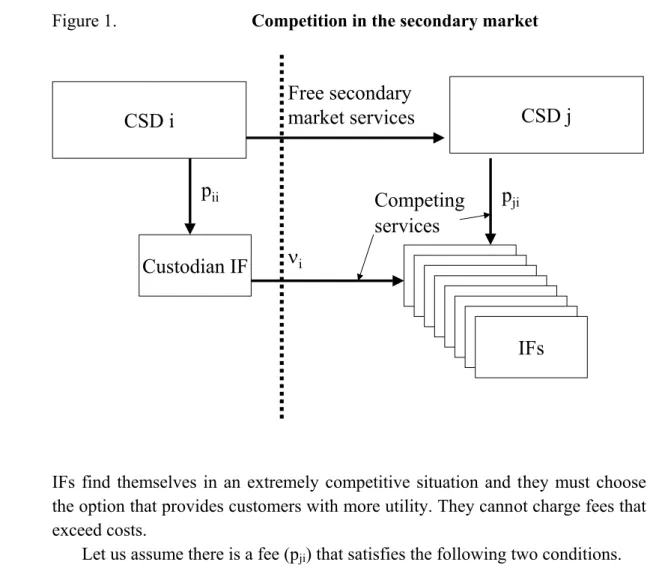
When the link is in place, the two CSDs find themselves in a kind of Bertrand competition for transactions in securities registered in the country i. At the stage 4 the decision variable of each CSD is the secondary market fee (p). The primary market access fees (a’s) and the primary market fees (αs and βs) have already been decided at stage 2. The domestic CSD i offers services to country j IFs through a domestic custodian IF, whereas the foreign CSD j offers services directly to its local IFs. However, this competition differs from the standard Bertrand competition of economics textbooks. The CSD i offers services through the domestic custodian IF, not directly to the foreign IFs, whereas the CSD j
offers services directly to its domestic IFs. The CSD offering the lowest fee (p) does not necessarily get the customers because the primary market fees (α’s and
β’s) affect the IFs’ choices between domestic custodian CSD and foreign custodian IF, and because the custodian IF in country i charges a price that would normally differ from pii.
Figure 1. Competition in the secondary market
p
iip
jiν
iCSD i
CSD j
Custodian IF
IFIF
IFIF
IFIF
IF
IFs
Free secondary
market services
Competing
services
IFs find themselves in an extremely competitive situation and they must choose the option that provides customers with more utility. They cannot charge fees that exceed costs.
Let us assume there is a fee (pji) that satisfies the following two conditions.
– The price enables CSD j to make a marginally positive profit in foreign securities if investors use the link.
– If IFs use the domestic CSD and the link, their customers get a marginally
positive net utility from country i securities.
How will the existence of such a potential fee affect investors’ decisions at the primary market stage? Interestingly, it will make country j investors willing to participate, even if the primary market fees (αs and βs) are higher than in the section 3. The reason is simple. The link eliminates the monopoly of the foreign CSD. If the link is in place, no secondary market price of CSD i (pii) would both
lead to a negative total net utility for country j investors and be sustainable in the competitive situation. If the prices of CSD i were too high to leave country j investors with a non-negative net utility from country i securities, CSD j would
undercut with a suitably low secondary market fee (pji), capture the market and
make profits. Whatever CSD i does at the stage 4, it cannot force foreign investors to accept a negative net utility. It cannot practice monopoly pricing because it is not a monopoly. Hence, investors understand that the total net utility they get from participating cannot be negative, and they decide to buy securities in the primary market.
Is it possible for the CSDs to artificially construct a situation where CSD j can offer a price that satisfies the two above-mentioned conditions, but is unable to offer, without making losses, a price that would be even more competitive?
Let us assume country j IFs use domestic CSD j and the link to conduct transactions with country i securities. The secondary market fee (pji) that leaves
investors with nothing but a marginally positive total net utility after trading costs satisfies condition (2.3). When (2.4) is substituted for Uji, the condition (2.3) can
be written as ε = γ − + θ + − θ − θ 2 ji ji ji ji 2 ji 1* b * (p c)* F b (5.1)
ε is an arbitrarily small positive constant. Letting ε = 0, and substituting for θ )] b 2 /( )) c p ( b
[( 1− ji + 2 ji and [βji + c] for γji, condition (5.1) can be rewritten
as4 ) c F ( b * 2 c b pji = 1− − 2 βji− + (5.2)
If βji≥ F–c, the custodian CSD can at stage 4 extract all the surpluses from
country j investors with a high secondary market fee and formula (5.2) has a real root. If the value of pji indicated by (5.2) is less than b1/2, which would be the
unconstrained monopoly price5, this is also the profit maximising value of pji.
Lower fees would imply less revenue and higher fees would violate investors’ participation constraints. CSD j is free to choose at stage 2 a value of βji that
satisfies both criteria, ie such that βji≥ F – c and formula (5.2) will imply that
pji
< b1/2. If CSD j wants to participate in the mutually beneficial cooperation with
the peer CSD, it must choose such a suitable primary market fee βji. If it does not,
the peer CSD has no incentive to open the link.
CSD i can choose an access fee (ai) that leaves CSD j with nothing but a
marginally positive profit from operations through the link even if CSD j charges
4 Mathematically there are two values of pji that satisfy the condition (5.1) pji = {b1 – c – 2*√[b2(βji – F + c)]} and pji = {b1 – c + 2*√[b2(βji – F + c)]}. However, the higher potential pji is not meaningful. It would imply negative secondary market turnover, which would make the term – (pji + c)*θji positive, as if customers could earn money by using negative amounts of expensive services.
5 Surprisingly, the cost parameter c has no impact on the optimal monopoly price. The reason for this is simple. It has been assumed that IFs and CSDs have the same cost parameter. If IFs’ costs increase, the demand faced by the CSD weakens, which lowers the optimal price. This effect and the direct impact of own costs on the optimal fee by the CSD offset each other.
the highest possible secondary market price (pji) which is determined by the
condition (5.2). When pji is determined according to condition (5.2), there is only
one value of ai that will lead to zero profits from CSD j operations in country i
securities. This value is determined as follows. 0 } c ) c p ( a { n βji− i + ji − θji− =
When (3.1) is substituted for θji, (pji + c) for wji and (5.2) for pji, this yields
2 ji 1 ji i 2F 3c (b 2c) ( c F)/b a = − −β + − β + − ⇔ (5.3)
When the value of ai is marginally lower than the value indicated by formula
(5.3), country j investors know that Bertrand competition in the secondary market cannot lead to a situation where investors’ total net utility from country i securities will be negative. If CSD i tried to charge a secondary market price that leads to negative net utility, foreign IFs would choose CSD j and the link, because CSD j could earn profits by offering prices that would allow country j investors to achieve a higher total net utility. Therefore country j investors decide to participate at stage 3.
However, because the access fee (a) has been optimised to enable CSD j to earn nothing but a marginally positive profit, Bertrand competition will lead to a situation where the link is not in use. In Bertrand competition between unequally matched rivals, the cost efficient institution gets all the customers. If CSD i charges a secondary market price that enables investors to get a marginally higher utility than what CSD j can do without making losses, it could earn a clear profit, not just a marginal one. Its cost efficiency has not been artificially handicapped.
5.3
The link and the posted fee
What does the analysis on pricing by two linked CSDs have to do with the posted fee discussed in section 4? Two linked CSDs can commit themselves in cooperation to the posted fees in the secondary market by opening the link and setting the prices according to the results presented in section 5.2. CSD j must set the maximal primary market fees that do not violate domestic and foreign investors’ participation constraints when *, and set an access fee (a
jj jj p
p = j)
according to (5.3). Moreover, it should set a suitable primary market fee βji so that
formula (5.2) has a real root and implies a value of pji < b1/2; otherwise the peer
CSD might not be willing to cooperate. When the moment to set secondary market prices comes, the peer CSD i would capture all the foreign customers if CSD j tried to charge a secondary market fee higher than the posted fee. It could
charge a lower fee pjj, but there is no reason to do so because a lower fee would
imply less revenue. Therefore the commitment to * is credible.
jj
p
The link will enable the CSD to earn a profit that would be unattainable if the link were not in place. By opening the link the CSD can itself create a suitable competitor. The competitor should be cost-efficient enough to convince sceptical would-be customers about reasonable future secondary market fees, but not competitive enough to capture the market. The optimal combination of primary and secondary market fees would not be feasible without this limited competition. If there were no link, the CSD could not convince any investor that the future secondary market fee (pii) is not significantly higher than c.
5.4
Alternative cases
It has been proven that an idle link is better for CSDs than no link at all, but it has not been proven that there is no alternative that would enable CSDs to make even more profits. The existence of significantly better cases should be impossible because, at least with a large number of investor segments (n>>0), an idle link leads to a Pareto optimal pricing outcome where the CSDs capture all the surpluses.
Would it be possible to construct examples where the link is in use, the outcome is Pareto optimal and all the surpluses are captured by the CSDs? In the light of the assumptions, the link is about as cost efficient as the custodian IF system, and no substantial improvement in overall cost-efficiency could be achieved by channelling transactions through the link. Moreover, the CSDs might not be able to capture all the surpluses. An artificial handicap should be imposed on the CSD of the issuer’s home country, and this handicap should prevent it from covering its costs with secondary market fees that would enable investors to get substantially positive net utility. If there were no such handicap, the CSDs would continue price competition far beyond the point where investors’ participation constraint is satisfied. It might even be profitable to charge a fee that is lower than the cost (pii < c) if this enables the CSD to capture the market and collect fee
revenue for primary market transactions. This would imply a transfer of wealth from CSDs to investors. It is difficult to imagine what such an artificial handicap could be. Perhaps the two CSDs could try to explicitly agree on secondary market prices (p’s), but such agreements would breach antitrust laws in most jurisdictions. It is certainly much simpler to impose an artificial handicap on the custodian CSD.
Moreover, it has not been proven that the link would actually be a credible commitment. Raising the fee in the secondary market significantly above the cost would induce foreign IFs to use the link, but domestic investors do not have this option. Collecting high fees in the secondary market from domestic investors might be a better strategy than collecting low fees from domestic and foreign customers alike. Moreover, if investments come via the link, the CSD earns access fee revenue. If these effects dominate, the link will have no impact on