AnNotify: A Private Notification Service
Ania M. Piotrowska
University College London, UK
Jamie Hayes
University College London, UK
Nethanel Gelernter
College of Management, Academic Studies, IL
George Danezis
University College London, UK
Amir Herzberg
Bar Ilan University, IL University of Connecticut, US
ABSTRACT
AnNotify is a scalable service for private, timely and low-cost
on-line notifications, based on anonymous communication, sharding,
dummy queries, and Bloom filters. We present the design and
anal-ysis of AnNotify, as well as an evaluation of its costs. We outline
the design of AnNotify and calculate the concrete advantage of
an adversary observing multiple queries. We present a number of
extensions, such as generic presence and broadcast notifications,
and applications, including notifications for incoming messages in
anonymous communications, updates to private cached web and
Domain Name Service (DNS) queries.
1
INTRODUCTION
A number of on-line applications require timely notifications. Mail
delivery protocols notify users when a new email can be retrieved,
social networking and instant messaging applications send updates
of presence, and broadcast notifications carry updates of DNS or
cached web records. Traditionally, notification services provide no
privacyvis-à-visthe notification service itself, that can observe the routing of notifications from the publisher of the event to the
subscriber. The fact, that particular consumers are subscribed to a
particular pubisher or larger groups of publishers can revel
sensi-tive private information about them. Thus, the privacy preserving
systems, such as anonymous communication systems [7], or private
presence systems [5], rely on private notifications: an adversary
should not be able to observe what events a user subscribes to.
In this paper we present AnNotify, a private notification service,
leveraging an anonymous communication system, based on simple
cryptographic constructions. The AnNotify system is designed for
efficiency. Subscribers only retrieve small parts of the event
data-base, to which we refer to asshards. Simple and fast cryptographic techniques, allow AnNotify to scale well, while providing rigorous
privacy guarantees.
AnNotify has numerous applications. Some only require
pri-vate notification to signal availability of a service or a peer (e.g.,
in instant-messaging systems), or events such as alerts. Other
ap-plications, e.g., blacklists, require public notifications with
multi-ple subscribers. Broadcast notifications may signal when a cached
value changes; this is especially important for privacy-preserving
storage mechanisms such as Oblivious RAM [21, 33] and PIR [8],
where each access involves significant overhead. Beyond these, the
broadcast notifications can improve the privacy of web and DNS
caches, and significantly improve the performance of such caches
when they are queried over anonymizing networks such as Tor;
see [16, 25, 32].
Contributions:This paper makes the following contributions:
• We introduce AnNotify, a new private and scalable notification system, which guarantees relationship privacy at a low
band-width and performance cost.
• We present a security definition for AnNotify which allows for some leakage, to flexibly accommodate efficient systems. We
also present a rigid proof of AnNotify security, delivering an
upper bound of the information leakage, which can be applied
to systems which security is based on sharding.
• We present an implementation of AnNotify as a web-server, which can be scaled to millions of clients at a lower cost than
alternatives such as DP5 which we also evaluate.
2
MODEL AND GOALS
AnNotify is a service connectingnotification publisherswith specific
notification subscribersthatqueryfor notifications. We describe the system for a single subscriber per notification first and extend it
later to broadcast to multiple subscribers.
The AnNotify system consists of multipleshardsthat are man-aged by a single untrusted server. Shards store information about
the presence of the notifications uploaded by the publishers, which
subscribers can then query from the system. AnNotify operates
in epochs. Each epoch publishers, who want to notify the
sub-scriber, connect directly to the system to upload the notifications,
whereas the subscribers, in order to subscribe or query for
notifica-tions, connect with the servers through the anonymous channels,
as illustrated in Figure 1. AnNotify uses anonymous channels for
communications, and leverages them to increase the efficiency of
private queries from a database of notifications. We consider these
channels to be perfect, namely to hide all meta-data about senders
and receivers of messages, and also the length of messages, as would
be expected from a robust mix-network [7].
Security Goals.The AnNotify system provides a number of pri-vacy properties:
Subscriber privacy. Third parties, including the notifier and the infrastructure, cannot tell whether a subscriber sought a
notification from a particular publisher.
Epoch unlinkability. An adversary cannot tell whether queries across epochs were initiated by the same subscriber or concern
the same notification.
Broadcast privacy. When multiple subscribers are authorized to receive the same notification, corrupt subscribers cannot
dis-cover that other honest subscribers are subscribed to the same
A Server managing shards s0 s1 s2 s3 s4 s5 . . . sS−1 Subscribers Publishers Mixnet
Figure 1: The AnNotify architecture.
Threat Model. The AnNotify design assumes a global passive adversary, who may observe any part or the whole network and
tries to infer the relationships between publishers and subscribers.
All servers that manage shards may be malicious and work with
the adversary.
Moreover, AnNotify considers that a fraction of users are
mali-cious: they collude with the eavesdropping adversary, servers or
other users to try to break the privacy properties of the system or
reveal some information about other users. However, we assume
that a large number of concurrent AnNotify users (publishers and
subscribers) are honest, and follow the protocol faithfully. We also
assume, that the adversary has a partial knowledge about the
rela-tionships among publishers and subscribers , and that the adversary
may chose to some extent which honest users participate in the
protocols at different times. We justify those assumptions further
in the paper.
All communications among the requesting subscribers and the
servers go through an anonymity network [7, 10, 28]. We assume
that this system is immune to traffic analysis. Namely, from the
point of view of the adversary, it provides a perfect secret
permuta-tion between its input and output messages.
3
THE DESIGN OF ANNOTIFY
In this section, we present the detailed description of AnNotify.
We first start with sketching the straw-man design based on
triv-ial Private Information Retrieval (PIR), and argue informally for
its security but also its inefficiency. We then present the detailed
description of AnNotify.
Straw-man Design.A single server acts as the infrastructure for storing notifications. Publishers and subscribers privately agree on
a secret random identifier for a specific notification event. When
a publisher wishes to send a notification, she transmits the
pre-arranged random identifier to the server which stores it forever.
Subscribers of notifications access the single server, and periodically
download the full database of stored notification identifiers, looking
for identifiers they recognise as events. This naïve design is secure:
since subscribers always download the full database, an adversary
at the server cannot distinguish the notification they seek. However,
performance is poor: since the database grows continuously, and
downloading the full database becomes very expensive. Even using
procedure
N.GenSystem(n,S,κ,∆) Choose packet lengthl
fori=0, . . . ,S−1do
s0
i ←[]
end for
▷σis the state of the system
σ← {s0 0,s 0 1, . . .s 0 S−1} π← {n,S,κ} returnσ,l,π end procedure procedureN.GenChannel(π) ck←R− {0,1}κ returnck end procedure procedureN.Notify(cki,t) µ←PRFcki(t) return(i,µ) end procedure procedureN.ProcNotify(µ,t,σ) i←µ modπ.S ifsitnot inσthen st i ←[] σ′←σ∪ {st i} end if
Add stringµto Bloom filterst i returnσ′ end procedure procedureN.Query(cki,t,π) µ←PRFcki(t) ϕ←µ modπ.S ϕ′ $ ← {0, . . . ,π.S} return{ϕ,ϕ′} end procedure procedure N.ProcQuery(ϕ,t,σ,sk) ρ←(ϕ,sϕt fromσ) returnρ end procedure procedure N.ProcResponse(ρ,ck,t) µ←PRFck(t) ϕ←µ modπ.S ϕ′′,s←ρ ifµinsandϕ=ϕ′′then returnTrue else returnFalse end if end procedure
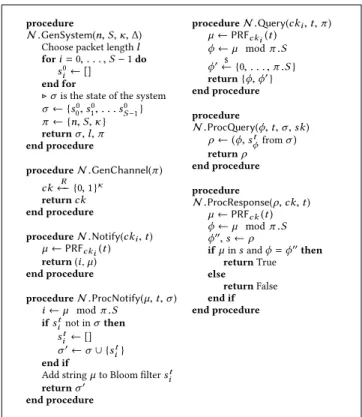
Figure 2: The concrete instantiation of all algorithms of AnNotify.
PIR [8], for more efficient private download causes a scalability
bottleneck and has performance limitations, as the DP5 presence
service [5] illustrates (more in Section 6.2). AnNotify provides an
efficient and scalable solution to this problem, at the cost of some
privacy leakage, which we evaluate carefully.
3.1
The AnNotify Protocols
Figure 2 presents the concrete algorithms of AnNotify, which we
discuss informally below.
Setup.We consider a population ofnusers, distinguished as pub-lishers and subscribers, using the AnNotify system to exchange
notifications. We denoteSas the number ofshardsused by AnNo-tify for sharing notifications, and each shard is denoted assi,i∈
{0, . . . ,S−1}. To increase the capacity and scalability of the system, the shards can be distributed among multiple untrusted servers,
however, the number of servers does not impact security. Thus, we
consider a single untrusted server managing all shards.
AnNotify uses Bloom filters [3], an efficient data structure used
for representing set membership, in order to compress the
repre-sentation of the shards. We note that Bloom filters are not used in
AnNotify as privacy mechanism, and could be replaced by any other
(succinct or not) data representation. AsN.GenSystem(n,S,κ,∆) we denote the system setup procedure, ran by the server to initialize
all parameters of the system, whereκ∈1∗, ∆>0 are the security parameters.
A publisher who wishes to send a notification to a subscriber,
or derived through a public key cryptographic scheme. We denote
the channel establishing procedure asN.GenChannel(π), whereπ is the public information.
For publishing and querying notifications clients use a
crypto-graphic Pseudo-Random Function (PRF:{0,1}∗× {0,1}∗→ {0,1}∗) that is indistinguishable from a true random function to a
compu-tationally bound adversary not knowing the secret key [23]. The
AnNotify system operates in sequential epochs, like Apres [24],
denoted bytfor time. For simplicity we assume that the length of all notifications, queries and responses, is always a fixed valuel.
Publishing notifications.To publish a notification the publisher runsN.Notifywhich derives an epoch specific notification iden-tifierIDt
ck for a particular event using aPRF. For each single no-tification the publisher computes the event nono-tification identifier
for epochtusing the shared channel keyckasIDt
ck =PRFck(t). The publisher then computes the index of shardsi in which the notification should be stored asi←IDt
ckmodS. Finally, the pub-lisher sendsIDt
ck directly to the server managing shardsi. This process spreads different notifications across shards. The server
may optionally perform some authentication and authorization of
publishers before accepting to store the notification. Our scheme
does not impede this, but details around authenticity are outside
the scope of this work.
Storing notifications.The server manages a set of shards, mod-eled as Bloom filters, for a given time epocht. Upon receiving a notificationIDt
ck at epochtserver runs procedureN.ProcNotify, which adds the notification to a Bloom filterBi,t[18] for shardsi, which includes all received notifications for a particular epoch. The
server makes all shards available for download in the next epoch.
Querying for notifications.To check for notifications, subscribers repeatedly poll, in every epoch, the server for notifications by
down-loading the shards of interest via an anonymous network. At the
beginning of epocht+1 each subscriber reconstructs the epoch event identifierIDt
ck for the notifications they wish to check for the previous periodtby computingIDt
ck =PRFck(t). Next, they recompute the shard identifieri ← IDt
ckmodS, in whichIDt ck might be stored. We denote this querying procedure asN.Query. Alongside the query for the ‘real’ shard of interest each honest user
anonymously sends a ‘dummy’ indistinguishable and unlinkable
query to a random shard. These dummies ensure that no matter
what side information is available to the adversary, each honest
user contributes some uncertainty to the pattern of queries for the
epoch. The notification service runs next theN.ProcQueryin order to process the received queries and returns the obtained results to
the subscribers. Each subscriber thenanonymously, through a mix network, downloads the Bloom filterBi,t for shardsi.
Processing the reponse.Upon receiving a response from the server, the subscriber triggers the procedureN.ProcResponse(ρ,ck,t), which checks whetherIDt
ckis present in the filter or not. This pro-cedure may yield afalse positivematch, misleading the subscriber into thinking that a particular notification was present when it
was not. However, selecting proper Bloom filter parameters
rela-tive to the number of notifications allows us to minimize the error
probability [6].
4
SECURITY OF ANNOTIFY
In this section, we first discuss anIndistinguishable-Notification
Experiment, a challenge game between an adversary and the sys-tem, which we use to measure the security. Next, we construe the
security definition resulting from it, to quantify the privacy
prop-erties guaranteed by the notification systems. Finally, we present
the main security theorem of our system and the degree of security
obtained for concrete parameters.
4.1
Game between the adversary and the
AnNotify system
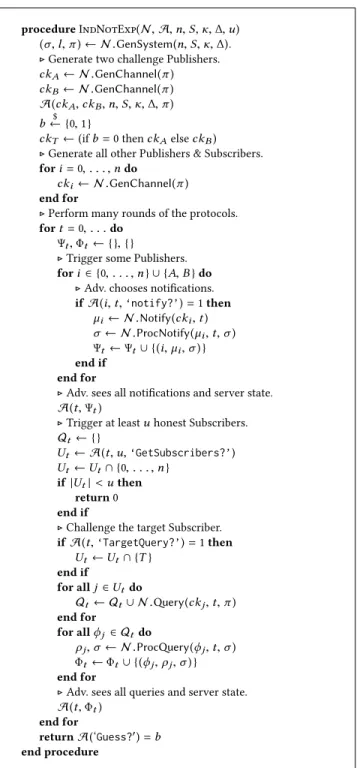
In this section, we describe anIndistinguishable-Notification
Experi-ment(IndNotExp), defined in details in Figure 7 in appendix A.1, addressing the threats identified in section 2. In this experiment, the
adversaryAobserves the system over many epochs. There exists a
target subscriber, that may be subscribed to one of two publishers (A or B) that are controlled by the adversary. The goal of the adversary
is to infer to which publisher a target user is subscribed.
At the beginning of time, the experiment flips a bitbat random, and decides which of the two publishers thetarget subscriber sub-scribes to. Over multiple epochs the adversary schedules multiple
notifications and queries to be executed, and has a full control over
which honest publishers notify and which honest subscribers query
for their respective notifications. We assume, that at leastuhonest subscribers query every epoch.Aobserves the query patterns of the subscribers, including thetarget subscriberrequesting the target notifications, possibly over multiple epochs, and tries to guessb. The threat model captured by theIndisitinguishable-Notification
Experimentis very generous to the adversary:Ahas a full visibil-ity into the processing of all notifications and all query requests
at all shards of the system for as many epochs as they wish. The
adversary is also assumed to know the relationship between all
honest publishers-subscriber pairs1and is given the secrets associ-ated with the notifications of the two potential target notifications
–modelling corrupt notifiers or other subscribers in a broadcast
group. Figure 7 in Appendix illustrates the detailed IndNotExp
experiment as a game in which the adversary controls, for a
num-ber of epochs, notifications (A(i,t,‘notify?’)=1) and queries
(A(t,u,‘GetSubscribers?’)) from users. The adversary is given
all the above information including the challenge notification keys ckAandckB(through invocations toA(·)). Inrrounds, the adver-sary may chose to trigger the target subscriber to query by setting
A(t,‘TargetQuery?’)to 1. Finally, the adversary tries to guess a
challenge bitbwithA(‘Guess?′), i.e., tries to decide which target notification was queried by the target subscriber in the protocol
run with full knowledge of the secrets it shares with notifiers. The
game returns 1 if the adversary guessed correctly.
Based on the presented challenge experiment we now define a ∆−private notification system.
Definition 4.1. A notification systemN is(u,n,∆)-private if for any PPT adversaryAholds:
Pr [IndNotExp(N,A,n,S,κ,∆,u)=1]≤ 1
2+∆+ negl(κ) 1
It is inevitable to model a private notification system that leaks information. Since the adversary may observe the system for a polynomial number of past epochs she may learn all other mappings except the challenge one.
The probability is taken over all coin tosses, including uniform
choice of bitb, and where negl(·) is a negligible function; the in-equality should hold for sufficiently large security parameterκ and depends on the number of epochsrthe target subscriber was activated to query. For simplicity, we call such a system∆-private. Intuitively,∆defines the advantage of the adversary, in successfully guessing which notification thetarget subscriber repeatedly queried, over a random guess. If the adversary would be guessing randomly,
she has a 50% chances of a correct guess. Thus,∆quantifies how much additional information the observed system leaks toA.
This definition ensures that AnNotify provides privacy even
when the adversary knows the shared key – allowing notification
privacy even when the notifier or another subscriber in a broadcast
group, is dishonest and working with the adversary.
4.2
The Security of AnNotify
In this section, we present the security theorem showing
An-Notify to be a secure∆-private notification system, as defined in Definition 4.1 (Section 4.1). We highlight, that the presented
secu-rity theorem is very general, thus is not limited to the AnNotify
system but also can be applied to other systems, which distribute
the information among many entities and base there security
prop-erties on an set of honest participants. Examples of such systems
are presented in section 7.
We recall, thatSdenotes the number of shards,udenotes the minimum number of honest subscribers querying in every epoch
andrdenotes the number of epochs the adversary observes the target subscriber querying for a notification.
In order to quantify the security properties of AnNotify, we
want to compute the advantage of the adversary in winning the
IndNotExp game, thus the chances to break the privacy of a target
subscriber. We start by proving a differentially private [13]
secu-rity boundϵfor the privacy loss in IndNotExp, where the target subscriber only sends a single query.
Let us first define the following notation
Definition 4.2. Let
A={(xA,xB): Pr[XA=xA,XB=xB|IA]
≤eϵPr[XA=xA,XB=xB|IB]}
We say that Pr[XA,XB|IA]≤eϵPr[XA,XB|IB] holds forϵ>0 with probability at least 1−δto mean that Pr[(XA,XB)∈ A]≥1−δ.
In the following lemma, we quantify all the possible scenarios
in which the queries sent by the subscribers are distributed among
shards in such a way, that the adversary can easily link thetarget
subscriberto the notification.
Lemma 4.3. LetXA,XBdenote the query volumes observed by the
adversary at shardssA,sBin a single round assuming that queries map to shards following uniform multinomial distribution, and let
IA,IBdefine events when a particular challenge notification is queried in the final round. An(ϵ,δ)-differential privacybound by which:
Pr[XA,XB|IA]≤eϵPr[XA,XB|IB]
holds forϵ>0with probability at least1−δ, where δ ≤exp −(u −1) 4S ! +exp −(u −1) 2S tanh2 ϵ 2 ! . (1)
The probabilities are taken over all coin flips of honest notification not observed by the adversary.
Proof. For proof see appendix B.
Intuitively, in the presented lemmaϵis a measure of a flexible leakage, andδsums up the probabilities of scenarios in which the adversary is easily winning the challenge game.
Since we know how to quantifyδ, we need additionally to com-pute the amount of leakage due toϵ. To derive the adversary advan-tage forrobserved queries we use a generic composition theorem. In the following lemma we derive an overall bound of adversary’s
advantage, in guessing to whom the target user subscribes, after rrounds when the adversary sees the target subscriber querying for the notification. AsSb=0,Sb=1we denote the events that the subscriber queries a particular shard, where the target notification
was uploaded. AsOi =(Xi
A,XiB)we denote the observation of the number of queries observed coming to shardsAandsBrespectively in roundi.
Lemma 4.4. LetOi be an (ϵ,δ)-differentially private
observa-tion in roundi, on two private inputsSb=0 andSb=1, for which
Pr[Oi|Sb=0]≤eϵPr[Oi|Sb=1]with probability at least1−δ.
If the adversaryAis provided with a set of observations overr rounds denoted asO¯ =(O
1, . . . ,Or)resulting from eitherSb=0or
Sb=1, and tries to guess the input bitb, she succeeds with probability:
Pr f A(O¯,S b=0,Sb=1)=b| ¯ Og ≤ 1 2+ 1 2 tanh rϵ 2 +rδ+negl(κ), whereA(O¯,S
b=0,Sb=1)denotes the guess of the adversary.
Proof. For proof see appendix B.
Based on the above lemmas we derive the security theorem,
proving that AnNotify is a∆-private notification system. Security Theorem 1. The AnNotify system is a∆-private
notifi-cation system, for∆>0satisfying the following inequality. For any ϵ>0, ∆≤1 2 tanh rϵ 2 +rexp −(u −1) 4S ! +rexp −(u −1) 2S tanh2 ϵ 2 !
Proof. The detailed proof is presented in Appendix A.1.
Security Theorem 1 presents a bound on∆that provides insight about the adversary’s advantage based on the security parameters
of the system. The bound for∆depends proportionaly on the ratio u−1
S andϵ.2However, this bound is very loose. A tighter bound on ∆is less elegant.
2Note, that the upper bound onδin lemma 4.3 is constant as long as the ratiou−1
S is constant. In theorem 1, becauseδdepends onϵ, we obtain a uniform bound for∆for all values ofδ, whenϵis fixed.
200000
400000
600000
800000
1000000
Number of users
10
410
310
2Va
lue
s o
f
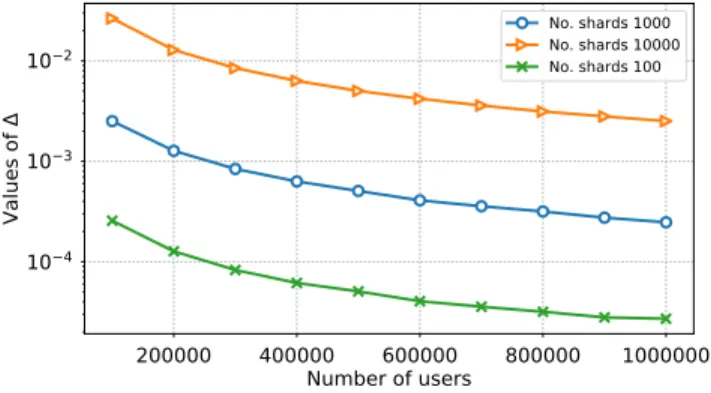
No. shards 1000 No. shards 10000 No. shards 100Figure 3: The empirical adversary’s advantage for a single round,
av-eraged over106samples, as a function of the number of subscribers
and the number of shards. The advantage is presented on a log scale.
Lemma 4.5. The AnNotify system is a∆-private notification system
for ∆≤1 2 tanh rϵ 2 +rCDF u−1, 2 S,C +r u−1 X i=C CDF i,1 2,α u−1 i ! 2 S i 1− 2 S u−1−i , whereϵ>0.
whereCDF[n,p,x] is the cumulative distribution function for a binomially distributed variable. We can compute this bound on∆ using Monte-Carlo integration though importance sampling.
4.3
Empirical adversary advantage
Our security theorems bound the advantage∆of the adversary through a number of upper bounds and a generic composition
the-orem. This upper bound is correct but extremely loose: it assumes
that in each round the worst possible observation will occur; it
dis-counts totally cases where the adversary observes too few queries
to target shards – even though they may hide information; and
takes a number of loose upper bounds to yield an insightful
ex-pression. To get a more accurate view of ˆ∆, the advantage of the adversary, we compute it empirically through sampling.
For fixed parametersuandSwe draw a large number of samples from a Multinomial(θ,n) distribution with parameter vectorθ = [(s−2)/s,1/s,1/s] andn=u−1, each in effect simulating a single observed epoch. We denote asxA⃗ andxB⃗ the sample values falling in the second and third bucket respectively. Without loss of generality,
we assume that bucketAalways gets at least one message. We first compute an empiricalδˆas the fraction of values inx⃗B that are zero, thus allowing the adversary to perfectly win the IndNotExp
experiment. Given the security parameters used in the evaluation
this condition is very rare and has never occurred. Next, we estimate
ˆ
ϵas the mean leakage the adversary observes for all samples with positivex⃗B: ˆ ϵ=1I ·X i logxA [i] xB[i],
whereI denotes the number of samples. This is the log of the Geometric mean of the leakage for each epoch. From the Law of
Large numbers [17], we know that for a large number of repeated
experiments, the average of the results is close to the expected
value, and the more trials we run, the closer the expeted value we
are. Hence, the computed value of ˆϵfor a large number of samples Iquantifies the expected leakage of an observed round. The overall advantage afterrepochs can then be computed as:
ˆ
∆=tanh(rϵˆ/2)/2+rδˆ
This empirical advantage is the mean advantage of the adversary
after observing a very large number of AnNotify epochs. And given
low leakage in every round it is a more accurate depiction of the
security of the system under multiple observations than the bound
from our theorems. Figure 3 depicts the empirically computed
ad-versarial advantage for a single round, over the AnNotify system
composed of 102,103,104shards and a varying number of sub-scribers querying for notifications.
Further in the work, we use the empirical evaluation to accurately
compare security and performance with DP5.
4.4
Other security arguments
Our main proof of security of AnNotify concerns thesubscriber
privacyproperty, under a very strong threat model. We argue informally in this section that other security properties also hold,
but defer their formal definition and proof to a longer version of
this work due to lack of space.
TheEpoch Unlinkabilityproperty ensures that queries in dif-ferent epochs cannot be linked with each other or a specific
sub-scriber. It is a simple result of the use of keyed pseudo-random
function to derive unlikable identifiers within each epoch.
TheBroadcast Privacyproperty ensures that a malicious sub-scriber, with knowledge of the notification key, is not not able
to determine whether another query (or subscriber) is querying
the same known notification. This property is implied by the very
strong IndNotExp definition and game. Since the adversary in this
game has knowledge of the notification shared key they are exactly
in the same position as another subscriber of the same notification,
and thus they both enjoy at most the same advantage.
5
ANALYTICAL PERFORMANCE
EVALUATION
Bandwidth.We evaluate the bandwidth cost of multi-shard AnNo-tify against the naïve design using a multi-server IT-PIR [8] scheme
inspired by DP5 [5]. Let the number of shards in AnNotify beS, and the number of servers in the PIR scheme beS′. Since in AnNotify all shards are of equal size, denoted asl, the number of bits transferred isnl·mxwherenis the number of subscribers that downloaded the Bloom filter andmxis the cost of using a mix network to transport data (to be fair we assumemx=S′). For the IT-PIR scheme the cost isnS′
√
v, wherevis the number of bits in the server’s database. Additionally, since AnNotify may yield false positives, we must
consider the bandwidth cost of a subsequent action of a subscriber
given that they received a notification, which we denote asa. We intentionally do not specify what this action is, as AnNotify could
be used in a variety of applications. Letk ≤nbe the number of subscribers who received a notification andf be the error rate of the Bloom filter. Thenh=nf subscribers will incorrectly think they have received a notification. Hence the cost of performing
actions in AnNotify isa(k+h), whereas in the PIR scheme the cost isaksince no false positives occurs.
The total cost of AnNotify isnl·mx+a(k+h)=nl·mx+a(k+nf). The total cost of the PIR scheme isnS′
√
v+ak. We want to estimate the cutoff costafor AnNotify to be less expensive than a PIR scheme, hence we requirenl·mx +a(k+nf) <nS′
√
v+ak. This gives a< S′√v−(l·mx)
f .
We note that the false positive ratef and the size of the Bloom filterlare related byf ≈(1/2)llog 2/m, wheremis the number of messages in the filter, that we assume is approximatelyN/Swhere Nis the total number of notifications. Similarly, the database in an IT-PIR system would need at leastv=NlogNbits to store a list of up toNdistinct notifications. Thus, it is preferable to use the AnNotify system over IT-PIR when the cost of an actionais lower than the following threshold:a<(S′pNlogN−(l·mx))2
l S Nlog 2
.
Latency.In the AnNotify system, a notification sent by a publisher in epochei becomes available to a subscriber in epochei+1. The
time between a notification being sent and when it can be read is
|e|+t, wheretis the round trip time taken by the notification to be routed through the mix network and|e|denotes the server epoch length. Note, that this timetis dependent on the amount of traffic passing through the mix network, and the mix networks flushing
mechanism.
Refresh rate, epoch length, cost and privacy.
In AnNotify system publishers and subscribers must decide on
an epoch length, based on which their notification identifiers will
change. There is a clear trade-off: shorter epochs mean shorter
waiting times but result in the subscribers requesting more often.
Publisher-subscriber epoch lengths are entirely context dependent,
for example a social network presence notification system will
likely have much shorter publisher-subscriber epoch lengths than
a storage system.
6
EXPERIMENTAL EVALUATION
Three key advantages of AnNotify over previous works [5, 8] are
efficiency, extremely low infrastructure cost (even at large scale),
and ease of implementation. In this section, we describe a prototype
implementation of AnNotify, based on web technologies for the
server components, and Tor as an anonymity system. Next, we
compare it with DP5.
6.1
Implementation & Infrastructure
We implement AnNotify as a web-server that subscribers may easily
access through the most popular anonymity network today, Tor [12].
We note, that even though we use Tor, the anonymous channels
might be implemented using other design, for example [28]. We are
aware that Tor only provides anonymity properties against a local
or limited passive adversary, and thus the experimental system
inherits this limitation. Since we are concerned with performance
we focus on supporting as many clients as possible, and decreasing
the connection time between the client and the server.
Our implementation of AnNotify consists of two servers: a
front-end server with whom the clients communicate to download shards,
and a back-end server that maintains the Bloom filters. We design
AnNotify so that queries are served as requests for a static resource:
since those only need to retrieve the Bloom filter corresponding
to a previous epoch. The task of the front-end server is simply to
serve medium to large static resources; since servers are untrusted,
caching and content distribution network may be used to speed
this up – and this is a feature of AnNotify. We expect the size of the
Bloom filter served to be similar to the size of an image, between
several kilobytes to a few megabytes.
To perform a query and retrieve the Bloom filter, AnNotify clients
just send an HT TP GET requests to the front-end server. To
op-tionally register a notification, the clients can addiop-tionally send the
notification identifier for the current epoch as a parameter to the
HT TP request. The front-end server immediately responds with
the relevantcurrentBloom filter, that is stored as a static file, and forwards the request to the back-end server to update thenextfilter. At the beginning of every epoch, the back-end server sends the
nextBloom filters, one for each shard, to the front-end server, and the front-end server replaces thecurrentBloom filter with it.
We used Nginx3for the front-end server due to its high perfor-mance in serving static resources. We implemented the back-end
server in Java, relying on Netty4, a non-blocking I/O (NIO) client-server framework. We relied on Google Guava’s implementation of
Bloom filter5. The front-end implementation simply consists of the Nginx configuration file, and the back-end is 300 lines of Java code.
6.2
Performance Evaluation
To evaluate AnNotify, we run an AnNotify server on a single
Win-dows 7 OS, 8GB RAM machine. The back-end and the front-end
servers run as two processes. From another machine, we run our
client program from several processes to simulate 100K requests in
epochs of 5 minutes. We tested the system for shards from 10Kb
to 100Kb. Larger shards imply larger Bloom filters to retrieve and
higher bandwidth.
A single machine served 100K clients when the shard size was up
to 30Kb. For larger shards we encountered sporadic failures for some
clients, and had to add additional servers to handle some shards.
The design of AnNotify allows distributing the shards among
sev-eral machines without overhead. The yearly cost of an Amazon
EC2m4.largeinstance (in April 2016), which is equivalent to the
machine we used, is $603. Dividing the cost of additional machine
by 100K clients implies minimal additional cost of less than a single
cent per client. Our measurements indicate an additional server is
required for each 30Kb increase of the shard size.
We estimated the cost of running AnNotify in the Amazon cloud.
The main factor in the cost calculation was the bandwidth that
increases linearly as a function of the shard size. However, the
bandwidth cost per byte decreases as the system consumes more
bandwidth, e.g., for larger shards and for more clients. Figure 4
3
The NGINX Web Server https://www.nginx.com/
4
The Netty Framework http://netty.io/
5
10Kb 20Kb 30Kb 40Kb 50Kb 60Kb 70Kb 80Kb 90Kb 100Kb
Shard size
0
10
20
Cost (cents)
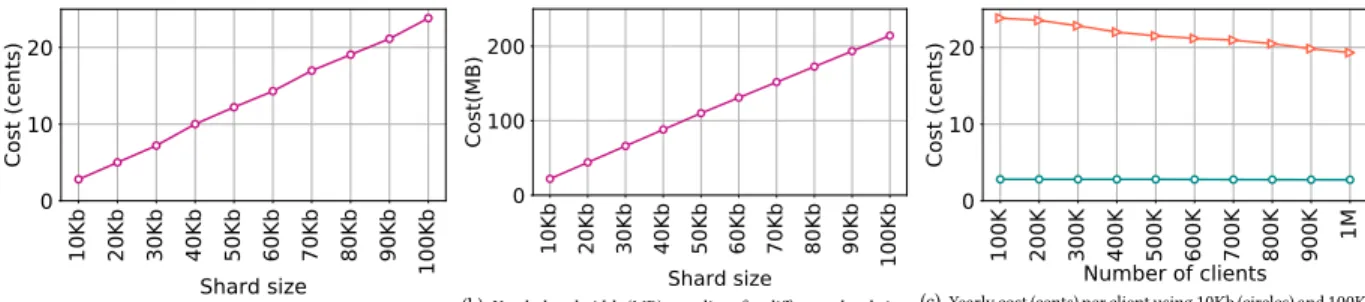
(a)Yearly cost (cents) per client for different shard sizes
10Kb 20Kb 30Kb 40Kb 50Kb 60Kb 70Kb 80Kb 90Kb 100Kb
Shard size
0
100
200
Cost(MB)
(b)Yearly bandwidth (MB) per client for different shard sizes
100K 200K 300K 400K 500K 600K 700K 800K 900K
Number of clients
1M
0
10
20
Cost (cents)
(c)Yearly cost (cents) per client using10Kb (circles) and100Kb (triangles) shards, for different numbers of clients
Figure 4: AnNotify’s implementation evaluation summary. The system scales perfectly for the increasing number of clients. Larger shards
imply higher bandwidth and cost per client. The cost evaluation was done based on Amazon EC2m4.largeinstances.
illustrates our costs estimation, extrapolated from measurements
using our experimental setup, for a full year of operation in the
Amazon cloud. The costs are illustrated in monetary values, on the
basis of the cost of an Amazon EC2m4.largeinstances. The results show that AnNotify is indeed very efficient, and extremely cheap
to operate in the real world. Figure 4(a) shows that the yearly cost
per client ranges from a few cents (shards of 10Kb) to less than a
quarter (shards of 100Kb). Figure 4(b) shows the linear growth in
the yearly bandwidth used by AnNotify client as a function of a
shard size. However, as depicted by Figure 4(c), the AnNotify scales
perfectly in the number of clients, such that the cost per client even
decreases as there are more clients in the system. For a shard of size
10Kb, yearly costs per client is around 3 cents for both 100K and 1
milion users. In comparison, in DP5 the monthly cost per-user for
bandwidth is about 0.05 cent, which results in 60 cents per year for 100K users, and around 120 cents for 1 milion users.
6.3
Comparison to DP5
Compared to the thousands of lines of C++ and Python used to build
DP5 [5], AnNotify was significantly easier to implement and does
not require PIR services or Pairing-friendly libraries. Despite being
implemented in Java, it efficiently supports a hundred thousand
clients, and can be parallelized to scale to millions of clients easily
(see Figure 4(c)) with significantly lower yearly cost than DP5, of a
few cents per client.
Given the different threat models and functionality it is delicate
to provide a fair comparison between DP5 and AnNotify calibrated
in terms of security. To do so we compare the second phase of DP5,
with each user having a single friend, and the status communicated
being a single bit notification. Thus, foruusers DP5 would have to serve through PIR a database of at leastubits using IT-PIR overℓ servers, acting as the security parameter. We configure AnNotify to
also serve a database ofubits overSshards, using a mix network with path lengthℓ. BothℓandS<uare the security parameters of AnNotify for a fixed number of usersu. We do not use Bloom filters to avoid making assumption on notification utilization, thus
presenting a very costly variant of AnNotify.
We consider that either IT-PIR servers or mix servers may be
corrupt with a fixed probabilityf. In that case the advantage of the adversary in DP5 isfℓ, namely the probability that all PIR servers are corrupt. For AnNotify the advantage of the adversary is the
4
6
8
10
12
14
Bandwidth Overhead bytes (log)
25
20
15
10
5
Adversary Advantage (log)
S = 10
3S = 10
4S = 10
7S = 10
6S = 10
5Bandwidth vs. Security for DP5 and AnNotify
AnNotify
DP5/IT-PIR
Figure 5: Security versus Bandwidth comparison for AnNotify and
DP5/IT-PIR, for different parameters ℓ ∈ {2, . . . ,11} and S ∈
{103, . . . ,108}. Database ofu =109bits and users, and fraction of
corrupt nodesf =10%. We observe that AnNotify is orders of
mag-nitude cheaper when some leakage may be tolerated (adversary ad-vantagee−5. . .e−10
). (Smaller is better on both axes.)
leakage∆, that we compute empirically (to get a tight estimate, see appendix 4.3), added to the probabilityfℓthat all mix-servers are corrupt.
Bandwidth.Figure 5 illustrates the trade-off between security and bandwidth for AnNotify compared to DP5 using the above
con-figuration, for differing security parametersS(shards) andℓ(mix or PIR servers). We varyS ∈ {103, . . . ,108}andℓ ∈ {2, . . . ,11}. The measurements are for one billion notifications (u=109) and a fractionf = 10% of corrupt servers. We observe that AnNotify requires many orders of magnitude (log scalexaxis) lower band-width per query than DP5 for moderate adversary advantage (e.g., e−5. . .e−11
). This advantage is comparable to usingℓ ≤ 5 PIR servers. For each value ofSwe observe that at first the advantage is dominated by the probability of the mix network failing (for lowℓ) before stabilizing and being dominated by the leakage of AnNotify.
Processing.We implement the DP5 second phase IT-PIR scheme using 64 bitnumpymatrix multiplication, to compare the CP U costs of AnNotify versus DP5. We note that IT-PIR is CP U bound,
15
16
17
18
CPU Overhead sec. (log)
25
20
15
10
5
Adversary Advantage (log)
CPU cost vs. Security for DP5 and AnNotify
AnNotify
DP5/IT-PIR
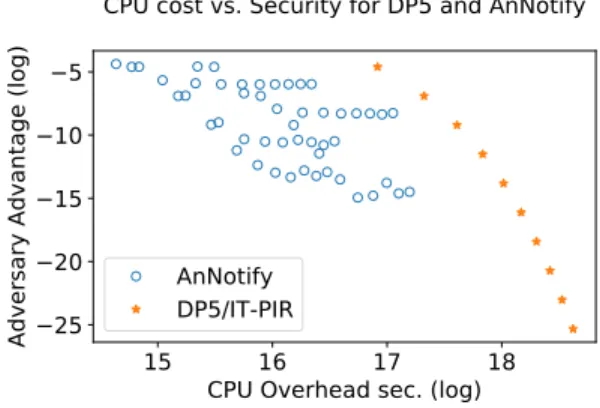
Figure 6: Security versus CPU cost comparison for AnNotify and
DP5/IT-PIR, for different parameters ℓ ∈ {2, . . . ,11} and S ∈
{103, . . . ,108}. Database ofu =109bits and users, and fraction of
corrupt nodesf =10%. We observe that AnNotify requires less
pro-cessing time than IT-PIR for comparable security levels. (Smaller is better on both axes.)
since no processing takes place on them aside from serving static
shards of data. However, the anonymity network used by AnNotify
may become a CP U bottleneck. To estimate this cost we measured
the total CP U overhead per mix message using the Sphinx6packet format [10] for appropriate payload sizes and path lengthsℓ.
Figure 6 illustrates the total CP U costs foru = 109queries andf = 10% for both DP5/IT-PIR and AnNotify. We varyS ∈
{103, . . . ,108}andℓ∈ {2, . . . ,11}. We observe that for equivalent security levels the CP U cost of mixing messages in AnNotify is
always orders of magnitude (log scalexaxis) lower than the equiv-alent CP U cost of processing IT-PIR queries in DP5.
7
ANNOTIFY EXTENSIONS
AnNotify as a presence system.AnNotify can be used as a privacy-friendly presence system, to transmit a small amount of information
from the publisher to the subscriber. A presence system allows to
indicate an online presence of the users. For example, when a single
user connects to the network the presence system informs which
friends are online.
In this variant, each shard stores the received notifications as a
list within each shard, instead of Bloom filter. Two users who would
like to use AnNotify share a secret channel keyck. Alice wants to notify Bob of messagemon this channel. To do so, she computes the value of a pseudo random function keyed withck based on the current time stamp asIDt =PRFck(t)and the shard index i=PRFck(t)modS. She then encrypts the selected message with an Authenticated Encryption Scheme with Associated Data (AEAD) (such asAES-GCM) with a secret keyckto obtain the ciphertext ct = AEAD
ck(IDt;m). In order to notify, Alice sends the tuple (IDt,c) to the corresponding shardsi based onIDt. The server adds it to the stored values within that shard.
At the beginning of the next epoch, Bob queries the servers for
shardsiand downloads the full set of values stored within it. To check for the presence notifications, the subscriber searches in the
6
Using the Pythonsphinxmixpackage.
list the tuple with the identifierPRFck(t), and checks and decrypts the attached ciphertext and tag using secret keyckin order to recover the notification messagem.
We note that the shard compression achieved through Bloom
filters is sacrificed in order to transmit the messagem. However, the subscriber-publisher privacy of Alice and Bob are maintained.
A rigorous proof of this would have to adapt the security definition
based on the IndNotExp experiment to provide the adversary with
theIDt
A andIDt
B identifiers for the target messages instead of the raw keysckAandckBto preserve the secrecy of the message. However, the rest of the proof and Security Theorem 1 do not need
major modification to show query privacy and message secrecy.
We note this scheme is in effect a leaky PIR scheme [34], based on
a secure anonymity infrastructure, and untrusted servers holding
shards. Given our evaluation results, relating the adversary
advan-tage to performance, such designs may be a competitive alternative
for other PIR related applications.
Broadcast AnNotify.The Security definitions and IndNotExp se-curity game assumes that the adversary knows the notification key
used by a target subscriber. Yet, they are still unable to determine
whether they seek a specific notification. As a result, AnNotify can
be extended to support broadcast notifications to a group, without
difficulties.
In a broadcast scheme, the notifier distributes the secret
notifica-tion key amongst a group of subscribers. Access control is required
when publishing a notification to ensure it is genuine. This may
be achieved using any authentication or non-repudiation scheme,
since notifiers are not anonymous. All subscribers in the group
share that key, and query each epoch on the basis of it.
Due to the security guarantees of Security Theorem 1, even if
one of the subscribers in the group is corrupt – and shares the key
with the adversary – they are not able to break subscriber privacy
of another target user with greater advantage than the one-on-one
AnNotify design.
8
APPLICATIONS
Notification-only Applications.The first application is a privacy-preserving version of event-notification services, such as the
popu-lar Yo application [36]. Yo and simipopu-lar applications allow one user
to send a content-free notification to peer(s). In Yo, the receiving
applications notify the user by transmitting the word “Yo”, in text
and audio. Such event notification services can be used for social
purposes, as well as to provide simple information about events,
e.g., Yo was used to warn Israeli citizens of missile strikes [1].
As each message is only a single bit, applying Bloom filter is
ideal for this kind of communication. The Anonymous Yo server
will maintain a Bloom filter, and an anonymous Yo message will
be sent by turning on a few bits according to the shared keys. The
client side application will periodically retrieve the Bloom filter
and will prompt Yo from another client, if this client turned on the
relevant bits.
The second application isAnonymous Presence Services. The goal of anonymous presence services is to allow users to indicate their
‘presence’, i.e., availability for online communication to their peers.
such as Skype and Facebook. A privacy-preserving presence
pro-tocol, providing presence indications to users while hiding their
relationships, was presented in [5]. Their solution relies on
expen-sive cryptography and is rather complex to implement, whereas
AnNotify provides an easier-to-implement and more efficient
solu-tion.
The third application is privacy-preservingblacklists, e.g., of phishing domain names. The goal is to allow a relying party, e.g.,
a browser or email server, to check if a given domain name (or
other identifier) is ‘blacklisted’, without exposing the identity of
the domain being queried. In particular, all major browsers use
some ‘safe browsing’ blacklist to protect users from phishing and
malware websites. Google Safe Browsing (GSB) alone accounts
for a billion users to date [22]. To protect users privacy, clients do
not lookup the suspect URL or domain-name, instead the query is
for a cryptographic hash of the domain-name or URL. However,
as already observed [19], providers can still identify the query.
AnNotify provides an alternative which strongly protects privacy,
and with comparable overhead. We note that Bloom filters are
already widely used to improve efficiency of blacklists, e.g., see [18,
27].
In all applications, AnNotify allows preserving the privacy of
users, by hiding the relationships between users and the
notifica-tions they receive. The use of AnNotify is easy, and has insignificant
performance overhead in addition to the use of anonymous
chan-nels. However, notice that AnNotify exposes thetotalnumber of clients currently connected to the system. We believe this is not a
concern in many applications. Indeed, many services publish an
estimate of the number of online clients, e.g., see Tor metrics [29].
Privacy-Preserving Caching and Storage Services.A classical use for Bloom filters, is to improve the efficiency of caching and
storage mechanisms, by allowing efficient detection when cached
items were updated (or not). In particular, Bloom filters were used
to improve the efficiency of web-caches [6, 15].
AnNotify can similarly improve the efficiency of caching and
storage mechanisms, while also protecting privacy. This is
espe-cially important for privacy-preserving storage mechanisms such
as Oblivious RAM [21, 33] and PIR [8], where each access involves
significant overhead, hence avoiding unnecessary requests has a
large impact on performance.
Due to its high efficiency, AnNotify can also be used to improve
the privacy of web and DNS caches. In particular, web-users may
use AnNotify to improve the efficiency of anonymous-browsing
mechanisms such as Tor [29] and the use of AnNotify seems to
offer significant performance improvements compared to existing
proposals for protecting privacy of DNS users, see [16, 25, 32].
9
RELATED WORK
Bloom Filters.Extensions of Bloom filters support additional fea-tures, like deletion [4, 15, 30] or representing multisets [9]. In [2]
authors presented metrics asK-anonymity andγ−deniability to measure the privacy and utility of Bloom filters but the resulting
privacy properties are weak. RAPPOR [14] allows the private
collec-tion of crowd sourced statistics as randomized responses in Bloom
filters, while guaranteeingϵ-differential privacy. RAPPOR uses
input perturbation locally on the client side, however extracting
results requires sophisticated statistical techniques.
Anonymity.The most widely deployed anonymity system is Tor [12]. In Tor, communications are routed through a network of relays
using onion routing, which hides the senders location and ensures
unlinkability between the user and the visited website. Although
Tor is popular it is vulnerable to traffic analysis attacks, and for
stronger anonymity properties mix networks have to be used [7, 10]
and as recent research showed, without sacrificing the latency [28].
Receiver anonymity systems, such as nymservers [26], may also be
used to route notifications to users. Pynchon Gate [31] proposes
a pseudonymous message retrieval system based on a distributed
PIR scheme.
Privacy in Remote Storage.Private information retrieval (PIR) allows a client to retrieve privately a single record from a remote
public database. The naive solution retrieves all records from the
database, but PIR protocols are more efficient in terms of bandwidth
[8, 11, 20]. IT-PIR is a multiple server PIR variant, where each server
stores a replicated copy of the database. IT-PIR guarantees perfect
privacy, as long as one server is honest, but requires all servers
to process each query and operate on the whole database, which
increases both the computational and communication costs.
Toledo et al. [34] present variants of IT-PIR based schemes
com-posed with an anonymity systems, which reduce the computational
costs by allowing some information leakage. The key difference
between [34] and this work, is that AnNotify servers are entirely
untrusted and it wholly relies on an anonymity system for privacy.
Social applications require private presence notifications.
Tradi-tional implementations of presence give a central server the social
graph of users. Protocols like Apres [24] and DP5 [5] offer
privacy-preserving notification services. Apres splits the time into epochs
and hides the correlation between the connectivity of the clients in
every two epochs. DP5 offers stronger privacy guarantees, however
this design uses multi-server IT-PIR to look up other users presence
without revealing information about the social graph. We compare
this work with DP5 in our evaluation section.
The anonymous messaging system presented in Vuvuzela [35]
also introduces an auxiliary scheme for notifying users, that
some-one wants to contact them, by sending invitations. AnNotify has
a lower bandwidth and operational cost than Vuvuzela, since in
that scheme the users have to download and try to decrypt all the
invitations, including cover ones.
10
CONCLUSIONS
AnNotify provides efficient and private notifications in a scalable
manner, compared with previous approaches like DP5 [5] that
struggles to scale past 1 million users. AnNotify benefits from a mass
of users: its key security parameters depend on the number of shards
and anonymity set size of the underlying anonymity system. These
may be tuned to provide meaningful privacy protection despite
some leakage.
AnNotify lowers the quality of protection to achieve
scalabil-ity, but does so in a controlled and well understood manner: the
concrete security theorems presented indicate the advantage of the
under repeated queries provide even stronger evidence that
AnNo-tify can provide strong protections. This is particularly relevant for
large-scale deployments and applications requiring notifications,
that today benefit from no protections at all.
Besides securing notifications, the AnNotify design, provides a
couple of important insights into general privacy engineering. We
show that anonymous channels may be important building blocks
to implement schemes, such as notifications, that are not entirely
related to messaging per se. Their study should expand to provide
robust and efficient schemes for such applications.
PIR schemes inspired from the AnNotify design and anonymous
channels, may be more competitive in terms of performance that
those proposed so far, despite leakage and required large anonymity
set. Pursuing this research direction would allow wider deployment
of private querying in general.
11
ACKNOWLEDGEMENTS
Acknowledgements.The authors would like to acknowledge their financial support: George Danezis and Ania Piotrowska are
sup-ported in part by EPSRC Grant EP/M013286/1 and H2020 Grant
PANORAMIX (ref.\653497). Jamie Hayes is supported by the UK Government Communications Headquarters (GCHQ), as part of
University College London’s status as a recognised Academic
Cen-tre of Excellence in Cyber Security Research. Amir Herzberg is
supported by EPSRC Grant EP/M013286/1.
REFERENCES
[1] BBC. 2014. “Yo app warns Israeli citizens of missile strikes”. Online. (July 2014). [2] G. Bianchi, L. Bracciale, and P. Loreti. 2012. Better Than Nothing. Privacy
with Bloom Filters: To What Extent?. InPrivacy in Statistical Databases - PSD
2012, Palermo, Italy, September 26-28, 2012.348–363.http://dx.doi.org/10.1007/ 978- 3- 642- 33627- 0
[3] B. Bloom. 1970. Space/Time trade-offs in hash coding with allowable errors.
Commun. ACM13, 7 (July 1970), 422–426.
[4] F. Bonomi, M. Mitzenmacher, R. Panigrahy, S. Singh, and G. Varghese. 2006. An Improved Construction for Counting Bloom Filters. InAlgorithms âĂŞ ESA. UK. https://doi.org/10.1007/11841036_61
[5] N. Borisov, G. Danezis, and I. Goldberg. 2015. DP5: A Private Presence Service.
PoPETs2015, 2 (2015), 4–24. http://www.degruyter.com/view/j/popets.2015.2015. issue- 2/popets- 2015- 0008/popets- 2015- 0008.xml
[6] A. Broder and M. Mitzenmacher. 2004. Network applications of Bloom filters: A survey.Internet mathematics1, 4 (2004), 485–509.
[7] D. Chaum. 1981. Untraceable Electronic Mail, Return Addresses, and Digital Pseudonyms.Commun. ACM24, 2 (1981), 84–88. https://doi.org/10.1145/358549. 358563
[8] B. Chor, E. Kushilevitz, O. Goldreich, and M. Sudan. 1998. Private information retrieval.Journal of the ACM (JACM)45, 6 (1998), 965–981.
[9] S. Cohen and Y. Matias. 2003. Spectral Bloom Filters. InConference on
Man-agement of Data (SIGMOD) (SIGMOD ’03). ACM, New York, NY, USA, 241–252. https://doi.org/10.1145/872757.872787
[10] George Danezis and Ian Goldberg. 2009. Sphinx: A Compact and Provably Secure Mix Format. In30th IEEE Symposium on Security and Privacy (S&P 2009), 17-20
May 2009, Oakland, California, USA. 269–282.
[11] C. Devet, I. Goldberg, and N. Heninger. 2012. Optimally robust private informa-tion retrieval. InUSENIX Security 12. 269–283.
[12] R. Dingledine, N. Mathewson, and P. F. Syverson. 2004. Tor: The Second-Generation Onion Router. InUSENIX Security. USENIX, 303–320. http://www. usenix.org/publications/library/proceedings/sec04/tech/dingledine.html [13] C. Dwork. 2006. Differential Privacy.ICALP(2006).
[14] Ú. Erlingsson, V. Pihur, and A. Korolova. 2014. RAPPOR: Randomized Aggre-gatable Privacy-Preserving Ordinal Response. InCCS. ACM, USA, 1054–1067. https://doi.org/10.1145/2660267.2660348
[15] L. Fan, P. Cao, J. Almeida, and A. Z. Broder. 2000. Summary Cache: A Scalable Wide-area Web Cache Sharing Protocol.IEEE/ACM Trans. Netw.8, 3 (June 2000), 281–293. https://doi.org/10.1109/90.851975
[16] H. Federrath, K.P. Fuchs, D. Herrmann, and C. Piosecny. 2011. Privacy-Preserving DNS: Analysis of Broadcast, Range Queries and Mix-Based Protection Methods.
InComputer Security - ESORICS 2011, Leuven, Belgium, September 12-14, 2011. http://dx.doi.org/10.1007/978- 3- 642- 23822- 2
[17] William Feller. 1968.An introduction to probability theory and its applications:
volume I. Vol. 3. John Wiley & Sons New York.
[18] S. Geravand and M. Ahmadi. 2013. Bloom filter applications in network security: A state-of-the-art survey.Computer Networks57, 18 (2013), 4047–4064.http: //dx.doi.org/10.1016/j.comnet.2013.09.003
[19] T. Gerbet, A. Kumar, and C. Lauradoux. 2015. A Privacy Analysis of Google
and Yandex Safe Browsing. Technical Report Research Report RR-8686. INRIA. https://hal.inria.fr/hal- 01120186v4
[20] I. Goldberg. 2007. Improving the robustness of private information retrieval. In
Security and Privacy, 2007. SP’07. IEEE Symposium on. IEEE, 131–148. [21] O. Goldreich and R. Ostrovsky. 1996.Software protection and simulation on
oblivious RAMs.Journal of the ACM (JACM)43, 3 (1996), 431–473. [22] Google. 2014. Google Transparency Report - Making the web safer. (June 2014). [23] Jonathan Katz and Yehuda Lindell. 2014.Introduction to modern cryptography.
CRC press.
[24] B. Laurie. 2004. Apres-a system for anonymous presence. (2004).
[25] Y. Lu and G. Tsudik. 2010. Towards Plugging Privacy Leaks in the Domain Name System. InPeer-to-Peer Computing. IEEE, 1–10.http://ieeexplore.ieee.org/xpl/ mostRecentIssue.jsp?punumber=5569876
[26] D. Mazières and M. F. Kaashoek. 1998. The Design, Implementation and Operation of an Email Pseudonym Server. InConference on Computer and Communications
Security (CCS ’98). 27–36.https://doi.org/10.1145/288090.288098
[27] S. Di Paola and D. Lombardo. 2011. Protecting against DNS Reflection Attacks with Bloom Filters. InDIMVA, Thorsten Holz and Herbert Bos (Eds.). http: //dx.doi.org/10.1007/978- 3- 642- 22424- 9
[28] Ania M. Piotrowska, Jamie Hayes, Tariq Elahi, Sebastian Meiser, and George Danezis. 2017.The Loopix Anonymity System.USENIX Security Symposium (2017). https://github.com/UCL- InfoSec/loopix
[29] The Tor project. 2016. Tor Metrics. https://metrics.torproject.org/. (April 2016). [30] C. E. Rothenberg, C. Macapuna, F. L. Verdi, and M. F. Magalhães. 2010.The Deletable Bloom filter: A new member of the Bloom family.CoRRabs/1005.0352 (2010). http://arxiv.org/abs/1005.0352
[31] L. Sassaman, B. Cohen, and N. Mathewson. 2005. The Pynchon Gate: A Secure Method of Pseudonymous Mail Retrieval. InProceedings of the 2005
ACM Workshop on Privacy in the Electronic Society (WPES ’05). 1–9. https: //doi.org/10.1145/1102199.1102201
[32] H. Shulman. 2015. Pretty Bad Privacy: Pitfalls of DNS Encryption. InWorkshop
on Privacy in the Electronic Society, WPES 2014.
[33] E. Stefanov, M. Van Dijk, E. Shi, C. Fletcher, L. Ren, X. Yu, and S. Devadas. 2013. Path oram: An extremely simple oblivious ram protocol. InComputer &
communications security (ACM CCS). ACM, 299–310.
[34] Raphael R Toledo, George Danezis, and Ian Goldberg. 2016. Lower-Costϵ-Private Information Retrieval.Proceedings on Privacy Enhancing Technologies2016, 4 (2016), 184–201.
[35] Jelle Van Den Hooff, David Lazar, Matei Zaharia, and Nickolai Zeldovich. 2015. Vuvuzela: Scalable private messaging resistant to traffic analysis. InProceedings
of the 25th Symposium on Operating Systems Principles. ACM, 137–152. [36] Wikipedia. 2016. Yo (app). https://en.wikipedia.org/wiki/Yo_(app). (April 2016).
A
PROOFS
A.1
Proof of Security Theorem 1
Proof. To prove the main security theorem, and ultimately
show that AnNotify is∆-private, we need to show that the adversary can only win theIndisitinguishable-Notificationgame, showed in Figure 7 with an advantage∆, defined in Definition 4.1, over a random guess. We do so by first arguing that the adversary learns
nothing new7from rounds not including the target subscriber, and then computing the advantage given the information about the
rounds when the target subscriber was active.
We proceed through a sequence of hybrid games, with slight
modifications over the initial security Definition 4.1, including the
IndNotExp experiment (Game0). We first note that in the concrete protocolsN.NotifyandN.Queryact on notification IDs generated using a pseudo-random function (PRF) keyed with an unknown key to the adversary and the epoch number (IDt =PRFck(t)). Thus, 7
Remember that the adversary already is assumed to know the correspondence between honest subscriber-publisher pairs, besides the target query in the challenge round.
procedureIndNotExp(N,A,n,S,κ,∆,u)
(σ,l,π)← N.GenSystem(n,S,κ,∆). ▷Generate two challenge Publishers. ckA← N.GenChannel(π) ckB← N.GenChannel(π) A(ckA,ckB,n,S,κ,∆,π) b $ ← {0,1} ckT←(ifb=0 thenckAelseckB) ▷Generate all other Publishers & Subscribers.
fori=0, . . . ,ndo
cki← N.GenChannel(π)
end for
▷Perform many rounds of the protocols.
fort=0, . . .do
Ψt,Φt← { },{ }
▷Trigger some Publishers.
fori∈ {0, . . . ,n} ∪ {A,B}do ▷Adv. chooses notifications.
ifA(i,t,‘notify?’)=1then µi ← N.Notify(cki,t) σ← N.ProcNotify(µi,t,σ) Ψt←Ψt∪ {(i,µi,σ)} end if end for
▷Adv. sees all notifications and server state.
A(t,Ψt)
▷Trigger at leastuhonest Subscribers.
Qt← { } Ut← A(t,u,‘GetSubscribers?’) Ut←Ut∩ {0, . . . ,n} if|Ut|<uthen return0 end if
▷Challenge the target Subscriber.
ifA(t,‘TargetQuery?’)=1then Ut←Ut∩ {T} end if for allj ∈Utdo Qt← Qt∪ N.Query(ckj,t,π) end for for allϕj ∈ Qtdo ρj,σ← N.ProcQuery(ϕj,t,σ) Φt←Φt∪ {(ϕj,ρj,σ)} end for
▷Adv. sees all queries and server state.
A(t,Φt)
end for
returnA(‘Guess?′)=b
end procedure
Figure 7: The Indistinguishable-Notification Experiment.
from the adversaries point of view, theIDs and the shards selection look random and the adversary cannot learn the notification or
shard number of any other entity. Hence, we can replace all
in-stances of the first invocation of thePRFby true random functions (Game1). Thus, the adversary can only distinguish between the
original experimentGame0andGame1with negligible advantage due to the properties of securePRFs.
InGame1the information within each epoch not including the target subscriber is statistically independent from the challengeb. Based on this observation, we defineGame2, that consists only of rounds in which the target subscriber is activated to query. Thus,
the advantage of the adversary winningGame2is equal to winning
Game1.
In each of the remaining rounds ofGame2the security defini-tion dictates that a numberuof honest users (including the target subscriber), query for their sought notification and a dummy shard.
InGame2the adversary can observe theIDtfor all notifications that have been seen in each epoch. However there remainu′queries (u ≤u′≤2u) for which the adversary does not know the corre-spondingIDt. These are indistinguishable from a random string, and the corresponding queries are distributed uniformly among
the shardsS. Thus, we defineGame3in which we simply remove all notifications and queries for which the adversary knows the IDt from all epochs – and that does not increase the adversary advantage.
Following this,Game3consists of epochs within which the un-certainty of the adversary is whether notificationAor notification Bwas queried (depending on the challenge bitb), and the volumes of at leasturandomly distributed queries across all shards. Thus, for every epoch, the adversary knowing the secret keysckA,ckB now has to decide on the basis of the query volumesXAandXB ob-served in the shardsA,sBcorresponding toµAandµBrespectively, what the challengebwas.
We compute the adversary advantage inGame3directly. We denote asSA,SBthe events that the target user queried shardssA,sB corresponding to notificationsA,B. Lemma 4.3 then shows that in a single epoch given two known shards andu−1 queries to uniformly random shards we can findϵ,δsuch that for notificationsAandB and all query volumes observed by the adversary: Pr[XA,XB|IA]≤ eϵPr[XA,XB|IB] with probability at least 1−δ. Lemma 4.4 then concludes the proof by showing this differentially private property
can be translated to a concrete adversary advantage∆gained by
observing many epochs. □
B
PROOFS OF LEMMAS
B.1
Lemma 4.3 from Section 4.2
The proof is presented in the full version of the paper https://eprint.
iacr.org/2016/466
B.2
Lemma 4.4 from Section 4.2
The proof is presented in the full version of the paper https://eprint.