Florida International University
FIU Digital Commons
FIU Electronic Theses and Dissertations
University Graduate School
11-3-2006
Context-aware data caching for mobile computing
environments
Stylianos Drakatos
Florida International University
DOI:
10.25148/etd.FI15101224
Follow this and additional works at:
https://digitalcommons.fiu.edu/etd
Part of the
Data Storage Systems Commons
This work is brought to you for free and open access by the University Graduate School at FIU Digital Commons. It has been accepted for inclusion in FIU Electronic Theses and Dissertations by an authorized administrator of FIU Digital Commons. For more information, please [email protected].
Recommended Citation
Drakatos, Stylianos, "Context-aware data caching for mobile computing environments" (2006).FIU Electronic Theses and Dissertations. 3082.
FLORIDA INTERNATIONAL UNIVERSITY
Miami, FloridaCONTEXT-AWARE DATA CACHING
FOR MOBILE COMPUTING ENVIRONMENTS
A dissertation submitted in partial fulfillment of the requirements for the degree of
DOCTOR OF PHILOSOPHY
inELECTRICAL ENGINEERING
by Stylianos Drakatos 2006To: Dean Vish Prasad
College of Engineering and Computing
This dissertation, written by Stylianos Drakatos, and entitled Context-Aware Data Caching for Mobile Computing Environments, having been approved in respect to style and intellectual content, is referred to you for judgment.
We have read this dissertation and recommend that it be approved.
Kia Makki, Co-Major Professor
Kang Yen
Christos Koulamas
Christos Douligeris
Niki Pissinou, Co-Major Professor
Date of Defense: November 3 2006
The dissertation of Stylianos Drakatos is approved.
Dean Vish Prasa'd College of Engineering and Computing
Dean George Walker University Graduate School
) Copyright 2006 by Stylianos Drakatos
ACKNOWLEDGMENTS
I would like to express my deep thanks and appreciation to my co-advisors pro-fessor Dr. Niki Pissinou and propro-fessor Dr. Kia Makki for their dedicated guidance, advisement, and support; I acknowledge that what I learned from them will benefit my advancement in the rest of my life. I am deeply indebted to them for their pro-fessional guidance and encouragement. My meetings with them have been extremely rewarding because of their insight, knowledge and quick grasp of essentials of my research area. Their excellent criticisms, and their prompt, careful reading of early drafts of this thesis were enormously helpful in its clarification and development.
I am grateful to Dr. Christos Douligeris for his continuous support, technical ideas and multiple paper reviews. My sincere thanks are also due to the other two members of the committee, Dr. Kang Yen, and Dr. Christos Koulamas, for their valuable comments and suggestions. Finally I would like to thank my parents for their ever continuing guidance and encouragement, especially my brother Dr. Charalambos Drakatos for never doubting the results of my efforts.
ABSTRACT OF THE DISSERTATION
CONTEXT-AWARE DATA CACHING
FOR MOBILE COMPUTING ENVIRONMENTS
by
Stylianos Drakatos
Florida International University, 2006
Miami, Florida
Professor Niki Pissinou, Co-Major Professor Professor Kia Makki, Co-Major Professor
The deployment of wireless communications coupled with the popularity of portable devices has led to significant research in the area of mobile data caching. Prior re-search has focused on the development of solutions that allow applications to run in wireless environments using proxy based techniques. Most of these approaches are semantic based and do not provide adequate support for representing the context of a user (i.e., the interpreted human intention.). Although the context may be treated
implicitly it is still crucial to data managerment. In order to address this challenge
this dissertation focuses on two characteristics: how to predict (i) the future location of the user and (ii) locations of the fetched data where the queried data item has valid answers. Using this approach, more complete information about the dynamics of an application environment is maintained.
The contribution of this dissertation is a novel data caching mechanism for perva-sive computing environments that can adapt dynamically to a mobile user's context. In this dissertation, we design and develop a conceptual model and context aware protocols for wireless data caching management. Our replacement policy uses the validity of the data fetched from the server and the neighboring locations to decide
which of the cache entries is less likely to be needed in the future, and therefore a good candidate for eviction when cache space is needed. The context aware driven prefetching algorithm exploits the query context to effectively guide the prefetch-ing process. The query context is defined using a mobile user's movement pattern and requested information context. Numerical results and simulations show that the proposed prefetching and replacement policies significantly outperform conventional ones.
Anticipated applications of these solutions include biomedical engineering, tele-health, medical information systems and business.
TABLE OF CONTENTS
CHAPTER PAGE
1 INTRODUCTION 1
1.1 Background and Preliminaries . . . . . . 3
1.1.1 Data Caching Overview . . . . . . 3
1.1.2 Location Dependent Data
Queries
.. . . . . 61.1.3 Cache Management Processes .... . . . . . . . .
8
1.2 M otivation . . . . .. . . . 9
1.3 Statement of the Problem . . ,... .. . . . 12
1.4 Research Goals . . . . 14
1.5 The Dissertation Environment . .
..
.,.,.,.,.,.... . 161.6 Significance and Contributions .... ... .. ... . 18
1.7 Methodology . . . 19
1.8 Targeted Applications . . .. . ... ... 20
1.9 Scope of Dissertation . . . 21
1.10 Outline of the Dissertation . . . .. 22
2 RELATED WORK 25 2.1 Modeling Moving Objects ... .... .. . . 25
2.2 Future Location Prediction ction.. . .... . 27
2.3 Cache
Replacement
. . ... . ... . 292.4 Cache Prefetching . . . .... .... ... 31
2.5 Previous Work Summary .. .... ... 34
3 A FUTURE LOCATION-PREDICTION REPLACEMENT POLICY 36 3.1 Introduction . . . . . . . . . .. . 37
3.2 Wireless Infrastructure Description .... ... 38
3.2.1 Modeling User Mobility ... .. .... .. 39
3.2.2 Location Granularity ... ... 40
3.2.3 Prediction Level . . . . .. .... , .... 43
3.2.4 The Client's Semantic Cache Description ... . 44
3.3 Query Modelling and Augmentation . . . . . 46
3.4 The Cache Replacement Policy Components ... 48
3.4.1 The Valid Scope Concept . . . .. ... . .. 48
3.4.2 Movement Pattern - Future Cells for Replacement ... 49
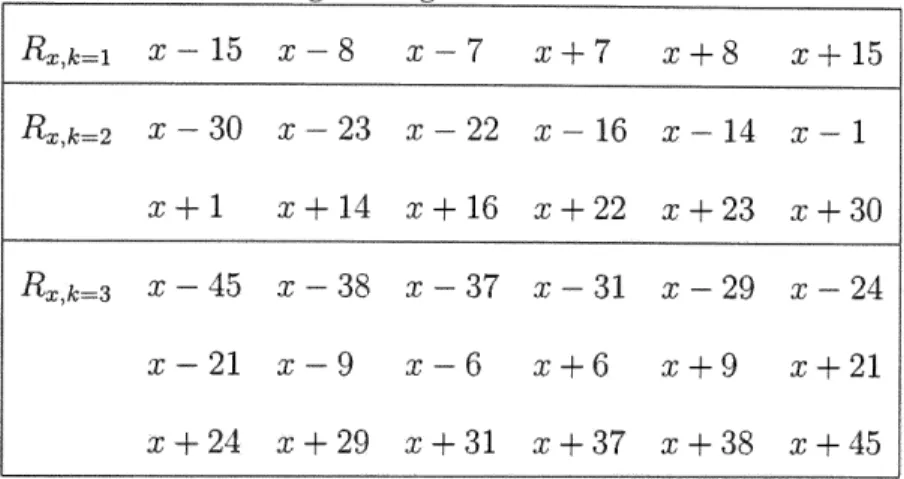
3.4.3 The Future Location Transition Probabilities . ... 54
3.4.4 The Replacement Score Model . . . 55
3.5 Replacement Performance Evaluation . . . 58
3.5.1 Impact of the Cache Size . ... 60
3.5.2 Impact of the Affinity Factor ... . 61
3.5.3 Data Item Types . . . 63
3.5.4 Impact of the Query Delay ... ... 64
3.5.5 Mobile Cache Response Time ... 66
4 A CONTEXT-AWARE PREFETCHING STRATEGY 70
4.1 Introduction . . . 71
4.2 The Cache Prefetching
Components
. . . 724.2.1
Query
Pattern and CacheManagement
. . . ... 74 4.3 Prefetching Cost Analysis Model . . . . 814.3.1
Numerical
Results . . . ... .,. ,,,.. .... 854.4 Prefetching
Performance
Evaluation ... . 874.4.1
Impact
of Cache Size . . . . .. . . . 904.4.2 Impact of Affinity Factor ....
....
91 4.4.3Impact
of Data Item Types .. . .. 924.4.4
Impact
of Query Delay ... .... . 944.4.5
Impact
ofMovement
Speed . . . ... . 97 4.5 Prefetching Strategy Conclusions . ... . . 975 THE EXPERIMENTAL ENVIRONMENT 99
5.1 The Client Cache Model . . . ... ... 101
5.2 Cache
Management
Simulation Examples .. . .. .. 1035.2.1 The Physical Cache Organization ... . .... 103 5.2.2 LRU Baseline Policy Simulation ... . 106
5.2.3 The FAR
Replacement
Policy ... ... 1096 CONCLUSIONS
110
6.1 Contributions of this dissertation . . . .. . . 110
6.2
Impact
of the Results to Mobile Computing . . . 1116.3 Future Work . . . .k, ... ,. 113
LIST OF REFERENCES ... , .. 117
APPENDICES...
.
...
....
124
LIST OF TABLES
TABLE PAGE
1.1 Example of dynamic semantic cache index . . . 10
1.2 Query predicate augmentation by client . . . 13
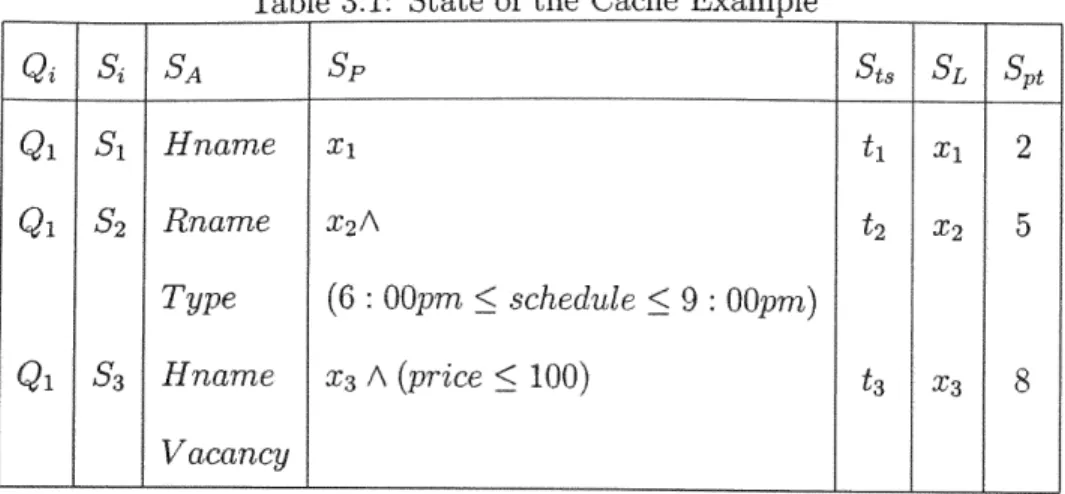
3.1 State of the Cache Example . ... .. ... . . 46
3.2 Neighboring Valid Cells Identification ... ... . 51
3.3 Example of Prime Index Table . ... .... ... 53
4.1 Query Candidates List for Prefetching ... . ... 77
4.2 Candidate Queries-Attributes and Predicates Description .... . 78
4.3 Candidate
Queries's
Cost Description ... . . . 79LIST OF FIGURES
FIGURE PAGE
L1 A data caching
taxonomy.
. . . 41.2 The shadow cluster concept([24]). . . . 15
3.1 A mobile architecture. . . .
38
3.2 The shadow cluster concept-neighboring cells distribution. ... 41
3.3 Random walk model - next cell probability distribution. ... . 41
3.4 Semantic cache structure and the prime list of cells. . ... . 44
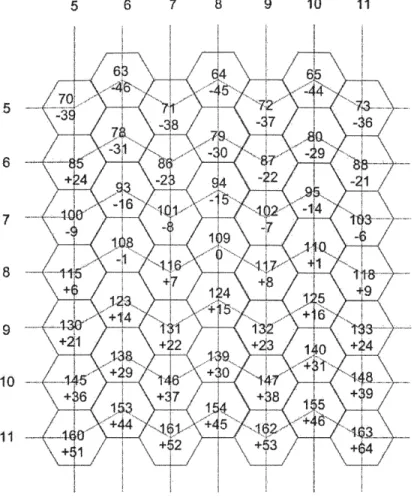
3.5 A four ring cluster (7x7 grid) of valid cells. . . . . ... . 52
3.6 Next ring neighboring cells identification model. . . ... . 52
3.7 Cache hit ratio versus cache size - for various simulation times . 59 3.8 Impact of cache size for different simulation time . .. ... 59
3.9 Changing the replacement query's pattern (Affinity factor) for FLA. 61 3.10 Affinity factor - Comparing FLA and FAR ... . . . 61
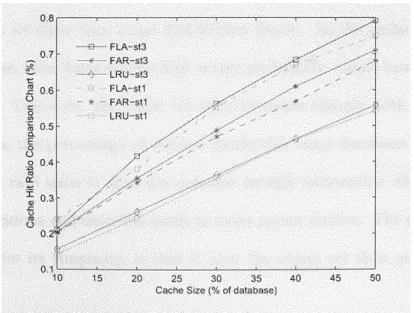
3.11 Cache hit ratio for FLA-FAR-LRU vs cache size
.
... 623.12 Cache hit ratio versus the data item types factor ... . 63
3.13 Impact of query delay on FLA.
.
. . . ... . 643.14 Impact of query delay for LRU, FAR and FLA. ... .. 65
3.15 Performance results based on scope distribution size. . 66 3.16 Cache response time for FAR and FLA versus cache size. . . 66
3.17 Cache response time for FAR and FLA versus affinity factor. ... 67
4.1 Roaming mobile user. . . . 73
4.3 Prefetching cost (Equation 4.1and
e
= 25%) . . . 844.4 Simulation work flow (res:resident query, rq:remote query). . . . 87
4.5 Effect of cache size in LRU, DR, and CAPS. . . .. . . 89
4.6 Effect of cache size for RW and DIR movements . . . 89
4.7 Effect of query pattern (Affinity factor) for DR and CAPS. ... . 91
4.8 Impact of data item types - Comparison chart . .... 92
4.9 Impact of data item types. . . . . 93
4.10 Impact of query delay on CAPS. . ... . 94
4.11 Impact of query delay on DR. ... . . 94
4.12 Impact of query delay-Average results for both CAPS and DR; : 95 4.13 Changing the moving speed for CAPS and DR. ... 96
4.14 Average speed performance comparisons for CAPS, DR and LRU. . . 96
5.1 A query random walk for the FAR policy. . . . 108
1 Layers crossing probabilities . . . 126
2 State diagram for the hexagonal random walk model . . . . 126
LIST OF ACRONYMS
ATM: Asynchronous Transfer Mode BS: Base Station
CS: Caching Strategy
CAC: Context-Aware Cache CA: Context-Aware
DBMS: Data Base Management System DOMINO: Data Base for Moving Objects
LDD: Location Dependent Data
FLA: Future Location-Aware FAR: Furthest Aware Replacement
GSM: Global System for Mobile Communications
GPS: Global Positioning Systems LRU: Least Recently Used LA: Local Area
LBS: Location Based Services
LDIS: Location Dependent Information Services MOST: Moving Objects Spatio-Temporal
MRU: Most Recently Used
MSC: Mobile Switching Center MC: Mobile Client
MOD: Moving Objects Database
MLS: Mobile Locations Systems
PDA: Personal Digital Assistant
PCS: Personal Communications Services Networks
RA: Registration Area RW: Random Walk
SA: Service Area
WLAN: Wireless Local Area Network WAP: Wireless Architecture Protocols
Chapter 1
INTRODUCTION
The ubiquity of pervasive mobile networks combined with the capability to support
large databases promise new opportunities for mobile applications. However, in order to efficiently support these applications, mobile platforms are required to cache por-tions of the available data so that access over relative slow communication channels can get accelerated and communication disruptions may be minimized.
One of the most popular mobile applications is the provisioning of services using location information known as location-based services (LBS). LBS use the location information of mobile users to provide them with relevant information based on their geographical position [1, 6, 11]. Through LBS, mobile clients can access location sen-sitive information, such as traffic reports, hotel information and weather forecasting. Location-aware dynamic caching and prefetching computing is a widely used tech-nique used to improve performance in mobile computing environments [3, 9}. Prior research on data caching [12, 14] and prefetching [28, 11] has focused on the devel-opment of solutions that allow applications to run in wireless environments using proxy-based techniques. Even though most of these approaches are semantic-based, they do not provide adequate support for representing the context of a user (i.e., the interpreted human intention.). Although the context may be treated implicitly, it
is still very crucial to data management in a
mobile
environment, since potentially context-sensitive and highly personalized information can be disseminated to mobile users. Even though the location information has been used as a key field of the user's query context, not enough attention has been paid to the other query fields (predi-cates) which define the user's information context. The characteristics of the mobile environments and the mobile user needs for dynamic provisioning of information con-tent make most previous caching and prefetching techniques unsuitable.This dissertation aims to solve this problem by presenting a novel data caching mechanism for pervasive computing environments that can adapt dynamically to a mobile user's context. In the dissertation we design and develop a conceptual model and context aware protocols for wireless data caching management. The presented replacement policy uses the validity of the data fetched from the server and the neigh-boring locations to decide which of the cache entries is less likely to be needed in the future, and therefore a good candidate for eviction when cache space is needed. The context aware driven prefetching algorithm exploits the query context to effectively guide the prefetching process. The query context is defined using a mobile user's movement pattern and requested information context.
In this chapter the principles of data caching, with a particular emphasis on cache
management and prefetching, are first presented, then the goals, issues and assump-tions of this dissertation are elaborated. Finally this chapter concludes with the scope and the outline of this dissertation.
1.1
Background
and
Preliminaries
1.1.1
Data Caching Overview
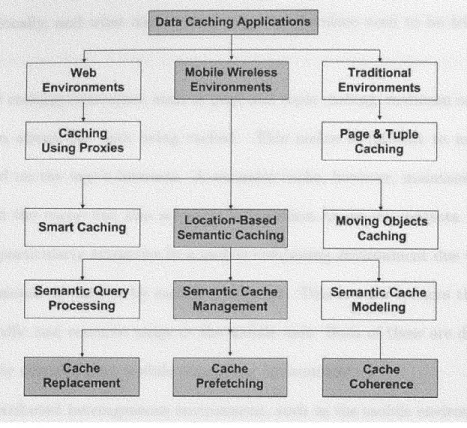
Data caching in mobile environments can support many applications and many levels of information systems design enhancing performance without significantly increasing the cost and complication of the overall information system design. Caching can occur at least at three different locations: (i) the server, (ii) the proxy server, and (iii) the client. Of these, server caching is used not a means to reduce delays, but as an effective way to reduce the demand for clients' connections on a single server. Enterprise applications where data caching is applied include the traditional client-server distributed environment, the web and the much newer mobile and wireless environments. Figure 1.1, shows a taxonomy of the main data caching applications, data caching techniques and the cache main processes discussed in this chapter. In a web environment, proxy servers deal with aggregate user demnand. Caches are commonly located at the client and at proxy servers [62], which are found within a user's intranet. Client data caching is particularly important in mobile computing, because it can reduce wireless communication and has been shown to be an effective
way to handle the above problems [18, 29, 14].
In traditional legacy systems a predictive caching system
makes
optimal caching decisions regarding the caching of the most important files, based on the types of user interaction with these files [4]. Through the concept of semantic distances the distance between files and directories is measured and quantified.The
sequence in which the files are accessed can also be taken into account. One such approach is found in the SEER system, which was implemented as a modification to the UNIXDat CchngApp
icin
Web WTraditional
Environments Enr sEnvironments
Caching Page & Tuple
Using Proxies Caching
SCMoving
ObjectsSmmatacaching hgCahing a
Semnantic Query remnt Cach Semantic Cache
Processing Maaemen Modeling
Figure 1.1: A data caching taxonomy.
kernel and a collection of user-level processes to calculate semantic relations among the files. These were logged by the kernel in a trace buffer and examined later to make optimal caching decisions.
While the traditional data dissemination systems use physical information to
orga-nize data and caching techniques based on page and tuple caching [13, 5], newer data
caching techniques maintain the associated answers (data items) of previous queries as well as their meaning (purpose). This form of information description is called
semantic description, and makes it possible to reason about and derive knowledge
from the given description. A semantic cache was defined in [7] composed of a set
of cached items, which are called semantic segments. During a new query processing the semantic description is used to determine what percentage of the query can be
answered locally, and what data are missing and therefore need to be fetched from the server.
Typical caching techniques, such as page and tuple caching, maintain no semantic information about the data being cached. This makes it difficult to manage the cache based on the user's interests. A semantic cache, however,
maintains
not onlythe data in the cache but also semantic information about its contents. Semantic caching is particularly attractive in a mobile computing environment due to the fact that the amount of data to be cached is reduced. This in turn reduces the wireless network traffic and resource usage at the mobile unit. Both of these are desirable in a potentially resource poor mobile computing environment.
In a distributed heterogeneous environment, such as the mobile environment, the semantic data caching paradigm is an important technique for improving the per-formance of wireless data dissemination systems. Semantic caching is by nature an ideal cache scheme for Location Dependent Data (LDD) applications due to the fol-lowing reasons. First the semantic caching is built on the semantic locality among queries, which perfectly fits the LDD applications where semantic rather than
tem-poral or spatial locality is exhibited [5, 7]. Secondly, continuous LDD queries can
be incrementally processed by semantic caching. With each successive request, a much smaller trimmed LDD query is processed at the server side and only the differ-ences are transmitted over the wireless link. Thirdly, semantic caching makes cache management more flexible.
Another data caching technique in a
mobile
environment called object cachingrelates to mobile objects or mobile clients who are on the move. These mobile objects need to be constantly provided with the relevant data they need depending on their
location. This brought forward the problem of keeping track of the mobile objects and therefore the need of databases to support moving objects and data structures to support their functioning. These
moving
objects are represented in a Database for Moving Objects (DOMINO) containing the moving objects and their location [30].Object caching techniques have demonstrated that discrete representations could be mapped into data structures that can be used in a DBMS environment providing a precise base for the implementation of spatio (space predicate) - temporal (time predicate) extension package to be added to a suitable extensible architecture. These moving object databases have to be continuously updated and queried. The update problem needs to determine when the location of a moving object has to be updated. These moving objects will generate random queries depending on their position. A critical set of capabilities such as the support for spatial and temporal information have to be built on top of existing databases in order to support moving objects databases [17]. Additionally, a new data model needs also to be introduced to check the location update policies and their performance.
1.1.2
Location Dependent Data
Queries
A location dependent (LD) query is a query which is processed on location
depen-dent data, and whose results depend on the location criteria explicitly or implicitly specified. Moreover, the result may change as the user changes location. An example of these queries may involve a traveler who gets different gas station information as s/he moves to different locations. Furthermore, since the same question is asked con-tinuously, there may be a large degree of overlap in the results of consecutive queries Clearly, continuously evaluating a query from scratch would be very inefficient. If
we keep a cache on the mobile unit, part of the new query result could be obtained locally. By doing this, the wireless network traffic is reduced, and the system perfor-mance is improved as well. To dynamically adapt to the query access pattern, the cached contents are required to move as the mobile unit moves.
Mobile clients querying static objects create queries like: "Tell me where is the nearest gas station?" and "Where is the nearest restaurant?" which are popular queries in real-world location applications. In general the mobile clients submitting this kind of queries are mobile and the data objects are fixed. The main challenge of this type of queries is how to get the location of the clients and how to guarantee the validation of the results when the client keeps moving during the query evaluation process.
Queries
such as "Report all the available hospitals within a 500-meter radius" arean extension of this type of query. A LD query becomes more difficult to answer when it is submitted as a continuous query. For example, a client in a moving car may submit the query: "Tell me the room rate of all the hotels within a 500 meter radius from me" continuously in order to find a cheap hotel. Since the client keeps moving, the query result becomes time-sensitive in that each result corresponds to one particular position and has a valid duration because of location dependency. The representation of this duration and how to transmit it to the client are the major focuses of Continuous
Queries
(CQ). Sistla et al. [17], employed a tuple to bind the valid time duration of the query result.Of course, the LDD queries listed above can also contain querying about location independent attributes, such as: "Tell me the nearest restaurant providing Chinese food." Since these queries can be broken down into two parts: one for
location-dependent information and the other for location-inlocation-dependent attributes, we only consider queries on location-dependent information as the others can be retrieved by traditional query-processing methods. In particular, this dissertation focuses on the continuous type of queries initiated by mobile users querying static objects.
1.1.3
Cache Management Processes
Regardless of the cache techniques described in the previous section and the orga-nization model being used the following data caching main issues (shown in Figure 1.1) make the design of client cache management for wireless data disseminations a
challenge.
1. Cache replacement: Cache replacement refers to the process that takes place
when the cache becomes full and old data items (objects) must be removed to make space for new (newly referenced) ones. An effective cache replacement
policy is needed to decide which cache entries will remain and which will be
evicted to make space for new data, since the cache is inevitably small to hold all the data referenced and, thus, some data must be evicted when new data is brought in. It is obvious that the cache will perform best if the data evicted is that which is least likely to be referenced again.
2.
Cache prefetching policy (also called cache hoarding): Cache prefetchingau-tomatically preloads auau-tomatically data values into the cache for possible fu-ture access requests. Prefetching in association with replacement manages the client's cache, providing an effective technique to handle information provision-ing for users with limited resources and frequent disconnections.
3. Cache coherence strategy: Cached results from previous queries may become invalid when the mobile client moves from one location to another, or even when the objects residing at the database server are updated. A cache coherence strategy usually involves cache invalidation and update schemes to invalidate and up-date an outdated cached entry. An invalidation policy maintains data consistency between the client cache and the server. This is achieved by the origin server notifying clients if a cached object has changed. Another approach for cache coherence is cache validation. With cache validation, the clients verify the validity of their cached objects with the origin server. A detailed work in cache coherence control is presented in
[29].
1.2 Motivation
In the real world, as mobile users change locations, they most likely tend to request the
same data item a few times until switching to another one. For example considering the case of the mobile user asking questions to find the nearest hotel. At time ti and location cell-id = xi, the mobile user asks query Qi: "Give me all the names of the nearest hotels (within 5 miles)", and then keeps on driving to the next location. Then at time t2 and location cell-id = x2, s/he asks query Q2: "Give me the names
and vacancy information for hotels within 5 miles which charge up to $100".
Affinity can be defined as the preference towards a particular database data item. Once the mobile client has demonstrated affinity towards one particular data item type (i.e., in this case hotel), each additional data item type has a lower affinity value for the duration of the query. Additionally, a certain user may query the same item often, while another user
may
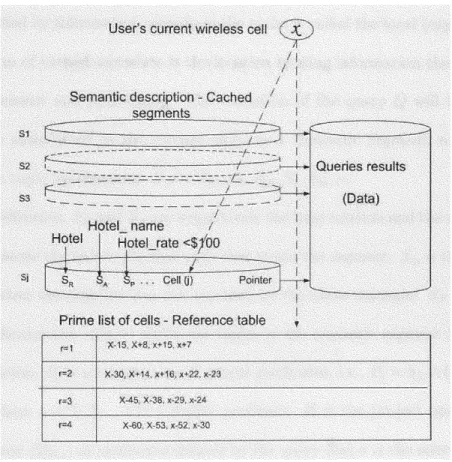
query the same item occasionally. Thus, both a user'sTable 1.1: Example of dynamic semantic cache index S
SRSSA
S SPT SL SCV STSSi
H H (Lx1 - 5 < hxpositon < 2 Lx1,
Ly1 110010 t1 o n Lxi + 5)A t a (Ly1-5
< e m hyposiion < Ly+5 )l
eS
2R
R T(Lx
2 - 5<
rxpositon<
5 Lx2,Ly
2 010111 t2 e ny Lx2 +5)A s ap (Ly2 -5< t me rypsiio e Ly2+5)A n (6:
0Opm <t Work - hours < 9: OOpm)
S
3H
V H
(Lx - 5 hxposition 8Lx
3, Lys 110010 t3o a n L 3 + 5)A
t ca (Ly3-5<
e a m yposion
1 n e Ly 3 + 5) A (price $100)
movement pattern and the query pattern need to be considered to further improve the effectiveness of a cache management strategy. The presented data caching strategy can be used to incorporate dynamic attributes in existing data models and capabilities to be added to existing query processing systems to deal with dynamic attributes.
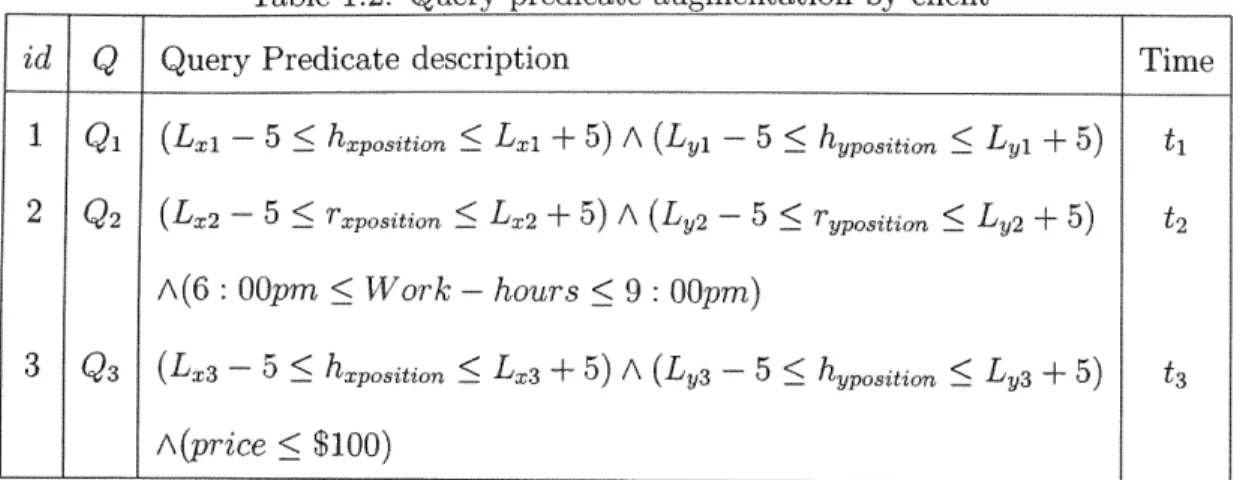
Next, observe that the number of moving objects in the database may be very large (e.g., in big cities with millions of inhabitants). Thus, for performance consid-erations, in answering LD queries examining the location of each moving object in the database should be avoided. In other words, it is preferable to index the location attribute. Therefore, the location granularity will be of great importance. Using a symbolic model based on cell granularity for location identification instead of the (x, y) geographical location
models
(as seen in the example shown in Tables 1.1 and 1.2) used so far is a better approach. The problem with a straightforward use of spatial indexing for location binding is that the continuous change of the locations implies that the spatial index has to be continuously updated. This is clearly an un-acceptable solution that can be mitigated with the cell granularity symbolic location model adopted by this research.Finally maybe the best motivation is that an increased in size cache can satisfy the expectations of more functionality at the client site (suggested by this research). Ad-ditional knowledge regarding the future location and query pattern of the mobile client can be included and it would be great to have available at the client. True Relational Data Base Management Systems (RDBMS), may now fit into 100K-150K of memory (e.g., DB2 Everywhere by IBM, Oracle Lite and Sybase's Ultra Lite databases). In implementing a small size RDBMS for the client, the symbolic model stresses the rep-resentation of relationships between logical entities rather their precise coordinates and is more suitable for LBS at a semantic level [21]. The fact that a cache can easily incorporate the functionality of a small database, can provide additional motivation
1.3
Statement of the Problem
Traditional distributed database techniques cannot efficiently support queries in mo-bile computing environment. Consequently, query processing in mobile database, which is conducted by some fixed hosts and several mobile hosts, has emerged as an issue of growing importance [6]. A mobile database can be recognized as a distributed database that supports mobile computing. In general mobile wireless networks [3], there are two sets of entities: Base Stations (BSs) and hosts. The hosts are either fixed or mobile (called MH). Fixed hosts communicate over the network with a fixed topology, while mobile hosts communicate with other hosts (mobile or fixed) via a wireless channel. With the development of mobile computing, another kind of wire-less network, both the hosts and the BSs are mobile. Thus, query processing becomes much more complex than that in general wireless network [10].
How to optimize mobile queries, cache and replicate data and manage transactions are some of the key issues in mobile environments which are grouped under the query processing cache management process. Location binding has been used as a means to mitigate these issues. The result of an LD query is not only determined by the selection and a projection condition specified, but also is related with a given bound location. However, current research has adopted the geographical location which uses the x, y location binding for the query processing (as seen in the example shown in
Tables 1.1 and 1.2).
A more effective and native to query/database processing location model is adopted by this research. This is the symbolic location model which is based on cell gran-ularity. Collecting information for individual mobile client at a finer level (i.e., x, y coordinates) would incur significant overhead without a significant performance
im-Table 1.2: Query predicate augmentation by client
id
Q
Query
Predicate description Time1 1
(Lx
xoiin<L1+5 Ll-5<hpsto Ly1 + 5) t12 Q2 (Lx2 5 <rpos ton < Lx2 +
5)
A(Ly2
-5
ryotn Ly2 + 5) t2A(6: OOpm < Work - hours <9
: 0pm)
3 Q3
(Lx3 5 hxposition Lx3 + 5) A (Ly3-
5 hyposit on Ly3 + 5) t3A(price $100)
provement. Being discrete and well structured, location information based on sym-bolic location models is easier to manage compared to that based on geometrical models. For example, location data is much more amenable for database storage and retrieval; they can help analyze location information such as individual mobility patterns. Steadily falling costs of storage lead to caches of sizes large enough to hold most of the additional requested data items by the presented prefetching technique.
In some cases, prefetching is only beneficial for latency reduction, but causes a cost
(i.e., cost of bandwidth and memory space) increase with respect to no prefetching. Prior research has not provided adequate support for representing the context of a user. However both the valid scope distribution defined as the locations of the fetched data where the queried data item has valid answers and the user's query context can be used as prefetching filtering mechanisms.
Finally, a significant amount of research has been conducted in future locations prediction, however, interesting enough it has not been adequately used to improve the cache management at the mobile client.
1.4
Research Goals
Based on the discussions in the previous sections the overall goal of this dissertation is to provide a novel data caching mechanism and a prefetching strategy for perva-sive computing environments that can adapt dynamically to a mobile user's context. None of the solutions proposed so far has incorporated the query context and future locations into cache management and prefetching. This demands the design of ef-ficient data caching mechanisms in mobile and wireless environments based on the issues and challenges arising out of their inherent characteristics and applications.
This dissertation's aim is twofold:
* Design a future location-aware cache replacement policy to manage a semantic cache. The proposed replacement policy uses the validity of the data fetched from the server and the neighboring locations to decide which of the cache entries is less likely to be needed in the future, and therefore a good victim for eviction when cache space is needed.
* Design a context-aware prefetching strategy that will explore the user's query context to predict the fiture query pattern on a cost effective manner. This will enable the formation and maintenance of a context-aware cache with data items of high benefit and at a low cost.
By meeting these goals we expect to improve the cache query processing process by using cell-id location binding information instead of the geographical x, y coordinates for the query augmentation. Additionally provide more intelligent caching techniques at the mobile client for better local decision making. This will reduce the client-server dependency and improve the network resources allocation. In view of the above issues
Figure 1 2: The shadow cluster concept
([24]).
and challenges and keeping in mind the overall systems performance, we intend to incorporate the following main components into our research:
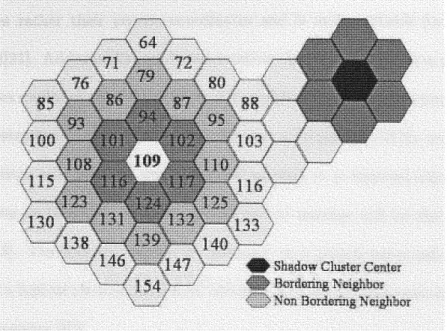
* Future location prediction. A future location prediction scheme is incorporated into the presented cache management strategy using the neighboring locations (cells). According to the shadow cluster concept (Figure 1.2), a cluster of cells based on the mobile user's current cell is formed. A bordering neighboring and the non-bordering neighboring group of cells are identified. Neighboring cells are most likely to be visited in the near future and therefore present a higher interest as fast as prefetching is concern. Remote cells are less likely to be visited in the near future and therefore are best candidates for replacement when additional cache space is needed. Even though the focus of this research is not in cells identifications, an algorithm has been included to identify the neighboring cells distribution and provide a number of other supplementary functions i.e., measuring the distance between cells.
* Symbolic location model based on cell granularity location modeling: Regarding the user's
mobility
the research has mainly emphasized the use of thegeograph-ical location models which uses a significantly high computational overhead. However most recent research has proven that a symbolic model is more appro-priate for the mobile environments [21]. In this research, the symbolic model based on cell granularity is adapted. It should be noted here that the focus of this research is not on modeling the user's mobility, and the presented tech-niques can be used with other mobility model as well.
* The validity of the data concept (valid scope distribution) is adapted and used
to derive a set of future locations of interest. The data item scope is defined as a set of cell where are the valid answers to the query and is maintained by the database server.
* In order to identify data items with high benefit as far as the cache content is
concerned the user's query context is exploited to limit the amount of prefetched information within the predicted set of future cells (the prefetching zone). Two query context criteria have to be designed based on the user's query context attributes and predicates. An algorithm is necessary to derive a set of candidate queries for prefetching using the user's previous history of the user's information content, then another algorithm uses two selection criteria to select the optimum query for prefetching based on cost. Cost is defined as the used transmission bandwidth and cache space.
1.5
The Dissertation Environment
There are several issues regarding the modeling of user movement, and the querying process that need to be defined before the study of the proposed algorithms.
* Mobility model: The random walk mobility model is assumed, however the proposed methods can easily be adapted to any other mobility model. The used mobility model includes random movement speed capabilities and is based on cell granularity several mobility models i.e., the Random Waypoint (RWP) mobility model and the one by Brinkhoff have recently attracted attention. This research has revealed that these models are still at a pretty nascent stage going through several modifications and used for ad hoc networks protocols simulation. Separate research streams exist on development and fine tuning of these models. For example "The Node Distribution of the Random Waypoint Mobility Model for Wireless Ad Hoc Networks" [86] has pointed out several
drawbacks on using Waypoint mobility. Alternatively a directional mobility
model is also used with some prefetching simulation experiments.
Query types: The continuous LD query type is assumed and for local queries.
It can be shown that any other type of query can be broken down and analyzed as if it was of continuous type. Local queries refer to the queries whose results are valid based on the current cell location of the mobile user. Non-local queries refer to the queries whose results are valid or are based in another cell which is not the mobile user's current location. For example "find the hotel names lower than $200 in West Palm Beach or in cell number "23". The presented approach
can be expanded to include the non-local queries.
Mobile user's location: Determining location it is assumed that MTs are equipped
with a mechanism to obtain its current location. This mechanism could either be tied to the tracking scheme used by the static network (to setup a communi-cation path to the client) or be completely independent of it. For example, the
client may determine its location via Global Positioning System (GPS) tech-nology in terms of its absolute geographical coordinates. Alternatively, in a environment with predefined cells, i.e. areas of wireless coverage with a com-mon access point to the fixed network, a client's location can only be pinned down to the granularity of a cell, (method adapted by this research), thereby defining its location relative to they fixed network. So, the term location has different connotations depending on the mechanism used, with a range of gran-ularity from a few square miles in the case of macro cellular structure (as in a cellular/Advanced Mobile Phone System (AMPS) setting) to a cell size of the order of meters, e.g. infrared cells within a building, "An Infrared Network for
Mobile Computers"
[87].
* Valid scope maintenance: It is assumed that a client cache is symbolically
or-ganized and each cache entry contains a data item ID, the attached validity information if any, and a pointer pointing to the real data. Note that the cached segment has a valid scope attached to it as of the time stamp of the last time it was accessed. When a data item is updated at the server-side, the cached copy becomes obsolete. When an MT hand-offs to another cell, a cached data item may also become obsolete due to the change of client location, depending on its valid scope. This paper does not deal with cache invalidation issues [21].
1.6
Significance and Contributions
The outcome of this research in the area of caching in a mobile environment would be used to make mobile devices more efficient in terms of the usage of their cache memory and for a wide variety of new wireless applications. Thus mobile and wireless
devices implementing any kind of memory to support their usage would be a target of this application. This research is, of course, not limited just to
mobile
devices; ad-hoc devices which face the problem of constant disconnections, would also be candidates for the use of this application. Any kind of distributed system where clients frequently disconnect from the servers could eventually use this application to improve the way data is cached.The presented techniques considerably enhance the query predicate with more ac-curate location and movement information. Hence the outcome will be the strength-ening of the query prefetching capabilities and therefore the local processing of a larger number of location dependent future queries. Regarding the query processing by the client and in particular in trying to generate the probe and remainder queries, the intelligent algorithm included, significantly improves this process by discriminating the cached tuples based on their future location binding information.
Finally, the performance evaluation results suggest possible capabilities of the proposed strategy in a larger design/application space, where more mobile clients can be used to see if they interface or help each other in a peer-to-peer computing architecture, i.e., if there is no data access via a BS or an MSS, ask your peer.
1.7 Methodology
The presented research in this dissertation involves the combination of model
opment, algorithm design, analysis, simulation and experimentation. Model devel-opment involves a critical assessment of the requirements and challenges of mobile environments. The data caching techniques have been designed to satisfy these
chal-lenges and needs with concentration to emerging technologies needs rather than the traditionally used methods.
The proposed design was evaluated using both a cost analysis model and simula-tion techniques. Even though simulasimula-tion is not quite foolproof, and only implementa-tion in a real environment can assure the effectiveness of the design, the performance results were mainly derived using simulation due to the complicated nature of the mobile environment and the lack of real life testing platforms. For the same reason there is no available simulator for mobile environments and therefore one had to be designed for the mobile computing environments.
Despite the recent surge in research activities in the mobile and wireless infrastruc-ture software simulation remains the primary approach to evaluate the data caching performance, as it is fairly easy to implement and manipulate. The presented methods for mobile environments are simple and practical for implementation and operation. The testing parameters used are available in practical systems. In order to evaluate the trustworthiness and overhead of the presented methods, a combination of analysis and simulation was adopted. An obvious extension of the work will be to create a mobile environments test bed and evaluate the presented techniques with real-time data.
1.8 Targeted Applications
The new classes of applications for mobile computing environment namely, LBS are expected to create a much higher user density in the future mobile networks. Also, the updating and querying loads on the location databases are expected to be very heavy [37]. Furthermore, with the technological improvements in pervasive computing, it is
expected that a large number of location-aware wireless devices will be available in the future. The network of consumers using Personal Digital Assistants (PDAs), tourists carrying on-line and position-aware cameras and wrist watches, and vehicles with computing and navigation equipment will give rise to a wide variety of new wireless applications. The list of the emerging wireless applications includes the following:
1. LBS Applications:
* Tracking and dispatching mobile resources * Traffic coordination, and way-finding
* Location-aware advertising Tourist services, and * Location-based games.
2. Multimedia
Caching.
One of the research streams of the LandMARC projecthas looked at the use of multimedia caching as an effective means of supporting intelligent load balancing and resource management.
3. Data caching in Mobile Ad-hoc Networks (MANET). This is an emerging area of research which presents a promising future application for data caching [88].
4. Additionally emerging application. A great interest for data caching has been
created with the biomedical engineering, tele-health, medical information
sys-tems and business.
1.9 Scope of Dissertation
The scope of this dissertation is to develop a conceptual model for cache management techniques and prefetching that could be performed for mobile devices and is focused
on the LDD continuous type of queries initiated by mobile clients and for fixed objects. The scope of this dissertation demands the design of a new strategy or the enhancing of the present algorithm for caching to use a semantic model to efficiently manage LDD as well as answer normal queries for general data.
Other issues that fall in the scope of this dissertation are the future location pre-diction and query pattern prepre-diction. The client cache management includes client side configuration parameters, cache fetching, cache replacement and cache prefetch-ing policies. Other issues such as neighborprefetch-ing cells identification are also addressed to a lesser extent, since the main thrust of the thesis is on the cache management mech-anism used for the mobile devices. The performance of the cache models is examined through analysis and a detailed simulation study, in order to show its effectiveness in a mobile computing.
1.10
Outline of the Dissertation
The work reported in this dissertation focuses on developing a novel future loca-tion predicloca-tion replacement policy and a context-aware prefetching strategy for the emerging location-depended computing paradigm. In Chapter 2, a survey of the ma-jor efforts conducted in recent years by the research community in the replacement
and prefetching cache management issues is presented. This chapter also includes previous work in the associated areas of semantic caching and future locations pre-diction.
Chapter 3 first discuss existing data caching architecture for the pervasive comput-ing environments includcomput-ing the semantic cache description and the use of the shadow cluster and the valid scope concepts for data caching. Next the design rationale of
the cache replacement policy and its associates components is discussed. The last part of Chapter 3 discusses and compares our work with other protocols.
The presented Context-Aware Prefetching Strategy (CAPS) is presented in Chap-ter 4. The main issues of prefetching are discussed and the design of two algorithms used as context filtering mechanism is examined. The first to form a list of candidate queries for prefetching based on the user's current query context and the second algo-rithm to select the optimum query for prefetching. Next, the design of the prefetch-ing cost
model
based on bandwidth allocation is presented followed by the numerical analysis and the performance results.Chapter 5 presents the cache organization overview and the design of the simulator which was used to simulate the presented data caching techniques and prefetching method and derive the performance comparison results. A number of key simulation pseudo-code modules are included, such as the random movement control module, the cache manager module and the LRU, FAR and FLA replacement policy modules. Chapter 6 summarizes the work of this dissertation, discusses the contributions it makes and the impact of the results to mobile computing. The last section in this chapter discusses suggestions for future research directions.
Finally, the appendices chapter, first, derives the formulas used by the neighboring cells distribution algorithm, i.e., the distance among cells formula, and the formulas used for the cell number and the reference number. Second, the transition probabili-ties evaluation is shown. Finally, in the performance statistical comparison appendix, we use the simulator's output and apply sampling techniques to construct confidence intervals (region) at specified confidence levels (i.e., 90% and 95
%),
to compare the cache hit ratio of the proposed cache management strategies (CAPS and FLA) withthe industry standard semantic cache management policy FAR and the baseline LRU protocol.
Chapter
2
RELATED WORK
Many researchers have advocated the use of caching and prefetching to reduce latency and improve the overall performance mainly in the traditional client-server distributed environments and the web. There are five other research areas that address issues discussed in this dissertation:
* Data Caching Techniques.
* Modelling the User's Mobility.
* Future Location Prediction.
* Cache Replacement, and
* Cache Prefetching.
2.1 Modeling Moving Objects
A formal data model Moving Object Spatiotemporal(or MOST for short) to
repre-sent moving objects in a database system was introduced in [17]. They treated the position of a moving object as a dynamic database attribute, and expressed it with three sub-attributes, namely value, update time and function, where the function
indicates how the value changes over time. In [17], an effort was made to represent the temporal development of spatial entities in certain data types such as moving point or moving region. Moving Object Databases (MOD) have to be continuously updated and queried and the update problem needs to determine when the location of a moving object has to be updated. In addition, these moving objects generate random queries depending on their position. A critical set of capabilities such as support for spatial and temporal information, etc have to be built on top of existing databases in order to support moving objects databases [72]. The problem of how to index moving objects in a database is investigated in [71] and [73]. A straightforward use of spatial indexing is inefficient and infeasible since the spatial index has to be continuously updated when the objects are continuously moving.
In [7] a new semantic caching technique was proposed. A formal model, which treats location dependent data as database spatial replicas tightly coupled with spe-cific data regions, is presented. Then based on this model, research issues such as query processing and the geographical model used for location binding are explored. The main advantage of geometrical location models, is their compatibility across het-erogeneous systems. However, because of the considerable cost and the complexity in-volved in providing accurate fine-grained location information, the cost/performance ratio of geometric models might not be promising for a large number of applications such as the nearby restaurant example.
In this work, a symbolic location model is used, where the cell id is the unit of location granularity. Every cached item has an attached semantic description based on a cell granularity. In most of the emerging mobile applications the cell id number will be the preferable granularity. This approach differs from the previous research
in semantic caching in that the knowledge of future location information is added as an extra rule for filtering information to be cached.
2.2 Future Location Prediction
The knowledge of the location adds an extra rule for filtering information to be cached, but its usability has been limited. Future location information can be used with the replacement policy. This particular technique offers a starting point for caching. In fact, when a mobile client is turned on, the only useful data available is its location. Hence, the caching system will start caching information steered by its location, and in the case this approach is feasible.
Zheng and Lee [12] have proposed to construct a Voronoi Diagram (VD) on the data objects to serve as an index for them. A VD defines, for each data object, the region within which the object is the nearest point to any mobile within that region, i.e., defined by the base station. Based on the VD, a semantic scheme that records a cached item as well as its valid range is proposed. The VD method even if, is a suitable approach to find the nearest-neighbor, it is not a real location prediction scheme and is seldom used in real applications because of the expensive maintenance of the structure when updating occurs. The Dead Reckoning schemes calculate where an object might be, instead of explicit updates. Other conventional methods on future location prediction are based on the use of historical movement patterns of the subscriber to calculate his possible future location. One
method
is based on a table with possible reference locations and on the probability that the MT is located in there in a deterministic period of time uses the time criteria to build the table index. A second method stores the historical movement pattern in a database andcompares the recent states with these movement tracks in the database to find the one which samples the actual states (States dependent approach). One method to combine the time and the location information is to use the prediction characteristics of some neural network types, or use the stochastic prediction approach adapted by this research .
Levine et al. proposed the use of the Shadow Cluster Concept in
[24]
(Figure 1.2) for future location prediction and used it for resource allocation in Asynchronous Transmission Mode(ATM)-based
wireless networks. The fundamental idea of the shadow cluster concept is that every MT with an active wireless connection exerts an influence upon the cells in the vicinity of its current location and along its direction of travel. As an active MT travels to other cells, the region of influence also moves, following the MT to its new location. The base stations (and their cells) currently being influenced are said to form a shadow cluster, because the region of influence follows the movements of the active mobile client like a shadow.Using the shadow cluster model a matrix of transition probabilities was proposed, considering all possible cell locations, for a total of 3k2 +3k
+
1 cells, each assigned to one state, where k is the number of rings. However, this number of states explodes ask increases, sometimes making the simulation of such system difficult and costly. A good amount of redundancy is built into this approach because not all of these cells are of interest if they have no valid answers for the query. In addition the shadow cluster model may be suitable for random walk only, in direction-based movement, the cells behind the user should not be considered for high access probability in the near future.
2.3 Cache Replacement
Cache replacement policies for the wireless broadcast environment were studied only in push-based broadcasts schemes [15, 16]. Furthermore, the previous studies are based on a number of unrealistic assumptions, such as, fixed data sizes, no updates, or no disconnections. Acharya et al. [15] proposed a cache replacement policy called
PIX, in which the data item with the minimum value of p/x was evicted for replace-ment, where p is the item's access probability and x is its broadcast frequency. Thus, an evicted item either has a low access probability or a short retrieval delay.
The commonly used cache replacement strategies such as such as LRU, MRU and LFU are built on temporal locality. The least recently used (LRU) policy is an implementation of a probability-based policy. A probability-based policy replaces the data with the least access probability (evicts the object that has not been accessed for the longest time). LRU is unaware of any semantic relationships among queries. Aa a result, a significant number of queries that land in the cold region of the relation and therefore are not likely to be accessed in the near future, they will still stay in the cache until they age out of the LRU chain. The LRU policy works well when most recently referenced objects are most likely to be referenced again in the near future. However, there should be more factors to be considered in wireless communication systems when researching data caching replacement.
An alternative to using the recency information for determining replacement val-ues is to use the semantic distance. In this approach, the data that is farther away from the client's current location is removed during replacement. In [5], Shaul et al. further utilize the semantic locality in semantic caching replacement. For each cached
between the "center of gravity" of that region and the "center of gravity" of the most recent query. With this distance function, semantic regions that are semantically "closer" to the current query are less likely to be discarded. The rationale used here is to predict the future use patterns for the segments by examining their semantic relationships with the current query. However, the calculation of the semantic dis-tances has a number of issues associated with. First, the center of each region must be determined. Second, there is a need to use estimated weights which are difficult to determine most of the time. In a more recent research, Zheng et al. [13], proposed the data distance and valid scope area as important factors for the data caching re-placement policy. According to their analysis, a promising cache rere-placement policy should choose its replacement data with a low access probability, a small valid scope area, and a long distance if the data distance is also an influential factor.
A different replacement policy is used in [14], where the cached items to be evicted are selected according to the access probabilities which are predicted by observing the data access history. In several studies on LDD caching, data distance-based cache replacement policies
[5]
utilize semantic locality in semantic caching replacement. For each cached semantic region, a replacement value is assigned to represent the semantic distance between the center of gravity of that region and the center of gravity of the most recent query. With this distance function, semantic regions that are semantically "closer" to the current query are less likely to be discarded. The rationale used here is to predict the future use patterns for the cached entries by examining their semantic relationships with the current query. A significant body of research on semantic cache strategies has used the distance and the direction ofmovement to determine replacement candidates to be evicted from the client's cache. This body of work implies the use of future location prediction in this process.
A mobility model that represents the moving behavior of mobile users is formally defined by Ren et al. in [7] for LDD queries. Based on this mobility model, a LDD semantic cache replacement policy was developed, named a Furthest Away Replacement (FAR). FAR chooses for replacement those segments which are not in the moving direction and are furthest away from the user. A future location is anticipated based on the current user's direction and speed. FAR implies future location prediction based on the tangent velocity. However, this approach is effective only within a short time interval, and therefore a great and frequent number of calculations is needed throughout and during the cache replacement decision making process. Additionally, for a small number of cells FAR would face a great difficulty to determine which of the previous locations is the furthest away. Furthermore, sudden changes in the direction of the MT make the FAR policy almost impractical. Xu et al. [20] proposed a cache replacement policy called Stretch Access-rate Inverse Update-frequency (SAIU), where the influence of data item sizes, data retrieval delays, data access probabilities and update frequencies are considered.
2.4 Cache Prefetching
Current research on prefetching is based on the tangent velocity approach, which is effective only within a short time interval and has a high cost for the continuous geometric estimations. Future location information can be used together with the prefetching strategy, a technique that offers a starting point for caching. In fact, when a mobile client is turned on, the only useful data available is its location. Hence, the