UPCommons
Portal del coneixement obert de la UPC
http://upcommons.upc.edu/e-prints
Aquesta és una còpia de la versió draft d'un article publicat a
Journal of optical communications and networking
http://hdl.handle.net/2117/104366
Walkowiak, K., Zotkiewicz, M., Klinkowski, M., Pioro, M., Ruiz, M.,
Velasco, L. Solving large instances of the RSA problem in flexgrid
elastic optical networks. "Journal of optical communications and
networking", 1 Maig 2016, vol. 8, núm. 5, p. 320-330.
DOI: 10.1364/JOCN.8.000320
This paper was published in
Journal of optical communications and networking
and
is made available as an electronic reprint with the permission of OSA. The paper can
be found at the following URL on the OSA website: DOI: 10.1364/JOCN.8.000320
Solving Large Instances of the RSA Problem in
Flexgrid Elastic Optical Networks
Mirosław Klinkowski, Mateusz ˙
Zotkiewicz, Krzysztof Walkowiak, Michał Pi´oro, Marc Ruiz, and Luis Velasco
Abstract—We present an optimization procedure that mixes advanced large scale optimization methods and heuristics to solve large instances (with over 1.7 million integer variables) of the routing and spectrum allocation (RSA) problem – a basic optimization problem in flexgrid elastic optical networks. We formulate the problem as a mixed-integer program for which we develop a branch-and-price algorithm enhanced with such techniques as problem relaxations and cuts for improving lower bounds for the optimal objective value, and an RSA heuristic for improving the upper bounds. All these elements are combined into an effective optimization procedure. The results of numerical experiments run on network topologies of different dimensions and with large demand sets show that the algorithm performs well and can be applied to the problem instances that are difficult to solve using commercial solvers such as CPLEX.
Index Terms—branch and price, cuts, elastic optical net-works, large-scale optimization, mixed-integer programming, relaxations, routing and spectrum allocation.
I. INTRODUCTION
The use of advanced transmission and modulation tech-niques, spectrum-selective switching technologies, and flexible frequency grids (flexgrids), will allow next-generation optical networks to be spectrally efficient and, in terms of optical bandwidth provisioning, scalable and elastic [2], [3], [4]. Among key concepts implemented in flexgrid elastic optical networks (EONs) we can distinguish distance-adaptive mod-ulation format assignment [5] and multi-carrier (i.e., super-channel, abbreviated as SCh) transmission [6]. The former technology allows applying an adequate optical format to a transmitted signal in a function of quality of the transmission path (e.g., estimated as signal-to-noise ratio), thus improving spectral efficiency of the network. In the latter, a high-capacity SCh transmitted over the network may consist of a number of optical carriers (OCs) each carrying a fraction of aggregated traffic.
Manuscript received November 3, 2015. A part of this work was presented at ICTON 2015 [1]. This work has been funded by the FP7 project IDE-ALIST (grant agreement no. 317999). This work was also supported by the National Science Centre (Poland) under grants 2011/01/D/ST7/05884, DEC-2012/07/B/ST7/01215, and 2015/17/B/ST7/03910 “Logical tunnel capacity control - a traffic routing and protection strategy for communication networks with variable link capacity”, and from the Spanish MINECO SYNERGY project (TEC2014-59995-R).
Mirosław Klinkowski ([email protected]) is with National Institute of Telecommunications, 1 Szachowa Street, 04-894 Warsaw, Poland.
Mateusz Zotkiewicz˙ ([email protected]) and Michał Pi´oro ([email protected]) are with Warsaw University of Technology, Warsaw, Poland. Michał Pi´oro is also with Lund University, Lund, Sweden.
Krzysztof Walkowiak ([email protected]) is with Faculty of Electronics, Wroclaw University of Technology, Wrocław, Poland.
Marc Ruiz ([email protected]) and Luis Velasco ([email protected]) are with Universitat Polit`ecnica de Catalunya (UPC), Barcelona, Spain.
A basic concern in the design and operation of EONs is the problem of routing and spectrum allocation (RSA). RSA consists in finding optical paths (lightpaths), tailored to the actual width of the transmitted signal, for a set of end-to-end demands that compete for spectrum resources. The RSA optimization problem isN P-hard [7], [8], [9], which means that there is no known algorithm that could deterministically solve it in polynomial time. Consequently, providing globally optimal RSA solutions in large network scenarios – in terms of network size, number of demands, and spectrum width – is very challenging.
In the literature, mixed-integer programming (MIP) formu-lations (e.g., [7], [8], [10]), metaheuristics (e.g., [3], [11], [12]), and heuristics (e.g., [8], [13]), have been proposed to solve RSA. (Meta)heuristics can produce locally optimal solutions, however, without guarantees for global optimality. On the contrary, MIP formulations can be solved to optimality. A common approach is to use a standard branch-and-bound (BB) method, which is implemented in MIP solvers, for instance, in CPLEX [14]. The resolution of MIP models using BB can be still difficult and time-consuming due to a large set of involved integer variables.
In the paper, we are aiming at developing exact optimization methods for the considered problem. Applying exact methods, although difficult already for medium size networks, is impor-tant because of the following reasons:
• even if exact solutions are obtainable only for small networks instances, they can serve as benchmarks for evaluating heuristic methods,
• when an exact method delivers only a suboptimal solution for a certain network instance, the quality (optimality gap) of the solution is known,
• exact methods can be run after heuristic approaches taking the heuristic results as upper bounds; in this way, they might improve returned solutions.
Thus, building on our previous study [1], we develop an efficient optimization algorithm capable of producing optimal solutions to large RSA problem instances. To achieve it, we apply several optimization approaches – including problem relaxation and application of cuts, both techniques used with the aim to improve lower bounds, as well as a search for upper bound solutions by means of a hybrid greedy RSA and simulated annealing algorithm – that are combined and built into a branch-and-price (BP) framework. Evaluation results obtained for three national and continental size networks of up to28nodes,200of demands,4 THz of spectrum, and two different traffic types (unicast and anycast) – leading to the
RSA problem instances of over 1.7 million integer variables – show the effectiveness of the method in terms of processing times and memory requirements. To the best of our knowledge, this study is among the first works that aim at efficiently solving large instances of RSA to optimality.
To position our work, we discuss state of the art approaches for solving RSA. Afterwards, we describe our contributions.
A. Related works
Analytical studies [9] and [15] considered the complexity of the offline spectrum allocation (SA) problem. Using results from graph coloring theory, it was shown in [15] that the SA problem in chain (path) networks, in which no routing deci-sions are involved, is N P-hard. An approximation algorithm to solve SA in ring networks with a performance bound of (4 + 2)was proposed in [15]. Eventually, in [9] it was shown that SA can be viewed as a problem of scheduling tasks on multiprocessor systems, and it is solvable in polynomial time on paths with at most three links, but N P-hard for paths with four or more links. Both [9] and [15] indicate that SA is harder than the wavelength assignment problem in fixed-grid wavelength division multiplexing (WDM) optical networks, which can be solved in polynomial time on paths.
As already noted, heuristic methods do not guarantee global optimality; thus, MIP formulations and algorithms should be applied in the search for optimal RSA solutions. In the literature, both node-link (NL) [16], link-route (LR) [7], and link-lightpath (LL) [10] modeling approaches for formulating RSA as an MIP problem have been utilized. Compact NL formulations involve a set of so-called flow conservation constraints, which determine the routes of traffic flows. Both LR and LL formulations get rid of these constraints and, instead, they use a set of allowable routing paths. Note that in general the set of possible routing paths between a pair of nodes grows exponentially with network size. If the set of allowable paths in LR and LL formulations consists only of a subset of all possible paths, then these formulations may produce suboptimal solutions. The difference between LR and LL comes from the way they deal with spectrum assignment. While LR makes use of dedicated constraints that allocate non-overlapping segments of spectrum (called frequency slices), LL utilizes a set of allowable lightpaths with pre-defined frequency channels (also referred to as frequency slots). LR and LL are sometimes called slice-based and channel-based models [17], respectively.
There are several studies that focus on the complexity of MIP formulations of RSA in terms of the number of involved variables and constraints, and the computation times required to solve them using MIP solvers [16], [17], [18], [19]. Even though solvable in moderate-size networks with fixed-size spectrum demands (a 10-node network with45 demands was evaluated in [16]), NL models are complicated and difficult to solve in distance-adaptive EONs [20]. Indeed, in such networks, the size of allocated spectrum is not fixed but depends on routing and, to account for it, additional variables and constraints should appear in NL models. The evaluation performed in [17] and [19] indicates that LR and LL models
are also not scalable and their complexity increases in a function of the available spectrum (in case of LL) and the number of demands (in case of LR). As discussed in the survey concerning spectrum management techniques for EONs [21], the practical applicability of MIP models for RSA problems have been limited so far to relatively small problem instances – in terms of either: network size, number of demands, spectrum width, the number of routes, or topology type.
To make large instances of RSA tractable by MIP formu-lations, decomposition methods can be applied [22]. Such methods usually involve the dynamic addition of variables (columns) and/or constraints (cutting planes, cuts) to the MIP model. Decomposition methods have been utilized in opti-mization of fixed-grid WDM optical networks. For instance, a branch-and-price method involving column generation (CG) was effectively applied to solve a routing and wavelength allocation (RWA) problem in WDM optical networks [23]. As well, appropriate cutting planes were developed for multi-layer WDM network design problems [24]. Contrarily, the appli-cation of decomposition methods in optimization of flexgrid EONs has not been thoroughly studied so far. Among few works that can be found in the literature, there are paper [25] proposing a CG algorithm for dynamic generation of lightpaths for LL formulations, which was subsequently applied to a re-optimization problem in [26], and paper [27] developing a kind of clique cuts for strengthening LL formulations. Still, in both works RSA solutions were generated using a heuristic approach instead of an exact method.
B. Contributions
As a natural next step of the above studies, in this work, we present an exact branch-and-price (BP) optimization algorithm that involves CG and is able to produce optimal RSA solutions for a given (large) set of allowable routing paths. With respect to existing works (e.g., refer to a survey in [21]), which rely on standard BB methods capable of solving RSA only in small networks, we demonstrate how to combine various op-timization techniques into an effective opop-timization procedure solving large RSA problem instances.
The BP algorithm has several significant improvements, with respect to its preliminary version presented in [1], in-cluding among others:
• development of a new type of cuts that improve the
estimation of lower bounds,
• reduction of processing complexity of heuristics by
con-sidering a reduced set of properly selected routes,
• several changes in the core of BP related to: selection of branching variables, selection of nodes to be processed, and processing order of optimization procedures. Eventually, the new algorithm is applicable also to distance-adaptive EONs realizing super-channel transmission. In this work, we assume a fully transparent EON in which neither spectrum conversion nor signal regeneration is performed in intermediate nodes. Still, the considered MIP formulation (in Sec. II) and the proposed optimization algorithm (in Sec. III) could be adapted to translucent EON scenarios. Such exten-sions are left for future work.
TABLE I: Notation. Sets and parameters
V set of nodes E set of links
D set of demands S set of all frequency slices,S={1,2, ..., S} L(d) set of lightpaths allowable for demandd P(d) set of routing paths allowable for demandd
L set of all allowable lightpaths,L=S
d∈DL(d) P set of all allowable paths,P=
S
d∈DP(d) L(e, s) set of lightpaths routed through linkeand slices P(e) set of paths routed through linke
E(l) set of links of lightpathl S(l) set of slices of lightpathl d(l) demand realized by lightpathl d(p) demand realized by pathp
n(d, p) number of slices requested by demanddon pathp R(R+) set of real (non-negative real) numbers Variables
xdl binary,xdl= 1when demandduses lightpathl;xdl= 0otherwise yes binary,yes= 1when slicesis allocated in linke;yes= 0otherwise ys binary,ys= 1when slicesis allocated in any network link;ys= 0otherwise
In the remainder of this paper, in Section II, we present an MIP formulation of the considered RSA optimization problem and discuss relevant techniques that are useful in solving such problems. In Section III, we describe the optimization algorithm. The algorithm is evaluated in Section IV using the results of numerical experiments. Finally, in Section V, we conclude this work.
II. BACKGROUND
In this section, we formulate the RSA problem using the LL modelling approach. Although the model is not novel, we describe it once more for the sake of consistency of the work. Besides, for the readers less familiar with optimization methods, we discuss briefly the techniques suitable to solving the problem.
A. RSA problem formulation
The considered EON network is represented by graphG= (V,E) where V is the set of optical nodes and E is the set of fiber links. In each link e∈ E, the same bandwidth (i.e., optical frequency spectrum) is available and it is divided into setS={s1, s2, . . . , s|S|}of frequency slices of a fixed width.
The set of node-to-node (traffic) demands to be realized in the network is denoted byD.
In the LL model, a notion of a lightpath is used. A lightpath is understood as pair(p, c), wherepis a spatial route andcis a frequency slot. The route is a path through the network from the source node to the termination node of a demand (p ⊆ E), while the frequency slot is a set of contiguous slices (the property called the spectrum contiguity constraint) assigned to the lightpath (c ⊆ S). Frequency slot c should be wide enough to carry the bit-rate of demand d on path p, if it is supposed to satisfy this demand. Note that the width ofc(i.e.,
|c|) may differ in the function of the length of pathp. This fact allows us to model the previously mentioned distance-adaptive transmission, where the best possible modulation format is selected for each candidate path. Frequency slot cis the same for each link belonging to the routing path. This property is called the spectrum continuity (SC) constraint. It is assumed that sets of allowable lightpaths L(d) for each demand are given. Finally, letLbe the set of all allowable lightpaths, i.e.,
L=S
d∈DL(d). The notation has been gathered in Table I.
Under the above assumptions, the RSA problem simplifies to selecting one of the allowable lightpaths for each demand
in such a way that no two demands use the same slice on the same link. As a consequence, each lightpath is assigned a binary variablexdl, d∈ D, l∈ L(d),wherexdl= 1indicates
that lightpath l is actually set-up and it carries the traffic of demand d. Besides, each binary variable yes, e ∈ E, s ∈ S,
indicates if there is a used lightpath allocated on slicesof link
e. Eventually, the use of slicesin the network is indicated by a binary variable ys, s∈ S. The MIP formulation of RSA is
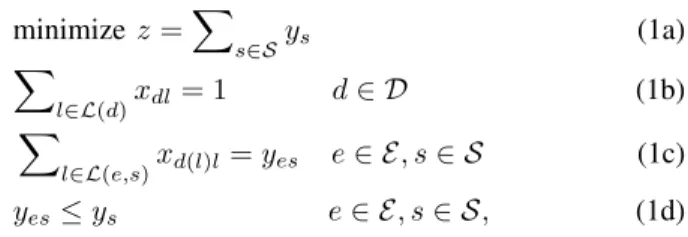
as follows: minimize z=X s∈Sys (1a) X l∈L(d)xdl= 1 d∈ D (1b) X l∈L(e,s)xd(l)l=yes e∈ E, s∈ S (1c) yes≤ys e∈ E, s∈ S, (1d)
where L(e, s) is the set of lightpaths routed through link e
and slice s, and d(l) is the demand realized by lightpath l. Optimization objective (1a) minimizes the number of the slices actually used (equal to the sum of variables ys). Constraint
(1b) assures that each demand will use exactly one lightpath from the set of allowable lightpaths. Constraint (1c) assures that there are no collisions of the assigned resources, i.e., no two lightpaths use the same slice on the same link. Finally, constraint (1d) defines variablesysthat indicate whether slice
sis used on at least one link.
In Section III, we will make use of the linear relaxation (referred to as LP) of (1). After getting rid of auxiliary variables yes, the relaxation can be written in the following
form: minimizezlb=X s∈Sys (2a) [λd] X l∈L(d)xdl= 1 d∈ D (2b) [πes≥0] X l∈L(e,s)xd(l)l≤ys e∈ E, s∈ S (2c) [σs≥0] ys≤1 s∈ S. (2d)
Above, all (primal) variablesysandxdl are non-negative and
continuous. Symbols λd, πes, σs denote the dual variables
associated with the respective constraints. In the following, the linear relaxation (2) will be called the master problem.
Fig. 1: A general framework of the branch-and-price algorithm for the RSA problem.
B. Solving MIP problems
Efficient solving of MIP formulations, such as (1), heav-ily relies on using professional general-purpose MIP solvers available on the market. The modern solvers often perform astonishingly efficient and outperform specialized computer programs implemented for specific problems. The solvers ap-ply sophisticated branching, bounding and cutting techniques in combination with extremely efficient linear programming solvers – all these techniques implemented within a standard BB method – and are constantly improved.
Improving the quality of MIP formulations and applying appropriately tailored decomposition techniques to MIP prob-lems can substantially improve the performance of optimiza-tion algorithms beyond the straightforward use of the solvers [22]. In particular, techniques such as adding valid inequalities (VE, called also cut generation) and column generation (CG) are of interest here. Adding VEs during the BB process leads to the so called branch-and-cut method while CG – to the so called branch-and-price method (combination of the two is called branch-and-cut-and-price method, see [28]). VEs are used to strengthen the MIP formulations and thus improving the lower bounds in the BB process while CG is required for generating paths in the so-called path-flow formulations of networks optimization problems.
Despite these promising developments, heuristic optimiza-tion methods are still important and even unavoidable for efficient solving MIP problems. Their importance is three-fold. First, heuristic methods usually do not require optimization solvers. Second, heuristics are able to deliver feasible solutions even for very large-scale networks in a reasonable time. Even though the so obtained solutions can be far from being optimal, they provide upper bounds for the optimal objective value. This is particularly valuable when exact solution methods are not available. Finally, heuristic solutions can speed up the exact BB algorithm just because they give the upper-bounding information in a short time.
III. BRANCH-AND-PRICE OPTIMIZATION ALGORITHM
In this section, we develop an optimization algorithm for problem (1). The algorithm is of the branch-and-price (BP) type, so it is a combination of the BB and CG methods (see Sec. II-B). In the BB method, a tree of linear subproblems, called restricted master problems (RMPs), related to the master problem is generated through a branching process. In partic-ular, at each BB node a subset of variables is bounded in the RMP by means of extra constraints. For a minimization problem (such as problem (1)), the optimal solution of each
RMP provides a lower bound (LB) for all the solutions below the considered BB node so it is used either to discard certain BB nodes or to update the upper bound (UB) whenever this solution happens to be integral (i.e., feasible for MIP).
Now, in BP each RMP is solved using a CG procedure. Namely, BP is initiated with a limited set of problem variables (columns) and at each node of the BB search tree, additional variables are generated and included into RMP. Since in large problems most columns are irrelevant for the problem (their corresponding variables equal zero in any optimal solution), the processing complexity can be decreased by excluding these columns from the formulation. Note that an unalterable (possibly complete) set of columns is included into each RMP in a standard BB method. Finally, to improve the BB search in BP, we implement additional procedures that aim at improving lower and upper bound of a solution.
The details of BP are presented in the following subsections. Due to space limitations, we restrict the formal description to the necessary minimum.
A. Branch-and-price framework
Letzlb andzub denote, respectively, a lower and an upper
(local) bound on the optimal solution that are estimated at a given BB node. Let zLB be the lowest lower bound among
all the nodes that are left for processing andzU B be the best
(global) upper bound found.
The optimization procedure starts with an initialization phase, in which an initial RSA solution is found using the heuristic described in Sec. III-D, and a master node of the BB tree is created. The initial solution is used to set upzub; thus,
also zU B, of the master node, and to determine the size of
set S, which is required for the RMP (see formulation (1)). Besides,zlb:=zLB:= 0 is assumed in the master node.
Next, at each BB node, the following actions are performed: 1) If zU B ≤zlb then discard the node.
2) Solve a relaxed problem (see Sec. III-C). If the solution is greater than zlb then updatezlb. If zU B ≤zlb then
discard the node.
3) Initialize RMP and solve it using CG (see Sec. III-B). If the solution of RMP is integral and lower than zU B
then update zU B and close the node. Otherwise, if the
solution is greater than zlb then updatezlb.
4) Search for a feasible RSA solution and its value zub
using a heuristic (see Sec. III-D). Ifzub< zU B then set
zU B :=zub. IfzU B =zlb then discard the node. 5) Create two child nodes by branching on selected
After either discarding or completing the node processing, a next node to be processed is selected (see Sec. III-F). The BB search is terminated whenever there are no nodes left for processing. The algorithm is illustrated in Fig. 1.
B. Solving RMP with column generation
At a BB node, the RMP is initiated with a set of allowable lightpaths L that either represent the initial RSA solution (in the master node) or have been used/generated at its parent node. This set is iteratively extended with new lightpaths that are provided by CG. A key element of CG is to formulate and solve a pricing problem (PP). Generally, PP concerns finding new lightpaths (whose respective variables xdl will form new
columns in the matrix formulation of problem (2)) not present in the current RMP formulation that, when included into RMP, will potentially improve objective function (2a) in the next CG iteration.
In order to define the pricing problem PP, we first formulate the problem dual to the LP relaxation (2), using the dual variables specified on the left-hand sides of constraints (2b)-(2d): maximizeP d∈Dλd−Ps∈Sσs (3a) P e∈Eπes≤1 +σs s∈ S (3b) λd−Pe∈E(l)( P s∈S(l)πes)≤0 d∈ D, l∈ L(d), (3c) where λd ∈ R, d ∈ D, πes ∈ R+, e ∈ E, s ∈ S, and σs ∈
R+, s∈ S. In (3c),E(l)andS(l)denote, respectively, the set of links and the set of slices used by lightpath l.
It can be shown that the left-hand side of (3c), i.e.,
λd−Pe∈E(l)(
P
s∈S(l)πes) (4)
represents the so-called reduced cost of primal variable xdl.
Let λ∗, π∗, σ∗ be the vectors representing an optimal dual solution obtained for the current RMP. Certainly, for such an optimal dual solution all the values (4) are non-positive. Nevertheless, there may be lightpaths outside of the set of lightpaths assumed for the current RMP that can have positive reduced cost for λ∗, π∗, σ∗, so that adding such paths to the problem can decrease the minimum value of the primal objective (2a) and thus to decrease the maximum value of the dual objective (3a) (recall that the values of the optimal primal and dual objectives are always equal to each other).
Consequently, PP is defined as a problem of finding, for each demand d∈ D, a new lightpath l for which its reduced cost (4) is positive (and the largest). When found, new variable
xdl representing this lightpath is included into the primal
problem. In our CG implementation, at each iteration and for each demand, we seek for and include into set L a lightpath with the largest positive reduced cost. If no such lightpath exists for all demands, the CG procedure terminates and the RMP is solved. For details the reader is referred to [25].
Observe that for a given demand d, the minuend of the reduced cost (i.e., λ∗d) is fixed for any lightpath re-alizing this demand. On the contrary, the subtrahend (i.e., P
e∈E(l)(
P
s∈S(l)πes)) depends on the lightpath l in hand.
Therefore, since in the pricing problem we are looking for a lightpath with a positive reduced cost, we just have to look for
a lightpath with the smallest value of the subtrahend. Noting thatπes represents the cost of using sliceson linke, the new
lightpath for demand dhas to be the cheapest (i.e., shortest) with respect to these costs. Note that after solving RMP, the optimal values of dual variables λ∗d and πes∗ are obtained directly from the LP solver, along with the optimal values of the primal variables; thus, the faced problem is simply the shortest path problem.
As discussed later in Sec. III-E, the lightpaths in the current L may not be permitted at some BB nodes as their corresponding variables xdl are set to0. Still, the lightpaths
corresponding to these variables can be solutions to PP. To alleviate this problem, we assume that the lightpaths have their routes restricted to a large predefined set ofP =S
d∈DP(d)
whereP(d)is the set of routes predefined for demandd. Then the lightpaths l that are considered for demand dat a given BB node are those withxdl>0 that have the route in P(d)
and the slots (appropriate for the selected route) formed from the set of slices that are not set to 0 in the considered BB node.
The above assumption regarding a predefined set of candi-date routes facilitates the search for a new lightpath l by PP in distance-adaptive EONs. Indeed, set E(l) is known once the route for l is set, and the feasible slots specified by set
S(l) can be easily enumerated. Denoting the set of all such feasible lighpaths byLc, we can easily calculate the reduced
cost (4) for eachl∈ Lc\Land select the best one. Note that
in [25] the frequency slot width is assumed to be fixed for each demand and the PP can be solved using a shortest path algorithm on a network graph putting κe = Ps∈S(l)πes as
the link metric. If distance-adaptive transmission is used, then the channel width depends on the (geographical length) of the routing path and the CG algorithm from [25] cannot be applied without appropriate adjustments.
Finally, note that z is integer in (1). Therefore, z ≥ dzlbe
holds. Since z represents the number of used slices in the network and we optimize the width of used spectrum, at least dzlbe consecutively indexed variables y
s should equal
1. Hence, we can strengthen the RMP with the following equalities:
ys= 1, s∈ {1,2, . . . ,dzlbe}.
Moreover, it is advantageous to add the following set of inequalities to (1):
ys≥ys+1, s∈ S \ {S}. (5)
Inequalities (5) force vectors y = (y1, y2, ..., yS) to be
non-increasing, i.e., of the form y = (1,1, ...,1,0,0, ...,0), and thus eliminate symmetric solutions (in terms ofy, for example solutions of the formy= (0,0, ...,0,1,1, ...,1)). At the same time, the dual problem to the accordingly modified linear relaxation (2) remains similar to (3), leading to the same pricing problem.
C. Improving lower bounds
Instead of using a linear relaxation of the problem (RMP) to obtain an LB it is generally more profitable to solve a
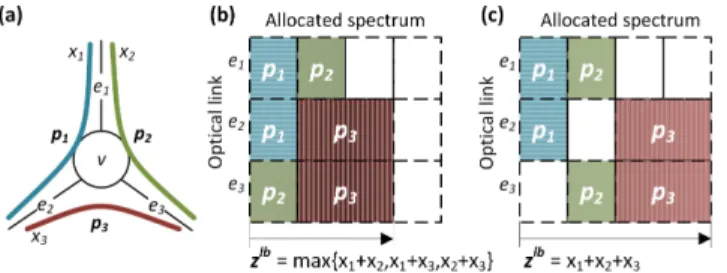
Fig. 2: Example of a clique of routes; (a) clique {p1, p2, p3}
with flows {x1, x2, x3} traversing links e1, e2, e3 adjacent to node v; (b) zlb obtained for the SC-relaxed problem (6); (c)
zlb for problem (6) enhanced with the clique cut (7).
simplified MIP problem that does not take spectrum continuity (SC) constraints into account. The problem can be formulated as follows: minimizezlb (6a) X p∈P(d)xdp= 1 d∈ D (6b) X p∈P(e)n(d(p), p)·xd(p)p≤z lb e∈ E, (6c)
where P(e) is the set of routes traversing link e, d(p) is the demand realized by path p, xdp is a binary variable that
indicates if allowable path p is used to realize demand d,
zlb expresses the (integer) number of slices required in the
most utilized link, and n(d, p) denotes the number of slices requested by demand don path p. The routing variables xdp
that correspond to restricted lightpaths (see Sec. III-E) are also restricted in problem (6).
The LB obtained using formulation (6) may be further improved if we assume that the SC constraint is preserved within a subset of routes. Namely, let clique κ ⊆ P denote such a subset of allowable routes that each pair of routes inκ
has at least one common link, i.e., pi∩pj 6=∅,∀pi, pj ∈κ.
Now let the SC constraint holds for all routes inκ, i.e., certain subsets of slices, unaltered in consecutive links, are allocated on those routes. Since the allocated spectrum cannot overlap in network links and each pair of routes in κ has at least one common link, these allocated subsets of slices must be disjoint. As a result, the LB on the number of used slices in the network (zlb) must be at least equal to the sum of slices
allocated on each route belonging to clique κ. Formally, this inequality can be expressed as:
X
p∈κn(d(p), p)·xd(p)p≤z lb,
(7) and it may improve the value of zlb when included into
formulation (6). We refer to inequality (7) as the clique cut. In Fig. 2(a), we show an exemplary clique of routes
{p1, p2, p3}traversing linkse1,e2, ande3adjacent to nodev. If SC is relaxed, the spectrum segments allocated on routes
p1,p2, andp3are not fixed, but they may vary in consecutive links, as it occurs on linkse1ande2 for routep2in Fig. 2(b). Consequently, zlb equals the sum of spectrum segments on the most loaded link, which is either e2 ore3. Now, if SC is preserved for the considered clique of routes, then they allocate pairwise not-overlapping segments of spectrum (see Fig. 2(c)).
As a result, zlb is limited by the sum of spectrum segments
of all the routes, according to the clique cut (7).
The total number of cliques existing in a given set of allowable routes P may be large and not all of them may be useful, i.e., some of them may not lead to the improvement of
zlbwhen included into formulation (6). For instance, each set
P(e) represents a clique but it appears already as constraint (6c) in formulation (6). As a counterexample, let E(v) be a subset of links adjacent to network nodev and of cardinality
|E(v)| = 3, and let clique κ(E(v)) be formed by the routes traversing any two links inE(v). As shown in the example in Fig. 2, cliqueκ(E(v))may improve zlb.
In this work, we generate a set of cliques κ(E(v)) by enumerating all the above defined subsetsE(v)for allv∈ V. Then we strengthen formulation (6) with the set of inequalities (7) representing these cliques. As shown in Sec. IV-A1, even using such a simple set of cliques may lead to better zlb
and may decrease the overall algorithm computation time for certain problem instances. The development of a general algorithm for dynamic clique generation is left for future studies.
D. Search for upper bound solutions
In each BB node, we run a greedy first-fit (FF) RSA algorithm that processes demands one-by-one, according to a given demand order, and allocates them with the lowest possible slice index (primary goal) and on the shortest routing path (secondary goal). The demand order is being optimized by applying a standard simulated annealing (SA) algorithm, in a similar way as in [29]. In such FF-SA heuristic, the FF procedure is capable of producing feasible RSA solutions quickly, while SA explores the feasible solution space in the search for (locally) optimal solutions. The obtained solutions provide UBs on the solution of problem (1).
The set of paths accessible to FF-SA consists of either:
• all allowable pathsP if FF-SA is run in the initialization
phase of BP, or
• a limited set of paths if FF-SA is run as a node heuristic.
The limited set of paths is being constructed during the processing of BB nodes. At each node, this set is inherited from the parent node and is expanded with: (a) routes found after solving the relaxed problem (6) and (b) routes that are active in the RMP solution and carry the whole traffic flow of their demands. The use of a limited set of paths decreases the complexity of FF-SA since a relatively smaller set of routes has to be processed when compared to the case in which all routes in P were accessible by the heuristic. As shown in Sec. IV-A, this approach is effective and it allows for decreasing the overall computation time of BP.
Finally, FF-SA obeys restrictions imposed on using selected routing paths and lightpaths (see Sec. III-E).
E. Branching
In the branching step, two child nodes (denoted asΩ0 and
Ω1) of the currently processed (parent) node are created. For a
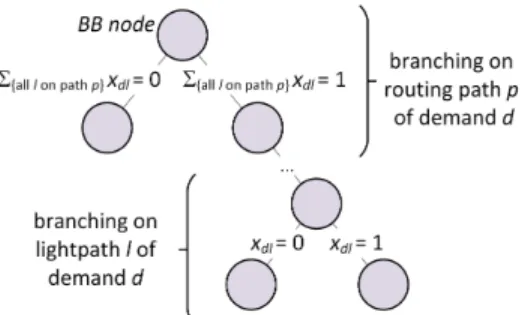
Fig. 3: Branching on a route and a lightpath.
(referred to as restricted) from the set of candidate lightpaths. For this demand, we enforce that only the restricted lightpaths can be used in Ω1 (i.e., they are imposed) and none of these
lightpaths can be used inΩ0(i.e., they are prohibited), as well
as in their descendants. The columns generated at the parent node are passed to the child nodes. Also, the values of zlb
andzubof the child nodes are initiated with the corresponding
values of the parent node.
We allow two kinds of branching, namely, for selected demand dwe impose/prohibit either (a) a routing path (b) a lightpath (see Fig. 3). In details, if case (a) is applied, then for demanddnone of the lightpaths routed through the branching path is allowed in Ω0 and, contrarily, only these lightpaths
can be used in Ω1. Formally, it is expressed as Pl∈L(p)xdl
equals to either 0 (in Ω0) or 1 (inΩ1) for branching path p
of demandd, whereL(p)is the set of lightpaths that use path
p. If case (b) is applied, then only the branching lightpath is allowable fordinΩ1(i.e.,xdl= 1) and this lightpath cannot
be used in Ω0 (i.e.,xdl = 0). In BP, we apply rule (a) until
each demand has its route restricted and next we use rule (b). We use the following procedure to select both the demand and its path/lightpath (for rule (a)/(b), respectively) on which branching is performed. First, we look for a link in the network which has the highest number of both shared and under-utilized slices in the optimal solution to RMP. The branching path/lightpath is the one carrying the largest flow through that link in the RMP solution. If there are more such paths/lightpaths, one with the largest number of hops is selected. Eventually, the branching demand is the one related to that path/lightpath.
F. Node selection
A BB node to be processed is selected (arbitrarily) among the so-far generated nodes for which zlb =zLB (a primary
condition), the improvement in zub in the two preceding
ancestor nodes is the largest (secondary condition), and zub
is minimal (tertiary condition).
IV. NUMERICAL RESULTS
In this section, we evaluate the BP algorithm in two national size networks, namely, a generic German network of12nodes and20links (DT12) and a generic British network of22nodes and35links (BT22), as well as in a European network of28 nodes and41 links (EURO28), presented in Fig. 4.
Fig. 4: Network topologies: DT12, BT22, and EURO28; data center nodesv1, v2, v3, v4 marked in BT22.
We assume the flexgrid of12.5GHz granularity. The trans-mission is bi-directional and realized using SChs and polar-ization division multiplexing. An SCh consists of a number of OCs, each OC occupying37.5GHz, and a guard-band of12.5 GHz. For OCs, we consider three modulation formats: BPSK, QPSK, and 16QAM, of the transmission reach 3400, 2000, and 500 km [30], and the carried bit-rate 50, 100, and 200 Gbit/s per OC, respectively. We consider that the OCs forming an SCh use the same modulation format. The aggregated capacity of an SCh is assumed to be either 100, 200, or 400Gbit/s; e.g., a long-range200 Gbit/s SCh is composed of four BPSK-modulated OCs. To generate allowable paths, we apply a k-shortest path algorithm withk= 30(per demand), and we exclude the paths of length exceeding the maximum transmission reach.
As in similar works on that topic (e.g., [8], [7]), our focus is on optimizing the spectrum width required to allocate a certain set of traffic demands. Traffic demands are symmetric with randomly generated end nodes and uniformly distributed bit-rates between10and400Gbit/s. Since in this work we do not assume signal regeneration, we consider the end node pairs with at least one allowable route between them. The evaluated number of demands|D| ∈ {50,60,80,100,150,200}, for each
|D|we evaluate10demand sets, and the results are averaged if not mentioned differently. The demands are unicast (one-to-one), apart from the last set of experiments, in which anycast (one-to-nearest) traffic is studied.
As a reference, we use a standard BB method of CPLEX v.12.5.1applied to problem (1). CPLEX is run with its default settings (all types of cuts and heuristics enabled) and in a par-allel mode (8threads). CPLEX in paraller mode is also used in BP, as an LP solver in column generation (see Sec. III-B) and as an MIP solver in the search for lower bounds (see Sec. III-C). The rest of procedures of BP, such as processing of BB nodes and heuristics, are run in a sequential way (1 thread). The algorithms are implemented in C++. Numerical experiments are performed on a 2.7 GHz i7-class machine with8GB RAM. We set a1-hour run-time limit. To find the number o slicesS, we run the FF-SA heuristic, as described in Sec. III. We report among others: processing times (T, in sec.), best solutions found (zU B), lower bounds (zLB), optimality gaps calculated as∆ = zU B−zLB
TABLE II: Comparison of lower bounds in selected problem instances (i1,i2,i3) in EURO28; TBP in seconds.
RMP MIP MIP&cuts
|D| zLB TBP zLB TBP zLB TBP zU B i1 50 117.667 3600 118 78 120 58 120
i2 100 242.879 3600 246 115 251 64 251
i3 100 245.667 3600 246 3600 247 1111 247
TABLE III: BP performance (averaged, in BT22) for FF-SA using either all allowable paths P or a limited set of paths.
FF-SA(P) FF-SA (a limited set of paths)
|D| TBP ∆ kheur TBP ∆ kheur 60 500 0.14% 30 74 0% 1.56 80 506 0.34% 30 206 0% 1.56 100 614 0% 30 144 0% 1.73 150 3478 0.55% 30 933 0.12% 1.78 A. Effectiveness of BP procedures
We begin with evaluating the effectiveness of the BP pro-cedures that estimate solution lower and upper bounds.
1) Lower bounds: In Table II, we compare the LBs ob-tained in a master node after solving: (a) RMP, (b) SC-relaxed MIP problem (i.e., problem (6)), and (c) MIP problem (6) facilitated with clique cuts (i.e., inequality (7)), for three selected problem instances (denoted asi1,i2,i3). We can see that the objective value of the RMP (zLB) is the lowest, while the use of MIP and cuts allows for a better LB estimation. Consequently, thezLB values are closer to upper bound
solu-tions (zU B) and the computation times (TBP) are significantly
reduced. Finally, we report that in 90% of evaluated problem instances in EURO28, LB estimation methods (b) and (c) have provided the same LBs.
2) Upper bounds: Here, we evaluate the FF-SA node heuristic. In particular, we analyze the impact of having a limited set of routing paths accessible for the heuristic (this set is defined in Sec. III-D) on the overall BP performance. In a reference scenario, we assume that the complete set of allowable paths |P|is accessible for FF-SA.
In Table III, we can see that the use of a limited set of paths in FF-SA, instead of the complete set |P|, improves considerably the average BP run-time (TBP). Note that this
limited set, being constructed during BP execution, consists of less than 2 paths per demand on average (kheur). It is much
less than in the reference scenario in which kheur = 30. In Table III, we also show average optimality gap ∆. If∆≥0, then it means that some problem instances could not be solved within the given 1-hour run-time limit. As we can see, there are much more such cases in the reference scenario than in a scenario in which a limited set of paths is used. Eventually, we would like to report that BP has been able to solve some small problem instances (DT12, |D| ≤ 20) without using a node heuristic.
B. Branch-and-bound vs. branch-and-price
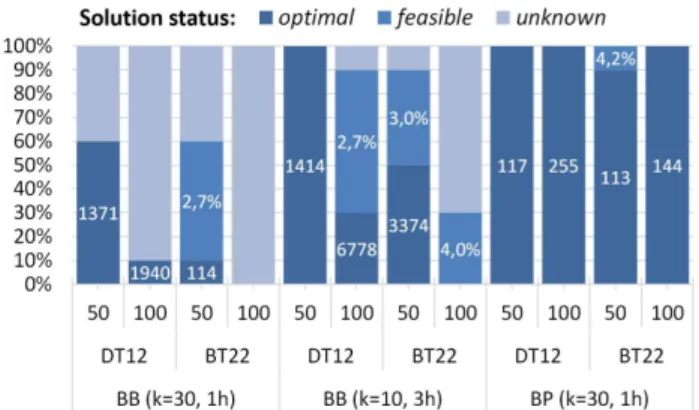
Next, we compare BP with a standard BB method of CPLEX. In Fig. 5, we can see that BP has been able to solve
Fig. 5: Status of RSA solutions obtained with BB (CPLEX) and BP; the value on bars corresponds either to the average computation time (foroptimal) or optimality gap (forfeasible).
TABLE IV: The size of RSA problem instances (averaged), in terms of the number of integer variables and constraints, for unicast demands andk∈ {10,30}of allowable routing paths.
variables constraints |D| k= 10 k= 30 k= 10 k= 30 DT12 50 35854 99870 3122 3094 100 143790 411280 6048 6044 200 606104 1738912 12524 12484 BT22 50 34315 95682 5006 4957 100 137381 398672 9865 9837 200 554845 1635236 19772 19716 EURO28 100 162457 203087 19608 19608 150 384502 485315 30375 30326
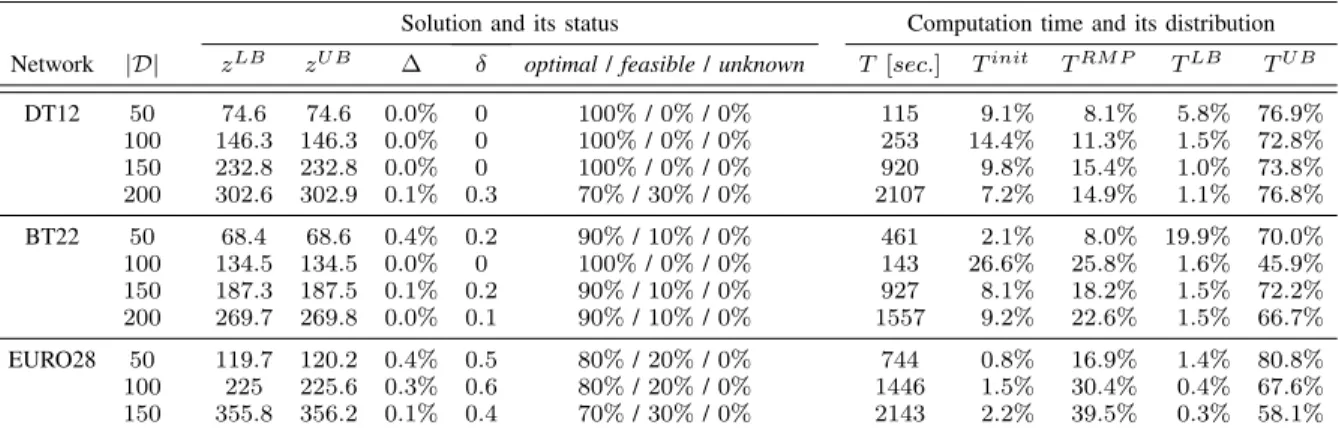
almost98% (39 out of 40) of analyzed problem instances in DT12 and BT22 networks and|D| ∈ {50,100}. At the same time, BB has not found any feasible solution in almost 68% of problem instances (unknownsolution status in Fig. 5). As shown in Table IV, these problem instances may consist of over 400000 integer variables and almost 10000 constraints. Even after both increasing the run-time limit (3 hours) and reducing the set of allowable paths (k= 10per demand); thus, reducing the size of problem instances (see Table IV), BB has difficulties with producing optimal solutions. Moreover, the average time to find an optimal solution in BP is at least one order of magnitude lower than that in BB. The problem instances consisting of over 1.6 million integer variables and about 20000 constraints, as for |D| = 200, k = 30 in BT22, have made CPLEX run out of memory. Eventually, for BP and |D| = 100 the average computation times are surprisingly higher in DT12 than in larger BT22 network. To explain this phenomenon, we may have to analyze detailed computation time results shown in Table V. In the discussed scenario, the overall time spent by the RSA node heuristic in the search for upper bound solutions (TU B) is much higher in DT12 than in BT22 (we have 72.8%·253sec.≈184sec.
vs. 45.9%·143sec. ≈ 65sec.). Such algorithm performance may result from both the availability of a larger number of links in BT22, and hence relatively smaller chance of conflicts when allocating spectrum resources to demands, and a smaller
TABLE V: BP performance – detailed results.
Solution and its status Computation time and its distribution Network |D| zLB zU B ∆ δ optimal/feasible/unknown T [sec.] Tinit TRM P TLB TU B
DT12 50 74.6 74.6 0.0% 0 100%/0%/0% 115 9.1% 8.1% 5.8% 76.9% 100 146.3 146.3 0.0% 0 100%/0%/0% 253 14.4% 11.3% 1.5% 72.8% 150 232.8 232.8 0.0% 0 100%/0%/0% 920 9.8% 15.4% 1.0% 73.8% 200 302.6 302.9 0.1% 0.3 70%/30%/0% 2107 7.2% 14.9% 1.1% 76.8% BT22 50 68.4 68.6 0.4% 0.2 90%/10%/0% 461 2.1% 8.0% 19.9% 70.0% 100 134.5 134.5 0.0% 0 100%/0%/0% 143 26.6% 25.8% 1.6% 45.9% 150 187.3 187.5 0.1% 0.2 90%/10%/0% 927 8.1% 18.2% 1.5% 72.2% 200 269.7 269.8 0.0% 0.1 90%/10%/0% 1557 9.2% 22.6% 1.5% 66.7% EURO28 50 119.7 120.2 0.4% 0.5 80%/20%/0% 744 0.8% 16.9% 1.4% 80.8% 100 225 225.6 0.3% 0.6 80%/20%/0% 1446 1.5% 30.4% 0.4% 67.6% 150 355.8 356.2 0.1% 0.4 70%/30%/0% 2143 2.2% 39.5% 0.3% 58.1%
TABLE VI: BP with anycast demands in BT22.
DCs |D| zLB zU B ∆ δ T 2 50 33.2 33.3 0.3% 0.1 362 80 51.8 51.8 0% 0 55 100 62.7 62.7 0% 0 310 150 96.7 96.8 0.1% 0.1 1001 3 50 23.8 23.8 0% 0 6 100 45 45 0% 0 47
number of slices that are subject to processing (comparezU B
for DT12 and BT22 in Table V).
C. Analysis of BP performance
Now, we analyse the performance of BP in details in all three networks. In Table V, we can see that the average LB (zLB) and UB (zU B) values are either equal or very close, and the relative optimality gap (∆) is near to0%. In practice, the average absolute difference between zU B and zLB (δ) is well below1frequency slice, even for large problem instances that utilize almost the whole available spectrum in network links (i.e., for zU B close to 320 slices) and involve over1.7
million integer variables (see |D| = 200, k = 30 for DT12 in Table IV). The percentage of optimal solutions is high (at least70%) and always a feasible solution is found. The average algorithm computation time (T) is between115and2200 sec-onds, depending on the number of demands. The estimation of LBs by solving MIP problem (6), especially for larger problem instances, takes a small percentage of time (TLB ≈1−2%).
On the contrary, searching for UB solutions is the most time consuming procedure of BP (TU B≈60−80%). Solving RMP may require TRM P ≈15−35% of the algorithm time. The initialization phase, which among others includes the search for an initial solution using FF-SA, takes between some to several percents of the BP time (Tinit≤10%in most cases). D. Anycast traffic demands
Finally, we evaluate BP in an EON with anycast traffic demands. Anycasting is used, among others, in content-deliver networks, in which certain content is replicated in a number of data centers (DCs). Similarly as in [12], we consider that lightpath connections deliver the requested (aggregated) content from DC to client nodes. The flexibility of anycasting
in selecting a most convenient DC to which a lightpath is established, involves a large set of allowable routes/lightpaths, which may increase the RSA problem complexity. The eval-uation is performed in BT22 for: (a)2 DCs located in nodes
v1 and v3, and (b) 3 DCs located in nodes v1, v2, and v4, as shown in Fig. 4. Traffic demands are randomly generated, as described at the beginning of this section. In Table VI, we can see that BP has been able to solve almost all considered problem instances (58 out of 60), and only for remaining 2 problem instances (for 2 DCs and |D| ∈ {50,150}) near-optimal solutions have been found with the absolute difference between zU B and zLB (δ) being equal to only 1 frequency
slice. Eventually, we can see that both spectrum requirements (zU B) and algorithm computation time (T) decrease if more
DCs are available in the network.
V. CONCLUDING REMARKS
We have presented a branch-and-price optimization algo-rithm for the routing and spectrum allocation problem in distance-adaptive elastic optical networks. We have shown that an appropriate use of advanced mathematical programming methods and dedicated optimization procedures allows to produce optimal and near-optimal solutions to large RSA problem instances. The performance of BP might be further improved by implementing parallel processing of its BB nodes and its heuristics, as well as by using other types of cuts and heuristics, for instance, those implemented in CPLEX.
REFERENCES
[1] M. Klinkowski, M. Pi´oro, M. ˙Zotkiewicz, K. Walkowiak, M. Ruiz, and L. Velasco, “Spectrum allocation problem in elastic optical networks - a branch-and-price approach,” in Proc. of IEEE ICTON, Budapest, Hungary, 2015.
[2] O. Gerstel, M. Jinno, A. Lord, and S. J. B. Yoo, “Elastic optical networking: A new dawn for the optical layer?” IEEE Comm. Mag., vol. 50, no. 2, pp. 12–20, Feb. 2012.
[3] M. Klinkowski, M. Ruiz, L. Velasco, D. Careglio, V. Lopez, and J. Comellas, “Elastic spectrum allocation for time-varying traffic in flexgrid optical networks,” J. of Sel. Areas in Comm., vol. 31, no. 1, pp. 26–38, 2013.
[4] M. Ruiz, L. Velasco, A. Lord, D. Fonseca, M. Pi´oro, R. Wessaly, and J. Fernandez-Palacios, “Planning fixed to flexgrid gradual migration: Drivers and open issues,”IEEE Comm. Mag., vol. 52, no. 1, pp. 70–76, 2014.
[5] M. Jinno, B. Kozicki, H. Takara, A. Watanabe, Y. Sone, T. Tanaka, and A. Hirano, “Distance-adaptive spectrum resource allocation in spectrum-sliced elastic optical path network,”IEEE Comm. Mag., vol. 48, no. 8, pp. 138–145, Aug. 2010.
[6] M.-F. Huang, A. Tanaka, E. Ip, Y.-K. Huang, D. Qian, Y. Zhang, S. Zhang, P. Ji, I. Djordjevic, T. Wang, Y. Aono, S. Murakami, T. Tajima, T. Xia, and G. Wellbrock, “Terabit/s Nyquist superchannels in high capacity fiber field trials using DP-16QAM and DP-8QAM modulation formats,”IEEE J. Lightw. Technol., vol. 32, no. 4, p. 776782, 2014. [7] K. Christodoulopoulos, I. Tomkos, and E. Varvarigos, “Elastic
band-width allocation in flexible OFDM based optical networks,” IEEE J. Lightw. Technol., vol. 29, no. 9, pp. 1354–1366, 2011.
[8] M. Klinkowski and K. Walkowiak, “Routing and spectrum assignment in spectrum sliced elastic optical path network,”IEEE Commun. Lett., vol. 15, no. 8, pp. 884–886, Aug. 2011.
[9] S. Talebi, E. Bampis, G. Lucarelli, I. Katib, and G. N. Rouskas, “Spectrum assignment in optical networks: A multiprocessor scheduling perspective,”IEEE/OSA J. of Opt. Commun. and Netw., vol. 6, no. 8, pp. 754–763, 2014.
[10] L. Velasco, A. Castro, M. Ruiz, and G. Junyent, “Solving routing and spectrum allocation related optimization problems: from off-line to in-operation flexgrid network planning,”IEEE J. Lightw. Technol., vol. 32, no. 16, pp. 2780–2795, 2014.
[11] M. Klinkowski, “An evolutionary algorithm approach for dedicated path protection problem in elastic optical networks,”Cybernetics and Systems, vol. 44, no. 6-7, pp. 589–605, 2013.
[12] R. Go´scie´n, K. Walkowiak, and M. Klinkowski, “Tabu search algorithm for routing, modulation and spectrum allocation in elastic optical net-work with anycast and unicast traffic,”Com. Net., vol. 79, pp. 148–165, 2015.
[13] K. Walkowiak, M. Klinkowski, B. Rabiega, and R. R. Go´scie´n, “Routing and spectrum allocation algorithms for elastic optical networks with dedicated path protection,”Opt. Switch. and Network., vol. 13, pp. 63– 75, July 2014.
[14] IBM, “ILOG CPLEX optimizer,” 2015, http://www.ibm.com. [15] S. Shirazipourazad, C. Zhou, Z. Derakhshandeh, and A. Sen, “On routing
and spectrum allocation in spectrum-sliced optical networks,” inProc. of IEEE INFOCOM, Turin, Italy, Apr. 2013, p. 385389.
[16] A. Cai, G. Shen, L. Peng, and M. Zukerman, “Novel node-arc model and multiiteration heuristics for static routing and spectrum assignment in elastic optical networks,”IEEE J. Lightw. Technol., vol. 31, no. 21, pp. 3402–3413, 2013.
[17] M. Tornatore, C. Rottondi, R. Go´scie´n, K. Walkowiak, G. Rizzelli, and A. Morea, “On the complexity of RSA in flexible-grid ring networks,”
IEEE/OSA J. of Opt. Commun. and Netw., vol. 7, no. 2, pp. A256–A267, 2015.
[18] L. Velasco, M. Klinkowski, M. Ruiz, and J. Comellas, “Modeling the routing and spectrum allocation problem for flexgrid optical networks,”
Phot. Netw. Commun., vol. 24, no. 3, pp. 177–186, 2012.
[19] R. Go´scie´n, K. Walkowiak, and M. Klinkowski, “ILP modelling and joint optimization of anycast and unicast traffic in survivable elastic optical networks,” inProc. of INOC, Warsaw, Poland, May 2015. [20] K. Walkowiak, R. Go´scie´n, and M. Klinkowski, “Optimization of
multicast traffic in elastic optical networks with distance-adaptive trans-mission,”IEEE Commun. Lett., vol. 18, no. 12, pp. 2117–2120, 2014. [21] S. Talebi, F. Alam, I. Katib, and G. N. Rouskas, “Spectrum management
techniques for elastic optical networks: A survey,” Opt. Switch. and Netw., vol. 13, pp. 34–48, July 2014.
[22] L. Lasdon,Optimization Theory for Large Systems. MacMillan, New York, 1970.
[23] B. Jaumard, C. Meyerb, and B. Thiongane, “On column generation formulations for the RWA problem,”Discrete. Appl. Math., vol. 157, pp. 1291–1308, 2009.
[24] A. Koster, S. Orlowski, C. Raack, G. Bayer, and T. Engel, “Single-layer cuts for multi-layer network design problems,” inTelecommunications Modeling, Policy, and Technology, S. Raghavanet al., Eds. Springer, 2008.
[25] M. Ruiz, M. Pi´oro, M. ˙Zotkiewicz, M. Klinkowski, and L. Velasco, “Column generation algorithm for RSA problems in flexgrid optical networks,”Phot. Netw. Commun., vol. 26, no. 2-3, pp. 53–64, 2013. [26] M. ˙Zotkiewicz, M. Ruiz, M. Klinkowski, M. Pi´oro, and L. Velasco,
“Reoptimization of dynamic flexgrid optical networks after link failure repairs,”IEEE/OSA J. of Opt. Commun. and Netw., vol. 7, no. 1, pp. 49–61, 2015.
[27] M. Klinkowski, M. Pi´oro, M. ˙Zotkiewicz, M. Ruiz, and L. Velasco, “Valid inequalities for the routing and spectrum allocation problem in elastic optical networks,” inProc. of IEEE ICTON, Graz, Austria, 2014.
[28] M. Pi´oro, “Network optimization techniques,” inMathematical Founda-tions of Signal Processing, CommunicaFounda-tions, and Networking, E. Ser-pedin, T. Chen, and D. Rajan, Eds. CRC Press, 2012, ch. 18. [29] M. Klinkowski and K. Walkowiak, “A simulated annealing heuristic for
a branch and price-based routing and spectrum allocation algorithm in elastic optical networks,” inProc. of IDEAL, Wroclaw, Poland, 2015. [30] G. Bosco, V. Curri, A. Carena, P. Poggiolini, and F. Forghieri, “On
the performance of Nyquist-WDM terabit superchannels based on PM-BPSK, PM-QPSK, PM-8QAM or PM-16QAM subcarriers,” IEEE J. Lightw. Technol., vol. 29, no. 1, p. 5361, 2011.