Topological Order and Universal Properties
of Gapped Quantum Systems
by
Heidar Moradi
A thesis
presented to the University of Waterloo in fulfillment of the
thesis requirement for the degree of Doctor of Philosophy
in Physics
Waterloo, Ontario, Canada, 2018
c
Examining Committee Membership
The following served on the Examining Committee for this thesis. The decision of the Examining Committee is by majority vote.
External Examiner: Marcel Franz
Professor, Dept. of Physics, University of British Columbia
Supervisor(s): Xiao-Gang Wen
Professor, Dept. of Physics, Massachusetts Institute of Technology Roger Melko
Professor, Dept. of Physics, University of Waterloo
Internal Member: Anton Burkov
Professor, Dept. of Physics, University of Waterloo Davide Gaiotto
Professor, Perimeter Institute, University of Waterloo
Internal-External Member: Jon Yard
This thesis consists of material all of which I authored or co-authored: see Statement of Contributions included in the thesis. This is a true copy of the thesis, including any required final revisions, as accepted by my examiners.
Statement of Contributions
Chapter 2 of this thesis consists of material from the paper [1], co-authored with Xiao-Gang Wen.
Chapter3 of this thesis consists of material from the paper [2], co-authored with Huan He and Xiao-Gang Wen.
Chapter 4 of this thesis consists of material from the paper [3], co-authored with Xiao-Gang Wen.
Chapter 5 of this thesis consists of material from the paper [4], co-authored with Wen Wei Ho, Lukasz Cincio, Davide Gaiotto, and Guifre Vidal.
Chapter 6 of this thesis consists of material from the paper [5], co-authored with Wen Wei Ho, Lukasz Cincio and Guifre Vidal.
Chapter 7 of this thesis consists of unpublished material [6], co-authored with Wen Wei Ho.
Abstract
Phases of gapped quantum liquids are topologically ordered and have very interesting physical features that are completely robust against any local perturbation that do not close the bulk energy gap. These universal properties are hidden in the ground states of these systems, as different patterns of many-body long-range entanglement. In this thesis we study the universal properties of gapped quantum liquids from various perspec-tives. We propose the notion of Universal Wavefunction Overlap as a way of extracting almost complete information about the underlying entanglement structure in a system with topological order. We propose an efficient numerical methods to use these universal wavefunction overlaps as topological order parameters and demonstrate their usefulness with concrete numerical computations. In 2 + 1D these overlaps correspond to known quantities and contain information about anyonic particle excitations. We show that in 3 + 1D, these overlaps contain information about linked multi-string braiding processes, in particular three-string braiding.
In the second part of this thesis, we study boundary physics of systems with topological order. We investigate the correspondence between edge and entanglement spectra for non-chiral topological systems in general and with the presence of extra symmetries and dualities. We also show that by local deformations of the fixed-point wavefunction on non-chiral topological orders, all possible edge theories can be extracted from its entanglement Hamiltonian. Finally we introduce the notion of fermionic gapped boundary and see how the phase diagram of the simplest topological orders get enriched.
Acknowledgements
I would like to thank my supervisor Xiao-Gang Wen for his supervision, patience, constant support and understanding, even during hard personal times. I have been very fortunate to have had the opportunity to learn from a physicist of his caliber. His deep physical intuition is unmatched, and his enthusiasm and encouragement has benefited me a great deal. I also would like to give a very special thank you to Guifre Vidal for his collaborations, encouragement, humor and personal support when I needed it the most.
During my time at the Perimeter Institute no collaboration was closer than the one with Wen Wei Ho. We have spent countless hours on blackboards discussing physics, leaving no question undiscussed and in the process learned and developed a tremendous amount. I also would like to thank my other collaborators Huan He, Davide Gaiotto, Lukasz Cincio, Faroogh Moosavian and Apoorv Tiwari.
Very importantly I would like to thank Roger Melko as my co-supervisor for making sure that my absentmindedness did not get in the way of fulfilling the formal requirements of the university. Roger Melko, Davide Gaiotto and Anton Burkov deserve thanks for valuable advice and feedback during commitee meetings and the defence of this thesis.
I am very thankful to Marcel Franz, the external examiner of this thesis, for the time spent reading this thesis carefully and asking interesting questions during the defence.
Finally I am very grateful to the Perimeter Institute for providing a wonderful work enviroment and to all the good friends that made my time there special.
Dedication
Table of Contents
List of Tables xiii
List of Figures xiv
1 Introduction 1
1.1 Gapped Quantum Systems . . . 2
1.2 Gapped Quantum Liquids . . . 5
1.3 Long-Range Entanglement . . . 7
1.3.1 Topological Entanglement Entropy . . . 8
1.3.2 Local Indistinguishability and the Mapping Class Group . . . 9
1.4 Topological Excitations . . . 11
1.4.1 Topological Types and Fusion . . . 12
1.4.2 Braiding . . . 16
1.4.3 Excitations in 3+1D . . . 19
1.4.4 Bosonic vs Fermionic Locality . . . 21
1.5 Boundary Physics . . . 22
1.5.1 Chiral and Invertible Topological Order . . . 23
1.5.2 Non-Chiral Topological Order and Gappable Boundaries . . . 25
2 Universal Wave Function Overlap and Universal Topological Data from
Generic Gapped Ground States 30
2.1 Introduction . . . 30
2.2 Construction of degenerate set of ground states from local tensor networks 33 2.3 ZN Topological Order. . . 35
2.3.1 Modular S and T-matrix from the ground state . . . 36
2.3.2 Perturbed ZN model . . . 37
2.4 3D Topological States and SL(3,Z) . . . 39
2.5 Conclusion . . . 39
Appendices . . . 41
2.A Appendix A: Cumulant Expansion . . . 41
2.B Appendix B: Mapping Class Groups. . . 44
3 Modular Matrices as Topological Order Parameter by Gauge Symmetry Preserved Tensor Renormalization Approach 47 3.1 Introduction . . . 47
3.2 Review of Modular Matrices . . . 49
3.3 Review of Tensor Renormalization Group . . . 49
3.4 Modular Matrices by Gauge-Symmetry Preserved Tensor Renormalization Group . . . 50
3.5 Modular Matrices for Z2 topological order . . . 53
3.6 Modular Matrices for Double-semion model . . . 55
3.7 Conclusion . . . 57
Appendices . . . 59
3.A Appendix A: Robustness of modular matrices under Z2 perturbations . . . 59
4 Universal Topological Data for Gapped Quantum Liquids in Three Di-mensions and Fusion Algebra for Non-Abelian String Excitations 62
4.1 Introduction . . . 62
4.2 ZN Model in 3-Dimensions . . . 64
4.3 Representations of MCG(T3) = SL(3,Z) . . . . 70
4.4 Quantum Double Models in Three-Dimensions . . . 75
4.4.1 Ground states on T3 . . . . 76
4.4.2 3D S˜ and ˜T matrices and theSL(2,Z) subgroup . . . 77
4.4.3 Branching Rules and Dimensional Reduction . . . 78
4.5 Example: G=S3 . . . 79
4.5.1 Two-Dimensional D(S3) . . . 79
4.5.2 Three-Dimensional G=S3 Model . . . 80
4.6 Some general considerations . . . 85
4.7 Conclusion . . . 85
5 Edge-Entanglement Spectrum Correspondence in a Nonchiral Topologi-cal Phase and Kramers-Wannier duality 87 5.1 Introduction . . . 87
5.1.1 Entanglement spectrum and edge-ES correspondence . . . 87
5.1.2 Edge-ES correspondence in non-chiral topological order . . . 88
5.1.3 Structure of chapter . . . 90
5.2 Exact Wen-plaquette model . . . 91
5.2.1 Edge theory on semi-infinite cylinder . . . 91
5.2.2 Entanglement spectrum . . . 94
5.2.3 Edge-ES correspondece . . . 97
5.3 Perturbed Wen-plaquette model . . . 98
5.3.1 Mathematical preliminaries: Schrieffer-Wolff transformation . . . . 99
5.3.3 Entanglement spectrum . . . 102
5.3.4 Edge-ES correspondence . . . 107
5.3.5 Remarks . . . 108
5.4 Mechanism for correspondence: Translational symmetry and Kramers-Wannier duality . . . 108
5.4.1 Analytical example: uniform single-site magnetic fields . . . 112
5.4.2 Numerical example: uniform single-site magnetic fields . . . 113
5.5 Conclusion and discussion . . . 118
Appendices . . . 119
5.A Schrieffer-Wolff transformation. . . 119
5.B Calculation of Λ0 of the entanglement spectrum . . . 121
5.C Derivation ofHa edge,L and Hent.a for uniform magnetic fields as perturbations 127 5.C.1 Calculation of Ha edge,L . . . 127
5.C.2 Calculation of Ha ent. . . 129
6 Universal Edge Information from Wave Function Deformation 134 6.1 Introduction . . . 134
6.2 Example: Wen-plaquette model . . . 136
6.2.1 Edge theories of Wen-plaquette model, revisited . . . 137
6.2.2 Edge theories of Wen-plaquette model from wave-function deformation140 6.3 General argument for nonchiral topological phases . . . 142
6.3.1 Edge Hamiltonian . . . 143
6.3.2 Entanglement Hamiltonian of deformed FPW . . . 145
6.4 Discussion and conclusion . . . 147
7 Fermionic gapped edges in bosonic abelian topological states via fermion
condensation 152
7.1 Introduction . . . 152
7.2 Topological order and gapped edges . . . 155
7.2.1 Characterization of topological order . . . 155
7.2.2 Gapped edges . . . 157
7.3 Fermionic gapped edge . . . 159
7.3.1 Lagrangian subgroup formalism and fermion condensation . . . 159
7.3.2 Modular invariance formalism . . . 162
7.4 Examples . . . 163
7.4.1 Z2 topological order. . . 163
7.4.2 ZN topological order . . . 164
7.4.3 Ising×Ising . . . 165
7.5 Microscopic model: Z2 Wen-plaquette model . . . 165
7.5.1 Model . . . 166
7.5.2 Rationale for model . . . 169
7.5.3 Analysis of model . . . 173
7.5.4 Numerics . . . 179
7.5.5 Anyonic symmetry and Kramers-Wannier dualities . . . 183
7.6 Conclusion . . . 185
List of Tables
4.4.1 Fusion rules of two-dimensional D(S3) model. . . 79
List of Figures
1.1 Energy spectrum of Gapped Quantum Systems in the thermodynamic limit. 3
1.2 Space of Gapped Quantum Liquids. . . 4
1.3 Diagram showing the equivalence relation between two stable gapped quan-tum liquids. . . 6
1.4 Fusion rules and splitting of energy degeneracy. . . 13
1.5 Linked string configuration with strings of type a, b, c, . . . threaded by a string of type X. . . 21
2.1 Tensor networks and intrinsic gauge structure. . . 35
2.2 S and T transformations on lattice. . . 37
2.3 Action of mapping class group of 2-torus in the string-net basis. . . 38
2.B.1Effects of automorphism locally. . . 45
2.B.2Examples of topologically trivial and non-trivial automorphisms. . . 45
3.3.1 Illustration for Symmetry Preserved Tensor Renormalization Group . . . . 51
3.4.1 Modular matrices from fixed point double tensors. . . 53
3.5.1 Detecting phase-transitions between different topological phases from nu-merical computation of modular matrices S and T. . . 54
3.5.2 Tensor network for ground state wave function of the Double Semion model. 55 3.A.1Phase diagram under perturbation . . . 60
B.1 Illustration of gauge-symmetry preserved simple update. . . 61
4.2.2 Non-contractible line and surface operators on the 3-torus. . . 67
4.2.3 Particle and string excitations on the lattice from boundaries of line and surface operators. . . 69
4.3.1 Graphical construction and illustration of the minimum entropy states (MES). 71
4.3.2 Action of 3-torus Dehn-twists and particle-string statistics. . . 73
4.5.1 Three string configuration, where two loops of type band care threaded by a string of type a. . . 81
5.2.1 Plaquette operators on the semi-infinite cylinder. . . 92
5.2.2 Mapping infinite cylinder with entanglement cut to a spin-ladder system. . 95
5.3.1 Degenerate perturbation theory and the Schrieffer-Wolff transformation.. . 104
5.4.1 Entanglement spectrum of various topological sectors and Ising CFT pri-mary fields. . . 114
5.4.2 Entanglement spectrum with anyonic twist-defect and the CFT spectrum of the duality-twisted Ising model.. . . 115
6.2.1 The infinite cylinder on which the Wen-plaquette model is defined on, with the bipartition into two semi-infinite cylinders L and R. . . 137
6.2.2 TheLsemi-infinite cylinder with boundary and the numerical computation of W(h). . . 139
7.2.1 Topological ambiguity of mutual-statistics in the presence of local fermions. 156
7.5.1 Coupling boundary of topological order on a semi-infinite lattice with a Majorana fermionic chain. . . 167
7.5.2 Movement and condensation of quasiparticles. . . 170
7.5.3 Boundary operators that measure condensation of quasiparticles. . . 172
7.5.4 Projection of upper quadrant of the unit sphereS2 onto the planex+y+z =
1 which gives an equilateral triangle. . . 176
7.5.5 Boundary phase diagram, dualities, RG flows and critical lines. . . 177
7.5.6 Contour plot of the order parameterhOei for a system with open boundary conditions using DMRG. . . 180
7.5.7 Contour plot of the order parameterhOf1ifor a system with open boundary
conditions using DMRG. . . 181
7.5.8 Computing central charge from entanglement scaling along critical lines us-ing DMRG. . . 182
Chapter 1
Introduction
Much of condensed matter physics and high energy physics has arguably developed on drastically opposite philosophical foundations. High energy physics, in particular particle physics, has succesfully developed pursuing a reductionistic worldview. Condensed matter physics, on the other hand, has primarily investigated the unimaginable rich physics that can emerge at low energies in systems with often boring and mundane high-energy degrees of freedom. This program ofemergent phenomena was more concretely explicated in Philip Warren Anderson’s influential essayMore is Different [7]. The rich emergent physics arises in various phases of matter and one of the principal goals of condensed matter physics is to classify and characterize the physics of all possible phases of matter.
For a long time Landau’s paradigm of spontaneous symmetry breaking [8, 9, 10, 11] was the main framework to understand different states of matter. Within this paradigm, phases of matter are characterized by local order-parameters ~φ(x) and phase transitions by spontaneous breaking of some global symmetry G down to a subgroupH. For continuous symmetries, these phases will generally have gapless excitations called goldstone modes [12] and their dynamics are described by nonlinear σ-models on G/H. Futhermore, depending on space dimensionality and the topology of the target space of the order-parameterφ~(x), these systems can have topological defects such as vortices, flux tubes, hedgehogs and so on [13]. The Landau paradigm provides a rich framework where a large class of interesting phases of matter can be analyzed. This together with Landau’s Fermi liquid theory [14,15] was for a long time thought to be the almost definitive theory for phases of matter.
With the discovery of Integer Quantum Hall Effect (IQHE) [16] and later Fractional Quantum Hall Effect (FQHE) [17,18] it became apparent that there exists states of matter that are beyond the framework provided by Landau’s theory. This particular class of state
of matter was dubbed Topological Order [19] and exists in quantum systems with an energy gap in the spectrum.
Often systems with topological order are presented as very exotic states of matter with certain exotic behavior, which makes these systems appear very rare and artificial. In this thesis we will have a different perspective, we will be thinking about topological order as the most protected, robust and universal features of a system protected by nothing but an energy gap. From this point of view, topological order is not something rare and artificial but rather more appropriately something very deep and fundamental.
The main aim of this thesis is to study universal properties and invariants of gapped quantum systems from various different perspectives. In the following sections we will make a more careful definition of gapped quantum systems and introduce equivalence relations between these that will define phases of matter with topological order. It turns out that topological order belongs to a subclass of gapped systems called stable gapped quantum liquids, which arguebly contain more or less all physically interesting gapped systems. We will then discuss the entanglement properties of the ground states of gapped quantum liquids and their importance. Then we will move on to universal properties of excitations in systems with topological order. For bulk excitations, it turns out that long-range features like statistics are universal; particles in 2+1D have anyonic statistics while in higher dimensions we have anyonic strings, membranes etc. Finally we will discuss the universal boundary physics of such states of matter.
The point of the discussion below is to help the reader understand what topologial order is, starting from basic principles, and put the contributions of this thesis into context.
1.1
Gapped Quantum Systems
Any finite system naturally has gaps in the energy spectrum and therefore in order to properly define the notion of gapped and gapless systems we need to consider the thermo-dynamic limit. We wil primarily have spin systems (built out of qubits) in mind, but the definitions can be readily extended to much more general degrees of freedom.
Image we have a sequence of graphs (or lattices) GNk of Nk nodes (where Nk → ∞ as
k→ ∞, c1 < Nk+1N−Nk
k < c2 and c1, c2 >0) embedded on a manifold Mwith no boundary. At each node i∈ GNk place a local Hilbert spaceHi and construct the spaces HNk as
HNk = O
i∈GNk
N→ ∞
∆
e−N/ξ
∆
Energy Energy
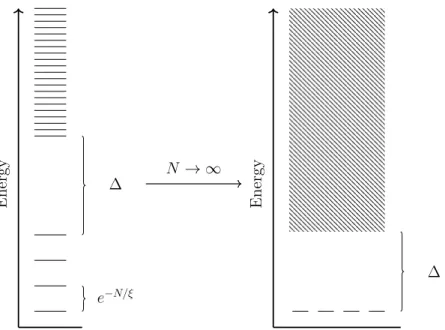
Figure 1.1: Energy spectrum of Gapped Quantum Systems in the thermodynamic limit. For finite systems, below an energy gap ∆ there can exist nearly degenerate states that become exactly degenerate in the thermodynamic limit and form a ground state subspace
V ⊂ H. The excited states above the energy gap can form a contiuum in the thermody-namic limit.
for any k ∈ N. A sequence of local Hamiltonians {HNk}k∈N on {HNK}k∈N is called a
Gapped Quantum System if there exists a constant energy window of size ∆ such that (a) there are no eigenstates in this window for anyNk and (b) the number of states below
this window is constant and their energy difference approaches zero asNk → ∞(see figure
1.1) [20]. For each system size, we will call the subspace spanned by the states under the gap ∆, for the ground state subspaceVNk or in other words HNk =VNk ⊕ · · ·.
1
Equipped with a notion of a gapped quantum system, we would like to introduce equivalence relations that define different phases of matter. We will primarily follow the approach of [20] and [24], but also see [25] for some interesting insight into gapped quantum liquids and beyond.
Loosely speaking, imagine we have the space of all gapped quantum systems G which is a subset of all theories G ⊂ T (which also contains gapless theories). We would like to think that each connected component of this space corresponds to a gapped quantum 1Note that a generic Hamiltonian is gapless [21] and gapped systems are in this sense rare. But even worse, the problem of proving that a system is gapped or gapless turns out to be undecidable [22,23].
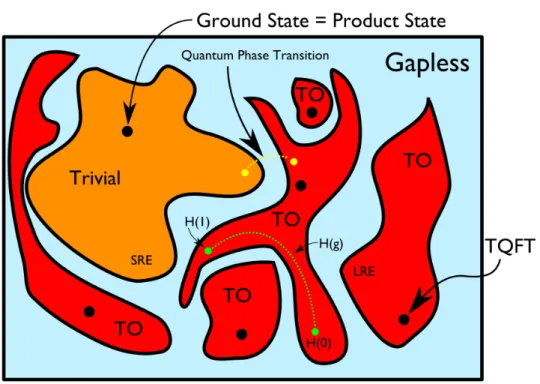
Figure 1.2: The figure illustrates the space of gapped quantum systems (more accurately, stable gapped quantum liquids) inside the space of all theories. The blue regions correspond to gapless systems, the orange region to short-range entangled systems while the red regions to long-range entangled systems. The black dots are (gapped) RG fixed points where all local degrees of freedom have been integrated out and only the universal physics is left behind. SRE systems flow to a trivial theory with product state ground states, while LRE systems are expected to flow to a Topological Quantum Field Theory (TQFT) at low energies. Each connected component corresponds to a different topological phase.
phase, and gapped phases are thus classified by π0(G) (see figure 1.2). More precisely we
would like to say that two gapped Hamiltonians2 H
0 and H1 belong to the same phase
iff there exists a path of Hamiltonians H(λ) such that H(0) = H0 and H(1) = H1 and
H(λ) is a gapped quantum system for any λ ∈ [0,1]. This is an equivalence relation and equivalence classes under H0 ∼ H1 correspond to gapped quantum phases. We can also
2The notion of Gapped Quantum System is based on a sequence of Hamiltonians, defining the ther-modynamic limit. But we will often just talk about them as a single Hamiltonian, as the meaning is clear.
think about this on the level of quantum states. Given ground states|ψ(0)i and |ψ(1)i of
H0 and H1, respectively, there exists a (finite-time) quasi-adiabatic continuation between
these states |ψ(λ)i=U(λ)|ψ(0)i, U(λ) =T exp −i Z λ 0 dsH˜(s) (1.2) whereT is the path-ordering operator and ˜H(s) is a local Hamiltonian. Again the Hamil-tonianH(λ) =U(λ)H0U(λ)† is gapped along the path and|ψ(λ)i is its ground state. The
form of ˜H(s) is discussed in [24, 26, 27]. This approach has the advantage of being very intuitive and connect to concepts of topology of the space of gapped quantum systemsG, but it turns out that there is a subtle step needed in order to define topological order. We will formulate the above in a slightly different way, which also connects to more physical concepts like entanglement.
It is known that a unitary finite time evolution with a local Hamiltonian can be sim-ulated with a constant depth quantum circuit [24]. This means that we can replace the time evolution in the definition above with unitary transformations of the form
Ucirc=Upwl(1)U (2) pwl. . . U
(N)
pwl, (1.3)
where each of theN-layers is a piecewise local unitary operatorUpwl(a) =QiUi,a= 1, . . . , N,
where {Ui} is a set of unitary operators that act on non-overlapping regions. A
transfor-mation of the form (1.3) is called a Local Unitary (LU) transformation.
1.2
Gapped Quantum Liquids
Topological order is deeply connected to patterns of long-range entanglement of gapped quantum systems, but in order to define these notions more precisely, it turns out that we need to break gapped quantum systems into smaller classes. Not all gapped quantum systems are well-behaved in the thermodynamic limit, since in the sequence {HNk}k∈N, Hamiltonians of different system sizes are not necessarily related to each other. We will here define a subclass that consist of, as far as I am aware, almost all examples of physically relevant gapped systems.
Starting with a Hamiltonian HNk on HNk, define a Hamiltonian on the Hilbert space
HNk+1 by adding a trivial system on the new degrees of freedom HNk −→HˆNk+1 =HNk+
Nk+1X−Nk
i=1
. . . HNk HNk+1 HNk+2 . . . . . . H0 Nk H 0 Nk+1 H 0 Nk+2 . . . gLU LU gLU LU gLU LU gLU
gLU gLU gLU gLU
Figure 1.3: Diagram showing the equivalence relation between two stable gapped quantum liquids {HNk}k∈N and {H
0
Nk}k∈N. If we ignore the condition that each layer should be related by a gLU transformation, then this defines an equivalence relation on gapped quantum systems (which includes non-liquids).
whereZiis the PauliZ matrix acting on sitei.3 If for a sequence{HNk}i∈Nfor anyHNk, the ground state subspace of ˆHNk+1 can be transformed to the ground state subspace ofHNk+1
by a LU transformation, then we say thatHNk andHNk+1 are connected by ageneralized
Local Unitary (gLU) transformation. We call a gapped quantum system satisfying this, a Gapped Quantum Liquid. A gapped quantum liquid is stable, if the ground state degeneracy is protected against any local perturbation.4
We can now modify our previous definition of gapped quantum phases: two stable gapped quantum liquid systems are equivalent{HNk} ∼ {H
0
Nk}if the ground state subspace ofHNk can be mapped to the ground state subspace ofH
0
Nk by a LU transformation for all
Nk (see figure1.3).5 These equivalence classes, we will calltopological order (TO). The
class that contains a Hamiltonian with a product state ground state, such as H =PiZi,
will be calledtrivial topological order.
To summarize, the point of the above discussion was to point out that we are not investigating universal properties of general gapped quantum systems but gapped quantum liquids, which is not a big restriction as it contains most physically interesting gapped systems. The equivalence relation based on gLU transformations, where we allow the addition of a trivial system, is analogous to stable equivalence of vector bundles where instead of considering homotopy equivalence the equivalence is loosened to also allow the 3On a more general non-qubit system, one can add any gapped trivial term instead. The important thing is that the new ground state should be the old ground state tensored with a product state.
4It turns out that gapped quantum liquids, besides topological order, contain symmetry breaking states and other states with unstable degeneracy. The stability condition picks out the robust gapped systems. It is possible to change the gLU transformation into a so-calledgeneralized stocahstic local transforma-tion(gSL), which only captures the systems with topological degeneracy. For a more detailed discussion, see [20].
5This is just another way of expressing the definition that two Hamiltonian are equivalent, if they are connected along a stable gapped liquid path.
addition (Whitney summing) of trivial bundles and thus making the classification more stable. This is exacly what is used to classify topological insulators and superconductors6,
where one allows the addition of trivial bands (bundles) and thus obtains a classification based on topological K-theory [28]. The Bott periodicity of this ”periodic table”, is a consequence of stable equivalence.
Note that gapped non-liquids can still have some sort of well-behaved thermodynamic limit. For example if we modify (1.4) such that we add copies of the smaller system, possibly with product states too, we can then relateHNk ↔HNk+1 via a LU transformation
by dissolving such a non-trivial layer. Systems with such a thermodynamic limit, will be different from conventional topological order. It is believed that so-calledfracton topological order [29, 30, 31, 32, 33] and systems built out of layers of lower-dimensional topological order, belong to gapped non-liquid systems [20,25].
1.3
Long-Range Entanglement
As discussed above, we can think about the definition of topological order from the point-of-view of states in the Hilbert space. From equation (1.4) it is clear how the gLU trans-formation acts on the ground state subspaces {VNk}k∈N; first the states are mapped to the
larger Hilbert space by tensoring them with a product state and then they are acted upon by a LU transformation. The important point to note is that each layer of a LU transfor-mation (1.3), separately acts on a local patch with a unitary operator. We can think of this local action as a local modification of the state’s entanglement structure. Any state that can be mapped into a product state (zero entanglement) by a gLU transformation7,
we call a short-range entangled (SRE) state as any entanglement can be removed by locally modifying the entanglement structure, over a finite number of layers. Any state that cannot be transformed into a product state we will call a long-range entangled (LRE) state.
Comparing with the above discussion about topological order, we see that short-range entangled states are ground states of system with trivial topological order. While different non-trivial topological orders have ground states that differ by their patterns of long-range entanglement. This is a very interesting and significant understanding; topological order is inherently related to global many-body (long range) entanglement of ground states and
6In the language of this thesis, these correspond to free fermion SPT and (invertible) SET phases. 7As mentioned earlier, this is not completely accurate as gLU transformations cannot map symmetry breaking states into product states. The correct transformation to use are generalized stochastic local (gSL) transformations. For more discussion see [20].
these patterns of entanglement are responsible for all the universal physics of the stable gapped quantum liquid phase.
1.3.1
Topological Entanglement Entropy
Now the natural question is, how can we detect and distinguish different topological or-ders from studying their ground states? A natural quantity to study is the entanglement entropy. Consider a 2+1D topological order on a manifold of simple topology, like the two-sphere S2. Split the Hilbert space into two spacial regions L and R, H =H
L⊗ HR,
with a boundary length of L between these regions. From the pure state ρS2 = |ψihψ|S2
contructed from a ground state|ψionS2, we can get a mixed state onLasρ
L= TrR(ρS2).
The entanglement entropy of ρS2 is defined as the Von Neumann entropy ofρL
S(ρL) = −Tr (ρRlogρR). (1.5)
It turns out that this entanglement entropy has the following area-law scaling [34,35, 36]
S=αL−γ+O(L−ν), ν >0. (1.6) This might be a surprise, as random pure states are expected to have volume-law scaling [37]. But there is a simple intuitive way to understand this result. Since gapped systems have very short-range correlations, one expects the entanglement to be fairly short range. One can make a simple (and quite trivial) toy model by tensoring valence bonds |i, ji =
1
√
2(| ↑i↓ji − | ↓i↑ji) for random sites i and j that are fairly close to each other. Now
splitting the Hilbert space into L and R, it is clear that only the valence bonds crossing the boundary are ”cut” and thus contribute to the entanglement entropy, hence this gives us an area-law scaling. The coefficient α is, however, clearly not universal. Note that this implies that groundstates of gapped systems belong to a tiny submanifold of Hilbert space and part of the motivation of the development of tensor networks is to parametrize this submanifold.
The constant subleading term γ is called the topological entanglement entropy [34,35] and is universal, meaning invariant under gapped local perturbations of the system or equivalently invariant under gLU transformations.8 This quantity turns out to be equal
to γ = logD where D is the total quantum dimension and directly related to physical properties of topological excitations and the ground state degeneracy [38]. This implies that long-range entanglement is like a constant entanglement over the full system, capable
of detecting global (topological) features of the manifold the system resides on. In fact, the ground state degeneracy directly depends on the (co-)homology groups of the underlying manifold. Note that if γ 6= 0 we are guaranteed to have topological order, but even when
γ = 0 we can still have topological order.9 The topological orders with γ = 0 are called
invertible topological order and have no topological excitations in the bulk but do have protected gapless boundary modes. It turns out that one can detect these (or gapless boundaries of so-called chiral topological order) from theentanglement spectrum, which is the spectrum of the entanglement Hamiltonian Hent. defined as [39, 40]
ρL≡
1
Z exp (−Hent.). (1.7)
The entanglement spectrum contains more information about the entanglement structure of the state |ψi. In chapters 5 and 6 we study the universal content of the entanglement spectrum for non-chiral topological orders.
The topological entanglement entropy can be generalized to higher dimensions [41, 42] and to topologically non-trivial bipartitions [43]. The entanglement entropy has several weaknesses, for example it contains very limited information about the universal physical properties of the system and it is hard to compute numerically.
In the next section we will discuss some very fundamental properties of the ground states of quantum liquids, in particular local indistinguishability and propose another method to extract topological information from the ground states.
1.3.2
Local Indistinguishability and the Mapping Class Group
Note that the stability condition implies that the ground states |ψii of gapped quantum
liquids are locally indistinguishable, they can only be distinguished globally. Or in other words, they form superselection sectors where
hψi|O|ˆ ψji=COδij, (1.8)
9There are two competing definitions of topological order in the field, which we will call the east-coast andwest-coast definitions. The east-coast definition is the one used in this thesis. The west-coast definition only considers states withγ6= 0 as having topological order. The difference between these are so-calledinvertible topological order, which are considered to be trivial in the west-coast definition. These invertible TOs have the property that they can be made trivial by stacking them on each other. One can think of the west-coast definition as using a stronger equivalence relation, besides what we have discussed it requires that two gapped systems that are related through stacking of invertible TOs, to be considered equivalent.
in the thermodynamic limit10 for any local operator ˆO. If any local operator existed that
had non-zero overlap between the different ground states, it could be used to split the degeneracy. This, however, does not have to hold for non-local operators. It turns out, as is highly plausible from the discussion so far, that the ground state degeneracy depends only on the topological structure of the underlying manifold such as the number of non-contractable homology cycles. Thus these states can be related to each other by non-local operators that act on non-contractible homology cycles (lines, surfaces etc.), signifying the non-trivial long-range entanglement hidden in these states.
A natural question is, can we extract more powerful information about the long-range entanglement structure in these states than given by the entanglement entropy? We explore this question in chapter 2. For any d-dimensional manifold Md we can associate a group
called theMapping Class Group MCG(Md) that has an action on the homology cycles of Md.11 Any group element A ∈ MCG(Md) induces an action MA
ij on the ground state
subspace V which rotates the ground states into each other. In other words, the ground state subspace on Md forms a representation space of the group MCG(Md). It is hard to
implement this action on the ground state subspace for a generic gapped quantum liquid (especially on the lattice)12, but it is easy to implement an operator ˆO
A acting on the
full Hilbert space for any A ∈MCG(Md). This will however bring us out the ground state subspace and give us a very small overlap. The question is, can we extract the universal pieaceMA
ij from this overlap? In chapter 2 we conjecture the following scaling behavior
hψi|OˆA|ψji= e−αV+o(1/V)MijA, (1.9)
where V is the volume of Md. For a given topological order, we thus have mapping class
group representations on essentially any compact manifold. Each of these representations constitute universal data that are not only much stronger than the topological entangle-ment entropy, but might provide complete set of invariants for any topological order with gappable boundary.13
The exponential volume-law scaling makes it very hard to compute this quantity di-rectly, numerically. In chapters 2 and 3 we propose a simple method to compute the 10In finite systems with non-zero correlation length there might be very small off-diagonal terms, origi-nating from the exponentially small energy-split among the states. See figure1.1.
11For some intuition behind mapping class groups see section 2.B. 12Unless the Hamiltonian has some very special symmetries.
13The mapping class group is related to so-called topologically non-trivial diffeomorphisms. One could in principle detect features of gapless boundaries, like the chiral central charge, by considering Berry-phases of trivial paths of the diffeomorphism group, inducing a gravitational Chern-Simions term [44]. But these are non-trivial to implement on the lattice. Although see [45].
universal piece of this overlap from local information of a single ground state in the form of a tensor network. These universal matrices can be used as topological order parameters, detecting phase-transitions between different topological systems.
In 2+1D these quantities are well-known and directly related to physical features of topological order, such as particle statistics and fusion. In chapter4 we study a subset of these invariants for 3 + 1D gapped liquids and show that they contain vital information about statistics of excitations, such as information about a braiding process containing three strings.
1.4
Topological Excitations
Having defined the notion of phases of gapped quantum liquids, discussed their ground states and their relation to entanglement, we will turn to one of the most important uni-versal physical features of these systems, namely the unusual statistics of bulk excitations. It turns out that systems with topological order have anyonic particle-like excitations in 2+1D and higher-dimensional objects in higher dimensions.
Let us restrict the discussion to point-like excitations. Let us imagine that we have
N particles on Rd and we will assume that particles cannot be on top of each other. If we furthermore require that all particles are indistinguishable, we must identify all points related by permutation of particles. The configuration spaces of such systems are
C(Rd, N) =RdN −∆, Cid(Rd, N) = RdN −∆/SN, (1.10)
where ∆ = {(r1, . . . ,rN) ∈ RdN|ri = rj for some i and j} is the set of configurations
where the position of at least two particles coincide andSN is the permutation group. The
topological classification of paths in these spaces that return to the original configuration is given by [46] π1(C(Rd, N)) = ( 0, d≥3, PN, d= 2 , π1(Cid(Rd, N)) = ( SN, d≥3, BN, d= 2 , (1.11)
where BN is the braid group while PN is the colored braid group, where the strands are
colored so only braids that return to their original spot are allowed. This implies that only bosons and fermions, corresponding to the symmetric and anti-symmetric one-dimensional representations ofSN, can exist for d≥3.14
14 It turns out that any higher dimensional representations of S
In 2+1D we see that the exchange statistics of indistinguishable particles are given by representations of BN, while double exchange of two distinguishable particles correspond
to representations of PN [53, 54].15 However, for a given gapped system with topological
order there will be several types of particles. Each type with self-statistics corresponding to a whole family of representations of BN (depending on how many particles has been
created), while each pair with mutual-statistics corresponding to a family of representations ofPN. And what if a single particle encircles several other particles, which representation
corresponds to this scenario? It naively appears to be very complicated to describe particle-statistics in 2+1-dimensions. However, we will below sketch how a natural algebraic theory appears for gapped quantum liquids, that takes care of all this.16
1.4.1
Topological Types and Fusion
Consider the energy distribution of an excited state over space. If the excited state has a higher energy density than that of the ground state only locally near a point x, we may consider that energy lump as a point-like excitation. If this excited state can be created by a local operator Ox, |xi = Ox|ψi, we will call the particle at x for a topologically
trivial excitation while if this is not the case we will say it is a topologically non-trivial excitation. In general we say that two excitations are of the same topological type, if we can go from one to the other by the action of local operators near the location of the excitations. Excitations of topologically trivial type are often denoted as 1. It turns out that topologically non-trivial excitations are created by line-like operators with the end-points being the locations of the excitations. Each topological type can thus be thought of as a superselection sector [56].
We can always modify our HamiltonianH toH+Vtrap in order to trap a few excitations
locally but individually far from each other, such that the ground state of the gapped system can be decomposed into tensor products of local Hilbert spaces of fermions and bosons with additional quantum numbers [47,48,49]. In [50] Wilczek proposed to consider projective particle statistics based on projective representations ofSN, but it was later shown to be inconsistent with locality [51]. Something
similar to non-abelian statistics for (pseudo-)particles in 3+1D is however possible, called projective ribbon permutation statistics [52,49].
15On topologically non-trivial manifolds we will get different results. For example, on a torus T2 we will get the torus-braid group and as particels can now also wind around the non-contractible cyles of the torus.
16This discussion partially follows lectures by Xiao-Gang Wen and [55]. We will not attempt to be rigorous, but rather give an idea of how the underlying mathematical structure appears and what its physical meaning is.
V(a⊗b, . . .) V(c, . . .) V(d, . . .) V(e, . . .) V(f, . . .) ⊕ ⊕ ⊕
Figure 1.4: On the left we have the degenerate subspaceV(a⊗b, . . .), where. . . represent other excitations far froma andb. The degeneracy is robust against local perturbations if
a and b are far from each other. If a and b are brought near each other, or perturbations in a region containing both a and b are allowed, the degeneracy will split. The right side represents maximal splitting from a generic perturbation. Each block remain degenerate. To represent this energy splitting, we writea⊗b =c⊕d⊕e⊕f.
H+Vtrap, is an excited state of H.17 We will byai denote an excitation of topological type
a at the position xi. The ground state subspace of H +Vtrap corresponding to trapping
(a1, b2, . . .) will be denoted byV(a1, b2, . . .), called thefusion space, with the dimension
dimV(a1, b2, . . .) ≥ 1. If the degeneracy of the fusion space V(a1, . . .) is robust against
any local perturbations near x1 we say that a is a simple type while if the degeneracy
is lifted we call it a composite type and think of it as being composed of several simple types a = x⊕y⊕. . .. Note that the lifting of degeneracy implies the following vector space decomposition
V(a1⊕b1, c2, . . .) =V(a1, c2, . . .)⊕ V(b1, c2, . . .). (1.12)
We will assume that we have a finite number of simple topological types, also called anyon types given by the set A ={a, b, c, . . .}. If we always have that dimV(a1, b2, . . .) = 1, we
say that the topological order isabelian, otherwise we say that it is non-abelian. We can also define the notion of fusion of two anyons. Imagine a1 and b2 at positions
x1 and x2, respectively, are much closer to each other than all other excitations. We will
denote this by a⊗b and this can in general be considered as a composite type because by acting with local operators in a region containing bothx1 and x2, we might be able to
split the degeneracy as V(a⊗b, . . .) = Lx∈ANab
x V(x, . . .), see figure 1.4. Based on this
17Note that the system ˜H =H +V
trap, while being gapped with robust degeneracy against any local perturbations, is not a quantum liquid as ˜HNk and ˜HNk+1 are not related by a gLU [20].
energy splitting, we will define afusion ring by the followingfusion rules
a⊗b=M
x∈A
Nxabx, (1.13)
whereNkij is an positive integer matrix saying how many times a given anyon type appears in the decomposition. As we can fuse particles in different orders, we need to demand associativity of the fusion product (a⊗b)⊗c=a⊗(b⊗c) which gives us constraints on
the fusion coefficients X
x
NxabNdxc=X
x
NxbcNday. (1.14)
We will furthermore assume that the product (1.13) is abelian,a⊗b=b⊗aor equivalently
Nab
x = Nxba, since there is no canonical way to define the order of fusion. This is true for
2 + 1-dimensions and above, but in 1 + 1-dimensions this cannot be assumed.
In [57], it was shown that topological excitations come in pairs and are created by line operators, where the end-points are the excitations. If the line is turned into a loop, the excitations annihilate. This implies that for each simple type a ∈ A, we have another ¯
a ∈ A such that a fusion channel to the vacuum (trivial type) exists: a⊗¯a = 1⊕. . ., here ¯a can be thought of as an anti-particle but we will call it the dual of a. The dual is unique and for simple objects they have a unique channel fusing to the vacuum. Therefore we have that dimV(a1,¯a2) = 1 where the basis vector will be graphically represented as
|a1,¯a2i=
a
b
1
. (1.15)
In general we can represent a fusion process by
a
b
c
µ
, (1.16)where µrepresents possible multiplicities in the fusion channel µ= 1, . . . , Nab
c . For
fusion space with n excitations of typea, V(a1, . . . , an), is given by
a
1a
2a
3a
n1
x
1x
2. ..
. . .
. (1.17)This graphical notation makes it easier to label all the states in the fusion spaces and has an intuitive physical interpretation: it is a space-time diagram showing the process of creating particles from the vacuum when read from bottom up. We can directly compute the dimension of this fusion space
dimV(a1, . . . , an) = X xi Nxaa1Nx1a x2 . . . N xn−2a 1 = [N a]n−1 a1 ∼d n a +O(1/n), (1.18)
where we have defined the matrices (Na)bc =Nba
c and da is the largest eigenvalue ofNa.18
The large n-scaling of the fusion space dimension seems to imply that we can think of each anyon of type a to be associated with a local Hilbert space of dimensionda. However
da is often not an integer and the dna scaling is only accurate for large n. This is a very
important point, as the Hilbert space does not have a standard tensor product structure but the information is rather stored non-locally among all the excitations. Only when brought near each other, can we act on this space with local operators and split the degeneracy. The number da is called the quantum dimension of anyon type a and D2 = Pa∈Ad2a
is the total quantum dimension and can be extracted from the ground state through the topological entanglement entropy γ = logD.
Imagine we chose a different basis of the fusion spaces by fusing in a different order, these must be related by a basis change. These basis changes can be built from the most basic one involving three anyons,
a
b
c
d
e
=X x∈A Fabcd;exa
b
c
d
x
, (1.19)18The Perron-Frobenius theorem ensures that a real square matrix with positive entries, has a unique largest real eigenvalue and all components of the corresponding eigenvector can be made stricly positive.
where the basis change coefficients are often called F-symbol. From this we can compute the basis change coefficient for larger number of anyons, however there might be many different ways to step by step go from one basis to another. In the case of four anyons, there are two ways to go from fusing from left to fusing from right. Since the coefficient in both cases must match, this gives us constraints of theF-symbols schematically of the formPF F F =PF F. This equation is known as thepentagon equation. Remarkably, due the McLane Coherence theorem if the pentagon equation is satisfied, all other basis changes inV(a1, b2, . . .) with (1.19) will automatically be consistent.
Before turning to braiding, let us reflect over what we have done. Usually local degrees of freedom, say s = 12 spins, carry their own local Hilbert spaces Hi. Fusing two spins
1 2 ⊗
1
2, gives rise to the ”fusion” of their individual Hilbert spaces H1 ⊗ H2. But clearly
anyons do not behave the same way, the fusion space is a collective space shared among all particles and stored non-locally. Adding another anyon to the system, the fusion space changes in a highly non-trivial way. It is therefore hard to describe the anyons directly, we have instead tried to extract information about them by studying the relations between them. For example the fusion of two anyons were defined through degeneracy splitting of the fusion spaces, which is shared with many other anyons. Even though the fusion spaces do not have a nice tensor product structure like in the case of spins, the fusion rules
a⊗b do give us many of the same properties. The idea of studying objects through their relationship with other objects, rather than the structure of the objects themselves is the essence of category theory. What we have constructed so far is called a symmetric unitary fusion category, where the objects are the anyon type A and the fusion states are the morphisms. The graphical notation (1.16) is literally the relation between different anyons (objects).
1.4.2
Braiding
Having discussed the algebraic theory describing topological excitations in a gapped quan-tum liquid, we will now turn to braiding.
Imagine we adiabatically tuneVtrap such that the simple typea1 at locationx1is rotated
around itself by 2π. The states inV(a1, b2, . . .) can potentially acquire a geometric phase19
eiθa. The phase θ
a is called thetopological spin of anyon typea. We can implement this
in our graphical notation by giving the lines a framing and think of them as ribbons, thus whenever we undo a twist in the ribbon the corresponding state acquires a phase eiθa.
It turns out that the right way to define the data for braiding is by introducing the so-called R-symbol, defined graphically by
b
a
c
=Rbacb
a
c
. (1.20)The R-matrix cannot be arbitrary and must satisfy certain non-trivial constraints which comes from consistency, one can go from one diagram to another in multiple ways giving us multiple mappings between these states and consistency requires them to be equal. Starting with three anyons, similar to the pentagon equation, we can derive a consistency relation of the schematic form RF R = PF RF that the R and F symbols must satisfy. This is called thehexagon equation. Again the McLane Coherence theorem ensures that no other consistency relations are needed.
Any solution of the pentagon and hexagon equations, will give us a consistent anyon model and correspond to a particular topological order in 2+1D. If start with the graphical notation (1.17), we can braid the anyons in any arbitrary way. By using the F and R -symbols, eq. (1.19) and (1.20), we can turn this braid diagram back into (1.17). This gives us a map on the fusion space that is nothing but the wanted Braid group representations discussed earlier.
The mathematical structure behind this is called amodular tensor category (MTC),20
and 2 + 1D topological orders can be classified by classifying MTCs. It naively appears that the solution space of the pentagon and hexagon equations form a continuous algebraic variety, but it turns out that they also containg gauge freedoms and after a gauge fixing, the solution space becomes discrete. We say that MTCs arerigid, meaning that no contin-uos deformations are possible. The classification of MTCs is an active research direction [58].
These equations first appeared in the work of Moore and Seiberg on 1 + 1D Rational Conformal Field theories [59,60] which in turn are very closely related to topological order in 2 + 1D [61,62]. We will however not go into this very deep and interesting direction.
Important for this thesis are two crucial pieces of universal data in a MTC called the 20Stricly speaking, we have only presented part of the definition of a MTC here.
modularS and T matrices21 Sab =
a
b
= 1 D X x∈C Nxabdx eiθx eiθaeiθb, (1.21) Tab =δabeiθa. (1.22)These matrices generate a projective representation of SL(2,Z) and satisfy the relations, (ST)3 =e28πic−C, S2 =C, C2 = 1 (1.23)
where c− is called the chiral central charge and is another universal quantity. Note that
knowing S and T, gives us c− mod 8, we will explain why when discussing boundary
physics. For abelian topological orders with N anyons these reduce to Sab = N11/2
eiθa+b
eiθaeiθb,
Tab = δabeiθa. Here the T matrix is just the self-statistics while the S matrix gives us the
mutual particle statistics (up a normalization). Thus S and T matrices contain informa-tion about statistics of particle excitainforma-tions. Despite being properties of excitainforma-tions, they can be computed from the ground states by the universal wavefunction overlap (1.9) as representations of the mapping class group of the torus.
It turns out that from these matrices one can compute the fusion rules, given by the Verlinde formula [63]. Knowing the fusion rules, one can solve the pentagon and hexagon equations and potentially reconstruct the whole catagory theory. Thus until recently it was believed that the S and T matrices can be used to compute any universal quantity in the MTC, but counter examples were recently found [64,65,66]. New invariants were proposed, but they are also in principle computable as mapping class group representations.22
For more details about modular tensor categories and their application to describe anyon models, see [67,56, 68].
A final note before we end this section. We have learned that topological excitations of gapped quantum liquids form degenerate fusion spaces that are stored non-locally and thus completely protected against local perturbations as long as the anyons are well separated. Not only that, we can act on this space using braiding of particles which is a non-local 21This diagramatic notation can be defined by introducing inner products to our current construction. In order to save space, we will not go through the details here.
22The smallest known examples are several rank 49 categories corresponding to discrete gauge theories
G=Z11oZ5 with certain group cohomology twists [ω]∈H3(Z11oZ5, U(1)). The group is of order 55, and there are 5 inequivalent twists that produces a rank 49 category.
operation and thus also protected against local perturbations. These important properties has given rise to the proposal of using non-abelian anyons to do quantum computation, an idea going under the name topological quantum computation [69, 70, 71]. Thus topological order is a physical mechanism for fault tolerant error correction, rendering millions of redundant qubits, as needed in conventional error correction codes, unnecessary.
1.4.3
Excitations in 3+1D
A bosonic topological order can only have bosonic and (emergent) fermionic particle ex-citations in 3 + 1D as seen from (1.11). However, now we can also have string-like exci-tations23 which opens up new and interesting possibilities. As mentioned previously, we
already know an example of such a topological order, namely the S-wave superconductor. Here the string-like excitations are nothing but Abrikosov vortex strings [72] (known as Nielsen-Olesen strings in high-energy physics [73]).
In [74] it was shown that the statistics ofN unlinked string-like excitations are governed by the Loop Braid Group LBN. This group has two classes of generators, the first
corresponds to braiding the ith andi+ 1th string worldsheets around each other24
si =
i i+1
. (1.24)
These generators satisfy the the following relations
sisj =sjsi, for |i−j|>1,
sisi+1si =si+1sisi+1, for 1≤i≤N −2,
s2i = 1, for 1≤i≤N −1,
(1.25)
which forms to a permutation subgroup SN ⊂ LBN. This is intuitive to understand as
if we shrink the strings to points, the worldsheets become the worldlines of particles and 23Actually we must have string-like excitations in order to have a non-anomalous topological order. In 2+1D we can have string-like excitations in anomalous topological systems, which are unstable unless on the boundary of a 3 + 1D topological system.
from (1.11) we know that the statistics are given by SN. The other class of generators
correspond to string excitations trading places by letting one of them go through the other
σi =
i i+1
. (1.26)
These generators satisfy the relations
σiσj =σjσi, for |i−j|>1,
σiσi+1σi =σi+1σiσi+1, for 1 ≤i≤N −2,
(1.27) which interestingly form a braiding subgroup of the loop braiding groupBN ⊂LBN. These
two subgroups are intertwined inside LBN through the mixed relations
siσj =σjsi, for |i−j|>1,
sisi+1σi =σi+1sisi+1, for 1≤i≤N −2,
σiσi+1si =si+1σiσi+1, for 1≤i≤N −2.
(1.28)
The loop braid group LBN only describes braiding processes with unlinked string
exci-tations, however in 3 + 1D we can have many other interesting braiding processes. For example we can have braiding processes of strings that are linked with each other in com-plicated ways. Or particle-string braiding, for example of the Aharonov-Bohm type of more nontrivial type where particle worldlines and string worldsheets form complicated links.25
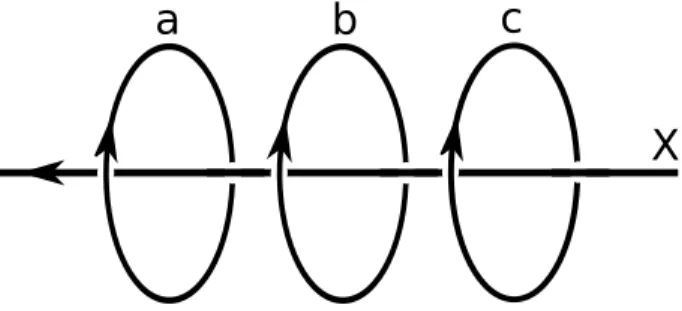
Let us consider one particularly simple, but very important, type of linked string exci-tation. Imagine we haveN strings of typesa, b, . . . with a base string of typeX threading them all, see figure 1.5. Due to the base loop X, it is clear that the other strings cannot shrink into a point and cannot perform braids of the type described by the generators
si (1.24). Braid processes of the σi type (1.26) is still possible and this implies that the
statistics of these loops are governed by the usual braiding group BN. Besides braiding,
25It is very straightforward to write down 3 + 1D topological quantum field theories describing these linking processes. Any BF-type theory has Aharonov-Bohm type braiding, abelian three-loop braiding exist inA∧A∧dAtwisted theories, non-abelian three-string braiding and abelian four-string braiding in A4twisted theories, more complicated processes with one particle and two strings are given byA∧A∧B twists. The discussing of these theories has not been included in this thesis as many related results were published by other authors before completion.
a
b
c
X
Figure 1.5: Linked string configuration with strings of typea, b, c, . . . threaded by a string of typeX.
we can also fuse the stringsa⊗X b, with the base loop X present, similar to 2 + 1D. This
implies that for this type of linked excitations we can associate fusion spacesVX(a, b, . . .)
and inherit the algebraic structure from 2 + 1D such as FX and RX-symbols and
topolog-ical spins θa;X [75]. Note that the reference to the base loop X is crucial as which MTC
describing the braiding and fusion of the strings a, b, c, . . . can depend on X. This all says that the category theory describing 3 + 1D topological order C3D, must have many
non-trivial MTCsC2D ”embedded” within it.
In chapter 4, using the universal wavefunction overlaps proposed in chapter 2, we extract representations of the mapping class group of the three-torus,MCG(T3) =SL(3,Z), from ground state wavefunctions of gapped quantum liquids. We show that these universal quantities can be used to extract the following dimensional reduction of topological orders
C3D =M
X
CX2D, (1.29)
where the sum is over string types. Here C2D
X is the MTC that describes the fusion and
braiding of strings a, b, c, . . . while penetrated by a base loop X. Such a linked-braiding process is calledthree-string braiding.
This type of linked-braiding process is one of many possible in 3 + 1D, where many cannot be described using dimensional reduction techniques. The construction of the proper (higher) categoryC3D which provides a complete description of 3 + 1D topological
orders is an active research direction.
1.4.4
Bosonic vs Fermionic Locality
The notion of ”locality” and ”local operators” has been crucial for most of the discussion above, but there is an important subtlety we need to point out. We usually think of our
full Hilbert space as having a tensor product decomposition H = NiHi where Hi is a
Hilbert space for the degree of freedom located ati. Usually we think of a local operator as only having support on a small connected region and commute with local operators that have support far away. However, this excludes fermionic operators which do not commute but rather anti-commute at long-separations and in this sense seem non-local. When defining gapped quantum systems, topological type etc. it is therefore important to distinguish between bosonic and fermionic locality. In a system with fundamental bosonic degrees of freedom, like spin systems, we will only allow bosonic local operators and call the corresponding topological system for bosonic topological order. While in a fermionic system, like an electronic system, where the fundamental fermion appears in the spectrum we can allow fermionic local operators as we want to consider a local electron to be a trivial particle. These types of topological systems are calledfermionic topological order.
Note that in a bosonic system we can have emergent fermions, but these are topological excitations and do not change the nature of locality. However in fermionic systems we can have a scenario where the local fermionic excitations are confined at low energies, and thus bosonic locality emerges. Fractional Quantum Hall systems are fermionic topological orders. S-wave superconductors correspond to Higgsing aU(1) gauge theory to aZ2 gauge
theory since the Higgs field, the cooper pair, has charge 2. So despite originating from fundamental fermionic degrees of freedom, superconductors are topologically ordered with emergent bosonic locality [76]. Another example is the largeU limit of the Hubbard model, which is a fermionic theory, which can lead to gapped spin liquids with bosonic topological order [77].
In the discussion above (and most of this thesis), we will be working with bosonic topo-logical order. However, in chapter 7 this distinction of locality is crucial as we argue that interfaces of different types of locality must be studied as they are relevant for experimental scenarios.
1.5
Boundary Physics
Having discussed the ground states and bulk excitations of systems with topological order, we will now discuss interesting universal features of the boundary physics. From very early on it was realized that Integer Quantum Hall systems (a fermionic invertible topological order in our nomenclature) posses quantized gapless edge modes that are completely pro-tected against local perturbations [78]. It was later realized that Fractional Quantum Hall systems have similar properties, with boundaries forming chiral Luttinger liquids [79, 80] and the universal boundary dynamics in general described by chiral Wess-Zumino-Witten
theories. The boundary physics has also been central in the experimental studies of FQHE. It is now understood that boundaries of gapped quantum liquids are much richer yet and even useful for classifying topological orders in different dimensions.
Let us first define different types of boundaries. If we put a stable gapped quantum liquid H on a manifold with boundary M, we have to specify boundary conditions BC on ∂M. If the gapped quantum liquid remains gapped on a manifold with the boundary condition BC, we will say that the pair (H,BC) has a gapped boundary, otherwise we say it has a gapless boundary. If a gapless boundary remains gapless for any local perturbation near the boundary, we say that the gapped quantum liquid H has protected gapless boundaries, otherwise its boundary is gappable. For a system with gappable boundary, we can define gapped boundary phases as we did above but only allow for perturbations near the boundary (such that the bulk remains in the same phase).
1.5.1
Chiral and Invertible Topological Order
First we will discuss chiral topological order, which was the first class of systems found and includes Fractional Quantum Hall systems. As discussed above there is another uni-versal quantity hidden in the ground state, the chiral central charge c−. Systems with
c− 6= 0 have chiral gapless boundary modes which are protected due to their chiral nature
and will generically break time-reversal symmetry. Physically these systems have a thermal Hall effect, with the thermal conductivity [81]
κH =c−
πk2
BT
6 , (1.30)
which transports energy between boundaries. The lack of energy-conservation on the boundaries are captured by (perturbative) gravitational anomalies which are directly re-lated to c− ∇iTij = cL−cR 96π k j∂kR, (1.31)
wherec− =cL−cRis the difference between the left and right central charges andR is the
Ricci scalar. Here the anomaly is with respect to small diffeomorphisms, which gives rise to convervation of the boundary energy-momentum tensor (had there been no anomaly). The bulk however also has an anomaly described by the gravitational Chern-Simons term
Sanom =− c− 96π Z tr Γ∧dΓ +2 3Γ 3 , (1.32)
which cancels the boundary anomaly through the usual Callan-Harvey inflow mechanism [82]. This is a consequence of the descent relations of anomalies in different dimensions [83]. Thus the universal number c− says that the system has a thermal (”gravitational”)
version of the usual quantum Hall effect.
Systems with integer and fractional quantum Hall effect usually have charge conser-vation (when considering both bulk and boundary), due to global U(1) symmetry, and usually thought of in terms of the Hall conductivity. But if we perturb these systems with charge non-conserving perturbations while preserving the bulk gap, like proximity coupling to a superconductor, does the Hall effect survive? Due to the universality of the chiral central charge, the answer is yes, even without charge conservation the thermal Hall transport remains protected. And while the statistics of the bulk anyons are protected, the fractional electric charge they carry is not under these perturbations.
It was shown in [56] that the chiral central charge only depends on the ground state and for a local lattice HamiltonianH =PiHi, a formula was derived
c−=− 12 π X i∈A X j∈B X k∈C hijk, (1.33)
where hijk is related to thermal-averages of the commutators [Hi, Hj]. Interestingly this
implies that any Hamiltonian which is a sum of commuting terms must have c− = 0, this
includes most exactly solvable models for topological order [69, 84].
Note that if we stack a chiral topological order with its time-reversed version, we will have modes with both chiralities on the boundary. Now it is possible to write interaction terms near the boundary that couples these modes and potentially gap them out, turn the system into a non-chiral topological order. Actually this construction gives rise to a large class of non-chiral topological systems often called doubled topological order. There are however a subset of chiral topological orders where doubling will turn the system to a trivial gapped system. These are called invertible topological order. This means that systems with invertible topological order, have no anyonic excitations in the bulk but do have protected gapless boundary modes. For bosonic topological order it turns out that these systems have chiral central charges given by c− = 8k, k ∈ N. Interestingly
the derivation of this result, is closely related to lattices used in the compactification of Heterotic string theory [85, 86, 87]. This implies if one knows everything about the bulk excitations, essentially the related modular tensor category, one will only know c− mod 8
as we can always stack the system with a invertible topological system without changing the bulk statistics. This explains equation (1.23). The simplest of these is called the E8