NOTE TO USERS
This reproduction is the best copy available.
The Effect of the Interview Structure on the Physical Attractiveness Bias
Khalil Jabbour
A Thesis in
The John Molson School of Business
Presented in Partial Fulfillment of the Requirements
For the Degree of Master of Science in Administration (Management) at Concordia University
Montreal, Quebec, Canada
June 2009
1*1
Library and Archives Canada Published Heritage Branch 395 Wellington Street OttawaONK1A0N4 Canada Bibliotheque et Archives Canada Direction du Patrimoine de I'edition 395, rue Wellington Ottawa ON K1A 0N4 CanadaYour file Votre rtiterence ISBN: 978-0-494-63144-7 Our We Notre reference ISBN: 978-0-494-63144-7
NOTICE: AVIS:
The author has granted a
non-exclusive license allowing Library and Archives Canada to reproduce, publish, archive, preserve, conserve, communicate to the public by
telecommunication or on the Internet, loan, distribute and sell theses
worldwide, for commercial or non-commercial purposes, in microform, paper, electronic and/or any other formats.
L'auteur a accorde une licence non exclusive permettant a la Bibliotheque et Archives Canada de reproduire, publier, archiver, sauvegarder, conserver, transmettre au public par telecommunication ou par I'lntemet, preter, distribuer et vendre des theses partout dans le monde, a des fins commerciales ou autres, sur support microforme, papier, electronique et/ou autres formats.
The author retains copyright ownership and moral rights in this thesis. Neither the thesis nor substantial extracts from it may be printed or otherwise reproduced without the author's permission.
L'auteur conserve la propriete du droit d'auteur et des droits moraux qui protege cette these. Ni la these ni des extraits substantiels de celle-ci ne doivent etre imprimes ou autrement
reproduits sans son autorisation.
In compliance with the Canadian Privacy Act some supporting forms may have been removed from this thesis.
Conformement a la loi canadienne sur la protection de la vie privee, quelques
formulaires secondaires ont ete enleves de cette these.
While these forms may be included in the document page count, their removal does not represent any loss of content from the thesis.
Bien que ces formulaires aient inclus dans la pagination, il n'y aura aucun contenu manquant.
• + •
Canada
ABSTRACT
The Effect of the Interview Structure on the Physical Attractiveness Bias Khalil Jabbour
This study investigated interview structure as a moderator of the relationship between the physical attractiveness of job candidates and two interview outcomes (suitability ratings and hiring recommendations). The sample for this study was
composed of 32 Concordia University students. Each participant interviewed the same two job candidates. 16 participants performed face-to-face structured interviews and 16 participants performed face-to-face unstructured interviews. Interview structure was manipulated by randomly providing participants with either the structured interview handout (which included the employment interview with eight questions, a job description, the scoring criteria with possible answers, benchmark responses and the candidate rating scale) or the unstructured interview handout (which included the six topics to be covered, a job description and the candidate rating scale). The physical attractiveness of both candidates was based on perceptions of participants, with respect to to facial features, body proportions and weight, posture and general appearance. The findings did show an interaction between physical attractiveness and interview structure. The more attractive candidate was perceived as more suitable in the unstructured
interview condition than in the structured interview. However, the less physically attractive candidate was perceived as equally suitable in the structured and the unstructured interview. On the other hand, no relations were found for hiring
recommendations. Also, more job relevant information was provided by both candidates in the structured interview. The study's contributions and limitations, along with
AKNOWLEDGEMENT
The collective efforts of a number of individuals made this thesis possible. My thanks and appreciation goes to my great supervisor, Dr. Kathleen Boies. Your patience, insight and continual guidance were invaluable over the past two years. I am grateful for the amount of time you dedicated to me.
I would also like to offer my thanks to my brilliant thesis committee members, Dr. Tracy Hecht and Dr. Linda Dyer. Your guidance in the final stages of my thesis was crucial. It was a privilege to work with you and I am truly blessed to have had such an encouraging, caring and involved team.
I thank my friends who have always supported me unconditionally. You entertained me and provided me with endless reasons to procrastinate (which I love doing). I am fortunate to have you all in my life.
Last, but certainly not least, I want to say an enormous thank you to my incredible family. To my wonderful mother, Cathy, who has supported me emotionally and
financially throughout the years; my sisters, Pamela and Rhea, who have always believed in me. Words can't describe how thankful I am to you. Your constant support,
DEDICATION
TABLE OF CONTENT
List of Figures viii List of Tables ix List of Appendices x Introduction 1
The Physical Attractiveness Bias 4 Other Appearance Biases in Selection 10
The Selection Interview 13 The Structuring Process of the Interview 14
The Interview Structure in the Current Study 19
Hypothesis Generation 20 Method 22 Sample -. 22 Experimental Design 23 Procedure 26 Measures 29 Materials 31 Results 36 Checking Model Assumptions 36
Test of Hypothesis 40 Supplementary Analysis 43
Discussion 44 Contributions 47
Limitations and Future Research Directions 50
Conclusion 54 References 56 Appendices 64
LIST OF FIGURES
Figure 1: Diagram of the Proposed Hypothesis 22 Figure 2: Interaction of Physical Attractiveness and Interview Structure for
LIST OF TABLES
Table 1: Agenda for Research Sessions 28 Table 2: Equivalent of the Different Questions with the Different Topics 34
Table 3: Means, Standard Deviations, and Correlations 38 Table 4: T-test Results for the Nonverbal Behavior, Physical Attractiveness,
Suitability and Hiring Recommendation 39 Table 5: Wilk's Lambda Statistic 42 Table 6: Favorite Candidate Pick for Structured and Unstructured Condition 43
LIST OF APPENDICES
Appendix A: Informed Consent Sheet for On-campus Recruitment 66 Appendix B: Informed Consent Sheet for Research Participation Pool 67 Appendix C: Script of Answers for Candidate A (for the Structured Interview) 68
Appendix D: Script of Answers for Candidate B (for the Structured Interview) 70 Appendix E: Script of Answers for Candidate A (for the Unstructured Interview) 72 Appendix F: Script of Answers for Candidate B (for the Unstructured Interview) 74
Appendix G: Curriculum Vitae for Candidate A 76 Appendix H: Curriculum Vitae for Candidate B 77 Appendix I: Introduction for Structured Interview Participants 78
Appendix J: Introduction for Unstructured Interview Participants 79 Appendix K: Candidate Rating Scale for Candidates A and B 80 Appendix L: Participant's Premier Choice of Candidate 84
Appendix M: Demographic Questionnaire 85 Appendix N: Payment Receipt for Participation in the Experiment 87
Appendix O: Debriefing of Participants 88 Appendix P: Social Science Research Assistant Job Description 89
Appendix Q: The Structured Interview 91 Appendix R: The Unstructured Interview 92 Appendix S: Scoring Criteria for the Structured Interview 93
Appendix T: Poster for Recruiting Participants for the Experiment 98 Appendix U: Coding Scheme for Candidate A (Structured and Unstructured) 99
The Effect of the Interview Structure on the Physical Attractiveness Bias
Beauty affects the life chances and the well-being of individuals. Research on physically attractive people has shown that beautiful individuals are generally more happy, satisfied and successful in their lives (Dion, Berscheid, & Walster, 1972). They are more accepting of their age, of their income, and their employment status (Umberson & Hughes, 1987). Morrow (1990) characterized physical attractiveness as the "degree to which one's facial image elicits favorable reactions from others" (p.47); however, in this study, physical attractiveness not only focuses on facial features but also on body
proportions and weight, posture and general appearance as defined in Dipboye, Arvey, and Terpstra (1977).
Usually, people assume that the purpose of the job selection interview is ideally to distinguish the candidate with the highest combination of education standards,
appropriate job experience and suitable skills and abilities; this is not always the case. Aspects of personal appearance have powerful effects on multiple job interview
outcomes. The Implicit Personality theory suggests that once an individual is categorized as physically attractive or unattractive, the recruiter will link numerous personality characteristics related with that social category, to that particular individual (Ashmore & Del Boca, 1979). Physical attractiveness of a job applicant seems to be beneficial during the employment application process. Job candidates, who were viewed as physically attractive, received better suitability ratings, better hiring recommendations and had higher chances of being promoted than their equally qualified unattractive peers (Baron,
& Cox, 1985; Jackson, Hunter, & Hodge, 1995; Jawahar & Mattsson, 2005; Marlowe, Schneider, & Nelson, 1996). Furthermore, if only one candidate had to be selected for a particular position, the highly attractive male always had the highest chance of being selected (Dipboye et al., 1977).
Schmitt (1976) suggested that to improve the reliability and validity of job interviews, it is important to use a structured interview format. Also, having a detailed job description of the position will help interviewers know what the exact job
requirements are and hence they will be able to focus on relevant information only. Generally the purpose of using the structured interview is to improve the quality and job-relatedness of the information the evaluator obtains from the job applicant, and to make sure the employment decision will be made only based on relevant information.
In their historical review of the research related to the selection interview over the past 100 years, Buckley, Norris, and Wiese (2000) recognized that using a highly
structured interview model would increase reliability, validity and inter-rater agreement of the interview as a selection tool. Furthermore, Marchese and Muchinsky (1993) found that the higher the structure of the interview, the higher the validity of the interview will be; hence, when using an interview to select job applicants, there will be a strong positive correlation between structure and validity. Therefore, using a structured interview format will yield a more accurate assessment of the candidate than using an unstructured
interview format. Moreover, the information gathered in an unstructured interview was less job-related than when a structured interview was used (Hayes, Wendt, & Craighead, 1990).
The current study contributes to the literature on both the physical attractiveness bias and selection interviews. It seeks to understand whether the physical attractiveness bias that tends to be a prominent factor in the interview process can be reduced through a formal structuring process of the interview. Physically attractive candidates tend to be evaluated as more suitable for a job and are privileged in hiring recommendations when an unstructured interview is employed. Furthermore, the use of a structured interview as a selection tool should reduce different stereotypes, prejudices and biases that evaluators might possess. Hence, it is supposed that the interview structure will have a moderating effect on the physical attractiveness bias; where it is presumed that the relation between physical attractiveness and interview outcomes will be weaker in a structured interview context.
Furthermore, while the physical attractiveness stereotype has been very well documented and acknowledged in the literature for more than thirty years, all studies have used similar methodologies. In these studies, the evaluators' ratings of candidate qualifications, the recommendations for hiring, the starting salaries, and so on, was based on photographs of candidates attached to resumes or videotapes of candidates (Baron,
1983; Cash & Trimer, 1984; Cox & Glick, 1986; Dipboyeet al., 1977; Forsythe et al., 1985; Jackson et al., 1995; Jawahar & Mattsson, 2005; Marlowe et al., 1996). The current study is, to this author's knowledge, the first to actually use direct, face-to-face
interviews to rate candidates while focusing mainly on studying the physical attractiveness bias.
The Physical Attractiveness Bias
What is beautiful is good. Research has indicated a "what is beautiful is good" phenomenon (Dion et al., 1972) which holds that individuals with physical beauty are associated with positive characteristics such as likeability, agreeableness, intelligence, success, and competence, which in turn affect, how that person is treated (Heilman & Stopeck, 1985; Riggio & Woll, 1984). A meta-analysis by Feingold (1992), which examined the relationship between an individual's physical attractiveness and a range of individual characteristics, established that physically attractive people were perceived as being more sociable, more dominant and as having a more positive general mental health. Physically unattractive individuals, on the other hand, were perceived to be lonelier and more socially anxious.
Riggio and Woll (1984) found that physical attractiveness and person likeability were correlated; the candidates who were rated the highest on physical attractiveness were also rated as the most likeable. These individuals were most often selected as potential dating partners. Furthermore, highly attractive applicants were perceived as more sociable and friendly than unattractive applicants. Also, attractive people were perceived as more masculine or feminine depending on their gender (Cash & Kilcullen,
1985; Gillen, 1981).
Beautiful individuals were seen as being more capable of attainting a prestigious occupation (Dion et al., 1972). Physically attractive candidates were usually perceived as more self confident (Forgas, 1988) and as being more socially competent and popular (Eagly, Ashmore, Makhijani, & Longo, 1991; Riggio & Throckmorton, 1988). Cash, Kehr, Polyson, and Freeman (1977) found that unattractive candidates were attributed a
higher level of psychological disturbance. Also, Forgas (1988) found that physically attractive candidates were usually perceived by raters as less likely to cheat.
A study conducted by Webster and Driskell (1983) found that individuals who are beautiful generally have a 'better life' than the 'ugly'. Moreover these individuals who are highly attractive are expected to also have other positive qualifications; for example, be more competent to pilot a plane (Webster & Driskell, 1983).
Gender and beauty. Most often, studies found no gender differences in the importance of attractiveness; hence physical beauty is equally important for both women and men (Dion et al., 1972; Eagly et al., 1991; Hosoda, Stone-Romero, & Coats, 2003; Langlois, Kalakanis, Rubenstein, Larson, Hallam, & Smoot, 2000). Also, there was a substantial agreement or consensus between raters of who is and who is not considered physically attractive both within and across cultures. Furthermore, Langlois et al. (2000) found that physical attractiveness was significantly advantageous for children and adults in most domains of judgment (academic, interpersonal, occupational competence), treatment (attention, care giving, cooperation, reward) and behavior (popularity, intelligence, performance). Moreover, since the attractiveness bias was equally present for male and female raters towards male and female applicants, Webster and Driskell (1983) thought it is acceptable to address candidate attractiveness without specifying the sex of the candidate or that of the rater. Therefore the physical attractiveness bias is present in everyone. Children and adults, males and females and people from different cultural backgrounds stereotype others based on their appearance. Beauty is equally appreciated by everyone universally. Physical attractive individuals are better treated and judged in everyday life.
Beauty is talent in the workplace. A substantial amount of research demonstrates that this beauty bias can exert powerful effects on how physically attractive individuals are treated in the workplace (Cash & Kehr, 1978; Cash & Salzbach, 1978; Cash & Trimer, 1984; DeGroot & Motowildo, 1999; Forgas, 1988; Frieze, Olson, & Russell,
1991; Hosada et al., 2003; Roszell, Kennedy, & Grabb, 1989).The term beautyism refers to a prejudice through which physically attractive people are awarded better career options and income opportunities than the average individual.
Good looks were uniformly advantageous to men and women, hence the saying "beauty is talent" (Cash & Trimer, 1984; DeGroot & Motowildo, 1999; Forgas, 1988). Beautiful people were perceived as having a more appropriate personality that better fits the job (Gilmore, Beehr, & Love, 1982). Physical attractiveness of candidates was significantly correlated with ratings on traits that are directly related to the job, such as leadership skills, teamwork, drive to excel and planning and organizing of projects and assignments (Burnett & Motowildo, 1998). In their meta-analysis, Hosoda et al. (2003) examined the relationship between the physical attractiveness of individuals and its effect on job-related outcomes. The authors found that on job related outcomes like ranking, hiring, promotion, predicted success, suitability performance evaluation and candidate choice, attractive candidates always fared better than their less attractive peers.
Moreover, physical attractiveness can have a significant effect on economic success; according to Canadian data, physically attractive people tend to earn a higher annual salary than less physically attractive people (Roszell et al., 1989). Furthermore, Frieze et al. (1991) found that on a 10-point facial attractiveness scale, each extra point
was worth an additional $2,000 in annual salary. Moreover, higher salaries were always recommended to highly and moderately attractive candidates (Dipboye et al., 1977).
Attractiveness has been studied across a variety of work disciplines. Cash and Kehr (1978) and Cash and Salzbach (1978) studied the effect of physical attractiveness of counselors and how it might affect their work and their patients. It was found that the physical attractiveness of the counselor had a significant positive effect on the perceived expertness of the counselor, the social attractiveness of the counselor, the trust in the counselor, the regard and empathy towards the counselor and the genuineness of the counselor. Also, the physically attractive counselors were expected to be more helpful in resolving the client's problems and the patient was more willing to return for a second visit. Landy and Sigall (1974) studied how physical attractiveness of female writers affected evaluations of their essays. It was found that writers who were physically
attractive received more favorable performance evaluations, based on characteristics such as creativity, ideas, style and general quality. The physical attractiveness bias had a
higher effect when the essay was of poor quality. The physically unattractive writers were rated very negatively. The writers were evaluated as having low intelligence, low
sensitivity, low talent and overall low ability. Finally, Heilman and Stopeck (1985) studied the effect of the physical attractiveness of an assistant vice president on the way they are perceived. It was found that an attractive assistant vice president compared to an unattractive assistant vice president was viewed as being more capable, more likable and as having better interpersonal skills.
Weight and height. Since weight and height are both components of physical attractiveness, they will also be discussed. Being tall is a physically attractive trait (Judge
& Cable, 2004) and being overweight is a physically unattractive trait (Larkin & Pines, 1979). First, overweight applicants received significantly lower rating scores when compared to normal-weight applicants (Kutcher & Bragger, 2004), were recommended for employment significantly less (Larkin & Pines, 1979; O'Brien, Latner, Halberstadt, Hunter, Anderson, & Caputi, 2008; Pingitore, Dugoni, Tindale, & Spring, 1994) and earned on average $4,000 less than their standard weight peers (Frieze et al., 1991). Furthermore, they were perceived as having more negative personalities (Pingitore et al.,
1994). Overweight applicants were perceived and rated as significantly less competent, neat, ambitious, attractive and productive; furthermore they were seen as being
disorganized, inactive, and indecisive and less successful (Larkin & Pines, 1979).
Overweight applicants were perceived as having less leadership potential, as less likely to succeed and were recommended a lower starting salary (O'Brien et al., 2008) and lower predicted future earnings (Judge & Cable, 2004). This discrimination against overweight applicants was present for positions requiring minimal public contact as well as for positions requiring extensive public contact (Pingitore et al., 1994).
Second, Judge and Cable (2004) found that candidate height was a positive indicator of earnings, social esteem (perceived status, potential, and esteem), leader emergence (election, nomination, ranking in leadership position) and performance (job, academic, athletic performance). Furthermore, Frieze et al. (1991) found that an extra inch in height was worth around $600 in additional yearly salary.
Physical attractiveness bias - myth or reality. The question arises whether this physical attractiveness stereotype is warranted. Kanazawa and Kovar (2004)
logical argumentation. First, they stated that evidence shows that men who occupy higher-status job positions are in fact intellectually brighter and more intelligent (Jensen, 1980). Second, they stated that it is a known fact that men prefer to mate with beautiful women and women prefer to mate with socially dominant and powerful men (Graziano, Jensen-Campbell, Todd, & Finch, 1997). Third, behavior genetics proved that general intelligence is heritable (Wang & Oakland, 1995). Finally, physical attractiveness is heritable (Moller & Thornhill, 1997). Based on the evidence provided by the previously stated four points, Kanazawa and Kovar (2004) felt confident that beautiful people are not only perceived as more intelligent but actually are more intelligent. However this author still believes in the physical attractiveness bias. Hence, beautiful people will be given preferential treatment in the job interview process.
The qualification factor. Other studies found that only when the candidate's qualifications were mediocre, did the physical attractiveness come to play, and the physically attractive would be privileged over the unattractive candidates. For example, Watkins and Johnston (2000) found that only when the applicant had a mediocre (as opposed to a high quality) resume, did physical attractiveness play a role in giving the physically attractive candidate a better quality rating. Chung and Leung (2001) found that when the candidate's performance was high, the candidate's physical attractiveness had no impact on perceived competence and likability and his or her chances of getting a promotion. However when the candidate's performance was mediocre, the more
physically attractive the candidate was, the higher his or her chance of being perceived as likable and competent and of getting a promotion was.
Tie-breaker effect. In some cases, the physical attractiveness of a candidate was the deciding factor. If the raters found more than one candidate who have very similar levels of skills or qualifications, candidate physical attractiveness, in these particular cases, might become the deciding factor (Hosoda et al., 2003). Here the physical attractiveness of the candidate is said to have a tie-breaking influence in the interview.
Thus, based on the above studies, it seems that the physical attractiveness bias does in fact exist and that physically attractive candidates are most often privileged over physically unattractive candidates in the interview process.
Other Appearance Biases in Selection
Empirical work has indicated that beyond physical beauty, an interviewer's decision-making process can be biased by job applicant details such as clothing, scent, cosmetic use and nonverbal behavior.
Clothing, cosmetics and scent Dress, cosmetic use and artificial scent can be important factors influencing the selection decision process. First, subjects' clothing had a strong positive influence on the judges' ratings of performance in the interview (Riggio & Throckmorton, 1988). Moreover, applicants' clothing affected the interviewer's
selection decision (Forsythe et al., 1985). Clothing masculinity influenced the perception of forcefulness, self reliance, dynamism, aggressiveness, decisiveness on evaluations and hiring recommendations of women for management position (Forsythe, 1990). Also, the more masculine and dark the costume was, the more favorable the hiring
recommendation for the female applicant was (Forsythe et al., 1985). Moreover, being dressed appropriately for an interview did significantly increase one's chance of being hired (Bardack & McAndrew, 1985). Furthermore, applicants were rated as having better
social skills when they dressed formally (Gifford, Fan Ng, & Wilkinson, 1985). Sometimes the physically attractive and unattractive candidates are more physically similar than one would expect. Webster and Driskell (1983) proved that minor changes in clothing can be enough to make an unattractive candidate more attractive and hence better evaluated. Second, it appears that women were able to manage their image through the use of cosmetics. Cosmetic use was shown to increase perceived attractiveness, femininity, and sexiness for gender-typed positions. However, having no makeup, moderate makeup or heavy makeup had no effect on a women's evaluation for a non gender typed position (Cox & Glick, 1986). Third, Baron (1993) found that a job applicant's scent appeared to influence the rater in a job interview context on different measures such as qualification for the job, intelligence, friendliness, potential for future success and hiring recommendation. Male interviewers assigned lower ratings to
candidates who wore perfume than to candidates who did not, while female interviewers assigned lower ratings to candidates who did not wear perfume (Baron, 1983).
Applicant's nonverbal behavior. Applicants are perceived as more qualified for a certain position when they exhibit positive nonverbal behavior. Different nonverbal behaviors like frequent eye contact, head movements and smiling influenced the overall impression and qualification assessment (Anderson & Shackleton, 1990; DeGroot & Motowildo, 1999) and the hiring recommendations (Parsons & Liden, 1984) made by the evaluator. Candidate frequent eye contact influenced perceived competence and strength of character, while positive facial expressions like smiling increased likability (Anderson, 1991). Also interviewees displaying frequent positive nonverbal behavior were rated significantly higher on enthusiasm, motivation, confidence, persuasiveness and pleasant
personality (McGovern & Tinsley, 1978); they received better leadership and teamwork ratings (Burnett & Motowildo, 1998) and were perceived as having a higher competence level (Howard & Ferris, 1996). They also had a significantly higher chance of being invited for a second interview (McGovern & Tinsley, 1978). Furthermore, Forgas (1988) found that when an unattractive candidate smiled, this showed submissiveness and a lack of self confidence. Also, in a non-work context, candidates who smiled more had a higher chance of being selected as dating partners (Riggio & Woll, 1984).
Forbes and Jackson (1980) differentiated between the nonverbal behavior
variables that positively affect the rater's evaluation and the nonverbal behavior variables that negatively affected the rater's evaluation. The positive nonverbal behavior variables led to the acceptance (hiring) of the job applicant and the negative nonverbal behavior variables led to the rejection (non-hiring) of the job candidate. Based on an extensive literature review and on the nonverbal behavior items present in the interviews of job candidates who received positive evaluations and were accepted for the position; Forbes and Jackson (1980) computed a three item nonverbal behavior scale. The nonverbal behavior items were (a) direct eye contact with the interviewer, (b) smiling and, (c) head nodding.
Hence, based on the extensive literature review related to physical attractiveness stereotypes, it would be assumed that in a job interview, candidates who are physically attractive would have a higher chance of receiving high suitability ratings and hiring recommendations, compared to their equally qualified physically unattractive peers. Furthermore, clothing, cosmetics and scent of applicants as well as their nonverbal behaviors might affect the final interview outcome. Hence, these variables should be
taken into account as well when evaluating a job applicant. However, since these factors are not the main focus of the study, the researcher will attempt to control their effects by making the job applicants as similar as possible in terms of what to wear, what cosmetics to use, how to smell and how to behave 'nonverbally'.
Consequently, the independent variable in this study will be the physical attractiveness of candidates. Furthermore, the dependent variables will be first the candidate suitability ratings and second the hiring recommendations in the selection interview.
The Selection Interview
The literature on hiring decisions is one of the oldest research focuses in the management discipline. As early as the 1950's, results of a survey of 852 firms by Spriegel and James (1958) showed that 99% of firms used the interview process as a selection device for hiring. Since then, the prominence of interviews during the hiring process has not decreased (Ulrich & Trumbo, 1965). By 2000, Buckley et al. (2000) stated that the interview as a selection tool has been analyzed, criticized, tested, and changed by a myriad of different researchers; still, it remains the most widely used selection tool by firms.
Wiesner and Cronshaw (1988) described the employment interview as "an interpersonal interaction of limited duration between one [...] interviewer and a job-seeker for the purpose of identifying interviewee knowledge, skills, abilities and
behaviors that may be predictive of success in subsequent employment. The operational indicators of this success include criteria of job performance, training success, promotion and tenure." (p. 276). The selection interview provides a personalized, face-to-face
interaction that humans prefer in their decision-making. Different types of interviews exist, such as screening interviews, longer second or third interviews, telephone interviews and video conferencing interviews (Crosby, 2000). The typical interview formats are the structured and the unstructured interview (McDaniel, Whetzel, Schmidt, & Maurer, 1994). These two processes are characteristically and significantly different.
The Structuring Process of the Interview
The term 'structured interview' can be generally defined as "any enhancement of the interview that is intended to increase the psychometric properties by increasing standardization or otherwise assisting the interviewer in determining what questions to ask or how to evaluate responses" (Campion, Palmer, & Campion, 1997; p. 656).
Campion, Pursell and Brown (1988) suggested different techniques for structuring the interview. Some of the steps were that (a) all questions should be based on a
developed job analysis, (b) the same questions should be asked to all job applicants and that (c) each answer should have an anchored scoring scale. Furthermore, Campion et al. (1997) concluded that interviews can improve validity (job relatedness, reduced
deficiency and reduced contamination) and reliability (test-retest reliability, inter-rater reliability, candidate consistency, interviewer-candidate interaction, internal consistency and inter-rater agreement) based on many components. First, basing questions on a job analysis that was prepared before the interview should enhance the quantity and the quality of the job-related information brought into the interview. This, in turn, will decrease deficiency and contamination of the information from the interview. Second, asking the same questions and in the same order to all job applicants, will increase both inter-rater and test-retest reliability, improve validity and consistency and will reduce
contamination of the job information. Third, the four best types of questions are
situational (hypothetical), background (work experience or education), past behavior and job knowledge questions. Fourth, it will increase test-retest and inter-rater reliability to
have ratings for each response. Finally, the last component of structure is training the interviewers. This will improve the interview outcome. Training the interviewers involves describing the purpose of the interview, how to use the questions and how to follow the given handout. This should improve test-retest and inter-rater reliability and agreement and should also decrease deficiency and contamination of information (Campion et al, 1997).
Furthermore, Huffcutt and Arthur (1994) proposed standardizing interview questions with four different levels of structure.
Four levels of structure for the interview questions exist (Huffcutt & Arthur, 1994). The first level has the lowest level of standardization; that is, there are absolutely no restrictions on the interviewer. There are no questions or topics to choose from. The interviewer is free to choose whatever questions or topics he or she finds appropriate. The second level has some formal structure. These types of interviews don't have written questions but outlines of topics that should be covered. The third level represents a high level of structure but does allow the interviewer some flexibility. For example, if the interviewee discussed an interesting issue, the interviewer is allowed to pursue this line of discussion. These interviews might consist of initial questions or patterns of questions to pick from; also the interviewer does not have to choose the same questions during each interview. Finally, the fourth level represents the highest level of structure. The
exact same order without adding any extra information that is not in the predetermined interview.
Moreover, three levels of structure for scoring the answers exist (Huffcutt & Arthur, 1994). Level 1 scoring is a global assessment of the interview, it is a single overall evaluation based on the totality of the information gathered during the interview. Level 2 scoring is assessed based on established criteria, for example, what candidate traits are important for a certain job or what different job dimensions are required to effectively perform a task. Finally, Level 3 response scoring consists of evaluating each answer based on pre-established answers, without any divergences and scoring each candidate based on the predetermined benchmark answers for each individual question.
Huffcutt and Arthur (1994) then decided to merge the structure available for the questions and for the answers into four combination of interview structure. First,
structure 1 which is the combination of level 1 questioning with level 1 scoring consisted of absolutely no constraints for the interviewer on the questions. He or she will ask about whatever topic they see appropriate and only one overall evaluation will be done for the interview as whole. Second, structure 2 is a combination of level 1 or level 2 or level 3 questioning with level 1 or level 2 or level 3 scoring, where the total of both the level of questioning and the level of scoring would be either 3 or 4. So in the case of structure 2, some minimal form of structure is present. Third, structure 3 requires a high level of structure but not the highest, where some degree of variability might be present. Structure 3 is a combination of level 3 or level 4 questioning with level 2 or level 3 scoring, where the total of both level of questioning and level of scoring would be either 5 or 6. Fourth and finally, structure 4 has the highest level of standardization for both the questions and
the scoring of answers. All interviewers are supposed to ask the exact same questions in the same order to all job candidates and rate each response based on the predetermined available benchmark answers. The Structure 4 is a combination of level 4 questioning with level 3 scoring. The results of Huffcutt and Arthur's (1994) tests demonstrated that the structure of the interview is a major moderator of interview validity, and that the validity of the interview will increase as structure increases.
Validity and reliability. In the unstructured interview, the gathering of information about the candidates is unsystematic and unstandardized. This lack of standardization makes the unstructured interview less reliable, less consistent and harder for the interviewer to obtain a wide range of job related information about the candidate. There is a general agreement in research that structured interviews have greater validity and reliability than unstructured interviews in the employment selection process (McDaniel et al., 1994). Structured interviews were found to be a significantly better predictor of job performance and future job success, yielding higher validities (Schmidt & Zimmerman, 2004; Wiesner & Cronshaw, 1988). Highly structured interviews contribute substantially to the prediction of a candidate's cognitive ability and conscientiousness which, in turn, contribute to the prediction of candidate job
performance (Cortina, Goldstein, Payne, Davison, & Gilliland, 2000). Interview scores contribute to the prediction of job performance proportionally to the degree that they are structured (Cortina et al., 2000). Furthermore, mean validity increased with increased levels of interview structure (Huffcutt & Arthur, 1994).
Consequently, performing a highly structured interview should improve validity, reliability and consistency of the job-related information. Furthermore, it should decrease
contaminated, deficient and unrelated information that is not related to the prediction of future job performance of the applicant but that might negatively affect the evaluator.
Discrimination and fairness. Research has also shown that structured interviews are generally fairer and less discriminatory across a variety of demographics (Brecher, Bragger, & Kutcher, 2006). A survey of human resources professionals shows that there was a tendency for structured interviews to be ranked highly for fairness as a
pre-employment selection technique for applicants with disabilities (Hayes et al., 1993). A leniency bias, which is as damaging as a discrimination bias, was found towards individuals with physical disabilities when using an unstructured interview model. The physically disabled job applicants were better evaluated and more likely to get hired than the equally qualified non-disabled job applicants. In an another example, the scores attributed to pregnant women were lower than the scores attributed to non-pregnant women when the unstructured interview was used; pregnant job applicants had a significantly lower chance of being recommended for hiring. However when the
structured condition was used, there was no significant difference between the pregnant and non-pregnant women's scores and hiring recommendations (Bragger, Kutcher, Morgan, & Firth, 2002). Furthermore, using a structured interview format did in fact decrease the bias against overweight applicants. Unlike in the unstructured interview, in the structured condition, both the average weight and overweight applicants received the same scores (Kutcher & Bragger, 1993).
Additionally, legally speaking, the unstructured interview was the selection device (personality tests, work samples, assessment centers, etc.) with the highest negative legal consequences (i.e. discrimination legal litigation against the firm). The
unstructured interview has survived legal challenges only 59% of the time; the structured interview, on the other hand, survived legal challenges 100% of the time (Terpstra, Mohamed, & Kethley, 1999).
Thus, research has shown that using a structured interview brings a lot of benefits to the selection process, since it is a better predictor of candidate predictive job success, and it is better at forming consistent evaluations of candidates, while also reducing discrimination and increasing fairness of the selection process.
The Interview Structure in the Current Study
In the present study, and for the structured interviews, the questions and
appropriate answers were specified in advance and the answers were rated for suitability of content. Also, structured interviews may be increasing the chances of obtaining a wider range of applicant information that is job-related and job relevant. Hence, for the structured interviews, this researcher used Huffcutt and Arthur's (1994) Structure 4 with level 4 questioning and level 3 scoring. The interviewers had eight questions to ask the candidates and a benchmark for responses to be able to rate applicants' answers. In unstructured interviews, Huffcutt and Arthur's (1994) Structure 2 with level 2 questioning and level 2 scoring was implemented. Interviewers collected applicants' information in a less methodical way, not asking all applicants the same questions, and without having a formal scoring guide. The interviewers had a list of six topics to discuss with the interviewees and a job description to be knowledgeable about the requirements for the job position and be able to judge and evaluate the interviewees properly. It was assumed that the interview evaluation will be affected by the interview structure. Because of the lack of standardization, the unstructured interviews might be less reliable.
Hypothesis Generation
In the following section, the major research hypothesis is proposed. The hypothesis proposes a moderating effect of the interview structure on the physical attractiveness bias. It is believed that the relation between the physical attractiveness of the candidate and the suitability ratings and hiring recommendation will be weaker in a structured interview condition.
Moderating effect of the interview structure on (a) candidate suitability ratings and (b) hiring recommendation. As previously mentioned, a number of studies have investigated the effect of the physical attractiveness of candidates during the interview process and how physically attractive candidates tend to receive better ratings on different personal and professional characteristics like social skills, likeability, job suitability, intellectual competence, etc. (Cash & Kilcullen, 1985; Cash & Trimer, 1984; Dion et al., 1972; Eagly et al., 1991; Feingold, 1992; Gilmore et al., 1982; Heilman & Stopeck, 1985; Jackson et al., 1995; Riggio & Throckmorton, 1988; Riggio & Woll, 1984). Furthermore, it was found that physically attractive candidates always had a better chance of being recommended for hiring as compared to their equally qualified but unattractive peers (Dipboye et al., 1977; Hosada et al., 2003; Jawahar & Mattson, 2005). In conclusion, it seems that physically attractive job applicants will receive higher suitability ratings and a better hiring recommendation, than their equally qualified physically unattractive peers.
Furthermore, studies have found that using a structured interview in the selection process as opposed to an unstructured interview will increase validity, reliability and predictive quality of the selection process (Buckley et al., 2000; Campion et al., 1997;
Cortina et al., 2000; Hayes et al., 1990; Huffcutt & Arthur, 1994; McDaniel et al., 1994; Schmidt & Zimmerman, 2004), will increase fairness and minimize or eliminate different stereotypes interviewers might possess (Bragger et al., 2002; Brecher et al., 2006; Hayes et al., 1993; Kutcher & Bragger, 1993). The major interviewer stereotype in this study is the physical attractiveness bias that evaluators might possess. Therefore it is believed that when using a structured interview, the suitability rating and the hiring recommendation should be the same for both the equally qualified physically attractive and physically unattractive candidates. Hence, the overall purpose of the present research will be to examine whether or not the effect of the physical attractiveness of candidates on the interview outcomes could be moderated by the interview structure, whereby adding structure to the interview would weaken the beauty stereotype.
The study examines the moderating effect of structuring the interview the following hypothesis will be tested:
HI: The interview structure will moderate the relation between the candidate's physical attractiveness and (a) suitability rating and (b) hiring recommendation; whereby the relation will be weaker in a structured interview condition.
Figure 1
Diagram of the Proposed Hypothesis
f Physical X
f Interview ^ V^ Structure A
METHOD Sample
The sample was constituted of 32 participants (interviewers; 7V=32). To recruit these participants, the researcher placed posters in the downtown campus of Concordia University. The poster stated that Concordia University students were being sought to participate in a study about interviewing and recruitment that would take about two hours. Finally the poster noted a $30 compensation for participating in the experiment (please refer to Appendix T). Also, one participant was recruited from the subject pool at the John Molson School of Business. The participant's involvement in the experiment was voluntary, but counted as an extra 1.5 percent credit in an organizational behavior introductory course.
The sample of 32 "Interviewers" was almost equally divided by gender, with 17 female (53.12%) and 15 male (46.88%) participants. The sample of interviewers was
University. The average age of participants was 24.19 years (SD = 3.51). They reported their native language to be English (18.75%), Mandarin (18.75%), French (15.62%), Arabic (15.62%), Spanish (9.37%) or other (21.87%). More than half the participants (56.25%o) had Canadian citizenship. The sample included interviewers from different nationalities and ethnicities; participants reported Canada (21.87%), the Middle East (25%), Asia (25%), Europe (12.5%), and others (15.63%) as birth countries. The majority of participants (81.25%) had never performed an interview before and 37.5% of the participants were currently employed. The physical attractiveness of the rater was not taken into consideration because the Dipboye et al. (1977) study found no effect between the raters' physical attractiveness and their evaluation and selection of job candidates. Each participant was randomly assigned to either the structured or the unstructured condition.
Experimental Design
Confederates. To identify candidates to be interviewed, the researcher contacted the drama department at Concordia University. The researcher was looking to recruit 2 candidates from a pool of actresses with somewhat similar backgrounds who might be interested in participating in an experiment. Two candidates with similar characteristics and backgrounds were chosen. A big difference in their attractiveness was avoided, because it would have been unethical to tell someone that they were selected to be in this study because they were physically unattractive. These 2 candidates served as job
applicants in the study, playing the role of the interviewees; they were unaware of the study's hypothesis but were given a sense of what the study was about in general terms (i.e. different interviewee characteristics and their effect on different interview
structures). They each received two hours of training on how to act and behave during the interview process before actually performing the task of being an interviewee.
Because factors like clothing (Bardack & McAndrew, 1985; Forsythe, 1990; Forsythe et al., 1985; Gifford et al., 1985; Riggio & Throckmorton, 1988), cosmetics (Cox & Glick, 1986) and scent (Baron, 1993) were found to influence the evaluator's decision making process, both candidates were asked to wear a black or grey suit with a white shirt, not to wear makeup and not to wear any perfume. Furthermore, since the nonverbal behaviors of job applicants were found to influence rater's evaluation process (Anderson, 1991; Anderson & Shackleton, 1990; Burnett & Motowildo, 1998; DeGroot & Motowildo, 1999; Forbes & Jackson, 1980; Forgas, 1988; Howard & Ferris, 1996; McGovern & Tinsley, 1978; Parsons & Liden, 1984; Riggio & Woll, 1984), both
candidates were asked to make frequent eye contact, nod their heads frequently and smile often. Essentially, both candidates were trained on how to act, how to present themselves, how to answer each of the questions, what tone to use, where to pause, how to look, how to sit, what to wear, not to wear etc... Basically they were actresses and they had to learn a script and re-enact it several times in front of all the participants (interviewers).
The interviewees were given the answers to the structured interview questions and potential answers to unstructured interview topics in order for them to be able to respond in a similar way and therefore be perceived as having the same qualifications for the position. Both candidate A (please refer to Appendix C) and candidate B (please refer to Appendix D) received different scripts for the structured interview. For the unstructured interview, candidate A and B received scripts that touched all six topics that interviewers were instructed to discuss (please refer to Appendices E and F respectively). Both
candidates' scripts for the structured and unstructured interview were similar in quality but different in content. Obviously both candidates could not say exactly the same script; this would have made the participants doubt the study and its purpose and would have made the whole process unrealistic.
The responses were not identical for both job applicants but had the same value, meaning that even though the responses were not exactly the same; the interviewees should have been considered equally qualified and should have received the same assessments. Therefore, all else equal, both applicants should have received the same overall evaluation and hiring recommendation. Candidate A and candidate B were also provided with curriculum vitas (please refer respectively to Appendices G and H). The curriculum vitas of both candidates were given to each interviewer in the study.
The position of a social science research assistant was selected for this study. This position is viewed as a gender-free position and as a low contact with the public position. Hence the candidate, physically attractive or not, should be able to complete all the essential functions of this particular job. It was essential for the position to be non-gender-typed since Cash, Gillen, and Burns (1977) found that the type of job position does influence rater perception, evaluation and fit of the candidate being rated. For example, for masculine jobs (automobile salesperson and wholesale hardware shipping and receiving clerk), males were perceived as more favorable and qualified for the position; for feminine jobs (telephone operator and office receptionist), females elicited more favorable evaluative decisions; and for neutral jobs (motel desk clerk and
evaluations (Cash et al., 1977). Hence in order for sex role stereotyping not to influence the evaluator's ratings, a non gender typed position was selected.
Interview conditions. The first interview condition was the unstructured
interview. The unstructured interview was composed of 6 topics/issues to be discussed or covered by the interviewer. The participants were asked to discuss the exact same thing (cover the same topics) with both candidates in order to give the job applicants an equal chance of responding and giving the same quality reply.
The second interview condition was the structured interview. Interviewers were supposed to ask eight predetermined questions in the structured interview that were based on the key aspects a social science research assistant needs to succeed. The eight
questions forming the structured interview were mainly based on past behavior and experiences.
Procedure
Research sessions. The two interviews were filmed on a DVD camcorder for coding purposes. Overall, 64 interviews were filmed with 32 participants interviewing the 2 candidates for about 10 minutes each. 16 of the participants performed two structured interviews and 16 performed two unstructured interviews. The same two actresses appeared in front of the participants for both conditions.
Each research session started with the participants being greeted by the researcher and seated in a classroom. The experimenter explained that they were part of a study and would have to assume the role of an interviewer and perform 2 interviews of about ten minutes each. Each participant was randomly assigned to either.the structured or the unstructured condition. The participants in the structured interview (please refer to
Appendix I) were given a different introduction than the ones in the unstructured interview (please refer to Appendix J). They were first given the consent sheet to read and sign (please refer to Appendix A). The participant recruited from the subject pool at the John Molson School of Business had a different consent sheet to read and sign (please refer to Appendix B). They were then given the Handout Package and given five minutes to look over it with the researcher, then ten minutes to re-read it and ask questions. Next the first interviewee would come in and introduce herself and the interview process would take about ten minutes. The camcorder only focused on the interviewee and not the interviewer. Afterwards the participants would have eight minutes to fill out the 'Candidate Rating Scale' (please refer to Appendix K). Then the second interviewee would come in and introduce herself and the interview process would start. Then the participants would have thirteen minutes to fill out the second 'Candidate Rating Scale'; pick their favorite candidate (please refer to Appendix L) and fill out the demographic questionnaire (please refer to Appendix M). Finally the participants were given the $30 for participation in the experiment and had to sign the 'receipt form' sheet (please refer to Appendix N).
To control for additional stimulus variables, the overall environment (setting) was very similar during all interviews. A similar room setting was used, with the same class, desk, and chair position and color pattern. The order of "presentation" of the different interviewees was varied, meaning that, during both structured and unstructured
interviews, sometimes candidate A was the first interviewee to be interviewed and sometimes candidate B was the first interviewee to be interviewed.
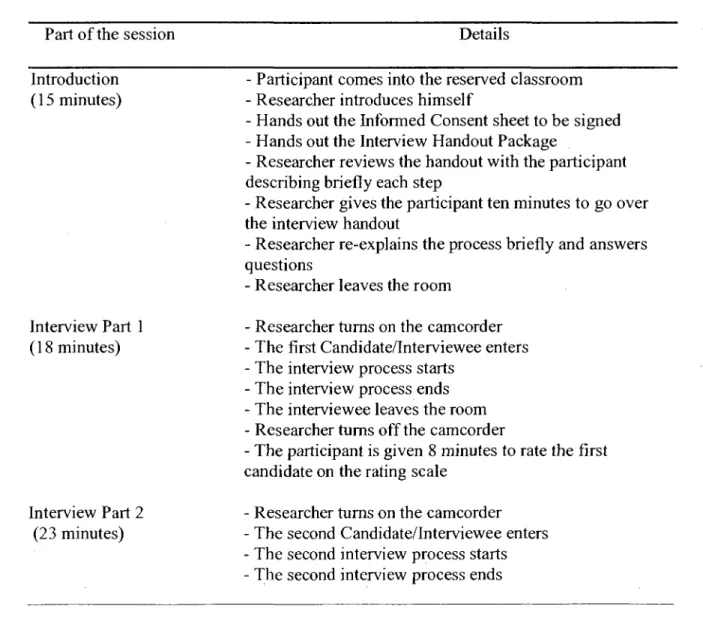
When all the participants (interviewers) were done with performing their interviews, the experimenter debriefed everyone by email including the two candidates that were playing the role of job applicants. The experimenter explained that they were part of a study looking into the different physical characteristics that affect interviewers while performing structured and unstructured interviews (please refer to Appendix O). Table 1 represents a Step-by-step procedure for each research session.
Table 1
Agenda for Research Sessions
Part of the session Details
Introduction (15 minutes) Interview Part 1 (18 minutes) Interview Part 2 (23 minutes)
- Participant comes into the reserved classroom - Researcher introduces himself
- Hands out the Informed Consent sheet to be signed - Hands out the Interview Handout Package
- Researcher reviews the handout with the participant describing briefly each step
- Researcher gives the participant ten minutes to go over the interview handout
- Researcher re-explains the process briefly and answers questions
- Researcher leaves the room
- Researcher turns on the camcorder - The first Candidate/Interviewee enters - The interview process starts
- The interview process ends - The interviewee leaves the room - Researcher turns off the camcorder
- The participant is given 8 minutes to rate the first candidate on the rating scale
- Researcher turns on the camcorder - The second Candidate/Interviewee enters - The second interview process starts - The second interview process ends
Part of the session Details - Researcher turns off the camcorder
- The interviewer has 8 minutes to rate the second candidate on the rating scale
- The interviewer is given 5 minutes to fill the comparison scale and the demographic questionnaire
Conclusion - The researcher checks if all scales and the demographic (5minutes) questionnaires were filled properly
- The participant fills the $30 receipt sheet and receives their compensation
Measures
Physical attractiveness. The independent variable was 'physical attractiveness' that was evaluated based on the participants' ratings of the candidates. The physical attractiveness scale was taken from Dipboye et al., (1977). The following six items tested physical attractiveness in the 'Candidate Rating Scale'; (a) Had positive facial features, (b) Had positive body proportions, (c) Had a positive general appearance, (d) Had a standard weight, (e) Had a good posture during the interview, (f) Was physically attractive overall/Had a pleasant appearance. Participants had to rate candidates using a 5-point scale. The responses were: (1) Strongly Disagree, (2) Disagree, (3) Not Sure, (4) Agree, and (5) Strongly Agree. Cronbach's alpha for this scale was reliable for candidate A (.71) and acceptable for candidate B (.69).
Nonverbal behavior. Previous literature showed that nonverbal behavior of the candidate being evaluated in a job interview context did in fact affect the evaluator's general ratings (Anderson, 1991; Anderson & Shackleton, 1990; Burnett & Motowildo, 1998; DeGroot & Motowildo, 1999; Forbes & Jackson, 1980; Forgas, 1988; Howard &
Ferris, 1996; McGovern & Tinsley, 1978) and their hiring recommendations (Parsons & Liden, 1984). Since nonverbal behavior affects evaluators' decisions, both candidates should be rated equally on nonverbal behavior. Hence the nonverbal behavior variable was added to ensure that both candidates were rated equally on nonverbal behavior before rating them on suitability and hiring recommendation. The 'nonverbal behavior' variable was taken from Harris and Ferris (1996). The three statements that were used to measure this variable were (a) Made direct eye contact with the interviewer often, (b) Nodded her head on average every two minutes and (c) Smiled enough during the
interview process. Participants had to rate candidates using a 5-point scale. The responses were: (1) Strongly Disagree, (2) Disagree, (3) Not Sure, (4) Agree, and (5) Strongly Agree. Cronbach's alpha for this scale were not reliable for both candidate A (.53) and candidate B (.42); thus, each item was examined separately.
Candidate suitability. The first dependent variable was 'candidate suitability' that was based on the four-item scale from Stevens and Kristof (1995, p.592). The candidate suitability scale included: (a) Is highly qualified for the job, (b) Is highly attractive as a potential future employee, (c) Is highly regarded for the position and (d) Did very well in this interview. Participants had to rate candidates using a 5-point scale. The responses were: (1) Very Inaccurate, (2) Moderately Inaccurate, (3) Not Sure, (4) Moderately Accurate, (5) Very Accurate. Cronbach's alphas for this scale were reliable for both candidate A (.82) and for candidate B (.79).
Hiring recommendation. The second dependent variable was the candidate 'hiring recommendation'. At the end of the 'Candidate Scoring Sheet', participants were asked to choose, on a 1 item scale, a hiring recommendation for each candidate. The scale
ranged from 5 (Strongly Recommend to Hire), 4 (Recommend to Hire), 3 (Indifferent about Recommendation), 2 (Recommend to Reject) to 1 (Strongly Recommend to Reject).
Candidate pick. The participants were also asked to choose one of the two candidates with the question, "If you had to pick only one candidate, which candidate would it be?" The responses were either the (1) First candidate or the (2) Second candidate (please refer to Appendix L).
Filler questions. The twenty filler questions in the 'candidate qualification' section were provided from the IPIP website
(http://ipip.ori.ors/newIndexofScaleLabels.htm) and were related to achievement-striving, initiative, resourcefulness and integrity, honesty and authenticity. Examples of the twenty filler questions about the candidate were (a) Replied to answers quickly, (b) Will stay true to her own values, and (c) Will be able to handle complex problems. The different filler questions were scored using a 5-point scale. The responses could vary between 1 and 5 with (1) Strongly Disagree, (2) Disagree, (3) Not Sure, (4) Agree, and (5) Strongly Agree. These filler questions were unrelated to the study but included in the questionnaire to obscure the participants from the true purpose of the study.
Materials
Job description. The study focused on the hiring of a social science research assistant. The Occupational Information Network website (0*Net) was used as a basis to write the job description. This included the main duties and responsibilities that a social science research assistant usually performs, the skills, qualifications and personal characteristics they should possess, the requisite level of education and experience the
research assistant needs to effectively and efficiently perform the job and the usual working conditions and hourly wages (please refer to Appendix P). The job description was given to the interviewers in order for them to be knowledgeable about the job position for which they were interviewing and the characteristics to look for in a candidate.
Structured interview. In the structured interview condition, the interview handout included a general introduction to the experiment (please refer to Appendix I), the
employment interview which included the eight questions to be asked (please refer to Appendix Q), a job description (please refer to Appendix P), the two candidates' CVs (which were matched for equivalence of abilities and qualifications; please refer to Appendices G and H), 2 blank pages for general note taking, the scoring criteria (including the interview questions, the possible answers, how to benchmark responses and the individual question ratings; please refer to Appendix S), the candidate rating scale (including 'candidate qualification' questions and 'candidate suitability' questions, the overall evaluation over 31 and the hiring recommendation; please refer to Appendix K), the 'Choice of Candidate' question (please refer to Appendix L) and the demographic information (please refer to Appendix M). The eight questions in the structured interview were based on the key aspects a social science research assistant need to succeed. Based on the job analysis performed on the Occupational Information Network website
(0*Net), a 'possible answers' scale was designed for the interviewers to be able to judge the potential of each candidate that was being interviewed. Then two 'benchmark
responses' scales were created for interviewers to rate the candidates on a scale from 1 to 5 with the following rating labels: 1-2 (Poor), 4-3 (Average), 5 (Excellent); or on a scale
from 0.5 to 2 with the following rating labels: 0.5 (Limited), 1 (Average), 2 (Above Average). Questions 1, 2, 6, 7, and 8 were rated on 5 point scales; and questions 3, 4 and 5 were rated on 2 point scales. The eight questions forming the structured interview were mainly based on past behavior and experiences (e.g.: (a) 'Have you ever worked on a project in which it was unclear what exactly should be done? If so, please describe the situation and how you handled it' or (b) 'What's your experience with SPSS? Describe a project where you had to use SPSS').
Unstructured interview. In the unstructured interview condition, the handout included a general introduction about the experiment (please refer to Appendix J), the six topics that should be covered during the interview (please refer to Appendix R), a job description, the two candidates' CVs, 2 blank pages for general note taking, the candidate rating scale which included the 'candidate qualification' questions and the 'candidate suitability' questions, the 'choice of candidate pick' question and the demographic information. The unstructured interview was composed of 6 topics/issues to be discussed by the interviewer. These six topics were (A) Interest in research assistant position, (B) Education and Experience, (C) Knowledge about research assistant position and different asks required, (D) Prior research experience, (E) Software usually used and (F) Strengths and Weaknesses. The information provided by the interviewees in this condition should therefore almost be the same as for the structured condition since the 6 topics were based on the 8 questions of the structured interview. The participants were asked to discuss the exact same thing (cover the same topics) with both candidates, in order to give the job applicants an equal chance of responding and giving the same quality reply. Please refer to Appendices C and D respectively for the script for candidate A and the Script for
candidate B for the structured interview and Appendices E and F for the unstructured interview.
Every question in the structured interview had an equivalent topic in the unstructured interview, except for question 6 ("Have you ever worked on a project in which it was unclear what exactly should be done? If so, please describe this situation and how you handled it.").
Table 2 represents each question in the structured interview, and its equivalent topic in the unstructured interview.
Table 2
Equivalent of the Different Questions with the Different Topics
Structured Interview Questions Unstructured Interview Topics
(1) Why are you interested in this position?-(2) Can you tell me about your education-and experience? How will it help you in being a Research Assistant?
(3) How would you assess yourself as a Literature reviewer?
(4) How would you assess yourself as a Data collector?
(5) How would you assess yourself as a Data analyst?
(6) Have you ever worked on a project in which it was unclear what exactly should be done? If so, please describe the situation and how you handled it.
->(A) Interest in RA position ->(B) Education and Experience
k(D) Prior research experience
(C) Knowledge about RA position (Different tasks required)
Structured Interview Questions Unstructured Interview Topics
(7) What's your experience with SPSS? >(E) Software usually used Describe a project where you had to use SPSS.
(8) What do you consider your research >•(¥) Strengths and Weaknesses strengths and weaknesses?
Coding information quality. During the interview process, each candidate was provided with a script on how to reply to the interviewer for each question in the structured interview (please refer to Appendix C and D) and for each topic in the unstructured interview (please refer to Appendix E and F). If both candidates followed perfectly their script and replied the way they should have, they both should have been considered equally qualified by the evaluators. Hence to test if the information provided to the interviewer by each candidate was equal in content and quality, two individual coders separately viewed the recordings of the interviews and rated the quality of the answers on a pre-determined coding scheme. Please see Appendix U for the coding scheme of candidate A and Appendix V for the coding scheme of candidate B. Basically if the candidates said everything they were supposed to in the interviews and if they followed the script perfectly, both candidate A and candidate B should have been considered equally qualified by their evaluators.
After both individual coders reviewed and rated the 64 interviews on tape based on the pre-determined coding schemes, they compared their results. The point was for both candidates to have given equally qualified answers to the participants and hence, all biases aside, being viewed and rated equally. A correlation analysis was conducted
between the results of both coders. The results showed a correlation of .97 (p = .00, 2-tailed). Thus, the results indicate that both raters agreed in their ratings of the candidates.
RESULTS Checking Model Assumptions
Assumption of normality. In an effort to determine whether the various variables followed a normal distribution, the skewness of each was examined. Skewness was calculated by dividing each skewness statistic by its standard error (to derive the z-score). A variable is normally distributed if this z-score has an absolute value of less than 1.96. Two variables, physical attractiveness of candidate A and suitability of candidate A were found to have high levels of skewness.
The Kurtosis of each variable was also examined. Kurtosis was calculated by dividing the kurtosis statistic by its standard error in order to calculate a z-score. Similar to skewness, a variable is normal (not kurtotic) if this z-score has an absolute value of less than 1.96. Two variables, physical attractiveness of candidate A and suitability of candidate A were found to have high levels of kurtosis. However, this was not
considered a significant problem since the candidates were not supposed to be rated as average; their qualifications were way above average standards.
Physical Attractiveness. For physical attractiveness, candidate B was rated higher on physical attractiveness (overall mean = 4.14, SD = .42) than candidate A (overall mean = 3.89, SD = .45) by participants. A t-test was conducted to test whether the mean difference between candidate A and candidate B for the physical attractiveness variable was significant. The t-test results indicated that the difference between the overall means