© 2013. Rajesh Kulkarni, P. Padmanabham & M. S. Namose. This is a research/review paper, distributed under the terms of the Creative Commons Attribution-Noncommercial 3.0 Unported License http://creativecommons.org/licenses/by-nc/3.0/), permitting all non-commercial use, distribution, and reproduction inany medium, provided the original work is properly cited.
Global Journal of Computer Science and Technology
Software & Data Engineering
Volume 13 Issue 8 Version 1.0 Year 2013
Type: Double Blind Peer Reviewed International Research Journal Publisher: Global Journals Inc. (USA)
Online ISSN: 0975-4172 & Print ISSN: 0975-4350
Improving Software Quality Attributes of PS using Stylecop
By Rajesh Kulkarni, P. Padmanabham & M. S. Namose
BSCOER Engineering College, India
Abstract -
Software product quality improvement is a desired attribute and a strenuous effort is
required to achieve that. Static Code Analysis (SCA) is used to find coding bugs. Stylecop is an SCA
tool from Microsoft. In this paper SCA and stylecop usages are discussed. Also a comparison of
Software Testing, software Metrics & Source Code Analysis (SCA) is done. Product PS designed by
author1 and author2 is introduced. PS application is analyzed using static SCA tool Stylecop. After
analysis recommendations were applied to PS. The results showed improved software quality
attributes.
Keywords :
SCA, PS, stylecop, software quality.
GJCST-C Classification :
K.6.4
Improving Software Quality Attributes of PS using Stylecop
Improving Software Quality Attributes of PS
using Stylecop
Rajesh Kulkarni α, P. Padmanabham σ & M. S. Namoseρ
Abstract - Software product quality improvement is a desired attribute and a strenuous effort is required to achieve that. Static Code Analysis (SCA) is used to find coding bugs. Stylecop is an SCA tool from Microsoft. In this paper SCA and stylecop usages are discussed. Also a comparison of Software Testing, software Metrics & Source Code Analysis (SCA) is done. Product PS designed by author1 and author2 is introduced. PS application is analyzed using static SCA tool Stylecop. After analysis recommendations were applied to PS. The results showed improved software quality attributes.
Keywords : SCA, PS, stylecop, software quality. I.
I
ntroductionoftware quality improvement is of foremost importance for product success. Techniques such as software testing, Usability testing and source code analysis are prevalent. Also secure programming to tackle code-based vulnerabilities is in vogue nowadays [2]. Our work focuses on evaluation of PS product designed by author1 and author2 using static source code Analysis (SCA) tool Stylecop. In this paper overview of SCA, comparison of SCA with software testing and software metrics [1] is done. Also introduction to PS product [8], [9] and Stylecop [1], [5], [6], [7] is given. The organization of the paper is as followed: section I which is the current section introduces SCA, section II distinguishes SCA with testing and metrics along with that evaluation criteria of SCA tool selection is also done, section III gives the introduction to PS, section IV details stylecop tool, section V discusses evaluation of PS product using stylecop and section VI lists results of analysis of PS using stylecop. The static analysis approach is meant to review the source code, checking the compliance of specific rules, usage of arguments and so forth. Static code analysis is the analysis of computer software which is performed without the actual execution of the programs built from that software, as opposite of dynamic analysis (testing software by executing programs) [6]. The output of static analysis tools still requires human evaluation [6].
The BCS SIGIST defines static analysis of source code as the “analysis of a program carried out without executing
the program” [2]. This definition
Author α : Department of Computer Engineering BSCOER, Pune, India.E-mail :
Author σ:Department of CSE Hyderabad, India.
Authorρ: ME Computer Engineering BIET, BSCOER, Pune, India.
emphasizes the contrast to dynamic analysis, where the behavior of program is observed while it is executed. Static analysis can be used for varied purposes such as software quality improvement, code optimizations and identifying vulnerabilities [2]. Manual reviewing of code is a form of static code analysis, it is a time consuming process and it should be done at the very early stage of design [6]. Manual review kind of static code analysis can be either a self-review or a third party review [6].
II.
S
CA vsT
esting andM
etricSoftware Testing is the process of executing a program or system with the intent of finding errors [10]. Software testing tools are programs that are trying to find errors, defects, bugs, failures, etc in the software [1]. Test cases are generated and results are compared with expected results. Nonconformance leads to debugging the program. Correctness is the minimum requirement of software, the essential purpose of testing. Correctness testing will need some type of oracle, to tell the right behavior from the wrong one [10]. While according to [11] software metrics is defined as the continuous application of measurement-based techniques to the software development process and its products to supply meaningful and timely management information, together with the use of those techniques to improve that process and its products. Software metrics are programs or tools that collect information about the software regarding its characteristics for example metrics such as Lines Of Code (LOC), size, complexity, Number of functions per class, etc [1]. While the high level goal of software metrics is similar to software testing in improving the overall quality of the software, there are several differences between software testing and metric tools [1]. Software metrics are usually collected after testing and after making sure that program is free from errors (at least syntactic errors)[1].
III.
PS P
roductThe PS (personal Secretary) web application is targeted for online users who has many email ids, other site ids, does online banking and online transactions. Presently he stores his email ids and passwords, ATM pins as emails or in written form on a paper which he keeps in his wallet. His constant fear is if he loses his wallet there may be misuse of his ids and pins. He also faces the problem of recollecting the ids, passwords
S
Global Journal of Computer Science and Technology Volume XIII Issue VIII Version I
21 (DDDDDDDD ) Year 013 2 C
and ATM pin numbers.PS is intended to provide
complete solutions for the above vulnerabilities through a single get way using the internet as the sole medium. It will enable the online user to retrieve ids, passwords and ATM pin numbers at will 24/7. The administration module will enable a user to allow addition, deletion and updating of ids, passwords and documents.
The target user also requires documents frequently such as Copies of mark memos, certificates and updated resume for applying for jobs. Copies of documents such as form 16s, salary slips, ids for loan application. Insurance policy numbers
PS was designed using TEIM(The Evolved Integration Model) of software engineering and human computer Engineering proposed by us [8].This paper is a continuation of efforts for validating the utility of TEIM and acceptance from peers [9].
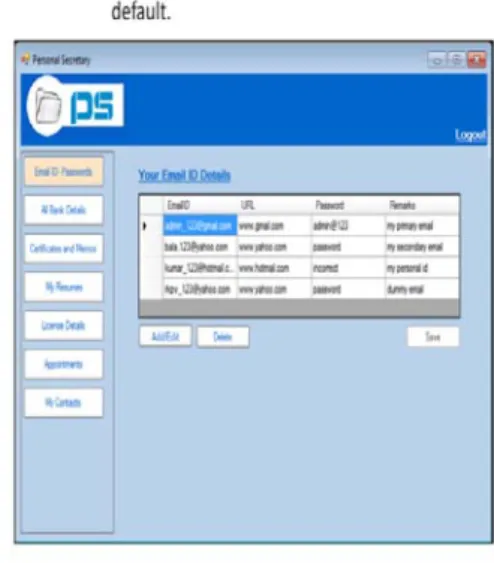
Figure 1: PS Product Screen IV.
S
tylecopStyleCop is an open source SCA tool from Microsoft that checks. NET code for conformance of several design guidelines defined based on Microsoft's .NET Framework [1][7]. StyleCop evaluates the style of C# source code in order to enforce both a set of style and consistency rules. Style guidelines are rules that specify how source code should be formatted and dictate whether spaces or tabs should be used for indentation and the format of for loops, if statements and other constructs [5]. The goal is to define guidelines to enforce consistent style and formatting and help developers avoid common pitfalls and mistakes. StyleCop contributes to this maintainability by encouraging consistency of style, which in turn makes it easier for developers to pick up existing code and work with it productively, and by encouraging plenty of documentation for future developers to read thereby improving the long term maintainability of the source.[6] Historically, different development groups have used drastically different coding styles. Many teams have
used inconsistent coding styles within a single product or even a single source file. StyleCop was originally written to provide a simple and efficient way to enforce a common coding style for C# code throughout Microsoft. Over time, StyleCop evolved to include new rules that go beyond style checks.[6]
V.
E
valuation of PS usingS
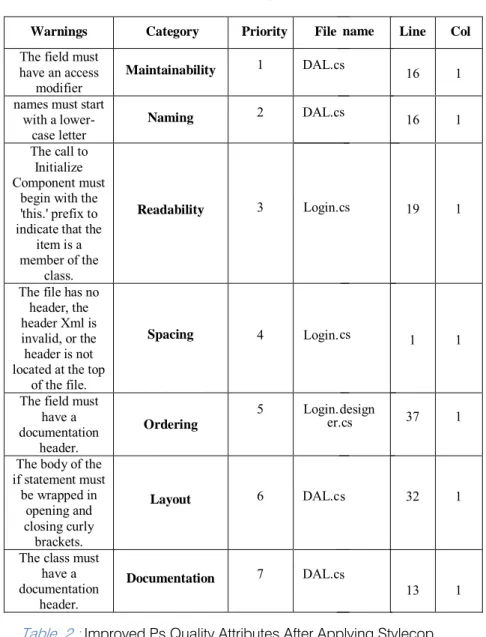
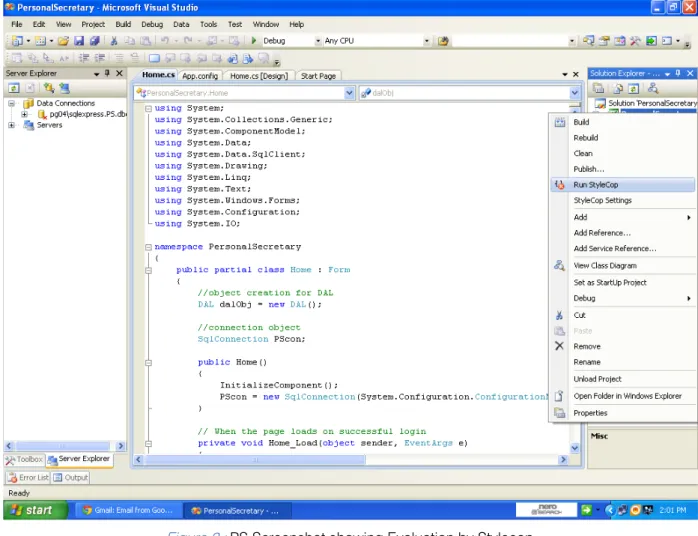
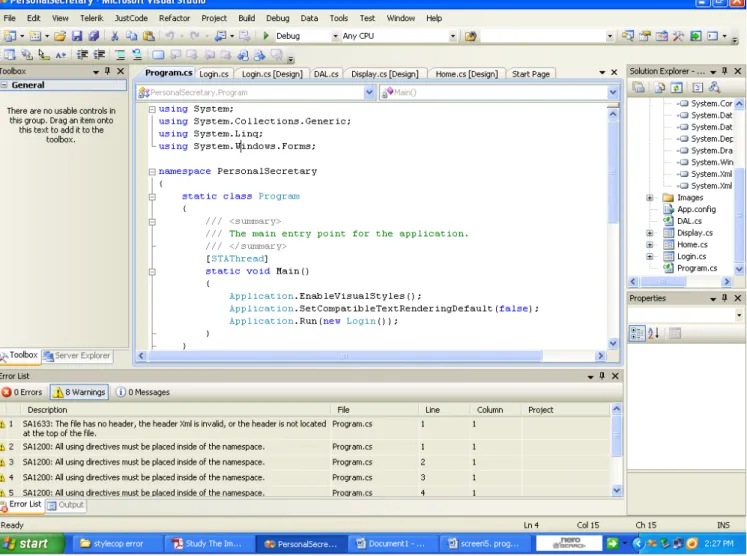
tylecop PS application was developed using .NET. Stylecop was configured with .NET during installation. Each of the file of PS was evaluated using Stylecop. Stylecop issued warnings and errors in the following categories: Naming, maintainability, documentation, ordering, readability, spacing, and layout [1] [7]. Except maintainability all the categories belong to refactoring. Refactoring indicates cosmetic improvementin software without changing its functionalities [1].Priority numbers assigned are based on the importance and impact of its program [1].Some sample warnings are shown in TABLE I. PS Screenshots showing Evaluation by Stylecop are shown in in Figure 2 and Figure 3. After evaluating PS with stylecop manual corrections were made in the code of PS. These corrections led to improvement in software quality attributes of PS as shown in TABLE II.22 Year 013 2
Improving Software Quality Attributes of PS Using Stylecop
For evaluation manual review technique was used. A group of students undergoing ME Computer program were given a walkthrough of the code and then static code analysis was done. We maintained a log of bugs found for each screen of PS.
Global Journal of Computer Science and Technology Volume XIII Issue VIII Version I
(DDDDDDDD
)
Global Journal of Computer Science and Technology Volume XIII Issue VIII Version I 23 (DDDDDDDD ) Year 013 2 C
Warnings Category Priority File name Line Col
The field must have an access
modifier
Maintainability 1 DAL.cs 16 1
names must start with a lower-case letter Naming 2 DAL.cs 16 1 The call to Initialize Component must
begin with the 'this.' prefix to indicate that the
item is a member of the
class.
Readability 3 Login.cs 19 1
The file has no header, the header Xml is invalid, or the header is not located at the top
of the file.
Spacing 4 Login.cs 1 1
The field must have a documentation header. Ordering 5 Login.design er.cs 37 1 The body of the
if statement must be wrapped in opening and closing curly brackets. Layout 6 DAL.cs 32 1
The class must have a documentation
header.
Documentation 7 DAL.cs
13 1
Table 1 :Sample Warnings for Ps
Table 2 :Improved Ps Quality Attributes After Applying Stylecop
Tool Increase complexity Increase usability Increase Maintainability Increase Documentation Style Cop √ √ √ √
24 Year 013 2
Improving Software Quality Attributes of PS Using Stylecop
Figure 2 :PS Screenshot showing Evaluation by Stylecop VI.
C
onclusionIn this paper we analyzed product PS designed by author1 and author2 using stylecop- a static source code analysis (SCA) tool. Manual corrections in code of PS as per recommendations of stylecop were done. The results showed
Global Journal of Computer Science and Technology Volume XIII Issue VIII Version I
(DDDDDDDD
)
Global Journal of Computer Science and Technology Volume XIII Issue VIII Version I
25 (DDDDDDDD ) Year 013 2 C
Figure 3 :PS Screenshot showing Evaluation by Stylecop improved software quality attributes in PS. The focus in
this paper was explored the working of stylecop SCA tool and improving software quality of PS using stylecop. It also helped in improving the style guidelines. Manual review was found to be a tedious process in terms of time and planning. As our product is being targeted as a client-server program security was not an issue and so our focus was less on security and more on styling and usability.
VII.
A
cknowledgementsWe sincerely thank staff and students of ME program of BSCOER College, Narhe, Pune, India for helping us in designing PS, installation of stylecop and analyzing PS using stylecop.
R
eferencesR
éférencesR
eferencias 1. Zoubi, Q.; Alsmadi, I.; Abul-Huda, B. “Study TheImpact of Improving Source Code on Software Metrics “CITS 2012 Digital Object Identifier: 10.1109/CITS.2012.6220379 Publication Year: 2012,
“Scanstud: A Methodology for Systematic, Fine-grained Evaluation of Static Analysis Tools” Digital Object Identifier:10.1109/ICSTW.2011.32 Publication Year: 2011, Page(s): 523 – 530.
2. Paul E. Black. SAMATE and Evaluating Static Analysis Tools. ADA User Journal, 28(3):184 – 189, September 2007.
3. Pressman, R. Software Engineering: A Practitioner’s Approach. McGraw-Hill, 2005.
4. http://code.msdn.microsoft.com/sourceanalysis,Mic rosoft StyleCop, (2008).
5. Ivo Gomes, Pedro Morgado, Tiago Gomes, Rodrigo Moreira,” An overview on the Static Code Analysis approach in Software Development”,.
6. StyleCop.Codeplex.WebsiteAvailable at:http://style cop.codeplex.com/ Accessed October 8, 2011.
8. R.Kulkarni, P.Padmanabham, “Validating Utility of TEIM: A Comparative Analysis”, IJACSA, To be
Page(s): 1–5. Martin Johns, Moritz Jodeit
7. R.Kulkarni, P.Padmanabham,” TEIM-The Evolved Integrated Model of SE and HCI”, UNIASCIT, Vol. 2 (3), 2012, 301-304, ISSN 2250-0987.
© 2013 Global Journals Inc. (US) 26 Year 013 2
Improving Software Quality Attributes of PS Using Stylecop
9. Jiantao Pan, “Software Testing”, Carnegie Mellon University, 18-849b Dependable Embedded Systems, Spring 1999.
10. Paul Goodman, “Software Metrics: Best Practices for Successful It Management”, Rothstein Associate Inc., 2004Ww.
Global Journal of Computer Science and Technology Volume XIII Issue VIII Version I
(DDDDDDDD
)
C
published, January 2012, U.S ISSN: 2156-5570 (Online), U.S ISSN : 2158-107X.