Bob Pearlmanis 21st Century School Development project con-sultant. He is the former Director of Strategic Planning for the New Technology Foundation and former President of the Autodesk Foundation (e-mail: [email protected]).
Learner-Centered, Information-Age schools have been proposed in Educational Technology and in other publications. This article reviews the experience of the New Technology Foundation, a school-development organization, working since 2001 to support 51 communities in 10 states to launch and implement 21st Century High Schools, based on the model and practices of New Technology High School (NTHS) in Napa, California. This article explores the key issues and lessons in 21st Century school development, encompassing a new learning culture.
Making 21st
Century Schools
Creating Learner-Centered
Schoolplaces/Workplaces for
a New Culture of
Students at Work
Bob Pearlman
Introduction
Hasn’t it been long enough? Over 100 years of public mass education, nearly 10 years into the new century, you still see the 30-student same-look classrooms with students sitting in rows and columns listening to teachers and doing monotonous worksheets.
The educational technology community knows well how new technology enables students to learn, produce, and construct knowledge. Marc Prensky, who several years ago presciently identified the new capa-bilities of “digital natives,” urges moving from “telling/lecturing” to the “‘new’ pedagogy of kids teaching themselves with the teacher’s guidance” (Prensky, 2008). Others call for a “Learner-Centered Paradigm of Education” (Watson & Reigeluth, 2008), with its accompanying changes in pedagogy, assess-ment, and support systems.
promote academic learning and instruction. In B. F. Jones & L. Idol (Eds.), Dimensions of thinking and cognitive instruction.Hillsdale, NJ: Lawrence Erlbaum Associates. Partnership for 21st Century Skills. (2004). The partnership for
21st century skills;http://www.21stcenturyskills.org/. Paul, R., & Elder, L. (2002). Critical thinking: Teaching
students how to study and learn, Part I. Journal of Developmental Education, 26(1), 36–37.
Paul, R., & Elder, L. (2004). Critical thinking...and the art of close reading, Part III.Journal of Developmental Education, 28(1), 36–37.
Piirto, J. (2004).Understanding creativity.Scottsdale, AZ: Great Potential Press.
Raths, L. E., Wassermann, S., Jonas, A., & Rothstein, A. M. (1986). Teaching for thinking: Theory, strategies, and activities for the classroom(2nd ed.). New York: Teachers College Press. Resnick, L. B., & Klopfer, L. E. (1989). Toward the thinking
curriculum: An overview. In L. B. Resnick & L. E. Klopfer (Eds.), Toward the thinking curriculum: Current cognitive research.Alexandria, VA: Association for Supervision and Curriculum Development.
Richardson, C. P. (2007). Engaging the world: Music education and the big ideas.Music Education Research, 9(2), 205–214. Runco, M. A. (2007).Creativity theories and themes: Research,
development, and practice.Burlington, MA: Elsevier.
Sawyer, R. K. (2006).Explaining creativity: The science of human innovation.New York: Oxford University Press.
Starko, A. J. (2005).Creativity in the classroom: Schools of curi-ous delight(3rd ed.). Mahwah, NJ: Lawrence Erlbaum Associates. Sternberg, R. J. (2000). Patterns of giftedness: A triarchic analysis. Roeper Review, 22(4), p. 231 (ERIC Document Reproduction Service No. EJ609729).
Sternberg, R. J., & Baron, J. B. (1985). A statewide approach to measuring critical thinking skills. Educational Leadership, 43(2), 40–43.
Sternberg, R. J., & Leighton, J. P. (2004). The nature of reasoning: Teaching for thinking. Washington, DC: Cambridge University Press.
Sternberg, R. J., & Lubart, T. I. (1991). An investment theory of creativity and its development.Human Development, 34,1–32. Sternberg, R., & Lubart, T. (1995).Defying the crowd: Cultivating
creativity in a culture of conformity.New York: Free Press. Sternberg, R. J., & Lubart, T. (1996). Investing in creativity.
American Psychologist, 51(7), 677–688.
Sternberg, R. J., & Spear-Swerling, L. (1996).Teaching for think-ing.Washington, DC: American Psychological Association. Swartz, R. J., & Perkins, D. N. (1990). Teaching thinking:
Issues and approaches. Pacific Grove, CA: Midwest Publications.
Tardif, T. Z., & Sternberg, R. J. (1988). What do we know about creativity? In R. J. Sternberg (Ed.), The nature of creativity.New York: Cambridge University Press.
Torrance, E. P. (1962).Guiding creative talent.Englewood Cliffs, NJ: Prentice-Hall.
Weisberg, R. W. (1999). Creativity and knowledge: A challenge to theories. In R. J. Sternberg (Ed.), Handbook of creativity.Cambridge, UK: Cambridge University Press. Wertheimer, M. (1938). Laws of organization in perceptual
forms. In C. Green. (Ed.), Classics in the history of psychology; http://psy.ed.asu.edu/~classics/Wertheimer/ Forms/forms.htm .(Reprinted from A source book of Gestalt psychology, pp. 71–88, by W. Ellis, Ed., 1938. London: Routledge & Kegan Paul.)
Williams, F. E. (1970).Classroom ideas for encouraging thinking and feeling.Buffalo, NY: D.O.K Publishers, Inc.
What really turned on the visitors always were the student voices describing their work, their teams, and their goals. Listen to these “takeaways“ from one delegation:
• “I saw engaged and challenged students, excited and talented teachers, 21st Century education and opportunities…a dream that I never thought I would see!–Chair of a state Senate Education Committee.
• “This reinforced my beliefs. All kids were on task. And this was NOT a “show!”–Teacher.
• “It’s refreshing to see students taking bility for their learning…and taking that responsi-bility to their homes as well. The teaching is going both ways…teachers to students–students to teachers!”–President of a state board of educa-tion.
Delegates would return home with common stories and the ability to present their findings to their respec-tive constituencies. With a shared vision, these leaders were then ale to work together to make a very signifi-cant investment in launching a 21st Century High School in their community. The investment includes funding for technology, facilities renovation, profes-sional development services, and a technology learning platform.
What Does 21st Century
Learning Look Like?
Walk into a classroom at a New Technology High School and you will see what we call Students at Work—students writing journals online, doing research on the Internet, meeting in groups to plan and make their Websites and their digital media presenta-tions, and evaluating their peers for collaboration and presentation skills.
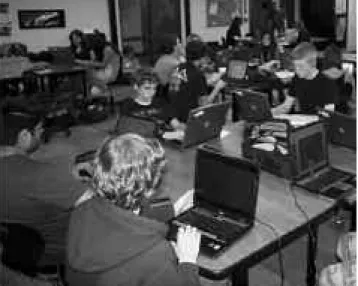
The classroom learning environment also looks different. It’s double size with a large group of students, two teachers, and a double-block period for an inter-disciplinary course. The classroom is populated by worktables, not individual student desks. Every student has access to a desktop or a laptop computer. The tables can be put together as needed for collaborative student project groups, or for workshops/seminars that are teacher-led in response to student need-to-knows. The classroom, or student workroom, can also serve as a design workshop or even a presentation space for end-of-project student presentation. Figure 1 shows student project teams at work in a classroom at New Tech High @ Coppell, Coppell, Texas. The classroom, or studio, can be set up to accommodate project teams, seminars, or workshops for some of the students, while others continue working, or large-group student or teacher presentations. Figure 2 shows a similar classroom at Manor New Technology High School, Manor, Texas, near Austin.
But how do you make this happen? How do you make new “learner-centered” schools where kids teach themselves with the teacher’s guidance? How do you create a newculture for learning?
I have been part of a unique school development group, the New Technology Foundation (NTF), based in Napa, California, for the past eight years. I want to share with readers our experience in creating 21st Century High Schools. There are lessons here that, I believe, will help school designers and developers, and education, civic, and business leaders, launch the next generation of innovative schools.
Since 2001, NTF has helped 51 communities in 10 states launch and implement 21st Century High Schools based on the model and practices of New Technology High School (NTHS) in Napa. Another 20 or more will start up in 2010. New Tech is positioned to scale in a few districts and states; however, these 21st Century High Schools are still a small dot on a very large landscape populated by traditional schools in the US and in other countries.
Why Not More Innovation?
Despite the great advances in information and communications technologies, the New American Schools Development Corporation initiative in the 1990s, the Charter School growth in the past decade, and the Gates Foundation’s small-schools investments, one might ask: Why is there not more innovation?
The easy answer is that traditional education is too entrenched culturally and institutionally. Every adult knows what school is supposed to be like. Another easy answer is that the standards and accountability movement, while well intended, tends to reinforce traditional teacher-directed, whole-class instruction.
While these are factors, of course, is it possible that there is another, simpler explanation, that people have a hard time envisioning, and conceptualizing, true 21st Century education?
There have been plenty of articles over the past 20 years, many articulating well what needs to be done, or chronicling good practices. And there are an increasing number of videos accessible via YouTube and other sties that tell the story of new kinds of learning.
Still, our experience at New Tech is that education, civic, and business leaders need tosee it for themselves and talk to students and teachers who are doing it.
Starting in 2004, NTF initiated Executive Tours to bring delegations of 20–30 education, civic, and business leaders from a community to visit our schools in Napa and Sacramento. Later we expanded these destinations to include newer schools in Los Angeles, Austin, Dallas, Albany (NY), and many sites in Indiana. Visitors would spend a whole day in student-led tours of classrooms, followed by a student panel and then a teacher panel.
Figure 4 shows several student collaborative project teams working in the school’s digital media library, which is an open, extended learning space.
New school development often flounders because educators are unable to specify what the new learning will look like. Often architects are flummoxed when all they can get the educators to specify is “flexibility,” which, of course, is often another word for “we don’t know.”
But architects are practitioners of “form follows function.” Show them what students and teachers will be doing in the new classrooms, and they will likely design excellent spaces and facilities. At New Tech Foundation, we hosted tours for architects and construction managers to existing New Tech facilities. By seeing students and teachers at work, architects have designed exemplary New Tech facilities in Columbus and Decatur, Indiana, and Coppell and Manor, Texas. Students at these schools often say about their classrooms and their non-classroom open spaces:
Figure 3. Student collaborative project team at Napa New Technology High School, Napa, California. Photo by New Technology Foundation
Figure 4. Student teams in the digital media library, one of many extended learning spaces at New Tech High @ Coppell. Photo by SHW Group, Plano, Texas.
There is also a lot of glass. Glass walls or large glass windows make visible to the students themselves, and to visiting adults, that this is a school whereall students are at work. Figure 3 shows a student collaborative project team at work at Napa New Technology High School.
At NTH @ Coppell, there are no “students” and no “teachers.” Instead there are learners and facilitators. NTH @ Coppell leverages state-of-the-art wireless tech-nology to create extended learning spaces throughout the building, in the corridors, in open small and large collaboration zones, and even small project team conference rooms, where a 3–6 student project team can go and work privately together on their project.
Figure 1. Student project teams at work in double-sized classrooms at New Tech High @ Coppell, Coppell, Texas. Photo by Kate Jenkins.
Figure 2.World GeoLit Integrated class at Manor New Technology High School, Manor, Texas. Photo by Les Simpson.
“it doesn’t feel like a school, it feels like a business workplace.”
21st Century Schools
What do students need to know and be able to do? New Tech schools start with defining Learner Out-comes. The original Napa school defined eight Learner Outcomes, corresponding to the outcomes articulated in 2003 by the Partnership for 21st Century Schools (P21): content standards, collaboration, critical thinking, oral communication, written communication, career prepara-tion, citizenship and ethics, and technology literacy. Other New Tech schools start with many of these same outcomes but emphasize or add others, such as numera-cy, work ethic, innovation, and global literanumera-cy, but always stay with a set of 8–12 outcomes. Why? Because the outcomes are not a wall poster, or a compendium of standards that no one looks at. Real outcomes go beyond what we think “students need to know and be able to do” to outcomes that students own, that students believe theyneed to know and be able to do.
New Tech schools embed these learning outcomes in all projects, assess them, and report them in online “living” grade reports. For New Tech students, the goal is to master the Learner Outcomes during their four years at the school. To graduate, students demonstrate their mastery of the Learner Outcomes on their digital “professional” portfolios.
These 21st Century Schools are schools where students are assessed on 21st Century knowledge and skills and master them for graduation.
Ask a student at a New Tech school how he or she is doing and the learner will say, for example, “I’m doing well on content but need to improve my oral commu-nication. My critical thinking skills are strong, but I need to collaborate better with my fellow students.”
“But How Do We Implement?”
One of the delegates on an Executive Tour, mentioned earlier, wrapped up the “takeaway” session with this appropriate query: “Great…but how do we implement?” Many of us have written about what it takes. Some emphasize project-based learning, others the one-to-one technology or innovative technology applications, others the assessment. By themselves none of these practices are enough.You need to put it all together.
For example, “1-to-1 computing” has been a pow-erful initiative in many districts (see Henrico County, Virginia) and states. It works as a policy campaign. It is very easy for mayors and governors to get their heads around it and back it. The only problem is that it doesn’t work without profound changes in pedagogy. How many of us have visited 1-to-1 classrooms, schools, or colleges, in this country and others, only to see teachers lecturing and students taking notes? Places like Henrico County complain they didn’t get the
punch they expected from 1-to-1. And many understand that they didn’t due to the limitations of traditional education to exploit the potential for creating self-directed learners.
Students as Workers and Producers (constructors of knowledge) are one of the key paradigms of 21st Century education. Students work and engage in self-directed learning when they are motivated to learn and have personal “need to knows.“
New Tech’s experience is that students best work, produce, and construct knowledge through Project-Based Learning (PBL). “Problem-Project-Based Learning,” also known as PBL, which originated in medical education and is more widely used today, is the foundational methodology for Project-Based Learning. The Buck Institute of Education defies standards-focused PBL as “a systematic teaching method that engages students in learning knowledge and skills through an extended inquiry process structured around complex, authentic questions and carefully designed products and tasks” (Buck Institute of Education, 2003).
Many are now calling PBL “Project Learning.” The name Project Learning emphasizes what students do and not what we educators do. In Singapore, it is called Project Work.
Projects at New Tech schools are typically one to three weeks long. New Tech teachers start each unit by placing students into a realistic, real-world project that both engages interest and generates a list of things students need to know. Projects are designed to tackle complex problems, requiring critical thinking.
At New Tech some examples of projects include presenting a plan to Congress on solving the oil crisis, addressing economic issues as a team of the President’s economic advisors, or inventing, under contract from NASA, new sports that astronauts can play on the moon so they can get exercise.
It is through projects that New Tech teachers can embed learner outcomes and assess against them. Projects have associated rubrics for content, collabora-tion, written communicacollabora-tion, oral communicacollabora-tion, critical thinking, etc., all posted online for students, so that they can decide on their own whether to achieve basic, proficient, or advanced work. Self-direction is a learned behavior accomplished by students motivated to learn, and having information on “how am I doing?” and “what do I want to accomplish?” Assessment and feedback are crucial.
When Learner Outcomes are the same across all subjects and interdisciplinary courses, they are known as “collective outcomes.” In Hawaii they call them “General Learner Outcomes.” Communication skills are no longer just the province of English classes; now they are part of, and assessed in, math and science classes as well. Likewise, technical skills span all courses, not just math and science.
New Tech, with nearly 1000 PBL teachers nationally, meets these challenges with several effective strategies: 1. Student work. Projects are designed to engage students and capitalize on their “need-to-know,” their aspirations to improve on and master their learning outcomes, and their growing ability to self-direct their learning.
2. Teamwork.In all projects, except for the individ-ualized Senior project, students work in collabo-rative teams, take on different roles, and collec-tively manage their work.
3. Teacher development.At New Tech, professional development involves a system of shadowing, training, and personal coaching for every teacher, a professional learning community with-in a school and across schools, and an onlwith-ine sharing community, all carried out over a 31⁄
2year
time frame.
4. Structure.Teachers design project calendars for student viewing with appropriate benchmarks and constantly check for understanding through daily journal prompts and interim assessments. 5. Guided Discovery.Teachers constantly question
and make suggestions to students, to project groups, and hold seminars with students on topics where they have a “need to know.” Through this they provide “hints, direction, coaching, feedback, and/or modeling to keep students on track” (Mayer, 2004).
Effective PBL requires design of projects that meet state standards and 21st Century Skills and their accompanying assessments. It also requires appropriate benchmarks and interim assessments. An effective project gets better over time, refined through execution in the classroom and scaffolding activities.
New Tech schools demonstrate that PBL can be done well. However, it takes significant professional development. Districts and states that hope to spread PBL through a set of workshops and one to two week training sessions will not achieve their goal. Districts and states that wish to scale 21st Century Schools should adopt a comprehensive systems approach to professional development similar to New Tech’s.
The second barrier relates to the difficulties of managing a PBL classroom. Students can’t work effec-tively as individuals or as members of a team unless they can access all their project materials, calendars, and rubrics for how the project will be assessed. They also need to check their grades constantly to see how they are doing and also see the criteria for how they can do better. In addition, teachers need to design projects, project calendars and benchmarks, and assessments and post them online for student access.
This is an area where today’s technology can make a huge difference.
Assessment for Learning
The U.S. has devoted ten to fifteen years to trying to build a state and national system of assessment for accountability. This has succeeded in shining a light at the same failing schools one might have named before it all started. What it has not accomplished is to provide students with “just-in-time” information about their own learning and link it to information on the criteria needed to do better. That is, assessment for learning.
At New Tech schools, students access GradePortal, an online disaggregated report card. New assessment information is added when available, so that students see a “living” assessment and don’t have to wait ten weeks to see how they are doing. Course reports give feedback on all of the school’s Learner Outcomes. Composite grades are available per subject, and across courses for the skills of the Learner Outcomes. Students and their parents can look at their grades anytime and from any place.
Self-assessment is a critical element of assessment for learning. Students are able to look at their grades on a daily basis and then check the online project rubrics to see how they might do better. Rubrics, which are available for each project and for each of the school-wide learner outcomes, show the criteria that consti-tute, respectively, basic, proficient, and advanced work. By making the assessment criteria transparent and understandable, students are then able to make their own decisions about what performance target or level they wish to accomplish. Such just-in-time feed-back, coupled with the assessment criteria, provides students with the information needed to foster self-directed behaviors.
At the end of a project, New Tech students assess their team members on their collaboration skills and get to see how their peers assessed them on their collaboration skills. They also write reflections on what they learned and how the project can be improved.
Barriers to 21st Century
School Development
There are two main barriers to 21st Century School Development. First, PBL is hard to do well. Second, effective schoolwide PBL needs a collaborative learning platform to support students and teachers.
Some theorists argue that PBL and other constructivist approaches do not work well (Kirschner, Sweller, & Clark, 2006; Mayer, 2004). These are legitimate concerns, since PBL has indeed been implemented poorly in many countries over the past 30 years.
New Tech’s approach to PBL is much more charac-teristic of “guided discovery,” however, than the pure or minimally guided discovery approach that has been criticized.
to do, embed them in all projects, and provide students just-in-time assessment feedback on their learner outcomes.
• Systematize 100% project learning in all courses. • Provide ongoing and systematic professional development. Go beyond training to coaching and a professional learning community.
• Go beyond 1-to-1 computing. Provide students and teachers with technology tools plus an online collaborative learning platform.
• Build a new student culture of “trust, respect, and
responsibility.”
References
Buck Institute of Education. (2003). Project based learning handbook,CSO Architects.
Kirschner, P. A., Sweller, J., & Clark, R. E. (2006). Why minimal guidance during instruction does not work: An analysis of the failure of constructivist, discovery, problem-based, experiential, and inquiry-based teaching. Educational Psychologist, 41(2), 75–86.
Mayer, R. (2004). Should there be three-strikes rules against pure discovery learning? American Psychologist, 59(1), 14–19.
Prensky, M. (2008). The role of technology in teaching and the classroom.Educational Technology, 48(6), p. 64. Watson, S. L., & Reigeluth, C. M. (2008). The
learner-centered paradigm of education.Educational Technology, 38(5), 42–48.
Technology’s Role in
21st Century Schools
Equipping students with appropriate technology and tools is the beginning, not the end. Computers, cameras, and interactive white boards all come to life as student tools in a 21st Century PBL classroom.
Students need these tools to be investigators and producers of knowledge. But they also need 24/7 access to their project information, project calendar, assessment rubrics, and just-in-time assessments. They also need, if they work in collaborative teams, discus-sion boards, journals, e-mail, and special group evaluation tools.
The original New Tech school in Napa built all these special technology tools and implemented them on a Lotus Notes platform. NTF took these tools and profes-sionalized them into the New Tech High Learning System, a learning management system or learning platform specially designed for PBL schools. In the past two years NTF has developed that platform into a Web portal called PeBL.
PeBL and its predecessor New Tech High Learning System also provide teachers with the tools to design projects, assessments, and calendars and post them online for student access.
Districts and states planning to scale 21st Century Schools will need to provide their teachers and students with these support tools. They can do this either with PeBL or alternatively design their own system on open source or commercial learning platforms.
A New Culture of Students at Work
Underlying an effective 21st Century School is a new culture of Students at Work. Visiting adults to New Tech schools are struck by how mature, poised, and articulate the students are and how comfortable they are speaking with adults.New Tech students speak of a culture of “trust, respect, and responsibility.”
Putting It All Together
The New Tech experience demonstrates that with appropriate know-how and support, diverse communi-ties across the country, in large urban, small urban, suburban, and rural settings, can effectively launch and implement 21st Century Schools. But it can’t be done piecemeal. It needs to be put all together:
• Help education, civic, and business leaders envision, and conceptualize, what 21st Century education looks like, by visiting 21st Century Schools.
• Create new classroom learning environments for “a culture of Students at Work.”
• Define the school’s Learner Outcomes that students believe they need to know and be able
Suggested Resources
Books
Collins, A., & Halverson, R. (2009).Rethinking education in the age of technology: The digital revolution and schooling in America.
New York: Teachers College Press.
Fielding, R., & Nair. P. (2005). The language of school design: Design patterns for 21st century schools; Designshare, Inc.;
http://designshare.com/index.php/language-school-design. Kelly, F., McCain, T., & Jukes, I. (2008).Teaching the digital
genera-tion: No more cookie cutter high schools.Thousand Oaks, CA: Corwin Press.
Articles
21st century learning in schools: A case study of New Technology
High School, by Bob Pearlman; New Directions for Youth
Development, 2006; http://www.bobpearlman.org/Articles/21st CenturyLearning.htm.
New Skills for a new century: Project-based learning teaches kids the collaborative and critical thinking abilities they’ll need to compete, by Bob Pearlman; Edutopia, 2006; http:// www.edutopia.org/new-skills-new-century.
Websites
http://www.bobpearlman.org/21stcenturyschools.htm . http://www.newtechfoundation.org/index.html . Videos
Manor New Tech High. YouTube channel:
http://www.youtube.com/user/ManorNewTechHigh. New Tech Video Clips Webpage: