Comunicar, n. 42, v. XXI, 2014, Media Education Research Journal; ISSN: 1134-3478; pages 65-74 ABSTRACT
Digital technologies offer new opportunities for learning in an increasingly connected society, in which learning to work with others and collaborate has become an extremely important skill. This article presents the results of a rese-arch study into the conceptions and practices of working teachers regarding collaborative learning methodologies mediated by information and communication technologies (ICT) in Elementary and Secondary Education schools. We analyze data concerning ICT contributions to collaborative work processes in the classroom, from the point of view of teachers at schools accredited with a high level of ICT by the Regional Government of Castile and Leon. We furthermore take into account the limitations of these tools, as well as teachers’ conceptions of collaborative lear-ning strategies. The methodology is based on the content analysis of interviews of teachers from a representative sample of schools. The results indicate that teachers think that ICT have great potential for enhancing collaborative activities among students and for developing highly relevant generic skills, although they are also aware of the diffi-culties that both students and teachers face in educational practice.
RESUMEN
Las tecnologías digitales ofrecen nuevas oportunidades para el aprendizaje en una sociedad cada vez más conectada, en la cual aprender a trabajar con otros y colaborar se convierte en una competencia trascendental. El texto presenta resultados de una investigación sobre concepciones y prácticas del profesorado en ejercicio acerca de las metodo-logías de aprendizaje colaborativo mediadas por las tecnometodo-logías de la comunicación (TIC), en centros de enseñanza de Educación Primaria y Secundaria. En el artículo se analizan los datos referidos a las aportaciones de las TIC para llevar a cabo procesos de trabajo colaborativo en el aula, desde el punto de vista de los docentes de los centros acre-ditados con alto nivel TIC por la Junta de Castilla y León. También se expondrán las limitaciones que imponen estas herramientas, así como las concepciones docentes sobre las estrategias de aprendizaje colaborativo. La meto-dología se basa en el análisis de contenido de entrevistas realizadas a equipos docentes de una muestra representativa de centros educativos. Los resultados apuntan que en estos centros los docentes atribuyen a las TIC una alta poten-cialidad para enriquecer las actividades de trabajo colaborativo entre los estudiantes y conseguir el desarrollo de competencias transversales de gran relevancia, aunque son conscientes de las dificultades a las que tanto alumnos como profesores se enfrentan en la práctica educativa.
KEYWORDS / DESCRIPTORES
Teaching methodology, curriculum integration, collaborative learning, virtual learning, teacher training, teaching practice.
Metodología didáctica, integración curricular, aprendizaje colaborativo, aprendizaje virtual, formación de profesorado, práctica docente.
DOI: http://dx.doi.org/10.3916/C42-2014-06
v Dr. Ana García-Valcárcel Muñoz-Repiso is Professor in the Faculty of Education at the University of Salamanca
(Spain) ([email protected]).
vVerónica Basilotta Gómez-Pablos is a PhD Student at the Department of Didactics and Organizational Research
Methods at the University of Salamanca (Spain) ([email protected]).
vCamino López García is a PhD Student at the Department of Didactics and Organizational Research Methods
at the University of Salamanca (Spain) ([email protected]).
Accepted: 01-08-2013 / Preprint: 15-11-2013 Published: 01-01-2014 / RECYT Code: 21655
l
Ana García-Valcárcel, Verónica Basilotta & Camino López
Salamanca (Spain)
ICT in Collaborative Learning
in the Classrooms of Primary and
Secondary Education
Las TIC en el aprendizaje colaborativo en el aula de Primaria y Secundaria
1. Introduction
Digital technology arrived in Spanish educational centres through various programmes for introducing ICT in the classroom, with one of the newest and most relevant programmes being the national Escuela (School) 2.0 developed in Castilla and León under the name Red XXI. Funding for technology has brought computers and smartboards to a large number of class-rooms in elementary and secondary schools. Now is a good time to determine the changes this new techno-logy has brought about in teaching methods, and the results in terms of student learning. To this end, the GITE-USAL research group at the University of Salamanca is carrying out research on collaborative learning strategies based on ICT use at those schools that boast a high level of technology in the region of Castilla and León (research financed by the Ministry of Education «Aprendizaje colaborativo a través de las TIC en el contexto de la Escuela 2.0»; EDU2011-28071).
Several decades ago, Piaget stated that «the princi-ple goal of education is to create men who are capable of doing new things, not simply of repeating what other generations have done - men who are creative, inven-tive and discoverers» (1981). Developing metacogniti-ve, creatimetacogniti-ve, and communicative skills is still an educa-tional goal today, and one that should view learning as a process of acquiring and building knowledge with a strong social and experiential component. Current pedagogy must allow students greater freedom to expand their thinking beyond conventional models, and collaborative learning methods are likely to generate learning environments that meet this objective. Building and sharing become transversal objectives for which the use of ICT proves to be quite advantageous for developing curricula and for teaching students. Education through the exchange of ideas is a far cry from bureaucratic education that values quantity over quality, and reaches out to inner transformation and mobilization. «Through such techniques as open dis-cussion, people in small groups may change collective thinking, learn to mobilize energy and actions toward common goals, and rely on an intelligence that is supe-rior to the sum of the individual talents of the members of the group» (Carneiro, 2009: 20).
Collaborative learning methods involve teamwork among students. Various strategies may be used to help students work together to achieve specific com-mon objectives which are the responsibility of all mem-bers of the group. Collaborative learning is based on the «construction» theory that assigns an important role to students as main protagonists in the learning
pro-cess. The academic, social and psychological benefits of this type of learning have been demonstrated by many authors, among them Kolloffel, Eysink & Jong (2011), Kozma & Anderson (2002) or Panitz (2004), who highlighted a long list of advantages, such as boosting mega-cognition and permitting students to feel a sense of control over what they are learning (academic benefits). Collaborative learning encoura-ges students to see situations from different perspecti-ves, creates an environment where they can practice social and leadership skills (social benefits), and provi-des a satisfactory learning experience that significantly reduces anxiety (psychological benefits).
Constructive-collaborative learning works very well with the Internet, placing us in the realm of «colla-borative learning using computers» (CSCL: Computer Supported Collaborative Learning), as a new model that unites learning theories with technological tools, based on a socio-cultural view of cognition that propo-ses an essentially social nature for the learning process, and looks to technology for its potential to create, sup-port and enrich interpersonal contexts for learning (Kolloffel, Eysink & Jong, 2011; García, Gros & Noguera, 2010; Gómez, Puigvert & Flecha, 2011; Salmerón, Rodríguez & Gutiérrez, 2010).
According to this model, it is the role of informa-tion and communicainforma-tion technologies (ICT) to offer new possibilities for social intervention, to create colla-borative learning environments (communities) that allow students to carry out group activities, activities that are integrated into the real world and planned with real objectives. Research in this area consistently points out the necessity of preparing technology to be used as a tool rather than as an end in and of itself, a tool the main purpose of which is to help students learn in a more efficient manner. Helping others to learn has to do with offering better channels for com-munication as well as better tools for exploring the domain that holds the primary materials for learning (Coll, Maurí & Onrubia, 2008; García-Valcárcel & Hernández, 2013).
Teachers at innovative European secondary scho-ols who make significant use of ICT to support lear-ning based on problem-solving report improvements in concepts and skills, motivation, responsibility and self-reliance (OCDE, 2003). For their part, the teachers and students who participate in collaborative learning projects with other schools express a high degree of satisfaction, especially concerning communication with students from other countries, as can be seen in the evaluation reports from the eTwinning project (Baca, 2010).
Comunicar,
42,
XXI,
Data from a study published by Sáez (2011) reveal that almost half of teachers maximize self-reliance and individual work using ICT, and 40% of teachers make use of ICT for collaborative and group activities using technology.
In studies carried out in Latin America (Murillo & Martínez-Garrido, 2013; Puentes & al., 2013; Román & Murillo, 2012), the conclusion is that teachers are aware of the potential that ICT possess as motivators for the teaching-learning process, and that they also recognize that they promote collaborative learning.
In Spain, and specifically in the region of Castilla and León, the use of
collabo-rative learning methods using ICT is both new and complex, even though technological tools are positively valued in the sense pointed out by Suárez & Gros (2013: 56): «The use of tools that allow for communication, collabora-tion and the acquisicollabora-tion of knowledge is fundamental for improving learning processes.» (p. 56). The main advantages that they point out have to do with easing communication (Plomp & Voogt, 2009). The official website for the Escuela (School) 2.0 initiative lists seven advantages of using ICT as part of collaborative
lear-ning and work procedures: efficiency, moral values, the exchange of information, innovation, limitation of duplicities, viability and unity.
ICT use has also been correlated with increased learning as it promotes better interaction between tea-chers and students. For Carrió (2007), collaborative learning is simply a very useful way of teaching in that students and teachers work together, whatever the subject matter. In his opinion, if we were to add tech-nological advances to this model as they occurred, we would, at the same time, increase learning.
As far as drawbacks or disadvantages to collabora-tive learning using ICT, Suárez & Gros (2013: 59) use the following words to refer to planning for activities, «collaborative learning requires much greater prepara-tion in order for students to be able to work indepen-dently in groups»; «The difficulties encountered in carrying out collaborative processes are usually the result of poorly designed activities and problems with communication and organization of those activities
rat-her than with technical aspects of the programs or platforms used.» They also note that ICT «actually aggravate conflict when teachers misinterpret messa-ges or when multiple messamessa-ges that need to be answe-red immediately are received» (57-58). On the other hand, we find a lack of experience on the part of stu-dents with this type of method and with the tools they must use in virtual environments, which are frequently poorly thought out in terms of promoting work that is both continuous and easy to evaluate.
The other great disadvantage has to do with the time factor, an aspect that has also been mentioned in
several research papers on the subject. Ferrero, Martinez & Otero (2009: 8) state that the use of ICT requires much more teacher time than do conventio-nal methods. «Internet communication requires enough time to read and answer messages, and to surf the web, which may cause teachers to feel overwhel-med. Clearly, far from saving time, the use of ICT may actually use up time that could otherwise be spent per-forming other tasks that are also a part of a teacher´s responsibility.»
Finally, we should point out the importance of relating these methods based on collaboration and the use of ICTs to build knowledge with the variables that affect student performance- skills acquisition, motiva-tion, satisfacmotiva-tion, etc. Studies of interest in this respect include those by Camilli, López & Barceló, 2012; Cox & Marshall, 2007; García-Valcárcel & Tejedor (2010); Martín & Tyner (2012); Monereo & Badía (2012); Rué (1998); Tejedor (2010); Zaho & Ken -neth (2002).
Comunicar,
42,
XXI,
2014
We must insist once again on the transformation that needs
to take place in school practices, so that practices will
promote the development of collaborative projects with
ICT, and so that ICT will become the channel for
commu-nication and information that is essential for guaranteeing
learning environments that are open, interactive, replete
with incentives and sources of information, motivating for
students, and focused on developing skills.
Comunicar,
42,
XXI,
2014
2. Research methods
The objective of this study was to determine the conceptions held by teachers who work in schools that are well-equipped with information and communica-tion technology (ICT) as to the advantages and disad-vantages of collaborative learning methods based on their own teaching experience.
At the same time, our study sought to discover to what extent teachers value and use ICT to support collaborative work projects for students as well as for their own professional development.
We chose a method that was qualitative in nature so that we could straightforwardly explore teacher conceptions regarding the potential value of collabora-tive learning processes, their actual classroom expe-riences with collaborative work activities, and the role that ICT play in these activities.
Our technique for gathering information com -prised interviews with key persons at the schools; spe-cifically, we spoke with groups of teachers in primary (third cycle) and secondary (first cycle) levels of edu-cation who teach at schools that have well-developed technological infrastructures. The population of inte-rest was defined as schools that have received ICT accreditation (level 4 and 5) from the Junta of Castilla and León for 2010 and 2011, and again, specifically, teachers who work at the educational levels mentio-ned above, since they are the ones directly involved in the Red XXI Program for the region of Castilla and León.
Twenty schools from the following provinces agreed to participate in the study and form the sample group: 2 schools in León, 2 in Palencia, 4 in Burgos, 1 in Soria, 3 in Valladolid, 2 in Zamora, 2 in Salamanca, and 4 in Segovia. Of these schools, 11 are city schools while the other 9 should be considered rural schools; there are 14 schools with pre-school and primary clas-ses (CEIP), 2 secondary schools (IES), 2 compulsory education schools (CEO), and 3 clustered rural scho-ols (CRA). The latter are schoscho-ols that are
part of a group of small schools in several nearby villages.
Field work was carried out during the school year 2011-12. In all cases, the administrators of each school had given their approval for the interviews, and an ordinary semi-structured protocol was applied. Each interview was led by a researcher with participation by a group of primary (third cycle) and/or secondary (first cycle) teachers at the school, tea-chers who taught different subjects, and
an ICT coordinator whenever possible.
In analysing the interviews we focused on the advantages and disadvantages that teachers perceived in collaborative learning strategies oriented both towards students and towards their own professional development, since these are the considerations that determine to a great extent the practices that teachers carry out. Thus, using the information from the inter-views on our topic, we inductively created a set of categories which, in turn, was validated by experts and subjected to control through double categorization of 5 interviews by two different researchers, obtaining a high index of reliability as revealed by the high degree of correlation between the two. We used the NVivo10 program to analyse the contents of the inter-views and that provided us with frequencies for the categories and allowed us to compare the opinions from each school using cluster analysis and the Jaccard index.
3. Results
At first glance, a general calculation of the textual units referring to the advantages and disadvantages of collaborative learning and the use of ICT indicates that the teachers interviewed identified many more advantages than disadvantages. Specifically, there are 101 textual references to advantages as opposed to 76 mentions of disadvantages, i.e. 57% as opposed to 43% of interventions in this sense.
3.1. Advantages of Collaborative Learning and the Use of ICT
The main advantages that teachers attribute to collaborative learning are related to «developing trans-versal skills, », «interaction among students» and «curri-culum development». They also make frequent refe-rence to increased student learning, motivation, and the repercussions of collaborative learning on students with learning disabilities. Table 1 shows the frequency
Comunicar,
42,
XXI,
2014
of mention for the various categories related to the advantages of collaborative learning.
The transversal learning skills mentioned refer to social skills (such as respect), problem solving, and work habits (self-reliance, responsibility, organiza-tion…), plus the capacity for reflection, critical thin-king, and initiative. Below are a few notable referen-ces to these skills:
•«They are more critical when it comes to carry -ing out tasks. Since they have access to more material, they discuss things more among themselves, in such ways as, what do we all think?, what do we want to do?, I think this bit would be better farther up or fart-her down in our writing.» interview 14).
•«To learn to learn, so that in the future they will know how to do things for themselves, how to coope-rate with others, to work as a team, to speak in public, and all these kinds of things. That is what is really going to be of value to them in the future» (interview 2).
•«Yes, and especially camaraderie, getting along with others, being able to work with others, knowing how to fit in with the world, in society, to respect dif-ferences and opinions» (interview 6).
Regarding curriculum development, teachers expressed the following:
•«Less and less time is spent transmitting informa-tion. The student gets bored less
and the teacher has more time to truly evaluate, and can be there with the student groups, lending support, observing…. At the same time you can be evaluating; you are able to follow the learning process much better» (interview 2).
•«Working collaboratively, students create digital walls on which each student, depending on
the subject he has been given, places an image and a commentary. They also use Webquest. For history class, one teacher uses a timeline with sli-des where students look for images and add data» (interview 14).
Graph 1 shows the different points that teachers identified as the advantages of collaborative learning using ICT. The notion they mention most often is that «they facilitate stu-dent work», which includes the follo-wing subcategories: they economize student work, they motivate students, they grab students´ attention, they promote student responsibility and self-reliance as they carry out their tasks, they help stu-dents with learning disabilities, ICT can be adapted to each student´s level, and student learning increases.
Rated second as an important advantage are «pro-moting interaction and communication» and «changes in approaches to teaching».
Teachers point out the high level of motivation for collaborative learning that digital tools inspire in stu-dents, as can be seen in the following opinions:
•«ICT provide the motivational component for collaborative projects» (interview 17).
•«Students help each other and it´s easier for them to work collaboratively with the computer than with traditional materials (paper and pencil); the pro-cess becomes more practical» (interview 5).
The following teacher opinions regarding inclu-ding students with learning disabilities are especially interesting:
•«Somehow, the ones that truly grasp or understand the project pull the others along; the ones doing the work bring the others up to the group little by little, and in the end we have a homogenous bunch» (interview 18).
•«The use of ICT with collaborative projects has an added value, which is that it promotes the integra-tion of students with learning disabilities» (interview 6).
Comunicar,
42,
XXI,
2014
3.2. Disadvantages of Collaborative Learning and the Use of ICT
Even though the various schools all consider colla-borating work as fundamental, they also describe a few disadvantages, in many cases related to curricu-lum development (table 2).
Some aspects related to curriculum development, such as time wasted in the classroom, loss of control over students, differences in level of involvement among students in the group (the more self-reliant direct the work, the least reliant just go along), inherent limitations because of students being so young (too young to be left on their own), student evaluation more difficult and incoherent (students evaluated indi-vidually even though they are working collaboratively), and difficulty in applying collaborative learning to all subjects are the major obstacles that teachers perceive when using collaborative learning-teaching strategies. Below are a few examples along these lines:
•«Collaborative activities with ICT are usually used with subjects that carry less academic weight» (interview 10).
•«They are very needy; sometimes I have to… not deny them help, but certainly delay giving it becau-se otherwibecau-se they have a tendency to take the easy road, which is the way they think solves all their pro-blems» (interview 8).
•«There is a contradiction in that what is propo-sed is that the work will be done collaboratively, as a group, but then the exams will be taken individually» (interview 16)
Teachers also feel that collaborative learning with ICT means a lot of work and effort, that is to say, that it requires very good planning and, above all, time to prepare the sessions (see graph 2). Some teachers do not see the added value of ICT for collaborative
lear-ning. They also feel that students already have certain work habits regarding computers that make collabora-tion difficult, such as computer game expectacollabora-tions, individualized work, and difficulties with reading (they copy and paste text without reading it first). They express themselves in the following manner with res-pect to planning efforts:
•«It requires much more preparation beforehand. You have to have everything very well prepared in advance; before you start, you have to figure out more or less what will be confusing for the children so you can guide them as they work» (interview 12).
•«The drawback with collaborative work with ICT is the time needed to prepare for it. It’s different because you have to gather together a lot of informa-tion; you have to choose the information that suits what you’re trying to accomplish; well, it’s more work but the results are perhaps better» (interview 18).
3.3. Comparative Analysis of Teachers from Different Schools
Cluster analysis was used as a multivariable tech-nique to classify our set of interviews into homogene-ous groups. This markedly exploratory type of analysis was used to measure similarity (or difference) in con-tent in function of the codification that we set up. Similarity was calculated by comparing all the inter-views in pairs using the Jaccard index, a coefficient that makes comparisons based on presence-absence data.
Graphs 3 and 4 show the similarity codifications between schools. A high degree of similarity is obser-ved in some cases such as 5 and 11, or 14 and 20, which would indicate that the teachers in these scho-ols, in general, share the same opinions. In any case, no interview was observed to be sig-nificantly different from the rest, a fact that allows us to confirm the cohesion of opinions expressed by the different sets of teachers.
As we can see in graphs 3 and 4, the interviews or sets of teachers that are most distant one from the other in their conceptions about the subject at hand, according to the codification we carried out, are interviews 4 and 15 which correspond to two urban schools located in the province of Burgos. At one of the schools the tea-chers pointed out more advantages than disadvantages when speaking
Comunicar,
42,
XXI,
2014
about collaborative learning and the use of ICT. We note, as an example: «Collaborative work produces improvements at both the individual and collective level, students are more motivated, ICT favour inclu-sion, and teachers learn a lot when they collaborate among themselves» (interview 4). At the same time, at the other school, teachers pointed out more disadvan-tages, stating: «ICT do not provide any added value for collaborative work; maybe when society becomes better prepared, because it is too individualistic. There is extra effort in creating materials and an increase in time spent on preparing students to handle the techno-logy» (interviews 15). We feel that such different opi-nions between these schools may be linked, among other things, to the existence or not of an ICT coordi-nator. At the first of the two schools, there is a person who carries out these functions and who develops training plans for the school, while also conferring with staff virtually. On the other hand, at the second school, the headmaster must also play the role of ICT coordinator, which means that this person has less time to devote to ICT.
3.4. Analysis of the Context of the Concept «Collaborative»
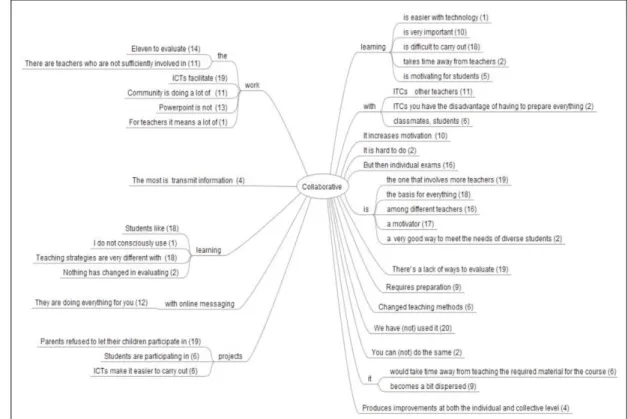
We chose the key word «collaborative» to analyse in its context, creating the word and sentence tree shown in figure 1. This tree shows the sentences from the different interviews in which the selected term appears and the number in parenthesis tells which interview they came from.
There are some especially interesting ideas on the tree for analysing the subject at hand and that summa-rize in one way or the other the ideas expressed by this set of teachers as far as the potential of ICT and
colla-borative learning, but also its weak points or the demands it makes on teachers: «ICT provide many benefits for collaborative learning»; «Collaborative learning is easier with technology»; «Students like collaborative learning»; «ICT make it easier to carry out collaborative projects»; «It kindles student inte-rest»; «It increases student motivation»; «It is a very good way to meet the needs of diverse students»; «There are teachers who do not get sufficiently invol-ved»; «Collaborative learning is difficult to carry out»; «Collaborative learning has the drawback of having to be thoroughly prepared beforehand»; «Collaborative work but then individual exams»; «There is a lack of tools for evaluation»; «It would take time away from other topics to be covered in the class».
4. Discussion and conclusions
The data we analysed clearly shows that the con-ceptions held by teachers who work in schools that are well-equipped with ICT regarding the potential for collaborative learning and the use of ICT for its imple-mentation are complex and reflect both the positive aspects and the limitations of this type of educational practices.
The principal advantages of collaborative learning are those related to developing transversal skills that sti-mulate social skills, problem solving, self-reliance, res-ponsibility, and the capacity for reflection and initiati-ve, all of which are considered of great relevance by teachers for achieving a well-rounded education for students. As for ICT, they are valued for the way they facilitate student work, giving them more independen-ce, motivating them, grabbing their attention, and adapting to varying student levels, which especially supports students with learning disabilities, while
increasing learning for all students.
These results coincide with those of other resear-chers (Alfageme, 2003; Cabero, 1994; García-Valcárcel & Tejedor, 2010; Lee & Tsai, 2013), who note that collaborative learning is a strategy for impro-ving the acquisition and retention of knowledge, one that enhances specific strategies that students may use when acquiring knowledge (problem solving, expres-sing ideas and thoughts, and expanding vocabulary). These authors also point to the high motivating power of ICT for students, the development of responsibility towards others and for their own learning, and the possibilities for integrating students with learning disa-bilities.
Regarding the principal obstacles when implemen-ting collaborative learning methods in the classroom, several questions have been raised that will impact curriculum development: These include more time spent on preparation, a certain loss of control, the une-qual participation of students in the process, or the dif-ficulties found in evaluating the learning process and the results obtained for each student. These conclu-sions also fall in line with those expressed by other aut-hors. Nogueiras, Membiela & Suárez (1993: 23) con-cluded that teachers noted the following disadvanta-ges: «poor performance by some groups, problems
with classroom organization, unequal participation by members of the groups, the work progressed more slowly, a decrease in the amount of material that can be covered…». For his part, Lobato (1998: 31) says that in this mode of work we may run into such diffi-culties as differences in academic levels and work pace, strikingly individualistic attitudes and learning patterns in students, a lack of teacher preparedness, difficulties establishing parameters and modes for eva-luation, lack of support by groups of teachers, and the mind-set of families.
These examples lead us to suppose that the same problems that teachers pointed out years ago regarding the implementation of this type of teaching method are still plaguing us today, in spite of the many changes in infrastructure that schools and other educational cen-tres have experienced in recent years. This is another indication of the difficult and slow methodological reconversion in schools, which, in spite of being well-equipped with technology, have not seen a change in conceptions or practices in consonance with the new perspectives for learning which demand more perso-nal and independent learning environments, while at the same time being interactive, mobile, universal, etc. and all of this certainly requires new teaching strate-gies.
Comunicar,
35,
XVIII,
2010
Both the document associated with the OEI´s (Organization of Ibero-American States) Educational Goals for 2021 and the report written by Puentes & others (2013) reflect upon the necessity of training tea-chers better. We must insist once again on the trans-formation that needs to take place in school practices, so that practices will promote the development of collaborative projects with ICT, and so that ICT will become the channel for communication and informa-tion that is essential for guaranteeing learning environ-ments that are open, interactive, replete with incenti-ves and sources of information, motivating for stu-dents, and focused on developing skills. In this sense, we must continue to maximize teacher training and the communities of practice that have been and are still working in this area (Pino & Soto, 2010; Watson, 1997; Windchiti & Sahl, 2002).
Financial Support
Research project funded by the Ministry of Science and Innovation. Title: «Collaborative Learning with ICT in the Context of Escuela (School) 2.0». Ref. EDU2011-28071, granted in 2011.
References
ALFAGEME, M.B. (2003). Modelo colaborativo de enseñanzaapren
-dizaje en situaciones no presenciales. Universidad de Murcia: Tesis doctoral.
BACA, V.M. (2010). El proyecto Etwinning. Revista Contribuciones
a las Ciencias Sociales.(www.eumed.net/rev/cccss/08/vmbm.htm) (20-04-2013).
CABERO, J. & MÁRQUEZ, D. (1997). Colaborando y aprendiendo. La
utilización del vídeo en la enseñanza de la geografía. Sevilla: Kronos. CAMILLI, C., LÓPEZ, E. & BARCELÓ, M.L. (2012). Eficacia del apren
-dizaje cooperativo en comparación con situaciones competitivas o individuales. Su aplicación en la tecnología: una revisión sistemática.
Enseñanza & Teaching, 30 (2),81-103.
Carneiro, R. (2009). Las TIC y los nuevos paradigmas educativos: la transformación de la escuela en una sociedad que se transforma. In R. CARNEIRO, J.C. TOSCANO, & T. DÍAZ(Coord.), Los desafíos
de las TIC para el cambio educativo.(pp. 15-28). Madrid: OEI /Fun dación Santillana.
CARRIÓ, M.L. (2007). Ventajas del uso de la tecnología en el
apren-dizaje colaborativo. Revista Iberoamericana de Educación, 41,1-10. COLL, C., MAURÍ, T. & ONRUBIA, J. (2008). Análisis de los usos
rea-les de las TIC en contextos educativos formarea-les: una aproximación socio-cultural. Revista Electrónica de Investigación Educativa, 10,
1-18.
COX, M. & MARSHALL, G. (2007). Effects of ICT: Do we know
what we should know? Education and Information Technologies, 12 (2),59-70. (DOI: 10.1007/s10639-007-9032-x).
FERRO, C., MARTÍNEZ, A. & OTERO, M.C. (2009). Ventajas del uso
de las TIC en el proceso de enseñanza-aprendizaje desde la óptica de los docentes universitarios españoles. Revista Electrónica de Tec -nología Educativa, 29(http://edutec.rediris.es/Revelec2/revelec29/ ar ticulos_n29_pdf/5Edutec-E_Ferro-Martinez-Otero_n29.pdf) (27-04-2013).
GARCÍA, I., GROS, B. & NOGUERA, I. (2010). La relación entre las
pres-taciones tecnológicas y el diseño de las actividades de aprendizaje
para la construcción colaborativa del conocimiento. Cultura y Edu -cación, 22 (4),395-418. (DOI: 10.1174/1135640107933518 67). GARCÍA-VALCÁRCEL, A. & TEJEDOR, F.J. (2010). Evaluación de
pro-cesos de innovación escolar basados en el uso de las TIC desarro-llados en la Comunidad de Castilla y León. Revista de Educacion, 352,125-148.
GARCÍA-VALCÁRCEL, A. & HERNÁNDEZ, A. (2013). Recursos
tecnoló-gicos para la enseñanza e innovación educativa. Madrid: Síntesis. GÓMEZ, A., PUIGVERT, L. & FLECHA, R. (2011). Critical Commu ni ca
-tive Methodology: Informing Real Social Transformation Through Research. Qualitative Inquiry, 17, (3), 235245. (DOI: 10.1177/10 -77800410397802).
KOLLOFFEL, B., EYSINK, T. & JONG, T. (2011). Comparing the
Effects of Representational Tools in Collaborative and Individual In -quiry Learning. Computer-Supported Collaborative Learning, 6,
223-251.(DOI: 10.1007/s11412-011-9110-3).
KOZMA, R.B. & ANDERSON, R.E. (2002). Qualitative Case Studies of Innovative Pedagogical Practices Using ICT. Journal of Computer Assisted Learning, 18, (4), 387394. (DOI: 10.1046/j.02664909.20 -02.00250.doc.x).
LEE, S.W. & TSAI, C.C. (2013). Technology-supported Learning
in Secondary and Undergraduate Biologial Education: Observations from Literature Review. Journal of Science Education and Techno -logy, 22,226-233. (DOI: 10.1007/s10956-012-9388-6). LOBATO, C. (1998). El trabajo en grupo. Aprendizaje cooperativo
en secundaria.Bilbao: Universidad del País Vasco. (DOI: 10.3916/ -C38-2012-02-03).
MARTÍN, A.G., & TYNER, K. (2012). Educación para los medios,
alfa-betización mediática y competencia digital. Comunicar, 38,31-39. MONEREO, C. & BADÍA, A. (2012) La competencia informacional
des de una perspectiva psicoeducativa: enseñanza basada en la reso-lución de problemas prototípicos y emergentes. Revista Española de Documentación Científica, 75-99.(DOI: 10.3989/ re dc. 2012. mo -no.978).
MURILLO, F.J. & MARTÍNEZ-GARRIDO, C. (2013). Impact of Home
work on Academic Performance. A Study of Iberoamerican Stu -dents of Primary Education. Revista de Psicodidáctica, 18 (1), 157-171. (DOI: 10.1387/RevPsicodidact.6156).
NOGUEIRAS, E., MEMBIELA, P. & SUÁREZ, M. (1993). Triangulando perspectivas. El trabajo en grupo a debate. Revista de Educación, 302, 259-271.
OEI (2013). Metas educativas para el 2021. (www.oei.es/me -tas2021/expertos02.htm) (27-04-2013).
OCDE (2003). Los desafíos de las tecnologías de la información y las comunicaciones en la educación.Madrid, Ministerio de Edu ca -ción, Cultura y Deporte.
PANITZ, T. (2001). Collaborative Versus Cooperative Learning. A
Comparison of the Two Concepts which will Helps Us Understand the Underlying Nature of Interactive Learning. (http://home.cape-cod.net/~tpanitz/tedsarticles/coopdefinition.htm) (30-04-2013). PIAGET, J.P. (1981). Intelligence and Affectivity.New York: Basic
Books.
PINO, M. & SOTO, J. (2010). Identificación del dominio de
compe-tencias digitales en el alumnado del grado de magisterio. Teoría de la Educación, 11, (3), 336-362.
PLOMP, T. & VOOGT, J. (2009). Pedagogical Practices and ICT
Use around the World: Findings from the IEA International Com -parative Study SITES 2006. Education and Information Tech no -logies, 14 (4), 285-292. (DOI: 10.1007/s10639-009-9090-3). PUENTES, A. & AL. (2013). Concepciones sobre las tecnologías de
la información y la comunicación (TIC) y sus implicaciones educa-tivas: Un estudio exploratorio con profesorado de la provincia de
Comunicar,
42,
XXI,
Ñu ble, Chile. Revista Iberoamericana de Ciencia, Tecnología y So ciedad, 22, (8), 75-88.
ROMÁN, M. & MURILLO, F.J. (2012). Learning Environments with
Technological Resources: A Look at their Contribution to Student Performance in Latin American Elementary Schools. Educational Technology Research and Development, 60 (6),1107-1118. (DOI: 10.1007/s11423-012-9262-5).
Rué, J. (1998). El aula: un espacio para la cooperación. In C. MIR
(Coord.), Cooperar en la escuela. La responsabilidad de educar pa ra la democracia.(pp. 17-49). Barcelona: Graó.
SÁEZ, J.M. (2011). Opiniones y práctica de los docentes respecto al
uso pedagógico de las tecnologías de la información y la comunica-ción. Revista Electrónica de Investigación y Docencia, 5,95-113. SALMERÓN, H., RODRÍGUEZ, S. & GUTIÉRREZ, C. (2010). Metodo
-logías que optimizan la comunicación en entornos de aprendizaje virtual. Comunicar, 34, 163171. (DOI http://dx.doi.org/10.3916/ -C 34- 2010-03-16).
SUÁREZ, C. & GROS, B. (2013). Aprender en red: de la interacción
a la colaboración.Barcelona: UOC.
TEJEDOR, F.J. (Coord.) (2010). Evaluación de procesos de
innovación escolar basados en el uso de las TIC desarrollados en la Co -mu nidad de Castilla y León. Salamanca: Universidad de Sala man -ca.
WATSON, G. (1997). Preservice Teachers’ Views on their Infor
-mation Technology Education. Journal of Information Technology for Teacher Education, 6, (3), 255270. (DOI: 10.1080/1475939 -9700200021).
WINDCHITI, M. & SAHL, K. (2002). Tracing Teachers’ Use of
Tech nology in a Laptop Computer School: The Interplay of Tea -cher Beliefs, Social Dynamics, and Institutional Culture. American Educational Research Journal, 39, (1),165205. (DOI: 10.3102/0 -0028312039001165).
ZHAO, J. & KENNETH, F. (2002). Factors Affecting Technology
Uses in Schools: An Ecological Perspective. American Educational Research Journal, 40, (4),807840. (DOI: 10.3102/00028312040 -004807).
Comunicar,
42,
XXI,