HIBERNATE - Persistance
relationnelle en Java standard
1
Documentation de
référence d'Hibernate
3.3.2.GA
par Gavin King, Christian Bauer, Max Rydahl Andersen, Emmanuel Bernard, et Steve Ebersole
and thanks to James Cobb (Graphic Design), Cheyenne Weaver (Graphic Design), Vincent Ricard, Sebastien Cesbron, Michael Courcy, Vincent
Préface ... xi
1. Feedback ... xii
1. Tutorial ... 1
1.1. Partie 1 - Première application Hibernate ... 1
1.1.1. Setup ... 1
1.1.2. La première classe ... 3
1.1.3. Le fichier de mapping ... 4
1.1.4. Configuration d'Hibernate ... 7
1.1.5. Building with Maven ... 9
1.1.6. Démarrage et aides ... 10
1.1.7. Charger et stocker des objets ... 11
1.2. Partie 2 - Mapper des associations ... 14
1.2.1. Mapper la classe Person ... 14
1.2.2. Une association unidirectionnelle basée sur Set ... 16
1.2.3. Travailler avec l'association ... 17
1.2.4. Collection de valeurs ... 19
1.2.5. Associations bidirectionnelles ... 21
1.2.6. Travailler avec des liens bidirectionnels ... 22
1.3. Part 3 - L'application web EventManager ... 23
1.3.1. Ecrire la servlet de base ... 23
1.3.2. Procéder et rendre ... 24
1.3.3. Déployer et tester ... 26
1.4. Résumé ... 27
2. Architecture ... 29
2.1. Généralités ... 29
2.2. Etats des instances ... 30
2.3. Intégration JMX ... 31
2.4. Support JCA ... 31
2.5. Contextual sessions ... 31
3. Configuration ... 33
3.1. Configuration par programmation ... 33
3.2. Obtenir une SessionFactory ... 34
3.3. Connexions JDBC ... 34
3.4. Propriétés de configuration optionnelles ... 36
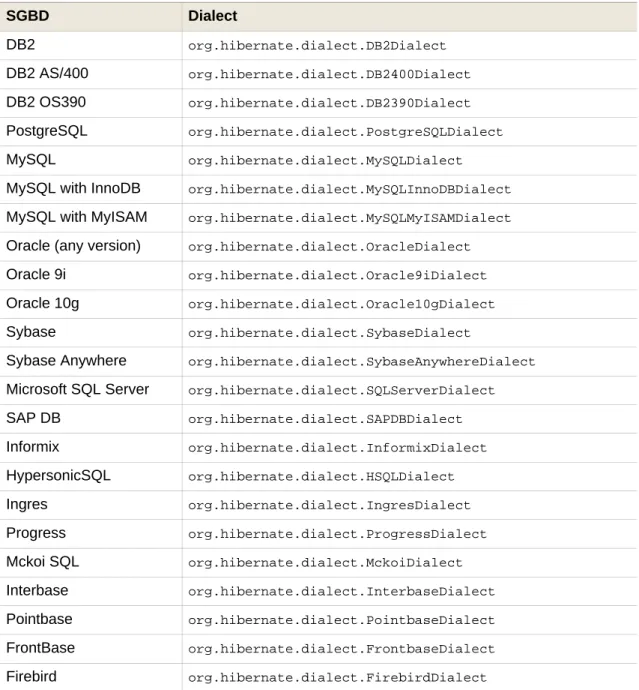
3.4.1. Dialectes SQL ... 43
3.4.2. Chargement par Jointure Ouverte ... 44
3.4.3. Flux binaires ... 44
3.4.4. Cache de second niveau et cache de requêtes ... 44
3.4.5. Substitution dans le langage de requêtage ... 44
3.4.6. Statistiques Hibernate ... 44
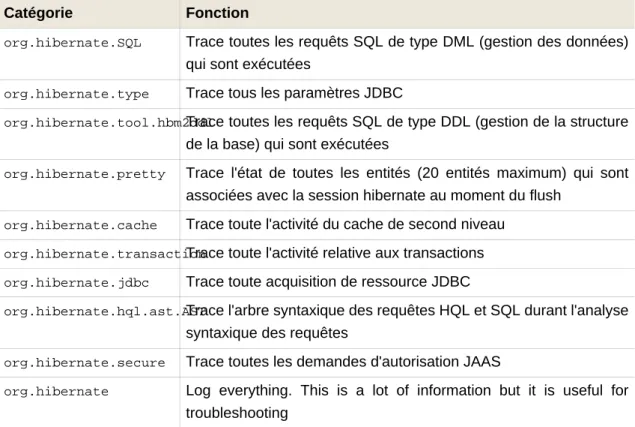
3.5. Tracer ... 45
3.6. Implémenter une NamingStrategy ... 46
3.7. Fichier de configuration XML ... 46
3.8.2. SessionFactory associée au JNDI ... 49
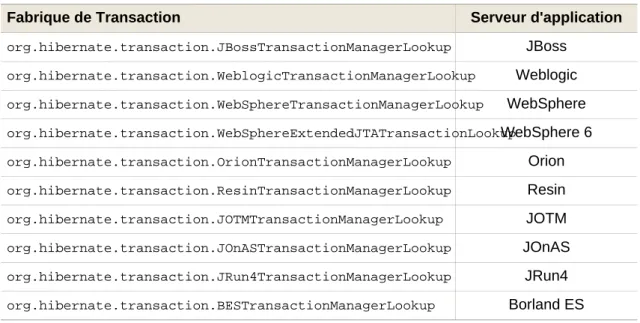
3.8.3. Association automatique de la Session à JTA ... 50
3.8.4. Déploiement JMX ... 50
4. Classes persistantes ... 53
4.1. Un exemple simple de POJO ... 53
4.1.1. Implémenter un constructeur sans argument ... 55
4.1.2. Fournir une propriété d'indentifiant (optionnel) ... 55
4.1.3. Favoriser les classes non finales (optionnel) ... 55
4.1.4. Déclarer les accesseurs et mutateurs des attributs persistants (optionnel) ... 56
4.2. Implémenter l'héritage ... 56
4.3. Implémenter equals() et hashCode() ... 56
4.4. Modèles dynamiques ... 58
4.5. Tuplizers ... 60
4.6. EntityNameResolvers ... 61
5. Mapping O/R basique ... 65
5.1. Déclaration de Mapping ... 65
5.1.1. Doctype ... 66
5.1.2. Hibernate-mapping ... 67
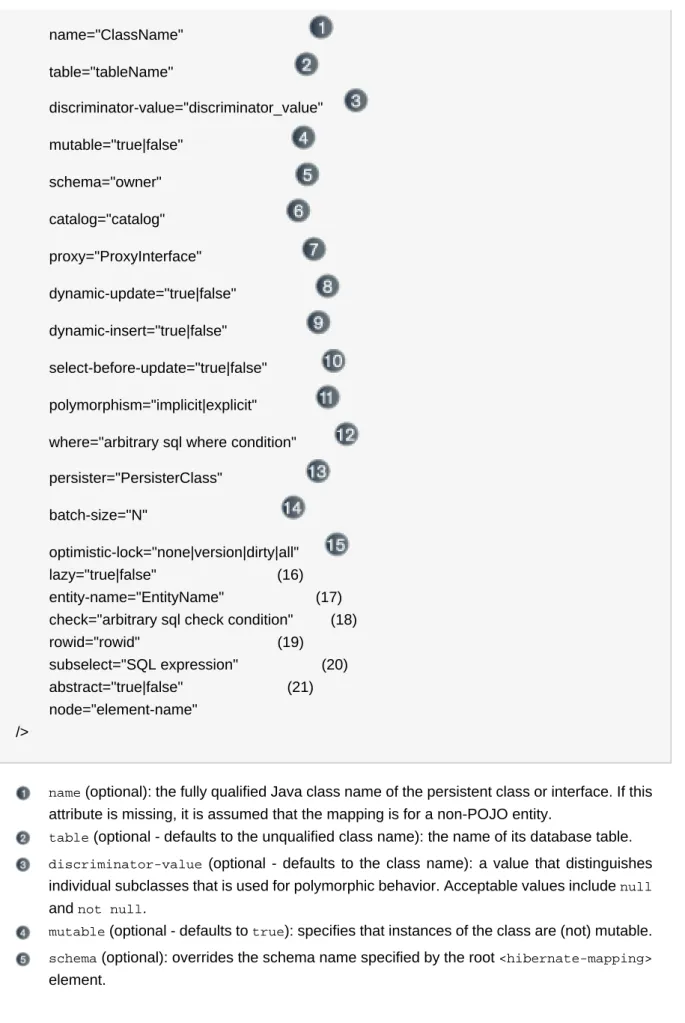
5.1.3. Class ... 68
5.1.4. id ... 72
5.1.5. Enhanced identifier generators ... 76
5.1.6. Identifier generator optimization ... 78
5.1.7. composite-id ... 78 5.1.8. Discriminator ... 80 5.1.9. Version (optional) ... 81 5.1.10. Timestamp (optional) ... 82 5.1.11. Property ... 83 5.1.12. Many-to-one ... 85 5.1.13. One-to-one ... 87 5.1.14. Natural-id ... 90
5.1.15. Component and dynamic-component ... 90
5.1.16. Properties ... 92 5.1.17. Subclass ... 93 5.1.18. Joined-subclass ... 94 5.1.19. Union-subclass ... 96 5.1.20. Join ... 97 5.1.21. Key ... 98
5.1.22. Column and formula elements ... 99
5.1.23. Import ... 100
5.1.24. Any ... 100
5.2. Hibernate types ... 101
5.2.1. Entités et valeurs ... 101
5.2.3. Types de valeur définis par l'utilisateur ... 104
5.3. Mapper une classe plus d'une fois ... 105
5.4. SQL quoted identifiers ... 106
5.5. alternatives Metadata ... 106
5.5.1. utilisation de XDoclet ... 106
5.5.2. Utilisation des annotations JDK 5.0 ... 109
5.6. Generated properties ... 110
5.7. Auxiliary database objects ... 110
6. Collection mapping ... 113
6.1. Collections persistantes ... 113
6.2. Mapper une collection ... 114
6.2.1. Les clefs étrangères d'une collection ... 116
6.2.2. Les éléments d'une collection ... 116
6.2.3. Collections indexées ... 117
6.2.4. Collections de valeurs et associations plusieurs-vers-plusieurs ... 118
6.2.5. Association un-vers-plusieurs ... 120
6.3. Mappings de collection avancés ... 122
6.3.1. Collections triées ... 122
6.3.2. Associations bidirectionnelles ... 123
6.3.3. Associations bidirectionnelles avec des collections indexées ... 125
6.3.4. Associations ternaires ... 126
6.3.5. Utiliser un <idbag> ... 127
6.4. Exemples de collections ... 127
7. Mapper les associations ... 133
7.1. Introduction ... 133
7.2. Association unidirectionnelle ... 133
7.2.1. Many-to-one ... 133
7.2.2. One-to-one ... 134
7.2.3. One-to-many ... 135
7.3. Associations unidirectionnelles avec tables de jointure ... 136
7.3.1. One-to-many ... 136 7.3.2. Many-to-one ... 136 7.3.3. One-to-one ... 137 7.3.4. Many-to-many ... 138 7.4. Associations bidirectionnelles ... 139 7.4.1. one-to-many / many-to-one ... 139 7.4.2. One-to-one ... 140
7.5. Associations bidirectionnelles avec table de jointure ... 141
7.5.1. one-to-many / many-to-one ... 141
7.5.2. one to one ... 142
7.5.3. Many-to-many ... 143
7.6. Des mappings plus complexes ... 144
8. Mapping de composants ... 147
8.3. Utiliser les composants comme index de map ... 151
8.4. Utiliser un composant comme identifiant ... 151
8.5. Composant Dynamique ... 153
9. Inheritance mapping ... 155
9.1. The three strategies ... 155
9.1.1. Une table par hiérarchie de classe ... 155
9.1.2. Une table par classe fille ... 156
9.1.3. Table per subclass: using a discriminator ... 157
9.1.4. Mélange d'une table par hiérarchie de classe avec une table par classe fille ... 158
9.1.5. Une table par classe concrète ... 158
9.1.6. Table per concrete class using implicit polymorphism ... 159
9.1.7. Mélange du polymorphisme implicite avec d'autres mappings d'héritage ... 160
9.2. Limitations ... 161
10. Travailler avec des objets ... 163
10.1. États des objets Hibernate ... 163
10.2. Rendre des objets persistants ... 163
10.3. Chargement d'un objet ... 165
10.4. Requêtage ... 166
10.4.1. Exécution de requêtes ... 166
10.4.2. Filtrer des collections ... 171
10.4.3. Requêtes Criteria ... 172
10.4.4. Requêtes en SQL natif ... 172
10.5. Modifier des objets persistants ... 172
10.6. Modifier des objets détachés ... 173
10.7. Détection automatique d'un état ... 174
10.8. Suppression d'objets persistants ... 175
10.9. Réplication d'objets entre deux entrepôts de données ... 176
10.10. Flush de la session ... 177
10.11. Persistance transitive ... 178
10.12. Utilisation des méta-données ... 179
11. Transactions and Concurrency ... 181
11.1. Gestion de session et délimitation de transactions ... 181
11.1.1. Unité de travail ... 181
11.1.2. Longue conversation ... 182
11.1.3. L'identité des objets ... 183
11.1.4. Problèmes communs ... 184
11.2. Démarcation des transactions ... 185
11.2.1. Environnement non managé ... 186
11.2.2. Utilisation de JTA ... 187
11.2.3. Gestion des exceptions ... 189
11.2.4. Timeout de transaction ... 189
11.3.1. Gestion du versionnage au niveau applicatif ... 190
11.3.2. Les sessions longues et le versionnage automatique. ... 191
11.3.3. Les objets détachés et le versionnage automatique ... 192
11.3.4. Personnaliser le versionnage automatique ... 193
11.4. Pessimistic locking ... 193
11.5. Connection release modes ... 194
12. Les intercepteurs et les événements ... 197
12.1. Intercepteurs ... 197
12.2. Système d'événements ... 199
12.3. Sécurité déclarative d'Hibernate ... 201
13. Traitement par paquet ... 203
13.1. Paquet de mises à jour ... 203
13.2. L'interface StatelessSession ... 204
13.3. Notez que dans le code de l'exemple, les intances de Customer retournées par la requête sont immédiatement détachées. Elles ne sont jamais associées à un contexte de persistance. ... 205
13.4. La pseudo-syntaxe pour les expressions UPDATE et DELETE est : ( UPDATE | DELETE ) FROM? EntityName (WHERE where_conditions)?. Certains points sont à noter : ... 206
14. HQL: Langage de requêtage d'Hibernate ... 211
14.1. Sensibilité à la casse ... 211
14.2. La clause from ... 211
14.3. Associations et jointures ... 212
14.4. Formes de syntaxes pour les jointures ... 214
14.5. Referring to identifier property ... 214
14.6. La clause select ... 214 14.7. Fonctions d'aggrégation ... 216 14.8. Requêtes polymorphiques ... 217 14.9. La clause where ... 217 14.10. Expressions ... 219 14.11. La clause order by ... 224 14.12. La clause group by ... 224 14.13. Sous-requêtes ... 225 14.14. Exemples HQL ... 226
14.15. Mise à jour et suppression ... 228
14.16. Trucs & Astuces ... 228
14.17. translator-credits ... 230
14.18. Row value constructor syntax ... 231
15. Requêtes par critères ... 233
15.1. Créer une instance de Criteria ... 233
15.2. Restriction du résultat ... 233
15.3. Trier les résultats ... 234
15.4. Associations ... 235
15.7. Projections, agrégation et regroupement ... 237
15.8. Requêtes et sous-requêtes détachées ... 239
15.9. Requêtes par identifiant naturel ... 240
16. SQL natif ... 243
16.1. Utiliser une SQLQuery ... 243
16.1.1. Scalar queries ... 243
16.1.2. Entity queries ... 244
16.1.3. Handling associations and collections ... 245
16.1.4. Returning multiple entities ... 245
16.1.5. Returning non-managed entities ... 247
16.1.6. Handling inheritance ... 247
16.1.7. Parameters ... 248
16.2. Requêtes SQL nommées ... 248
16.2.1. Utilisation de return-property pour spécifier explicitement les noms des colonnes/alias ... 250
16.2.2. Utilisation de procédures stockées pour les requêtes ... 251
16.3. SQL personnalisé pour créer, mettre à jour et effacer ... 252
16.4. SQL personnalisé pour le chargement ... 254
17. Filtrer les données ... 257
17.1. Filtres Hibernate ... 257
18. Mapping XML ... 261
18.1. Travailler avec des données XML ... 261
18.1.1. Spécifier le mapping XML et le mapping d'une classe ensemble ... 261
18.1.2. Spécifier seulement un mapping XML ... 262
18.2. Métadonnées du mapping XML ... 262
18.3. Manipuler des données XML ... 265
19. Améliorer les performances ... 267
19.1. Stratégies de chargement ... 267
19.1.1. Travailler avec des associations chargées tardivement ... 268
19.1.2. Personnalisation des stratégies de chargement ... 269
19.1.3. Proxys pour des associations vers un seul objet ... 270
19.1.4. Initialisation des collections et des proxys ... 272
19.1.5. Utiliser le chargement par lot ... 273
19.1.6. Utilisation du chargement par sous select ... 274
19.1.7. Utiliser le chargement tardif des propriétés ... 274
19.2. Le cache de second niveau ... 275
19.2.1. Mapping de Cache ... 276
19.2.2. Strategie : lecture seule ... 277
19.2.3. Stratégie : lecture/écriture ... 277
19.2.4. Stratégie : lecture/écriture non stricte ... 277
19.2.5. Stratégie : transactionelle ... 278
19.2.6. Cache-provider/concurrency-strategy compatibility ... 278
19.4. Le cache de requêtes ... 280
19.5. Comprendre les performances des Collections ... 280
19.5.1. Classification ... 281
19.5.2. Les lists, les maps, les idbags et les sets sont les collections les plus efficaces pour la mise à jour ... 282
19.5.3. Les Bags et les lists sont les plus efficaces pour les collections inverse ... 282
19.5.4. Suppression en un coup ... 282
19.6. Moniteur de performance ... 283
19.6.1. Suivi d'une SessionFactory ... 283
19.6.2. Métriques ... 284
20. Guide des outils ... 287
20.1. Génération automatique du schéma ... 287
20.1.1. Personnaliser le schéma ... 287
20.1.2. Exécuter l'outil ... 290
20.1.3. Propriétés ... 291
20.1.4. Utiliser Ant ... 292
20.1.5. Mises à jour incrémentales du schéma ... 292
20.1.6. Utiliser Ant pour des mises à jour de schéma par incrément ... 293
20.1.7. Validation du schéma ... 293
20.1.8. Utiliser Ant pour la validation du Schéma ... 294
21. Exemple : Père/Fils ... 295
21.1. Une note à propos des collections ... 295
21.2. un-vers-plusieurs bidirectionnel ... 295
21.3. Cycle de vie en cascade ... 297
21.4. Cascades et unsaved-value ... 299
21.5. Conclusion ... 299
22. Exemple : application Weblog ... 301
22.1. Classes persistantes ... 301
22.2. Mappings Hibernate ... 302
22.3. Code Hibernate ... 305
23. Exemple : quelques mappings ... 311
23.1. Employeur/Employé (Employer/Employee) ... 311
23.2. Auteur/Travail (Author/Work) ... 313
23.3. Client/Commande/Produit (Customer/Order/Product) ... 315
23.4. Divers mappings d'exemple ... 317
23.4.1. "Typed" one-to-one association ... 317
23.4.2. Exemple de clef composée ... 318
23.4.3. Many-to-many avec une clef composée partagée ... 321
23.4.4. Contenu basé sur une discrimination ... 322
23.4.5. Associations sur des clefs alternées ... 323
24. Meilleures pratiques ... 325
25. Database Portability Considerations ... 329
25.1. Portability Basics ... 329
25.4. Identifier generation ... 330
25.5. Database functions ... 331
25.6. Type mappings ... 331
Préface
Working with object-oriented software and a relational database can be cumbersome and time consuming in today's enterprise environments. Hibernate is an Object/Relational Mapping tool for Java environments. The term Object/Relational Mapping (ORM) refers to the technique of mapping a data representation from an object model to a relational data model with a SQL-based schema.
Hibernate not only takes care of the mapping from Java classes to database tables (and from Java data types to SQL data types), but also provides data query and retrieval facilities. It can also significantly reduce development time otherwise spent with manual data handling in SQL and JDBC.
Hibernate's goal is to relieve the developer from 95 percent of common data persistence related programming tasks. Hibernate may not be the best solution for data-centric applications that only use stored-procedures to implement the business logic in the database, it is most useful with object-oriented domain models and business logic in the Java-based middle-tier. However, Hibernate can certainly help you to remove or encapsulate vendor-specific SQL code and will help with the common task of result set translation from a tabular representation to a graph of objects. Si vous êtes nouveau dans Hibernate et le mapping Objet/Relationnel voire même en Java, suivez ces quelques étapes :
1. Lisez Chapitre 1, Tutorial pour un didacticiel plus long avec plus d'instructions étape par étape. 2. Lisez Chapitre 2, Architecture pour comprendre les environnements dans lesquels Hibernate
peut être utilisé.
3. View the eg/ directory in the Hibernate distribution. It contains a simple standalone application. Copy your JDBC driver to the lib/ directory and edit etc/hibernate.properties, specifying
correct values for your database. From a command prompt in the distribution directory, type
ant eg (using Ant), or under Windows, type build eg.
4. Use this reference documentation as your primary source of information. Consider reading [JPwH] if you need more help with application design, or if you prefer a step-by-step tutorial. Also visit http://caveatemptor.hibernate.org and download the example application from [JPwH]. 5. Les questions les plus fréquemment posées (FAQs) trouvent leur réponse sur le site web
Hibernate.
6. Links to third party demos, examples, and tutorials are maintained on the Hibernate website. 7. La zone communautaire (Community Area) du site web Hibernate est une bonne source
d'information sur les design patterns et sur différentes solutions d'intégration d'Hibernate (Tomcat, JBoss, Spring Framework, Struts, EJB, etc).
If you have questions, use the user forum linked on the Hibernate website. We also provide a JIRA issue tracking system for bug reports and feature requests. If you are interested in the
documentation into your language, contact us on the developer mailing list.
Le développement commercial, le support de production et les formations à Hibernate sont proposés par JBoss Inc (voir http://www.hibernate.org/SupportTraining/). Hibernate est un projet Open Source professionnel et un composant critique de la suite de produits JBoss Enterprise Middleware System (JEMS).
1. Feedback
Use Hibernate JIRA [http://opensource.atlassian.com/projects/hibernate] to report errors or request enhacements to this documentation.
Chapitre 1.
Tutorial
Intended for new users, this chapter provides an step-by-step introduction to Hibernate, starting with a simple application using an in-memory database. The tutorial is based on an earlier tutorial developed by Michael Gloegl. All code is contained in the tutorials/web directory of the project
source.
Important
This tutorial expects the user have knowledge of both Java and SQL. If you have a limited knowledge of JAVA or SQL, it is advised that you start with a good introduction to that technology prior to attempting to learn Hibernate.
Note
The distribution contains another example application under the tutorial/eg project source directory.
1.1. Partie 1 - Première application Hibernate
For this example, we will set up a small database application that can store events we want to attend and information about the host(s) of these events.
Note
Although you can use whatever database you feel comfortable using, we will use HSQLDB [http://hsqldb.org/] (an in-memory, Java database) to avoid describing installation/setup of any particular database servers.
1.1.1. Setup
The first thing we need to do is to set up the development environment. We will be using the "standard layout" advocated by alot of build tools such as Maven [http://maven.org]. Maven, in particular, has a good resource describing this layout [http://maven.apache.org/guides/ introduction/introduction-to-the-standard-directory-layout.html]. As this tutorial is to be a web application, we will be creating and making use of src/main/java, src/main/resources and
src/main/webapp directories.
We will be using Maven in this tutorial, taking advantage of its transitive dependency management capabilities as well as the ability of many IDEs to automatically set up a project for us based on the maven descriptor.
<project xmlns="http://maven.apache.org/POM/4.0.0" xmlns:xsi="http://www.w3.org/2001/XMLSchema-instance" xsi:schemaLocation="http://maven.apache.org/POM/4.0.0 http://maven.apache.org/xsd/ maven-4.0.0.xsd"> <modelVersion>4.0.0</modelVersion> <groupId>org.hibernate.tutorials</groupId> <artifactId>hibernate-tutorial</artifactId> <version>1.0.0-SNAPSHOT</version> <name>First Hibernate Tutorial</name>
<build>
<!-- we dont want the version to be part of the generated war file name --> <finalName>${artifactId}</finalName> </build> <dependencies> <dependency> <groupId>org.hibernate</groupId> <artifactId>hibernate-core</artifactId> </dependency>
<!-- Because this is a web app, we also have a dependency on the servlet api. --> <dependency>
<groupId>javax.servlet</groupId> <artifactId>servlet-api</artifactId> </dependency>
<!-- Hibernate uses slf4j for logging, for our purposes here use the simple backend --> <dependency>
<groupId>org.slf4j</groupId> <artifactId>slf4j-simple</artifactId> </dependency>
<!-- Hibernate gives you a choice of bytecode providers between cglib and javassist --> <dependency> <groupId>javassist</groupId> <artifactId>javassist</artifactId> </dependency> </dependencies> </project>
La première classe
Astuce
It is not a requirement to use Maven. If you wish to use something else to build this tutoial (such as Ant), the layout will remain the same. The only change is that you will need to manually account for all the needed dependencies. If you use something like Ivy [http://ant.apache.org/ivy/] providing transitive dependency management you would still use the dependencies mentioned below. Otherwise, you'd need to grab all dependencies, both explicit and transitive, and add them to the project's classpath. If working from the Hibernate distribution bundle, this would mean hibernate3.jar, all artifacts in the lib/required directory and all files from either the lib/bytecode/cglib or lib/bytecode/javassist directory; additionally you will need both the servlet-api jar and one of the slf4j logging backends.
Save this file as pom.xml in the project root directory.
1.1.2. La première classe
Next, we create a class that represents the event we want to store in the database; it is a simple JavaBean class with some properties:
package org.hibernate.tutorial.domain;
import java.util.Date;
public class Event { private Long id;
private String title; private Date date;
public Event() {}
public Long getId() { return id;
}
private void setId(Long id) { this.id = id;
}
public Date getDate() { return date;
public void setDate(Date date) { this.date = date;
}
public String getTitle() { return title;
}
public void setTitle(String title) { this.title = title;
} }
This class uses standard JavaBean naming conventions for property getter and setter methods, as well as private visibility for the fields. Although this is the recommended design, it is not required. Hibernate can also access fields directly, the benefit of accessor methods is robustness for refactoring.
The id property holds a unique identifier value for a particular event. All persistent entity classes
(there are less important dependent classes as well) will need such an identifier property if we want to use the full feature set of Hibernate. In fact, most applications, especially web applications, need to distinguish objects by identifier, so you should consider this a feature rather than a limitation. However, we usually do not manipulate the identity of an object, hence the setter method should be private. Only Hibernate will assign identifiers when an object is saved. Hibernate can access public, private, and protected accessor methods, as well as public, private and protected fields directly. The choice is up to you and you can match it to fit your application design.
The no-argument constructor is a requirement for all persistent classes; Hibernate has to create objects for you, using Java Reflection. The constructor can be private, however package or public visibility is required for runtime proxy generation and efficient data retrieval without bytecode instrumentation.
Save this file to the src/main/java/org/hibernate/tutorial/domain directory.
1.1.3. Le fichier de mapping
Hibernate a besoin de savoir comment charger et stocker des objets d'une classe persistante. C'est là qu'intervient le fichier de mapping Hibernate. Le fichier de mapping indique à Hibernate à quelle table dans la base de données il doit accéder, et quelles colonnes de cette table il devra utiliser.
Le fichier de mapping
<?xml version="1.0"?>
<!DOCTYPE hibernate-mapping PUBLIC
"-//Hibernate/Hibernate Mapping DTD 3.0//EN"
"http://hibernate.sourceforge.net/hibernate-mapping-3.0.dtd">
<hibernate-mapping package="org.hibernate.tutorial.domain"> [...]
</hibernate-mapping>
Hibernate DTD is sophisticated. You can use it for auto-completion of XML mapping elements and attributes in your editor or IDE. Opening up the DTD file in your text editor is the easiest way to get an overview of all elements and attributes, and to view the defaults, as well as some comments. Hibernate will not load the DTD file from the web, but first look it up from the classpath of the application. The DTD file is included in hibernate-core.jar (it is also included in the
hibernate3.jar, if using the distribution bundle).
Important
We will omit the DTD declaration in future examples to shorten the code. It is, of course, not optional.
Between the two hibernate-mapping tags, include a class element. All persistent entity classes (again, there might be dependent classes later on, which are not first-class entities) need a mapping to a table in the SQL database:
<hibernate-mapping package="org.hibernate.tutorial.domain">
<class name="Event" table="EVENTS">
</class>
</hibernate-mapping>
So far we have told Hibernate how to persist and load object of class Event to the table EVENTS.
Each instance is now represented by a row in that table. Now we can continue by mapping the unique identifier property to the tables primary key. As we do not want to care about handling this identifier, we configure Hibernate's identifier generation strategy for a surrogate primary key column:
<class name="Event" table="EVENTS"> <id name="id" column="EVENT_ID"> <generator class="native"/> </id>
</class>
</hibernate-mapping>
The id element is the declaration of the identifier property. The name="id" mapping attribute
declares the name of the JavaBean property and tells Hibernate to use the getId() and setId()
methods to access the property. The column attribute tells Hibernate which column of the EVENTS
table holds the primary key value.
The nested generator element specifies the identifier generation strategy (aka how are identifier
values generated?). In this case we choose native, which offers a level of portability depending on the configured database dialect. Hibernate supports database generated, globally unique, as well as application assigned, identifiers. Identifier value generation is also one of Hibernate's many extension points and you can plugin in your own strategy.
Astuce
native is no longer consider the best strategy in terms of portability. for further discussion, see Section 25.4, « Identifier generation »
Lastly, we need to tell Hibernate about the remaining entity class properties. By default, no properties of the class are considered persistent:
<hibernate-mapping package="org.hibernate.tutorial.domain">
<class name="Event" table="EVENTS"> <id name="id" column="EVENT_ID"> <generator class="native"/> </id>
<property name="date" type="timestamp" column="EVENT_DATE"/> <property name="title"/>
</class>
Configuration d'Hibernate
Similar to the id element, the name attribute of the property element tells Hibernate which getter and setter methods to use. In this case, Hibernate will search for getDate(), setDate(),
getTitle() and setTitle() methods.
Note
Why does the date property mapping include the column attribute, but the title does not? Without the column attribute, Hibernate by default uses the property name as the column name. This works for title, however, date is a reserved keyword in most databases so you will need to map it to a different name.
The title mapping also lacks a type attribute. The types declared and used in the mapping files are not Java data types; they are not SQL database types either. These types are called Hibernate
mapping types, converters which can translate from Java to SQL data types and vice versa. Again,
Hibernate will try to determine the correct conversion and mapping type itself if the type attribute
is not present in the mapping. In some cases this automatic detection using Reflection on the Java class might not have the default you expect or need. This is the case with the date property.
Hibernate cannot know if the property, which is of java.util.Date, should map to a SQL date,
timestamp, or time column. Full date and time information is preserved by mapping the property
with a timestamp converter.
Astuce
Hibernate makes this mapping type determination using reflection when the mapping files are processed. This can take time and resources, so if startup performance is important you should consider explicitly defining the type to use.
Save this mapping file as src/main/resources/org/hibernate/tutorial/domain/ Event.hbm.xml.
1.1.4. Configuration d'Hibernate
At this point, you should have the persistent class and its mapping file in place. It is now time to configure Hibernate. First let's set up HSQLDB to run in "server mode"
Note
We do this do that the data remains between runs.
We will utilize the Maven exec plugin to launch the HSQLDB server by running: mvn exec:java -Dexec.mainClass="org.hsqldb.Server" -Dexec.args="-database.0 file:target/data/ tutorial" You will see it start up and bind to a TCP/IP socket; this is where our application will
delete all files in the target/data directory, and start HSQLDB again.
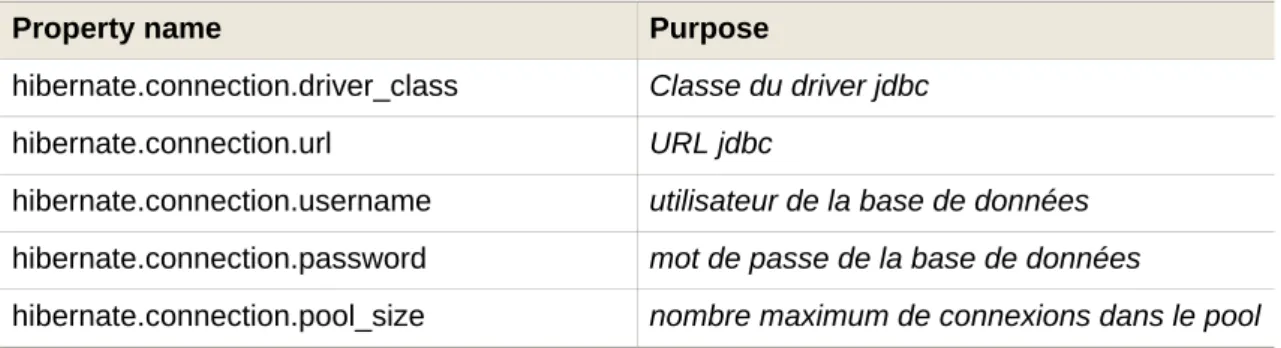
Hibernate will be connecting to the database on behalf of your application, so it needs to know how to obtain connections. For this tutorial we will be using a standalone connection pool (as opposed to a javax.sql.DataSource). Hibernate comes with support for two third-party open source JDBC connection pools: c3p0 [https://sourceforge.net/projects/c3p0] and proxool [http:// proxool.sourceforge.net/]. However, we will be using the Hibernate built-in connection pool for this tutorial.
Attention
The built-in Hibernate connection pool is in no way intended for production use. It lacks several features found on any decent connection pool.
For Hibernate's configuration, we can use a simple hibernate.properties file, a more
sophisticated hibernate.cfg.xml file, or even complete programmatic setup. Most users prefer the XML configuration file:
<?xml version='1.0' encoding='utf-8'?> <!DOCTYPE hibernate-configuration PUBLIC
"-//Hibernate/Hibernate Configuration DTD 3.0//EN"
"http://hibernate.sourceforge.net/hibernate-configuration-3.0.dtd">
<hibernate-configuration>
<session-factory>
<!-- Database connection settings -->
<property name="connection.driver_class">org.hsqldb.jdbcDriver</property> <property name="connection.url">jdbc:hsqldb:hsql://localhost</property> <property name="connection.username">sa</property>
<property name="connection.password"></property>
<!-- JDBC connection pool (use the built-in) --> <property name="connection.pool_size">1</property>
<!-- SQL dialect -->
<property name="dialect">org.hibernate.dialect.HSQLDialect</property>
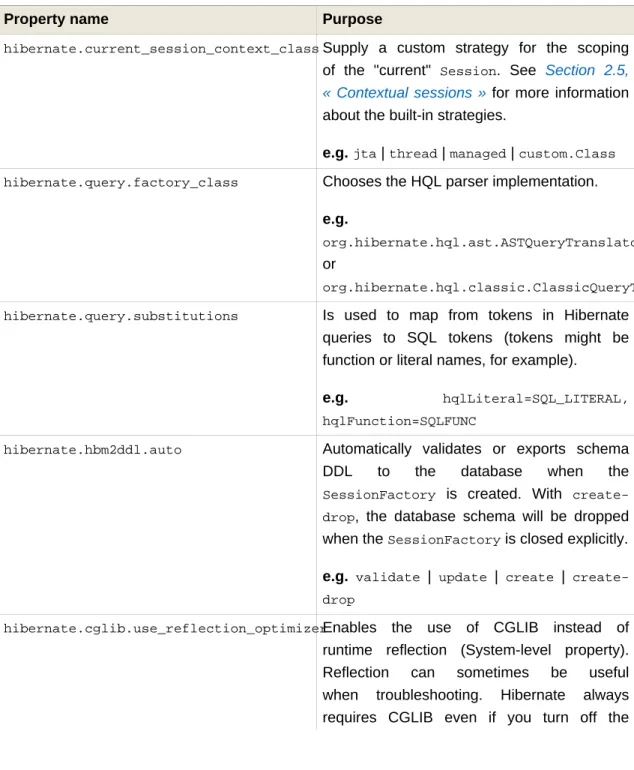
<!-- Enable Hibernate's automatic session context management --> <property name="current_session_context_class">thread</property>
Building with Maven
<!-- Disable the second-level cache -->
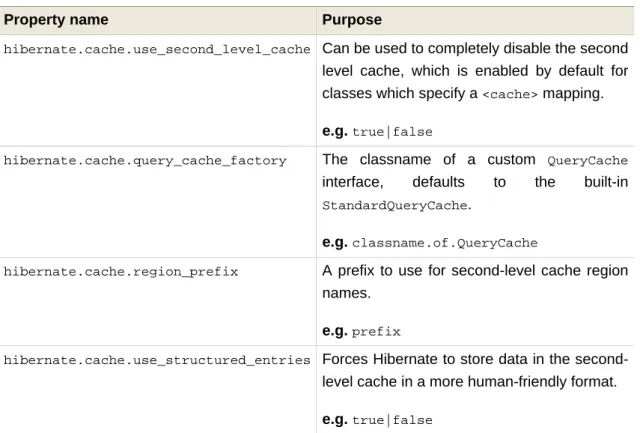
<property name="cache.provider_class">org.hibernate.cache.NoCacheProvider</property>
<!-- Echo all executed SQL to stdout --> <property name="show_sql">true</property>
<!-- Drop and re-create the database schema on startup --> <property name="hbm2ddl.auto">update</property>
<mapping resource="org/hibernate/tutorial/domain/Event.hbm.xml"/>
</session-factory>
</hibernate-configuration>
Note
Notice that this configuration file specifies a different DTD
You configure Hibernate's SessionFactory. SessionFactory is a global factory responsible for a particular database. If you have several databases, for easier startup you should use several
<session-factory> configurations in several configuration files.
The first four property elements contain the necessary configuration for the JDBC connection. The dialect property element specifies the particular SQL variant Hibernate generates.
Astuce
In most cases, Hibernate is able to properly determine which dialect to use. See Section 25.3, « Dialect resolution » for more information.
Hibernate's automatic session management for persistence contexts is particularly useful in this context. The hbm2ddl.auto option turns on automatic generation of database schemas directly into the database. This can also be turned off by removing the configuration option, or redirected to a file with the help of the SchemaExport Ant task. Finally, add the mapping file(s) for persistent classes to the configuration.
Save this file as hibernate.cfg.xml into the src/main/resources directory.
1.1.5. Building with Maven
We will now build the tutorial with Maven. You will need to have Maven installed; it is available from the Maven download page [http://maven.apache.org/download.html]. Maven will read the /
the compile goal to make sure we can compile everything so far:
[hibernateTutorial]$ mvn compile [INFO] Scanning for projects...
[INFO] ---[INFO] Building First Hibernate Tutorial
[INFO] task-segment: [compile]
[INFO] ---[INFO] [resources:resources]
[INFO] Using default encoding to copy filtered resources. [INFO] [compiler:compile]
[INFO] Compiling 1 source file to /home/steve/projects/sandbox/hibernateTutorial/target/classes [INFO]
---[INFO] BUILD SUCCESSFUL
[INFO] ---[INFO] Total time: 2 seconds
[INFO] Finished at: Tue Jun 09 12:25:25 CDT 2009 [INFO] Final Memory: 5M/547M
[INFO]
---1.1.6. Démarrage et aides
It is time to load and store some Event objects, but first you have to complete the setup with some infrastructure code. You have to startup Hibernate by building a global
org.hibernate.SessionFactory object and storing it somewhere for easy access in application code. A org.hibernate.SessionFactory is used to obtain org.hibernate.Session
instances. A org.hibernate.Session represents a single-threaded unit of work. The
org.hibernate.SessionFactory is a thread-safe global object that is instantiated once. We will create a HibernateUtil helper class that takes care of startup and makes accessing the org.hibernate.SessionFactory more convenient.
package org.hibernate.tutorial.util;
import org.hibernate.SessionFactory; import org.hibernate.cfg.Configuration;
public class HibernateUtil {
private static final SessionFactory sessionFactory = buildSessionFactory();
Charger et stocker des objets
try {
// Create the SessionFactory from hibernate.cfg.xml
return new Configuration().configure().buildSessionFactory(); }
catch (Throwable ex) {
// Make sure you log the exception, as it might be swallowed System.err.println("Initial SessionFactory creation failed." + ex); throw new ExceptionInInitializerError(ex);
} }
public static SessionFactory getSessionFactory() { return sessionFactory;
}
}
Save this code as src/main/java/org/hibernate/tutorial/util/HibernateUtil.java
This class not only produces the global org.hibernate.SessionFactory reference in its static initializer; it also hides the fact that it uses a static singleton. We might just as well have looked up the org.hibernate.SessionFactory reference from JNDI in an application server or any other location for that matter.
If you give the org.hibernate.SessionFactory a name in your configuration, Hibernate will try
to bind it to JNDI under that name after it has been built. Another, better option is to use a JMX deployment and let the JMX-capable container instantiate and bind a HibernateService to JNDI.
Such advanced options are discussed later.
You now need to configure a logging system. Hibernate uses commons logging and provides two choices: Log4j and JDK 1.4 logging. Most developers prefer Log4j: copy log4j.properties from the Hibernate distribution in the etc/ directory to your src directory, next to hibernate.cfg.xml. If you prefer to have more verbose output than that provided in the example configuration, you can change the settings. By default, only the Hibernate startup message is shown on stdout. The tutorial infrastructure is complete and you are now ready to do some real work with Hibernate.
1.1.7. Charger et stocker des objets
We are now ready to start doing some real worjk with Hibernate. Let's start by writing an
EventManager class with a main() method:
package org.hibernate.tutorial;
import java.util.*;
import org.hibernate.tutorial.domain.Event; import org.hibernate.tutorial.util.HibernateUtil;
public class EventManager {
public static void main(String[] args) {
EventManager mgr = new EventManager();
if (args[0].equals("store")) {
mgr.createAndStoreEvent("My Event", new Date()); }
HibernateUtil.getSessionFactory().close(); }
private void createAndStoreEvent(String title, Date theDate) {
Session session = HibernateUtil.getSessionFactory().getCurrentSession(); session.beginTransaction();
Event theEvent = new Event(); theEvent.setTitle(title); theEvent.setDate(theDate); session.save(theEvent); session.getTransaction().commit(); } }
In createAndStoreEvent() we created a new Event object and handed it over to Hibernate. At that point, Hibernate takes care of the SQL and executes an INSERT on the database.
A org.hibernate.Session is designed to represent a single unit of work (a single atmoic piece of work to be performed). For now we will keep things simple and assume a one-to-one granularity between a Hibernate org.hibernate.Session and a database transaction. To shield our code from the actual underlying transaction system we use the Hibernate org.hibernate.Transaction
API. In this particular case we are using JDBC-based transactional semantics, but it could also run with JTA.
What does sessionFactory.getCurrentSession() do? First, you can call it as many times
and anywhere you like once you get hold of your org.hibernate.SessionFactory. The
Charger et stocker des objets
switched the configuration option for this mechanism to "thread" in our src/main/resources/ hibernate.cfg.xml? Due to that setting, the context of a current unit of work is bound to the current Java thread that executes the application.
Important
Hibernate offers three methods of current session tracking. The "thread" based method is not intended for production use; it is merely useful for prototyping and tutorials such as this one. Current session tracking is discussed in more detail later on.
A org.hibernate.Session begins when the first call to getCurrentSession() is made for the
current thread. It is then bound by Hibernate to the current thread. When the transaction ends, either through commit or rollback, Hibernate automatically unbinds the org.hibernate.Session from the thread and closes it for you. If you call getCurrentSession() again, you get a new org.hibernate.Session and can start a new unit of work.
Related to the unit of work scope, should the Hibernate org.hibernate.Session be used to execute one or several database operations? The above example uses one org.hibernate.Session for one operation. However this is pure coincidence; the example is just not complex enough to show any other approach. The scope of a Hibernate org.hibernate.Session is flexible but you should never design your application to use a new Hibernate org.hibernate.Session for every database operation. Even though it is used in the following examples, consider session-per-operation an anti-pattern. A real web application is shown later in the tutorial which will help illustrate this. See Chapitre 11, Transactions and Concurrency for more information about transaction handling and demarcation. The previous example also skipped any error handling and rollback.
To run this, we will make use of the Maven exec plugin to call our class with the necessary classpath setup: mvn exec:java -Dexec.mainClass="org.hibernate.tutorial.EventManager" -Dexec.args="store"
Note
You may need to perform mvn compile first.
You should see Hibernate starting up and, depending on your configuration, lots of log output. Towards the end, the following line will be displayed:
[java] Hibernate: insert into EVENTS (EVENT_DATE, title, EVENT_ID) values (?, ?, ?)
This is the INSERT executed by Hibernate.
if (args[0].equals("store")) {
mgr.createAndStoreEvent("My Event", new Date()); }
else if (args[0].equals("list")) { List events = mgr.listEvents(); for (int i = 0; i < events.size(); i++) { Event theEvent = (Event) events.get(i); System.out.println(
"Event: " + theEvent.getTitle() + " Time: " + theEvent.getDate() );
} }
A new listEvents() method is also added:
private List listEvents() {
Session session = HibernateUtil.getSessionFactory().getCurrentSession(); session.beginTransaction();
List result = session.createQuery("from Event").list(); session.getTransaction().commit();
return result; }
Here, we are using a Hibernate Query Language (HQL) query to load all existing Event objects from the database. Hibernate will generate the appropriate SQL, send it to the database and populate Event objects with the data. You can create more complex queries with HQL. See
Chapitre 14, HQL: Langage de requêtage d'Hibernate for more information.
Now we can call our new functionality, again using the Maven exec plugin: mvn exec:java -Dexec.mainClass="org.hibernate.tutorial.EventManager" -Dexec.args="list"
1.2. Partie 2 - Mapper des associations
So far we have mapped a single persistent entity class to a table in isolation. Let's expand on that a bit and add some class associations. We will add people to the application and store a list of events in which they participate.
1.2.1. Mapper la classe Person
The first cut of the Person class looks like this:
Mapper la classe Person
public class Person {
private Long id; private int age;
private String firstname; private String lastname;
public Person() {}
// Accessor methods for all properties, private setter for 'id'
}
Save this to a file named src/main/java/org/hibernate/tutorial/domain/Person.java
Next, create the new mapping file as src/main/resources/org/hibernate/tutorial/domain/ Person.hbm.xml
<hibernate-mapping package="org.hibernate.tutorial.domain">
<class name="Person" table="PERSON"> <id name="id" column="PERSON_ID"> <generator class="native"/> </id> <property name="age"/> <property name="firstname"/> <property name="lastname"/> </class> </hibernate-mapping>
Finalement, ajoutez la nouveau mapping à la configuration d'Hibernate :
<mapping resource="events/Event.hbm.xml"/> <mapping resource="events/Person.hbm.xml"/>
Create an association between these two entities. Persons can participate in events, and events have participants. The design questions you have to deal with are: directionality, multiplicity, and collection behavior.
1.2.2. Une association unidirectionnelle basée sur Set
By adding a collection of events to the Person class, you can easily navigate to the events for a particular person, without executing an explicit query - by calling Person#getEvents. Multi-valued associations are represented in Hibernate by one of the Java Collection Framework contracts; here we choose a java.util.Set because the collection will not contain duplicate elements and the ordering is not relevant to our examples:
public class Person {
private Set events = new HashSet();
public Set getEvents() { return events; }
public void setEvents(Set events) { this.events = events;
} }
Before mapping this association, let's consider the other side. We could just keep this unidirectional or create another collection on the Event, if we wanted to be able to navigate it from both directions. This is not necessary, from a functional perspective. You can always execute an explicit query to retrieve the participants for a particular event. This is a design choice left to you, but what is clear from this discussion is the multiplicity of the association: "many" valued on both sides is called a many-to-many association. Hence, we use Hibernate's many-to-many mapping:
<class name="Person" table="PERSON"> <id name="id" column="PERSON_ID"> <generator class="native"/>
</id>
<property name="age"/> <property name="firstname"/> <property name="lastname"/>
<set name="events" table="PERSON_EVENT"> <key column="PERSON_ID"/>
<many-to-many column="EVENT_ID" class="Event"/> </set>
Travailler avec l'association
Hibernate supports a broad range of collection mappings, a set being most common. For a many-to-many association, or n:m entity relationship, an association table is required. Each row in this table represents a link between a person and an event. The table name is decalred using the table
attribute of the set element. The identifier column name in the association, for the person side, is defined with the key element, the column name for the event's side with the column attribute of the many-to-many. You also have to tell Hibernate the class of the objects in your collection (the class on the other side of the collection of references).
Le schéma de base de données pour ce mapping est donc :
_____________ __________________ | | | | _____________ | EVENTS | | PERSON_EVENT | | | |_____________| |__________________| | PERSON | | | | | |_____________| | *EVENT_ID | <--> | *EVENT_ID | | |
| EVENT_DATE | | *PERSON_ID | <--> | *PERSON_ID | | TITLE | |__________________| | AGE |
|_____________| | FIRSTNAME | | LASTNAME |
|_____________|
1.2.3. Travailler avec l'association
Now we will bring some people and events together in a new method in EventManager:
private void addPersonToEvent(Long personId, Long eventId) {
Session session = HibernateUtil.getSessionFactory().getCurrentSession(); session.beginTransaction();
Person aPerson = (Person) session.load(Person.class, personId); Event anEvent = (Event) session.load(Event.class, eventId); aPerson.getEvents().add(anEvent);
session.getTransaction().commit(); }
After loading a Person and an Event, simply modify the collection using the normal collection methods. There is no explicit call to update() or save(); Hibernate automatically detects that the collection has been modified and needs to be updated. This is called automatic dirty checking. You
in persistent state, that is, bound to a particular Hibernate org.hibernate.Session, Hibernate monitors any changes and executes SQL in a write-behind fashion. The process of synchronizing the memory state with the database, usually only at the end of a unit of work, is called flushing. In our code, the unit of work ends with a commit, or rollback, of the database transaction.
You can load person and event in different units of work. Or you can modify an object outside of a org.hibernate.Session, when it is not in persistent state (if it was persistent before, this state is called detached). You can even modify a collection when it is detached:
private void addPersonToEvent(Long personId, Long eventId) {
Session session = HibernateUtil.getSessionFactory().getCurrentSession(); session.beginTransaction();
Person aPerson = (Person) session
.createQuery("select p from Person p left join fetch p.events where p.id = :pid") .setParameter("pid", personId)
.uniqueResult(); // Eager fetch the collection so we can use it detached Event anEvent = (Event) session.load(Event.class, eventId);
session.getTransaction().commit();
// End of first unit of work
aPerson.getEvents().add(anEvent); // aPerson (and its collection) is detached
// Begin second unit of work
Session session2 = HibernateUtil.getSessionFactory().getCurrentSession(); session2.beginTransaction();
session2.update(aPerson); // Reattachment of aPerson
session2.getTransaction().commit(); }
The call to update makes a detached object persistent again by binding it to a new unit of work, so any modifications you made to it while detached can be saved to the database. This includes any modifications (additions/deletions) you made to a collection of that entity object.
This is not much use in our example, but it is an important concept you can incorporate into your own application. Complete this exercise by adding a new action to the main method of the
EventManager and call it from the command line. If you need the identifiers of a person and an
event - the save() method returns it (you might have to modify some of the previous methods to return that identifier):
Collection de valeurs
else if (args[0].equals("addpersontoevent")) {
Long eventId = mgr.createAndStoreEvent("My Event", new Date()); Long personId = mgr.createAndStorePerson("Foo", "Bar");
mgr.addPersonToEvent(personId, eventId);
System.out.println("Added person " + personId + " to event " + eventId); }
This is an example of an association between two equally important classes : two entities. As mentioned earlier, there are other classes and types in a typical model, usually "less important". Some you have already seen, like an int or a java.lang.String. We call these classes value
types, and their instances depend on a particular entity. Instances of these types do not have
their own identity, nor are they shared between entities. Two persons do not reference the same
firstname object, even if they have the same first name. Value types cannot only be found in the JDK , but you can also write dependent classes yourself such as an Address or MonetaryAmount
class. In fact, in a Hibernate application all JDK classes are considered value types.
You can also design a collection of value types. This is conceptually different from a collection of references to other entities, but looks almost the same in Java.
1.2.4. Collection de valeurs
Let's add a collection of email addresses to the Person entity. This will be represented as a
java.util.Set of java.lang.String instances:
private Set emailAddresses = new HashSet();
public Set getEmailAddresses() { return emailAddresses; }
public void setEmailAddresses(Set emailAddresses) { this.emailAddresses = emailAddresses;
}
The mapping of this Set is as follows:
<set name="emailAddresses" table="PERSON_EMAIL_ADDR"> <key column="PERSON_ID"/>
<element type="string" column="EMAIL_ADDR"/> </set>
Hibernate that the collection does not contain references to another entity, but is rather a collection whose elements are values types, here specifically of type string. The lowercase name tells you it is a Hibernate mapping type/converter. Again the table attribute of the set element determines the table name for the collection. The key element defines the foreign-key column name in the collection table. The column attribute in the element element defines the column name where the email address values will actually be stored.
Here is the updated schema:
_____________ __________________ | | | | _____________ | EVENTS | | PERSON_EVENT | | | ___________________ |_____________| |__________________| | PERSON | | | | | | | |_____________| | PERSON_EMAIL_ADDR | | *EVENT_ID | <--> | *EVENT_ID | | | |___________________|
| EVENT_DATE | | *PERSON_ID | <--> | *PERSON_ID | <--> | *PERSON_ID | | TITLE | |__________________| | AGE | | *EMAIL_ADDR |
|_____________| | FIRSTNAME | |___________________| | LASTNAME |
|_____________|
You can see that the primary key of the collection table is in fact a composite key that uses both columns. This also implies that there cannot be duplicate email addresses per person, which is exactly the semantics we need for a set in Java.
You can now try to add elements to this collection, just like we did before by linking persons and events. It is the same code in Java:
private void addEmailToPerson(Long personId, String emailAddress) { Session session = HibernateUtil.getSessionFactory().getCurrentSession(); session.beginTransaction();
Person aPerson = (Person) session.load(Person.class, personId);
// adding to the emailAddress collection might trigger a lazy load of the collection aPerson.getEmailAddresses().add(emailAddress);
session.getTransaction().commit(); }
Associations bidirectionnelles
This time we did not use a fetch query to initialize the collection. Monitor the SQL log and try to optimize this with an eager fetch.
1.2.5. Associations bidirectionnelles
Next you will map a bi-directional association. You will make the association between person and event work from both sides in Java. The database schema does not change, so you will still have many-to-many multiplicity.
Note
A relational database is more flexible than a network programming language, in that it does not need a navigation direction; data can be viewed and retrieved in any possible way.
First, add a collection of participants to the Event class:
private Set participants = new HashSet();
public Set getParticipants() { return participants; }
public void setParticipants(Set participants) { this.participants = participants;
}
Now map this side of the association in Event.hbm.xml.
<set name="participants" table="PERSON_EVENT" inverse="true"> <key column="EVENT_ID"/>
<many-to-many column="PERSON_ID" class="events.Person"/> </set>
These are normal set mappings in both mapping documents. Notice that the column names in key and many-to-many swap in both mapping documents. The most important addition here is the inverse="true" attribute in the set element of the Event's collection mapping.
What this means is that Hibernate should take the other side, the Person class, when it needs to find out information about the link between the two. This will be a lot easier to understand once you see how the bi-directional link between our two entities is created.
1.2.6. Travailler avec des liens bidirectionnels
First, keep in mind that Hibernate does not affect normal Java semantics. How did we create a link between a Person and an Event in the unidirectional example? You add an instance of
Event to the collection of event references, of an instance of Person. If you want to make this link bi-directional, you have to do the same on the other side by adding a Person reference to the collection in an Event. This process of "setting the link on both sides" is absolutely necessary with bi-directional links.
Many developers program defensively and create link management methods to correctly set both sides (for example, in Person):
protected Set getEvents() { return events;
}
protected void setEvents(Set events) { this.events = events;
}
public void addToEvent(Event event) { this.getEvents().add(event);
event.getParticipants().add(this); }
public void removeFromEvent(Event event) { this.getEvents().remove(event);
event.getParticipants().remove(this); }
The get and set methods for the collection are now protected. This allows classes in the same package and subclasses to still access the methods, but prevents everybody else from altering the collections directly. Repeat the steps for the collection on the other side.
What about the inverse mapping attribute? For you, and for Java, a bi-directional link is simply a matter of setting the references on both sides correctly. Hibernate, however, does not have enough information to correctly arrange SQL INSERT and UPDATE statements (to avoid constraint violations). Making one side of the association inverse tells Hibernate to consider it a mirror of the other side. That is all that is necessary for Hibernate to resolve any issues that arise when transforming a directional navigation model to a SQL database schema. The rules are straightforward: all bi-directional associations need one side as inverse. In a one-to-many association it has to be the many-side, and in many-to-many association you can select either side.
Part 3 - L'application web EventManager
1.3. Part 3 - L'application web EventManager
A Hibernate web application uses Session and Transaction almost like a standalone application. However, some common patterns are useful. You can now write an EventManagerServlet. This servlet can list all events stored in the database, and it provides an HTML form to enter new events.
1.3.1. Ecrire la servlet de base
First we need create our basic processing servlet. Since our servlet only handles HTTP GET
requests, we will only implement the doGet() method:
package org.hibernate.tutorial.web;
// Imports
public class EventManagerServlet extends HttpServlet {
protected void doGet(
HttpServletRequest request,
HttpServletResponse response) throws ServletException, IOException {
SimpleDateFormat dateFormatter = new SimpleDateFormat( "dd.MM.yyyy" );
try {
// Begin unit of work
HibernateUtil.getSessionFactory().getCurrentSession().beginTransaction();
// Process request and render page...
// End unit of work
HibernateUtil.getSessionFactory().getCurrentSession().getTransaction().commit(); }
catch (Exception ex) {
HibernateUtil.getSessionFactory().getCurrentSession().getTransaction().rollback(); if ( ServletException.class.isInstance( ex ) ) {
throw ( ServletException ) ex; }
else {
throw new ServletException( ex ); }
} }
Save this servlet as src/main/java/org/hibernate/tutorial/web/ EventManagerServlet.java
The pattern applied here is called session-per-request. When a request hits the servlet, a new Hibernate Session is opened through the first call to getCurrentSession() on the
SessionFactory. A database transaction is then started. All data access occurs inside a transaction irrespective of whether the data is read or written. Do not use the auto-commit mode in applications.
UNTRANSLATED Do not use a new Hibernate Session for every database operation. Use one Hibernate Session that is scoped to the whole request. Use getCurrentSession(), so that it is
automatically bound to the current Java thread.
Next, the possible actions of the request are processed and the response HTML is rendered. We will get to that part soon.
Finally, the unit of work ends when processing and rendering are complete. If any problems occurred during processing or rendering, an exception will be thrown and the database transaction rolled back. This completes the session-per-request pattern. Instead of the transaction demarcation code in every servlet, you could also write a servlet filter. See the Hibernate website and Wiki for more information about this pattern called Open Session in View. You will need it as soon as you consider rendering your view in JSP, not in a servlet.
1.3.2. Procéder et rendre
Now you can implement the processing of the request and the rendering of the page.
// Write HTML header
PrintWriter out = response.getWriter();
out.println("<html><head><title>Event Manager</title></head><body>");
// Handle actions
if ( "store".equals(request.getParameter("action")) ) {
String eventTitle = request.getParameter("eventTitle"); String eventDate = request.getParameter("eventDate");
if ( "".equals(eventTitle) || "".equals(eventDate) ) {
out.println("<b><i>Please enter event title and date.</i></b>"); }
else {
createAndStoreEvent(eventTitle, dateFormatter.parse(eventDate)); out.println("<b><i>Added event.</i></b>");
Procéder et rendre } } // Print page printEventForm(out); listEvents(out, dateFormatter); // Write HTML footer out.println("</body></html>"); out.flush(); out.close();
This coding style, with a mix of Java and HTML, would not scale in a more complex application-keep in mind that we are only illustrating basic Hibernate concepts in this tutorial. The code prints an HTML header and a footer. Inside this page, an HTML form for event entry and a list of all events in the database are printed. The first method is trivial and only outputs HTML:
private void printEventForm(PrintWriter out) { out.println("<h2>Add new event:</h2>"); out.println("<form>");
out.println("Title: <input name='eventTitle' length='50'/><br/>");
out.println("Date (e.g. 24.12.2009): <input name='eventDate' length='10'/><br/>"); out.println("<input type='submit' name='action' value='store'/>");
out.println("</form>"); }
La méthode listEvents() utilise la Session Hibernate liée au thread courant pour exécuter la
requête:
private void listEvents(PrintWriter out, SimpleDateFormat dateFormatter) {
List result = HibernateUtil.getSessionFactory()
.getCurrentSession().createCriteria(Event.class).list(); if (result.size() > 0) { out.println("<h2>Events in database:</h2>"); out.println("<table border='1'>"); out.println("<tr>"); out.println("<th>Event title</th>"); out.println("<th>Event date</th>"); out.println("</tr>"); Iterator it = result.iterator(); while (it.hasNext()) {
out.println("<tr>"); out.println("<td>" + event.getTitle() + "</td>"); out.println("<td>" + dateFormatter.format(event.getDate()) + "</td>"); out.println("</tr>"); } out.println("</table>"); } }
FEnfin, l'action store renvoie à la méthode createAndStoreEvent(), qui utilise aussi la Session
du thread courant:
protected void createAndStoreEvent(String title, Date theDate) { Event theEvent = new Event();
theEvent.setTitle(title); theEvent.setDate(theDate);
HibernateUtil.getSessionFactory()
.getCurrentSession().save(theEvent); }
The servlet is now complete. A request to the servlet will be processed in a single Session and Transaction. As earlier in the standalone application, Hibernate can automatically bind these objects to the current thread of execution. This gives you the freedom to layer your code and access the SessionFactory in any way you like. Usually you would use a more sophisticated design and move the data access code into data access objects (the DAO pattern). See the Hibernate Wiki for more examples.
1.3.3. Déployer et tester
To deploy this application for testing we must create a Web ARchive (WAR). First we must define the WAR descriptor as src/main/webapp/WEB-INF/web.xml
<?xml version="1.0" encoding="UTF-8"?> <web-app version="2.4" xmlns="http://java.sun.com/xml/ns/j2ee" xmlns:xsi="http://www.w3.org/2001/XMLSchema-instance" xsi:schemaLocation="http://java.sun.com/xml/ns/j2ee http://java.sun.com/xml/ns/j2ee/web-app_2_4.xsd"> <servlet>
Résumé <servlet-name>Event Manager</servlet-name> <servlet-class>org.hibernate.tutorial.web.EventManagerServlet</servlet-class> </servlet> <servlet-mapping> <servlet-name>Event Manager</servlet-name> <url-pattern>/eventmanager</url-pattern> </servlet-mapping> </web-app>
To build and deploy call mvn package in your project directory and copy the hibernate-tutorial.war file into your Tomcat webapps directory.
Note
If you do not have Tomcat installed, download it from http://tomcat.apache.org/ and follow the installation instructions. Our application requires no changes to the standard Tomcat configuration.
Une fois l'application déployée et Tomcat lancé, accédez à l'application via http:// localhost:8080/hibernate-tutorial/eventmanager. Assurez vous de consulter les traces tomcat pour observer l'initialisation d'Hibernate à la première requête touchant votre servlet (l'initialisation statique dans HibernateUtil est invoquée) et pour vérifier qu'aucune exception ne survienne.
1.4. Résumé
This tutorial covered the basics of writing a simple standalone Hibernate application and a small web application. More tutorials are available from the Hibernate website [http://hibernate.org].