Paper Title Bridging the Gap - Bringing Life to Strategy Using
Project Management
Jan Begg
Azulin Pty Ltd, Melbourne, Victoria, Australia Dr. Graeme Cocks
Melbourne Business School, Melbourne, Victoria, Austraila Biography.
Jan Begg is a well known contributor to Australian and international standards groups, the managing director of Azulin Pty Ltd, a specialist project governance consultancy, a non-executive director of a large NFP and a Fellow of AICD.
Jan has recently undertaken market research into the success of projects and colloborated with Associate Professor Graeme Cocks, Melbourne Business School.
Her executive experience over 25 years includes roles at Australian financial services and technology organisations, as well as consulting experience in USA, UK and NZ across sectors including: information technology, finance, logistics, manufacturing and healthcare.
Abstract. Introduction:
In a recent performance survey of senior executives, 92% identified that after all their hard work in strategy development and project selection and planning, projects still lost focus, lacked momentum, became side-tracked and continually failed to meet their expectations - overall they considered their projects as largely unsuccessful.
Most organisations are struggling to deliver strategic initiatives and the anticipated business benefits are not being realised. What is going wrong?
Can the challenges that organisations experience in executing their strategies be mitigated by using new insights to applying project management disciplines, tools and techniques?
Methods:
An international survey of 55 senior executives on the success of projects and an empirical study of the characteristics of eleven Australian long-term high performing organisations were compared to identify synergies, common themes and opportunities to enhance organisational capability to effectively execute strategic objectives using project management. Results and Conclusions:
Effective execution of organisational strategies is directly correlated with the project manager's knowledge of the business case and conversely the sponsor's experience and knowledge of project management. It also highlights some unique aspects of the Australian culture which enable project leaders to build more effective teams and enhance communications.
Project managers, PMO managers and sponsors can use our conclusions to focus their attention on communication, new skills and process enhancements that result in more successful project outcomes.
Keywords.
Leadership, process thinking, organisational learning, communications, relationship management, strategy execution
Bridging the Gap - Bringing Life to Strategy Using Project Management 1. Introduction and Background
Why are most business projects a waste of time and money? Why do sponsors say that
projects are failing to meet business needs? Why do organisations continue to repeat mistakes although the recipe for success is known?
In a recent performance survey [1], 92% of participants said their project successes were poor to fair.
The survey showed most organisations are struggling to deliver initiatives that have a significant technology component. It is just too hard for the typical manager?
Projects lose focus, lack momentum, get side-tracked and continually fail to meet their timelines. What is going wrong?
Yet the participants did not hesitate when asked to list the preconditions for success. 70% said that clear goals, business buy-in, skilled project team and effective governance lead to success. The emphasis on each factor differed by role, for example CIO’s said governance was the number one factor, whereas service providers had business buy-in first. Business sponsors and project practitioners agreed that for them having a clear goal was the most important factor.
Most managers have formal education qualifications such as an MBA or have completed reputable executive education courses. Is executive education failing managers?
Executive education concentrates on operational management and includes little more than a passing reference to project management. It is widely accepted that most people learn from experience, benefit from coaching and maintain higher knowledge retention from their formal education through application. Managers must practice on-the-job, however this experience is costly and with increased labour mobility companies are tempted to buy-in qualified project managers rather than provide development opportunities.
Strategy is still poorly executed, especially and specifically the driving of key projects that contribute to the organisational objectives. Further analysis of an empirical study of the characteristics of eleven Australian long-term high performing organisations summarised the critical drivers for successful implementation of strategy as focused leadership, visible management systems and good project management [2]. All too often business managers hire an external project manager and return their focus to day-to-day operational issues, confident that the project governance framework and attendance at monthly meetings will keep them informed of the progress.
The role and impact of project sponsorship is a focus for recent research [3] conducted over 108 interviews relating to 36 projects in five different regions: Australia, China, Europe, North America and South Africa. Trying to answer the question: what is the sponsor’s true role? Crawford [3] concluded that the sponsor is pivotal in project success through a combination of governance oversight, support and influence.
The path to successful implementation demands project management and executive sponsor time, knowledge and skill, recognising and resolving obstacles, managing change and providing consistent and focused leadership.
Is there any evidence that organisational maturity in project methodologies helps? Azulin [1] also identifies that there is a strong correlation between the level of project governance maturity, acting on review recommendations and project success. The organisations that had higher maturity had project management at the core of their business operating model and their profitability depended on it.
The international survey also found that 89% of organisations did not learn from past projects. Strikingly CIO’s were the most pessimistic, not one said that organisations learnt any lessons although they acknowledged that individuals did. Is this a case for retaining project management capability in-house, or at least having a strategic approach to which skills are contract or permanent, balancing short term costs with longer term outcomes?
The GFC has reduced the availability of investment funds and approved projects must deliver real business benefits. Those organisations that increase their project success will gain competitive advantage by successfully completing initiatives that deliver strategic objectives. To achieve this success project sponsors must focus their leadership, get effective coaching so that they can ask the right questions and be aware of the common causes of project failure. Research on successful organisations in Australia followed on from research conducted in the USA [4], motivated by the desire for Australian executives and strategists to clarify which local enterprises could be considered winning organisations. Further were there any differences in practice in Australia compared to overseas that contributed to success?
Measuring Organisational Performance
The research highlighted the importance of measuring performance and the Balanced Scorecard Model [5] was used. The Balanced Scorecard Model uses four generic categories of measurement: financial, market/customer, internal efficiency and innovation. The balance is between lead and lag indicators, financial and non-financial measures and short and long-term performance. Both internal and external stakeholders needs are also factored in. Australian managers use it as a tool to measure and control their businesses and it can be used to evaluate the effectiveness of project execution.
Winning Organisations Overseas
Two studies and their ensuing books were instrumental in identifying top performing organisations in the USA and the practices that appeared to contribute to sustainable performance: Built to Last [6] and earlier In Search of Excellence [7].
The McKinsey consultants Peters and Waterman [7] prompted by a desire to discover how leading US organisations were responding to the Japanese-led quality revolution, undertook the first major study which investigated 43 organisations’ practices and developed benchmarks for ‘‘excellent organisations’’.
The ideas of the 7S model (strategy, systems, style, staff, skills, shared values and structure), and the terms ‘‘bias for action’’ and ‘‘stick to the knitting’’ evolved from this study. Literature and management practice still use these concepts today. Most of the organisations
in the Peters and Waterman study [7] are still recognised as high performers of their industries.
In their book, Built to Last, Stanford academics Collins and Porras [6] included a detailed summary of their methodology. For each of the ‘‘visionary’’ organisations a control company was chosen. This allowed for comparisons and identification of the unique practices of the visionary organisations. 18 organisations, almost exclusively from the USA were highlighted. As In Search of Excellence [7] had done before, this research introduced new phrases such as ‘‘big hairy audacious goals’’, ‘‘no tyranny of the ‘or’’’ and ‘‘cult-like cultures’’. The book remains widely available and many organisations' practices reflect its findings.
Collins [8] published another research study (a prequel to Built to Last) which showed that only 11 companies had been able to sustain 15 years of outstanding performance after the previous 15 years had been of average or below stock market performance. Terminology such as ‘‘level 5 leadership’’, the ‘‘hedgehog’’ concept and ‘‘the flywheel and the doomloop’’ resulted from this study.
Winning Organisations In Australia
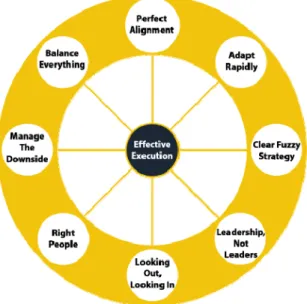
Building interest created by the promotion by the Australian Business Excellence Framework, research by Hubbard et al. [9] investigated practices used by winning organisations in Australia. Their research of 11 organisations covered a 25-year period from 1982 to 2007. Over 1,000 executives of medium-to-large organisations participated in the survey and a balanced scorecard perspective was used to define ‘‘Success’’. Experienced executives' insights helped to further validate the nine common elements uncovered in the research.
Figure 1 The Winning Framework for Organisational Excellence
All nine elements need to be in place but the study [9] highlighted the pivotal nature of effective execution in winning organisations. Hence its position at the centre of the winning wheel.
2. Methods
An international survey [1] of 55 senior executives on the success of projects and an empirical study [4] of the characteristics of eleven Australian long term high performing organisations were compared to identify synergies, common themes and opportunities to enhance organisational capability to effectively execute strategic objectives using project management.
Project Success Survey Methods
The international survey investigated project success and governance interventions with the aim to:
• obtain feedback from sponsors and senior project practitioners: o regarding the current practice and success of project health checks,
o with emphasis on business projects with a significant technology component
• provide market intelligence to the project community
Figure 2 Participants by Role The survey was conducted over the
last 3 months of 2008 Survey Participants by Role
Executive sponsors 24% Chief Information Officers 20% Project practitioners 31% Service providers 25% • 55 individual face-to-face or phone interviews
• 50 Public, private, not-for-profit, government entities
• Asia-Pacific (84%)
• UK, Europe, USA (16%)
Winning Organisations in Australia study Methods
The Research methodology was based on that used in Built to Last [6]. The views of 1000 senior executives regarding the most successful organisations in Australia over the period 1982-2007 were captured in a study. Using a balanced scorecard approach 11 were selected for detailed study. Experienced executives' insights helped to identify and validate the nine common elements uncovered in the research.
The 11 organisations were Woolworths, Westfield, Telstra, Salvation Army, Rio Tinto, Qantas, National Australia Bank, Macquarie Bank, Lend Lease, Harvey Norman and Brambles. These organisations substantially outperformed the All Ordinaries Accumulation Index over a 25 year period. The findings are represented as a “winning wheel” framework for success (Figure 1) that practitioners have found to be applicable to organisations of all types from a wide range of industry sectors.
Comparison of Project Success Survey and Winning Organisations Study Methods
The findings from the survey [1] and the study [4] were compared in three ways: project success factors were mapped against the winning wheel common elements; a review of the effectiveness of strategy execution in the organisations that participated in both studies; use of project governance and project management techniques.
Results and Discussion
Project Success Factors Compared With Winning Wheel Common Elements
Clear goals, business buy-in, skilled project team and effective governance lead to project success. The nine common elements for long-term organisational success are: effective execution, perfect alignment, adapting rapidly, clear and fuzzy strategy, leadership not leaders, looking out and looking in, right people, managing the downside and balancing everything.
When these factors and elements are considered in the context of strategy implementation the following connections are made.
Project Survey Winning Organisations Study
clear goals perfect alignment, clear and fuzzy strategy, looking out and looking in
business buy-in leadership not leaders
skilled project team effective execution, right people, managing the downside effective governance balancing everything, adapting rapidly,
Clearly there are very strong links between the elements of the winning wheel and characteristics of organisations that successfully execute projects.
Realistic Strategic Plans and Project Business Cases
In the winning organisations the strategic plan is realistic, has been planned as a program of activities and is communicated throughout the organisation. Further this planning helps the organisation to decide what to give up so that it can concentrate on delivering the strategic change program and improve resource utilisation. Winning organisations monitor and enhance the plans during program implementation. Refinements are made along the way using input from within and from analysis of external factors such as competitor behaviour; however clear strategic goals do not change. Portfolio management, which only seems to exist in organisations with some maturity in project governance, is a tool to help in decision making and monitoring.
The survey showed that individual projects have a higher chance of success if they start with clear goals and business buy-in. If there are benefits to the business and leaders are able to articulate these clearly then the business case is not only created and approved but is understood and visibly backed by business leaders.
Top leaders are developed from within winning organisations, they know how to get things done and their teams are made up of people who share the organisation's culture. Leaders often select people according to their values and invest in their training and development; the reward is an engaged workforce that produces higher performance over the long term.
By contrast major projects or a strategic program of work are often lead by a "professional" contract program manager. The survey pointed to the relationship between this person and the business sponsor as a key determinant of success. When compared with the findings about culture in winning Australian organisations, the sponsor is creating the cultural link and
support that would normally be developed by the program manager over many years. Investigation of how a strong relationship is formed requires further research, however initial findings suggest that a business leader who supports their people will invest more in the relationship with the program manager even though it may be a short term contract.
From the survey a program manager who has business experience and qualifications can more rapidly gain the respect and trust of the business sponsor by understanding (and possibly contributing to) the business case. They speak the same language and understand the business dynamics that make this strategic project essential. Combining a sponsor, who is predisposed to build a strong relationship and has some knowledge of project management, with a business savvy program manager gives a powerful start to building a realistic implementation plan and a convincing business case.
Project Governance and Visible Management Systems
What is the role of overall IT Governance in helping organisations to harvest real value from projects? The standard ISO IEC 38500-2008 [10] provides us with a framework to understand responsibilities and the division between management and governance for “IT Projects” or “Business Projects with IT Components” [11]. It is through these endeavours that organisations implement strategic change. They frequently involve design of new business process, acquisition of new skills and establishment of new control structures. The governance framework should also allow for reviews to determine if the resulting project is still relevant and feasible. The survey found that only 33% of participants said that their organisations not only did project reviews but also actioned the recommendations.
A mature governance framework is supported by a culture that fosters responsibility and ownership through open information and encouragement of objective team debate and learning. Visible management systems designed for operating, information, decision-making and reward combined with how people behave in the system. The project management methodology is integrated into these systems in mature project governance environments. Hence score cards, dashboards, flowcharts and tools for problem solving and managing the project are consistent and provide clear communication. The organisations that had higher maturity had project management at the core of their business operating model and their profitability depended on it.
The path to successful implementation demands project management and executive sponsor time, knowledge and skill, recognising and resolving obstacles, managing change and providing consistent leadership. Change management and communications plans built on a sound understanding of stakeholders and organisational culture support the program manager in delivery. Effective leaders are on the same page all the time in real time.
Use of project management techniques
The work break down structure [12] is not just a project management planning technique but it enables organisations to test if the strategy can be effectively implemented. Gantt charts and network diagrams display tasks in chronological order, show task dependencies and uncover the critical path. These tools and the planning processes used to create them increase confidence that the initiative is possible in the required time frame.
Evidence in the survey [1] showed that successful projects had a Project Management Office that was not just reporting status by project administrators but supplying real project management expertise to the entire program - linking projects, efficiencies in scheduling, budgeting, risk assessment, communications, quality management and control.
A further key aspect of project governance are the controls that allow executives to monitor project progress and performance. The survey [1] showed that sponsors of successful projects expected the governance framework to provide them with timely and reliable information so that they received early warning signs and were able to act to clear obstacles.
Conclusion
The comparison and analysis of the two research studies has provided insights into the key factors of project management and implementation of strategy in winning organisations in Australia.
Effective execution of organisational strategies is directly correlated with the project manager's knowledge of the business case and conversely the sponsor's experience and knowledge of project management. It also highlights some unique aspects of the Australian culture which enable project leaders to build more effective teams and enhance communications.
Project managers, PMO managers and sponsors can use our conclusions to focus their attention on communication, new skills and process enhancements that result in more successful project outcomes.
References.
1. Azulin Pty Ltd. Project Success Survey 2008 http://www.azulin.com.au
2. Cocks, Graeme. Associate Professor, Melbourne Business School. Strategy in Action Leadership Excellence Vol. 24 No. 3 March 2007
3. Crawford, Lynn. Lille School of Management in France (ESC Lille) and Bond University, Australia. (http://www.pmperspectives.org/).
4. Cocks, Graeme. Mt Eliza Business School in Australia. An Empirically Based Model of Business Excellence Journal of Management Systems, Vol. XVII, No. 1, 2005. 5. Kaplan, R. and Norton, D. 1992, The Balanced Scorecard-Measures that Drive
Performance, Harvard Business Review, Jan-Feb., pp 71-79.
6. Collins, J. and Porras, J. 1994, Built to Last: Successful Habits of Visionary Companies, Random House, London.
7. Peters, T and Waterman, R. 1982, In Search of Excellence: Lessons from America’s Best-run Companies, Harper and Row, New York
8. Collins, J. Good to Great: Why Some Companies Make the Leap... and Others Don't 2001, Harper Business
9. Hubbard, G., Samuel, D., Heap, S. and Cocks, G.J. 2002, The First XI: Winning Organisations in Australia, John Wiley, Australia.
10. ISO IEC 38500-2008 Corporate Governance of Information Technology 11. Toomey, Mark. Waltzing with the Elephant. www.infonomics.com.au
12. Meredith, JR and Mantel, SJ. 2003, Project Management – A Managerial Approach, John Wiley, US.