4. Introducing Conformal Field Theory
The purpose of this section is to get comfortable with the basic language of two dimen-sional conformal field theory4. This is a topic which has many applications outside of string theory, most notably in statistical physics where it offers a description of critical phenomena. Moreover, it turns out that conformal field theories in two dimensions provide rare examples of interacting, yet exactly solvable, quantum field theories. In recent years, attention has focussed on conformal field theories in higher dimensions due to their role in the AdS/CFT correspondence.
A conformal transformation is a change of coordinates σα → σ˜α(σ) such that the
metric changes by
gαβ(σ)→Ω2(σ)gαβ(σ) (4.1)
Aconformal field theory(CFT) is a field theory which is invariant under these transfor-mations. This means that the physics of the theory looks the same at all length scales. Conformal field theories cares about angles, but not about distances.
A transformation of the form (4.1) has a different interpretation depending on whether we are considering a fixed background metric gαβ, or a dynamical background metric.
When the metric is dynamical, the transformation is a diffeomorphism; this is a gauge symmetry. When the background is fixed, the transformation should be thought of as an honest, physical symmetry, taking the point σα to point ˜σα. This is now a global
symmetry with the corresponding conserved currents.
In the context of string theory in the Polyakov formalism, the metric is dynamical and the transformations (4.1) are residual gauge transformations: diffeomorphisms which can be undone by a Weyl transformation.
In contrast, in this section we will be primarily interested in theories defined on fixed backgrounds. Apart from a few noticeable exceptions, we will usually take this background to be flat. This is the situation that we are used to when studying quantum field theory.
4Much of the material covered in this section was first described in the ground breaking paper by
Belavin, Polyakov and Zamalodchikov, “Infinite Conformal Symmetry in Two-Dimensional Quantum Field Theory”, Nucl. Phys. B241 (1984). The application to string theory was explained by Friedan, Martinec and Shenker in “Conformal Invariance, Supersymmetry and String Theory”, Nucl. Phys. B271 (1986). The canonical reference for learning conformal field theory is the excellent review by Ginsparg. A link can be found on the course webpage.
Of course, we can alternate between thinking of theories as defined on fixed or fluc-tuating backgrounds. Any theory of 2d gravity which enjoys both diffeomorphism and Weyl invariance will reduce to a conformally invariant theory when the background metric is fixed. Similarly, any conformally invariant theory can be coupled to 2d grav-ity where it will give rise to a classical theory which enjoys both diffeomorphism and Weyl invariance. Notice the caveat “classical”! In some sense, the whole point of this course is to understand when this last statement also holds at the quantum level.
Even though conformal field theories are a subset of quantum field theories, the language used to describe them is a little different. This is partly out of necessity. Invariance under the transformation (4.1) can only hold if the theory has no preferred length scale. But this means that there can be nothing in the theory like a mass or a Compton wavelength. In other words, conformal field theories only support massless excitations. The questions that we ask are not those of particles and S-matrices. Instead we will be concerned with correlation functions and the behaviour of different operators under conformal transformations.
4.0.1 Euclidean Space
Although we’re ultimately interested in Minkowski signature worldsheets, it will be much simpler and elegant if we work instead with Euclidean worldsheets. There’s no funny business here — everything we do could also be formulated in Minkowski space. The Euclidean worldsheet coordinates are (σ1, σ2) = (σ1, iσ0) and it will prove useful to form the complex coordinates,
z =σ1+iσ2 and z¯=σ1−iσ2
which are the Euclidean analogue of the lightcone coordinates. Motivated by this analogy, it is common to refer to holomorphic functions as “left-moving” and anti-holomorphic functions as “right-moving”.
The holomorphic derivatives are ∂z ≡∂ =
1
2(∂1−i∂2) and ∂¯z ≡∂¯= 1
2(∂1+i∂2)
These obey ∂z = ¯∂z¯ = 1 and ∂z¯ = ¯∂z = 0. We will usually work in flat Euclidean space, with metric
In components, this flat metric reads
gzz =gz¯z¯= 0 and gz¯z =
1 2
With this convention, the measure factor is dzdz¯ = 2dσ1dσ2. We define the delta-function such that R d2z δ(z,z) = 1. Notice that because we also have¯ R d2σ δ(σ) = 1, this means that there is a factor of 2 difference between the two delta functions. Vectors naturally have their indices up: vz = (v1+iv2) and vz¯ = (v1−iv2). When indices are down, the vectors arevz = 12(v1−iv2) and v¯z = 12(v1+iv2).
4.0.2 The Holomorphy of Conformal Transformations
In the complex Euclidean coordinatesz and ¯z, conformal transformations of flat space are simple: they are any holomorphic change of coordinates,
z →z′ =f(z) and z¯→z¯′ = ¯f(¯z)
Under this transformation, ds2 = dzd¯z → |df /dz|2dzd¯z, which indeed takes the form (4.1). Note that we have an infinite number of conformal transformations — in fact, a whole functions worth f(z). This is special to conformal field theories in two dimensions. In higher dimensions, the space of conformal transformations is a finite dimensional group. For theories defined onRp,q, the conformal group isSO(p+1, q+1) whenp+q >2.
A couple of particularly simple and important examples of 2d conformal transforma-tions are
• z →z+a: This is a translation.
• z → ζz: This is a rotation for |ζ|= 1 and a scale transformation (also known as a dilatation) for realζ 6= 1.
For many purposes, it’s simplest to treat z and ¯z as independent variables. In doing this, we’re really extending the worldsheet from R2 to C2. This will allow us to make use of various theorems from complex methods. However, at the end of the day we should remember that we’re really sitting on the real sliceR2 ⊂C2 defined by ¯z =z⋆.
4.1 Classical Aspects
We start by deriving some properties of classical theories which are invariant under conformal transformations (4.1).
4.1.1 The Stress-Energy Tensor
One of the most important objects in any field theory is the stress-energy tensor(also known as the energy-momentum tensor). This is defined in the usual way as the matrix of conserved currents which arise from translational invariance,
δσα =ǫα .
In flat spacetime, a translation is a special case of a conformal transformation.
There’s a cute way to derive the stress-energy tensor in any theory. Suppose for the moment that we are in flat spacegαβ =ηαβ. Recall that we can usually derive conserved
currents by promoting the constant parameter ǫ that appears in the symmetry to a function of the spacetime coordinates. The change in the action must then be of the form,
δS = Z
d2σ Jα∂αǫ (4.3)
for some function of the fields,Jα. This ensures that the variation of the action vanishes
when ǫ is constant, which is of course the definition of a symmetry. But when the equations of motion are satisfied, we must have δS = 0 for all variationsǫ(σ), not just constantǫ. This means that when the equations of motion are obeyed,Jα must satisfy
∂αJα = 0
The functionJα is our conserved current.
Let’s see how this works for translational invariance. If we promote ǫ to a function of the worldsheet variables, the change of the action must be of the form (4.3). But what is Jα? At this point we do the cute thing. Consider the same theory, but now
coupled to a dynamical background metricgαβ(σ). In other words, coupled to gravity.
Then we could view the transformation
δσα =ǫα(σ)
as a diffeomorphism and we know that the theory is invariant as long as we make the corresponding change to the metric
δgαβ =∂αǫβ+∂βǫα .
This means that if we just make the transformation of the coordinates in our original theory, then the change in the action must be the opposite of what we get if we just
transform the metric. (Because doing both together leaves the action invariant). So we have δS =− Z d2σ ∂S ∂gαβ δgαβ =−2 Z d2σ ∂S ∂gαβ ∂αǫβ
Note that∂S/∂gαβ in this expression is really a functional derivatives but we won’t be
careful about using notation to indicate this. We now have the conserved current arising from translational invariance. We will add a normalization constant which is standard in string theory (although not necessarily in other areas) and define the stress-energy tensor to be
Tαβ =−
4π
√g ∂g∂Sαβ (4.4)
If we have a flat worldsheet, we evaluateTαβ ongαβ =δαβ and the resulting expression
obeys∂αT
αβ = 0. If we’re working on a curved worldsheet, then the energy-momentum
tensor is covariantly conserved, ∇αT
αβ = 0.
The Stress-Energy Tensor is Traceless
In conformal theories, Tαβ has a very important property: its trace vanishes. To see
this, let’s vary the action with respect to a scale transformation which is a special case of a conformal transformation, δgαβ =ǫgαβ (4.5) Then we have δS = Z d2σ ∂S ∂gαβ δgαβ =− 1 4π Z d2σ√g ǫ Tαα
But this must vanish in a conformal theory because scaling transformations are a symmetry. So
Tαα = 0
This is the key feature of a conformal field theory in any dimension. Many theories have this feature at the classical level, including Maxwell theory and Yang-Mills theory in four-dimensions. However, it is much harder to preserve at the quantum level. (The weight of the world rests on the fact that Yang-Mills theory fails to be conformal at the quantum level). Technically the difficulty arises due to the need to introduce a scale when regulating the theories. Here we will be interested in two-dimensional theories
which succeed in preserving the conformal symmetry at the quantum level.
Looking Ahead: Even when the conformal invariance survives in a 2d quantum theory, the vanishing trace Tα
α = 0 will only turn out to hold in flat space. We will
derive this result in section 4.4.2.
The Stress-Tensor in Complex Coordinates
In complex coordinates,z =σ1+iσ2, the vanishing of the trace Tα
α = 0 becomes
Tz¯z = 0
Meanwhile, the conservation equation ∂αTαβ = 0 becomes ∂Tzz = ¯∂T¯zz¯ = 0. Or,
lowering the indices onT, ¯
∂ Tzz = 0 and ∂ T¯z¯z = 0
In other words, Tzz = Tzz(z) is a holomorphic function while T¯zz¯ =T¯zz¯(¯z) is an anti-holomorphic function. We will often use the simplified notation
Tzz(z)≡T(z) and T¯zz¯(¯z)≡T¯(¯z)
4.1.2 Noether Currents
The stress-energy tensorTαβ provides the Noether currents for translations. What are
the currents associated to the other conformal transformations? Consider the infinites-imal change,
z′ =z+ǫ(z) , z¯′ = ¯z+ ¯ǫ(¯z)
where, making contact with the two examples above, constantǫcorresponds to a trans-lation whileǫ(z)∼z corresponds to a rotation and dilatation. To compute the current, we’ll use the same trick that we saw before: we promote the parameter ǫ to depend on the worldsheet coordinates. But it’s already a function of half of the worldsheet coordinates, so this now meansǫ(z)→ǫ(z,z). Then we can compute the change in the¯ action, again using the fact that we can make a compensating change in the metric,
δS = − Z d2σ ∂S ∂gαβ δg αβ = 1 2π Z d2σ Tαβ(∂αδσβ) = 1 2π Z d2z 1 2[Tzz(∂ zδz) +T¯ z¯z(∂z¯δz)]¯ = 1 2π Z d2z [Tzz∂¯zǫ+T¯zz¯∂z¯ǫ] (4.6)
Firstly note that if ǫ is holomorphic and ¯ǫ is anti-holomorphic, then we immediately have δS = 0. This, of course, is the statement that we have a symmetry on our hands. (You may wonder where in the above derivation we used the fact that the theory was conformal. It lies in the transition to the third line where we needed Tz¯z = 0).
At this stage, let’s use the trick of treating z and ¯z as independent variables. We look at separate currents that come from shifts inz and shifts ¯z. Let’s first look at the symmetry
δz =ǫ(z) , δ¯z = 0
We can read off the conserved current from (4.6) by using the standard trick of letting the small parameter depend on position. Since ǫ(z) already depends on position, this means promoting ǫ→ ǫ(z)f(¯z) for some function f and then looking at the ¯∂f terms in (4.6). This gives us the current
Jz = 0 and Jz¯=Tzz(z)ǫ(z)≡T(z)ǫ(z) (4.7)
Importantly, we find that the current itself is also holomorphic. We can check that this is indeed a conserved current: it should satisfy∂αJα =∂zJz+∂¯zJz¯= 0. But in fact it
does so with room to spare: it satisfies the much stronger condition∂z¯Jz¯= 0.
Similarly, we can look at transformations δz¯= ¯ǫ(¯z) with δz = 0. We get the anti-holomorphic current ¯J,
¯
Jz = ¯T(¯z) ¯ǫ(¯z) and J¯z¯= 0 (4.8)
4.1.3 An Example: The Free Scalar Field
Let’s illustrate some of these ideas about classical conformal theories with the free scalar field,
S= 1 4πα′
Z
d2σ ∂αX ∂αX
Notice that there’s no overall minus sign, in contrast to our earlier action (1.30). That’s because we’re now working with a Euclidean worldsheet metric. The theory of a free scalar field is, of course, dead easy. We can compute anything we like in this theory. Nonetheless, it will still exhibit enough structure to provide an example of all the abstract concepts that we will come across in CFT. For this reason, the free scalar field will prove a good companion throughout this part of the lectures.
Firstly, let’s just check that this free scalar field is actually conformal. In particular, we can look at rescaling σα →λσα. If we view this in the sense of an active
transfor-mation, the coordinates remain fixed but the value of the field at point σ gets moved to point λσ. This means,
X(σ) → X(λ−1σ) and ∂X(σ) ∂σα → ∂X(λ−1σ) ∂σα = 1 λ ∂X(˜σ) ∂σ˜
where we’ve defined ˜σ = λ−1σ. The factor of λ−2 coming from the two derivatives in the Lagrangian then cancels the Jacobian factor from the measure d2σ = λ2d2σ,˜ leaving the action invariant. Note that any polynomial interaction term for X would break conformal invariance.
The stress-energy tensor for this theory is defined using (4.4), Tαβ =− 1 α′ ∂αX∂βX− 1 2δαβ(∂X) 2 , (4.9)
which indeed satisfiesTα
α = 0 as it should. The stress-energy tensor looks much simpler
in complex coordinates. It is simple to check thatTzz¯= 0 while T =−1
α′ ∂X∂X and T¯=−
1
α′ ∂X¯ ∂X¯
The equation of motion forX is ∂∂X¯ = 0. The general classical solution decomposes as,
X(z,z) =¯ X(z) + ¯X(¯z)
When evaluated on this solution,T and ¯T become holomorphic and anti-holomorphic functions respectively.
4.2 Quantum Aspects
So far our discussion has been entirely classical. We now turn to the quantum theory. The first concept that we want to discuss is actually a feature of any quantum field theory. But it really comes into its own in the context of CFT: it is theoperator product expansion.
4.2.1 Operator Product Expansion
Let’s first describe what we mean by a local operator in a CFT. We will also refer to these objects as fields. There is a slight difference in terminology between CFTs and more general quantum field theories. Usually in quantum field theory, one reserves the
term “field” for the objects φ which sit in the action and are integrated over in the path integral. In contrast, in CFT the term “field” refers to any local expression that we can write down. This includes φ, but also includes derivatives ∂nφ or composite
operators such aseiφ. All of these are thought of as different fields in a CFT. It should
be clear from this that the set of all “fields” in a CFT is always infinite even though, if you were used to working with quantum field theory, you would talk about only a finite number of fundamental objects φ. Obviously, this is nothing to be scared about. It’s just a change of language: it doesn’t mean that our theory got harder.
We now define the operator product expansion (OPE). It is a statement about what happens as local operators approach each other. The idea is that two local operators inserted at nearby points can be closely approximated by a string of operators at one of these points. Let’s denote all the local operators of the CFT by Oi, where i runs
over the set of all operators. Then the OPE is
Oi(z,z)¯ Oj(w,w) =¯
X
k
Cijk(z−w,z¯−w)¯ Ok(w,w)¯ (4.10)
Here Ck
ij(z −w,z¯−w) are a set of functions which, on¯
(z) O2 O1(w) x x x x x x Figure 19:
grounds of translational invariance, depend only on the separation between the two operators. We will write a lot of operator equations of the form (4.10) and it’s impor-tant to clarify exactly what they mean: they are always to be understood as statements which hold as operator insertions inside time-ordered correlation functions,
hOi(z,z)¯ Oj(w,w)¯ . . .i=
X
k
Cijk(z−w,z¯−w)¯ hOk(w,w)¯ . . .i
where the. . .can be any other operator insertions that we choose. Obviously it would be tedious to continually write h. . .i. So we don’t. But it’s always implicitly there. There are further caveats about the OPE that are worth stressing
• The correlation functions are always assumed to be time-ordered. (Or something similar that we will discuss in Section 4.5.1). This means that as far as the OPE is concerned, everything commutes since the ordering of operators is determined inside the correlation function anyway. So we must have Oi(z,z)¯ Oj(w,w) =¯
Oj(w,w)¯ Oi(z,z). (There is a caveat here: if the operators are Grassmann objects,¯
then they pick up an extra minus sign when commuted, even inside time-ordered products).
• The other operator insertions in the correlation function (denoted . . . above) are arbitrary. Exceptthey should be at a distance large compared to|z−w|. It turns out — rather remarkably — that in a CFT the OPEs are exact statements and have a radius of convergence equal to the distance to the nearest other insertion. We will return to this in Section 4.6. The radius of convergence is denoted in the figure by the dotted line.
• The OPEs have singular behaviour as z → w. In fact, this singular behaviour will really be the only thing we care about! It will turn out to contain the same information as commutation relations, as well as telling us how operators transform under symmetries. Indeed, in many equations we will simply write the singular terms in the OPE and denote the non-singular terms as +. . ..
4.2.2 Ward Identities
The spirit of Noether’s theorem in quantum field theories is captured by operator equations known as Ward Identities. Here we derive the Ward identities associated to conformal invariance. We start by considering a general theory with a symmetry. Later we will restrict to conformal symmetries.
Games with Path Integrals
We’ll take this opportunity to get comfortable with some basic techniques using path integrals. Schematically, the path integral takes the form
Z = Z
Dφ e−S[φ]
where φ collectively denote all the fields (in the path integral sense...not the CFT sense!). A symmetry of the quantum theory is such that an infinitesimal transformation
φ′ =φ+ǫδφ
leaves both the actionand the measure invariant,
S[φ′] =S[φ] and Dφ′ =Dφ
(In fact, we only really need the combinationDφ e−S[φ]to be invariant but this subtlety won’t matter in this course). We use the same trick that we employed earlier in the classical theory and promote ǫ → ǫ(σ). Then, typically, neither the action nor the measure are invariant but, to leading order in ǫ, the change has to be proportional to
∂ǫ. We have Z −→ Z Dφ′ exp (−S[φ′]) = Z Dφ exp −S[φ]− 1 2π Z Jα∂αǫ = Z Dφ e−S[φ] 1− 1 2π Z Jα∂αǫ
where the factor of 1/2πis merely a convention andR is shorthand forR d2σ√g. Notice that the currentJα may now also have contributions from the measure transformation
as well as the action.
Now comes the clever step. Although the integrand has changed, the actual value of the partition function can’t have changed at all. After all, we just redefined a dummy integration variableφ. So the expression above must be equal to the originalZ. Or, in other words, Z Dφ e−S[φ] Z Jα∂ αǫ = 0
Moreover, this must hold for all ǫ. This gives us the quantum version of Noether’s theorem: the vacuum expectation value of the divergence of the current vanishes:
h∂αJαi= 0.
We can repeat these tricks of this sort to derive some stronger statements. Let’s see what happens when we have other insertions in the path integral. The time-ordered correlation function is given by
hO1(σ1). . .On(σn)i= 1 Z Z Dφ e−S[φ] O1(σ1). . .On(σn)
We can think of these as operators inserted at particular points on the plane as shown in the figure. As we described above, the operators Oi are any general expressions
that we can form from theφ fields. Under the symmetry of interest, the operator will change in some way, say
Oi → Oi +ǫ δOi
We once again promote ǫ → ǫ(σ). As our first pass, let’s pick a choice of ǫ(σ) which only has support away from the operator insertions as shown in the Figure 21. Then,
and the above derivation goes through in exactly the same ε=0 ( ) O1 ( ) O2 ( ) O4 ( ) O3 σ 1 σ 2 σ 4 σ 3 x x x x Figure 20: way to give h∂αJα(σ)O1(σ1). . .On(σn)i= 0 for σ6=σi
Because this holds for any operator insertions away from σ, from the discussion in Section 4.2.1 we are entitled to write the operator equation
∂αJα = 0
But what if there are operator insertions that lie at ε=0
( ) O2 ( ) O4 ( ) O3 σ 2 σ 4 σ 3 ( ) O1σ 1 x x x x Figure 21:
the same point as Jα? In other words, what happens as
σ approaches one of the insertion points? The resulting formulae are called Ward identities. To derive these, let’s takeǫ(σ) to have support in some region that includes the point σ1, but not the other points as shown in Figure 22. The simplest choice is just to takeǫ(σ) to be constant inside the shaded region and zero outside. Now using the same procedure as before, we find that the original correlation function is equal to,
1 Z Z Dφ e−S[φ] 1− 1 2π Z Jα∂αǫ (O1+ǫ δO1)O2. . .On
Working to leading order in ǫ, this gives
−2π1 Z
ǫ
∂αhJα(σ)O1(σ1). . .i=hδO1(σ1). . .i (4.11) where the integral on the left-hand-side is only over the region of non-zero ǫ. This is the Ward Identity.
Ward Identities for Conformal Transformations
Ward identities (4.11) hold for any symmetries. Let’s now see what they give when applied to conformal transformations. There are two further steps needed in the deriva-tion. The first simply comes from the fact that we’re working in two dimensions and we can use Stokes’ theorem to convert the integral on the left-hand-side of (4.11) to a line integral around the boundary. Let ˆnα be the unit vector normal to the boundary.
For any vector Jα, we have
Z ǫ ∂αJα = I ∂ǫ Jαnˆα = I ∂ǫ (J1dσ2−J2dσ1) =−i I ∂ǫ (Jzdz−J¯zd¯z)
where we have written the expression both in Cartesian coordinates σα and complex
coordinates on the plane. As described in Section 4.0.1, the complex components of the vector with indices down are defined asJz = 12(J1−iJ2) andJ¯z = 12(J1+iJ2). So,
applying this to the Ward identity (4.11), we find for two dimensional theories i 2π I ∂ǫ dz hJz(z,z)¯ O1(σ1). . .i − i 2π I ∂ǫ d¯z hJ¯z(z,z)¯ O1(σ1). . .i=hδO1(σ1). . .i So far our derivation holds for any conserved currentJ in two dimensions. At this stage we specialize to the currents that arise from conformal transformations (4.7) and (4.8). Here something nice happens because Jz is holomorphic while J¯z is anti-holomorphic.
This means that the contour integral simply picks up the residue, i
2π I
∂ǫ
dz Jz(z)O1(σ1) =−Res [JzO1]
where this means the residue in the OPE between the two operators, Jz(z)O1(w,w) =¯ . . .+
Res [JzO1(w,w)]¯ z−w +. . .
So we find a rather nice way of writing the Ward identities for conformal transforma-tions. If we again view z and ¯z as independent variables, the Ward identities split into two pieces. From the change δz=ǫ(z), we get
δO1(σ1) =−Res [Jz(z)O1(σ1)] =−Res [ǫ(z)T(z)O1(σ1)] (4.12)
where, in the second equality, we have used the expression for the conformal current (4.7). Meanwhile, from the change δ¯z = ¯ǫ(¯z), we have
δO1(σ1) =−Res [ ¯J¯z(¯z)O1(σ1)] =−Res [¯ǫ(¯z) ¯T(¯z)O1(σ1)]
where the minus sign comes from the fact that theH d¯z boundary integral is taken in the opposite direction.
This result means that if we know the OPE between an operator and the stress-tensorsT(z) and ¯T(¯z), then we immediately know how the operator transforms under conformal symmetry. Or, standing this on its head, if we know how an operator trans-forms then we know at least some part of its OPE withT and ¯T.
4.2.3 Primary Operators
The Ward identity allows us to start piecing together some OPEs by looking at how operators transform under conformal symmetries. Although we don’t yet know the
action of general conformal symmetries, we can start to make progress by looking at the two simplest examples.
Translations: Ifδz =ǫ, a constant, then all operators transform as
O(z−ǫ) =O(z)−ǫ ∂O(z) +. . .
The Noether current for translations is the stress-energy tensor T. The Ward identity in the form (4.12) tells us that the OPE ofT with any operatorOmust be of the form,
T(z)O(w,w) =¯ . . .+∂O(w,w)¯
z−w +. . . (4.13) Similarly, the OPE with ¯T is
¯
T(¯z)O(w,w) =¯ . . .+∂¯O(w,w)¯ ¯
z−w¯ +. . . (4.14)
Rotations and Scaling: The transformation
z →z+ǫz and z¯→z¯+ ¯ǫ¯z (4.15) describes rotation for ǫ purely imaginary and scaling (dilatation) for ǫ real. Not all operators have good transformation properties under these actions. This is entirely analogous to the statement in quantum mechanics that not all states transform nicely under the Hamiltonian H and angular momentum operator L. However, in quantum mechanics we know that the eigenstates of H and L can be chosen as a basis of the Hilbert space provided, of course, that [H, L] = 0.
The same statement holds for operators in a CFT: we can choose a basis of local operators that have good transformation properties under rotations and dilatations. In fact, we will see in Section 4.6 that the statement about local operators actually follows from the statement about states.
Definition: An operator O is said to haveweight (h,h) if, under˜ δz =ǫz and δ¯z = ¯ǫ¯z,
O transforms as
δO =−ǫ(hO+z ∂O)−¯ǫ(˜hO+ ¯z∂¯O) (4.16) The terms ∂O in this expression would be there for any operator. They simply come from expandingO(z−ǫz,z¯−¯ǫ¯z). The terms hOand ˜hOare special to operators which are eigenstates of dilatations and rotations. Some comments:
• Both h and ˜h are real numbers. In a unitary CFT, all operators have h,˜h ≥ 0. We will prove this is Section 4.5.4.
• The weights are not as unfamiliar as they appear. They simply tell us how operators transform under rotations and scalings. But we already have names for these concepts from undergraduate days. The eigenvalue under rotation is usually called the spin, s, and is given in terms of the weights as
s=h−˜h
Meanwhile, the scaling dimension ∆ of an operator is ∆ =h+ ˜h
• To motivate these definitions, it’s worth recalling how rotations and scale trans-formations act on the underlying coordinates. Rotations are implemented by the operator
L=−i(σ1∂2−σ2∂1) =z∂−z¯∂¯ while the dilation operator Dwhich gives rise to scalings is
D=σα∂α =z∂+ ¯z∂¯
• The scaling dimension is nothing more than the familiar “dimension” that we usually associate to fields and operators by dimensional analysis. For exam-ple, worldsheet derivatives always increase the dimension of an operator by one: ∆[∂] = +1. The tricky part is that the naive dimension that fields have in the classical theory is not necessarily the same as the dimension in the quantum theory.
Let’s compare the transformation law (4.16) with the Ward identity (4.12). The Noether current arising from rotations and scaling δz = ǫz was given in (4.7): it is J(z) = zT(z). This means that the residue of the JO OPE will determine the 1/z2 term in the TO OPE. Similar arguments hold, of course, for δz¯= ¯ǫ¯z and ¯T. So, the upshot of this is that, for an operator O with weight (h,˜h), the OPE with T and ¯T takes the form
T(z)O(w,w) =¯ . . .+hO(w,w)¯ (z−w)2 + ∂O(w,w)¯ z−w +. . . ¯ T(¯z)O(w,w) =¯ . . .+ ˜hO(w,w)¯ (¯z−w)¯ 2 + ¯ ∂O(w,w)¯ ¯ z−w¯ +. . .
Primary Operators
A primary operator is one whose OPE with T and ¯T truncates at order (z−w)−2 or order (¯z−w)¯ −2 respectively. There are no higher singularities:
T(z)O(w,w) =¯ hO(w,w)¯ (z−w)2 + ∂O(w,w)¯ z−w + non-singular ¯ T(¯z)O(w,w) = ˜¯ hO(w,w)¯ (¯z−w)¯ 2 + ¯ ∂O(w,w)¯ ¯ z−w¯ + non-singular
Since we now know all singularities in the TO OPE, we can reconstruct the transfor-mation under all conformal transfortransfor-mations. The importance of primary operators is that they have particularly simple transformation properties. Focussing on δz =ǫ(z), we have δO(w,w) =¯ −Res [ǫ(z)T(z)O(w,w)]¯ =−Res ǫ(z) hO(w,w)¯ (z−w)2 + ∂O(w,w)¯ z−w +. . .
We want to look at smooth conformal transformations and so require that ǫ(z) itself has no singularities atz =w. We can then Taylor expand
ǫ(z) =ǫ(w) +ǫ′(w) (z
−w) +. . .
We learn that the infinitesimal change of a primary operator under a general conformal transformationδz =ǫ(z) is
δO(w,w) =¯ −hǫ′(w)O(w,w)¯ −ǫ(w)∂O(w,w)¯ (4.17) There is a similar expression for the anti-holomorphic transformationsδz¯= ¯ǫ(¯z).
Equation (4.17) holds for infinitesimal conformal transformations. It is a simple matter to integrate up to find how primary operators change under a finite conformal transformation,
z →z(z)˜ and z¯→z(¯¯˜z) The general transformation of a primary operator is given by
O(z,z)¯ → O˜(˜z,¯˜z) = ∂z˜ ∂z −h ∂¯˜ z ∂z¯ −˜h O(z,z)¯ (4.18) It will turn out that one of the main objects of interest in a CFT is the spectrum of weights (h,˜h) of primary fields. This will be equivalent to computing the particle mass spectrum in a quantum field theory. In the context of statistical mechanics, the weights of primary operators are the critical exponents.
4.3 An Example: The Free Scalar Field
Let’s look at how all of this works for the free scalar field. We’ll start by familiarizing ourselves with some techniques using the path integral. The action is,
S= 1 4πα′
Z
d2σ ∂αX ∂αX (4.19)
The classical equation of motion is ∂2X = 0. Let’s start by seeing how to derive the analogous statement in the quantum theory using the path integral. The key fact that we’ll need is that the integral of a total derivative vanishes in the path integral just as it does in an ordinary integral. From this we have,
0 = Z DX δ δX(σ)e −S = Z DX e−S 1 2πα′ ∂ 2X(σ)
But this is nothing more than the Ehrenfest theorem which states that expectation values of operators obey the classical equations of motion,
h∂2X(σ)i= 0
4.3.1 The Propagator
The next thing that we want to do is compute the propagator forX. We could do this using canonical quantization, but it will be useful to again see how it works using the path integral. This time we look at,
0 = Z DX δ δX(σ) e−SX(σ′) =R DX e−S 1 2πα′∂ 2X(σ)X(σ′) +δ(σ−σ′)
So this time we learn that
h∂2X(σ)X(σ′)
i=−2πα′δ(σ
−σ′) (4.20)
Note that if we’d computed this in the canonical approach, we would have found the same answer: the δ-function arises in this calculation because all correlation functions are time-ordered.
We can now treat (4.20) as a differential equation for the propagator hX(σ)X(σ′) i. To solve this equation, we need the following standard result
∂2ln(σ−σ′)2 = 4πδ(σ
Since this is important, let’s just quickly check that it’s true. It’s a simple application of Stokes’ theorem. Setσ′ = 0 and integrate over R d2σ. We obviously get 4π from the right-hand-side. The left-hand-side gives
Z d2σ ∂2ln(σ12+σ22) = Z d2σ ∂α 2σα σ2 1+σ22 = 2 I (σ1dσ2−σ2dσ1) σ2 1 +σ22
Switching to polar coordinatesσ1+iσ2 =reiθ, we can rewrite this expression as
2 Z
r2dθ r2 = 4π
confirming (4.21). Applying this result to our equation (4.20), we get the propagator of a free scalar in two-dimensions,
hX(σ)X(σ′)i=−α
′
2 ln(σ−σ
′
)2
The propagator has a singularity as σ → σ′. This is an ultra-violet divergence and is
common to all field theories. It also has a singularity as|σ−σ′| → ∞. This is telling
us something important that we will mention in Section 4.3.2.
Finally, we could repeat our trick of looking at total derivatives in the path integral, now with other operator insertions O1(σ1), . . .On(σn) in the path integral. As long
as σ, σ′ 6= σ
i, then the whole analysis goes through as before. But this is exactly our
criterion to write the operator product equation, X(σ)X(σ′) =
−α ′
2 ln(σ−σ
′)2+. . . (4.22)
We can also write this in complex coordinates. The classical equation of motion∂∂X¯ = 0 allows us to split the operatorX into left-moving and right-moving pieces,
X(z,z) =¯ X(z) + ¯X(¯z)
We’ll focus just on the left-moving piece. This has the operator product expansion, X(z)X(w) = −α
′
2 ln(z−w) +. . .
The logarithm means thatX(z) doesn’t have any nice properties under the conformal transformations. For this reason, the “fundamental field” X is not really the object of interest in this theory! However, we can look at the derivative ofX. This has a rather nice looking OPE,
∂X(z)∂X(w) =−α
′
2 1
4.3.2 An Aside: No Goldstone Bosons in Two Dimensions
The infra-red divergence in the propagator has an important physical implication. Let’s start by pointing out one of the big differences between quantum mechanics and quan-tum field theory in d = 3 + 1 dimensions. Since the language used to describe these two theories is rather different, you may not even be aware that this difference exists.
Consider the quantum mechanics of a particle on a line. This is a d = 0 + 1 di-mensional theory of a free scalar field X. Let’s prepare the particle in some localized state – say a Gaussian wavefunction Ψ(X) ∼ exp(−X2/L2). What then happens? The wavefunction starts to spread out. And the spreading doesn’t stop. In fact, the would-be ground state of the system is a uniform wavefunction of infinite width, which isn’t a state in the Hilbert space because it is non-normalizable.
Let’s now compare this to the situation of a free scalar field X in a d = 3 + 1 dimensional field theory. Now we think of this as a scalar without potential. The physics is very different: the theory has an infinite number of ground states, determined by the expectation valuehXi. Small fluctuations around this vacuum are massless: they are Goldstone bosons for broken translational invariance X →X+c.
We see that the physics is very different in field theories in d= 0 + 1 and d= 3 + 1 dimensions. The wavefunction spreads along flat directions in quantum mechanics, but not in higher dimensional field theories. But what happens ind = 1 + 1 andd= 2 + 1 dimensions? It turns out that field theories in d = 1 + 1 dimensions are more like quantum mechanics: the wavefunction spreads. Theories ind = 2 + 1 dimensions and higher exhibit the opposite behaviour: they have Goldstone bosons. The place to see this is the propagator. Ind spacetime dimensions, it takes the form
hX(r)X(0)i ∼ (
1/rd−2 d6= 2
lnr d= 2
which diverges at larger only for d= 1 and d = 2. If we perturb the vacuum slightly by inserting the operatorX(0), this correlation function tells us how this perturbation falls off with distance. The infra-red divergence in low dimensions is telling us that the wavefunction wants to spread.
The spreading of the wavefunction in low dimensions means that there is no spon-taneous symmetry breaking and no Goldstone bosons. It is usually referred to as the Coleman-Mermin-Wagner theorem. Note, however, that it certainly doesn’t prohibit massless excitations in two dimensions: it only prohibits Goldstone-like massless exci-tations.
4.3.3 The Stress-Energy Tensor and Primary Operators
We want to compute the OPE of T with other operators. Firstly, what is T? We computed it in the classical theory in (4.9). It is,
T =−1
α′ ∂X∂X (4.24)
But we need to be careful about what this means in the quantum theory. It involves the product of two operators defined at the same point and this is bound to mean divergences if we just treat it naively. In canonical quantization, we would be tempted to normal order by putting all annihilation operators to the right. This guarantees that the vacuum has zero energy. Here we do something that is basically equivalent, but without reference to creation and annihilation operators. We write
T =−1
α′ :∂X∂X : ≡ −
1
α′ limitz→w (∂X(z)∂X(w)− h∂X(z)∂X(w)i) (4.25)
which, by construction, hashTi= 0.
With this definition ofT, let’s start to compute the OPEs to determine the primary fields in the theory.
Claim 1: ∂X is a primary field with weight h= 1 and ˜h= 0.
Proof: We need to figure out how to take products of normal ordered operators T(z)∂X(w) =−1
α′ :∂X(z)∂X(z) :∂X(w)
The operators on the left-hand side are time-ordered (because all operator expressions of this type are taken to live inside time-ordered correlation functions). In contrast, the right-hand side is a product of normal-ordered operators. But we know how to change normal ordered products into time ordered products: this is the content of Wick’s theorem. Although we have defined normal ordering in (4.25) without reference to creation and annihilation operators, Wick’s theorem still holds. We must sum over all possible contractions of pairs of operators, where the term “contraction” means that we replace the pair by the propagator,
z }| { ∂X(z)∂X(w) =−α ′ 2 1 (z−w)2 Using this, we have
T(z)∂X(w) =−2 α′∂X(z) −α ′ 2 1 (z−w)2 + non-singular
Here the “non-singular” piece includes the totally normal ordered term :T(z)∂X(w) :. It is only the singular part that interests us. Continuing, we have
T(z)∂X(w) = ∂X(z) (z−w)2 +. . .= ∂X(w) (z−w)2 + ∂2X(w) z−w +. . .
This is indeed the OPE for a primary operator of weight h= 1.
Note that higher derivatives ∂nX are not primary forn > 1. For example, ∂2X has weight (h,˜h) = (2,0), but is not a primary operator, as we see from the OPE,
T(z)∂2X(w) =∂w ∂X(w) (z−w)2 +. . . = 2∂X(w) (z−w)3 + 2∂2X(w) (z−w)2 +. . .
The fact that the field ∂nX has weight (h,˜h) = (n,0) fits our natural intuition: each
derivative provides spins= 1 and dimension ∆ = 1, while the field X does not appear to be contributing, presumably reflecting the fact that it has naive, classical dimension zero. However, in the quantum theory, it is not correct to say that X has vanishing dimension: it has an ill-defined dimension due to the logarithmic behaviour of its OPE (4.22). This is responsible for the following, more surprising, result
Claim 2: The field :eikX : is primary with weighth= ˜h=α′k2/4.
This result is not what we would guess from the classical theory. Indeed, it’s obvious that it has a quantum origin because the weight is proportional toα′, which sits outside
the action in the same place that ~ would (if we hadn’t set it to one). Note also that
this means that the spectrum of the free scalar field is continuous. This is related to the fact that the range ofXis non-compact. Generally, CFTs will have a discrete spectrum.
Proof: Let’s first compute the OPE with ∂X. We have ∂X(z) :eikX(w): = ∞ X n=0 (ik)n n! ∂X(z) :X(w) n: = ∞ X n=1 (ik)n (n−1)! :X(w) n−1 : −α ′ 2 1 z−w +. . . = −iα ′k 2 :eikX(w) : z−w +. . . (4.26)
From this, we can compute the OPE with T. T(z) :eikX(w) : = − 1 α′ :∂X(z)∂X(z) : :e ikX(w): = α ′k2 4 :eikX(w) : (z−w)2 +ik :∂X(z)eikX(w) : z−w +. . .
where the first term comes from two contractions, while the second term comes from a single contraction. Replacing ∂z by ∂w in the final term we get
T(z) :eikX(w) := α ′k2 4 :eikX(w) : (z−w)2 + ∂w :eikX(w) : z−w +. . . (4.27) showing that :eikX(w) : is indeed primary. We will encounter this operator frequently later, but will choose to simplify notation and drop the normal ordering colons. Normal
ordering will just be assumed from now on. .
Finally, lets check to see the OPE of T with itself. This is again just an exercise in Wick contractions. T(z)T(w) = 1 α′2 :∂X(z)∂X(z) : :∂X(w)∂X(w) : = 2 α′2 −α ′ 2 1 (z−w)2 2 − 4 α′2 α′ 2 :∂X(z)∂X(w) : (z−w)2 +. . .
The factor of 2 in front of the first term comes from the two ways of performing two contractions; the factor of 4 in the second term comes from the number of ways of performing a single contraction. Continuing,
T(z)T(w) = 1/2 (z−w)4 + 2T(w) (z−w)2 − 2 α′ ∂2X(w)∂X(w) z−w +. . . = 1/2 (z−w)4 + 2T(w) (z−w)2 + ∂T(w) z−w +. . . (4.28) We learn thatT is nota primary operator in the theory of a single free scalar field. It is an operator of weight (h,˜h) = (2,0), but it fails the primary test on account of the (z −w)−4 term. In fact, this property of the stress energy tensor a general feature of all CFTs which we now explore in more detail.
4.4 The Central Charge
In any CFT, the most prominent example of an operator which is not primary is the stress-energy tensor itself.
For the free scalar field, we have already seen thatT is an operator of weight (h,˜h) = (2,0). This remains true in any CFT. The reason for this is simple: Tαβ has dimension
∆ = 2 because we obtain the energy by integrating over space. It has spin s = 2 because it is a symmetric 2-tensor. But these two pieces of information are equivalent
to the statement thatT is has weight (2,0). Similarly, ¯T has weight (0,2). This means that the T T OPE takes the form,
T(z)T(w) =. . .+ 2T(w) (z−w)2 +
∂T(w) z−w +. . .
and similar for ¯TT¯. What other terms could we have in this expansion? Since each term has dimension ∆ = 4, any operators that appear on the right-hand-side must be of the form
On
(z−w)n (4.29)
where ∆[On] = 4−n. But, in a unitary CFT there are no operators with h, ˜h < 0.
(We will prove this shortly). So the most singular term that we can have is of order (z−w)−4. Such a term must be multiplied by a constant. We write,
T(z)T(w) = c/2 (z−w)4 + 2T(w) (z−w)2 + ∂T(w) z−w +. . . and, similarly, ¯ T(¯z) ¯T( ¯w) = ˜c/2 (¯z−w)¯ 4 + 2 ¯T( ¯w) (¯z−w)¯ 2 + ¯ ∂T¯( ¯w) ¯ z−w¯ +. . .
The constantscand ˜care called the central charges. (Sometimes they are referred to as left-moving and right-moving central charges). They are perhaps the most important numbers characterizing the CFT. We can already get some intuition for the information contained in these two numbers. Looking back at the free scalar field (4.28) we see that it hasc= ˜c= 1. If we instead consideredDnon-interacting free scalar fields, we would get c = ˜c = D. This gives us a hint: c and ˜c are somehow measuring the number of degrees of freedom in the CFT. This is true in a deep sense! However, be warned: c is not necessarily an integer.
Before moving on, it’s worth pausing to explain why we didn’t include a (z−w)−3 term in the T T OPE. The reason is that the OPE must obey T(z)T(w) = T(w)T(z) because, as explained previously, these operator equations are all taken to hold inside time-ordered correlation functions. So the quick answer is that a (z−w)−3 term would not be invariant under z ↔ w. However, you may wonder how the (z −w)−1 term manages to satisfy this property. Let’s see how this works:
T(w)T(z) = c/2 (z−w)4 + 2T(z) (z−w)2 + ∂T(z) w−z +. . .
Now we can Taylor expandT(z) =T(w)+(z−w)∂T(w)+. . .and∂T(z) =∂T(w)+. . .. Using this in the above expression, we find
T(w)T(z) = c/2 (z−w)4 + 2T(w) + 2(z−w)∂T(w) (z−w)2 − ∂T(w) z−w +. . .=T(z)T(w) This trick of Taylor expanding saves the (z −w)−1 term. It wouldn’t work for the (z−w)−3 term.
The Transformation of Energy
SoT is not primary unless c= 0. And we will see shortly that all theories have c >0. What does this mean for the transformation ofT?
δT(w) = −Res [ǫ(z)T(z)T(w)] =−Res ǫ(z) c/2 (z−w)4 + 2T(w) (z−w)2 + ∂T(w) z−w +. . .
Ifǫ(z) contains no singular terms, we can expand ǫ(z) =ǫ(w) +ǫ′(w)(z−w) + 1 2ǫ ′′ (z−w)2+1 6ǫ ′′′ (w)(z−w)3+. . . from which we find
δT(w) =−ǫ(w)∂T(w)−2ǫ′(w)T(w)− c 12ǫ
′′′
(w) (4.30)
This is the infinitesimal version. We would like to know what becomes of T under the finite conformal transformationz →z(z). The answer turns out to be˜
˜ T(˜z) = ∂z˜ ∂z −2 h T(z)− c 12S(˜z, z) i (4.31) whereS(˜z, z) is known as theSchwarzian and is defined by
S(˜z, z) = ∂3z˜ ∂z3 ∂z˜ ∂z −1 − 3 2 ∂2z˜ ∂z2 2 ∂z˜ ∂z −2 (4.32) It is simple to check that the Schwarzian has the right infinitesimal form to give (4.30). Its key property is that it preserves the group structure of successive conformal trans-formations.
4.4.1 c is for Casimir
Note that the extra term in the transformation (4.31) ofT does not depend onT itself. In particular, it will be the same evaluated on all states. It only affects the constant term — or zero mode — in the energy. In other words, it is the Casimir energy of the system.
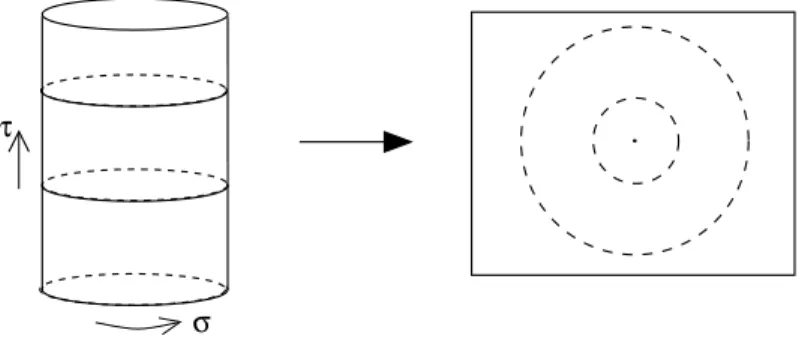
Let’s look at an example that will prove to be useful later for the string. Consider the Euclidean cylinder, parameterized by
w=σ+iτ , σ ∈[0,2π) We can make a conformal
transforma-Figure 22:
tion from the cylinder to the complex plane by
z =e−iw
The fact that the cylinder and the plane are related by a conformal map means that if we understand a given CFT on
the cylinder, then we immediately understand it on the plane. And vice-versa. Notice that constant time slices on the cylinder are mapped to circles of constant radius. The origin,z = 0, is the distant past, τ → −∞.
What becomes of T under this transformation? The Schwarzian can be easily calcu-lated to be S(z, w) = 1/2. So we find,
Tcylinder(w) =−z2Tplane(z) + c
24 (4.33)
Suppose that the ground state energy vanishes when the theory is defined on the plane:
hTplanei = 0. What happens on the cylinder? We want to look at the Hamiltonian, which is defined by H ≡ Z dσ Tτ τ =− Z dσ(Tww+ ¯Tw¯w¯)
The conformal transformation then tells us that the ground state energy on the cylinder is
E=−2π(c+ ˜c) 24
This is indeed the (negative) Casimir energy on a cylinder. For a free scalar field, we have c= ˜c= 1 and the energy density E/2π=−1/12. This is the same result that we got in Section 2.2.2, but this time with no funny business where we throw out infinities.
An Application: The L¨uscher Term
If we’re looking at a physical system, the cylinder will have a radius L. In this case, the Casimir energy is given by E =−2π(c+ ˜c)/24L. There is an application of this to QCD-like theories. Consider two quarks in a confining theory, separated by a distance L. If the tension of the confining flux tube is T, then the string will be stable as long as T L . m, the mass of the lightest quark. The energy of the stretched string as a function ofL is given by
E(L) =T L+a− πc 24L +. . .
Herea is an undetermined constant, while c counts the number of degrees of freedom of the QCD flux tube. (There is no analog of ˜chere because of the reflecting boundary conditions at the end of the string). If the string has no internal degrees of freedom, then c= 2 for the two transverse fluctuations. This contribution to the string energy is known as the L¨uscher term.
4.4.2 The Weyl Anomaly
There is another way in which the central charge affects the stress-energy tensor. Recall that in the classical theory, one of the defining features of a CFT was the vanishing of the trace of the stress tensor,
Tαα = 0
However, things are more subtle in the quantum theory. While hTα
αi indeed vanishes
in flat space, it will not longer be true if we place the theory on a curved background. The purpose of this section is to show that
hTααi=− c
12R (4.34)
where R is the Ricci scalar of the 2d worldsheet. Before we derive this formula, some quick comments:
• Equation (4.34) holds for any state in the theory — not just the vacuum. This reflects the fact that it comes from regulating short distant divergences in the theory. But, at short distances all finite energy states look basically the same.
• BecausehTα
αiis the same for any state it must be equal to something that depends
only on the background metric. This something should be local and must be dimension 2. The only candidate is the Ricci scalar R. For this reason, the formula hTα
αi ∼ R is the most general possibility. The only question is: what is
• By a suitable choice of coordinates, we can always put any 2d metric in the form gαβ =e2ωδαβ. In these coordinates, the Ricci scalar is given by
R=−2e−2ω∂2ω (4.35) which depends explicitly on the function ω. Equation (4.34) is then telling us that any conformal theory with c6= 0 has at least one physical observable, hTα
αi,
which takes different values on backgrounds related by a Weyl transformation ω. This result is referred to as theWeyl anomaly, or sometimes as the trace anomaly.
• There is also a Weyl anomaly for conformal field theories in higher dimensions. For example, 4d CFTs are characterized by two numbers, a and c, which appear as coefficients in the Weyl anomaly,
hTµµi4d= c 16π2CρσκλC ρσκλ − 16πa 2R˜ρσκλR˜ ρσκλ
where C is the Weyl tensor and ˜R is the dual of the Riemann tensor.
• Equation (4.34) involves only the left-moving central chargec. You might wonder what’s special about the left-moving sector. The answer, of course, is nothing. We also have
hTααi=−
˜ c 12R
In flat space, conformal field theories with different cand ˜c are perfectly accept-able. However, if we wish these theories to be consistent in fixed, curved back-grounds, then we require c= ˜c. This is an example of a gravitational anomaly.
• The fact that Weyl invariance requires c = 0 will prove crucial in string theory. We shall return to this in Chapter 5.
We will now prove the Weyl anomaly formula (4.34). Firstly, we need to derive an intermediate formula: theTzz¯Tww¯ OPE. Of course, in the classical theory we found that conformal invariance requires Tz¯z = 0. We will now show that it’s a little more
subtle in the quantum theory.
Our starting point is the equation for energy conservation, ∂Tz¯z =−∂ T¯ zz
Using this, we can express our desired OPE in terms of the familiarT T OPE, ∂zTz¯z(z,z)¯ ∂wTww¯(w,w) = ¯¯ ∂z¯Tzz(z,z) ¯¯ ∂w¯Tww(w,w) = ¯¯ ∂z¯∂¯w¯ c/2 (z−w)4 +. . . (4.36)
Now you might think that the right-hand-side just vanishes: after all, it is an anti-holomorphic derivative ¯∂ of a holomorphic quantity. But we shouldn’t be so cavalier because there is a singularity atz =w. For example, consider the following equation,
¯
∂¯z∂z ln|z−w|2 = ¯∂z¯ 1
z−w = 2πδ(z−w,z¯−w)¯ (4.37) We proved this statement after equation (4.21). (The factor of 2 difference from (4.21) can be traced to the conventions we defined for complex coordinates in Section 4.0.1). Looking at the intermediate step in (4.37), we again have an anti-holomorphic derivative of a holomorphic function and you might be tempted to say that this also vanishes. But you’d be wrong: subtle things happen because of the singularity and equation (4.37) tells us that the function 1/z secretly depends on ¯z. (This should really be understood as a statement about distributions, with the delta function integrated against arbitrary test functions). Using this result, we can write
¯ ∂z¯∂¯w¯ 1 (z−w)4 = 1 6∂¯z¯∂¯w¯ ∂z2∂w 1 z−w = π 3∂ 2 z ∂w∂¯w¯δ(z−w,z¯−w)¯
Inserting this into the correlation function (4.36) and stripping off the∂z∂w derivatives
on both sides, we end up with what we want, Tzz¯(z,z)¯ Tww¯(w,w) =¯
cπ
6 ∂z∂¯w¯δ(z−w,z¯−w)¯ (4.38) So the OPE ofTz¯zandTww¯ almost vanishes, but there’s some strange singular behaviour going on as z → w. This is usually referred to as a contact term between operators and, as we have shown, it is needed to ensure the conservation of energy-momentum. We will now see that this contact term is responsible for the Weyl anomaly.
We assume that hTα
αi= 0 in flat space. Our goal is to derive an expression forhTααi
close to flat space. Firstly, consider the change of hTα
αi under a general shift of the
metricδgαβ. Using the definition of the energy-momentum tensor (4.4), we have
δhTαα(σ)i =δ Z Dφ e−STαα(σ) = 1 4π Z Dφ e−S Tαα(σ) Z d2σ′√g δgβγT βγ(σ′)
If we now restrict to a Weyl transformation, the change to a flat metric isδgαβ = 2ωδαβ,
so the change in the inverse metric is δgαβ =−2ωδαβ. This gives
δhTαα(σ)i=− 1 2π Z Dφ e−S Tαα(σ) Z d2σ′ ω(σ′)Tβ β(σ ′) (4.39)
Now we see why the OPE (4.38) determines the Weyl anomaly. We need to change between complex coordinates and Cartesian coordinates, keeping track of factors of 2. We have
Tαα(σ)Tββ(σ′) = 16Tzz¯(z,z)¯ Tww¯(w,w)¯
Meanwhile, using the conventions laid down in 4.0.1, we have 8∂z∂¯w¯δ(z−w,z¯−w) =¯
−∂2δ(σ−σ′). This gives us the OPE in Cartesian coordinates
Tαα(σ)Tββ(σ′) =
−cπ3 ∂2δ(σ−σ′)
We now plug this into (4.39) and integrate by parts to move the two derivatives onto the conformal factor ω. We’re left with,
δhTααi= c 6∂
2ω
⇒ hTααi=− c 12R
where, to get to the final step, we’ve used (4.35) and, since we’re working infinitesimally, we can replace e−2ω ≈ 1. This completes the proof of the Weyl anomaly, at least for
spaces infinitesimally close to flat space. The fact that R remains on the right-hand-side for general 2d surfaces follows simply from the comments after equation (4.34), most pertinently the need for the expression to be reparameterization invariant.
4.4.3 c is for Cardy
The Casimir effect and the Weyl anomaly have a similar smell. In both, the central charge provides an extra contribution to the energy. We now demonstrate a different avatar of the central charge: it tells us the density of high energy states.
We will study conformal field theory on a Euclidean torus. We’ll keep our normal-izationσ ∈[0,2π), but now we also take τ to be periodic, lying in the range
τ ∈[0, β)
The partition function of a theory with periodic Euclidean time has a very natural interpretation: it is related to the free energy of the theory at temperatureT = 1/β.
Z[β] = Tre−βH =e−βF (4.40)
At very low temperatures, β → ∞, the free energy is dominated by the lowest energy state. All other states are exponentially suppressed. But we saw in 4.4.1 that the vacuum state on the cylinder has Casimir energy H = −c/12. In the limit of low temperature, the partition function is therefore approximated by
Now comes the trick. In Euclidean space, β 2π 2π 4π β 2 Figure 23:
both directions of the torus are on equal footing. We’re perfectly at liberty to de-cide that σ is “time” and τ is “space”. This can’t change the value of the par-tition function. So let’s make the swap. To compare to our original partition func-tion, we want the spatial direction to have range [0,2π). Happily, due to the
confor-mal nature of our theory, we arrange this through the scaling τ → 2π
β τ , σ → 2π
β σ
Now we’re back where we started, but with the temporal direction taking values in σ∈[0,4π2/β). This tells us that the high-temperature and low-temperature partition functions are related,
Z[4π2/β] =Z[β]
This is called modular invariance. We’ll come across it again in Section 6.4. Writing β′ = 4π2/β, this tells us the very high temperature behaviour of the partition function
Z[β′] → ecπ2/3β′ as β′ →0
But the very high temperature limit of the partition function is sampling all states in the theory. On entropic grounds, this sampling is dominated by the high energy states. So this computation is telling us how many high energy states there are.
To see this more explicitly, let’s do some elementary manipulations in statistical mechanics. Any system has a density of states ρ(E) = eS(E), where S(E) is the entropy. The free energy is given by
e−βF = Z
dE ρ(E)e−βE = Z
dE eS(E)−βE
In two dimensions, all systems have an entropy which scales at large energy as
S(E)→N√E (4.42)
The coefficient N counts the number of degrees of freedom. The fact that S ∼ √E is equivalent to the fact that F ∼ T2, as befits an energy density in a theory with one
spatial dimension. To see this, we need only approximate the integral by the saddle pointS′(E
⋆) =β. From (4.42), this gives us the free energy
F ∼N2T2
We can now make the statement about the central charge more explicit. In a conformal field theory, the entropy of high energy states is given by
S(E)∼ √cE This is Cardy’s formula.
4.4.4 c has a Theorem
The connection between the central charge and the degrees of freedom in a theory is given further weight by a result of Zamalodchikov, known as the c-theorem. The idea of the c-theorem is to stand back and look at the space of all theories and the renormalization group (RG) flows between them.
Conformal field theories are special. They are the fixed points of the renormalization group, looking the same at all length scales. One can consider perturbing a conformal field theory by adding an extra term to the action,
S →S+α Z
d2σ O(σ)
HereOis a local operator of the theory, whileαis some coefficient. These perturbations fall into three classes, depending on the dimension ∆ ofO.
• ∆ < 2: In this case, α has positive dimension: [α] = 2−δ. Such deformations are called relevant because they are important in the infra-red. RG flow takes us away from our original CFT. We only stop flowing when we hit a new CFT (which could be trivial with c= 0).
• ∆ = 2: The constant α is dimensionless. Such deformations are called marginal. The deformed theory defines a new CFT.
• ∆ > 2: The constant α has negative dimension. These deformations are ir-relevant. The infra-red physics is still described by the original CFT. But the ultra-violet physics is altered.
We expect information is lost as we flow from an ultra-violet theory to the infra-red. The c-theorem makes this intuition precise. The theorem exhibits a function c on the space of all theories which monotonically decreases along RG flows. At the fixed points, ccoincides with the central charge of the CFT.
4.5 The Virasoro Algebra
So far our discussion has been limited to the operators of the CFT. We haven’t said anything about states. We now remedy this. We start by taking a closer look at the map between the cylinder and the plane.
4.5.1 Radial Quantization
To discuss states in a quantum field theory we need to think
x t
Figure 24:
about where they live and how they evolve. For example, con-sider a two dimensional quantum field theory defined on the plane. Traditionally, when quantizing this theory, we param-eterize the plane by Cartesian coordinates (t, x) which we’ll call “time” and “space”. The states live on spatial slices. The Hamiltonian generates time translations and hence governs the evolution of states.
However, the map between the cylinder and the plane suggests a different way to quantize a CFT on the plane. The complex coordinate on the cylinder is taken to be ω, while the coordinate on the plane is z. They are related by,
ω =σ+iτ , z =e−iω
On the cylinder, states live on spatial slices of constantσand evolve by the Hamiltonian, H =∂τ
After the map to the plane, the Hamiltonian becomes the dilatation operator D=z∂+ ¯z∂¯
If we want the states on the plane to remember their cylindrical roots, they should live on circles of constant radius. Their evolution is governed by the dilatation operatorD. This approach to a theory is known asradial quantization.
Usually in a quantum field theory, we’re interested in time-ordered correlation func-tions. Time ordering on the cylinder becomes radial ordering on the plane. Operators in correlation functions are ordered so that those inserted at larger radial distance are moved to the left.
σ τ
Figure 25: The map from the cylinder to the plane. Virasoro Generators
Let’s look at what becomes of the stress tensor T(z) evaluated on the plane. On the cylinder, we would decompose T in a Fourier expansion.
Tcylinder(w) = − ∞ X m=−∞ Lmeimw+ c 24
After the transformation (4.33) to the plane, this becomes the Laurent expansion T(z) = ∞ X m=−∞ Lm zm+2
As always, a similar statement holds for the right-moving sector ¯ T(¯z) = ∞ X m=−∞ ˜ Lm ¯ zm+2
We can invert these expressions to getLm in terms ofT(z). We need to take a suitable
contour integral Ln= 1 2πi I dz zn+1T(z) , L˜n = 1 2πi I d¯z z¯n+1T¯(¯z) (4.43) where, if we just wantLn or ˜Ln, we must make sure that there are no other insertions
inside the contour.
In radial quantization, Lnis the conserved charge associated to the conformal
trans-formationδz=zn+1. To see this, recall that the corresponding Noether current, given in (4.7), is J(z) =zn+1T(z). Moreover, the contour integralH dz maps to the integral around spatial slices on the cylinder. This tells us that Ln is the conserved charge
where “conserved” means that it is constant under time evolution on the cylinder, or under radial evolution on the plane. Similarly, ˜Ln is the conserved charge associated
When we go to the quantum theory, conserved charges become generators for the transformation. Thus the operatorsLnand ˜Lngenerate the conformal transformations
δz =zn+1 and δz¯= ¯zn+1. They are known as the Virasoro generators. In particular, our two favorite conformal transformations are
• L−1 and ˜L−1 generate translations in the plane.
• L0 and ˜L0 generate scaling and rotations.
The Hamiltonian of the system — which measures the energy of states on the cylinder — is mapped into the dilatation operator on the plane. When acting on states of the theory, this operator is represented as
D=L0+ ˜L0
4.5.2 The Virasoro Algebra
If we have some number of conserved charges, the first thing that we should do is compute their algebra. Representations of this algebra then classify the states of the theory. (For example, think angular momentum in the hydrogen atom). For conformal symmetry, we want to determine the algebra obeyed by the Ln generators. It’s a nice
fact that the commutation relations are actually encodedT T OPE. Let’s see how this works.
We want to compute [Lm, Ln]. Let’s write Lm as a contour integral over
H
dz and Ln as a contour integral over
H
dw. (Note: both z and w denote coordinates on the complex plane now). The commutator is
[Lm, Ln] = I dz 2πi I dw 2πi − I dw 2πi I dz 2πi zm+1wn+1T(z)T(w)
What does this actually mean?! We need to remember that all operator equations are to be viewed as living inside time-ordered correlation functions. Except, now we’re working on the z-plane, this statement has transmuted into radially ordered correlation functions: outies to the left, innies to the right.
SoLmLn means w z while LnLm means w z .
The trick to computing the commutator is to first fixwand do theH dz integrations. The resulting contour is,
z
z w z
w
In other words, we do the z-integration around a fixed point w, to get [Lm, Ln] = I dw 2πi I w dz 2πi z m+1wn+1T(z)T(w) = I dw 2πiRes zm+1wn+1 c/2 (z−w)4 + 2T(w) (z−w)2 + ∂T(w) z−w +. . .
To compute the residue atz =w, we first need to Taylor expandzm+1 about the point w, zm+1 = wm+1+ (m+ 1)wm(z−w) + 1 2m(m+ 1)w m−1(z −w)2 +1 6m(m 2 −1)wm−2(z −w)3+. . .
The residue then picks up a contribution from each of the three terms, [Lm, Ln] = I dw 2πi w n+1hwm+1∂T(w) + 2(m+ 1)wmT(w) + c 12m(m 2 −1)wm−2i To proceed, it is simplest to integrate the first term by parts. Then we do the w-integral. But for both the first two terms, the resulting integral is of the form (4.43) and gives usLm+n. For the third term, we pick up the pole. The end result is
[Lm, Ln] = (m−n)Lm+n+
c 12m(m
2
−1)δm+n,0
This is the Virasoro algebra. It’s quite famous. The ˜Ln’s satisfy exactly the same
algebra, but withc replaced by ˜c. Of course, [Ln,L˜m] = 0. The appearance of cas an
extra term in the Virasoro algebra is the reason it is called the “central charge”. In general, a central charge is an extra term in an algebra that commutes with everything else.