Occurrence and habitat preferences of diploid and tetraploid
cytotypes of
Centaurea stoebe
in the Czech Republic
Výskyt obou cytotypůCentaurea stoebev České republice a jejich stanovištní nároky
Veronika O t i s k o v á
1, Tomáš K o u t e c k ý
2, Filip K o l á ř
3,4& Petr K o u t e c k ý
1* 1Department of Botany, Faculty of Science, University of South Bohemia, Branišovská 31,
CZ-370 05 České Budějovice, Czech Republic, e-mail: [email protected], [email protected];
2
Department of Forest Botany, Dendrology and Geobiocoenology, Faculty of Forestry
and Wood Technology, Mendel University, Zemědělská 3, CZ-702 00 Brno, e-mail:
[email protected];
3Department of Botany, Faculty of Science, Charles University in
Prague, Benátská 2, CZ- 128 01 Prague, Czech Republic, e-mail: [email protected];
4Institute of Botany, Academy of Sciences of the Czech Republic, Průhonice 1, CZ-252 43
Průhonice, Czech Republic
*
corresponding author
Otisková V., Koutecký T., Kolář F. & Koutecký P. (2014): Occurrence and habitat preferences of diploid and tetraploid cytotypes ofCentaurea stoebein the Czech Republic. – Preslia 86: 67–80
Two ecologically and phenotypically distinct cytotypes, a diploid and tetraploid, are known in
Centaurea stoebe. Diploids are widespread throughout Europe and occur mainly in semi-natural habitats (dry grasslands, rocky ledges, etc.). Tetraploids are probably native in south-eastern Europe and spreading in central and western Europe, where they frequently occur in man-made habitats (roads and railways, stone quarries, etc.). Tetraploids occur also in North America, where they rank among the most noxious invasive plants. Despite good knowledge on various life history traits and the invasiveness of tetraploids, detailed information on the distribution of cytotypes in its native range in Europe is still fragmentary and there is no karyological data onC. stoebeoccurring in the Czech Republic. Using flow cytometric screening of 119 populations, we report for the first time the occurrence of both cytotypes in the Czech Republic and describe their habitat preferences. Diploids (94 localities) were more frequent than tetraploids (25 localities). Habitat preferences of the cytotypes confirmed the situation reported from other parts of central and western Europe: diploids markedly prevail in semi-natural habitats whereas tetraploids occupy mainly man-made habitats. TheC. stoebecytotypes can be distinguished as distinct subspecies and should be added to the cur-rent list of the Czech flora.
K e y w o r d s: Centaurea sect. Acrolophus, Centaurea stoebe, Centaurea maculosa, flow cytometry, cytogeography, distribution
Introduction
Centaurea stoebe
L. (synonyms
C. maculosa
Lam.,
C. rhenana
Boreau) is one of the two
central-European native species of a group traditionally recognized as
Centaurea
sect.
Acrolophus
(Cass.) DC. [
C.
subgen.
Acrolophus
(Cass.) Dobrocz. or
Acosta
Hill]. The
other native species is
C. arenaria
Willd., which occurs in south-eastern Europe (up to
southern Hungary). The third taxon present in central Europe is an alien species,
C. diffusa
Lam. (Dostál 1976, Greuter 2006–2009). The group is characterized by usually pinnatisect
leaves with narrow segments, relatively small appendages of involucral bracts, which are
shortly decurrent on bracts and relatively small capitula in a corymb-like inflorescence
(e.g. Dostál 1976). Recent studies show that the traditional
C.
sect.
Acrolophus
together
with the other two traditional sections,
C.
sect.
Phalolepis
(Cass.) DC. and
C.
sect.
Willkommia
Blanca, form a monophyletic group of a rather unclear internal structure, which does not
reflect the morphologically defined sections (Garcia-Jacas et al. 2006).
Centaurea stoebe
occurs throughout most of Europe – from France in the west to
Rus-sia in the east (more or less to the border between Europe and ARus-sia) and from Italy and
Greece northwards to Poland and Baltic countries. In the United Kingdom, Switzerland,
Netherlands, Belgium, Denmark and Scandinavia it is a non-native species (Meusel &
Jäger 1992, Greuter 2006–2009). It occurs also in North America, where it ranks among
the most noxious of invasive plants (e.g. Sheley et al. 1998, DiTomaso 2000, Skinner et al.
2000; referred to as
C. maculosa
by most American authors). Rare adventive occurrences
are also reported from Russian Far East (Probatova et al. 1996) and Australia (Anonymus
2013). In the Czech Republic and surrounding countries it is quite frequent at low to
medium altitudes, where it occurs in various types of dry more or less disturbed grassland,
rocky and sandy areas, and in various ruderal habitats (railways, road margins etc.)
(Oberdorfer 2001, Štěpánek & Koutecký 2004, Fischer et al. 2008, Španiel et al. 2008).
There are two cytotypes of
C. stoebe
– diploids (2n = 18) and tetraploids (2n = 36)
(Španiel et al. 2008 and references therein). In addition, the occasional occurrence of B
chromosomes and rare aneuploidy is documented among diploids (Španiel et al. 2008)
and the exceptional occurrence of a hexaploid (2n = 54) individual in a tetraploid
popula-tion is recorded (Mráz et al. 2011). Diploids occur throughout the European range of this
species. Tetraploids are reported from Germany, Switzerland, Austria, Italy, Slovakia,
Hungary, the Balkans, Ukraine and Russia (Španiel et al. 2008 and references therein,
Treier et al. 2009). In central Europe, populations of a single-cytotype are usual and
mixed-ploidy populations are very rare (Španiel et al. 2008, Mráz et al. 2012b). There are
only tetraploids in the invasive populations in North America (Treier et al. 2009, Mráz et
al. 2011 and references therein) and the only report of diploids in North America by Treier
et al. (2009) is most probably erroneous (Mráz et al. 2011). Interestingly, based on
microsatellites (Marrs et al. 2008) and non-coding chloroplast DNA sequences (Hufbauer
& Sforza 2008) it is hypothesized that there have been multiple introductions of
tetraploids into North America and the Balkans, where tetraploids are more frequent than
diploids (Mráz et al. 2011), is suggested as the source. The origin of the tetraploid cytotype
is not clear. Based on sequences of nuclear ribosomal DNA (ITS region), Mráz et al.
(2012a) postulate allopolyploid origin of the tetraploids with the diploid cytotype as one
of the parents, but they failed to identify the second parent and the overall molecular
diversity is rather low.
The success of the tetraploids that were introduced into North America (in contrast to
the absence of diploids) might be due to several slight differences between the cytotypes in
morphology, life cycle and growth, which can be advantageous in the somewhat more
con-tinental climate in North America compared to Europe (Treier et al. 2009, Henery et al.
2010). Tetraploids are mainly short-lived perennials (polycarpic), while diploids are
pre-dominantly monocarpic biennials (Treier et al. 2009, Henery et al. 2010, Mráz et al. 2011).
Tetraploids also seem to flower earlier (often already in the first year), accumulate more
biomass in early growth, allocate more biomass below-ground and have a lower specific
leaf area (Treier et al. 2009, Henery et al. 2010, Collins et al. 2011, Mráz et al. 2011).
Tetraploids also outcompete diploids in garden experiments (Collins et al. 2011, Thébault
et al. 2011).
There are several morphological differences between diploids and tetraploids, although
the variation in all characters overlaps and not all specimens can be determined with
cer-tainty. The most important morphological characters include: (i) presence of accessory
rosettes (less than 3% of individuals in diploids, while 34% of tetraploids in the field and
up to 74% in greenhouse conditions; this trait corresponds with their monocarpic and
polycarpic life cycles; Mráz et al. 2011, 2012b), (ii) shape of involucre (more ovate ca
6.5–11.0 mm wide, mean length/width ratio 1.2 in diploids, more elongated ca 5–8 mm
wide, mean length/width ratio 1.35 in tetraploids, Fischer et al. 2008, Jäger 2011, Mráz et
al. 2011; this character is also expressed as number of florets in the morphometric studies
of Španiel et al. 2008 and Mráz et al. 2011), and (iii) length of pappus (1.1–1.9 mm in
dip-loids and 0.8–1.6 mm in tetrapdip-loids, Španiel et al. 2008; however, this character is not
reli-able, Mráz et al. 2011). Based on greenhouse cultivation, Mráz et al. (2011) also report
minor differences in branch length, number of capitula, shape of leaves and colour of
involucral bracts and flowers.
For the Czech Republic, there is no previous data on chromosome counts / ploidy levels
in
C. stoebe
nor were the cytotypes distinguished morphologically (Štěpánek & Koutecký
2004). The aim of the present study is therefore to assess karyological variation and
pro-vide data on distribution and habitat preferences of the cytotypes of
C. stoebe
in the Czech
Republic.
Methods
Field sampling
In total 119 localities were sampled, three of them consisted of two subsamples
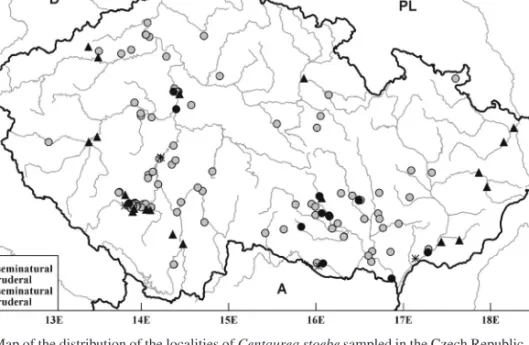
(microlocalities or different habitats); see Appendix 1 for details of the localities and Fig. 1
for a distribution map. Usually 5–10 individuals (at least 1 m apart to avoid collecting the
same genet) were collected for flow cytometry (see Appendix 1). We collected one mature
leaf per individual; the leaves were immediately placed in plastic bags and transferred to
a laboratory, where they were stored up to 10 days at 4 °C. Habitat was assigned to one of
the following types: (i) dry grassland (including man-made habitats abandoned for a long
time with semi-natural steppe-like communities, such as old stone quarries), (ii) rocky
ledges and terraces, (iii) open grassland on sand, (iv) ruderal vegetation (including road
margins and along railway lines).
Preference of the cytotypes for the above habitats was tested using contingency tables,
with Statistica 9 software (StatSoft 2010). The distribution map was prepared using
DMAP 7.1 software (A. Morton, www.dmap.org.uk). Voucher specimens are stored in the
herbarium CBFS.
Flow cytometry
DNA ploidy levels were determined using a Partec PA II flow cytometer (Partec GmbH.,
Münster, Germany) equipped with a mercury arc lamp. Samples were prepared following
the simplified two-step protocol (Doležel et al. 2007). About 0.25 cm
2of leaf tissue was
chopped with a sharp razor blade together with about the same amount of the internal
stan-dard (
Glycine max
‘Polanka’, 2C = 2.50 pg; Doležel et al. 1994) in a Petri dish containing
0.5 ml of ice-cold Otto I buffer (0.1M citric acid, 0.5% Tween-20). The suspension was
fil-tered through a 42-μm nylon mesh and incubated for about 1 min at room temperature.
After incubation, 1 ml of the staining solution was added. The staining solution consisted
of 1 ml of Otto II buffer (0.4M Na
2HPO
4.12H
2O), 2-mercaptoethanol (2 μl/ml) and the
fluorochrome DAPI (4 μg/ml). Samples were run on the flow cytometer after about one
minute of staining and the fluorescence intensity of 3000 particles recorded. Only
histo-grams with coefficients of variation for the G
0/G
1peaks of both the sample and the
stan-dard below 3.0% were considered. To reduce the number of samples, we usually pooled up
to 10 individuals from one population into a sample; leaves of all individuals were
chopped together. Pooled samples could be used due to high resolution of the analyses,
predominance of G
0/G
1nuclei and absence of endoreduplication (Fig. 2). Nevertheless, if
it was suspected there were more DNA ploidy levels in a pooled sample or if the
coeffi-cients of variation of the peaks exceeded the 3% threshold, each plant from that sample
was separately reanalysed. Results of the ploidy level analysis were calibrated using
sam-ples from populations for which there were direct chromosome counts.
Several samples were (for technical reasons) stained with propidium iodide instead of
DAPI and measured using Partec CyFlow SL flow cytometer equipped with 532 nm
(green) laser as the light source (see Koutecký et al. 2012 for details). For these samples,
only ploidy level was estimated and they were not included in the summary statistics of
fluorescence intensities.
Chromosome counts
Chromosomes of plants from one locality of the diploid (no. 45) and tetraploid (no. 107;
see Appendix 1) cytotypes were counted and used to calibrate the results of flow
Fig. 1. – Map of the distribution of the localities ofCentaurea stoebesampled in the Czech Republic. Individual cytotypes and habitat types (ruderal and semi-natural; the latter includes three habitat types: dry grasslands, rocks and sand) are indicated by different symbols.
cytometry. Chromosomes from root tips of several-day old seedlings germinated from
seeds collected at the two localities were counted. Seeds were collected from three
indi-viduals per population and at least two seedlings from a seed family were examined.
Sam-ple preparation followed the method of Španiel et al. (2008).
Results
Cytotype distribution
Among 1100 cytotyped individuals from 119 localities we detected two groups of samples
with different relative fluorescence intensities corresponding to diploid and tetraploid
cytotypes, the ratio of their mean relative fluorescence was 1.89 (Fig. 2, Table 1). We
recorded only a small variation within a ploidy level (5.5% and 4.5% for diploids and
tetraploids, respectively), which can be attributed to random measurement errors.
Chro-mosome counts 2n = 18 and 2n = 36 were confirmed for the selected populations of
dip-loids and tetrapdip-loids, respectively. We did not find any mixed populations although in
some areas the two cytotypes grow close to each other (the shortest distance was between
localities no. 71 and 112, ~800 m).
In general, both cytotypes occur throughout the whole of the Czech Republic (Fig. 1),
though they prefer different habitats (see the next section). Diploids were more frequent
than tetraploids (94 and 25 localities, respectively, see Appendix 1 for ploidy levels of
individual populations). The only exception seems to be in the north-east of the country,
where
C. stoebe
occurs mainly in ruderal habitats according to floristic databases and
where we detected only tetraploids.
Fig. 2. – Histograms of DAPI fluorescence assessed using flow cytometry of diploid (left; pooled sample of six individuals) and tetraploid (right; eight individuals) cytotypes ofCentaurea stoebe. The nuclei of the sample and the internal standard (Glycine max‘Polanka’) were isolated, stained and analysed simultaneously.
Table 1. – Relative DNA contents of individual cytotypes ofCentaurea stoebeassessed using flow cytometry with DAPI staining (the ratio relative to the internal standardGlycine max‘Polanka’, which is the given unit rela-tive DNA content). N = number of flow cytometry analyses/number of individuals, S.E. = standard error of mean. Cytotype N Relative DNA content S.E. Range of relative DNA contents
2x 110/828 0.656 0.001 0.637–0.672
4x 33/272 1.238 0.002 1.214–1.269
Habitat preferences
Diploids and tetraploids prefer different habitats in the Czech Republic (a 4 × 2
contin-gency table,
c
2= 52.66, df = 3, P = 1 × 10
–10). Diploids were the only cytotype found on
rocky ledges and terraces and strongly prevailed over tetraploids in (semi)natural
grass-lands and on sand (though there are only a few observations for the latter). At ruderal sites,
about one third of the localities (12) were occupied by diploids and two thirds (21) by
tetraploids (Fig. 3). Among ruderal sites, seven of 12 localities of diploids were on road
margins or railways (the other localities were river dykes, quarries, etc.), while all
locali-ties of tetraploids were on roads or railway lines.
Grasslands 64% (62) Rocks 20% (19) Sands 4% (4) Ruderal12% (12) Ruderal 84% (21) Sands 4% (1) Grasslands 12% (3) Diploids Tetraploids
Fig. 3. – Pie diagram of the habitat preferences of diploid and tetraploid cytotypes ofCentaurea stoebein the Czech Republic. Percentage within a cytotype and actual number of localities studied (in parentheses) are pro-vided for each of the four types of habitat. Note that three diploid localities were each dipro-vided into two sublocalities (occurrence in two types of habitat).
Discussion
Taxonomy
In the previous treatment of
C. stoebe
in the Flora of the Czech Republic (Štěpánek &
Koutecký 2004), no infraspecific taxa were recognized. Based on an inspection of
herbar-ium material, the two key morphological characters (size and shape of involucre and length
of pappus) are only weakly correlated. However, morphometric studies of Španiel et al.
(2008) and Mráz et al. (2011) clearly demonstrate morphological differences between the
cytotypes of
C. stoebe
, though the former authors do not recommend formal classification
due to overlapping values of most of the characters. Mráz et al. (2011) also challenge the
length of pappus as a discriminating character, which can explain the inconsistency with
other characters. The most important differences are life form and shape of involucre.
Our field experience of Czech populations is in accordance with the results of the cited
morphometric studies; determination of flowering plants in the field is usually possible.
Diploids usually have larger and more rounded capitula than tetraploids. Diploid
popula-tions contain mainly monocarpic plants (without accessory rosettes and usually
single-stemmed), while polycarpic plants are present in tetraploid populations (accessory
rosettes present, plants form a lax tuft with several stems). However, plant architecture and
life cycle must be considered with caution. We repeatedly observed diploid plants that
regenerated after some damage (cutting, animal grazing, etc.) from axillary buds just
above the ground and formed several-stemmed individuals. There is also a certain amount
of phenological and developmental variation that hinders determination of the cytotypes:
plants collected late in the vegetation season generally have smaller capitula and capitula
of higher orders (i.e. on lateral branches) are smaller and more cylindrical than terminal
capitula. Other characters differentiating the cytotypes in standardized greenhouse
condi-tions, such as number of capitula and shape of leaves and level of their dissection (Mráz et
al. 2011) can not be used for field-collected material, because they are heavily influenced
by site conditions and vary strongly even within a single population.
The cytotypes are reproductively isolated. Mixed populations are rare (Španiel et al.
2008, Mráz et al. 2012b, and this study) and, moreover, the cytotypes tend to form
single-cytotype clusters within mixed populations due to different micro-habitat preferences and
limited seed dispersal (Mráz et al. 2012b). Hybridization between diploids and tetraploids is
further hampered by a strong post-zygotic barrier (Mráz et al. 2012b), similar to that in other
Centaurea
taxa (Hardy et al. 2001, Koutecký et al. 2011, 2012). Triploid hybrids within
mixed populations of
C. stoebe
cytotypes are extremely rare and nearly sterile (Mráz et al.
2012b) and possible tetraploid hybrids due to unreduced gametes were not found.
The reproductive isolation, morphological differences, different habitat requirements
and overall distribution of the cytotypes justifies treating them as distinct taxa. Due to
overlapping morphological variation and unclear phylogenetic relations, the traditional
rank of subspecies seems to be the most appropriate, at least until the phylogeny of the
group is fully resolved. The name
C. stoebe
L. subsp.
stoebe
refers to diploids and the
name
C. stoebe
subsp.
australis
(A. Kern.) Greuter is applied to tetraploids in recent
litera-ture (e.g. Greuter 2006–2009, Fischer et al. 2008, Jäger 2011), although the nomenclalitera-ture
of the tetraploids is not definitely resolved and changes may be expected (Španiel et al.
2008, Mráz et al. 2011). Our results thus provide a rationale for the addition of both taxa to
the current list of the flora of the Czech Republic (Danihelka et al. 2012).
Distribution and habitat preferences
Both cytotypes (subspecies) occur throughout the Czech Republic. This pattern is
some-what different from neighbouring Slovakia, where Španiel et al. (2008) found tetraploids
only in the warmest area (the south of the country). However, this difference may just
reflect the greater sampling effort in our study (119 vs 40 localities), which was designed
to include both seminatural and ruderal stands. For example, occurrence of tetraploids in
north-western Slovakia can be expected, since we found them on both main railway lines
leading to this region.
We did not find any mixed populations of diploids and tetraploids, although they are
known from Slovakia and Austria (Španiel et al. 2008, Mráz et al. 2012b). Rare
occur-rence of mixed populations in the Czech Republic is probable and might be revealed using
more extensive sampling (both more populations and more individuals per population,
since the cytotype composition can be biased to one of the cytotypes, usually diploids;
Mráz et al. 2012b). Mixed populations can be expected especially in the south-east of the
country, where diploids are frequent and sometimes occur close to ruderal sites or even
colonize ruderal sites including railways where otherwise tetraploids frequently occur.
Habitat preferences of the two cytotypes in the Czech Republic are similar to that
recorded in other areas (e.g. Španiel et al. 2008, Mráz et al. 2012b). There is a certain
eco-logical differentiation between the cytotypes, though not perfect. Diploids were the only
cytotype found on rocky ledges and prevailed in semi-natural dry grasslands. Moreover,
two of the three localities of tetraploids in dry grasslands could have been colonized
recently: a disturbed meadow along a local road (locality no. 100) and a grassy slope
between forest edge and a local road (locality no. 103); the latter locality is close to a
rail-way line along which tetraploids frequently occur. The only recently undisturbed
(“natu-ral”) locality of tetraploids is the heathland and steppe-like vegetation (formerly a pasture)
at Kraví hora hill near Znojmo in the south-east of the country (locality no. 112); such sites
might be the natural habitat of tetraploids. Five localities with open vegetation on sand
were sampled. Interestingly, three of them were used as military training areas in the
sec-ond half of 20th century (localities no. 11, 93, 119). No obvious pattern can be seen,
dip-loids occurred at four of these localities (including two former military areas), while
tetraploids occured at only one. Ruderal sites, such as railways, road margins and quarries,
are the only habitats where tetraploids prevail over diploids. However, diploids also
occa-sionally occur at ruderal sites (including railways), especially in the warm area in the
south-east of the country.
In conclusion, distribution of the cytotypes may reflect their different migration history.
Diploid,
C. stoebe
subsp.
stoebe
, represent a native “relic” element confined to sites with
suitable vegetation. However, as a short-lived plant producing quite a lot of seed it is able to
colonize new localities, although there is some limitation due to absence of any structures
for long distance seed dispersal. The dispersal limitation is obvious from the uneven
fre-quency of occurrence at ruderal sites. Diploids occur in ruderal vegetation mainly in areas
where they have many “natural” localities (esp. south-eastern Moravia, where eight of 12
occurrences on ruderal sites are located), that is, where many seeds are produced and the
localities are close enough to each other. In contrast, in areas where “natural” occurrence is
rare occurrence in ruderal vegetation is also rare (for example, only one ruderal site with
a diploid population – a stone quarry – was found in southern Bohemia, despite intense
sam-pling).
Tetraploid,
C. stoebe
subsp.
australis
, might be native only to south-eastern Europe and
to have spread to central Europe only recently, because it is reported mainly in man-made
habitats such as railways, roadsides or stone quarries (Mráz et al. 2011). Our data are in
accordance with this pattern. Only four of 25 occurrences of tetraploids we recorded were
in semi-natural sites and, moreover, one of these four is close to other tetraploid localities
on a railway line, and two others are influenced by recent human activity (a ruderalized
meadow and a former military training area). All occurrences of tetraploids at ruderal sites
were on road margins and along railways lines and it is thus probable that the tetraploid
subspecies is spreading along transportation routes in the Czech Republic. However, we
cannot exclude the possibility that the tetraploid subspecies might be native to warm areas,
especially in the south-east of the country (locality no. 112 and similar). A more detailed
study including a revision of herbarium material is needed to assess the history of
Centaurea stoebe
subsp.
australis
in the Czech Republic in order to judge whether it
should be included in the list of alien taxa (Pyšek et al. 2012).
Acknowledgements
We thank Patrik Mráz and Stanislav Španiel for their valuable advice on our study and three anonymous reviewers for helpful comments on the manuscript. We are grateful to all colleagues who collected samples in the field: Libor Ekrt, Michal Hroneš, Alena Jírová, Petra Karešová, Adam Knotek, Lucie Kobrlová, Pavel Kúr, Martin Lepší, Petr Lepší, Jaroslava Nesvadbová, Čestmír Ondráček, Radim Paulič, Milan Štech, Táňa Štechová, Jan Štěpánek, Jana Tkáčiková, Bohumil Trávníček. Tony Dixon kindly improved our English.
Souhrn
Sledovali jsme rozšíření a stanovištní vazbu cytotypůCentaurea stoebev České republice, odkud karyologické údaje o tomto druhu dosud chyběly. Metodou průtokové cytometrie jsme analyzovali rostliny ze 119 lokalit; na 94 se vyskytovali diploidi a na 25 tetraploidi. Nebyly nalezeny žádné smíšené populace. Počítání chromosomů u dvou vybraných populací potvrdilo chromosomové počty udávané ze zahraničí, tj. 2n = 18 pro diploidy a 2n = 36 pro tetraploidy. Ve shodě s údaji z jiných částí střední Evropy se na polopřirozených stanovištích (hrany a te-rásky skal, suché trávníky, písčiny) vyskytovali především diploidi, zatímco na ruderálních stanovištích (hlavně železnice, okraje silnic, lomy apod.) převažovali tetraploidi. Diploidi se ale na ruderálních stanovištích také vy-skytují (zhruba třetina lokalit), zvláště v oblasti jižní Moravy, kde jsou velmi hojní i na polopřirozených stanoviš-tích, odkud mohou antropogenní stanoviště kolonizovat. Naše terénní zkušenosti potvrzují morfologické rozdíly udávané v literatuře (diploidi převážně monokarpičtí, tj. po odkvětu odumírající, bez postranních růžic na bázi kvetoucí lodyhy, a s okrouhlejšími zákrovy, průměrný poměr délky a šířky 1,2, šířka zákrovu 6,5–11 mm; tetra-ploidi často polykarpičtí, tj. po odkvětu se na bázi lodyhy vytváří postranní růžice, s válcovitými zákrovy, průměr-ný poměr délky a šířky 1,35, šířka zákrovu 5–8 mm). Na základě v literatuře udávané reprodukční izolace, morfo-logických rozdílů a rozdílu ve stanovištní vazbě navrhujeme – ve shodě s literaturou okolních zemí – i v České re-publice oba cytotypy rozlišovat na úrovni poddruhů, tj.C. stoebesubsp.stoebe(diploidi) aC. stoebesubsp. aus-tralis(tetraploidi).
References
Anonymus (2013): Australian Plant Name Index, IBIS database, Centre for Australian National Biodiversity Research, Australian Government, Canberra. – URL: http://www.cpbr.gov.au/cgi-bin/apni (accessed 10 April 2013).
Collins A. R., Naderi R. & Müller-Schärer H. (2011): Competition between cytotypes changes across a longitudi-nal gradient inCentaurea stoebe(Asteraceae). – Am. J. Bot. 98: 1935–1942.
Danihelka J., Chrtek J. & Kaplan Z. (2012): Checklist of vascular plants of the Czech Republic. – Preslia 84: 647–811.
DiTomaso J. M. (2000): Invasive weeds in rangelands: species, impacts, and management. – Weed Sci. 48: 255–265.
Doležel J., Doleželová M. & Novák F. J. (1994): Flow cytometric estimation of nuclear DNA amount in diploid bananas (Musa acuminataandM.balbisiana). – Biol. Plant. 36: 351–357.
Doležel J., Greilhuber J. & Suda J. (2007): Estimation of nuclear DNA content in plants using flow cytometry. – Nature Protocols 2: 2233–2244.
Dostál J. (1976):CentaureaL. – In: Tutin T. G., Heywood V. H., Burges N. A., Valentine D. H., Walters S. M. & Webb D. A. (eds), Flora Europaea 4: 254–301, Cambridge University Press, Cambridge.
Fischer M. A., Adler W. & Oswald K. (2008): Exkursionsflora für Österreich, Liechtenstein und Südtirol, Ed. 3. – Land Oberösterreich & Biologiezentrum der OÖ Landesmuseen, Linz.
Garcia-Jacas N., Uysal T., Romashchenko K., Suárez-Santiago V. N., Ertuđrul K. & Susanna A. (2006):
Centaurearevisited: a molecular survey of theJaceagroup. – Ann. Bot. 98: 741–753.
Greuter W. (2006–2009):Compositae (pro major parte). – In: Greuter W. & von Raab-Straube E. (eds),
Compositae. Euro+Med Plantbase, URL: http://ww2.bgbm.org/EuroPlusMed (accessed 29 March 2013). Hardy O. J., de Loose M., Vekemans X. & Meerts P. (2001): Allozyme segregation and inter-cytotype mating
bar-riers in the polyploid complexCentaurea jacea. – Heredity 87: 136–145.
Henery M. L., Bowman G., Mráz P., Treier U. A., Gex-Fabry E., Schaffner U. & Müller-Schärer H. (2010): Evi-dence for a combination of pre-adapted traits and rapid adaptive change in the invasive plantCentaurea stoebe. – J. Ecol. 98: 800–813.
Hufbauer R. A. & Sforza R. (2008): Multiple introductions of two invasiveCentaureataxa inferred from cpDNA haplotypes. – Diversity Distrib. 14: 252–261.
Jäger E. J. (ed.) (2011): Rothmaler, Exkursionsflora von Deutschland, Gefäßpflanzen: Grundband. Ed. 20. – Spektrum Akademischer Verlag, Heidelberg.
Koutecký P., Baďurová T., Štech M., Košnar J. & Karásek J. (2011): Hybridization between diploidCentaurea pseudophrygiaand tetraploidC. jacea(Asteraceae): the role of mixed pollination, unreduced gametes, and mentor effects. – Biol. J. Linn. Soc. 104: 93–106.
Koutecký P., Štěpánek J. & Baďurová T. (2012): Differentiation between diploid and tetraploidCentaurea phrygia: mating barriers, morphology and geographicdistribution. – Preslia 84: 1–32.
Marrs R. A., Sforza R. & Hufbauer R. A. (2008): Evidence for multiple introductions ofCentaurea stoebe micranthos(spotted knapweed,Asteraceae) to North America. – Mol. Ecol. 17: 4197–4208.
Meusel H. & Jäger E. J. (1992): Vergleichende Chorologie der zentraleuropäischen Flora. Band 3. – Gustav Fischer Verlag, Jena.
Mráz P., Bourchier R. S., Treier U. A., Schaffner U. & Müller-Schärer H. (2011): Polyploidy in phenotypic space and invasion context: a morphometric study ofCentaurea stoebes.l. – Int. J. Plant Sci. 172: 386–402. Mráz P., Garcia-Jacas N., Gex-Fabry E., Susanna A., Barres L. & Müller-Schärer H. (2012a): Allopolyploid
ori-gin of highly invasiveCentaurea stoebes.l. (Asteraceae). – Mol. Phylogen. Evol. 62: 612–623.
Mráz P., Španiel S., Keller A., Bowmann G., Farkas A., Šingliarová B., Rohr R. P., Broennimann O. & Müller-Schärer H. (2012b): Anthropogenic disturbance as a driver of microspatial and microhabitat segregation of cytotypes ofCentaurea stoebeand cytotype interactions in secondary contact zones. – Ann. Bot. 110: 615–627.
Oberdorfer E. (2001): Pflanzensoziologische Exkursionsflora für Deutschland und angrenzende Gebiete. Ed. 8. – Eugen Ulmer, Stuttgart.
Probatova N. S., Rudyka E. G. & Sokolovskaya A. P. (1996): Chisla khromosom sinantropnykh vidov rastenii s Dalnego vostoka Rossii [Chromosome numbers in synanthropic plants from the Russian Far East]. – Bot. Zhurn. 81: 98–101.
Pyšek P., Danihelka J., Sádlo J., Chrtek J., Chytrý M., Jarošík V., Kaplan Z., Krahulec F., Moravcová L., Pergl J., Štajerová K. & Tichý L. (2012): Catalogue of alien plants of the Czech Republic (2nd edition): checklist update, taxonomic diversity and invasion patterns. – Preslia 84: 155–255.
Sheley R. L., Jacobs J. S. & Carpinelli M. F. (1998): Distribution, biology, and management of diffuse knapweed (Centaurea diffusa) and spotted knapweed (Centaurea maculosa). – Weed Technol. 12: 353–362. Skinner K., Smith L. & Rice P. (2000): Using noxious weed lists to prioritize targets for developing weed
man-agement strategies. – Weed Sci. 48: 640–644.
Španiel S., Marhold K., Hodálová I. & Lihová J. (2008): Diploid and tetraploid cytotypes ofCentaurea stoebe
(Asteraceae) in Central Europe: morphological differentiation and cytotype distribution patterns. – Folia Geobot. 43: 131–158.
StatSoft (2010): STATISTICA (data analysis software system), version 9.1. – StatSoft Inc., Tulsa, URL: http://www.statsoft.com.
Štěpánek J. & Koutecký P. (2004):CentaureaL. – In: Slavík B. & Štěpánková J. (eds), Květena České republiky [Flora of the Czech Republic], 7: 426–449, Academia, Praha.
Thébault A., Gillet F., Müller-Schärer H. & Buttler A. (2011): Polyploidy and invasion success: trait trade-offs in native and introduced cytotypes of twoAsteraceaespecies. – Plant Ecol. 212: 315–325.
Treier U. A., Broennimann O., Normand S., Guisan A., Schaffner U., Steinger T. & Müller-Schärer H. (2009): Shift in cytotype frequency and niche space in the invasive plantCentaurea maculosa. – Ecology 90: 1366–1377.
Received 14 May 2013 Revision received 25 September 2013 Accepted 11 November 2013
Appendix 1. – List of localities ofCentaurea stoebein the Czech Republic sampled during this study. The locali-ties are numbered within a cytotype roughly in a north-west to south-east direction. The format of the data is: Locality number. Town (district): localization; habitat type; coordinates (WGS 84); altitude; collection date; col-lector; number of individuals analysed using flow cytometry. Abbreviations of habitat types: gr – grasslands, ro – rocks, ru – ruderal, sa – sands (note that in Fig. 1 the habitat types gr, ro, sa are grouped as semi-natural habitats). Abbreviations of collectors: FK – Filip Kolář, MŠ – Milan Štech, PK – Petr Koutecký, RP – Radim Paulič, TK – Tomáš Koutecký, VO – Veronika Otisková.
Centaurea stoebesubsp.stoebe(diploids)
1. Voděrady (distr. Chomutov): grassy slope in a small valley N of the village; gr; 50°25'29''N 13°30'51''E; 270 m; 10 Sep 2012; Č. Ondráček; 10 –2. Raná (distr. Louny): ca 0.8 km SW of the church, steppic grassland on the SE slope of Raná hill; gr; 50°24'20''N 13°46'17''E; 370 m; 6 Sep 2012; MŠ; 10 –3. Hnojnice (distr. Louny): ca 0.9 km SE of the village, steppic grassland by the border of Kamenná slunce nature reserve; gr; 50°26'02''N 13°53'08''E; 250 m; 6 Sep 2012; MŠ; 7 –4. Ústí nad Labem-Brná (distr. Ústí nad Labem): N of the village, rocky ledges and stony slope; ro; 50°38'06''N 14°04'16''E; 400 m; 30 Apr 2012; PK; 5 –5. Velké Žernoseky (distr. Litoměřice): rock "Kalvárie" ca 1.3 km NW of the church; ro; 50°32'48''N 14°03'00''E; 420 m; 1 May 2012; T. Štechová; 8 –6. Velké Žernoseky (distr. Litoměřice): ca 1 km NW of the church, rocks SW of the summit of Velká Vendula hill; ro; 50°32'47''N 14°03'15''E; 190 m; 1 May 2012; T. Štechová; 5 –7. Žalhostice (distr. Litoměřice): ca 0.6 km NNW of the railway station, steppic grassland near the summit of Radobýl hill; gr; 50°31'48''N 14°05'37''E; 395 m; 1 May 2012; T. Štechová; 5 –8. Vražkov (distr. Litoměřice): rocks on the SW slope of Říp hill, ca 120 m SW of its summit, NE of the village; ro; 50°23'05''N 14°17'17''E; 400 m; 26 Jan 2013; FK; 3 –9. Bezděz (distr. Česká Lípa): steppic grassland in the foothills of Bezděz hill, on the N edge of the village; gr; 50°32'14''N 14°43'02''E; 460 m; 17 Aug 2012; MŠ; 5 –10. Milíkov (distr. Tachov): dry grassland on the steep slope on the left bank of the Mže River, N of the village; gr; 49°45'00"N, 12°56'24"E; 380 m; 15 Sep 2013; MŠ; 14 –11. Milovice (distr. Nymburk): dry grassland on sand, by the former military airport NE of the town; sa; 50°14'22''N 14°53'58''E; 200 m; 12 May 2012; FK; 7 –12. Praha-Suchdol (distr. Praha): steppic grassland on the south slope of Unětický potok valley, N of the town; gr; 50°08'49''N 14°22'47''E; 240 m; 14 May 2011; FK; 3 –13. Praha-Lysolaje (distr. Praha): ground of the former soil-pit on the SW edge of the town; ru; 50°07'24''N 14°22'11''E; 270 m; 25 Apr 2013; FK; 4 –14. Praha-Troja (distr. Praha): steppic grassland on Velká skála hill; gr; 50°07'29''N 14°25'34''E; 410 m; 14 May 2012; FK; 3 –15. Praha-Troja (distr. Praha): dry grassland on Salabka hill; gr; 50°07'23''N 14°24'47''E; 250 m; 29 Sep 2012; FK; 5 –16. Zbečno (distr. Rakovník): rocky ledge on Pěnčina ridge, NE of the village; ro; 50°02'34''N 13°55'24''E; 360 m; 19 Nov 2012; TK; 2 –17. Hudlice (distr. Beroun): ca 1.5 km E of the church, dry grassy slope by Stará ves nature reserve; gr; 49°57'46''N 13°59'39''E; 320 m; 3 Oct 2012; P. Karešová; 3 –18. Trubín (distr. Beroun): steppic grassland on the S slope of Trubínský vrch hill, NW of the village; gr; 49°56'39''N 13°59'49''E; 340 m; 3 Oct 2012; P. Karešová; 3 –19. Srbsko (distr. Beroun): ca 0.9 km WSW of the railway station, steppic grassland; gr; 49°56'02''N 14°07'12''E; 350 m; 15 Sep 2012; P. Lepší; 10 –20. Praha-Zbraslav (distr. Praha): a dyke by the confluence of Vltava and Berounka rivers, cca 2 km SSE of the town; ru; 49°59'38''N 14°24'01''E;
190 m; 25 May 2011; FK; 1 –21. Praha-Pitkovice (distr. Praha): grassy slope NW of the village; gr; 50°01'29''N 14°34'23''E; 275 m; 25 Apr 2013; FK; 4 –22. Nalžovické Podhájí (distr. Příbram): edges of Albertovy skály rocks, ca 1.4 km N of the centre of the village; ro; 49°43'26''N 14°22'09''E; 400 m; 7 May 2010; PK; 3 –23. Zduchovice (distr. Příbram): rocks above Vltava River, ca 1.4 km SSW of the village; ro; 49°37'34''N 14°12'19''E; 400 m; 25 Apr 2011; PK; 10 –24. Vysoký Chlumec (distr. Příbram): grassy slope above a road on the SE edge of the village; gr; 49°36'55''N 14°23'33''E; 450 m; 23 Apr 2011; PK; 10 –25. Skoupý (distr. Příbram): dry grassland on a limestone hill ca 0.7 km NE of the centre of the village; gr; 49°34'59''N 14°20'59''E; 560 m; 23 Apr 2011; PK; 10 –26. Mladá Vožice (distr. Tábor): rock edge on the E slope of Hrad hill, E of the town; ro; 49°31'56''N 14°48'53''E; 480 m; 6 Jun 2012; VO & PK; 8 –27. Pukňov (distr. Písek): dry grassy slope ca 0.2 km SW from the W end of the village; gr; 49°31'49''N 14°07'56''E; 450 m; 27 Jun 2012; VO & PK; 10 –28. Dolní Nerestce (distr. Písek): dry grassland in an abandoned limestone quarry, ca 0.9 km NNE of the village; gr; 49°30'28''N 14°04'53''E; 460 m; 17 Apr 2011; PK; 7 –29. Krsice (distr. Písek): dry grassy slope in the village, ca 0.5 km SE of the church; gr; 49°28'57''N 14°04'42''E; 420 m; 17 Apr 2011; PK; 9 –30. Zvíkovské Podhradí (distr. Písek): rocks S of the castle Zvíkov, ca 1.4 km NNW of the village; ro; 49°26'14''N 14°11'37''E; 380 m; 27 Jun 2012; VO & PK; 10 –31. Svéradice (distr. Klatovy): dry grassy slope E of the football pitch, N of the village; gr; 49°22'32''N 13°44'30''E; 470 m; 27 Jun 2012; VO & PK; 10 –32. Svéradice (distr. Klatovy): dry grassland in an abandoned sand-pit, ca 1.2 km NE of the village; gr; 49°22'46''N 13°45'05''E; 485 m; 3 Jun 2012; RP; 10 –33. Střela (distr. Strakonice): 1.1 km N of the church, dry grassy slope on the south slope of Banina hill; gr; 49°16'38''N 13°51'12''E; 420 m; 23 Jun 2011; VO & PK; 20 –34. Krty (distr. Strakonice): an active limestone quarry NE of the village; ru; 49°17'48''N 13°51'42''E; 440 m; 3 Jun 2012; RP; 10 –35. Strakonice (distr. Strakonice): edge of Velká skála rock, W of the town part Podskalí; ro; 49°15'33''N 13°52'54''E; 420 m; 27 May 2012; RP; 10 –36. Strakonice (distr. Strakonice): NNE of the town, dry grassy slope on the ESE foothills of Šibeník hill; gr; 49°16'23''N 13°54'32''E; 450 m; 25 May 2012; RP; 10 –37. Droužetice (distr. Strakonice): an abandoned football pitch and grassy slope above it, NE of the village; gr; 49°17'25''N 13°53'38''E; 470 m; 3 Jun 2012; RP; 10 –38. Domanice (distr. Strakonice): ca 0.5 km ENE of the church, grassy forest margin; gr; 49°18'00''N 13°55'40''E; 475 m; 21 May 2011; P. Kúr; 10 –39. Domanice (distr. Strakonice): ca 0.65 km ESE of the church, grassy forest margin; gr; 49°17'47''N 13°55'43''E; 490 m; 21 May 2011; P. Kúr; 10 –40. Slaník (distr. Strakonice): grassy forest margin at the south foothills of Na Hájcích hill, NW of the village; gr; 49°16'14''N 13°56'36''E; 400 m; 23 May 2012; RP; 10 –41. Rovná (distr. Strakonice): an abandoned limestone pit on Zbuš hill, ca 1 km NW of the village; gr; 49°17'33''N 13°56'40''E; 430 m; 21 May 2011; P. Kúr; 10 –42. Rovná (distr. Strakonice): dry meadow on a limestone slope, ca 0.7 km S of the village; gr; 49°16'39''N 13°57'13''E; 400 m; 23 May 2012; RP; 10 –43. Štěkeň (distr. Strakonice): rocky ledge ca 0.25 km SW of the castle, W of the village; ro; 49°15'58''N 14°00'01''E; 400 m; 23 Jun 2011; VO & PK; 7 –44. Vítkov (distr. Strakonice): dry meadow ca 0.35 km NW of the centre of the village; gr; 49°17'25''N 14°01'19''E; 420 m; 3 Jun 2011; VO & PK; 10 –45. Dobev (distr. Písek): dry grassy slope S of the village, by the road to Kestřany; gr; 49°17'29''N 14°03'01''E; 395 m; 3 Jun 2011; VO & PK; 20 –46. Putim (distr. Písek): dry grassland ca 0.35 km WNW of the church; gr; 49°16'01''N 14°06'53''E; 380 m; 23 Jun 2011; VO & PK; 25 –47. Tábor (distr. Tábor): rock above Lužnice river, W of the town, ca 200 m SE of Klokoty monastery; ro; 49°24'47''N 14°38'49''E; 400 m; 6 Jun 2012; VO & PK; 10 –48. Sezimovo Ústí (distr. Tábor): dry grassy slope by the border of Luna nature reserve, N of the town; gr; 49°23'11''N 14°42'07''E; 405 m; 28 Apr 2012; FK; 10 –
49. Bechyně (distr. Tábor): grassy slope above a road to Radětice, ca 100 m N of the bridge over Smutná river, NW of the town; gr; 49°18'16''N 14°27'15''E; 380 m; 6 Jun 2012; VO & PK; 5 –50. Týn nad Vltavou (distr. České Budějovice): dry stony slope and rocky ledge, by Semenec view point, NW of the town; ro; 49°13'50''N 14°24'34''E; 390 m; 6 Jun 2012; VO & PK; 10 –51. Vlkov nad Lužnicí (distr. Tábor): dry grassland in the N part of the village [this occurrence is most probably not native, since at the same place several other thermophilous spe-cies occur that are not native in this area, e.g.Filipendula vulgaris,Trifolium alpestre,Veronica teucrium]; gr; 49°09'19''N 14°43'25''E; 390 m; 26 May 2012; PK; 10 –52a. Černice (distr. Český Krumlov): rocks on the right bank of Vltava river, ca 0.8 km NW of the centre of the village; ro; 48°50'35''N 14°22'19''E; 490 m; 21 Aug 2012; VO & PK; 5 –52b. Černice (distr. Český Krumlov): rocks on the right bank of Vltava river, ca 0.65 km NW of the centre of the village; ro; 48°50'34''N 14°22'30''E; 500 m; 21 Aug 2012; VO & PK; 10 –53. Zdelov (distr. Rychnov nad Kněžnou): dry grassland on sand in the S edge of the grounds of a farm in the middle part of the village; sa; 50°06'01''N 16°08'44''E; 280 m; 4 Sep 2013; VO & PK; 20 –54. Mravín (distr. Chrudim): dry steep grassy slope on the W edge of the village; gr; 49°56'34''N 16°03'14''E; 320 m; 4 Sep 2013; VO & PK; 10 – 55.
Skuteč–Štepánov (distr. Chrudim): dry grassy slope ca 0.8 km ESE of the centre of the village; gr; 49°51'21''N 16°00'41''E; 410 m; 4 Sep 2013; VO & PK; 10 –56.Ronov nad Doubravou (distr. Chrudim): dry grassy slope ca 0.2 km NW of the railway stop Žlebské Chvalovice, E of the village; gr; 49°53'06''N 15°33'12''E; 290 m; 4 Sep 2013; VO & PK; 2 –57. Dačice, part Toužín (distr. Jindřichův Hradec): dry grassy slope N of the village; gr; 49°04'32''N 15°25'10''E; 470 m; 28 Jun 2011; L. Ekrt; 2 –58. Krasonice (distr. Jihlava): dry grassland in an
aban-doned limestone quarry, ca 2 km SE of the village; gr; 49°06'11''N 15°37'55''E; 510 m; 7 Jun 2011; L. Ekrt; 10 –
59. Číchov (distr. Třebíč): dry grassland Na Skaličce, NE of the village; gr; 49°17'14''N 15°45'59''E; 430 m; 4 Aug 2012; FK; 4 –60. Šebkovice (distr. Třebíč): railway station; ru; 49°07'20''N 15°49'57''E; 460 m; 5 Jul 2011; MŠ; 5 –61a. Velké Meziříčí (distr. Žďár nad Sázavou): ca 2.1 km ESE of the church, dry grassy slope N of the highway Praha-Brno; gr; 49°20'57''N 16°02'23''E; 480 m; 6 Jul 2011; PK; 5 –61b. Velké Meziříčí (distr. Žďár nad Sázavou): ca 2.1 km ESE of the church, margin of a road N of the highway Praha-Brno; ru; 49°20'56''N 16°02'25''E; 480 m; 6 Jul 2011; PK; 6 –62. Rudíkov (distr. Třebíč): dry grassy slope on the NE edge of the village; gr; 49°17'30''N 15°57'01''E; 540 m; 4 Jul 2011; PK; 10 –63. Budišov (distr. Třebíč): ca 0.5 km WNW of the church, dry grassy slope; gr; 49°16'17''N 15°59'38''E; 485 m; 4 Jul 2011; PK; 10 –64. Vladislav (distr. Třebíč): ca 0.45 km ESE of the church, rocks above Jihlava river; ro; 49°12'33''N 15°59'39''E; 400 m; 7 Jul 2011; PK; 10 –65. Studenec (distr. Třebíč): W part of the railway station, N of the town; ru; 49°13'21''N 16°04'02''E; 440 m; 4 Jul 2011; J. Štěpánek; 4 –66. Náměšť nad Oslavou (distr. Třebíč): grassy strip between railway line and a local road and garages, ca 200 ESE of the railway station; ru; 49°12'20''N 16°09'03''E; 390 m; 8 Jul 2011; PK; 3 –67. Náměšť nad Oslavou (distr. Třebíč): dry grassy slope, ca 0.15 km W of the railway bridge S of the town; gr; 49°11'54''N 16°09'20''E; 360 m; 8 Jul 2011; PK; 10 –68. Ketkovice (distr. Brno-venkov): ca 1.7 km SW of the church, dry grasslands above an abandoned quarry; gr; 49°08'52''N 16°14'55''E; 370 m; 5 Jul 2011; PK; 10 –69. Mohelno (distr. Třebíč): edge of steppic grassland on serpentinite, S of the village; gr; 49°06'33''N 16°11'09''E; 380 m; 14 Sep 2012; FK; 9 –70a. Moravský Krumlov (distr. Znojmo): dry grassy slope, E of the town, ca 200 m NE of St. Florian church; gr; 49°02'58''N 16°19'19''E; 290 m; 6 Jul 2011; A. Jírová, M. Lepší & P. Lepší; 8 –70b. Moravský Krumlov (distr. Znojmo): rocks by St. Florian church, E of the town; ro; 49°02'52''N 16°19'11''E; 280 m; 1 Jun 2012; MŠ; 10 –71. Znojmo (distr. Znojmo): rocky slope S of the castle, on the SW edge of the town; ro; 48°51'17''N 16°02'36''E; 260 m; 26 Oct 2012; TK; 5 –72. Znojmo (distr. Znojmo): ruderal vegetation in the S part of the railway station; ru; 48°51'03''N 16°03'25''E; 259 m; 26 Oct 2012; TK; 15 –73. Ostrov (distr. Brno-venkov): dry meadow ca 0.7 km ESE of the village; gr; 49°22'14''N 16°17'18''E; 415 m; 9 Oct 2012; TK; 5 –74. Tišnov (distr. Brno-venkov): steppic grassland on the S slope of Květnice hill, NW of the town; gr; 49°21'10''N 16°24'59''E; 340 m; 29 Apr 2011; PK; 5 –75. Malhostovice (distr. Brno-venkov): ca 1.2 km SW of the church, Drásovský kopeček hill, dry grassland on a limestone; gr; 49°19'25''N 16°29'44''E; 320 m; 30 Apr 2011; PK; 10 –
76. Čebín (distr. Brno-venkov): edge of a road to a limestone quarry on the E slope of Čebínka hill, NE of the vil-lage; ru; 49°19'02''N 16°29'27''E; 310 m; 29 Aug 2012; B. Trávníček; 10 –77. Kuřim (distr. Brno-venkov): ca 2 km NW of the church, dry meadow; gr; 49°19'12''N 16°30'49''E; 360 m; 15 May 2012; TK; 10 –78. Vilémovice (distr. Blansko): rocks above Pustý žleb valley, ca 2 km NW of the village; ro; 49°22'24''N 16°43'28''E; 430 m; 2 Apr 2011; PK; 4 –79. Brno-Líšeň (distr. Brno-město): small steppic grassland, NE of the town part; gr; 49°13'16''N 16°42'45''E; 300 m; 17 May 2012; TK; 8 –80. Brno-Nový Lískovec (distr. Brno-město): Kamenný vrch hill, N of the town part; gr; 49°10'48''N 16°33'19''E; 340 m; 18 Mar 2012; PK; 10 –81. Bedřichovice (distr. Brno-venkov): dry grassland on the top of Horka hill, E of the village; gr; 49°10'50''N 16°43'43''E; 250 m; 17 Oct 2012; TK; 10 –82. Újezd u Brna (distr. Brno-venkov): dry grassland (probably an abandoned vineyard) on Stará hora hill, W of Špice nature reserve, NE of the town; gr; 49°06'48''N 16°46'04''E; 280 m; 28 Apr 2013; PK; 10 –
73. Křižanovice (distr. Vyškov): ca 0.8 km E of the railway station, dry grassy slope above a road Brno-Bučovice; gr; 49°08'44''N 16°56'52''E; 225 m; 17 Oct 2012; TK; 5 –84. Pouzdřany (distr. Břeclav): 1.6 km ENE of the church, steppic grassland (probably an abandoned vineyard) S of Pouzdřanská step nature reserve; gr; 48°56'21''N 16°38'41''E; 210 m; 16 Sep 2011; PK; 13 –85. Ivaň (distr. Brno-venkov): ca 3 km SE of the church, the N dyke of “Nové Mlýny střed” water reservoir; ru; 48°54'30''N 16°36'04''E; 170 m; 10 Sep 2012; TK; 10 –86. Horní Věstonice (distr. Břeclav): ca 1.4 km SSE of the church, dry grassy slope; gr; 48°51'46''N 16°38'02''E; 395 m; 30 May 2012; VO; 30 –87. Němčičky (distr. Břeclav): ca 3.6 km ENE of the church, dry grassy slope E of Zázmoníky nature reserve; gr; 48°56'09''N 16°51'18''E; 300 m; 27 Apr 2013; PK; 10 –88. Břeclav (distr. Břeclav): railway station Boří les, S of the town; ru; 48°44'17''N 16°52'01''E; 160 m; 8 Apr 2012; FK; 3 –89. Liptaň (distr. Bruntál): ca 0.2 km WSW of the church, dry grassy slope above a road to Třemešná; gr; 50°13'16''N 17°35'59''E; 385 m; 10 Jul 2012; PK; 10 –90. Slatinky (distr. Prostějov): dry grasslands on limestone, ca 1.1 km S of the village; gr; 49°32'21''N 17°05'29''E; 300 m; 18 Apr 2013; PK; 10 –91. Grygov (distr. Olomouc): dry grassland in an abandoned limestone quarry, ca 2 km SE of the railway station; gr; 49°31'25''N 17°19'39''E; 220 m; 30 Aug 2012; M. Hroneš & L. Kobrlová; 10 –92. Drysice (distr. Vyškov): dry grassland in an abandoned quarry, ca 1.5 km NE of the church; gr; 49°20'28''N 17°04'27''E; 265 m; 5 Sep 2013; VO; 10 –93. Bzenec (distr. Hodonín): ca 2.1 km N from the railway station Bzenec-Přívoz, dry grassland on sand (a former military training area); sa; 48°57'23''N 17°17'22''E; 200 m; 17 Oct 2012; TK; 5 –94a. Bzenec (distr. Hodonín): ca 0.8 km SW from the railway station Bzenec-Přívoz, dry grassland on sand; sa; 48°55'55''N 17°16'51''E; 195 m; 17 Oct 2012; TK; 3 –94b. Bzenec (distr. Hodonín): ca 0.8 km SW from the railway station Bzenec-Přívoz, on a railway line; ru; 48°55'59''N 17°16'59''E; 190 m; 17 Oct 2012; TK; 3.
Centaurea stoebesubsp.australis(tetraploids)
95. Chomutov (distr. Chomutov): railway station; ru; 50°27'19''N 13°23'47''E; 350 m; 10 Sep 2012; Č. Ondráček; 10 –96. Hořetice (distr. Louny): along a railway line on the S edge of the village; ru; 50°22'39''N 13°30'28''E; 260 m; 10 Sep 2012; Č. Ondráček; 20 –97. Praha (distr. Praha): railway station Praha-Bubny; ru; 50°06'17''N 14°26'20''E; 190 m; 29 Sep 2012; FK; 10 –98. Plzeň (distr. Plzeň-město): NE part of the main railway station; ru; 49°44'58''N 13°24'03''E; 320 m; 2 Sep 2012; J. Nesvadbová; 10 –99. Chrást (distr. Plzeň-město): railway station; ru; 49°47'15''N 13°29'44''E; 350 m; 17 Sep 2012; J. Nesvadbová; 10 –100. Zduchovice (distr. Příbram): meadow, ca 1.25 ESE of the centre of the village; gr; 49°38'07''N 14°13'33''E; 380 m; 25 Apr 2011; PK; 10 –101. Mečichov (distr. Strakonice): road edge, ca 1.1 km NNE of the town; ru; 49°21'28''N 13°49'03''E; 550 m; 21 Jun 2011; MŠ; 1 –102. Dolní Poříčí (distr. Strakonice): railway cutting 1 km SE of the village; ru; 49°16'38''N 13°48'27''E; 410 m; 27 May 2012; RP; 10 –103. Katovice (distr. Strakonice): ca 1.1 km WNW of the village, grassy forest margin on the southern foothills of Kněží hora hill above a local road; gr; 49°16'42''N 13°48'49''E; 400 m; 27 May 2012; RP; 10 –104. Strakonice (distr. Strakonice): railway station; ru; 49°15'20''N 13°55'04''E; 400 m; 26 May 2012; RP; 10 –105. Radošovice (distr. Strakonice): edge of road, by the railway station SE of the village; ru; 49°13'57''N 13°54'07''E; 415 m; 23 Jun 2011; VO & PK; 29 – 106. Sudoměř (distr. Strakonice): railway station; ru; 49°14'58''N 14°03'25''E; 380 m; 23 Jun 2011; VO & PK; 20 –107. Ražice (distr. Písek): N part of the railway sta-tion; ru; 49°14'43''N 14°06'19''E; 375 m; 3 Jun 2011; VO & PK; 30 –108. Zliv (distr. České Budějovice): railway station; ru; 49°03'56''N 14°21'41''E; 370 m; 26 Jun 2012; VO; 10 – 109. České Budějovice (distr. České Budějovice): railway station České Budějovice-severní zastávka; ru; 48°59'42''N 14°28'45''E; 390 m; 22 Jun 2011; VO; 17 –110. Hradec Králové (distr. Hradec Králové): E part of the railway station Hradec Králové-Slezské předměstí; ru; 50°13'18''N 15°51'47''E; 235 m; 9 Sep 2012; M. Hroneš; 10 –111. Jabloňov (distr. Žďár nad Sázavou): edge of road, by the underpass of the highway Praha-Brno, ca 1.9 km NW of the village; ru; 49°19'59''N 16°04'04''E; 480 m; 13 Jun 2011; P. Kúr; 11 –112. Znojmo (distr. Znojmo): dry grassland and heath land Kraví hora, SW of the town; gr; 48°50'53''N 16°02'21''E; 300 m; 26 Oct 2012; TK; 5 –113. Ostrava (distr. Ostrava-město): railway station Ostrava-hlavní nádraží; ru; 49°51'16''N 18°15'58''E; 410 m; 18 Sep 2012; TK; 2 –
114. Jistebník (distr. Nový Jičín): railway station (E part, currently not used); ru; 49°44'56''N 18°09'05''E; 225 m; 27 Jun 2012; TK; 1 –115. Hustopeče nad Bečvou (distr. Přerov): railway station, S of the village; ru; 49°31'23''N 17°51'58''E; 265 m; 4 Jun 2010; PK; 3 –116. Bystřička (distr. Vsetín): railway station; ru; 49°25'02''N 17°57'32''E; 310 m; 11 Jul 2012; J. Tkáčiková; 5 –117. Ostrožská Nová Ves (distr. Uherské Hradiště): railway sta-tion; ru; 49°00'32''N 17°26'09''E; 175 m; 21 Oct 2012; A. Knotek; 3 –118. Uherský Brod (distr. Uherské Hradiště): ruderal vegetation on the S edge of the railway station; ru; 49°01'18''N 17°38'35''E; 210 m; 18 Sep 2012; TK; 5 –119. Hodonín (distr. Hodonín): open vegetation on sand (a former military training area), NE of the town, NW of the village of Pánov; sa; 48°53'07''N 17°08'24''E; 210 m; 19 May 2011; PK; 20.