A
PPROACH
TO THE
C
ONTROL OF
E
NTERO
-
HAEMORRHAGIC
E
SCHERICHIA COLI
(EHEC)
R e p o r t S e r i e s
© 2001 International Life Sciences Institute
All rights reserved. No part of this publication may be reproduced, stored in a retrieval system, or transmitted, in
any form or by any means, electronic, mechanical, photocopying, recording, or otherwise, without the prior written permission of the copyright holder. The International Life Sciences Institute (ILSI) does not claim copyright on U.S. government information.
Authorization to photocopy items for internal or personal use is granted by ILSI for libraries and other users registered with the Copyright Clearance Center (CCC) Transactional Reporting Services, provided that $0.50 per page per copy is paid directly to CCC, 222 Rosewood Drive, Danvers, MA 01923. Tel: (+1) 978 750 8400,
fax: (+1) 978 750 4744.
ILSI®, “A Global Partnership for a Safer, Healthier World.®”, and the ILSI logo image of the microscope over the globe are registered trademarks of the International Life Sciences Institute. The use of trade names and
commercial sources in this document is for purposes of identification only, and does not imply endorsement by the International Life Sciences Institute (ILSI). In addition, the views expressed herein are those of the individual authors and/or their organizations, and do not necessarily reflect those of ILSI.
ILSI Press 1126 Sixteenth Street, N.W. Washington, DC 20036-4810 USA Tel: (+1) 202 659 0074 Fax: (+1) 202 659 8654 ILSI Europe
Avenue E. Mounier 83, Box 6 B-1200 Brussels Belgium Tel: (+32) 2 771 00 14 Fax: (+32) 2 762 00 44 Printed in Belgium ISBN 1-57881-119-8
Report on the Approach to the Control of Entero-haemorrhagic Escherichia coli (EHEC).
APPROACH TO THE CONTROL OF
ENTERO-HAEMORRHAGIC
ESCHERICHIA COLI
(EHEC)
REPORT
PREPARED UNDER THE RESPONSIBILITY OF THE ILSI EUROPE EMERGING PATHOGEN TASK FORCE
A
PPROACH T O THE CONTROL OF ENTERO-HAEMORRHAGIC ESCHERICHIA COLI
(
EHEC)
CONTENTS
FOREWORD 4 EXECUTIVE SUMMARY 5INTRODUCTION AND DEFINITIONS 6
SOURCES AND INCIDENCE OF EHEC 7
ILLNESS CAUSED BY EHEC 11
FOODBORNE OUTBREAKS AND PRODUCTS AT RISK 12 SURVIVAL, STRESS RESPONSE AND GROWTH IN FOOD 14
LABORATORY METHODS 17
CONTROL 18
CONCLUSION AND RECOMMENDATIONS 19
GLOSSARY 20
REFERENCES 22
FURTHER READING 25
ANNEX 1: GENERAL PRINCIPLES FOR SAFE FOOD PRODUCTION 26 ANNEX 2: FACT SHEET ON ENTERO-HAEMORRHAGIC 30
ESCHERICHIA COLI(EHEC)
ANNEX 3: QUESTIONS AND ANSWERS 33
A
PPROACH T O THE CONTROL OF ENTERO-HAEMORRHAGIC ESCHERICHIA COLI
(
EHEC)
FOREWORD
ntero-haemorrhagic Escherichia coli (EHEC) are, collectively, one of the greatest microbiological challenges to hit the food industry since the scourge of botulism some 80 years ago. EHEC are bacteria that are a challenge because they: • are highly infectious in humans,
• have a very low infectious dose, • cause serious acute illness,
• cause serious long-term sequelae, especially kidney failure,
• are naturally occurring in cattle (and other animals) and, hence, are in the soil, • are not clinically apparent in infected cattle (and other animals), and
• occur globally.
The challenge to the food industry posed by EHEC today is far greater than the challenge posed years ago by botulism. Although effective processing in food production facilities can control both
Clostridium botulinum and EHEC, their presence on fresh produce intended to be eaten raw has
very different consequences for public health. A few spores of C. botulinum on fresh produce will not cause harm to consumers, whereas a few cells of EHEC may cause serious illness, especially in children.
Thus, the real problem posed by EHEC cannot be solved simply in the food manufacturing plant, catering service, or the home. It has to be solved on the farms where raw food materials are raised or grown. The ecology of EHEC is not yet fully understood so their control is likely to be far more complex than the rules to control C. botulinum in the food chain. Interventions are also required at all subsequent steps in the food chain.
Difficulties and confusions have evolved with the nomenclature of entero-haemorrhagic E. coli. Strains of E. coli that produce potent cytotoxins were first reported in 1977. They were described as verotoxin-producing E. coli (VTEC), because the cytotoxins are active on vero cells in tissue culture. It was then discovered that the toxins are similar to Shiga toxins, and so the organisms became known as Shiga-like toxin-producing E. coli (STEC). STEC contain subgroups of E. coli with many different properties and virulence factors. One subgroup of STEC is EHEC. These organisms have been linked to a spectrum of disorders including watery diarrhoea, bloody diarrhoea (haemorrhagic colitis), and haemolytic uraemic syndrome (HUS) as described in this report. Generally speaking, all EHECs are STECs, but not all STECs are EHECs. The predominant pathogenic EHEC in the world is E. coli O157:H7, and it is the main subject of this report. Further explanation of the nomenclature can be found in the Glossary.
As Chairman of the ILSI Europe Emerging Pathogen Task Force, I warmly acknowledge all of the hard work put into this report by Dr. C. Bell and my colleagues on the task force and its expert group on EHEC.
Dr. John Crowther (Unilever, UK) Chairman, ILSI Europe Emerging Pathogen Task Force
EXECUTIVE SUMMARY
Entero-haemorrhagic Escherichia coli (EHEC) are highly infectious bacterial pathogens in humans.
Outbreaks or incidents of illness are believed to result from very low infective doses of EHEC, e.g. <100 cells.
EHEC cause serious acute illness leading to fatality in some cases and life-long sequelae in other cases.
EHEC are a growing global problem.
EHEC occur naturally in cattle and other food animals, and there is no immediate prospect of eliminating them from the food chain.
Many raw foods that have been directly exposed to animal faecal contamination or indirectly exposed via faecally contaminated water supplies may also be contaminated by EHEC. EHEC are spread mainly by contaminated foods and water, contact with animals carrying the organisms, and person-to-person contact.
EHEC can be reduced or eliminated from foods by normal, well-managed food production processes, e.g. cleaning procedures and pasteurisation heat processes.
For consistently reliable control of EHEC in the food production chain, it is necessary to • improve animal husbandry,
• improve human and animal waste and water management, • improve slaughterhouse practices,
• ensure good agricultural practices and proper application of HACCP-based management and control of food production processes, and
• educate food handlers and the public about their responsibilities for safe and hygienic food-handling practices.
A
PPROACH T O THE CONTROL OF ENTERO-HAEMORRHAGIC ESCHERICHIA COLI
(
EHEC)
INTRODUCTION AND DEFINITIONS
scherichia coli has been recognised as an important human pathogen virtually
since its discovery in 1885 by Dr. Theodor Escherich during his work on bacteria in infant stools. In more recent years, however, the entero-haemorrhagic E. coli (EHEC) have been recognised as a cause of significant, serious illness and even mortality in outbreaks of foodborne illness involving a wide variety of foods.
E. coli is commonly a harmless member of the normal microflora of the intestinal tract of humans
and other warm-blooded animals and is acquired by infants within a very few days of birth. However, acquired mobile virulence genes located on so-called pathogenicity islands, on integrated bacteriophages, or on plasmids have conferred different types of pathogenicity to certain strains of E. coli. Such strains are classified as entero-pathogenic E. coli for infants (EPEC), entero-toxigenic E. coli (ETEC), entero-invasive E. coli (EIEC), entero-haemorrhagic E. coli (EHEC), and entero-aggregative E. coli (EAEC) (Nataro and Kaper 1998). Furthermore, distinctive surface structures have been identified which are associated with specific invasiveness or uro-pathogenicity characteristics of the different isolates.
Production of cytotoxins called Shiga toxins is the leading trait of a group of E. coli for which three terms have been used concomitantly: Shiga-like toxin-producing E. coli (STEC), vero cytotoxin-producing E. coli (VTEC), and entero-haemorrhagic E. coli (EHEC). Some authors prefer to reserve the term EHEC for those E. coli that cause more severe illnesses characterised by bloody diarrhoea or the haemolytic uraemic syndrome (HUS), in contrast to milder, non-bloody diarrhoea caused by VTEC or STEC. However, this differentiation based on clinical severity is not paralleled by the presence of phenotypic or genotypic traits that might be used for assessing the potential risk to humans of isolates from animals, food, or the environment.
To date, at least six virulence factors have been suggested including Shiga toxin production, formation of the adhesion factor intimin, presence of EHEC haemolysin, production of a serin protease and of a heat-stable enterotoxin (EAST), and presence of a special catalase system. Among these, Shiga toxin, intimin, and haemolysin production are considered the most important virulence factors. Some of these factors are encoded on mobile genetic elements, and various combinations of these factors have been identified in isolates from different clinical conditions as well as from non-clinical sources. In the present report, the term EHEC refers to strains producing Shiga toxins either alone or in association with other virulence factors.
Despite this definition, the task force was aware that specific clones belonging to certain E. coli serotypes have attained worldwide importance in outbreaks as well as in association with more severe illnesses. Among these, the serotypes O157:H7/H–, O26:H11/H–, O103:H2/H–, O111:H2/H–, and O145:H28/H– deserve special mention.
E
A
PPROACH T O THE CONTROL OF ENTERO-HAEMORRHAGIC ESCHERICHIA COLI
(
EHEC)
SOURCES AND INCIDENCE OF EHEC
he primary habitat of E. coli is the intestinal tract of humans and other warm-blooded animals. E. coli infections in humans are transmitted directly from animals, by person-to-person contact and via contaminated foods. Widespread faecal contamination of the environment (soil or water) by farm animals and wild animals provides a continuing source of EHEC in the agricultural environment and hence, in a wide variety of raw foods.
Many serogroups of E. coli are found as normal and harmless inhabitants of the mammalian gut, but others are pathogenic to man and animals. Domestic pets such as dogs and cats carry E. coli including serogroups containing types pathogenic to humans, e.g. O55, O111, and O128. Other domesticated animals including cattle, pigs, sheep, the young of these animals, and poultry carry
E. coli as commensal flora, often different from the “normal” and harmless strains in humans.
They may also be infected by specific strains different from those infecting humans.
As more research is carried out, many other wild animals and birds are being added to the list of carriers of VTECs pathogenic to humans, and they perpetuate the reservoir of these organisms in the environment and add to the sources of contamination of the raw food supply. However, the EHEC “cycle” in the environment is probably driven primarily by bovine faecal contamination. Faecal shedding of E. coli O157:H7 persists longer in calves than in adult cattle, and the type of feed consumed by cattle can influence the prevalence and acid resistance of this organism (Park
et al., 1999).
Asymptomatic human carriers are of particular concern in food-handling environments. In one survey, the polymerase chain reaction (PCR) product for verotoxin-encoding genes was detected in 3.5% of more than 5500 stool samples taken from healthy employees in the Swiss meat-processing industry (Stephan et al., 2000). In an earlier report relating to 1730 specimens taken from meat-processing company staff in all parts of Switzerland, Stephan and Untermann (1999) reported that the PCR product was detected in 4.6% of the total samples taken. With regard to employee workplace, the highest positive rate was in slaughterhouse workers, at a level of 9%. Butcher shop and processing workers were less than half this rate, at 4%. Thus, food handlers must be regarded as a potential direct source of EHEC.
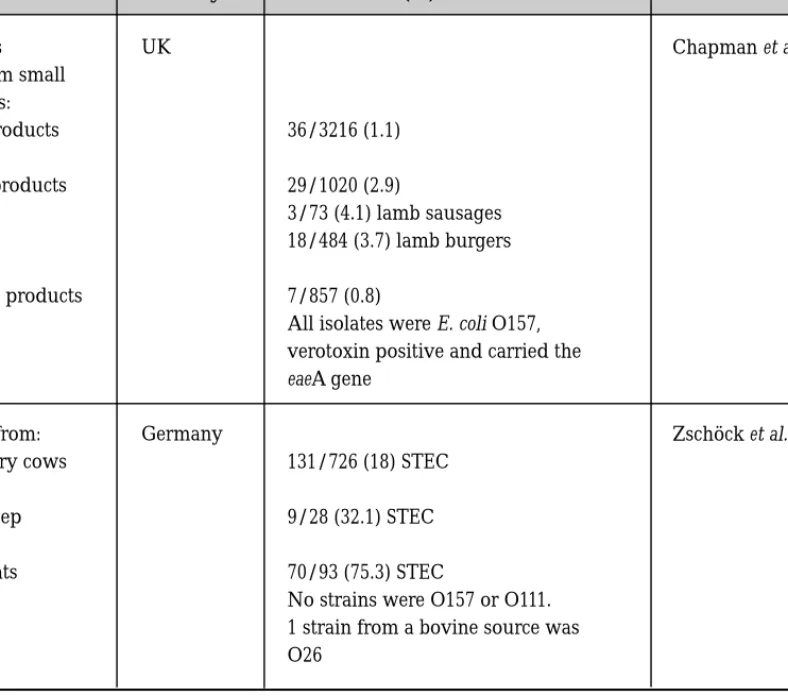
Surveys of the incidence of E. coli O157 in food animals, their carcasses, and raw meats indicate levels ranging up to 80% (Table 1).
T
A
PPROACH T O THE CONTROL OF ENTERO-HAEMORRHAGIC ESCHERICHIA COLI
(
EHEC)
Table 1
Recent reported incidences of E. coli O157 in animal and animal product samples
A
PPROACH T O THE CONTROL OF ENTERO-HAEMORRHAGIC ESCHERICHIA COLI
(
EHEC)
Subject
Retail meat and meat products: survey of fresh and processed meat products from supermarkets and butchers shops over 2 years
Lamb: faeces from lambs in abattoir holding yards Healthy cattle: rectal swabs from healthy animals from 10 dairy farms (n=121) and 4 beef farms (n=60) and 2 samplings from 1 slaughterhouse (n=16) Dairy cattle: faecal samples from 60 herds (average of 41 animals tested per herd); total of 2419 animals tested Cattle:
• Slaughterhouse samples (faecal samples from rectum after evisceration) • Swabs from warm
carcasses
Country
Netherlands Australia Brazil Denmark DenmarkOccurrence (%) of STEC
O157 STEC (VTEC) isolated from 6/571 (1.1) raw minced beef
2/402 (0.5) raw minced beef and pork mixed
1/76 (1.3) raw minced pork
1/393 (0.3) other raw pork products 1/328 (0.3) cooked or fermented ready-to-eat meats
0/223 (0) other raw beef products 0/819 (0) poultry meat samples 0/46 (0) sheep or lamb samples 0/83 (0) wild animal samples 26/72 (36) STEC
3/72 (4.0) E. coli O157:H–
99/121 (82) dairy cattle positive for Shiga toxin gene sequences
40/76 (53) beef cattle positive for Shiga toxin gene sequences
3/197 (1.5) E. coli O157:H7 isolated 10 non-O157 Shiga toxin-producing E.
coli also isolated
87/2419 (3.6) cattle positive for E. coli O157
10 positive herds in which 3–53% of the animals were excreters (average 21%)
42/195 (22.5) faecal samples positive for E. coli O157, 30 (15.5) of which produced verocytotoxin
11/195 (5.6) carcass swabs positive for
E. coli O157, 3 of which produced
verocytotoxin
Reference
Heuvelink et al., 1999 Fegan and Desmarchelier, 1999 Cerqueira et al., 1999 Nielsen, 2000 Boel, 2000Cattle are now widely accepted as a major reservoir of E. coli O157:H7 (currently the most important of the foodborne EHEC). Potential routes of infection from cattle to humans include:
• faecal–oral route from animals to humans by direct contact with infected animals,
• faecal contamination of food crops when untreated or poorly treated manures are used for fertiliser,
• faecal contamination of water courses subsequently consumed directly or indirectly (via irrigated or washed field crops),
• faecal contamination of carcasses during slaughter and evisceration processes, and • consumption of faecally contaminated raw milk or raw products derived from it.
Figure 1 gives a simplified overview of the currently understood “cycle” of EHEC in the food-related environment. Significantly, poultry and eggs have not been associated with EHEC in outbreaks of foodborne illness. Also, fish, shellfish, and related products so far have not been implicated in outbreaks of foodborne EHEC. In light of the pivotal role played by water in the cycle, these current gaps in the list of product types implicated in such outbreaks should alert governments, public health officials, and food scientists to the possibility that it may be only a matter of time before these gaps will be “filled”.
In the European Union, the reported incidence of human cases of EHEC for 1996 ranged from 0.01 per 100,000 population (Spain) to 2.03 per 100,000 population (United Kingdom) (Anonymous, 1999a), but in Scotland in the same year, that figure was 9.85 per 100,000. In the United States, the incidence of cases of E. coli O157:H7 was 2.8 per 100,000 in 1998. Much more recent information
A
PPROACH T O THE CONTROL OF ENTERO-HAEMORRHAGIC ESCHERICHIA COLI
(
EHEC)
Subject
Meat products purchased from small butchers shops: • Raw beef products • Raw lamb products• Mixed meat products
Faecal swabs from: • Healthy dairy cows • Healthy sheep • Healthy goats
Country
UK GermanyOccurrence (%) of STEC
36/3216 (1.1) 29/1020 (2.9) 3/73 (4.1) lamb sausages 18/484 (3.7) lamb burgers 7/857 (0.8)All isolates were E. coli O157, verotoxin positive and carried the
eaeA gene
131/726 (18) STEC 9/28 (32.1) STEC 70/93 (75.3) STEC
No strains were O157 or O111. 1 strain from a bovine source was O26
Reference
Chapman et al., 2000
from Denmark indicates an incidence of 1.0 per 100,000 in 1999, and for England and Wales in the same year the incidence was approximately 2.0 per 100,000.
As methods of detecting these organisms improve and more detailed examination and investigation of cases of bloody diarrhoea occur, the reported incidence may increase.
From 1982 to 1997, more than 100 outbreaks of infection from E. coli O157 were reported in the United States. Where the vehicle of infection was identified, 52% were foods derived from cattle, 16% person-to-person spread, 14% fruit and vegetable produce, 12% water and 5% other foods (World Health Organization, 1997).
Figure 1
Simplified diagram of the current main routes of transmission of EHEC
A
PPROACH T O THE CONTROL OF ENTERO-HAEMORRHAGIC ESCHERICHIA COLI
(
EHEC)
Contaminated humansewage Infected people
Contaminated fruit Contaminated meat products Contaminated vegetables Contaminated raw meat Contaminated water
(well water, surface water, drinking water,
irrigation water)
Animal faecal contamination
Infected cattle and sheep
Wildlife
(animals and birds)
Environment
(water, soil, air)
Food contamination during preparation
e.g. food handlers, direct or indirect contamination
organism survives preparation process
e.g. undercooked contaminated meats
Contaminated dairy products
e.g. raw milk products, improperly pasteurised products Contaminated raw milk
Disease in man
ILLNESS CAUSED BY EHEC
ome people may carry EHEC as part of their transient gut microflora. When these organisms do cause illness, very serious illness can occur including haemorrhagic colitis and haemolytic uraemic syndrome (HUS). This latter condition usually occurs in children under 5 years of age and is the major cause of acute renal failure in children in Britain and several other countries. About 5% of cases of haemorrhagic colitis progress to HUS in which the case fatality rate is approximately 10% (Anonymous, 1995). Long-term sequelae in survivors of HUS may involve kidney disease, hypertension and nervous system disorders.
Some outbreaks of food poisoning caused by EHEC have involved very large numbers of people and have had particularly devastating consequences to some of those involved. In an outbreak attributed to radish sprouts in Japan in 1996, more than 6,300 school children were affected with three deaths (Fukushima et al., 1997). In the United States in 1999, more than 1000 people (11 children with HUS and two deaths recorded) were believed to have been infected by contaminated water used for ice, snow cones, and lemonade (Charatan, 1999).
Although E. coli O157:H7 has been accorded the most attention by researchers in the clinical and food-related public health sectors, a large number of other VTEC serogroups have also been associated with foodborne illness, e.g. O26:H11, O103:H2, O111:H2, and O145:H28.
Caprioli et al. (1997) noted that some 10–30% of HUS in Germany, Italy, and the United Kingdom resulted from non-O157 VTEC infection and that HUS has been caused by E. coli O111:H– in Italy and France. Also, sudden increases in infections caused by E. coli O103 and O26 were noted in Germany and Italy in 1996. Beutin et al. (1998) reported 15 different typable non-O157 O-groups from 89 VTEC-infected patients in 1996. Thus, any strategies implemented to control E. coli O157 in food production and processing systems must also control all of these other, similarly dangerous organisms.
S
A
PPROACH T O THE CONTROL OF ENTERO-HAEMORRHAGIC ESCHERICHIA COLI
(
EHEC)
FOODBORNE OUTBREAKS AND PRODUCTS
AT RISK
able 2 indicates a variety of food types that have been linked to EHEC outbreaks, to which can be added cantaloupe melon, salad dressing containing mayonnaise made in store and cooked ham. Some possible underlying reasons for the outbreaks are also given in the table. It is striking that all of the outbreaks are probably linked to contaminated primary raw food material, whether it was meat, milk, fruit or vegetables. Adequate hygienic measures applied at the primary source and during further handling/processing, together with well-controlled and appropriate heat processes (where these were applicable), could well have, or are even likely to have, prevented the outbreaks.
It is clear that raw foods such as meat, milk, vegetables, salad, sprouted vegetables, fruits and foods exposed directly or indirectly to animal faecal contamination, e.g. washed in water contaminated by animal faecal matter, are all potential hazards for EHEC. When carrying out a hazard analysis for food production safety purposes, it is advisable to assume that all raw food may be contaminated by these organisms from time to time. Fermented food products made from raw milk or raw meat that receive no bacterial reduction process, e.g. a pasteurisation step, during manufacture will also present potential EHEC hazards.
Because the infective dose of EHEC is low, i.e. <100 cells of the organism (Advisory Committee on the Microbiological Safety of Food, 1995; Bolton et al., 1996), even low levels of contamination in raw foods are of concern. Therefore, any EHEC control measures implemented in the food chain should aim not only to reduce the hazard, but to actually remove it.
A
PPROACH T O THE CONTROL OF ENTERO-HAEMORRHAGIC ESCHERICHIA COLI
(
EHEC)
T
Table 2
Examples of outbreaks of foodborne illness caused by VTEC and possible reasons for their occurrence (adapted from Bell and Kyriakides, 1998)
A
PPROACH T O THE CONTROL OF ENTERO-HAEMORRHAGIC ESCHERICHIA COLI
(
EHEC)
Outbreak 1992–1993 United States 1994–1995 Australia 1991 and 1996 United States 1996 United States 1996 Japan Technology Sector Raw, comminuted meat production Fermented meat processesFresh fruit juice production Raw salad vegetable production Raw salad vegetable production
Possible Reasons for Occurrence
Use of contaminated beefburger patties
Inadequate cooking of beefburgers in the restaurant Survival of E. coli O157 in cooked ready-to-eat burgers Contamination of raw meat mix Inadequate process control Cross-contamination to finished product
Use of fallen apples
Contamination of apples with cattle manure used as fertiliser or from cattle grazing in the orchards
Inadequate washing of apples Survival of E. coli O157 in apple juice at low pH and chilled temperature
Contamination of growing crop from water supplies used for adjacent cattle ranch and lettuce growing fields
Contamination of growing crop from free-range chickens that had access to cattle and lettuce fields
Contamination from process wash water
Inadequate staff hygiene facilities
Contamination of the seed Survival of seed washing Growth during seed germination
Organism E. coli O157:H7, STX1+, and STX2+ (VT1+, VT2+) VTEC O111:NM E. coli O157:H7 E. coli O157:H7 E. coli O157:H7, STX1+ and STX2+ (VT1+, VT2+) Products Cooked beefburger patties from a restaurant Raw fermented meat product Unpasteurised, unfermented, fresh-pressed apple juice Mesclun lettuce School lunches containing radish sprouts
SURVIVAL, STRESS RESPONSE AND GROWTH
IN FOOD
he general growth-limiting characteristics of pathogenic E. coli are shown in Table 3. Under freezing conditions, non-pathogenic E. coli are reduced 10-fold at –25.5°C over 38 weeks but little or no change in population numbers was noted for E. coli O157:H7 in ground beef over 9 months at –20°C (Doyle and Schoeni, 1984). In common with other vegetative bacteria, the conditions of freezing and thawing (rates, method, temperature achieved, etc.) affect the degree of injury and death of cells of E. coli, but it is clear that survival of freezing processes can and does occur.
Table 3
Growth-limiting parameters for pathogenic E. coli
(adapted from International Commission on Microbiological Specifications for Foods, 1996)
a growth has been demonstrated in milk at 6.5°C (Kauppi et al., 1996).
b for some strains of EHEC, the maximum temperature for growth is lower than 44°C. c E. coli O157 is reported to survive at pH levels below 4.4 (Semanchek and Golden, 1996). Previous research using an increase in numbers of colony-forming units as a measure of growth demonstrated that E. coli do not grow under the refrigeration temperature conditions commonly used in the food industry, i.e. 2–5°C. Recent work demonstrated, however, that E. coli, including isolates of E. coli O157, are able to form long filaments under such conditions and in other conditions just outside the growth range of these organisms (T.J. Humphrey, unpublished data, 2000). The filaments seem to be similar to those formed by Salmonella spp. (Phillips et al., 1998) including S. Typhimurium DT104. The public health implications of these observations have yet to be elucidated. Pathogenic E. coli can survive well for several weeks at refrigeration temperatures with only a 0.5–1.5-log cycle reduction in populations over 1–5 weeks (International Commission on Microbiological Specifications for Foods, 1996). E. coli O157:H7 survived largely unchanged in numbers in raw cow’s milk held at 7°C for 144 hours and to increase 2.0 log10at 15°C after 144 hours (Heuvelink et al., 1998).
Pathogenic E. coli are not particularly heat resistant and in common with other Gram-negative pathogens, thermal inactivation/heat resistance is affected by other prevailing factors such as lowering pH (increases sensitivity to heat), water activity (aw) and humectant used, high fat content (can increase heat resistance), and pre-conditioning of the organism, e.g. previous
A
PPROACH T O THE CONTROL OF ENTERO-HAEMORRHAGIC ESCHERICHIA COLI
(
EHEC)
T
Temperature (°C) pH Aw Sodium chloride (Glass et al., 1992) Minimum c. 7-8a 4.4c 0.95 Maximum c. 44-46b 9.0 -Grows vigorously in 2.5% NaClGrows slowly in 6.5% NaCl Does not grow in 8.5% NaCl
For acidic products such as cheese or fermented meats in which lactic acid is produced by the metabolic activity of the starter cultures used, or salad dressings in which acetic acid is added directly to an oil component, pH contributes to controlling EHEC growth. Survival, however, depends on the type of acid present, e.g. acetic, lactic, citric, propionic, and other physico-chemical conditions. Outbreaks in the United States linked to unfermented apple juice products known as apple cider (in Europe, cider is a fermented apple, alcoholic drink) and mayonnaise led to studies of the survival of VTEC in acidic foods. In general, at low temperatures (7–8°C), E. coli O157:H7 survived in such environments at pH ~4.0 for 20 days or more (Table 4).
Table 4
The survival of E. coli O157 in acidic products
A
PPROACH T O THE CONTROL OF ENTERO-HAEMORRHAGIC ESCHERICHIA COLI
(
EHEC)
Suspect Food Fermented dry sausage Unpasteur-ised apple cider Live yoghurt locally produced from pasteurised full fat milkMayonnaise and mayonnaise-based dressings and sauces Survival
E. coli O157 population
reduced from 4.68 log10 cfu/g to 2.72 log10 cfu/g after 8 weeks
E. coli O157:H7 could be
detected for up to 20 days
Survivors were detected at 2 and 3 days, but not at 6 days after inoculation. At both inoculum levels, populations reduced to ~10% of the initial level after 7 days stored at 4°C
Rapidly died off when stored at 25°C but cells were still detectable in mayonnaise up to 35 days when held at 7°C Reference Glass et al., 1992 Besser et al., 1993 Zhao et al., 1993 Morgan et al., 1993 Massa et al., 1997 Weagent et al., 1994 pH and Other Conditions Final pH 4.4, titratable acidity 1.4% 3.6–4.0 The final product pH was 4.5 in the traditional and 4.6 in the “bifido” yoghurt. 3.65–4.44 Experimental conditions
Sausage made without starter culture, fermented, dried, and stored at 4°C for 2 months
In ciders with no preservative added Product held at 8°C after initial inoculation with ~105cfu/ml.
Product held at 25°C,
E. coli O157:H7 (low
inoculum [103cfu/ml] and high inoculum [107 cfu/ml]) was added at the same time as the starter cultures for making traditional and “bifido” yoghurts Three different strains of
E. coli O157:H7
inoculated into
mayonnaise at levels of ~107cfu/g
Likewise, outbreaks linked to fermented meat products, e.g. salami, prompted studies on survival during the manufacturing process and throughout the life of these products. In the United States research was carried out to determine which fermented meat processes would achieve a 5-log reduction in contaminating E. coli O157. For processes without a heating stage, a pH of 4.6 after fermentation was found to be required together with holding at 32.2°C for 6 or more days or 43.3°C for 4 or more days for products in small or large casings respectively (Anonymous, 1996). More recent investigations indicate that when subjected to sub-lethal stress conditions, e.g. pH 4.0, strains of E. coli O157:H7 exhibited significantly greater resistance to low pH, high salt (20% w/v) and heat (56°C for 80 minutes) than did controls maintained at pH 7.0 (Rowe and Kirk, 1999). This type of cross-protection created as a response to stress is of concern in food-processing environments, where any localised contamination with these organisms may be exposed to sub-lethal concentrations of the inhibitory substances used in a food formulation and may subsequently cross-contaminate foods in production. This potential must be recognised and combated via hygienic procedures put in place to reliably eliminate foci of infection in the production environment and production equipment.
The water activity of a food product is lowered by the addition of sodium chloride, sugars and/or other solutes. The higher the concentration of the solute, the lower the water activity of the product. For products in which the water activity approaches or is lower than the minimum for growth of EHEC, growth of the organism is prevented or minimised. Hinkens et al. (1996) reported that E. coli O157:H7 survived the fermentation and drying processes of a dry fermented meat product that reached a water activity of 0.87 and pH 4.74 at the end of the process. Such reports and recent outbreaks of infection with E. coli O157:H7 associated with dry fermented meat products of relatively low water activity (approximately 0.9) serve to underline the fact that this organism survives the fermentation and drying processes used to produce some of these products.
In other studies, E. coli O157:H7 was found to survive in river water, soil cores and cattle faeces for times ranging from 2 weeks to 2 months; to grow in sprouting seeds and on prepared pre-packed fresh vegetables; to survive the cheddar cheese ripening processes up to 60 days; and to survive raw meat (salami) fermentation processes and in dried foods. Dried foods, especially those used as raw materials/ingredients in others foods, are of particular concern because if they are contaminated with EHEC and added to foods that have water activities in the range of growth of the organisms, a significantly greater hazard can result.
Studies on bacterial penetration of and/or attachment to meat surfaces and means for reducing levels of bacteria including E. coli O157:H7 in beef tissue indicate that bacteria can penetrate deeper layers of muscle tissue and that such penetration and attachment, particularly to collagen fibres, appears to reduce the effectiveness of both carcass and meat rinsing treatments (Fratamico
et al., 1996, Woody et al., 2000), thus facilitating the survival of EHEC. In addition to the possible
need for research directed towards seeking antimicrobial rinses effective against bacteria that are attached to meat surfaces, practices at the primary stages of the slaughter and carcass dressing process should clearly continue to be a target for improvement. These are important critical points at which much can be done to minimise the potential for bacteria to contaminate, attach to, and penetrate carcass meats in the first place.
Clearly, difficulties in removing EHEC once present on meat and the tolerance of EHEC to a wide range of pH and water activity conditions and low temperatures, including freezing, mean that there is considerable potential for these organisms to survive in many food environments and remain present in or on many food types. Because only low numbers of viable cells are necessary
A
PPROACH T O THE CONTROL OF ENTERO-HAEMORRHAGIC ESCHERICHIA COLI
(
EHEC)
LABORATORY METHODS
onventional methods for the routine isolation and identification of normal E.
coli are ineffective for the isolation of E. coli O157 for which specific methods
of isolation have been developed. The most successful and widely used of these methods employs selective culture enrichment of the organisms in the food sample, followed by capture and concentration of cells of E. coli O157 from the enrichment broth by using immunomagnetic particles coated with a specific antibody (immunomagnetic separation, or IMS). The captured cells on the particles are transferred and spread onto the surface of selective agars and incubated. Colonies growing on the agars showing typical characteristics of E. coli O157 are further tested to confirm their identity (International Standard, ISO 16654 Draft, 1999).
Although in some countries, e.g. the United States and the United Kingdom, more than 90% of illnesses caused by EHEC are due to E. coli O157:H7, in other countries, non-O157 EHEC are important causes of outbreaks. It is now recognised that it is important to have methods in place for specifically isolating and identifying non-O157 EHEC. Compared with method development for the detection and characterization of E. coli O157, relatively little has been done so far to develop routine methods for detecting non-O157 EHEC. Consequently, more research is required to develop suitable methods for the specific detection and characterisation of these organisms.
A
PPROACH T O THE CONTROL OF ENTERO-HAEMORRHAGIC ESCHERICHIA COLI
(
EHEC)
C
CONTROL
ecause of the widespread environmental sources and survival character-istics of EHEC, their presence at low frequencies and levels in raw foods, particularly of red meat and vegetable origin, must be expected.
It is essential that responsibility is exercised at each step of the food chain to ensure that relevant controls are in place either to prevent/minimise contamination of food materials by EHEC or to prevent the further growth, or preferably reduce the numbers, of EHEC already present.
Governments and public health enforcement agencies alone are not in a position to ensure the production of safe foods. Individuals directly involved in the primary production, processing, retailing, catering, and domestic handling of food hold the keys to safe food production. The role of governments and their agencies should be to facilitate the provision and dissemination of accurate and relevant microbiological information that can be used in risk assessments by food industry personnel and to ensure that legislation is even-handed (applied to both large and small food businesses), is soundly based on HACCP systems, and includes an obligation for all food businesses to demonstrate appropriate knowledge, competence, facility, etc., before being allowed to commence business.
Guidelines for the control of infection with EHEC such as those produced recently by a sub-committee of the Public Health Advisory Committee on Gastrointestinal Infections (Anonymous, 2000) and the Food Safety Authority of Ireland (Anonymous, 1999 a–g) are to be welcomed and endorsed. However, it is also vitally important to strengthen and maintain, on a global basis, the co-operation necessary among food producers, processors, retailers, caterers, governments and consumers to effect practical controls that will successfully minimise (if not eliminate) the hazard from these organisms.
The general approach taken in European and North American legislation clearly places the responsibility on food business proprietors to produce and supply safe and wholesome foods and to employ HACCP-based systems to do so, e.g. European Union Directive 93/43/EEC, 14th June 1993, on the hygiene of foodstuffs, Article 3, paragraph 2 (Anonymous, 1993). Simple failures of basic food safety requirements, however, have resulted in outbreaks of illness from EHEC (Table 2). Such failures were avoidable and should have been prevented.
In the food production chain, a number of controls are globally applicable to the reduction/elimination of EHEC (see Annex 1, General Principles for Safe Food Production).
B
A
PPROACH T O THE CONTROL OF ENTERO-HAEMORRHAGIC ESCHERICHIA COLI
(
EHEC)
CONCLUSION AND RECOMMENDATIONS
lthough a great deal of work has been carried out on all aspects of E. coli since it was first described, the organism continues to provide new challenges largely because of the constant evolution of types within the species and the development of types that cause illness from extremely low infective doses, e.g. <100 cells. EHEC are the latest and most serious of these new challenges, and illness caused by EHEC is largely preventable by good hygienic practice and thorough cooking processes.
Far more work must be done to increase our knowledge and identify the reservoirs and routes of transmission to humans of the different EHEC serotypes. However, it will always be prudent to assume that these organisms are present in raw foods at some low frequency and level. Thus, the introduction and consistent maintenance of basic practical hygiene and process control measures by all persons directly involved at all stages of the food production chain should prevent any complacency that could lead to further rises in cases of foodborne illness caused by EHEC. The basic requirements for keeping the food supply safe from the hazard of EHEC are known and are straightforward. It is necessary through an active partnership involving veterinarians, medical practitioners, epidemiologists, and the food industry (from producers to retailers and caterers) to ensure that these basic requirements are globally met.
International cooperation fostered by governments is essential to ensure the common understanding and application of the basic controls necessary to prevent EHEC from becoming a major scourge of this new century. The following recommendations are made:
1. Research requirement: develop simple methods for the routine detection of all EHEC types. 2. Research requirement: employ microbiological surveillance of agricultural and aquatic environments and raw foods, using the techniques developed in recommendation 1, to determine the full EHEC cycle and potential break points.
3. Research requirement: determine the foodborne hazards from non-O157 EHEC organisms and non-E. coli Shiga toxin-producing organisms.
4. Under the auspices of international bodies, e.g. Codex Alimentarius Commission or the World Health Organization (WHO), a select working party should be charged with the task of managing the production of:
• internationally applicable, sector-related, e.g. raw meat, dairy products, raw fermented meat, guides to effective EHEC controls that can be practically implemented at all relevant levels of the food production chain, and
• a relevant consumer education package.
5. Under the auspices of international bodies, e.g. Codex Alimentarius Commission or WHO, an international work programme should coordinate results from research, surveillance projects, and outbreak investigations relating to EHEC to ensure that results obtained can be readily understood and applied by other workers.
6. Governments should apply food safety legislation equally to all food businesses throughout the food chain, from primary agriculture/aquaculture to retailers and caterers regardless of the size of the business.
7. Use current and future scientific knowledge in risk assessments to ensure that all reasonable practical measures are taken to keep the food supply safe from EHEC.
A
A
PPROACH T O THE CONTROL OF ENTERO-HAEMORRHAGIC ESCHERICHIA COLI
(
EHEC)
GLOSSARY
Bacteriophage Viruses whose hosts are bacteria, i.e. bacterial viruses.
Biotyping The conventional method for distinguishing between bacterial types using their metabolic (biochemical reaction changes caused) and/or physiological properties.
Challenge test A study in which the organism of concern, e.g. E. coli O157:H7, is inoculated and distributed at different levels into real food products. Specific numbers of inoculated and un-inoculated (control) products are usually then incubated at different temperatures and the levels of the organism are determined at different time intervals. Alternatively, the organism may be inoculated into a raw material mix, e.g. for salami products, and the product is then processed through the required manufacturing conditions. Again, the levels of the organism are determined at intervals throughout the process and storage time. Results are commonly used to determine process or shelf life conditions that will deliver a safe product with respect to the bacterial hazard studied, i.e. VTEC. These studies should be carried out only in research laboratory facilities and by people qualified and experienced in designing studies relevant to the target product types and organisms.
Critical control point (CCP) A step at which control can be used to prevent or eliminate a food safety hazard or reduce it to an acceptable level.
D value The time required (usually expressed in minutes) at a given temperature to reduce the number of viable cells or spores of a given microorganism to 10% of the initial population.
Facultative Optional lifestyle, associated with the mode not normally adopted, e.g. facultative anaerobe is a microorganism that is usually aerobic but can grow anaerobically.
Genotyping Methods used to differentiate bacteria based on the composition of their nucleic acids.
HACCP Hazard analysis critical control point: system which identifies, evaluates and controls hazards which are significant for food safety.
Hazard A biological, chemical or physical agent in, or condition of, food with the potential to cause an adverse health effect (Codex Alimentarius Commission, 1999).
Hazard analysis The process of collecting and evaluating information on hazards and conditions leading to their presence to decide which are significant for food safety.
Infection In relation to bacterial food poisoning, a condition in which a pathogen multiplies in the host’s body and becomes established in or on the cells or tissues of the host.
Pasteurisation A form of heat treatment that kills vegetative pathogens and spoilage microorganisms in milk and other foods, e.g. for milk, the legal requirement for the pasteurisation process in the European Union is at least 71.7°C for 15 seconds.
Pathogen Any microorganism which causes disease in humans or animals by direct interaction with (infection of) the host.
Pathogenic Pertaining to behaviour as a pathogen.
Phage typing A method used to distinguish among bacteria within the same species on the basis of their susceptibility to a range of bacterial viruses (bacteriophage).
Phenotype The observable characteristics of an organism, including biotype, serotype, phage type, and bacteriocin type.
Plasmid Extra-chromosomal DNA that replicates independently of the host cell DNA. Plasmids (and the genetic characteristics they carry) are transferable between cells.
A
PPROACH T O THE CONTROL OF ENTERO-HAEMORRHAGIC ESCHERICHIA COLI
(
EHEC)
Polymerase chain reaction (PCR) A technique used to amplify the number of copies of a pre-selected region of DNA to a level sufficient for testing.
Polymorphism The ability to occur in two or more morphologically distinct types (morphotypes), depending on prevailing conditions.
Pulsed field gel electrophoresis (PFGE)A technique which allows chromosomal restriction fragment patterns to be produced from restriction enzyme analysis.
Restriction enzyme analysis (REA) A method for discriminating among isolates of the same species on the basis of patterns obtained from the separation of DNA fragments in agarose gel after they have been digested with one or more restriction enzymes, e.g. EcoR1, HaeIII, HhaI, or Xhol. Differences in the banding profiles of two isolates are referred to as a restriction fragment length polymorphism.
Risk The probability of an adverse health effect and the severity of that effect consequential to a hazard(s) in food.
Serotyping A method of distinguishing among bacteria on the basis of their antigenic properties (reaction to known antisera). The O antigen defines the serogroup of a strain and the H antigen defines the serotype of the strain; a number of serotypes may thus constitute a serogroup.
STEC Shiga-like toxin-producing E. coli.
Strain An isolate or group of isolates that can be distinguished from other isolates of the same genus and species by either phenotypic and/or genotypic characteristics.
Thrombocytopaenia Low numbers of platelets circulating in the blood stream.
Verocytotoxigenic Pertaining to organisms which produce a toxin capable of killing vero cells, an established cell line derived from African Green Monkey kidney.
Virulence The capacity of a pathogen to cause disease, generally expressed in relation to the severity of the illness caused in the host, e.g. a highly virulent strain may cause very severe illness.
VTEC Verocytotoxin-producing E. coli, i.e. E. coli that produce verocytotoxin (Shiga toxin) that destroys vero cells.
A
PPROACH T O THE CONTROL OF ENTERO-HAEMORRHAGIC ESCHERICHIA COLI
(
EHEC)
REFERENCES
Advisory Committee on the Microbiological Safety of Food (1995). Report on Vero cytotoxin-producing Escherichia coli. Her Majesty’s Stationary Office, London.
Anonymous (1993). European Union Directive 93/43/EEC of 14th June 1993 on the hygiene of foodstuffs. Official Journal of the European Communities L175, 36:1–11.
Anonymous (1995). The prevention of human transmission of gastrointestinal infections, infestations, and bacterial intoxications: Escherichia coli – Vero cytotoxin producing (VTEC).
Communicable Disease Report, 5, Rev. No. 11, R164. Public Health Laboratory Service, London.
Anonymous (1996). Dry Fermented Sausage and E. coli O157:H7. Research Report No. 11. Blue Ribbon Task Force, National Cattlemen’s Association, Chicago.
Anonymous (1999a). The Prevention of E. coli O157:H7 Infection: A Shared Responsibility. Food Safety Authority of Ireland, Dublin.
Anonymous (1999b). Reducing the Risk of E. coli O157 on the Farm. Food Safety Authority of Ireland, Dublin.
Anonymous (1999c). E. coli O157 Preventing the Spread of Infection in the Abattoir. Food Safety Authority of Ireland, Dublin.
Anonymous (1999d). E. coli O157 Preventing the Spread of Infection in the Food Factory. Food Safety Authority of Ireland, Dublin.
Anonymous (1999e). E. coli O157 Preventing the Spread of Infection in Catering and Retailing. Food Safety Authority of Ireland, Dublin.
Anonymous (1999f). E. coli O157 Protecting Vulnerable Groups. Food Safety Authority of Ireland, Dublin.
Anonymous (1999g). E. coli O157 Protecting Yourself and Your Family. Food Safety Authority of Ireland, Dublin.
Anonymous (2000). Guidelines for the control of infection with Vero cytotoxin producing
Escherichia coli (VTEC). Subcommittee of the PHLS Advisory Committee on Gastrointestinal
Infections. Communicable Disease and Public Health, 3:14–23.
Bell, C., Kyriakides, A. (1998). E. coli: A Practical Approach to the Organism and its Control in Foods. Blackwell Science Ltd., Oxford.
Besser, R.E., Lett, S.M., Weber, J.T., et al. (1993). An outbreak of diarrhea and hemolytic uremic syndrome from Escherichia coli O157:H7 in fresh-pressed apple cider. Journal of the American
Medical Association, 269:2217–2220.
Beutin, L., Zimmermann, S., Gleier, K. (1998). Human infections with Shiga toxin-producing
Escherichia coli other than serogroup O157 in Germany. Emerging Infectious Diseases, 4:635–639.
Boel, J. (2000). Forekomst af VTEC O157 på kvægslagteri. Zoonose-Nyt, 7(4):6–7.
Bolton, F.J., Crozier, L., Williamson, J.K. (1996). Isolation of Escherichia coli O157 from raw meat products. Letters in Applied Microbiology, 23:317–321.
A
PPROACH T O THE CONTROL OF ENTERO-HAEMORRHAGIC ESCHERICHIA COLI
(
EHEC)
Caprioli, A., Tozzi, A.E., Rizzoni, G., et al. (1997). Non-O157 Shiga toxin-producing Escherichia coli infections in Europe. Emerging Infectious Diseases, 3:578–579.
Cerqueira, A.M.F., Guth, B.E.C., Joaquim, R.M., et al. (1999). High occurrence of Shiga toxin-producing Escherichia coli (STEC) in healthy cattle in Rio de Janeiro State, Brazil. Veterinary
Microbiology, 70:111–121.
Chapman, P.A., Siddons, C.A., Cerdan Malo, A.T., et al. (2000). A one-year study of Escherichia coli O157 in raw beef and lamb products. Epidemiology and Infection, 124:207–213.
Charatan, F. (1999). New York outbreak of E. coli poisoning affects 1000 and kills two. British
Medical Journal, 319:873.
Codex Alimentarius Commission (1999). Alinorm 99/13 Appendix IV: Proposed Draft Principles and Guidelines for the Conduct of Microbiological Risk Assessment (at step 5 of the procedure). Report of the Thirtieth Session of the Codex Committee on Food Hygiene, Washington, DC, 20-24 October 1997. Joint FAO/WHO Food Standards Programme, Codex Alimentarius Commission, Twenty-third Session, Rome.
Doyle, M.P., Schoeni, J.L. (1984). Survival and growth characteristics of Escherichia coli associated with hemorrhagic colitis. Applied and Environmental Microbiology, 48:855–856.
Fegan, N., Desmarchelier, P. (1999). Shiga toxin-producing Escherichia coli in sheep and pre-slaughter lambs in eastern Australia. Letters in Applied Microbiology, 28:335–339.
Fratamico, P.M., Schultz, F.J., Benedict, R.C., et al. (1996). Factors influencing attachment of
Escherichia coli O157:H7 to beef tissues and removal using selected sanitising rinses. Journal of Food Protection, 59:453–459.
Fukushima, H., Hashizume, T., Kitani, T. (1997). The massive outbreak of enterohemorragic E. coli O157 infections by food poisoning among the elementary school children in Sakai, Japan in 1996 [abstract]. VTEC ’97, 3rd International Symposium and Workshop on Shiga Toxin (Verocytotoxin) – Producing Escherichia coli Infections, June 22–26, 1997, Baltimore under the auspices of the Lois Joy Galler Foundation for Hemolytic Uremic Syndrome.
Glass, K.A., Loeffelholz, J.M., Ford, J.P., et al. (1992). Fate of Escherichia coli O157:H7 as affected by pH or sodium chloride and in fermented, dry sausage. Applied and Environmental Microbiology,
58:2513–2516.
Heuvelink, A.E., Bleumink, B., van den Biggelaar, F.L.A.M., et al. (1998). Occurrence and survival of verocytotoxin-producing Escherichia coli O157 in raw cow’s milk in the Netherlands. Journal of
Food Protection, 61:1597–1601.
Heuvelink, A.E., Zwartkruis-Nahuis, J.T.M., Beumer, R.R., et al. (1999). Occurrence and survival of verocytotoxin-producing Escherichia coli O157 in meats obtained from retail outlets in The Netherlands. Journal of Food Protection, 62:1115–1122.
Hinkens, J.C., Faith, N.G., Lorang, T.D., et al. (1996). Validation of pepperoni processes for control of Escherichia coli O157:H7. Journal of Food Protection, 59:1260–1266.
International Commission on Microbiological Specifications for Foods (1996). Microbiological Specifications of Food Pathogens. Microorganisms in Foods, Vol. 5. Blackie Academic & Professional, London.
A
PPROACH T O THE CONTROL OF ENTERO-HAEMORRHAGIC ESCHERICHIA COLI
(
EHEC)
International Standard, ISO 16654 Draft, British Standard for Public Comment (1999). Microbiology of Food and Animal Feeding Stuffs – Horizontal Method for the Detection of
Escherichia coli O157. International Organization for Standardization, Geneva.
Kauppi, K.L., Tatini, S.R., Harrell, F., et al. (1996). Influence of substrate and low temperature on growth and survival of verotoxigenic Escherichia coli. Food Microbiology, 13:397–405.
Massa, S., Altieri, C., Quaranta, V., et al. (1997). Survival of Escherichia coli O157:H7 in yoghurt during preparation and storage at 4°C. Letters in Applied Microbiology, 24:347–350.
Morgan, D., Newman, C.P., Hutchinson, D.N., et al. (1993). Verotoxin producing Escherichia coli O157 infections associated with the consumption of yoghurt. Epidemiology and Infection,
111:181–187.
Nataro, J.P., Kaper, J.B. (1998). Diarrheagenic Escherichia coli. Clinical Microbiology Reviews,
11:142–201.
Nielsen, E.M. (2000). Forekomst of VTEC O157 i malkekvægsbesætninger. Zoonose-Nyt, 7(4):3–5. Park, S., Worobo, R.W., Durst R.A. (1999). Escherichia coli O157:H7 as an emerging foodborne pathogen: a literature review. Critical Reviews in Food Science and Nutrition, 39:481–502.
Phillips, L.E., Humphrey, T.J., Lappin-Scott, H.M. (1998). Chilling invokes different morphologies in two Salmonella Enteritidis PT4 strains. Journal of Applied Microbiology, 84:820–826.
Rowe, M.T., Kirk, R. (1999). An investigation into the phenomenon of cross-protection in
Escherichia coli O157:H7. Food Microbiology, 16:157–164.
Semanchek, J.J., Golden, D.A. (1996). Survival of Escherichia coli O157:H7 during fermentation of apple cider. Journal of Food Protection, 59:1256–1259.
Stephan, R., Untermann, F. (1999). Virulence factors and phenotypical traits of verotoxin-producing Escherichia coli strains isolated from asymptomatic human carriers. Journal of Clinical
Microbiology, 37:1570–1572.
Stephan, R., Ragettli, S., Untermann, F. (2000). Prevalence and characteristics of verotoxin-producing Escherichia coli (VTEC) in stool samples from asymptomatic human carriers working in the meat processing industry in Switzerland. Journal of Applied Microbiology, 88:335–341.
Weagant, S.D., Bryant, J.L., Bark, D.H. (1994). Survival of Escherichia coli O157:H7 in mayonnaise and mayonnaise-based sauces at room and refrigerated temperatures. Journal of Food Protection,
57:629–631.
Woody, J-M., Walsh, R.A., Doores, S., et al. (2000). Role of bacterial association and penetration on destruction of Escherichia coli O157:H7 in beef tissue by high pH. Journal of Food Protection, 63:3–11. World Health Organization (1997). Prevention and Control of Enterohaemorrhagic Escherichia coli (EHEC) infections. Report of a WHO Consultation. Food Safety Unit, Programme of Food Safety and Food Aid, World Health Organization, Geneva.
Zschöck, M., Hamann, H.P., Kloppert, B., et al. (2000). Shiga toxin-producing Escherichia coli in faeces of healthy dairy cows, sheep and goats: prevalence and virulence properties. Letters in
Applied Microbiology, 31:203–208.
Zhao, T., Doyle, M.P., Besser, R.E. (1993). Fate of enterohemorrhagic Escherichia coli O157:H7 in apple cider with and without preservatives. Applied and Environmental Microbiology, 59:2526–2530.
A
PPROACH T O THE CONTROL OF ENTERO-HAEMORRHAGIC ESCHERICHIA COLI
(
EHEC)
FURTHER READING
Baylis, C. (2000). Review No. 1. The Catalogue of Rapid Microbiological Methods, 4th ed. Campden & Chorleywood Food Research Association, Chipping Campden.
Bockemühl, J., Aleksic, S., Karch, H. (1992). Serological and biochemical properties of Shiga-like toxin (verocytotoxin)-producing strains of Escherichia coli, other than O-group 157, from patients in Germany. Zentralblatt für Bakteriologie, A, 276:189–195.
Stewart, C.S., Flint, H.J. eds. (1999). Escherichia coli O157 in Farm Animals. CABI Publishing, Wallingford.
Sussman, M., ed. (1997). Escherichia coli: Mechanisms of Virulence. Cambridge University Press, Cambridge.
Wong, C.S., Jelacic, S., Habeeb, R.L., et al. (2000). The risk of the hemolytic-uremic syndrome after antibiotic treatment of Escherichia coli O157:H7 infections. New England Journal of Medicine,
342:1930–1936.
A
PPROACH T O THE CONTROL OF ENTERO-HAEMORRHAGIC ESCHERICHIA COLI
(
EHEC)
ANNEX 1
General Principles for Safe Food Production
1General Principles
Environment
• Ensure that human and animal waste and slurries are effectively treated to eliminate, or at least minimise, the bacterial pathogen load prior to discharge into the environment and surface waters.
Manufacturing site
• Ensure that all food production, processing and handling facilities (building environment, equipment, etc.) are suitable for the purpose required.
• Ensure that adequate hygienic facilities are provided for staff.
• Ensure that sufficient cleaning facilities are provided to allow maintenance of high standards of environment, equipment, and personal hygiene.
• Ensure that potable water supplies are available and used for all food contact purposes.
Staff
• Ensure that an employee health programme is in place for food handlers. • Ensure that suitably qualified staff are employed for the tasks required.
• Ensure that all staff are properly trained in all aspects of personal hygiene, particularly effective hand-washing procedures.
• Ensure that all staff are properly trained for the job they are required to do, particularly in aspects affecting process critical control points.
• Ensure that all staff are provided with the necessary tools to carry out the tasks expected of them.
Quality systems
• Ensure that appropriate food safety management tools, e.g. HACCP-based approaches, are employed by suitably trained and qualified people to establish relevant EHEC control points, and maintain appropriate means for monitoring these.
• Operate an appropriate quality assurance programme for raw material suppliers.
Processes
• Ensure that, where applicable, temperatures (chill or heat processing) are consistently and accurately maintained.
New product and process development
• Ensure that before the application of any new technology, alternative technology or the new application of an existing technology (whether in food processing, food packaging, storage, or any combination of these), any consequent effect on EHEC reduction, destruction,
A
PPROACH T O THE CONTROL OF ENTERO-HAEMORRHAGIC ESCHERICHIA COLI
(
EHEC)
• For products and processes that may be considered marginal in relation to the destruction of EHEC or where survival may be possible, it may be appropriate to perform challenge studies specifically designed to determine the process effects on the survival of EHEC to demonstrate that the final product will be safe with respect to EHEC hazards.
Specific matters
Primary production
• Avoid the use of untreated animal or human faeces/manure as fertilisers.
• Avoid the use of faecally contaminated water supplies to irrigate fruit and vegetable crops. • Provide adequate staff facilities for hand-washing during harvesting of crops that are destined to be eaten without further processing (other than washing), with any crop washing carried out on the farm done using potable water supplies.
• Ensure that all milking animals are adequately cleaned before milking and that all milking equipment is kept, used and maintained in a hygienic condition.
• Ensure that animals sent for slaughter are in a clean condition (as far as is practicable).
Processing
MeatTransport
• Ensure that live animal and carcass meat transport vehicles are kept, used, and maintained in a hygienic condition.
Slaughter and raw meat butchery
• Employ pre-slaughter feeding regimes that exploit ruminant digestive systems to reduce carriage of EHEC.
• Minimise faecal contamination on hides. • Avoid gut content spillage during evisceration. • Employ carcass decontamination systems. • Ensure that clean carcasses are chilled rapidly.
• Ensure that all knives, scrapers, etc., are kept in good hygienic condition.
• Employ monitoring systems/schemes aimed at detecting and controlling contamination sources.
Product manufacture
• Ensure that process flows are designed to eliminate any possibility of cross-contamination between raw and heat-processed meat/meat products.
• Ensure that process conditions are consistently maintained to achieve the physico-chemical conditions required to control (reduce/eliminate) EHEC, e.g. temperature and humidity cycles in raw, fermented meat manufacture to achieve effective pH reduction and acidity development and reduction in water activity (loss of moisture). Consider the use of challenge studies to demonstrate the effective control of EHEC, e.g. minimum 3-log reduction in the inoculated level of EHEC.
Dairy
• Ensure that where pasteurisation is used as a critical control point, systems, e.g. diversion valves, are in place and operating correctly to prevent any un-pasteurised milk going through.
• Ensure process flows are designed to eliminate any possibility of cross-contamination between raw and heat-processed milk/milk products.