Curriculum Framework
Bachelor of Education - Special Education
B.Ed.Spl.Ed.
Norms, Regulations & Course Content
May, 2015
Effective from Academic Session 2015-16
Two Years Duration
Rehabilitation Council of India B-22, Qutab Institutional Area,
New Delhi - 110 016
Email: [email protected], [email protected] www.rehabcouncil.nic.in
PREFACE
Rehabilitation Council of India has been running B.Ed and M.Ed Programme in Special Education for more than a decade and half with degrees recognised by the UGC through Notification of July 5, 2014 as well as Notification of May 2009. It has always made efforts to keep parity with NCTE recommended framework so as to facilitate the role requirement of special teachers/special educators for all types of school setting in which children and young persons with disability are educated. As of today this covers inclusive schools, resource room, home- based education as well as special schools through which the educational needs of children with disabilities are being met.
NCTE vide its Notification of December 2014 increased the duration of B.Ed. and M.Ed. level courses to 2 years each beside recommending integrated programme leading to 4 years BA/B.Com/B.Sc degree as well as B.Ed. /M.Ed. (3 years Integrated programme) leading to B.Ed./M.Ed. (Integrated Degree). It also needs to be mentioned that duration of the education programme through open and distance learning system leading to B.Ed. programme remained unchanged so far by NCTE.
RCI was already in the process of revising its courses leading to diploma and degree in special education during last one year through the Core Committees constituted out of the Expert Committees as mandated by the Act. However, a policy decision was made at the level of the Department of Empowerment of Persons with Disabilities, MoSJ&E as well as RCI through its competent bodies that RCI will also increase the duration of B.Ed./M.Ed. Special Education to two years from the academic session 2015-16. RCI has decided through a consultative process to expand B.Ed. Spl. Ed. (ODL) to Five Semesters (Two Years and Six Months) effective from the academic session 2015-16.
For this purpose RCI has been continuously working since December 2014 to make it a reality and implement the programme w.e.f. the academic session 2015-16. This involves a continuous work of a team at RCI as well as the professionals support drawn through the Expert Committees and the Special Invitees. RCI’s competent bodies like General Council (GC) and Executive Council (EC) have been duly informed and have been supportive.
As of today RCI has been able to circulate the framework for the two years B.Ed. Special Education and M.Ed Special Education Programme to all implementing agencies and has shared with larger public through its website. Meeting at RCI for the Core and Common Courses and parallel meetings at all the related National Institutes (AYJNIHH, NIVH, NIMH, NIEPMD) as well as SNDT Women’s University, Juhu Campus were conducted during April 2015. Meeting of all the Universities offering these courses through Distance/ODL mode as per MoU signed with RCI has also been accomplished on 7-8 May 2015. Now we are ready to share this comprehensive document for further processing for initiating the session 2015-16 onwards by the respective RCI recognized institutions.
I record appreciation for all the members of the Expert Committees dealing with B.Ed. and M.Ed. courses as well as other Committee Members dealing with diploma level courses. Their inputs have been valuable to this exercise. Members of Expert Committee also shared their views and approval for these finalized courses through emails; RCI appreciates their valuable support and inputs. It is not possible to put all the names here but I am sure every one will appreciate the sentiments of our gratitude for the members as well as the invitees for this healthy and fruitful partnership (Please see annexure for the list of all such professional partners).
I also take this opportunity to put on record my appreciation for the team at RCI which has worked continuously to make it a reality in such a short time of less than five months to bring it up to this stage. It was a great pleasure to lead the lead the team and work with all the partners. RCI specifically acknowledge Mr. Suman Kumar, Dy. Director (Programme), Mr. Sandeep Tambe, Assistant Director (Recognition) for working out the framework and details for B.Ed. and M.Ed. Special Education through regular mode and Dr. Subodh Kumar, Dy. Director (Academics) and Mr. Sandeep Thakur, Programme Officer for B.Ed. Special Education through Distance/ODL mode; needless to say that these four persons have been working continuously as a team to take this work forward with support from RCI’s Administrative staff beyond office hours and holidays.
I will also like to express my appreciation of the contribution and support of Shri D N Sreenivasappa, Member Secretary till 10.3.2015 and Shri Satish Kumar Srivastava, Member Secretary who have continuously supported this intense and intensive exercise of curriculum development at such a short notice with their administrative support and valuable suggestions from time to time.
Last but not the least I also take this opportunity to express my gratitude to the officials of Deptt. of Empowerment of Persons with Disabilities specially Shri Awanish Kumar Awasthi, Joint Secretary who is also a member of RCI General Council and Executive Committee for continuously supporting RCI towards all its commitments and aspirations.
Prof. Sudesh Mukhopadhyay Chairperson, RCI
Index
Sl. No. Details Page No.
1. Bachelor of Education - Special Education (B.Ed.Spl.Ed.) Programme Framework
4
2. Norms and Regulations for Open and Distance Learning Programme B.Ed.Spl.Ed.(ODL)
21
2a Semester wise curriculum framework for B.Ed. Spl. Ed. (ODL) 31
3. Area A – Core Courses 32
4. Area B – Cross Disability and Inclusion Courses 59
5. Area C – Disability Specialisation Courses 106
5a Autism Spectrum Disorders 107
5b Hearing Impairment 127
5c Learning Disability 152
5d Mental Retardation / Intellectual Disability 171
5e Multiple Disabilities 195
5f Visual Impairment 215
6. Area D – Enhancement of Professional Capacities (EPC) 238 7. Minimum Qualification for the appointment of faculty in Special
Education
247
8. Norms for faculty requirement 252
9. Expert Committes 255
Bachelor of Education - Special Education (B.Ed. Spl.Ed.)
Programme
1I.
PREAMBLE
Both, Indian society (and hence) the Indian school system are full of strengths and challenges the essence of which is diversity. Coming together with diverse background is part of our growing up and functioning in the society as adults. But how are the classrooms which are known to be miniature societies and future societies handling this coming together currently? This is one of the key questions waiting to be addressed at macro as well as micro level today. As we take the credit (and pride) of managing some of the obviously visible diversities quite well, it is high time that we move on to dealing with lesser visible diversities in classrooms. Various subtle diversities are waiting to be identified by classroom teachers if not by theorists and experts – dealing with these will come only after acknowledging them systematically. Diversities related to learning styles, multiple intelligences, personality profiles or study habits are a few of the factors yet to take their due places in classroom activities. Similarly diversity of abilities and hence of the related educational needs, too are waiting to be addressed properly in Indian classrooms.
With this backdrop the current B. Ed. Special Education curriculum is revisited. After a lot of brainstorming this curriculum has been developed to empower the special teachers/educators to ensure education of students with disabilities in an inclusive, right based and barrier free environment. It is in tune with the reforms in Indian education and teacher education system in general with specific reference to NCTE Notification of December 2014. It intends to place teacher education preparation in special education in the rights- perspective of the larger picture. The prime intention is to develop a task force of the special teachers/educators who can deliver the best in all settings: inclusive, special, open or home based and in all the roles: classroom teacher, resource teacher, itinerant teacher or cross disability teacher facilitators.
This document proposes the program structure for the duration of two years so that a wide range of knowledge and skills can be inculcated in trainee teachers during the program. Difference in philosophies and theories between special and general education need to be bridged and special educators and teachers trained to collaborate to meet diverse needs in the classroom. The program structure readies them for embarking on a fulfilling professional journey spurred by refection and practices. Moving away from ‘show and tell’ to ‘learning by doing’, the course will be skill oriented, and offer various opportunities of interaction with self, students, schools and communities.
The curriculum attempts at striking a balance between core knowledge (theory and pedagogy) and skills; cross disability knowledge and skills, as well as disability specific knowledge and skills. The role of special educators has changed dramatically, with a shift from direct
1
This Degree is as per UGC Notification on Specifications of Degrees March 2014 as published in the Gazette of India, July 5, 2014.
provider of instruction to facilitator and consultant. A teacher would need the first set of skills to develop a basic understanding of curriculum transaction and content pedagogical knowledge as well as change agent, collaboration, communication and time management skills. Provision of the second set would be required, since cross disability expertise is more relevant within the framework of inclusion; and a teacher would need the third set to specialise in one of the disabilities particularly for serving the needs of children with specific disability in inclusive as well as special setting.
Inclusion is at the educational centre stage today and hence the role of special and general teachers need to be operationalized systematically. To give the program more pragmatic relevance, issues related to projected needs, employability, career and higher education options and entry level eligibility are given serious consideration so the opportunities for a special educator are at par with teachers in general education. It is expected that so far separated general and special education would initiate more bilateral collaborations with each other to fulfil the global objective of EDUCATION FOR ALL.
II. OBJECTIVES
The B.Ed.Spl.Ed. programme aims to develop Special Education teachers/Educators for children with disabilities for various settings (including Inclusive, Special, Open School and Home Based Education). The B.Ed. (Special Education) programme will prepare human resources to enable them to acquire knowledge and develop competencies and skills to impart education and training effectively to children with disability as well as all other children and this being teachers for all children. After completing the B.Ed. (Special Education) programme the student-teachers will:
a. Acquire knowledge & skills about human development, contemporary Indian education, and pedagogy of various school subjects and assessment for learning.
b. Acquire knowledge & skills about nature and educational needs of children with disabilities as well as of few select specific disabilities.
c. Develop conceptual understanding of education provisions and skills for working with children with various disabilities in Special and inclusive settings.
d. Enhance knowledge and skills for professional development.
III. NOMENCLATURE
Nomenclature of B.Ed. Special Education programmes should be as per UGC Notification of 2009 and 2014 and the new nomenclature will be B.Ed.Spl.Ed. such as for Visual Impairment the nomenclature will be B.Ed.Spl.Ed.(VI).
IV
.GENERAL FRAMEWORK OF THE COURSE
The programme is planned on the Choice Based Credit System (CBCS). According to UGC guidelines one credit is equivalent to one hour of teaching (lecture or tutorial) or two hours of practical work/field work per week. RCI also recommends practical work for each theory course besides these contact hours including self study, assignments, etc. That may involve same number of hours as are the contact hours specified for each course.
The Programme structure has three sets of courses: 1. Core courses in every semester
2. Elective course which can be chosen from pool of papers in order to: a. Support the discipline of study
b. Provide an expanded scope
c. Exposure to some other discipline/domain (this will depend on the options available with the implementing university and institution)
d. Nurturing student proficiency/skills 3. Elective Foundation courses are value-based
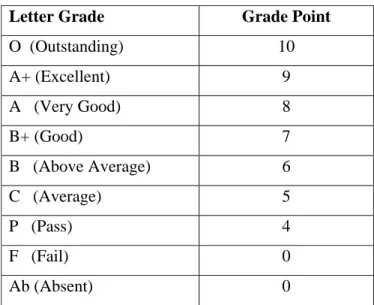
RCI will follow the 10-point grading system following letter grades recommended by the UGC2 as given below:
Table 1: Grades and Grade Points
Letter Grade Grade Point
O (Outstanding) 10 A+ (Excellent) 9 A (Very Good) 8 B+ (Good) 7 B (Above Average) 6 C (Average) 5 P (Pass) 4 F (Fail) 0 Ab (Absent) 0
a. A student obtaining Grade F shall be considered fail and will be required to reappear in the examination.
b. For non-credit courses ‘Satisfactory’ or ‘Unsatisfactory’ shall be indicated instead of the letter grade and this will not be counted for the computation of SGPA/CGPA.
c. The Universities can decide on the grade or percentage of marks required to pass in a course and also the CGPA required to qualify for a degree taking into consideration the recommendations of the statutory professional councils such as AICTE, MCI, BCI, NCTE, etc.
d. The statutory requirement for eligibility to enter as assistant professor in colleges and universities in the disciplines of arts, science, commerce, etc., is a minimum average mark of 50% and 55% in relevant postgraduate degree respectively for reserved and general category. Hence, it is recommended that the cut-off marks for grade B shall not be less than 50% and for grade B+, it should not be less than 55% under the absolute grading system. Similarly
cut-
2
off marks shall be fixed for grade B and B+ based on the recommendation of the statutory bodies (AICTE, NCTE, etc.) of the relevant disciplines.
RCI as a Statutory body recommends that the cut-off marks for grade B shall not be less than 50% and for grade B+, it should not be less than 55% under the absolute grading system. Internal assessment for Theory Courses will not exceed 20% and 50% in the practicum wherever applicable.
Duration
The programme will be of two years with 2 semesters in each year. Each semester will be of 16-18 weeks; 2 weeks in summer and 2 weeks in inter semester break will also be utilized for covering the courses. In this way, the following operational weeks will be available for transacting the course:
Year 1- 16-18 weeks for two semesters + 2 weeks in summer
Year 2- 16-18 weeks for two semesters + 2 weeks in inter-semester breaks
This comes to 64-72 weeks + 6 weeks for field activities/skill development with 40 credits in each year.
V. PROGRAMME STRUCTURE
STRUCTURE FOR 2 YEARS
Code Area Courses Credits
A THEORY: Core courses 5 20
B THEORY: Cross Disability & Inclusive Education
courses (including optional courses) 6 12
C THEORY: Disability Specialisation Courses 5 18
D THEORY: Enhancing Professional Capacities (EPC) /
Professional Development Courses 3 06
E Practical related to disability 2 12
F Field Engagement /School Internship 3 12
Total 24 80
Each theory course (A, B, C, D) will have up to 5 units. Each practical course (E1 and E2) will have 4 units. Each field Engagement/internship (F1, F2 and F3) will have 2 units. All courses as specified in the structure include lecture, tutorials as contact hours besides assignment, field work including observation, seminar, workshop and practicum relating to the concerned course.
Specialisation offered (with specific reference to Area C)
The B. Ed. Spl. Ed. programme is offered in following specializations:
I. Autism Spectrum Disorders (ASD) II. Hearing Impairment (HI)
III.Learning Disability (LD)
IV.Mental Retardation/ Intellectual Disability (MR/ID) V. Multiple Disabilities (MD)
VI.Visual Impairment (VI)
AREA A: CORE COURSES
A1 Human Growth & Development A2 Contemporary India and Education A3 Learning, Teaching and Assessment
A4 Pedagogy of Teaching (Special Reference to Disability) Any one PART I : Science (Special Reference to Disability)
PART II: Mathematics (Special Reference to Disability) PART III: Social Studies (Special Reference to Disability) A5 Pedagogy of Teaching (Special Reference to Disability) Any one
PART IV: Hindi / Regional Language (Special Reference to Disability) PART V: English (Special Reference to Disability)
AREA B: CROSS DISABILITY AND INCLUSION Note:
a. All student-teachers will be learning about all disabilities (theory, practical as well as field engagement) and specialization in any one disability other than selected for Area C.
b. Institutions/organizations offering B.Ed.Spl.Ed. are expected to decide other than specialization area out of VI / HI / MR / LD / MR (ID) / ASD / MD.
c. In case of student-teacherswith disability; the choice of two optional courses from 10 or B-11 can be on case to case basis (e.g. Student-teachers with VI and HI may opt for courses that are appropriate for them across/only from B10 & B11).
B6 Inclusive Education
B7 Introduction to Sensory Disabilities (VI, HI, Deaf-Blind)
B8 Introduction to Neuro Developmental Disabilities (LD, MR(ID), ASD) B9 Introduction to Locomotor & Multiple Disabilities ( CP, MD)
B10 Skill Based Optional Course (Cross Disability and Inclusion) B11 Skill Based Optional Course (Disability Specialization)
B10: Skill-based Optional Course (Cross Disability and Inclusion) ANY ONE
A Guidance and Counselling B Early Childhood Care & Education C Applied Behavioural Analysis D Community Based Rehabilitation E Application of ICT in Classroom F Gender and Disability G Braille and Assistive Devices
B11: Skill-based Optional Course (Disability Specialization) ANY ONE A Orientation & Mobility
B Communication Options: Oralism
C Communication Options: Manual (Indian Sign Language) D Augmentative and Alternative Communication
E Management of Learning Disability
F Vocational Rehabilitation & Transition to Job Placement
AREA C: DISABILITY SPECIALIZATION COURSES
Institutions/ Organizations offering B.Ed.Spl.Ed. are expected to decide on Specific Disability Area for Specialization out of ASD / HI / LD / MR(ID) / MD / VI
C12 Assessment and Identification of Needs
C13 Curriculum Designing, Adaptation and Evaluation C14 Intervention and Teaching Strategies
C15 Technology and Disability C16 Psycho Social and Family Issues
AREA D: ENHANCEMENT OF PROFESSIONAL CAPACITIES (EPC) (Wherever applicable specific reference to disability will be focused)
D17 Reading and Reflecting on Texts D18 Drama and Art in Education D 19 Basic Research & Basic Statistic
AREA E: PRACTICAL RELATED TO DISABILITY E1. Cross disability and inclusion (Part of Area B)
E2. Disability specialization (Part of Area C)
AREA F: FIELD ENGAGEMENT/ SCHOOL ATTACHMENT/ INTERNSHIP F1. Main disability special school (Related to Area C)
F2. Other disability special school (Related to Area B)
SEMESTER-WISE STRUCTURE
SEMESTER – I
Course Course title Credits Weightage /
Marks
A1 Human Growth & Development 4 100 A2 Contemporary India and Education 4 100 B7 Introduction to Sensory Disabilities (VI, HI, Deaf-blind) 2 50 B8 Introduction to Neuro Developmental Disabilities (LD, ID
/ MR, ASD)
2 50
B9 Introduction to Locomotor & Multiple Disabilities (Deaf-Blind, CP, MD)
2 50
C12 Assessment and Identification of Needs 4 100 E1 Practical: Cross Disability and Inclusion 2 50
TOTAL 20 500
Engagement with field as part of courses indicated below:
Sl. No. Task for the Student-teachers Course Place
1 Assignment / Project A1 Institute 2 Assignment / Project A2 Institute 3 Assessment & Identification of
Needs
C12 (All disabilities)
Camp / Clinic / School, etc. for minimum of fifteen hours
Area E1: Practical- Cross Disability and Inclusion Tasks for the
Student-teachers Disability Focus Educational Setting Hrs (60) Description Classroom observation
Major Disability Special school 25 Minimum 30 school Periods
Other than Major disability
Minimum 3 Special schools for other disabilities
25 Minimum 30 school Periods
Any Disability Inclusive Schools 10 Minimum 10 school Periods
• Schedule for practical for E-1 shall be included in the time table (ten working days may be allocated).
• Observations as mentioned are essential. However, if schools for other disability are not available in the nearby area, the same may be interpreted as observation at Inclusive school/ education/services being provided in the resource room/ home based education or vice versa with other disability.
SEMESTER – II
Course Course title Credits Weightage /
Marks
A3 Learning, Teaching and Assessment 4 100 A4 Pedagogy of School Subjects (ANY ONE from Part I
to Part V)
4 100
A5 Pedagogy of School Subjects (ANY ONE from Part I to Part V)
4 100
B6 Inclusive Education 2 50
C13 Curriculum Designing, Adaptation and Evaluation 4 100 E2 Practical: Disability specialization 2 50
TOTAL 20 500
Engagement with field as part of as indicated below:
S.No. Task for the Student-teachers Course Place
1 Assignment / Project / Presentation A3 Institute 2 Assignment / Project / Presentation B6 Institute
3 Assignment / Project / Presentation C13 Institute/ Special/ Inclusive School 4 Assignment / Project / Presentation A4/A5
Area E2: Practical- Disability Specialization (Area C)
Note: Schedule for practical for E-1 shall be included in the time table (minimum ten working days may be allocated). Skill for Micro teaching shall be selected with reference to Major Disability
Sl.No. Tasks for the
Student-teachers Disability Focus Educational Setting Hrs (60) Description
1.1 Classroom observation Major Disability
Special school 30 Observation of all subjects at different level, minimum 50 school periods. 1.2 a. Lesson planning for
subjects selected Major Disability For Special school & Inclusive Set up 10 10 lessons b. Lesson planning focussing on adaptation, evaluation Major Disability For Special school & Inclusive Set up 10 10 lessons
1.3 a. Micro teaching & simulated teaching on selected skills
General Institute 5 10 lessons
b. Micro teaching & simulated teaching on 5 each from lessons planned in 1.2
Major Disability
SEMESTER – III
Course Course title Credits Weightage/Marks
C14 Educational Intervention and Teaching Strategies
4 100
C15 Technology and Disability 4 100 C16 Psycho Social and Family Issues 2 50
E2 Practical: Disability Specialization 4 100 F1 Main disability special school (Related
to Area C)
4 100
D17 Reading and Reflecting on Texts (EPC) 2 50 D18 Drama and Art in Education (EPC) 2 50
TOTAL 22 550
Engagement with field as part of course as indicated below:
Sl. No. Task for the Student-teachers Course Place
1 a. Assignment / Project / Presentation C14 Institute 2 b. Assignment / Project / Presentation C15 Institute 3 c. Assignment / Project / Presentation C16 Institute 4 d. Assignment / Project / Presentation D17 Institute/ school
5 e. Assignment / Project / Presentation D18 Institute/ school
Area E2- Practical Disability Specialization (Part C)
Sl. No. Tasks for the
Student-teachers Disability Focus Educational Setting No. of Lessons 1.1
a. Classroom observation Major Disability
Special School Minimum 30 school Periods
b. Visit to other special schools
Major Disability
Special School Minimum 2 schools
1.2
a. Lesson planning and execution on different levels for all subjects
Major Disability
Special School/ Resource Room
30 lessons
b. Lesson planning and execution on different levels for selected subjects
Major Disability Special School/ Resource Room 20 lessons 1.3 Individualised Teaching lessons on selected subjects
Major Disability Special School/ Resource Room 20 IEPs 1.4 Observation of support services Major Disability
Institute/ Clinic Depending on the specialization
Area F1: Disability Specialisation
Sl. No. Tasks for the
Student-teachers
Disability Focus
Set up No. of Lessons
1 Classroom Teaching Major disability
Special schools for disability specialisation
Minimum 90 school Periods
Minimum of four weeks should be allocated for School attachment/Internship and reflected in the time table and should cover Tasks specified under E-2 and F-1 with sufficient time for teaching to acquire Pedagogical competence to deal with school subjects chosen and related activities for whole class as well as children with disabilities in different education settings. A suggestive framework is given below:
Areas Disability Specialization (E-2 & F-1)
A-4Pedagogy Subject 1 Semester –III (three days-15 Hrs) A-5Pedagogy Subject 2 Semester-III (three days-15 Hrs) F-1 School Attachment/ Internship Semester- III(24 days-120 Hrs)
SEMESTER – IV
Course Course title Credits Weightage/Marks
B10 Skill based Optional Course (Cross disability and inclusion) ANY ONE
2 50
B11 Skill based Optional Course
(specialization disability) ANY ONE
2 50
D19 Basic Research & Basic Statistic (EPC)
2 50
E1 Practical: Cross Disability and Inclusion
4 100
F2 Other disability special school 4 100
F3 Inclusive school 4 100
TOTAL 18 450
Engagement with field as part of course as indicated below:
Sl.No. Task for the Student-teachers Course Place
1 Assignment / Project / Presentation B10 Institute
2 Assignment / Project / Presentation B11 Institute / school 3 Assignment / Project / Presentation D19 Institute / school
Area E1: Practical- Cross Disability and Inclusion (Area B)
Note: Practical timing shall be included in time table (minimum of four week)
Observations as mentioned are essential. However, if schools for other disability are not available in the nearby area, the same may be interpreted as observation at Inclusive school/ education/services being provided in the resource room/ home based education or vice versa with other disability
Sl.No. Tasks for the
Student-teachers Disability Focus Educational Setting No. of Lessons
1.1 Classroom observation Other than Major disability
Special schools for other disabilities
Observation of all subjects at different level, minimum 15 school periods
Any Disability Inclusive Schools Observation of all subjects at different level ,
minimum 15 school periods
1.2 Lesson planning and execution on different levels for selected subjects
Any Disability
Special schools for other disabilities/ Resource Room
25 lessons
Inclusive Schools 25 lessons
1.3 a. Individualised Teaching lessons on different levels for selected subjects
Special schools for other disabilities/ Resource Room
20 lessons
b. Individualised Teaching lessons
Any Disability Inclusive Schools 20 lessons
Area F2: Other Disability Special School (Area B)
Sl.No. Tasks for the
Student-teachers
Disability Focus
Set up No. of Lessons
1 Classroom Teaching Other than Major disability
Special schools for other disabilities
Minimum 180 school periods
Area F3: Inclusive School (Area B & C)
Sl.No. Tasks for the
Student-teachers
Disability Focus
Set up No. of Lessons
1 Classroom Teaching Any Disability Inclusive School Minimum 180 school Periods
Minimum of four weeks should be allocated for School attachment/ Internship and reflected in the time table and should cover Tasks specified under E-1, F-2 and F-3 with sufficient time for teaching to acquire Pedagogical competence to deal with school subjects chosen and related activities for whole class as well as children with disabilities in different education settings. A suggestive framework is given below:
Area Disability Specialization Other disability Inclusive Education
A4 Pedagogy Subject 1 Semester –III (3 days-15 Hrs) Semester –IV (2 days-12 Hrs) Semester –IV (2 days-12 Hrs) A5 Pedagogy Subject 2 Semester-III (3 days-15 Hrs) Semester-IV (2 days-12 Hrs) Semester-IV (2 days-12 Hrs) F-2&F-3 Internship Semester- III (24 days-120 Hrs) Semester- IV (24 days-120 Hrs) Semester- IV (24 days-120 Hrs) It may be noted:
1. Observations and Lessons should be on Primary and Secondary level of classes in all three areas, i.e., Disability Specialisation, Other disability and in Special and Inclusive Settings. 2. Practical are focused on school subject teaching. Every student is expected to opt for and
teach any two school subject as offered by the Institution/ University.
3. Practical in Other disability should be for other than disability specialisation. 4. Practical in Inclusive settings should be preferably with various disabilities.
VI. ADEQUACY OF THE SPECIAL EDUCATION SYLLABI
The syllabus prescribed for the B.Ed.Spl.Ed. is on the basis of minimum requirements and therefore, Universities and Colleges of Education/Institutes implementing the B.Ed course can exercise flexibility in opting the number of papers without compromising on the adequacy and validity of the contents prescribed by the RCI.
VII. DURATION OF THE COURSE
The duration of the Course is two academic years, which can be completed in a maximum of three years from the date of admission to the programme.
VIII. WORKING DAYS & ATTENDANCE
The programme will be conducted for at least 200 working days each year exclusive of the period of examination and admission. The institution shall work for a minimum of thirty six hours in a week (five or six days), during which physical presence in the institution of all the teachers and student-teachers is necessary to ensure their availability for advice, guidance, dialogue and consultation as and when needed.
The minimum attendance of Student-Teachers shall have to be 80% for all course work, 90% for all practicum, and 100% for school internship (5% attendance may be condoned by the head of institution on genuine grounds).
IX. ELIGIBILITY FOR ADMISSION
(a) Candidates with at least fifty percent marks either in the Bachelors Degree and/or in the Masters degree in Sciences/ Social Sciences/ Humanities, Bachelor’s in Engineering or Technology with specialization in Science and Mathematics with 55 % marks or any other qualification equivalent thereto, are eligible for admission to the programme.
(b) The reservation and relaxation for SC/ST/OBC/PWD and other categories shall be as per the rules of the Central Government/ State Government, whichever is applicable.
X. ADMISSION
Admission Procedure: as per University norms.
XI. PROGRAMME PATTERN
The programme has been developed on Semester basis. RCI has proposed 2000 marks in view of disability specific specialization.
XII. PASSING MINIMUM
Minimum 50% marks are essential in all courses for passing in the programme (Grace Marks as per University norms).
XIII. NATURE OF EVALUATION
Internal & External as per University norms; RCI as Statutory body recommends that the (i) cut-off marks for grade B shall not be less than 50% and for grade B+, it should not be less than 55% under the absolute grading system, and (ii) Internal assessment for Theory Courses will not exceed 20% and 50% in the practicum wherever applicable.
XIV. TRANSITORY REGULATIONS
Whenever a course or scheme of instruction is changed in a particular year, two more examinations immediately following thereafter shall be conducted according to the old syllabus/ regulations. Candidates not appearing at the examinations or failing shall take the examinations subsequently according to the changed syllabus/ regulations/ as per University norms.
XV. FACULTY-STUDENT RATIO
The faculty-student ratio in the area of B.Ed.Spl.Ed. may be 1:10, as per the RCI norms. Considering the infrastructural facilities needed for Special Education and based on the tasks such as supervising practicum, a minimum number of 20 and maximum of 30 students may be admitted for the B.Ed.Spl.Ed. programme.
XVI. FACULTY NORMS
The existing faculty norms will be applicable only for the first year of the academic session 2015-16. Revised norms will be applicable from the academic session 2016-17 onwards (second year of the course starting in 2015-16 onwards). Faculty norms are attached herewith at Annexure - I.
XVII. INFRASTRUCTURAL FACILITIES
It is desirable that institutions have their own building. The building & the plot should ideally be in the name of Institution/ Society/ Trust. In case of rented building, the institution must have a rent agreement for a period extending up to the date of completion of the proposed training program (whenever the training program is proposed to be started). However, in either case, the institution should have minimum 1000 sq. meters area and shall consist of 500 sq. meters built up area for the first proposed training program. For each additional course, 300 sq. meters additional built up area is required. For example, for one course 500 sq. meters built up area, for two courses (500+300) sq. meters and so on.
• Lecture Hall / Classrooms – 3 basic requirements (minimum one Additional classroom for each additional programme)
• Multipurpose Hall – 1 • Staff Room – 1 • Resource Room* – 1 • HOD / Principal Room – 1 • Administrative Room - 1 • Library – 1
• ICT - 1
• Disabled Friendly Disabled Friendly gender- wise washrooms
*Space for Resource Room- it should be large enough to include disability as well as health, physical education, yoga, drama, etc. with respect to children with disabilities.
XVIII. CERTIFICATION AS A REGISTERED PROFESSIONAL
It is mandatory as per Section 13 of RCI Act for every teacher of special education to obtain a “Registered Professional Certificate” from the Rehabilitation Council of India to work in the field of special education in India. As continuous professional growth is necessary for the renewal of the certificate, the teachers as well as educators in special education should undergo in-service programme periodically to update their professional knowledge. Amendments, if any, to the regulations of the course will be made periodically by the Rehabilitation Council of India. Any deviation from the above regulations should have the prior approval of the Rehabilitation Council of India.
The successful students will be registered as Special Educator (Professional). The training institution/organization should ensure that all passed out students are registered with the Council.
XIX. AWARD OF DEGREE
The affiliating Universities will award degree in Bachelor of Education Special Education (Area of Specialisation). The areas of specialisation provided are Autism Spectrum Disorders (ASD), Hearing Impairment (HI) , Learning Disability (LD), Mental Retardation/ Intellectual Disability (MR/ID), Multiple Disabilities (MD) and Visual Impairment (VI). For example in the area of Hearing Impairment the degree awarded will be B.Ed.Spl.Ed. (HI). While issuing degree certificate, the Universities are advised to clearly spell out the area of specialization and mention as a statement that the passed out can teach in all settings and other disabilities (cross disabilities)
XX. PRACTICING SCHOOLS
Special & Inclusive School - Own Special School/ MoU with Special & Inclusive Schools, preferably up to senior secondary school level recognised by State Government for the main disability area and permission to carry out practical in other disability. Special Schools for ASD and LD is not an essential condition. With a precaution that students with disability should not be overstressed. Institutions offering more than one programme in Special Education must have own Special School and MoU with other Special/Inclusive School for school engagement and field experience3.
XXI. B.Ed.Spl.Ed.(Open and Distance Learning)- B.Ed.Spl.Ed.(ODL)
The course content of B.Ed.Spl.Ed.(ODL) will be same as B.Ed.Spl.Ed. Programme structure.
3
Engagement with the Field and School Experience
4The B.Ed. Spl. Ed. curriculum shall provide for sustained interaction with the child, school and community in varied settings for establishing close connections between different curricular areas and making teacher-trainee understand her/his role and function.
In the first year (First two semesters), there shall be work on the field amounting to a minimum of 4 weeks, spread over several days throughout the semester/ year. This will include minimum of one week of school engagement and three weeks of other practical work/engagements. In the second year (Third and Fourth semesters), there shall be a minimum of 16 weeks of engagement with the field of which minimum of 15 weeks are for school internship and one week is for other field engagements. Thus a minimum of 20 weeks (4+16) shall be allocated over the two years for tasks, assignments as per the courses and school internship in the field, under the broad curricular areas of Practical related to Disability and Field Engagement. The weightage of internal assessment for Engagement with the Field shall be decided by the concerned university.
a) Tasks and Assignments that run through all the courses
These tasks and projects would help in substantiating perspectives and theoretical frameworks studied in a teacher education classroom with field based experiences. The tasks and projects may include collaborative partnership with the schools for developing CCE practices, creative ways of tracking learners’ progress, forums for professional development of in-service school teachers, dialoguing with the School Management Committee, parents and the community. The community based engagement may also be related to the pedagogical subjects and/or concerns and challenges arising out of special needs of children.
b) School Internship/Attachment
While First year prepares grounds for going to education settings and interacting and working with children including children with disabilities; the second year would offer intensive engagement with the school in the form of School Internship.
During the Internship, student-teachers shall work as a regular teacher/ special teacher/ special educator and participate in all the school activities, including planning, teaching and assessment, interacting with school teachers, parents, community members, other support personnel and children including children with special needs specific to the areas of specialization being offered by the student teacher.
Before teaching in a classroom, the student-teachers will observe the school and its classrooms for a week, to understand the school in totality, its philosophy and aims, organisation and management; the life of a teacher; needs of the physical, mental, emotional development of children; aspects of curriculum and its transaction; quality, transaction, and assessment of teaching–learning.
4
Short note is given here, course details given separately after each semester. The same needs to be suitably adapted for B.Ed.Spl.Ed.(ODL).
School Internship shall be designed to lead to the development of a broad repertoire of perspectives, professional capacities, teacher dispositions, sensibilities and skills. Student teachers shall be equipped to cater to diverse needs of learners in schools.
Student-teachers are to be actively engaged in teaching at two levels, namely, upper primary and secondary.
Internship in schools is to be done for a minimum duration of 15 weeks. This should include observing a regular classroom with a regular teacher and would also include peer observations, teacher observations and observations of interns’ lessons by faculty besides other settings.
It is important that the student-teachers consolidate and reflect on their teaching experience during and after the school internship. Therefore, along with writing reflective journals during the internship programme, there shall be space for extended discussions and presentations on different aspects of the teaching experience after the internship.
For each student-teacher, internship should be conducted preferably in one school for the entire 15 weeks. However, to understand the dynamics of teaching at elementary and secondary levels, this period can be divided into two blocks; this will also be impacted by the type of schools (Special and Inclusive) being available.
Internship should not be reduced to the ‘delivery’ of a certain number of lesson plans but should aim for meaningful and holistic engagement with learners and the school. Internship will involve spending maximum time in school for practice teaching performing all tasks of a special teacher/ special educator and also being teacher for the school subjects opted as part of pedagogical courses; setting will be a mix of special school, inclusive school and resource and home-based teaching and support as may be required by the special needs of students.
NORMS AND REGULATIONS
FOR OPEN AND DISTANCE LEARNING
PROGRAMME
NORMS AND REGULATIONS FOR OPEN AND DISTANCE
LEARNING PROGRAMME IN SPECIAL EDUCATION FOR
UNIVERSITIES / INSTITUTIONS / COLLEGES
1. Preamble
The annual turnover of professional manpower trained through the regular institutions is unable to meet the demand of trained manpower in the area of special education and rehabilitation. The Rehabilitation Council of India opted for the Open and Distance Learning (ODL) mode of curriculum transaction to achieve its vision in rendering services to all the people with disabilities in India and providing them age and disability appropriate continuum of rehabilitation services. As a result, Need based and innovative Special Education Programmes through Distance Mode were initiated by the Council in 2001 in collaboration with MPBOU, Bhopal. The Council later on launched more such programmes in collaboration with 11 other universities through signing of Memorandum of Understanding (MoU) with them.
The “Distance Education Cell” for monitoring the Distance Education programmes was established by the Rehabilitation Council of India in the year 2001.The responsibilities of this “Cell” expanded and subsequently due to increase in number of programmes an “OUTREACH DIVISION” was established in April 2004. This division is responsible for promoting, maintaining, monitoring, and coordinating the special education programs (s) offered through Open and Distance Learning system across the country. In order to safeguard the interest of the students with special needs, and to ensure the quality of special education programmes, the norms & guidelines-2015 has been framed for regulating & monitoring the Open Learning Institutions.
2.Eligibility of Universities and Territorial Jurisdiction 2.1 Eligibility of Universities
Universities like the National Open University, State Open Universities and the Directorates/ School of Open & Distance Learning recognized by the UGC established for offering ODL programmes, shall be eligible to offer the teacher education programme in special education. The deemed to be Universities, Agricultural, Technical or Allied Universities, which specialized in a field other than teacher education and other discipline specific Universities, are not eligible to offer teacher education programme through ODL.
2.2 Territorial Jurisdiction
The University offering teacher education programme in special education through ODL will have territorial jurisdiction as defined in its Act or as decided by the concerned State Government and as per the circulars issued by the UGC from time to time.
3. Duration
The duration of the programme shall be of 05 semesters (2½ years). However, students shall be permitted to complete the programme within a maximum period of five years. The commencement and completion of the programme shall be so regulated that two long spells of the programme (summer/winter/ staggered) are available to learners for guided/supervised instruction and face-to-face contact sessions. The programme can also be sandwiched between two summer vacations for face-to-face contact session.
4. Nomenclature
Nomenclature of B.Ed. Special Education courses should be as per UGC Notification of 2008 and 2014 and the new nomenclature will be B.Ed.Spl.Ed.(Name of Specialization in Disability) such as for Visual Impairment the nomenclature will be B.Ed.Spl.Ed.(VI) i.e. B.Ed.Spl.Ed.(Disability Specialization).
5. Intake, Eligibility, Admission Procedure and Fees 5.1Intake
The maximum intake for the B.Ed.Spl.Ed. (Disability Specialization) course per academic session shall be 500 students subject to the condition that one Study Centre shall not enrol more than 50 students in a given session. However, the request for additional units shall be examined by the RCI on the basis of the availability of required facilities in respect of study centres and geographical conditions and requirement of the respective State.
5.2 Eligibility
(a) Candidates with at least fifty percent marks either in the Bachelors Degree and/or in the Masters degree in Sciences/ Social Sciences/ Humanities, Bachelor’s in Engineering or Technology with specialization in Science and Mathematics with 55% marks or any other qualification equivalent thereto, are eligible for admission to the programme. (b) The reservation and relaxation for SC/ST/OBC/PWD and other categories shall be as per
the rules of the Central Government/ State Government, whichever is applicable.
(c) However, weightage to be given to the candidates fulfilling any one of the following
conditions:-1. Parent of a child with disability
2. Person with disability possessing Disability Certificate issuedby the Competent Authority
3. Possession of any RCI approved diploma/degree
5.3 Registration as Professionals
RCI Certification is must to work as a Teacher in the field of Special Education The successful candidates of the B.Ed.Spl.Ed.(Disability Specialization) programme which has been jointly offered by State Open/ Central Universities having MoU with RCI should obtain a "Registered Professional Certificate" from the Rehabilitation Council of India to work as a
teacher in the field of special education u/s 13 of (3) of RCI Act-1992. For Registration with the Council students have to apply online to RCI directly.
5.4 Admission Procedure
The University shall develop a suitable procedure for the selection of candidates for admission to B.Ed.Spl.Ed. (Disability Specialization)-ODL.
5.5 Fee Structure
The fee to be decided by the respective University. However, in the light of increased duration of course and higher cost involved in development of Self Learning Material(SLM) It is suggested that Rs. 6000/- per semester may be charged for B.Ed. Spl. Ed. (Disability Specialization)-ODL.
6. Eligibility Criteria for Study Centre to Conduct B.Ed.Spl.Ed.(Disability Specialization)
‘Study Centre’ means a centre established and maintained or approved by the University in consultation with the RCI or directly by the RCI for the purpose of advising, counselling or for rendering any other assistance required by the students used in the context of special education -distance education program(s). The University shall make adequate provisions for Study Centers approved by the Council within its jurisdiction having adequate student support facilities, including Academic Staff, Coordinator, and Counselors/Tutors etc as per the norms.
6.1 Eligibility Criteria for any institution to become Study Centre
i. Any institution offering B.Ed.Spl.Ed.(Disability Specialization) through face-to-face mode approved by RCI and willing to appoint one additional faculty with prescribed qualification as Course Co-ordinator for B.Ed.Spl.Ed. (Disability Specialization)- ODL programme in the respective area of disability.
OR
ii. Institution having experience of successfully completion of three batches of D.Ed.Spl.Ed. Course approved by RCI and willing to appoint one additional faculty with prescribed qualification as Course Co-ordinator for B.Ed.Spl.Ed.(Disability Specialization)- ODL programme in the respective area of disability.
iii. The students allotted to a Study centres shall not exceed One Hundred Fifty (50 for the first year, 50 for the second year and 50 in the final semester of third year). The Study Centre shall provide the learners (allocated to it) access to its library, laboratories and other physical facilities.
iv. Special teacher educators/ supervisors engaged for various activities of the Study Centre shall be fully qualified as per the RCI norms.
v. All the functionaries associated with the activities of the Study Centres must be orientated by the Open University in the practice of the ODL system from time to time, but at least once in a year.
vi. The request for additional unit of intake in any programme shall be examined by the RCI on the basis of availability of required facilities in respect of study centres and related support in the territorial jurisdiction of the institution. Laid down procedures shall be followed for seeking recognition for additional intake.
P.S.: Prior to this notification B.Ed.–SEDE stands for B.Ed.Special Education Distance Education, whereas now it will be termed as B.Ed.Spl.Ed. (Disability Specialization) w.e.f. the batches starting from academic session 2015-16.
7. Curriculum, Programme Implementation and Assessment 7.1 Curriculum
The curriculum of B.Ed.Spl.Ed.(Disability Specialization) offered through face-to-face mode will be the curriculum of this B.Ed. Spl. Ed. (Disability Specialization)course and shall be transformed into distance mode consisting of Block/Units as per credit hours of study. However, the concerned University may make appropriate modifications in the curriculum framework as suggested by their Academic Council or Board of Studies or any other alike bodies. The semester wise prescribed curriculum framework for B.Ed. Spl. Ed. (ODL) is appended at page no. 31.
7.2 Programme Implementation
The B.Ed.Spl.Ed.(Disability Specialization) programme aims to prepare teachers who are able to continuously asses and improve their professional practice as teachers by critically reflecting on it, who can understand that teaching is embedded in the social context of the learners and who can engage with content and subject matter that they will be teaching. The students-teachers will also be familiarised with how children learn so that they can develop and use teaching strategies that are responsive to the learning needs of all the learners in diverse and plural settings of secondary and senior secondary classrooms.
The University/ Institution shall develop curriculum based audio-video resources on its own or adapt such resources from other or Open Education Resources (OERs) and make those AV/ resources available at HQ and Study Centres (and, if possible, directly to the students). Teleconferencing facilities wherever available such as State Resource Centres, State Governments and open Universities may also be utilised.
The programme shall be developed in a blended mode by judiciously mixing the components of resource-based self learning, face-to-face counselling and workshops and technology-enabled interaction and learning.
7.2. (I) Self Learning Materials: The programme shall be conducted with full professional expertise. Self Learning materials both print and non print, must be based on the principles of instructional design and the pedagogy of self learning, and be duly approved by the appropriate mechanisms at the University/ DEC/ DEB and RCI. A blended learning approach (integration of methods and media) should be applied. The course materials shall be modular and credit-based.The study materials shall be made available to the learners in the beginning
of the session itself either in one go or in a phased manner as per the requirement of the programme.
7.2. (II) Contact Programme: Apart from the school based activities and practice teaching, in a programme of 05 semesters i.e. 2½ years duration, the personal contact programme shall cover counselling and workshops, seminar, presentations, report writing etc., and must be conducted at the headquarters and/or Study Centres convenient to the learners for a total period of six months. The personal contact programme shall be conducted as per details given below:
7.2.(2).I Academic Counselling: Academic counselling session shall be spread over the entire duration of the programme and be conducted on a regular basis depending on the need and convenience of the learners. The academic and perusal problems related to the course shall be discussed in the counselling sessions. The counselling session shall be utilized for providing personalised guidance to the learners regarding content difficulty, fieldworks, teaching practice, projects assignments, dissertation, time management , study skills, etc., A minimum of 140 study hours spread over 05 semesters i.e. 2½ years shall be devoted to the Counselling sessions. The Counselling sessions shall be organized in the form of tutorials and not as teaching sessions as the learning materials provided to the learners shall perform the teaching function.
7.2.(2).II Workshops: In the workshop, the learners shall acquire competencies and skills required be special teacher or special teacher educator. Therefore they shall be engaged in certain activities as individuals or in groups. The Study Centres shall alsomake arrangements for practice teaching in classroom and on simulated situations. The learners shall also be provided training in preparation and use of ICT, research tools, worksheets, course units, assignment etc. The learners shall be given sufficient opportunities to practice what they have learnt from the theory courses and what they are suppose to do in the classrooms. There shall be two workshops (one in each year) of 6 days duration each.
7.2.(2).III School Based Activities: the learners pursuing B.Ed.Spl.Ed. (Disability Specialization) system shall be involved in activities which a teacher is supposed to perform in the school. The school based activities have been mentioned in the curriculum framework of B.Ed.Spl.Ed. (Disability Specialization). The learners shall interact with a faculty member (a senior experienced teacher /principal/ faculty of the school/college where the learner is working) to work on school based activities. Thus a learners shall be supervised/guided by the mentor for a minimum of 15 study hours.
7.2.(2).IV Teaching practice: A learner enrolled in the B.Ed.Spl.Ed.(Disability Specialization). Programme shall go through a teaching practice for 03 months in the schools where he/she works, under supervision of senior teacher/academic counsellor. Each lesson will be guided, supervised, assessed, lesson and feedback given. The learner shall be provided constructive feedback on his/ her performance (strength and weakness) by the supervisor/ teacher educators. Thus, the learners shall discuss with supervisor/teacher educators the preparation of the lesson plans, delivery of lesson and feedback on the lessons
delivered. Each learner shall receive personal supervision and feedback on his/her teaching practice from the teacher.
8. Internal & External Examination
The University headquarter staff shall develop curriculum, self-learning materials, model lesson plans and multimedia learning process for use at the Study Centres. There shall be student assignment and at least 25% weigthage be given to assessment of assignments. At the end of first and second years, external examinations will be conducted by the respective State Open University. Study Centres shall conduct examination of practice teaching and work experience components by appointing internal and external examiners.
9. Programme Organization
University/ Institutions offering B.Ed.Spl.Ed.(Disability Specialization) shall maintain their website to enable students to have access to all learning material and resources to interact with their peers, to facilitate-student discussions on suitable social media or networking services.
10. Website
All the University/ Institutions offering B.Ed.Spl.Ed.(Disability Specialization) shall ensure transparency by uploading detail information on their website regarding student’s enrolment, list of programme study centres, academic counsellors, mentors regional consultants and the schools where the teacher trainees are expected to undergo teaching practice.
11. Academic Calendar
The University offering B.Ed.Spl.Ed.(Disability Specialization) institution shall prepare the calendar for all academic activities regarding admission notification, counselling, practicum and examinations, and ensure that they conduct their activities according to the calendar.
12. Programme Catalogue
The University shall also prepare manuals for learners, and mentors, counsellors, and resource persons for the implementation of the programme activities.
13. Libraryat University
There shall be a well-equipped library with adequate number of prescribed textbooks and reference books in Special Education, Educational Technology Library, ICT Library, Psychological Equipment, CDs Encyclopedias, Journals of Teacher Education and Distance Education. In addition, Self-instructional material in sufficient quantity shall be available in English/Hindi/Regional Languages.
14. Library at Study Centre
There shall be a library equipped with text and reference books on special education and general teacher education of respective disability area, educational encyclopaedia, year- books, electronic publications, CD ROMs and journals on teacher education and Special
Education, distance education etc. Attempt should be made to procure the books listed in the curriculum of the course prescribed by RCI.
15. Constitution of Advisory Committee
The University shall constitute an ‘Advisory Committee’ to manage the academic and administrative matters of the Special Education Department at University. The Advisory Committee shall report to the Academic Council and Executive Council of the University. The University shall maintain a separate book of accounts for Special Education Department at Headquarter. The major part of the income shall be used for the academic enrichment, maintenance and strengthening of infrastructural facilities in r/o Special Education Programme at the University Department .
16. Provision of Infrastructural Facilities 16.1 At University Headquarter
Adequate number of cubical rooms for faculty members, an office room with photocopiers, a large room for computer operators for maintaining database of students, another room for production/ processing of learning materials, a store for the storing and dispatch of learning materials and equipped with an audio-video studio for recording of lessons and production of CDs and a large Conference Room for conducting meetings/teleconferencing shall be made available at University Headquarter.
16.2At Study Centre
The institution selected for a study centre for contact programme for implementing the B.Ed.Spl.Ed.(Disability Specialization) or any special education courses shall provide necessary infrastructural facilities such as the barrier free rooms/ ramps/ accessible toilet/ Cabin for trainee/ faculty members, psycho Educational laboratory, language laboratory, work Experience laboratory, computer Room, internet facilities, conference room with audio visual aids. Besides, the aids and appliances necessary for training programme in the respective area of disability should also be available.
17. Procedure to be followed by the University for Approval from RCI
The application should be submitted in the prescribed Performa by the Registrar of the University along with the requisite documents for consideration of their request by the Council for signing of MoU between them.
18. Procedure to be followed by the Institute for Approval from RCI to become Study Centre
Institution fulfils the eligibility conditions as mentioned at Para. No. 5 (i) above may apply to the Council on the prescribed format along with the requisite documents and the prescribed fee in the form of Demand Draft, drawn in favour of ‘Rehabilitation Council of India-Projects’, payable at New Delhi with a copy to the concerned University. On receipt of the proposal, the Council may process for further action, provided maximum intake i.e. 500 allocated to the concerned University should not exceed in a given session.
19. Procedure to be followed by University for Renewal of MoU
19.1 The University may approach to the RCI for continuation/ renewal of MOU, which was initially signed, ordinarily six month prior to the date of expiry of earlier MOU. 19.2 The RCI may constitute an Expert Committee to review and assess the present status of infrastructural facilities, and the quality of the existing academic special education programmes in the University.
19.3 The Expert committee constituted by RCI shall visit the University to assess the facilities available with the University for the courses of study as per the norms and guidelines of the RCI and the committee shall submit its report to the RCI.
19.4 The RCI after considering the report of the committee may permit the University to continue with the special education programme under the Open and Distance Learning system.
20. Monitoring of Programme at University Department
20.1 University from time to time shall furnish the detail reports in r/o year-wise, disability-wise enrolment status of trainees, faculty details, status of total fee collected, remittance of fee share to Study Centre and RCI and any other information as may be required by the Council to enable it to assess the academic standards of special education programmes being offered, and the administrative and financial management.
20.2 The Member Secretary/ Chairperson, RCI or nominate any experts to visit University to oversee the implementation of the training programme at least once in two years to ensure the required standards.
21. Assessment of Study Centre by the University/ RCI
21.1 Every Study Centre shall provide information with regard to required infrastructure facilities for physical verification by the team of visiting experts deputed by Council/ University. Accordingly, they will submit their report to RCI/ University. 21.2 The Vice-Chancellor of the University and Member Secretary ,RCI shall cause
every Study Centre to be inspected, at least once in every two years, by an team of visiting experts appointed by the RCI and University for the purpose.
21.3 Each Study Centre shall apply to the RCI in prescribed form for the continuation of the Study Centre with the fees as prescribed by the Council after the expiry of approval.
21.4 The Member Secretary shall communicate the decision of the Council to the Study Centre.
22. Closing of Study Centre by University/ RCI
22.1 If a Study Centre fails to comply with conditions as contained in the Certificate of Approval of RCI or in the MOU signed between Study Centre & University. The
University /RCI may issue a show cause notice to the Institution/Study Centre as to why not disciplinary action to be taken against the institute which may lead to withdrawal of approval.
22.2 The Study Centre may submit their written clarification against the notice within a period of 30 days.
22.3 If the University/ RCI withdraw permission of running its programme from Study Centre then the closure of Study Centre shall be as per the procedure and time frame that may be laid down by RCI.
23. Norms for Regular Faculty at the University Head Quarter
The existing faculty norms will be applicable only for the first year of the academic session 2015-16. Revised norms will be applicable from the academic session 2016-17 onwards (second year of the course starting in 2015-16). Information with regard to appointment of faculty to be submitted to the Council.
NOTE: M.Ed.Spl.Ed.(ODL), PGPC and PGPD courses are provisionally kept on hold by the RCI.
SEMESTER-WISE CURRICULUM FRAMEWORK FOR B.Ed.Spl.Ed.(ODL)
Course Code
Course Title Weightage/ Marks
Semester –I ( July to December)
A1 Human Growth and Development 100
A2 Contemporary India and Education 100
B7 Introduction to Sensory Disabilities 50
B8 Introduction to Sensory Disabilities 50
B9 Introduction to Locomotor and Multiple Disabilities 50
E1 Cross Disability and Inclusion 50
Total 400
Semester –II ( January To June)
A3 Learning Teaching & Assessment 100
A4 Pedagogy of Teaching Science/ Social Studies / Mathematics - any one
100
B6 Inclusive Education 50
C12 Assessment and Identification of Needs 100
E2 Disability Specialization 50
Total 400
Semester –III (July to December)
A5 Hindi/English/Regional Language- any one 100
C13 Curriculum Designing, Adaptation and Evaluation 100
C14 Intervention & Teaching Strategies 100
E2 Disability Specialization 100
Total 400
Semester –IV (January To June)
B10 Skill base optional Course ( Cross Disability & Inclusion) 50
C15 Technology & Disability 100
C16 Psycho Social and Family Issues 50
F1 Main Disability Special School ( Related to Area C) 100
D17 Reading and Reflecting on Text 50
D18 Drama and Art in Education 50
Total 400
Semester –V ( July to December)
B11 Skill base optional Course ( Disability Specialization) 50
D19 Basic Research and basic statistics 50
E1 Cross Disability and Inclusion 100
F2 Other Disability Practical: (Special School (Related to Area B) 100 F3 Inclusive School Practical ( Related to Area B and C) 100
Total 400