Irma Mänty, Pasi Nissinen
FROM IDEA TO IMPLEMENTATION:
planning and administration of online learningLAUREA PUBLICATIONS
C
•10
2005 Vantaa
Laurea Publications
C•10
From idea to implementation:
planning and administration of
online learning
Irma Mänty, Pasi Nissinen
Copyright © authors and Laurea Polytechnic Cover picture: Eeva Dahlberg
ISSN 1458-722X ISBN 951-799-07
Edita Prima Oy, Helsinki 2005 4X
Contents
FOREWORD 5
1 INTRODUCTION 7
2 TRAINING IN ONLINE PEDAGOGY FOR LAUREA LECTURERS 8 3 DEFINING ONLINE LEARNING 11
3.1 Online instruction 11
3.2 Learning environment, teaching environment or study
environment? 12
3.3 Classifying education on the basis of different instruction
methods 14
4 CONCEIVING ONLINE IMPLEMENTATIONS 16
4.1 Networking and inquiry learning in projects 17 4.2 Experiential learning in authentic work situations 18 4.3 Entirely or partly online? 22
5 PLANNING ONLINE LEARNING 25
5.1 Pedagogical bases for planning 25 5.1.1 Progressive inquiry learning 25 5.1.2 Collaborative and cooperative learning 29
5.2 Operating environment 32 5.3 Planning phase 33 5.3.1 User scenario 35 5.3.2 Synopsis 36 5.3.3 Project plan 37 5.3.4 Structural plan 38
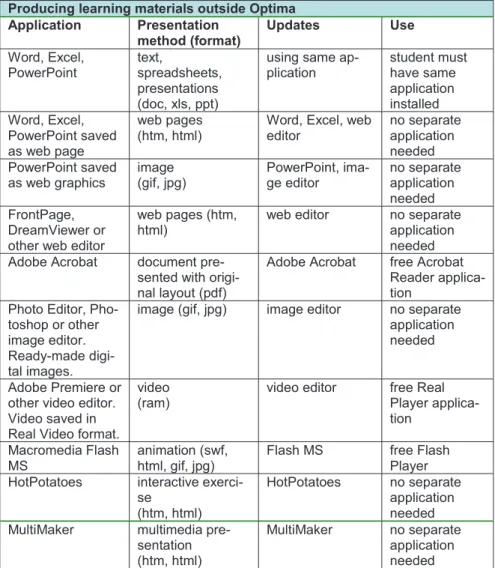
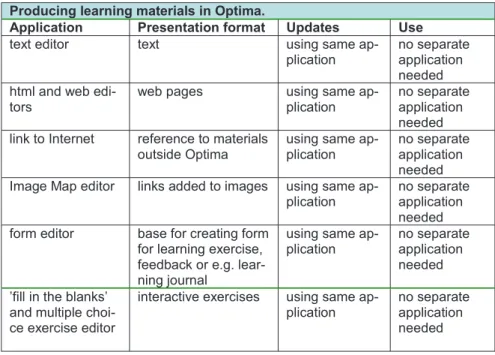
5.4 Producing learning materials 40 5.4.1 The use of learning materials in a learning environment 41 5.4.2 Producing online texts 43
5.5 Building and testing an online implementation 47 6 ONLINE GUIDANCE FOR STUDENTS 49
6.1 Tutoring tasks 49
6.2 Guidance tools 50
6.3 Supporting dialogue 51
7 ADMINISTRATION 53
8 EVALUATION AND DEVELOPMENT OF AN ONLINE
IMPLEMENTATION 55
FOREWORD
As the popularity and volume of online learning grow, quality takes on an in-creasingly central role. IT networks and online elements can be foundations for meaningful learning methods. One of our main future challenges is to create on-line implementations of broader scope than traditional study units. The concepti-on of concepti-online learning should always be rooted in pedagogy, promoting in depth learning and growth into multidisciplinary expertise.
This publication was created as a virtual collaboration between its authors. Irma Mänty has developed, coordinated and maintained various services to support eLearning at Laurea, acting as Online Study Coordinator and Virtual Polytechnic contact. Pasi Nissinen has developed online learning in Social Services, Health and Sports and carried out research for the Helsinki University of Technology (HUT) SimLab™ research laboratory’s HELMI project (Holistic Development of eLearning and Business Models). Both authors are trainers and tutors in Lau-rea’s Planning and Administration of Online Education training module and the professional development training in eLearning Expertise (20 credits) offered jointly by Laurea, Häme Polytechnic and HUT.
This text is based on the authors’ views and experiences as developers of Lau-rea’s online learning. We wish to thank all lecturers who have participated in the project for their interesting and fruitful contributions. The development of online learning has been a mutually informative experience.
Vantaa 2005 Irma Mänty Coordinator, eLearning, M.Sc. (Educ.) Laurea Polytechnic Pasi Nissinen
Senior Lecturer, M.Sc. (Soc.), Lic.Sc. (Educ.)
1 INTRODUCTION
This publication is intended as a guidebook for the planning and administration of online learning for lecturers and others who intend to carry out online projects. Its aim is to offer ideas, models and pointers to enable the creation of online pro-jects of optimal quality. We believe we should avoid trying to provide universally applicable pedagogic directions, as each instruction scenario is unique and re-quires pedagogic training from the person who plans it. As instruction contexts are never alike and each student learns in a different way, the application of uni-versal models is problematic. The final decisions are always made by a lecturer or team of lecturers by choosing the most appropriate pedagogic and technical solutions for their instruction needs.
Planning and implementing online learning for the first time always requires a lot of work. Lecturers who are beginning to plan an online study unit can seek as-sistance from a trainer or tutor to avoid the worst pitfalls in planning, but the ba-sic pedagogic and communication-related issues should be resolved by the lec-turer together with his or her group of students.
This publication has arisen from the authors’ views and experiences as develo-pers of Laurea’s online learning. A need to develop online learning in the direc-tion of an increasing amount of lecturers using informadirec-tion and communicadirec-tion technology (ICT) in their instruction work was identified in the late 1990s. This led to the creation of a strategy for how to fulfil this aim.
As the volume of online learning grows, an increasing amount of attention is paid to its quality. Diverse testing and evaluation processes for online study projects take centre stage in assuring the quality of these projects. This publication ho-pes to offer practical guidelines for implementing high-quality online learning.
2 TRAINING IN ONLINE PEDAGOGY FOR
LAUREA LECTURERS
Online learning has been implemented at Laurea Polytechnic (previously the Espoo-Vantaa Polytechnic) since the mid-1990s. The first online study units were eLearning experiments carried out by individual lecturers. In 1998, staff were invited to attend the five-credit module Future Management – Information Network Services in Communication, Instruction and Education as part of their professional development training.
A need to expand online learning soon became apparent and a new strategy for the step-by-step development of Laurea staff training in online pedagogy was created with a basis in received experiences. The aim was to train a vanguard of online study experts who would gradually integrate online learning into the poly-technic’s operating culture.
A pilot project for open polytechnic learning was launched at Laurea in 1999, training 24 lecturers and producing the twenty-credit course module Individuals in Society; Citizens in Finland and the World. The module’s expert trainer was principal lecturer Veli-Pekka Lifländer from the EVTEK Institute of Technology. Participants were instructed in the production of an online study unit centred on project-based learning with the use of basic ICT tools.
Online instruction began to be offered in a web-based learning environment on the polytechnic’s own server. This environment did not, however, offer the kind of interaction and communication tools contained in existing group work pro-grammes and learning environments. There began to be a need for a web-based learning environment specifically adapted for instruction, which would fa-cilitate a more extensive use of ICT in online instruction.
In 2000 Laurea adopted the use of the TELSIPro online learning platform, which offered more extensive and varied opportunities for implementing online lear-ning. In conjunction with this purchase, Laurea commissioned training in peda-gogic issues and the use of the platform from the University of Oulu. The trainer was Eric Rousselle.
Lecturers could apply to take part in the training by presenting a proposal for an online study project, with a special focus on multidisciplinary projects linked in practice to the labour market and an explanation of the added value produced by the online implementation. Applicants were asked to consider added value from the perspectives of learning, the labour market and the polytechnic itself.
Thirty-five lecturers were selected on the basis of their applications, which were all re-lated to online implementations of study units.
During the year 2000 the polytechnic offered training equivalent to six credits, containing seven days of face-to-face instruction and work in an online learning environment. TELSIPro presented a platform for discussion and guidance as well as allowing participants to build their own study units in the learning envi-ronment. This gave lecturers experience of studying online as part of their trai-ning, and technology and pedagogy went hand in hand throughout the course. The online study units were piloted in practice that same autumn and December saw the final day of face-to-face instruction, where completed online learning projects were assessed and plans were made for their development.
Of the lecturers who participated in the training, five were trained by the provi-ders of the TELSIPro platform to be internal trainers. In subsequent years they have participated in training other lecturers and mentoring their colleagues in matters related to online learning.
The training in Planning and Administration of Online Education for lecturers has been developed continuously, with actual implementations in 2000, 2001, 2003 and 2004. By autumn 2004, 117 people had been trained in online pedagogy.
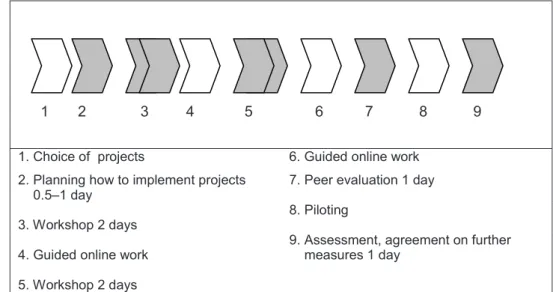
1. Choice of projects 6. Guided online work 2. Planning how to implement projects
0.5–1 day
7. Peer evaluation 1 day
3. Workshop 2 days
8. Piloting
4. Guided online work
9. Assessment, agreement on further measures 1 day
5. Workshop 2 days
Figure 1. Programme for Planning and Administration of Online Education course
In order to ensure the development of online learning, 20 credits of professional development training in eLearning Expertise were offered to teaching staff at Laurea and Häme Polytechnic between 2001 and 2003. A total of some 50 lec-turers attended the training, organised by the two polytechnics in cooperation with the Lifelong Learning Institute Dipoli at Helsinki University of Technology. The TELSIPro learning environment platform was replaced by the Discendum Optima platform during the 2002-2003 academic year and completed online im-plementations were transferred according to the online implementation sche-dule. Annual training in the use of the Optima platform has been arranged for staff since then.
In our opinion some of the main challenges for staff training will be the propaga-tion of good practices and expertise in online pedagogy within Laurea, an in-creasingly diverse use of media in the production of study materials and instruc-tion, and the provision of support for research and development activities related to online pedagogy within the polytechnic. In order to develop we need to im-plement continuous training and networking with partners as well as active re-search and development work. The use of increasingly demanding media ele-ments and technologies means that lecturers must receive good technical sup-port, as for instance the use of voice, video and web conferencing tools requires specialist knowledge even on the part of support personnel.
3 DEFINING ONLINE LEARNING
3.1 Online
instruction
‘Online learning’ is not semantically an established concept. Other terms used include web-based learning, e-learning, eLearning, online teaching, online lear-ning, virtual learning and virtual teaching. In terms of content, however, the defi-nition is clear in that it relates to computer-assisted instruction or teaching over a network. The term used depends on the user and the purpose. Tella, Vahtivuori, Vuorento, Wagner and Oksanen (2001, p. 21) relate online learning to instruc-tion, studying and learning supported by or at least partly based on materials and services available on an information network, particularly the Internet. With regard to instruction carried out over a network we can also talk about spe-cific ‘web didactics’. Pesonen sees web didactics as consisting of two elements: 1) the plans and targets of the instruction, and 2) the procedures (methods) by which these targets are attained. By web didactics Pesonen means that in plan-ning instruction through Internet-based learplan-ning environments we take into ac-count the content of the studies and the aims of the instruction, as well as plan-ning appropriate structural and functional elements, while recognising the chal-lenges related to a hypermedia environment (Pesonen 2000, p. 89).
We still see myths related to the superiority of technology linked to online lear-ning. Some people unrealistically believe that everyone likes online learning and considers it to be an attractive study method. Some students, however, find no motivation to study through an online learning environment. An often heard man-tra is that the web offers opportunities to complete studies without committing to a specific place or time. Studies are not carried out automatically in any envi-ronment, however, without systematic activity and efforts on behalf of students to achieve the targets set for their studies. Lecturers and students alike must plan their schedules and set a time and place for their work. The online study environment is especially susceptible to technical problems, which could arise from a multitude of elements – software used, telecommunication, users’ skills, poor planning of online implementations, etc.
3.2 Learning environment, teaching environment or
study environment?
Certain IT concepts have become established in everyday language use through the social changes brought by information and communication technology. Living in an information society requires lifelong learning and the perpetual main-tenance of our understanding. Ongoing social changes pose a learning chal-lenge in themselves. The chalchal-lenge grows due to our inability accurately to pre-dict what the future will bring in this constantly and swiftly changing society (Lin-turi 1998, p. 35). A concept often used in parallel to ‘information society’ is ‘learning society’, which refers to the new learning challenges set by our society, to the emphasis on information and knowledge, and to the networking of social structures (Heiskanen 1999a, 1999b). An essential requirement for favourable social development is often seen to be the free access of individuals to networks and information highways (Castells 1999).
These social developments have also left their mark on education and learning. Study environments have diversified through the creation of web-based learning environments. Individuals continue learning throughout their lives, and from the point of view of lifelong education this is not limited to formal instruction and education. According to Linturi (1998), the concept of ‘learning environment’ was born from the need to challenge the traditional classroom paradigm. In his opi-nion, the learning environment is no longer linked solely to educational institu-tions but it permeates our entire lives. Learning environments strive to attain an open structure which offers the raw materials needed for learning rather than ready-made contents or products (Linturi 1998, pp. 38–39).
As a concept, learning environment is linked to both learning and instruction. According to a belief that is currently accepted widely, learning does not happen mechanically through a transfer of information from a teacher or expert to a stu-dent through a lecture or similar learning package. According to Wilson (1995, pp. 25–27), seeing teaching and instruction from the point of view of an envi-ronment gives students more opportunities for independence and decision-making. Students must receive the necessary tools and access to as diverse a set of information sources as possible. They must also be given support and guidance during their studies. As such, the concept of a learning environment seems more appropriate than that of a teaching environment. In a learning envi-ronment the central focus is on learning.
According to Panzar, the learning environment includes the learning materials used and the physical and mental framework that facilitates goal-directed
lear-ning. The framework may be chosen by the student or offered by the educator (Panzar 1995, p. 86). If we wish to emphasise the technical elements of a lear-ning environment, the essential factors are hypermedia-based study materials, problem-solving tools and communication tools (Multisilta 1997, p. 102).
Tella (1997) uses the concept of ‘study environment’ rather than learning envi-ronment, thus emphasising the active studying phase of the teaching-learning process. According to Tella, the task of the teacher or lecturer is to assist the student in making the study environment as attractive as possible. The combina-tion of an attractive study environment and the teacher’s teaching activities may lead to the creation of a learning environment, which is a model or internal rep-resentation of the external reality constructed in the student’s mind (Tella 1997, p. 52).
Mononen-Aaltonen (1999) presents the view that the translation of the English concept of ‘learning environment’ into Finnish is problematic. According to Mononen-Aaltonen, the learning environment should be seen as a purely psy-chological concept, whereas the study environment would come under didactics. The learning environment can be a didactical concept only as a theoretical and abstract construct, whereas the study environment is related to the level of acti-vity and must be paired with the teacher’s perspective, the teaching environment (Mononen-Aaltonen 1999, pp. 225–226).
Koli views the learning environment as a combination of internal and external learning environments. The internal learning environment is constructed within the student’s mind and is affected by the student’s individual experiences. In ot-her words, the individual’s attitudes, beliefs and emotions would affect learning positively or negatively. Koli’s external learning environment consists of the phy-sical and social factors which guide and direct learning (Koli 2003, pp. 157–160).
In this publication we will use the concept of learning environment as it is widely used in Finnish research and literature, conscious of the conflict that arises from a single concept being simultaneously an explanative principle and a target of concrete study (Mononen-Aaltonen 1999, p. 225).
An online learning environment is implemented using the Internet and web tech-nology. This kind of learning environment differs from others mainly with regard to its structure and functions. An online learning environment is built up of hyper-text structures, hypermedia, links, discussion boards and other interactive chan-nels (e.g. email and chat rooms) as well as possible interactive programmed web pages and word processing software (Manninen 2000, p. 37).
In this publication, by learning environment we mean the operating environment in which students and lecturers operate. By an online learning environment we mean a learning environment created with the use of web technology and with a basis in the Internet as a technical platform.
3.3 Classifying education on the basis of different
in-struction methods
In spring 2003, the Finnish Virtual Polytechnic agreed to classify education by dividing it into four categories based on instruction methods: education based on face-to-face instruction, education based on guided online learning, education based on online self-study materials, and blended learning. This classification and definition process carried out by all polytechnics together will help students in creating their study plans. Online learning and blended learning add flexibility to students’ schedules. The joint classification also improves the reliability of the statistics and reports compiled by polytechnics on students’ performances. The classification was approved by the Finnish Ministry of Education.
The four instruction methods are defined as follows.
1. Education based on face-to-face instruction (Face-to-face instruction) Face-to-face instruction is instruction that mainly takes place in a specific place at a specific time in the presence of both the lecturer and the students. Face-to-face instruction can also be web-supported, which means that reporting and ma-terials such as overheads, photocopies, exercises and study material lists are provided online. Students may have access to online services which support the face-to-face instruction, such as discussion boards or group work platforms. Students’ work may be published online. The web is, however, in principle used solely to distribute information and materials.
2. Education based on guided online learning (Guided online learning) Guided online learning is instruction based on group work in which the lecturer and the students interact actively through various digital tools. The studies may include work done independently, in pairs or in teams, with simultaneous com-munication for instance through chat rooms or video/audio links. Some online learning may require presence at the polytechnic for an examination.
3. Education based on online self-study materials (Online self-study) Online learning based on self-study materials refers to studies in which students learn independently with the help of online materials and instructions contained
in these. Students can solve problems and receive feedback through these ma-terials. Online self-study does not involve guidance or teaching from a lecturer or necessarily interaction with other students.
4. Education based on both face-to-face and online learning (Blended learning)
Blended learning refers to an implementation involving various instruction methods. Instruction is organised through both face-to-face and online learning. Students’ work may take various forms and be carried out independently, in pairs, in teams or in larger groups. Studies may take place at an institution, in the workplace or through information networks. Blended learning implies that students must be present for face-to-face instruction and also work in an online environment.
4 CONCEIVING ONLINE IMPLEMENTATIONS
When conceiving an online learning programme, lecturers should consider what kinds of projects are worth implementing in an online environment. Although IT networks open doors to flexible learning independent of time and place, the needs of the target audience must take centre stage in the planning of studies and work methods. In many cases, face-to-face communication cannot be re-placed entirely by online interaction and collaboration. Implementations can also only be based on technologies to which the target group has access.
Often, however, learning results can be improved significantly with the use of ICT. The starting point for the conception of online learning should always be pedagogical. The use of technology and access to well-structured information do not in themselves guarantee a quality learning experience. Many believe unrea-listically that the presentation of information in a well-structured and interesting way supports in-depth understanding and learning. As a consequence, discus-sions on virtual learning have focused excessively on the transfer of information, neglecting to investigate the processes of social interaction and participation (Hakkarainen 2001, p. 19).
When building an online study unit, the main question to consider is what added value is created by transferring the study unit to an online environment. If the on-ly answers are that the production of online study units supports the image of the educational institution and that it is a modern way to do things, the use of ICT as an instruction tool is probably fairly useless in pedagogical terms.
Polytechnics have three main tasks as defined in Finnish legislation: teaching; research and development; and regional development. In conceiving online learning programmes, it is worth considering how the online implementation will support the fulfilment of these basic tasks.
The Ministry of Education’s Development Plan for Education and Research in 2003–2008 (2003, p. 45) stresses the importance of offering flexible studies; the role of personal study plans should be strengthened and all students, regardless of their degree programme, should have the opportunity to take 20 credits of their studies in an online format. Polytechnics have good prospects of reaching this target by extending their own selections of online study units and making use of products created by the Finnish Virtual Polytechnic. Until now, our poly-technics’ online learning selections have been fairly marginal, so a lot remains to be done. The quantitative targets for the growth of online learning should not, however, take precedence over qualitative requirements. The online
environ-ment should be an attractive learning method, and its use must not become an end in itself. If better learning results can be achieved through more traditional instruction methods, there should be no obstacles to their use. The challenge lies in how to implement innovative study modules in which the use of ICT is ap-propriate.
4.1 Networking and inquiry learning in projects
A central challenge for polytechnic education in the future will be the creation of even more solid and tightly knit cooperation networks between polytechnics and the local labour market. Finland’s welfare and international competitiveness levels are partly reliant on the role of polytechnics, which help to invigorate acti-vity in their areas of expertise. The task of polytechnics is to train experts who will serve the labour market. An expert could be defined as an individual who understands the principles behind things and uses them to provide solutions to encountered problems, and someone who is able to provide new information needed for problem-solving together with his or her working community (Hak-karainen, Palonen & Paavola 2002, p. 460). An expert must possess dynamic know-how, manifested as a diverse and active interaction between data, emo-tions and acemo-tions. This interaction leads to increased problem-solving (Isokorpi & Viitanen 2001, pp. 112–113; Hakkarainen 2003, p. 12).
Experts must promote the creation of innovative solutions through their work. In order to generate true expertise, the targets set for research and educational policies must be reconciled by increasing and reinforcing the collaboration between polytechnics and the local labour market. The fulfilment of the learning process in an authentic learning environment brings new opportunities for deve-loping the cooperation between representatives of the labour market and poly-technics; this can be called situational learning (Anderson et al. 1996; Lave et al. 1996, Wenger 1998). Situational learning strives to break down the barriers between educational institutions and the labour market and conceives of learn-ing as taklearn-ing place in the cultural context around which operations are centred. Thus the focus is on learning based on social participation, through which stu-dents gradually become more and more integrated in the expert community (Kotila 2003, p. 18).
Today’s information society demands that experts have cross-disciplinary know-how in order to understand the constantly changing phenomena of the world of work. This means that one of the most important tasks for polytechnics is to
train students in multidisciplinary expertise, which in turn calls for phenomenon-based learning.
Phenomenon-based learning can be brought about by intensifying collaboration between polytechnics and organisations representing the local labour market through the organisation of studies into larger modules. Learning is often linked to a project carried out for or with the labour market. Inquiry learning in projects is closely associated with situational learning, although it is more strongly linked to project-based learning. A project can be seen as a larger concept, containing several tasks or undertakings. The projects must be sufficiently long in duration to create a fruitful basis for interaction between the polytechnics and representa-tives of the labour market.
Inquiry learning in projects can make use of IT networks, particularly for the purposes of documentation and interaction. New learning environments are created as they shift increasingly into authentic work situations and away from the traditional classroom context. This brings significant challenges for teachers and lecturers, as a genuine atmosphere of collaboration must be created be-tween polytechnics and the labour market to guarantee the future quality of poly-technic education. Polypoly-technics must be able to respond to the qualification de-mands of the labour market and to train experts who will serve the information society.
The intellectual capital of an organisation refers to the organisation’s intangible assets and its capacity to transform its employees’ know-how continuously into innovations. This success factor will be crucial – if difficult to control – in future (Ståhle & Gröönroos 1999). Innovation cannot, however, take place in isolation within the polytechnic environment, as it is strongly characterised by the prin-ciple of collaboration. The innovation process must involve not only the local la-bour market but also scientific higher education institutions, international educa-tional organisations and various public sector bodies.
4.2 Experiential learning in authentic work situations
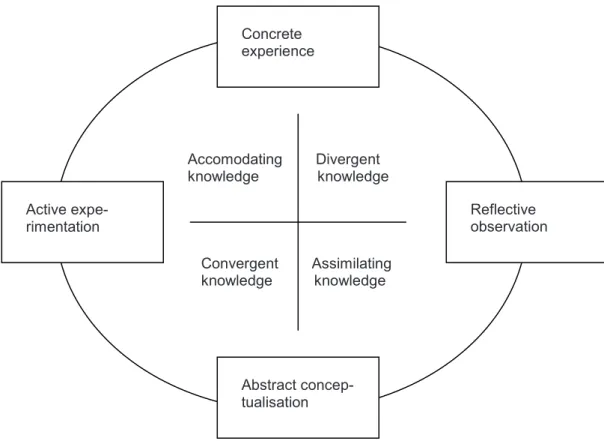
The challenges of learning apply equally to online learning. Online learning can significantly, even crucially affect the creation of a culture of lifelong learning, which in turn helps to safeguard a favourable social development (Markkula 2003, pp. 1–2). Lifelong learning is strongly linked to experiential learning (Kor-honen 1992, p. 17). The experiential learning process is based on Kolb’s (1984) experiential learning model (Figure 2).
Figure 2. Experiential learning model (Kolb 1984)
According to Kolb, the learning process should be linked to an immediate, con-crete experience, which emphasises involvement and feeling. Students should identify their own characteristic styles of learning, gathering information and in-creasing their understanding. Thus Kolb’s model stresses the importance of dif-ferent learning styles. Learning styles are often unconscious, but it is important for students to find pleasant ways of learning. Experience leads to divergent knowledge, in which the student’s own knowledge is still somewhat separate from the generally recognised frame of reference. Through reflective observa-tion, the student can structure his or her experiences, naming them and thus conceptualising them. At the same time the student broadens his or her concept of the learned phenomenon. Considering issues from various perspectives is essential to observation, which is also closely linked to reflection over that which has been learnt. At the assimilation stage, the individual’s own knowledge is in-tegrated into the existing broader frame of reference. This forms the basis for carrying out new experiments and testing what has been learnt, which requires
Concrete experience Accomodating Divergent knowledge knowledge Convergent Assimilating knowledge knowledge Active expe-rimentation Reflective observation Abstract concep-tualisation
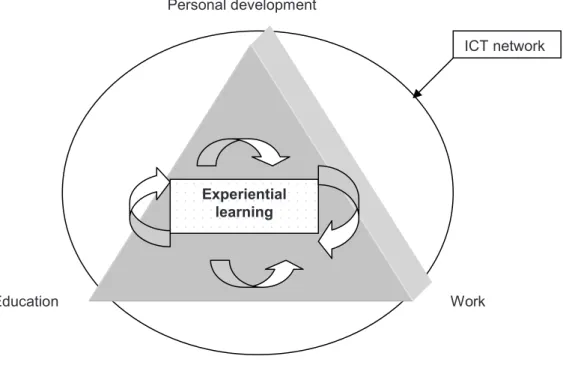
work and effort – i.e. convergent thinking. This causes new concrete experi-ences, active experimentation and learning situations, which lead to renewed re-flective observation and accommodating knowledge. Thus an active relationship is created between the student and the learned phenomenon (Kolb 1984). Experiential learning can also be defined in terms of education, work and per-sonal development. The opportunities offered by IT networks for bringing these three factors together could be illustrated by adapting Kolb’s model, as shown in Figure 3.
Figure 3. Experiential learning model (derived from Kolb 1984, p. 4)
Ideally, information networks create a culture and procedure which can erase the barriers between education and the labour market. Education should in-creasingly take place in authentic work situations, even once the individual is al-ready employed in the labour market. Collaboration between educational institu-tions and the labour market cannot simply be intensified through technical solu-tions, however. Close collaboration implies that the interaction between the par-ties must develop sufficiently quickly. In addition, the parpar-ties must be able to create the necessary atmosphere of cooperation and maintain and develop joint
Experiential learning Education Personal development Work ICT network
cooperation models and processes. This makes innovation possible. A close link between educational institutions and the labour market promotes the personal development of individuals and can thus be assumed to be connected to an in-crease in motivation levels.
One of the duties of polytechnics is to participate actively in their areas of exper-tise and to respond to constant changes in the challenges set by the labour mar-ket. The coordination of the know-how created in different fields of study and on different campuses is a critical success factor for polytechnics. IT networks offer excellent opportunities for sharing know-how. It is essential to create virtual meeting places for knowledge sharing to help in acquiring even more accurate and exhaustive information of the constantly changing phenomena of the labour market.
Learning environments will increasingly move away from the traditional class-room towards authentic environments moulded by the labour market. This constitutes a large challenge for teachers and lecturers, whose work is not just associated to pedagogical duties but also relates to developing the local labour market and adopting an investigative approach. The transformative and emanci-patory learning process emphasises the importance of companionship with stu-dents. The involvement of students in the planning phase of online implementa-tions of inquiry learning in projects increases their commitment and motivation for the implementation. By participating in these projects, students acquire skills related to project work, which form some of the crucial abilities in our future skill-based society.
In an ideal situation, inquiry learning in projects will transform the learning pro-cess into a cyclically deepening research propro-cess, where the research objects are the phenomena of the labour market. IT networks support this research process especially by offering a platform for sharing know-how. An online learn-ing environment makes it possible to document project-specific plans and jour-nals, as well as personal study plans and diaries, which furthers reflection on what has been learnt. Thus the online learning environment supports commu-nity-based learning through interaction between students and student groups. To create an in-depth understanding of the phenomena of the labour market, the implementation of instruction programmes must involve multidisciplinary know-how. When conceiving online learning programmes it is therefore worth consi-dering what kinds of expertise are required of the lecturers who wish to imple-ment them. Online learning projects created by cross-disciplinary teams of lec-turers can often be more innovative than those implemented by just one lecturer
or by a team of lecturers with the same training background. Ideally, experts from the labour market should participate with lecturers in conceiving online pro-grammes and later in guiding students’ learning processes.
4.3 Entirely or partly online?
At the early stages of online learning, many had visions of online programmes saving time and money as large student groups could be taught with the use of small instruction resources – almost as if students would learn by themselves as soon as they had been given online access to learning materials and tasks. Ma-terials could certainly be distributed through the new technology, but online in-struction was lacking in interaction. The development of learning environment platforms and other web applications in the late 1990s meant that teachers can now focus increasingly on pedagogy and supporting learning instead of technical issues. A general tendency adopted currently in the implementation of study programmes appears to be that of blended learning. Long-distance and face-to-face instruction are combined to create attractive modules, as interaction between people still appears to be activated most easily through face-to-face encounters. There is a constant need, however, for study units implemented en-tirely online. Online study units can be taken from any location in Finland and can include international students, which is why Laurea is increasing its use of online learning environments for online and blended learning, and as virtual classrooms or project spaces.
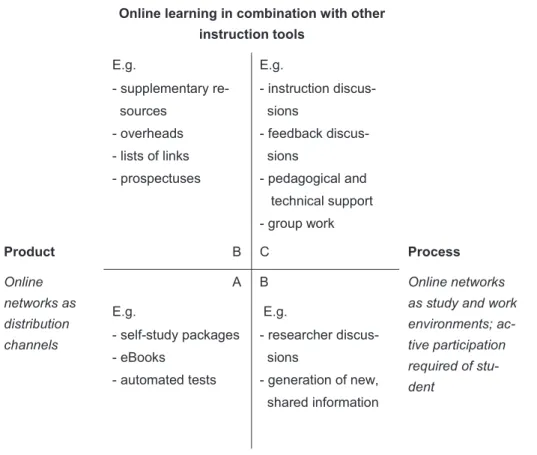
Hein, Ihanainen and Nieminen (2000) define the significance of IT networks in education as illustrated in Figure 4.
Online learning in combination with other instruction tools E.g. - supplementary re- sources - overheads - lists of links - prospectuses E.g. - instruction discus- sions - feedback discus- sions - pedagogical and technical support - group work Product B C Process Online networks as distribution channels A E.g. - self-study packages - eBooks - automated tests B E.g. - researcher discus- sions - generation of new, shared information Online networks as study and work environments; ac-tive participation required of stu-dent
Online learning environment alone
Figure 4. Forms of online learning (Hein et al. 2000).
The horizontal axis describes the division into product- and process-based online learning. The vertical axis defines whether online networks are used to support other instruction tools or whether the aim is to transfer the entire instruc-tion and learning process into an online environment. Sector A describes the use of networks as a kind of resource database, which may contain automated tests, lists of links produced by the lecturer, entire textbooks or self-study packages. In sector A, instruction is carried out entirely online. In Sector B, online networks are used as an instruction tool in combination with more traditional tools. In the-se cathe-ses, networks are often uthe-sed as resource databathe-ses – similar in content to those in sector A – which complement face-to-face teaching. Sectors A and B are characterised by the fact that communication is unidirectional (Hein et al. 2000).
Sectors C and D, on the other hand, are characterised by bidirectional commu-nication. Online instruction and learning can take place in combination with tradi-tional methods (sector C) or entirely online (sector D). These sectors embody the idea of students’ active participation in online operations (Hein et al. 2000) and the use of networks as tools for collaborative and cooperative learning.
5 PLANNING ONLINE LEARNING
5.1 Pedagogical bases for planning
The planning of an online learning environment should always have a basis in pedagogic principles. The plans must take into account the students’ previous knowledge of the phenomenon at hand. They must also consider which peda-gogic principles or models are appropriate for use to guarantee an optimal lear-ning experience.
Pedagogical and technical points of departure may lead to very different online learning methods. Online learning may consist of independent browsing through and searching for information or joint generation and editing of information between people. The principles of inquiry learning and collaborative and coope-rative learning have been tested widely in online learning, so we will consider them in more depth in this publication. Other recommended frames of reference are various constructivist perspectives, authentic dialogic online learning (cf. Aarnio, H. & Enqvist, J.: Dialoginen oppiminen verkossa. DIANA-malli ammatilli-sen osaamiammatilli-sen rakentamiseen; Finnish National Board of Education, Helsinki, 2001), and the cooperative project-based learning model (cf. Lifländer, V.-P.: Verkko-oppiminen – Yhteistoiminnallinen projektioppiminen verkossa; Edita, Helsinki, 1999).
5.1.1 Progressive inquiry learning
In their publication Tieto- ja viestintätekniikka tutkivan oppimisen välineenä, re-searchers at the University of Helsinki define a pedagogical model which sup-ports students in acquiring the advanced IT skills required for successful opera-tion in our informaopera-tion society (Hakkarainen, Lonka & Lipponen 1999, p. 9). The progressive inquiry learning model is based on the problem-based learning (PBL) model. According to the PBL model, the starting point for learning is not contained in ready-made data presented for learning but in a poorly defined, genuine problem to which students themselves must find solutions. Learning is therefore not directed by ready-made action plans or resources, but by prob-lems, the students’ preconceptions and particularly the deficiencies found in these preconceptions.
The progressive inquiry learning principle is based on the idea that creating new information is in essence a similar process to that of understanding existing
in-formation. When individuals try to understand existing scientific theories or frames of reference, they have to go through the same processes as the people who originally created the theories or frames of reference. According to the pro-gressive inquiry learning principle, in its ideal form learning would be a research process, which generates new information and understanding (Hakkarainen, Muukkonen, Seitamaa-Hakkarainen & Lipponen 1998, p. 2).
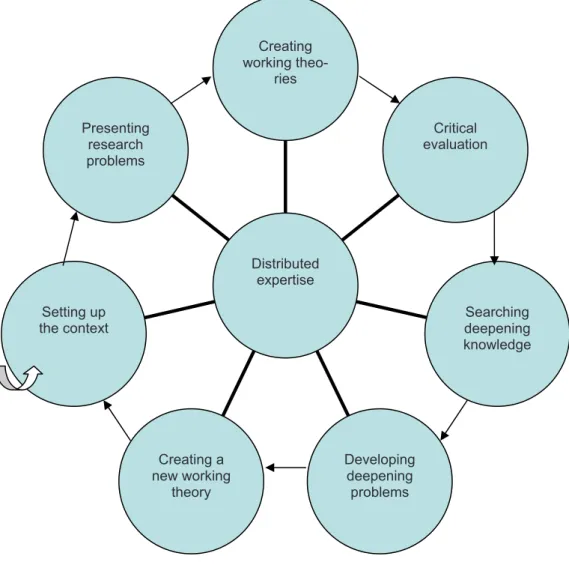
The progressive inquiry learning frame of reference is based on the fact that the operation of the learning environment can be organised so that it is comparable to the practices used by scientific research teams or expert organisations. A central concept in progressive inquiry learning is the idea that learners do not assimilate new information in direct relation to their previous data constructs, but by adopting constructs and problems related to the understanding of the new in-formation. In addition, the learner constructs individual theories and explanations of the subject of study (Hakkarainen et al. 1998, p. 2).
The objectives of progressive inquiry learning are the concepts of the subject, constructed during the learning process by the learners and the teachers. It is essential to see that the progressive inquiry learning process is a gradually deepening one. Thus attention is focused specifically on developing learning and, simultaneously, the learning environments. The learning process takes time and generates various working theories, which change and deepen as more in-formation is gathered (Hakkarainen et al. 1998, p. 3)
Figure 5. Progressive inquiry learning (Hakkarainen et al. 1998, p. 4)
Setting up the context
The object of analysis in the progressive inquiry learning process should be a problem related to a topic that is of central importance to the students’ concep-tual understanding. The topic should contain sufficient dimensions and perspec-tives to ensure that it can be treated from various points of view. It is important to set a context by linking the subject of study to significant and interesting scien-tific issues, actual problems arising from the labour market or the students’ own conceptions and experiences (Hakkarainen et al. 1998, p. 4).
Presenting research problems
The point of departure for progressive inquiry learning is setting problems which will direct the learning process and which are central in terms of the students’
Presenting research problems Setting up the context Creating a new working theory Developing deepening problems Searching deepening knowledge Critical evaluation Creating working theo-ries Distributed expertise
conceptual understanding. Although the lecturer may define the general frame-work for the subject of study, the students themselves must determine the prob-lems they are going to investigate further (Hakkarainen et al. 1998, pp. 4–5). Creating a working theory
The students’ own working theories and interpretations take centre stage in learning by developing. The task of the lecturer is to encourage students to con-sider the problems in the subject of study and to present their own interpreta-tions. The presentation of the students’ own interpretations and explanations is essential if the newly found information is to be deepened (Hakkarainen et al. 1998, p. 5).
Critical evaluation
The idea behind critical evaluation is to encourage students to evaluate what they have learnt critically and constructively. The aim of critical evaluation is to develop and compare working theories, thus finding out their strengths and weaknesses (Hakkarainen et al. 1998, p. 5).
Searching deepening knowledge
The aim of learning by developing is generating new understanding and informa-tion. Thus it is strongly linked to effective information gathering from various sources. Students are guided by the problems they have set themselves, by their existing knowledge bases and by the assumptions they may form through their working theories. When gathering information, students must remember to assess the reliability of the data found in various sources.
Developing deepening problems
In terms of learning, inspiring commitment and motivation in students towards solving the problems they have set is essential in maintaining their incentive to learn. This also helps students develop towards true expertise (Hakkarainen et al. 1999, p. 82). By setting gradually more specific questions, students can deepen their knowledge of the studied phenomenon. In order to promote lear-ning, conceptual changes should take place in parallel to information increases (Hakkarainen et al. 1998, p. 6).
Creating a new working theory
One criterion affecting the success of learning by developing is whether students can generate new working theories to explain the studied phenomena. To do this, students must gather gradually deepening knowledge (Hakkarainen et al. 1998, p. 6).
Distributed expertise
Learning by developing is based on including collaborative activity in the lear-ning process. Shared expertise refers to a situation in which working theories and their stages are shared between all the parties participating in the learning process. The aim is to guide and encourage students to consider the best prac-tices that arise from collaborative activities. The process of learning by develop-ing may involve experts from the labour market in addition to lecturers and stu-dents (Hakkarainen et al. 1998, p. 6). IT networks and learning environment software offer an effective channel for sharing expertise.
5.1.2 Collaborative and cooperative learning
The importance of information networks in learning is often justified from the point of view of collaborative and cooperative learning. The collaborative per-spective is very significant, as it is considered to support the growth of students to become true experts (Hakkarainen et al. 1999). When looking at learning en-vironments from the collaborative perspective, it is important to define the idea of a community and the relationship between collaboration and cooperation. The definitions of these characteristics are based on the research tradition formed on the basis of Piaget’s genetic epistemology (1970) and on Vygotsky’s ideas on social and cultural development (1962, 1978). By learning together, students af-fect each other’s knowledge constructs, thus generating new information and broadening their understanding (Korhonen 2003, p. 33). Both approaches are rooted in the ideas and thoughts of John Dewey, who sought to strengthen the interaction between students in learning situations. After Dewey’s tests on lear-ning and interaction, researchers in the mid-twentieth century began to search for teaching organisations based more specifically on group dynamics, in order to create well-functioning groups (Sahlberg & Sharan 2002, p. 10).
A community emphasises the importance of experience-based and interactive events (Tahkokallio 1998). Social interaction is a human need; collaborating with a community is important in the construction of our self-esteem. Social interac-tion signifies a kind of liberainterac-tion of our emointerac-tions, which are the balancing force between the controlled (conscious) and uncontrolled (unconscious) levels of community (Isokorpi & Viitanen 2001, pp. 200–2001).
Collaborative learning focuses more clearly on the learning process. During their learning process, students analyse the subject of study, forming conceptions and explanations of it, which are examined critically and in a questioning mode jointly by the members of the community. The aim of the learning process is to
transform students’ knowledge and know-how in a topic clearly by doing more than just increasing the amount of information they possess. Collaborative lear-ning does not differentiate between students’ roles as clearly as cooperative learning does, as it relates more to a joint attempt to understand something con-sciously and in detail (Korhonen 2003, p. 33).
Collaborative learning emphasises the use of dispersed cognitive resources – i.e. making other participants understand our thoughts through shared commu-nication and reflection (Hakkarainen, Järvelä, Lipponen, Lonka & Lehtinen 1996; Hakkarainen 1997).
Individual and group participation in interactive learning is strongly related to the collaborative context and the adoption of the group’s thinking and operating methods. By participating in a community, students can broaden their spheres of experience and receive feedback on their thoughts and actions from the other members of the community. Collaborative learning is characterised by interac-tion between students and the tools related to the learning environment pro-duced by that culture. Significant knowledge is acquired when students strive to understand the processes affecting this interaction. The production of significant knowledge takes place as a shared social process, which can be defined with the help of Piaget’s concept of the cognitive conflict (1970). Students try to solve the cognitive conflict, which arises between what we know, what we believe others to know and what we wish to or should know due to the challenges posed by our environment (Korhonen 2003, p. 34).
Cooperative learning could be defined as a learning project which focuses on cooperation and in which students act with joint responsibility in order to attain a specific target (Slavin 1985; Johnson & Johnson 1987, 1990a, 1990b). Coopera-tive learning stresses the importance of sharing study resources and responsibi-lity. Learning is based on the creation of a fixed relationship between the stu-dents and the subject of study. The interaction that takes place in the learning environment has a deep impact on the social, cognitive and professional deve-lopment of the students (Kagan & Kagan 2002, p. 24). When working in a lear-ning environment, it is natural to allocate roles between the parties in accor-dance with the situation and the students’ learning process.
In cooperative learning, the members of the group are positively dependent on one another. A relationship of positive dependence is created when individuals realise that the success of one signifies the success of another (Kagan & Kagan 2002, p. 41). It may appear in the form of dependence on resources, materials, tasks or the reward that is received for completing a task. Positive dependence
promotes learning. Collaborative learning focuses on participation and interac-tion; cooperative learning emphasises the allocation of roles (Korhonen 2003, p. 33). Cooperation does not imply the elimination of individual responsibility; each member of the group is responsible for his or her own input to the group and therefore also for his or her own learning. In order for the group to work success-fully and its learning process to develop positively, there must be a strong team spirit (Kagan & Kagan 2002, p. 42).
Team spirit does not appear by itself. The orientation phase is particularly impor-tant in the creation of team spirit; the lecturer must successfully divide the stu-dents into groups and create a favourable atmosphere for work in small groups. The grouping process can be supported by various activities which help to cre-ate a feeling of openness and cooperation between the students. In online lear-ning, as interaction in the learning process is transferred to the online environ-ment, the division into groups is especially important. Students who have been grouped together unsuccessfully cannot be expected to participate in an active dialogue in the online environment.
Cooperative learning is situational in the sense that beginners can acquire knowledge and skills by participating in the community’s social and cultural prac-tices, in order to gradually become full members of the community (Korhonen 2003, p. 32; cf. also Wenger 1998). Through the participation of beginners, the learning process becomes a socialising and participation process (Korhonen 2003, p. 32).
We could say that in cooperative learning the aim of the learning process is clea-rer from the start than in collaborative learning, where it is formed gradually through the interaction of the participants. Collaborative learning centres on the significance of dialogue in the creation of common understanding and in-depth knowledge. Collaborative and cooperative learning are not mutually exclusive: for instance choral singing is simultaneously collaborative and cooperative. In a choir, each singer is given a specific role as a tenor, bass, soprano, etc., but some of the singers may occasionally have solos while others remain in the background. The conductor is responsible for ensuring that the singers learn all the songs and that the results are high in quality. All choir members share the aim of learning the songs they are to perform. In this example, collaborative learning could be seen as the result of the learning, which is complemented by cooperative learning.
Sahlberg and Sharan define cooperative learning as a collective term for the pedagogic methods which are based on organising large student groups into
smaller units with scientific principles (Sahlberg & Sharan 2002, p. 11). Defined thus, collaborative learning would be a subgroup of cooperative learning. For everyday instruction work, however, it does not make sense to define coopera-tive learning so broadly. In the light of the descriptions given above, it is also dif-ficult to see collaborative learning as a subgroup of cooperative learning – it would more likely seem vice versa. In a nutshell, we could call cooperative lear-ning a learlear-ning process in which students work together and with joint respon-sibility to achieve a specific aim, through a relationship of positive dependence. The subject of study varies depending on the role but always serves the joint learning targets for the group.
Collaborative learning could then be defined as a learning process during which students assess the subject of study, creating concepts and explanations for it which are assessed critically and questioningly among the members of the community. The subject of study remains the same throughout the process. Rauhala considers collaboration to have been analysed too uncritically, as if it were an ideal goal to aim for. Social interaction is based on advanced individua-lity and personaindividua-lity, which is why Rauhala emphasises the importance of evalua-ting the individual growth processes of the group’s members (Rauhala 1991, 1998).
5.2 Operating
environment
The foundations for the planning of online learning should lie in the polytechnic’s strategic aims and in the framework provided by its operating environment. Otherwise the online implementations will lack continuity and development op-portunities. Laurea’s Information Technology Strategy describes matters related to the polytechnic’s infrastructure (machinery, equipment, networks, employees’ basic IT skills). The Strategy for the Use of Information and Communication Technology in Instruction, and the Pedagogic Strategy set the targets for staff and student skills.
Sufficient personnel and man hours must be reserved for planning online imple-mentations. One lecturer’s enthusiasm is not enough to provide an online im-plementation which could be turned into a successful product and distributed for broader use within the organisation. The projects to implement online must be chosen together with a superior to ensure that there is sufficient demand and re-sources for them.
The polytechnic’s activities in regional development, networking with the labour market and international projects facilitate studies that cross the boundaries of the polytechnic. Online learning can increase the flexibility and openness of studies. Currently, the Finnish Virtual Polytechnic and the Study Pass system in the capital city area provide opportunities for degree students to take study units in polytechnics other than their own. The Open Polytechnic could offer even more online study units than it does. The Virtual Polytechnic offers lecturers op-portunities for developing as experts and content producers in online learning. National content-production networks are in place to produce study units which can be used broadly across various fields of study and polytechnics.
A learning environment consists of all the material and immaterial frameworks within which the lecturer and students operate. An online learning environment is an operating environment that combines pedagogical choices, selected methods and tools, and teaching and study resources. The online learning environment must never be seen as a purely technical product; in polytechnics, it is made up of the entire operating environment, not just a technical platform.
With the use of various online learning platforms in combination, students, lec-turers and representatives of the labour market can be brought together without commitment to a specific time and place. It is particularly important to strive to break down the barriers between educational institutions and the society around them with the use of IT and networking. This means students will participate in external activities that are essential in terms of their expertise (Nissinen 2003, p. 226).
The available software options vary greatly in terms of the ‘pedagogical freedom’ they offer the creator of an online study unit. Some programs are structured in accordance with specific pedagogical models, which means that the structure will control the pedagogy of the study unit rather strictly, allowing the creator ve-ry little pedagogical freedom. In polytechnic instruction, the learning process is characterised by close interaction between the institution and representatives of the labour market. This means that the online learning environment used must be easy to adapt to support this interaction as much as possible (Nissinen 2003, p. 227).
5.3 Planning
phase
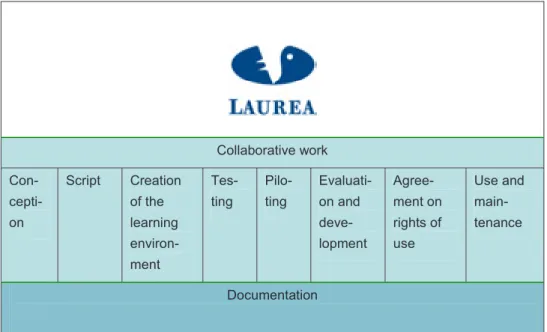
At Laurea Polytechnic the planning process for online implementations consists of eight stages:
• conception
• script-writing
• creation of the learning environment
• testing
• piloting
• evaluation and development
• agreement on rights of use
• use and maintenance
Planning work carried out collaboratively, through open interaction with a team of lecturers and support personnel, results in high-quality online implementa-tions. By documenting each stage of the planning phase we can guarantee the continuity of the work even if individual participants leave the team.
After conceiving an online implementation, the lecturers and any other produc-tion team members begin to plan the script of the implementaproduc-tion. Depending on the extent of the project, the script may contain a synopsis, a project plan and a structural and material plan in addition to the user scenario. At the script-writing stage the production team should identify the learning processes, contents, eva-luation and tutoring of the study unit, always keeping in mind the needs of the target group.
After creating the learning environment and the necessary materials (exercises, learning materials, guidelines, etc.), the environment should be tested before ini-tiating a pilot project. During the pilot project, feedback on the implementation is gathered from all participants and used to improve the project. The makers of the online implementation will make agreements on the rights to use the imple-mentation so that it and the materials it contains can be used inside the poly-technic and, if necessary, shared with other institutions. Well-designed online implementations may be used extensively within the polytechnic and may be long-lived if they are adaptable into different versions for different purposes.
Collaborative work Con- cepti-on Script Creation of the learning environ-ment Tes-ting Pilo-ting Evaluati-on and deve-lopment Agree-ment on rights of use Use and main-tenance Documentation
Figure 6. Factors that make up the planning of online implementations
In terms of the script-writing stage, this publication will look more closely at the user scenario, the synopsis, the project plan and the structural plan. For more in-formation on script-writing, please refer to content production guides. For refe-rence, we have used two printed works: Jussi Luukkonen’s Digitaalisen median käsikirjoitusopas (2000) and Jyrki Kanerva, Jukka Packalén & Maarit Puttonen’s Ideasta multimediaksi (1997), as well as the script-writing website created by Suvi Keituri (http://virtuaaliyliopisto.jyu.fi/oppimateriaali/suvi/). Other good refe-rence materials in planning online implementations are the content production guides, support materials and online tools provided by the Finnish Virtual Poly-technic and the Finnish Virtual University.
5.3.1 User
scenario
The user scenario helps to align the implementation to the needs of the correct target group. Quite a few creators of online implementations believe that their project will serve various different target groups, without concretely identifying the needs of these groups. For instance mature students may find themselves in a very different situation than younger students. Each user has different reasons for choosing an online implementation, and their learning styles also vary. If the
online implementation is designed to serve various target groups, it must include alternative learning paths.
The user scenario should describe for instance two or three different users of the online environment. The following issues may be used as a basis for the plan:
• the user’s name, age and gender
• why the user has chosen the online environment
• what the user is interested in and motivated by in online learning
• the user’s information and communication technology skills
• the situations in which the network will be used
• the tools that are available to the user
5.3.2 Synopsis
The synopsis is a short, one- or two-page abstract of the project. It describes the content-related and technical implementation and gives an estimate of the cost, production time and resource requirements. The synopsis should look at the fol-lowing issues:
• the idea behind and target group of the implementation
• the main characteristics of the content: e.g. limits, scope, pedagogical princip-les
• methods of use of the implementation
• how the implementation fits in with the rest of the polytechnic’s supply
• creators
• calculated useful life
• preliminary schedule
• preliminary cost calculation
The synopsis is a tool to use when the project is beginning to take shape and requires the approval of the client or partners. The idea and methods of use of the implementation should be written up creatively. A few pertinent illustrations may help the reader to understand the idea behind the implementation quicker. Partners and participants in the projects will often find it easier and quicker to comment on a concisely written synopsis than on an in-depth project plan. The synopsis may be used as a basis for agreements on the planning and fulfilment of the project.
5.3.3 Project
plan
The project plan for an online implementation must include all the general ele-ments of a project plan. In addition it should focus on determining the operators, learning process, ways of achieving targets, study contents, evaluation and tu-toring plans of the implementation.
Lecturers are usually experienced at planning studies and projects, so in plan-ning online implementations they can focus on how best to attain the targets set for their teaching work through an online environment. If the planned implemen-tation has previously been carried out through face-to-face instruction, we must especially avoid transferring well-known practices into the online environment as they are. Pedagogic solutions must be rethought completely. The amount of work required of the lecturer and students must be realistic and form a suitable module. Online learning must not be included ‘on top of’ face-to-face instruction so that it results in additional work for the students and lecturer.
The workload caused by the online implementation may be shared by a team of lecturers, where each lecturer has a specific role. These roles may include that of a teacher, a tutor, a producer of learning materials, a text writer, a producer of graphical elements and an environment manager. The responsibility for tutoring may be shared on a weekly basis between lecturers. The responsibility for the progress of the studies should, where possible, also be shared with the stu-dents.
The project plan for an online implementation should consider the following is-sues:
• the title and scope of the online project
• the lecturers participating in the project and their respective areas of responsibility
• the target groups for which the project is being planned
• the schedule and resources for the project
• the aims of the implementation; i.e. what students are expected to learn through it
• how the students will learn
• the kinds of tasks and exercises that will be set and the work students are ex-pected to produce
• the assessment methods that will be used
• how tutoring will be organised
The project plan should also include the following:
• a detailed plan of the learning process
• a description of the implementation and teaching methods
• the risks and limitations of the project
• planned right of use agreements
5.3.4 Structural
plan
A well-designed online work space will support the learning process and help students progress through the learning environment. Designing the structure of the work space means creating a structural plan for the operating concept of the online implementation. The structure may be based on various principles, e.g. supporting the learning process and the students’ activities, the sequence of the content of the studies, knowledge construction or a theoretical model.
Each person can visualise the structural model in their own way. The mind map technique can be used to visualise thought processes and to structure contents in relation to each other. Appendix 1 has an example of a mind map with the structure of a study unit. A flow chart or tree diagram can be used to organise all the elements to be fitted into the online work space, classified under folders or other work structures. These elements include exercises and their delivery, learning materials, various guidelines, discussion areas, other communication tools, calendars, etc.
The structure of the work space and the progress of the work can be simplified in the following ways:
• organising and classifying the structure, e.g. through numerals or alphabeti-cally
• phasing the work process, e.g. through modules or calendar weeks
• subdividing the structure, e.g. on the basis of study methods, activities or work groups
• relating the structure to an apt metaphor that describes the content and target group. Metaphors commonly used in online environments include a path, a road, steps, a café, an arena, a marketplace, a ballpark, a building, a hotel and a classroom.
• using symbols and images. Visualisation can be used to support the meta-phor, to simplify navigation through the online environment and to add a sense of style.
A site map will help students see the online work space as a whole. If there is no fixed structure at the beginning and it will instead be built up during the learning process e.g. through group work, it is important that students be informed initially of what will take place in the work space.
Koli and Silander (2003, pp. 34–44) structure learning situations by using online learning ‘building blocks’ placed in a form they themselves created. The building blocks are piled up in the order of the learning situations, and the piles form the structure of the online implementation. Not all building blocks have to be used each time; instead, they select the appropriate blocks for each specific part of the online implementation.
The building blocks consist of:
• aims, practices
• creation of a context
• activation
• presenting a learning task
• knowledge construction
• collaborative knowledge construc-tion • reflection • tutoring • peer feedback • delivery of exercises • learning diary • lecture • self-assessment • portfolio
• learning objects/learning materials
• assessment
Appendices 1–4 contain examples of the structure of an online implementation carried out in the Optima environment. Introduction to Statistical Methods is an online study unit that progresses in accordance with a previously agreed weekly plan. Specific learning materials and a learning exercise are assigned weekly and must be delivered into that week’s folder. When the delivery deadline has passed, the lecturer publishes the correct answers and the following week’s exercise. Planning and Administration of Online Education and the Virtual Class-room for Group AA are examples of virtual work spaces that are constantly available to students. The virtual classroom’s work space reserves as much space and visibility as possible for the students’ own outputs. The students have personal folders in which they keep their personal study plans and study portfo-lios. These folders may also be used for publishing materials needed by other