Communications of the Association for Information Systems
Volume 40 Article 18
5-2017
MSIS 2016 Global Competency Model for
Graduate Degree Programs in Information Systems
Heikki Topi
Bentley University, [email protected]
Helena Karsten Åbo Akademi University Sue A. Brown University of Arizona João Alvaro Carvalho Universidade do Minho Brian Donnellan Maynooth University
See next page for additional authors
Follow this and additional works at:http://aisel.aisnet.org/cais
This material is brought to you by the Journals at AIS Electronic Library (AISeL). It has been accepted for inclusion in Communications of the Association for Information Systems by an authorized administrator of AIS Electronic Library (AISeL). For more information, please contact
Recommended Citation
Topi, Heikki; Karsten, Helena; Brown, Sue A.; Carvalho, João Alvaro; Donnellan, Brian; Shen, Jun; Tan, Bernard C.Y.; and Thouin, Mark F. (2017) "MSIS 2016 Global Competency Model for Graduate Degree Programs in Information Systems,"Communications of the Association for Information Systems: Vol. 40 , Article 18.
DOI: 10.17705/1CAIS.04018
MSIS 2016 Global Competency Model for Graduate Degree Programs in
Information Systems
Authors
Heikki Topi, Helena Karsten, Sue A. Brown, João Alvaro Carvalho, Brian Donnellan, Jun Shen, Bernard C.Y. Tan, and Mark F. Thouin
C
ommunications of the
A
I
S
ssociation
for
nformation
ystems
Teaching Paper ISSN: 1529‐3181
MSIS 2016
Global Competency Model for Graduate Degree
Programs in Information Systems
The Joint ACM/AIS MSIS 2016 Task Force
HeikkiTopi
Bentley University; ACM, co‐chair
HelenaKarsten
Åbo Akademi University; AIS, co‐chair
SueA.Brown
University of Arizona; AIS
JoãoAlvaroCarvalho
Universidade do Minho; AIS
BrianDonnellan
Maynooth University; ACM
JunShen
University of Wollongong; ACM
BernardC.Y.Tan
National University of Singapore; AIS
MarkF.Thouin
University of Texas at Dallas; ACM
Sponsoring Societies
This report was made possible by financial and other institutional support from the
Foreword
This document, “MSIS 2016: Global Competency Model for Graduate Degree Programs in Information Systems”, is the latest in the series of reports that provides guidance for degree programs in the Information Systems (IS) academic discipline. The first of these reports (Ashenhurst, 1972) was published in the early 1970s, and
the work has continued ever since both at the undergraduate and master’s levels.
The Association for Computing Machinery (ACM) has sponsored the reports from the beginning. Since the Association for Information Systems (AIS) was established in the mid‐1990s, the two organizations have collaborated on the production of curriculum recommendations for the IS discipline. At the undergraduate level, both the Association for Information Technology Professionals (AITP) (formerly DPMA) and the International Federation for Information Processing (IFIP) have also made significant contributions to the curriculum recommendations.
MSIS 2016 is the seventh collaborative effort between ACM and AIS (following IS’97, IS 2002, and IS 2010 at the undergraduate level; MSIS 2000 and MSIS 2006 at the graduate level; and CC 2005 as an integrative document). Both ACM and AIS are global organizations that work to advance computing and its transformative uses. ACM’s membership includes industry professionals, academics, and students worldwide, and it works in a broad spectrum of areas in computing. AIS is the premier global society for faculty members affiliated with IS, and it also serves students through a student chapter structure. The organizations complement each other’s strengths and have been strong partners in educational initiatives since the 1990s.
As we discuss in more detail in the document, MSIS 2016 is the first curriculum guidance document in IS that has been developed with a truly global process for a global audience. Earlier reports have been used around the world, but a U.S.‐based task force developed the reports with assumptions that were mostly aligned with the North American educational system. MSIS 2016 is also the first document of its kind that does not provide a predefined curriculum model (and thus, it is not called a curriculum recommendation). Instead, it focuses on articulating competencies that graduates should have attained upon completing their degree programs. The task force believes that this approach particularly suits a document that is designed to serve a broad range of degree programs around the world.
Recommendations such as MSIS 2016 have a variety of uses. For some institutions, MSIS 2016 can provide detailed guidance and a specific foundation for a curriculum. For others, this document may serve in a variety of supporting roles: it can be a starting point for internal conversations, a source of ideas in situations when new perspectives are necessary, a benchmark for an internal development effort, and a structural guide. We strongly advise all users of this document to adapt its recommendations based on the needs of each local program, and we believe that it can best serve in a role of a guide and advisor. In addition to providing information
to universities and their units, this document provides highly useful information regarding the nature and identity of MS degree programs in IS to several other stakeholder groups, such as prospective and current students, employers, university administrators, and policymakers.
We hope that this document will also contribute to the global IS community’s ongoing process of self‐reflection and continuous improvement. First and foremost, however, we hope that MSIS 2016 will serve as many schools and programs as possible in their continuous efforts to offer their students as strong, innovative, and long‐lasting educational experience as possible. We encourage you to share your experiences with the MSIS 2016 model with the rest of the global IS community— please see msis2016.org to find the best ways to do so.
Acknowledgements
The MSIS 2016 task force is very thankful for the work of numerous faculty members from around the world who ultimately made this document possible! Specifically, we want to thank the following groups and individuals:
ACM Education Council and Board (Jane Prey and Mehran Sahami, co‐chairs;
Andrew McGettrick, past chair) and AIS Council (Jason Thatcher, president; Jae Kyu Lee, immediate past president; Helmut Krcmar and Jane Fedorowicz, past presidents) for their feedback, encouragement, and willingness to sponsor this project and approve the final deliverable.
AIS VP of Education Jan vom Brocke for his detailed comments and edits that
greatly helped us improve the document.
Members of the AIS Education Committee for their feedback and guidance.
Active and supportive participants of panels, special sessions, and other
presentations at numerous conferences for their insightful comments and constructive feedback.
Numerous faculty members who answered our surveys and provided
qualitative feedback regarding various drafts of this document. We would like to particularly acknowledge the contributions of Cecil Chua (The University of Auckland), Tomi Dahlberg (University of Turku), David DiBiase (Esri), Jonna Järveläinen (University of Turku), Manuel Mora (Autonomous University of Aguascalientes), Doug Newton (Mathworks) Mirja Pulkkinen (University of Jyväskylä), Filipe Sá Soares (University of Minho), Hannu Salmela (University of Turku), Gary Spurrier (Bentley University), Murray Turoff (NJIT), and Tuure Tuunanen (University of Jyväskylä).
Executive
Summary
MSIS1 2016 provides a competency model and curriculum guidance for master’s
level degree programs in information systems (IS). This joint effort by AIS and ACM builds on the foundation of four earlier graduate IS curriculum recommendations (Ashenhurst, 1972; Nunamaker, Couger, & Davis, 1982; Gorgone et al., 2000; Gorgone, Gray, Stohr, Valacich, & Wigand, 2006). MSIS 2016 does, however, break new ground in several important ways—most importantly by focusing on graduate
competencies and competency2 areas and categories as its basic architectural
building blocks and by offering a recommendation that has been specifically designed for the global IS community by a task force with broad cultural and geographic diversity. In addition, MSIS 2016 explicitly recognizes that business is not the only domain of practice for IS programs and considers alternatives such as healthcare, government, education, and law.
MSIS 2016 is based on a set of core premises, the most important of which include:
1. MSIS is a professional practice master’s degree that always integrates the
development of competencies in the realms of information systems
(including both computing3 and IT and IS management), a specific domain of
practice, and individual foundational competencies.
2. MSIS is based on a completed undergraduate degree that provides a
foundation in all three major competency realms (see #1 above). Missing competencies can be developed with pre‐program bridge courses.
3. MSIS does not have any general expectations regarding prior professional
experience (although an individual program can set its own professional experience requirements).
4. The central element of this recommendation comprises specifications for a
hierarchy of competency areas, competency categories, and sample competencies for IS. In addition, it provides general descriptions of required areas of individual foundational competencies and examples of areas of domain of practice competencies.
5. The target professional profiles of various MSIS programs vary (, sometimes
significantly).
6. Different professional profiles require different sets of competencies. MSIS
2016 specifies four levels at which a student can attain competencies in a category: Awareness, Novice, Supporting (role), and Independent (contributor). A competency profile specifies for each competency category the level the graduates of a program should attain.
1Master of Science in Information Systems
2We recognize that, in some research traditions, the words “competency” and “competence” are used to denote different constructs. In this context, they represent different spellings of the same construct; we use “competency” with essentially the same meaning as “competence” in the European e‐Competence Framework (ECF).
3We recognize that “computing” is used more frequently in North America than in other parts of the world. In Europe and in Asia, “ICT” or “informatics” would often be more familiar synonyms.
7. A program can demonstrate compatibility with MSIS 2016 by showing that all of its graduates attain at least the minimum level of competency specified in this recommendation in each of the categories.
8. Competency categories and their attainment levels (see #6 above) form the
foundation for determining modules (courses and equivalents) and their learning objectives. The structure, delivery modes, pedagogy, and content of the modules will be highly dependent on program‐specific conditions and requirements.
MSIS 2016 comprises nine IS competencyareas4 (the full names of all are preceded
by the phrase “competencies in,” but we are not repeating it for the sake of brevity):
1. Business Continuity and Information Assurance
2. Data, Information, and Content Management
3. Enterprise Architecture
4. Ethics, Impacts, and Sustainability
5. Innovation, Organizational Change, and Entrepreneurship
6. IS Management and Operations
7. IS Strategy and Governance
8. IT Infrastructure, and
9. Systems Development and Deployment.
Each area includes competencycategories. Categories, in turn, include the actual
competencies, which are significantly more fluid than the areas and categories; therefore, competency‐level specifications should be interpreted as examples.
MSIS 2016 includes the following areas of individualfoundationalcompetencies:
Critical Thinking, Creativity, Collaboration and Teamwork, Ethical Analysis, Intercultural Competency, Leadership, Mathematical and Statistical Competencies, Negotiation, Oral Communication, Problem Solving, and Written Communication.
Domain competencies specify the key competency areas related to a domain of
practice with which the degree program is associated. In addition to business, which has traditionally been the most common domain of practice, MSIS degree programs can be and have already been built to be aligned with many other domains (such as healthcare, law, government, education, etc.).
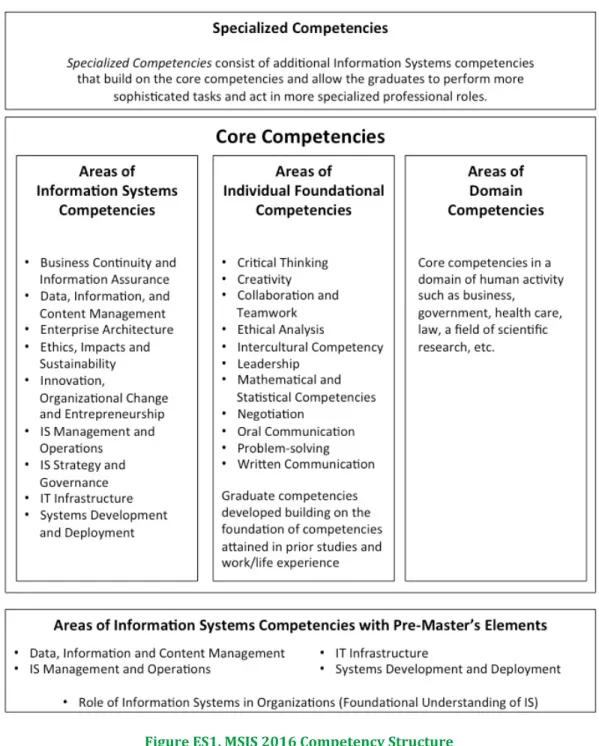
Figure ES1 describes the overall competency structure of MSIS 2016.
4Many readers will find that an area or areas important for them may appear to be missing from this set. It is very likely that they the document includes them either as part of a competency category or a competency.
FigureES1.MSIS2016CompetencyStructure
MSIS programs use various mechanisms to determine the professional profiles for which they prepare their graduates. This document uses a subset of profiles specified in the CEN Workshop Agreement on European ICT Professional Profiles (CEN, 2012) as an example but only as such. This list is not intended to be exhaustive; on the contrary, it is expected that programs will develop and adapt target profiles that fit their specific needs.
MSIS 2016 demonstrates the importance of a mapping between the competency categories and the professional profiles. Programs that follow MSIS 2016 can use the competencies determined based on the target profile(s) to build a set of modules
(courses and equivalents) that will form the structure for students’ learning experiences. MSIS 2016 does not specify how a master’s degree program in IS should be implemented, nor does it specify how exactly specific graduate competency levels should be achieved. Instead, the recommendation provides
process guidance for moving from competencies to an implementable curriculum.
Table
of
Contents
Foreword ... i
Acknowledgements ... ii
Executive Summary ... iii
Table of Contents... vii
Part
A:
MSIS
2016:
Principles
and
Premises
1 Introduction ... 1
2 Principles and Premises Underlying the MSIS Degree and the IS Profession ... 2
2.1 Degree Entry Conditions and Pre‐Program Leveling Experiences ... 2
2.2 Key Degree Characteristics ... 3
2.3 Post‐Experience Degrees ... 6
Part
B:
The
MSIS
2016
Competency
Model
3 Architecture of the MSIS 2016 Competency Model ... 7
4 Overview of the MSIS 2016 Graduate Competencies ... 10
4.1 Big Picture ... 10
4.2 Areas of Information Systems Competencies ... 11
4.3 Areas of Individual Foundational Competencies ... 12
4.4 Areas of Domain Competencies ... 12
4.5 Areas of Prerequisite Competencies with Pre‐Master’s Elements ... 12
4.6 Specialized Competencies ... 13
4.7 Impact of Professional Profiles on Competency Categories ... 13
5 MSIS 2016 Competency Specifications ... 14
5.1 Specifications of Competency Areas, Competency Categories, and Competencies for Information Systems ... 14
5.1.1 Competency Area Specifications ... 16
5.1.2 Competency Categories ... 20
5.2 Specifications of Individual Foundational Competencies ... 24
5.3 Role of Domain Competencies in MSIS 2016 ... 25
5.3.1 Business ... 25
5.3.2 Healthcare ... 26
Part
C:
Using
MSIS
2016
6 Developing a Curriculum Based on MSIS Competency Specifications ... 28
6.1 From Competencies to Curriculum ... 28
6.2 MSIS Curriculum Architectures ... 28
6.2.1 U.S. Model ... 29
6.2.2 European Model ... 30
6.3 Role of Target Profiles in Designing the Curriculum ... 32
6.4 Process for Deriving Courses from Competency Specifications ... 33
6.5 Examples ... 35
6.5.1 Program Focusing on an IT Consultant/Systems Analyst profile ... 35
6.5.2 Program Focusing on the Project Manager profile ... 36
6.5.3 Program focusing on Analytics Specialist Profile ... 37
6.5.4 Program Focusing on Start‐up Entrepreneur profile ... 39
6.6 Teaching and Learning Strategies for Building Competencies ... 40
6.7 Master’s Thesis or a Research Project as Form of Pedagogy ... 42
7 MSIS 2016 Resource Requirements... 43
7.1 Faculty Expertise and Development ... 43
7.2 Internet and Library Resources ... 44
7.3 Computing Infrastructure and Laboratory Resources ... 44
7.4 Pedagogical Support Resources ... 45
Part
D:
Justification,
History,
and
Current
Status
8 Why an MS in Information Systems? ... 46
9 Expectations for an MS in Information Systems ... 48
9.1 Student Perspective ... 48
9.2 University, School, and Department Perspectives ... 49
9.3 Employer Perspective ... 49
9.4 Quality Control Perspective ... 50
9.5 Societal Perspective ... 50
10 Uses of the MSIS 2016 Competency Model ... 51
11 Information Systems Curriculum Guidance – History and Background ... 53
12 Current Status – Review of Global IS Master’s Degree Program Practices by Global Region ... 54
12.2 Length of Program and Amount of Student Work ... 55
12.3 Degree Structures ... 56
13 MSIS 2016 Design Process ... 56
14 Key Differences between MSIS 2006 and MSIS 2016 ... 58
14.1 Geographic Scope ... 58
14.2 Broader Range of Domains of Practice ... 59
14.3 Prerequisites ... 59
14.4 Content ... 60
15 Maintaining the Currency of MSIS 2016 ... 60
16 Conclusion ... 62
17 References ... 63 Appendix A: Detailed Competency Specification
Part
A:
MSIS
2016:
Principles
and
Premises
1
Introduction
MSIS 2016 is a competency specification for master’s level degree programs in information systems (IS). It builds on the essential foundation of four earlier graduate IS model curricula (Ashenhurst, 1972; Nunamaker et al., 1982; Gorgone et al., 2000; Gorgone et al., 2006). At the same time, it represents in several ways a departure from them. Instead of prescribing a curriculum course model, this document specifies a set of Master of Science in Information Systems (MSIS) graduate competency requirements. This recommendation is the result of the work by a global task force for the purposes of the global IS community, a clearly different approach compared to the North American focus of the earlier curricula.
Compared to earlier models, this recommendation offers a significantly stronger focus on three of the nine competency areas: Innovation, Organizational Change, and Entrepreneurship; Ethics, Impacts, and Sustainability; and Enterprise Architecture. The others include Business Continuity and Information Assurance; Data, Information, and Content Management; IS Management and Operations; IS Strategy and Governance; IT Infrastructure; and Systems Development and Deployment.
MSIS 2016 focuses on capabilities that enable graduates to contribute to positive transformation of various goal‐oriented human activities through digitalization. This document explicitly recognizes that master’s degree programs in IS can be offered in the context of multiple types of domains of practice (not only business). Section 2 of this document provides an essential foundational conversation regarding the principles and assumptions that underlie the MSIS degree and the IS profession. Sections 3, 4, and 5 form the core of the document: Section 3 describes the architecture of the competency model, Section 4 reviews the graduate competencies, and Section 5 specifies the expected graduate competencies at a detailed level. Section 6 offers guidance for developing a curriculum based on target competencies, and Section 7 discusses the resources that a high‐quality MSIS program requires.
The remaining sections discuss the justification, history, current status, and future of MSIS 2016. Section 8 presents a broad range of reasons why various stakeholders find an MS degree in IS useful, and Section 9 describes the specific goals for the MSIS from the perspective of these same stakeholder groups. Section 10 discusses a variety of uses for MSIS 2016. Section 11 presents a brief history of the earlier curriculum recommendations as background for this effort. Section 12 reviews the existing MSIS program practices globally by region. Section 13 describes the process through which this recommendation was created. Section 14 analyzes MSIS 2016 compared to MSIS 2006 and describes several major differences between the two
documents. Section 15 describes the processes that will be needed to maintain the currency of MSIS 2016. Section 16 concludes the report.
2
Principles
and
Premises
Underlying
the
MSIS
Degree
and
the
IS
Profession
The MSIS 2016 competency model is based on the following premises regarding the MSIS degree:
1. MSIS is a professional practice master’s degree that focuses on the
development of specialized competencies in IS. In addition, an MSIS degree can provide a foundational preparation for academic research; the programs that choose this emphasis typically require a research thesis. An MSIS degree
focuses on the development of competencies that are aligned with a
specificdomainofpractice (such as business, healthcare, law, government,
education, etc.).
2.1 Degree Entry Conditions and Pre‐program Leveling Experiences
2. An MSIS degree is based on a completed undergraduate degree that
provides a foundation in the core IS competencies as defined in IS 2010 (Topi et al., 2010a). The length of the prior undergraduate degree in IS may vary depending on the national or regional educational system (e.g., in many European countries, an undergraduate degree can be a three‐year degree and lead to a two‐year master’s, while, in North America, a typical undergraduate degree is a four‐year degree). MSIS 2016 does not, however, require all the competencies developed by a typical undergraduate degree in IS as its entry requirements, just a subset of the core competencies as specified in Section 4.5.
3. It is possible for those without an undergraduate degree specified in #2
above to enter an MSIS degree program. These students will, however, need
additional preparation thatprovidestheequivalent ofanundergraduate
preparation in the IS topics specified below. This preparation is often
offered in the form of educational experiences that are called, for example,
bridge modules5, foundations modules, or pre‐program leveling courses. The
topic areas of these modules (together with the references to IS 2010) are:
a. Foundations of Information Systems (IS 2010.1)
b. Data and Information Management (IS 2010.2)
c. IT Infrastructure (IS 2010.5), and
d. Systems Analysis & Design (IS 2010.6).
5The word “module” is used throughout the document to denote various types of structured collections of learning experiences, such as courses, seminars, internships, theses, large‐scale projects, etc.
Section 5 specifies the competencies expected from these learning experiences further.
4. An MSIS degree requires foundational studies in its specified domain of
practice as a program prerequisite or the development of the same competencies through bridge modules.
The most common domain of practice is currently business, but the integration between technology understanding and domain expertise is useful and can be achieved in many other domains, too. Examples of such domains include government and public administration, non‐governmental organizations and other non‐profits, healthcare, education, law, services in general, and many science disciplines. Section 5 discusses domains of practice at a more detailed level.
5. A student entering an MSIS degree program needs to have at least one
university‐levelmoduleinstatisticsoranalytics.
6. An MSIS degree program has no expectations regarding prior
professional experience. Therefore, no competency expectations for
graduates can be built based on prior professional experience. However, it is often valuable for students to have relevant professional experience because it could help them overcome shortcomings in domain knowledge and/or an undergraduate degree (if, for example, the professional experience is in computing). It is possible and fully acceptable that individual schools or departments create MSIS programs targeted to experienced professionals that require a pre‐specified level of professional experience.
2.2 Key Degree Characteristics
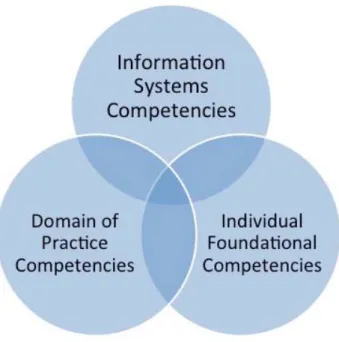
7. An MSIS degree provides competencies in three realms (see Figure 1):
a. Information Systems, including both computing 6 /information
technology (IT) and IS management dimensions
b. Domain of Practice (see discussion above in #4)
c. Individual Foundational Competencies (such as written and oral
communication, critical thinking, ethical analysis, teamwork, leadership, etc.)
The competency category specifications for information systems and specifications for areas of individual foundational competencies are the essential elements of MSIS 2016. In addition, this document provides examples of competency area specifications for two domains of practice. Section 5 discusses these details.
6We recognize that “computing” is used more frequently in North America than in other parts of the world. In Europe and in Asia, “ICT” or “informatics” would often be more familiar synonyms.
Figure1.MSIS2016High‐levelRealms
The emphasis on or balance of competencies in these realms varies depending on the program. All of them should, however, be included in every MSIS degree program.
8. Universities around the world are offering an increasing number of highly
specialized master’s degrees in IS that focus on specific technical competency areas, such as analytics or security. Whether or not such degrees can be considered MSIS degrees depends on the relative proportion of specialized content to core competency areas. Any MSIS degree should support the
development of competencies in all of the four areas discussed above. Ifthe
specialty dominates the degree so significantly that the core
competency categories specified later in this document are not all
covered at the minimum required level, the degree does not fit under
theMSISumbrella.
9. All MSIS degrees will share the same core competency areas, but program
implementations will vary in terms of their emphasis on specific competency categories. The selection of categories that a specific program emphasizes
will depend on the target professionalprofiles (or personas). One possible
source of such profiles is the latest version of the CEN workshop agreement on European ICT professional profiles (CEN, 2012). The MSIS task force evaluated these profiles and agreed that they have broad global applicability. The task force selected six of the 23 ICT professional profiles as the primary MSIS target profiles: Business Information Manager, Project Manager, Business Analyst, Systems Analyst, Enterprise Architect, and IT Consultant
(CEN (2012) describes the profiles). For example, an MSIS program that primarily focuses on preparing its graduates for the integrated Systems Analyst/IT Consultant role will have a different target competency profile compared with the programs that focus on the Project Manager roles (which we feature as examples in Section 6). We also provide examples of two profiles outside the CWA model: one for a digital entrepreneur and another for an analytics professional.
The list specified above is not exclusive: it is perfectly reasonable for a university to offer a master’s degree in IS that prepares its graduates for careers as CIOs or, by contrast, developers or database administrators. It is, however, likely that these types of programs will have additional background requirements, such as significant work experience as an IS manager for the CIO preparation or a much stronger technical preparation for developers or database administrators. These program types will still have to attain the core MSIS competencies at levels specified in Section 5.
10.MSIS 2016 uses four different levels to specify the extent to which a
particular professional profile requires that a competency category be attained. These levels are called Awareness, Novice, Supporting (role), and Independent (contributor). Section 3 describes these levels in more detail. An association between competency categories and corresponding
competency attainment levels is called a competencyprofile.
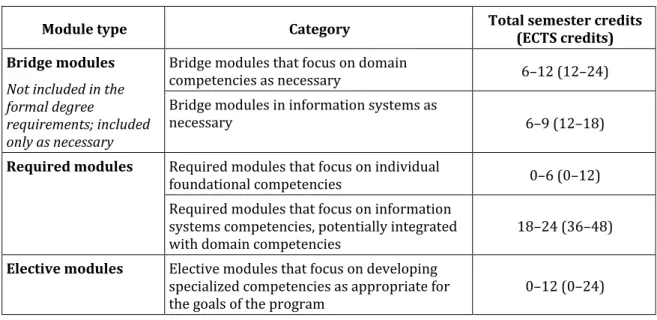
11.An MSIS degree comprises at least 30 semester hours (USA)/ 60 ECTS
credits (Europe)and requires at least11 monthsof full‐timestudy (or
an equivalent amount of part‐time work). This total should not include possible bridge modules in IS and/or the domain of practice.
12.When evaluating the required competencies when a student graduates from
an MSIS program, it is essential to take into account not only the MSIS program components but also the graduate competencies attained before they enter the degree program. This sounds trivial but is easy to ignore in practice.
13.When determining the expected graduate competencies for an MSIS
program, it will be useful to use professional competency models developed during recent years by multiple regional or national governmental organizations (such as the European e‐CF competence framework) or industry organizations (such as U.K.‐based SFIA). Key elements of these models have inspired the MSIS task force’s work. The underlying competency model is also aligned with the international TUNING process and the primarily U.S.‐based Degree Qualifications Profile (DQP) model supported by the Lumina Foundation (Adelman, Ewell, Gaston, & Schneider, 2014).
2.3 Post‐experience Degrees
Many master’s degree programs in IS require students to have experience as IS professionals before and/or during the graduate program and depend on this experience. These programs can be highly valuable and lead to excellent outcomes. Master’s degree programs that are highly individualized, address just‐in‐time professional needs, and include components collected over a long period of time could become a very popular or even a dominant program model in the future. It would, however, be difficult to build a curriculum or competency recommendation for these programs given the significant differences between students’ backgrounds and program expectations regarding them. Programs targeted primarily to pre‐ experience students may, naturally, let students with relevant professional experience adjust their curricula so that they better fit their existing competencies. For example, experienced network/systems administrators may have competencies that allow them to take an advanced elective instead of an intermediate course in IT infrastructure.
The IS community would likely benefit from a mechanism that allows IS professionals to acquire and collect educational experiences over their professional careers and build recognized credentials based on them. We do, however, recommend that this type of degree be built separately with an identity that differs from that of an MSIS (it could, for example, be an executive master’s that comprises multiple certificates). This type of separation would likely benefit both the pre‐ experience MSIS and the post‐experience degree. All of these are mechanisms through which IS professionals acquire new competencies or strengthen existing ones as part of their lifelong learning process. Offering them can, however, be an important part of a university’s mission, but it is clearer if a separate degree type is specified for them.
In addition, we recognize the existence of MBA concentrations in IS as a separate entity from master’s degrees in IS. An MBA is a generalist degree designed to focus primarily on the development of managerial capabilities, and an MBA concentration seldom provides the type of technical depth expected from a specialized master’s in IS.
Part
B:
The
MSIS
2016
Competency
Model
3
Architecture
of
the
MSIS
2016
Competency
Model
In this section, we discuss the underlying conceptual structure of the MSIS 2016 competency model. In brief, we specify the model using graduate competencies as its foundational element instead of courses/modules or knowledge areas, units, and topics.
Historically, most computing curriculum documents have been built around a typically hierarchical knowledge area–knowledge unit–topic (KA/KU/topic) structure that forms a body of knowledge (BoK). For example, the most recent computer science curriculum recommendation (CS2013) has 18 knowledge areas that contain five to 12 knowledge units each. Each knowledge unit, in turn, includes topics. For example, the Information Management knowledge area has 12 knowledge units, such as Relational Databases. This knowledge unit has 11 topics, which are familiar to those who teach IS courses in this area, such as mapping conceptual schema to relational schema, entity and referential integrity, and so on. A potential problem with the KA/KU/topic structure is, however, that it focuses mostly on cognitive aspects of learning and leaves experiential elements out. A curriculum based on a knowledge area structure conveys relatively little on what the graduates are able to do at the time of graduation. Some observers might find this perfectly acceptable because they do not view applicable skills and attitudes as a goal of university education; for others, it is a major problem because they hold a broader view of the goals of a university degree.
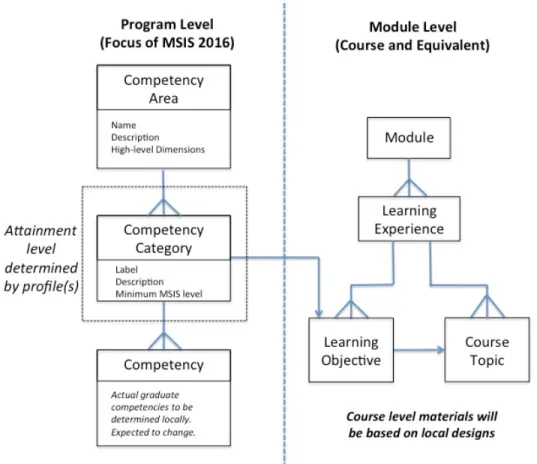
Prior IS model curricula have always included some type of a representation of an IS BoK, but none of the IS curricula has been structured around the BoK structure in the same way as the other computing curricula are. Instead, the IS curricula have been represented mainly through courses (both core and elective/specialized) with learning objectives and topics (see the right‐side panel of Figure 2). This approach has been used in IS 2002 (Gorgone et al., 2002), IS 2010 (Topi et al., 2010a), MSIS 2000 (Gorgone et al., 2000), and MSIS 2006 (Gorgone et al., 2006). The main challenge of this approach is that it typically presents a course‐specific view without providing a detailed program‐level representation of expected graduate capabilities. Some of these curricula—particularly IS 2010—dedicate significant attention to the specification of program‐level graduate capabilities at a high level of abstraction, but even IS 2010 never maps the course level with the program level to analyze or demonstrate how the courses contribute to the way in which students achieve the program‐level objectives.
Figure2.MSIS2016Program‐levelGraduateCompetenciesvs.Module‐levelTopicsand LearningObjectives
From the beginning of the project, the MSIS 2016 task force followed a third and increasingly commonly used model (see the left panel of Figure 2). Instead of specifying a body of knowledge or a set of courses, this model identifies a set of graduate competencies. In this context, we use the term “competency” to refer to graduate ability to use knowledge, skills, and attitudes to perform specified tasks successfully. Using more refined language, Lockoff et al. (2010, p. 21) define competencies as follows:
Competenciesrepresentadynamiccombinationofcognitiveandmetacognitive
skills, demonstration of knowledge and understanding, interpersonal,
intellectualandpracticalskills,andethicalvalues.
We are aware of the complex discussion associated with the term “competency” (see Hoffmann, 1999; Paquette, 2007). In this context, we do not contribute to that conversation but simply specify competency as an integrative concept that brings together graduate knowledge, skills, and attitudes.
The MSIS 2016 competency model specifies competencyareasas the highest‐level
categorization of competencies. The areas, in turn, include competencycategories,
and these categories specify the actual competencies. Competency areas and
competency categories are much more stable and depend less on technology than the competencies themselves. In addition, there will be much more local variation in
the competencies than at the higher levels. Therefore, the competencies should be primarily seen as current examples.
Each competency area has a name, a brief (paragraph‐long) description, and three to five high‐level dimensions. Each category is specified with a name and a brief description, as is each competency in a category.
All programs will not, however, prepare students to attain competencies at the same level in all competency categories. Different professional profiles have different competency needs, and the professional profiles that a program desires its graduates to be able to achieve determine the level at which a program should enable its graduates to attain each of the competency categories.
MSIS 2016 specifies four different levels of competency category attainment:
Awareness, Novice, Supporting (role), and Independent (contributor). We define
these levels as follows:
At the Awareness level, a graduate knows that the competency category
exists and is aware of the reasons why it is important for the domain of practice and individual organizations that use information systems to achieve their goals. Graduates at this level have not yet reached SFIA level of responsibility 1 (SFIA, 2016, pp. 15–18).
At the Novice level, a graduate can effectively communicate regarding
matters related to the competency, perform component activities under supervision, and develop on‐the‐job experience related to the competency. This level corresponds closely to SFIA level of responsibility 1.
At the Supporting (role) level, a graduate has achieved a level of knowledge
and skill that allows him/her to collaborate effectively in a supporting role with colleagues who have achieved a higher level of the competency to produce the desired outcomes. This level corresponds closely to SFIA levels of responsibilities 2 and 3.
At the Independent (contributor) level, a graduate has achieved a level of
knowledge and skills that allows the graduate to perform without continuous support/supervision the tasks required to produce the desired competency outcomes. This level corresponds closely to SFIA level of responsibility 4. Higher levels of competencies do exist and could be considered (such as an expert level). A master’s degree program alone cannot, however, bring a student to the highest levels of competency and, thus, are not included as targets for general MSIS programs. There are, of course, examples of master’s programs for experienced professionals that are carefully designed to integrate academic content, pedagogy, and professional experience so that students can attain the highest levels of learning. One cannot, however, expect this level of achievement as a general requirement.
In their seminal book, Dreyfus and Dreyfus (1986; see also Dreyfus & Dreyfus, 2005) articulate a five‐stage model of skill acquisition (novice, advanced beginner, competent, proficient, expert). Although the levels are not directly applicable to the
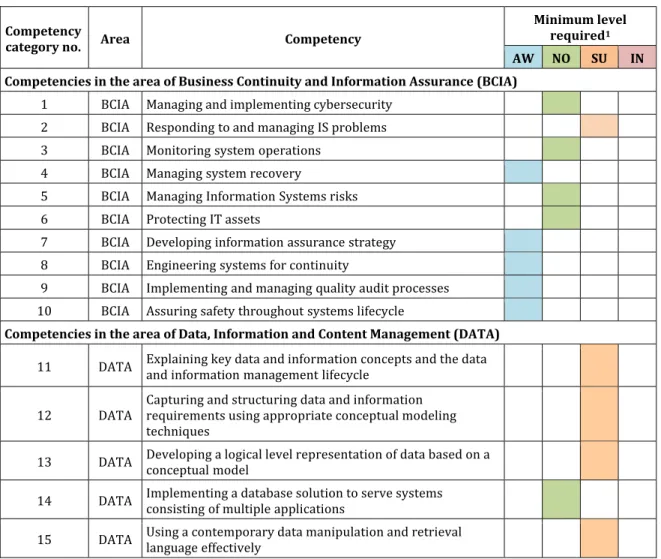
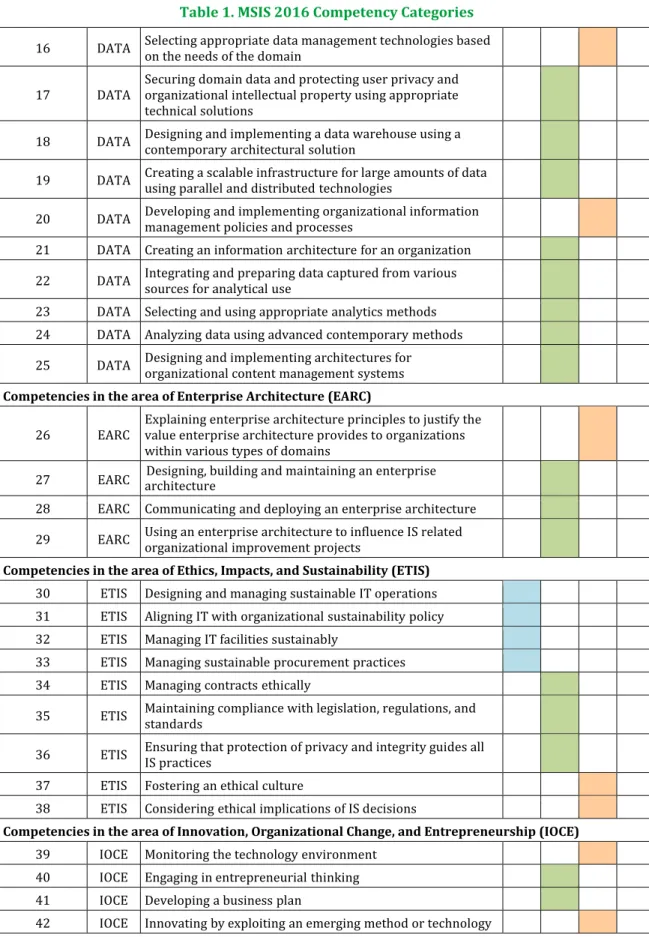
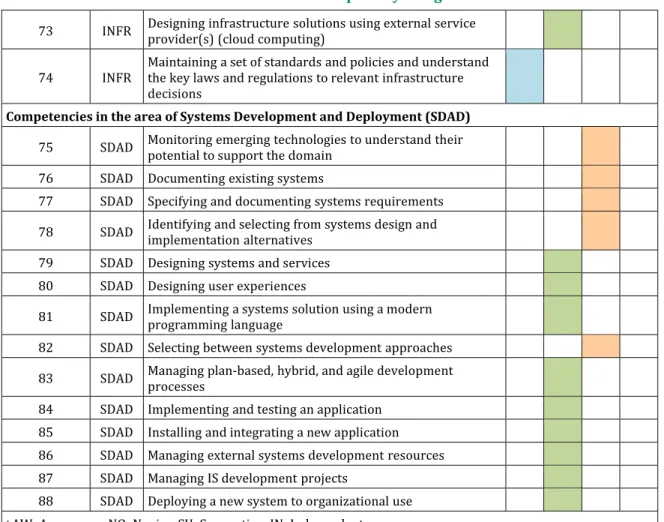
development of professional competencies, there are at least two specific aspects of the model that are highly relevant. First, it is not possible to develop human competencies beyond the novice level only based on abstract knowledge without a close association with a context; developing situational awareness requires learning through experience. Second, gaining the highest levels of skill achievement requires highly involved engagement in a variety of situations relevant to the skill of interest. All MSIS 2016 degree programs are expected to enable their graduates to attain a total of 88 competency categories at least at the awareness level, and, for many categories, the required minimum level is higher. Section 5 identifies the minimum required MSIS 2016 achievement levels for each competency category.
4
Overview
of
the
MSIS
2016
Graduate
Competencies
4.1 Big Picture
Most importantly, the MSIS is a degree at the master’s level, and, as such, MSIS graduates should exhibit general characteristics of master’s program graduates as specified in the Dublin Descriptors (Bologna Working Group, 2005). That is, graduates need:
To “have demonstrated knowledge and understanding that is founded upon
and extends and/or enhances that typically associated with Bachelor’s level, and that provides a basis or opportunity for originality in developing and/or applying ideas, often within a research context”
Be able to “apply their knowledge and understanding, and problem‐solving
abilities in new or unfamiliar environments within broader (or multidisciplinary) contexts related to their field of study”
“Have the ability to integrate knowledge and handle complexity, and
formulate judgments with incomplete or limited information, but that include reflecting on social and ethical responsibilities linked to the application of their knowledge and judgments”
Be able to “communicate their conclusions, and the knowledge and rationale
underpinning these, to specialist and non‐specialist audiences clearly and unambiguously”, and
“Have the learning skills to allow them to continue to study in a manner that
may be largely self‐directed or autonomous”.
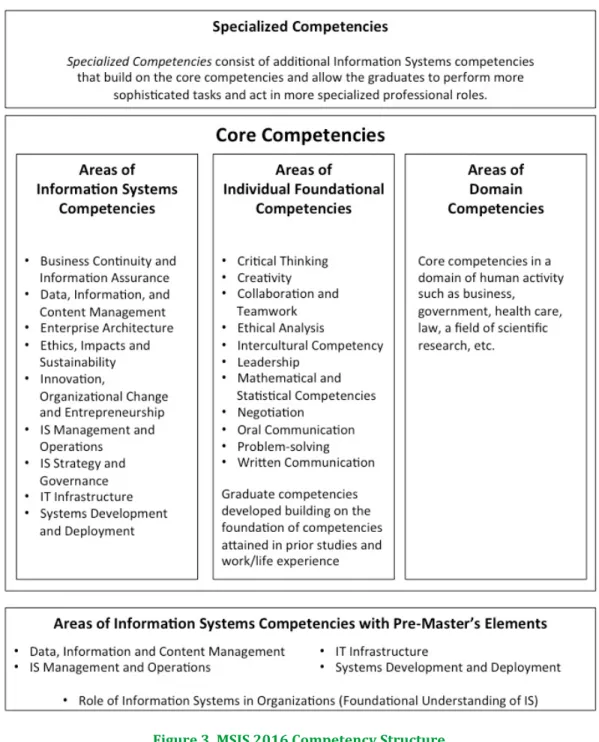
Overall, an MSIS program develops competencies in three realms: Information Systems Competencies, Individual Foundational Competencies, and Domain Competencies (see also Figure 1). Figure 3 presents an overview of the MSIS competency area structure. The rest of this section discusses its elements in more detail.
Figure3.MSIS2016CompetencyStructure
4.2 Areas of Information Systems Competencies
IS competencies (including both computing/IT and IS management dimensions) form the center of the MSIS competency specification: the competencies included in this element are distinctively our discipline’s own competencies. Individual foundational competencies and domain competencies (see Sections 4.3. and 4.4, respectively) are, in practice, shared as outcomes with many other program types. Most of this document focuses on reviewing in more detail the competency areas, categories, and sample competencies in the IS competencies element. Figure 3 lists
the competency areas. We detail these areas, categories, and competencies at a significantly more detailed level in Section 5.1.
4.3 Areas of Individual Foundational Competencies
Individual foundational competencies are those competencies necessary for all knowledge professionals in a variety of professions, such as communication, collaboration, and problem solving. They are specified only at the highest level of abstraction per area level. The specific areas of competencies chosen for MSIS 2016 are an extended version of the set articulated in IS 2010. This list has been modified by separating competencies that were presented together in IS 2010. Figure 3 shows the list of these competencies, and Section 5.2 discusses it in more detail. 4.4 Areas of Domain Competencies
The MSIS is a professional practice master’s degree that always integrates information systems with a specific domain of practice (such as business, healthcare, legal environment, government, K–12 education, higher education, etc.). MSIS 2016 does not articulate a set of detailed competencies for any single domain of practice to avoid the impression of giving one domain a priority status, but it does provide examples of competency areas for two domains in Section 5.3.
4.5 Areas of Prerequisite Competencies with Pre‐Master’s Elements
Most computing curricula target the undergraduate level, so the entering student’s qualifications for these curricula are typically defined as a secondary education (e.g., high school) degree. As a master’s degree, MSIS has to consider additional dimensions of the incoming student background. The first requirement for incoming MSIS students is an earned bachelor’s degree. In most contexts, a bachelor’s degree requires about 120 semester credit hours or 180–240 ECTS credits (three to four years of full‐time work). This is, however, just a basic technical requirement.
In addition, for an MSIS degree to achieve its objectives regarding graduate competencies, incoming students should already have acquired a certain set of prerequisite competencies related to IS. Earlier versions of the MSIS curriculum have specified these competencies as prerequisite courses. In MSIS 2006, these courses included IS Fundamentals and Programming, and Data, Files, and Object Structures (both specified as IS 2002 courses).
In MSIS 2016, the task force has moved to a model that specifies a set of prerequisite competencies. A necessary but not sufficient prerequisite is foundational understanding of IS—that is, understanding the role of information systems in organizations. We recommend a literature‐based examination or a bridge course to ensure sufficient coverage of basic understanding that IS constitutes not only technologies and software but also a whole system with users and their activities. The theoretical approach to cover is the general systems theory (e.g., von Bertalanffy, 1968) because it helps to structure the area and is a vital tool in problem‐solving activities in complex environments. Systems theory is also a helpful viewpoint into the complexities in all competency areas. Many of the prerequisite
competencies are in the same competency areas that include competencies specified for MSIS graduates but should be gained at an earlier stage. Specifically, the prerequisite competencies are included in three areas: 1) Data, Information, and Content Management; 2) IT Infrastructure; and 3) Systems Development and Deployment (Figure 3; see also Section 5 for details).
As for the individual foundational competencies, MSIS 2016 does not make specific assumptions regarding the competencies that incoming students have. It does, however, assume that the undergraduate/first‐cycle degree requirement has given students competencies in oral communication, written communication, leadership and collaboration, negotiation, analytical and critical thinking, creativity, ethical analysis, and problem solving (as specified, for example, in IS 2010). As a master’s degree, MSIS 2016 strengthens and brings these competencies to a level compatible with master’s level expectations.
Please note that MSIS 2016 does not take a position regarding the preferred way in which students should acquire the prerequisite competencies. Clearly one way to
get them is to have an undergraduate degree in IS or in a related applied
computingdiscipline. It is also possible that an incoming student has acquired the
required competencies through work experience (which, of course, needs to be
verified with appropriate testing). Finally, students can achieve the prerequisite
competencies by taking bridgemodules before the actual graduate program starts.
Whichever mechanism is used, students need to attain the competencies in a way that allows them to fully use the prerequisite competencies as part of the master’s level study process—the master’s program should be built on the assumption that all students have the prerequisite competencies and can use them.
4.6 Specialized Competencies
As Figure 3 indicates, specialized competencies comprise additional IS competencies that build on the program’s chosen core competencies and allow graduates to perform more sophisticated tasks and act in more specialized professional roles. Specialized competencies may also create differentiation between career tracks in addition to the differences specified with the secondary core competencies. The specialized competencies enable MSIS graduates to serve in roles that require competencies in a specific area of technical expert knowledge, such as security or analytics. Not all specialized master’s degrees leading to specialized IS competencies are MSIS degrees—an MSIS requires that, in addition to the specialized competencies, the program enables its graduates to attain all core competencies at the minimum at a level specified in Table 1 below (in Section 5.1.2). 4.7 Impact of Professional Profiles on Competency Categories
This recommendation recognizes that there are significant differences between MSIS programs. One of the most important dimensions relates to graduates’ expected professional profiles. It is unlikely that any MSIS program would only prepare its graduates for one specific profile, but target profiles vary and the chosen
profile(s) have an impact on the expected graduate competencies and, through these, the curriculum.
CEN (2012) describes in detail the six professional profiles that have been chosen as the most likely targets for MSIS programs: Business Analyst, Business Information Manager, Enterprise Architect, IT consultant, (IT) Project Manager, and Systems Analyst. It is clear that the specific definitions of these profiles vary depending on the regional, national, and local requirements, but it is likely that the general characteristics of each profile are close to each other regardless of the location. As mentioned above, all 88 competency categories belong to the core of the MSIS because all MSIS programs should enable their graduates to attain them at least at the Awareness level (see Section 3 for the definition of the levels). In addition, this
recommendation specifies for each of the competency categories the minimum
level that all graduates should attain. For 22 competency categories, the minimum
level has been specified as Awareness, for 46 categories as Novice, and for 20
categories as Supporting. No minimum levels have been specified as Independent.
We recognize that many programs prepare their graduates to achieve this level with some or even many competencies, but this document recognizes that, particularly with programs targeted to students with little or no work experience, this level is very difficult to achieve.
Section 5.1 specifies the competency categories and a set of competencies in each that should be viewed as examples. For each category, it further specifies the minimum level at which each MSIS degree program needs to enable its graduate to attain each category.
5
MSIS
2016
Competency
Specifications
This section provides additional contextual information for the nine competency areas in IS competencies (overview in Figure 4; details in Section 5.1), 11 areas of individual foundational competencies (Section 5.2), and competency area examples for two domains of practice (Section 5.3).
5.1 Specifications of Competency Areas, Competency Categories, and
Competencies for Information Systems
The task force has benefited significantly from the following sources when developing the competency structure outlined in this section:
The European e‐Competence Framework (e‐CF) 3.0: A Common European
Framework for ICT Professionals in All Industry Sectors
(www.ecompetences.eu)
The Skills Framework for the Information Age (SFIA) (www.sfia‐
online.org/en)
2012 Clinger‐Cohen Core Competencies & Learning Objectives (CIO Council, 2012).
The task force gratefully acknowledges the significant impact of all these outstanding specifications of IT professional competencies on the process of MSIS 2016 competency development. In addition to these specifications, the task force used primary data collected from MSIS program directors, current students, alumni, and corporate stakeholders regarding graduate competency priorities.
Material from all these sources was integrated in a multi‐staged grouping process that took place at the competency category level: the categories were first grouped into competency areas, and then individual competencies were articulated for each of the competency categories. As discussed above, the individual competencies are less stable than the areas and categories, and they are not intended to be exhaustive. This section documents the competency areas (see Figure 4 for summary) with two tables and a narrative description. First, we present a narrative description of the areas and high‐level dimensions of the areas. After that, Table 1 summarizes the competency areas and categories and provides a convenient overview of the IS competencies. Appendix A includes the detailed competency examples.
5.1.1 Competency Area Specifications
CompetenciesintheareaofBusiness7ContinuityandInformationAssurance
(BCIA)
Areadescription: the Business Continuity and Information Assurance competency
area mainly concerns the continuity, auditing, and assurance of information systems. It generally covers areas such as risk avoidance, security management, and quality auditing. The challenging issues related to business continuity and information assurance span from tactical and strategic to technical and operational levels. They often involve a range of processes from management, such as policy and standard setting, to hands‐on skills, such as system contingency and recovery planning.
High‐levelareadimensions: Graduates will be able to:
1. Create policies and standards for business continuity and information
assurance.
2. Plan and implement procedures, operations, and technologies for managing
risk and trust, security, and safety and for business continuity and disaster recovery.
3. Monitor, control, and institutionalize the protection and growth of the
hardware, software, and information assets in information systems.
CompetenciesintheareaofData,Information,andContentmanagement
(DATA)
Area description: the Data, Information, and Content management area covers
competencies that enable graduates to be effective contributors in processes that improve the domain’s ability to achieve its goals using structured and unstructured data and information effectively.
High‐levelareadimensions: Graduates will be able to:
1. Identify data and information management technology alternatives, select
the most appropriate options based on the organizational information needs, and manage the implementation of the selected options.
2. Identify, create, and manage organizational policies and processes related to
data and information management by balancing multidimensional requirements, such as legal and regulatory requirements, ethical considerations and implications of technology decisions, organizational business requirements, data quality issues, and requirements of operating in an international environment.
3. Analyze the needs of a domain and determine how those needs can best be
addressed with data, information, and content management solutions.
7We use the term business continuity here because of its longstanding use to refer to the continuity of all types of domain activities.
CompetenciesintheareaofEnterpriseArchitecture(EARC)
Area description:Enterprise architecture has two aims: managing the complexity
of information systems and technologies and aligning these systems/technologies with the organization’s strategy. The area covers competences that enable graduates to participate in planning, building, using, maintaining, and evaluating architectures.
High‐levelareadimensions:Graduates will be able to:
1. Design an enterprise architecture (EA). This involves identifying and applying a
formal approach to EA development, performing the multistage process of developing an EA, identifying the EA change needs, and applying them to the EA. Graduates are able to incorporate information, domain activity processes, technology platforms, applications, software, and hardware in the EA while considering the alignment between domain requirements and technology development.
2. Deploy and maintain an EA. This involves conveying the architecture to domain
process owners, software development and maintenance projects, and infrastructure planners and taking into account the current status of the projects and infrastructure. This also includes gathering input from the enterprise and from technology developments for maintaining the architecture and performing architecture maintenance.
CompetenciesintheareaofEthics,ImpactsandSustainability(ETIS)
Area description:the Ethics, Impacts, and Sustainability competency area covers
the conceptualization and implementation of environmentally and socially sustainable IT solutions that are aligned with the responsibilities of organizations and in compliance with legislative and regulatory requirements and industry standards. This competency area addresses key questions such as environmental and social sustainability, safety and health, privacy, and integrity. It also covers the impact of IT on the nature of work and workplaces and explores how culture and ethics (internal pertaining to organizations and external pertaining to stakeholders) shape behavior. These areas tend to be aligned with a strategic or a tactical level of organizational decision making.
High‐levelareadimensions:Graduates will be able to:
1. Apply sustainable approaches for IT solutions development, IT procurement,
IT operations, IT resources management, and other IT practices.
2. Ensure safety and avoid health hazards for contract arrangements with
external parties and internal systems development, maintenance, and reuse.
3. Ensure that privacy and integrity guide all IT practices.
4. Interpret and comply with legislative and regulatory requirements governing
IT practices as well as industry standards for IT practices. Understand how culture and ethics shape compliance behavior.
CompetenciesintheareaofInnovation,OrganizationalChange,and
Entrepreneurship(IOCE)
Area description: the Innovation, Organizational Change, and Entrepreneurship
area covers the capability to recognize and exploit the potential afforded by current and upcoming technologies to address existing and new business opportunities. This area also includes competencies required to understand and to intervene in different forms of domain activities (e.g., work units, work teams, processes, organizations, markets, society setting) in order to use information technologies to improve the way those business activities are structured and performed.
High‐levelareadimensions: Graduates will be able to:
1. Monitor the environment in order to identify and evaluate new IS methods
and trends in terms of their appropriateness for an organization.
2. Develop innovative domain activity models that rely on new uses of existing
technology or new technologies themselves.
3. Develop a plan to exploit new and emerging methods and technologies for
new purposes in an organization.
4. Devise new ways of structuring and performing domain activities at different
levels (individual, team, process, and organization) while considering the enabling and enhancing effects of information technology applications.
5. Estimate the benefits of the new designs, assess the consequences of their
implementation, and anticipate potential adverse consequences.
CompetenciesintheareaofISManagementandOperations(ISMO)
Areadescription: the IS Management and Operations area covers the capability to
develop, maintain, and consistently improve domain performance while providing appropriate information systems, services, and infrastructure. The capability focuses externally on creating value for the domain and internally on IS staff motivation, performance, and accountability.
High‐levelareadimensions: Graduates will be able to:
1. Apply professional management skills to the design and management of an
effective IS organization.
2. Ensure operational efficiency and effectiveness in service delivery.
3. Govern IS project management principles and support their use in the
organization.
4. Manage information systems use.
5. Manage information resources together with line management.
CompetenciesintheareaofISStrategyandGovernance(ISSG)
Area description: the IS Strategy and Governance area covers the creation and
implementation of long‐term plans for designing, delivering, and using organizational information systems to achieve strategic domain goals and objectives. This area also covers monitoring and controlling organizational IS
resources to ensure alignment with and achievement of strategies, goals, and objectives.
High‐levelareadimensions: Graduates will be able to:
1. Analyze the effect and impact of IS on industries, firms, and institutions;
develop and implement plans of action for maximizing firm benefits associated with IS design, delivery, and use; and manage IS resources financially.
2. Create and manage the oversight mechanisms by which an organization
evaluates, directs, and monitors organizational IT. These mechanisms may leverage one or more governance frameworks; hence, understanding the process of applying and analyzing a framework is a critical competency. Distribution of decision rights and organizational decision‐making practices are other key components of this competency area.
3. Establish practices for minimizing environmental impacts and planning for
long‐term firm viability.
CompetenciesintheareaofITInfrastructure(INFR)
Area description: the IT Infrastructure area covers competencies that allow
graduates to contribute to needs analysis for and design and implementation of effective, technically correct IT infrastructure solutions.
High‐levelareadimensions:Graduates will be able to:
1. Design integrated communication networks for small‐ and medium‐size
organizations, including local area networks and the use of wide‐area network technologies to connect the local networks.
2. Specify requirements for large‐scale network solutions.
3. Design an implementation architecture for organizational data processing
and system solutions, using both internal hardware resources and external service solutions.
4. Negotiate and enforce contracts with providers of IT infrastructure services.
CompetenciesintheareaofSystemsDevelopmentandDeployment(SDAD)
Area description: the Systems Development and Deployment area covers the
design of information systems and services, including the design of how humans interact with and how they experience IT artifacts. It also includes competencies related to systems implementation and the deployment of systems to organizational use.
High‐levelareadimensions: Graduates will be able to:
1. Analyze and specify requirements for IT artifacts through studying and
documenting the whole or part of some form of domain activities (e.g., work unit, work team, process, organization, market, society setting) in terms of the actions they involve and the information they deal with. Define