Masters Theses & Doctoral Dissertations
Spring 3-2018
The CybHER Program supported by CISSE
Framework to Engage and Anchor Middle-school
Girls in Cybersecurity
Pamela Rowland Dakota State University
Follow this and additional works at:https://scholar.dsu.edu/theses Part of theDatabases and Information Systems Commons
This Dissertation is brought to you for free and open access by Beadle Scholar. It has been accepted for inclusion in Masters Theses & Doctoral Recommended Citation
Rowland, Pamela, "The CybHER Program supported by CISSE Framework to Engage and Anchor Middle-school Girls in Cybersecurity" (2018).Masters Theses & Doctoral Dissertations. 337.
The CybHER Program supported by CISSE Framework to
Engage and Anchor Middle-school Girls in Cybersecurity
A dissertation submitted to Dakota State University in partial fulfillment of the requirements for the degree of
Doctor of Science in Information Systems March 2018 By Pamela Rowland Dissertation Committee: Dr. Ashley Podhradsky - Chair
Dr. Gabe Mydland Dr. Jennifer Nash Dr. Cherie Noteboom
Acknowledgement
It will be difficult to express my gratitude in a short amount of text, so please realize my gratitude goes beyond what you read on this page.
First, I would like to thank Dr. Ashley Podhradsky, my dissertation chair. She has been an encourager, mentor, and friend throughout this process. Your invaluable encouragement and support have propelled me to stay positive and keep moving. Your hard work and determination as a woman in cybersecurity is an inspiration. You conquer more and do more than anyone I know. Thank you for being a role model and a friend.
I am extremely grateful to my dissertation committee members Dr. Gabe Mydland, Dr. Jennifer Nash, and Dr. Cherie Noteboom. Gabe, your sense of humor and insights into the research process are forever etched in my work. Jennifer, your careful readings of all my drafts, your gentle guidance, and your encouragement helped refine and make this research far better than I could have made it. Cherie, your time, commitment, and encouragement to making sure the research was sound and complete was invaluable.
I would also like to thank the many faculty at Dakota State University that have given me words of encouragement, thoughts to ponder, and that have challenged me perhaps without even realizing that they did. As I entered this adventure in my late 40s, there were skeptics,
supporters, and friends that helped me be determined, encouraged, motivated, and ultimately to make it to the end. Each person had a small or large part in the process, and I am thankful.
And finally, I want to thank the most important people in my life – my husband and kids. They are my biggest supporters, prayer warriors, and friends. Loren, thank you for always
believing in me, loving me, and holding my hand through all our adventures. Tom and Breanna, your determination to be the best at your field is inspiring. Your love for life, Jesus, and your ability to have fun in the midst of hard work has helped me to see life through a different lens. Tom and Ashlee, you two have taught me that there is joy and fun to be had, and to take a moment to experience the joy. Your love for each other and the Lord shine through everything you do. Amanda, you inspire me with your dedication and determination. As you walk your path, your faith is revealed at every step. Your dreams and goals are going to come true. Be patient and keep moving. Celina, what a joy you are to our family. You keep us all focused on what is important – each other and our faith. The future is wide open and bright for your amazing self.
I dedicate this dissertation to my dad and mom who taught me to never stop learning, to be kind, and that love always wins.
Abstract
There is a piercing shortage of personnel in the cybersecurity field that will take several decades to accommodate. Despite being 50 percent of the workforce, females only account for 11 percent of the cybersecurity personnel. While efforts have been made to encourage more females into the field, more needs to be done. Reality shows that a change in the statistics is not taking place. Women remain seriously under-represented in cybersecurity degree programs and the workforce.
Prior research shows that elementary girls are equally as interested in the cyber path as boys. It is in middle school that this interest shifts, which raises interesting questions about middle-school girls’ perceptions of cyber-related studies. This study focuses on middle-school girls’ perceptions of cybersecurity and what promising practices can be discovered to engage middle school girls in cybersecurity. These promising practices are then applied to the CybHER program.
Drawing on literature from gender gap and STEM research, prior interventions, and anchoring girls to the field, this study looks specifically at adolescent females in middle school. Through open-ended interviews, rich data was collected to form the CISSE framework of promising practices. The CISSE framework shows that community, influence, social media connection, education, increase in self-efficacy, and education are important factors to anchor girls in a cybersecurity career path.
The CISSE framework assisted in developing and enhancing the comprehensive program called CybHER. CybHER started as simply a name with a dream. By incorporating the CISSE framework, paying attention to prior successes and prior research, the CybHER program
developed into a comprehensive program that includes intervention methods to educate and motivate girls to pursue cybersecurity. Five CybHER themes make up the program. These themes recognize time and relationships as important elements to girls.
CybHER provides community, influence, social media connection, increased self-efficacy and education while also producing anchors for girls in cybersecurity. Evaluation from experts in the field suggest that the program will make a significant difference in recruitment and retention of girls.
Declaration
I hereby certify that this dissertation constitutes my own product, that where the language of others is set forth, quotation marks so indicate, and that appropriate credit is given where I have used the language, ideas, expressions or writings of another.
I declare that the dissertation describes original work that has not previously been presented for the award of any other degree of any institution.
Signed,
_____________________________ Pamela Rowland
Contents
Dissertation Approval Form ... II
Acknowledgement ... III Abstract ... V Declaration ... VI List of Figures ... X List of Tables ... XI Chapter 1: Introduction ... 2
Background of the Problem ... 2
Research Questions ... 4
Structure of Paper ... 5
Chapter 2: Literature Review ... 6
Introduction of Literature Review ... 6
Social Belonging and Social Cognitive Theory ... 6
Policy and Programming to Recruit Women into STEM ... 7
Role models ... 9
Promoting STEM at Middle School Age ... 9
Schein’s Career Anchor Theory ... 10
Summary of Literature Review ... 11
Chapter 3: The Research Methodology and Method ... 12
Introduction ... 12
Design Science ... 12
Qualitative Exploratory Interview Research ... 16
Seven Stages of an Interview Investigation ... 17
Design Science Research Process ... 20
Activity 1: Problem identification and motivation. ... 20
Activity 2: Define the objectives for a solution. ... 21
Activity 3: Design and Development. ... 21
Activity 4: Demonstration and Activity 5: Evaluation. ... 21
Activity 6: Communication. ... 22
Research Method ... 22
Interviews and Analysis... 22
Research Method ... 23
Participants ... 24
Ethical issues ... 24
Limitations of sample ... 25
Data Collection Process ... 25
Chapter 4: Interview Analysis and Development of Framework ... 28
Data Analysis ... 28
Results ... 31
Community ... 31
Influence ... 32
Social Media Connection... 34
Self-Efficacy ... 35
Education ... 35
Conclusion ... 36
Chapter 5: The Artifact: The CybHER Program ... 38
CybHER Minutes ... 40 CybHER Hours ... 40 CybHER Days ... 41 CybHER Together ... 41 Anchors ... 41 Evaluation ... 43 Formative Evaluation ... 43 Questions ... 44 Evaluation Results ... 45
Expected Results, Contributions and Discussion ... 54
Chapter 6: Discussion and Conclusion ... 57
Fulfilment of Research Objectives ... 57
How do middle school girls perceive the cybersecurity field? ... 57
What are some promising practices to engage middle school girls in cybersecurity? ... 57
How can the promising practices be applied to and enhance the CybHER project? ... 58
Contributions ... 58
Future Research ... 58
Conclusion ... 59
Bibliography ... 61
Appendix A: Definition of Key Terms ... 66
Appendix B: Interview Questions ... 67
Appendix C: Informed Consent and IRB approval number ... 69
List of Figures
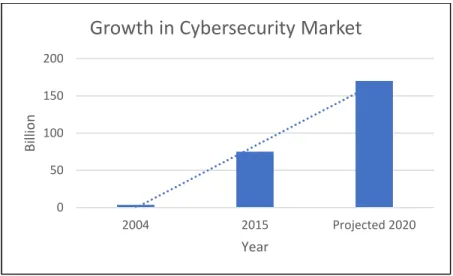
Figure 1: Chart of expected growth in Cybersecurity market ... 3
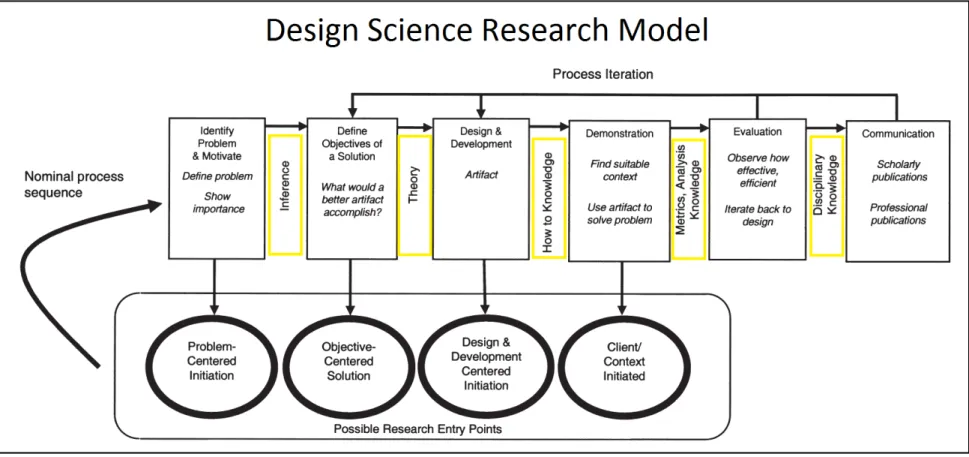
Figure 2: Design Science Research Model ... 15
Figure 3: Steps in an interview study (Rose, Spinks, & Canhoto, 2014) ... 23
Figure 4: The CISSE framework ... 31
List of Tables
Table 1: Structure of Paper ... 5
Table 2: Efforts to increase participation in cybersecurity. ... 8
Table 3: Relationship between Questions and Constructs ... 19
Table 4: Research Process and Research Techniques ... 22
Table 5: Demographics of Participants and Transcripts (*recording failed) ... 26
Table 6: Demographics cont. ... 26
Table 7: Code Groups ... 29
Table 8: Constructs represented in Code Groups ... 30
Table 9: CISSE Framework connected to CybHER Themes ... 39
Table 10: CybHER Anchor Themes ... 42
Table 11: Interview questions and Analysis ... 46
Table 12: Categories and Ratings ... 50
Chapter 1: Introduction
Background of the Problem
A fresh approach is needed to combat the underrepresentation of women within the cybersecurity workforce. This phenomenon is typically termed the gender gap. The need for cybersecurity workers is increasing, and the gender gap is not improving. There is a clear
disconnect between the cybersecurity industry and the message adolescent girls receive about the field; indicating that this industry is not for them. We need to act now, starting with girls in middle school to help them sustain interest throughout their education. I believe that with
innovative teaching materials and pedagogical approaches, female students could be motivated to choose a cybersecurity degree.
By the year 2020, there is expected to be a deficit of 1.5 million professionals in the cybersecurity field (Nolte, 2015). The cybersecurity market grew from $3.5 billion in 2004 to $75 billion in 2015, with a forecast of reaching $170 billion by 2020 (Morgan, 2016). The human capital crisis is one of the most significant obstacles we face in an effort to meet the growing demand in the market.
The Bureau of Labor Statistics states “employment of computer and information
technology occupations is projected to grow 12 percent [annually] from 2014 to 2024, faster than the average for all occupations. These occupations are expected to add about 488,500 new jobs, from about 3.9 million jobs to about 4.4 million jobs from 2014 to 2024” (Occupational Outlook Handbook, 2016).
Figure 1: Chart of expected growth in Cybersecurity market
Nationally, the gender gap has been well recognized and documented (Foundation, 2017). A theme has emerged showing women are not entering the computing field in large numbers, and most notably this is seen in cybersecurity (Securing Our Future: Closing the Cybersecurity Talent Gap, 2016). Currently, only 11% of computer security professionals are women,
therefore, retaining and growing the number of women in cybersecurity is key to addressing the shortfall of trained professionals while improving the diversity of thought that experts state will strengthen our national security (Davidson, 2017).
There is a growing interest and focus on diversity in the global IT economy. A diverse workforce is a reflection of the world and marketplace. There are several benefits to a diverse workforce. First, it contributes to increased levels of innovation and creativity (Florida, 2005; Green, López, Wysocki, & Kepner, 2002). Second, it increases employee recruitment and retention (Kossek & Pichler, 2007). Third, diversity lends itself to the creation of more diverse products and services (Joshi & Kuhn, 2001). Including more women in cybersecurity will not only increase the number of workers, but will also increase the quality, creativity, innovation, and group problem solving (Jayne & Dipboye, 2004; Konrad, 2003).
Awareness programs of cyber careers have grown in the recent years. These activities include career exploration incentive programs, clubs, job fairs, competitions, scholarships, mentoring programs, and camps. A recent report indicated that 26% of the young people surveyed were more aware of these opportunities from the previous years, however the gender
0 50 100 150 200 2004 2015 Projected 2020 Billion Year
Growth in Cybersecurity Market
gap maintains with nearly twice as many men as there are women knowing about these activities (Securing Our Future: Closing the Cybersecurity Talent Gap, 2016).
Adolescents lack awareness of the wide range of opportunities in cybersecurity.
Perceptions of computer science careers are frequently limited to gaming or programing (Grover, Pea, & Cooper, 2014; Shumba et al., 2013), and cybersecurity is not seen as different from computer science. Social activities often draw girls into STEM activities, but girls do not realize that cybersecurity has a high social component. Girls perceptions of cybersecurity are important to examine as this field differs from computer science. Cybersecurity requires a unique set of skills including crisis management, forensics, and the ability to work on a collaborative team (Bagchi-Sen, Rao, Upadhyaya, & Chai, 2010; Tims, Turner, Corbett, Deemer, & Mhire, 2014).
We have many challenging problems in the field of cybersecurity and for that reason alone we must engage women as an untapped resource in our national effort to protect our citizens and infrastructure. Globally there is a growing focus on cybersecurity leading to demands for a larger and more diverse workforce.
Although prior research has begun to examine girls’ perceptions of computer science, little is known about how adolescent girls perceive cybersecurity, or the unique ways in which we might engage more adolescent girls in cybersecurity. The focus of this research is to seek to understand middle school girls’ perceptions of cybersecurity and build a framework for
increasing and engaging females in the field of cybersecurity that can be implemented in the CybHER program.
CybHER is a project focused on supporting and engaging more girls and women in cybersecurity. The name of the project was just the beginning. Prior efforts of reaching girls with one-time outreach events and camps was not enough. Developing and designing a more comprehensive program was the next step. This research was a part of that process.
Research Questions
Utilizing data gleaned from interviews with 14 middle-school girls, this study examines the following research questions:
1. How do middle school girls perceive the cybersecurity field?
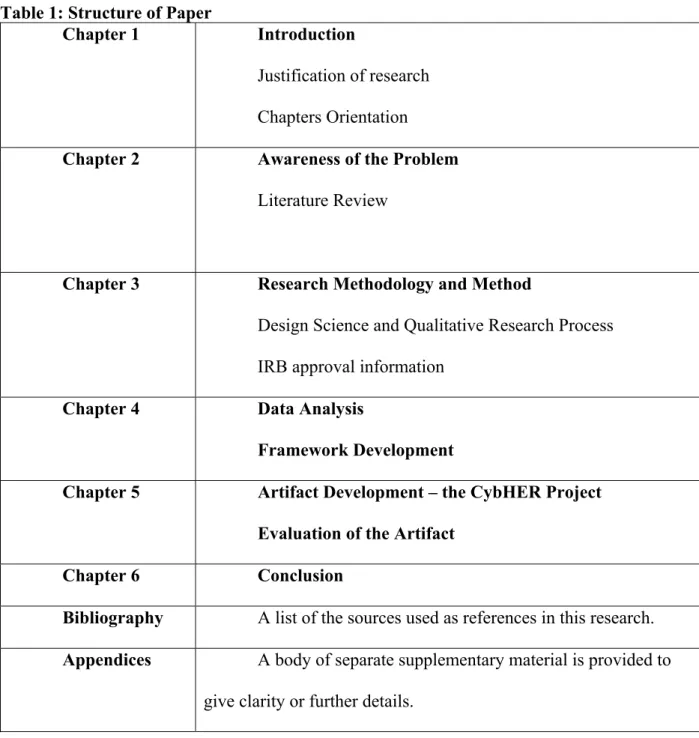
Structure of Paper
Table 1: Structure of Paper
Chapter 1 Introduction
Justification of research Chapters Orientation
Chapter 2 Awareness of the Problem
Literature Review
Chapter 3 Research Methodology and Method
Design Science and Qualitative Research Process IRB approval information
Chapter 4 Data Analysis
Framework Development
Chapter 5 Artifact Development – the CybHER Project Evaluation of the Artifact
Chapter 6 Conclusion
Bibliography A list of the sources used as references in this research.
Appendices A body of separate supplementary material is provided to give clarity or further details.
Chapter 2: Literature Review
Introduction of Literature Review
This chapter provides background literature on related theories, practices that have been deemed effective for engaging females, challenges girls face in cybersecurity through the lens of computer science, policies and programs currently in effect, and support for reaching adolescent girls. It concludes with career development theory related to anchoring females to a career.
Social Belonging and Social Cognitive Theory
Women in cybersecurity have a disadvantage when it comes to identifying with a group. In 2016, only 11% of information security professionals were women (Sullivan, 2017). Social belonging proves to be important to intellectual achievement. Social belonging is a basic human desire (Baumeister & Leary, 1995) and group identities can be fundamental to a person's self-concept (Tajfel & Turner, 1979). Both social belonging and group identities can influence a young girl’s career path and self-efficacy.
The social cognitive theory identifies self-efficacy, which relates to personal beliefs about capabilities to learn or perform (Bandura, 2000). Self-efficacy influences academic motivation, learning, and achievement (Pajares & Schunk, 2001). Environmental factors influence self-efficacy, and in the case of girls’ interest in cybersecurity, the environmental factors tend to be masculine.
There is a fine line between the desire to belong and the desire to be different (Hornsey & Jetten, 2004). The core value of individualism indicates that people should be free to explore their individuality and to express their true selves (Bellah, 1985; Spindler & Spindler, 1990). Social connection causes individuals to ask, “Do I belong?” When an individual’s social connection is threatened, motivation to pursue individual desires or interests can be affected.
When individuals are in a state of belonging uncertainty, they may notice threatening cues that they may otherwise overlook (Kleck & Strenta, 1980; Mendoza-Denton, Downey, Purdie, Davis, & Pietrzak, 2002). As young girls interested in computing enter middle school, they notice the threatening cues of conformity to social expectations, gender stereotypes, and gender roles. Middle school is a time when girls expand their social group and reassess their
The widely expanded social reference group, coupled with the shift in evaluation standards, requires that students reassess their academic abilities. Consequently, perceptions of academic competence typically begin to decline during middle school (Harter, 1996; Midgley, Feldlaufer, & Eccles, 1989). As elementary and middle school girls face belonging uncertainty they are influenced to look at areas of study that they feel a belonging in. Research has shown that these societal level factors have influenced female student’s career choices and commitment to a field (Shih, Pittinsky, & Ambady, 1999; Steele & Ambady, 2006).
In his hierarchy of needs, Maslow (1968) placed the need to form loving social bonds immediately above other drives, such as satisfying hunger (Hall & Nougaim, 1968). The need to belong does not have to be fulfilled through interpersonal relations; it can also be fulfilled
through group memberships. A supportive group can motivate individuals to continue to explore an area of study. The underrepresented group of women in cybersecurity can benefit from belonging to a social group that encourages, motivates, and provides opportunities for education in cybersecurity. Women in male-dominated professions experience social identity threat more significantly than women in more gender-balanced fields (Richman, Vandellen, & Wood, 2011). Providing a community to girls starting at a young age will give girls the sense of belonging that will help them persist in cybersecurity studies.
Policy and Programming to Recruit Women into STEM
To increase gender diversity in the STEM and computing fields, many outreach programs targeting female adolescents have been created by the higher education community. These
programs use outreach activities and classes to introduce girls to computing and the format varies from after-school programs to day workshop to summer camps.
Governments and organizations worldwide are concerned about the cybersecurity skills crisis. The Cyber Security Act (2009) was created by Congress to address this problem
(Rockefeller, 2010). National efforts to promote computer science have been prominent in the last decade. Table 2 outlines a sample of these efforts. Most of the efforts include computer science, technology, and cybersecurity awareness.
Table 2: Efforts to increase participation in cybersecurity.
Project Website Sponsor Objective
Computer Science Principles
csprinciples.org NSF and College Board Focused on developing an
Advanced Placement course to “broaden participate in computing and computer science” ("CS Principles,").
GenCyber gencyber.org NSA Learning cybersecurity
principles in a fun and inspirational way ("GenCyber," 2017). CyberCorps
Scholarships for Service
sfs.opm.gov NSF Scholarships for students at
CAE designated schools ("CyberCorps®: Scholarship for Service," 2017). National Initiative for Cybersecurity Education (NIST) nist.gove US Department of
Commerce “The mission of NICE is to energize and promote a robust network and an ecosystem of cybersecurity education, training, and workforce development” ("National Initiative for Cybersecurity Education (NICE) | NIST," 2016).
NCWIT ncwit.org National Center for
Women & Information Technology (NSF is the primary sponsor)
A national non-profit organization tha tworks to increase meaningful participation of girls and women in computing (Ncwit, 2017).
AAUW aauw.org The American
Association of University Women
AAUW empowers women to improve their lives (Aauw, 2017).
Girl Scouts girlscouts.org Girls Scouts The Girl Scouts have added
a cybersecurity badge to their program (Gsblog, 2017).
Girls who Code girlswhocode.com Girls who code Mission: “Girls Who Code
was founded with a single mission: to close the gender
Despite these and other attempts to broaden participation, not enough progress has been made in closing the gender gap and recruiting more cybersecurity workers.
Role models
Research shows that female role models positively impact women in typically male-dominated fields (Grabisch & Rusinowska, 2010; Young, Rudman, Buettner, & McLean, 2013). Role models increase a woman’s implicit identification within the field, while decreasing the implicit gendered stereotypes. Limited access to female role models in cybersecurity reinforces the image of the field (Catherine Ashcraft, 2012) and continues to hinder the field.
Promoting STEM at Middle School Age
Evidence suggests that girls are becoming uninterested in computer science in
adolescence. Educators have learned that waiting to engage female students until high-school is too late (LeClair & Pheils, 2016). By focusing on girls in middle school, options are offered that may grow into anchors for their future studies and careers.
A 2017 survey by Microsoft found that young girls in Europe become interested in STEM subjects around the age of 11. Girls lost interest around the age of 15. "Conformity to social expectations, gender stereotypes, gender roles and lack of role models continue to channel girls' career choices away from STEM fields," said psychology professor Martin Bauer of the London School of Economics, who helped coordinate the survey of 11,500 girls across 12 European countries (Petroff, 2017). And once interest is lost, it doesn’t appear that girls ever rebound.
The underrepresentation of girls and women in cybersecurity and computer science has a unique set of challenges. Research shows girls tend to express less confidence and rate their computer knowledge lower than boys, however achievement levels are similar (Cooper, 2006; Moorman & Johnson, 2003; Shapiro & Williams, 2012). Girls also perceive the computer science field as masculine, ‘geeky’, and isolated (Cheryan, Drury, & Vichayapai, 2013; Margolis & Fisher, 2003; Shumba et al., 2013).
When individuals are in a state of belonging uncertainty, they may notice threatening cues that they may otherwise overlook (Kleck & Strenta, 1980; Mendoza-Denton et al., 2002). Young girls interested in computing notice the threatening cues of conformity to social
expectations, gender stereotypes, and gender roles. Middle school is a time when girls expand their social group and reassess their academic abilities (Pajares & Schunk, 2001).
A 2016 report by Accenture and Girls who Code shows that women entering computing jobs is declining. The report suggests that “universal access to computing in schools will not address the gender gap, and only by tailoring to girls’ specific needs can we boost their
commitment to computing (Cracking the Gender Code in Computing - Accenture and Girls Who Code, 2016).” Finding novel ways to bring cybersecurity topics to middle school girls serves to address the recognized national need for recruitment. This would begin to address the widening gap between the availability and demand for qualified and diverse security professionals.
Designing security interventions that are creative, socially relevant, and accessible to an underrepresented population in cybersecurity is a challenge that informs how education and outreach can be performed within other contexts.
Schein’s Career Anchor Theory
The career anchor theory was first developed by Schein (Schein, 1971), who later
described a career anchor as “his or her self-concept, which consists of self-perceived talents and abilities, basic values, and evolved sense of motives and needs as pertaining to a career” (Schein, 1996). Schein’s research shows that this self-concept evolves over time, however once formed, “it functions as a stabilizing force, an anchor, and can be thought of as the values and motives that a person will not give up if forced to make a choice” (Schein, 1996). Fifty percent of women leave the cyber field within 12 years (Glass, Sassler, Levitte, & Michelmore, 2013), a rate more than two times what it is for men (Hewlett, 2008) and 10% more than the already abysmal attrition rate for women in general engineering (Silbey). Creating anchors is a necessity to achieve a vibrant and diverse workforce. Anchors can be identified and created through education and outreach (Noteboom & Rowland, 2017).
This leads to a very important question, how can anchors be formed? Schein identifies eight anchors that most people’s self-concepts revolve around. These include 1)
autonomy/independence; 2) security/stability; 3) technical-functional competence; 4) general managerial competence; 5) entrepreneurial creativity; 6) service or dedication to a cause; 7) pure challenge; 8) life style.
Summary of Literature Review
From the literature review I note that to expand the number of females as cybersecurity professionals more attention needs to be placed at the middle school age. Middle school girls are at a critical turning-point that will either motivate them to learn more about cybersecurity or will cause a disinterest that will be hard to reclaim in future years (LeClair & Pheils, 2016; Pajares & Schunk, 2001; Petroff, 2017).
I also note that while there are intervention programs, more needs to be done. Research needs to be continued recognizing that generations change, but the problem has not. Role models, community, and social engagement are three key elements that draw girls to explore cybersecurity. This research will identify key elements and promising practices of the current generation of middle school girls and relate those to an intervention program.
And finally, while current programs may peek an interest, anchoring girls to this area is vital. Anchors are defined as “a heavy object attached to a boat or ship by a rope or chain that is thrown into the water to hold the boat or ship in place” (Merriam-Webster). This study also looks at ‘holding’ female students ‘in place’.
Chapter 3: The Research Methodology and Method
Introduction
This chapter will address the research methodology and research method. The research methodology is the broad philosophical base of the chosen research methods. Research
methodology addresses how the research is done and includes the steps that are generally adopted by a researcher in studying the research problem (Kumar, 2008). Kumar (2008, p. 5) defines research methods as ‘the methods the researcher uses in performing research operations.’ In this research methodology chapter, I will first outline the design science research process and conclude with qualitative research.
Design Science Research (DSR) mixed with qualitative research will be the methodology used for this project. DSR addresses the social context and has the best potential for influencing practice by producing tangible programs and products. Qualitative research yields data that provides depth and detail to create understanding of a phenomenon and lived experience.
Studies using mixed methods combine quantitative and/or qualitative approaches during different phases of the research process to create a product that is aligned with pragmatic paradigm
(Tashakkori & Teddlie, 1998). Using qualitative and design science provides a better
understanding of the research problem and the design of the artifact. Exploratory interviews will be conducted to critically review the initial list of predetermined key concepts, to clarify the problem and to identify perceptions which could be investigated and addressed when developing the artifact.
The goal of this research is to design a framework from the qualitative results that will be utilized in a program, therefore the design science methodology will be used in conjunction with the qualitative method.
Design Science
Design science will be the primary research method followed. The design science research method is intended to understand a phenomenon. While the gender gap has been in existence, a significant change has not occurred. The shortage of women in computing is still a challenge for the US economy and global competitiveness.
Currently much of the research around the gender gap is based on descriptive knowledge (explanatory science) (Mike Gallivan, 2013; Michael Gallivan & Benbunan-Finch, 2008), which is theory driven and includes the development of knowledge by understanding the social world including describing, explaining, and possibly predicting shared understanding (van Aken, 2004).
DSR is focused on practical problem solving and includes prescriptive or solution-oriented knowledge where the results are from scientific justification including predicting, understanding, or explaining a phenomenon. Scientific justifications can be used in designing solutions to complex problems. DSR is used to design solutions to field problems by describing and analyzing alternative courses of action.
Simon’s inspired Design Science in The Sciences of the Artificial (Simon, 1969). Simon argues that an important source of knowledge can be found from the human-constructed world of the ‘artificial’. These ‘artificial’ sciences focus on usefulness and contingency (possibility). “Whereas natural sciences and social sciences try to understand reality, design science attempts to create things to serve human purposes” (Simon, 1969). This research is intended to design a framework to serve human purposes, specifically to understand middle school girls’ perceptions of cybersecurity, identify promising practices, and provide a program that will reach girls and ultimately increase the numbers of females in cybersecurity.
Design science was introduced to the research community in the late 1960s, but it is a relatively new approach within the Information Systems discipline (Hevner, March, Park, & Ram, 2004). The ultimate goal of design science is development of design knowledge. Van Aken included social innovations as an artifact, and stated that “the ultimate mission is to develop design knowledge, i.e. knowledge that can be used in designing solutions to problems” (van Aken, 2004).
While there may not be one best research methodology to undertake a particular research project, the researcher has to be able to make an informed choice. This study uses DSR as the philosophical approach for discovering and identifying opportunities relevant to increasing the number of women in cybersecurity. This study will look at creating a new or improved
explanation at the end of the process. DSR is not concerned with the action itself, but with the knowledge to be used in designing solutions (van Aken, 2004).
There are many models in DSR that are reported in high-impact journals (Hevner, 2007; Järvinen, 2004; March & Smith, 1995; Peffers, Tuunanen, Rothenberger, & Chatterjee, 2007; Vaishnavi & Kuechler, 2004). The main processes are 1) establish awareness of problem, 2) development of the artifact and evaluation, 3) connecting to theory (developing knowledge).
I will use the 6-step design science process created by Peffers, et al, which are outlined later in this chapter. This research model incorporates three objectives related to IS research: consistent with prior literature, provides a process for doing DS research, and provides a model for presenting and evaluating DS research (Peffers et al., 2007).
Qualitative Exploratory Interview Research
A strength of the qualitative research portion of this study is that it yields data that provides depth and detail to create understanding of a phenomenon and lived experience. Past studies have shed light on the gender gap primarily in Computer Science or other STEM fields, have motivated intervention programs, but have yielded little results in closing the gender gap, and very few studies have focused specifically on cybersecurity. Hence, this study is designed to provide a current understanding of middle school perceptions around cybersecurity by focusing on the qualitative aspects. Interview questions will elicit data based on common community perceptions related to the closest field, computer science, while also seeking specific data related to cybersecurity. By identifying characteristics, this study will strengthen the knowledge base on which decisions can be made to recruit more girls into the cybersecurity field. This study will draw attention to some important dynamics that prevail within the current middle school community.
The qualitative research interview is intended to seek, describe and obtain meanings of central themes in life situations. The main task is to understand the meaning of the interviewee’s dialog (Kvale, 1996).
Interviewing is particularly useful to get the story behind the participants experiences. Interviews are more time-consuming and resource intensive than questionnaires, however they are more personal. By using exploratory interviewing, I can start with an initial list of questions and explore responses during the interview process. This will give the me more opportunity to discover meanings and themes by asking follow-up questions. Interviews are also found to be easier for the respondent, and because I am seeking opinions and impressions from middle-school girls, this will be a valuable means of data collection.
I will be using the general interview guide approach which is intended to ensure the same general areas of information are collected from each interviewee while allowing follow-up exploration. This approach provides more focus than a conversational approach where there are no predetermined questions, while still allowing some freedom and adaptability in gaining information.
Phone interviews are used because it is easier to connect with the students, it is a more personal approach than a survey, and it is easier to ask open-ended questions and follow-up questions. The disadvantages of the phone interview process are that the interviewer can be biased, it requires strong interviewing skills, can reach only a small sample, and analysis can be difficult.
Since the interviews control the quality of the results, I have prepared by reading Kvale’s guide to interviewing several times as well as other resources (Kvale & Brinkmann, 2009b). As a student researcher, one of the disadvantages to this method is lack of experience. As the researcher, I have prepared ahead of time and followed the stages and suggestions closely. Interview bias is acknowledged, and awareness is key to staying unbiased.
Seven Stages of an Interview Investigation
I will be following Kvale and Brinkmann’s seven stages (Kvale & Brinkmann, 2009a). 1. Thematizing an interview – the why and what of the investigation – the research aim. 2. Designing – protocol of how interview is to be undertaken
3. Interviewing – conduct the interview
4. Transcribing – preparing the interview material for analysis 5. Analyzing – coding the data and discovering themes
6. Verifying – ascertain validity and reliability 7. Reporting – communicating findings
Questions
Research interviews are a conversation between two individuals. Knowledge is created within the points of view of the interviewer and the interviewee (Kvale & Brinkmann, 2009b). Utilizing a semi-structured interview seeks to obtain descriptions of the world of the interviewee. There is openness to change the sequence and forms of the questions to follow up on specific answers given. As stated by Spradley:
“I want to understand the world from your point of view. I want to know what you know in a way you know it. I want to understand the meaning of your experience, to walk in your shoes, to feel things as you feel them, to explain things as you explain them. Will you become my teacher and help me understand? (Spradley, 2016)”
Questions have been developed utilizing guidelines, prior research, and these helpful ideas from Interviews, Learning the Craft of Qualitative Research Interviewing (Kvale & Brinkmann, 2009b):
Questions are brief and simple. One question will be asked at a time.
Introductory questions are engaging.
Interview questions focus on:
o Behaviors - what a person has done or is doing.
o Opinions/values - what a person thinks about the topic.
o Feelings - what a person feels rather than what a person thinks.
o Knowledge - to get facts about the topic.
o Sensory - what people have seen, touched, heard, tasted or smelled.
o Background/demographics - standard background questions, such as age, education, etc
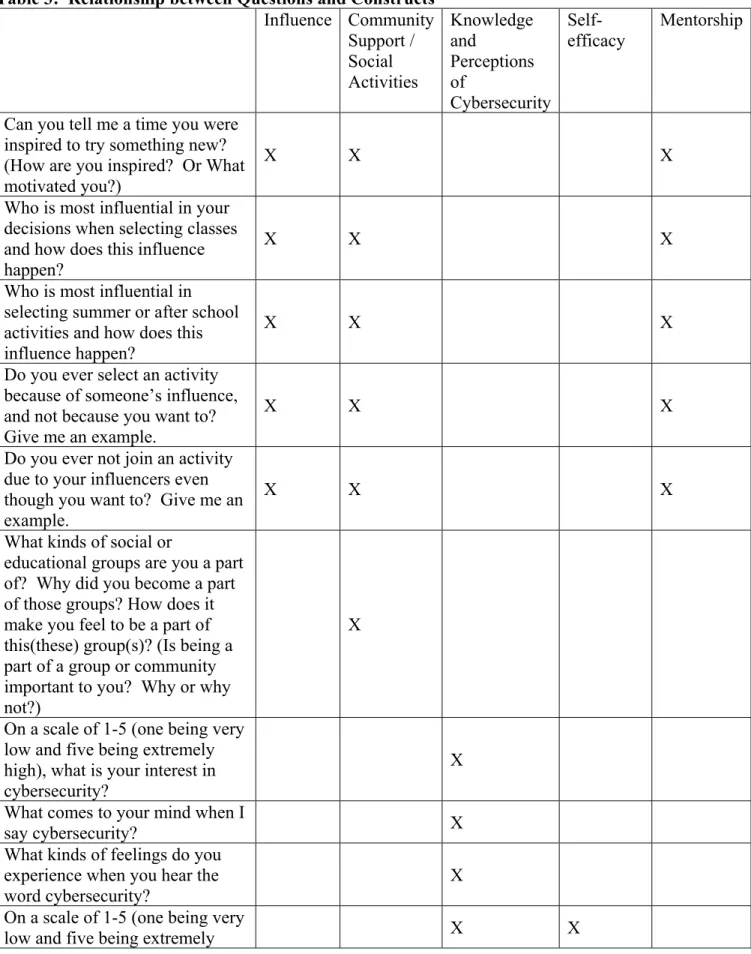
Constructs identified within the literature review are explored. Questions and related constructs can be found in Table 3. A full list of questions can also be found in Appendix B, while keeping in mind that I am using exploratory interviews that allow for follow-up
questioning. Constructs used in development of the questions are as follows:
Influence (Bright, Pryor, Wilkenfeld, & Earl, 2005; Chai & Kim, 2012; J. C. Turner, 1991; S. V. Turner, Bernt, & Pecora, 2002)
Community support (Barr & Stephenson, 2011; Springer, Stanne, & Donovan, 1999; Williams, Wiebe, Yang, Ferzli, & Miller, 2002) and Social activities (J. C. Turner, 1991)
Knowledge and perceptions of cybersecurity
Self-efficacy – one’s belief about one’s own abilities (Bandura, 1982; Busch, 1995)
Table 3: Relationship between Questions and Constructs Influence Community Support / Social Activities Knowledge and Perceptions of Cybersecurity Self-efficacy Mentorship
Can you tell me a time you were inspired to try something new? (How are you inspired? Or What motivated you?)
X X X
Who is most influential in your decisions when selecting classes and how does this influence happen?
X X X
Who is most influential in selecting summer or after school activities and how does this influence happen?
X X X
Do you ever select an activity because of someone’s influence, and not because you want to? Give me an example.
X X X
Do you ever not join an activity due to your influencers even though you want to? Give me an example.
X X X
What kinds of social or
educational groups are you a part of? Why did you become a part of those groups? How does it make you feel to be a part of this(these) group(s)? (Is being a part of a group or community important to you? Why or why not?)
X
On a scale of 1-5 (one being very low and five being extremely high), what is your interest in cybersecurity?
X What comes to your mind when I
say cybersecurity? X
What kinds of feelings do you experience when you hear the
word cybersecurity? X
On a scale of 1-5 (one being very
Influence Community Support / Social Activities Knowledge and Perceptions of Cybersecurity Self-efficacy Mentorship
high), how to you rate yourself on cybersecurity knowledge? What kinds of jobs do you think of when you think of a
cybersecurity career? Could you tell me how you feel about these types of jobs?
X X X X
What does a typical cybersecurity professional look like?
When you are unsure of a subject or topic, how do you learn more about the subject/topic?
X X
Do you enjoy computing classes? X X
Looking back, do you enjoy computing classes more or less now than in the last two years?
X X
Would you tend to take
computing classes, why or why not?
X What three classes do you
typically feel like you belong in? (or in other words, you feel most like you are a part of)
X X X X
Do you have a role model? How did that person become your role
model? X X
What characteristics do you want
in a role model or mentor? X X
Design Science Research Process
Activity 1: Problem identification and motivation.
Two types of research methods will be used to establish awareness of the problem: 1) literature review and 2) interviews utilizing qualitative research.
This research study is started with a critical literature review, see Chapter 2. The review is done to establish an in-depth understanding of the gender gap in cybersecurity and the current models or programs designed for middle school girls. While there are several theories and
enrichment activities, there is need for a program that could provide consistent and lasting impact to girls.
Exploratory interviews will be conducted with middle-school girls. The IRB process will be followed. These interviews will identify current perception of cybersecurity among middle school girls. Interview questions are listed in Appendix A. Interviews will be transcribed, deidentified, and coded using Atlas.ti and researching processes.
During the analysis the data will be condensed (summarized), grouped (categorized), and relationships will be identified between categories as a narrative to support meaningful analysis (Kvale & Brinkmann, 2009b).
Activity 2: Define the objectives for a solution.
Research Objectives:
1. To understand how middle school girls perceive the cybersecurity field.
2. To identify some promising practices to engage middle school girls in cybersecurity and create a framework.
3. To apply the framework to a project. Activity 3: Design and Development.
This is the creation of the artifact, which will be a program. To develop the program, four to seven general themes for classification need to be identified. These themes will emerge through literature review and interview data collection (Creswell & Clark, 2007). The categories will be descriptive and analytical links will emerge between the categories and interpretation of the data (Corbin & Strauss, 1990). The themes will be put into a framework that can be used in other programs and projects.
Activity 4: Demonstration and Activity 5: Evaluation.
In some DSR projects, one would build a solution through synthesis and try it out in practice. However, in this research study, existing practical (that is they are clearly working in practice) solutions that are compatible with the conceptual solution (Simon, 1969; Venable, Pries-Heje, & Baskerville, 2012) have been identified, and the program will be evaluated by
Activity 6: Communication.
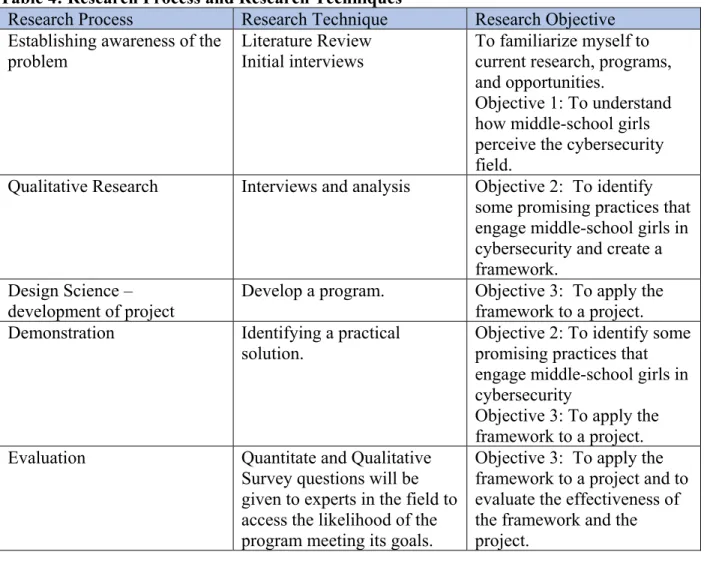
The results of this research will be shared through scholarly publications, my dissertation publication, and presentations at conferences. I will make a strong contribution to applied practice through this dissertation research. Table 4 outlines the relationship between the design science research process and the research techniques.
Table 4: Research Process and Research Techniques
Research Process Research Technique Research Objective
Establishing awareness of the problem
Literature Review Initial interviews
To familiarize myself to current research, programs, and opportunities.
Objective 1: To understand how middle-school girls perceive the cybersecurity field.
Qualitative Research Interviews and analysis Objective 2: To identify
some promising practices that engage middle-school girls in cybersecurity and create a framework.
Design Science –
development of project Develop a program. Objective 3: To apply the framework to a project.
Demonstration Identifying a practical
solution.
Objective 2: To identify some promising practices that engage middle-school girls in cybersecurity
Objective 3: To apply the framework to a project.
Evaluation Quantitate and Qualitative
Survey questions will be given to experts in the field to access the likelihood of the program meeting its goals.
Objective 3: To apply the framework to a project and to evaluate the effectiveness of the framework and the project.
Research Method
Interviews and Analysis
Chapter 3 outlined the interview process. In this chapter I will further explain the research method, clarify the participants and the ethical issues of the research, identify limitations, and finally cover the data collection process.
Research Method
To analyze the interview data, I used qualitative techniques. The qualitative techniques allowed me to explore and focus on a smaller number of interviews to help illuminate, clarify, and deepen my understanding of middle school girls perceptions towards cybersecurity (Neuman, 2002). The interviews allowed me to understand the phenomena within real-life contexts (Berg, 2004). This study addresses the real-life context of middle school girls’
experiences, influences, and knowledge of cybersecurity. Additionally, I explored their interests and how they use social media. I also examined perceptions based on the literature and the constructs identified in Table 3.
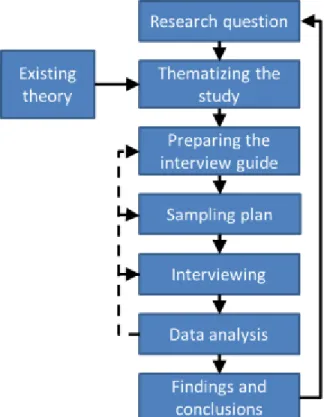
The key steps involved for this interview study are found in Figure 2. This process has a series of feedback loops underlining the developing character and emerging findings.
Preparation is very important for the interviews to produce worthwhile findings. Kvale and Brinkmann call this ‘thematising’ the study (Kvale & Brinkmann, 2009a). Through my research questions and knowledge of existing theory, I have a clear understanding of my topic. This process also helped me identify issues and formulate relevant questions.
Kvale and Brinkmann’s seven stages (Kvale & Brinkmann, 2009a) were followed closely and are outlined previously in Chapter 3.
Participants
This study was approved by the Institutional Review Board (IRB). Participants for this study were middle school girls from Midwest schools. To develop the list of participants, I contacted middle school principals, teachers, and parents in the community. After interviewing a participant, I would ask them for additional contacts who might be able to contribute to our study. This technique of identifying participants is sometimes called the snowball technique or chain referral technique. Although this approach may have issues, if managed appropriately it can be useful for qualitative research (Biernacki & Waldorf, 1981).
Ethical issues
The main ethical issues to consider when interviewing middle-school girls are consent, confidentiality, and the issue of consequences (Dixon, 2015). All ethical issues were addressed through the university IRB process.
Informed Consent
Informed consent ensures that all subjects participating in the interview freely and voluntarily consent to participate. This includes informing participants of their rights to withdraw at any time. The IRB approval process ensures protection of the participants in the study.
Confidentiality
Confidentiality means that private data cannot be linked to participants and will not be disclosed. Participants were provided with the information regarding how I will protect their identity. Each interview transcription was de-identified, and all private data was removed.
Consequences
The risks of harm were addressed in the IRB process. The potential benefits and importance of knowledge gained outweighed any harm to the participant. I felt this study was justified because exploring middle-school girls’ perceptions about cybersecurity could lead to creating a framework for reaching more middle-school girls to explore this area.
Limitations of sample
Although the sampling technique and purposiveness allowed for the development of in-depth and rich information about middle school girls’ perceptions, there are some limitations and problems. One of the major limitations is that the results are not generalizable. A majority of the interviews came from one region in one Midwest state with a unique culture and context, thus the results are context bound (Museus, 2010). Another limitation is the lack of a
comparison group. For future research, comparing female students’ responses to male students would indicate if the perceptions were unique to females, if there were crossover, or if any were uniquely different. A third limitation, is selection bias. The initial set of students were selected by principals and teachers, and it is possible that they selected individuals they felt would respond well to a cybersecurity research project. This bias was addressed through soliciting three additional participants from the Boys and Girls club. And finally, a part of qualitative research is the influence of researcher bias (Kaplan & Maxwell, 2005). As a cybersecurity professor and being deeply involved in outreach to middle school girls, it is likely that my experience and knowledge of previously reviewed literature shaped my perceptions and interpretation of the data analysis.
Data Collection Process
The initial 11 interviews were conducted within the local population. To expand my population base, I reached out to boys and girls clubs and industry contacts in larger cities. Unfortunately, this only expanded my interviews by three individuals. The challenge was found in getting parental support. While I did not get many additional interviews, the interviews confirmed initial findings.
The process of the interview and data collection consisted of the following steps: 1. The parent was contacted to sign an informed consent form. I went over the form
with the parent to point out the main points, which including indicating that the phone conversation would be recorded.
2. The parent and student signed the consent form.
3. The phone number given was called to set up an interview time.
4. At the interview time, a recording app was used to record the interviews.
5. The interviewee was informed that they did not have to answer any questions they did not want to and given the opportunity to ask any questions about the process.
6. Semi-structured interview questions are listed in Appendix B.
7. After the interview was conducted, the recording was sent to a transcription company to be transcribed.
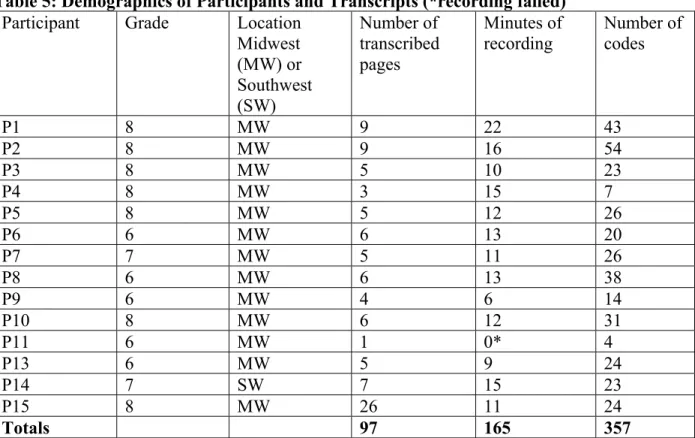
8. Once the transcription was returned, it was deidentified before data analysis. The participant demographics are summarized in Tables 5 & 6.
Table 5: Demographics of Participants and Transcripts (*recording failed)
Participant Grade Location
Midwest (MW) or Southwest (SW) Number of transcribed pages Minutes of recording Number of codes P1 8 MW 9 22 43 P2 8 MW 9 16 54 P3 8 MW 5 10 23 P4 8 MW 3 15 7 P5 8 MW 5 12 26 P6 6 MW 6 13 20 P7 7 MW 5 11 26 P8 6 MW 6 13 38 P9 6 MW 4 6 14 P10 8 MW 6 12 31 P11 6 MW 1 0* 4 P13 6 MW 5 9 24 P14 7 SW 7 15 23 P15 8 MW 26 11 24 Totals 97 165 357
Table 6: Demographics cont.
Total Participants 14
Number of Schools
Represented 5, four Midwest and one Southwest
Number in 6th grade 5
Number in 7th grade 3
Number in 8th grade 7
Total Transcribed Pages 97
Total Minutes 165
Total Codes 357
Coding takes place in the following steps (Kvale & Brinkmann, 2009b): 1. Researcher reads through the transcripts and codes passages,
2. With the aid of Atlas.ti, the coded passages can be retrieved and inspected over again, 3. Recoding was conducted, and relevant codes are combined.
Coding involves applying one or more keywords to a passage of text. Coding can be either concept-driven or data-driven. Concept-driven utilize codes that have been developed in advance by the researcher through exiting literature in the field. When the researcher does not start with any codes, it is data-driven. Flick and Gibbs suggests that anything can be coded (Flick & Gibbs, 2007). The coding of text meanings allows the researcher to quantify how often themes are addressed in a text. Frequency of themes can be compared and analyzed in a useful manner. Coding categories can arise during the analysis, but they can also be taken from theory or the interviewees.
Chapter 4: Interview Analysis and Development of Framework
Data Analysis
This research has adopted thematic analysis with a theoretical approach, at a semantic level of analysis, and epistemologically founded on the realist paradigm (Braun & Clarke, 2006). Each of these areas are outlined in the following paragraphs.
From the various data analysis methods, thematic analysis has been chosen. Thematic analysis can be defined as ‘a process for encoding qualitative information’ (Boyatzis, 1998). The objective of thematic analysis is to identify themes for understanding the research, in this case middle-school girls’ perceptions of cybersecurity. A theoretical approach is used which uses the researcher’s theoretical ideas drawn from previous literature. The research questions also guide the themes that emerge from the interview transcripts.
The data analysis uses a semantic or explicit approach, which required me to pay attention to manifest meanings in the text. This goes beyond the description of the text, but stresses the interpretation and significant themes (Braun & Clarke, 2006).
And finally, the epistemological approach used is founded on the realist paradigm where language is believed to be a clear reflection of meaning and experience. In this approach, I can analyze the data in a direct manner in regards to the motivations and experiences of the
participants (Braun & Clarke, 2006).
To summarize, I am utilizing themes for understanding the meanings in the text. The language of the participants is a clear reflection of what they have experienced and the knowledge they portray.
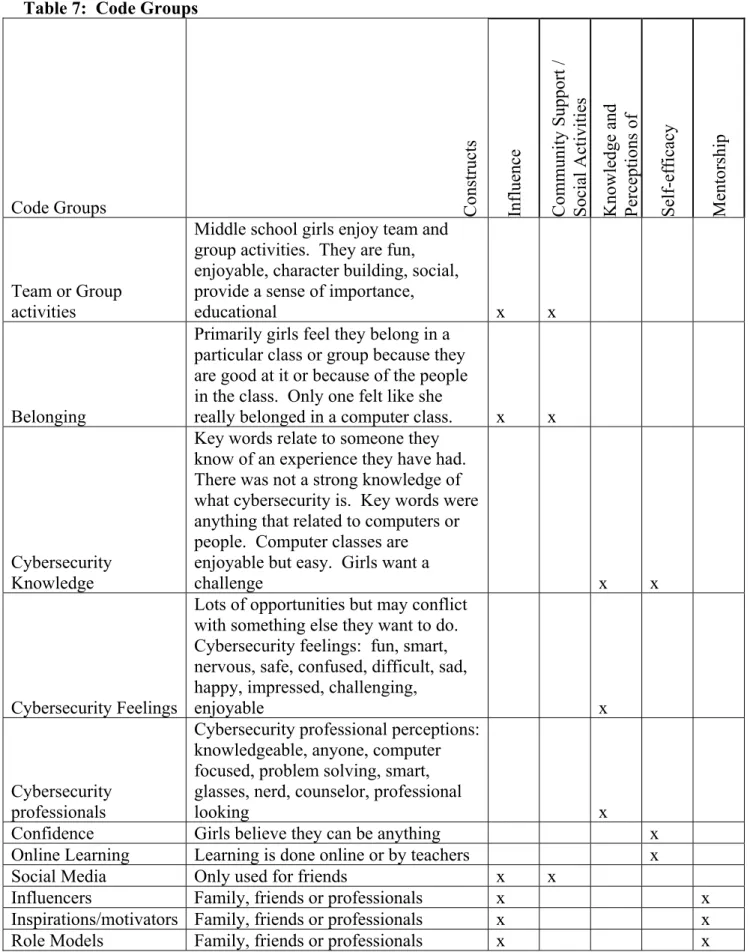
Building on the details in Chapter 3 regarding the interview process and data analysis, the coding process lead to 363 pieces of text. These were further broken down into 13 code groups, which were compared to the constructs identified in Chapter 2 and shown in Table 7. Each of the code groups related to one or more of the constructs, although influence had the largest representation in the code groups. These code groups can be seen in Table 7.
Table 7: Code Groups
Code Groups Constructs Influen
ce
Community Support / Social Activ
ities
Knowledge and Perceptions
of Self-e fficac y Mentorship Team or Group activities
Middle school girls enjoy team and group activities. They are fun, enjoyable, character building, social, provide a sense of importance,
educational x x
Belonging
Primarily girls feel they belong in a particular class or group because they are good at it or because of the people in the class. Only one felt like she
really belonged in a computer class. x x
Cybersecurity Knowledge
Key words relate to someone they know of an experience they have had. There was not a strong knowledge of what cybersecurity is. Key words were anything that related to computers or people. Computer classes are
enjoyable but easy. Girls want a
challenge x x
Cybersecurity Feelings
Lots of opportunities but may conflict with something else they want to do. Cybersecurity feelings: fun, smart, nervous, safe, confused, difficult, sad, happy, impressed, challenging,
enjoyable x
Cybersecurity professionals
Cybersecurity professional perceptions: knowledgeable, anyone, computer focused, problem solving, smart, glasses, nerd, counselor, professional
looking x
Confidence Girls believe they can be anything x
Online Learning Learning is done online or by teachers x
Social Media Only used for friends x x
Influencers Family, friends or professionals x x
Inspirations/motivators Family, friends or professionals x x
Role Model Characteristics
Role model characteristics: amazing, composed, determined, giving, integrity, entrepreneur, good attitude, kind, nice, overcomes failures, stable,
trusting, understanding, hard working x x
Adventure x
To further understand the data, I calculated the number of times a construct was represented in the code groups. A breakdown of this data can be found in Table 8.
Table 8: Constructs represented in Code Groups
Construct Definition Number of times
represented in code groups
Influence To have an effect on the
behavior of someone.
7 Community Support /
Social Activities
The support from a community and being a part of a
community through activities. 2 Knowledge and
Perceptions of Cybersecurity
Current knowledge and ideas related to cybersecurity.
3
Self-efficacy One’s belief about one’s own
abilities.
4
Mentorship A relationship with a more
knowledgeable person to help guide a less knowledgeable person.
4
Influence and mentorship can be closely related, so it is no surprise that these are the top constructs with self-efficacy being equal to mentorship. This indicates that middle-school girls relate their perceptions and interest in cybersecurity most closely to their influencers, mentors, and what they believe about their own abilities.
Through the data analysis process and relating the results to the constructs, a framework has emerged to be included in efforts to reach middle-school girls for cybersecurity. To peek their interest, anchor their interest, and grow their interest, this framework should be woven into outreach, recruitment, and retention efforts.
Results
In Figure 4, I present the CISSE (siss-e) framework. This framework indicates what is important to middle school girls and how to shape their experiences, motivation, and perceptions of cybersecurity. The framework emerged from the interview results, code groups, and
meanings of data.
There are five key areas that should be utilized in any effort to reach middle-school girls for cybersecurity.
Figure 4: The CISSE framework
Community
Middle school girls enjoy team and group activities. The participants indicate these activities are fun, enjoyable, character building, educational, and provide a sense of importance. Girls have a sense of belonging when they are good at an activity or a valuable part of the community. Social media is a community that they belong to, however, I have put social media as an element of its own, as participants shared the importance of that connection.
P1 shared how an after-school program taught her teamworking and problem-solving skills, and indicated that the program gave her value and importance.
Promising
Practices
Community Influence Soical Media Connection Self Efficacy Education“(The) program teaches people teamwork and problem-solving skills. It’s like an after-school activity, and there will be like six or so challenges you can choose. It’s a really big deal…”
P2 shared that being a part of a group shapes your character:
“I think it kinda shapes who you become. I'm a very quiet person, but like, being a part of a group helps me open up a little more.”
P3 shared that after her experience at a camp based on cybersecurity that she likes learning more since being a part of the camp community. This indicates that being a part of a community really does influence perceptions of exploring cybersecurity:
“I think I like them more because I just know more about it after the camp.”
P7 states “I think it's good to be part of a group so you can make more friends and be active.”
P9 likes to be a part of a community as she would “rather work with other people to get like different opinions.” And P10 states that being a part of a team “feels good because I feel like I'm on a team and I like being with a team and supporting them.”
Influence
Girls are highly influenced by their family and friends, with professionals also having a part. Participants pick activities based on what their parents and friends encourage them to do. This framework recommends that influencers are provided opportunities to learn about
cybersecurity opportunities, thereby allowing influencers to take a role in the recruitment and encouragement of middle-school girls in this field. Participants relate cybersecurity workers to those within their range of influence; whether that be a parent, a teacher, or a tv personality. The image they relate to is changing from past studies where the image was a nerdy, white, male. The image given by the participants included computer focused, smart, professional looking – basically anyone.
Examples of Family influence
P1 shared that she joined wrestling (primarily a male sport) because she was influenced by her brother.
P3: “My mom inspires me to do things. She always wants me to do the best that I can.”
P4 also had an experience of being influenced to start a primarily male activity and discovering that she enjoyed it:
“When I was little my dad would always bring home ducks he shot and I started to like that and now I hunt all the time.”
Examples of Friend influence
P2: “Well, my friend is a little more outgoing, so she has ideas and then we kinda work it out together.” (In regard to attending an activity) “My friend was going, and then I ended up liking it.”
P5 doesn’t like to participate in activities unless her friends are, and she indicates that it is fan to be a part of the acidity and learn something new in the community.
“Like if there is sometimes when none of my friends or something are going I usually don't: I like having somebody that I know… It's fun because I get to have fun with my friends and learn new things and it's another activity to be a part of.”
P6 was influenced to try coding by her friends:
“In fifth grade we did a little coding and I guess a lot of – a couple of my friends actually – liked that and so I kind of did some of that too.”
P8 was influenced by her friends to try a new activity:
“I had seen some of my friends doing it and I had gone and watched some games and I thought it would be fun to try it.”
Cybersecurity image and Professionals as an influencer
P1 indicated that a cybersecurity professional spent time “sitting in front of a computer” and imaged the professional to be a girl with:
“Like, a pretty loose ponytail, black hair, you know, really casual clothes most of the time. I don't know, just basically, like, the same picture, I don't know where I got it from, but— glasses, too.”
And P1 perceives that there are lots opportunities for girls in cybersecurity, showing that the perceptions are changing.
“I feel like I could go into if I really wanted to, because I'm pretty sure there are a lot of opportunities in that. I think it’s getting easier. I don't think there would be much—like, I mean,
learning in college and all that stuff would be hard, but I think the opportunities for girls are getting better, so I don't think it'll be as hard as it was.”
P2 could not specifically describe a cybersecurity professional as “People all look different.” This indicated that it could be anyone. And P3 states, “It (a cybersecurity
professional) could be anybody.” And P8’s image also indicates it could be anyone: “well, I guess it could be anyone really, but mostly I think of somebody like with glasses and really into that kind of stuff, like always carrying around his phone or something technology like.”
P7 relates the image of a cybersecurity professional to someone she knows who has influenced her: “A person that I picture is someone that looks like (name) because I know her and that she works with computers a lot, so she comes to my mind.” And P8 relates the image to her dad: “what my dad did and I really liked his job so I want to do that when I get older.”
P8 is influenced by professional gymnasts indicating that middle-school girls can be influenced by professionals:
“I'm a gymnast and a lot of times during the Olympics when I watched Olympic gymnasts I get inspired when I see them do all these crazy splits and stuff.”
She adds to this that the professionals motivate her to do more:
“Well, just seeing how good they could be and knowing that they had to try really hard to get there and that I can do the same.”
P9 shares that she is influenced by high school girls (professionals to her): “I watched like the high school girls I kind of wanted to do what they're doing.” This shows that influencing can come from anyone that motivates you to want to know more. Programs can incorporate a role-model/mentoring aspect to meet this need.
Social Media Connection
Social media is the primary way middle-school girls connect to friends. Currently, none of the participants follow educational groups on social media. When given the idea, they
comment that “they had never thought of that”. A few of the participants follow professionals in an area of interest, which would indicate that given an opportunity to experience cybersecurity professionals as role models, middle-school girls would follow them as well.