The Organizational Improvement Plan at Western
University Education Faculty
6-22-2018
The implementation of problem-based learning in
mathematics through teacher capacity building
Zelaikha FarahmandFollow this and additional works at:https://ir.lib.uwo.ca/oip
Part of theEducational Leadership Commons, and theHigher Education Commons
This Dissertation/Thesis is brought to you for free and open access by the Education Faculty at Scholarship@Western. It has been accepted for inclusion in The Organizational Improvement Plan at Western University by an authorized administrator of Scholarship@Western. For more information, please [email protected], [email protected].
Recommended Citation
Farahmand, Z. (2018). The implementation of problem-based learning in mathematics through teacher capacity building.The Organizational Improvement Plan at Western University, 39. Retrieved fromhttps://ir.lib.uwo.ca/oip/39
i
Current instructional approaches to mathematics are not meeting the diverse needs of students in Ontario. In response to steadily declining mathematics performance, the Ontario Ministry of Education released a Renewed Math Strategy geared towards addressing the gap in achievement. The position of mathematics lead teacher was created as part of this strategy. These teacher leaders are expected to devise plans for improvement initiatives relevant to their respective school sites. This Organizational Improvement Plan (OIP) explores the problem of practice where the mathematics lead teacher wishes to facilitate the implementation of problem-based learning in mathematics at an Ontario elementary school. Problem-based learning is a
pedagogical approach characterized by student-led learning through teacher facilitation and solving real-world, open-ended and open-entry problems. Perspectives on the problem are gained through analysis of current practices, school board procedures and organizational culture.
External and internal forces for change are assessed to establish momentum. Transformational and shared leadership approaches to change leadership, and possible solutions are considered to address this problem. Kotter’s 8-Stage Model for change is used to create a change
implementation plan, guide communication and to evaluate and monitor the change process. The proposed solution incorporates the Systems Improvement Learning Cycle (SILC), a Plan, Act, Observe and Reflect cycle, collaborative inquiry and team teaching guided by the mathematics lead teacher and school administration. Ethical consideration and possible next steps are outlined in this OIP. It is proposed that if implemented, this OIP will successfully support teachers
through the implementation of problem-based learning, leading to improved student learning outcomes. Key words: teacher capacity building, mathematics, school reform, shared leadership, transformational leadership, coaching
ii
First and foremost, I would like to thank God, without whom nothing is possible. I would also like to thank my parents who have always supported me and encouraged me throughout my studies and showed me the importance of education from a young age. A heartfelt thank you to my mother-in-law for your support throughout the years. To my siblings, thank you for always being there for me and supporting me in this journey.
I want to acknowledge the love and support from my husband and my son; you
encouraged me through the challenges and celebrated successes on my path to completing this OIP. You showed understanding of the countless evenings and weekends that I spent away from you and for that I am ever thankful.
I would like to extend a warm thank you to my professors at the University of Western Ontario for their teaching and expertise. To my supervisor, Dr. Beate Planche, thank you for your time, guidance and support throughout the development and refinement of this OIP. Your feedback and reality checks were instrumental in my success and your mentorship has had a profound impact on my learning.
To Dr. Dean Lindquist and Dr. Robert Campbell, thank you for your feedback and guidance through my academic years. To Nargis Farahmand, thank you for providing a fresh perspective and helping me improve as a writer.
iii
Table of Contents
Abstract ... i
Acknowledgements ... ii
Executive Summary ... v
Definition of Terms... vii
Chapter 1: Introduction and Problem ... 1
Introduction & Organizational Context ... 1
Leadership Position Statement ... 6
Leadership Problem of Practice ... 9
Framing the Problem of Practice ... 10
Review of Literature Pertaining to the Problem of Practice ... 14
Internal Data Analysis ... 18
External Data Analysis ... 19
Leadership Perspective ... 20
Guiding Questions Emerging from the Problem of Practice ... 21
Challenges ... 22
Leadership-Focused Vision for Change ... 23
Future State ... 25
Forces that Drive Change ... 25
Key Stakeholders ... 26
Organizational Change Readiness ... 26
Conclusion ... 28
Chapter 2: Framework for Leading Change ... 29
Shared Leadership ... 29
Relevant Frames for Leading Organizational Change ... 31
Critical Organizational Analysis ... 32
A Vision for Learning ... 36
Required Changes ... 37
Possible Solutions ... 38
Chosen Solution... 47
Leadership Approaches to Change ... 48
Towards Shared Transformational Leadership ... 50
Plan to Communicate the Need for Change ... 55
Conclusion ... 59
Chapter 3: Change Implementation Plan ... 61
Introduction ... 61
New strategic organizational chart ... 67
Change Process Communications Plan ... 83
iv
Act and Observe ... 87
Reflect... 88
Next Steps and Future Considerations ... 89
v
Executive Summary
This organizational improvement plan represents the work undertaken during a doctor of education program. This work investigates the need for a strategic approach to professional learning during the implementation of problem-based learning in mathematics at an elementary school, Elm Grove Public School (EGPS), located in an urban school board, Blue Heron District School Board (BHDSB).
Chapter 1 provides an introduction of the problem of practice that is the focus of this organizational improvement plan. Organizational structures and current leadership approaches are explored. Ontario’s Renewed Math Strategy (RMS) is discussed as part of the organizational history, exploring the Ministry of Education’s goals and current achievement data in
mathematics. EGPS’ cohort mathematics scores on the Education Quality Assessment Office (EQAO) testing across are analyzed and the agency of the mathematics lead teacher (MLT) is discussed. Transformational and shared leadership are presented as underpinning the leadership lens behind this organizational improvement plan. The Ontario Leadership Framework (OLF) and the Five Core Competencies of Leaders are offered as the leadership frameworks guiding the development of this organizational improvement plan. Guiding questions, challenges, a vision for change and a study of the forces that drive change at EGPS are explored. Finally, key stakeholders and organizational change readiness are discussed.
Chapter 2 delves into how change might take place at EGPS. Kotter’s 8-Stage Model (1996) is presented as the theory and basis for proposed change at the school. Nadler and Tushman’s (1980) Congruence Model for Organizational Analysis is used to perform a gap analysis and further understand the dynamics and performance of the organization. Required changes resulting from the gap analysis are explored, including a system of supports in place for
vi
teachers during the implementation of mathematics related change. Possible solutions are put forth with corresponding benefits, drawbacks, required changes and resources needed. Systems Improvement Learning Cycle (SILC) is chosen as the solution to the problem of practice because it is aligned with current approaches to system improvement in Ontario and fits with the structure at EGPS. Collaborative inquiry and constructivist professional development (Pitsoe & Malia, 2012) are incorporated in the SILC solution. The role that growth mindset plays in the SILC cycle is also explored. Kotter’s 8-Step Model (1996) is put forth as a framework for
communication throughout implementation.
In Chapter 3, implementation of the chosen solution is laid out. Problem-based learning is compared with traditional approaches to mathematics instruction. Priorities and goals for implementation are shared, including garnering formal leadership support, sharing the rationale behind PBL, eliciting understanding surrounding this learning theory, developing and sustaining a collaborative culture, and providing individualized support for teachers. A detailed
implementation plan is outlined along with corresponding timelines and a communication plan informed by Klein’s (1996) key principles of organizational communication. Current and proposed organizational strategies are explored and potential implementation challenges stipulated, including the varied needs of teachers and underlying assumptions. Change process monitoring and evaluation outlined, based on the concepts of open communication and ongoing feedback. A detailed monitoring and evaluation plan is outlined and ethical issues considered.
Next steps and future considerations conclude this organizational improvement plan, including the importance of maintaining the culture of collaboration and inquiry that is established as part of implementation and ensuring that it carries forward to other change initiatives and reform in mathematics at EGPS.
vii
Definition of Terms
• EGPS - Elm Grove Public School, a pseudonym for an elementary school located in a large urban school board in Ontario.
• BHDSB - Blue Heron District School, a pseudonym for a large urban school board in Ontario.
• MLT - Mathematics lead teacher
• PBL - Problem-based learning.
• ELL - English language learners
• SIP - School improvement plan
• POR - Position of responsibility
viii List of Tables
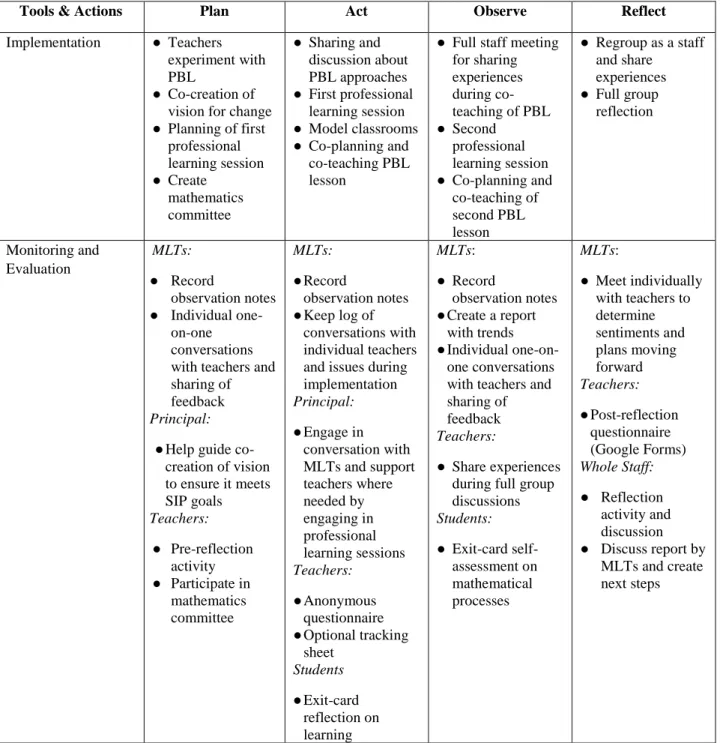
Table 2.1: Kotter’s 8-Stage Model ………...… 31 Table 3.1: Implementation and corresponding monitoring and evaluation actions……….. 77
ix List of Figures
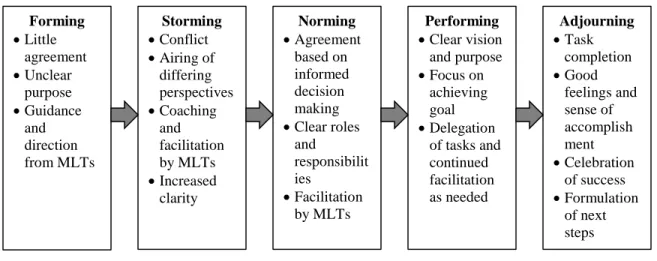
Figure 1.1: Trend line analysis of cohort scores on EQAO from 2013 to 2016 ……….…. 20 Figure 2.1: Adaptation of Tuckman and Jensen’s (1977) Stages of Small Group
Development………..………. 58
Figure 3.1: Comparison between traditional and PBL approaches to mathematics instruction… ………. 61 Figure 3.2: Current and Proposed New Models of Organizational Strategy for EGPS………….68
Chapter 1: Introduction and Problem Introduction & Organizational Context
Elm Grove Public School (EGPS) is in the Blue Heron District School Board (BHDSB), a large urban school board in Ontario. EGPS caters to kindergarten through grade 5 students following a recent regional reorganization. It is dual track with both French Immersion and regular English track programs available. Enrolment is decreasing on the English side but rapidly increasing on the French side due to rising popularity of the French Immersion program in Ontario, with current student enrolment sitting at 300. There are 40 staff members and an administration team comprised of a principal and two teacher chairpersons. The chairpersons’ role is to liaise between teaching staff and the principal.
The surrounding community is mostly upper middle class. There is an involved parent council that advocates and raises funds for various projects in the school and neighbourhood. Parental involvement is generally high, but it varies across the two tracks, with extra
involvement in the French immersion track and less on the English side. A contributing factor may be the fact that some French Immersion students are bussed to EGPS from other
neighbourhoods. Other contributing factors might include parent availability, differences in socioeconomic status and family situation. Parental involvement and understanding of
educational programs is a reliable indicator of whether or not a child will be enrolled in French Immersion programs (Roy, 2008, p.397).
Vision, Mission, Values, Purpose, and Goals. The ideological framework of the school is complex. One formal belief that is evident in the structures and expectations at EGPS is that individuals must work together to deliver the best education to all students in the school. A belief that is connected to this is that students have diverse needs that should be addressed. By
extension, the worldview that has been explicitly communicated in writing on the school website is that all students are able to succeed, given the appropriate support and opportunities.
The mission of EGPS is to provide quality education to all students and enable them to acquire the knowledge, skills and values required to become responsible members of society, a message which is communicated in the student agenda and in the school foyer. The school’s vision is to provide a positive and caring environment where staff works together to provide the best education such that children can grow and succeed. The school has the same values as the school board, which include strong public education, partnerships between students, schools, families and the community, diversity, the commitment and skills of school staff, equity,
innovation, accountability and accessibility, as showcased on the website and explicitly stated on posters in classrooms and around the school. Other values are fairness, caring, success, respect and student empowerment. These values become apparent through curriculum, school events and community relations. The purpose of EGPS is to provide quality education to students in both French and English such that they are prepared to succeed in a competitive environment. The goals are to make it an effective school and to identify and help those who are disadvantaged, as well as being environmentally sustainable, and to provide quality education to students in both French and English.
Organizational Structure and Current Leadership Approaches. The administration team at EGPS consists of the principal and division chairs. EGPS is divided into two divisions with a primary and junior division chair whose jobs are to liaise between the principal and teachers. Teachers use this structure to make sensitive concerns known to division chairs, who then speak to school administration on their behalf. School administration generally introduces initiatives in a holistic manner, to the school where applicable. There are teachers who are
willing and open to collaboration and new initiatives and others who are hesitant due to past experiences with change.
Current leadership approaches in the school are transformational and shared in nature. Transformational leadership necessitates guiding others through vision, inspiration and
motivating people to work towards achieving common goals (Bass & Riggio, 2006). It involves encouraging creativity and exploring novel ways of action through individual encouragement and the creation of supportive relationships. Doody and Doody (2012) state that transformational leaders establish open lines of communication and supportive rapport with individuals in an organization. The principal at EGPS sets goals in collaboration with staff and provides guidance throughout the process of reaching them. Some of these goals are guided by the school
improvement plan (SIP) and others are based on that which the administration team deems necessary or beneficial in conjunction with conversation and feedback from teachers.
Interaction between leaders and followers is the cornerstone of transformational leadership (English, 2008, p.15). The principal at EGPS communicates goals with teachers and engages them in the process of finding ways to reach them, through emails and in meetings. He also acts as an instructional leader. Hallinger (2005) notes that such leaders are goal-oriented individuals who can pinpoint a precise direction for the school and can motivate his or her followers to work towards achieving that goal. These principals are willing to work with teachers to reach goals for the betterment of the school (Hallinger, 2005, p.224).
Shared leadership is very much in line with the leadership framework that the school board and, by extension, EGPS has adapted. Gibb (1954) postulated that shared or distributed
leadership is comprised of groups of leaders who work together to take leadership actions, a concept which has evolved to Pearce and Conger’s definition of shared leadership as “…a
dynamic, interactive influence process among individuals for which the objective is to lead one another to the achievement of group or organizational goals or both” (p. 1). Shared leadership theory is important when looking at reform in schools because it provides a framework for harmonizing direction from the top (the school board or school administration) and the contextual nuances and expertise on the front lines (teachers and staff in schools). Shared leadership is a framework that places an emphasis on the relationships and interactions between those in leadership roles by focusing on how leadership practice affects improvement in an organization (Spillane, 2006).
The tenets of shared leadership (Carson, Tesluk, & Marrone, 2007) such as having a shared vision, sharing responsibility and celebrating and using individual expertise to further
organizational goals, lend themselves well to issues surrounding the implementation of problem-based learning (PBL) in mathematics. Issues faced by teachers will naturally be made known since they, too, will be involved in leadership. This also impacts decision-making, because teachers will be part of the planning and implementation of the initiative, giving feedback and working with administration and the mathematics lead teacher (MLT) (Lambert, 2002; Barnett, & Weidenfeller, 2016).
Contractual agreements allow for curriculum leads as deemed necessary by individual schools, while others are positions mandated by the Ministry of Education of Ontario. An example of this is the position of MLT, which is integral to this OIP and will be discussed in greater detail throughout this chapter.
Organization History. A recent Ministry Memorandum, sent to board leaders, outlined the need for a renewed focus on mathematics from Early Years to Grade 12 to improve
achievement across the province, and more than $60 million dollars was to be dedicated to funding the Renewed Math Strategy (RMS).
The RMS provides support to all schools, increases support to schools where students are underperforming in mathematics and gives intensive support to schools with the lowest scores to boost achievement in mathematics. This support primarily emphasizes professional learning, which leads to student learning and well-being through a balanced approach to instruction that aims to develop proficiency and understanding in mathematics. Culturally responsive pedagogy is also important to meet the needs of French-language learners, English Language Learners (ELL) and Indigenous students in Ontario. EGPS has many ELL students and as a dual track school, the issues facing French-language students are also pertinent.
The Ministry’s goal for mathematics is that 75% of elementary students achieve a level 3, which means that they are meeting the provincial standard. To identify the needs of mathematics learners, information from the Education Quality and Accountability Office (EQAO) and other assessments were used. Basic skills and conceptual understanding of mathematics are an important goal in Ontario to allow students to apply their skills and critical thinking to real-life tasks. School-level supports involve providing release-time for teams of teachers to work together and collaborate in professional learning and capacity-building activities. Each elementary school must have up to three lead teachers who are responsible for extending and deepening their knowledge in mathematics through collaboration with other MLTs. They must then apply this learning to their practice within the school and share with other teachers, followed by sharing at transition meetings within the LC.
Each school board is given funding to allocate a part-time specialist teacher in mathematics; an English-language and French-language professional learning mathematics
facilitator; funding for school board supports to grade 9 and 10 mathematics teachers; funding for networking; pedagogical leadership for kindergarten to grade 3 and summer learning programs in mathematics. Ministry officials will engage in dialogue with school boards in working towards implementation of the RMS.
Mathematics performance at EGPS reflects a similar decline as seen in the rest of the province. The school has three MLTs who meet regularly with the school principal to discuss goals and ideas. These lead teachers represent both the English and French tracks, as well as the primary and junior divisions. As part of the RMS, EGPS must look for ways to improve student learning outcomes in mathematics. Despite various school and school board PLCs and learning pathways, mathematics scores continue to decline.
Leadership Position Statement
As mentioned, the MLT position is a relatively new one that has been mandated by the Ministry of Education in Ontario. This position was created as part of the RMS to address the need for change in mathematics instruction. Each school has different areas of need, thus the school-based MLT position allows for contextual relevancy and provides agency for teacher leaders to lead change. The position and responsibilities of the MLT at EGPS will be the focal point when addressing the problem of practice throughout this OIP. As the lead MLT at EGPS, I will be leading and facilitating the change process as described in this OIP.
Transformational and shared leadership are the chosen frameworks for the development of this OIP. In this section, literature surrounding both theories and the ways in which these theories connect with the problem of practice are discussed.
Transformational Leadership. Transformative leadership is a framework where those who lead and those who follow work together and support one another towards improvement
(Burns, 1978). It is characterized by individualized consideration, which describes the level of attention the leader gives to the individualized needs of followers; intellectual stimulation, which entails the encouragement of risk-taking and critical thinking, inspirational motivation, the articulation of the vision and challenging of high standards; and idealized influence, which describes the modeling of moral and ethical behaviour by the leader (Bass & Bass, 2008; Northouse, 2013; Lamm, Sapp & Lamm, 2016). Allen, Grigsby and Peters (2015) define transformational leadership as involving a leader who finds a way to unite staff such that they work together to meet a goal as set out by the leader. This leader provides a clear and purposeful goal that he or she and the staff work towards achieving. There is also the element of
empowerment wherein the leader seeks to empower teachers to achieve these goals. There is a relationship between transformational leadership and school climate, which in turn affects school culture (Allen et al., 2015, p.3).
Teachers’ perceptions of school leaders can play a large role in the implementation of curriculum change in mathematics. Transformational leadership on the part of the principal will help the MLTs set up systems to support the implementation of these changes. It will be useful to see how transformative leadership can work in conjunction with distributed or shared leadership to support teachers throughout implementation. A lack of transformational leadership can result in leaders who mislead themselves, leading to misrecognition, which means that the leader does not criticize his or her own stake or interest in achieving a goal (Bourdieu, 2008 as cited in Bolton, 2011, p.226). This can result in teacher apathy or disinterest because the leader will not have sufficiently analyzed the change initiative in a manner that considers stakeholder
Shared Leadership. Shared leadership maximizes the human resources in an organization by allowing individuals to take on leadership roles in their areas of expertise. In shared
leadership individuals lead each other, which allows for a reciprocal sort of relationship between formal leadership and members of the organization (Cawthorne, 2010; Bezzina, 2007). Shared leadership involves sharing power by giving it to the most qualified individuals, setting limits for decision-making power, creating a climate where people feel comfortable leading initiatives, allowing those who are qualified to have some autonomy over their resources and accepting the decisions that these leaders make (Carson, Tesluk, & Marrone, 2007).
As the lead MLT, I have a passion for and am knowledgeable about mathematics and have expertise in this subject area as well as some decision-making power related to issues pertaining to mathematics instruction at EGPS. Shared leadership provides a useful framework for this OIP because it allows for the sharing of power and the empowerment of individuals that can address issues surrounding the success or failure of mathematics related curriculum change. This
leadership framework provides the opportunity for critical discussions and the building of trust in an organization, such that change becomes a part of the culture and a way of doing (De Jong & Dirks, 2012). As Aime, Humphrey, DeRue and Paul (2013) suggest, it is important that those who are leading feel that they are making a difference. The MLT should be involved in decision-making, as should members of the mathematics committee and mathematics teachers in the school.
Leaders need to develop the leadership skills in others with the understanding that developing human potential leads to positive outcomes for the organization. New relationships are also critical, and the leader has to create the circumstances for greater organizational capacity through the fostering of relationships. Collaborative cultures should be purposeful and focus on
the right outcomes to be positive. School culture needs to be developed to create the conditions for these systems and supports. Resistance is often seen by leaders to be a setback, but the idea that resistance can help improve the initiative is critical when looking at curriculum reform (Fullan, 2007).
Leadership Problem of Practice
One of the challenges faced by elementary schools across Ontario is the lack of sustainable implementation of professional learning initiatives pertaining to curriculum in mathematics. Traditional approaches to mathematics instruction are not meeting the diverse needs of students. According to the Education Quality and Accountability Office that puts together EQAO testing in Ontario, the percentage of students in grade 3 who are meeting the Provincial Standard in mathematics has been steadily declining from 71% in 2009 to 67% in 2014 (Education Quality Assessment Office, 2016c). In response to this, the Ministry of Education has recently allocated $60 million to be used to improve mathematics scores on EQAO testing through various
curricular initiatives. One of the areas in which students’ struggle is problem-based questions and mathematical communication.
School culture and relationships between teachers and school leadership play a large role in the implementation phase of curricular changes. There is a lack of time, minimal access to
resources and decreased teacher leadership, which results in diminished teacher implementation of professional learning initiatives as they are presented. As a result, the degree of authentic, measurable change focused on addressing and achieving school board math-related initiatives is limited. This problem of practice investigates the need for a strategic approach in professional learning initiatives related to the implementation of problem-based learning in an Ontario elementary school.
Framing the Problem of Practice
Historical Overview of the Problem of Practice. Improving mathematics instruction has been an area of interest in the province of Ontario for many years. EQAO scores have
demonstrated a decline in student performance in mathematics. In 2012, 58% of grade 6 students met or surpassed provincial math standards and in 2016, that number fell to 50%. The percentage of grade 3 students who performed at or above grade level fell from 68% to 63%, while the number of grade 9 students who met or exceeded provincial standards decreased by one (1%) percent. During this time, students in both grades 3 and 6 improved in reading and writing (Education Quality and Accountability Office, 2016a). Data from the EQAO scores also shows that there is no difference in performance between males and females (Education Quality and Accountability Office, 2016b).
The EQAO releases achievement data for each grade level. In 2012, 39% of grade 6
students did not meet provincial standards, in 2013 that number increased to 41%, in 2014 and in 2016 it increased further to 47% (Education Quality and Accountability Office, 2016c). This is worrying, in that it not only shows that a very large percentage of students are not succeeding in mathematics, but that more and more students are not meeting provincial standards. This
indicates that there is a misalignment between current instructional practices and student learning outcomes.
The Ministry of Education of Ontario published a document entitled “Paying Attention to Mathematics Education: K-12.” In this document, the need for refocusing on mathematics is laid out. This focus on mathematics suggests beginning with curriculum, planning and connecting key concepts across grades, assisting students in making sense of relationships between strands in mathematics, providing opportunities for application of mathematical knowledge, co-learning,
undertaking meaningful, complex tasks, using higher-level thinking, encouraging diverse
approaches, differentiating instruction, fostering an environment where questioning is welcomed and developing goals and success criteria based off of student reasoning (Ontario Ministry of Education, 2011).
Problem of Practice Framed Using the Ontario Leadership Framework and the Five Core Competencies of Leaders. The Ontario Leadership Framework (OLF) is a roadmap for leadership that was created based on the thoughts and experiences of effective leaders in Ontario and around the world. It outlines the skills, attitudes and knowledge that strong leaders have and discusses leadership language that allows for quality discussion, collaboration and professional learning (The Institute for Education Leadership, 2013). EGPS is situated in Ontario, thus any leadership framework geared towards finding a solution to the problem of practice at the centre of this OIP must align with this document.
The OLF states that while system leaders play an important role by setting up supportive system practices and procedures to lead school leaders, school leaders themselves are critical to the development of best teaching practices, effective schools and improved student achievement and well-being (The Institute for Education Leadership, 2013). The key concepts of the OLF that will provide the foundation for framing this problem of practice are leadership, management, authority and context.
The OLF cites Leithwood (2012), who states that Ontario’s commitment to equity and inclusion in education necessitates the sharing of leadership. This, along with the key concepts of the OLF will provide a framework for understanding the problem of practice and developing this OIP. This OIP focuses on leadership practices that can provide systems and supports at the
school level throughout the implementation of PBL. As such, the guidelines for school-level leadership as outlined in the OLF will be used.
Another framework that is of particular interest with respect to this OIP are the five core leadership capacities, as outlined in the Ministry of Education document entitled Ideas into Action: For School and System Leaders. The first capacity put forth in the document is setting goals, which refers to working in conjunction with others to make sure that specific, measurable, attainable, results-oriented, and timely (SMART) goals are created. The second capacity is aligning resources with priorities, meaning that financial, capital, human resources, curriculum, professional learning resources and program allocations are all connected to student achievement and well-being. Promoting collaborative learning cultures is the third capacity, followed by using data to show the need for school improvement and finally, engaging in courageous conversations when challenging current practices in an organization (Ontario Ministry of Education, 2009, p.5).
The OLF and the core capacities are relevant to this OIP since EGPS is located in Ontario and that the OLF is a roadmap used to frame leadership in the province. By extension, the five core capacities of effective leaders are connected to the OLF and used as a guideline for leaders. All five capacities as referenced by the OLF will be analyzed to better understand the goal state of the organization.
Bolman and Deal’s Four Frames. Bolman and Deal’s (2013) Four Frames Model
consists of four frames: structural, human resources, political and symbolic. The structural frame creates policies, procedures and hierarchies comprised of standards and formal roles in an organization (Bolman & Deal, 2013). The structural frame plays a large role at EGPS. The central leadership structure involves a principal and vice-principal who work closely with the office administrator. As mentioned, we also have division chairs who are classified as holding
PORs or positions of responsibility. There are also subject leads who oversee committees that are tasked with guiding subject related initiatives. School administration is open to the creation of groups and committees to help with initiatives, but there is a chain of command that is to be followed. Any created committee often must fall in line with the current structures.
The human resources frame involves looking after the needs of individuals, supporting them so that they succeed and improving interpersonal competence (Bolman & Deal, 2013). The principal at EGPS makes himself available and encourages teachers to approach him with
concerns and input. He is highly involved, visiting classrooms and providing feedback as well as ideas for improvement. Some teachers appreciate this, while others have stated that they feel it is intimidating. Some teachers feel that they do not need the improvement, which has a direct impact on the success of an initiative, because there is a connection between the successful implementation of a change initiative and a teacher’s willingness or belief that the change is useful or needed (Robinson & Timperley, 2007).
In terms of conflict resolution, interactions and coalition building in the political frame, EGPS has a very involved parent community which is generally positive but has some negative aspects as well. Parents place pressure on teachers but often go so far as to speak to the principal about classroom concerns instead of speaking to the teacher first. As mentioned before, parent council and school council do a lot of fundraising and work closely with school administration when deciding where the funds will go. The elementary teachers’ union is an example of an external political factor that has an impact on what happens in the school which can sometimes include change initiatives that affect teachers. There is also BHDSB and the Ministry of
The symbolic frame provides individuals in an organization with a reason for what they are doing, making the mission of the organization meaningful (Bolman & Deal, 2013). The structure of staff meetings at EGPS indicates the importance that is placed on learning. The second half of each meeting is designed as a professional learning session with opportunities for discussion, collaboration and the sharing of ideas or resources. They are usually delivered by the principal, which symbolizes the fact that he is aware of and involved in pedagogical practices pertaining to the classroom. As mentioned, the principal visits classrooms often, sometimes at random and other times to check in on implementation of an initiative during scheduled visits. The symbolic frame as it applies to EGPS is important when looking at how teachers perceive change.
Further Considerations in the Problem of Practice
Teacher Leadership. Teachers contribute greatly to the reform process by changing and adapting the change to meet the needs of their respective contexts. When teachers engage in instructional discourse within schools pertaining to change, they are more likely to take
ownership and to help implement it. Drawing upon teacher expertise would help bridge the gap between the top-down nature of curriculum reform and the bottom-up orientation of effective school reform (Brondyk & Stanulis, 2014).
Teacher leaders can create the conditions and environment required to support other teachers to understand and learn through the creation of relationships and coalitions (Brondyk & Stanulis, 2014). Teacher ownership of curriculum change is possible when teachers have the agency to speak and share opinions about curriculum change, thereby becoming change agents. If teachers are actively engaged in the implementation of curriculum change, then they are able to speak authoritatively and situate themselves in relation to it. Teachers are also aware of their own skills and motivations as well as the realities of their workplaces, thus they are aware of the
environment in which they work and their mindsets. This concept links directly to teacher participation in curriculum change because it involves the contextual relevancy of the initiative in question (Kirk & MacDonald, 2001).
The notion of involving teachers in the change process is integral to the problem of practice involving MLTs, because it supports the need for teachers to be engaged on some level in the implementation of change initiatives pertaining to pedagogy. Teachers who are
encouraged to lead and accept change must engage in reflection in order to help develop the beliefs, skills and knowledge that address the needs of schools, ultimately resulting in change in teacher pedagogy. Challenging traditional views through critical discourse plays a critical role in changing teacher beliefs (Carrington, Deppeler & Moss, 2010).
Teacher Change Agents and Growth Mindset. Change in schools requires a lead teacher who has the agency to lead his or her colleagues in a contextually relevant manner, given that they work directly with teachers and students in their respective schools (Fastier, 2016). Teacher agency is ecological in that it is tied to context; it can be temporary and spatial, therefore past experiences need to be accounted for. Teacher agency that develops and challenges the status quo in schools requires a well-developed educational philosophy that includes the broader goals of education. Whether or not a teacher embraces risk taking is impacted by their social and professional contexts as well as their past experiences. Top-down prescribed change is a problem because it does not take into account what they call ecological factors that can influence whether or not the change is successfully implemented. Educational change needs to be flexible and take into account teacher agency and what teachers’ projective and proactive contexts and mindsets might be (Priestly, Edwards, Miller & Priestly, 2015).
Bearing this in mind, it is essential to include and incorporate teacher voice when designing and implementing professional development. Teachers differ in the types of
mathematical knowledge they use when teaching, thus their needs will be different. Although mathematics professional development is often prescribed and delivered in one way, it is not effective because the needs of teachers are so different. Varied teacher needs towards
mathematics are shaped by their diverse experiences and backgrounds in math (Caddle, Bautista, Barabara & Sharpe, 2016). In the context of the current problem of practice, one of the roles of the MLT is to discuss and address teacher needs, which necessitates understanding and expertise on the part of the MLT.
Learning and growth is critical when dealing with this problem of practice. Dweck (2006) describes the growth mindset as the belief that human qualities can be developed and formed through practice and cultivation. In the chapter involving the changing of mindsets, she explores the nature of change and the idea that intrinsically, it is a tenet of the growth mindset. Dweck defines a person with a fixed mindset as one who measures self-worth by his or her successes and failures. An individual with a growth mindset sees success and failure as opportunities for growth. Dweck stipulates that asking people to change from a fixed to growth mindset may be difficult because it pulls people away from the reinforcing behaviour and beliefs they have been engaged in since childhood and has become an integral part of the self.
The fixed mindset can lead to people feeling like they do not need to change, rather the world and the circumstances around them need to change. In a school, this can result in stakeholders feeling that pedagogical change is not necessary and that it is not worth trying, given that trying a new strategy means he or she has failed and the individual will avoid problems because it attacks the perception of self that he or she holds to be true.
Dweck’s work surrounding mindsets and change is integral to the problem of practice because it applies directly to the issue of whether or not an individual is receptive to change. Looking at growth versus fixed mindsets can help leaders understand why a teacher may be unwilling to consider or take on new change initiatives. Feelings pertaining to success, failure and even comfort with mathematics may also be a contributing factor; an individual with a fixed mindset who did not do well in mathematics throughout his or her schooling may be made uncomfortable for various reasons if he or she is asked to explore the teaching of mathematics in a different way. Exploring these mindsets and the way in which leaders can help teachers move from fixed to growth mindsets is an important subject when looking at the structures required to support the implementation of mathematics related curriculum change.
Problem-based learning. PBL is an approach that is characterized by an environment of stimulation and engagement in problem solving behaviours (Savery & Duffy, 1995). Students learn through completing complex projects based on challenging problems and are actively involved in the design, problem solving, decision-making, and investigation (Thomas,
Mergandoller, & Michaelson, 1999). The content of these problems and assessment is authentic, the teacher facilitates learning and learning goals are shared. Reflection and collaborative learning are critical and instruction involves communal inquiry (Moursund, 1999).
PBL is an instructional strategy used in mathematics in order to improve learners’ higher order thinking skills through the use of questions that are open to interpretation and assumption by the learner, who then has to justify his or her answer by communicating strategies and reasoning (Tarmizi & Bayat, 2012). Due to this engagement in critical thinking, PBL has a positive effect on student motivation and learning of concepts (Schwartz, Mennin, & Webb, 2001).
Internal Data Analysis
The school improvement plan (SIP) for EGPS resembles the plans for many schools in the province of Ontario. The overarching goal is to prepare students to be problem solvers, to work cooperatively and to think creatively. The goals of equity, well-being and achievement are the cornerstones of the SIP. The goal related to equity is to re-engage underperforming students and maintain a positive environment through a constant and purposeful sharing, discussion and application of strategies and ideas found in professional articles on pedagogy, classroom environment and management. This involves inquiry-based learning and differentiation in the classroom. Well-being involves ensuring that we have healthy bodies and minds by
incorporating mindfulness, daily physical activity and environmental literacy in curriculum delivery.
The section of the SIP that is directly connected to the problem of practice that is the focus of this OIP is student achievement, which entails meeting the academic needs of all students. The first component of this section is numeracy and the focus on improving student achievement as outlined in the RMS. This entails increasing the capacity, confidence and enthusiasm in
mathematics instruction through professional development. EGPS will undertake a review of materials and resources to ensure all classes have equitable access to manipulative and 21st century appropriate materials. Teachers will share best practices, authentic and rich tasks, new and challenging pedagogical documentation to further professional competence in mathematics education. Students will be taught to apply learning and apply problem-solving skills in
meaningful and authentic contexts so that they see mathematics as a relevant part of their current and future lives.
The goals for numeracy are based on student achievement in mathematics in the school. Internal data shows that 37% students are not showing improvement in mathematics achievement between grades 3 and 6. There is also a large difference in student achievement between the English and French tracks, with French immersion students consistently outperforming their English counterparts.
External Data Analysis
External data for this OIP comes from EQAO standardized testing. As previously discussed, EQAO is an arms length organization that creates standardized testing in reading, writing and mathematics in grades 3 and 6 and mathematics in grade 9. The purpose of EQAO testing is to measure how well the education system is nurturing student’s reading, writing and math skills (EQAO, 2017). The trends and performance for each school are available through the EQAO’s website. For the purposes of this OIP, the data pertaining to student performance in mathematics in grade 3 and 6 will be analyzed.
In 2013, 85% of grade 3 students in Ontario were at or above grade level, 88% in 2014 and 86% in 2016. Although these numbers are relatively high, they are falling, a trend that is more obvious when looking at grade 6 students’ performance. In 2013, 79% of grade 6 students were performing at or above grade level in mathematics. In 2014 and 2016, that number fell to 73%. To further illustrate the way in which the numbers are declining, it is important to compare how the grade 3 cohort from 2013 performed on EQAO when they were in grade 6. The number of students who performed at or above grade level in this cohort went from 85% in grade 3 to 73% in grade 6. This demonstrates a 10% decline in student performance in the same group of students, which indicates an issue with mathematics instruction on some level.
The declining trends in mathematics performance at EGPS are similar to the trends in the school board as a whole. In 2013 and 2014, 70% of grade 3 students were at or above grade level and in 2016 that number fell to 69%. In 2013, 61% of grade 6 students were meeting or
exceeding grade level expectations, a number which fell to 60% of students in 2014 and 57%in 2016. When comparing the same grade 3 cohort from 2013 through to 2016, there is a decrease from 70% of students meeting grade level expectations in mathematics to only 57% in 2016 when those same students are in grade 6. This is an alarming drop of 13% which demonstrates a downward trend in achievement in mathematics in the school board (see Figure 1.1).
Figure 1.1: Trend line analysis of cohort scores on EQAO from 2013 to 2016.
Leadership Perspective
The problem of practice regarding the procedures required in order to support the
implementation of PBL at EGPS is complex. The Ministry of Education in Ontario has outlined
0 10 20 30 40 50 60 70 80 2013 2014 2015 2016 Stude nts a t or A bove Pr ovin cia l Sta nda rds (%) Year
the need for improving mathematics performance in the province, referencing the decline in the number of students who are meeting and passing grade level expectations.
The position of MLT provides a useful method to improve mathematics in a way that is contextually relevant, while working towards board and Ministry goals. As the lead MLT at EGPS, I have the agency to lead change in my organization by working with other teachers and school administration in order to improve student learning outcomes in mathematics. The MLT is someone who teaches mathematics at the school, is passionate about pedagogy pertaining to the instruction of mathematics and is willing to lead through collaboration with others (Ontario Ministry of Education, 2016a). This means that the individual is someone who is willing to learn, share and help develop teachers’ capabilities as mathematics instructors. The role of MLT is relatively new and differs depending on other leadership structures in each school. At EGPS, three MLTs work together collaboratively to improve mathematics instruction and student learning outcomes. These teachers also attend board and Ministry conferences and professional learning sessions for guidance and collaborative learning with Ministry and board officials, as well as lead teachers from other schools.
The agency and expertise connected to the MLT position is critical to this OIP and the problem of practice because it provides the opportunity for teacher leadership of change. Guiding Questions Emerging from the Problem of Practice
One of the lines of inquiry that emerges from this problem of practice is what structures are required in order to support the implementation of curriculum change. How is curriculum change different than other forms of change at the school level? How does this curriculum change translate to teacher practice? How can this change become sustainable? Given that the MLT position is still relatively new, how does teacher mentorship become teacher leadership?
How does this position fit in with the leadership structure at the school? How can the systems and structures for the implementation of PBL be institutionalized such that they become the way of doing at the school? Further, how does this leadership affect the relationship between the MLT and his or her colleagues, as well as the relationship between the lead teacher and school administration?
Challenges
Change Fatigue. Change fatigue, describes what happens when teachers become overwhelmed, passive and even resistant to change initiatives. This is often a result of the repeated top-down initiatives that were being implemented in schools and leads to a negative impact on the implementation of change initiatives as well as teachers’ receptiveness to this change. When this happens, real change cannot take place because the change does not translate into an actual change in teacher practice (Dilkes, Cunningham & Gray, 2014). Persistent school reform and the pressures it places on teachers can create cynicism and resistance (Lingard, Mills & Hayes, 2000). It is a psychological response to the belief that too much change is taking place and can have a negative effect on stakeholders in an organization (Berneth, Walker, & Harris, 2011).
There have been various initiatives over the years pertaining to mathematics instruction in Ontario and change fatigue may cause teachers to be unwilling to participate in new initiatives. Burnout and change fatigue have been linked to change cynicism, change resistance, and uncertainty (McMillan & Perron, 2013). This is one of the challenges that may be faced when implementing this OIP and will be discussed further in Chapter 2.
Motivation. If leaders wish to have teachers engaged in reform, their needs, beliefs, commitments and professional contexts must be considered (Day & Leitch, 2007). One
perspective that should be considered is that of usefulness for teachers, which is when the initiative in question relates to teacher and student needs as well as practitioner inquiry. In order to be effective, the change in question should also inspire motivation, commitment and be related to the teacher in terms of his or her professional identity (Day & Leitch, 2007). If these criteria are met, then teachers may feel more motivated to engage and participate in change.
It is important for the leader to realize that simply forcing change on teachers cannot result in motivation. He or she needs to look at the issue on a deeper level rather than simply looking to create teacher buy-in to change initiatives, because this assumes that teachers can be roadblocks (Day & Leitch, 2007). The tenets of transformational leadership can help remedy this challenge and will be discussed further in Chapter 2.
Leadership-Focused Vision for Change
Gap Analysis. Nadler and Tushman’s (1980) congruence model deals with the ways in which the performance of an organization is influenced by tasks, people, structures and culture. The higher the congruence between these four components, the better the performance of the organization. The main task of the school is to educate students and with respect to this problem of practice, it is to educate students in mathematics. Teaching students mathematics is
interdependent, because the teacher works with other teachers, needs resources and works with outside supports, depending on school administration and the MLT.
When looking at the people involved, the principal, the MLT, classroom teachers and outside board supports work together in the delivering of mathematics curriculum. This
collaboration between teachers, school administration and school board staff has to be perceived as useful, be focused and sustained in order for implementation of change to be successful in improving student learning outcomes (Ronfeldt, Farmer, McQueen & Grissom, 2015). When the
focus of the change is a change in pedagogy, teacher and student need should inform the collaboration and implementation processes (Ronfeldt et al., 2015). The MLT must be able to help and lead in the area of mathematics and teachers must be able to teach mathematics and willing to learn. Some are and others are not due to various factors including but not limited to previous experience with change or change fatigue, as discussed earlier. The principal needs to be open to sharing leadership and be capable to lead in times of change.
Organizational structure involves the formal systems, structures, and processes in an organization (Nadler & Tushman, 1980). The rules and procedures surrounding the role of the MLT are not clearly defined given that it is a new position. There is informal teacher recognition at staff meetings and school recognition by superintendents, but nothing formal within the school itself in terms of incentives. Culture looks at the unwritten rules that outline the way that work happens in the organization. Information at EGPS is shared through email and hardcopy notices. Monthly staff meetings and smaller more focused meetings are also used for complex issues. Leadership is mostly shared, transformative and inclusive. The principal encourages people to use their individual expertise and lead, but he oversees what happens and keeps in constant contact with these individuals. There are organizational goals set out by the principal, and he works with staff to find ways to support them to get to where those goals are achieved.
The Congruence Model (1980) is useful as a gap analysis tool to gauge where the
organization is in terms of systems and supports being in place to help create and sustain change in mathematics instruction at the school. It is evident that although there is some compatibility between the components in the model, there is a need for greater congruency, thus the need for change at EGPS. The organizational structure generally provides a framework for change but
some of the historical and environmental factors that influence school culture are at odds with stakeholder needs.
Future State
The future state of the organization will include systems that support teachers throughout the implementation of mathematics-related curriculum change. The MLT will be integral to the development and maintenance of these systems and structures, liaising between administration and teachers. These systems would include professional development, coaching, mentorship and advocacy for resources. This would be geared towards not only meeting the goals of the RMS, but ultimately to support teachers working towards improving student learning outcomes and will be discussed throughout this OIP.
Forces that Drive Change
The most significant external force that influences the success of this OIP is the Ministry of Education’s RMS. The Ministry has mandated that each school have at least one MLT, allocated funds and communicated goals for student performance in mathematics (Ontario Ministry of Education, 2016a). Parents in the community are another factor, because they are heavily
involved in what happens in the school. Parent council allocates funds for mathematics and often asks the MLTs at EGPS for input on how to use these funds. The teachers’ union is another factor; the MLT is a member of the union, therefore he or she must abide by union rules and regulations.
Internal forces include the principal; the principal’s leadership style has a drastic effect on whether or not an initiative in a school is successful, particularly when it is inclusive and
learning-oriented (Soini, Petarinen and Pyhältö, 2016). Teacher individual experiences, both past and present, with change also have an impact on whether or not this OIP is successful.
Key Stakeholders
The readiness of a school community for the implementation of a change initiative depends on the readiness levels of key stakeholders, including principals and teachers. The information gathered from these stakeholders can be used to guide implementation of an initiative (Ehlers, Huberty & Beseler, 2013). The readiness of school staff when implementing reform along with the staff’s perception of leadership plays a critical role in the progress of an initiative (Huberty, Dinkel & Coleman, 2012).
Principal. The support of the principal is critical in the implementation of this OIP, because he holds the formal position of leadership. The MLT will have to work closely with the principal in order to set up the systems and structures required to support the implementation of mathematics related curriculum change. This may involve in-school supports as well as outside supports (e.g., school board supports, Ministry funding, etc.).
Teachers. Teachers must support this OIP in order for it to be successful, because they are on the front lines. It is teachers who have a direct impact on student learning outcomes. They must be open and willing to work with the MLT in order to establish the procedures and supports that they need to successfully implement mathematics related curriculum change.
Organizational Change Readiness
The change readiness of an organization is characterized by the members’ experiences with change in the past, how flexible and adaptable the culture of an organization is, how involved leadership is in the change process and the confidence that members have in leadership. Previous experiences with change affects individual readiness for change, which in turn affects
organizational change readiness (Cawsey, Deszca & Ingols, 2016). The development and
There are various factors affecting an organization’s readiness for change, including: making the need for change apparent by referencing the gap between the current and goal state of the organization; individuals believe that the change is right for the organization; members of the organization believe that they can affect change; key individuals in the organization support the change and the benefits of the change have been communicated (Armenakis, Harris & Field, 1999). Judge and Douglas (2009) list eight dimensions related to readiness for change:
trustworthy leadership; trusting followers, capable champions; involved middle management; innovative culture; accountable culture; effective communications and systems thinking.
Cawsey et al. created a tool for assessing an organization’s readiness for change which w referenced in this OIP in order to understand the readiness for change at EGPS (Cawsey et al., 2016, Table 4.1, p. 108). The previous change experiences of the organization have been
generally positive, however with teachers coming from different schools, individual experiences with change vary. Executive support is strong because the principal and vice-principal are supportive of change, endorsing it and being actively involved in its implementation. Leadership is credible and generally trusted and middle managers, the MLTs for the purposes of this OIP, are able to liaise between school administration and school staff. There is an openness to change because there are open lines of communication for teachers to voice their concerns, conflict is dealt with openly and teachers and administration will be willing to look into implementing change related to improving student learning outcomes in mathematics. Future EQAO testing provides a formal measure of change that will allow members of the organization to see the success or failure of the initiative. Rewards for change need to be developed, because at present there is a lack of formal rewards to celebrate success.
Conclusion
In Chapter 1, the organization that is at the centre of this OIP was described, providing historical information and current contexts. The role of the MLT was explained and the need for structures and supports throughout the implementation of mathematics-related curriculum change at EGPS was explored through the analysis of internal and external data. In Chapter 2, a detailed plan for establishing these systems and structures will be described through frameworks for leading change and the provision of possible solutions to the problem of practice as discussed in Chapter 1.
Chapter 2: Framework for Leading Change
This chapter will include an analysis of EGPS as well as a discussion of applicable
organizational frameworks that can help implement change. Potential solutions to the problem of practice will be put forth, highlighting considerations for each and proposing a solution that fits best for the organization. To close the chapter, relevant leadership approaches to change will be discussed.
A personal leadership framework of shared leadership and a constructivist orientation towards learning underpin this Organizational Improvement Plan. Shared leadership is “…a dynamic, interactive influence process among individuals for which the objective is to lead one another to the achievement of group or organizational goals or both” (Pearce & Conger, 2003, p. 1). The constructivist paradigm posits that reality and learning are constructed in the minds of individuals and therefore it is not objective, instead there are multiple constructions of reality that are tied to each individual and context (Lincoln & Guba, 1985, p.167). The ontology associated with the constructivist paradigm is relativist, in that reality is relative and subjective (Schwandt, 1998). Constructivism is based on the belief that in order to understand the world, an individual must interpret it in his or her own way by constructing meaning and clarifying how meaning is portrayed through the language and behaviours of those who use it (Schwandt, 1998). Shared leadership connects with the constructivist paradigm because constructivism allows for teachers to build their own meaning and teacher leaders, such as the MLT, to navigate their roles as teacher leaders.
Shared Leadership
Shared leadership involves developing leadership in others so that school improvement can be carried forward and become part of the organization (Fullan, 2006). Although Dollarhide,
Smith and Lemberger (2007) suggest that principals are school leaders who have the agency to initiate change, they must use this power to develop leadership in others. According to Carson, Tesluk, and Marrone (2007) shared leadership requires a team environment that has shared purpose, social support and voice (p.1222). This form of leadership also involves the joint completion of tasks, mutual skill development, decentralized interaction and emotional support (Wood, 2005, p.76).
The problem of practice addressed in this OIP involves establishing supports and systems to help teachers throughout the implementation of PBL. There are likely differing views on which appropriate pedagogical approaches are best and the actual level of student achievement at the school, among other areas. It is essential to reach an agreement in order to move forward with implementation and in order to achieve sustainable change. The distribution of work in accordance with the expertise that different individuals have is also important, because the MLT will likely have a high level of interest and knowledge in the area of mathematics instruction. Plans should be shared throughout the change process because it allows for transparency and the inclusion of stakeholder voice. Teamwork and collaboration are important in order for the change process to move smoothly.
Shared leadership is the chosen leadership framework for this OIP because it lends itself well to involving teachers in the change process while still allowing for school leadership to guide and set parameters for the change. Details pertaining to the method in which this framework will be operationalized will be discussed throughout this chapter.
Relevant Frames for Leading Organizational Change
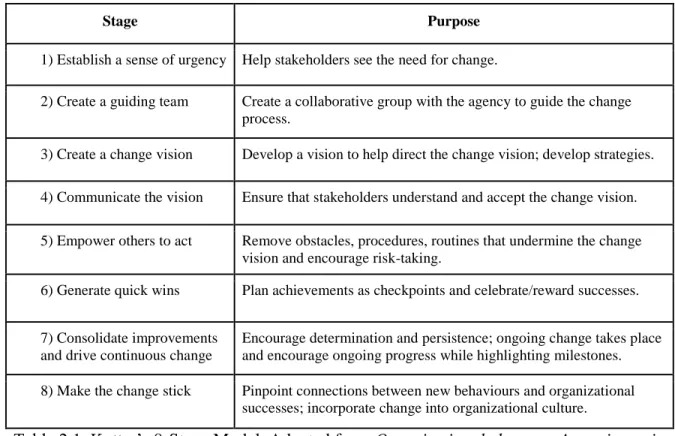
Kotter’s 8-Stage Model. Kotter’s 8-Stage Model (1996) will be used in this OIP as the theory and basis for proposed change in the organization. The stages and purposes at each stage are outlined in Table 2.1 below.
Stage Purpose
1) Establish a sense of urgency Help stakeholders see the need for change.
2) Create a guiding team Create a collaborative group with the agency to guide the change
process.
3) Create a change vision Develop a vision to help direct the change vision; develop strategies.
4) Communicate the vision Ensure that stakeholders understand and accept the change vision.
5) Empower others to act Remove obstacles, procedures, routines that undermine the change
vision and encourage risk-taking.
6) Generate quick wins Plan achievements as checkpoints and celebrate/reward successes.
7) Consolidate improvements and drive continuous change
Encourage determination and persistence; ongoing change takes place and encourage ongoing progress while highlighting milestones.
8) Make the change stick Pinpoint connections between new behaviours and organizational
successes; incorporate change into organizational culture.
Table 2.1. Kotter’s 8-Stage Model. Adapted from Organizational change – An action-oriented toolkit (3rd ed.) by Cawsey, T. F., Deszca, G., & Ingols, C. (2016).
Kotter’s model is designed to follow a step-by-step format, with each preceding step informing and supporting the next. This OIP adapts Kotter’s model for change but treats it as a cycle wherein after the making it stick stage, reflective activities will inform whether further changes are required and will help MLTs decide in conjunction with the principal, which supports are needed moving forward.
Schein (1996) discusses cognitive re-definition that occurs when the individual learner becomes motivated to change and opens him or herself up for the reception of new information
(p.4). The inclusion of Schein’s perspective on the individual learner will be of great importance moving forward when looking at how teachers are affected by and participate in the change process. Schein also delves into areas such as survival anxiety, overcoming learning anxiety, imitation and identification with role models and trial and error learning to shed light on the personal aspect of change in an organization. Schein’s expansions and theories connected to Kotter’s 8-Stage Model will be instrumental in Chapter 3 when considering teacher resistance to change.
Critical Organizational Analysis
Gap Analysis. Nadler and Tushman’s (1980) Congruence Model for Organizational Analysis is used to perform a gap analysis (p.44). As mentioned in Chapter 1, this model is geared towards understanding the dynamics and performance in an organization. When used, the Congruence Model provides a diagnosis of the issues within an organization. Each component of the model will be used to analyze EGPS.
In the Congruence Model, input consists of the environment, resources and history of the organization (Nadler & Tushman, 1980, p.39). Environmental input involves the institutions, groups, events and individuals external to the organization that can have an impact on it. Environmental factors affecting EGPS include parents, the teachers’ union, community groups and the Ministry of Education. When looking at the environmental factors affecting the
organization, Nadler and Tushman suggest that it is necessary to look at the demands that are made on the organization from its environment. The parent community at EGPS is highly involved and follow teacher and school performance closely. This places pressure on the organization when it comes to student performance in mathematics and literacy.
Resources are the assets that the organization may have access to, such as human, capital, technological, financial and informational resources (Nadler & Tushman, 1980, p.39). There are also intangible resources that are at the organization’s disposal, such as community recognition. EGPS has access to technology within the school, school board technology and technology provided by the ministry in the form of technological devices and programming. All personnel working in the school are managed and allocated centrally by the school board. The ministry provides funding to the school board, who then allocates funds to schools based on various factors, such as student enrolment and perceived student socio-economic need. EGPS is privy to the same basic resources as other schools at the BHDSB. It is not an inner city school and does not score high enough on the learning index to necessitate additional funding for special
programming. Financial resources are allocated based on the special programs and the number of students in the school. EGPS is located in an upper middle-class neighbourhood with a very active parent council that engages in many fundraising activities for the school, which allows for extra funds in order to support the use of technology in the classroom.
Historical resources consist of the trends in past activity, behaviour and overall
effectiveness of the organization being analyzed which might have an effect on it (Nadler & Tushman, 1980, p.39). This includes any landmark events that have occurred in the past. EGPS is an inclusive school that is well-known in the community for its outreach and support to students and their families. In terms of the historical resources, EGPS has a history of providing both curricular and extracurricular activities for students.
Some resources in the organization are fixed by the school board or ministry. These include areas such as financial and human resources allocated for specific purposes. Other