UNIVERSITI PUTRA MALAYSIA
EFFECTS OF THE USE OF CALCULATORS, THE POLYA
HEURISTIC AND WORKED EXAMPLES ON PERFORMANCE IN
LEARNING MATHEMATICS FROM A COGNITIVE LOAD
PERSPECTIVE
LAWRENCE ALOYSIUS AERIA.
EFFECTS OF THE USE OF CALCULATORS, THE POLYA HEURISTIC AND WORKED EXAMPLES ON PERFORMANCE IN LEARNING MATHEMATICS
FROM A COGNITIVE LOAD PERSPECTIVE
LAWRENCE ALOYSIUS AERlA
Thesis Submitted to the School of Graduate Studies, Universiti Putra Malaysia,
in Fulfilment of the Requirements for the Degree of Doctor of Philosophy December 2004
Abstract of thesis presented to the Senate of Universiti Putra Malaysia in fulfilment of the requirement for the degree of Doctor of Philosophy
EFFECTS OF THE USE OF CALCULATORS, THE POLYA HEURISTIC AND WORKED EXAMPLES ON PERFORMANCE IN LEARNING
MATHEMATICS FROM A COGNITIVE LOAD PERSPECTIVE
BY
LAWRENCE ALOYSIUS AERIA December 2004
Chairman: Associate Professor Rohani Ahmad Tannizi, Ph.D. Faculty: Educational Studies
Cognitive load theory holds that if an instructional format reduces extraneous cognitive load andlor increases germane cognitive load during learning, as compared to another instructional format, then it will be more efficient in promoting learning, provided that the total cognitive load does not exceed the total mental resources. Based on this premise, a series of four experiments was conducted to investigate the use of calculators, the Polya heuristic and worked examples in an attempt to generate an alternative instructional format that is more instructionally efficient than the conventional one to teach Percentage to Form 1 students. It was hypothesized that the use of calculators and the use of worked examples can reduce cognitive load during leaming and lead to better learning performance while the use of the Polya heuristic increases cognitive load and reduces learning performance. The results from the experiments
indicated that the use of calculators and worked examples reduced cognitive load and led to better learning performance but the use of the Polya heuristic produced zero effects. Based on the results from the experiments, an alternative instructional format, called the calcworked instructional format, that incorporated the use of calculators and the use of partial completion worked examples was generated. The calcworked instructional format was compared with the conventional instructional format and was found to be more instructionally efficient.
Abstrak tesis yang dikemukakan kepada Senat Universiti Putra Malaysia sebagai memenuhi keperluan untuk ijazah Doktor Falsafah
KESAN PENGGUNAAN KALKULATOR, HEURfSTlK POLYA DAN CONTOH PENYELESAIAN TERHADAP PRESTASI
DALAM PEMBELAJARAN MATEMATIK DARlPADA SATU PERSPEKTIF BEBANAN KOGWITIF
Oleh
LAWRENCE ALOYSlUS AERlA Disem ber 2004
Pengerusi: Fakulti:
Profesor Madya Rohani Ahmad Tarrnizi, Ph.D. Pengajian Pendidikan
Teori bebanan kognitif menegaskan bahawa jika sesuatu format pengajaran rnengurangkan bebanan kognitif ekstraneous danlatau menambahkan bebanan kognitif germane semasa pembelajaran, berbanding dengan sesuatu format pengajaran yang lain, maka format pengajaran tersebut akan lebih cekap dalam menggalakkan pembelajaran selagi jumlah bebanan kognitif tidak melebihi jumlah sumber mental. Berdasarkan penyataan ini, satu siri yang mengandungi empat eksperimen telah dijalankan untuk mengkaji penggunaan kalkulator, heuristik Polya dan contoh penyelesaian supaya dapat diwujudkan satu format pengajaran alternatif yang lebih cekap berbanding format pengajaran konvensional, untuk mengajar tajuk Peratusan kepada pelajar Tingkatan 1. Hipotesis telah dibuat bahawa penggunaan kalkuiator dan contoh penyelesaian dapat mengurangkan bebanan kognitif semasa
pembelajaran dan meningkatkan prestasi pembelajaran manakala penggunaan heuristik Polya akan menambahkan bebanan kognitif dan mengurangkan prestasi pembelajaran. Keputusan eksperimen menunjukkan bahawa penggunaan kalkulator dan contoh penyelesaian dapat mengurangkan bebanan kognitif dan mengingkatkan prestasi pembelajaran tetapi penggunaan heuristik Polya menghasilkan kesan sifar. Berdasarkan keputusan eksperimen-eksperimen tersebut, satu format pengajaran altematif, dinamakan format pengajaran calcworked, yang menggabungkan penggunaan katkulator dan contoh penyefesaian separa lengkap telah diwujudkan. Jika dibandingkan dengan format pengajaran konvensional, format pengajaran calcworked didapati lebih cekap.
ACKNOWLEDGEMENTS
Before and after I embarked on this study, I have been dependent on, beholden to and grateful for the kindness and efforts of many generous people who have helped me to make this study a reality. It is well past time to acknowledge my debts.
Like many post-graduate students who conduct studies in schools, I am first and foremost grateful to the many students, teachers, senior assistants and principals who tolerated my presence in their school and to the disruptions to their normal school routine. They were gracious in granting permission and extending their cooperation. I am overwhelmed by their generosity especially in the face of mounting work pressures and daily school assignments. I am especially grateful to the numerous students who willingly participated in the experiments.
I am grateful to the many lecturers and staff of the Faculty of Educational Studies, Universiti Putra Malaysia, without whom I would not have been able to complete this study. Foremost, I would like to thank members of my supervisory committee. Thank you Associate Professor Dr. Rohani Ahmad Tarmizi, Professor Dr. Kamariah Hj. Abu Bakar and Professor Dr. Turiman Hj. Suandi. Without your help, this study would never have been completed. I would also like to thank Associate Professor Dr. Ab. Rahim Bakar and Tuan Haji Azali Mahbar for giving me helpful pointers during my proposal defence and to Associate Professor Dr. Aida Suraya Haji Md.
Yunus for her encouragement during the presentation of my paper in the GREDUC Seminar in April 2001. 1 would also like to thank Puan Norkiah Mohd. Khalil and Puan Rafiah Maat both of whom have helped me in more ways than one.
Throughout this study I have solicited help from various sources outside UPM. Foremost, 1 would like to express my heartfelt gratitude to the many cognitive load theory researchers who have helped me. I especially would like to thank Professor Dr. John Sweller and Professor Dr. Fred Paas, both of whom not only gave me useful pointers but were also so patient in replying to my queries at various stages of my study. I am grateful to Dr. Paas for taking the time out to review the paper on this study that was presented at the National Seminar on Mathematics Education held at the De Palma Hotel in Kuala Lumpur in October 2002.
I am also grateful to members on the AERA-D Division D: Measurement and Research Methodology Listserv discussion group who responded to my queries on the methodology issues of this study. They have been extremely generous in helping me iron out some of the more thorny methodology issues.
This study would not have been possible without the validators and translators of the instruments, proof-readers and reviewers. I would like to thank all of them. I especially would like to thank Mr. Anthony Gomer,
Mr. Heng Fook Seng and Mr. Joseph Gomez for their proof-readings, reviews and comments. I am particularly indebted to Professor Margaret McLaren and Professor Ian McLaren who not only painstakingly proof- read and reviewed the many drafts of this thesis and made suggestions for improvements but also kept me believing in myself.
I have often been sustained or revived during the difficult periods of this study by many friends who listened, laughed, encouraged and offered advice. They have cammented on drafts, debated key issues, dreamed up titles, suggested alternative explanations, and kept me believing that I was up to the task. Karen Lai Kuen Choo, Desmond Lee Chan Leong, Tan Aig Bee, Dr. Boon Pong Yin, Anne Minjoot, Mohanakrishnan, Dr. Wong Su Luan, Dr. Loh Sau Cheong, Gomes, Ms. Goh Soon Gaik, Dr. Chong Poh Wan , Dr. Linton Britten, Bernadette Soon Ah Nooi, Tuan Haji Habib Wagiman, Joseph Kulandai, Heng Fook Seng and
all
my colleagues at the International Languages Teacher Training Institute have been there for me and I thank all of them. I also would like to thank Jacqueline Lim, my cousin, for sourcing literature for me from the University of New South Wales at the initial stages of this study.There have been countless others who have helped me somewhere along the way but whom I may have inadvertently omitted. I am grateful to all of them.
Finaily to my family members, thank you for your patience and encouragement throughout this study. I especially would like to dedicate this study to the memory of my mum, Helena Lim, who provided me the most encouragement to complete this study.
I certify that an Examination Committee met on lSth ~ e c e m b e r 2004 to conduct the final examination of Lawrence Aloysius Aeria on his Doctor of Philosophy thesis entitled "Effects of the Use of Calculators, the Polya Heuristic and Worked Examples on Performance in Learning Mathematics from a Cognitive Load Perspective" in accordance with Universiti Pertanian Malaysia (Higher Degree) Act 1980 and Universiti Pertanian Malaysia (Higher Degree) Regulations 1981. The Committee recommends that the candidate be awarded the relevant degree. Members of the Examination Committee are as follows:
Othman Dato' Hj. Mohamed, Ph.D. Professor
Faculty of Educational Studies Universiti Putra Malaysia (Chairman)
Aida Suraya Haji Md. Yunus, Ph.D. Associate Professor
Faculty of Educational Studies Universiti Putra Malaysia (Member)
Habibah Elias, Ph.D. Professor
Faculty of Educational Studies Universiti Putra Malaysia (Member)
John Sweller, Ph.D. Professor
Faculty of Education
University of New South Wales (Independent Examiner)
~ r o f & o r / ~ e ~ u t ~ Dean School of Graduate Studies Universiti Putra Malaysia Date:
1
7
MAR 2005
This thesis submitted to the Senate of Universiti Putra Malaysia and has been accepted as fulfilment of the requirement for the degree of Doctor of Philosophy. The members of the Supervisory Committee are as follows:
Rohani Ahmad Tarmizi, Ph.D. Associate Professor
Faculty of Educational Studies Universiti Putra Malaysia (Chairperson)
Kamariah Hj. Abu Bakar, Ph.D. Professor
Faculty of Educational Studies Universiti Putra Malaysia (Member)
Turiman Hj. Suandi, Ph.D. Professor
Faculty of Educational Studies Universiti Putra Malaysia (Member)
7
AlNl IDERIS, Ph.D. ProfessorIDean
School of Graduate Studies Universiti Putra Malaysia Date:
DECLARATION
I hereby declare that the thesis is based on my original work except for quotations and citations which have been duly acknowledged. I also declare that it has not been previously or concurrently submitted for any other degree at UPM or other institutions.
Date: 2znd April 2004
TABLE OF CONTENTS Page ABSTRACT ABSTRAK ACKNOWLEDGEMENT APPROVAL DECLARATION LlST OF APPENDICES LIST OF TABLES LlST OF FIGURES CHAPTER INTRODUCTION
Background of the Study Introduction
Research in Mathematical Problem Solving The lnformation Processing Theory
Cognitive Load Theory
Performance of Malaysian Lower Secondary School Students in Mathematical Problem Solving
The Use of Caiculators
The Use of the Polya Heuristic The Use of Worked Exampies Statement of the Problem
Purpose of the Study Research Hypotheses Significance of the Study
Limitations of the Study Definition of Terms
REVIEW OF RELATED LITERATURE Introduction
Problem and Problem Solving in Mathematics Meaning of Problem in Mathematics
Meaning of Problem Solving in Mathematics The lnformation Processing Theory
The Modal Model of Memory Sensory Buffer
Short Term Memory (STM)I Working Memory Long Term Memory
Encoding, Storage and Retrieval Cognitive Load Theory
Overview of Cognitive Load Theory
I I iv vi X xii xix xx xxiii
Key Concepts in Cognitive Load Theory Meaning of Cognitive Load
The Cognitive Load Construct Measurement of Cognitive Load
Learning from the Perspective of Cognitive Load Theory
Expert-Novice Differences from the Perspective of Cognitive Load Theory
Principles of Cognitive Load Theory Application of Cognitive Load Theory to lnstructional Design
Conventional Problems and Conventional Problem Solving (Means-Ends Analysis) The lnstructional Techniques (Effects) Generated by Cognitive Load Theory Methodology of Cognitive Load Studies
Cognitive Load Studies in lnstructional Fields of Research
Recent Developments in Cognitive Load Theory Research
Calculators in Mathematics Overview
Arguments For and Against the Use of Calculators
Research Findings On Calculators in Mathematics Education
Heuristics in Mathematics
What are Heuristics? The Polya Heuristic
Research Findings on Heuristics The Integrated Curriculum for Secondary Schools
Mathematics syllabus Conceptual Framework of the Study Summary
METHODOLOGY Overview of Chapter Introduction
Design of the Study
The Experimental Design
Overview of the Staggered Experimental Design
Justification for the Staggered Experimental Design
Design of Each Experiment The Variables of the Study
Sample CompositionICriteria Sample Criteria Sampling Procedure Sample Size Instrumentation Pre-Experiment Preparation
Overview of Procedures for Experiments Pilot Study
Preliminary Study (Experiment 1)
Development of lnstrument I (The Selection Criteria Test)
Reliability of The Selection Criteria Test Development of lnstrument 3 (The General Guideline Lesson Plan)
Development of lnstrument 4 (The Percentage Problems)
Reliability of lnstrument 4 (The Percentage Problems)
ltem Difficulty lndex and ltem Discrimination lndex of lnstrument 4
Development of lnstrument 5 (The Worked Examples)
Development of lnstrument 6 (The Paas Mental Effort Rating Scale)
Reliability of lnstrument 6 (The Paas Mental Effort Rating Scale)
Details of the Procedures for the Experiments Experiment 1 Experiment 2 Experiment 3 Experiment 4 Summary RESULTS Introduction Experiment 1
Effects of the Use of Calculators, the Polya Heuristic and Worked Examples on
Performance and Mental Effort in the Acquisition Phase
Effects of the Use of Calculators, the Polya Heuristic and Worked Examples on
Performance and Mental Effort in the Test Phase
instructional Efficiency of the Conventional, Calculator, Heuristic and Worked Example Instructional Formats
Correlation Between Cognitive Load and the Performance Variables
Research Hypotheses Post-hoc Power Analyses Experiment 2
Effects of the Use of Calculators, the Polya Heuristic and Worked Examples on
Performance and Mental Effort in the Acquisition Phase
Effects of the Use of Calculators, the Polya Heuristic and Worked Examples on
Performance and Mental Effort in the Test Phase
Instructional Efficiency of the Conventional, Calculator, Heuristic and Worked Example lnstructional Formats
Correlation Between Cognitive Load and the Performance Variables
Research Hypotheses Post-hoc Power Analyses Experiment 3
Effects of the Use of the Alternative (Calcworked) lnstructional Format on Performance and Mental
Effort in the Acquisition Phase Effects of the Use of the Alternative (Calcworked) lnstructional Format on Performance and Mental
Effort in the Test Phase
lnstructional Efficiency of the Conventional and Calcworked lnstructional Formats Correlation Between Cognitive Load and the Performance Variables
Research Hypotheses Post-hoc Power Analyses Experiment 4
Effects of the Use of the Alternative (Calcworked) lnstructional Format on Performance and Mental
Effort in the Acquisition Phase Effects of the Use of the Alternative (Calcworked) lnstructional Format on Performance and Mental
Effort in the Test Phase
lnstructional Efficiency of the Conventional and Calcworked lnstructional Formats Correlation Between Cognitive Load and the Performance Variables
Research Hypotheses Post-hoc Power Analyses Summary
DlSCUSSlON lntroduction Experiment 1
Effects of the Use of Calculators on Performance in Learning
Effects of the Use of the Polya Heuristic on Performance in Learning
Effects of the Use of Worked Exampies on Performance in Learning
Summary of Research Findings of Experiment 1
Experiment 2
Effects of the Use of Calculators and Worked Examples on Performance in Learning
Effects of the Use of the Polya Heuristic on Performance in Learning
Summary of Research Findings of Experiment 2
Experiment 3
Effects of the Calworked instructional Format Summary of Research Findings of
Experiment 3 Experiment 4
Effects of the Calworked Instructional Format under Classroom Conditions
Summary of Research Findings of Experiment 4
Summary
SUMMARY, CONCLUSIONS, IMPLICATIONS AND RECOMMENDATIONS
lntroduction
Overview of the Study
Summary of the Purpose of the Study Summary of Research Methodology Summary of Research Findings
Research Question No. 1
Effects of the Use of Calculators
Effects of the Use of the Polya Heuristic Effects of the Use of Worked Examples Research Question No. 2
Effects of the Use of the Alternative Instructional Formats
Conclusions of the Study
lmplications of the Study
Theoretical lmplications Practical Implications Recommendations
The Use of Calculators
The Use of the Polya Heuristic The Use of Worked Examples Recommendations for Further Research BIBLIOGRAPHY
APPENDICES
BIODATA OF THE AUTHOR
LIST OF APPENDICES
Appendix A
Page Ujian Pemilihan Kriteria (Instrumen 1)
Selection Criteria Test
Record Keeping And Observational Form (Instrumen 2) Rancangan Mengajar untuk Eksperimen 1,2 & 3 (Instrumen 3) General Guideline Lesson Plan For Experiments I, 2 & 3 Rancangan Mengajar untuk Eksperimen 4 (Instrumen 3) General Guideline Lesson Plan For Experiments 4 Rumus-Rumus
lnstrumen 4 bagi Eksperimen I (Soalan-Soalan Peratus) (The Percentage Questions)
lnstrumen 4 bagi Eksperimen 2 & 3 (Soalan-Soalan Peratus) (The Percentage Questions)
lnstrumen 4 bagi Eksperimen 4 (Soalan-Soalan Peratus) (The Percentage Questions)
lnstrumen 5 bagi Eksperimen 1 (Worked Examples)
lnstrumen 5 bagi Eksperimen 2 (Worked Examples)
lnstrumen 5 bagi Eksperimen 3 (Worked Examples)
lnstrumen 5 bagi Eksperimen 4
worked Examples)
lnstrumen 6 (Skala Kadar Daya Mental) The Paas Mental Effort Rating Scale
Panel of Content Validators And Translators Letters of Permission
LIST OF TABLES
Table
I
.I
Page Differences between conventional instructional
practices and cognitive load generated instructional practices
Performance of Malaysian students for PMR Mathematics Paper 1 (1 993-1 996)
Analysis of students' performance on percentage problems for PMR Mathematics Paper 1 (1 993-1 996) The four-stage Polya heuristic
Rotation of control and treatment groups for Experiment 3 according to time allocation
The independent variable (instructional format) for Experiment I and Experiment 2
The independent variable (instructional format) for Experiment 3 and Experiment 4
Dependent variables (Measures of performance) The recommended alpha range (DeVelli's Scale)
Difficulty and Discriminant indices of the acquisition and test items of instrument 4 in Experiment 1
Reliability estimates of the Paas Mental Effort Rating scale
Summary of Experiment
I
Summary of Experiment 2 Summary of Experiment 3 Summary of Experiment 4Means and standard deviations of the dependent variables for the control and treatment groups for the acquisition phase of Experiment 1
One-way analysis of variance on the dependent variables for the acquisition phase of Experiment I Tukey post-hoc comparisons on the dependent variables for the acquisition phase of Experiment 1
Means and standard deviations of the dependent variables for the control and treatment groups for the test phase of Experiment 1
One-way analysis of variance on the dependent variables for the test phase of Experiment 1
Tukey post-hoc comparisons on time per test problem for the test phase of Experiment I
Relative condition efficiency index of the control and treatment groups for Experiment 1
One-way analysis of variance on the relative condition efficiency index for Experiment 1
Pearson product moment correlation between mental effort and the performance variables of Experiment 1 Means and standard deviations of the dependent variabies for the control and treatment groups for the acquisition phase of Experiment 2
One-way analysis of variance on the dependent variables for the acquisition phase of Experiment 2 Tukey post-hoc comparisons on the dependent variables for the acquisition phase of Experiment 2 Means and standard deviations of the dependent variables for the control and treatment groups for the test phase of Experiment 2
One-way analysis of variance on the dependent variables for the test phase of Experiment 2 Tukey post-hoc comparisons on the dependent variables for the test phase of Experiment 2
Relative condition efficiency index of the control and treatment groups for Experiment 2
One-way analysis of variance on the relative condition efficiency index for Experiment 2
Tukey post-hoc comparisons on the relative condition efficiency index for Experiment 2
Pearson product moment correlation between mental effort and the performance variables of Experiment 2 Means and standard deviations of the dependent variables for the conventional and calcworked groups and results of the t-test analyses for the acquisition phase of Experiment 3
Means and standard deviations of the dependent variables for the conventional and calcworked groups and results of the t-test analyses for the test phase of Experiment 3
Relative condition efficiency index of the conventional and calcworked groups and results of the t-test
analyses for Experiment 3
Pearson product moment correiation between mental effort and the performance variables of Experiment 3 Means and standard deviations of the dependent variables for the conventional and calcworked groups and results of the t-test analyses for the acquisition phase of Experiment 4
Means and standard deviations of the dependent variables for the conventional and calcworked groups and results of the t-test analyses for the test phase of Experiment 4
Relative condition efficiency index of the conventional and calcworked groups and results of the t-test
analyses for Experiment 4
Pearson product moment correlation between mental effort and the performance variables of Experiment 4
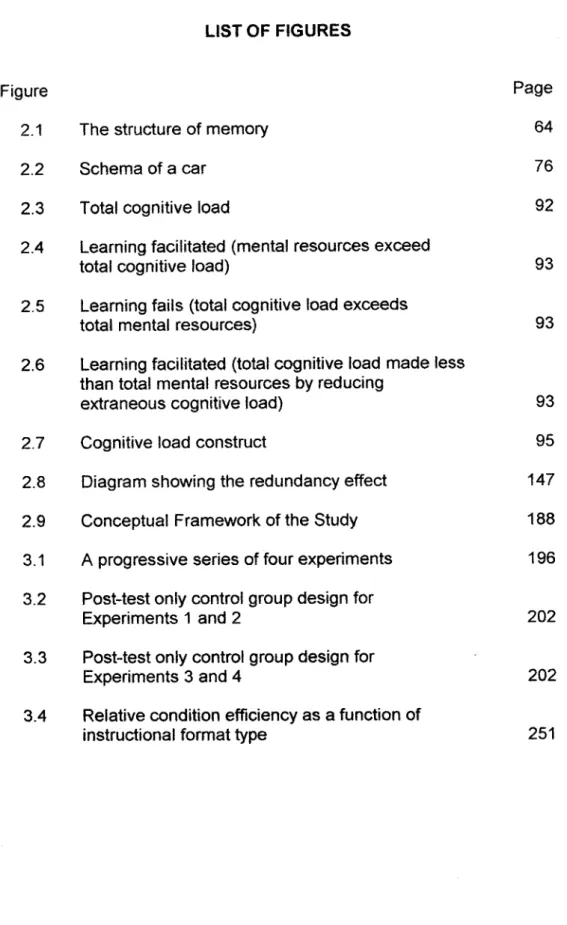
LIST OF FIGURES Figure 2.1 2.2 2.3 2.4
The structure of memory Schema of a car
Total cognitive load
Learning facilitated (mental resources exceed total cognitive load)
Learning fails (total cognitive load exceeds total mental resources)
Learning facilitated (total cognitive load made less than total mental resources by reducing
extraneous cognitive load) Cognitive toad construct
Diagram showing the redundancy effect Conceptual Framework of the Study A progressive series of four experiments
Post-test only control group design for Experiments 1 and 2
3.3 Post-test only control group design for Experiments 3 and 4
3.4 Relative condition efficiency as a function of instructional format type
Page 64 76
CHAPTER 1 INTRODUCTtON
Background of the Study
Introduction
In the last few decades, the mathematical community has struggled to define what mathematics is and what mathematical thinking means. One possible reason for this is the growing role of mathematics, science and technology in modem life (Organization of Economic CQ- operation and Development, 2004). Consequently, there have been numerous changes made to the mathematics cumculum used in schools and institutions of higher learning.
The events in the United States typify the situation. According to Schoenfeld (1 992), in 1957 when the Russians launched their space satellite Sputnik, it galvanized American educators, scientists and mathematicians to restructure the curriculum in line with their notion of what mathematics and mathematical thinking should be. Thus evolved
The New Mafhs. When it was discovered that this new curriculum was not working, the pendulum swung to the other end and the back-to- basics movement grew in popularity. This too was eventually deemed to