
Flawed Tools: The Efficacy of Group Research Methods to
Generate Customer Ideas*
Gary R. Schirr
Group customer and user research methods, brainstorming, and focus groups continue to be used in innovation efforts to uncover customer needs, generate new product and service ideas, and evaluate decisions, despite extensive empirical evidence that group methods are ineffective for such purposes. This paper summarizes the strong evidence of the ineffectiveness of group research methods for these purposes, much of which has been published outside of the new product development or business literature. The paper shows that the most common rationalization for the continued use of group methods—cost and speed advantages—are questionable, and then proposes an organizational market learning framework for evaluating the use of group methods. This framework provides guidance for the proper use of these research tools and suggests areas for future research on research methods for product innovation.
U
nderstanding customer needs and generating ideas from good customer research are impor-tant antecedents of success in new products and service (Cooper, Easingwood, Edgett, Kleinschmidt, and Storey, 1994; Cooper and Edgett, 1996; Henard and Szymanski, 2001). A succession of research streams has focused on engaging customers to understand their deep needs and to generate ideas for product and service inno-vation, including (1) the customer active paradigm of pro-duct development (von Hippel, 1978); (2) lead users (von Hippel, 1986); (3) the voice of the customer (Griffin and Hauser, 1993); (4) probe and learn (Lynn and Morone, 1996); (5) experimentation (Thomke, 2001); and (6) cocreation by customers (Payne, Storbacka, and Frow, 2008; Prahalad and Ramaswamy, 2004). These methods focus on engaging users or customers at the individual level to uncover deep needs and sticky information (Szulanski, 2003; von Hippel, 1994); for example, the authors of “The Voice of the Customer” stressed that individual customer interviews were much more effectivefor new product ideas than focus groups (Griffin and Hauser, 1993).
This preference for engaging customersindividually
instead of through group research methods is consistent with 50 years of research that casts doubt on the efficacy of group research methods for customer ideas or needs (Fern, 1982; Griffin and Hauser, 1993; Paulus and Dzin-dolet, 1993; Taylor, Berry, and Block, 1958; Thompson, 2003). The two primary face-to-face group techniques that may be employed in the ideation phase of innovation are focus groups, generally a group of 4–9 customers or users assembled to explore userneeds, and brainstorming groups, which may include engineers, customers, con-sultants and/or marketing staff, as well as users, to gen-erate new product or service ideas (Fern, 2001). Both focus groups and brainstorming groups are discussed in this paper because (1) as noted, needs and ideas are key antecedents of new product and service innovation and are gathered and generated at the onset of the effort; (2) both share the characteristics of face-to-face group inter-action, which have been considered a source of problems with the techniques; and (3) there is overlap in these groups: both may include customers and users, and, despite the definitional distinctions, focus groups are fre-quently used to generate new product or service ideas through brainstorming techniques (Durgee, 1992; Fern, 2001; McQuarrie and McIntyre, 1986).
Despite strong and consistent evidence denouncing group ideation methods, some new product development researchers and consultants seem to consider all customer research to be effective. In addition, firms and consultants are using focus groups as part of new product and service ideation. This continued use of brainstorming groups and focus groups to uncover valuable customer needs Address correspondence to: Gary R. Schirr, Radford University, P.O.
Box 6917, Radford VA 24142. E-mail: [email protected]. Tel: 540-808-6630.
* For their time and efforts contributing to this paper, a debt is owed to (1) Dr. Abbie Griffin for her encouragement and thoughtful suggestions; (2) Dr. Edward F. Fern and Dr. Albert L. Page for their encouragement in this effort; (3) The American Bankers Association, and Dr. Yao and Maggie Kelly, who sponsored 2007 Bank Innovation Survey; (4) The Product Development and Management Association Research Foundation and to Thomas Hustad and Stephen K. Markham of the Foundation for granting the author access to the comparative performance assessment study data set, and to Dr. Abbie Griffin, University of Utah, and Dr. Marjorie Adams-Bigelow for their help in analyzing the data; (5) anonymous conference reviewers who made useful suggestions on earlier versions of this manu-script; and (6) an anonymous reviewer atJPIMwho made valuable sug-gestions to improve the paper.
and ideas is puzzling given strong evidence illustrating the ineffectiveness of group production. Why do group market research methods continue to be used in product and service development despite five decades of research showing such methods to be inferior to more individual-ized research techniques? The research questions for this paper are vital to innovation in organizations:
Why are group research methods, focus groups, and brainstorming used in customer research for NPD ideas despite extensive evidence of ineffectiveness for ide-ation? Under what circumstances might an organization use group market research methods to support innova-tion and new product development?
Two recent articles have reviewed the strong evidence against group brainstorming and then suggested proce-dural changes, expressing hope that electronic groups might solve the group problems (Furnham, 2000; Thomp-son, 2003). This paper takes a more fundamental approach to the issue: the evidence against group methods is reviewed, propositions about application of group methods in research for innovation are developed, and a framework for analyzing new group or hybrid methods for new product and service development (NPD) research is presented.
A Conceptual Study
This paper is a conceptual study to provide propositions to guide future research about the use of group market research methods as part of a new product development effort, and to provide a theoretical framework for
choos-ing between group and individual ideation methods. The literature on the effectiveness of focus groups and brainstorming for generating ideas and uncovering customer needs in the context of product development is discussed. Possible benefits to organizational market learning from group techniques are explored. Ideas from the literature of new product development and market learning are used to frame the issue of when to employ group research. The objective of the effort is to develop propositions for future research and tentative guidelines on the proper use, if any, of these research tools.
The analysis emerges from a review of the literature on group research methods and focus groups in NPD. Most of these articles are empirical studies or meta-analyses of past empirical studies, although conceptual discussions are frequent in the meta-analyses and litera-ture reviews. Meta-analyses are theory building as they derive key effects and themes from previous empirical study. Given the increased acceptance of qualitative methods in marketing research, a conceptual paper based in part on empirical studies should not seem unreason-able: theory can be created from data (Glaser, 1992; Glaser and Strauss, 1967; Strauss and Corbin, 1998). Past conceptual work is, of course, also discussed and utilized.
Two secondary data sets, which the author had access to, are used to illustrate and frame the issues being dis-cussed in the paper. This is not an empirical study; the article could have been produced without the use of these two data sets. In the author’s opinion, the statistics and exploratory data help the understanding of the issues, illustrate the problems, and frame choices. The two data sets used are the comparative performance assessment study (CPAS) 2003 data set from the Product Develop-ment and ManageDevelop-ment Association (Adams-Bigelow, 2004) and the results of the 2007 Bank New Service Development Survey conducted by the author in coop-eration with the American Bankers Association (Schirr and Page, 2009). Additional information about the two data sets is available in Appendix A.
The first section of this paper reviews the empirical case against group research methods and the use of focus groups in need discovery, ideation, or idea evaluation for innovation. The case against traditional group methods is strong with 50 years of evidence and hundreds of empiri-cal studies, 208 articles in the subperiod 1967–1994 alone (Sutton and Hargadon, 1996). Much of the empirical evidence is outside the marketing literature, in psychol-ogy and other social science areas, and may have there-fore escaped full notice by marketing researchers and practitioners; this may explain why group research
BIOGRAPHICAL SKETCH
Dr. Gary Schirr is an assistant professor of marketing at Radford Uni-versity (Va.). He is a member of the Product Development and Manage-ment Association and reviews articles for the leading academic journal of new product development,JPIM. With the help of the American Bankers Association, Gary conducted the 2007 Bank New Service Development Survey. Before beginning his academic career, Gary was actively involved in new product and service development in financial services. Professor Schirr formerly served on the new product commit-tees of two international financial futures exchanges, headed service development for an online clearing subsidiary of a major bank, and had been in charge of product development for a leading software vendor serving online trading. From 2001 to 2004, he consulted with start-up firms involved in online trading and risk management. Gary has a Ph.D. in marketing from the University of Illinois at Chicago. He also has an M.S. in finance from Carnegie Mellon and a B.S. in mathematics from Miami University. He is coauthor with Albert L. Page of aJPIMarticle that was awarded a 2008 Thomas Hustad Best Paper award.
methods are still advocated for early-stage innova-tion without fully acknowledging the proven pitfalls (Furnham, 2000). The second section of the paper demonstrates that despite the evidence against group methods, focus groups are still used in NPD to uncover valuable customer ideas and needs. Section three dis-cusses efforts to explain the persistence of the use of group methods in the face of the dismal evidence of their efficacy. In the fourth section, rationales for the use of group methods are linked to an organizational market learning model of NPD success. The final section before the conclusion discusses the alternatives to face-to-face group methods that have been promoted through the years to reduce groupthink problems.
Several propositions that emerge in the discussion are presented in the later sections. These propositions will ideally guide future research and provide some insight to innovators.
Group Research Methods Fail to Uncover
Needs and
Kill
Ideas
This section presents the extensive evidence against the effectiveness of focus groups and brainstorming groups for the key research missions of product and service innovation: (1) uncovering user needs; (2) generating ideas for innovation; and (3) evaluating alternative ideas. Many studies, primarily empirical tests or meta-analyses of empirical studies of focus group and brainstorming effectiveness, are cited in the discussions. A summary table of selected past research articles is included in Appendix B.
Uncovering User Needs Through Focus Groups
Griffin and Hauser (1991) in their working paper that preceded the 1993 “Voice of the Customer” article, note that there are often key “exciting needs . . . not voiced . . . (by most customers who) . . . do not consider their fulfillment a realistic possibility” (p.7) and claim that these needs are often key to the success of a project. The consensus process within a focus group may inhibit raising key issues and be a partial explanation for the lower quality of ideas generated in focus groups. Consis-tent with the evidence on idea generation in brainstorming groups, “The Voice of the Customer” found that individu-als were less effective at uncovering user needs in a group session (Griffin and Hauser, 1993). A 2003 article sug-gests that the appropriate use of focus groups in innova-tion is to uncover “thoughts held in common” and “less idiosyncratic ideas” (Bristol and Fern, 2003, p. 447–8).
Especially for more innovative product development, uncovering customer needs and problems is hampered by their contextual knowledge and inability to express or understand the needs away from the context (Szulanski, 2003; von Hippel, 1994). Focus group or brainstorming participants are gathered at a central location away from their work or home environment where they normally use the organization’s goods or services. An article written by an experienced focus group leader declared that focus groups should not be used for idea generation or screen-ing in innovation (McQuarrie and McIntyre, 1986, 1987). McQuarrie (1991, 1998) later wrote a number of publi-cations on the merit of customer site visits for gathering ideas—visiting a user where the good or service would be used and observing and interviewing one-on-one.
Such sticky or contextual information is likely lost in these group methods. IDEO, a well-known innovation and design consultancy, is known as an active user of brainstorming groups for ideation, as will be discussed in a later section (Hargadon and Sutton, 1997; Kelley, Littman, and Peters, 2001). However, even IDEO advo-cates are using ethnographic methods rather than focus groups to uncover customer and user needs, to get at the deep or really interesting needs (Higgins and Koucky, 2003; Kelley, 2005).
Group Ideation
Brainstorming—and the underlying techniques of group research employed in brainstorming, focus groups, or “group creativity” exercises—was proposed as a method to generate ideas (“ideation”) in a book written by an advertising executive and adjunct professor (Osborn, 1957). Osborn claimed that he had empirical evidence that a group brainstorming by his four key rules—(1) criticism not welcome; (2) freewheeling welcome; (3) quantity of ideas welcome; and (4) combining/improving ideas welcome—could produce twice as many ideas as individuals brainstorming aloneand also produce better ideas (Osborn, 1957; Thompson, 2003). Osborn (1957) indicated that number of ideas alone is a sufficient metric to measure the performance of group ideation because
better ideas necessarily result from more ideas. Osborn never presented the evidence to back his claims for brain-storming’s superiority, but he laid down a gauntlet and clear metrics—number of ideas and quality of those ideas—that has led to 50 years of research and hundreds of studies testing group ideation methods against indi-vidual ideation. Taylor et al. (1958) conducted experi-ments, finding that the combined results of individual brainstorming outperformed groups in terms of the
number, quality, and uniqueness of the ideas generated. Several studies have found support for two of Osborn’s ideas—that the four rules of conduct enhance creativity and that quantity of ideas is linked to quality of ideas (Litchfield, 2008; Mullen, Johnson, and Salas, 1991; Thompson, 2003). However, a wide range of studies have supported Taylor et al.’s (1958) findings that brainstorm-inggroupsproduce fewer and lower average quality ideas than methods employing users individually (Bouchard, 1972a, 1972b; Bouchard, Barsaloux, and Drauden, 1974; Bouchard and Hare, 1970; Bristol and Fern, 2003; Diehl and Stroebe, 1987; Fern, 1982; Griffin and Hauser, 1993; Mullen et al., 1991; Taylor et al., 1958).
As noted in the introduction of this paper, multiple streams of research have pointed to the importance of user and customer ideas for effective product and service innovation. Experimental results from customer research reported in the Journal of Marketing Research (Fern, 1982, p. 11) found that individual one-on-one interviews were superior to focus groups in terms of (1) thenumber
of ideas generated; (2) the quality of ideas generated; (3) dealing with complex concepts; and (4) “ thought-generation tasks.” Fern’s (1982) list of four areas in which focus groups were inferior to individual interviews seems to correspond well to what new product develop-ment managers would seek in generating ideas from customer research.
Focus groups reduce the number of unique ideas per subject involved and reduce the quality of the ideas generated; the effect is predicted to be more severe in complex products (Fern, 1982). Fern’s (1982) find-ings that focus groups reduce ideas and eliminate the most creative ideas are consistent with research results about the effectiveness of group market research methods—focus groups and group brainstorming—from the two decades before he wrote his article and in the decades since (Diehl and Stroebe, 1987; Griffin and Hauser, 1993; Taylor et al., 1958; Thompson, 2003). The effectiveness trade-off is all too clear: for a standard time period of around an hour, individual interviews averaged 28 unique ideas (unique ideas within a randomly selected group), members of a four-person focus group averaged 20 unique ideas, and members of a six-person group averaged only 14 unique ideas (Fern, 1982, p. 7). On the two measures of quality—“summed quality” and number of “good ideas”—the individual interviews scored 50% better than moderated focus groups (p. 8). Fern (1982) was not surprised by these results, noting that they were consistent with a series of earlier studies that found that brainstorming groups—students, scientists, or business managers—generated fewer ideas and lower quality
ideas than by working alone (Campbell, 1968; Dunnette, Campbell, and Jaastad, 1963; Taylor et al., 1958). McQuarrie and McIntyre (1986) recommended thatfocus groups not be used for idea generation or idea screening in a new product development effort(p. 41). Past research presents clear evidence that focus groups are less effec-tive in idea generation or idea testing (Fern, 1982), in defining customer needs (Griffin and Hauser, 1993) or in discerning customer attitudes toward existing products (Bristol and Fern, 2003).
Quality of Ideas and Best Ideas
Osborn (1957) stressed that quality of ideas was linked to quantity generated, so to measure the effectiveness of an ideation technique measuring the quantity of ideas gener-ated was sufficient. A large number of studies have mea-sured both quantity and quality and have supported Osborn’s quantity–quality link, while strongly rejecting his claims for the performance of group brainstorming. A meta-analysis of data from 20 published studies showed that “quantitative productivity loss is not compensated for by an increase in quality of productivity” and in fact that “productivity loss . . . is highly significant and of strong magnitude” measured by either quantity or quality of ideas generated (Mullen et al., 1991, p. 18). The link between quantity and quality is not a simple linear link because of the percentage of quality ideas staying constant; empirical evidence shows that theaverage quality of ideasgenerated through individual interviewing or brainstorming is higher than in groups (Diehl and Stroebe, 1991; Fern, 1982; Lamm and Trommsdorff, 1973; Mullen et al., 1991; Taylor et al., 1958; Thompson, 2003).
A current working paper examines group and hybrid (individual research first then group brainstorming) ide-ation for the quantity, average quality, and very best ideas generated (Girotra, Terwiesch, and Ulrich, 2010). Girotra et al. (2010) conclude that an organization interested in generating ideas would be “better off relying on the asyn-chronous idea generation of individuals” rather than using groups (p. 602). Girotra found that hybrid groups were better than traditional groups in:
1. Generating more ideas; 2. Generating better ideas; 3. Generating the best ideas; and 4. Discerning the best ideas.
Furthermore, Girotra et al. (2010) found that all of the benefits of the hybrid technique came from individual ideation: idea add-on and building, alleged advantages of group efforts, resulted in lower average quality ideas.The
group effect in ideation does not simply kill ideas, but it disproportionately eliminates better ideas and the very best ideas.This is a major problem for group research: if the shortfall was only in quantity of ideas—or if the quality of ideas was even proportional to quantity—an organization could compensate for the ineffectiveness of group ideation by holding additional sessions. However, this quality idea devastation cannot be cured by simply holding more group sessions. The only way to compen-sate for the reduction in higher quality and the very best ideas is to undertake research at the individual level.
Idea Devastation
The effect of 50 years of empirical evidence on face-to-face group brainstorming methods is summarized in quotes from earlier researchers who have examined the empirical literature. Thompson (2003, p. 100) notes: “40 or so years of research on brainstorming has shown that group brainstorming is significantly worse in terms of fostering creativity than comparable numbers of solitary brainstormers.” “Research shows unequivocally that brainstorming groups produce fewer and poorer quality
ideas than the same number of individuals working alone” (Furnham, 2000, p. 21). Furnham (2000, p. 23) further states that: “The evidence from science suggests that business people must be insane to use brainstorming groups.” Academic meta-analyses use more restrained statements, but the meaning is still clear: “[Past and current studies] . . . suggest that there is little justification for group brainstorming in organizations” (Paulus, Larey, and Ortega, 1995, p. 262). A meta-analysis of group versus nominal brainstorming studies state that “the long-lived popularity of brainstorming techniques is unequivocally and substantially misguided” (Mullen et al., 1991, p. 18). Before developing the propositions of this paper, it is worth noting a law of group ideation that has been sup-ported by testing Osborn’s (1957) criterion for successful idea generation in hundreds of studies and multiple meta-analyses (Diehl and Stroebe, 1987, 1991; Lamm and Trommsdorff, 1973; Mullen et al., 1991; Mullen, Symons, Hu, and Salas, 1989):
L1: Group methods, focus groups, or brainstorming produce fewer and lower average quality ideas than indi-vidual brainstorming or interviews.
Why Do Group Methods Kill Ideas, Especially Good Ideas?
Diehl and Stroebe (1987, 1991) believed that group inter-actions caused the destruction of ideas in a group,
spe-cifically via three hindrances: (1) free-riding by individuals; (2) evaluation apprehension; and (3) produc-tion blocking (limited time and need to wait for one’s turn). Mullen et al. (1991) argued that it was not group processes but social psychology that affected group idea productivity. They noted that multiple studies had shown that limiting individual brainstorming to the time each was allowed in a group did not negate the superiority of individual ideation to group efforts in both quantity and average quality of ideas. Other efforts to procedurally deal with the three hindrances of Diehl and Stroebe (1991) similarly did not eliminate the idea gap. Mullen et al. (1991) urged that researchers and practitioners focus on issues such as self-attention and drive arousal that may be impacted by a group setting.
In a recent review of group literature, Thompson (2003) states that the key problem in group methods is not the group or team, “but rather the social-cognitive processes that operate in teamwork” (p. 100). She lists four major problems (pp. 100–1), the original three from Diehl and Stroebe (1991), plus an additional factor: 1. Social loafing—people in a group tend not to work as
hard as they would individually, especially if their personal contributions will not be obvious in the final product.
2. Conformity—group members desire to be accepted, which leads them to respond with “traditional conser-vative and highly similar ideas.”
3. Production blocking—a group member does not enjoy an “uninterrupted flow of thought . . . they must wait their turn . . . idea production is blocked.”
4. Downward norm setting—individuals working in groups “tend to match their performance to the least productive member” (Camacho and Paulus, 1995; Paulus and Dzindolet, 1993).
Her first and third factors would seem to predict the lower quantity of ideas from groups, while the second and fourth may explain the lower quality of group ideas. It is perhaps beyond the talents of even the most gifted mod-erators to overcome these group barriers as well as the social psychology barriers discussed by Mullen et al. (1991). Certainly, the moderators used in 50 years of research under carefully controlled experimental condi-tions have not succeeded.
Despite Strong Evidence, Group Research
Methods Are Used in NPD
Despite 50 years of evidence that group methods under-perform by Osborn’s (1957) standards, group methods are
still used in early-stage innovation—to uncover needs, generate ideas, and evaluate ideas. Thompson (2003, p. 100) notes that “companies who use brainstorming don’t like to hear . . . [about the empirical evidence]” and “Despite the empirical evidence for its ineffectiveness, group brainstorming remains popular in business and industry.” As noted, IDEO argued for individual methods rather than focus groups to uncover customer needs, but consultants, including IDEO, continue to promote the benefits of ideation in brainstorming sessions (Kelley et al., 2001). A recent article on ideation by prominent NPD academics and consultants even classified focus groups as a technique to understand the “Voice of the Customer,” despite the fact that Griffin and Hauser (1993) had marshaled considerable evidence against focus groups in their famous article (Cooper and Edgett, 2008). A 2005 business press article urged companies to “Kill the Focus Groups (BusinessWeek, 2005). Often-benchmarked P&G only recently de-emphasized focus groups in favor of individual methods such as individual interviews and eth-nography in their innovation efforts (Lafley and Charan, 2008).
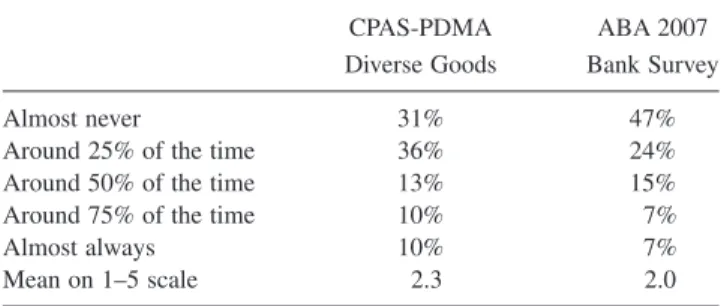
Table 1 summarizes usage data from the two second-ary data sets referred to in this study. A third of the Product Development and Management Association (PDMA) membership that participated in the CPAS survey indicated that their organization uses focus groups for customer research in at least half of their NPD efforts; 69% use them in at least 25% of the projects. Over half of the banks surveyed in the 2007 Bank New Service Devel-opment Study indicated that focus groups were employed in at least half of their service innovation programs. Despite 50 years of evidence about the ineffectiveness of the group methods to uncover needs and to generate ideas, they are still widely used in customer research for product innovation.
Why Are Group Methods Still Used in
Product Innovation?
After 50 years of evidence that groups are ineffective to generate ideas, evaluate ideas, or uncover customer needs, several ideas have been proposed to explain why brainstorming and focus groups have continued to be used for those purposes. Certainly, there are times when focus groups can have real value, for example, (1) in conducting research with hard to reach or sensitive sub-jects such as immigrants, children, prisoners, persons with disabilities, or anyone uncomfortable in a one-to-one interview situations; and (2) in situations where group decision making is relevant (Fern, 2001; Stewart and Shamdasani, 1998).
The focus of this paper is the use of group customer research for product innovation. The literature showing that group ideation is ineffective has been discussed. McQuarrie and McIntyre (1986) recommended that
focus groups not be used for idea generation or idea screening in a new product development effort (p. 41); they may instead may be useful for studying the adoption and diffusion of selected ideas (p. 42), far later in the NPD process. Two follow-up articles in response to the original article provided further support for the argument that focus groups were not good instruments for the front end of new product development (McQuarrie and McIn-tyre, 1986; Seymour, 1987). Group interaction in a focus group leads to a “shared perspective” on the issues dis-cussed in the group (Calder, 1977, p. 362). McQuarrie and McIntyre (1986) and Morgan (1996) suggest that the research topics should fit the group dynamics, where ideas and attitudes move toward a consensus. A possible effective use of the focus group procedure might be to help group customers into different categories (Bristol and Fern, 2003). This approach—using the group nature of these methods—is logical but would limit their use to very specific applications. Aside from very specific applications (1) when customers are a protected group or (2) when product use will be a group decision, the research question of this paper remains: why are group research methods still widely used in innovation research?
Empirical Results Have Not Been Disseminated to Business Researchers and Practitioners
As noted in the introduction to this paper, most of the hundreds of papers and multiple meta-analyses that have shown empirical evidence have appeared in journals outside of the literature of marketing, new product
devel-Table 1. Use of Focus Groups for Customer Research in New Product Development
CPAS-PDMA ABA 2007 Diverse Goods Bank Survey
Almost never 31% 47%
Around 25% of the time 36% 24% Around 50% of the time 13% 15% Around 75% of the time 10% 7%
Almost always 10% 7%
Mean on 1–5 scale 2.3 2.0
CPAS, comparative performance assessment study; PDMA, Product Development & Management Association; ABA, American Bankers Association.
opment, or business; many have been published in social psychology or applied psychology publications. Busi-nesspersons as well as business researchers may not be fully aware of the strong evidence against the effective-ness of group ideation methods. Furthermore Adrian Furnham (2000, p. 26) notes that “most textbooks seem reluctant to discuss the damning research.” Furnham (2000) suggests that the ignorance of businesspersons of the extensive empirical evidence of the ineffectiveness of group methods, especially when combined with the ten-dency of group participants to overestimate group effec-tiveness (Paulus, Dzindolet, Poletes, and Camacho, 1993), may be a potent combination sustaining group research.
Low Cost or Faster Innovation?
A common rationale for the use of group methods to generate ideas is low cost or speed in collecting informa-tion: lower cost or faster results may compensate for less effective ideation and fewer good ideas than from indi-vidual interviews (Fern, 1982; Krieg, 1981; McQuarrie and McIntyre, 1986). However, a review of the group research literature casts doubt on this rationale. In “The Voice of the Customer,” a field experiment (Silver and Thompson, 1991) to generate ideas for a complex piece of office equipment was cited (Griffin and Hauser, 1993, p. 7) as well as the ideation experiments from Fern (1982). As a general rule, Griffin and Hauser (1993) found that groups of any size, 1–8, generated roughly the same number of ideas per hour. A study comparing indi-vidual interviews and focus groups suggested that even with the reduced quantity and quality of ideas, “a number of logistical factors, such as location of the interviews, the mobility of the participants, the flexibility of their schedules, would determine which study would actually be easier to accomplish” (Morgan, 1996).
Girotra et al. (2010) suggested an “asynchronous idea generation of individuals” for idea generation (p. 602). Because individual brainstorming or interviewing requires little training (Fern, 1982), ideas could be col-lected by salespersons or customer services representa-tives during normal calls. When speed is essential, it may be faster to gather six to eight customers in one location for a couple hours than to visit each one at their sites. However, the cost of an experienced moderator, taping, the facilities, and time reviewing the tapes must also be considered,as well as the loss of better and the very best ideas means the group effort is likely more expensive and less effective. If speed is more important than effectiveness, there is still the option to employ
the nominal group technique (NGT), which is indivi-dual brainstorming within and group and which has shown to be almost as effective as individual interviews or individual brainstorming; furthermore, NGT does not require a high-priced expert moderator (Claxton, Ritchie, and Zaichkowsky, 1980; Delbecq, Van de Ven, and Gustafson, 1975). Thus, neither the cost nor the speed is a justification for the use of traditional face-to-face group research methods in innovation.
The lower cost argument is really only convincing when an organization chooses to have a management team actively participate in the research: for example, sometimes, a management team will observe a focus group session behind two-way mirrors. There is no evi-dence that such observation improves the number or quantity of ideas generated in group sessions. If an organization is determined to have a team of executives observe the idea generation, the cost and opportunity cost of their time may make individual one-on-one interviews prohibitively expensive. However, even under the constraint that an organization wanted multiple executives to monitor ideation, some of the quasi-individual techniques such as nominal groups have proven to be more effective than focus groups or group brainstorming. So again, even with management team involvement, a cost argument does not mandate idea-killing group sessions.
It is worth repeating that earlier cited evidence showed the effectiveness of nominal groups or NGT with a single leader, or even leader-less individual idea generation. Organizations that choose to have management teams directly observe ideation efforts might have a rationale for the involvement of the teams other than the Osborn (1957) criteria of number and quantity of ideas generated, such as eliciting the help of the team members in the dissemination and implementation of ideas within the organization. These issues are discussed later, in the orga-nizational market learning discussion.
Ideas Are Lost, But Consultants Profit from Moderated Group Research
An ethnographic study of IDEO, a renowned design-consulting firm that uses group brainstorming, acknowl-edges the compelling evidence against the effectiveness of group brainstorming for idea generation (Sutton and Hargadon, 1996). Sutton and Hargadon (1996) explored how and why IDEO uses brainstorming, believing that Osborn’s idea generation success metrics must be inad-equate in light of the continued use of group research for ideation. They found “six important consequences . . . not
labeled as effectiveness outcomes [in prior research]: (1) supporting the organizational memory of design solu-tions; (2) providing skill variety for designers; (3) sup-porting an attitude of wisdom (acting with knowledge while doubting what one knows); (4) creating a status auction (a competition for status based on technical skill); (5) impressing clients; and (6) providing income for the firm” (p. 685).
Sutton and Hargadon’s (1996) “consequences” are consistent with past findings on the illusion of group effectiveness and organizational credibility of group output, and individual positive affect for group informa-tion (Paulus, 2006; Paulus et al., 1993; Thompson, 2003). Again, one way to read this list of group ideation consequences is to worry that consultants are taking advantage of the ignorance of businesspeople of the compelling evidence against group methods (Furnham, 2000): Consultants make money moderating group research (Sutton and Hargadon’s consequence number 6); illusion of effectiveness makes the service easy to sell (number 5); and the sessions advance the skills of the consultants that they can apply on future assignments (numbers 1 and 2).
While the author believes from experience and anec-dotal evidence that this cynical view of overselling by consultants is sometimes correct, organizational memory and skills (numbers 1 and 2) and confidence in the infor-mation (numbers 3 and 5) may help a firm’s innovation efforts in some circumstances. There is likely value in training your consultants and taking advantage of their other expertise. In addition, organizational memory could be valuable within an organization that has ongoing inno-vation efforts. Furnham (2000) suggested that a benefit of group methods might be organizational acceptance of results. Indeed, “the illusion of productivity might be a valuable affective outcome in some work contexts” (Litchfield, 2008, p. 652; Paulus and Yang, 2000; Sutton and Hargadon, 1996).
The Illusion of Group Effectivity
The illusion of group effectivity is thus one possi-ble rationale for the continuing popularity of group research—brainstorming and focus groups are enjoyable, and participants feel that they have been creative (Stroebe, Diehl, and Abakkoumkin, 1992). Group partici-pants expect their efforts to be productive before com-mencing [they have not reviewed the empirical evidence], believe after the fact that they were productive, and take excess ownership of the results: they take individual credit for the group results (Paulus and Dzindolet, 1993;
Paulus et al., 1993, 1995). Thompson (2003) studied the tapes of multiple brainstorming sessions and found a pattern of positive feedback to all participants that likely left everyone with a good feeling and confirmed Paulus et al.’s (1993) findings that individuals seemed to take personal credit for the group results. Fern (2001) notes the same effect in focus group participants involved in ideation or needs discovery: evidence shows that they were not as productive as working alone, but they enjoy the process more and have more confidence in the infor-mation obtained. Fern (2001) also notes thateven orga-nizational members not involved in the group research
but merely observing or viewing the tapes give greater credibility to group output.
Even though ideas are being lost through group research methods, individuals involved in innovation in organizations feel that the efforts are successful, believe in the information collected, and enjoy the process. Com-bined with ignorance of the empirical evidence against group methods (Furnham, 2000), this credibility and affect for group methods may lead to overuse of the methods. However, the credibility and affect for group methods by participants and nonparticipants in an orga-nization (Fern, 2001), even if not merited, might provide advantages to an organization. A few articles have sug-gested including group methods as a supplement to indi-vidual ideation due to the organization affect and credibility (Paulus et al., 1993; Paulus and Yang, 2000), but they have not suggested the exact benefit to innova-tion or how to evaluate the trade-off between good ideas and organizational affect and credibility. Furnham (2000) suggests that it is reasonable for firms to use group methods to “increase decision acceptance” and get diverse groups in an organization on board (p. 26).
These suggested benefits of group methods seem to fit an organizational market learning model of innovation success that has been used in recent new product devel-opment research. The next section of this paper explores how the illusion of group effectiveness, belief in the information collected, and organizational learning and skill-building, might fit into an organizational marketing learning model of innovation success. L1 should always be kept in mind, however: group methods will produce fewer and lower quality ideas.
Market Learning and Assimilation of Ideas
An organizational market learning model stressing the importance of information acquisition, dissemination, and implementation has been applied to new product development (Lynn, Skov, and Abel, 1999; March, 1991;Slater and Narver, 1995; Veldhuizen, Hultink, and Griffin, 2006). A process that gathers customer informa-tion can affect new product development directly through the needs collected and the ideas generated and indirectly through its effect on dissemination and acceptance of the new ideas (Berchicci and Tucci, 2010). Three recent studies applying the organizational market learning approach to new product development have found that (1) a stage-gateTM type process may hinder learning and therefore negatively impact long-term organizational innovation (Sethi and Iqbal, 2008); (2) organizations can enhance high-tech innovation by “influencing project pri-ority and flexibility, and by reducing interdepartmental conflict” (Veldhuizen et al., 2006, p. 353); and (3) team values may affect NPD by affecting how the information is shared (Berchicci and Tucci, 2010).
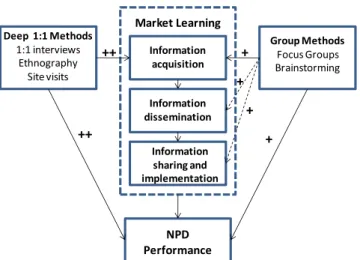
This organizational market learning framework explains the value of fun, credibility, and idea dissemina-tion from group research techniques. In a group process, information is disseminated to multiple members of an organization at once: in the case of internal brainstorm-ing, multiple members of the organization participate and should buy into the results (Thompson, 2003). Similar multiple members of the organization will be involved in focus group sessions, and tapes of sessions are often shown to organization members. Even organizational nonparticipants in group research seem to have positive effects to grant increased credibility to group research results (Fern, 2001). Adapting figure 5 from Berchicci and Tucci (2010, p. 987), Figure 1 contrasts the effect of 1:1 methods on NPD success through a market learning model to the effect from group methods.
In Figure 1, the use of 1:1 customer research methods has a strong positive direct effect on both
information acquisition and the ultimate NPD perfor-mance; group methods have only moderate direct posi-tive effects on acquisition and performance. However, group methods also have positive effects on the two later stages of market learning, information dissemina-tion and sharing and implementadissemina-tion due to the cred-ibility and positive effects for the group process within the organization. Because project priorities and the innovation process is driven by teams, dissemination and implementation of innovation ideas is important. The illusion of group effectivity (Stroebe et al., 1992) may have a positive effect in promoting the implement of ideas. The model depicted in Figure 1 provides a rationale for employing group methods of ideation, at least on a limited basis:
P1: Group methods for ideation enhance the dissemina-tion of informadissemina-tion in an organizadissemina-tion.
P2: Group methods for ideation enhance information sharing in an organization and lead to faster implemen-tation of new ideas.
P1 and P2 provide a possible rationale for continued use of group methods of market research in NPD: An organization may want to first engage in individual research activities and then use group methods. Satura-tion is a term used in qualitative analysis to describe the point at which most of the good ideas have been gener-ated and further research is high cost relative to new discovery (Berg, 2004). Griffin and Hauser (1993) found that 20 subjects were generally sufficient to saturate new product ideas; in narrow markets with very similar users, as few as eight subjects might be sufficient. Thus, a logical approach to group methods might be to first gather ideas from 1:1 methods and then hold some focus groups or brainstorming sessions to aid market learning: “saturate, and then meet.” Saturate, then meet would seem to be particularly well suited for internal organiza-tion brainstorming.
P1 and P2 and the idea of saturation suggest some possible specialized uses for group ideation methods
including:
1. When the gain from (1) enhancing the dissemi-nation of information and (2) the sharing and imple-mentation of ideas is believed to outweigh the costs of lost ideas and more creative ideas from employing the methods;
2. To advance the dissemination and implementation of the information, after individual ideation methods have reached saturation;
Figure 1. Market Learning Framework for Weighing Group Research versus 1:1 Customer Research
3. To validate decisions—for example, when an innovation has already been decided upon by senior management and cooperation or organization “buy-in” is sought; and
4. When the product innovation is small or incremental.
Future research, both qualitative and quantitative, should explore whether group idea-generation methods are being used for these specialized uses, and if so, how effective they are in these uses.
Trade-off of Group versus Individual Techniques in Different Innovation Situations
Focus groups and brainstorming methods kill ideas, and eliminate the better ideas (Diehl and Stroebe, 1987; Fern, 1982; Griffin and Hauser, 1993; Thompson, 2003) and the very best ideas (Girotra et al., 2010; Taylor et al., 1958). Group gatherings remove the ideation effort from useful context and reduce the chances of collecting sticky or contextual information, which is often essential to more innovative ideas (Szulanski, 2003; von Hippel, 1994). Ideation groups are not good at evaluating ideas (Fern, 2001; Fern 1982; Girotra et al., 2010; McQuarrie and McIntyre, 1986). Clearly, an NPD team looking for ideas for more innovative projects should be skeptical of these methods.
However, as suggested in the preceding propositions, there may be circumstances when the positive affect, credibility, and organizational acceptance from group methods compensate for reduced quantity and quality of ideas generated. This trade-off could differ in varying innovation situations. For example, consultants are often hired to “sell” ideas that senior management has already accepted or that are viewed as obvious needed changes to line managers and staff (O’Shea and Madigan, 2002). The credibility of group processes could be used as a tool to achieve employee buy-in for such engagements: what could be more powerful than to note that the ideas came from a brainstorming session of the managers or focus groups that they were involved in? Similarly, the loss of the better ideas and the very best ideas may be more costly to a more innovative project than an incre-mental new product or service. This discussion leads to the following proposition:
P3: Group ideation methods will be less frequently used in more innovative or radical new product development and explorative innovation efforts than for more incre-mental innovation.
User Input as a Scarce Resource: Business-to-Business (B2B) Firms
Small firms, startup firms, and some B2B organizations have a limited number of customers or potential users to solicit ideas, needs, and problems (McQuarrie, 1991; Oliva, 2005). Even firms with larger customer bases pur-suing novel or more innovative ideas may find available hours of lead users (von Hippel, 1986) to be limited. There is actually a reduction of productivity as the groups get larger (Mullen et al., 1991). This idea devastation should be even more alarming when customer time is scarce. Using this framework of scarcity of user time for ideation, another proposition emerges:
P4: Group ideation methods will be less frequently used as a part of a new product development effort by B2B firms or firms targeting a small number of customers.
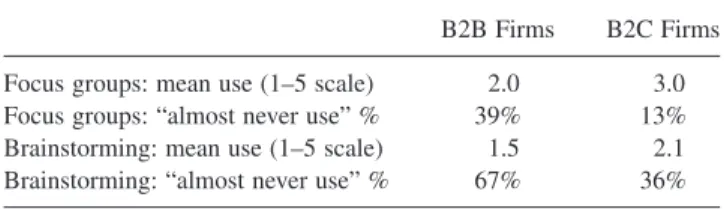
The CPAS data set allows an exploratory look at this proposition. The B2B members of the PDMA who par-ticipated in the survey were indeed less likely to use focus groups than business-to-consumer participants. This is illustrated in Table 2.
Removing the Group from Group
Ideation Methods
Osborn’s original four principles of brainstorming and similar rules for focus groups are in part attempts to overcome problems caused by group dynamics (Osborn, 1957). As evidence continues to collect that group methods kill ideas, other rules or approaches have been proposed to improve creativity. Thompson (2003, pp. 102–3) summarized some of the more promising approaches, which include:
1. Diversity—participants with different expertise will tend to look at things differently. In addition, diverse individuals may be less likely to bond into tight teams.
Table 2. Use of Groups Methods for Innovation for B2B versus B2C Firms Group Methods Usage by B2B versus B2C Firms in CPAS Data Set
B2B Firms B2C Firms Focus groups: mean use (1–5 scale) 2.0 3.0 Focus groups: “almost never use” % 39% 13% Brainstorming: mean use (1–5 scale) 1.5 2.1 Brainstorming: “almost never use” % 67% 36%
2. Analogical reasoning—this cognitive approach may help to access deep or contextual knowledge. 3. Brainwriting—group members individually write
down ideas silently. This is an attempt to gather indi-vidual ideas before group pressures kill them. 4. NGTs—groups engage in brainwriting to collect
ideas, and after discussing them, they individually, silently rate the ideas.
5. Delphi—Delphi is the ultimate NGT: group members
nevermeet face-to-face.
According to Mullen et al. (1991), totally eliminating the face-to-face interaction is key: defining “alone nominal groups” (standard nominal groups) as indi-vidual brainstormers and “together nominal groups” as groups sitting together doing individual activity, this meta-analysis found that together nominal groups had less productivity loss than group brainstorming but still underperformed the alone nominal groups. These efforts to enhance group methods raise some interest-ing definitional problems: when has a method ceased to be a group method? An important topic worthy of future study is whether or to what degree the group benefits of improved dissemination and implemen-tation of ideas persist in “nongroup group approaches”
such as nominal groups, Delphi, and markets for ideas (Armstrong, 2006b; Green, Armstrong, and Graefe, 2007).
Researchers and practitioners should investigate the use of nongroup group techniques, often electronic or virtual techniques enabled by the internet, such as Delphi and idea markets (Armstrong, 1996, 2006a, 2006b; Thompson, 2003). Perhaps nongroup group techniques—Delphi, idea markets, or online limited-interaction brainstorming or focus groups—can provide a superior trade-off of ideas generated and dissemina-tion and implementadissemina-tion of the ideas. However, if these techniques completely remove group effects, then they may be merely considered to be more effi-cient electronic or online interviews or individual brainstorming.
Evaluating New, Hybrid, and/or Online Ideation Methods
The discussion of organizational market learning sug-gests that group methods may aid in the dissemination and implementation of ideas. If these benefits to group methods are shown to exist, than it may be possible that some of the hybrid techniques combine benefits of indi-vidual and group ideation methods. These new or hybrid
techniques should thus be evaluated against benefits from both individual techniques and traditional group techniques:
Electronic groups, nominal groups and any proposed procedures to reduce idea loss from group research should be evaluated by three criteria: (1) Osborn’s measures—quantity and quality of ideas relative to indi-vidual brainstorming; (2) cost by time and resources used; and (3) to what extent the new methods advance dissemination and implementation by being fun, attract-ing management attention, and aidattract-ing firm retention, compared to traditional face-to-face group methods.
Conclusion
A review of selected empirical studies, and multiple meta-analyses and reviews covering hundreds of empiri-cal studies over the past 50 years, established that group techniques are not effective for key early inputs into orga-nizational innovation: (1) uncovering user needs; (2) gen-erating new product or service ideas; and (3) evaluating ideas. Group ideation has been shown to be inferior to individual ideation whether measured by the numberof ideas generated, the average qualityof ideas generated, generating thevery best ideas,orevaluating ideas. This review of the empirical research, including the summary table in Appendix B, should address the need to further disseminate the strong evidence against group methods suggested by Furnham (2000).
This paper also showed that a review of the empirical evidence did not support the most common justification for the continued use of group methods for ideation and needs discovery, the alleged low cost and speed of group methods. Individual methods that should be at least as quick and low cost as traditional group research methods are more productive in generating ideas and uncovering user needs. Cost and speed do not justify group methods; the use of group methods can only be justified by factors other than the output of ideas and information.
Group methods have been shown to be fun and believed productive by participants who take undo credit for the results; even nonparticipant observers find group results credible. Applying an organizational market learning model to an organization’s innovation effort, it seems likely that group methods may promote dissemination and implementation of information. A set of propositions are presented about the trade-offs of individual and group methods for ideation and need dis-covery that should suggest future research and guidance for practitioners.
Group methods may have a role in the early stages of innovation to promote dissemination and implementation of user information, but ideally only after information has been gathered through individual research methods. Online, virtual, and pseudo-group methods should be evaluated both on idea-generation versus individual brainstorming and interviews and on organizational affect and credibility to further the implementation and dissemi-nation of information compared with traditional group methods.
Implications for Future Research
The (fuzzy) front end of product innovation, where user needs are discovered and product ideas generated and partially screened, is recognized as a vital process of innovation that is relatively unknown and understudied (Koen et al., 2001; Page and Schirr, 2008; Reid and de Brentani, 2004). A recent study of the front-end process found that enhancing inputs positively impacted the process while formal process controls inhibited an effec-tive front-end effort (Poskela and Miia, 2009). A primary contribution of this paper is to summarize the extensive research from social psychology on the efficacy of group research for ideation for the front-end innovation process. This suggests that individual methods be substituted for—or at minimum be used to augment—traditional group methods for soliciting user inputs. In addition, an organizational market learning framework suggested other areas of research on ideation methods and measures to supplement the Osborn (1957) metrics of ideation success.
From the organizational market learning discussion, there emerged four propositions about the proper use of group methods for ideation in a product innovation effort. These propositions should translate into testable hypoth-eses in experimental or quantitative research efforts. In addition, within the discussion of the organizational mar-keting learning model, a series of potential niche uses for group methods was suggested that could be explored in qualitative studies of organizational product innovation. For example: Do group methods suit incremental product innovation?
Individual interviews, individual brainstorming, or even the NGT outperform group methods for ideation—this should be considered a law of idea genera-tion for NPD. There are arrays of individual engagement techniques (ethnography, lead user analysis, experimen-tation, etc.) that have been presented in the product inno-vation literature to elicit deep or sticky information from users (Szulanski, 2003; von Hippel, 1998). These
tech-niques have generally been observed in a limited number of case studies. It is time to test these promising methods against individual interviews as the group methods have been tested. Product innovation researchers and practitio-ners would benefit from experimental and quantitative tests and ultimately meta-analyses of the efficacy of these individual engagement methods. Similarly, the online, electronic, or virtual “group” methods need to be sub-jected to rigorous testing. It seems reasonable that Delphi research for experts and various forms of online brain-storming for users that minimizes group interaction may produce results similar to individual interviews or nominal groups, but empirical evidence of their effective-ness is needed.
Finally, the discussion of organizational market learn-ing suggested supplemental measures of organizational members “buy-in” to aid in the dissemination and imple-mentation of ideas. As suggested, group methods should be evaluated for these benefits. More importantly, some of the online and virtual group methods should be evalu-ated as well. Do tapes and records from nominal group sessions lead to better organizational dissemination than do output from individual interviews or solo brainstorm-ing? If so, is there a benefit to the product innovation effort beyond the quality of ideation? Does Delphi research and forms of online brainstorming that limit group interaction still lead to increased acceptance from participants and observers? Research on these questions could provide further illumination of need discovery and idea generation at the front end of product innovation.
Implications for Product
Innovation Practice
Managers of NPD or organizational innovation should be wary of dependence on group techniques, whether focus groups of potential customers or brainstorming of stake-holders, to generate or evaluate ideas for innovation. A group brainstorming session among organizational members may be a good way to build enthusiasm for change, but it is unlikely to generate the quantity of ideas or more importantly the most innovative ideas. Organi-zational members involved in NPD should visit customer sites and engage in one-to-one interviewing to understand customer needs and elicit their ideas (Griffin and Hauser, 1993; McQuarrie, 1998). When group techniques are used, urge the research leaders to employ techniques such as brainwriting—individually generating ideas before the group session—that have been shown to reduce the idea devastation resulting from the use of group research methods.
The evidence on the relative efficacy of research methods indicates that product innovation teams should employ one-on-one discussions with users and perhaps try out online interview and “individual brainstorming” techniques to directly solicit ideas for innovation. As noted in the previous section, additional research is needed on new one-on-one engagement techniques, but NPD managers might experiment with methods designed to more deeply engage users in ideation such as ethnog-raphy (Rosenthal and Capper, 2006), experimentation (Thomke, 2003), and lead user methods (von Hippel, 1986). If an innovation team has funds allocated to hire “expert moderators” for group sessions, it should consider diverting some of the funds to instead hire an anthropologist to train employees on ethnographic techniques.
References
Adams-Bigelow, M. 2004. Comparative performance assessment study (CPAS). In Foundation report, ed. M. Adams-Bigelow. Chicago: Product Development and Management Association Foundation. Adams-Bigelow, M., and D. Boike. 2004. PDMA foundation’s comparative
performance assessment.Visions28 (3): 26–29.
Armstrong, J. S. 1996. Factors affecting new product forecasting accuracy in new firms: William B. Gartner, and Robert J. Thomas, 1993, Journal of Product Innovation Management, 10, 35–52.International Journal of Forecasting12 (2): 321–22.
Armstrong, J. S. 2006a. Findings from evidence-based forecasting: Methods for reducing forecast error.International Journal of Forecast-ing22 (3): 583–95.
Armstrong, J. S. 2006b. How to make better forecasts and decisions: Avoid face-to-face meetings.Foresight5: 3–8.
Berchicci, L., and C. L. Tucci. 2010. There is more to market learning than gathering good Information: The role of shared team values in radical product definition.Journal of Product Innovation Management27 (7): 972–90.
Berg, B. L. 2004.Qualitative research methods for the social sciences(5th ed.). Boston, MA: Pearson.
Bouchard, T. J. 1972a. A comparison of two group brainstorming proce-dures.Journal of Applied Psychology56 (5): 418–33.
Bouchard, T. J. 1972b. Training, motivation, and personality as determi-nants of the effectiveness of brainstorming groups and individuals.
Journal of Applied Psychology56 (4): 324–31.
Bouchard, T. J., J. Barsaloux, and G. Drauden. 1974. Brainstorming pro-cedure, group size, and sex as determinants of the problem-solving effectiveness of groups and individuals.Journal of Applied Psychology
59 (2): 135–38.
Bouchard, T. J. Jr., and M. Hare. 1970. Size, performance, and potential in brainstorming groups.Journal of Applied Psychology54 (1): 51–55. Bristol, T., and E. F. Fern. 2003. The effects of interaction on consumers’
attitudes in focus groups.Psychology and Marketing20 (5): 433–54. BusinessWeek 2005. Shoot the focus group. Business Week. New York:
McGraw-Hill.
Calder, B. J. 1977. Focus groups and the nature of qualitative marketing research.Journal of Marketing Research14 (3): 353–64.
Camacho, L. M., and P. B. Paulus. 1995. The role of social anxiousness in group brainstorming.Journal of Personality and Social Psychology68 (6): 1071–80.
Campbell, J. 1968. Individual versus group problem solving in an industrial sample.Journal of Applied Psychology52 (June): 205–10.
Claxton, J. D., J. R. B. Ritchie, and J. Zaichkowsky. 1980. The nominal group technique: Its potential for consumer research.Journal of Con-sumer Research7 (3): 308–13.
Cooper, R. G., C. J. Easingwood, S. Edgett, E. J. Kleinschmidt, and C. Storey. 1994. What distinguishes the top performing new products in financial services.Journal of Product Innovation Management11 (4): 281–99.
Cooper, R. G., and S. J. Edgett. 1996. Critical success factors for new financial services.Marketing Management5 (3): 26–39.
Cooper, R. G., and S. J. Edgett. 2008. Ideation for product innovation: What are the best methods?Visions32 (1): 12–17.
Delbecq, A., and A. H. Van de Ven. 1971. A group process model for problem identification and program planning. Journal of Applied Behavioral Science7: 466–92.
Delbecq, A. L., A. H. Van de Ven, and H. Gustafson. 1975. Guidelines for conducting NGT meetings. InGroup techniques for program planning, ed. A. L. Delbecq, A. H. Van de Ven and H. Gustafson. Glenview, IL: Scott Foresman.
Diehl, M., and W. Stroebe. 1987. Productivity loss in brainstorming groups: Toward a solution of a riddle.Journal of Personality and Social Psy-chology53: 497–509.
Diehl, M., and W. Stroebe. 1991. Productivity loss in idea-generating groups: Tracking down the blocking effect.Journal of Personality and Social Psychology61 (3): 392–403.
Dunnette, M. D., J. Campbell, and K. Jaastad. 1963. The effect of group participation on brainstorming effectiveness for two industrial samples.
Journal of Applied Psychology47 (January): 30–37.
Durgee, J. 1992. New product ideas from focus groups.Journal of Product and Brand Management1 (3): 24–29.
Fern, E. F. 1982. The use of focus groups for idea generation: The effects of group size, acquaintanceship, and moderator on response quantity and quality.Journal of Marketing Research19 (1): 1–13.
Fern, E. F. 2001.Advanced focus group research. Thousand Oaks, CA: Sage.
Furnham, A. 2000. The brainstorming myth.Business Strategy Review11 (4): 21–28.
Girotra, K., C. Terwiesch, and K. T. Ulrich. 2010. Idea generation and the quality of the best idea.Management Science56 (4): 591–605. Glaser, B. G. 1992.Basics of grounded theory analysis: Emergence vs.
forcing. Mill Valley, CA: Sociology Press.
Glaser, B. G., and A. L. Strauss. 1967.The discovery of grounded theory: Strategies for qualitative research. Chicago: Aldine Publishing. Green, K. C., J. S. Armstrong, and A. Graefe. 2007. Methods to elicit
forecasts from groups: Delphi and prediction markets compared. Fore-sight8 (1): 17–20.
Griffin, A., and J. R. Hauser. 1991. The voice of the customer (WP #3449-92). Sloan Working Papers, Cambridge.
Griffin, A., and J. R. Hauser. 1993. The voice of the customer.Marketing Science12 (1): 1–27.
Hargadon, A., and R. I. Sutton. 1997. Technology brokering and innovation in a product development firm.Administrative Science Quarterly42 (4): 716–49.
Henard, D. H., and D. M. Szymanski. 2001. Why some new products are more successful than others.Journal of Marketing Research (JMR)38 (3): 362–80.
Higgins, A., and S. Koucky. 2003. Forget focus groups. Just watch users, innovator says.Machine Design75 (6): 28.
Kelley, T. 2005.The ten faces of innovation. New York: Doubleday. Kelley, T., J. Littman, and T. Peters. 2001.The art of innovation: Lessons
in creativity from IDEO, America’s leading design firm. New York: Doubleday Business.
Koen, P., G. Ajamian, R. Burkart, A. Clamen, J. Davidson, R. D’Amore, C. Elkins, K. Herald, M. Incorvia, A. Johnson, R. Karol, R. Seibert, A. Slavejkov, and K. Wagner. 2001. Providing clarity and a common language to the “fuzzy front end.”Research-Technology Management
44 (2): 46–55.
Krieg, P. 1981. A look at focus groups. Chicago, IL: Bank Marketing Association.
Lafley, A. G., and R. Charan. 2008.The game-changer: How you can drive revenue and profit growth with innovation. New York: Crown Business. Lamm, H., and G. Trommsdorff. 1973. Group versus individual perfor-mance on tasks requiring ideational proficiency (brainstorming): A review.European Journal of Social Psychology3 (4): 361–88. Litchfield, R. C. 2008. Brainstorming reconsidered: A goal-based view.
Academy of Management Review33 (3): 649–88.
Lynn, G. S., and J. G. Morone. 1996. Marketing and discontinuous inno-vation: The probe and learn process.California Management Review
38 (3): 8–37.
Lynn, G. S., R. B. Skov, and K. D. Abel. 1999. Practices that support team learning and their impact on speed to market and new product success.
Journal of Product Innovation Management16 (5): 439–54. March, J. G. 1991. Exploration and exploitation in organizational learning.
Organization Science2 (1): 71–87.
McQuarrie, E. F. 1991. The customer visit: Qualitative research business-to-business marketers.Journal of Marketing Research3 (2): 121–35. McQuarrie, E. F. 1998.Customer visits(2nd ed.). Thousand Oaks, CA:
Sage.
McQuarrie, E. F., and S. H. McIntyre. 1986. Focus groups and the devel-opment of new products by technologically driven companies: Some guidelines.Journal of Product Innovation Management3 (1): 40–7. McQuarrie, E. F., and S. H. McIntyre. 1987. What focus groups can and
cannot do: A reply to Seymour.Journal of Product Innovation Man-agement4 (1): 55–60.
Morgan, D. L. 1996. Focus groups.Annual Review of Sociology22 (1): 129–52.
Mullen, B., C. Johnson, and E. Salas. 1991. Productivity loss in brainstorm-ing groups: A meta-analytic integration.Basic and Applied Social Psy-chology12 (1): 3–23.
Mullen, B., C. Symons, L.-T. Hu, and E. Salas. 1989. Group size, leader-ship behavior, and subordinate satisfaction.Journal of General Psy-chology116 (2): 155–69.
O’Shea, J., and C. Madigan. 2002.Dangerous company: The consulting powerhouses and the businesses they save and ruin. Darby, PA: Diane Publishing.
Oliva, R. A. 2005.Business marketing “straight up.”State College, PA: ISBM, Pennsylvania State University.
Osborn, A. F. 1957.Applied imagination: Principles and procedures of creative problem solving. New York: Charles Scribner’s Sons. Page, A. L., and G. R. Schirr. 2008. Growth and development of a body of
knowledge: Sixteen years of new product development research 1989– 2004.Journal of Product Innovation Management25 (3): 233–48. Paulus, P. B. 2006. Putting the brain back into brainstorming.Associations
Now2 (12): 24–28.
Paulus, P. B., and M. T. Dzindolet. 1993. Social influence processes in group brainstorming.Journal of Personality and Social Psychology64 (4): 575–86.
Paulus, P. B., M. T. Dzindolet, G. Poletes, and L. M. Camacho. 1993. Perception of performance in group brainstorming: The illusion of group productivity.Personality and Social Psychology Bulletin19 (1): 78–89.
Paulus, P. B., T. S. Larey, and A. H. Ortega. 1995. Performance and perceptions of brainstormers in an organizational setting.Basic and Applied Social Psychology17: 249–65.
Paulus, P. B., and H.-C. Yang. 2000. Idea generation in groups: A basis for creativity in organizations.Organizational Behavior and Human Deci-sion Processes82 (1): 76–87.
Payne, A. F., K. Storbacka, and P. Frow. 2008. Managing the co-creation of value.Journal of the Academy of Marketing Science36 (1): 83–96. Poskela, J., and M. Miia. 2009. Management control and strategic renewal
in the front end of innovation.Journal of Product Innovation Manage-ment26 (6): 671–84.
Prahalad, C. K., and V. Ramaswamy. 2004. Co-creation experiences: The next practice in value creation.Journal of Interactive Marketing18 (3): 5–14.
Reid, S. E., and U. de Brentani. 2004. The fuzzy front end of new product development for discontinuous innovations: A theoretical model.
Journal of Product Innovation Management21 (3): 170–84. Rosenthal, S. R., and M. Capper. 2006. Ethnographies in the front end:
Designing for enhanced customer experiences. Journal of Product Innovation Management23 (3): 215–37.
Schirr, G. R., and A. L. Page. 2009. Antecedents of service development success: A culture-tools-process model. InAmerican Marketing Asso-ciation Winter Conference, ed. K. Reynolds and J. C. White, 27. Tampa, FL: American Marketing Association.
Sethi, R., and Z. Iqbal. 2008. Stage-gate controls, learning failure, and adverse effect on novel new products.Journal of Marketing72 (1): 118–34.
Seymour, D. T. 1987. Focus groups and the development of new products by technologically driven companies: A comment.Journal of Product Innovation Man4 (1): 50–54.
Silver, J. A., and J. C. Thompson Jr. 1991.Understanding customer needs: A systematic approach to the “voice of the customer.”Master’s thesis, MIT: Cambridge, MA.
Slater, S. F., and J. C. Narver. 1995. Market orientation and the learning organization.Journal of Marketing59 (3): 63–74.
Stewart, D. W., and P. N. Shamdasani. 1998. Focus group research: Explo-ration and discovery. InHandbook of applied social research methods, ed. L. Bickman and D. J. Rog, 505–26. Thousand Oaks, CA: Sage. Strauss, A. L., and J. Corbin. 1998.Basics of qualitative research(2nd ed.).
Thousand Oaks, CA: Sage.
Stroebe, W., M. Diehl, and G. Abakkoumkin. 1992. The illusion of group effectivity.Personality and Social Psychology Bulletin18 (5): 643–50. Sutton, R. I, and A. Hargadon. 1996. Brainstorming groups in context: Effectiveness in a product design firm.Administrative Science Quar-terly41 (4): 685–718.
Szulanski, G. 2003.Sticky knowledge: Barriers to knowing in the firm. Thousand Oaks, CA: Sage.
Taylor, D. W., P. C. Berry, and C. H. Block. 1958. Does group participation, when using brainstorming, facilitate or inhibit creative thinking?
Administrative Science Quarterly3 (June): 23–47.
Thomke, S. 2001. Enlightened experimentation: The new imperative for innovation.Harvard Business Review79 (2): 67–78.
Thomke, S. 2003.Experimentation matters. Boston, MA: Harvard Business School Press.
Thompson, L. 2003. Improving the creativity of organizational work groups.Academy of Management Executive17 (1): 96–111. Veldhuizen, E., E. J. Hultink, and A. Griffin. 2006. Modeling market
infor-mation processing in new product development: An empirical analysis.
Journal of Engineering and Technology Management23 (4): 353–73. von Hippel, E. 1978. Successful industrial products from customer ideas.
Journal of Marketing42 (1): 39–49.
von Hippel, E. 1986. Lead users: A source of novel product concepts.
Management Science32 (7): 791–805.
von Hippel, E. 1994. “Sticky information” and the locus of problem solving: Implications for innovation.Management Science40 (4): 429– 39.
von Hippel, E. 1998. Economics of product development by users: The impact of “sticky” local information. Management Science 44 (5): 629–42.
![3 (4 Methoxyphenyl) 6,7 dihydro 1H furo[3,4 c]pyran 4(3H) one](data:image/gif;base64,R0lGODlhAQABAIAAAP///wAAACH5BAEAAAAALAAAAAABAAEAAAICRAEAOw==)