IPA Dissertation Series: 2016-13
Typeset using LATEX
Cover design
Promotie In Zicht, Arnhem
The work in this thesis has been carried out under the auspices of the research school IPA (Institute for Programming research and Algorithmics).
This work is licensed under a Creative Com-mons Attribution 4.0 International License. To view a copy of this license, visit http: //creativecommons.org/licenses/by/4.0/
Mobile communication security
Proefschrift ter verkrijging van de graad van doctor
aan de Radboud Universiteit Nijmegen
op gezag van de rector magnificus prof. dr. J.H.J.M. Van Krieken,
volgens besluit van het college van decanen
in het openbaar te verdedigen op
woensdag 14 december 2016,
om 10:30 uur precies
door
Fabian Marinus Jan van den Broek
geboren op 14 augustus 1981
prof. dr. B.P.F. Jacobs Copromotor:
dr. ir. E. Poll
Manuscriptcommissie: prof. dr. E.R. Verheul
prof. dr. K. Mayes (Royal Holloway University of London, GB) prof. dr. JP. Seifert (Technische Universität Berlin, DE) prof. dr. A. Pras (University of Twente, NL)
Acknowledgements
Over the years a lot of people have contributed either to this thesis directly, or to my personal well-being in some way, and I thank them all. Still, there are some I would like to explicitly mention here.
First of all, I would like to thank my doctoral supervisor, Bart Jacobs, who was also my Master thesis supervisor (and actually suggested the topic) which evolved into this PhD project. After this PhD project, he asked me to come work within a project on the IRMA credential technology. Both were very different, but great experiences, that I would have never had without him.
My utmost thanks as well to my daily supervisor Erik Poll, who is always available for questions and feedback. I am constantly amazed at his ability to do a context switch from whatever he is working on when I come knocking at his office door, to whatever question I have this time.
I greatly enjoyed working with Bart and Erik because they both possess two im-portant qualities: enthusiasm, which is always useful in academia, but also a great sense of humour, which is equally important within security research.
My thanks as well to my reading committee, Eric Verheul, Keith Mayes, Jean-Pierre Seifert, Aiko Pras and Erik Reitsma, for taking the time and effort to read this thesis and for their helpful comments.
Writing a PhD thesis might be a solitary job, but working in science definitely is not. I greatly valued the collaboration with my co-authors over the years: Erik, Ronny, Brinio, Arturo, Bárbara, Brinda, Gergely, Bart, Roel and Joeri. For the last two years I have been working with Wouter and Sietse on the IRMA code base and I really enjoy this collaboration, which has taught me much. The progress we achieved with just the three of us is impressive.
Besides those who I have worked with directly, all the other colleagues of the Di-gital Security group, both current and past, deserve my gratitude as well for amazing discussions, great advice, hilarious coffee breaks, or just for the fantastic atmosphere.
Het werk binnen de academische wereld en zeker binnen een promotietraject kan af en toe ook enorm frustreren. Dan is het prettig af te kunnen spreken met vrienden voor de nodige relativering. Velen van hen hebben een bijdrage geleverd aan dit werk zonder zich dat zelf te beseffen, maar daarnaast zorgen zij ervoor dat ik een sociaal leven houd, zelfs als een proefschrift of het vaderschap veel energie vergt.
thing is awesome,Borreltijd!,De centraleenMerlet. Dan mis ik alleen nog Tom, wat ook toepasselijk is, want hij laat zich niet indelen. Bedankt allemaal.
In het bijzonder wil ik hier nog mijn paranimfen noemen en bedanken. Freek en Maarten, het is voor mij een eer naast jullie te staan tijdens de verdediging [Mulders07]. En ook daarbuiten, natuurlijk [Verbeek13].
Mijn lieve ouders, zonder jullie zou ik hier nooit hebben gestaan en dat gaat veel verder dan alleen in biologische zin. Jullie lieten mij vrij om mijn eigen keuzes te maken en steunen mij in alles, bedankt.
Lieve Klaartje, tijdens dit promotietraject zijn we getrouwd en samen kregen we twee prachtige kinderen, maar bovenal was en blijf je mijn maatje. Je bent geweldig. Bedankt voor alles.
En dan uiteindelijk Caspar en Simon, ik kan onmogelijk beweren dat jullie positief hebben bijgedragen aan dit werk, maar jullie hebben mijn leven zelf enorm verrijkt. Dankzij jullie heb ik de meest waardevolle titel van mijn leven al binnen: die van jullie papa.
Nijmegen, October 2016 Fabian van den Broek
Contents
1 Introduction 1
1.1 Research question . . . 3
1.2 Contributions and outline of this thesis . . . 8
2 Background 13 2.1 Generations . . . 13
2.2 Network overview . . . 15
2.3 Authentication within the network . . . 18
2.4 Equipment and software used . . . 19
3 Security of the wireless interface 29 3.1 Introduction . . . 30
3.2 Attacking GSM wireless confidentiality . . . 30
3.3 The practical implementation . . . 37
3.4 Analysis and countermeasures . . . 40
3.5 Countermeasures on next generation networks . . . 44
3.6 Conclusions . . . 47
4 Time Memory Trade-Off attacks 49 4.1 Introduction . . . 50
4.2 Typical TMTO . . . 51
4.3 The TMTO attacks . . . 52
4.4 Comparison . . . 62
4.5 Two possible improvements for Fuzzy Rainbow Tables . . . 65
4.6 A Fuzzy Rainbow Table Case study: Kraken . . . 68
4.7 Related work . . . 71
4.8 Conclusions . . . 72
5 Femtocell security 75 5.1 Introduction . . . 76
5.2 Femtocell overview . . . 77
5.3 The security model . . . 79
5.4 Theoretical security analysis of femtocells without local break-out . . . 81
5.6 Future Work . . . 88
5.7 Conclusions . . . 88
6 Fuzz testing GSM implementations 91 6.1 Introduction . . . 92
6.2 GSM . . . 93
6.3 Fuzzing . . . 95
6.4 Our fuzzing . . . 98
6.5 Conclusions . . . 104
7 Mobile phones as second factor in authentication 107 7.1 Introduction . . . 108
7.2 On (remote) authentication . . . 108
7.3 Digital signatures . . . 116
7.4 The Digidentity setup . . . 122
7.5 Related work . . . 127
7.6 Conclusions . . . 128
8 Defeating IMSI catchers 131 8.1 Introduction . . . 132 8.2 Background . . . 134 8.3 Solution for 3G/4G . . . 139 8.4 Solution for 2G . . . 143 8.5 Analysis . . . 143 8.6 Related work . . . 148 8.7 Conclusions . . . 149
9 Conclusions and future work 151 9.1 Overview and discussion . . . 151
9.2 Conclusions . . . 153
9.3 Directions for future work . . . 154
Bibliography 157
Summary 173
Samenvatting 175
Index 177
Chapter
1
Introduction
In 1882 Almon Brown Strowger bought an undertaking business in Topeka, Kansas. After some successful years business started to decline. When Strowger learnt a friend of him died, he was shocked: not only by the loss, but also to find the funeral arrangements were being made by a competitor. Being a suspicious man by nature, Strowger investigated and would later claim his financial trouble was accountable to a specific switch-board operator who was romantically involved with (according to some stories, she was actually married to) his competitor. Strowger suspected the switch-board operator was connecting calls meant for him to his competitor, thereby providing the first known instance of an impersonation attack on the telephone sys-tem [101, 168].
Almon Strowger thought it was ridiculous that callers had to rely on switch-board operators to connect them to the right person and trust these operators to not listen in on phone conversations. He decided to do something about the weakest element in the phone system and set out to remove the human component: the switch-board operator. Together with his nephew Walter Strowger he invented the Strowger switch, an electromechanical phone switch allowing users to select the phone they wish to connect to (initially from a set of a 100 contacts) without the intervention of an op-erator, by sending electrical pulses over the phone lines. On March 10, 1891 he was awarded the patent (US Patent No. 447918 10/6/1891) for his invention and on Novem-ber 3 1892 the first Strowger switch was taken into use in La Porte, Indiana. This was quite an occasion, celebrated with a brass band and a special train run from Chicago. Apparently Almon Strowger described his revolutionary system as being “girl-less, cuss-less, out-of-order-less, and wait-less.” By automating his phone system Strowger removed the untrusted switch-board operators and replaced them with automated machines, trusting the automation instead of the person.
Automation, however, still leaves the customer at the hands of the people in-stalling and maintaining the automated devices. Furthermore, automated systems lack any sense of context or sanity checks, which allows users to trigger behaviour that makes little sense within the current context, but nets the user some benefit. An example of this is phone phreaking, which started when Joe Engressia found out that whistling a tone at 2600 Hz (for piano players the fourth E above middle C) during a phone conversation would drop the current conversation, but keep the line open [147]. This could be exploited by starting a call to a toll-free number, sending the 2600Hz
tone, and then dialling the actual number you wished to call. The resulting call would not be billed to the user, as the phone switch regarded the user’s phone line as used for a free call. Joe Engressia was gifted with perfect pitch, but other less or otherwise gifted individuals started looking for reliable ways to generate the required tones. In a more humorous example it turned out that the toy whistle that came in a box of Cap ’n Crunch cereal could produce the exact 2600 Hz tone needed when one hole was covered. In the end several tones were found which influenced switches and some people started making devices, called boxes, to generate the right tones for the required durations. The best known of these were the original blue boxes, which influ-enced the call routing, but many different boxes appeared, such as red boxes (faking coin drops in a payphone) and black boxes (allowing other people to call you for free). Phone phreaking had its peak in the late 1960s and early 1970s. The weakness at the heart of these attacks was that the control signals where transmitted over the same connection as the user data and this so-called in-band signalling allowed attackers to insert fake control signals over their phones. When phone companies switched to out-of-band signalling in the 1980s, phone phreaking pretty much went away, although the drop in costs for domestic phone conversation probably also re-moved a lot of the incentive [148]. Currently, practically all of the switched phone net-work uses out-of-band signalling; still, it was discovered in 2005 that common police wiretapping equipment was backwards compatible with the old in-band signalling, which could be used to stop the recording of phone conversations by this equipment by transmitting the 2600 Hz signal [153].
The two examples discussed above illustrate that the telephone network has al-ways been under attack and naturally this did not change when mobile telephony was introduced in the latter half of the 1980s. The first generation of cellular tele-phony was analogue and had no real authentication [148]. Mobile phones simply iden-tified themselves with a serial number transmitted plain text over the air (the U.S. system required an additional number to identify the subscriber). This led to e.g. call-sell fraud, where an attacker would capture the serial numbers of mobile phones off the air and re-program their phones with these serials. The attacker would then sell phone minutes on his phone to people wanting to make cheap phone calls.
In a recurring story for (mobile) telephony, the lack of security and resulting fraud did not hamper the success of the technology. The prognosis of 500,000 subscribers by 1990 was greatly exceeded by the actual number of 10 million subscribers in 1990 and 15 million in 1992 [101]. This enormous and unforeseen popularity caused a degraded service for costumers as the large numbers of subscribers within urban areas caused congestion on the wireless part of the network. This drove the need for a digital mobile telephony system, since digital systems can use data compression and allow for the shared use of frequencies over several phones at the same time. Additionally, digital systems improve transmission quality, so more users can enjoy a better service when switching to a digital system. However, seeing the large amount of fraud occurring in the analog system, the designers of the different digital systems were given the explicit design goal of adding security. Which finally brings us to the subject of this thesis: the security of mobile communication.
1.1 Research question
1.1
Research question
Now that we have come to the subject of this thesis we come to the research question:
How secure is mobile communication in practice?
Now this is of course a rather vague question, which requires more specificity on what is meant by “secure” and “mobile communication.” As we discuss in more detail in the rest of this section, by mobile communication we mean the 3GPP family of networks, and as attacker model we consider an attacker with access to the wireless interface. But first, lets consider the “in practice” part of the research question. This thesis cov-ers some practical work, e.g. by verifying how difficult it is to eavesdrop convcov-ersa- conversa-tions in practice in Chapter 3, but this qualification signifies that we do not just want to analyse the theoretical strength of security and theoretical improvements, but we also want to consider the practicality. So, for instance, when we look at the encryp-tion used to protect mobile communicaencryp-tion in Chapter 4, we look at the encrypencryp-tion used in our local networks at that time, not the much better encryption proposed – but either not supported or simply unused in our local situation. Also, when suggest-ing possible improvements to the mobile networks in Chapter 8, we take care that these improvements can be added to the current network infrastructure without too much trouble. In fact, we are currently working on getting the improvements from Chapter 8 introduced in the official specifications, so they can be more easily adopted by manufacturers.
1.1.1
Mobile communication
There are many different kinds of mobile communication technologies, such as satel-lite telephony, DECT, and WiFi. It is therefore necessary to define the scope of this thesis, with respect to mobile communication. In this thesis we will only look at global cellular technology. That is technology in which the geographic area being served is divided up into cells. These cells allow for frequency re-use between non-neighbouring cells. Because of interference, two non-neighbouring cells can never use the same frequencies. This is schematically shown in Figure 1.1, which also shows that cells can differ in size, for instance to accommodate a densely populated area. This figure is a simplification of the practical situation in which one cell tower often con-tains three transmitters, each handling 120◦angle around the tower. This does not change anything about the general working of a cell tower, it just defines a smaller cell. The advantages of a cellular network come at a cost. The providers need to do extra book keeping to know in which cell a subscriber is currently located, in order to be able to route incoming traffic to the correct cell. The cellular approach also requires extra protocols in order to allow a subscriber a continued uninterrupted service as he moves around between cells. So, the often used term (also in this thesis) of “mobile networks” is thus something of a misnomer, since the networks themselves are not mobile, but they allow the subscribers to be mobile.
Even within cellular technologies there are way too many systems to discuss all of them in this thesis. This is why we will only look at the most popular digital mobile communication technologies, the 3GPP or GSM family of networks, named after the
F4
F4
F4
F4
F3
F3
F3
F3
F1
F1
F1
F4
F4
Figure 1.1: A schematic division of frequencies in a geographical area, with four different frequencies (F1 - F4).
consortium maintaining the specifications (3GPP – 3rd Generation Partnership Pro-ject) and after the first network in the family (GSM – Global System of Mobile com-munication), respectively. So this excludes the analogue cellular networks and the earlier competing digital systems, such as the Japanese PDC and the American IS-95. As of April 2016, over 7.7 billion subscriptions are using the GSM family of networks for around 4.7 billion unique subscribers [89]. Moreover, the biggest remaining compet-itor for the GSM family, Qualcomm’s CDMA family of networks, halted development of their fourth generation, after Qualcomm favoured GSM’s fourth generation LTE in-stead. This makes the GSM/3GPP family of networks the most popular global digital cellular networks by far.
The 3GPP family of networks consists of several different types of networks which are usually designated to a specific generation, starting with GSM as 2G –the second generation– in order to differentiate it from its analogous predecessors. These net-works are summarised in Table 1.1 and are discussed in more detail in Section 2.1.
Not all chapters in this thesis consider all mobile standards within the GSM family, so Table 1.2 shows which chapter discusses which technology.
Mobile telephony networks are operated by Mobile Network Operators (MNOs),
Table 1.1:Overview of the different networks within the 3GPP family, with their usual generation desig-nation and major improvements they brought
Generation Name Improvement
2G GSM First digital mobile phone system of the 3GPP family. 2.5G GPRS Support for package switched data is added.
2.75G EDGE Higher bandwidth.
3G UMTS Higher bandwidth and mutual authentication. 3.5G HSPA Higher bandwidth.
4G LTE Higher bandwidth, all IP based and forward secrecy. True 4G LTE-Adv. Higher bandwidth.
1.1 Research question
these are the companies that own and maintain the cellular infrastructure. Users or subscribers have a subscription with a MNO, or a MVNO (Mobile Virtual Network Operator – a provider offering mobile phone services to users, but using the network of a MNO). MNOs and MVNOs are colloquially known as providers or telco’s, and we will use the term provider in this thesis, instead of the more vague acronyms.
There are many different components in each of the 3GPP networks, and most have interesting responsibilities from a security perspective. However, in this thesis we will focus on the wireless interface of mobile networks, as this is the part of the network that anyone with a good enough transceiver has access to. This wireless interface is also referred to as the air interface or wireless link.
Figure 1.2 shows the model we will consider for most of this thesis, where the phone and SIM (Subscriber Identity Module — here meaning a generic piece of sep-arate hardware securely storing the subscriber’s credentials, not specifically the SIM used in GSM ) connect wirelessly to the cell tower which connects directly into the “Network.” In essence the cell tower is simply an antenna for the network. The net-work in turn routes data to the correct recipient, keeps track of subscribers within reach of its cell towers and generated authentication tokens.
Section 2.2 provides a more detailed version of this model.
Cell Tower Network
Phone SIM
Figure 1.2:The focus of this thesis lies on the wireless interface of mobile networks.
1.1.2
Attacker model
Before we address what we mean by security in this thesis we will first define an attacker model.
The previous subsection already established that this thesis concerns attacks on the wireless interface. This means we disregard the providers or other insiders as potential attackers, as well as any attacks directly from or on the network, when they did not originate on the wireless interface or the end points (phones and cell towers). We also consider the phones, SIMs, cell towers and network themselves as trusted, so they are out-of-scope of our attacker model.
When we look at the wireless interface of the 3GPP networks from a security-oriented view, we can distinguish several levels of abstractions which could be a point of attack:
• Radio signals
• Protocols, which make use of cryptographic primitives • Protocol and crypto implementations
• Additional services
At the lowest level all information transmitted through the air is essentiallyradio sig-nalsand an attacker will need to be able to generate and receive these radio signals to attack over the wireless interface. This level mostly represents a “physical” hurdle for other attacks, where it is interesting to see how hard it is to access this level, but where likely the only meaningful explicit attack is a denial of service attack through jamming.
The different 3GPP protocols are specified using these radio signals and crypto-graphic primitives, so we recognise thecryptographic primitivesandprotocol abstrac-tions as a different level, as an attacker might find a weakness in the cryptographic primitives used in the protocols, or a weakness in the protocols themselves. Espe-cially at the protocol level, one typically assumes a Dolev-Yao attacker [41] who has complete control of the wireless interface. An attack found at this level will have the highest impact, as it is applicable on all instances using the specific cryptographic primitive or protocol, and will be vary hard to patch in all implementations.
An attacker might also find weaknesses inimplementationsof these protocols and cryptographic primitives involved. The 3GPP protocols are very complicated and ex-tensive, with lots of options, making it very likely that the actual implementations contain mistakes. An attacker can always choose to try and exploit one of those mis-takes in one of the endpoints, even if the protocols themselves are secure. Such at-tacks would only impact specific implementations, but there are only a few vendors of cell towers and mobile phones, so one would expect a security vulnerability found at this level to still have a major impact. Additionally, getting access to one of these im-plementations could prevent an attacker from having to fiddle around with the radio signals and directly attack the logical protocol layer.
On top of the implementations of the 3GPP protocol areadditional servicesthat are being deployed, using the 3GPP protocols as a basis, but which were often not ima-gined when the 3GPP protocols where designed. Examples of these services can be payments being transferred over SMS (such as in many African countries), or using the mobile phone as an additional factor in online authentication. An attacker could simply be interested in 3GPP networks because the service he is targeting is deployed on top of one of those networks. This means attacks at this level are very application-specific.
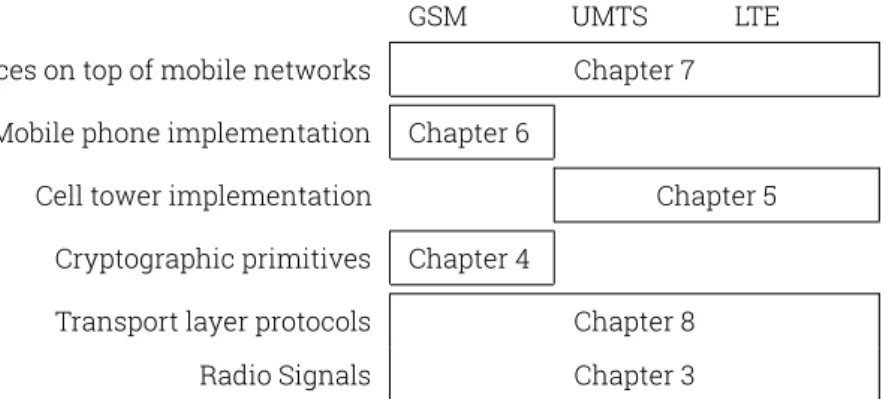
This thesis will look at each of these levels of abstraction presented here, as is summarised in Table 1.2.
One level not discussed in this thesis is the design and implementation of the mobile phone operating systems and applications. This is a very interesting and im-portant security subject, but veers closer to traditional operating system security and is easily a large enough subject to fill a thesis on its own.
Another way to look at the attacker model, is to examine the resources required for an attack or to look at the goals of the attacker. These resources can be both in terms of financial resources and time needed, but also in terms of the required level of expertise.
The revelation of the Snowden documents have proven what many already sus-pected, namely that state actors are capable of attacking mobile communication se-curity in almost any way. State actors can hack into the heart of the providers net-works [150] or simply order taps, but also run fake cell towers mounted on drones [104]
1.1 Research question
or steal the keys from SIM cards [105]. In at least one instance, the NSA was capable of intercepting and storing all telephone communications from a single country in a month [12]. While it is very interesting research to consider ways to protect the mo-bile networks against state agents such as the NSA, the question of how secure momo-bile communication currently is, is uninteresting against such a powerful attacker, as the answer is obvious. Therefore this thesis is mostly interested in attackers of limited means, by which we mean motivated attackers that have basic technical skills, but not the financial resources to buy off-the-shelf attack equipment such as fake cell towers.
About the possible goals of the attacker, we do not wish to make too much assump-tions. These goals will, for the most part, be simplified to breaking one of the security goals, as doing so is either a goal in itself, or most likely a prerequisite for a higher level goal, e.g. financial gain.
1.1.3
Security goals
Before we continue with the in-depth look at security of mobile communication, it is essential to discuss what it means for a cellular network to be secure. In this thesis we will narrow the definition of what it means to be secure, to several security goals. These are:
• Confidentiality, of data transmitted on the wireless link. This can be explicit user data (e.g. voice or IP packets) or meta data such as identifiers. We recognise two special forms of confidentiality, namely:
– Untraceability, of user activity in the network. – Location privacy, of the user’s geographical location. • Integrity, of user and signalling data on the wireless link.
• Availability, of the wireless network and of the user device (phone). • Authentication, of the user to the network and of the network to the user. The traditional security goals from the well-known CIA acronym, also play an im-portant role in the security of mobile networks. Here it should be noted that one stand-ard attack against availability is always possible on the wireless interface of mobile networks, namely jamming of the frequencies used for communication. This obvious attack is not regarded in this thesis.
Another important security goal in mobile networks isAuthentication, authentica-tion both of the network and of the subscriber. Authenticaauthentica-tion of the subscriber by the network is both important to prevent theft-of-service, but also to prevent impersona-tion attacks. Authenticaimpersona-tion of the network by the subscriber protects the subscribers against network-impersonation attacks, e.g. Man-in-the-Middle attacks.
Security goals that are more specific for cellular network security areLocation pri-vacyandUntraceability. Essentially, an attacker should not be able to identify which users are currently at a geographic area, nor should he be able to track a subscriber through the network, neither by observing wireless network traffic nor by generat-ing traffic himself. The network needs to know where every SIM is, so that incomgenerat-ing
Table 1.2: Overview of the thesis’s contents divided over mobile technologies and layers within that technology.
GSM UMTS LTE
Services on top of mobile networks Chapter 7 Mobile phone implementation Chapter 6
Cell tower implementation Chapter 5
Cryptographic primitives Chapter 4
Transport layer protocols Chapter 8
Radio Signals Chapter 3
transmissions can be routed to the correct location. As such, location privacy and untraceability are impossible to guarantee if the attacker controls the network.
To achieve these high level security goals listed above, additional, more detailed, security requirements have been specified by the 3GPP consortium, such as integrity of signalling information, as will be discussed in Chapter 5.
1.2
Contributions and outline of this thesis
This section describes the organisation of this thesis and highlights the contributions by the author. Table 1.2 provides an overview which shows for each chapter which level of abstraction within the wireless technology is examined and which wireless 3GPP technology.
Chapter 2 provides some background for the interested reader. It contains inform-ation which is not essential for understanding the rest of the thesis, but can provide the reader with a deeper insight. The chapter gives a more detailed overview of the different 3GPP networks, the elements they contain, and their air interfaces. It also gives an overview of the different types of hardware that were used during the more practical parts of this research.
Chapter 3 examines how feasible it is to break confidentiality on the wireless link of mobile telephony in practice. This can either be done passively (eavesdrop-ping) or actively (Man-in-the-Middle attacks) and both approaches are invest-igated. This means this chapter focuses on the physical and protocol layers of the wireless connections as well as on the security goals confidentiality and authentication.
In the case of GSM the practical feasibility is tested by examining the effort re-quired in catching and interpreting GSM signals using commodity hardware. The choice to focus on GSM in this part was a simple practical matter, as this was the only mobile telephone technology at the time where we could con-ceivably access the wireless network using generic radio transceivers. Finally,
1.2 Contributions and outline of this thesis
this chapter also looks at the available countermeasures against these attacks against confidentiality on the wireless link.
This chapter is an updated version of the paperEavesdropping on GSM: state-of-affairs(F. van den Broek [173]), presented at the 5th Benelux Workshop on In-formation and System Security, WISSec 2010. An earlier version was presented at BruCON 2010 [174]. Since, the paper was over six years old, it needed to be updated to the current situation. I have independently performed and written down the research described in this chapter.
Chapter 4 focuses on Time-Memory Trade-Off attacks against A5/1, the main cipher used in GSM. When using a passive eavesdropping attack against GSM, an at-tacker will likely end up with A5/1 encrypted data. A Time-Memory Trade-Off attack is currently the best known attack against this cipher, which was at that time by far the most widely used cipher in GSM, which in turn was the most widely deployed mobile network. The much stronger A5/3 cipher has seen ad-ditional roll-out in recent years, though at the moment of writing, A5/1 is still most prevalent. The newer mobile telephony technologies use much stronger cryptography, but as phones can be forced to the weaker GSM, these confiden-tiality attacks are most important.
Confidentiality is the primary security goal investigated in this chapter. Since the attacks discussed in this chapter retrieve the session key, they also impact integrity and authentication. The chapter compares different Time-Memory Trade-Off techniques and delivers the first analysis of the Fuzzy Rainbow Tables used against A5/1. It combines with the previous chapter in looking at the diffi-culty of breaking confidentiality on the wireless link in practice.
This chapter is based on the paperA comparison of time-memory trade-off attacks on stream ciphers(F. van den Broek and E. Poll [176]), presented at the 6th In-ternational Conference on the Theory and Application of Cryptographic Tech-niques in Africa, AfricaCrypt 2013. I was the main contributor in this research and wrote most of the resulting publication.
Chapter 5 looks at possible attacks coming from a corrupted type of cell tower, spe-cifically femtocells. Femtocells are cheap, consumer-owned mobile telephony base stations, which extend the coverage of mobile networks within a small range. These devices have significant implications on all the security goals of mobile networks, which this chapter examines in depth. The choice for look-ing at the possible dangers of corrupted femtocells is again a practical choice, as it is much simpler for an attacker to obtain a femtocell then to get access to an actual cell tower. Additionally, this chapter examines how hard it is for an attacker to obtain access to an actual femtocell, by testing the security of the, at that moment newest, commercially available femtocell.
This chapter is based on the paperFemtocell Security in Theory and Practice(F. van den Broek and R. Wichers Schreur, [178]), presented at the 18th Nordic Confer-ence on Secure IT Systems, NordSec 2013. The practical analysis of the femto-cell was performed with the help of Roel Verdult and Joeri de Ruiter. I performed most of the theoretical security analysis independently and wrote most of the resulting paper.
Chapter 6 focuses on the security of the actual protocol implementations on mobile phones. Within mobile phones a specific chip (or computing core within a chip), called the baseband chip, is responsible for the handling of the mobile network protocol. Although the specifications of the mobile network protocols are pub-lic, they are very extensive and the implementations of the baseband stacks are closed-source and notoriously complicated. We tested several of these im-plementations in actual mobile phones, using our own base station and a tech-nique called fuzzing – in essence automated, largely random, security testing – focusing on two parts of the GSM protocol: Short Message Service (SMS) and the Public Warning System (PWS). Besides finding attacks at the protocol level, an attacker can also attempt to find weaknesses in the implementations, which can also have a large impact if said implementations have a large install base. Although, in this chapter we also found that there are many differences in base-band stacks, even from the same vendor, which decreases the impact of flaws found at this level.
This chapter is based on the paperSecurity Testing of GSM Implementations(F. van den Broek, B. Hond and A. Cedillo Torres [175]), presented at the International Symposium on Engineering Secure Software and Systems, ESSoS 2014. The re-search for this chapter was part of the Master theses of Brinio Hond and Arturo Cedillo Torres. Brinio Hond’s master thesis discussed the fuzzing of SMS mes-sages and Arturo Cedillo Torres’s master thesis was on the fuzzing of broadcast messages, specifically PWS (Public Warning System) messages. As supervisor to both projects I was heavily involved with the direction of this research, as well as setting up the practical experiments with phones. I wrote most of the resulting publication as a summary of the results from both theses.
Chapter 7 looks at the use of mobile phones as an additional authentication factor and the use of security-sensitive applications on mobile devices. In particular, it looks at so-called server-based signatures, which should also provide non-repudiation. With server-based signatures a user’s private key is stored in a server (instead of say a smartcard that is under direct control of the user) and users send documents they want to have signed to this server. Naturally, such an approach requires strong remote authentication. Mobile phones are popular solutions to use as an additional element during authentication. Usually, the authenticating server thereby implicitly trusts the authentication provided by the 3GPP network. This chapter analyses whether mobile phones can provide an appropriate level of security for this assumption.
This chapter is based on the articleDigitale handtekeningen: nieuwe technologie & nieuwe wet- en regelgeving(F. van den Broek and E. Poll [177]), published in the Dutch journal “Privacy en Informatie”. I was the main contributor in this search and wrote most of the resulting publication. Some of the research re-ported in this chapter was done for a practical risk assessment on a system were users could view their medical data online. For this system SMS messages were considered as an additional authentication factor. This risk assessment was commissioned by the Dutch Ministry of Health [144]. Based on this assess-ment, this authentication mechanism was judged to be too weak for securing access to this medical data.
1.2 Contributions and outline of this thesis
Chapter 8 looks at ways to improve the security offered by current mobile networks. Specifically, this chapter proposes a solution against so-called IMSI catching, which is an attack whereby an attacker can wirelessly retrieve the long term identifier inside every SIM card in the vicinity. IMSI catching is among the old-est attacks possible in mobile networks, but it still persists, even in the most modern 3GPP protocols. IMSI catching is clearly an attack against location pri-vacy and traceability, so those security goals are the focus in this chapter. Addi-tionally, our solution for 2G technology actually strengthens the authentication procedure, by providing the SIM the possibility to verify if a challenge was cre-ated by its home network. The solutions offered are compatible with the current specifications of the mobile standards and requires only limited changes to the SIM and the authentication server, both of which are under control of the user’s network provider. Therefore, any individual (virtual) provider that distributes SIM cards and controls its own authentication server can deploy a more privacy friendly mobile network that is resilient against IMSI catching attacks, without requiring any changes in the infrastructure, or in the intervening massively de-ployed network equipment. We are currently working with the Fraud and Se-curity Architecture Group (FSAG) of the GSMA to get this solution into the 3GPP specifications.
This chapter is based on the paperDefeating IMSI Catchers(F. van den Broek, R. Verdult and J. De Ruiter [179]), presented at the ACM Conference on Computer and Communications Security, CCS 2015. I was the main contributor in this re-search and wrote most of the resulting paper, except for the formal verification of our solution using ProVerif, which was performed by Joeri de Ruiter. Chapter 9 draws conclusions and provides directions for future work.
Chapter
2
Background
The background information presented in this chapter is here purely for complete-ness sake and is not essential for understanding the rest of the thesis. For the inter-ested reader this chapter gives an overview of the different generations within the 3GPP family of mobile networks. It also presents a more detailed, but still very gen-eric overview of mobile networks and gives an overview on the specific hardware that was used for the more practical research presented in the rest of this thesis.
2.1
Generations
Currently, providers are rolling out the LTE network globally, which is also called 4G, where the G stands for generation, to imply that this is the fourth generation of mo-bile telephony. Most momo-bile networks have had these designations to a certain gen-eration. This started with GSM and IS-95, which were called 2G networks, thereby retroactively naming the preceding analogue systems 1G.
We will now shortly describe the major generations within the 3GPP family. This information was also summarised in the Chapter 1 in table 1.1.
2.1.1
2G – GSM
GSM was the acronym given to the research group in charge of creating a new digital cellular mobile phone standard, Groupe Spécial Mobile. When GSM started getting world wide popularity GSM’s long form was changed to Global System of Mobile com-munication.
GSM was developed in the late 1980s and deployed in most Western countries in the early 1990s. GSM saw its first deployment in 1991 in Finland. Since then GSM has seen an enormous rise both in its coverage and in the number of subscribers, making it perhaps the most successful technology of the last twenty years.
When GSM was first deployed there was some security research, which mostly fo-cused on the specifications and the reverse engineering of the secret and proprietary encryption algorithm [25]. Several weaknesses in GSM’s protocols and cryptographic primitives where quickly identified, though practical exploits of these weaknesses proved complicated because of all the signal processing involved. This changed
around 2010 with the arrival of cheap hardware [49] and open-source software [26] which provided easy access to the GSM spectrum. This immediately led to some high profile attacks, such as the release of the Time-Memory Trade-Off tables for breaking GSM’s standard encryption [132]. These attacks are discussed in Chapter 3.
GPRS
GSM has no support for packet-switched data, as the phone network was still circuit-switched when GSM was developed. There are some techniques to actually run an IP stack on top of SMS, but the performance of this is rather dreadful. This is where Gen-eral Packet Radio Service (GPRS) comes in. GPRS is a backwards compatible update for GSM allowing for packet-switched data, such as IP protocols to be transmitted over GSM. The peak speed of GPRS-based data is 114 kbit/s.
EDGE
Enhanced Data rates for GSM Evolution (EDGE) is an improvement on GPRS and there-fore also known as Enhanced GPRS (EGPRS). EDGE can manage a peak bandwidth of 473.6 kbit/s. As you can read below on UMTS, this bandwidth qualifies EDGE as a 3G technology. Still, it is usually still designated within the second generation, saving a generation upgrade for non-backwards compatible technologies. EDGE is being de-ployed on GSM networks since 2003.
2.1.2
3G – UMTS
For the third generation of mobile telephony the International Telecommunication Union (ITU) — a United Nations agency responsible for telecommunication issues, such as coordinating the global use of the radio spectrum and helping in creating worldwide technical standards — specified some standards for mobile technologies to be considered 3G. Most important in these specifications was an information transfer rate of at least 200 kbit/s.
In order to establish a 3G mobile phone system based on GSM, telecommunica-tions associatelecommunica-tions started collaborating under the name 3rd Generation Partnership Project (3GPP). Later on they also became responsible for maintaining the GSM, GPRS and EDGE specifications.
The Universal Mobile Telecommunications System (UMTS) was 3GPP’s first tech-nology to be classified as 3G. It was introduced in 2002 and started out managing an information transfer rate of 384 kbit/s. UMTS introduced Code Division Multiple Ac-cess (CDMA), a channel acAc-cess method in which multiple parties can use the same fre-quency simultaneously by assigning codes to each connection used within the mod-ulation. Confusingly, the name CDMA is also used to describe Qualcomm’s family of mobile networks, which also use the CDMA channel access method, as opposed to GSM’s Time Division Multiple Access (TDMA) where the same frequency is shared by dividing it into different time-slots. This switch to the CDMA channel access method effectively meant that new phones and cell towers were needed for UMTS, as it made UMTS non-backwards compatible with its pre-decessors.
2.2 Network overview
The most important security change incorporated in UMTS was the mutual au-thentication procedure between phone and cell tower, meaning that, as opposed to the earlier technologies, the SIM now also authenticates the network. Additionally UMTS introduced a longer secret key (now 128 bits) and better and publicly available cryptography. UMTS security is discussed in detail in Section 3.5.
HSPA
The High Speed Packet Access (HSPA) is a family of upgrades possible within existing UMTS networks, which are being deployed since 2006. They are usually subdivided in two upgrades HSDPA (Downlink) and HSUPA (Uplink), with HSDPA achieving down-link speeds of up to 14.4 Mbit/s and HSUPA achieving updown-link speeds of up to 5.76 Mbit/s.
After HSPA there was another improvement called Evolved HSPA, or HSPA+. HSPA+ has a theoretical maximum downlink speed of 672 Mbit/s and an uplink speed of 168 Mbit/s.
Neither HSPA or HSPA+ included any security improvements.
2.1.3
4G – LTE
The designation of Long Term Evolution (LTE) as 4G is controversial. Again, for the fourth generation the ITU defined a peak speed requirement. This time the require-ment was 100 Mbit/s for fast moving targets such as users in cars or trains and speeds up to 1Gbit/s for slow moving targets, such as pedestrians. LTE manages a peak down-link speed of 300 Mbit/s and a peak updown-link speed of 75 Mbit/s. This would mean LTE does not qualify as 4G. However, since LTE switches to an all IP network and uses Or-thogonal Frequency-Division Multiple Access (OFDMA) as a channel access method, thereby not being backward compatible with its predecessors, and since LTE was already being marketed as “4G”, the ITU decided to name LTE a 4G technology. LTE is being deployed since 2010.
Security-wise the most important change is the introduction of forward secur-ity, by deriving extra keys during the authentication procedure, as explained in Sec-tion 3.5.
LTE-Advanced
LTE-Advanced improves the speeds of LTE to a peak downlink speed of 1 Gbit/s, with a 100 Mbit/s for fast moving targets. This caused the ITU to consider LTE-Advanced as “true 4G”. Some small LTE-Advanced test networks have been rolled out since 2013, but major commercial deployment is not yet underway.
2.2
Network overview
In Chapter 1 we discussed a very simplified model for cellular networks focusing on the wireless interface. That model is shown in Figure 1.2.
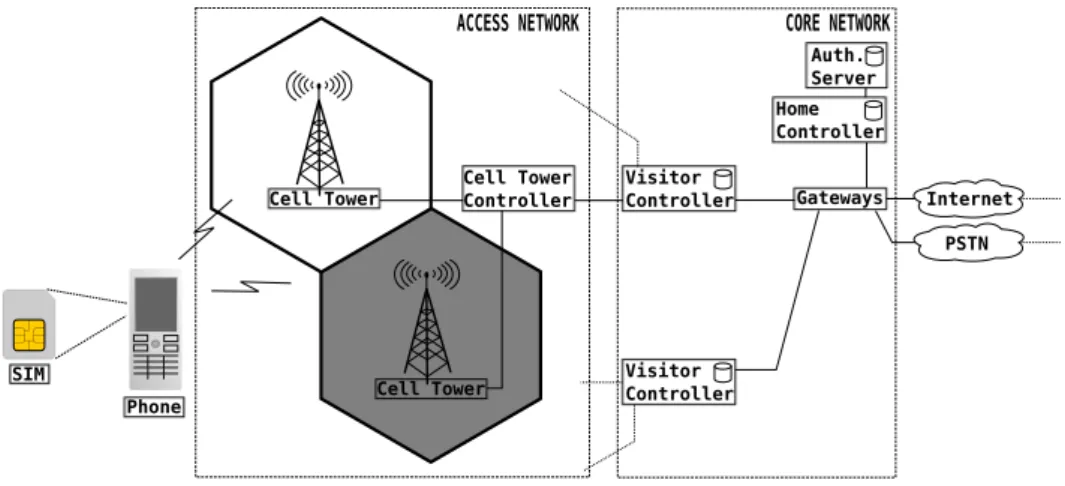
Mobile telephony networks have many more components. Figure 2.1 gives a gen-eric but more detailed overview of the 2nd and 3rd generation of 3GPP networks. The
model presented here is still very generic and should not be used as an overview of the actual layout of any 3GPP network, but rather as a generic idea of common elements between these networks. In an attempt for this thesis to use as little terminology as possible, all the names in Figure 2.1 are generic names instead of the actual terms. We choose to use generic terms because the different generations of 3GPP networks introduce new names for each component. For instance, cell towers are called “Base Transceiver Station” (BTS) in GSM, “NodeB” in UMTS and “eNodeB” in LTE. It is therefore simpler to introduce generic, hopefully self-explanatory terms for these components rather than switching between terms when we discuss different networks.
SIM Phone Cell Tower Cell Tower Cell Tower Controller Visitor Controller Visitor Controller Home Controller Auth. Server Gateways Internet PSTN
ACCESS NETWORK CORE NETWORK
Figure 2.1:Generic overview of 3GPP style networks.
The 3GPP networks are usually divided in at least two domains: the access net-work and the core netnet-work, as is shown in Figure 2.1. Sometimes an additional sub-scriber domain is defined and sometimes the subsub-scriber domain is included in the ac-cess network. The subscriber has some 3GPP supporting mobile device, in the figure represented by a phone, and a SIM. The SIM (Subscriber Identity Module), a removable smart card securely storing the subscriber’s unique serial number, secret keys and au-thentication algorithms, was a unique feature for GSM and is often named as one of the main reasons why GSM’s popularity outgrew its competitors [101]. It is also the only actual GSM term we use in Figure 2.1, since this term now seems firmly estab-lished in common language. Indeed, the SIM’s successor, UMTS’s Universal Integrated Circuit Card (UICC) containing a USIM application, is still colloquially called a SIM. Mo-bile phones are recognised within a network based on the serial number within their SIM, which is provided by the subscriber’s provider.
The mobile phone connects wirelessly to cell towers, which are relatively dumb devices, mostly forwarding every message to their controllers. These controllers can serve one or more cell towers, managing the radio channel setup and handovers between connected cell towers, and watch the status of the cell tower’s hardware.
The real logic of the mobile network starts at the Visitor Controllers. These con-trollers have a database in which they keep track of all mobile phones within their area. They handle handovers between cell tower controllers and store authentication records generated by the Authentication Server (Auth. server in Figure 2.1). When a mobile phone enters a cell under control by a another Visitor controller, this Visitor
2.2 Network overview
Controller will inform the Home Controller, who will store the current Visitor location of his subscriber and inform the previous Visitor Controller to remove the subscriber from its database.
The Home Controller and Authentication Server are both part of the home network of the subscriber’s own provider, while the rest of the network could be part of another provider. If this is the case a subscriber is said to beroaming.
If a new authentication is required, the Visitor Controller will request authentica-tion records from the Home network’s Authenticaauthentica-tion Server. The contents of these authentication records depend on the actual 3GPP network, but at least they contain a challenge, a response and a session key, generated with the authentication algorithm and secret key present in both the Authentication server and the SIM. This leaves the provider some freedom to choose his own authentication algorithms since he con-trols both the contents of the SIM and the Auth server in his back-end. It also allows visiting networks to authenticate the SIM without learning the secret key.
There are several gateways that connect everything together and connect the mo-bile network to other networks, such as the internet and the Public Switched Phone Network (PSTN).
LTE Network Overview
The 2nd and 3rd generation of 3GPP networks have fairly similar network topologies, but for the fourth generation there were some major changes, which are reflected in Figure 2.2. As before, the names provided for the network entities are self-chosen names and not the actual names as defined by the 3GPP consortium. For the LTE
SIM Phone Cell Tower Cell Tower Signaling Gateway Home Controller Auth. Server Internet PSTN
ACCESS NETWORK CORE NETWORK
Data Gateway
Figure 2.2:Generic overview of LTE style networks.
style networks, the cell tower controllers have been incorporated with the cell towers. This makes the cell towers “smarter” devices than their previous generation counter-parts, which are now capable of communicating directly with each other when dir-ectly connected. In this way handovers within the area of one Signalling Gateway can be handled efficiently between connected cell towers.
The other major difference is the explicit splitting of signalling and user data flows, whereby the former is handled through a Signalling Gateway and the latter by
a Data Gateway. This split of the different information flows also allows for different security measures per flow, as will be explained in the next section. Additionally, all the links within the access and core network are now fully IP based.
2.3
Authentication within the network
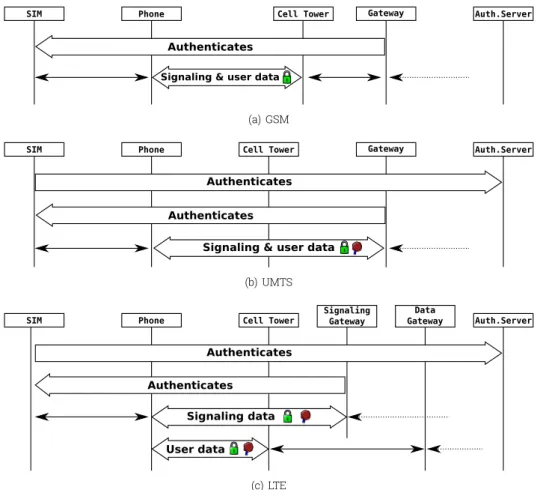
Authentication on the different 3GPP networks will be discussed in more detail in Chapter 3. However, there are some interesting interplays between the network to-pologies, the authentication and the different confidentiality and integrity protected links for each of the 3GPP generations, which did not fit within the scope of Chapter 3, where the focus lies solely on the air interfaces. These interplays are summarised in Figure 2.3, where for the three generations of 3GPP networks the authentication steps are shown, as well as whether the user and signalling data are encrypted (the padlock symbol) and have a MAC (the seal symbol). Please note that this figure, nor this sec-tion provides any judgement on the strength of the cryptographic algorithms used for each generation. A discussion on that can be found in Chapters 3 and 4.
For all three networks shown in Figure 2.3 there are signalling messages that are unprotected. Additionally, all three networks support a null-cipher for the user data. So, only the protected information flows are shown in the figure. The figure illustrates the differences between the 3GPP generations in terms of (mutual) authentication, and what data is protected in between which network entities.
For all 3GPP networks the authentication procedure also establishes session keys. The authentication server and the SIM share a secret key, which is used by the authen-tication server to compute the response, and session keys based on a fresh random challenge. In the case of UMTS and LTE the authentication server also computes a token which proves knowledge of the secret key. These computed values are them moved on to other network components. It is up to a specific gateway to compare the SIM’s response with the response provided by the authentication server and forward the session keys to the correct place in the network.
Although UMTS and LTE have mutual authentication between subscriber and net-work, this authentication does not happen between the exact same entities. The SIM verifies the authentication token it receives, which essentially provides a MAC over the challenge and a sequence number (to prevent replay attacks) using the secret key. The SIM thereby authenticates this token coming from the authentication server, while the SIM’s response is verified at the respective gateway.
UMTS and LTE also provide explicit integrity protection on certain messages, through computing a MAC over these messages using an extra session key: the integ-rity key. GSM only has encryption on its messages, which, since the encryption key results from the authentication process, is assumed to provide some authentication. Since encryption in GSM is provided by XORing keystream with plaintext, there is no integrity protection; simply flipping a bit on the ciphertext will flip the underlying plaintext bit. In other words the cipher is malleable.
There is also a difference how far into the network the connection is secured. In GSM the encryption key is forwarded to the cell tower, which decrypts messages com-ing from the phone and encrypts messages gocom-ing towards the phone. For UMTS the 3GPP consortium chose to secure the user link all the way to the first gateway within
2.4 Equipment and software used Auth.Server Gateway Cell Tower Phone SIM
Signaling & user data Authenticates (a) GSM Auth.Server Gateway Cell Tower Phone SIM Authenticates
Signaling & user data Authenticates (b) UMTS Signaling Gateway Cell Tower Phone SIM Auth.Server Authenticates Authenticates Data Gateway Signaling data User data (c) LTE
Figure 2.3:Authentication, confidentiality and integrity in 3GPP networks
the core network. LTE has a secured signalling connection between the phone and the signalling gateway and a separately secured user data connection between the phone and the cell tower. Additionally, all connections within the provider’s network are to be secured by IPSEC [69]. This setup was chosen to allow cheaper handovers between connected cell towers, as the encryption and integrity key for the user data connection can be forwarded between directly connected cell towers.
2.4
Equipment and software used
During this research we used several different pieces of hardware and different open-source software projects; these are most prominently used in the practical sections of Chapters 3 and 6. This section describes the hardware and software used and some of their limitations. The different combinations are ordered by their capabilities.
2.4.1
Analysis and eavesdropping of the air interface
There are several options for analysis and eavesdropping on the GSM air interfaces. For the other 3GPP protocols, this is more complicated. Hardware is available for catching air interface signals of UMTS or LTE, but we found no software driving this hardware. Also, as will be explained in detail in Section 3.5, the newer generations air interfaces are not as susceptible to eavesdropping as GSM is.
USRP + AirProbe
The Universal Software Radio Peripherals (USRPs) are a series of generic transceiver devices developed by Matt Ettus and which can be ordered through his company Ettus Research [49]. Originally, these devices where introduced as open hardware, although it is unclear where the designs of the devices can be found. The different models cost somewhere between 600 and 4000 euros, with the base USRP1 model costing 615,- euros. The devices are transceivers that can be linked to a computer and can be tailored to specific frequencies by extending it with daughter boards and attaching the appropriate antenna. The USRPs contain a programmable FPGA which can be used to perform some signal processing, some digital-to-analog (DAC) and analog-to-digital (ADC) converters and a communication port for the connection with a host computer. Depending on the model, the converters and the computational power of the FPGA range in quality. The communication port also ranges between a USB2.0, a USB3.0 or single to dual Gigabit Ethernet connections. We used the USRP1, then simply known as the USRP, as it was the only model available when we started this research.
The USRP can be extended with a daughter board in order to receive the correct frequency spectrum. We have used several daughterboards:
• a DBSRX, a 800 MHz to 2.4 GHz receive-only board, • a WBX, a 50 MHz to 2.2 GHz transceiver board, and
• two RFX1800, 1.5 to 2.1 GHz, of which the firmware can be flashed to change them into RFX900s, 750 to 1050 MHz transceiver boards.
For eavesdropping and analysis of GSM frequencies all boards functioned with sim-ilar results. In Section 2.4.4, we detail why the USRP was incapable of following GSM signals over multiple frequencies (frequency hopping).
GNU Radio [82] is a free software toolkit licensed under GPL for implementing software-defined radios. It was started by Eric Blossom. Basically GNU Radio is a library containing lots of standard signal processing functions, such as filters and (de)modulations and offers a general interface to a transceiver. GNU Radio mainly functions as the driver of the USRPs. GNU Radio, out-of-the-box, does not offer much in terms of GSM sniffing capabilities. However, GNU Radio can be used by other soft-ware packages, such asAirProbe, to perform the low level functions of GSM sniffing, such as reception and demodulation.
AirProbe [29] is an open-source project aimed at learning the details of GSM tech-nology, helping people who develop other open GSM technology and demonstrating the insecurity of the current GSM standard. Currently, AirProbe supports sniffing on
2.4 Equipment and software used
single frequency GSM downlink (cell tower to phone) traffic and it can interpret sev-eral types (but not all) of bursts (GSM packets). There has not been much development for AirProbe in the last three years to add the missing functionality.
Motorola C123 + OsmocomBB
OsmocomBB [139] offers a new firmware for the Texas Instruments Calypso baseband chip (the closed source component inside phones, handling the 3GPP protocol). One of the phones containing this baseband chip is the Motorola C123. This phone (as well as most Calypso phones) has a 3.3V serial port on its 2.5 mm audio jack. Using a converter cable the phone can be connected to a PC’s USB port.
With the OsmocomBB software it is possible to re-flash the phone, with code hand-ling only the lowest layer of the GSM protocol. All higher layers then run on the con-nected PC. This allows a user to change the phone’s behaviour to, for instance, listen to GSM channels destined for other phones. While the OsmocomBB project offers interesting capabilities, it is not an out-of-the-box eavesdropping project, as several necessary parts for this have not been released. Section 3.3.1 details the use of the OsmocomBB project within an eavesdropping attack.
Nokia 3210 + Gammu
We also made extensive use of a Nokia 3210 GSM phone, connected to a computer, also via USB, running the open-source Gammu [2] project. This combination enabled us to force the Nokia 3210 in a debug mode that transparently logs all packets sent to and from the phone.
The Gammu + Nokia phone method has much better reception than the USRP + AirProbe. This makes sense, since after all the mobile phone is specifically made to receive these signals. Since this only uses functionality already present in the Nokia 3210, you only see the messages to or from the specific phone connected to the com-puter. You cannot see any message for other phones, nor is it possible to change the phone’s behaviour in this manner. So, Gammu with a Nokia 3210 is a great practical aid to get a better grasp of the GSM protocol and to fine-tune the USRP, but it lacks the versatility to be useful in a eavesdropping attack.
2.4.2
Running our own GSM network
We ran our own GSM network for several different research goals. Next to the insight provided by running your own network, it allowed for testing the difficulty of eaves-dropping on single frequency cells, and our fuzzing research discussed in Chapter 6. Again for the newer generation 3GPP networks there is little availability of open-source software for running your own network. There is commercial LTE software available which requires a USRP [14], but this software is not open-source, making it harder to make changes in its operation for, for instance, fuzzing.
In the Netherlands, the regulatory body for frequency spectrum use within the Dutch ether, the Agentschap Telecom [1], decided to make a small part of the GSM frequency freely available. This spectrum, specifically 1782.1 to 1784.9 MHz for the uplink and 1877.5 to 1880 MHz for the downlink can be used for running you own GSM
network. Doing this does not require a license, but you should register your network use.
USRP + OpenBTS
The USRP was discussed earlier in this section. Using the USRP as a GSM basestation required some adaptation. The USRPs have a 64MHz crystal oscillator internal clock, while most GSM phones use a 13MHz symbol clock with a much better accuracy. Of course the 64MHz samples can be re-sampled to (a multiple of) 13MHz, although this brings an extra computing complexity. Also the USRP’s oscillators are much less ac-curate and can show quite some drift when compared to GSM system clocks, resulting in bad reception. Using a more accurate external clock providing a pulse at (a multiple of) 13MHz solves these issues. We used the programmable Fairwaves Clocktamer for this [71].
OpenBTS [26], founded by David Burgess, offers an open-source cell tower im-plementation for GSM using the USRP as a transceiver. Some of the logic normally present in a cell tower controller is placed inside OpenBTS. The OpenBTS software can be connected with Asterisk [7], which is an open-source software project imple-menting a telephone exchange, and has the option to connect to a VOIP network.
2.4.3
SIM cards and the SIM-phone interface
While not directly a subject in this thesis, the phone-SIM interface is interesting, if only to observe. This can for instance tell you when a phone has to re-authenticate to a network without having to observe the air interface. This makes this method of research often the only available option when investigating UMTS or LTE networks. The SIM-Phone interface uses a standard ISO 7816 smartcard interface.
RebelSim Scanner
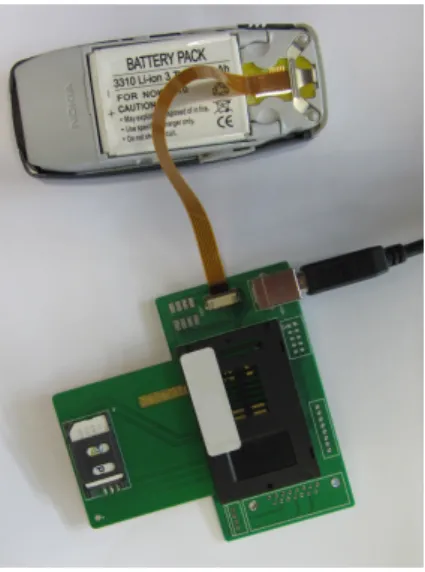
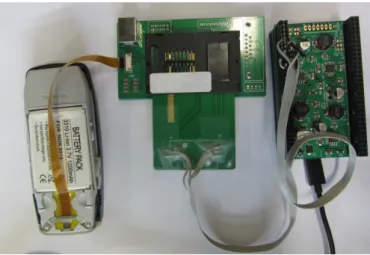
The RebelSim scanner [146] provides passive eavesdropping between the phone and SIM card. This is achieved by providing a SIM to smartcard holder, which allows the original SIM card to be inserted in a smartcard reader. This smartcard reader then for-wards all communication to dummy SIM-shaped connectors which can be inserted in the phone and meanwhile also copies all communication to a serial port connection which can be observed on a PC. This setup is shown in Figure 2.5. These SIM-shaped connectors are used by several other projects aimed at examining the Phone-SIM in-terface, discussed below. These connectors allow access to the phone-SIM inin-terface, while the phone is in operation. A detailed photo of such a connector is shown in Fig-ure 2.4. The RebelSim connectors are only available in the standard SIM size and not in the currently much used micro or nano SIM shape.
There are some tools out there, such as SimParser.pl [80], which help understand the output given by RebelSim Scanner.
SmartLogic Tool
While the SIM tracer only allows passive eavesdropping on the communication between SIM and Phone, the SmartLogic Tool [37] can actively insert commands. It is a sniffer
2.4 Equipment and software used
Figure 2.4:The RebelSim SIM shaped connector.
Figure 2.5:The RebelSim Scanner setup, which uses a SIM shaped connector to eavesdrop the com-munication between SIM and Phone.
Figure 2.6: The SmartLogic setup, which uses the RebelSim setup, but extents it by simulating a SIM card. Optionally an actual SIM card can be read through a card reader.
and MitM tool for smartcard communication, originally designed for bank cards. The SmartLogic tool uses an FPGA board to essentially emulate a SIM card within the RebelSim setup, as is shown in Figure 2.6. Optionally, an actual SIM card can be read by a card reader connected to a server. The SmartLogic FPGA board can either fully implement a SIM card, relay all communication to the SIM card at the server, or anything in between. This allows for listening to and manipulating of SIM-phone traffic. In our experiments it turned out that this was mostly successful with older phones [81]. It seems the speeds of communication of SIM cards is much higher than of bank cards, which caused unreliable connections with the SmartLogic tool.
Bladox Turbo SIM
The Bladox Turbo SIM [18], is a thin sheet with SIM connectors on both sides and a small chip. It can be inserted inside a phone, between the SIM and the phone, and will Man-in-the-Middle the traffic between both, based on the programming of the chip. A part of the original SIM card will usually need to be cut off, to accommodate the chip, as can be seen in Figure 2.7.
This offers, for instance, the ability to add new functionality to the SIM, without having actual access to the SIM, but it can also change the commands and/or re-sponses between SIM and phone. It is convenient in that the whole setup is contained within a phone and so does not need any wires sticking out. However, programming the Turbo SIM can be quite a hassle and debugging is very hard. It is also not very useful for simple observation of the SIM-Phone interface, due to limited storage.
2.4.4
Problems using the USRP to eavesdrop on GSM
Many GSM cell towers transmit on multiple frequencies. To achieve an average sig-nal reception quality, most data connections with phones will switch rapidly between
2.4 Equipment and software used
Figure 2.7:Picture from the Bladox website [18] showing how to cut the SIM card to place the Turbo SIM in between SIM and phone.
these frequencies, a process referred to as “frequency hopping”. While not a secur-ity measure per se, the hopping sequence, which is often negotiated confidentially, makes eavesdropping on GSM frequencies much harder, especially when using gen-eric equipment like the USRP.
In its standard configuration a USRP1 creates 16 bit I and Q samples when receiv-ing a given frequency. These are complex samples, with the real part (Q) describreceiv-ing the cosine of the signal, and the imaginary part (I) describing the sine of the signal plus 90 degrees. One sample is thus 32 bit long and can be sent to the host computer through the communication port, for further processing. The USRP1 can receive a bandwidth of 32MHz and can transmit on a bandwidth of 64MHz. It transmits the samples to the host computer via a USB2.0 connection, which has a practical max-imum data throughput of 32 Mbyte/s. Other USRP models can receive and transmit on a bandwidth of up to 120 MHz, but the costs rise quickly.
As discussed in Section 2.4.2, the internal clock of the more affordable USRP1 has a too imprecise internal clock. An issue that can be solved by using a more accurate external clock.
The main problem for reception is the channel hopping used in most GSM net-works. Using the AirProbe software out of the box helps you receive a single carrier on the down link (messages from cell tower to mobile). In order to capture an en-tire conversation when channel hopping is used, you will need a way to gather all the bursts on all the different frequencies. There are two general approaches to achieve this:
I. Let the USRP follow the hopping sequence.
II. Capture all possible frequencies and attempt to follow the sequence afterwards. Approach I requires a lot of processing inside the USRP’s FPGA. All the parameters for the hopping sequence need to be retrieved from certain bursts, then the hopping se-quence needs to be calculated and followed for every burst. There are three possible configurations for mobile networks in which to transmit the hopping sequence para-meters. In one of these the parameters are transmitted in the clear. In the other two configurations these parameters are transmitted after encryption has been enabled. During our experiments we only ever observed cell towers that use so-called “early assignment”, in which the hopping parameters are transmitted under encryption. Be-sides, the network can always command a new hopping sequence under encryption, irrespective of which configuration is used. This necessitates breaking the encryp-tion really fast in order to follow the hopping sequence in time. This is currently not possible. The USRP’s FPGA only samples a certain frequency at a certain rate and sends these samples to a computer. So having the FPGA decrypt and interpret the