Illinois State University
ISU ReD: Research and eData
Theses and Dissertations3-3-2014
An Examination Of Teachers' Perceptions And
Implementation Of Learning Trajectory Based
Professional Development
Megan Hope Wickstrom
Illinois State University, [email protected]
Follow this and additional works at:http://ir.library.illinoisstate.edu/etd
Part of theScience and Mathematics Education Commons
This Thesis and Dissertation is brought to you for free and open access by ISU ReD: Research and eData. It has been accepted for inclusion in Theses and Dissertations by an authorized administrator of ISU ReD: Research and eData. For more information, please [email protected].
Recommended Citation
Wickstrom, Megan Hope, "An Examination Of Teachers' Perceptions And Implementation Of Learning Trajectory Based Professional Development" (2014).Theses and Dissertations.Paper 87.
AN EXAMINATION OF TEACHERS' PERCEPTIONS AND IMPLEMENTATION OF LEARNING TRAJECTORY BASED PROFESSIONAL DEVELOPMENT
Megan H. Wickstrom
342 Pages May 2014
The aims of this study were to investigate how teachers incorporated learning trajectory based research into practice, specifically how they made sense of students’ thinking in relation to classroom instruction. To conduct this study, I used an ethno-methodological approach (Garfinkel, 1967) across several months, with three fourth-grade teachers in a diverse, high needs school. Each of the teachers participated in professional development on using learning trajectories (Sarama & Clements, 2009) as a tool to formatively assess individual student's thinking as a means to inform classroom instruction. During the study, the teachers were asked to conduct clinical interviews with students in their classroom and note events during the interviews that revealed students’ thinking. They were also asked to note revealing events during their instruction of a month-long mathematics unit. Following student interviews and classroom instruction, the teachers participated in debriefing interviews in which we discussed each of the noted events, what they implied about the students’ understanding, and if they provided any implications for instruction. Each of the debriefing interviews was audio recorded and
transcribed verbatim resulting in approximately 200 pages of transcribed interviews. Using the construct of mathematics teacher noticing (Jacobs, Lamb, & Philipp, 2010) as an analytical lens, I qualitatively explored (Miles, Huberman, & Saldana, 2014) what teachers noticed about their students and how they used knowledge of students, gained from task-based interviews and classroom interactions, to inform whole-classroom instruction and planning. I investigated how the teachers referenced learning trajectory based research in their noticing and if and how it surfaced in their practices. I also looked across the three cases to compare and contrast themes.
Findings indicate that the teachers noticed student thinking constantly in their daily work through actions such as students' measurement strategies, counting strategies, language, interactions with other students, and written accounts. However, the actions were not always connected with instructional implications. Across the cases,
mathematical tasks and curriculum were critical in helping teachers understand students' thinking and implement it into practice. Interview tasks were relevant in instructional planning when they were similar or connected to future classroom tasks. Within the classroom setting, the teacher's willingness to supplement or modify current curriculum determined how she used knowledge of students' thinking in practice. Teachers unwilling to modify curriculum had difficulty using knowledge of students' thinking in practice. Findings also indicate that knowledge of an individual student's thinking gained from interviews informed teachers of student misconceptions and current understandings of a topic, but much of what informed the teachers’ instruction came from a complex
framework of past education and daily experiences with students. Lastly, teachers interpreted, redefined, and even rejected learning trajectory research in their own ways
depending on how well it agreed with their current practices and belief systems. These findings have implications for the design and conduct of teacher professional
development and indicate the need for modifications to current learning trajectories (Sarama & Clements, 2009) to make them more accessible to teachers.
AN EXAMINATION OF TEACHERS' PERCEPTIONS AND IMPLEMENTATION OF LEARNING TRAJECTORY BASED PROFESSIONAL DEVELOPMENT
MEGAN H. WICKSTROM
A Dissertation Submitted in Partial Fulfillment of the Requirements
for the Degree of
DOCTOR OF PHILOSOPHY Department of Mathematics ILLINOIS STATE UNIVERSITY
AN EXAMINATION OF TEACHERS' PERCEPTIONS AND IMPLEMENTATION OF LEARNING TRAJECTORY BASED PROFESSIONAL DEVELOPMENT
MEGAN H. WICKSTROM
COMMITEE MEMBERS: Cynthia W. Langrall, Co-Chair Jae M. Baek, Co-Chair
Beth Hatt
Jeffrey E. Barrett Tami S. Martin
i
ACKNOWLEDGMENTS
This dissertation and all of my graduate work would not be possible without the support, guidance, and love of so many people in my life. Through each year at Illinois State University, I have been fortunate enough to encounter supportive, creative, and challenging souls that have shaped my journey thus far. I would first like to thank Dr. Cynthia Langrall. She and Dr. Edward Mooney encouraged me to continue toward the doctorate after finishing my master’s degree. Their faith and support started me on this journey. Since then, Cindy has been ever present in my life giving me just the right amount of support and guidance throughout the process. I am so thankful to have worked with Cindy.
Secondly, I would like to thank Dr. Beth Hatt. Beth has continually encouraged me to go out of my comfort zone and explore the many facets of qualitative research. Without Beth, I would not have had the courage to conduct this study. Each step of the dissertation process, she has been an amazing mentor and friend.
I would also like to thank Dr. Jeffrey Barrett, Dr. Jae Baek, Dr. Craig Cullen, and Dr. Jennifer Tobias for allowing me to be a part of their work with teachers. Each of these professors provided me with support, guidance, and feedback as I learned how to study teachers at work. My work with them helped to spark my dissertation idea and shape my future research plans. I would also like to thank Dr. Tami Martin for her support throughout graduate school and for acting as one of my committee members. I am also grateful for the support and guidance of all of my other professors at Illinois
ii
State. They have challenged me to grow and expand my understanding of mathematics education.
This dissertation would not exist without Mrs. Grey, Mrs. Purl, Mrs. Brownstein, and the students of Terrace Elementary. Each of these women is an outstanding member of the teaching profession and I am so thankful that I had the opportunity to get to know and work with them. No matter what I asked them to do, they went out of their way to help me. I hope that we can continue to stay in touch and collaborate on future projects.
Throughout the graduate school experience, I have found that the journey is much better when shared with friends and colleagues. I would like to thank Chepina Rumsey and Josh Hertel for their support and mentorship throughout the process. They helped me to see the light at the end of the tunnel. I would also like to thank Nicole Enzinger for her encouragement and willingness to collaborate on many projects and presentations
throughout our time at Illinois State. Thank you also to my other graduate student
colleagues, Elif Safak, Melike Kara, Cheryl Eames, Amanda Miller, and Vince Kirwan. It has been a pleasure completing the graduate program with you.
Above all, I would like to express the utmost gratitude to my family and friends. I am extremely grateful for the love and support of my husband, Daric Wickstrom. Thanks for following me to the cornfields of Illinois to pursue my dreams. We have had so much fun and I cannot wait to experience the next phase of our journey in Montana. Thank you to my mom, dad, and brother, James, for supporting me through the ups and downs of my academic career. Each step of the way, through triumphs and tribulations, I knew all of you were there for me. Thank you to my Saint Mary's sisters, Erica, Gail, and Emily for making time for weekends away to de-stress and to just have fun. I also need to thank my
iii
dogs, Yogi and Zoey. They convinced me to put my work aside and take a walk every now and then to clear my mind. Thank you lastly to all the friends I have made while living in Normal, especially the Thompson family.
iv CONTENTS Page ACKNOWLEDGEMENTS i CONTENTS iv FIGURES ix CHAPTER
I. THE PROBLEM AND ITS BACKGROUND 1
The Problem 1
A Personal Account 5
Rationale 10
Epistemological and Ontological Groundings 14
Classroom Ecology 15
Teacher Research 17
II. REVIEW OF RELATED LITERATURE 21
Defining Learning Trajectories 21
Implications of Learning Trajectories for Instruction 23 Learning Trajectory Based Professional Development 25 Teachers' Initial Reactions to Learning Trajectories 26 Teachers' Skepticism of Learning Trajectories 26 Noticing Students' Actions and Understanding 27
Issues in Implementation 31
Role of the Learning Trajectory in Understanding
Students' Thinking 32
Use of Learning Trajectories within Instruction 33 Criticism of Integrating Learning Trajectory Research in
Practice 35
Informing This Study 36
v Design of Study 39 Research Context 40 Selection of Participants 41 Data Collection 43 Data Analysis 50
Analysis of Each Phase 58
Analysis Across The Three Cases 63
My Perception 64
Trustworthiness and Validity 64
Summary 68
IV. MRS. GREY 70
Description of Mrs. Grey and Her Classroom 70
School Year Events 72
Interview 1 73
Interview 2 80
Interview 3 93
Instructional Unit on Area Measurement 99
Smartboard Lesson 100
Relating Units of Measure Lesson 109
Area Conservation Lesson 120
Summary 124
Interviews: Events Noticed and Implications for
Instruction 125
Instructional Unit: Events Noticed and Implications
for Instruction. 127
Mrs. Grey's Perceptions of Learning Trajectory Based
Professional Development 129
Perceived Strengths of the Professional Development 130 Perceived Difficulties of the Professional Development 134 My Perspective and Interpretation of Mrs. Grey 137
Student Interviews 137
Classroom Instruction 138
vi
V. MRS. PURL 141
Description of Mrs. Purl and Her Classroom 141
School Year Events 142
Interview 1 143
Interview 2 148
Interview 3 156
Instructional Unit on Area Measurement 162
Smartboard Lesson 163
Relating Units of Measure Lesson 170
Area Conservation Lesson 187
Summary 192
Interviews: Events Noticed and Implications for
Instruction 193
Instructional Unit: Events Noticed and Implications
for Instruction. 196
Mrs. Purl's Perceptions of Learning Trajectory Based
Professional Development 197
Perceived Strengths of the Professional Development 198 Perceived Difficulties of the Professional Development 203 My Perspective and Interpretation of Mrs. Purl 206
Student Interviews 206
Classroom Instruction and Role of the Professional
Development 207
VI. MRS. BROWNSTEIN 211
Description of Mrs. Brownstein and Her Classroom 211
School Year Events 212
Interview 1 213
Interview 2 223
Interview 3 229
Instructional Unit on Volume Measurement 234
vii
Building and Filling Lesson 239
Volume Assessment 249
Summary 257
Interviews: Events Noticed and Implications for
Instruction 258
Instructional Unit: Events Noticed and Implications
for Instruction. 260
Mrs. Brownstein's Perceptions of Learning Trajectory Based
Professional Development 261
Perceived Strengths of the Professional Development 262 Perceived Difficulties of the Professional Development 265 My Perspective and Interpretation of Mrs. Brownstein 269
Student Interviews 269
Classroom Instruction and Role of the Professional
Development 270
VII. LOOKING ACROSS THE TEACHERS 273
A Characterization of Mrs. Grey 273
A Characterization of Mrs. Purl 278
A Characterization of Mrs. Brownstein 282
What Do We Learn From the Teachers in This Study 287
VIII. DISCUSSION AND FUTURE RESEARCH 291
Teacher's Perceptions of Learning Trajectory Research 292
Perceived Advantages 292
Perceived Disadvantages 296
Implications for Learning Trajectory Based Professional
Development 299
Accessibility of Research 299
Accountability 300
Research and Teachers' Beliefs 302
The Role of the Interview 303
viii
Theoretical Grounding of the Study and the Role of
Reciprocity 305
Evaluating Use of Research in Practice 307
Limitations of the Study 309
Recommendations for Future Research 309
Closing Thoughts 312
REFERENCES 314
APPENDIX A: Description of Professional Development 320
APPENDIX B: Area Learning Trajectory 326
APPENDIX C: Noticing Reflection Prompts for Student Interviews
and Teacher Lesson Plan Packet 329
APPENDIX D: Interview Questions for Student Interviews and
ix FIGURES
Figure Page
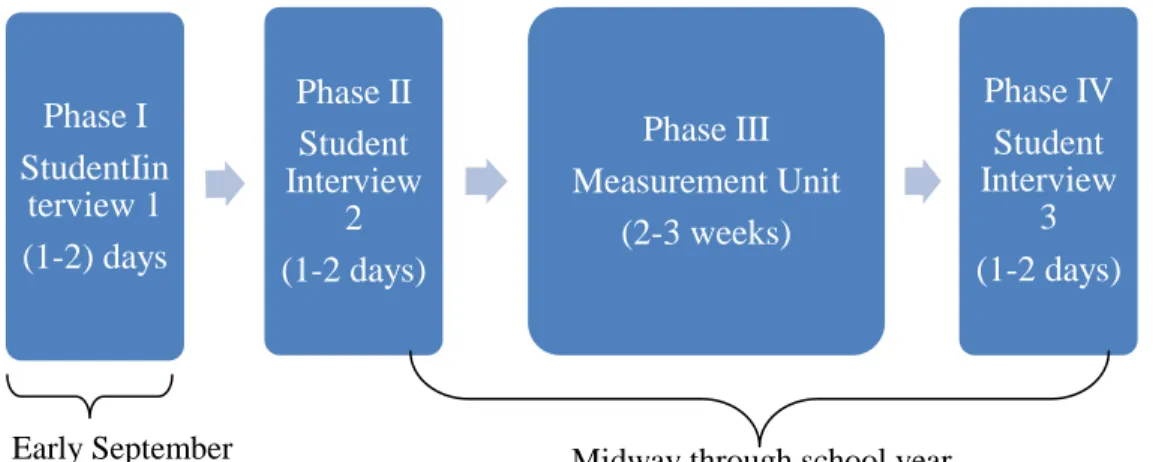
1. Progression of phases of data collection 43
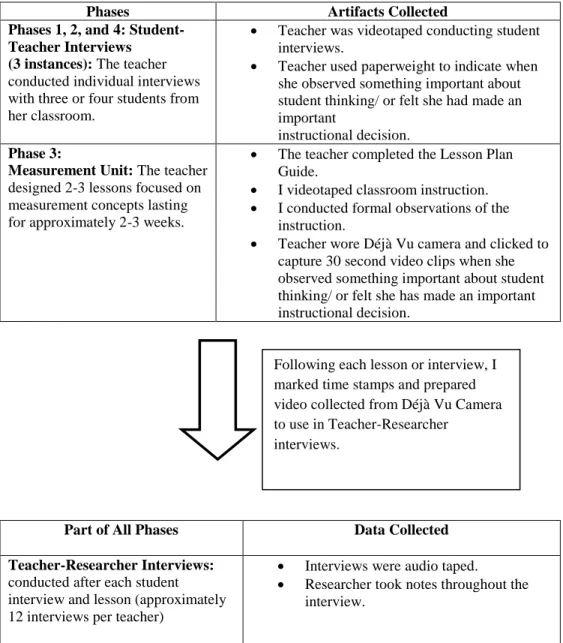
2. Artifact collection by phases 49
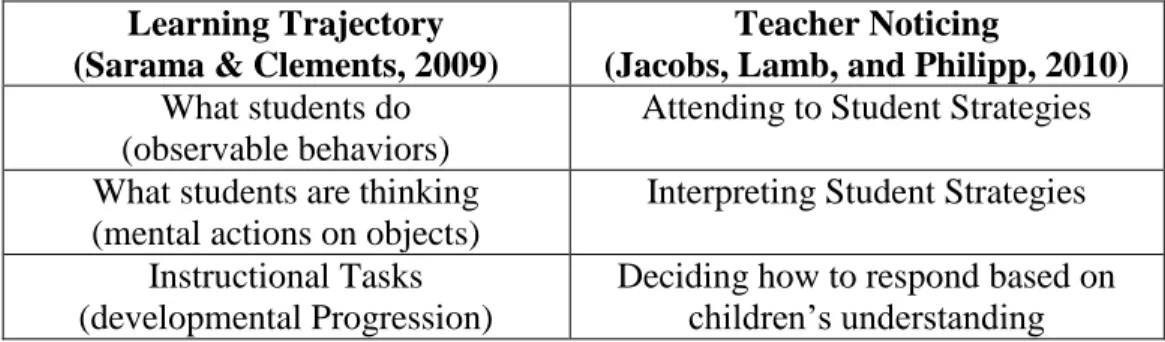
3. Learning trajectory and teacher noticing comparison 54
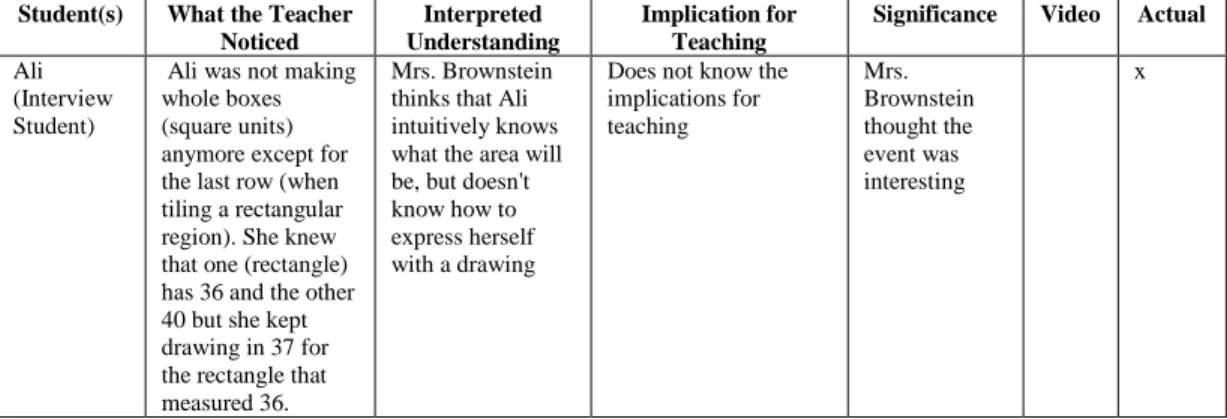
4. Description of event 56
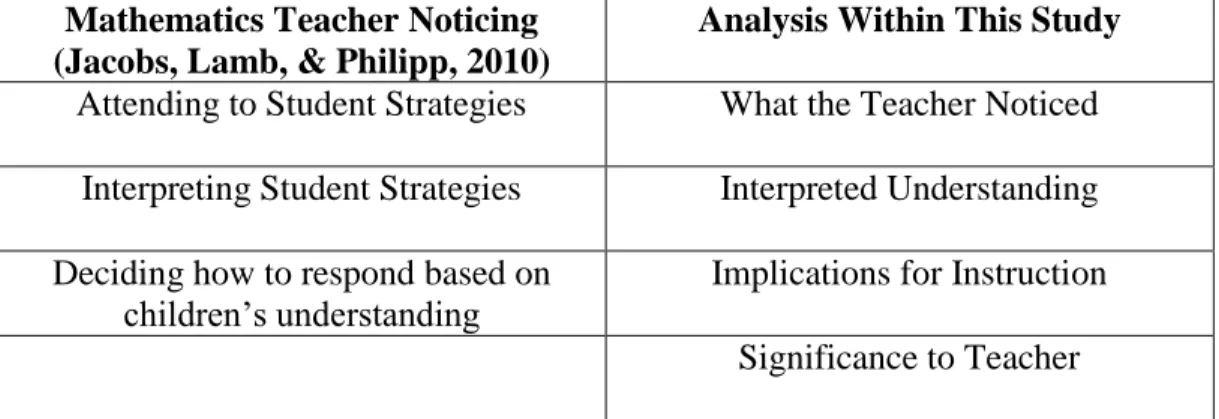
5. Teacher noticing in relation to this study 58
6. Example of event within matrix 60
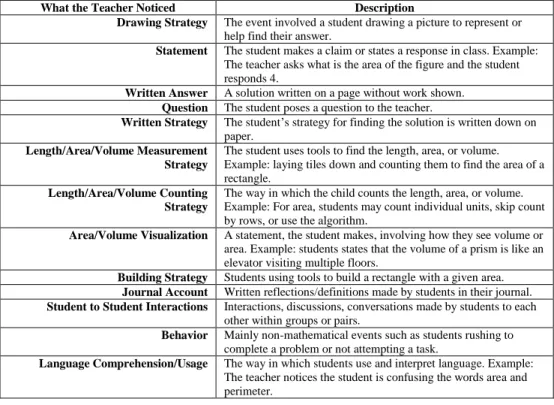
7. Codes for event types 61
8. Mrs. Grey's interview tasks 74
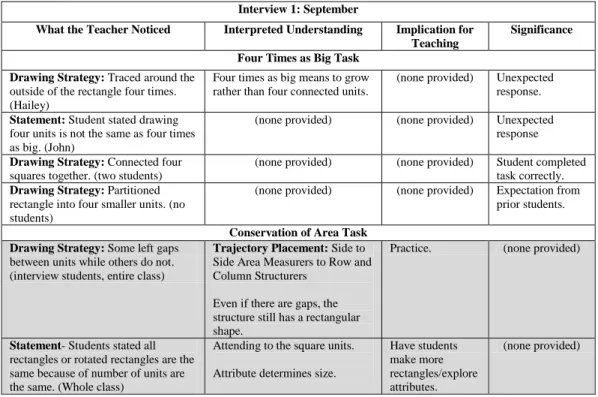
9. Events that Mrs. Grey noticed during Interview 1 75
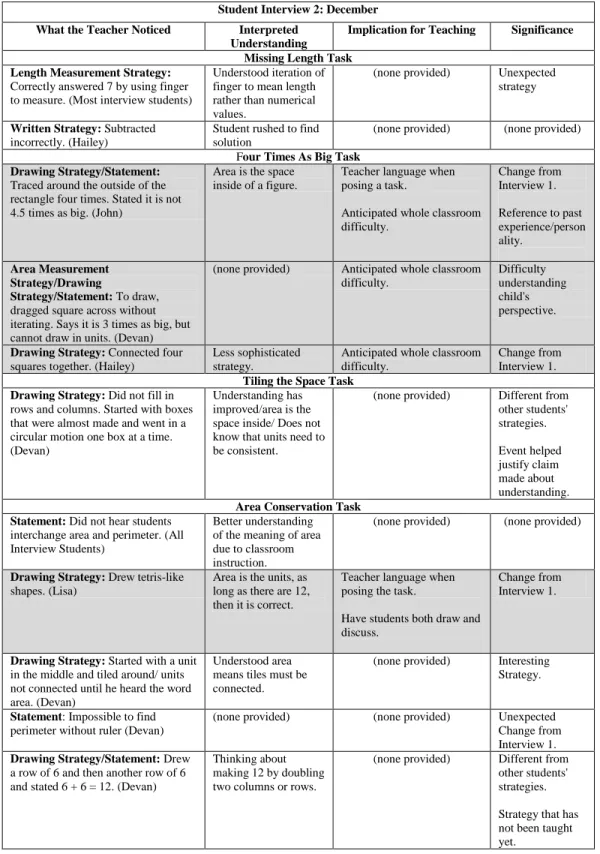
10. Events that Mrs. Grey noticed during Interview 2 81
11. Events that Mrs. Grey noticed during Interview 3 94
12. Events that Mrs. Grey noticed during Smartboard Lesson 102 13. Events that Mrs. Grey noticed during Relating Units of Measure Lesson 111 14. Events that Mrs. Grey noticed during Area Conservation Lesson 121 15. Summary of all student actions Mrs. Grey noticed 125
16. Mrs. Grey professional development questions 130
17. Events that Mrs. Purl noticed during Interview 1 144 18. Events that Mrs. Purl noticed during Interview 2 149 19. Events that Mrs. Purl noticed during Interview 3 157
x
20. Events that Mrs. Purl noticed during Smartboard Lesson 165 21. Events that Mrs. Purl noticed during Relating Units of Measure Lesson 171 22. Events that Mrs. Purl noticed during Area Conservation Lesson 188 23. Summary of all student actions Mrs. Purl noticed 193
24. Mrs. Purl professional development questions 198
25. Mrs. Brownstein interview tasks 214
26. Events that Mrs. Brownstein noticed during Interview 1 215 27. Events that Mrs. Brownstein noticed during Interview 2 224 28. Events that Mrs. Brownstein noticed during Interview 3 230 29. Events that Mrs. Brownstein noticed during Candy Filling Task 235 30. Events that Mrs. Brownstein noticed during Building and Filling Lesson 240 31. Events that Mrs. Brownstein noticed during Volume Assessment 252 32. Summary of all student actions Mrs. Brownstein noticed 258 33. Mrs. Brownstein professional development questions 262 34. Categories of events noted by Mrs. Grey during interviews and classroom
instruction 274
35. Aspects of students’ understanding and implications for instruction that Mrs. Grey discussed with regard to student interviews and the instructional
unit. 277
36. Categories of events noted by Mrs. Purl during interviews and classroom
instruction 279
37. Aspects of students’ understanding and implications for instruction that Mrs. Purl discussed with regard to student interviews and the instructional
unit. 281
38. Categories of events noted by Mrs. Brownstein during interviews and
classroom instruction 283
xi
39. Aspects of students’ understanding and implications for instruction that Mrs. Brownstein discussed with regard to student interviews and the
1 CHAPTER I
THE PROBLEM AND ITS BACKGROUND
The Problem
In mathematics education research, it has been established that knowledge of children’s thinking influences the work of teachers. Several groups of researchers (e.g., Carpenter et al., 1989; Clements, Sarama, Spitler, Lange, & Wolfe, 2011; Cobb, Wood, & Yackel, 1990; Fennema et al., 1996, Schifter & Fosnot, 1993) have documented that this knowledge is important because it affects a teacher’s understanding of her students’ thinking in relation to mathematics and also the enactment of instruction. It has been documented that teachers involved in professional development with a focus on student thinking become more knowledgeable about student strategies and confident in their teaching abilities (e.g., Carpenter et al., 2000; Carpenter et al., 1989; Fennema et al., 1996). They also spend more time discussing mathematics, questioning students and listening to their responses, and allowing more classroom time for mathematics (e.g., Clarke et al., 2003; Fennema et al., 1996). These practices have been related to changes in students’ mathematical understanding and achievement as well as students’ confidence in their mathematical abilities (Carpenter et al., 1989; Clements, Sarama, Spitler, Lange, & Wolfe, 2011; Fennema et al., 1996). For these reasons, there is a consensus in the research community that knowledge of students’ mathematical thinking is valuable in the education of teachers.
2
To share knowledge of students’ thinking with teachers, researchers have
developed frameworks and tools that describe and categorize student thinking in different mathematical domains (e.g., Clarke et al., 2003). One such tool is the learning trajectory (e.g., Battista, 2004; Confrey, 2008; Sarama & Clements, 2009). A learning trajectory or
progression is a theoretical framework that describes how a student may come to know a mathematical concept over time. As students learn about a mathematical topic they progress through levels of sophistication and a series of cognitive plateaus before they reach an understanding of a formal mathematical concept (Battista, 2004; Daro, Mosher, & Corcoran, 2011). Using interviews with students and small-group instruction,
researchers have developed learning trajectories in several mathematical domains that describe progressions of student actions and thinking in relation to a topic and also instructional tasks that may help students progress in their understanding (Sarama & Clements, 2009).
Because learning trajectories describe student thinking over time, researchers have hypothesized that knowledge of trajectories would allow teachers to develop a deep and connected knowledge base of student thinking across grade levels, which could help to inform instruction (Sarama & Clements, 2009). Researchers (e.g., Daro, Mosher, & Corocoran, 2011) have further hypothesized that learning trajectories could be used as a tool to help teachers formatively assess student thinking (Ginsburg, 2009) as well as accommodate varied levels of ability within the classroom (Sztajn et al., 2012). Teachers could use a learning trajectory to evaluate and interpret student thinking through evidence collected during classroom instruction such as student work, classroom dialogue, or one-on-one interviews. They could then be able to assess students’ understanding and
3
determine what instruction or feedback was needed to reach the instructional goal. Daro, Mosher, and Corcoran (2011) stated:
(A learning trajectory) offers one promising approach to developing the
knowledge needed to define the “track” that students may be on or should be on. Learning progressions can inform teachers about what to expect from their
students. They provide an empirical basis for choices about when to teach what to whom. (p. 14)
Researchers who have introduced learning trajectories in professional
development settings for mathematics have documented changes in both teaching and learning. Teachers grew in ability to compare student strategies and use this information to justify instructional tasks (Wilson, 2009). The teachers’ mathematical expectations for students changed as well as their instruction (Bardsley, 2006), including allowing more time for discussion and posing a variety of problems (McCool, 2009). Most importantly, these professional development settings led to both growth in students’ mathematical achievement, as measured through test scores, and teachers’ pedagogical content
knowledge and mathematical knowledge over time (Clements, Sarama, Spitler, Lange, & Wolfe, 2011; Wilson, 2009).
Although researchers have found a relationship between teachers’ knowledge of student thinking and effects on instruction and student achievement, how this relationship unfolds and develops is still relatively unclear. Many of the ways that researchers have hypothesized that learning trajectories could be used in instruction have proved difficult for teachers to enact. For instance, it is hypothesized that teachers could use a learning trajectory to explain and define different levels of thinking within the classroom (Stzajn
4
et al., 2012), but several researchers (Bardsley, 2006; McCool, 2009; Wilson, 2009) documented that it was a difficult task for teachers to use the trajectory in this way. The teachers were able to conduct one-on-one interviews with students and evaluate findings, but analyzing levels of thinking became more difficult when analyzing an entire
classroom of students. It was also proposed that learning trajectories could be used as a tool to aid in formative assessment, but Heritage et al. (2009) documented that it is difficult for teachers to use student strategies as a tool to guide instruction.
In studies by Bardsley (2006), McCool (2009), and Wilson (2009), teachers had difficulty enacting research into practice in the theoretically proposed manner, but instruction and student achievement were still influenced in a positive way as measured through standardized test scores. This begs the question of how exactly the teachers were using knowledge of student thinking gained from interviews and observations to inform classroom instruction.
Little is known, as reported in the research literature, about the process of thinking and reflection a teacher goes through when implementing knowledge of a learning trajectory into classroom practice to identify and reflect on students' thinking, but perhaps much is known, within the minds of the teachers, that has not been expressed in words or perhaps has been overlooked by researchers. To help frame this study, I present the following personal account of my experiences as a teacher and a researcher in the field of learning trajectories that led to the research questions I proposed for this work.
5
A Personal Account
I entered the field of teaching following several years working as a graduate research assistant in mathematics education. During my time as a graduate student, I learned of, and worked with, frameworks that described student thinking and I found them to be powerful tools that helped me to analyze student thinking and propose instructional tasks. As a researcher, I was excited to step into the world of teaching and apply this knowledge. I felt that knowledge of student thinking and frameworks that described student thinking would help me to become a better teacher because I would be able to relate my instruction to the needs of my students. When I entered the classroom, I held the belief that I could make sense of my students’ thinking in the same way that I had done as a researcher.
Unlike my experiences as a researcher, I found that as a classroom teacher, I struggled to get to know each of my students’ thinking, and I had difficulties categorizing and monitoring student strategies. I often referred to this as the “tension” between
research and teaching. Other researchers have expressed the word “tension” to describe the difficulties that teachers face when incorporating research into practice (e.g., Burkhardt & Shoenfeld, 2003; Heid et al., 2006). The tension that I felt was specific to analyzing student thinking. I knew that I needed to pay attention to what my students were doing and saying, but I often did not have the time or energy to make sense of it all. I found that when I studied student work, tutored individual students, or listened to small groups I was able to see and understand individual strategies, but I struggled to figure out what it meant in terms of whole classroom practice and instructional decisions. I
6
After several years of teaching, I decided to return to graduate school to pursue my doctorate in mathematics education. I returned to the university to work as a research assistant on a professional development grant with elementary teachers. The goals of the professional development were for teachers to use a learning trajectory (Sarama & Clements, 2009) as a tool to understand student thinking in the domain of measurement and also to use learning trajectories as a formative assessment tool for classroom
instruction. In this professional development program, the teachers learned about student strategies in the domain of measurement by watching and analyzing individual students through video and interviews with their own students. Teachers were asked to use information from the interviews they conducted to design and implement lessons that responded to the needs of the students.
In the initial year of the grant, I found that many of the teachers were successful in interviewing their students and describing student thinking in detail, but it was not always evident that they connected knowledge of the individual students with classroom instruction (Wickstrom et al., 2012). Teachers did not use the same level of description and analysis when describing classroom instruction as they did in individual interviews with students. In individual interview reflections, teachers would discuss each child’s actions, thinking, and what level they thought the student’s thinking exemplified in the trajectory, but, during classroom instruction, it was more difficult for teachers to provide the same level of analysis. When reflecting on instruction, many of them expressed the tension that I had experienced. It was not an easy task for the teachers to incorporate this new knowledge into their classroom. One teacher expressed it best when she said, “I am a teacher! Not a researcher!”
7
Initially, when reflecting on these teaching episodes, I believed that the teachers were not learning or enacting what they had learned in the professional development. After reading The Consortium for Policy Research in Education (CPRE) report (Daro, Mosher, & Cocorcoran, 2011), I had expected teachers to use the trajectory in the same way they had done in their interviews. I thought they would classify types of thinking they saw in the classroom and propose instruction based upon what they saw and
interpreted. In the classroom setting, this process became very difficult for them. After a group meeting with several teachers, I began to think about their perspective. Many of the teachers were expressing the same exasperation that I felt as a teacher. It was not an easy task to integrate the worlds of research and teaching. I began to wonder why this was and wanted see the world from their point of view.
As a pilot study, I decided to recreate the teacher’s situation for myself to gain a broader understanding of the issue (Wickstrom, in press). During the spring of 2012, I spent three months observing, interviewing, and teaching students in a second-grade classroom. Just as the teachers had done, I identified focus students and interviewed them individually. I kept notes of their strategies and what I thought it meant in terms of their thinking. After the interviews, I planned a unit on perimeter that I taught to the entire class. During classroom instruction, I found that I poured over each lesson thinking about levels of thinking and how to address each student. For the most part, I was successful at planning in this way, but, unlike the regular classroom teachers, I had the luxury of time. As each lesson was enacted, I tried to jot down notes about students to later reflect on. I realized that I struggled with many of the same issues as the teachers. Following each lesson, I found that I had a general sense of student strategies, in that I could name a few
8
that I saw during instruction, but I often could not remember exactly what my focus students had done. I was unable to successfully attend to and analyze individual thinking to the same degree of specificity as I had done in student interviews. I believe this was because my attention was constantly divided among the 24 seven- and eight-year-olds in the classroom and I never had the time to sit and watch a child work for more than thirty seconds to a minute.
Even though attending to individual students proved difficult, I found that my experiences conducting student interviews and using the learning trajectory to analyze student thinking informed several components of instruction. I felt that these individual experiences helped me to anticipate possible student responses, interpret and address student misconceptions, and connect student representations during classroom discussion. Because I had conducted interviews connected to the lesson, I had an idea of how
students might respond and I had witnessed firsthand common mistakes that they might make. The experience of interviewing allowed me to notice these errors during
instruction and have students discuss and work through them.
Reflecting on these experiences, I realized that, as a researcher, I had made certain predictions, rooted in research, of ways in which a teacher would use knowledge of students to inform instruction. These predictions clouded what I saw and biased my evaluation of teacher’s growth. I had to step into the role of the teacher before I could see all of the growth that was possible. Changing perspective brought me to the realization that professional development settings are often framed through the experiences and knowledge of the researchers rather than teachers (Cochran-Smith & Lytle, 1993). This disconnect in bodies of knowledge creates a transition and tension between research and
9
practice that teachers must navigate to implement research. Sometimes professional development does not always provide a clear path for teachers to follow in their attempts to apply their knowledge of research into practice and often teachers create this path for themselves.
Following this realization, I began to explore the philosophies of other
professional development programs rooted in student thinking and student strategies to explore how to best study the ways in which teachers implement knowledge of student thinking into classroom instruction. I found that, in the past, several groups of researchers (Carpenter et al., 1989; Fennema et al., 1996; Simon and Schifter, 1991) recognized that the transition between research and practice exists. Instead of hypothesizing or suggesting how teachers might use research and frameworks on student thinking, the researchers let the teachers decide how information about student thinking should be implemented within instruction. When Cognitively Guided Instruction (CGI) was introduced to
teachers, teachers expressed concern about implementing what they had learned into their practice. Fennema et al. (1996) wrote:
We did not ignore the concerns of the teachers. Rather we tried to communicate that they had certain unique knowledge, and so did we. Although we attempted to communicate that we could help them to understand what their own students knew, we emphasized that they were professionals who should decide how their emerging knowledge of children’s thinking should and could be used in the classroom. (p. 408)
From these initials studies, the researchers were able to identify ways in which the teachers used research and frameworks on student thinking and they used that knowledge
10
to inform future professional development activities. It was also noted that teachers within these programs felt empowered as learners and researchers because they were making sense of student thinking and using it in a way that made sense to them (Richardson, 1990).
It was my initial research (Wickstrom et al., 2012), reflections on that research, and review of similar studies that led me to question how teachers interpret and use learning trajectories in conjunction with formative assessment to inform their classroom instruction. If it is difficult for teachers to use knowledge of student thinking gained from experiences like individual interviews in ways researchers have hypothesized, then it is important to explore other ways teachers might interpret and implement the ideas and knowledge encapsulated within such learning trajectories and gleaned from individual interviews with students. Furthermore, it is important to understand contextual factors that shape the ways teachers interpret and implement knowledge gained through professional development in order to better bridge the research–practice divide.
Rationale
Based on the existing research on teachers’ uses of learning trajectories in mathematics education (e.g., Bardsley, 2006; McCool, 2009; Wilson, 2009) and my personal experiences, there is a clear need to investigate how teachers make sense of student thinking using learning trajectory research and how teachers may implement their findings regarding student thinking into classroom instruction. In the mathematics
education community, the process of analyzing student thinking and discussing it in terms of instruction is valued both within pre-service teacher education as well as the professional development community (e.g., Cobb, Wood, & Yackel, 1990; Fennema et
11
al., 1996, Schifter & Fosnot, 1993) because of noted effects on student achievement. As with any process, it is important not only to consider the result, but to also make sense of the steps in between. By making sense of the process of integrating knowledge of
students’ thinking and strategies for learning into instructional practice, teachers and teacher educators can become better informed.
Ball, Thames, and Phelps (2008) stated that the connection between students and classroom instruction, defined as knowledge of content and students, is an important domain of the mathematical knowledge for teaching. They stated:
When assigning a task, teachers need to anticipate what students are likely to do with it and whether they will find it hard or easy. Teachers must also be able to hear and interpret students’ emerging and incomplete thinking as expressed in the ways that pupils use language. Each of these tasks requires an interaction between specific mathematical understanding and familiarity with students and their mathematical thinking. (Ball, Thames, & Phelps, 2008, p. 401)
It is my belief that the process of understanding student thinking and
implementing this knowledge into practice are possibly two different subdomains of knowledge of content and students and it takes effort to relate the two. Teachers may be able to recognize and understand student thinking, but it is not entirely clear how this information is related to their enactment of instruction.
The way that teachers use knowledge of student strategies within classroom instruction may not be completely visible by looking at their outward actions and may be missed. It is important to consider the perspectives of teachers to fully understand the process that occurs when transitioning knowledge into practice. Surprisingly, almost all
12
research on teacher growth when using learning trajectories is framed from the researcher’s perspective looking into the classroom. Several studies have documented how the teacher enacts instruction over time following professional development and the effects on student achievement, via standardized test scores (e.g., Bardsley, 2006;
Fennema et al., 1996, McCool, 2009; Wilson, 2009), but none have explored why the teacher made certain instructional decisions and her thoughts and reflections about those decisions. It is unclear how teachers utilize their understanding of students' thinking, gained through individual student interviews and mediated by their knowledge of learning trajectories, to make decisions about instructional practices.
Research and practice should form a synergistic loop (e.g., Cochran-Smith & Lytle, 1999; Lewis, 2002). Cochran-Smith and Lytle (1999) argued for “knowledge-in-practice” with regard to professional development. Professional development programs should be “embedded in practice and in teachers’ reflections on practice” (p. 250). In order to inform this process, it is important to shed light on how the teacher, the interpreter of the research on student thinking, makes sense of the information she
collects and how she modifies it for classroom instruction. Her thoughts and decisions are important information that can be used to bridge the gap between research and practice and further refine professional development.
The purpose of this study was to investigate this issue by working with three elementary teachers who were engaged in professional development on learning
trajectory based instruction in the domain of measurement (Sarama & Clements, 2009). My goal was to examine what these teachers noticed about their students’ mathematical thinking and how they integrated what they noticed into their instructional practice. I was
13
particularly interested in documenting whether and how the teachers referred to the learning trajectory and the related research they had examined during the professional development program. Through an ethno-methodological perspective (Garfinkel, 1967) and working cooperatively with the teachers, I addressed the following research question:
What are the advantages and disadvantages teachers perceive in participating in learning trajectory based professional development to improve classroom instruction and student learning?
a. What aspects do teachers identify as important in revealing student thinking during clinical interviews that are intended to assess students’ thinking?
i. What information does the teacher say that she gleans from these events?
ii. What claims, if any, does the teacher make about how these events inform her instruction?
iii. How does the teacher acknowledge or draw on her understanding of the learning trajectory when referring to the clinical interviews? b. What classroom events do teachers identify as important in revealing
student thinking during daily classroom instruction?
i. What information does the teacher say that she gleans from these events?
ii. What claims, if any, does the teacher make about how these events inform her instruction?
14
iii. How does the teacher acknowledge or draw on her understanding of the learning trajectory when referring to classroom instruction?
Epistemological and Ontological Groundings
In this section, I explore theories that have shaped the nature of the study and the way in which it was conducted. Epistemology describes how a specific knowledge can be acquired and ontology is the ability to describe the nature and existence of an idea. In this section, I describe theories that I think appropriately address the existence of teacher knowledge and how it can be accessed.
In mathematics education several paradigms have been used to determine how teaching is researched and framed. A paradigm of the past that was prominent in research on teaching, is the process-product paradigm (Brophy & Good, 1986; Dunkin & Biddle, 1984). Process-product is based on the belief that effective teaching can be measured by determining if teacher behavior can be linked to student performance, usually in the form of achievement tests. It characterizes teaching much like a science with fundamental laws (Cochran-Smith & Lytle, 1993). A fundamental law indicates that a causal relationship exists between two things based upon repeated measures such as the observation that the state of water changes from liquid to gas at 100 degrees Celsius. Even though some would argue that the process-product paradigm is something of the past in education, many tenets still remain in education today. For example, to determine if professional development is effective, it is common practice to first compare standardized test scores of students from the classrooms of participating teachers to look for differences between methods and repeatability over time.
15
Teaching and learning is much more complex of an activity than a simple causal relationship. Behaviors and actions may often fit into a larger schema. Sometimes by looking for a fundamental law or a cause and effect relationship, smaller details that could add meaning are ignored or overlooked, such as the knowledge and life experiences students bring into the classroom and use to interpret school curriculum. In this study, I attempted to address such complexities. Two interpretivist theories, together, have guided the framing of this study: classroom ecology and teacher research. These theories are described in detail below.
Classroom Ecology
The theory of classroom ecology (Cazden, 1986; Evertson & Green, 1986) acknowledges that the classroom environment is complex and interactive. Researchers within this paradigm examine the perspectives of teachers and students to describe the interrelationships within the classroom. The paradigm is an interpretive paradigm with an emphasis on finding how the participants (i.e., teachers and students) co-create meaning and interpret mathematical content and instruction within the classroom instead of searching for a fundamental law of teaching (Shulman, 1986). In essence, it allows for classroom practice to be understood in a real life setting with the complexity and
messiness of real life teaching rather than a sterile or non-realistic research environment that is far removed from the actual daily experience of teachers by trying to reduce complexity through prediction, explanation, and control.
Hamilton (1983) argued that the theoretical construct of classroom ecology is composed of four key tenets. The first tenet is that attention should be paid to “the interaction between persons and their environments, especially in reciprocal terms rather
16
than in terms of simple directional causality from teachers to students” (Shulman, 1986, p. 19). This tenet helped to frame the research design of this study by considering the interaction between teacher and student. The interplay between teacher and student is ongoing. A teacher may make decisions based on what she sees a student doing or
conjectures about what a student might be thinking, but the student, in turn, reacts to what the teacher has just done. Whether knowingly or unknowingly, both the teacher and the student interact and inform one another in an endless loop.
The second tenet of classroom ecology is that teaching and learning are interactive and continuous rather than unidirectional and discrete (Hamilton, 1983). Events and experiences within the classroom and within the life of the teacher and student are repeatedly accessed and referenced over time. In this study, the teacher’s understanding of the students is viewed in this fashion. The way that a teacher comes to know and interpret student thinking is a complex process that combines all of her
classroom experience, and possibly non-classroom related experiences, past and present. An individual interview may help to inform a teacher’s understanding of student
thinking, but other factors such as prior experiences with the child, past experiences teaching, and day-to-day interactions also may be informing the teacher’s decisions.
The third tenet of classroom ecology is that the classroom can never be an isolated system (Hamilton, 1983). It is an entity that is nested within other contexts such as
culture, community, and family. Thus the classroom culture that the teacher and the students in this study created was based on the students’ and teachers’ experiences and knowledge, classroom norms, familial structures, and school structures. This study was
17
framed so that outside contexts such as school structure or knowledge of students outside of classroom life were acknowledged and taken into account.
The final tenet of classroom ecology is that unobservable processes such as thoughts, attitudes, perceptions, and feelings are important data sources (Hamilton, 1983). This particular tenet played a key role in the conduct of this study. The primary goal of this study was to make sense of the perspective of the teacher and how she noticed and made sense of student thinking to inform instruction. Her perception was vital in making meaning of the classroom environment because she was the primary interpreter and decision maker on a daily basis.
Teacher Research
One of the limitations of the theory of classroom ecology is that classroom research is investigated, framed, and reported through the perspective of the researcher (Cochran & Lytle, 1993). Even though classroom ecology acknowledges the complexities of the classroom and the different voices that exist, the research questions, interpretation, and analysis of the study still stem from the researcher rather than the teacher. Because of this, research in classroom ecology usually emerges from analysis of theoretical and empirical literature rather than problems situated within classroom practice (Cochran-Smith & Lytle, 1993).
The epistemological perspective of this study is unusual because the research questions stemmed directly from classroom experience rather than theory, but were investigated by a researcher attempting to interpret and convey the teachers’ perspectives. To further support the last tenet of classroom ecology and acknowledge the perspective of the teacher within the classroom, the design and conduct of this study was grounded in
18
several of the tenets of the theory of teacher research (Cochran-Smith & Lytle, 1993). Cochran-Smith and Lytle (1993) defined teacher research as “systematic, intentional inquiry by teachers about their school and classroom work” (p. 24). Teacher research usually stems from issues and questions that arise within the practice of teaching. Teacher research is grounded in the epistemological belief that teachers should have a voice and a presence in the research community and acknowledges that the teacher’s perspective is critical when implementing and evaluating research on practice.
Even though the teacher participants were not the primary investigators in this study, the study itself was guided by several of the tenets of the teacher research paradigm. The first tenet is that the perspective of the teacher matters when conducting research on teaching (Cochran-Smith & Lytle, 1993). Teachers have continual interaction with the classroom environment and a wealth of experiences to draw upon, so issues and concerns that teachers face when teaching should be valued and investigated. Reynolds (1989) stated that “what is known and worth knowing about teaching…should be related to the practical knowledge possessed by teachers of how and when to act in actual teaching situations” (p. x). Teachers can provide insights and perspectives of the classroom that researchers might not be able to see. This tenet guided the structure and design of this study. Instead of a researcher observing the classroom from the outside in, the teacher was the primary voice. She was an active participant in the research and helped to make sure that her perspective was accurately framed.
The second tenet of teacher research is that research should stem from problems of practice (Cochran-Smith & Lytle, 1993). These can sometimes be described as differences or tension between the theoretical and the actual. In this study, the problem
19
arose from my own experiences as a teacher and from a problem of practice experienced by the teachers within the professional development context. It was unclear how the teachers made sense of students' thinking and used it to inform classroom instruction. This was a problem discussed by the teachers and felt by the researchers conducting the professional development.
The final tenet is that knowledge of individual teachers and their instructional practices are important. These add to the overall understanding of classroom dynamics (Cochran-Smith & Lytle, 1993). Since the aim of teacher research is to further clarify meaning within the classroom environment, any and every case adds to the community’s understanding. A critique of teacher research has been that one or a few cases say very little about classrooms in general. Researchers (Guba, 1980; Zumwalt, 1982) have countered this by arguing that the classroom is a complex environment and no two are alike. When researchers make generalizations or claim fundamental truths about teaching and learning, those generalizations are, by default, context free, but when considering any real classroom, none is without context. Both of these researchers (Guba, 1980; Zumwalt, 1982) advocated the position that information from classrooms should not be generalized. Instead, information collected should be rich and descriptive to better understand and give insight into what is happening and why certain practices do or do not work in particular classrooms.
With regard to this study, it was important to investigate from the teachers’ perspectives how they used knowledge of student understanding to inform classroom instruction. The theories of classroom ecology and teacher research provide
20
epistemological and ontological frameworks that acknowledge the complexity of the classroom environment and value the perspective of the teacher.
21 CHAPTER II
REVIEW OF RELATED LITERATURE
This section is a review of the literature related to learning trajectory based professional development. The review begins with defining learning trajectories and the ways in which different researchers view this term. Following this, there is a discussion of how different researchers have viewed the theoretical implications of learning trajectories for classroom instruction and curricular implications. From there, the theoretical actualizations of learning trajectory based professional development are discussed. This includes teachers' perspectives of learning trajectories, teachers' uses of the trajectories to notice and interpret student thinking, findings related to instructional practices, and findings regarding student achievement. The literature review concludes with a discussion of how all of these ideas directly informed this study.
Defining Learning Trajectories
A learning trajectory is a theoretical framework to aid in understanding young children’s mathematical thinking. Simon (1995) thought of a learning trajectory as teacher’s prediction of a likely path for learning. He recognized that the paths might be hypothetical because student understanding is not knowable in advance. He also stated that even though students learn in different ways, they may move along similar paths so many students can benefit from the same task.
22
Since then, other researchers (Sarama and Clements, 2009; Battista, 2004) have further conceptualized the meaning of learning trajectories. Battista (2004) described a learning progression or trajectory through levels of sophistication. Students move from pre-instructional reasoning through a series of cognitive plateaus to formal mathematical concepts. Battista emphasized that students may not progress through the terrain in the same way or in a linear fashion. Daro, Mosher, and Corcoran (2011) defined learning trajectories as “empirically supported hypotheses about the levels or waypoints of thinking, knowledge, and skill in using knowledge, that students are likely to go through as they learn mathematics” (p. 12).
Sarama and Clements (2009) defined a learning trajectory as a pedagogical construct with three parts: a mathematical goal, a learning path through which students move through levels of thinking, and instruction that will help them move along that path. Sarama and Clements (2009) stated, "learning trajectories are descriptions of children's thinking as they learn to achieve specific goals in a mathematical domain, and a related, conjectured route through a set of instructional tasks designed to engender those mental processes or actions hypothesized to move children through a developmental progression of levels of thinking” (p. 19). In this study, I implement Sarama and Clements (2009) definition of learning trajectory.
In each of these definitions, a learning trajectory is seen as a path through which students grow and change in their understanding of a mathematical topic, in conjunction with a complementing set of conjectured tasks to help the student progress through understandings. The learning trajectory not only defines student thinking at different
23
levels, but it also informs tasks that may build further understanding fostering sophistication.
Implications of Learning Trajectories for Instruction
Research on the structure of learning trajectories is recent and ongoing with constant revision. Several studies (e.g., Barrett, Jones, Thornton, & Dickson, 2003; Barrett et al., 2012) have noted the theoretical benefits of learning trajectories when implemented in an instructional setting. These implications include formatively assessing students over time, analyzing and accommodating multiple levels of thinking within the classroom, and creating a more connected pedagogical content knowledge across grade levels.
Daro, Mosher, and Concoran (2011) recently hypothesized that learning
trajectories could be used as a tool to help teachers formatively assess student thinking. Teachers could use trajectories or curriculum informed by trajectories as an evaluative tool to determine students' understanding and appropriate instructional responses. The authors argued that learning trajectories provide teachers with a progression so they can order instructional tasks and experiences to develop higher levels of reasoning.
Instruction based on hierarchical thinking alone is not enough, because progression of instruction is directly connected to progression of learning. In order to use the learning trajectory appropriately, Daro, Mosher, and Concoran argued that a teacher must be able to use it to assess instruction and student thinking, as well.
Sarama and Clements (2009) compared learning trajectories or knowledge of learning progressions to that of Cognitively Guided Instruction (CGI) (Carpenter, Fennema, Peterson, & Carey, 1988). They hypothesized that knowledge of learning
24
trajectories will directly impact student achievement. Teachers would be able to help students move through levels of sophistication because the teacher would have a deeper, extended understanding of the child’s knowledge in relation to the curriculum overall.
In relation to levels of sophistication, one of the most promising aspects of the learning trajectories is a resource to possibly differentiate instruction. Sarama and Clements (2009) stated, “thus, learning trajectories can facilitate developmentally appropriate teaching and learning for all children” (p. 18).
Sztajn et al. (2012) proposed the theory of Learning Trajectory Based Instruction (LTBI). They defined learning trajectory based instruction as teaching that uses students' LTs as the basis for instructional decisions. Building on Shulman’s (1987) theory of pedagogical content knowledge, Ball, Thames, and Phelps (2008) mathematical
knowledge for teaching, and Smith and Steins (2011) The 5 Practices for Orchestrating Effective Mathematics Discussions, the researchers connected knowledge of students to knowledge of teaching through research on learning trajectories. The work of Sztajn et al. (2012) is different from the learning trajectories themselves in that the learning
trajectories focus on specific instructional tasks to promote learning while Sztajn and colleagues focus on creating a bridge between current frameworks that describe teaching and knowledge of students' thinking imbedded in learning trajectory research. The researchers reference that these concepts are still abstract and research is being done to see how ideas about teaching, learning, and mathematics fits together.
LTBI focuses on current teaching frameworks to show how learning trajectories can help teachers with many instructional actions in the classroom. They describe teaching practices such as analyzing and differentiating tasks to accommodate varied
25
levels within the classroom, facilitating discussions, and formatively assessing students' thinking. LTBI connects many practices of teaching with the ideas presented on students' learning in learning trajectories.
Learning Trajectory Based Professional Development
In the last decade, several learning trajectory based professional development have been enacted, each in slightly different ways. The primary difference between the programs is the learning trajectory implemented. Several groups of researchers (e.g. Bardsley, 2006; McCool, 2009; Clements et al., 2011) implemented trajectories created by Sarama and Clements (2009) primarily focused on measurement, geometry and shape, as well as counting strategies. Other groups (Mojica, 2009; Wilson, 2009) implemented trajectories related to equipartitioning (Confrey et al., 2009).
In relation to this, a secondary difference in the programs is the decision to integrate a curriculum within the professional development. Some professional developments have developed curricular materials to complement trajectory research during classroom use (e.g., Bardsley, 2006) while others opted to integrate it with teachers' existing materials (e.g., McCool, 2009; Wilson, 2009).
Professional developments also differed in their approach to conveying the idea of learning trajectory research to teachers. Many of the studies (e.g., McCool, 2009; Wilson, 2009) focused on clinical interviews as a way for teachers to learn about students
thinking and to discuss it in relation to research. By learning about individual students, researchers hypothesized that this information would transfer to classroom practice. Professional developments with curricular materials (Bardsley, 2006) primarily focused on the enactment within classroom instruction.
26
Lastly, the number of participants in each of the professional developments varied. Many of the professional developments were conducted with large groups of in-service teachers (e.g., Bardsley, 2006; Wilson, 2009; Clements et al., 2011), but one focused on pre-service teachers (Mojica, 2009) and another on a single teacher (McCool, 2009).
Teachers' Initial Reactions to Learning Trajectories
A small group of researchers (Bardsley, 2006; McCool, 2009; Wilson, 2009) has documented teachers' initial perceptions about trajectories as well as perceptions over time. A common response from teachers throughout the studies is that of being overwhelmed. Both Bardsley (2006) and Wilson (2009) documented that teachers felt that the trajectory document itself was too large, in terms of number of pages, as well as too verbose. They complained that the terms were big, and the language was confusing, even comparing it to learning a foreign language. Researchers (Bardsley, 2006; McCool, 2009) also found that teachers were skeptical of using it within the classroom. They felt overwhelmed at the thought of integrating knowledge of multiple levels of thinking into practice.
Teachers' Skepticism of Learning Trajectories
As teachers were introduced to student strategies and actions related to learning trajectories, research (Bardsley, 2006; McCool; 2009) has indicated that they initially experienced a period of doubt. Many teachers were skeptical that students progress through levels of understanding when they had experiences in which students had seemed to learn and master a task with relative ease. For example, Bardsley (2006) documented that initially kindergarten teachers viewed the process of counting as a three-step process,
27
the inability to count, emerging ability, and mastering the ability to count. Many of the teachers felt that mastering counting was the ability to count numbers aloud in succession or the route counting sequence. When the teachers were challenged to think about
whether their students understood what number a collection of toys represented, they realized that this task was difficult for students and that the ability to count encompassed more than then reciting numbers in order.
For many teachers, their skepticism is often followed by amazement that students do not understand what the teacher thought he or she had taught them through mastering a set skill. While working one-on-one with an elementary teacher, McCool (2009) documented that the teacher thought that the students had mastered the idea of unit following learning how to measure by reading the endpoint on a meter stick. McCool (2009) stated,
When she (the teacher) found that the students did not understand the units on a meter stick, she was "amazed". I (McCool) said that we force students to label, label, label their answers and she (the teacher) said "but they don't know what they (the labels) mean" (p. 84).
This reaction of amazement and surprise seems to legitimize the idea of learning trajectories for the teachers and they begin to open their minds to the idea that students may understand mathematical topics in varying ways or ways the teacher had not thought about before (Bardsley, 2006; McCool; 2009).
Noticing Students' Actions and Understanding
After teachers begin to see that different student strategies exist their focus on student actions and strategies often becomes more acute and they are able to "see" or
28
notice student strategies in new ways both during interview assessments, as well as classroom instruction. Researchers (Bardsley, 2006; McCool, 2009; Wilson, 2009) noted that initially teachers begin to focus more closely on students as they solve problems. Teachers discussed that, prior to professional development, they often focused solely on correct versus incorrect solutions. Solutions that were nonroutine or incorrect were often disregarded because the teacher could not completely understand the methodology of the solution. Bardsley (2006) found that one teacher in particular recognized strategies that were non-routine or incorrect prior to professional development but did not understand what they meant. This teacher, Mrs. Cousin, referred to these strategies as the "weird" ones and knew they were different but did not know why they were important or if they had any implications for instruction. Her focus shifted from correctness to inquiry about what the student was doing, following learning trajectory based professional
development. Bardsley (2006) stated,
Mrs. Cousin had several groups of objects on a table. She asked a girl who could count to 10 to point to the group of 4. The girl responded incorrectly. Mrs. Cousin, curious, asked, "Does that have 4?" Mrs. Cousin reported the girl said, "Well, if you take one away it will." Mrs. Cousin explained that before she would have thought the child was "weird", pondered about it but not understood why she would think a group of 5 was 4. "Now I ask, trying to get to their
thinking"... Mrs. Cousin found that she wanted to know how children count and solve problems, not just whether they could. (p. 120)
This idea was also evident in McCool's (2009) study. Kathy, the teacher she worked with, initially focused on formulas, and whether students had the correct answer.
29
As she progressed in the professional development, she began to pause more frequently during class to observe students working and to ask them what they were doing.
Even though Bardsley (2006) found that teachers' attention became more focused, it was, nevertheless, difficult for teachers in her study to document students’ strategies when teaching an entire classroom. When teachers were given a sheet to help record their observations, they found it difficult to coordinate teaching and note taking and became overwhelmed by the documentation. Bardsley (2006) reported that many of the teachers stated they would not continue to use the observation sheet to document student thinking in the future.
From the few studies conducted, the literature suggests that teachers become more aware of students' strategies as they progress in learning trajectory based professional development. Their focus shifts from observing who is correct and incorrect to observing details of all solutions and thinking more deeply about the meaning behind the strategy. It still remains difficult for teachers to coordinate and organize this information during classroom instruction.
Even though teachers began to notice students' actions more clearly over time, researchers (Bardsley, 2006; McCool, 2009; Mojica, 2009; Wilson, 2009) have indicated that, for many teachers, it is often still unclear to them what these actions indicate in terms of students' thinking. Wilson (2009) found that early in professional development teachers made broad and nonspecific comments about students' thinking, especially at the initiation of the professional development. Teachers were able to point out details as well as notice commonalities and differences in student strategies but were unable to describe the understanding associated with the action.
30
If teachers were able to provide a description of students' understanding, it often arose from a deficit perspective (Wilson, 2009). This meant that they discussed
understanding that they knew the students did not know based on their actions. In many cases, teachers initially interpreted describing students' understanding as simply matching a trajectory level to a particular student without providing justification or evidence. (Bardsley, 2006; McCool, 2009; Mojica, 2009; Wilson, 2009).
As teachers progress in the professional development programs, some teachers' understanding of their students becomes more detailed (Bardsley, 2006; McCool, 2009; Mojica, 2009; Wilson, 2009). They are able to see things that they had not noticed before as well as provide justification and evidence supporting their thoughts about students' thinking. Because of this, the teachers’ perceptions of their classrooms often changed. Bardsley (2006) documented that teachers initially thought several tasks would be too difficult for their students, but as the teachers worked with students, their perceptions about task difficulty changed. They became more confident that the students could attempt to solve the problem in some way.
One group of researchers (e.g., Myers et al., 2013) has classified stereotypes or representations of students as learners of mathematics that emerge as teachers discuss student actions and thinking over time within a professional development setting. These stereotypes included ideas such as ability, effort, luck, task difficulty, grade level, cultural context, and teaching. Although these ideas have been expressed, researchers have not yet explored how these stereotypes change over time and what they imply, except for ability. Myers et al. (2013) described that, as teachers observed students, they were often surprised by students that they considered "low" that could solve a task or "high" that
31
couldn't solve a task. Myers and colleagues expressed that the instructors expected that the teachers' language use of "low" and "high" would fade as they learned about and explored levels of student thinking, but this was not the case. The teachers still used labels of "low" and "high" but they began to approach student thinking with an emphasis on what students could do in relation to the learning trajectory rather than from a deficit approach.
Issues in Implementation
Along with difficulty in interpretation of students' thinking, it has also been documented that teachers often find writing about student thinking to be an arduous process. Researchers (Bardsley, 2006; McCool, 2009; Mojica, 2009; Wilson, 2009) found that teachers' writing is informal and vague and they often understand more about their students than they feel comfortable or have time to write down. McCool (2009) found that even though it appeared that the teacher, Kathy, had not completed her reflection on students' thinking in written form she had, in fact, given it much thought. McCool (2009) states,
I was surprised that Kathy (the teacher) did not record her responses to this task. In our meeting, she said that she should have written her thoughts down on paper, but was able to give reasons for her placements quick enough to make it clear that she had spent time on the task...This led me to think that Kathy had really given each of her decisions a lot of thought because she was ready and able to defend her claims. (p. 83).