ScholarWorks
ScholarWorks
Walden Dissertations and Doctoral Studies Walden Dissertations and Doctoral Studies Collection
2020
Perspectives of Elementary Teachers Implementing Blended
Perspectives of Elementary Teachers Implementing Blended
Learning While Participating in Virtual Coaching
Learning While Participating in Virtual Coaching
Jessica Kristin AndersonWalden University
Follow this and additional works at: https://scholarworks.waldenu.edu/dissertations Part of the Instructional Media Design Commons
This Dissertation is brought to you for free and open access by the Walden Dissertations and Doctoral Studies Collection at ScholarWorks. It has been accepted for inclusion in Walden Dissertations and Doctoral Studies by an authorized administrator of ScholarWorks. For more information, please contact [email protected].
Walden University
College of EducationThis is to certify that the doctoral dissertation by Jessica Kristin Anderson
has been found to be complete and satisfactory in all respects, and that any and all revisions required by
the review committee have been made. Review Committee
Dr. Darci J. Harland, Committee Chairperson, Education Faculty Dr. Gladys Arome, Committee Member, Education Faculty Dr. Marcia Griffiths-Prince, University Reviewer, Education Faculty
Chief Academic Officer and Provost Sue Subocz, Ph.D.
Walden University 2020
Abstract
Perspectives of Elementary Teachers Implementing Blended Learning While Participating in Virtual Coaching
by
Jessica Kristin Anderson
MA, Montana State University, 2012 BS, Pacific Lutheran University, 2007
Dissertation Submitted in Partial Fulfillment of the Requirements for the Degree of
Doctor of Philosophy Education
Walden University May 2020
Abstract
As the use of blended learning in classrooms has increased across the United States, it is important to provide differentiated professional development and support to educators. As a technology-enabled form of professional development, virtual coaching connects teachers with experts in the field. However, the usefulness of individualized virtual coaching as a differentiated professional development support for elementary teachers implementing blended learning is not well understood. Using Kolb’s experiential learning theory and Magana’s T3 framework, the purpose of this basic qualitative study was to explore elementary teachers’ perspectives on the usefulness of individualized virtual coaching in supporting blended learning implementation and to determine how the level at which the teachers used technology influenced their perspectives. Semistructured interviews were conducted with 12 K-5 teachers who participated in at least 1 year of virtual coaching for blended learning. Interview data were analyzed using a priori and emergent coding. Results indicated teachers at higher modes of cognitive processing and higher levels of technology innovation found virtual coaching useful for (a) the
implementation of technology tools and strategies, (b) for shifting instructional practices for student impacts, and (c) for reflective practices for professional growth. This study contributes knowledge to the field of blended learning professional development and furthers understanding of virtual coaching as an innovative approach to professional learning. The findings may contribute to positive social change in that school districts can make informed professional development decisions that provide a convenient and flexible means for K-5 teachers to access expert support for blended learning implementation.
Perspectives of Elementary Teachers Implementing Blended Learning While Participating in Virtual Coaching
by
Jessica Kristin Anderson
MA, Montana State University, 2012 BS, Pacific Lutheran University, 2007
Dissertation Submitted in Partial Fulfillment of the Requirements for the Degree of
Doctor of Philosophy Education
Walden University May 2020
Dedication
This dissertation is dedicated to the most amazing man in the world, my husband, Chris Anderson. His encouragement, confidence in my abilities, and willingness to carry a heavier lift for our family is the reason this dissertation is complete. I would not have accomplished this feat without him and will always be deeply appreciative of his personal sacrifices.
To my boys, Bryer and Jase, thank you for your unconditional love and support, and for allowing me to model for you perseverance through challenges and wins. Always know you can accomplish big goals and do hard things too! Even though you may never read this dissertation, know you played a big role in its completion. Bryer, I am finally done and now you can call me Dr. Mom.
Thank you to my parents, Duane and Karen, for always trusting in me, giving me the foundation I needed to reach this education milestone, and holding Tuesday date nights with my boys so I could write. I will forever be grateful for your support! To my in-laws, Jim and Brenda, thank you for your encouragement and for raising the man who did everything he could to support me on this journey.
To my friends and colleagues, thank you for the accountability, the words of encouragement, and talking me off the ledge when things felt too hard. In particular, thank you to my friends Anna, Chris N., Crista, Eric, Heather, John, Melyssa, and Nikki, who shared the best advice, supported me when I was stuck or needed time, and
Acknowledgements
I have earned a doctorate degree because I have stood on the shoulders of many giants. First, I acknowledge the role my late grandmother, Dorothy Matthew, played in my journey into education. Second, I acknowledge how education and guidance from experts and mentors in my education (Julie, Dr. Benham, Dr. Foley, Jules, Jacquie, Ron, Lee, Rick, Kerry, John, Kathy, Gary, Jess) set me up to become a great science teacher and educational leader. I was able to pursue and complete a doctorate degree because of you! Third, I acknowledge the role my place of employment and my colleagues had in my growth as an instructional coach and leader, and how their actions made it possible to bring this research to the world. Thank you!
A big thank you to Dr. Darci Harland (chair), Dr. Gladys Arome, and Dr. Marcia Griffiths-Prince, for being the team I needed to accomplish this big task. Your advice pushed my research and my skills as a researcher, thank you! In particular, thank you, Dr. Darci Harland. You are the epitome of the BEST dissertation chair and mentor anyone could ever ask for. You have ‘a way’ with knowing when to encourage, when to question and push, and when to pull out the full stop because a conversation is needed. It was always exactly what I needed in the moment. Your commitment to my success was what kept me moving forward and, because of that, I am deeply grateful for you!
i
Table of Contents
List of Tables ... vi
List of Figures ... viii
Chapter 1: Introduction to the Study ... 1
Introduction ... 1
Background ... 3
Problem Statement ... 7
Purpose of the Study ... 11
Research Questions ... 11
Conceptual Framework ... 12
Nature of the Study ... 16
Definitions ... 17
Assumptions ... 19
Scope and Delimitations ... 19
Limitations ... 21
Significance ... 22
Summary ... 23
Chapter 2: Literature Review ... 25
Introduction ... 25
Literature Search Strategy ... 26
Conceptual Framework ... 27
ii
Magana’s T3 Framework ... 32
Virtual Coaching in Education ... 37
Types of Virtual Coaching ... 37
Professional Development Through Virtual Coaching ... 40
Teacher Perspectives on Virtual Coaching ... 52
Implementation of Blended Learning in Elementary Classrooms ... 63
Successful Implementation of Blended Learning in K-5 Classrooms ... 64
Challenges of Implementing Blended Learning in K-5 Classrooms ... 72
Technology Use in the Elementary Classroom ... 74
Factors That Influence Elementary Teacher Technology Use ... 75
Technology Use for Blended Learning in K-5 Classrooms ... 80
Summary and Conclusions ... 87
Chapter 3: Research Method ... 92
Introduction ... 92
Research Design and Rationale ... 92
Rationale for Research Design ... 92
Other Qualitative Designs Considered ... 94
Role of the Researcher ... 96
Methodology ... 97
Participant Selection Logic ... 97
Instrumentation ... 100
iii
Procedures for Participation ... 102
Procedures for Data Collection ... 103
Data Analysis Plan ... 104
Issues of Trustworthiness ... 105 Credibility ... 106 Transferability ... 107 Dependability ... 107 Confirmability ... 108 Ethical Procedures ... 108 Summary ... 112 Chapter 4: Results ... 113 Introduction ... 113 Setting ... 113 Demographics ... 114 Data Collection ... 115 Interviews ... 115 Data Analysis ... 117
Level 1 Data Analysis ... 117
Level 2 Data Analysis ... 118
Evidence of Trustworthiness ... 120
Credibility ... 120
iv
Dependability ... 122
Confirmability ... 122
Results ... 123
Usefulness of Virtual Coaching for Blended Learning Implementation ... 123
Key Finding for Research Question 1 ... 150
Technology Level Influence on Teacher Perspectives ... 150
Key Finding for Research Question 2 ... 160
Discrepant Data ... 161
Summary ... 163
Chapter 5: Discussion, Conclusions, and Recommendations ... 165
Introduction ... 165
Interpretation of the Findings ... 165
Usefulness of Virtual Coaching for Blended Learning Implementation ... 165
Technology Level Influence on Teacher Perspectives ... 169
Limitations of the Study ... 170
Recommendations ... 172
Implications ... 175
Conclusion ... 177
References ... 179
Appendix A: Code Book for Kolb’s Experiential Learning Theory ... 203
Appendix B: Code Book for Magana’s T3 Framework ... 205
v
Appendix D: Permission to Include Process of Experiential Learning Figure ... 209 Appendix E: Permission to Include Stages of Educational Technology Use Figure ... 210
vi List of Tables
Table 1. Interview Questions for K-5 Teachers ... 101 Table 2. Emergent Codes for Usefulness of Virtual Coaching for Blended Learning
Implementation Aligned to RQ1 ... 119 Table 3. Frequency of A Priori Codes for Each Teacher Aligned to Kolb’s Experiential
Learning Theory for RQ1 ... 124 Table 4. Frequency of A Priori Codes for Each Teacher Aligned to Magana’s T3
Framework for RQ1 ... 124 Table 5. Code Frequency for Concrete Experiences Emergent Codes and Highest Coded
T3 Framework Level for Each Teacher for RQ1 ... 125 Table 6. Code Frequency for Reflective Observation Emergent Codes and Highest Coded T3 Framework Level for Each Teacher for RQ1 ... 131 Table 7. Code Frequency for Abstract Conceptualization Emergent Codes and Highest
Coded T3 Framework Level for Each Teacher for RQ1 ... 138 Table 8. Code Frequency for Active Experimentation Emergent Codes and Highest
Coded T3 Framework Level for Each Teacher for RQ1 ... 142 Table 9. Code Frequency for T1: Translational Emergent Pattern for RQ1 ... 144 Table 10. Code Frequency for T2: Transformational Emergent Pattern for RQ1 ... 146 Table 11. Code Frequency for Kolb’s Experiential Learning Theory and the Highest
Coded T3 Framework Level for Each Teacher ... 151 Table 12. Code Frequency for T1: Translational Emergent Codes of Digital Automation
vii
Table 13. Code Frequency for Kolb’s Experiential Learning Theory and the Highest Coded T3 Framework Level for Each Teacher for RQ2 ... 154 Table 14. Code Frequency for Concrete Experiences Emergent Codes and Highest Coded T3 Framework Level for T1: Translational Teachers From RQ1 ... 155 Table 15. Code Frequency for Reflective Observation Emergent Code and Highest Coded
T3 Framework Level for T1: Translational Teachers From RQ1 ... 156 Table 16. Code Frequency for Abstract Conceptualization Emergent Codes and Highest
Coded T3 Framework Level for T1: Translational Teachers From RQ1 ... 156 Table 17. Code Frequency for Concrete Experiences Emergent Codes and Highes Coded
T3 Framework Level for T2: Transformational Teachers From RQ1 ... 157 Table 18. Code Frequency for Reflective Observation Emergent Codes and Highest
Coded T3 Framework Level for T2: Transformational Teachers From RQ1 ... 158 Table 19. Code Frequency for Abstract Conceptualization Emergent Codes and Highest
Coded T3 Framework Level for T2: Transformational Teachers From RQ1 ... 159 Table 20. Code Frequency for Active Experimentation Emergent Codes and Highest
viii List of Figures
Figure 1. Structural dimensions underlying the process of experiential learning and the resulting basic knowledge forms ... 13 Figure 2. Stages of educational technology use ... 14 Figure 3. Structural dimensions underlying the process of experiential learning and the resulting basic knowledge forms ... 29 Figure 4. Kolb’s learning cycle ... 29 Figure 5. Stages of educational technology use ... 34
Chapter 1: Introduction to the Study
Introduction
Virtual coaching in education focuses on the methodology of coaching in a digital setting while maximizing coaching practice and technology-enabled professional
development, including bug-in-ear coaching (BIE), video-based coaching, and web-based coaching, for preservice and inservice education practitioners. As a technology-enabled form of professional development virtual coaching focuses on digitally connecting coaching participants with their coaches by providing a cost-effective, easy to access flexible approach to coaching from experts in the field (Anthony, Gimbert, Fultz, & Parker, 2011; Carmouche, Thompson, & Carter, 2018; Lee, Nugent, Kunz, Houston, & DeChenne-Peters, 2018; Leighton et al., 2018; Matsumura, Bickel, Zook-Howell, Correnti, & Walsh, 2016) while growing the skills and knowledge of coaching participants through virtual feedback and discussion (Barton, Pribble, & Chen, 2013; Barton, Rigor, Pokorski, Velez, & Domingo, 2018; Carmouche et al., 2018; Nugent, Kunz, Houston, Kalutskaya, & Pedersen, 2017). At present, virtual coaching has played a role in providing targeted support for educators across disciplines and grade levels yet has not been explored as a useful tool for individualized professional development for the implementation of blended learning. Blended learning, the combination of face-to-face and online learning, is a pedagogical shift in instruction requiring teachers to build a collection of innovative strategies aligned to a new mode of teaching and learning (Jonker, März, & Voogt, 2018; Powell et al., 2015). Although elementary teachers are being asked to shift their instruction, they are often not provided the differentiated
support they need to transition from face-to-face instruction to blended instruction (Prouty & Werth, 2015; Ramadan, 2017; Varier et al., 2017).
The purpose of this basic qualitative study was to explore the perspectives of elementary teachers on the usefulness of individualized virtual coaching in supporting their blended learning implementation. This study contributes knowledge to the field of blended learning professional development by sharing the experiences of elementary teachers participating in virtual coaching while implementing blended learning and furthers understanding of virtual coaching as an innovative approach to professional learning to support professional development decisions of school administrators. This study fills a gap in the literature by sharing insights from elementary educators receiving support for blended learning implementation. Data from this study provides insights into how well virtual coaching functions as an innovative replacement for face-to-face or internal coaching to support elementary teachers in implementing blended learning. Therefore, results of the study provide administrators the information and leverage they need to better support elementary teachers with blended learning implementation through alternative professional opportunities, reaching beyond one-and-done professional
learning models.
Chapter 1 begins with a review of the background literature informing the problem statement, purpose of the study, and research questions of which are also
included in this chapter. Next, the conceptual frameworks for this study are identified and justification for their use is provided. In the next sections, the nature of the study is reviewed and important definitions from the literature are shared. Finally, the chapter
concludes with the assumptions, scope and delimitations, limitations, and the significance of the study through potential contributions.
Background
Through the examination of empirical research on types of virtual coaching, including BIE, video-based coaching, and web-based coaching, emerging themes include types of professional development through virtual coaching and teacher perspectives on virtual coaching. When research from the themes is considered, virtual coaching includes a supportive coach who provides opportunities for feedback and reflection using
methodologies that are convenient and flexible while supporting the growth of education practitioners and their students. Although much research has been conducted on the perspectives of teachers using BIE coaching via qualitative methods, limited studies have looked at varying approaches to professional development through BIE coaching (Ottley, Piasta, Coogle, Spear, & Rahn, 2018; Storie, Coogle, Rahn, & Ottley, 2017), specifically studies using quantitative methodologies. Additionally, a limited number of studies within the last five years have focused on teachers’ perspectives while participating in video-based coaching (Gregory et al., 2017; Kennedy & Lees, 2016; McLeod, Kim, & Resua, 2018; Suhrheinrich & Chan, 2017) or web-based coaching (Barton et al., 2018; Carmouche et al., 2018; Matsumura et al., 2016; Shannon, Snyder, & McLaughlin, 2015a). However, empirical quantitative research has been conducted on professional development through virtual coaching for both video-based and web-based coaching.
In terms of participant populations, much research has been conducted with general and special education early childhood and preschool inservice and preservice
teachers on teacher perspectives in BIE coaching, but only two studies focused on professional development through virtual coaching (Ottley et al., 2018; Storie et al., 2017). In contrast, participant population varies with video-based and web-based coaching. When looking at professional development through virtual coaching,
participant populations for video-based coaching consist of early childhood preservice and inservice teachers, middle school teachers, and high school, but no elementary teachers. In comparison, participant populations for web-based coaching consist of a larger focus on early childhood (Barton et al., 2013; Barton et al., 2018; Hemmeter, Snyder, Kinder, & Artman, 2011) and elementary teachers (Vernon-Feagans, Kainz, Ginsberg, Hedrick, & Amendum, 2013) than middle school, preservice, or high school teachers. With this in mind, this study extends what was understood about elementary and early childhood teachers via web-based virtual coaching, with a particular focus on the individualization of web-based coaching which was the focus of only one research study (Leighton et al., 2018). In terms of conceptual frameworks, no research studies focused on Kolb’s (1984) experiential learning theory or Magana’s (2017) T3 framework. This identified gap served as a lens for looking at the usefulness of individualized
professional development through virtual coaching in this study. Furthermore, no research studies have examined the perspectives of teachers, at any grade level, implementing blended learning while participating in virtual coaching, including BIE, video-based, or web-based coaching. The results of this study provide a new
filling a gap on the role of web-based coaching in implementing blended learning into elementary classrooms.
Emerging themes from literature related to the implementation of blended learning in elementary classrooms included the successful implementation of blended learning and the challenges encountered implementing blended learning in K-5 classrooms. When research from the themes is considered, blended learning can positively impact elementary students’ performance, attitudes, and interests (Firdaus, Isnaeni, & Ellianawati, 2018; Hui, Mai, Qian, & Kwok, 2018) in a variety of contexts when intentionally and successfully designed and implemented in the classroom. Although much quantitative research has been done on the impacts of blended learning models on students’ performance (Al-Madani, 2015; Kazakoff, Macaruso, & Hook, 2018; Macaruso, Marshall, & Hurwitz, 2019; Schechter, Macaruso, Kazakoff, & Brooke, 2015; Shannon et al., 2015a; Wilkes, Macaruso, Kazakoff, & Albert, 2016; Yaghmour, 2016), limited studies have examined teacher perspectives of blended learning implementation, except when embedded in quantitative methodologies (Aidinopoulou & Sampson, 2017; Prouty & Werth, 2015; Ramadan, 2017; Rieckhoff, Owens, & Kraber, 2018; Truitt & Ku, 2018; Varier et al., 2017). In terms of participant populations, much research has been conducted on the implementation of blended learning with reading (Kazakoff et al., 2018; Schechter et al., 2015; Wilkes et al., 2016) and mathematics (Arifin & Herman, 2017; Hwang & Lai, 2017; Lai & Hwang, 2016; Truitt & Ku, 2018; Yaghmour, 2016) in the K-5 classroom, but little to no studies have specifically investigated the perspectives of K-K-5 teachers while implementing blended learning (Varier et al., 2017), particularly on the
professional development needs for implementing the model. With this in mind, this study extends what was known about the implementation of blended learning by elementary teachers. Furthermore, no research studies in the K-5 range on blended learning used Kolb’s (1984) experiential learning theory or Magana’s (2017) T3 framework. Additionally, no research studies had looked at the perspectives of
elementary teachers, at any grade level, using virtual coaching as a support for blended learning implementation. This study adds understanding to the gap by having explored elementary teachers’ perspectives while implementing blended learning with support from a virtual coach.
Themes emerging from the examination of literature on technology use in the elementary classroom include factors that influence elementary teacher technology use and use of technology for blended learning in K-5 classrooms. When research from the themes is considered, technology use in the elementary classroom can support
opportunities for individualized and personalized instruction (Firdaus et al., 2018; Prescott, Bundschuh, Kazakoff, & Macaruso, 2018), while increasing the academic performance (Hwang & Lai, 2017), engagement, and interest levels (Chen, Huang, & Chou, 2017; Truitt & Ku, 2018; Varier et al., 2017) of students participating in a technology-enabled classroom. However, in order to implement technology in the classroom teachers have to overcome many obstacles, including time needed for the planning and implementation of technology integrated lessons (Spiteri & Rundgren, 2017; Vrasidas, 2015), access to reliable technology resources and devices (Lim, 2015; Nikolopoulou & Gialamas, 2015; Varier et al., 2017) and their own confidence levels and
beliefs about technology use in the classroom (Darling-Aduana & Heinrich, 2018; Ruggiero & Mong, 2015). Although much research has been conducted on the perspectives of teachers about factors negatively impacting technology integration, limited studies have delved into the positive factors impacting technology use in the elementary classroom (Hlásná, Klímová, & Poulová, 2017; Shelton & Parlin, 2016), including studies focused on professional development that positively impacts technology integration (Coleman, Gibson, Cotten, Howell-Moroney, & Stringer, 2016; Hlásná et al., 2017). The literature review confirmed that, in order to better understand teacher
perspectives of their technology use, a qualitative approach was appropriate. Other
teacher perspective studies used case study (Hlásná et al., 2017; Ramadan, 2017; Thibaut, Curwood, Carvalho, & Simpson, 2015); all using interviews as a primary data source, which helped to justify the basic qualitative design for this study. Additionally, this study extends what is known about elementary teacher technology use, specifically related to blended instruction with young learners, because no research studies on technology use in the elementary classroom used Kolb’s (1984) experiential learning theory or Magana’s (2017) T3 framework. This study provides new information on elementary teachers’ technology use while filling a gap in perspectives based on teacher participation in virtual coaching while implementing blended learning.
Problem Statement
The problem related to this study was that the usefulness of individualized virtual coaching as a differentiated professional development support for elementary teachers implementing blended learning is not well understood. Current education research
indicates that this problem was justified and timely. Blended learning, across grade levels and disciplines, is a growing pedagogical practice in the field of education. As of 2017, an estimated 9 million students in the United States were engaging in a form of blended learning (Greene & Hale, 2017). Although millions of students are engaging in blended learning and teachers are being asked to shift their instruction, teachers are often not provided the differentiated support they need to transition from face-to-face instruction to blended instruction (Jonker et al., 2018; Margolis, Porter, & Pitterle, 2017; Porter,
Graham, Bodily, & Sandberg, 2016). According to Greene and Hale (2017), “facilitating blended learning requires a teacher to understand and apply strategies and methodologies that are far more multifaceted than simply learning new content or finding new
resources” (p. 140). In a case study conducted by Frazier and Trekles (2018), data showed the most challenging aspects of implementing an innovation are the lack of timely and ongoing job-embedded professional development opportunities led by experts for elementary teachers. However, elementary teachers’ concerns with implementing an innovation can be decreased with tailored support and intervention (Dailey & Robinson, 2016) and may benefit from personalized and sustained teacher training from veteran teachers when implementing blended learning (Lewis & Garret Dikkers, 2016; Liao, Ottenbreit-Leftwich, Karlin, Glazewski, & Brush, 2017). Recently, K-12 school districts have been trying a new form of job-embedded professional development focused on individualized virtual coaching. Virtual coaching represents a coaching relationship between two individuals which is exclusively conducted through digital technologies (Hultgren, Palmer, & O’Riordan, 2016). After an empirical review of the literature,
qualitative research was needed to explore professional development through web-based virtual coaching, to gather teacher perspectives on participating in virtual coaching while implementing blended learning, and on professional development needs for implementing blended learning. Research focused on building an understanding of teachers’
perspectives on participation in virtual coaching while implementing may inform education stakeholders on whether this innovation can provide quality differentiated professional development for educators.
Based on current research, the problem in the study was relevant and meaningful to the field of education. As the use of blended learning as a means to personalize instruction continues to grow in classrooms across the United States, it is becoming increasingly important to provide differentiated professional development and tailored support to educators for blended learning (Greene & Hale, 2017). One component of implementing blended learning in the classroom is the use of technology by teachers and students. In a study with primary school teachers, when technology use was combined with ongoing technology training teachers used technology in their classrooms at increased rates (Hlásná et al., 2017). Although teachers shared positive perspectives about training on technology integration, teachers do not always receive the training they need to successfully use technology in their classrooms. Elementary teachers felt
challenged implementing technology due to a lack of differentiated professional development (Darling-Aduana & Heinrich, 2018; Vrasidas, 2015), technology support, and by the increased time outside of school they spent learning and navigating new technology devices (Prouty & Werth, 2015). Although much research had been done on
teachers’ perspectives on integrating technology into the classroom, little to no research had addressed the usefulness of individualized professional development, like virtual coaching, to support components like technology integration for blended learning. Current literature regarding virtual coaching looked at BIE coaching within early
childhood classrooms (Ottley, 2016) and teacher preparation programs (Regan & Weiss, 2020; Wake, Dailey, Cotabish, & Benson, 2017), video-based coaching with elementary (Suhrheinrich & Chan, 2017), early childhood preservice teachers (Kennedy & Lees, 2016), and secondary level educators where the class and teacher are recorded in a lesson and given delayed feedback (Gregory et al., 2017), and teachers’ perceptions of
e-coaching models in higher education (Ermeling, Tatsui, & Young, 2015; Wake et al., 2017). Although current studies examined virtual coaching in different forms across learning levels, there was a gap in research literature with regards to studies on virtual coaching as a differentiated support for elementary teachers implementing blended learning. Research providing relevant information for administrators to better support elementary teachers with blended learning implementation through alternative
professional development opportunities may lead to teachers perceiving professional development as personalized and tailored to their professional needs.
The study is significant to the disciplines of virtual coaching and blended learning in the K-5 setting. As shown in the literature there was a need for differentiated and tailored support for elementary teachers implementing blended learning. Literature has also shown virtual coaching, in multiple forms, as beneficial for supporting elementary teachers with building targeted instructional practices (Coogle, Ottley, Rahn, & Storie,
2018; Scheeler, Morano, & Lee, 2018). However, a gap existed connecting the two disciplines. Little to no studies had looked at the usefulness of individualized virtual coaching for blended learning implementation. By expanding what was understood about professional development for blended learning, this study provides education
stakeholders currently implementing or considering blended learning as a method of instruction with the information they need to provide elementary teachers with targeted, individualized professional development.
Purpose of the Study
The purpose of this basic qualitative study was to explore the perspectives of elementary teachers on the usefulness of individualized virtual coaching in supporting their blended learning implementation. To fulfill this purpose, I explored research questions focused on understanding the perspectives of elementary teachers on the usefulness of individualized virtual coaching to support their blended learning implementation and how the level at which teachers use technology influenced their perspectives of virtual coaching. Expanding upon the use of virtual coaching for differentiated professional development helped determine if and how virtual coaching supports the blended learning implementation process, and whether this innovation provides quality differentiated professional development for educators.
Research Questions
To address the problem and purpose of this study, I used the following research questions (RQs) to guide the study.
RQ #1: What are elementary teacher perspectives on the usefulness of individualized virtual coaching to support their blended learning implementation?
RQ #2: How does the level at which teachers use technology influence the perspectives of the virtual coaching support during blended learning implementation?
Conceptual Framework
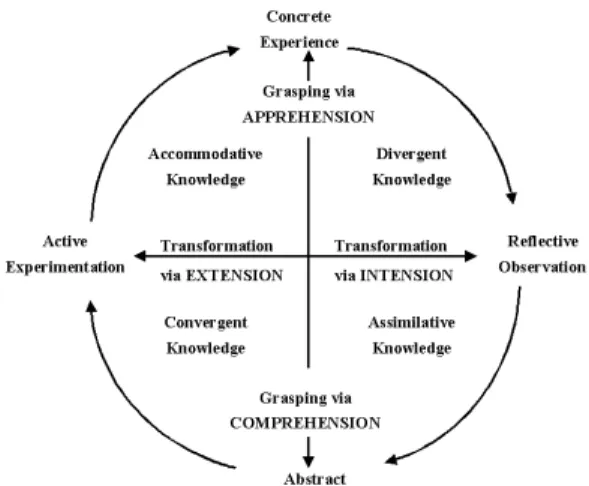
The concept explored in this study was the perspectives of elementary teachers on the usefulness of individualized virtual coaching in supporting their blended learning implementation. The conceptual framework that informed this study included two elements. The first was Kolb’s (1984) experiential learning theory. Kolb’s experiential learning theory draws from multiple experiential learning theories, including the work of John Dewey, Kurt Lewin, and Jean Piaget, and is based in research from the fields of philosophy, physiology, and psychology (p. 17). Kolb posits in the experiential learning theory that learning happens in four distinct segments: (a) concrete experiences, (b) reflections, (c) abstract conceptualization, and (d) active experimentation (p. 68). Figure 1 shows the four segments of the learning theory.
Figure 1. Structural dimensions underlying the process of experiential learning and the resulting basic knowledge forms. Reprinted from “Experiential Learning: Experience as the Source of Learning and Development,” by D. A. Kolb, 1984, Englewood Cliffs, NJ: Prentice-Hall, p. 42. Reprinted with permission of Pearson Education, Inc.
Kolb’s (1984) experiential learning theory was developed as an adaption of previous experiential learning theories, posing a three dimensional mode of learning instead of a learning continuum (p. 40). As shown in Figure 1, Kolb’s experiential learning theory represents the learning process by four adaptable modes that are determined through the grasping of and transformation of knowledge by the learner (Kolb, 1984, pp. 41-42). This experiential learning theory was a good fit for exploring the perspectives of elementary teachers because it had been widely used in adult professional development and gave a categorical lens to the perspectives shared by elementary
teachers implementing blended learning. In Chapter 2, I provide more details on the use of Kolb’s experiential learning theory in this research study.
The four modes of Kolb’s (1984) experiential learning theory were used in the development of the interview questions in order to help build an understanding of where the participants fit in the adult learning cycle. Additionally, the four modes were used
during the data analysis phase of the study using a priori codebook developed with the theory in mind. I analyzed the transcripts from the interviews of elementary teachers using a priori coding to determine where their perspectives fell in the adult learning cycle, and to identify themes and emerging discrepant data. This data were used to analyze elementary teachers’ perspectives on the usefulness of individualized virtual coaching to support their blended learning implementation, in order to answer RQ 1.
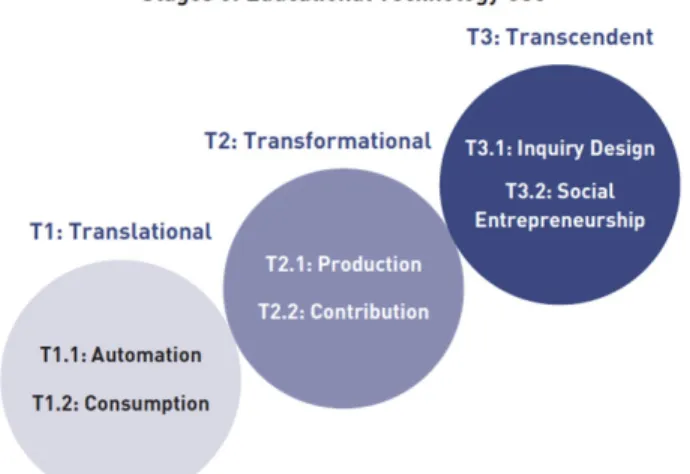
The second element of the conceptual framework to ground the study was the T3 framework (Magana, 2017). Magana designed the T3 framework to synthesize and extend the TPACK model by focusing specifically on technology use and the value of technology in the adoption of innovative teaching and learning practices. In the T3 framework, Magana suggested three domains of technology use in education, (a) translational, (b) transformational, and (c) transcendent. Figure 2 shows the educational technology innovation continuum from translational to transcendent.
Figure 2. Stages of educational technology use. Republished with permission of Corwin Press from “Disruptive Classroom Technologies: A Framework for Innovation in
Education,” by S. Magana, 2017, Thousand Oaks, CA: Sage, p. 21. Permission conveyed through Copyright Clearance Center, Inc.
The development of Magana’s (2017) T3 framework is informed by the research of Hattie (2009), Haystead (2009, 2010), and Marzano (In Magana & Marzano, 2014), and research empirically collected on innovation in education and technology use and adoption (A. Magana, personal communication, September 11, 2018). The T3 framework represents stages of educational technology use within three domains, where each domain has a different level of added value for technology use in education. The framework serves as a method to support educators in choosing technology tools and integration techniques to improve the learning experiences of students (Magana, 2017). The T3 framework served as an innovative lens for examining teacher implementation of technology in blended learning environments. In Chapter 2, I share how the T3
framework provided a support lens during the study as well as detailed description of the constructions within the three domains of the T3 framework of educational technology use.
In this basic qualitative study, the T3 framework supported the research design and the analysis of data collected during the research study. In the research design, the framework served as a way to categorize elementary teachers into educational technology use stages in order to identify common experiences, and to design interview questions to verify these categorizations. The T3 framework was used during the data analysis phase to determine where the technology practices of elementary teachers fell within the three domains, and to answer RQ2.
Nature of the Study
A qualitative paradigm was used for this proposed study focused on elementary teachers’ perspectives implementing blended learning while participating in virtual coaching. According to Merriam and Tisdell (2016), basic qualitative research supports researchers in examining how individuals interpret their experiences and the meaning connected to those experiences. In the case of virtual coaching, elementary teachers engaged in a one-on-one conversation with their virtual coach and experience coaching through an individual lens. With this structure in mind, basic qualitative research allowed for data to solely be collected via individual interviews which mirrors and provides similar conditions as virtual coaching sessions (Merriam & Tisdell, 2016; Percy, Kostere, & Kostere, 2015). Additionally, interviews provided the researchers with non-observable perspectives about a specific phenomenon through a human’s story which they would normally not be able to capture on their own (Jacob & Furgerson, 2012; Merriam & Tisdell, 2016). The use of individual interviews aligned with the purpose of the study which was to explore the perspectives of elementary teachers on the usefulness of individualized virtual coaching in supporting their blended learning implementation.
Participants for this study included elementary teachers who taught kindergarten through fifth grade in a public or private school in the United States and had received at least one year of virtual coaching while implementing blended learning. Purposeful sampling was used to capture information-rich cases, like virtual coaching, to identify participants whose perspectives aligned to the purpose of the study and the RQs being examined by the study (see Merriam & Tisdell, 2016; Patton, 2015; “Purposeful
Sampling,” 2013). The target sample size for participation in this study, based on Guest, Bunce, and Johnson’s (2006) qualitative study, was between nine and twelve K-5
teachers. Data was collected during individual semistructured 30 to 45 minute interviews. I conducted these interviews virtually via the web conferencing tool Zoom, which was only used to capture audio. I coded the audio transcribed interviews at the first level using
a prioricodes, which are codes established based on experience or from understanding
the phenomenon (Saldaña, 2015). For this study, the pre-determined codes were established using two frameworks, Kolb’s (1984) experiential learning theory and Magana’s (2017) T3 framework. Appendix A shows Kolb’s experiential learning theory codebook. Appendix B shows Magana’s T3 framework codebook. In my second level of coding, I focused on identifying emerging codes, those codes focused on finding patterns and themes from the data (Saldaña, 2015). During the coding process, I used Microsoft Office Word to organize my transcriptions and Dedoose to help me make sense of the data I collected.
Definitions
Blended learning: A method of instruction by which teachers build a collection of innovative strategies aligned to a new mode of teaching and learning (Jonker et al., 2018) where they leverage digital technology and face-to-face instruction to facilitate student learning while allowing students to have a level of control over their pace and learning pathway (Staker & Horn, 2012).
Bug-in-ear (BIE) coaching: A method of instructional coaching focused on discrete, immediate feedback or instruction given via a wirelessly transmitted one-way
ear piece by a colleague or supervisor observing the implementation of targeted strategies or practices in a given setting (Coogle et al., 2018; Ottley & Hanline, 2014; Rock et al., 2014; Scheeler et al., 2018).
Video-based coaching: A method of instructional coaching where teachers, coaches, or instructors record video-based evidence of preservice or inservice teachers and use the digital evidence to encourage the teacher to reflect individually, with peers (Kennedy & Lees, 2016) or with the guidance from a coach or instructor to improve the teachers’ practice (Allen, Hafen, Gregory, Mikami, & Pianta, 2015; Bradley et al., 2013; Knight, Hock, Skrtic, Bradley, & Knight, 2018; Rickels, 2016). Video-based coaching may include synchronous debriefing sessions or teachers receiving feedback
asynchronously via annotations, comments, or voice overs from their coach or instructor (Allen et al., 2015; Rickels, 2016; Suhrheinrich & Chan, 2017).
Virtual coaching: A method of instructional coaching focused on digitally connecting coaching participants with their coaches to grow the skills and knowledge of coaching participants through virtual feedback and discussion (Barton et al., 2013; Barton
et al., 2018; Carmouche et al., 2018; Nugent et al., 2017). Also referred to as
distance-based coaching, webcam coaching, and web-based coaching.
Web-based coaching: A method of instructional coaching focused on digitally connecting coaching participants with their coaches to grow the skills and knowledge of coaching participants through virtual feedback and discussion (Barton et al., 2013; Barton
et al., 2018; Carmouche et al., 2018; Nugent et al., 2017). Also referred to as
Assumptions
This study was based on several assumptions. First, I assumed the interview questions I used in the study appropriately assessed the perspectives of the elementary teachers and captured the experiences defined by the purpose of the study. I carefully crafted the interview questions based on my conceptual frameworks, literature, and my understandings of the phenomenon. Second, I assumed all participants of the study were open and honest with their responses to the interview questions. Although I assured participants their identities would be kept confidential, participants may have felt the need to exaggerate their answers as to not reflect poorly on themselves or their coach. Lastly, I assumed participants engaging in year-long virtual coaching experienced similar coaching styles. As participants were working with an individually assigned coach, participants may have experienced slightly different coaching styles compared to other participants when engaging in virtual coaching for blended learning implementation.
Scope and Delimitations
The scope of this study was based on certain study boundaries. The purpose of the study, which was to explore the perspectives of elementary teachers on the usefulness of individualized virtual coaching in supporting their blended learning implementation, was one of the boundaries. The empirical literature on virtual coaching and blended learning defined the participant demographics, as the gap in the literature pointed to the capturing of perspectives on differentiated professional development for K-5 teachers. I did not
include 6th grade to college as much research, particularly in higher education, had been
et al., 2018). Within the boundaries of the purpose of the study, a basic qualitative research design was chosen as the methodology as the literature pointed to a gap in the description of perspectives by teachers implementing blended learning, particularly through the lens of professional development.
The delimitations of this study included the selection of participants for this study based on inclusion criteria. First, the study was limited to teachers teaching K-5 grade levels during the coaching year. I only explored the perspectives of teachers from one virtual coaching company. I did not control for other factors, like those K-5 teachers who received virtual coaching for blended learning through other means but are not included in this study. Second, I limited invitations to participants who taught these grade levels in a public or private school in the United States during the coaching year. I did not send invitations to K-5 educators who participated in virtual coaching for blended learning who were outside of the United States, as to capture data from one nation’s educational system. Third, based on the purpose of my study, I controlled for K-5 teachers who participated in year-long coaching for blended learning implementation. I did not control for other factors, such as years of teaching, geographic location in the United States, or other areas of coaching support the participant may have received during the year. My decision to limit the focus on blended learning was based on literature related to teachers’ need for differentiated professional development with technology use and at the
elementary level. The use of the inclusion criteria and purposeful sampling, supported the transferability of the study with detailed and rich descriptions of the participants (i.e.,
grade level taught) and their settings (i.e., public or private school; Merriam & Tisdell, 2016) which can be used by other researchers to build out their own studies.
Limitations
The research design of a study often creates limitations. As a basic qualitative research approach was used in this study, one limitation was my perspectives and biases as a researcher (see Merriam & Tisdell, 2016). In Chapter 3, I describe how I increased the trustworthiness of the study by being transparent about the research findings, the recruitment process and the demographics and settings of the participants, and clearly stated personal and professional connections to the research study. In addition, to manage my bias in this study I conducted member checks (Carlson, 2010), did researcher
reflective journaling (Slevin & Sines, 2000), and provided transcripts for review by participants. A second limitation of the study was the amount of time that had passed since coaching concluded. By the time this study was conducted, participants had completed their one-year of virtual coaching for blended learning implementation four months prior. This time gap might have impacted the clearness of participant’s memories (Merriam & Tisdell, 2016). A third limitation of the study was the use of virtual
interviews to capture the perspectives of elementary teachers. Conducting interviews virtually could potentially affect data analysis as it may be difficult to capture the participant’s full descriptive experience (Merriam & Tisdell, 2016). The last limitation was the transferability of the findings gathered through this study as I was looking at a very specific virtual coaching program; making it difficult to generalize the results of the study.
Significance
This study is significant as it may provide contributions to advance knowledge of innovative practices, like virtual coaching, to support blended learning implementation in K-5 classrooms. As documented in higher-education, there is a growing need for
differentiated support for blended learning implementation (Jonker et al., 2018; Margolis et al., 2017). However, little is known about the professional needs of K-12 educators, particularly K-5 teachers, when it comes to implementing blended learning. This study fills a gap in the literature by sharing insights from elementary educators receiving
support for blended learning implementation and advises learning leaders on the adoption of innovative alternative forms of professional development as best practice in supporting the execution of blended learning. In relation to potential positive social change, learning leaders may use data from this study to further access to blended learning experts;
potentially positively impacting K-5 teachers and students through access to expert professional support.
In relation to improving practice, this study may inform the use of information technology and staff development in teacher education. Educational stakeholders,
including district officials, administrators, preservice teacher instructors, and instructional coaches, may use results from this study as a means to examine whether virtual coaching for differentiated professional development for teachers implementing blended learning in the classroom meets their needs. Additionally, this study fills a gap in the literature by providing administrators with insights into how well virtual coaching may function as an innovative replacement for face-to-face or internal coaching to support elementary
teachers in implementing blended learning. In relation to potential positive social change, administrators may be able to maximize resources while giving their K-5 educators a convenient and flexible means to access expert knowledge for blended learning implementation.
Summary
In Chapter 1, I introduced my qualitative study by describing virtual coaching and blended learning, sharing the population, which was examined in this study, and
described why the study needed to be conducted. In the background section, I summarized the research literature and identified the gaps in knowledge for virtual coaching and blended learning professional development. My problem statement and purpose of the study provided evidence of the relevancy and significance of the
phenomenon of interest. The questions outlined in the RQ section framed the boundaries of the study by examining the research data through two conceptual frameworks, Kolb’s (1984) experiential learning theory and Magana’s (2017) T3 framework. In the nature of study section, I provided rationale for the selection of the basic qualitative research design, described the phenomenon being investigated, and summarized my approach to data collection and analysis for this study. To clarify language used in the study, the definitions section contains concise definitions of key concepts used throughout the study. Boundaries of the study were clarified in the assumptions, scope and delimitations, and limitations sections. Lastly, in the significance section, I identified potential
contributions of the study in advancing knowledge and practice in innovation and expounded upon potential implications for positive social change from this study.
In Chapter 2, I describe the literature search strategies I used in the study, review the conceptual frameworks used in the study, and provide an exhaustive review of current literature related to virtual coaching in education, implementation of blended learning in elementary classrooms, and technology use in elementary classrooms.
Chapter 2: Literature Review
Introduction
The problem related to this study was that the usefulness of individualized virtual coaching as a differentiated professional development support for elementary teachers implementing blended learning is not well understood. The purpose of this basic
qualitative study was to explore the perspectives of elementary teachers on the usefulness of individualized virtual coaching in supporting their blended learning implementation. Current literature establishes the benefits of blended learning on the academic
performance, self-efficacy, engagement, and interests of students (Firdaus et al., 2018; Hui et al., 2018; Lai & Hwang, 2016). There are studies which have helped establish the challenges teachers faced with implementing technology-enabled instruction when technology and instructional supports were lacking (Prouty & Werth, 2015; Spiteri & Rundgren, 2017; Vrasidas, 2015). Although the benefits of virtual coaching on instruction have been found in multiple forms, including BIE coaching, video-based coaching, and web-based coaching, current literature has not explored the impacts of virtual coaching on blended learning implementation. The goal of this research study was to gain an understanding of the perspectives of elementary teachers who are participating in bi-weekly virtual coaching over the course of a year, and how virtual coaching impacts the implementation of blended learning. The information gathered from this research study may help increase awareness of teacher perspectives on innovative professional development options for educators implementing models of instruction, like blended learning.
Chapter 2 begins with a review of my literature search strategy and an overview of the conceptual frameworks for this study, Kolb’s (1984) experiential learning theory and Magana’s (2017) T3 Framework. In the literature section, I provide an overview of the types of virtual coaching, one of which is the focus of this research study. Next, I review the types of professional development conducted through virtual coaching and the perspectives of teachers who are participating in several types of virtual coaching. In the next section, I present the successes and challenges with blended learning implementation
in the K-5 classroom, while focusing on academic and 21st century skills, like
self-efficacy. Finally, I review the factors influencing elementary teacher technology use in the classroom and how technology is used for blended learning in K-5 classrooms.
Literature Search Strategy
The literature review for the perspectives of elementary teachers implementing blended learning while participating in virtual coaching used scholarly sources from published reports and peer-reviewed journal articles. The scholarly publications were accessed the databases ACM Digital Library, Directory of Open Access Journals, EBSCOhost, Education Source, ERIC, Google Scholar, SAGE Journals, The Learning and Technology Library, Taylor and Francis Online, and Teacher Reference Center. The search terms used to explore articles published within the last five years about the topic
of study included blended learning, bug-in-ear, computer technology integration, digital
coaching, digital tools, digital tools in the classroom, distance-based instructional coaching, distance coaching, e-coaching, elementary teachers, email coaching, factors that influence elementary teacher technology use, flex model, flipped learning, hybrid
learning, individual rotation, individualized professional development, K-5, K-12, lab rotation, mobile devices, online coaching, personalized professional development, primary teachers, self-blend, station rotation, swivl and coaching, teacher perceptions of virtual coaching, technology implementation, technology integration, technology use, tele-coaching, telephone coaching, text-based coaching, video-based coaching, virtual coaching, web-based coaching, and webcam coaching. After examining the articles in each search, articles pertinent to the study were saved and categorized in four locations, the Walden Library, in a literature review matrix, in a folder on a computer desktop, and printed and placed in a binder. The literature review matrix was used for further
categorization based on methodology, research findings, and relevancy to level two headings. The reference section of each of the articles was used to find additional
publications for this study. The determination that saturation had been met occurred with recurring themes in the literature and the appearance of the same author names in the publications.
Conceptual Framework
The concept explored in this study was the perspectives of elementary teachers on the usefulness of individualized virtual coaching in supporting their blended learning implementation. The conceptual framework grounding this study included Kolb’s (1984) experiential learning theory and Magana’s (2017) T3 framework. These conceptual frameworks served as an innovative lens to capture the perspectives of elementary teachers as they experienced the implementation of blended learning with support from a virtual coach.
Kolb’s Experiential Learning Theory
Kolb’s (1984) experiential learning theory draws from the experiential learning theories of John Dewey, Kurt Lewin, and Jean Piaget, whose contribution to experiential learning stem from multiple themes (Kolb, 1984). As the basis of their experiential learning theories, Lewin and Dewey’s educational philosophies concentrate on
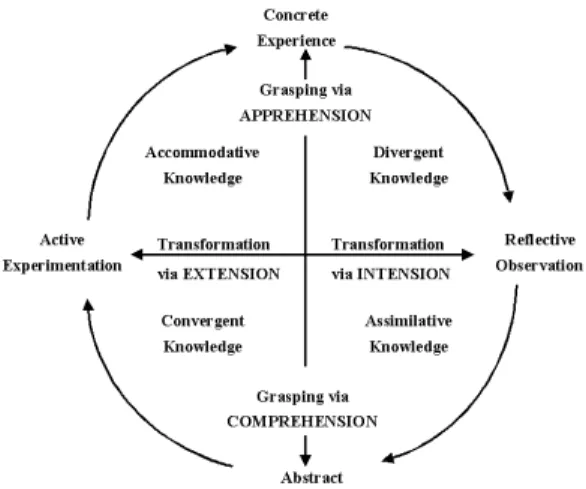
democratic values, including cooperative leadership, dialogue, and scientific humanism, and pragmatism, with a focus on life-long learning from experience (Kolb, 1984). Piaget’s contributions include his work on learning from experiences, and the link between learning and knowledge (Kolb, 1984). With these theories as the foundation of experiential learning, Kolb’s posits in his experiential learning theory that learning happens in four distinct segments: (a) concrete experiences, (b) reflections, (c) abstract conceptualization, and (d) active experimentation (p. 68). Figure 3 shows the four segments of the learning theory.
Figure 3. Structural Dimensions Underlying the Process of Experiential Learning and the Resulting Basic Knowledge Forms. Adapted from “Experiential Learning: Experience as a Source of Learning and Development” By D. A. Kolb, 1984, Englewood Cliffs, NJ: Prentice-Hall, p. 42. Reprinted with permission.
Kolb’s (1984) experiential learning theory was developed as an adaption of previous experiential learning theories. The theory represents the learning process in four adaptable modes determined through the grasping of and transformation of knowledge by the learner (Kolb, 1984, pp. 41-42). These four modes of cognitive processing are
represented via a learning cycle, as shown in Figure 4.
Figure 4. Kolb’s Learning Cycle. Adapted from “Experiential Learning: Experience as the Source of Learning and Development,” by D. A. Kolb, 1984, Englewood Cliffs, NJ: Prentice-Hall, p. 42. Reprinted with permission.
In Kolb’s experiential learning cycle, the four adaptable modes are defined as follows
§ concrete experience (CE) where the learner engages in a new or existing
experience;
§ reflective observation (RO) where the learner assesses for gaps between what they
experienced and what they understand;
§ abstract conceptualization (AC) where the learner reflects to form new ideas or to
re-examine existing understanding; and
§ active experimentation (AE) where the learner applies new understanding to
future experiences.
According to Kolb (1984), in this continuous learning cycle, an adult learner engages in an action (CE) and seeks to make connections to outside conditions through observation and reflection (RO). The learner then analyzes whether the knowledge gained by the experience corresponds to what was experienced and draws a conclusion (AC). The knowledge gained from this experience is then used by the learner when interacting with new or pre-existing experiences (AE). Due to the continuity of the cycle, the learner engages in all or parts of these cognitive phases while learning; however, Kolb shared in his theory that the learner must fully engage in each of the four modes in a sequential order before true learning can take place.
Application of Kolb’s experiential learning theory in previous research.
Perspectives of elementary teachers on the usefulness of individualized virtual coaching in supporting their blended learning implementation is attuned with Kolb’s (1984) experiential learning theory. The virtual coaching structure, whether supporting the
implementation of blended learning or other pedagogical innovations, embodies the continuous learning cycle proposed by Kolb for adult learners. In previous research, Kolb’s experiential learning theory has been widely used as a lens for adult learning in the nursing field, including mentorship to support novice practitioners. Cooley and De Gagne (2016) applied Kolb’s experiential learning theory to a study looking at the support gaps for nurses becoming nursing educators. The researchers found that new nursing educators need ongoing mentor support to overcome the knowledge gap while transitioning from nurse to educator, and that the application of the new knowledge should be embedded in experience (Cooley & De Gagne, 2016; Kolb, 1984). Kolb’s experiential learning theory has also been applied to mentorship of trainee music
teachers. While conducting a case study, Cain (2007) found mentorship to be successful when the mentor intentionally provides opportunities for the trainee music teachers to engage in all four modes of the learning cycle instead of exclusively in the mentors’ or trainees’ area of preference (Kolb, 1984). Furthermore, Turesky and Gallagher (2011) wrote an article on the benefits of coaching for leadership while using Kolb’s experiential learning theory, and suggest leadership coaches adapt their learning preference to meet the needs of their clients. Additionally, Stirling (2013) shares how utilizing Kolb’s experiential learning theory may address coach education gaps and improve the effectiveness of professional coaches through the focus on experience and reflection (Kolb, 1984). Collectively, these studies provided a precedent for the use of Kolb’s experiential learning theory in exploring the perspectives of elementary teachers as it had been widely used in adult professional development, and gave a categorical lens to the
perspectives shared by elementary teachers implementing blended learning with support from a virtual coach.
Benefits of Kolb’s experiential learning theory. Kolb’s (1984) experiential learning theory benefits this study as it gives a categorical lens to the perspectives shared by elementary teachers implementing blended learning while participating in virtual coaching. This lens was used during the data analysis phase of the study with a focus on determining where the perspectives of elementary teachers implementing blended
learning fall in the adult learning cycle. Kolb’s experiential learning theory was also used during data analysis to identify the themes in the interview data, to identify how the perspectives of elementary teachers changed with their level of engagement in Kolb’s four adaptable modes, and made visible any discrepant data which emerged from the study. Additionally, this data was used to analyze the perspectives of elementary teachers on the usefulness of individualized virtual coaching to support their blended learning implementation in order to answer RQ 1. Furthermore, by using the learning cycle as a lens, Kolb’s experiential learning theory captured an understanding of how experience and knowledge inform the transition of an elementary teacher’s current instructional practices to more innovative practices, like blended learning (Kolb, 1984).
Magana’s T3 Framework
The development of Magana’s (2017) T3 framework was informed by the research of Hattie (2009), Haystead (2009, 2010), and Marzano (2014), and research empirically collected on innovation in education and technology use and adoption (A. Magana, personal communication, September 11, 2018). Hattie’s (2009) meta-analysis,
which focuses on student achievement, surfaced the importance of making student feedback visible to teachers to improve the effectiveness of instruction for the students. Additionally, Hattie’s research raised the importance of goal development in increasing (32-percentage points) the achievement of students. Haystead (2009, 2010) and Marzano contributions include their work on intrinsic and mastery-based goals, visualizing the growth process, and increasing the ownership of students through strategies focused on self-reflection and self-monitoring (Magana, 2017). Collectively, the research presented by Hattie, Haystead, and Marzano drives the foundational importance of ownership and student-driven learning with technological supports in Magana’s T3 framework.
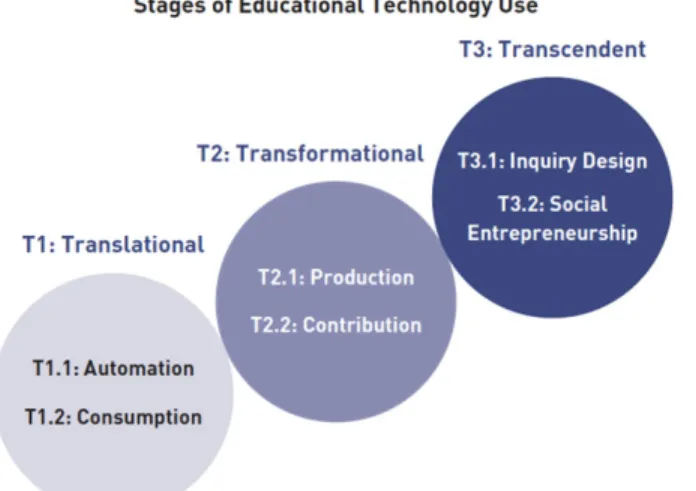
Magana (2017) designed the T3 framework to synthesize and extend Mishra and Koehler’s (2006) Technology, Pedagogy, and Content Knowledge (TPACK) model by focusing specifically on technology use and the value of technology in the adoption of innovative teaching and learning practices. In the T3 framework, Magana suggested three domains of technology use in education, (a) translational, (b) transformational, and (c) transcendent. Figure 5 shows the educational technology innovation continuum from translational to transcendent.
Figure 5. Stages of educational technology use. Republished with permission of Corwin Press from “Disruptive Classroom Technologies: A Framework for Innovation in
Education,” by S. Magana, 2017, Thousand Oaks, CA: Sage, p. 21. Permission conveyed through Copyright Clearance Center, Inc.
In Magana’s (2017) T3 framework, the three stages of educational technology use are defined as
§ translational (T1) where technology integration provides the lowest level of value,
as educators use technology to do analog tasks digitally to automate the process (automation, T1.1) or consume information in a variety of ways (consumption, T1.2) (Magana, 2017, pp. 28-35);
§ transformational (T2) where the integration of technology leads to a substantial
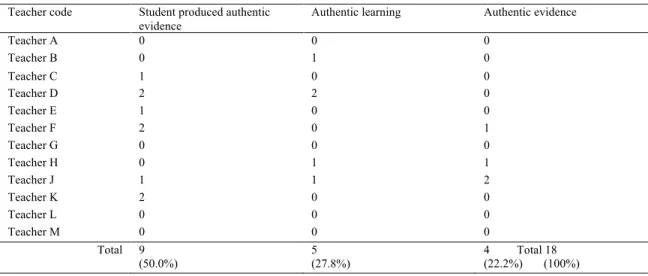
change in the nature or impact of the task, or the role of the individual doing the task (Magana, 2017, p. 38). In the production (T2.1) phase of this stage, learners produce quality, authentic evidence to illustrate their growth in knowledge and their thinking processes (Magana, 2017, p. 42). In the contribution (T2.2) stage, learners apply all the qualities of the production phase while extending their knowledge to others (Magana, 2017, pp. 53-54); and
§ transcendent (T3) where technology use goes beyond what is normally expected in education and focuses on students designing learning opportunities based on their passions and interests (inquiry design, T3.1), and social entrepreneurship (T3.2) where students solve problems and bring those solutions to life via technology in the real-world (Magana, 2017, pp. 63-77).
According to Magana (2017), the three stages of educational technology use have various levels of value. As the educational technology use moves from translational to
transcendent the value-added level increases (Magana, 2017). For example, a learner engaging in a task in the automation phase of the T3 framework versus the production phase is experiencing a lower value-added use of educational technology. Furthermore, as the learner experiences higher value-added stages of the technology use, the level of ownership required by the learner increases and the role of the educator shifts to a facilitator of the learning process (Magana, 2017). The goal of the T3 framework is to make visible the continuum of educational technology use and to use the framework to analyze technology use in the classroom in hopes of encouraging innovative teaching and learning practices (Magana, 2017).
Application of Magana’s T3 framework in previous research. Magana’s (2017) T3 framework was aligned with the purpose of this research study which was to explore the perspectives of elementary teachers on the usefulness of individualized virtual coaching in supporting their blended learning implementation. Although the framework is not currently documented in education research, the TPACK framework it extends is based on five years of design experimentation and has been widely used in the
field of education as a conceptual lens for educational technology use and integration (Mishra & Koehler, 2006). Along with TPACK, another model which is often used when examining technology integration in education is the substitution, augmentation,
modification, and redefinition (SAMR) model. Although the SAMR model is popular amongst researchers, it is not based in peer-reviewed research (Green, 2014) and because of its nature as a categorizing model (Marcovitz & Janiszewski, 2015), it provides an
inadequate frame for designing innovative teaching and learning practices for the 21st
century classroom (Magana, 2017). With the limitations of these educational technology conceptual lenses in mind, Magana’s T3 framework provided an innovative lens for exploring the perspectives of elementary teachers implementing blended learning with support from a virtual coach.
Benefits of Magana’s T3 framework. Magana’s (2017) T3 framework benefitted this study because it served as an innovative lens for examining teacher implementation of technology in blended learning environments. The T3 framework fit the needs of this study as it provided a way to categorize elementary teachers into educational use stages in order to identify common perspectives and discrepant data emerging from interviews. The T3 framework was used during data analysis to determine where the technology practices of elementary teachers fell within the three stages of educational technology use. This framework was used to answer RQ 2. Additionally, I used the stages of educational technology use in Magana’s T3 framework to gain a clearer understanding of the role of technology innovation in the implementation of blended learning by elementary teachers.