Educational Administration
”
“
the value
of the
chaplaincy
program
has been
questioned,
leading to
assertions
that it was
a waste of
money.
School chaplaincy is effective but
could it be better?
Michael Parker
Lecturer, Discipline of Humanities and Creative Arts, Avondale College of Higher
Education, Cooranbong, NSW
Barry Gane
Head of the School of Ministry and Theology, Discipline of Humanities and Creative
Arts, Avondale College of Higher Education, Cooranbong, NSW
Carola Parker
Teacher, Central Coast Adventist College, Erina, NSW
TEACH
RKey words: chaplaincy, faith development, reflective practice
Abstract
Analysis of the data collected in the Valuegenesis II study of 3263 students in Seventh-day
Adventist schools, indicates that 63% consider the school chaplain has influenced their
development of faith. Further, school chaplaincy is associated with statistically significant positive differences in the levels of Faith Maturity,
Christian Commitment, Intrinsic Orientation to Religion, Positive Views of God, Denominational Loyalty and Social Responsibility, being a medium to large effect impacting students lives. The potential of reflective practice to improve the outcomes of chaplaincy in the current context of low levels of job satisfaction and chaplaincy retention is considered.
Context and purpose
Chaplaincy in Australian schools can be traced to the time of The First Fleet, with Reverend Richard Johnson, the first chaplain, establishing the first schools in Sydney and Parramatta in 1792 (Anglican Church League, n.d.). It was not until much later that Australian governments introduced chaplaincy into state schools (Victoria – 1955, Western Australia – 1982, South Australia – 1986, Queensland – 1970, New South Wales - unknown ) (Pohlmann, 2013, p. 58). The real momentum for school chaplaincy came with the introduction of the National School Chaplaincy Program (NSCP) in 2007, where the Howard government provided funding for two thousand seven hundred schools to establish a
chaplaincy program (Department of Education, Science and Training, 2007). This was further extended to another thousand schools by the Gillard government in the lead-up to the federal election in 2010 (Commonwealth of Australia, 2011, p. 5). The funding allowed the introduction of chaplaincy programs and created new, unique and untried roles in the government school sector. It allowed faith-based schools to expand their existing programs and to employ chaplains in areas where lack of finance had previously made it difficult to have full time chaplains.
The NSCP has come under considerable criticism, not only from the non-religious sector, but from society in general. At a time when governments needed to slash funding, the value of the chaplaincy program has been questioned, leading to assertions that it was a waste of money. Initially, many schools hired people who had no training in chaplaincy, which also caused people to ask questions about the validity of the program. Later, when guidelines were clarified, some schools opted to hire counsellors rather than chaplains, and the question “What is the role of the chaplain?” was often posed.
Recent research
Judith Salecich, in 2001, and David Pohlmann, in 2010, both made significant contributions into the research of school chaplaincy by looking at case studies and models of chaplaincy in Queensland state schools. Their research encompassed a detailed investigation of a range of models that were currently operating in a sample of Queensland state schools. However their goals were not to identify best practice models.
Educational Administration
”
“
63% of
students say
the chaplain
has a fair
amount or
a very large
influence
on their
development
of faith
Paget and McCormack (2006) consider chaplaincy in a wide range of contexts. Later David O’Malley (2008) looked at chaplaincy in a school context and the different aspects of the work, but the point of commonality reported is the lack of clear job descriptions and definitions of the role of the chaplain, which leads to a lot of frustration, lack of job satisfaction and stress-related burnout. Clare McBeath (cited in Threthfall-Holmes & Newitt, 2011) observes “many chaplains leave to take up other forms of ministry as a result” (p. 23).
With the government investing so much money in the school chaplaincy program, and with many questioning its relevance and validity, a study was completed by Hughes and Sims (2009) looking at The Effectiveness of Chaplaincy.
The Adventist schools system
Before 2007 the Seventh-day Adventist school system had several full-time chaplains in its biggest schools and many church pastors who fulfilled the role of part-time chaplain in addition to their roles in the local parish. With the introduction of the NSCP the available funding enabled the majority of schools within the system to have a full or part time chaplain. However, in this school system, the role of the chaplain was often defined by the school principal, and varied from school to school. There was often no clear line of accountability, and there was confusion over job descriptions and no clear model for chaplaincy.
In this context of a comparatively recently introduced national school program and limited current research, this article will look at some of the evidence that supports the validity of the chaplaincy program within the Seventh-day Adventist school system in Australia; the role the chaplains perform; and how this can be enhanced by “reflective practice”. The research approach or method
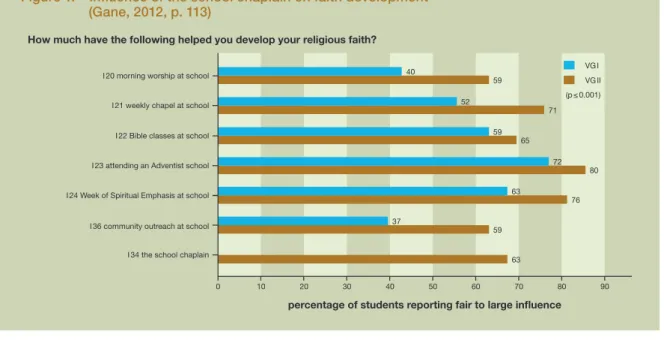
In an attempt to ascertain the relationship between homes, churches and schools, the Seventh-day Adventist church in the South Pacific conducted a major Valuegenesis I study in 1992 (Hughes, 1993), prior to the introduction of school chaplains in all schools. A further study (Valuegenesis II, Gane, 2012) was commissioned in 2011 (twenty years later) to revisit this area of research in order to evaluate past programs and to assist in goal setting for the future. This latest study added a question (see Figure 1.) on the role of chaplaincy in the development of faith in the lives of the students.
As there are now a number of schools that have full time chaplains it was a goal of the study to discover answers to the following queries: Does having a chaplain on the campus make any difference
in the lives of the students? Does the chaplain become one of those important and significant adults who at least shows an interest in the lives of the students or at best becomes a mentor with ongoing real impact? Does spiritual activity on the campus increase in both frequency and quality through the addition of a chaplain? The following analysis of the student responses informs answers to these questions.
The survey instrument and the respondents The data for this study was collected through the Valuegenesis II instrument being administered to most students in the Adventist School system in Australia and New Zealand. A final response rate of 3263 (80% of the total available) was achieved after the data cleaning process. One thousand, three hundred and fifty nine (1359) students came from homes with at least one Adventist parent while 1904 came from homes with no religion stated or another religion or Christian denomination listed.
The results Spiritual influence
As the impact of the chaplain was not included in the original 1992 study this paper reflects only the results from the Valuegenesis II study. The personal influence of the chaplain is reflected in item I 34 where 63% of students say the chaplain has a fair amount or a very large influence on their development of faith (see Figure 1.). One cannot state that the major changes in the overall results for the school can be directly attributed to the chaplain as the cause, but the data suggests that there is a relationship.
A series of independent samples t-tests were conducted to examine the difference between having or not having a chaplain for the following scales: Faith Maturity, Christian Commitment, Intrinsic Orientation to Religion, Positive Views of God, Denominational Loyalty and Social Responsibility. Accepting the criteria that the probability of rejecting the statistical hypothesis when in fact it is true (Type I error) be 5% or less (α = .05), there are significant differences between students who had a school chaplain and those who did not. The presence of the chaplain is associated with significant differences and higher scores (p ≤ .05 to p ≤ .001). Further, the magnitude
of the effect size for the difference is medium (d = .5) for Faith Maturity and Christian Commitment, approaching large (d = .7) for Intrinsic Orientation to Religion, while the effect size for Denominational 1Because the study was designed to compare results for schools between the original Valuegenesis study of 1992 and the second study of 2012 the results presented below are generally only for those students from homes where the was at least one SDA parent.
Educational Administration
”
“
the addition
of a chaplain
does affect
the lives of
students, in
particular
increasing
the quality of
spirituality on
the campus
Loyalty is only a little less (d = .6). However, for increasing Positive Views of God the impact of a chaplain approaches a medium effect (d = .4) (Gane, 2012, p. 110). The effect sizes noted suggest that the addition of a chaplain does affect the lives of students, in particular increasing the quality of spirituality on the campus.
Additional analysis considered the effect of chaplaincy on two sub-samples – SDA and non-SDA students. The scale scores for non-SDA students who had a school chaplain and those who did not were significantly different (Faith Maturity, p ≤ .05; Christian Commitment, p ≤ .005; Intrinsic Orientation to Religion, p ≤ .05; Positive Views of God, p ≤ .005; and Denominational Loyalty, p ≤ .05). The only
scale where there was no confirmed difference was Social Responsibility (Gane 2012, p. 109). The differences for the non-SDA students were of higher probability for all scales (Faith Maturity, p ≤ .001; Christian Commitment, p ≤ .001; Intrinsic Orientation to Religion, p ≤ .001; and Positive Views of God, p ≤ .001) except Denominational Loyalty; further, there was a difference for Social Responsibility (p ≤ .05). It appears that the presence in the school of a chaplain has a major positive influence on students of all faiths, but the effect is even more predictable for non-SDA students and enhances their service within society.
Figure 2. shows a difference between having a chaplain and higher levels of faith maturity. When students did not have a chaplain only 21% expressed high faith maturity, while 34% of students who had a chaplain indicated high faith maturity.
Figure 3. shows the positive difference having a school chaplain has on Christian commitment. Among the students who do not have a chaplain, 35% have high Christian commitment while of their counterparts with a chaplain, 51% have high Christian commitment.
Figure 4. shows 55% percent of those with a chaplain have higher intrinsic orientation to religion while 32% of those without a chaplain have a high intrinsic orientation.
Figure 5. shows that 80% percent of students in those schools that have chaplains have a very positive view of God, while only 60% those without chaplains have positive views of God.
Mentoring
About 40% of students recognise 5 or more adults have shown a significant interest in them at school, yet 15% do not identify even one adult mentor. About 65% of students recognise a significant
Figure 1: Influence of the school chaplain on faith development
(Gane, 2012, p. 113)
percentage of students reporting fair to large influence
How much have the following helped you develop your religious faith?
VG I VG II I 23 attending an Adventist school
I 36 community outreach at school I 21 weekly chapel at school I 24 Week of Spiritual Emphasis at school I 34 the school chaplain I 22 Bible classes at school I 20 morning worship at school
0 10 20 30 40 50 60 70 80 90 40 52 59 72 63 37 59 71 65 80 76 59 63 (p ≤ 0.001)
Figure 2: Presence of a school chaplain and faith maturity (Gane, 2012, p. 113)
percentage of students with high faith maturity
chaplain no chaplain 0 10 20 30 40 50 60 70 80 21 34 (p ≤ 0.05)
Educational Administration
”
“
Valuegenesis
II is the first
research in
Seventh-day
Adventist
schools
that has …
shown the
significant
impact …
chaplains
have in the
spiritual lives
of students
relationship with a mature Christian adult at school (Gane, 2012, p. 102). Mentoring in the church has a weak correlation with reduced ‘at risk behaviours’, moderate correlations with aspects of spirituality, but these are lower in schools (Gane, 2012, p. 102-106). School climate
Comparision of school climate measures between the 1992 and 2011 surveys show a negative trend with the increasing presence of chaplains in schools (Gane, 2012, p. 67). Possible reasons for this observation are offered in the following dicusssion but should be part of future research.
Discussion
Considering the research questions
Anecdotally, it has long been thought that chaplaincy
Figure 3: Presence of a school chaplain and high Christian commitment (Gane, 2012, p. 114)
percentage of students with high Christian commitment chaplain no chaplain 0 10 20 30 40 50 60 70 80 35 51 (p ≤ 0.01)
Figure 4: Presence of a school chaplain and orientation to religion (Gane, 2012, p. 114)
percentage of students with intrinsic orientation to religion chaplain no chaplain 0 10 20 30 40 50 60 70 80 32 54 (p ≤ 0.005) 79
Figure 5: Presence of a school chaplain and views of God (Gane, 2012, p. 115)
percentage of students with positive views of God
chaplain no chaplain
0 10 20 30 40 50 60 70 80 60
(p ≤ 0.001)
has made a significant difference in schools. Valuegenesis II is the first research in Seventh-day Adventist schools that has definitively shown the significant impact that chaplains have in the spiritual lives of students, affecting their view of God, their spiritual growth and their faith. Introducing school chaplains has increased the intentionality of Christian mentoring (numerically) and consequently the potential for an increasing influence on students’ lives. An increase in the number of chaplains does not seem however, to have had a trending impact on school climate. The overall negative change in school climate may however link to societal influences or any of the changes introduced over the period, including the effect of growth introducing a more varied student intake.
A known weakness of this broad survey is that it does not measure the quality of chaplaincy practice. Considering that very few, if any, chaplains in Adventist schools have specific chaplaincy training, training should make a demonstrable improvement in the quality of the chaplain’s work and consequently in desirable outcomes.
Improving chaplaincy by reflective practice Reflective practice is used in many professions as a means to improve performance, in areas such as healthcare, education and business. Little investigation has been done into the effectiveness of the elements of the chaplain’s role, or the critical evaluation of their daily activities. So it is appropriate to investigate the various roles of the chaplain and how reflective practice contributes, or could contribute further, to these roles. Such reflection has the possibility of further enhancing the impact of school chaplaincy on students. The tasks that the chaplains perform are many and varied, but largely fall into the following categories – shepherding, counselling, crisis managing, celebrating important milestones/occasions, dealing with the big issues of human suffering such as death and dying, divorce and issues such as bullying (Petersen, 2007). All of these pastoral responsibilities provide opportunity for the practitioner to enhance their services through reflection.
One of the major roles of the school chaplain is to journey with the students (King’s Baptist Grammar School, 2010). This “journeying” involves getting alongside them, listening to them, being available to assist them through the various elements of life that they are experiencing. Often the chaplain is so busy “doing” that he/she fails to take the time to reflect on why they do what they
Educational Administration
”
“
One of the
major roles
of the school
chaplain is to
journey with
the students
do, or evaluate the effectiveness of what they are doing. The chaplain often feels pulled in many directions, is busy running events, and needs to set aside the time to take stock, to determine the effectiveness of all these activities in order to ensure he/she is being effective, and in order to avoid the burnout to which chaplains are particularly prone.
In order to address these issues, “theological reflective practice” is very important.
Reflection is an active process of witnessing one’s own experience in order to take a closer look at it, sometimes to direct attention to it briefly, but often to explore it in greater depth. This can be done in the midst of an activity or as an activity in itself. The key to reflection is learning how to take perspective on one’s own and experience—in other words, to examine that experience rather than just living it. (Amulya, n.d., para. 1)
Reflective practice is a process which can be used to enhance our working with individual students, and it is also a practice which should be applied to evaluating and modifying/improving the overall chaplaincy program within the school. “Being reflective is one of the ways we learn to be ministers” (Nash & Nash, 2009, p. 19). When we reflect, we do things better. The chaplain who, as a result of reflecting on his/her practice is better able to evaluate their pastoral practice, and is able to articulate this to their line manager and others, frequently receives greater support. This can often result in a team ethos being developed as the chaplain involves others in his/her work, rather than bearing the pressure of isolation in their role.
Often the school chaplain is busy “doing”, rushing from one place to another, from one appointment to another, their lives dominated by the school bell, often failing to stop and “take stock”, “to be” rather than “to do”. When the chaplain takes the time to stop, and evaluates all the busyness in his/her life, he/she will often come to the realisation that “being” is far more important and effective. Jesus asked “Who do people say I am?” (Mark 8:27) and this search for identity is also the central question in the life of every teenager. When the chaplain takes time to “journey” with people, to “be” with them, through whatever issues concern them at the time, this allows the chaplain to play a significant role in individual lives, and helps teenagers make sense of the confusion felt in the search for identity, and lessens the anger that teens feel as they try to make sense of themselves (Threlfall-Holmes & Newitt, 2011, p. 19).
“There is another aspect of the chaplain’s
relationship to the whole school that is seldom mentioned. Listening is at the heart of the chaplain’s role and every chaplain will need to develop the skill of being still and letting people talk honestly and safely” (O’Malley, 2008, p. 19). Frequently, chaplains (especially males) listen to solve the problems that they think people are sharing with them. This limits their impact. As they learn to “listen” they will “hear” people’s “hopes, fears, disappointment, anger, frustration, joys and sadness” (O’Malley, 2008, p. 88). As the chaplain reflects on what he/she hears, he/she will be able to minister far more effectively, and as students, staff and the community recognise and gain confidence in the chaplain’s listening ability, the scope of his/ her effectiveness will be significantly extended.
As the chaplain incorporates reflective practice into his/her mode of operation there will be many benefits for their pastoral practice. These benefits are seen in their ministry and in their personal experience. In terms of ministry, reflective practice enables the school chaplain to:
• analyse why he/she is doing the activities that he/she is doing and to determine how they can be done better
• concentrate on the things that are most important without becoming bogged down by minutiae
• evaluate the theological rationale underpinning his/her ministry and ensure that tasks fit within this
• achieve greater spirituality in their role, as everything has a theological rationale
• include others in his/her ministry, and so widen their effectiveness
• have a greater impact on individuals as he/ she listens and reflects on the deeper issues of individuals
• develop a better pastoral care model that will enable them to minister more effectively to their school community
On a personal level, adopting a habit of critical evaluation and reflection enables the school chaplain to:
• be a better time manager, through identifying and addressing the things that are most important
• realise that he/she is not, and does not have to be, “superhuman”, to accept that they did the best that they could at the time
• do a better job of self-care, leading to less likelihood of burnout, because they are evaluating what works and what does not work • achieve a higher degree of job satisfaction, due
Educational Administration
”
“
reflective
practice
offers a way
for the school
chaplain
to …
demonstrate
… they
are being
increasingly
effective
Future researchResearch consequently should further evaluate the impact of chaplaincy and specific relationships including the effects of levels of formal training, clarity of job specification, accountability measures, the mentoring of chaplains, retention rates and other variables related to chaplaincy practice, particularly reflective practice.
Conclusion
The evidence indicates that school chaplains are having a very positive effect in the Adventist schools and communities in which they work, but chaplains still suffer a high degree of dissatisfaction and burnout. Some reflection on why they appear to help develop social responsibility in the non-SDA students but not those from non-SDA homes could profit from the process of reflection we are advocating. When the chaplain takes time to reflect on their pastoral practice and critically evaluate, it is asserted that the school chaplain will be far more effective. In response to those who have
a negative mindset towards chaplains, reflective practice offers a way for the school chaplain to identify and demonstrate: to themselves, to their colleagues, to employers and to the wider community; that in their role, they are being increasingly effective.
References
Amulya, J. (n.d.). What is reflective practice? Center for
Reflective Community Practice, Massachusetts Institute
of Technology. Accessed on January 13, 2015 from http:// www.supervisionandcoaching.com/pdf/What%20is%20
Reflective%20Practice%20%28Amulya%202004%29.pdf
Anglican Church League. (n.d.). Richard Johnson – First chaplain
to Australia. Accessed on January 12, 2015 from http://acl. asn.au/resources/richard-johnson-first-chaplain-to-australia/
Commonwealth of Australia. (2011). National school chaplaincy and student welfare program guidelines July 2012. Canberra: Australian Government
Dayringer, R. (1998). The Heart of pastoral counselling: Healing through relationship. Binghampton, New York: Haworth Pastoral Press.
Department of Education, Science and Training. (2007). National school chaplaincy programme. Canberra: Australian Government.
Gane, A. B. (2012). Valuegenesis II: Study 1 core report: A comparative study of faith development and values formation in Seventh-day Adventist adolescents and youth aged 12-18 years in two generations. Cooranbong. Australia: Avondale Academic Press.
Hughes, O. L. (Ed.). (1993). Valuegenesis study 1 – core report: A study of faith development and values formation in Seventh-day Adventist adolescents and youthaged 12-18 years. Warburton, Vic: Signs Publishing Company.
Hughes, P., & Sims, M. (2009) The effectiveness of chaplaincy: As provided by the National School Chaplaincy
Association to government schools in Australia. Perth: Edith Cowan University. Accessed January
12, 2015 http://schoolchaplaincy.org.au/files/2012/09/
chaplaincyeffectiveness.pdf
King’s Baptist Grammar School. (2010). Chaplaincy @ King’s.
Accessed April 28, 2015 http://www.kingsbaptist.sa.edu.au Nash, P., & Nash, S. (2009). Tools for reflective ministry. London:
SPCK.
O’Malley, D. (2008). School ethos and chaplaincy. Bolton: Don
Bosco Publications.
Paget, N. K., & McCormack, J. R. (2006). The work of the chaplain. Valley Forge, Pennsylvania: Judson Press. Petersen, B. L. (2007). Foundations of pastoral care. Kansas City:
Beacon Hill Press.
Pohlmann, D. (2013). School chaplaincy: An introduction. Eugene, Oregon: Wipf & Stock.
Pohlmann, D. J. (2010). School chaplaincy in Queensland
state schools: A case study. Accessed on February 23, 2014 from https://www120.secure.griffith.edu.au/ rch/file/9e12d0b6-0d70-b233-ce56-408f874dcb04/1/
Pohlmann_2010_02Thesis.pdf
Salecich, J. A. (2001). Chaplaincy in Queensland state schools: An investigation. Accessed on February 23, 2014 from http:// www.textqueensland.com.au/item/thesis/60ebd74e20cba170 2d7d97b35f9907dc
Threlfall-Holmes, M., & Newitt, M. (2011). Being a chaplain. London: SPCK.
Chaplain Mel Lemke, sharing ideas (with a student) at Avondale School, Cooranbong, NSW.