Interdisciplinary Journal of Problem-Based Learning
Interdisciplinary Journal of Problem-Based Learning
Volume 12 Issue 2 Article 3
Published online: 5-22-2018
Making Learners: A Framework for Evaluating Making in STEM
Making Learners: A Framework for Evaluating Making in STEM
Education
Education
Jill A. Marshall
University of Texas at Austin, [email protected] Jason R. Harron
University of Texas at Austin, [email protected]
IJPBL is Published in Open Access Format through the Generous Support of the Teaching Academy at Purdue University, the School of Education at Indiana University, and the Jeannine Rainbolt College of Education at the University of Oklahoma.
Recommended Citation Recommended Citation
Marshall, J. A. , & Harron, J. R. (2018). Making Learners: A Framework for Evaluating Making in STEM Education. Interdisciplinary Journal of Problem-Based Learning, 12(2).
Available at: https://doi.org/10.7771/1541-5015.1749
This document has been made available through Purdue e-Pubs, a service of the Purdue University Libraries. Please contact [email protected] for additional information.
This is an Open Access journal. This means that it uses a funding model that does not charge readers or their institutions for access. Readers may freely read, download, copy, distribute, print, search, or link to the full texts of articles. This journal is covered under the CC BY-NC-ND license.
Cover Page Footnote Cover Page Footnote
The authors gratefully acknowledge the support of National Science Foundation Project UTeach Noyce Scholarship and Stipend #1557155.
This article is available in Interdisciplinary Journal of Problem-Based Learning: https://docs.lib.purdue.edu/ijpbl/ vol12/iss2/3
September 2018 | Volume 12 | Issue 2
The Interdisciplinary Journal of
Problem-based Learning
Special iSSue: Tinkering in Technology-rich DeSign conTexTS
Introduction
Over the last decade the maker movement and related ini-tiatives have made significant inroads into informal and, increasingly, formal science, technology, engineering, and mathematics (STEM) education (Bevan, 2017; Blikstein, 2013). Stemming from the publication of Make: Magazine
and the first Maker Faire in 2006, making was conceived as a platform for people to rediscover the joy and empower-ment of creating artifacts for themselves and sharing them with a larger community of “makers” through digital and physical forums (Dougherty, 2012; Halverson & Sheridan, 2014). From its informal, extracurricular origins, making has been seized by the educational community as a mecha-nism to promote STEM learning, taking the “field by storm due to its perceived potential as a driver of creativity, excite-ment, and innovation” (Bevan, Gutwill, Petrich, & Wilkin-son, 2015, p. 99).
There has been an enduring separation between the types of practices that are found within formal and informal learn-ing environments (Peppler, Halverson, & Kafai, 2016). With the adoption of making practices by the formal education community comes an often unexamined shift in goals from empowering people to make, of their own volition, whatever might take their fancy, to incorporating making as part of
a required curriculum to meet externally mandated learn-ing standards. Formal education perforce has its own set of goals as articulated by national, state, and local educational institutions/organizations. Making, with its free-form, play-ful, and serendipitous approach to personally meaningful projects, often seems to be incompatible with the currently adopted (cognitive) STEM learning goals. Some even argue against adopting (cognitive) STEM learning goals to focus on “Maker empowerment” (Clapp, 2017). Still, the process of cultivating sensitivity to design though maker empowerment (Clapp, Ross, Ryan, & Tishman, 2016) seems just as much at home in the practices of tinkering and applied STEM. As such, further examination of the relationship between mak-ing and academic disciplines is warranted.
Relation to Academic Disciplines
Further complicating the spread to formal education is the issue of where the practices of making should be situated within the curriculum when adopted. Although connec-tions to engineering design and technology are evident in an endeavor focused on creating “makers rather than consum-ers” of products, engineering is not a standard in the U.S. curriculum (National Academy of Engineering Committee on Standards in K–12 Engineering Education, 2010). Shop and home economics classes, although once a mainstay in
Making Learners: A Framework for Evaluating
Making in STEM Education
Jill A. Marshall and Jason R. Harron (University of Texas at Austin)
Abstract
The maker movement has strong connections to science, technology, engineering, and mathematics (STEM) as well as art and crafts, but the goals of making are not in perfect alignment with any of these disciplines. Within the problem-based paradigm, however, there is room to incorporate making as situated STEM learning, even in formal, standards-based educa-tional settings. We report on a framework for making in STEM education and describe a rubric for assessing the presence of the essential elements of making within STEM instruction. We present examples of the application of the rubric in a STEM teacher education course.
Keywords: evaluation, making, problem-based learning, STEM, teacher education
American schools and currently undergoing something of a resurgence as “makerspaces” and digital fabrication labs (Blikstein, 2013), are also not a required part of the academic curriculum. Art is likewise an elective in the standard Amer-ican curriculum. Mathematics and science courses, required components in all state-mandated curricula, are another possibility, particularly when instruction is through prob-lem-based learning (PBL). Th e connection between mak-ing and (oft en abstract) mathematics and science standards, however, is not always obvious, particularly to teachers in a high-stakes testing environment.
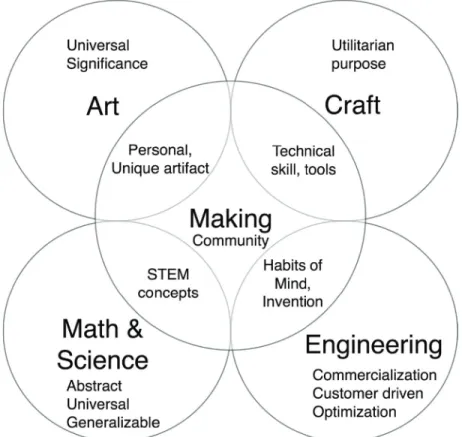
Further, there are theoretical concerns, tensions between maker projects driven by personally relevant goals and exter-nally imposed constraints of curriculum standards of any kind. Moreover, formal education is typically a private pro-cess, where students are assessed and evaluated on individual achievement, which is also at odds with how making repre-sents a shared/collaborative process (Cohen, Jones, Smith, & Calandra, 2017). Perhaps more importantly, there are epis-temological issues to be addressed in merging making into any of these traditional school disciplines. Making has con-nections to art, science, craft s, and engineering, but is not comfortably contained within any of them. Th is relationship is illustrated in Figure 1.
Making as Craft . Making is oft en cited as the natural suc-cessor to tinkering, hacking, and other DIY movements, and technical skills and the use of tools are arguably cen-tral to the paradigm (Bevan, Gutwill, Petrich, & Wilkinson, 2015). Th us, making might be seen as most closely aligning with “craft .” Th e diff erence here is that craft fundamentally comprises a utilitarian function, although coupled to vary-ing degrees with artistry. Th e garment worker and the auto mechanic following standard designs and procedures serve a strictly utilitarian purpose. Designing one’s own clothes or repurposing a gas-powered car to be electric could elevate the work beyond the utilitarian to something more akin to art. Passion drives these endeavors beyond the merely useful.
Making as Art. In contrast, the creative and fanciful nature of making would also seem to align well with the nature of art. It is possible to imagine giant fl ame-throwing robots (Aus-tin Maker Faire, 2016) as art installations in a museum set-ting, and unicorn-headed dancers moving to techno-music (Total Unicorn) or a Tesla coil–playing band (Arc Attack) in a performing arts venue, and homemade cards and orna-mental objects are staples of school art classes. However, as with the utilitarian nature of craft , art comprises a spectrum in terms of deeper meaning. In its purest form, universal
Figure 1. Representation of the relationship between making and art, craft , engineering, and math and science.
Marshall, J. A., & Harron, J. R. A Framework for Evaluating Making in STEM
3 | www.ijpbl.org (ISSN 1541-5015) September 2018 | Volume 12 | Issue 2 Despite differences along the dimensions of utility, uni-versality, customer focus, and abstraction, the strong over-laps with other enterprises might lead one to question what is uniquely characteristic of making. Is making simply the intersection of art, craft, and the STEM disciplines? We argue, as in Figure 1, that it is the maker community itself, in a broad and grassroots sense that uniquely defines making. As argued by Dougherty (2012), “Whether it’s arts and sci-ence or crafts and engineering, they seem to belong together, connected by enthusiasm and a common passion” (p. 12).
Making in Teacher Education
Despite an upsurge in research on making in education and the manifest popularity of the movement (Halverson & Sheridan, 2014), demonstration of its efficacy toward meeting any of its intended learning goals is limited. In particular, there has been little research on effective maker teacher education to date. Much of the peer-reviewed research has taken place in informal spaces, rather than in formal classrooms, or as one-time interventions.
Studies of short-term making activities with pre- and in-service teachers generally show positive results in terms of attitudes and beliefs (Jones, Smith, & Cohen, 2017). Teach-ers in that study considered making to be in alignment with instructional strategies, such as project-based instruction, that had been promoted by their preparation programs. They also expressed concerns about barriers to implementation, including lack of access to resources and resistance from col-leagues and administrators. These are particularly salient in a high-stakes learning environment. Thus, it remains to be seen how and whether these teachers would actually incor-porate making into their future instruction.
While pre- and in-service teachers who are exposed to the maker-centered education tend to have a positive attitude, there has not been a commitment to the pedagogy in most university teacher preparation programs. A national survey by Cohen and colleagues (2017) found that although about half of preservice programs have an opportunity to address some technology and principles associated with making, only 17.1% had access to a makerspace or fabrication lab. Those preservice teachers who are involved in makerspace-based projects as part of their teacher preparation often are frustrated by the learning curve of the equipment (Corbat & Quinn, 2018) or find the practices to be in conflict with their view of what learning looks like (Sator & Bullock, 2017). Fur-thermore, teacher candidates may be confused if preparation programs do not take the time to unpack terminology that is often associated with making (Sator & Bullock, 2017).
Papavlasopoulou, Giannakos, and Jaccheri (2017) reviewed empirical literature on the maker movement and found 43 studies meeting their inclusion criteria, the major-ity using qualitative methods. These studies were limited to significance is essential to recognition of art, whereas no
such recognition is fundamental in making.
Making as Engineering. The “maker mindset” (Dougherty, 2013; Martin, 2015) also has much in common with engi-neering habits of mind (NAE and NRC Committee on K–12 Engineering Education, 2009), as noted in Figure 1, and invention/innovation are central to both making and engi-neering, but the maker ethos is antithetical to the customer-driven nature of engineering. Creation with the client or user in mind is an essential component in engineering, but mak-ing is inherently personal. “Makers work on self-directed projects, and while both the process and product of their work is offered for public consumption, the work itself is often intended for a client base of one” (Cohen et al., 2017, p. 225). Optimization under constraints is also a central tenet in engineering. Although makers also operate under con-straints of time, resources, and physical laws, the best solu-tion is not the fastest, most durable, or most efficient in terms of resources, but rather the one that most pleases the maker. The notion of specifications is foreign to making.
Making as Science and Mathematics. Finally, as noted above, the required science and mathematics curriculum may be the most universally accessed by (or imposed on) American students, but there are significant differences in the nature of science and mathematics vs. making. Although laws of science implicitly govern the manipulation/creation of any physical object, and thus the making of any artifact, science and mathematics in essence strive for the universal and gen-eralizable, whereas making is, again, essentially personal and idiosyncratic. The lines between science, mathematics, and making are blurred, however, as one moves toward a situated paradigm of STEM learning, found, for example, in a problem-based model of instruction (Hmelo-Silver, 2004; Savery & Duffy, 1995).
Situating Making within the Community
In the constructionist framework that underlies making (Pap-ert, 1991), the creation of physical artifacts is privileged over the creation of (inherently unsharable) mental abstractions in promoting learning. Constructionism invokes the affordances of situated cognition inherent in authentic artifacts that will actually be used or enjoyed by students. In making, the abstrac-tion comes from iteraabstrac-tion, an essential feature (Cohen et al., 2017). Through the iterative process of tinkering students can develop intuition and comfort with science concepts (Petrich, Wilkinson, & Bevan, 2013). Following paradigms of learning such as PBL, making indeed can, in fact must, serve as a basis for STEM learning, where the creation of a product is central in some frameworks (Marshall, Petrosino, & Martin, 2010).
workshop settings and did not shed light on making in for-mal classrooms. They call for further investigation, particu-larly in classrooms, aimed at determining which aspects of making are more effective, and with which students.
Thus, there is still a need to advance understanding of making in formal STEM classrooms, its effectiveness in terms of achiev-ing STEM learnachiev-ing goals, and the mechanisms by which teacher preparation programs can promote its authentic implementation.
The Purpose of the Study
The University of Texas at Austin (UT-Austin) has under-taken efforts to promote the maker community among its students, first with the establishment of the Longhorn mak-erspace in the engineering department, The Foundry maker-space open to all UT-Austin students in the fine arts library, and more recently with the establishment of the UTeach Maker (Rodriguez, Harron, & DeGraff, 2018) (https://maker .uteach.utexas.edu) initiative in its pre- and in-service STEM teacher communities. We are also engaged in an NSF-funded effort to investigate the affordances of making in STEM teacher education and professional development.
As a first step toward researching the value of incorporating making into teacher education, it was necessary to articulate the essential elements of making to serve as a guiding frame-work. This framework will serve as the basis for a rubric by which we will judge whether our pre- and in-service teach-ers are, in fact, engaging in making both in our program and, later, with their students.
Method
In the section below we describe the development of a frame-work and rubric for assessing the elements of making in pre-service STEM activities and coursework.
Framework Design
The authors began with a literature review and stakeholder survey in regard to the essential elements of making. We reviewed both research-based and popular literature on making, including peer-reviewed journal articles, practi-tioner journal articles, and frequently cited books on the topic. Following the literature review we surveyed tors noted for incorporating making into STEM instruc-tion, makerspace directors, educational researchers with a focus on making, and others acknowledged as leaders in the maker education initiative. As a result of grounded coding of all these artifacts we identified five essential components of making associated with STEM education. These elements, which are presented in Table 1, include ownership/empow-erment, maker habits, production of an artifact, collabora-tion, and STEM tools.
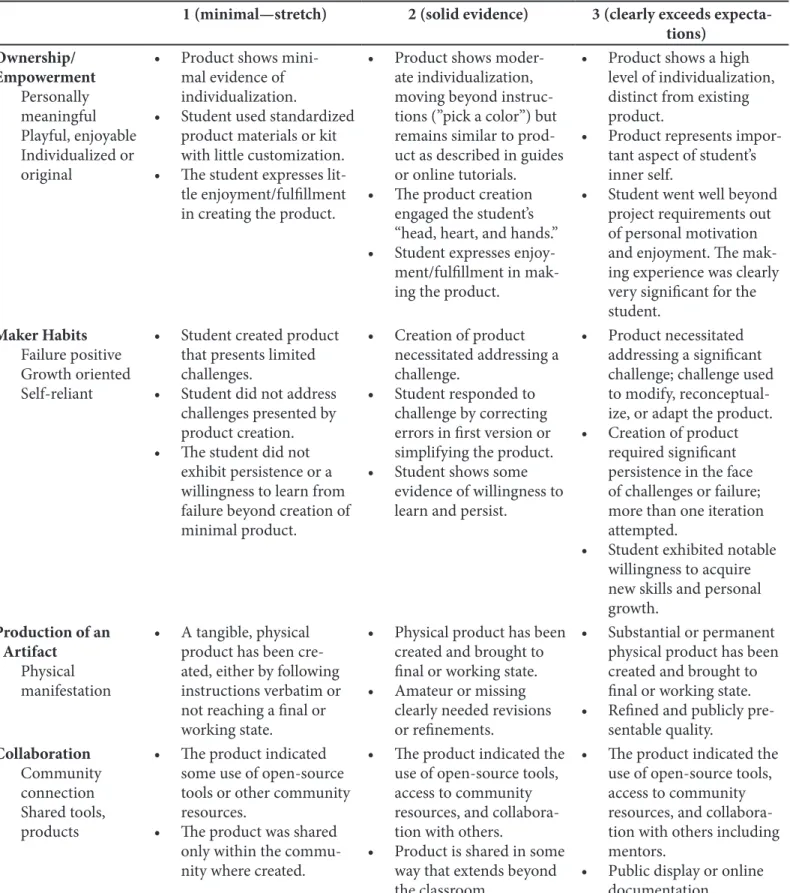
The use of our framework was piloted on an end-of-course making assignment from the first introductory teaching and recruitment class in the UTeach curriculum. For this assign-ment, students were tasked with creating a representation of their trajectory to date as teachers. The authors and two other researchers selected sample artifacts from two class sections taught by the same instructor. Based on pilot results, the frame-work was revised and descriptors were added for clarification. A rubric was developed to aid in assessing the degree with which projects aligned with the framework (see Table 2, next two pages). Levels in the rubric were designed to character-ize work that might exhibit some making characteristics, but would be a “stretch” to classify as making, work that demon-strated the characteristic in an easily defendable way, and work that exceeded expectations for making in the classroom, with artifacts comparable to those that exemplify making in the community. The rubric was piloted first in the introductory course, reviewed by several researchers for ease and agreement
Element Qualities
Ownership/Empowerment Personally meaningful Playful, enjoyable Individualized/original Maker Habits Failure positive
Growth oriented Self-reliant
Production of an Artifact Physical manifestation Collaboration Community connection
Sharing of tools and products STEM Tools Digital tools
Manufacturing tools
Marshall, J. A., & Harron, J. R. A Framework for Evaluating Making in STEM
5 | www.ijpbl.org (ISSN 1541-5015) September 2018 | Volume 12 | Issue 2
1 (minimal—stretch) 2 (solid evidence) 3 (clearly exceeds expecta-tions) Ownership/ Empowerment • Personally meaningful • Playful, enjoyable • Individualized or original
• Product shows mini-mal evidence of individualization.
• Student used standardized product materials or kit with little customization.
• The student expresses lit-tle enjoyment/fulfillment in creating the product.
• Product shows moder-ate individualization, moving beyond instruc-tions (”pick a color”) but remains similar to prod-uct as described in guides or online tutorials.
• The product creation engaged the student’s “head, heart, and hands.”
• Student expresses enjoy-ment/fulfillment in mak-ing the product.
• Product shows a high level of individualization, distinct from existing product.
• Product represents impor-tant aspect of student’s inner self.
• Student went well beyond project requirements out of personal motivation and enjoyment. The mak-ing experience was clearly very significant for the student.
Maker Habits
• Failure positive
• Growth oriented
• Self-reliant
• Student created product that presents limited challenges.
• Student did not address challenges presented by product creation.
• The student did not exhibit persistence or a willingness to learn from failure beyond creation of minimal product. • Creation of product necessitated addressing a challenge. • Student responded to challenge by correcting errors in first version or simplifying the product.
• Student shows some evidence of willingness to learn and persist.
• Product necessitated addressing a significant challenge; challenge used to modify, reconceptual-ize, or adapt the product.
• Creation of product required significant persistence in the face of challenges or failure; more than one iteration attempted.
• Student exhibited notable willingness to acquire new skills and personal growth. Production of an Artifact • Physical manifestation • A tangible, physical product has been cre-ated, either by following instructions verbatim or not reaching a final or working state.
• Physical product has been created and brought to final or working state.
• Amateur or missing clearly needed revisions or refinements.
• Substantial or permanent physical product has been created and brought to final or working state.
• Refined and publicly pre-sentable quality. Collaboration • Community connection • Shared tools, products
• The product indicated some use of open-source tools or other community resources.
• The product was shared only within the commu-nity where created.
• The product indicated the use of open-source tools, access to community resources, and collabora-tion with others.
• Product is shared in some way that extends beyond the classroom.
• The product indicated the use of open-source tools, access to community resources, and collabora-tion with others including mentors.
• Public display or online documentation.
of use in scoring, and then revised until consensus was reached. Descriptions of the categories in the rubric follow.
Ownership/Empowerment. With Clapp and colleagues (2016), we identify ownership and empowerment as the first/primary element of making. Making enables students to create things that they actually want to have in their lives; makers engage passionately with the objects of their creation (Dougherty, 2012). Just as almost anyone can be compelled to sing in a music class, but not everyone self-identifies as a singer, having assembled something does not automati-cally qualify someone as a maker. In making there must be a sense of agency, some sense of individual empowerment and choice (Cohen et al., 2017). Ownership might manifest itself simply as personalization; a choice of color, writing one’s own name in lights, but in the ultimate incarnation maker projects become “like little pieces of us and seem to embody portions of our souls” (Hatch, 2014). Although ownership and empowerment seem to be universally acknowledged as central to making, more research is needed into how this ele-ment interacts with learning (Martin, 2015).
Maker Habits. Just as a sense of optimism is inherent in engi-neering habits of mind, optimism characterizes the maker community (Dougherty, 2012). Makers are failure-positive (view setbacks as opportunities to learn), growth oriented (believe that they can learn and do what they need to), and self-reliant. Makers are characterized as risk takers (Bevan et al., 2015). Maker habits operationalize as taking on intel-lectually challenging tasks, or choosing to make things that require the acquisition of new knowledge or skills, and in a willingness to engage in multiple design and construction iterations to achieve a desired product.
Production of an Artifact. Artifacts that are constructed in the maker movement are usually very personal in nature, where creators have very few limitations placed on their creativity.
Making in educational environments, despite constraints, still provides students with the freedom to create some-thing that is personally meaningful while also attempting to broaden their deeper thinking and inquiry skills. At the most basic level, products constructed can be created following a set of instructions or sometimes abandoned in an incomplete state. However, as makers develop their skills, working prod-ucts can be created, improved upon, and shared with others to, in turn, inspire them to make their own creations. The practices of designing, personalizing, sharing, and reflecting are essential for learning in constructionist environments (Papert, 1991).
Collaboration. As noted above and in Figure 1, we view com-munity as the heart of the making enterprise. The shared nature of learning is an essential element of constructionism (Papert, 1991). Dougherty (2012) highlights the origin of Maker Faires as an opportunity to come together and share. This includes both giving and receiving advice, help, and resources. The plethora of online as well as physical forums for sharing both the process and products of making provide users with very little technical background an access to mak-ing. Collaboration manifests itself in the use and repurpos-ing of existrepurpos-ing resources, such as open-source code routines or posted mechanical designs, in original projects, as well as the sharing of finished artifacts in a public forum.
STEM Tools. In placing STEM tools last among the essential elements of making, we acknowledge the danger of a tool-centered focus in making (Martin, 2015). The movement away from what are perceived as “women’s” tools (those used in sewing, baking, quilting, knitting) and more acces-sible mechanical tools (hammers, saws, calculators) toward more complex digital tools lent the maker movement an exclusionary air, possibly discouraging the participation of both women (Buechley, 2013) and those who do not iden-tify as “tech savvy.” Still, we argue that incorporating making
1 (minimal—stretch) 2 (solid evidence) 3 (clearly exceeds expecta-tions)
STEM tools
• Digital
• Manufacturing
• The student shows the ability to use STEM mate-rials, concepts, or skills.
• Successful application of STEM tools and skills (e.g., metal or wood working, sewing, knitting, weaving, mathematical algorithms for spatial lay-out and part design, 3-D printers, digital recording) in a new context.
• The student has developed and documented origi-nal tools, processes, or procedures.
• The student has demon-strated significant STEM expertise through the project.
Marshall, J. A., & Harron, J. R. A Framework for Evaluating Making in STEM
7 | www.ijpbl.org (ISSN 1541-5015) September 2018 | Volume 12 | Issue 2 into the standard school curriculum would work against this
stigma, and we have defined STEM tools broadly and explic-itly to include both digital and physical manufacturing tools, in particular those such as sewing machines and knitting needles that have traditionally been associated with women. The extent to which STEM tools can be made critical in the design of maker tasks that are ultimately student-driven, however, remains to be seen.
Commonalities with Other Maker Education Frameworks
Our framework has commonalities with other published maker education frameworks. The Agency by Design frame-work examines maker-centered education through the lens of maker empowerment, defined as “[h]aving a sensitivity to the design of objects and systems along with the inclination and capacity to shape one’s world through building, tinker-ing, re/designtinker-ing, or hacking” (Clapp et al., 2016, p. 103). That framework also foregrounds agency, but presents the essential elements in three interacting capacities: looking closely, exploring completely, and finding opportunity. These focus much more on the process of development (as opposed to the nature of making and makers).
The Tinkering Learning Dimensions (TDL) framework (Bevan et al., 2015) consists of four learning dimensions: (a) engagement, (b) initiative and intentionality, (c) social scaffolding, and (d) development of understanding. Much as our framework recognizes the importance of develop-ing maker habits, Bevan and colleagues (2015) recognized that the growth and persistence of the learner are important, and that social scaffolding/collaboration are important ele-ments of learning in a community. While the TDL frame-work is learner focused, it serves as a tool to better evaluate free-form tinkering rather than open-ended problem-based learning, such as the design problem described below.
Participants
Using our framework and rubric as a form of evaluation, stu-dents in a preservice physics class were assigned the open-ended problem to create something of personal interest that involved electric circuits or optics, the two broad curricu-lum topics for the course. Following this student-centered pedagogy, the students were able to define their own project that best complemented their existing knowledge and ability level. The class had 20 students enrolled, of which 19 con-sented to participate in this study. Students could request supplies for their projects, such as Arduino microcontrollers, which were purchased with material funds allocated for the class. Additional technical support was provided by both the authors via email and by appointment for in-person help as
needed. All projects were independently evaluated by two coders using the rubric, and differences were negotiated until agreement was reached, resulting in minor modifications to the rubric (Marshall & Harron, 2017).
Exemplars: Making and STEM
Learning in a Physics Class
Examples of projects that scored at various levels of the rubric in different categories are highlighted below.
Ownership/Empowerment
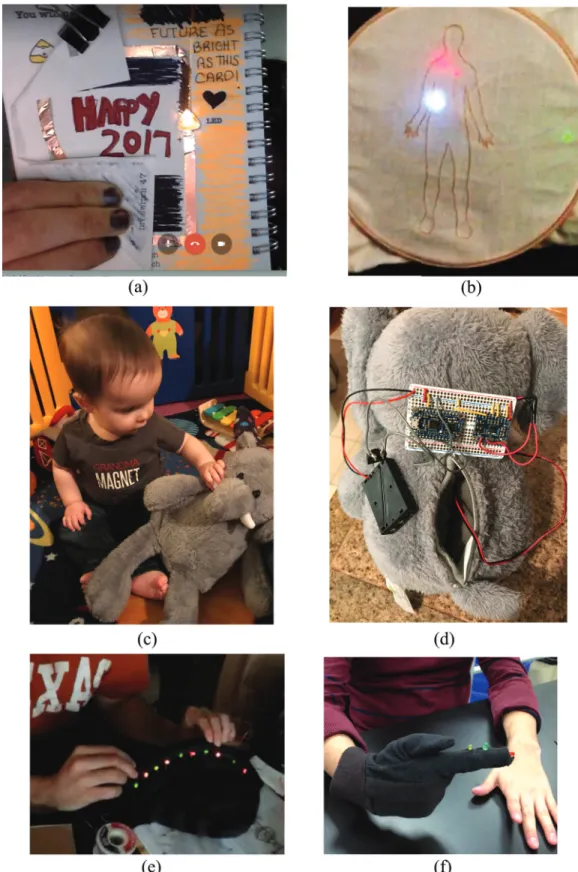
On the lower end of the empowerment/ownership scale, projects that were rated as indicating only minimal owner-ship included a holiday card made with a Chibitronics kit (see Figure 2a, next page) and a curriculum manual for a middle school science unit using Snap Circuits (http://www.elenco .com). Although the student creating the unit was teaching middle school science and might have used it herself at some point, it was intended as a close-ended generic resource for teachers and did not capture the enjoyable/playful aspect of making. While a study by Remold, Fusco, Anderson, and Leones (2016) highlighted that there is a need for maker-centered teacher resources, this may indicate that teachers who are new to maker-centered education may confuse the act of building/constructing with commercial education kits as an authentic form of making.
On the high end of the spectrum, a future biology teacher created an embroidered model of the human circulatory sys-tem (see Figure 2b, next page), combining her first love of hand stitching with her teaching vocation. During the pro-cess the teacher had to overcome challenges such as calcu-lating the resistance needed to illuminate different colored light-emitting diodes (LEDs) in a parallel circuit. A stu-dent teaching mathematics at the high school level created a stuffed toy with a sound module embedded that played a recording of her own heartbeat for her first child (see Figures 2c and 2d). This project was viewed as having a high degree of ownership due to the personally meaningful nature of the project, as well as empowerment, as the student needed to learn new programming skills to control the sound module.
Maker Habits
The project involving Snap Circuitsalso scored lower in terms of maker habits. Curriculum development was not new to the student and she also had some prior experience with Snap Circuits. Thus, creating the unit did not pose major chal-lenges or opportunities for growth. At the other end of spec-trum, the student creating the stuffed toy had never worked with an audio module (or any sort of integrated circuit) and
Figure 2. Examples of project artifacts: (a) Chibitronics greeting card, (b) embroidered model of the human circulatory system, (c) stuff ed elephant, (d) circuit inside of stuff ed elephant, (e) stocking cap ornamented with fl ashing LEDs, and (f) “laser glove.”
Marshall, J. A., & Harron, J. R. A Framework for Evaluating Making in STEM
9 | www.ijpbl.org (ISSN 1541-5015) September 2018 | Volume 12 | Issue 2 never used a soldering iron. Her first attempts at uploading
the recording of her heartbeat to the audio module failed because only a certain type of mini-SD memory card would work with the module, a fact that she discovered by research-ing user posts on an online forum for makers. Workresearch-ing over the Thanksgiving break, she was able to assemble a working module by the end of the semester, but the sound quality was poor and the construction not robust. She continued to work after the end of the semester, rebuilding with a different audio module and an enclosed speaker system, and presented the final product to her son almost a year later.
Production of an Artifact
In contrast to the ratings in the first two categories, the Snap Circuits curriculum unit scored a solid 3 in the artifact cat-egory. Although the resulting artifact was digital (online), it was completely robust and professionally produced, and was, in fact, distributed to other teachers. All of the prod-ucts reached at least the second level on the rubric (solid evidence) by creating products that worked, at least tempo-rarily. An example is a stocking cap ornamented with flash-ing LEDs (Figure 2e, see previous page) that worked in the classroom, but failed while being used by the student after the classroom presentation.
Collaboration
The student who created the embroidered representation of the human circulatory systems scored in the highest cat-egory here. She created a website describing her process and product and went on to model it at maker events. The act of sharing publicly in conjunction with attending maker events demonstrated that she was becoming a member of both the online and local maker communities. On the other hand, the student who created a “laser glove” with LEDs (Figure 2f, see previous page) only worked with the instructor of the course and a graduate research assistant rather than engaging in col-laboration with peers or online forums. The creator of the glove also did not share his project outside of the class pre-sentation, and thus scored lower in this category.
STEM Tools
Almost all the projects scored in the middle category on STEM tools, with the makers having successfully learned and employed STEM tools, including soldering irons, band saws, embroidery and sewing tools, the Scratch programming environment, a Raspberry Pi microcomputer, and maker kits from Chibitronics and Lily Pad Arduino. There were no examples, however, that scored in the top category, as none of the projects were judged to involve the development and documentation of original tools, processes, or procedures, although many did develop original solutions in response to
construction issues. This is the one area in which the rubric was not aligned with the full range of projects, and may indi-cate a need for further revision.
Discussion
As the practices related to making find their way into the STEM classroom, it is important for educators to have a means of evaluating student work that does not rely on the traditional notions of transfer of knowledge and memorization in the classroom. Our framework provides one possible method to help educators think about how making can empower students to develop positive maker habits, experience the frustration and satisfaction of developing a personally meaningful arti-fact, collaborate with others in both the process of construct-ing and sharconstruct-ing artifacts, and have an opportunity to explore STEM-related tools that can fuel their curiosity and creativity. Using making as an outlet to engage in problem-based learning may seem overwhelming to educators implement-ing these practices for the first time. We believe the collabora-tive nature of making can address this issue. Further, making lends itself perfectly to problem-based pedagogy and should be explored by educators who are interested in providing stu-dents with a high degree of autonomy in the classroom.
Conclusion
To date, we have been able to use the framework and rubric described here effectively in several teacher education courses. A limitation of the work is that the rubric has only been used by a small number of researchers in one teacher preparation program. Whether the rubric as currently configured would categorize the span of work in other classes where maker edu-cation is being attempted remains to be seen.
Still, creation of the rubric and exemplars is only a first step toward researching the effect of incorporating making into STEM teacher preparation on both teachers and ultimately on their future students. Given the required resources, infra-structure (in terms of equipment and space), and teacher preparation necessary to implement making in education, whether and how it will affect student outcomes, particularly in regard to STEM learning, is important to assess. The ques-tion of whether making enables not only empowerment, but also STEM learning as measured against national, state, and local standards, remains to be addressed.
Acknowledgments
This work was supported by National Science Foundation grant NSF DUE-1557155 UTeach Noyce Scholarships and Stipends: Making Teachers.
References
Bevan, B. (2017). The promise and the promises of making in science education. Studies in Science Education, 53(1), 75–103. https://doi.org/10.1080/03057267.2016.1275380 Bevan, B., Gutwill, J. P., Petrich. M., & Wilkinson, K. (2015).
Learning through STEM-rich tinkering: Findings from a jointly negotiated research project taken up in practice.
Science Education, 99(1), 98–120.
Blikstein, P. (2013). Digital fabrication and “making” in edu-cation: The democratization of invention. In J. Walter-Herrmann & C. Büching (Eds.), FabLabs: Of machines, makers and inventors (pp. 203–222). Bielefeld, Germany: Transcript Publishers.
Buechley, L. (2013, October). Closing address. FabLearn Conference, Stanford University, Palo Alto, CA. Retrieved from http://edstream.stanford.edu/Video/Play/883b61dd 951d4d3f90abeec65eead2911d
Clapp, E. P. (2017). Empowering young people to shape their worlds through maker-centered learning. Available at http://makered.org/blog/empowering-young-people-to -shape-their-worlds-through-maker-centered-learning/ Clapp, E. P., Ross, J., Ryan, J. O., & Tishman, S. (2016).
Maker-centered learning: Empowering young people to shape their worlds. San Francisco, CA: Jossey-Bass.
Cohen, J., Jones, W. M., Smith, S., & Calandra, B. (2017). Makification: Towards a framework for leveraging the maker movement in formal education. Journal of Educa-tional Multimedia and Hypermedia, 26(3), 217–229. Corbat, J., & Quinn, C. (2018, April). Engaging preservice
teachers in the makerspace: Embracing the maker movement in a multi-level teacher preparation program. Presentation at the annual convention of the Society of Information Technology and Teacher Education, Washington, DC. Dougherty, D. (2012). The maker movement. Innovations:
Technology, Governance, Globalization, 7(3), 11–14. https:// doi.org/10.1162/INOV_a_00135
Dougherty, D. (2013). The maker mindset. In M. Honey & D. E. Kanter (Eds.), Design. Make. Play. Growing the next generation of STEM innovators (pp. 7–16). New York, NY: Routledge.
Halverson, E. R., & Sheridan, K. (2014). The maker movement in education. Harvard Educational Review, 84(4), 495–504. https://doi.org/10.17763/haer.84.4.34j1g68140382063. Hatch, M. (2014). The maker movement manifesto. New York:
McGraw-Hill.
Hmelo-Silver, C. E. (2004). Problem-based learning: What and how do students learn? Educational Psychology Review, 16(3), 235–266.
Jones, W., Smith, S., & Cohen, J. (2017). Preservice teach-ers’ beliefs about using maker activities in formal K–12
educational settings: A multi-institutional study. Journal of Research on Technology in Education, 49, 134–148. Marshall, J. A., & Harron, J. (February, 2017). The maker
movement in a UTeach physics class, American Associa-tion of Physics Teachers Meeting, Atlanta, GA.
Marshall, J. A., Petrosino, A. J., & Martin, H. T. (2010). Pre-service teachers’ conceptions and enactments of Project Based Instruction. Journal of Science Education and Tech-nology, 19(4), 370–386.
Martin, L. (2015). The promise of the maker movement for education. Journal of Pre-College Engineering Educa-tion Research, 5(1), 30–39. https://doi.org/10.7771/2157 -9288.1099
NAE and NRC Committee on K–12 Engineering Education. (2009). Engineering in K–12 education: Understand-ing the status and improvUnderstand-ing the prospects. Available at: http://citeseerx.ist.psu.edu/viewdoc/download?doi=10.1 .1.470.5912&rep=rep1&type=pdf
National Academy of Engineering Committee on Standards in K–12 Engineering Education. (2010). Standards for K–12 engineering education? Retrieved from http://www. nap.edu/catalog.php?record_id512990/standards-for-k -12-engineering-education
Papavlasopoulou, S., Giannakos, M., & Jaccheri, M. L. (2017). Empirical studies on the maker movement, a promising approach to learning: A literature review. Entertainment Computing, 18, 57–78. https://doi.org/10.1016/j.entcom .2016.09.002
Papert, S. (1991). Situating constructionism. In I. Harel & S. Papert (Eds.), Constructionism (pp. 1–11). Norwood, NJ: Ablex.
Peppler, K., Halverson, E., & Kafai, Y. B. (2016). Chapter 1: Introduction to this volume. In K. Peppler, E. Halverson, & Y. B. Kafai (Eds.), Makeology: Makerspaces as learning environments (Vol. 1, pp. 1–11). New York, NY: Routledge. Petrich, M., Wilkinson, K., & Bevan, B. (2013). It looks like
fun, but are they learning? In M. Honey & D. E. Kanter (Eds.), Design, make, play: Growing the next generation of STEM innovators (pp. 50–70). New York, NY: Routledge. Remold, J., Fusco, J., Anderson, K., & Leones, T. (2016),
Com-munities for maker educators: A study of the comCom-munities and resources that connect educators engaged in making.
Menlo Park, CA: SRI International.
Rodriguez, S. R., Harron, J. R., & DeGraff, M. W. (2018). UTeach Maker: A micro-credentialing program for pre-service teachers. Journal of Digital Learning in Teacher Education, 34(1), 6–17. https://doi.org/10.1080/21532974 .2017.1387830
Sator, A. J., & Bullock, S. M. (2017). “Making” as a catalyst for reflective practice. Reflective Practice, 18(2), 244–255. https://doi.org/10.1080/14623943.2016.1268118
Marshall, J. A., & Harron, J. R. A Framework for Evaluating Making in STEM
11 | www.ijpbl.org (ISSN 1541-5015) September 2018 | Volume 12 | Issue 2 Savery, J. R., & Duffy, T. M. (1995). Problem based learning:
An instructional model and its constructivist framework.
Educational Technology, 35(5), 31–38.
Jill Marshall is the Associate Co-Director of the UTeach sec-ondary STEM teacher preparation program and Associate Professor in the STEM Education group at the University of Texas at Austin. She received her BS from Stanford in 1980 and her PhD from the University of Texas in 1984, both in physics. She is a past President of the American Associa-tion of Physics Teachers and Advisory Board member of the Physics Teacher Education Coalition. Her research interests include teacher preparation and student learning in science and engineering at the secondary and postsecondary levels. Jason R. Harron is a PhD candidate at the University of Texas at Austin. His research focuses on how technology helps lower the barriers for people to be creative and self-expres-sive. Through the exploration of design, play, and tinkering, his work seeks to better understand how to support individ-uals to become lifelong learners in both formal and informal learning environments.