SELECTING HIGHER EDUCATION SYSTEM
(FutureEDU.com)
By
RAFIQAH BINTI ZAINAL ABIDIN
16326
Dissertation submitted in partial fulfilment of the requirements for the
Bachelor of Technology (Hons)
Information Communication Technology
May 2015
Universiti Teknologi PETRONAS Bandar Seri Iskandar
31750 Tronoh Perak Darul Ridzuan
CERTIFICATION OF APPROVAL
Selecting Higher Education System (FutureEDU.com)
By
Rafiqah Binti Zainal Abidin A project dissertation to the
Information and Communication Technology Programme Universiti Teknologi PETRONAS
in partial fulfillment of the requirement for the BACHELOR OF TECHNOLOGY (Hons)
(INFORMATION and COMMUNICATION TECHNOLOGY)
Approved by,
(Dr. HELMI MD. RAIS)
UNIVERSITI TEKNOLOGI PETRONAS BANDAR SERI ISKANDAR, PERAK
CETIFICATION OF ORIGINALITY
This is to certify that I am responsible for the work submitted in this project, that the original work in my own except as specified in the references and
acknowledgements, and that the original work contained herein have not been undertaken or done by unspecified sources or persons.
ABSTRACT
There are facts that choosing a major course has serious implications for the majority of students. The rapid growing of higher education institution in Malaysia cause students more confused in making decision. With the problem of student confusion, a project named FutureEDU.com is proposed to be created. The purpose of this project as Decision Support System is narrowing choice of major course and university for student based on the personality test answer collected by students in the system. This system also provides the information of pre universities and also the institution that offered the program. The existence of this system will able to assist student in making a right decision for their higher education. Students will no longer having an uncertainty in making decision. It will also increase their level of confidence in pursuing their higher education. This can help them to be more focused and successfully complete their study without changing major course. This project will use the RAD development methodology and proposed for 12 months to be completed. A session of testing has done with 25 users which come from different age to test and review the system. Many of them seem excited and happy with the existence of this system as they have the knowledge and also the guidance about their higher education. It is concludes that this project can assist student in making a right decision and enables them to identify their area of interest. This system also gives the benefits in terms of choosing the right path in students’ life and also gives the big impact in decreasing the number of students that changing major course because of the uncertainty decision at the first place.
ACKNOWLEDGMENT
Foremost, Alhamdulillah praised to ALAH who made all the things good. I gratefully acknowledges to the following people for helping me during my degree program. Studying in a world ranking university has been a wonderful and enrich episode of my life. And finally, I am reaching the end of my study after spending 4 years in UTP. The final outcome of my final year project required a lot of guidance and assistance from various people.
I am extremely fortunate to receive undivided support from everyone, including: parents, lecturers, friends and people who are involved directly or indirectly in this project. And to be honest, I manage to stay and stand here today due to great guidance and assistance from the people surround me
Therefore, I would like to express my sincere gratitude to my supervisor Dr.Helmi Bin Md Rais, for his assistance and encouragement in the completion of my final year project. This project would not be possible without his guidance.I owe my profound gratitude to my classmate, who took keen interest on my work project and guided me all along by providing all the necessary information for developing a good system. I also would like to give my deepest appreciation to my nephew and his fellow friends whom I am deeply indebted to, for their help and contribution towards my journey to complete my final year project.
Not forgetting, a handful thank you to UTP and our coordinator, Dr Sobri for giving such a constant encouragements, support and guidance throughout the semester for us to come out with an excellent project and report.
Last but not least, I would like to extend my heartily and sincere regards to my superiors, seniors, mentors and fellow friends from UTP and other universities who contribute directly or indirectly in helping me to experience such an enjoyable and precious moment of developing this FutureEDU.com system. Without their helps and assistance, the experience and success will never be as what it is now. Thank you once again.
TABLE OF CONTENTS
ABSTRACT ACKNOWLEDGMENT CHAPTER 1: INTRODUCTION 1 1.1 Background of Study 2 1.2Project Objectives 2 1. 3 Problem Definition 2CHAPTER 2: LITERATURE REVIEW 6
2.1 Higher Education in Malaysia 6
2.2 The Importance of Choosing the Right Choice for Higher Education 9 2.3 Factors Influencing Students’Decision Making Choosing Higher Education 10
2.4 Issue Related to Higher Education 12
2.5 Personality Test (Holland Codes) 13
2.6 The need of FutureEDU.com System 15
2.7 Existing system 16
CHAPTER 3: METHODOLOGY 18
3.1 Research Methodology 18
3.3 Key Milestone 27 3.4 Tools (eg. Equipment, hardware, etc) required 27
CHAPTER 4: RESULTS AND DISCUSSION 28
4.1 Result Findings 28
4.2 Comparative Existing System and Proposed System 36
4.3 Prototype 36
4.3 Testing 47
CHAPTER 5: CONCLUSION AND RECOMMENDATION 51
5.1 Conclusion 51
5.2 Recommendations 52
REFERENCES APPENDIXES
LIST OF FIGURES
Figure 1: RIASEC Hexagon Figure 2: Afterschool.my Figure 3: EduAdvisor.my Figure 4: RAD Model Figure 5: System Flow Figure 2: Demography
Figure 3: Difficulties in Choosing Higher Education
Figure 4: If yes, which one is more difficult and challenging to choose
Figure 5: Are you familiar with the institutions and programs offered in Malaysia Figure 6: The answered of having any personality test before
Figure 7: Level of satisfaction in current field of study Figure 8: Level of satisfaction in current University Figure 9: Rating for CGPA
Figure 10: Have you ever experienced in changing program of study Figure 11: Advice comment for future students
Figure 12: Home Page Figure 13: Pre- Universities Figure 18: Field of study Figure 19: Accounting Course Figure 20: Universities
Figure 21: University’s Information Figure 22: EduAdvisor Tab
Figure 23: Scholarship Tab
Figure 14: FutureEDU.com Main Page Figure 15: FutureEDU.com Main Page Figure 16: FutureEDU.com About Us Figure 17: Select Level Of Studies Figure 18: Foundation Course
Figure 19: Foundation Course Grid View Figure 20: Field Of Study
Figure 21: Course Description Figure 22: University
Figure 23: Course Recommender
Figure 24: List of major based on Holland Codes Figure 25: Final Three Suggested Course
Figure 26: Scholarship
Figure 27: Testing Demography
Figure 28: How do you rate the functionality of FutureEDU.com system in terms of performance?
Figure 29: How do you rate the graphical user interface design of this system? Figure 30: How do you rate the system in terms of user friendliness?
Figure 31: How do you rate the information provided by this system? Figure 32: Do you understand the concept of this system?
Figure 33: Does this FutureEDU.com help users to easily choose the best programme and university to enrol in much easier?
Figure 34: Does this application help users to easily make comparison on the institution?
LIST OF TABLES
Table 1. List of Public Universities Table 2. List of Private Universities Table 3. Personality Test
Table 4. Comparative Study Table 5: Gantt Chart
Table 6: Key Milestone
1
CHAPTER 1
1.0
INTRODUCTION
1.1 Background Study
Malaysia towards its high income nation has put higher education system as one of the key element to achieve their 2020 mission. Numbers of initiatives have been done by the government to ensure the mission is achieved. Part of its plan is to be the hub of higher education excellence in Southeast Asia. Malaysia also through its Ministry of Higher Education (MOHE) has boarded a national higher education plan from 2007-2020 to achieve the world-class status among its universities. This has been incorporated as one of the primary objectives under the Strategic Plan, in line with the national agenda to make Malaysia as a preferred Centre to pursue higher education.
This agenda is targeted to change the society perception on the importance of pursuing higher education. It is no longer considered an option but a need for everybody to pursue their education towards the higher level. As a result, the number of universities and graduates in Malaysia has increasing yearly. As of 31 August 2009, there were 20 universities, 20 college universities, five branch campuses and 470 colleges that were registered with the Private Higher Educational Institution Management Sector.
With all these changes, Malaysia now not only has the tremendous number of higher education institution but also the programme to be offered to their students. At the surface level, it may sounds good and benefit to the school leavers when they are in the position to choose the best course for them, but when we zoom in to the real scenario, noted that many school leavers do not have the basic knowledge and always have a problem to select their major course and programme to pursue their study especially when they are a lot of options offered to them. This should not have happened. A proper guideline shall be provided to assist them to opt the best for their tertiary education.
2 In my humble opinion, I believe that national agenda to be the world class universities and the education level is at their best will not achieve if the fundamental of the higher education is not in place. As such, this project will develop a web based system of selecting their program and major course based on relevant factors and courses details offered by the higher education institution. By having this system as a tool to select, the students will have more assurance on their decision ultimately will yield a quality and successful graduate to the family, nation and the country.
1.2 Project Objectives
This project is to develop a web based system of selecting program and major course in higher education for secondary school leavers. There are three main objectives for this project which are achievable and can be measured for better result analysis and further enhancement in future work. The objectives are:
i. To identify the weakness of students in their personality and interest by answering the personality test.
ii. To develop a system that gives the assurance to student in selecting their higher education based on their interest and qualification.
iii. To validate on the relevant information about the courses, programs and the universities that offers the programs.
1.3 Problem Definition
Project is normally created as the solution or the enhancement to the flaws that always happened in the surrounding. Findings from the current situation show some weaknesses which are:
3
Students having difficulties to identify their personality.
Personality is an individual’s unique group of consistent interactive traits. It has a significant role in deciding self-enthusiasm, interest and skill. Research has shown that individuals who choose course and careers that are closely aligned with their interests, skills, values and personality tend to be more satisfied and enjoy greater success. In this concept shows that personality is one of the important factor that need to be considered in choosing the course of higher education. However, our students in Malaysia don’t really care about their personality, and what they actually desire. Most of them are influenced by concerned people like parents, educators, relations, friends and peer who are genuinely interested in their education prospects. Furthermore, the less encouragement by people surrounding regarding the self-assessment also contribute the reason why students having difficulties to identify their personality. Thus, this system requires students to answer personality test and provide them the result to know their type of interest or personality.
Many choices of programmes and universities (public and private universities) offered in Malaysia
There are more than 100 Universities and programmes offered in Malaysia nowadays. Due to that, many students’ especially secondary school leavers confused in choosing the programme and place for their higher education. The other major concern when deciding on choices is financial situation because education does not come cheap. Thus, the decision-making to select the correct institution for higher education would be a tough one. To solve these problems, this web based system is introduced to help secondary school leavers to choose the best programme or university by filtering the information that match with their needs.
4
Students have lack information about the course, programme and Universities that offers the programs.
Moving from secondary school to universities is not an easy move. Many students choose their higher education influenced by family decision especially if the elder has taken the choice. Only by that, student will have enough information regarding the programme. The rest usually have a problem in making decision for their tertiary education. Most of them have lack of information about the course, program and universities that offered the programs. Thus, this system provides the relevant information about the courses, programs and the universities that offers the programs to students.
Uncertainty in making decision
The process of selecting the right programme and universities was sometimes quite hard for the SPM leavers. Referring to the study conducted by Smith and Cavusgil, the university selection process needs more than one issue to be considered. The process must include the academic reputations, accreditations, proximity, cost, and potential marketability of the degree. Other than that students also considered quality and flexibility of the degree/course combinations, availability of accommodation, whether or not employers are likely to recruit from that university, costs, spatial proximity to home . Therefore, it is important to create and develop a method to assist and provide the suitable suggestions to the secondary school leaver.
Due to all the problems stated above, following are the expected deliverables on this project: A web-based system for students with below details:
Personality test with the result.
Preferred programme based on interest and qualification of students.
5 1.3 Scope of study
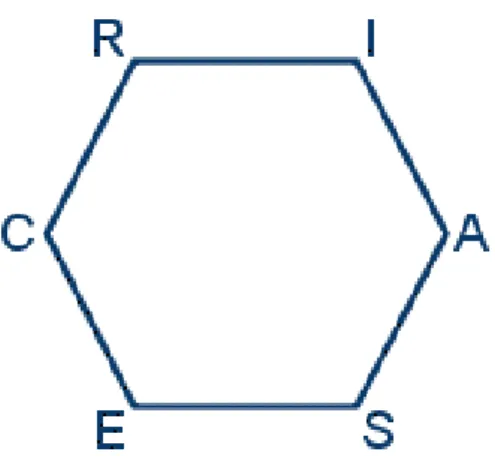
This project focuses on a few scope of study. The first one is secondary school leavers. The secondary school leavers are mostly in range between 17 years until 20 years old. Normally, age in their range always have a problem in making decision for their higher education. Thus, this system well suit with them to ensure their decision in choosing programmes and University as an early preparation to further the studies. The first factor that needs to be considered in choosing the programs is personality. For the personality test, this project used Holland Code personality test. Holland Code personality test is a theory of careers choice based upon personality type. Holland Code personality test consists of six different personality codes which are Realistic (R), Investigative (I), Artistic (A), Social (S), Entrepreneur (E) and Conventional (C). Holland Code personality test required a user to select several characteristics that appealed to them the most and the end result will show the user the most code that suits with their personality. Holland Code will tell the user the most suitable future job career that matches with their personality. In this study, only the public and some private universities in Malaysia are being focused on. This is due to the time framework of the project. It takes longer time to collect all information about the programmes offered by public and private universities and compiled it into this project database. Furthermore, this project required long processes to match the programmes and universities with the Holland Code. All public universities are included in this project but due to the time constraints only certain private universities are selected to be in the list of universities as a sample in this project.
6
CHAPTER 2
2.0 LITERATURE REVIEW
2.1 Higher Education in MalaysiaHigher Education is an elective finishing stage of formal learning after finish the secondary school. Higher education often provided at Universities. A higher education qualification at degree level will be completes not less than 3 years, and typically more than four. It will contain a theoretical basis, where it normally qualifies a person to work in professional field. Briefly, higher education mainly and generally means university level of education. It offers some of the qualifications starting from Higher National Diplomas and Foundation Degrees to Honours Degree and as further step, Postgraduate programmes such as masters Degrees to Doctorates.
In Malaysia, Higher Education is overseen by Ministry of Higher Education (MOHE). The Ministry of Higher Education (MOHE) was established on 27 March, 2004 with the purpose of developing and creating a higher education environment to inspire the establishment of centres of knowledge, and the development of competent, innovative and ethical individuals thus fulfilling national and international aspirations (Higher Education Portal, 2011). Higher Education in Malaysia can be found in two categories which are Public Institutions of Higher Education (PIHE) and Private Institutions of Higher Education (PvIHE). At each state in Malaysia, Education Department plays similarly important role to coordinate and implement education agenda in its territory.
As of 31st August 2009, there were 20 universities, 20 college universities, five branch campuses and 470 colleges that were registered with the Private Higher Educational Institution Management Sector. Malaysia now is known for an international hub for quality higher education which one of the popular destination for students from countries around the world pursuing higher education.
7
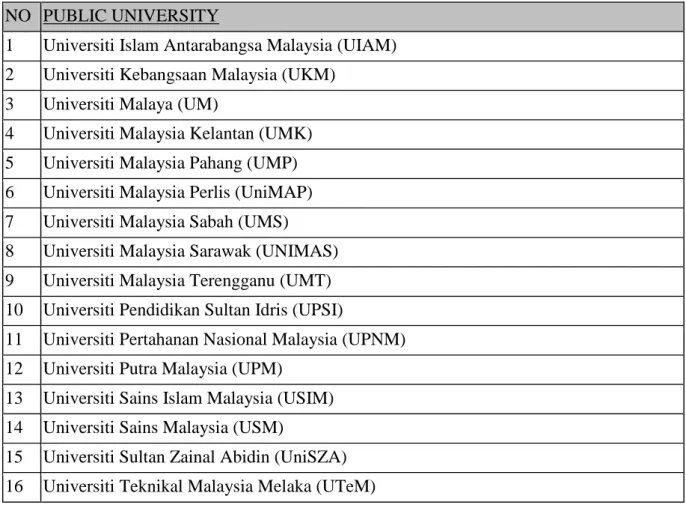
Table 7. List of Public Universities
NO PUBLIC UNIVERSITY
1 Universiti Islam Antarabangsa Malaysia (UIAM) 2 Universiti Kebangsaan Malaysia (UKM)
3 Universiti Malaya (UM)
4 Universiti Malaysia Kelantan (UMK) 5 Universiti Malaysia Pahang (UMP) 6 Universiti Malaysia Perlis (UniMAP) 7 Universiti Malaysia Sabah (UMS) 8 Universiti Malaysia Sarawak (UNIMAS) 9 Universiti Malaysia Terengganu (UMT) 10 Universiti Pendidikan Sultan Idris (UPSI)
11 Universiti Pertahanan Nasional Malaysia (UPNM) 12 Universiti Putra Malaysia (UPM)
13 Universiti Sains Islam Malaysia (USIM) 14 Universiti Sains Malaysia (USM)
15 Universiti Sultan Zainal Abidin (UniSZA) 16 Universiti Teknikal Malaysia Melaka (UTeM)
Table 8. List of Private Universities
NO PRIVATE UNIVERSITY 1 Monash University
2 Asia Metropolitan University (AMU) 3 Taylor’s University
4 Universiti Teknologi PETRONAS (UTP) 5 Multimedia University (MMU)
6 Management and Science University (MSU) 7 Infrastructure University Kuala Lumpur
8 Malaysian Institute for Supply Chain Innovation (MISI) 9 Management and Science University
10 Universiti Selangor (UNISEL)
11 Universiti Tun Abdul Razak (UNIRAZAK) 12 Universiti Tunku Abdul Rahman (UTAR) 13 University of Wales
8 14 Raffles University Iskandar (RUI)
15 Swinburne University of Technology Sarawak Campus 16 The University of Nottingham Malaysia Campus 17 Wawasan Open University
18 AIMST University
19 Albukhary International University
20 Al-Madinah International University (MEDIU) 21 INTI International University
22 Open University Malaysia (OUM)
23 International Centre for Education in Islamic Finance (INCEIF) 24 Infrastructure University Kuala Lumpur
25 Universiti Kuala Lumpur (UniKL)
2.2 The Importance of making the right choice for higher education
Choosing the right field of study and the institution to study are very important, but also very difficult decision. In higher education, there are two important element to choose; major course and higher education institution. E. St. John said, “There is perhaps, no college decision that is more thought-provoking, gut wrenching and rest of your life oriented-or disoriented than the choice of a major” (St. John, 2000, p.22). In fact, choosing the wrong choice, will receive the harsh implications. The successful of the student life is depends on the major choose by students. The choice of major can have a positive significant or negative implication on student life, effecting retention, engagement, student learning, academic standing, setting of academic and career goals, and more. The study conducted in Canadian on 2006 founds that most of students in eighty seven colleges during a five year period and showed good grades are related to having a major close to one’s personality.
Next is institution, there are institution that really have a very good quality in their academic but there are also university that only good in advertising but not in reality. The rise numbers of university in this country will cause many universities compete with each other to attract students enrol with them. This sometimes will confuse
9 students with the real quality have by university or just the marketing of the university. It is important for students to choose the best choice of university that suits with them.
2.3 Factors That Influencing the Students’ Decision Making In Choosing Higher Education
There are numerous factors that are affecting the student decisions’ to choose the best higher education institution that suits the best with their interests and qualifications. Some of the factors that effect on student’s choice of higher education institution are as following:
2.3.1 Programme offered
Programme offered by institutions are also found as one of the factor that considered by student in choosing higher education institution. Course offered are the most important variable (Price et al., 2013) and the factor that considered by graduate students in choosing institution are come from the diversity of courses offered by institution (Kallio, 1995). There are statement claims the most important reason for student’s choice of institution is depends on the suitability of the programmed offered by the institution (Hooley and Lynch, 1981). Students assess programmes depends on the following standards:
1. Selection of courses (Qureshi, 1995). 2. Availability of courses (Bourke, 2000). 3. Entry requirements (Bourke, 2000).
4. Quality and variety of education (Shanka, Quintal and Taylor, 2005).
5. Quality and flexibility of degree or course combinations (Holdsworth and Nind, 2006).
6. Reputation of the course among employers (Lee and Chatfield (n.d)). 7. Graduate satisfaction from the course (Lee and Chatfield (n.d))
8. Graduate employment rates from the course (Lee and Chatfield (n.d)). 9. The quality of teaching in the course (Lee and Chatfield (n.d)).
10 10.Approaches to teaching in the course (Lee and Chatfield (n.d)).
11.Learning and assessment from the course including opportunities for flexible study (Lee and Chatfield (n.d)).
There is positive significant Programmed offered by Institution influence on higher education institution choice decision.
2.3.2 Location
Based on early 90’s research, it has found that location is one of the important factors that influenced student in choosing higher education institution. The location of college and university can be a major factor that has been considered by potential student’s before apply and enrol (Sevier, 1986). Some of them may be searching the institution that near to their hometown or place of works that best suits them and accessibility (Absher & Crawford, 1996; Servier, 1994). The researchers on this era millennium also found that the location of institution is one of the factors that considered by student while choosing higher education institution but no longer as the major factor. According from one researcher, the University that located close or near to student homes and that do not existing unnecessary academic or financial difficulty will be more considered by many students (Fernandez, 2010). It is true that the strategic location of the university can attracts many students but still, students in the university are mostly come from the nearer location (Al-Fattal, 2010). As a result, this study hypothesises that location has a significant influence on higher education institution choice decision.
2.3.4 University Reputation
Institution reputation and image has a great effect on university choice. The university reputations are really convincing in the process of searching and selecting the institution and give a big influence on potential students to make a decision. The reputation of university appreciated by the students and it is counted as leading factor for attract students in their process of choosing university (Lay & Maguire, 1981;
11 Murphy, 1981; Sevier, 1986; Keling, 2006). The same comments from different researchers in different years was enough to reaffirm how university reputation really important in influencing students to choose their higher education institution. Keling (2007) stated that the most influential factor that students will evaluate in selecting their choice of institution was reputation of the institution. The study was conducted in Malaysia with an average mean score of 3.730. The existence of this relationship justifies that there is a positive relationship between college reputation and college choice decisions.
2.3.5 Facilities
Another element that has bearing on student’s university choice is the facilities provided by the university. Absher & Crawford (1996) belief that the good facilities provide by university are important in student’s choice of higher education institution. Students nowadays have a very high expectation on the facilities provided by University. They need technology for almost everything they want to do in their life. As Price et al. (2013) point out; all kind of education facilities including new technology plays important roles in influencing student to choose which university attracted them. He also stated that the position or aspire of a University is depend from the facilities provided by them. One of the top factors persuading on the issue of university facilities is the service of the university itself on the ability and quality of library resources and services (Kitsawad, 2013). Based on the research, students also need any other kind of facilities. The study (Noel-Levitz, 2012) found that the chance to receive sports facilities from university also able to influence student’s choice of university.
2.3.6 Cost and the Availability of Financial Aid
The cost of study also found as the factor that influenced student’s choice of university. Based on the research from Joseph & Joseph (2000), the matter that related to cost become more importance from years to years. Joseph and Joseph (1998, 2000) and Wagner and Fard (2009) stated that cost of study is one of the most important factors that influence students in selecting higher education institution.
12 University that offers a lower cost of tuition fees are most favoured by student to choose because high cost will troublesome certain students to find the sources of financial aid that end up as a debt for them after graduate (Dixon, April 2013). The higher the cost of study will less attract the student to register the university. However, it depends on the availability of financial aid offered by the university. In 2008, Yusof found that financial aid offered by university as one of the very important factors that able to attract students. The receivers of financial aid awards are most likely the one who tends to register at the university (Jackson, 1988; Litten, 1982; Manski & Wise, 1983). Jackson (1986) concluded that cost of study give a big impact to influence student on university choice while financial aid to decrease costs is a positive influence.
2.3.7 Influence of the student's family and peers
Students can consider as young and has less experience always consult with parents and family in deciding their higher education. As Cabera and La Nasa (2000) point out, there are two forms of parental influences: motivational and proactive. In the point of motivational, the high educational expectations for children are maintained by parents; while in proactive point, parents involved in discussion of higher education plans (Miller, 1997; Hossler, Schmit and Vesper, 1999; Perna, 2000). Parental influence usually gives a big impact on students' higher education choice. To some extent, peers also able to persuade students regarding the university choice. Several studies (Falsey and Haynes, 1984; Joseph and Joseph, 1998; Shanka, Quintal and Taylor, 2005) observed the interactions between student with other university-bound students and their university participation. The more the students interact with others regarding university plans, the more they tend to enter the university. The finding above give the hypothesised that he influence of the student's family and peers has a significant influence higher education institution decision.
13 2.4 Issue Related to Higher Education
Some of the thorniest issues facing higher education are uncertainty. Many students face a high level of uncertainty as they have insufficient information regarding higher education. Next issue is conflicts of interest in student. The study (Gordon, 1995) found, 75 percent of students were estimated change their major course at least once before graduation. This statistic shows that choosing major course has serious effect for students. Every student should decide their major after have factual research and self- reflection. Beggs, Bantham, & Taylor (2008) stated that more than 800 students who were asked to explain on their career decision-making process, elements that taken into consideration when choosing major are from family and peer influence; and assumption about introductory course, potential job characteristic and characteristic of the major. This study shows that students are decide on a major based on influence and assumptions rather than through a considerate of their own personal goals and values. Then, other issue that hit potential students in choosing higher education nowadays are because of the rapid growth of higher education institution in Malaysia. The growth of higher education in Malaysia can cause as following: increase in students’ enrolment, increase in number of higher education institution (HEIs), increase in government spending, additional government policies in promoting education and the country’s continuous need for human resources (Ariffin et al, 2008, 2). Increase in student’s enrolment and increase in number of higher education make it hard for student to make decision in choosing the best decision for their higher education.
2.5 Personality Test (Holland Code)
The Holland Codes or the Holland Occupational Themes (RIASEC), refers to a theory of careers and vocational choice based upon personality types. The US Department of Labor ETA has been using the RIASEC model in the "Interests" section of its free online database, The Occupational Information Network (O*NET), since its inception during the late 1990s.
The theoretical framework behind the Holland Codes was developed by psychologist John L. Holland. Each letter or code stands for a particular "type":
14 Realistic (Doers), Investigative (Thinkers), Artistic (Creators), Social (Helpers), Enterprising (Persuaders), and Conventional (Organizers)." Professor John Johnson of Penn State suggested that an alternative way of categorizing the six types would be through ancient social roles: "hunters (Realistic), shamans (Investigative), artisans (Artistic), healers (Social), leaders (Enterprising), and lore keepers (Conventional)."
Figure 36: RIASEC Hexagon
Realistic [R]: A realistic person prefers concrete tasks. He or she likes working alone or with other realistic people.
Investigative [I]: Someone who is investigative likes to use his or her abstract or analytical skills to figure things out. He or she is a "thinker" who strives to complete tasks and often prefers to do so independently.
Artistic [A]: The artistic members of our society like to create things. They are imaginative and usually extroverted.
Social [S]: A social person prefers interacting with people. He or she tends to be concerned with social problems and wants to help others.
Enterprising [E]: Those who are enterprising lean toward leadership roles. They are willing to take on challenges and are extroverted. They can be aggressive as well. Conventional [C]: Someone who is conventional prefers structured tasks and tending to details. He or she is often conservative.
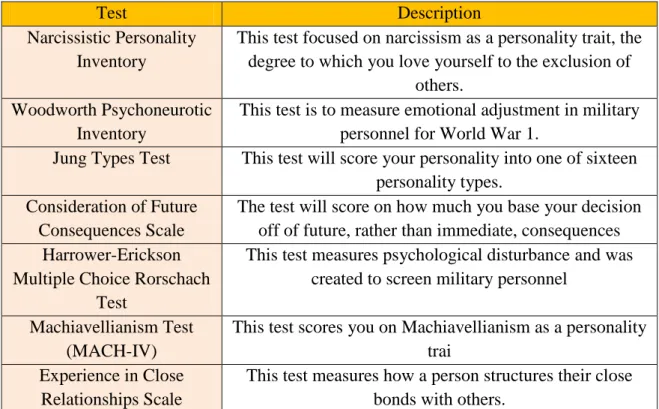
15 The result of the personality test will categorized the students based on the six elements of Holland Code. Each element will shows the suitable career possibilities or the area of study that suitable with the students’ result through matching process. The result of the personality test also shows the list of universities that offered the programme. There are many others example of personality test as shown in Table 3.
Table 9: Personality Test
Test Description
Narcissistic Personality Inventory
This test focused on narcissism as a personality trait, the degree to which you love yourself to the exclusion of
others. Woodworth Psychoneurotic
Inventory
This test is to measure emotional adjustment in military personnel for World War 1.
Jung Types Test This test will score your personality into one of sixteen personality types.
Consideration of Future Consequences Scale
The test will score on how much you base your decision off of future, rather than immediate, consequences Harrower-Erickson
Multiple Choice Rorschach Test
This test measures psychological disturbance and was created to screen military personnel
Machiavellianism Test (MACH-IV)
This test scores you on Machiavellianism as a personality trai
Experience in Close Relationships Scale
This test measures how a person structures their close bonds with others.
Some universities have applied the Holland Code personality test as the guideline to help their students to choose the course or programme that match with their personality. For example, University of Missouri distributed a manual Holland Code personality test to their students and listed out all programmes that being offered in the university that match with several Holland Code results. Salisbury University also provided an online Holland Code personality test in their university main website under career services section. The students of the university are able to take an online Holland Code personality and get the result of the personality test. They can identify their Holland Code, the job title which suits with their personality and 15 also the best programmes offered by their university. The sample of results from the Holland Code personality test conducted by Salisbury University as shown in the
16 Appendix (x). Unfortunately there is no university in Malaysia which applied Holland Code personality test but Ministry of Higher Education (MOHE) helps Malaysian students to gain knowledge about university and the field of study that available in Malaysia in their website. Hence, this research attempts to implement more Holland Code.
2.6 The need of FutureEDU.com System
Nowadays, higher education institution in Malaysia grows rapidly. This is due to the higher request among the potential students in this country. A lot number of institutions make it hard to potential student to choose the right and best choice for their higher education. The problems become worst when most of them have lack information regarding higher education available in Malaysia. Many of them make a mistake by choosing the choice that not suitable with them. They need sufficient information on education and any related information to make a decision that they won’t regret in future. With that reason, this system needs to be developed. It help student and assist them to make a good decision. This system helps them make decision by providing the right information necessary to choose the best and suitable for them. Research has shown that individuals who choose course and careers that are closely aligned with their interests, skills, values and personality tend to be more satisfied and enjoy greater success. So, this system is really needed by every potential student who wishes to pursue their study. Match making tool in tab “course recommender” help to give students assurance deciding the best path for higher education.
2.7 Existing system
There is no existing system that exactly the same with my system. However, there is little system that related to higher education and provides the information to students.
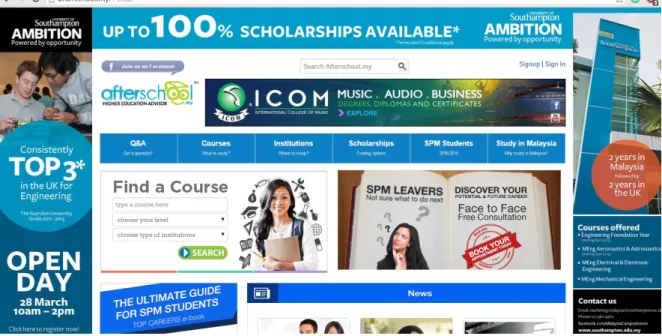
17 2.7.1 After School.my
After School is a web portal for secondary students who are planning to pursue higher education in Malaysia. After school only provide the details information regarding the institution and the major course offered in Malaysia.
Figure 37: Afterschool.my
2.7.2 EduAdvisor
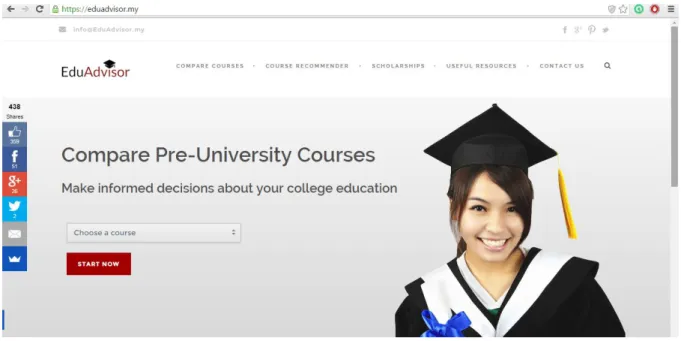
EduAdvisor is a web portal that makes informed decisions about college education. EduAdvisor only focused on Pre-University Courses. There have narrowing choice for students to choose, but it’s only for pre university courses.
18
Figure 38: EduAdvisor.my
2.7.3 System Comparative study
Table 10: Comparative Study
Features and Functionality AfterSchool.my EduAdvisor.my User Friendly x User Navigation x Personality Test List Of Programmed x List of University x List of Scholarship x x Course Comparison x
19
CHAPTER 3
3.0 METHODOLOGY
3.1 Research MethodologyMethodology is the systematic, theoretical analysis of the methods applied to a field of study, or the theoretical analysis of the body of methods and principles associated with a branch of knowledge. In preparation of this project, the process used to collect information and data are as following:
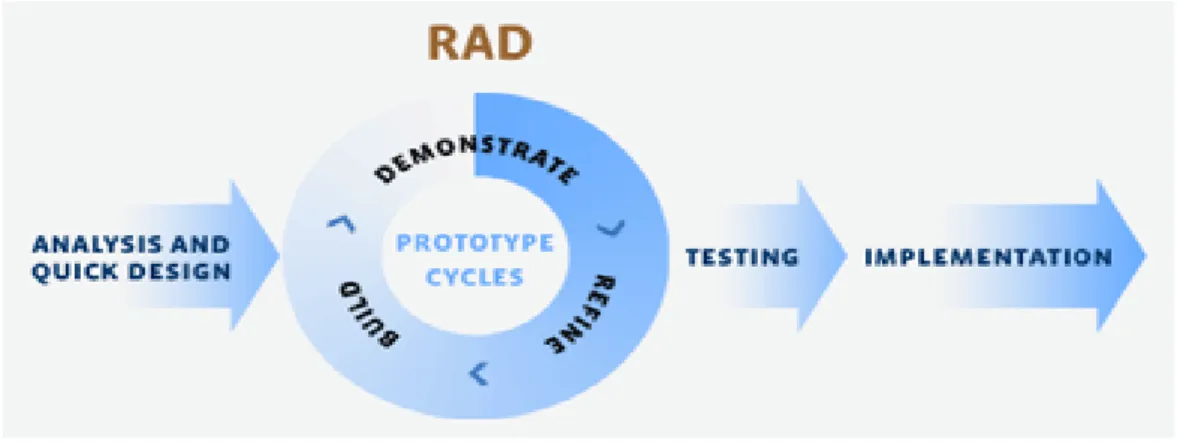
3.1.1 Rapid Application Development methodology
This project used RAD (Rapid Application Development) as the methodology method. RAD is a model based on the concept that higher-quality products can be developed faster through more expedient processes, such as early prototyping, reusing software components and less formality in team communications. RAD methodologies adjust the Systems Development Life Cycle (SDLC) phases to get some part of the system developed quickly and into the hands of the users. What lies beneath this approach is to get the users to better understand the system through interactive and simultaneous revisions, which bring the system closer to what is needed. Since this project needs to complete in a short time, the Rapid Application Development model suited for this project. The Rapid Application Development Model is shown in the figure below,
20 Requirement Planning
The Requirements Planning stage consists of a review of the areas immediately associated with the proposed system. This review produces a broad definition of the system requirements in terms of the functions the system will support. In this phase, all possible requirement of the system to be developed are identified, captured and documented in a requirement document. For this project, requirements are collected by doing some research, following current issue and also online questionnaire. First, in order to provide the sufficient information regarding higher education to student, all the information of Universities, and program offered in Malaysia are collected by visiting official website of each Universities that involved in this project. This is to get the valid information from the respective side. Then, the personality test is collected and analysed which is the best test that suit with students and related with career choice. Next some researches are conducted to match the personality result and the program offered in Malaysia. The entry requirements for each program are emphasized in this phase and also the information regarding scholarship to be includes in the system. This project also conducted an online questionnaire to identify the problem that faced by student in selecting higher education using the online Google document shit. The question derived from the research found in literature review which to make sure either the statement is still believable or not for the current time. The results collected from the questionnaire are analysed. Documentation of all information is conducted in this phase. The research finding is described using descriptive analysis. The results collected from operational process also combine with the information gathered through theoretical process to get the exact result.
User Design
The User Design stage is where the system flow is created. The flow of this system can be seen clearly from the diagram. Hardware and software needed for this system also can be specified in this phase. The system flow as shown in the figure below is created to have better view on how this system works.
21
22 This system consists of five main tabs as following:
Compare College
This tab consists of information about Pre University. User can see the comparison of the type of Pre University offered in Malaysia. Then, the system will display the comparison result of institution that offered the programme based on the type choose by user.
Find Course
User can get the list of major course offered in Malaysia from this tab. When user click on the course, the system will display the details information of the course like; the requirements needed, the career for that course, and also the institutions that offered the course.
Find University
This tab will list of qualified university that available in Malaysia. User can filter the information and system will shortlisted the university from the filtered information. Then, students can view the shortlisted list in a grid view.
Course Recommender
When this tab is chosen, users are required to answer the personality test. Then, system will display the result from test and the list of programmes related with user’s answers. Next, user need to select their qualification performance. System will narrow down the list of the programme. Then, user is required to answer questions regarding “what they are tends to” to narrow down the list of programme. Once finish, User will decide which programme to choose from the most three suitable list after the results are narrowed. Then, from user’s choice, system will display the details information of the course that consist the list of universities that offer the
23 programme. If user knows what university to choose, then the final decision will be decide by user. Else, the system will provide the grid view and filter information for user to choose and display the comparison between the universities. Then, the final decision is still depend on the user to choose which choice that really suits with their needs.
Scholarship
This tab will contains list of scholarship’s link available in Malaysia. When user clicked on the link, system will directly navigate to scholarship page.
After the system architecture has been created, the prototype of the system is developed. The overview can be seen from the prototype. This will discuss in discussion part.
Construction
In the Construction stage, the design is finalized and the system built. The software construction process consists of a series of "design-and-build" steps in which the users have the opportunity to fine-tune the requirements and review the resulting software implementation. Follow the design proposed in design phase, the system start developed. The system is first developed in small programs called units. Each unit is developed and tested for its functionality. Basically, this is the software process in which actual coding takes place. In this phase, the coding activities are started. The coding activities involved are to develop the interface of the system. For the coding part, HTML5 and JavaScript language is used. All information related to universities and programs and also information regarding personality test is filled into the system database. In addition to the tested software, Construction stage deliverables include documentation and instructions necessary to operate the new application, and routines and procedures needed to put the system into operation.
24 Implementation
The implementation stage involves implementing the new system and managing the change from the old system environment to the new one. This may include implementing bridges between existing and new systems, converting data, and training users. User acceptance is the end point of the implementation stage.
3.1.1 Data Collection
This approach is used to gather information related to the study. Several methods were used for the collection of information, which includes interviews with the students and also prepare a set of questionnaire to distribute to them as well as some read-ups on existing studies. I also related this study with the experience happened in my lifetime. Data is collected in order to be further analysed to come up with the results of the research.
3.1.2 Data Analysis
Interviewing the students and giving them to answer questionnaire allows information gathering of the subject matter. Interviewing is one of the most widely used method as a source of information gathering when it comes to human scientific and behaviour research (Gill, Stewart, Treasure & Chadwick, 2008). Therefore, questionnaire method is chosen and used to analyse the web site-related problems commonly faced by students followed by interpretation of the data. In order to gain information on which factor are really considered by students, data analysis phase takes place. This is done to interpret the received information systematically. The data recorded will be charted to obtain information of pattern or trend of the subject matter.
25 Task Weeks 2 3 4 5 6 7 8 9 10 11 12 13 14 15 16 17 18 19 20 21 22 23 24 25 26 27 28 Planning phase Identify problem Study feasibility Study the background Approval of project title Literature review Extended Proposal Submission Analysis phase Distribution of questionnaires 3.2 Gantt Chart
26 Analysis collected data Design phase Process modeling Design & sketch the interface System Architecture Design Interim Report Submission Proposal Defence Implementation phase System Development System Deployment
27 Developer Testing Usability Testing Prototype Improvement Pre-Sedex Viva Submission of Project Dissertation
28 3.3 Key Milestones
Table 12: Key Milestone
4.0 Tools (eg. Equipment, hardware,etc) required: For this project to be initiated, the tools needed are as follows: Software: • Microsoft Windows 7. Programming Language: • HTML5 • JAVASCRIPT • PHP Hardware: • Lenovo Laptop No Deliverables/Activities Schedule 1 Title Selection and Proposal Week 2
2 Project Approval Week 4
4 Extended Proposal Week 6
7 Interface Design Week 12
8 Interim Report Week 12
9 Proposal Defence Week 14
11 System Complete Week17
12 Usability Testing Week 21
13 Pre- Sedex Week 24
14 Technical Report Week 25
15 Sedex Week 26
16 Viva Week 27
29 CHAPTER 4
4.0 RESULT AND DISCUSSION
4.1 Questionnaire Result Findings
This project is proposed to create a web system for secondary school leaver selecting their higher education. The research found that many students have difficulty in identifying their personality, uncertainty in making decision and also lack of information regarding the institution and the course of higher education. These entire problems are contributed to the creation of this system. A set of questionnaire as mentioned in chapter 3 was created and distributed to public through social media in the process of collecting data. This chapter takes an in-depth look at the research result by analysing the responses of the question found in questionnaire (refer to Appendixes). The question are divided into few parts which are demography, the process in making decision of higher education and also the level of satisfaction in their current education. The results of this survey are based on the feedback of the 107 respondents.
4.1.1 Demography
The demography variable use in this study are only age and gender. There are 107 respondents involved in this questionnaire. The age categories are divided into four which are from 16 to 18 years old, 19 to 21 years old, 22 to 24 years old, and others. The age profile of the students shows that there are 42.1 % respondents are between 19 to 21 years old which is the highest. The percentage of respondents which range from 16-18 years old and 22 to 24 years old are equal which contributed 29.9% each. There is one respondent aged 25 years old and it falls under ‘other’ categories. The sample of respondents for this questionnaire is 54% female and 46% male. The exact origin of the respondents cannot be identified as they come from the random place since this questionnaire was distributed through social media . But many of respondent range from 16 to 18 years old are from MRSM Johor Bahru and SMK Sg Kapar Indah, Klang. There are also students from Universiti Sains Islam Malaysia (USIM), Universit[i Teknologi Petronas (UTP), Universiti Teknologi MARA (UiTM), and Universiti Tenaga Nasiaonal (UNITEN) involved in this questionnaire.
30
Figure 41: Demography (Google Doc sheet)
4.1.2 Process in making decision of higher education
In this section, a few questions are asked to students regarding the process of making decision to pursue higher education. For the first question, students were asked either they face any difficulties in choosing higher education or not. Based on the Figure 7, most of the respondents which is 77% of them having difficulties in choosing higher education. On the other hand, the other 23% of the respondents did not face any difficulties in making decisions. From this feedback, it can be concluded that it is true that choosing higher education is not an easy task as most of students having difficulty in the process of making decision of their higher education.
Figure 42: Difficulties in Choosing Higher Education
77% 23%
Do you face any difficulties in choosing
higher education
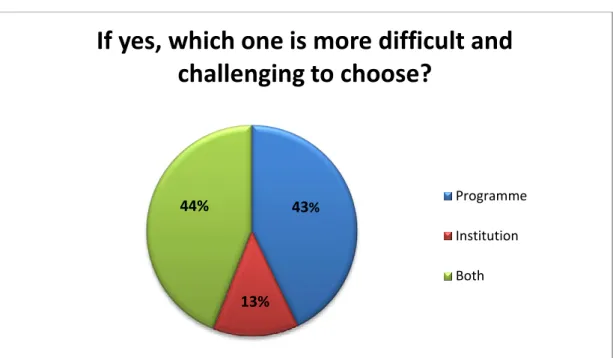
31 From the previous question, students were asked further whether programmes, institution or both are more challenging to choose. From the feedback collected, there are 43% respondents believe that programme is more challenging to choose. In contrast, 13% of total respondents choose institution, then programme. However, 44% of respondents admit that both programme and institution are difficult and challenging to choose. Therefore, this study shows that students not only need to be assisted in choosing the programme of study but also the institution. This finding result has been considered in the project deliverable to assist student in choosing higher education institution.
Figure 43: If Yes, which one is more difficult and challenging to choose.
Next, students were asked about their familiarity with the institution and programs offered in Malaysia. Based on the Figure below, 50% of the respondents seem not familiar with the information of higher education in our country. However, there are feedback from 49% of respondents stated that they are familiar while the other 1% said that his familiarity with institution and programmes offered in Malaysia only at the level of average or intermediate. The 50% of not familiar respondents with the institution and programme offered in Malaysia probably due to the rapid growth of
43%
13% 44%
If yes, which one is more difficult and
challenging to choose?
Programme
Institution
32 higher education in our country nowadays or maybe less exposure to them regarding higher education information.
Figure 44: Are you familiar with the institutions and programs offered in Malaysia
The Figure 10 shows the result when students were asked whether they have answered any Personality test that informs which career best suits them before making decision in choosing higher education or not. From 107 respondents, 60% of them that represent 64 respondents have already answered that kind of personality test. However, the rest 40% of respondents pursuing their higher education without answering any kind of personality test related to career choice before making decision in choosing higher education. It is shows that not everyone really concerned on what they want or interest in making decision related to future career while research shows that personality play a major role in choosing higher education. This is maybe the reason why students have a problem in identifying their personality as mentioned in problem statement.
49% 50%
1%
Are you familiar with the institutions and
programs offered in Malaysia?
Yes
No
33
Figure 45: The answered of having any personality test before
4.1.3 Level of satisfaction with current study
After decision making process, there are few questions asked to students regarding their level of satisfaction with current study. Starting from this point and up to the end, the questions only applied to respondents who pursue their higher education to tertiary level. Figure below shows the result collected from respondents when asked about their level of satisfaction in their current field of study or programme. From the feedback collected, found that most of the respondents are satisfied with their current field of study. The percentage of satisfied respondents are 51%, there are only 10% of them which are very satisfied and 33% choose just average with their current program or field of study. However, there are still respondents that are not satisfied with their current field of study which represent 4% and more worst when there are 2% of them very unsatisfied. In my opinions, when it comes to higher education every student should at least satisfy with their field of study because it is the first step in shaping their future.
60% 40%
Have you ever answered any Personality
Test that informs which career best suits
you before making decision in choosing
higher education?
Yes No
34
Figure 46: Level of satisfaction in current field of study
After knowing their rate level of satisfaction with current field of study, students were asked to rate their level of satisfaction with their current University. From the feedback collected, there are only 4% of them which are very satisfied with their current University. Most of respondents which contributed 51% are satisfied and 37% of them feel average with their level of satisfaction to their current University. There are also students which contributed 8% from total who are unsatisfied with their current University. The satisfaction of University wills little bit contributes to students achievement in higher education.
Figure 47: Level of satisfaction in current University
10%
51% 33%
4% 2%
Rate your level of satisfaction in your
current field of study
Very Satisfied Satisfied Average Unsatiesfied Very Unsatisfied 4% 51% 37% 8%
Rate your level of satisfaction in your
current University
Very Satisfied Satisfied Average Unsatisfied Very Unsatisfied35 Then, students also asked to rate their current CGPA. According to Figure 13, most of respondents achieved 3.0 to 3.5 for their CGPA. There are only 23% of them that gets higher than 3.5 and most of them is a first semester students in University. About 30% of the respondents only get between 2.5 to 3.0 and the rest 5% get below than 2.5 for their CGPA. From my analysis with the responses collected, students that get below than 2.5 or between 2.5 to 3.0 are mostly has an average level of satisfaction with their current of study.
Figure 48: Rating for CGPA
Students were also asked either they have any experienced in changing program of study or not throughout the journey in their higher education. The responses received are much unexpected when there are more than 20 respondents out of 107 have an experienced in changing their program of study. The ratio can be defined as 1:5. This is the problem that really should be highlighted and resolved.
5%
30%
42% 23%
Rate your current CGPA
< 2.5 2.5 - 3.0 3.0 - 3.5 > 3.5
36
Figure 49: Have you ever experienced in changing program of study
Lastly, respondents are asked to share their advice with future students. From the responses received, most of them advise to choose wisely. Future students are advised to emphasize their interest before making decision. In conclusion, the process of choosing higher education is not easy and it should be done wisely so that students won’t regret it later.
Figure 50: Advice comment for future students
24%
76%
Have you ever experienced in changing
program of study?
Yes
37 4.2 Comparative Study of Existing System and Proposed FutureEDU.com
From the result finding and the study of existing system, a FutureEdu.com system is created with below functionality and characteristics.
Table 13: Comparative study of existing system and proposed system
Features and Functionality
AfterSchool.my EduAdvisor.my FutureEDU.com (Proposed System) User Friendly x x User Navigation x x Personality Test x List Of Programmed x x List of University x x List of Scholarship x x x Course Comparison x
The main focuses of this system are the personality test and the course comparison which are not yet implemented by other existing system. The interface of this system will explain in details under prototype point.
4.3 Prototype
4.3.1 First Prototype
Prototype is an early sample and model of a product created to test the concept of the original product. The prototype of this project is designed, created, reviewed, modified and implemented for several times. The reimplementation process is
38 needed in order to produce desired interface which will satisfied users. The first prototype is presented as below:
Figure 51: Home Page
Home Page
This page can be described as the welcome note to the user. There are five main tabs in the homepage which are Pre Universities, Field of Study, Universities, Education Advisor and Scholarship. User can click on any of the tab to move from home page to the chosen page.
Figure 52: Pre Universities
Pre Universities
System will display the comparison between pre universities offered in Malaysia. All the information can be seen in table view.
39
Figure 53: Field Study
Figure 54: Accounting
Field of Study
In this tab, system will display all the field of study offered in Malaysia and also brief information of the programme. The interfaces of the system will be shown like the Figure 18. Once the users choose any field of study, system will be display as show in Figure 19.
Figure 55: Universities
Figure 56: University's information
Universities
The system will display the page that asked user to choose which kind of Universities they are interested to. Then, if let say the users choose Public Universities, the system will move to the page that display all the information of the Public Universities as shown in Figure 21. Users can back to the homepage by click on the home icon located at the bottom right of the page. This icon are located on each page to easy the user make a move.
40
Figure 57: EduAdvisor
EduAdvisor
This is the most important tab which is
EduAdvisor. According to figure 24, this tab contains a few question that need to answer by users. Than, when the user click on the ‘Get Your Result’ buton, the system will display the test result for user and brief explain about users result and also the list of career that relates to user’s result. The next phase of this tab will repeats the same flow with different kind of question until users can get the narrowed down list to choose.
Figure 58: Scholarship
Scholarship
Lastly is the tab for Scholarship. Once users choose this tab at the home page, this page will be displayed as shown in Figure 23. All the list of scholarship offered in Malaysia will be in this page. Users can get the information of the scholars through this page. All the five main tabs will always be located in each page of this system.
41 4.3.2 Final Prototype
After the first prototype has been created, the prototype is reviewed and improvised. All the comments are taken into consideration and used as a guideline for the improvement. From that, the final prototype of FutureEDU.com system is created. The final prototype applied more user-friendliness and also easy to navigate and the interfaces looks more elegant. Figure 16 showed the Home Page for this system. This page can be described as the welcome note to the user. At this page, a few lines of sentences are put to briefly inform the user what this system is all about. The home page is expected to be fewer words and more attractive with colours and pictures to attract user visit this website. Clear instruction will be displayed so that it is easier for user to navigate in this system. There are five main tabs in the homepage which are Compare College, Find Course, Find University, Course Recommender and Find Scholarship. User can click on any of the tab to move from home page to the chosen page.
42
Figure 60: FutureEDU.com Main Page
Figure 61: FutureEDU.com About Us
If users choose “Compare College”, system will display a page that contains dropbox menu for user to select what kind of studies they want; “Foundation”, “Diploma” or “Pre Universities”. If let say user choose “Foundation”, the system will display a list of institutions that offered the foundation programme and also the details of the course information that offered by the institutions as shown in figure below. User can click the filter on the left side to narrow down the list of
43 institutions based on what they want. User can also view the information in a grid view to ease them to make a comparison.
Figure 62: Select Level of Studies
44
Figure 64: Foundation Course Grid View
Next, if users choose “Find Course”, system will display a list of field of study offered in Malaysia. The interfaces of the system will be shown like the Figure 30. Once the user click on the major course, the system will display the details information of the course as per below figure. The information consists of the details of the course, the requirements of the course, the career for the course and also the institution that offered the course. User can go directly to the institution official website by click on the link of institutions given.
45
Figure 66: Course Description
In the Figure 32, it is shown when users choose tab “Find University”. The interfaces of this tab similar with the “Compare College” tab. But, in this tab there will be a list of institutions that available in Malaysia. User can find the information of the institutions and also choose what they required by filtering the information on the left side of page. User can also go directly to official website of the institution by clicking the image of the institution.
46 Next is Course Recommender. There are major match making tool in this tab. User need to answer a set of personality test to identify in what category of Holland Codes they are. Then, the system will list out the major course based on the user categories of Holland Code. Then, user can find the shortlisted of the suitable major course by select their qualification and also answer a set of question to identify what they really want in life.
Figure 68: Course Recommender
47 The system then will display the final three major course that really suits with user requirements and qualification. User then can click to the course to find the details information of the course including the institutions that offered the program.
Figure 70: Final Three Suggested Course
Lastly is the tab for “Find Scholarship”. Once users choose this tab at the home page, this page will be displayed as shown in Figure 36. All the list of scholarship offered in Malaysia will be in this page. Users can get the information of the scholars through this page. User can go directly to scholarship link by clicking the company’s box.