Learning Chinese Language Structures with
Multiple Views
Weiwei Sun
Saarbr¨
ucken Graduate School of Computer Science
Department of Computational Linguistics
University of Saarland
Thesis for obtaining the title of
Doctor of Engineering
of the Faculties
of Natural Sciences and Technology of Saarland University
Saarbr¨
ucken, Germany
April, 2012
Dean: Prof. Dr. Mark Groves Department of Mathematics Saarland University Colloquium: 2012-04-17 Saarland University Examination Board
Supervisor and Prof. Dr. Hans-J¨urgen Uszkoreit First Reviewer: Saarland University
German Research Centre for Artificial Intelligence
Second Reviewer: Prof. Dr. Dietrich Klakow Saarland University
Chairman: Prof. Dr. J¨org Siekmann Saarland University
German Research Centre for Artificial Intelligence
Academic assessor: Dr. Yi Zhang Saarland University
Eidesstattliche Erkl¨
arung
Hiermit versichere ich an Eides statt, dass ich die vorliegende Arbeit selbst¨andig und ohne Benutzung anderer als der angegebenen Hilfsmittel angefertigt habe. Die aus anderen Quellen oder indirekt ¨ubernommenen Daten und Konzepte sind unter Angabe der Quelle gekennzeichnet. Die Arbeit wurde bisher weder im In- noch im Ausland in gleicher oder ¨ahnlicher Form in einem Verfahren zur Erlangung eines akademischen Grades vorgelegt.
Name: Weiwei Sun Date: 2012-4-17
Abstract
Motivated by the inadequacy of single view approaches in many areas in NLP, we study multi-view Chinese language processing, including word segmentation, part-of-speech (POS) tagging, syntactic parsing and seman-tic role labeling (SRL), in this thesis. We consider three situations of mul-tiple views in statistical NLP: (1) Heterogeneous computational models have been designed for a given problem; (2) Heterogeneous annotation data is available to train systems; (3) Supervised and unsupervised ma-chine learning techniques are applicable.
First, we comparatively analyze successful single view approaches for Chi-nese lexical, syntactic and semantic processing. Our analysis highlights the diversity between heterogenous systems built on different views, and motivates us to improve the state-of-the-art by combining or integrating heterogeneous approaches. Second, we study the annotation ensemble problem, i.e. learning from multiple data sets under different annotation standards. We propose a series of generalized stacking models to effec-tively utilize heterogeneous labeled data to reduce approximation errors for word segmentation and parsing. Finally, we are concerned with bridg-ing the gap between unsupervised and supervised learnbridg-ing paradigms. We introduce feature induction solutions that harvest useful linguistic knowl-edge from large-scale unlabeled data and effectively use them as new fea-tures to enhance discriminative learning based systems.
For word segmentation, we present a comparative study of word-based and character-based approaches. Inspired by the diversity of the two views, we design a novel stacked sub-word tagging model for joint word segmentation and POS tagging, which is robust to integrate different models, even mod-els trained on heterogeneous annotations. To benefit from unsupervised word segmentation, we derive expressive string knowledge from unlabeled data which significantly enhances a strong supervised segmenter.
(1) combining syntax-free sequential tagging and syntax-based chart pars-ing results to better capture syntagmatic lexical relations and (2) integrat-ing word clusters acquired from unlabeled data to better capture paradig-matic lexical relations.
For syntactic parsing, we present a comparative analysis for generative PCFG-LA constituency parsing and discriminative graph-based depen-dency parsing. To benefit from the diversity of parsing in different for-malisms, we implement a previously introduced stacking method and propose a novel Bagging model to combine complementary strengths of grammar-free and grammar-based models. In addition to the study on the syntactic formalism, we also propose a reranking model to explore het-erogenous treebanks that are labeled under different annotation scheme. Finally, we continue our efforts on combining strengths of supervised and unsupervised learning, and evaluate the impact of word clustering on dif-ferent syntactic processing tasks.
Our work on SRL focus on improving the full parsing method with linguis-tically rich features and a chunking strategy. Furthermore, we developed a partial parsing based semantic chunking method, which has comple-mentary strengths to the full parsing based method. Based on our work,
Zhuang and Zong[2010] successfully improve the state-of-the-art by com-bining full and partial parsing based SRL systems.
Zusammenfassung
Motiviert durch die Unzul¨anglichkeit der Ans¨atze mit dem einzigen An-sicht in vielen Bereichen in NLP, untersuchen wir Chinesische Sprache Ve-rarbeitung mit mehrfachen Ansichten, einschließlich Wortsegmentierung, Part-of-Speech (POS)-Tagging und syntaktische Parsing und die Kennze-ichnung der semantische Rolle (SRL) in dieser Arbeit. Wir betrachten drei Situationen von mehreren Ansichten in der statistischen NLP: (1) Heterogene computergest¨utzte Modelle sind f¨ur ein gegebenes Problem entwurft, (2) Heterogene Annotationsdaten sind verf¨ugbar, um die Sys-teme zu trainieren, (3) ¨uberwachten und un¨uberwachten Methoden des maschinellen Lernens sind zur Verf¨ugung gestellt.
Erstens, wir analysieren vergleichsweise erfolgreiche Ans¨atze mit einzigen Ansicht f¨ur chinesische lexikalische, syntaktische und semantische Verar-beitung. Unsere Analyse zeigt die Unterschiede zwischen den heteroge-nen Systemen, die auf verschiedeheteroge-nen Ansichten gebaut werden, und mo-tiviert uns, die state-of-the-Art durch die Kombination oder Integration heterogener Ans¨atze zu verbessern. Zweitens, untersuchen wir die An-notation Ensemble Problem, d.h. das Lernen aus mehreren Datens¨atzen unter verschiedenen Annotation Standards. Wir schlagen eine Reihe allge-meiner Stapeln Modelle, um eine effektive Nutzung heterogener Daten zu beschriften, und um Approximationsfehler f¨ur Wort Segmentierung und Analyse zu reduzieren. Schließlich sind wir besorgt mit der ¨Uberbr¨uckung der Kluft zwischen un¨uberwachten und ¨uberwachten Lernens Paradigmen. Wir f¨uhren Induktion Feature-L¨osungen, die n¨utzliche Sprachkenntnisse von großfl¨achigen unmarkierter Daten ernte, und die effektiv nutzen als neue Features, um die unterscheidenden Lernen basierten Systemen zu verbessern.
F¨ur die Wortsegmentierung, pr¨asentieren wir eine vergleichende Studie der Wort-basierte und Charakter-basierten Ans¨atzen. Inspiriert von der Vielfalt der beiden Ansichten, entwerfen wir eine neuartige gestapelt Sub-Wort-Tagging-Modell f¨ur gemeinsame Wort-Segmentierung und POS-Tagging, die robust ist, um verschiedene Modelle zu integrieren, auch Modelle auf heterogenen Annotationen geschult. Um den unbeaufsichtigten Wortseg-mentierung zu profitieren, leiten wir ausdrucksstarke Zeichenfolge Wissen
von unmarkierten Daten. Diese Methode hat eine ¨uberwachte Methode erheblich verbessert.
F¨ur POS-Tagging, f¨uhren wir zwei linguistisch motiviert Verbesserun-gen: (1) die Kombination von Syntaxfreie sequentielle Tagging und Syn-taxbasierten Grafik-Parsing-Ergebnisse, um syntagmatische lexikalische Beziehungen besser zu erfassen (2) die Integration von Wortclusteren von nicht markierte Daten, um die paradigmatische lexikalische Beziehungen besser zu erfassen.
F¨ur syntaktische Parsing pr¨asentieren wir eine vergleichenbare Analyse f¨ur generative PCFG-LA Wahlkreis Parsing und diskriminierende Graphen-basierte Abh¨angigkeit Parsing. Um aus der Vielfalt der Parsen in unter-schiedlichen Formalismen zu profitieren, setzen wir eine zuvor eingef¨uhrte Stacking-Methode und schlagen eine neuartige Schrumpfbeutel-Modell vor, um die erg¨anzenden St¨arken der Grammatik und Grammatik-free-basierte Modelle zu kombinieren. Neben dem syntaktischen Formalismus, wir schlagen auch ein Modell, um heterogene reranking Baumbanken, die unter verschiedenen Annotationsschema beschriftet sind zu erkunden. Schließlich setzen wir unsere Bem¨uhungen auf die B¨undelung von St¨arken des ¨uberwachten und un¨uberwachten Lernen, und bewerten wir die Auswirkungen der Wort-Clustering auf verschiedene syntaktische Verarbeitung Aufgaben.
Unsere Arbeit an SRL ist konzentriert auf die Verbesserung der vollen Parsingsmethode mit linguistischen umfangreichen Funktionen und einer Chunkingstrategie. Weiterhin entwickelten wir eine semantische Chunk-ingmethode basiert auf dem partiellen Parsing, die die komplement¨are St¨arken gegen die die Methode basiert auf dem vollen Parsing hat. Basiert auf unserer Arbeit, Zhuang and Zong [2010] hat den aktuelle Stand er-folgreich verbessert durch die Kombination von voll-und partielle-Parsing basierte SRL Systeme.
Acknowledgements
First and foremost, I thank my advisor, Prof. Hans Uszkoreit. Prof. Uszkoreit was personally responsible for bringing me to Saarbr¨ucken, and offered exceptional academic freedom during my study while at the same time made sure I was on the right track. His comments on my work have improved both my results and the readability of the dissertation.
I am also indebted to many collaborators during my PhD study, especially Yi Zhang, Rui Wang and Jia Xu. They helped me much not only in research but also in daily life. I thank Regine Bader for proofreading my ACL-2011 paper. I would like to acknowledge our secretaries, Christina Deeg, Corinna Johanns and Sandra Loch. They help me a lot to organize many things.
I thank my parents for their unconditional love and endless support through-out all these years. I dedicate this thesis to them.
Finally, I would like to thank the graduate school of computer science for its support during the submission of this dissertation.
Contents
Contents viii
List of Figures xvi
List of Tables xviii
1 Introduction 1
1.1 About Multiple Views in NLP . . . 3
1.1.1 A General Framework for Data-driven Text Processing . . . . 3
1.1.2 Three Categories of Multi-views . . . 4
1.1.3 Advantages of Multi-view Processing . . . 5
1.1.4 View Integration . . . 6
1.2 The Problems Investigated in This Thesis . . . 7
1.3 Main Contributions . . . 8
1.4 Outline of the Thesis . . . 10
I
Word Segmentation
11
2 Comparing and Combining Word-based and Character-based Seg-menters 12 2.1 Background . . . 122.1.1 The Problem . . . 12
2.1.2 Previous Work . . . 13
2.2 State-of-the-Art . . . 13
2.2.1 Word-Based Method: Semi-Markov Tagging . . . 14
2.2.2 Character-Based Method: Markov Tagging . . . 15
2.3 Theoretical Comparison . . . 16
CONTENTS
2.3.2 Linearity and Nonlinearity . . . 16
2.3.3 Dynamic Tokens or Static Tokens . . . 17
2.3.4 Word Token or Word Type Features . . . 17
2.4 Empirical Comparision . . . 17 2.4.1 Baseline Systems . . . 18 2.4.1.1 Models . . . 18 2.4.1.2 Learning . . . 18 2.4.1.3 Features . . . 19 2.4.2 Setting . . . 21 2.4.3 Results . . . 21 2.4.3.1 Baseline Performance . . . 21
2.4.3.2 Word Frequency Factors . . . 22
2.4.3.3 Length Factors . . . 24
2.4.3.4 Feature Factors . . . 25
2.5 Combination . . . 25
2.5.1 Upper Bound of System Combination . . . 26
2.5.2 Segmenter Ensemble via Bagging . . . 26
2.5.3 Evaluation . . . 28
2.6 Conclusion and Discussion . . . 29
3 Stacked Sub-word Tagging for Joint Word Segmentation and POS Tagging 31 3.1 Background . . . 32
3.1.1 The Problem . . . 32
3.1.2 Character-Based and Word-Based Methods . . . 32
3.1.3 Stacked Learning . . . 33
3.1.4 Annotation Ensemble . . . 34
3.2 A Stacked Sub-word Tagging Model . . . 34
3.2.1 Method . . . 34
3.2.2 The Coarse-grained Solvers . . . 36
3.2.3 Generating Sub-word Sequences . . . 38
3.2.4 Features . . . 39
3.2.5 Stacked Learning for Parameter Estimation . . . 40
3.3 Experiments and Analysis . . . 41
3.3.1 Setting . . . 41
CONTENTS
3.3.3 Statistics of Sub-words . . . 42
3.3.4 Rich Contextual Features Are Helpful . . . 43
3.3.5 Stacked Learning Is Helpful . . . 44
3.3.6 Comparison to the State-of-the-Art . . . 44
3.3.7 Results on the CTB 6.0 . . . 45
3.4 Reducing Approximation and Estimation Errors with Heterogeneous Annotations . . . 47
3.4.1 Two Essential Characteristics of Heterogeneous Annotations . 47 3.4.2 Diversity Analysis . . . 48
3.4.3 Reducing the Approximation Error via Stacking . . . 50
3.4.3.1 Annotation Ensemble as System Integration . . . 50
3.4.3.2 A Character-based Joint Model . . . 51
3.4.3.3 Feature-based Stacking . . . 51
3.4.3.4 Structure-based Stacking . . . 52
3.4.4 Reducing the Estimation Error via Corpus Conversion . . . . 53
3.5 Evaluation of Annotation Ensemble . . . 55
3.5.1 Setting . . . 55
3.5.2 Results of Stacking . . . 55
3.5.3 Learning Curves . . . 56
3.5.4 Results of Annotation Conversion . . . 56
3.5.5 Results of Re-training . . . 57
3.5.6 Comparison to the State-of-the-Art . . . 57
3.6 Conclusion . . . 58
4 Harvesting String Knowledge for Word Segmentation 59 4.1 Background . . . 59
4.1.1 The Problem: Combining Supervised and Unsupervised NLP . 59 4.1.2 The Method: Feature Induction . . . 60
4.2 Three Types of Unlabeled Data . . . 61
4.3 Feature Design . . . 62
4.3.1 Baseline Features . . . 62
4.3.2 Statistics-based Features . . . 63
4.3.2.1 Mutual Information . . . 63
4.3.2.2 Accessor Variety Features . . . 64
4.3.2.3 Punctuation Features . . . 64
CONTENTS
4.3.3 Document-based Features . . . 66
4.4 Experiments and Analysis . . . 66
4.4.1 Setting . . . 66
4.4.2 Main Results . . . 67
4.4.3 Learning Curves . . . 69
4.4.4 Feature Analysis . . . 70
4.5 Related Work . . . 71
4.6 Discussion: Unsupervised Language Acquisition for Supervised Lan-guage Processing . . . 73
II
Syntactic Parsing
75
5 Comparing and Integrating Heterogeneous Parsers 76 5.1 Background . . . 765.1.1 The Problem . . . 76
5.1.2 Previous Work . . . 78
5.2 State-of-the-Art . . . 79
5.2.1 A Discriminative Sequential Model for POS Tagging . . . 79
5.2.2 A Generative PCFG-LA Model for Constituency Parsing . . . 80
5.2.3 A Discriminative Graph-based Model for Dependency Parsing 82 5.3 Key Distinctions . . . 82
5.3.1 Syntax-free and Syntax-based POS Tagging . . . 82
5.3.2 Grammar-free and Grammar-based Dependency Parsing . . . 83
5.4 Experimental Setting . . . 84
5.5 Comparing and Combining Syntax-free and Syntax-based Tagging Mod-els . . . 86
5.5.1 Overall Performance . . . 86
5.5.1.1 Discriminative Learning is Competitive for POS Tagging 86 5.5.1.2 The Impact of POS Tagging on Parsing . . . 86
5.5.2 Comparison . . . 87
5.5.2.1 Content Words vs. Function Words . . . 87
5.5.2.2 Open Classes vs. Close Classes . . . 89
5.5.2.3 Local Disambiguation vs. Global Disambiguation . . 90
5.5.3 Combination . . . 91
5.5.3.1 Tagger Ensemble via Bagging . . . 91
CONTENTS
5.5.3.3 Final Results . . . 92
5.6 Comparing and Combining Grammar-free and Grammar-based Pars-ing Models . . . 92
5.6.1 Grammar-based Dependency Parsing . . . 92
5.6.2 Overall Performance . . . 93
5.6.3 Comparison . . . 94
5.6.3.1 Relating Parsing Accuracies . . . 94
5.6.3.2 Constraints . . . 94
5.6.3.3 Endocentric and Exocentric Constructions . . . 95
5.6.3.4 Factorization . . . 96
5.6.4 Combination . . . 96
5.6.4.1 Parser Ensemble via Stacking . . . 97
5.6.4.2 Parser Ensemble via Re-parsing . . . 98
5.6.4.3 Parser Ensemble via Bagging . . . 98
5.6.4.4 Evaluation . . . 99
5.6.4.5 Final Results . . . 100
5.7 Discussion . . . 101
6 Parse Reranking with Homogeneous and Heterogeneous Annota-tions 103 6.1 Motivation . . . 103
6.2 Comparison of Two Chinese Treebanks . . . 105
6.3 A Hybrid Parsing System . . . 106
6.3.1 System Architecture . . . 107 6.3.2 Parse Reranking . . . 107 6.3.2.1 Parameter Estimation . . . 107 6.3.2.2 Features . . . 108 6.3.3 Head Classifier . . . 110 6.4 Experiments . . . 110 6.4.1 Setting . . . 110
6.4.2 Upper Bound of Reranking . . . 111
6.4.3 Reranking Using Homogeneous Annotations . . . 111
6.4.4 Reranking Using Heterogeneous Annotations . . . 112
6.4.5 Head Classification . . . 112
CONTENTS
7 Enriching Lexical Representation for Syntactic Parsing 114
7.1 Motivation . . . 114
7.2 Word Clustering . . . 115
7.2.1 Brown Clustering . . . 116
7.2.2 MKCLS Clustering . . . 116
7.3 Experiments in POS Tagging . . . 117
7.3.1 Cluster-based Features . . . 117
7.3.2 Experiments and Analysis . . . 117
7.3.2.1 Setting . . . 117
7.3.2.2 Main Results . . . 117
7.3.2.3 Learning Curves . . . 120
7.3.2.4 Two-fold Effect . . . 120
7.3.2.5 Combining with the Berkeley Parser . . . 121
7.3.2.6 Final Results . . . 122
7.4 Experiments in Text Chunking . . . 123
7.4.1 Discriminative Text Chunking . . . 123
7.4.2 Features . . . 124
7.4.2.1 Baseline Features . . . 124
7.4.2.2 Cluster-based Features . . . 125
7.4.3 Experiments and Analysis . . . 125
7.4.3.1 Baseline Performance . . . 125
7.4.3.2 Comparing Chunking and PCFG-LA Parsing . . . . 126
7.4.3.3 Word Clustering is Helpful . . . 126
7.4.3.4 Final Results . . . 127
7.5 Experiments in Dependency Parsing . . . 128
7.5.1 Cluster-based Features . . . 128
7.5.2 Experiments and Analysis . . . 128
7.5.2.1 Main Results . . . 128
7.5.2.2 Two-fold Effect . . . 128
7.5.2.3 Impact on the Prediction of OOV Words . . . 129
7.5.2.4 Final Results . . . 130
7.6 Conclusion and Discussion . . . 130
III
Semantic Role Labeling
132
CONTENTS
8.1 Background . . . 133
8.1.1 The Problem . . . 133
8.1.2 The Annotation Data . . . 134
8.1.3 Successful Methods for English SRL . . . 136
8.1.4 Previous Work on Chinese SRL . . . 136
8.2 Full Parsing Based Semantic Chunking with Rich Syntactic Features . 137 8.2.1 Motivation . . . 137
8.2.2 Constituent Classification System . . . 138
8.2.3 Constituent Chunking System . . . 138
8.2.4 Features . . . 140
8.2.4.1 Word Features . . . 140
8.2.4.2 Syntactic Features . . . 141
8.2.4.3 Additional Features for SRC . . . 143
8.3 Partial Parsing Based Semantic Chunking . . . 144
8.3.1 Motivation . . . 144
8.3.2 System Architecture . . . 145
8.3.3 Features . . . 146
8.4 Experiments and Analysis . . . 147
8.4.1 Setting . . . 147
8.4.2 Main Results . . . 148
8.4.2.1 Rich Syntactic Features Are Helpful . . . 148
8.4.2.2 Semantic Chunking Is Helpful . . . 149
8.4.3 Two-fold Effect of Parsing in SRL . . . 150
8.4.3.1 Impact on Different Sub-tasks . . . 150
8.4.3.2 Why Word Features Are Effective for SRC? . . . 151
8.4.4 Predicate Frequency Factor . . . 152
8.5 Comparative Analysis . . . 153
8.5.1 Full Parsing is Necessary . . . 153
8.5.2 A Comparison of the Recall . . . 154
8.5.3 A Comparison of the Precision . . . 156
8.5.4 Impact of Predicate Frequency . . . 156
8.6 Conclusion and Discussion . . . 157
9 Conclusions 158 9.1 Summary of the Thesis . . . 158
CONTENTS
List of Figures
1.1 Outline of generic data-driven NLP framework. . . 3
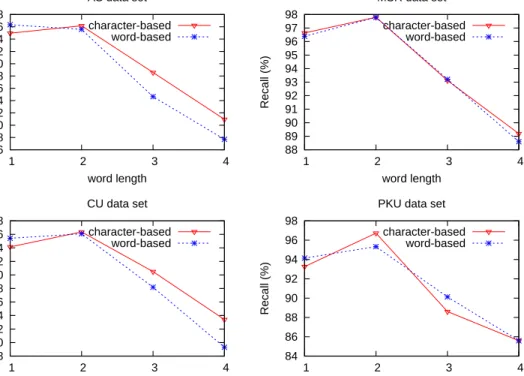
2.1 Segmentation recall relative to gold word frequency. . . 22
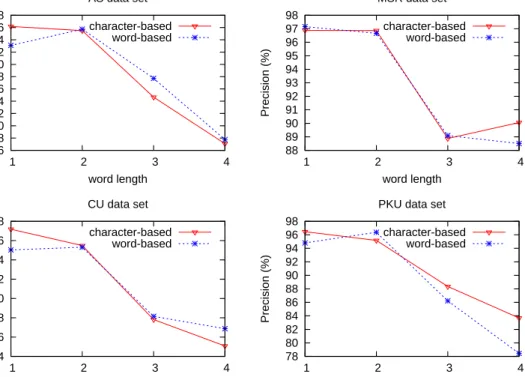
2.2 Segmentation precision relative to gold word length in training data. . 23
2.3 Segmentation recall relative to gold word length in training data. . . 24
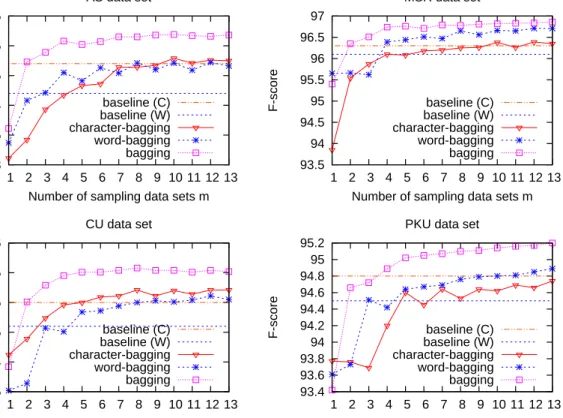
2.4 F-score of bagging models with different numbers of sampling data sets. Character-bagging means that the bagging system built on the single character-based segmenter. Word-bagging is named in the same way. . . 27
2.5 Precision/Recall/F-score of different models. . . 28
3.1 Workflow of the stacked sub-word model. . . 36
3.2 An example phrase: 以总成绩355.35分居领先地位 (Being in front with a total score of 355.35 points). . . 37
3.3 Sub-word tagging based on heterogeneous taggers. . . 53
4.1 The learning curves (F-score) of different models. . . 69
4.2 The learning curves (Recall of OOV) of different models. . . 70
4.3 Scatter plot of feature (L2 pv(c[i:i+1]) score against feature value. . . 71
4.4 Scatter plot of feature score against feature value forL2 av(c[i:i+1]). . . . 72
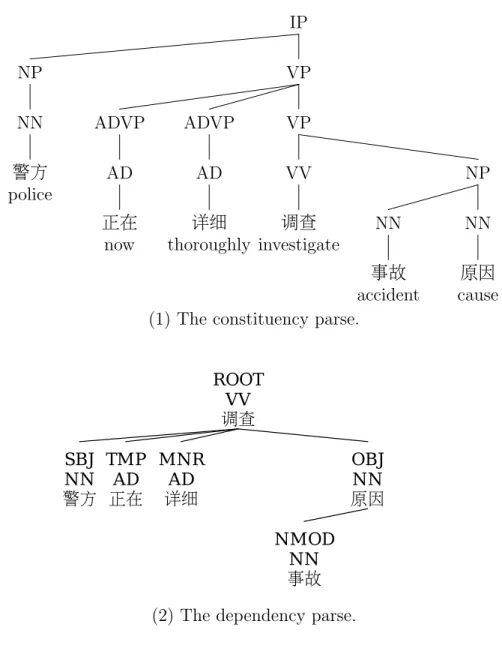
5.1 An example sentence with constituency and dependency structures: The police are thoroughly investigating the cause of the accident. . . . 77
5.2 An example of Chinese POS tagging: Until now, the insurance com-pany has provided insurance services for the Sanxia Project. . . 80
5.3 Tagging accuracy of Bagging models with different numbers of sam-pling data sets. Tagger-Bagging means that the Bagging system built on the single tagger. Parser-Bagging is named in the same way. . . . 91
LIST OF FIGURES
5.4 Scatter plots of UAS of the based model against the grammar-free model. . . 94
5.5 Nominal vs. verbal constructions. . . 96
5.6 Parsing precision relative to dependency length. . . 97
5.7 Dependency UAS of Bagging models with different numbers of sam-pling data sets. . . 100
6.1 Workflow of the System . . . 106
6.2 An example for interpretation of features: To eat apples that are bought.108
7.1 Tagging accuracy of Bagging models with different numbers of sam-pling data sets. Semi-Tagger-Bagging means that the Bagging system built on the tagger with word cluster information. Parser-Bagging is named in the same way. . . 122
7.2 An example from of Chinese chunking: Until now, the insurance
com-pany has provided insurance services for the Sanxia Project. . . 124
7.3 Chunking f-scores for different chunk types. . . 126
8.1 An example sentence for CTB and CPB: The police are thoroughly
investigating the cause of the accident. . . 135
8.2 Parsing errors that can be tolerated by full parsing based constituent chunking. . . 139
8.3 An example of the definition of semantic chunks: The insurance
com-pany has provided insurance services for the Sanxia Project. . . 145
8.4 F-scores of different tasks and different systems relative to the predicate frequency on the training data. . . 153
8.5 Recall of different systems relative to the length of arguments. . . 154
8.6 Recall of different systems relative to the distance between arguments and predicates. . . 155
List of Tables
1.1 Properties of different views in NLP. . . 7
2.1 Baseline performance. . . 22
2.2 Word length statistics on test sets. . . 25
2.3 F-score of two segmenters, with (−) and without (+) word token/type features. . . 25
2.4 Upper bound for combination. The error reduction (ER) rate is a comparison between the F-score produced by the oracle combination system and the character-based system (see Table 2.1). . . 26
2.5 Segmentation performance presented in previous work and of our com-bination model. . . 29
3.1 An example of features used for sub-word tagging. . . 40
3.2 Training, development and test data on CTB 5.0 . . . 41
3.3 Performance of the coarse-grained solvers on the development data. . 42
3.4 Upper bound of the sub-word tagging on the development data. . . . 43
3.5 Performance of the stacked sub-word model (K = 5) with features in different window sizes. . . 44
3.6 Performance on the development data. No stacking and different folds of cross-validation are separately applied. . . 44
3.7 F-score performance on the test data. . . 45
3.8 Training, development and test data on CTB 6.0 . . . 45
3.9 F-score performance on the CTB 6.0. . . 46
3.10 Mapping between CTB-style tags and PPD-style tags. . . 49
3.11 Performance of different stacking models on the development data. . . 55
3.12 F-scores relative to sizes of training data. Sizes (shown in column #CTB and #PPD) are numbers of sentences in each training corpus. 56
LIST OF TABLES
3.14 Performance of re-trained models on the development data. . . 57
3.15 Performance of different systems on the test data. . . 57
4.1 Segmentation performance with different feature sets on the develop-ment data. Abbreviations: MI=mutual information; AV=accessor va-riety; PU=punctuation vava-riety; DOC=document features. The num-bers in each bracket pair are the lengths of strings. For example, PU(2,3) means punctuation variety features of character bigrams and trigrams are added. . . 68
4.2 Segmentation performance on the test data. . . 69
5.1 An example of features used for POS tagging. . . 80
5.2 Training, development and test data on CTB 6.0 (setting 1). . . 84
5.3 Tagging accuracy on the test data (setting 1). . . 86
5.4 Parsing accuracy on the development data. . . 86
5.5 Tagging accuracy of words of different classes on the development data. 88 5.6 Tagging accuracy of the IV and OOV words on the development data. 89 5.7 Tagging recall of OOV words (frequency>10) on the development data. 90 5.8 Tagging accuracy of different models on the test data (CoNLL setting). 92 5.9 Parsing accuracies on the development data. . . 93
5.10 Different evaluation metrics. . . 95
5.11 Performance of the stacking model. . . 99
5.12 Performance of the re-parsing model. . . 99
5.13 Performance of different Bagging models. m=10, Inference=re-parsing. 100 5.14 Accuracies of different models on the test data. . . 101
6.1 Upper bound of f-score as a function of number n of n-best parses. . . 111
6.2 Reranking performance with different number of parse candidates on the sentences that contain no more than 40 words in the development data. . . 112
6.3 Reranking performance with different number of parse candidates on the sentences that contain no more than 40 words in the development data. . . 112
6.4 Head classification performance with gold trees on the development data.113 7.1 Tagging accuracies with different feature configurations on the devel-opment data. . . 118
LIST OF TABLES
7.2 Detailed tagging accuracies of the baseline model and the
“+c500(MKCLS)+1991-2004” model on the development data. . . 119
7.3 Tagging accuracy on the development data. Size=#sentences in the training corpus. . . 120
7.4 Tagging performance with IV clustering on the development data. . . 121
7.5 The tagging recall of OOV words (frequency>10) on the development data. . . 121
7.6 Tagging performance on the test data. . . 122
7.7 Parsing accuracies on the test data. (CoNLL) . . . 123
7.8 An example of features used for Chunking. . . 124
7.9 The tagging accuracy on the development data. . . 125
7.10 Chunking f-scores with different feature configurations on the develop-ment data. . . 127
7.11 Bracketing performance on the development data. . . 127
7.12 Chunking performance on the test data. . . 127
7.13 Dependency parsing UAS/LAS with different feature configurations on the development data. . . 129
7.14 Dependency performance with IV clustering on the development data. 129 7.15 Dependency prediction accuracy relative to word type (OOV or IV). . 130
7.16 Dependency parsing performance on the test data. . . 130
8.1 Category Clusters . . . 142
8.2 An example of the features used in our SRL system. . . 144
8.3 Training, development and test data on CTB 5.0 . . . 147
8.4 Performance of the full parsing based classification system on the test data. . . 148
8.5 Performance of full parsing based SRL systems on the test data. . . . 150
8.6 Performance of the partial parsing based semantic chunking system on the test data. . . 150
8.7 Classification performance on different tasks on the development data. 151 8.8 Top 10 useful features for AI. ‡ means word features. . . 151
8.9 Top 10 useful features for SRC. . . 152
8.10 Performance of different semantic chunking systems on the develop-ment data. . . 153
8.11 Error rate and the recovery rate relative to the type of arguments. . . 156
Chapter 1
Introduction
The application of statistical learning techniques to natural language processing (NLP) has been remarkably successful over the past two decades. The wide avail-ability of linguistic corpora has played a critical role in their success, but acquiring sufficient quantities of usefully labeled training examples is still a major bottleneck for many supervised NLP algorithms. Two promising methods to address the anno-tation bottleneck are co-training, a variant of semi-supervised learning, in which two (or more) learners label most reliable pseudo training examples for each other, and
co-testing, a variant of active learning, in which two (or more) learners find
train-ing examples that are the most informative by disagreement for the human to label. There are some successful application of both co-training and co-testing for several NLP tasks, such as syntactic parsing [Hwa et al.,2003;Osborne and Baldridge,2004;
Sarkar, 2001] and information extraction [Collins and Singer, 1999; Liao and Grish-man, 2011].
The success of both co-training and co-testing results from multiple sufficiently independent views, based on which labeled and unlabeled data are explored by mu-tually training a set of classifiers defined in each view. These twomulti-view learning
approaches are inspired by a general principle: The agreement rate of multiple hy-potheses based on different views lower-bounds the error rate of either hypothesis. By maximizing the agreement rate, the error rate can be minimized. Broadly speaking, multi-view learning is not restricted to the semi-supervised and active learning cases, and has, explicitly or implicitly, been applied in many other very different approaches, although many authors do not seem to be aware of the multi-view aspect. By utilizing the consensus maximization principle, multi-view learning can be advantageous when compared to learning with only a single view especially when the weaknesses of one view complement the strengths of the other.
Previous research efforts on NLP have mainly focused on designing and develop-ing individual models with sdevelop-ingle views, and have met with success in a majority of tasks: word segmentation, POS tagging, syntactic parsing, machine translation, just to name a few. Normally, there have been a considerable number of methods to resolve one problem. Take English Penn Treebank guided parsing—one of the biggest break-throughs in the last two decades—for example. First, different grammar formalisms, e.g. probabilistic context-free grammars [Charniak, 2000; Collins, 2003; Klein and Manning, 2003], tree-adjoining grammars [Carreras et al., 2008; Chiang, 2000; Shen and Joshi, 2005], and dependency grammars [Eisner, 1996; McDonald et al., 2005;
Yamada and Matsumoto, 2003], are explored. Second, in one grammar formalism, different approaches are proposed and well implemented. For example, based on the context free grammar, both lexicalized models, such as Collins and Charniak parsers [Charniak,2000;Collins,2003], and unlexicalized models, such as the Berkeley parser [Petrov et al., 2006; Petrov and Klein, 2007] achieve good results. Finally, even in the same approach, there are still different strategies to follow. For instance, both shift-reduce [Sagae and Lavie, 2006a] and cascaded chunking [Tsuruoka et al., 2009] models are evaluated for incremental parsing.
Single views could be adequate if for every processing task, we could have a few perfect views that could be precise enough. Unfortunately, we are not even close to finding such perfect views, if they do exist. On the other hand, NLP systems built on particular single views normally capture different properties of an original problem, and therefore differ in predictive powers. Moreover, our motivating examples, i.e. co-training and co-testing, suggest that multi-view processing is an encouraging solu-tion since it may combines complementary strengths of different views. In this thesis, we empirically investigate learning natural language structures with multiple views. Traditional multi-view learning describes the setting of learning from data where ob-servations are represented by multiple independent sets of features. Different from such setting, we extend the idea and study different views with respect to computa-tional models, linguistic annotations and learning paradigms, which are three typical situations in NLP. We claim that multiple, distinct, heterogeneous views are needed to process natural languages in all levels, to efficiently construct linguistic resources, to enhance existing computational models, as well as to inspire novel ideas.
This thesis focuses on the automatic statistical processing of the Chinese language. The process of comprehending a Chinese sentence involves structuring a sequence of characters lexically, syntactically and semantically to arrive at a representation of the sentence’s meaning. The problems studied in this thesis include word segmentation,
POS tagging, constituency as well as dependency parsing, and semantic role labeling. First, we use existing approaches as a starting point to comparatively analyze cur-rently successful models for lexical, syntactic and semantic processing. The results of analysis is further exploited to advance the state-of-the-art by combining or integrat-ing heterogeneous methods. Second, we study the annotation ensemble problem, i.e. learning from multiple data sets created according to different annotation standards. We propose generalized stacking models to effectively utilize heterogeneous labeled data. Finally, we are concerned with bridging the gap between unsupervised and supervised learning paradigms. We introducefeature induction solutions that harvest useful linguistic knowledge from large-scale unlabeled data and effectively use them as new features to enhance language processing systems based on discriminative learn-ing.
1.1
About Multiple Views in NLP
1.1.1
A General Framework for Data-driven Text Processing
Figure 1.1: Outline of generic data-driven NLP framework.
Figure 1.1 graphically displays the general framework for most data-driven NLP systems. First, a system must define a learning algorithm that takes as input the
training data, which is either labeled texts with informative linguistic structures or
unlabeled raw texts, and outputs a model. Sometimes, multiple heterogeneous an-notated corpora that are labeled according to different standards are available. The learned model is the main part of a NLP system. When a new sentence x is given
to the NLP system, the system uses the parameter specifications in the model to produce a linguistic structure y.
1.1.2
Three Categories of Multi-views
According to the aforementioned general framework, we distinguish between differ-ent views for data-driven NLP from three aspects: computational model, linguistic annotation and learning paradigm. First, given a training data set, different models can be taken as different views. Second, for one type of task, heterogeneous anno-tations that yield predictors with different outputs can be taken as different views. Finally, different learning paradigms, namely unsupervised language acquisition and supervised language processing, can be taken as different views.
Heterogeneous Computational Models: For a number of NLP tasks, distinct, heterogeneous models have been proposed for solutions, each of which is based on a particular view of a problem. Take Chinese word segmentation for example. There are two dominant approaches for word segmentation. The first one naturally formulates the problem as finding words contained in a given sentence one-by-one. The second one transforms the segmentation problem into a character classification problem, of which the target classes are word boundary labels. The different start points make the two types of models behave very differently, and especially have different error distributions.
Heterogeneous Linguistic Annotations: A majority of data-driven NLP sys-tems rely on large-scale, manually annotated corpora. These corpora with consider-able information are important to train statistical systems but very expensive to build. Nowadays, for many tasks, multiple heterogeneous annotated corpora have been built and publicly available. For Chinese lexical processing, both the PKU’s People’s Daily data and the Penn Chinese Treebank provide word boundary and POS information. For parsing, the HIT-IR dependency Treebank and the Tsinghua Treebank are two alternative corpora of the Penn Treebank. However, the annotation formalisms or
schemesin different projects are usually different, since the underlying linguistic
the-ories vary and have different ways to explain the same language phenomena. Each linguistic annotation standard with its associated labeled corpus can be taken as a particular view.
Heterogeneous Learning Paradigms: In data-driven NLP, we are interested in automatically learning something from labeled and unlabeled corpora. Generally speaking, typical approaches in NLP to the natural language learning problem fall into two categories. In the first case, we basically build strong systems on labeled data by applying highly developed supervised training techniques. In the second case, we acquire linguistic knowledge from raw texts in a primarily unsupervised fashion. Both achieve encouraging results for some tasks. A good example for the first case is syntactic parsing, while a good example for the second case is word alignment. These two learning paradigms can be conventionally taken as two views for learning language structures.
1.1.3
Advantages of Multi-view Processing
On one hand, each view alone can yield a reasonably good predictor in many cases, but is inadequate to interpret every linguistic phenomenon. On the other hand, some linguistic properties that are not captured by one model, can be potentially captured by other models. As a result, NLP systems can take advantage of complementary strengths of multiple views. Below we sketch some possible directions.
• Model Selection: Comparative analysis of different views gives better under-standing of the goodness and badness of different solutions. This can help select an appropriate solution from a set of candidate models for a particular problem.
• Inspiration for Novel Models: Comparative analysis can (at least partially) interpret why a particular view works or does not work for a given task. This can help us design new models by overcoming the shortcomings of each view.
• System Ensemble: We could use multiple systems to obtain better predic-tive performance than could be obtained from any of the constituent systems. Multiple views can increase the diversity of base systems which is of the central role of system ensemble.
• Agreement-based semi-supervised Learning: Agreement-based semi-supervised learning is a general approach for learning from both labeled and unlabeled data, where the agreement among multiple learners is exploited for learning. This general approach can benefit from multiple views to explore unlabeled data, or benefit from unlabeled data to explore the diversity of multiple views.
• Disagreement-based Active Learning: Similar to agreement-based semi-supervised learning, multiple views can also help detect informative examples by disagreement for active learning and therefore reduce labeling efforts for corpus construction.
1.1.4
View Integration
Apart from achieving better understanding of Chinese language processing through comparative study, we are also (or even more) interested in enhancing individual systems by combining or integrating different views. There are many conceivable ways to do so. In this thesis, we present a unified framework for view integration. Each view alone can yield a predictor that can be taken as a mechanism to produce morphology, lexical, syntactic or semantic structures for given texts. With different views, we can construct multiple heterogeneous systems. These systems may produce the same type of linguistic analysis but with different error distributions, may produce similar linguistic analysis which holds the same high level linguistic principles but differs in details, or just produce some non-directly comparable but relevant information. We leverage post-inference to integrate the outputs from systems designed by single views. This framework is general and robust, in the sense that we assume almost nothing about the individual systems and take them as black boxes.
Formally speaking, our idea is to include two “levels” of processing. The first level includes one or more predictors f1m, ..., fKmm, f1a, ..., fKaa, f1l, ..., fKll that are inde-pendently built on different views. When views are about different computational models, the associated predictors fm
1 , ..., fKmm have the same input space X and the
same output spaceY. When views are about different linguistic annotations or learn-ing paradigms, the associated predictors fa
1, ..., fKaa, f
l
1, ..., fKll have the same input
space X but different output spaces Ya
1, ...,YaKa,Y
l
1, ...,YlKl. The second level
pro-cessing consists of an inference function h that takes as input hx, fm
1 (x), ..., fKmm(x),
f1a(x), ..., fKaa(x), f1l(x), ..., fKl
l(x)iand outputs a final predictionh(x, f
m
1 (x), ..., fKll(x)).
Learning-free Inference: When the relations between heterogeneous systems can be explicitly expressed as hard constraints, i.e. the outputs are directly comparable, we can use a learning-free post-inference to pick up good analysis from the output pool. By learning-free, we mean no machine learning procedure is involved in the selection of outputs. The simplest case is the combination of heterogeneous methods, where the target outputs of different systems are exactly the same. A more complex example is the combination of a constituency parser and a dependency parser. If we
assume that a constituency structure is adequate to be transformed to its associated dependency structure, we can still use a word-by-word voting method to combine the results from a dependency parser with the transformed dependency results from a constituency parser to achieve better dependency analyzing.
Learning-based Inference: When the relations between heterogeneous systems are hard to be expressed as constraints, i.e. the outputs are not comparable, we can still use discriminative learning techniques to integrate their outputs. The discrimina-tive nature of a learning-based post-inference procedure allows it to define arbitrary features from rich heterogeneous structures, and to automatically identify and explore informative features for output selection.
Table 1.1 lists some properties of the three categories of heterogeneous views. When the views are about computational models, the output spaces are the same one, so the outputs of different systems are directly comparable. In this case, we can apply both learning-based and learning-free inference to get the final result. When the views are about linguistic annotations, the output spaces are not directly compa-rable. In this case, we can apply learning-based inference to get the final result. If the assistant annotations are adequate to be converted to the target annotation, we can still employ learning-free inference by first transforming between heterogeneous annotations. When the views are about different machine learning paradigms, the output spaces are not comparable. In this case, only learning-based inference is ap-plicable. When the supervised processing system is itself a discriminative one, we can directly incorporate the heterogeneous linguistic knowledge into the system as new features.
View category Output Post-inference
Learning-based Learning-free Computational model Directly comparable YES YES Linguistic annotation Not directly comparable YES ? Learning paradigm Not comparable YES NO
Table 1.1: Properties of different views in NLP.
1.2
The Problems Investigated in This Thesis
In this thesis, we focus on multi-view Chinese language processing, including learning lexical, syntactic and shallow semantic structures. Before we move on to the main body of the thesis, we give a brief introduction to the tasks we investigate.
Word Segmentation: The Chinese language has a number of characteristics that make Chinese language processing particularly challenging and intellectually reward-ing. For example, written Chinese text does not have marked word boundaries like English and other Western languages. To find the basic language units, word segmen-tation, of which the goal is to transform a Chinese sentence from a character sequence to a word sequence, is a necessary initial step for Chinese language processing.
Syntactic Parsing: As one of the core issues of NLP, syntactic parsing is the process of analyzing a sequence of words to determine its grammatical structure. Two popular formalisms to express syntactic relations are constituency and depen-dency representations. A constituency grammar arranges sentences into a hierarchy of nested phrases which determine the construction of each phrase, while a dependency grammar formalizes syntactic structure as a directed tree of bilexical dependencies, which determines relations between head words and their dependents. It is generally accepted that finding syntactic structures is useful in determining the meaning of a sentence. Therefore most NLP applications could certainly benefit from high-accuracy parsing.
Semantic Role Labeling: Semantic role labeling (SRL) is the process of assign-ing semantic roles to constituents in a sentence accordassign-ing to their relationship to predicates expressed in the sentence. It consists of the detection of the semantic ar-guments associated with a target predicate and their classification into their specific roles. Such sentence-level semantic analysis of text is concerned with the character-ization of events and is therefore important to understand the essential meaning of natural language sentences – who did what to whom, for whom or what, how, where,
whenand why?
1.3
Main Contributions
We present a series of theoretical and empirical comparative analysis for a number of state-of-the-art heterogeneous methods to resolve the Chinese language structure learning problems, including,
• word-based and character-based methods for word segmentation,
• discriminative sequential tagging and generative chart parsing methods for POS tagging,
• generative PCFG-LA models and discriminative graph-based methods for con-stituency and dependency parsing,
• full and shallow parsing based methods for SRL.
Generally, to get a good hybrid solver, the component learners should be as more accurate as possible, and as diverse as possible. Our comparative analysis highlights the diversity between different systems built on different views, and therefore moti-vates our research on view integration. Amongst many conceivable ways, this thesis specially focus on the aforementioned post-inferencemethod to combine outputs pro-duced by heterogeneous systems. We propose several effective models and improve state-of-the-art accuracy for Chinese language processing, including,
• a Bagging model to combine word-based and character-based word segmentation methods,
• a stacked sub-word tagging model for joint word segmentation and POS tagging, which is robust to integrate not only heterogeneous models, but also heteroge-neous annotation data,
• a Bagging model for POS tagging which combine the complementary strengths of syntax-free sequential tagging and syntax-based chat parsing,
• a Bagging model for dependency parsing which combine the complementary strengths of a discriminative, free parser and a generative, grammar-based parser,
• a parse reranking model to explore heterogeneous treebanks for constituency parsing.
The last topic we explore is unsupervised language acquisition for supervised
lan-guage processing. Rather than utilize an extra post-inference, we directly incorporate
linguistic knowledge acquired from unlabeled data into discriminative processors. Our work includes,
• deriving useful and expressive string knowledge from unlabeled data to enhance strong supervised word segmenters,
• utilizing word clusters to improve different syntactic processing tasks, including POS tagging, text chunking and dependency parsing.
1.4
Outline of the Thesis
The remainder of this thesis consists of three main parts and is structured as follows. In the first part, we present our work on word segmentation.
• Chapter 2provides a comparative study of two dominant model views for word segmentation.
• Chapter 3 presents a stacked sub-word tagging model for joint word segmen-tation and POS tagging, which is robust to integrate different models, even models trained on heterogeneous annotations.
• Chapter 4 describes a semi-supervised method to enhance a supervised word segmenter via harvesting string knowledge from unlabeled data.
Then, we introduce our work on syntactic parsing in the second part.
• Chapter 5provides a comparative study for POS tagging and syntactic parsing in different formalisms.
• Chapter 6 exploits heterogenous treebanks to improve constituency parsing.
• Chapter 7applies unsupervised lexical acquisition to POS tagging, text chunk-ing and dependency parschunk-ing.
The third part is our work on shallow semantic parsing.
• Chapter8introduces full and partial parsing based semantic chunking methods for SRL and presents a comparative analysis.
Chapter 9 concludes by summarizing the thesis and providing ideas for future work.
Part I
Chapter 2
Comparing and Combining
Word-based and Character-based
Segmenters
This chapter introduces the Chinese word segmentation problem, which is a funda-mental task of Chinese language processing. Supervised learning with specifically defined training data has become a dominant paradigm. Our discussion is under this setting. We present a theoretical and empirical comparative analysis of the two dominant categories of approaches in word segmentation: word-based models and character-based models. From a machine learning view, the two approaches formu-late segmentation as semi-Markov and Markov tagging respectively. We show that, in spite of similar performance overall, the two models produce different distributions of segmentation errors, in a way that can be explained by theoretical properties of the two models. The analysis is further exploited to improve segmentation accuracy by integrating a word-based segmenter and a character-based segmenter.
Parts of this chapter are originally published in [Sun,2010c].
2.1
Background
2.1.1
The Problem
In language, words are relatively independent carriers of meaning that can be codified in the lexicon and be described syntactically as the smallest substitutable units of a sentence. Chinese sentences are written in continuous sequences of characters without space characters as explicit word delimiters. To find the basic language units, word
segmentation, of which the goal is to transform a Chinese sentence from a character sequence to a word sequence, is a necessary intial step for Chinese language processing.
2.1.2
Previous Work
There are two dominant models for Chinese word segmentation. The first one is what we call “word-based” approach, where the basic predicting units are words themselves. This kind of segmenters sequentially decides whether the local sequence of characters make up a word. This word-by-word approach ranges from naive maximum matching [Chen and Liu,1992] to complex solution based on semi-Markov conditional random fields (CRF) [Andrew, 2006]. The second is the “character-based” approach, where basic processing units are characters which compose words. Segmentation is formulated as a classification problem to predict whether a character locates at the beginning of, inside or at the end of a word. This character-by-character method was first proposed in [Xue,2003], and a number of machine learning algorithms have been exploited, including maximum entropy classification [Ng and Low, 2004], structured perceptron [Jiang et al., 2009], CRFs [Tseng et al., 2005a], and discriminative latent variable CRFs [Sun et al.,2009b].
State-of-the-art segmenters nearly all leverage discriminative sequential tagging. It is easy to formulate the two kinds of methods as semi-Markov and Markov tag-ging problems. This chapter is concerned with the behavior of different segmentation models in general. We present a detailed analysis that reveals important differences of the two methods. First, we give a theoretical comparative analysis of the two models. Then we implement two statistical segmenters and empirically study several factors that influence the performance of the two types of algorithms. Our analysis will indicate that the two types of approaches exhibit different behaviors, and each segmentation model has strengths and weaknesses. We further consider integrat-ing word-based and character-based models in order to exploit their complementary strengths and thereby improve segmentation accuracy beyond what is possible by either model in isolation. We present a Bootstrap Aggregating model to combine multiple segmentation systems.
2.2
State-of-the-Art
First of all, we distinguish two kinds of “words”: (1) Words in dictionary are word types; (2) Words in sentences are word tokens. The goal of word segmentation is
to identify word tokens in a running text, where a large dictionary (i.e. list of word types) and annotated corpora may be available. From the view of token, we divide segmentation models into two main categories: word-based models and character-based models. There are two key issues of a segmentation model: (1) How to decide whether a local sequence of characters is a word? (2) How to do disambiguation if ambiguous segmentation occurs? For each model, we separately discuss the strategies for word prediction and segmentation disambiguation.
2.2.1
Word-Based Method: Semi-Markov Tagging
It may be the most natural idea for segmentation to find word tokens one by one. This kind of segmenters read the input sentences from left to right, predict whether current piece of continuous characters is a word token. After one word is found, segmenters move on and search for next possible word. There are different strategies for the word prediction and disambiguation problems. Take for example maximum matching, which was a popular algorithm at the early stage of research [Chen and Liu, 1992]. For word prediction, if a sequence of characters appears in a dictionary, it is taken as a word candidate. For segmentation disambiguation, if more than one word types are matched, the algorithm chooses the longest one.
In the last several years, machine learning techniques are employed to improve word-based segmentation, where the above two problems are solved in a uniform semi-Markov tagging model. Given a sequence of charactersc∈Cn (n is the number
of characters), denote a segmented sequence of words w ∈ Wm (m is the number
of words, i.e. m varies with w), and a function GEN that enumerates a set of segmentation candidates GEN(c) for c. In general, a segmenter solves the following “argmax” problem: ˆ w = arg max w∈GEN(c)θ > Φ(c,w) (2.1) = arg max w∈GEN(c)θ > |w| X i=1 φ(c, w[1:i]) (2.2)
where Φ and φ are global and local feature maps and θ is the parameter vector to learn. The inner product θ>φ(c, w[1:i]) can been seen as the confidence score of whetherwi is a word. The disambiguation takes into account confidence score of each
word, by using the sum of local scores as its criteria. Markov assumption is necessary for computation, so φ is usually defined on a limited history. Perceptron and
semi-Markov CRFs were used to estimate θ in previous work [Andrew, 2006; Zhang and Clark, 2007].
Our introduction here is according to the properties of segmentation models, not the research history. Note that the first disambiguation method with machine learning techniques was introduced under the character-based scheme.
2.2.2
Character-Based Method: Markov Tagging
Most previous data-driven segmentation solutions took an alternative, character-based view. This approach observes that by classifying characters as different po-sitions in words, e.g. word-initial, word-middle, word-final, etc., segmentation can be treated as a Markov sequential tagging problem, assigning labels to the characters in a sentence indicating whether a character ci is a single character word (S) or the
begin (B), middle (I) or end (E) of a multi-character word. For word prediction, word tokens are inferred based on the character classes. For example, the target label representation of the book title “国家的囚犯:赵紫阳总理的秘密日记/Prisoner of the State: The Secret Journal of Premier Zhao Ziyang” is as follows.
国 家 的 囚 徒 : 赵 紫 阳 总 理 的 秘 密 日 记
B E S B E S B I E B E S B E B E
The main difficulty of this model is character ambiguity that most Chinese char-acters can occur in different positions within different words. Linear models are also popular for character disambiguation (i.e. segmentation disambiguation). Denote a sequence of character labels y∈Yn, a linear model is defined as:
ˆ y = arg max y∈Y|c|θ >Ψ(c,y) (2.3) = arg max y∈Y|c|θ > |c| X i=1 ψ(c, y[1:i]) (2.4)
Note that local feature mapψ is defined only on the sequence of characters and their labels. Several discriminative models have been exploited for parameter estimation, including perceptron, CRFs, and discriminative latent variable CRFs [Jiang et al.,
2.3
Theoretical Comparison
Theoretically, the two types of models are different. We compare them under four aspects.
2.3.1
Internal Structure of Words
Chinese words have internal structures. In most cases, a Chinese character is a morpheme which is the smallest meaningful unit of the language. Though we cannot exactly infer the meaning of a word from its character components, the character structure is still meaningful [Sun et al., 2009a]. Partially characterizing the internal structures of words, one advantage of character-based models is the ability to induce new words. E.g., character “者/person” is usually used as a suffix meaning “one kind of people”. If a segmenter never sees “工作者/worker” in training data, it may still rightly recognize this word by analyzing the prefix “工作/work” with label BI and the suffix “者” with label E. This feature may be helpful in CWS for generalizing to new words. In contrast, current word-based models only utilize the weighted features as word prediction criteria, and thus word formation information is not well explored. For more details about Chinese word fomation in NLP, see [Sun et al., 2009a].
2.3.2
Linearity and Nonlinearity
A majority of structured prediction models are linear models in the sense that the score functions are linear combination of parameters. Both previous solutions for word-based and character-based systems utilize linear models. However, both prin-ciply linear models incur nonlinearity to some extent. In general, a sequence clas-sification itself involves nonlinearity because the features of current token usually encode previous state information which is a linear combination of features of previ-ous tokens. The interested readers may consult [Liang et al., 2008] for preliminary discussion about the nonlinearity in structured models. This kind of nonlinearity ex-ists in both word-based and character-based models. The word-based solution, such as word-based perceptron and semi-Markov CRFs, is a linear model. The word pre-diction acts on features in a linear way. In addition, in most character-based models, a word should take a Slabel or start with a B label, end with Elabel, and only have
I label inside. This inductive way for word prediction actually behaves nonlinearly. Only strings with label sequence like BI*Eor S are predicted as words.
2.3.3
Dynamic Tokens or Static Tokens
Since word-based models take the sum of part score of each individual word token, it increases the upper bound of the whole score to segment more words. As a result, word-based segmenter tends to segment words into smaller pieces. A difficult case occurs when a word tokenw consists of some sub-strings that cound be word tokens. In such cases a word-based segmenter more easily splits the word into individual words. For example, in the phrase “四千三百/4300 米/meter (4300 meters)”, the numeral “四千三百” consists of two individual strings “四千(4000)” and “三百(300)” which are numeral word typs. A word-based segmenter could more more easily make a mistake to segment two word tokens. This phenomenon is very common in named entities.
2.3.4
Word Token or Word Type Features
In character-based models, features are usually defined by the character informa-tion in the neighboring n-character window. Despite a large set of valuable features that could be expressed, it is slightly less natural to encode predicted word token information. On the contrary, taking words as dynamic tokens, it is very easy to define word token features in a word-based model. Word-based segmenters hence have greater representational power. Despite of the lack of word token representation ability, character-based segmenters can use word type features by looking up a dictio-nary. For example, if a local sequence of characters following current token matches a word in a dictionary; these word types can be used as features. If a string matches a word type, it has a very high probability (ca. 90%) to be a word token. So word type features are a good approximation of word token features.
2.4
Empirical Comparision
The primary purpose of this study is to characterize the different properties of the two methods. We present a series of experiments that relate segmentation performance to a set of properties of input words. We argue that the results can be correlated to specific theoretical aspects of each model.
2.4.1
Baseline Systems
For empirical analysis, we implement segmenters in word-based and character-based architectures respectively. We introduce them from three aspects: basic models, parameter estimation and feature selection.
2.4.1.1 Models
For both word-based and character-based segmenters, we use linear models introduced in the section above. We use first order (Semi-)Markov models for training and test. In particular, for word-based segmenter, the local feature map φ(c, w[1:i]) is defined only on c, wi−1 and wi, and thereby Eq. 2.2 is defined as
ˆ w= arg max w∈GEN(c)θ > |w| X i=1 φ(c, wi−1, wi) (2.5)
This model has a first-order Semi-Markov structure. For decoding, Zhang and Clark
[2007] used a beam search algorithm to get approximate solutions, andSarawagi and Cohen [2004] introduced a Viterbi style algorithm for exact inference. We use this exact inference algorithm in our segmenter at both training and test time.
For our character-based segmenter, the local feature map ψ(c, y[1:i]) is defined on
c, yi−1 and yi, and Eq. 2.4 is defined as
ˆ y= arg max y∈Y|c|θ > |c| X i=1 ψ(θ, yi−1, yi) (2.6)
In our character-based segmenter, we also use a Viterbi algorithm for decoding.
2.4.1.2 Learning
We adopt Passive-Aggressive (PA) framework [Crammer et al., 2006], a family of margin based online learning algorithms, for the parameter estimation. It is fast and easy to implement. Algorithm 3 illustrates the learning procedure. The parameter vectorw is initialized to (0, ...,0). A PAlearner processes all the instances (t is from 1 ton) in each iteration (I). If current hypothesis (w) fails to predictxt, the learner
updates w through calculating the loss lt and the difference between Φ(xt,y∗t) and
Φ(xt,yt) (line 5-7). There are three variants in the update step. We here only present
the PA-II rule1, which performs best in our experiments. This update step is based on
input : Data {(xt,yt), t= 1,2, ..., n} Initialize: w←(0, ...,0) 1 for I = 1,2, ... do 2 for t= 1, ..., n do 3
Predict: y∗t = arg maxy∈GEN(xt)w
>Φ(x t,y) 4 Suffer loss: lt =ρ(yt,y∗t) +w>Φ(xt,y∗t)−w>Φ(xt,yt) 5 Set: τt = ||Φ(xt,y∗ lt t)−Φ(xt,yt)||2+0.5C 6 Update: w←w+τt(Φ(xt,yt)−Φ(xt,y∗t)) 7 end 8 end 9
Algorithm 1: The PA learning procedure.
analytical solutions to simple constrained optimization problems. For more details, please refer to the original paper.
The PA algorithm utilizes a paradigm of cost-sensitive learning to resolve struc-tured prediction. A cost function ρ is necessary to calculate the loss lt (line 5). For
every pair of labels (y∗,y), users should define a cost ρ(y∗,y) associated with pre-dicting y∗ when the correct label is y. ρ should be defined differently for different purposes. There are two natural costs for segmentation: (1) sum of the number of wrong and missed word predictions and (2) sum of the number of wrongly classi-fied characters. We tried both cost functions for both models. We find that the first one is suitable for a word-based segmenter and the second one is suitable for a character-based segmenter. We do not report segmentation performance for the weeker combination of the problem structure and the cost function in this thesis. C
(in line 6) is the slack variable. In our experiments, the segmentation performance is not sensitive to C. In the following experiments, we set C = 1.
2.4.1.3 Features
Developing features has been shown crucial to advancing the state-of-the-art statisti-cal solutions of in a number of NLP tasks. It is also important for word segmentation. The features used in our segmenters are mainly borrowed from previous research, which are elaborated on in the following.
Word-based Segmenter
For the convenience of illustration, we denote a candidate word token wi with a contextcj−1[wi−1cj...ck][wick+1...cl]cl+1.
Boundary character unigram: cj,ck,ck+1,clandcl+1;Boundary character bigram:
ckck+1 and clcl+1.
Inside character unigram: cs (k + 1 < s < l); Inside character bigram: cscs+1 (k+ 1< s < l).
Length of current word.
Whether ck+1 and ck+1 are identical.
Combination Features: ck+1 and cl,
The word token features includes,
Word Unigram: previous word wi−1 and current word wi;Word Bigram: wi−1wi.
The identity of wi, if it is aSingle character word.
Combination Features: wi−1 and length of wi, wi and length of wi−1. ck+1 and
length of wi, cl and length of wi.
Character-based Segmenter
We use the exact same feature templates described in [Sun et al., 2009b]. We denote a candidate character token ci with a context...ci−1cici+1.... The features are divided into two types: character features and word type features. The character-based features are indicator functions that fire when the bracketing label takes some value and some predict of the input (at a certain position) corresponding to the label is satisfied. Note that the word type features are indicator functions that fire when the local character sequence matches a word unigram or bigram. Dictionaries containing word unigrams and bigrams was collected from the training data.
We use the predicate templates as follows:
• character unigram: cs (i−3< s < i+ 3)
• character bigram: cscs+1 (i−3< s < i+ 3)
• Whether cs and cs+1 are identical, for i−2< s < i+ 2.
• Whether cs and cs+2 are identical, for i−4< s < i+ 2.
The latter two feature templates are designed to detect character or word redupli-cation, a morphological phenomenon that can influence word segmentation in Chinese. The word type features are indicator functions that fire when the local character sequence matches a word unigram or bigram. The dictionary containing word and bigram information was collected from the training data. They includes,
• The identityof the string c[s:i] (i−6< s < i), if it matches a word from the list of unigram words;
• the identity of the string c[i:s] (i < s < i+ 6), if it matches a word; multiple features could be generated.
• The identityof the bigram c[s:i−1]c[i:t] (i−6< s, t < i+ 6), if it matches a word bigram from the list of unigram words.
• The identityof the bigramc[j:i]c[i+1:k](i−6< s, t < i+ 6), if it matches a word bigram; multiple features could be generated.
2.4.2
Setting
The data sets from the international Chinese word segmentation bakeoffs are popular of Chinese word segmentation research. In this chapter, we used the data provided by the second SIGHAN Bakeoff [Emerson, 2005] to test the two segmentation models. The data contains four corpora from different sources: Academia Sinica Corpus (AS), City University of Hong Kong (CU), Microsoft Research Asia (MSR), and Peking University (PKU). Experiments have shown that there is only about 75% agreement among native speakers regarding the correct word segmentation (Sproat et al., 1996). There is no fixed standard for Chinese word segmentation. Also, specific NLP tasks may require different segmentation criteria. For example, “赵紫阳/Person name: Zhao Zhiyang” should be treated as two words (surname and given name) in the PKU data, but one word in the MSR data. The four data sets above are annotated with different standards. To catch general properties, we do experiments on all the four data sets. For the generation of word token features used in the character-based model, we extracted a unigram and bigram word list from the training data as the dictionary. Three metrics were used for evaluation: precision (P), recall (R) and balanced F-score (F) defined by 2PR/(P+R). For more detailed information on the corpora and these metrics, refer to [Emerson, 2005].
2.4.3
Results
2.4.3.1 Baseline Performance
Table 2.1 shows the performance of our two segmenters. Numbers of iterations are respectively set to 15 and 20 for our word-based segmenter and character-based seg-menter. The word-based segmenter performs slightly worse than the character-based





![Figure 4.4: Scatter plot of feature score against feature value for L 2 av (c [i:i+1] ).](https://thumb-us.123doks.com/thumbv2/123dok_us/10997766.2987396/93.918.269.707.163.484/figure-scatter-plot-feature-score-against-feature-value.webp)