I
NTERNATIONAL RESEARCH JOURNALOF MULTIDISCIPLINARYT
ECHNOVATION(IRJMT)http://www.mapletreejournals.com/index.php/IRJMT
Received 08 August 2019 ISSN 2582-1040 Accepted 13 September 2019 2019; 1(6); 7-17 Published online 02 November 2019
Applications of IOT in Smart Cities and Smart Environment
G. Keerthivasan1*, G. Aishwarya2, G. Jawahar1, C. Muthukumar11 Department of Mechatronics, Bannari Amman Institute of Technology, Sathyamangalam, Tamil Nadu, India.
2 Department of Information Technology, Bannari Amman Institute of Technology, Sathyamangalam, Tamil Nadu,
India.
*Corresponding author E-Mail ID: [email protected],
Doi: https://doi.org/10.34256/irjmtcon2
ABSTRACT
Internet of things is one of the emerging technologies in the world. Through which we can generate a large network among the tiny devices to communicate with each other to develop environmental and ecological resources. Most of the smart technology devices are designed by IoT network of devices. By connecting these devices that help to interact with each other and to collect and transfer data over the internet. The IoT devices working speed and their performance have improved by introducing a device called a sensor. The idea of IoT devices with sensors that sense the data and make smart decisions in the environment. This paper makes it clear about the benefits of IoT devices over technology in the modern environment. The sensors in IoT devices are connected to Wi-Fi, Bluetooth and RFID etc. to collect useful data. By connecting devices over the network, the world will become smart and thus it evolves the smart environment including smart homes, smart buildings and smart cities. It is believed that about 30 billion people in the world will use at least one IoT technology devices by the year 2020. To maintain our environment safe and secure the IoT devices play a major role in several enabling technologies. This paper is to present the applications of IoT in smart cities and the environment and a brief explanation about their uses.
Keywords: Internet of Things (IoT), Sensors, RFID, IoT Applications, Smart city.
1. INTRODUCTION
In recent days, the large number of people changing their lifestyle and moving towards the urban areas. It is predicted that about 70℅ of the population will depend on urban environment. So some of the systems with the sensors used in IoT devices for the development of smart cities. The concept of Smart City that provides an inventive way to create more devices in the field of transport, Healthcare, buildings, homes and the environment. The internet of things is point out to be as new technologies in network accessing. The word IoT is simply referred to an object or a device that are connected through the internet so that they can able to collect and exchange of enormous data. The internet means of connectivity and the things refers to various objects and devices. The IoT devices involve several types of sensors such as wireless sensors, software and other computer devices. These devices help to transfer and share the useful data through the internet without the interaction between human to human or human to computer and about the environment around them. It has been developed tremendously over the past years and still it is one of the emerging technologies around the world. The primary way of generating the data by these IoT devices is achieved by wireless sensor networks. Thus the wireless sensor networks in
these devices has been developed in many industrial sectors such as smart environmental monitoring, transport, vehicle parking especially in reducing traffic, Smart home appliances, water quality monitoring, smart lighting, emergency services, crowd monitoring, waste management, Healthcare monitoring and many more. Now, IoT devices has developed in many sectors by interconnected using various mobile Technologies such as wireless and wired mobile networks GPS and the Bluetooth systems and several other advancing Technologies. RFID (Radio Frequency Identification) plays a major role in IoT devices on exchanging of information among them. The cities can be changed into smart cities through these IoT devices by improving various features to make the city smarter. The above mentioned application in the various domains is very helpful to develop the Smart cities and environment. And it requires the sensor networks, RFID system identification and QR codes, mobile and desktop communication. This paper describes mainly on design and development of smart environment and cities through the internet and focused on its applications. To work like a smart, the device doesn't need to be a super computer with mass storage. Only the thing they need a connection between the supercomputer to make those devices smart.
The device has the ability to send or receive information, only when it is connected to the network. The major Use of IoT in the application of Smart Technologies is get connected anywhere at any time for anything and can make decisions by themselves. The word Internet of Things was first coined by Kevin Ashton in 1999, but it was already in the year 1998. The concept of Internet of Things is to unfold the future with the physical objects to get connected to the network and can communicate with other devices. This paper describes about the current state of IoT devices and the IoT based applications in various domains specifically in smart cities and environment.
1. LITERATURE SURVEY
This paper clearly explains about the applications of IoT in smart cities and environment. The applications of Smart cities and environment includes in transport such as smart vehicle parking, smart lighting and in environmental purposes such as emergency services, Crowd monitoring, waste management, water quality monitoring, smart weather monitoring system, smart buildings, smart agricultural system and Smart rescue. These systems works efficiently with the device called sensor which are connected to Wi-Fi, Bluetooth and RFID. The sensors that are used in the smart environment to create a Global network that can be provided by information Kendra. The main objective of creating Global network in smart environment and cities is completely depends on the device sensor and it can be provided by scalable IoT. In Kendra information the data is processed where the data is predefined. The objects or other network devices are connected through IoT based Kendra information. By implementing these smart systems in environment can provide High security, personal comfort, efficiency and scalability. The Government of India has implemented new scheme called digital India to connect the rural areas with very high speed internet networks. With the help of these technologies by using a high speed 5G network we change our environment into a smart environment. The technology is developing day by day and the world is heading towards the advanced technology which is known as 5G network. Nowadays, most of the IoT devices are connected with the help of 5G network. The 5G revolution in future innovations of IoT involves automotive industries, Communication network, Healthcare, smart cities and environment.
The Internet of Things (or IoT) is now a developing and picking up pace, however, the implementation of 5G will give the better infrastructure to make the billions of people and devices to connect to the internet, the network system. The IoT devices are increasing enormously and their usage of these devices is increased in a home which provides a major chance for hardware makers who develop it. But the original potential lies only in modern industrial IoT. Nowadays, this technology plays a major in many sectors like assembling, agriculture and retail. Health care
is the one division that completely changed by using IoT technology to improve treatment methods and completely in new ways. In the future, 5G will reach every individual by its innovations and get advanced technologies all over the country. The innovations involve remote robot surgery in health care sectors and also provide the customized medicines for every individual depending upon the data from wearable hospital health trackers. The ability to reach it and to monitor the other health conditions will be provided by this technology. Thus monitoring this type of health issue could affect majorly in the insurance sectors, with every cost of premiums controlled by customer lifestyles.
2. APPLICATIONS OF IOT
The applications of IoT are innumerable, and it is a developing Technology in all networks of different domains of everyday life of people.
2.1. Smart Cities
The smart cities in the future completely depend on networking devices and it can be accessed by everyone all over the country. In the future, the smart cities will completely depend on every connected device and most of them are associated with automatic vehicles. New methods in public transportation will also arise a smart bus for the entire public through on-demand accessing and the upcoming technologies involve the drone (flying) taxis. The most significant way of accessing these technologies only through network connectivity. The smart cities include the smart buildings which target to work efficiently will permit the organizations to control very high energy consumption in many areas. And also the smart billboards will allow the companies and sectors to work for users very legitimately.
2.1.1. Smart Vehicles
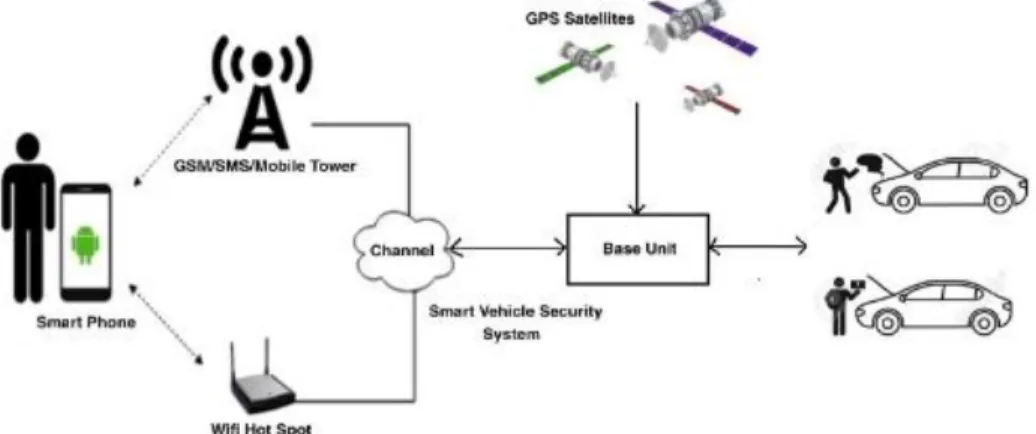
The Recent study in related to smart vehicle says that India plays a major role in marketing two wheelers in the world. It is estimated that India’s sales close to 17.8 million vehicles in the year 2016. Whereas, China remains in the second position in marketing of two wheelers. According to the Research in 2016 which was published by National Crime Records Bureau (NCRB) says that about 211,844 two wheeler vehicles were stolen only in India. Out of these stolen vehicles, the recovered vehicle count is only 46,436 and others were still unseen. By recovering the above problem, the smart vehicle using Internet of Things provides a better solution by implementing smart security device using IoT in vehicles. Thus the smart security system in vehicle using IoT is mainly used for automatic controlling and managing or accessing the vehicles. It can be done 6only by using IoT devices and access by using smart phones. The main purpose of this smart security system can provide the information about the vehicle involves the vehicle position and their time and also provides security by making an alarm sound to the owner of a particular vehicle or by providing a Short Message Service (SMS). Nowadays, it can also be done through mobile application. These technologies using IoT to control a vehicle and provide security from remote Locations. This application is useful for the drivers, individual users, delivery agencies and many other organizations. The features of this system involves emergency alert, vehicle performance and analytics with low battery alert, low type pressure alert, fuel leakage and consumption, fuel level monitoring. And also Image & video analytics, audio analytics, motion detection analytics with face detection, hands and legs detection etc.
Fig 1. IoT in Smart vehicles
2.1.2. Smart Lighting
The smart lighting systems includes Hue and lighting holding B.V,can sense humans and automatically detect when the user are in the room so that it can adjust the lighting whenever it is needed. Besides, there is another device called smart light bulbs which can detect and adjust or regulate themselves based on the light availability in daytime. It can be controlled by remote technology.
2.1.3. Smart Buildings
Every smart building is not like a smart home. The smart buildings with commercial, industrial buildings and other residential buildings. The offices, multi-tenant offices and apartment buildings are part of residential buildings with different shapes and sizes. Most of the smart home technologies are also now be used in smart buildings such as smart lighting, air conditioning, automatic switching on/off of many systems and smart security to access the important organization documents also many other building access systems. The advantages of IoT systems involves high building efficiency, improves security and provides customer satisfaction, reduces work of humans and cost of products etc.,
Fig 2: IoT in Smart buildings
The smart grid which is mainly used to make listen or talk with the other smart devices. The electric smart grid is connected to smart buildings.
By this technology, the building maintenance can be monitored and it can provide the high efficiency and the power consumption can be reduced. Moreover, the smart systems can be handled more quickly and safely. The temperature of the room can be monitored automatically by the sensors and adjust the air coolers based upon the climatic conditions. The continuous maintenance of the elevators, refrigerators in buildings and lighting systems can be done by smart devices.
2.2 Smart Homes
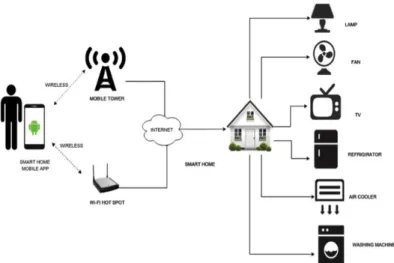
There are numerous applications for smart homes using IoT involves automatic switching on and off the light and camera with the help of sensors called motion sensors. The automatic AC on/off by temperature sensors. And the magnetic door sensor is used for main door opening and closing detection system. The different appliances in homes are controlled by using this technology, and can be accessed through mobile phones. Also it can send a notification to smart phones via SMS and email etc. The main application of IoT is can easily sense while smoking and make an alarm through sensor called smoke sensor. The advantages of applying these IoT devices in smart homes are reducing energy consumption, fully open source solution, improve comfort, smart control of all devices. The smart homes are one which uses the internet connected devices which provides us to monitoring and managing the home appliances and other systems like lighting and heating. These devices and smart home systems are operated together with the help of sharing the resources of consumers and the data they have used among themselves and actions which were done automatically based on users in smart homes. The home automation with IoT enabled systems provide numerous applications such as home air and water quality monitoring, Lawn or gardening management system, smart energy meters, home safety and security by IoT smart systems, lighting control etc. The examples of smart home technologies involve themselves based on the light availability in the day time.
Fig 3: IoT in Smart homes
2.2.1. Smart TV
Smart TV which is connected to the internet and can access those content by many applications such as video and music devices. Nowadays, most of the smart TVs can recognize human voice.
2.2.2. Smart Thermostats
climatic changes, it includes Nest from Nest Labs Inc., which provides with integrated Wi-Fi, helpful for the user to monitoring, scheduling, and remotely controlling the temperature of homes. These IoT devices can also detect or learn the human behavior i.e., homeowners activities and it can automatically modify settings. This is mainly to provide home with maximum comfort and achieve high efficiency. Most of the devices like smart thermostats can also record energy use and act as a remainder for users to modify filters.
2.2.3. Smart Locks
The smart locks in homes are used to unlock the door when the particular residents are near to the door. And also the locks and garage-door openers through which users of their homes, can access like grant or deny the opening of doors to the visitors.
2.2.4. Smart security camera
The smart security camera is used to monitor our homes lively when the residents are out for their vacation or any other purposes. The new technology called smart motion sensor which is used to identify the difference between home owners, their pets, visitors and other burglars and provide access of opening the doors when it sense the matches of their behavior.
2.2.5. Smart Kitchen Appliances
The smart kitchen appliances involves numerous automatic devices such as smart refrigerators, smart coffee makers, slow cookers and toasters, washing machines and dryers etc., The smart coffee makers is used to make a fresh cup of coffee while your alarm goes off. It is very useful for the users who prefer a bed coffee during morning times. The smart refrigerator which is used to make the food or other ingredients fresh and clean and also keep track of their expiration dates. Make a shopping list based on their user needs. The cookers are used to make recipes based on the food items or ingredients that are currently available.
2.2.6. Smart Household Systems
Household systems can sense and monitor through sensors and make it work based on their response. It can sense a water failures and turn off the water pipes when it is runs out to your basement. The sensors can sense electric surge and automatically turn off the appliances.
2.2.7. Smart Pet Care
Based on the scheduled timing, the pet care system automatically feeds the food to their pets. And also provide water to your lawn and house plants etc.
Thus the smart home is the technology in which many electrical and electronics things that are connected to the central control system that are wired to each other. And the system has the ability to control by switching on and off at the particular time. For example, lights can be automatic when there is a person in the sensor room. And it also switch on the light when the sensor detects it is dark inside. Another example is automatic switching on the heater when the alarm rings or when the time strikes to morning 6.00 am or it is the winter morning. The sensor which is used to detect these type of activities is called photoelectric sensor. These can be done automatically without any involvement of human activities. Nowadays, most of the homes has already called as ‘smart homes’ because most of the appliances are come up with built in sensors in it. For example, washing machine, water heater, vacuum cleaner etc. are already developed only with the sensors and programmed with smartness. The air-conditioner that automatically
detects the room temperature by their sensor and keep the room better with the climatic conditions.
The above all examples in smart homes are directly involved in automation and it makes the home to be in a centralized control of all these systems. Thus it is continuously monitoring all the devices and other appliances switches in smart homes. It has the capability to detect your movements across the floor and sense the motion. It can also has the ability to monitor light levels.
2.3. Smart Environment
By 2025, the technology will be developed very much and it is predicted that the data transfer from one place to another is done by transportation. It will be implemented all over the world. Thus, 20% of these will be moved only by the network. The traffic occurs in 5G networks is very high when compared to other networks like 2G/3G/4G.The network will be judged to be implemented and developed only in the dense urban areas first. These areas with highly improved mobile transport technologies and get an information transfer through wireless access which will be the first and foremost cases of trading use. Whereas, other trading use cases will initiate from other sectors include public services, healthcare, Internet sectors, autonomous vehicle and manufacturing industries, etc.,
2.3.1. Emergency Services
The emergency services mainly involve road safety, early accident detection by assuming based on the sensor detection by the devices. And also the emergency medical services systems is done by GSM/GPS system by collecting the data and made communication between the IoT devices. The road accident occurs frequently because of the increase in population, over recent years. The recent survey of the road ministry says that there is one death happened in every four minutes. Besides this there occur 55 accidents in every one hour. Therefore, by providing the emergency services in these areas making comfort to people and also minimize the loss of lives. There are several reasons why the road accidents are occurs frequently is rapid growth of population which also leads to increase in number of vehicles, which makes high traffic. Including the poor condition of roads, especially in hill stations, highways and narrow roads etc. The change in climate is also a main reason for accidents.
2.3.2. Smart Crowd Monitoring
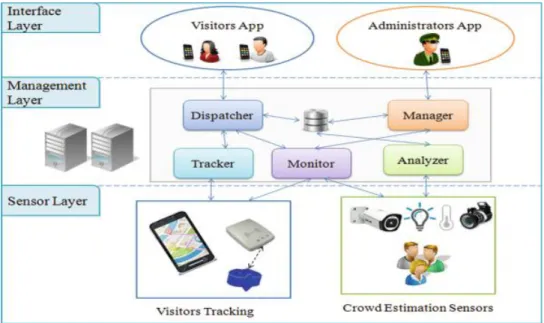
Crowd sensing is the powerful technology that makes the better environmental monitoring and also controls the air pollution levels in the crowded areas. The IoT device with this crowd sensing system provides the users to make an analysis of air conditions in their surroundings. It is implemented in smart cities, thus it provides a high level of integration and coordination between the objects or smart device called sensors by allowing them with a high degree of intelligence. The smart city is literally achieved by making the environment to communicate with each device by sensing their different behaviors. And allow these smart devices to collect data and provide a better result based upon the environmental problems. The crowd monitoring is one the best IoT application system in smart cities and environment. The different device and the sensor technologies are actively involved or take part in collecting skillful data about the large group of people which take place in the process. When all the data are possessed perfectly, they are now redirected to a central server which stores all data and use it for further process. The central server is to make a survey and allow the feedback return to the citizens only through the responses and actions to make advance lifestyle.
The crowd sensing device system is introduced by providing an alternative source to air quality stations. By these traditional monitoring stations, has only the very tiny sensors which assign toa large group of people in which this system works successfully.
Fig 4: Crowd monitoring using IoT
2.3.3. Waste Management
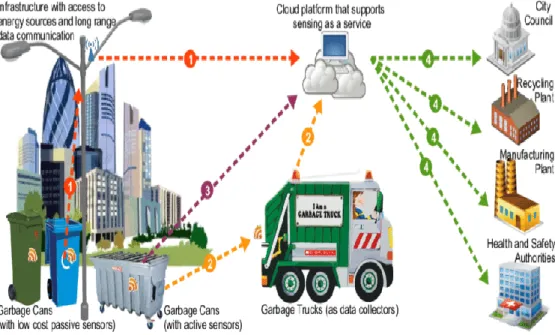
Waste management is the process of managing the waste from its origin to its disposal so that waste can’t be spread. In this process there are many stages which involve identification of waste i.e. its type basically as bio degradable waste or non-bio degradable waste so we can find a proper method to dispose the waste. Even the wastes can be classified as wet and dry wastes. In that purpose for identification of different types of waste we can use devices which use IoT for communication. Using IoT we can automatically separate different wastes using different types of sensors like IR, ultrasonic, etc. The municipal operations can be very much improved when IoT is a part of it. The application of IoT can be used even from the collection of wastes itself. By using sensors the person who collect the garbage can easily know whether the tank is fill or not and using sensors in the garbage bin to identify wet and dry wastes and connecting it to certain interior bins can be helpful in separation of wastes. And the best part is that workers don’t need to and check the system by themselves, they can check it with their mobile phones so it helps them from toxic gases and smells. By applying this also helps in saving time as in separating wastes, fuel in garbage trucks and maintains hygiene for the workers as well as for the environment. And after identifying the wastes as different types it will be much easy for the disposals. It is also necessary to find the wastes which are toxic and biological waste because we cannot dispose them as usual wastes. It can cause interior damages to the workers and the people who surround it. These types of wastes need special set up to dispose. Many of the wastes can be recycled and reused if we are able to isolate them properly. IoT can be played in the recycle process to identify the things. The producer who are making the products can insert the digital codes in packaging and define the packaged material can be reused through IoT so that whenever that product is thrown away using that code we can say that it is reusable. But in our generation e-wastes play a major role. Everyday a new technology rises and the old one is thrown away. The recycle using IoT can be concentrated in e-wastes to remove them.
Fig 5: Waste management using IoT
2.3.4. Water Quality Monitoring
In the world we are living now have shortened of pure water and it has become responsible for our generation to hand over the water safely to the future generations. It means we have to utilize the water properly and for that IoT can be very useful to give people some knowledge about the conditions of water so a proper use of that water can be happen. With the help of sensors and using its data people can make sure that they make the best use of available water. With the help of sensors we can know the color and smell of sensor from very distance space if we upload the data of sensors in the cloud and manage to view that data in our mobile Phones. Even we can save much amount of water in dams if we know the amount of water present in it by using ultrasonic sensors. If we know the height we can easily know when to release water from the dam without any fear and can produce less damage when the water is released. It is not possible for people to monitor the water flow at all places. But by implementing IoT applications it is possible to monitor the pathways and tunnels, the water flows. And using IoT we can even guide the route of water to reach its destiny by opening gate valves with the help of sensors which is operated bya person at a distance. We can also know turbidity, pH and temperature using sensors.
CONCLUSION
In this paper we have analyzed the application and future scope of IoT in smart cities and environment provides a better development in our lives. Thus applying IoT technology which creates new environment and cities with smart homes in future. This paper described how IoT plays a major in our cities and environment to become smart. The benefits of using the sensors in smart homes and cities are addressed properly. And how they face challenges in the environment is explained clearly. The applications in smart environment are quite difficult when compared to other systems. But once they have implemented successfully, they can provide high benefits to our society. Thus it helps in better development in the environment and instance facilities and utilization become easier. It develops a decent environment through their smart devices or sensor and their solutions using IoT. IoT is the best choice among all that helps in development of smart cities and environment. By addressing the benefits of IoT technology in smart cities and environment provides the better functioning of this technology.
REFERENCES
[1] A. Vimal Jerald, S. Albert Rabara, T. Daisy Premila Bai ,2015. IoT Based Smart Environment Integrating Various Business Applications. International Journal of Computer Applications (0975-8887), Vol 128-No.8, October 2015.
[2] D. Devi Kala Rathinam, J. Sherin, A. Santhiya Grace,2018. IoT Based Smart Environment and its Applications. International Journal of Trend in Scientific Research and Development (2456-6470), Vol-2|Issue-4, June 2018.
[3] Francesca Righetti, Carlo Vallati, Giuseppe Anastasi,2018. IoT Applications in Smart Cities: a Perspective into Social and Ethical issues. IEEE International Conference on Smart Computing, August 2018.
[4] BadisHammi, RidaKhatoun, SheraliZeadally, Achraffayad, LyesKhoukhi, 2015. IoT Technologies for Smart Cities. The Institution of Engineering and Technology, 2015.
[5] ShaguftaRajguru, Swati Kinhekar, Sandhya Pati, 2015. Analysis of IoT in a Smart Environment. International Journal of Enhanced Research in Management & Computer Applications (2319-7471), Vol-4|Issue-4, April 2015.
[6] Dr. Madhvi A. Pradhan, SupriyaPatankar, Akshay Shinde, Virendra Shivarkar, Prashant Phadatare, 2017. IoT for Smart City: Improvising Smart Environment. International Conference on Energy, Communication, Data Analytics and Soft Computing, August 2018.
[7] Husam Rajab, Tibor Cinkelr, 2018. IoT Based Smart Cities. IEEE, November 2018.
[8] C. Gokulnath, J. Marietta, R. Deepa, R. Senthil Prabhu, M. Praveen Kumar Reddy, B.R. Kavitha, 2017. Survey in IoT Based Smart City. International Journal of Computer Trends and Technology, Vol-46, April 2017.
[9] Ejaz Ahmed, Ibrar Yaqoob, Abdullah Gani, Muhammad Imran , Mohsen Guizani. IoT Based Smart Environments: State-of-the-Art, Taxonomy, and Open Research Challenges. IEEE Wireless Communication.
[10] Renu Thapliyal, Ravi Kumar Patel, Ajit Kumar Yadav, Akhilesh Singh, 2018. IoT for Smart Environment and Integrated Ecosystem. International Journal of Engineering & Technology (1218-1221) 2018.
[11] Carles Gomez, StefanoChessa, Anthony Fleury, George Roussos, Davy Preuveneers,2019. IoT for enabling Smart Environments: A technology centric perspective. Journal of Ambient Intelligence and Smart Environment, Vol-11,January 2019.
[12]M. M. Rathore, A. Ahmad, A. Paul, and S. Rho, “Urban planning and building smart cities based on the internet of things using big data analytics”,Comput. Netw., 2016, DOI: 10.1016/j.comnet.2015.12.023.
[13] A. Bassi, and G. Horn, “Internet of Things in 2020: A Roadmap for the Future,” European Commission: Information Society and Media, 2008.
[14]A.K. Evangelos, D.T. Nikolaos, and C.B. Anthony, “Integrating RFIDs and smart objects into a Unified Internet of Things architecture,” Advances in Internet of Things, vol. 1, pp. 5-12, 2011. [15] N. Neyestani, M. Y. Damavandi, M. Shafie-khah and J. P. S. Catalão, “Modeling the PEV traffic pattern in an urban environment with parking lots and charging stations,” PowerTech, 2015 IEEE Eindhoven, Eindhoven, 2015, pp. 1-6.
[16] M. Yazdani-Damavandi, M. P. Moghaddam, M. R. Haghifam, M. Shafie-khah and J. P. S. Catalão, "Modeling Operational Behavior of Plug-in Electric Vehicles’ Parking Lot in Multienergy Systems," IEEE Trans. Smart Grid, vol. 7, pp. 124-135, 2016.
[17] N. Neyestani, M. Y. Damavandi, M. Shafie-Khah, J. Contreras, and J. P. S. Catalão, "Allocation of plug-in vehicles' parking lots in distribution systems considering network-constrained objectives," IEEE Trans. Power Syst., vol. 30, pp. 2643-2656, 2015.