Sede Amministrativa: Università degli Studi di Padova Dipartimento di Studi linguistici e letterari
CORSO DI DOTTORATO DI RICERCA IN: SCIENZE LINGUISTICHE, FILOLOGICHE E LETTERARIE CURRICOLO: LINGUE E LETTERATURE ANGLO-GERMANICHE
CICLO: XXIX
Gesture and prosody: cognitive and communicative
effort in L1 and L2
Coordinatore: Ch.ma Prof.ssa Annalisa Oboe
Supervisore: Ch.ma Prof.ssa Maria Grazia Busà
Dottoranda: Sara Brugnerotto
3
Contents
List of figures ... 7 List of tables... 9 Abstract ... 11 Riassunto ... 15 Introduction ... 21Part I | Theoretical Background ... 25
1/ Gestures ... 27
1. Defining Gestures ... 27
2. Recognizing Gestural Actions ... 28
3. Anatomy and Structure of Gestures ... 30
3.1 Gesture structure ... 30
3.2 Gesture space ... 33
4. Classifying Gestures... 34
4.1 A semiotic categorization, Wilhelm Wundt ... 34
4.2 Categorizations of gestures and their relation with speech ... 35
4.2.1 David Efron ... 35
4.2.2 Paul Ekman and Wallace Friesen: the repertoire of nonverbal behavior ... 37
4.2.3 David McNeill ... 43
4.2.4 Kendon’s continuum ... 47
4.2.5 Speech interaction with gestures – Pragmatic meanings or rhythmic markers ... 48
2/ Gestures in relation with speech ... 51
1. Introduction ... 51
2. Speaking and Gesturing. When Words are Complemented by Gestures ... 53
3. Gestures in L1 and L2 Acquisition ... 54
3.1 L1 acquisition ... 54
3.2 L2 acquisition ... 56
4
3/ Cognitive and communicative functions of gesture ... 61
1. Introduction ... 61
2. Gesture, cognition and thinking for speaking ... 62
3. Beyond cognition. The communicative function of gestures ... 66
3.1 The role of representational gestures in communication. ... 72
4/ About speech prosody and its relations with gestures ... 77
1. Prosody... 77
2. On Intonation ... 78
3. About Pitch Range ... 79
4. Pitch in L2 ... 80
4.1 Measuring global pitch range ... 82
5. Prosody and Gestures ... 82
6. Pitch and Gestures ... 84
Part II | Experimental analyses ... 87
5/ Does communicative effort influence pitch and gestures? ... 89
1. A note on terminology ... 89
2. Introduction ... 89
3. Subjects and Materials ... 92
4. Procedure ... 92
5. Methods and Analysis ... 94
6. Gesture data ... 96
6.1 The gesturing styles: some examples from the corpora ... 99
7. Results ... 105
7.1 About Pitch ... 105
7.2 Speech data ... 106
7.3 Occurrence of gesture types ... 110
7.4 Relation of pitch and gestures ... 112
8. Discussion ... 114
6/ Does repetition help to be more communicative? Experiment 2 ... 119
1.Introduction ... 119
2. Subjects and Materials ... 120
5
4. Methods and Analysis ... 123
5. Prosodic and Speech data ... 123
6. Gesture data ... 125
6.1 Gesturing styles and annotation criteria. Some examples from the corpora ... 127
7. Results ... 130
7.1 About Pitch ... 130
7.2 Speech data ... 132
7.3 Gesture data ... 135
8. A little insight into the vagueness issue ... 138
9. Discussion ... 139
7 / Integrating the results ... 143
Conclusions ... 147 References ... 153 Appendix 1 ... 173 Appendix 2 ... 175 Appendix 3 ... 177 Appendix 4 ... 179 Appendix 5 ... 183 Appendix 6 ... 185
7
List of figures
Fig. 1. Kendon's hierarchy ... 30
Fig. 2. Example taken and adapted from Kendon 2004, pp.120-121 ... 32
Fig. 3. Gesture space, taken from McNeill, 1992; p. 89 ... 33
Fig. 4 Relationships among types of ‘usage’ according to Ekman & Friesen, 1969 ... 39
Fig. 5. Metaphoric gesture ... 44
Fig. 6. Deictic gesture ... 45
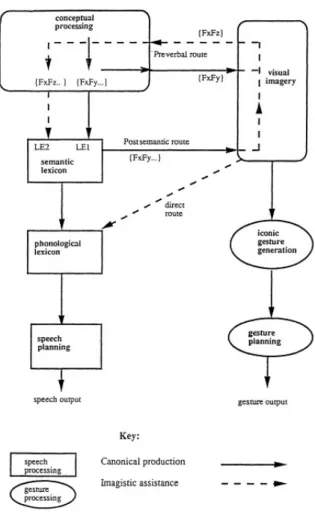
Fig. 7. The relation between iconic gestures generation and speech production ... 63
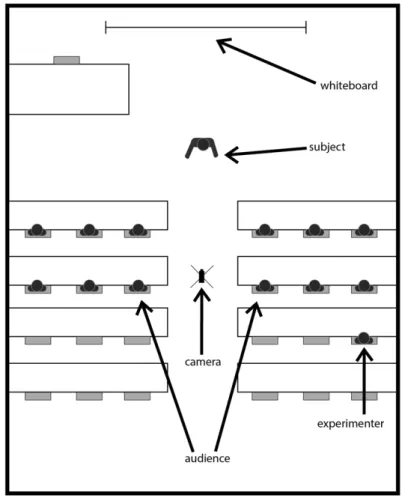
Fig. 8. Experimental set ... 93
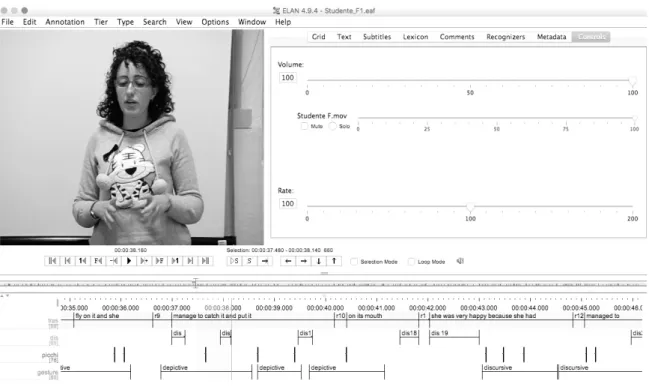
Fig. 9. Annotation in Elan ... 96
Fig. 10. Example of iconic gesture ... 97
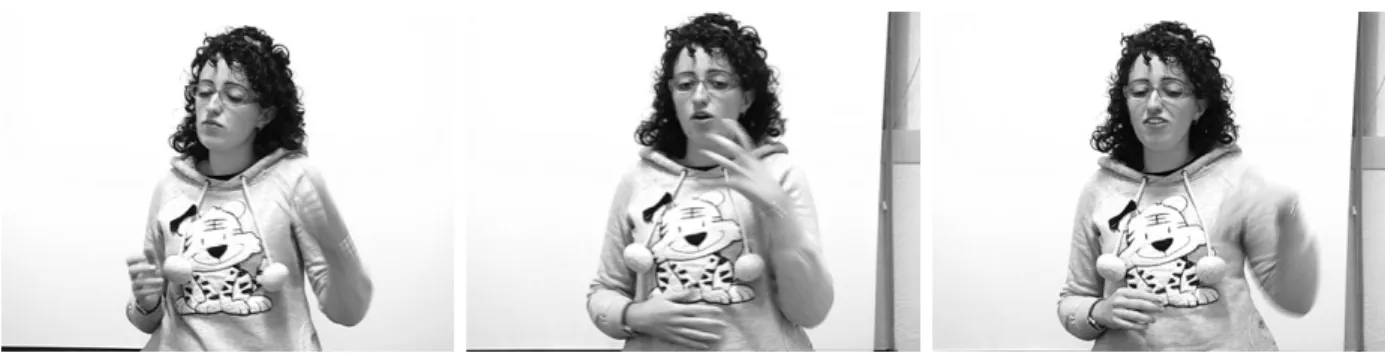
Fig. 11 Student C in her first (on the left) and second telling of the fable in English ... 101
Fig. 12 Student B while conveying the sentence "it picks up the cheese" ... 101
Fig. 13 Beat Gestures (annotated discursive) in the three different conditions ... 102
Fig. 14 Cyclic, vague and other pragmatic gestures ... 103
Fig. 15 Emblem occurrence ... 104
Fig. 16. Anova results for PVQ values ... 106
Fig. 17. Comparison of the frequency of co-occurrence of pauses in relation to spoken words in the three datasets ... 108
Fig. 18 Gesture occurrences (in raw numbers) for every macro category ... 110
Fig. 19. Comparison between the pitch variation and the Gesture Rate ... 113
Fig. 20. Experimental set ... 122
Fig. 21. Example of Elan annotation ... 125
Fig. 22 Students G and C performing iconic gestures ... 127
Fig. 23 Student A while producing metaphoric and abstract deictic gestures ... 128
Fig. 24 discursive gestures ... 129
Fig. 25 PVQ in the four conditions ... 131
Fig. 26. Gesture sequence in which the Speaker L is saying "the cheese falls" ... 135
8
Fig. 28 Total Gesture rate ... 136 Fig. 29 Gesture rates of the four conditions for each gesture type ... 137
9
List of tables
Tab. 1 The seven types of illustrators (Ekman and Friesen, 1969; Ekman, 2004) ... 41
Tab. 2. Gesture categorization comparison, Efron, Ekman & Friesen and McNeill ... 46
Tab. 3 L1 development (Masur 1990) ... 55
Tab. 4 Gesture use in relation to age (adapted from Gullberg, 1998) ... 56
Tab. 5 gesture macro-categorization ... 99
Tab. 6. Pitch values for the three experimental conditions ... 105
Tab. 7. Speech data in the three experimental conditions ... 106
Tab. 8 Gesture categorization ... 126
Tab. 9. Pitch values in the four experimental conditions ... 131
Tab. 10 Average duration of speech features ... 132
Tab. 11 Average number of occurrencies in speech and speech rate ... 133
Tab. 12. Percentage of gesture usage in each experimental condition ... 136
Tab. 13. Gesture rates ... 137
Tab. 14. Gesture rate for the vagueness category ... 138
Tab. 15. Speech rate in the four conditions ... 138
Tab. 16. Pitch Variation Quotient for the four conditions ... 139
Tab. 17. Comparison of the two investigations results ... 146
11
Abstract
Gestures and speech are two interconnected features of human communication. Studies have shown that they develop together and they both covey semantic and pragmatic meanings (Kendon, 2004; McNeill, 1992). Furthermore, gestures seem to be also linked to the prosodic features of speech since they also share synchronicity aspects and are often temporally aligned (McClave, 1991; Esteve-Gibert & Prieto, 2013).
The co-production of gestures and speech, thus, seems to have a number of different functions both at the cognitive and at the communicative levels. On the one hand, in fact, gestures seem to help the process of speaking: they have a scaffolding function in the lexical and rhythmical organization of speech and they help information packaging (Butterworth & Beattie, 1978; Esteve-Gibert et al., 2014; Krauss et al, 1996; Kita, 2000, 2010). This is supported by the evidence that speakers gesticulate also when they don’t see their addressees (for example when they are speaking over the phone (Cohen & Harrison, 1973; de Ruiter, 2003). On the other hand, gesturing is intended to communicate and is part of the speaker’s communicative effort (Kendon, 2004).
Gestures also play an important role in L2 development and communicative strategies (Gullberg, 1998) and it is possible that L1 gestures influence gestures during L2 language development, and that gestural transfer co-occurs with linguistic transfer (Brown & Gullberg, 2008; Pika, Nicoladis, Marentette, 2006). It has also been suggested that, since gestures play an important role in facilitating language access in speech production, bilingual/L2 speakers may gesture more than monolingual speakers. This would be due to the cognitive load deriving from speaking a different language from the native one (Kita, 2000; Krauss & Hadar, 1999).
Until now, gestures and prosody have been studied mostly in their temporal interaction and coordination (McClave, 1991, Loehr, 2004) or in the possible similarities between their pragmatic functions (Tuite, 1993). Little attention has been paid to the relationship between speakers’ global pitch range and use of gestures (and gesture categories) in conditions of high cognitive effort, or when they increase their communicative effort in their speeches. In fact, there
12
seem to be a lack of scientific evidence about the use of pitch and gestures variability as a communicative strategy of the speaker.
The aim of this thesis is to investigate aspects of the role and functions of gestures and speech in L1 and L2 and how the cognitive and communicative efforts may influence speakers’ global pitch range and the use of gestures in a story telling task.
The investigation consists of two experiments. The first one (presented in chapter 5) aims to examine if speakers’ increase in the communicative effort produces changes in pitch variation and in the use of different categories of gestures. The second one (presented in chapter 6) examines the effects of speakers’ decrease in cognitive effort in the production of speech and gestures.
In the first experiment 8 Italian speakers, Italian learners of English (L2) and students of a Public Speaking class, were asked to read and tell a fable in English to their classmates (Italian was used only as a control and recorded only one time). One week later, the subjects were asked to repeat the task with the instruction to be as communicative as possible. The audiovisual material was analyzed with the software Praat (phonetic analysis) and Elan (gesture analysis). For speech, the aim was to examine possible changes in the speakers’ fluency and pitch variation after they received the instruction to be communicative; for gestures, the aim was to examine the variations in both speakers’ overall gesturing and representational gestures in the communicative task. The hypothesis tested was that the communicative task causes an increase in fluency in the L2 (shown through features like a higher speech rate and a decrease of disfluencies and pauses), and that the communicative task leads to an increased use of representational gestures, since they might be considered as helpful for the addressee to better understand what is said. The results of the first experiment led to the conclusion that if a person is asked to be communicative in the L2, they will probably increase both their pitch variation and the total number of gestures produced, with a significant increase in iconic and representational gestures. The results on pitch variation, though, do not exclude the possible effect of other variables, first of all of task repetition. In fact, it is possible that by repeating the task, the speakers became more confident and could be more focused on being more communicative in telling the story.
The second experiment tests the effect of task repetition on L2 speech and gesture. In this experiment (chapter 6) only the cognitive facilitation and the effect of the decrease in cognitive load was considered. This time, in fact, the subjects (10 Italian students of English L2) were
13
asked to watch a short cartoon and to tell the story, both in Italian and English, in front of a small audience while being video-recorded. The subjects were asked to repeat the task one week later in the two languages with the same modalities. The analyses followed the same procedure as the previous experiment (chapter 5). The hypotheses tested were that repetition itself could influence the communicativeness of the speakers in both the speech and the gesturing levels, with an increased fluency and a different use of gestures compared to the first narration attempt. This could be caused by the facilitation of the task in terms of cognitive load and better memorization. The results showed that with the decrease of the cognitive load, speakers reach a higher fluency in L2. In Italian, however, the speakers show no significant difference in fluency or liveliness
(Hincks, 2005) and this might be due to the fact that repetition and memorization did not help their fluency as much as they did in the L2. As for gestures, the speakers employed a greater number overall gestures when speaking English, their L2. The use of gestures, though, did not change in spite of the repetition, with a greater use of discursive gestures even if representational gestures seem to be used more in the L2 than in Italian.
Overall, the investigation shows that the results of the two experiments can be integrated and offer a wider picture on the use of gesture and the employment of representationality with the conscious intent to be communicative. When people are asked to tell a story in a more communicative way, their response is to increase the representationality carried in their gestures and consequently use more representational gestures, this does not occur whenever the subjects only repeat the narration with a lighter cognitive load.
15
Riassunto
La comunicazione parlata è fortemente legata a quella gestuale. Il sistema gestuale e quello del parlato, infatti, sono considerati parti integranti di uno stesso sistema linguistico all’interno del quale si sviluppano assieme e si condizionano e influenzano l’un l’altro (Kendon, 2004; McNeill, 1992). I gesti, infatti, supportano l’organizzazione e “l’impacchettamento” delle informazioni espresse nel parlato (Information packaging, Kita 2000, Alibali & Kita, 2010). I gesti, inoltre, integrano e contribuiscono alla resa semantica e pragmatica del parlato (Kendon, 2004). Inoltre, la gestualità sembra ricoprire un ruolo anche per quanto riguarda alcuni aspetti ritmico prosodici del parlato, sia nella prima che nella seconda lingua (Esteve-Gibert & Prieto, 2014; McCafferty, 2004).
Generalmente, gli studi che mettono in relazione prosodia e parlato si concentrano sulla sincronicità dei picchi intonativi con determinate categorie gestuali (generalmente i beats o
batonici, caratterizzati da movimenti ritmici di dita, mani o braccia). Molta meno attenzione è stata data alla relazione esistente fra la variabilità intonativa e l’uso delle categorie gestuali. Mancano quindi studi che investighino il comportamento di gesti e prosodia in condizioni di comunicatività e sforzo cognitivo differente. Anche se diverse lingue hanno diverse caratteristiche prosodiche e intonative che le contraddistinguono, esistono comunque degli
universali prosodici (Ladd, 2008) che caratterizzano il parlato e ne comunicano alcuni aspetti pragmatici (un universale prosodico, ad esempio, è l’alzarsi del contorno intonativo quando la frase viene interrotta da una pausa ma non è ancora considerata conclusa dal parlante). Per esempio, è stato dimostrato che la variabilità dell’intonazione influenza la percezione della vivacità del discorso (Hincks, 2004, 2005). Ne potrebbe essere una dimostrazione il fatto che, nei corsi di public speaking, gli studenti vengano incitati a modulare il tono di voce in modo tale che risulti variato. Un’altra istruzione che viene data agli studenti di public speaking riguarda la modulazione del proprio linguaggio del corpo e, quindi, della gestualità. Slemberebbe in fatti che anche la variabilità del linguaggio del corpo abbia come effetto la percezione di una maggiore vivacità comunicativa e aiuti quindi l’ascoltatore.
16
Tuttavia, nel panorama della ricerca scientifica, scarseggiano gli studi che dimostrano l’esistenza una relazione tra la variabilità dell’intonazione e dei gesti del parlante. Una parte consistente del lavoro di questa tesi è infatti rivolto all’approfondimento della funzione comunicativa di gesti e intonazione e alla verifica di possibili correlazioni fra questi due aspetti.
Un’altra questione che viene affrontata all’interno di questa tesi è l’effetto della ripetizione e la conseguente facilitazione del compito di narrazione in L2. Comunicare in una lingua straniera, infatti, comporta un complesso sforzo cognitivo: oltre a dover organizzare il discorso e recuperare il lessico adeguato, il parlante deve conferire al proprio discorso anche la pronuncia, la prosodia e il ritmo della lingua che sta parlando. Questo sforzo cognitivo può portare a una diminuzione della fluenza, ad un aumento di esitazioni nel parlato ed a una minore variabilità intonativa (Zimmerer et al. 2014). Un aspetto che verrà investigato all’interno di questo lavoro riguarda, appunto, il rapporto fra la facilitazione del compito narrativo in L2, attraverso la ripetizione del task narrativo, e l’uso di prosodia e gesti.
Questa tesi si inserisce negli studi relativi a gesti e prosodia e si focalizza sulle differenze gestuali e prosodico-intonative in parlanti L2 di inglese che raccontano una favola e la ripetono poi a distanza di una settimana. L’ipotesi che ho voluto testare è che quando cambia il contesto comunicativo cambia anche la gestualità e alcuni aspetti ritmici e linguistici del parlato. In particolare, quando domina la funzione cognitiva del parlato, e quindi il soggetto si concentra sulla struttura della storia, prevalgono gesti di tipo ritmico-discorsivo anche associati alle esitazioni del parlante; quando invece domina la funzione comunicativa, aumentano i gesti di tipo rappresentativo e diminuiscono le esitazioni nel parlato.
Il lavoro è strutturato in due parti: la prima parte, Theoretical Background, è intesa come la presentazione dell’argomento e della letteratura riguardante i temi d’interesse. La seconda parte riguarda i due esperimenti condotti per testare le ipotesi di ricerca.
Più nello specifico questo lavoro è strutturato in 7 capitoli così suddivisi:
Dopo l’introduzione al lavoro generale, il primo capitolo riguarda una presentazione generale sugli studi sulla gestualità, iniziando dalla definizione di gesto e dai criteri che rendono possibile la distinzione di un gesto da un non-gesto. In questo capitolo, inoltre, viene spiegata l’anatomia dei gesti e l’uso dello spazio da parte dei parlanti. Infine, vengono presentate le principali categorizzazioni che sono state date dai principali studiosi. Lo studio dei gesti, infatti, è una
17
disciplina relativamente giovane, che si è sviluppata soprattutto a partire dalla seconda metà del novecento e per la quale non sono ancora state definite categorie univoche.
Il seguente capitolo (capitolo 2), tratta la relazione dei gesti con il parlato. Il rapporto esistente fra parlato e gesti non è del tutto chiaro. Se da una parte, infatti, i gesti e il parlato sono considerati parte di uno stesso sistema linguistico che si sviluppa e interagisce nell’atto comunicativo (McNeill, 1992; Kendon, 2004), dall’altra essi vengono considerati come il risultato di due processi indipendenti (Hostetter, Alibali & Kita, 2007). In generale, comunque, i gesti possono in alcuni casi sostituirsi al parlato, in altri, arricchire il significato semantico e pragmatico di ciò che viene detto, o possono marcarne il ritmo (McNeill, 1992). All’interno di questo capitolo, viene inoltre discusso il rapporto che gesti e parlato hanno sullo sviluppo della prima lingua e sull’apprendimento della seconda lingua, nonché le funzioni che i gesti hanno nella narrazione. Il capitolo 3 si focalizza sul dibattito riguardante le funzioni cognitive e comunicative dei gesti partendo da considerazioni e studi da considerarsi fondativi in questo ambito. Nella prima parte del capitolo vengono presentati i più importanti studi a supporto dell’idea che i gesti siano principalmente legati alle funzioni cognitive e quindi organizzative e lessicali del parlato (v. Beattie & Coughlan, 1999; Hadar & Butterworth, 1997; Rauscher et al., 1996; Kita, 2000, 2010; Krauss et al., 1996). La seconda parte del capitolo illustra gli studi che si concentrano sulla funzione comunicativa e pragmatica che i gesti ricoprono nel parlato (Bavelas et al. 2008; Kendon, 1985, 2004) e, nello specifico, su quale sia il ruolo che i gesti iconici hanno nella comunicazione (v. Cohen & Harrison, 1973; Melinger & Levelt, 2004),
Il quarto capitolo è dedicato alla prosodia e alla sua relazione con il sistema gestuale nel parlato. In questo capitolo vengono chiariti i concetti di intonazione e variabilità intonativa sia in L1 che in L2 (v. Hincks, 2004; Mennen et al. 2007; Patterson, 2000).
La seconda parte, Experimental analyses, comprende i capitoli 5, 6 e 7 dedicati al lavoro sperimentale.
Nel quinto capitolo viene esposto il primo dei due lavori sperimentali. L’ipotesi di partenza è quella che un maggiore sforzo comunicativo da parte del parlante L2 abbia come effetti, da un lato, una maggiore variabilità intonativa rispetto a quella della L1; dall’altra un uso distinto dei gesti rispetto alla condizione L2 nella quale tale sforzo comunicativo è meno consapevole. Il primo dei due effetti, la maggiore variabilità intonativa, sarebbe dovuto al fatto che i soggetti si
18
concentrano maggiormente nella resa comunicativa del parlato e quindi riescono a conferire una variabilità intonativa. In particolare, i parlanti riescono ad avere un’intonazione più simile a quella della L2 (che in questo caso è l’inglese, generalmente percepito come una lingua con maggiore variabilità rispetto all’italiano). Il secondo effetto sarebbe invece dovuto al fatto che i soggetti, per risultare più comunicativi, si concentrerebbero su quei gesti che considerano più importanti a livello comunicativo e percettivo.
Il primo esperimento ha coinvolto otto studentesse, frequentanti un corso di Public Speaking all’interno dell’Università di Padova. Alle studentesse è stata fatta leggere la favola di Esopo “Il corvo e la volpe” ed è stato chiesto loro di raccontare la storia due volte: la prima senza ricevere alcuna istruzione specifica e la seconda con la richiesta di cercare di essere il più comunicative possibile. L’analisi del corpus di materiale audiovisivo è stata effettuata:
• Tramite un’analisi fonetico-prosodica degli audio (con l’utilizzo del software Praat http://www.fon.hum.uva.nl/praat/) con il quale sono stati misurati: disfluenze, ripetizioni, correzioni, pause piene, pause silenti e pause respiratorie, altezza tonale. Sono state inoltre conteggiate le parole.
• Tramite l’analisi gestuale del corpus di video (con l’utilizzo del software Elan, https://tla.mpi.nl/tools/tla-tools/elan/download/) con cui sono stati analizzati i gesti concomitanti al parlato suddividendoli in macro-categorie (rappresentazionali, che descrivono caratteristiche fisico o metaforiche dell’oggetto del discorso; discorsivi, che hanno una relazione ritmica con il parlato e che ne marcano continuità e coesione;
emblemi, gesti tipici di una cultura e che sono capiti e condivisi solo da chi fa parte di un determinato gruppo linguistico e/o sociale).
I risultati di questo primo esperimento suggeriscono che un maggiore sforzo comunicativo porta ad un aumento della quantità di gesti totali e della percentuale di gesti di tipo iconico-rappresentazionali, oltre che ad una maggiore fluenza, e ad un uso più variato dell’altezza tonale da parte dei soggetti sperimentali. Tale risultato porta alla conclusione che, quando viene richiesto loro di essere comunicativi, i parlanti migliorano la fluenza del parlato, modificano la variazione dell’altezza tonale e implementano un numero maggiore di gesti iconici.
Il sesto capitolo è dedicato alla seconda ricerca sperimentale, nella quale le parlanti sono state registrate fuori dal contesto di insegnamento e, nella seconda ripetizione, non è stato chiesto loro di concentrarsi sulla resa comunicativa del proprio racconto. L’esperimento mira ad integrare i
19
risultati raggiunti dall’esperimento con focus sulla resa comunicativa dei soggetti e vuole verificare quali siano le differenze prosodico-gestuali in un contesto in cui alle parlanti (in questo caso sia di L1 che di L2) viene richiesto solamente di ricordare e ripetere il racconto senza dover migliorare la propria performance comunicativa.
Nel secondo esperimento sono state coinvolte 10 studentesse di lingue e linguistica di età compresa fra i 22 e i 25 anni, con livello B2 di inglese (CEFR).
Alle studentesse è stato fatto vedere un video con un breve cartone animato che illustrava la favola “Il Corvo e la Volpe” di Esopo. Subito dopo aver visto il cartone, le ragazze sono state videoregistrate mentre raccontavano la storia sia in italiano che in inglese. Le stesse studentesse hanno ripetuto l’esperimento dopo una settimana. Per evitare l’effetto di common ground, per il quale si omettono informazioni verbali quando l’interlocutore condivide o è a conoscenza di ciò di cui si sta parlando, il pubblico al quale le studentesse raccontavano la storia è stato cambiato ad ogni ripetizione, sia in italiano che in inglese.
Le seguenti analisi sono state effettuate sul materiale audiovisivo:
• Analisi fonetico-prosodica del materiale audio con il software di analisi acustica Praat (disfluenze, ripetizioni, correzioni, pause piene, pause silenti e pause respiratorie, altezza tonale). Sono state inoltre conteggiate le parole.
• Analisi gestuale del materiale visivo con il software di analisi multimodale Elan. Per poter confrontare i risultati con quelli ottenuti nel primo esperimento, l’annotazione dei gesti co-occorrenti al parlato ha mantenuto la stessa categorizzazione dei gesti in macro-categorie: representational, che comprende tutti i gesti di tipo rappresentazionale, che indicano o rappresentano fisicamente o metaforicamente l’oggetto o l’azione di cui si parla; discursive (ritmico-discorsivi), cioè tutti quei gesti che aiutano il parlante ad organizzare il proprio discorso e/o a marcarne il ritmo.
I risultati di questo esperimento hanno mostrato che, nonostante ci sia un effetto di ripetizione, che comporta un miglioramento nella fluenza del parlato (soprattutto in L2, condizione nella quale la differenza fra le due ripetizioni è risultata statisticamente significativa), le parlanti non modificano significativamente i gesti.
20
Il settimo capitolo è dedicato all’integrazione dei risultati e delle conclusioni delle due ricerche e quindi alle considerazioni finali. I risultati dei due esperimenti conducono alla conclusione che all’aumentare dello sforzo comunicativo da parte dei parlanti corrisponde anche una maggiore gestualità, visibile in particolare nell’aumentare della quantità di gesti appartenenti alla macro-categoria rappresentativa (representational). Allo stesso tempo, la riduzione dello sforzo cognitivo nella seconda ripetizione comporta effetti sia sul parlato che sui gesti. Nel parlato, il fatto di essere di fronte ad un compito relativamente più facile (per effetto della ripetizione della storia) porta le studentesse a migliorare la loro fluenza in L2 (si riducono le disfluenze come esitazioni, pause piene, correzioni e ripetizioni). La maggiore facilità nel raccontare la storia, inoltre, permette di aumentare significativamente la variazione dell’altezza tonale nella seconda ripetizione in L2, consentendo alle studentesse di imitare le caratteristiche prosodiche dell’inglese. Dal punto di vista gestuale, invece, non si presentano differenze statisticamente rilevanti fra le ripetizioni, né in italiano, né in inglese. L’unica differenza significativa rilevata è quella dell’uso della categoria rappresentazionale fra la prima ripetizione in Italiano e la prima in inglese. Quando raccontano la storia in inglese, infatti, le studentesse usano un maggior numero di gesti di tipo rappresentazionale, suggerendo così che la rappresentazionalità dei gesti non è solo effetto del maggior intento comunicativo (come si era visto nel primo esperimento) ma è anche effetto del minor sforzo cognitivo.
21
Introduction
Gestures and speech are an interrelated system and develop together. For example, it seems that gestures help reducing the cognitive load of the speakers (Goldin-Meadow et al., 2001; Mol et al., 2009), they seem to help fastening the learning processes (Goldin-Meadow, 2000; Roth, 2001). Furthermore, gestures seem to help speakers organize visual information with speech (Kita, 2000, 2010) but they are also an important feature that supports the delivery of semantic and pragmatic aspects of speech (Kendon, 2004; McNeill, 1992). The functions of gestures in speech are still objects of debate, and this will be illustrated in the present work.
Another important aspect of communication is represented by speech characteristics and prosody. Besides being different for every language, prosody seems to have an effect on the perception of liveliness in speech and thus, when a speaker intends to deliver a lively speech, they will probably use a more varied pitch range (Hincks, 2004, 2005). In fact, in public speaking classes students are urged to employ a varied intonation together with salient gestures in order to catch the attention of their audience. Even if these instructions are commonly given in many public speaking classes, there is a lack of scientific evidence that proves the actual effectiveness of these techniques. One of the aims of this work is to provide this scientific evidence. Another important instruction that is given in public speaking classes is to repeat and rehearse before delivering a speech, so that speakers can gain confidence and memorize their speeches, and this allows them to reduce hesitations and to improve the fluency of their speech. But does repetition also have an effect on speakers’ pitch and gestures? Another aim of this work is to understand if repetition can elicit a different use of gestures and pitch.
Another important aspect that is investigated in this work is the role that communicative intent has in L2 gestures, speech and prosody. In fact, if a lively and communicative speech is characterized by an increase in pitch variation in L1 (Hincks, 2004, 2005), it is possible that the same effect will be shown in the L2. The communicative intent might also affect the use of gestural categories and this work will also investigate whether an increased liveliness in pitch might be accompanied by an increased liveliness in gestures, and, if so, how this relates gesture use.
22
Communicating in a second language is a complex cognitive process that includes word retrieval and speech structure organization. This cognitive load can cause a radical decrease in speech fluency and prosodic variation (see Jenkins, 2002; Zimmerer et al., 2014). In the present work, the role of cognitive load decrease will be investigated both in speech and gestures. In fact, since gestures seem to be involved in the lexical and rhythmical organization of speech (Butterworth & Beattie, 1978; Esteve-Gilbert et al., 2014; Krauss et al, 1996), their use could also be affected by the level of cognitive load speakers are facing in their utterances and this might also cause a different use of gestures in the L2 when the task is facilitated (through repetition).
The present work aims to test a number of hypotheses relating to the relationship between prosodic features of speech (pauses, disfluencies, speech rate, pitch variation) and gestures in situations in which communicative and cognitive efforts change their loads. In particular, the main hypothesis is that an increased communicative effort of the speakers will cause intonation to be more varied and gestures to be used differently. When the cognitive effort is decreased with task repetition, the hypotheses is that speakers will perform the task with a better fluency, increased pitch variation and different use of gesture categories.
The present work is divided into two parts: the first is an overview of the literature about gestures and speech; the second presents the two experiments carried out to test the experimental hypotheses.
In particular, chapter 1 aims to give an introduction on gesture studies, starting from gesture recognition and the discrimination of what can and what cannot be considered gesture. The chapter is also intended to explain the anatomy and the structure of gestures: what body parts can be used to produce a gesture and how speakers use space to perform gestures. This part mainly follows the definitions by Kendon (2004) and McNeill (1992), two of the main contributors in the gesture studies field. Chapter 1 also presents the main classifications of gestures based on the importance given to features such as type of movement or semantic and pragmatic functions. Chapter 2 presents an overview of the studies on gestures in relation with speech. First of all, the five linkages between gestures and speech (McNeill, 1992) are presented. McNeill, in fact, explains five reasons why gesture and speech should be considered within a unified conceptual framework, and these represent one of the bases of modern studies of gestures and speech. Gestures convey pragmatic meaning but are also markers of speech rhythm. These functions are explained by Kendon (2004). Chapter 2 also aims to give an overview of gestures in L1
23
acquisition, and their facilitating function in L2 acquisition and communication. Finally, the chapter illustrates the importance of gestures in narration and of narrative levels that are linked to certain gestures and certain functions of gestures.
Chapter 3 is dedicated to the debate on the communicative versus the cognitive approach of gesture functions. This debate is illustrated in two sections. First, the chapter explains the evolution of the idea that gestures’ main function is lexical facilitation (see Beattie & Coughlan, 1999; Butterworth & Hadar, 1997; Rauscher et al., 1996; Kita, 2000, 2010; Krauss et al., 1996). The second part of the chapter is devoted to the literature that claims that the main function of gestures is communication (Kendon, 2004; McNeill, 1992, 2005). The studies about the communicative role of gestures were carried on the observation that listeners’ comprehension seems to be greater when they can see the speakers’ gestures (Berger & Popelka, 1971; Graham & Argyle, 1975; Rogers, 1978; Riseborough, 1981) but also on speakers’ observation in natural situations (Kendon, 1985) and on the analysis of conversations in natural settings (Goodwin, 1981; Goodwin & Goodwin, 1986, 1992; Moerman, 1990; de Fornel 1992; Streeck & Hartge, 1992; Streeck, 1993). The last part of the chapter is devoted in particular to the role that representational gestures have in communication (Bavelas et al. 2002, 2008; Cohen & Harrison, 1973; Melinger & Levelt, 2004).
Chapter 4 presents an introduction and a summary of what is prosody and what are its relations with gestures. In this chapter, the reader will be able to understand what is pitch and how this can vary cross-linguistically (Mennen et al. 2007, 2012; Patterson, 2000). The measure of pitch range used by Hincks (2004, 2005) represents one of the bases of the analysis run in the experimental part of this work.
Chapter 5 and Chapter 6 present the experimental investigations.
In Chapter 5, the experiment focuses on the effect that the communicative instruction given by the experimenter can have on pitch and gestures in the L2. The aim is to investigate global pitch range and use of gestures as produced by Italian speakers of English L2 before and after they are asked to be communicative in their speech. The main hypothesis is that the explicit instruction to be communicative may cause speakers to use a different pitch range together with a different way of gesturing, showing a more varied intonation and a different use of gestures. In particular, the aim of this experiment is to verify the possible relations between prosodic features and gestures in L2. The results will show that the instruction to be more communicative will bring
24
out a change in the way subjects use representationality in gestures and that these changes may be also linked to an increased prosodic variation and fluency.
In chapter 6, the experiment focuses on the effect of repetition on gestures and speech in a story retelling task in L1 and L2. The aim was to test whether by making the speakers’ task easier with the repetition, speakers used a more varied pitch range and increased gesturing as it happened when they were asked to be more communicative (in chapter 5). To do so, subjects were asked to watch a cartoon, tell the story to a small audience and repeat the experiment one week later, this time with no special instruction being given before the task. The results will show that repetition has an impact in fluency and in L2 prosody, while the way speakers gesture does not change significantly in the second repetition, either in L1 or in L2.
Chapter 7 presents the integration of the results of the two investigations and a general discussion of the research, which is aimed to contribute to the study of the interrelations between communicativeness and gestures, supporting the idea that when speakers have the intention to deliver a communicative speech, gesture representationality will increase relevantly. The results also show that repetition helps elicit a better fluency in L2, although it seems to have no impact on speakers’ gesturing.
25
27
1/ Gestures
1. Defining Gestures
Humans interact with each other through a complex communication system that involves both the use of verbal codes such as speech, whether or not the language employed is understood, and nonverbal expressions, or paralinguistic features, that can add and specify lots of contents and pragmatic meanings. Besides the whole core of vocal production, human communication also implements facial expressions, proxemics, body motions and spontaneous hand movements called gestures (Birdwhistell, 1955; Ekman & Friesen, 1969; Hall et al., 1968). Traditionally, though, research on communication has focused on verbal features and speech production. Lately, however, the interest in communication as an ensemble of various aspects of human cognition, and the idea that language and action are two aspects of the same communicative process has grown.
One of the body actions that often occurs when a speaker is talking is gesture. The Oxford English Dictionary defines ‘gesture’ as “a movement of the body or of any part of it that is expressive of thought or feeling” (Kendon, 1997). The meaning of the word, though, evolved to the current notation that refers more to a person’s manner of action and expressive meaning than to its physical appearance. However, it is always difficult to specify what a gesture is and what it is not: for example, it is sometimes uncertain to understand whether a postural adjustment, an object manipulation, or even a hair pat are gestures or not. As an object of his study, Kendon (2000) defines gestures as “that range of visible body actions that are, more or less, generally regarded as a part of a person’s willing expression”. According to Kendon (1997), gestures are intended as actions that are treated as communicative by co-participants in interaction, including conventional gestures, gesticulations and signing, but excluding postural shifts, self-touching and incidental objects manipulations. According to Kendon (2004), ‘gesture’ is a name for a visible action when it is used as an utterance or as a part of it. The term ‘utterance’ refers to any combination of actions that are viewed by others as an attempt by the speaker to convey some kind of information. This concept arises from the formulation made by Goffman (1963, 1981; reviewed also by Craib, 1978) in which he states that whenever people are co-present to each other, they cannot avoid providing
28
information to one another about their purposes and involvements, about their social status and about their own individual personality. So, the notion of ‘utterance’ used by Kendon refers to a unity that includes any action or group of actions made by the interlocutors as a communicative act. These units may be formed by speech or by visible body actions or by combinations of these two features (Goffman, 1981; Kendon, 2004).
Whenever we observe someone speaking, we will notice what appears to be a set of hands and arms movements together with their speech. Nonetheless, even if it is a feature that everyone uses in almost all circumstances, gesturing is a phenomenon that often passes unnoticed at the conscious level (McNeill, 2000). Gestures, in fact, are able to express meanings and images that cannot always be expressed through speech, and so, combining gestures and speech allows the speaker to connote the meaning of what they intend to say.
Not all body actions, though, can be defined as gestures. Usually, in fact, those body expressions that can be considered as innate or physiological are excluded from the gesture category. So, if actions like waving goodbye, pointing or pantomimes are included in the definition of gesture, laughter, smiling or crying cannot be considered gestures unless they are used on purpose as, for example, to imitate those genuine expressions of emotion (Ekman, 1993; Ekman & Friesen, 1974). In an interactional context, moreover, there are many other actions that can reveal the personal attitudes or feelings of the speakers towards each other. These are not usually referred to as gestures just because they are practical to the interaction itself. Thus, even if interpersonal distance and posture can establish the attitude or nature of a relationship between the interlocutors, movements and actions that take place to determine which is the right personal space and/or the most comfortable posture to interact with each other are not considered gestures. Interpersonal distance and posture, in fact, usually pass unnoticed unless they violate the common expectations about space and special orientation within the specific culture in which they are taking place (Mehrabian, 1972; Hall, 1968; Kendon, 1973).
2.
Recognizing Gestural Actions
Action movements seem to be easily categorized even by the non-expert observer. In order to understand how body movements are perceived, in a study by Kendon (1978), a mute video of a man giving a speech was shown to 20 people who were asked to describe the movements made by the man. Without any exception, every subject first said that they saw deliberate, conscious
29
movements that were part of the man’s speech and only later described the presence of some other movements, described as ‘natural’ that did not carry any meaning. Basing his analysis on what the subjects reported, Kendon classified these movements into four types:
Deliberate expressive movements, which are intentional movements in order to consciously communicate something.
Position movements, that are all those actions made by the speakers to change their body orientation. These kinds of movements might involve the whole body or even only head and eyes, whenever they intend to change the direction of attention.
Object manipulations, meaning all those movements that involve an object, such as changing the position of an object or clothing manipulation, and that are not intended to be communicative.
Incidental or nervous movements, that, during the experiment ran by Kendon, were always mentioned last, only after the experimenter had asked them to recall every movement they had seen. These kinds of actions were never considered to bring any specific meaning and were never seen as intentional.
Even if the subjects recalled movements that are distributed in these four categories, according to Kendon (2004), only the actions that are included in the first category can be considered proper gestures. In fact, he intends ‘gesture’ as a label for actions showing deliberate expressiveness and that are perceived as controlled voluntarily by the speaker. How these actions may be considered as deliberate expressive or not varies from one situation to another: what can be interpreted as an expressive action (or gesture) may be considered an incidental movement if it occurs in a different context or even if, for example, the recipient does not share or does not recognize the meaning of the actions made by the speaker.
However, it is possible to claim that there are different cores of visible body actions that are usually referred to as gestures. During the last decades, various classifications of all these different cores of gestures have been attempted.
30
3. Anatomy and Structure of Gestures
3.1 Gesture structure
In his analyses on the relationships between body motion and speech, Kendon (1972, 1980) established a hierarchy of gesture movements in order to provide a diagram of the relations between the units of discourse.
In Kendon’s hierarchy above (Fig.1, taken and adapted from the summarization found in McNeill, Pedelty & Levy, 1990; McNeill, 1992) the first level is Arm use and body posture in which the speaker adopts different body postures and arm usage patterns. Within stretches of an arm and body movement, shorter actions occur in which head movements take place. So, when speakers are engaged in gestural actions, the body parts that they use to produce these actions undertake movement excursions or successions of such excursion starting from a rest position (also called Home position by Sacks & Schegloff, 2002) and, right after the excursion is completed, these body parts move back to their original rest position. The whole excursion, from the moment the articulators begin to move up to the moment they eventually return to the rest position is called gesture unit (also called G-Unit in McNeill, 1992).
Within the time of a G-Unit, it is possible to distinguish different gesture phrases and each of these finally consists of different phases:
Fig. 1. Kendon's hierarchy Consistent Arm Use and Body Posture
Consistent Head Movement Gesture-Unit Gesture Phrase Retraction Preparation Stroke Hold (pre-stroke) Hold (post-stroke)
31
1. Preparation: This is an optional phase in which the body parts move away from their rest position to a position in gesture space where the stroke begins. Usually the preparation phase tends to anticipate the co-occurring linguistic expression.
- Pre-stroke hold: is the position and hand posture reached by the hand at the end of the preparation phase which can be held shortly just before the stroke begins. This phase is optional and appears only when, for some reason, the stroke onset is delayed (Kita, 1990).
2. Stroke: is “the peak of effort in the gesture” (McNeill, 1992) that is obligatory in the gesture hierarchy. In this phase the meaning of a gesture is expressed. Usually, the stroke is temporally synchronized with the co-expressive speech.
- Post-stroke hold: is the position that comes at the end of the stroke. Occasionally this position can be held briefly before the beginning of the retraction phase. Usually, post-stroke holds appear in those cases in which the co-expressive linguistic segments are delayed (Kita, 1990).
3. Retraction: occurs when the arm/hand returns to a rest position, which can be different from the rest position occupied before the G-phrase.
While a G-phrase cannot exist without a stroke, all the other phases are optional. While almost all gestures contain a preparation component, retraction phases do not appear often because they are omitted when a gesture ends with the beginning of the following gesture. Furthermore, McNeill affirms that the preparation and the two-stroke phases can compensate for mismatches of speech-gesture synchrony.
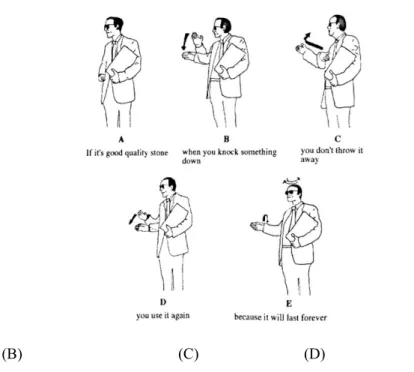
In order to illustrate a typical G-Unit, Kendon (2004) described the following example (fig.2) in which is possible to recognize different gesture phrases inside the same G-unit.
32
Only the stroke phase is obligatory while all the other phases don’t necessarily appear. For example, it is possible to see that the speaker, while ending G-phrase 3 and passing to G-phrase 4 did not engage in any preparation phase before performing the subsequent gestural movement, but instead passed directly from a hold position to the next stroke phase. Kendon (2004) analyzed also the phrasal organization of the gesturing in relation to speech, noticing that the stroke is often produced in close temporal proximity with the linguistic expression that has a similar semantic function. By coordinating the nucleus of the gesture phrase (which is the stroke and/or any post-stroke hold) with the semantic nucleus of the spoken expression, the speaker achieves the conjunction of two different expressive modalities with a coherent meaning (Kendon, 2004). In fact, when speaking, the speech is organized into a series of packages, identified as tone units, marked in terms of variations in voice, pitch level, loudness and pacing. The tone units tend to correspond to units of meaning, called by Kendon (1980) ‘idea units’. Gestures seem to be organized in packages as well as speech, the gesture phrases. However, gestural expression usually corresponds with just one part of the entire idea unit expressed in the tone unit. Thus,
G-unit 1
G-phrase 1 G-phrase 2 G-phrase 3 G-phrase 4
(B) (C) (D) (E)
When you knock something down / you don’t throw it away/ you use it again/ because it will last forever
33
gestures may bring out an aspect of meaning associated with a verb in the phrase; or they may add an imagistic dimension related to a noun.
3.2 Gesture space
When gesturing, the speaker performs gestures in a specific space (fig. 3). McNeill (1992) affirms that this space can be “visualized as a shallow disk in front of the speaker, the bottom half flattened when the speaker is seated”.
In order to better analyze gestural utterances, McNeill (1992) divided the space in front of the speaker as an imaginary concentric space, with four basic sectors: “center center”, “center”, “periphery” and “extreme periphery” which are further differentiated according to the features “upper”, “lower”, and “right” and “left”. For example, a speaker that, while talking, performs a movement above his left shoulder, performs a gesture that would be described as produced in a “peripheral upper left” position.
Gesture space seems to be important for cohesion. In fact, gestures contribute to cohesion by repeating the same form or the same location in order to indicate discourse continuity (McNeill, 1992; Perniss & Özyürek, 2015). In narratives, for example, when introducing a new subject,
34
adult speakers usually assign it to a specific area by some gesture, either deictic or iconic (see §4.2.3) and, when the same subject is mentioned later, the speaker generally indicates the same location. These kinds of gestures seem to have a very decisive role in the avoidance of ambiguous interpretations of what is being said (Goodrich & Hudson Kam, 2012).
4. Classifying Gestures
Even if the importance of gestures for human expression has been recognized since the Greek and Roman era, when it was developed mainly in relation to the art of rhetoric and scenic gestures1, and there are many descriptions of gestures even before the XX century (for example De Jorio in 1832 or even Bonifacio, in 1616), it is only in this century that the attention on these aspects of communication has grown. Thus, with the rise of the scientific interest in gestures, various attempts to categorize the gestural phenomena for scientific purposes have been made.
4.1 A semiotic categorization, Wilhelm Wundt
The first important categorization is the one made by Wilhelm Wundt (1921, edited in 1973). His classification is mainly semiotic and does not analyze gestures in relation to speech, but it refers to how the different forms of gestural actions are related to their meanings. He first divided gestures into two main categories: demonstrative and descriptive. In the first one, demonstrative, he included all those gestures that are pointing to something. For example, he refers to gestures that help to draw attention to present objects, to indicate spatial relations or to refer to body parts. The second category, descriptive, it is divided into more subcategories:
-Mimic gestures: which are those that directly imitate some action or object.
-Connotative gestures: in which some aspect of something is taken as standing as the whole. -Symbolic gestures: which are those gestures that have a more complex relation with their
meanings. Even if the shape of the gesture may refer to the object it is portraying or to the
1 Before the XX century, gestures were analyzed as part of the oratorical technique and scenic art. The first discussion on
gestures reported by Kendon (2004) is the one by Quintilian titled Institutio Oratoria (“Education of the Orator”) written in the first century AD. In the XI book of the Institutio Quintilian divides actio or pronunciatio (Action or Delivery) into two components: vox (voice)and motum/gestus (movement and gesture).
35
action that can be made with it, sometimes it may also be standing for some more abstract concept. For example, a gesture that shapes the hand as a glass, not only delivers the image of glass but might also convey the general meaning of drinking.
4.2 Categorizations of gestures and their relation with speech 4.2.1 David Efron
Even though he never presented a real systematic categorization of gestures, one of the first detailed analysis of gestures and their relationship with speech was offered by David Efron in 1941. With his considerations (summarized and categorized by Paul Ekman2), Efron wanted to prove that the Nazi theory about a racial origin of gesture was wrong. In order to do so, Efron found, when comparing two different groups of immigrants in the U.S., Italians and Jews, that they used completely different repertoires of movements during conversation. Since he believed that these differences were due to the different environments in which they grew up while in Europe, he demonstrated that the amount of differences between the way of gesturing of the two groups of immigrants decreased in the first generation offspring: those who were assimilated into the American culture failed to maintain the gestural style belonging to their original cultures. To be able to analyze the differences between the two groups, Efron elaborated very detailed distinctions, focusing mainly upon hand movements, and to a reduced extent on head movements, with only occasional considerations of trunk positions. He did not consider facial expressions, posture, stride, or eye movements.
In his analysis, Efron distinguished and measured three aspects of hand-head movements:
1. Spatio-temporal, in which gestures are considered simply as movements, independently from the reason why they are produced.
The features that are included in this distinction are:
-radius, meaning the size of radius and axis of movement (for example, wrist, elbow etc.);
-form, which can be distinguished between sinuous, elliptical, angular or straight;
2 The classification was actually organized by Paul Ekman in his Introduction to the 1972 edition of the book “Gesture,
36
-plane, that can be sideways-transversal, towards auditor-frontal, up-down-vertical, away from speaker and auditor-dorsoventral centrifugal;
-body parts, involved in gesticulation and ways in which they are employed: head gestures, whenever they are used as a substitute for hands, digital gestures, meaning the variety of positions and shapes of hands, ambulatory gestures, in which the motion is transferred from one hand to the other;
-tempo, which can be abrupt, dischronic or described as a flowing transition from one movement to another.
2. Inter-locutional, meaning all those aspects that consider the communicative or interactive elements of gestures, separately from the referential aspects:
-Familiarity with the physical person of the interlocutor (touching the interlocutors to interrupt them or to capture their attention)
-Simultaneous gesturing of all the interactants
-Conversational grouping (use of space and distance between speakers and recipients)
-Gesturing with objects
3. Linguistic, or the referential meanings of gestures. Among the linguistic aspects, Efron (1941) differentiated two wide classes of gestures based on whether the meaning of the gesture is independent or is conveyable only together with speech:
-Logical-discursive. Gestures that refer to the course of the ideational process and do not refer to any object or thought so that they relate to how they enact the concept more than what they represent. These kinds of gestures are used to give emphasis to the content of the verbal behavior, so that they are physical re-enactments of the speech process, of logical pauses, inflections etc.
The logical-discursive gestures are further subdivided into two categories: a) Baton, that are used to beat the tempo of the mental flow of discourse; b) Ideographic, that are used to sketch out in the air the path or motion of
thought.
- Objective, those gestures that have an independent meaning from speech and that may be used by the speaker while talking. According to Efron, these kinds of gestures can belong to three different subcategories, which are:
37
a) Deictic: when pointing a visually present object or subject;
b) Physiographic: gestures that physically show their meaning. In this subcategory it is possible to find both gestures that depict the form of the visual object, called iconographics, and gestures that depict a body action or movement, called kinetographics.
c) Emblematic or symbolic: those gestures whose function is to represent either a visual or a logical object by a form that has no morphological relations with the entity it represents since their meaning is standardized within a specific culture.
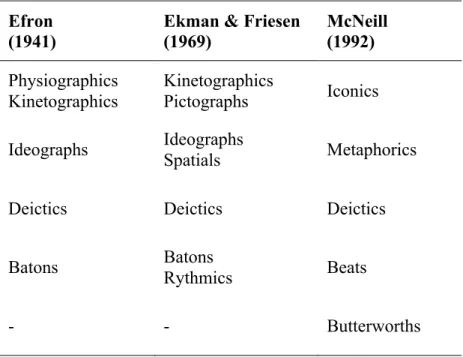
The analysis by David Efron can be considered pioneering work. First of all, it is one of the first attempts to offer an insightful and detailed examination of gestures in relation with speech because it recognized that, in order to get a comprehensive understanding of gestural communication, it is necessary to integrate analyses from different perspectives. Furthermore, his analysis of how gesturing can be related to speech from a linguistic point of view is one of the most articulated to date and it is one of the milestones on which the later studies are based.
4.2.2 Paul Ekman and Wallace Friesen: the repertoire of nonverbal behavior
As said before, the analysis made by Efron represents the basis for many studies that followed from the second half of the XX century. One of the most important among these is the study by Paul Ekman and Wallace Friesen who used and somehow expanded Efron’s analysis offering a structured category system that allows distinguishing different kinds of nonverbal communicative performances. In their work, entitled ‘The Repertoire of Nonverbal Behavior: Categories, Usage, and Coding’ (1969), Ekman & Friesen define nonverbal behavior as ‘any movement or position of the face and/or the body’ that is relevant for communication and interaction. Unlike Efron, Ekman and Friesen didn’t focus only on the hand and arm movements, but extended their interest also on facial expressions. Their distinctions follow three main considerations for understanding a person’s nonverbal behavior: origin, usage and coding.
The first one, origin, refers to whether the action is innate or learned. For example, facial expressions of emotions can be considered heavily shaped by inborn tendencies (1969). The
38
authors differentiate at least three types of origins that can occur whenever a nonverbal behavior is enacted:
a) The simple relationship between stimulus events that cause a nonverbal activity which is proper of every intact nervous system of any human being. The most obvious example is the one represented by a reflex or any kind of spontaneous reaction, and it seems that facial expressions of emotions are based upon inherited neurological connections common to everyone.
b) The nonverbal action that is common to all the people that is not strictly inherited and inborn but is rather acquired as part of the human experience while interacting with the surrounding environment. For example, no matter the culture, every human being uses hands to bring food to their mouths.
c) Nonverbal behaviors that come from an experience that, as the authors say, ‘varies with culture, class, family or individual’. In this third kind of origins, Ekman and Friesen include those behaviors that are learned:
- as part of an instrumental task, in order to master a particular activity such as swimming or learning how to do something in a certain way;
- as part of a social interaction, with a more or less explicit and conscious attention from learner and/or tutor, in order to establish or keep a specific type of social interaction. In fact, imitating postures or facial expressions can be done intentionally if they are made consciously from a person learning to be an actor but they may be occurring with less awareness when a child is imitating the movements of the same-sex parent.
Other kinds of considerations that, according to Ekman and Friesen (1969), are necessary to understand the human nonverbal behavior are those about usage. With the term usage, the authors refer to regular conditions surrounding the occurrence of a nonverbal action. The issues included in these considerations are various:
a) The relationship of the act with the associated verbal behavior: a nonverbal act can anticipate, match, follow the verbal behavior, or even substitute it; a nonverbal act can illustrate or underline what is being said by the speaker, but it can also contradict the co-occurring words if, for instance, the speaker wants to be ironic.
b) The nature of the external conditions found when the act occurs: this refers to any environmental circumstances that can inhibit or facilitate an act. For example, the set of an
39
act can be considered an external condition. In fact, some acts are more frequent in a setting than in another one, for example, the same two persons can act as father and son in a home setting and as employer and employee in a work setting.
c) Whether the person is acting consciously or not: this refers to the awareness of a person delivering a specific nonverbal message. People, in fact, can be more or less conscious of delivering a communicative message through their nonverbal enactments.
d) The person’s intention to communicate or the deliberate use of a particular nonverbal behavior to intentionally communicate something rather than something else.
e) The feedback from the observer of the act: this means the information concerning a nonverbal act that the receiver provides to the sender.
f) The type of information conveyed by the act: this distinguishes between idiosyncratic, referring to that information that has a meaning or interpretation only for a single person, and shared information, where groups of people agree on how to interpret an act.
The authors then distinguish between three types of interpretations that a nonverbal act can have:
informative, when the act can be interpreted in a shared way by others but the information delivered is independent of whether the sender intended to convey any information or not; communicative,
when the non-acoustic parts of the acts are clearly and consciously intended to transmit a message
Idiosyncratic Shared Informative Interactive c a b a f d g e g Communicative
(a) Much informative behavior is neither interactive nor communicative (b) Though, interactive behavior may also be informative
(c) But it can also be idiosyncratic (these are acts that influence a specific person, i.e. the acts of a son in regard of his mother, but that have no influence on the other interactants)
(d) Some communicative behavior is only informative (e) Some other are both interactive and informative
(f) There could be some communicative behavior which is neither interactive nor informative (rare cases in which a mental disorder may affect the communication to the receivers which cannot interpret or interact with the sender) (g) Much idiosyncratic behavior is neither interactive nor communicative.
40
to the receiver;and interactive, whenever anonverbal behavior clearly modifies or influences the interactive behavior or the receiver. The relationships between these nonverbal behavior modalities are illustrated by Ekman and Friesen in fig 4.
The last of Ekman and Friesen’s three aspects about human nonverbal behavior is coding, or the principle of correspondence among the act and its meaning. The rule that characterizes the relationship between a certain action and its significance is the code, and this may be intrinsic, when the act stands for its own significant without any kind of semantic separation, or extrinsic, when the act signifies for something else in a way that can be arbitrary or iconic: acts that are arbitrarily coded have no resemblance to their meaning while iconically-coded acts carry similarities to what they are meant to signify. The difference between iconic and intrinsic codes is that the first only resembles its significant while the second is, at least in a part, the significant itself (a kiss, for example, does not only look like a kiss, it is the meaning and the significant of that act at the same time). Referring to both intrinsic and iconic acts, Ekman and Friesen affirm that the ways in which a nonverbal act is related to its significant may be pictorial, whenever a movement shows its meaning by drawing a picture of what the person is communicating; spatial,
that is the relationship in which the movement depicts distance between people, objects or ideas;
kinetic, in which the movement resembles an action or a part of it; pointing, in which some part of the body points to an object, a person or even to an abstract idea; rhythmic, in which the movement traces the flow of ideas, or accents a specific sentence. Usually, the rhythmic relationship between act and meaning does not carry any message. Besides pointing, that is always intrinsically coded, these relationships are always iconic, while kinetic relationships may be either iconic or intrinsic, whenever the movement is part of the action it signifies.
Following the considerations about origin, usage, and coding, Ekman and Friesen identified five different categories of nonverbal behavior: emblems, illustrators, manipulators (or adapters), regulators, and emotional expressions (or affect display).
1. Emblems. When defining emblems, the authors referred to those nonverbal actions that can be directly translated into words and usually consist of one or two words, sometimes a phrase, but do not change the information conveyed. An emblem may repeat, replace, contradict the verbal behavior, but also provide a separate comment related to the co-occurring speech. According to Ekman and Friesen (1969 1972) and Ekman (2004) emblems are the “only true body language”, in the sense that these kinds of movements have a set of specific meanings which are understood by all members of the same culture, subculture or social groups. Since they are socially learned,