BUILDING THE RESILIENT SME:
DEVELOPING THE ‘4 IN A ROW’ TOOL FOR
SUPPLY CHAIN RISK MANAGEMENT
Antonio Domínguez Garrido
June 2014
Master’s Thesis
Registration Code __________
Technical University of Denmark
Thesis Advisor: Dr. Josef Oehmen
I hereby declare that I am the sole author of this thesis. No other sources than those indicated have been used in the accomplishment of this work.
2
Intellectuals solve problems, geniuses prevent them
3
Table of contents
Abstract ... 6
Acknowledgements ... 7
1- Introduction to research motivation and goals ... 8
1.1- Initial situation and motivation ... 8
1.2- Research objectives and hypotheses ... 9
1.3- Thesis structure ... 10
2- Theory of Lean philosophy and Supply Chain Risk Management within manufacturing Small and Medium Enterprises ... 12
2.1- Supply Chain Risk processes ... 12
2.2- Supply Chain Risk classification... 20
2.2.1- Overview ... 20 2.2.2- Demand risk ... 25 2.2.3- Supply risk ... 26 2.2.4- Process risk ... 28 2.2.5- Control risk ... 29 2.2.6- Environmental risk ... 31 2.2.7- Other risk ... 32
2.2.8 – Supply Chain Risk impact of disruptions in enterprises ... 34
2.3- Lean philosophy ... 36
2.3.1-Definition ... 38
2.3.2- Lean principles ... 39
2.4- Resilience ... 41
4
2.4.2- Key aspects of resilience ... 43
2.4.3- Nine principles to build a resilient SME ... 44
2.5- Summary and currents gaps in the literature ... 45
3- Research approach... 47
3.1- Definitions ... 48
3.2- Literature review ... 48
3.3- Semi-structured interview ... 49
3.4- Summary ... 50
4- Constraints, necessities and opportunities of manufacturing SMEs based on Supply Chain managers’ interviews ... 52
4.1- Supply chain most challenging risks ... 53
4.2- Mitigation of Key Supply Chain Risks ... 55
4.3- Experts work philosophy and their approach to Lean ... 57
4.4- Lean principles and resilience ... 58
4.5- Main key points for a successful Supply Chain ... 60
4.6- Summary and main challenges ... 61
5-Overcoming Supply Chain problems to create a resilient SME – ‘4 in a row’ ... 64
5.1- Step one: Tailoring ‘four in a row’ ... 64
5.1.1- Self-questionnaire... 65
5.1.2- Self-questionnaire results ... 66
5.2- Step two: Identification and prioritization of risks through Failure Mode and Effect Analysis (FMEA) ... 75
5.2.1- Background to FMEA ... 76
5 5.2.3- Benefits and handicaps of the implementation of a systematic FMEA in
SMEs ... 82
5.3- Step three: Mitigation actions for identified and high-priority risks ... 83
5.3.1- Lean tools ... 83
5.3.2- Best practices... 99
5.4- Step 4: Benefit/Cost analysis... 103
5.5- Summary ... 105
6- Implementation of the proposed procedure in a SME ... 107
6.1- Step one of ‘4 in a row’: Tailoring the tool ... 107
6.2- Step two of ‘4 in a row’: Identification and prioritization of risks through Failure Mode and Effect Analysis (FMEA)... 109
6.3- Step three of ‘4 in a row’: Mitigation actions for identified and high-priority risks ... 114
6.4- Step four of ‘4 in a row’: Benefit/Cost analysis ... 115
6.5- Summary ... 115
7- Discussion and Conclusion ... 117
7.1- Hypotheses verification ... 117
7.2- Limitations of the research ... 118
7.3- Future research ... 118
References ... 120
Appendix ... 127
Appendix 1: Semi-structured interview on risk, resilience and the role of lean management techniques in supply chains – Overview of Questions... 127
Appendix 2: Informed Consent for the participation in a research study ... 128
Appendix 3: TAGXEDO of the thesis ... 130
6
Abstract
The number of supply chain risks has sharply risen due to climate change and the increasing complexity of the 21st century business network whose firms are exporting and importing articles worldwide. Nowadays, it is not enough to ensure an effective production plant; it is high time to guarantee the perfect performance of the whole supply chain. And that means, among other issues, an intense and close relationship between suppliers and customers.
This thesis addresses some of the small and medium enterprises’ concerns by developing a new procedure: ‘4 in a row’. ‘4 in a row’ is unpretentious, effective and carefully designed to be implemented taking into account its users constraints. ‘4 in a row’ is the result of a deep literature review and a passionate interaction with supply chain experts. ‘4 in a row’ is the main contribution of a project in which I started to think about one year ago: creating something valuable to improve the small and medium enterprise’s supply chain.
The thesis starts with the introduction chapter and the literature review. Then, it follows the research approach chapter in which the motives of choosing a literature review and a semi-structured interview as the main study methods are reasoned. Chapter four summarises feedback from five different supply chain experts. The core of the thesis is in chapter 5: the design of a four-step procedure with the intuitive name of ‘4 in a row’. The first step of ‘4 in a row’ is the adaptation of the tool to the needs of each firm; the second step is the identification and prioritization of supply chain risks through a Failure Mode and Effect Analysis; the third step contains potential mitigation actions in order to cope with the identified high-priority risks organized in two categories, ‘Lean tools’ and ‘best practices’; and the fourth and last step is a benefit/cost analysis which aims to assess from an economical point of view which mitigation actions are worth to implement. The core of the thesis is followed, in chapter 6, by an evaluation of the performance of ‘4 in a row’ in a real small company. Lastly, there is a critical discussion in what could have been done better and some natural indications about how to continue with further investigation.
I wholeheartedly expect to capture your attention through this 132-page thesis and 32.980 words mostly written in the awe-inspiring Denmark Technical University facilities. It might not be the longest thesis; however, I hope you will find this text easy-to-read and above all else, profitable and constructive.
7
Acknowledgements
I would like to take the chance to express my gratitude to those who have given their support enabling the successful completion of my thesis.
My greatest thanks to Dr. Josef Oehmen: my DTU supervisor. His guidance as well as his fruitful feedback in the ‘I don’t know how to continue’ moments were a truly support for the thesis.
I would also like to thanks to my family, and especially to my parents, for minimising these depressing moments when you feel ‘What on Earth am I doing here instead of being at home’ and their obvious financial support.
And last but not least, to my darling fiancée who has been taking care of me in Denmark from the very beginning and has made from this experience something unforgettable and unrepeatable.
8
1- Introduction to research motivation and goals
A few years before moving in Denmark to finish my Master I had the chance to leave my studies and start working in the family small company. My mother has a medical degree and she pushed me to develop my academic skills in a foreign University (what she considered very stimulating) whereas my father did not especially encourage me to do so. He has been quite successful by creating the family enterprise and maybe for that reason he would have preferred me to stay at home and learn there that leaving ‘the only child he has’ moving around the globe. However, it must be said that once he visited me and realised that in that country ‘there was something to eat’ and I was not living ‘under a bridge’, he was also proud of having ‘the only child he has’ involved in this experience and getting prepared to enter in the labour market. And what was my opinion? Before coming, I wanted to start working as soon as possible to have economic independence but I also wanted to challenge myself with a new language, new workmates and a new country from the northern Europe. And when I am in the verge of finishing my thesis, I can only say that it was the best decision I could have ever taken. Nowadays, I feel much more prepared, full of fulfilment and very pleased to have had this magnificent chance to study abroad.1.1- Initial situation and motivation
Supply chains have become much more complex and difficult-to-drive whereas the number of risks has sharply risen due to globalization and capital needs. Luckily, an overwhelming increase of awareness about supply chain in the last two decades has meant a new science, Supply Chain Risk Management, which nowadays is an attractive research area to academics who wish to have impact on business (Sodhi et al., 2011). Most large firms have specialised teams trying to cope with new daily supply chain challenges and still suffer huge losses when unexpected disruptions appears (Pisarenko and Rodkin, 2014). However, Small and Medium Enterprises (SME) are exposed to the same challenges with additional constraints (Gutierrez et al., 2006) such as very limited budgets, shortage of human resources and lack of knowledge. Hence, the main question is: How can a SME face, prioritize and mitigate supply chains risks to improve its resilience according to their constraints? There are also two subquestions which are lacking a solution: Does ‘resilient supply chain’ have a common meaning in SMEs and in large firms? And what kind of problems struggle most the SMEs’ supply chains? The first clue might be to take profit from the agile organization that a SME tends to have and solve problems quick and effective without an excess of bureaucracy. With around 2.5 million SMEs in Europe representing 99% of European manufacturing
9 businesses, it is not difficult to conclude that EU competitiveness is significantly influenced by the performance of its SMEs. It is therefore not surprising, particularly in the recent economic downturn, that sustainability of SMEs is vitally important for the global economy (Mikhailitchenko and Lundstrom, 2006; Turner et al., 2010; North, 1998).
The second clue might be the correct implementation of already existing successful technologies and philosophies applied traditionally by large firms, such as Lean, in SMEs. Many authors have developed the Toyota Production System (TPS) until defining a whole philosophy with its own principles what is today called Lean but, unfortunately, very little attention has been paid in the adaptation of Lean to manufacturing SMEs in an easy way.
As a result, this thesis is going to contribute to fill the existing gap of connecting the concepts of resilience and Lean and give a meaning to supply chain risk management within the SMEs context. The motivation is in some way being ‘a small Robin Hood’ by taking profit from the valuable SCRM contribution established by large firms to facilitate and spread out their knowledge among SMEs.
1.2- Research objectives and hypotheses
This thesis is going to address and verify three research hypotheses.
The first one refers to the similarity of problems and hazards between the ones confronted by SMEs and the ones handled by large firms. The first hypothesis of the thesis is that these hazards are different: SMEs worry most of the time about the survival of their business whereas large firms have the chance of improving processes and productivity since nearly any risk can challenge their existence.
H1: SMEs and large firms differ in the approach to the concept of resilience.
The second hypothesis refers to which problems challenge most a supply chain of a company. The hypothesis of the thesis is that the most problematic risks are the ones which were not previously considered by the corporation.
H2: Hidden problems are the most challenging hazards. There is a necessity of tools useful and easy to implement to mitigate these risks.
The third and last hypothesis is that Lean, the Japanese philosophy firstly adopted by
Toyota, is something what is not worth to implement as a risk mitigation strategy since most SMEs do not have the required time and/or funds to cultivate it.
10 H3: Lean is mostly applicable in large firms.
By corroborating these three hypotheses, I hope to realise what the state-of-the-art is regarding the application of Supply Chain Risk Management, Lean and resilience within the small and medium enterprise context. Afterwards, I expect to contribute the existing literature by developing an online tool, accessible for whoever wants to have a glance, which can help to bring near the above mentioned concepts to SMEs. In my opinion, there is no other way to success than creating something easy-to-use and with objective benefits - exactly what I want for my contribution.
1.3- Thesis structure
This thesis is structured in 7 chapters plus an abstract, acknowledgements, references and appendixes.
Chapter 1 is the introduction to the thesis. It aims to highlight the main reasons to carry on this project and includes the research objectives and the thesis structure.
Chapter 2 is the theoretical background chapter. In 4 subchapters the main topics are introduced through a literature review. The first two subchapters are about supply chain risk management; the third subchapter covers the Lean philosophy and the last one discovers the resilience concept and its key concepts.
Chapter 3 introduces the research approach and describes the research methods used in this thesis.
Chapter 4 includes the reflections from five different supply chain experts who are interviewed. Five completely different profiles which include: a CEO of a SME selling worldwide, a Lean external consultant for SMEs, a University professor head of a research group in IT, a co-partner of a procurement consultancy and a naval manager specialised in the logistics area. Thanks to their valuable contribution, it was possible to collect different insights from different key players all working in the supply chain area.
Chapter 5 is the core of the thesis and where the tool I designed, ‘4 in a row’, is described in 4 intuitive steps. ‘4 in a row’ is a free online resource whose goal is to assess SMEs in the tough field of Supply Chain Risk Management. Until now, there was no self-assessment process, specially designed for SMEs, which aimed to measure and cope with their supply chain risks from the early stage of identifying those risks until the decision point of implementing mitigation actions based on economic facts. The first step of ‘4 in a row’ is the adaptation of ‘4 in a row’ to the needs of each manufacturing SME; the second step is the identification and prioritization of supply chain risks through a Failure Mode and Effect Analysis; the third step contains mitigation actions to cope with the identified high-priority supply chain risks organized in two categories, ‘Lean tools’ and ‘best practices’; and the
11 fourth step is a benefit/cost analysis which aims to assess from an economical point of view which mitigation actions are worth to implement.
Chapter 6 is an example of how ‘4 in a row’ is tested on a real SME and includes the reflections from the manager who tried the tool.
Chapter 7 is a summary of the project and includes the conclusions and a discussion based on the previous literature.
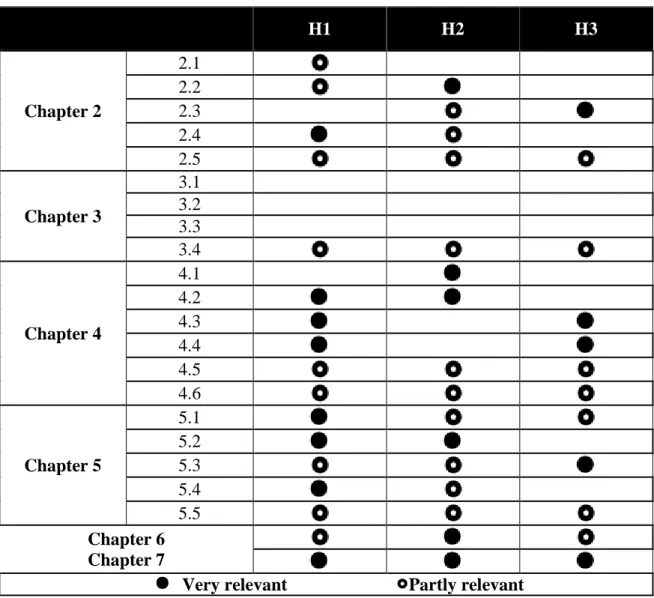
Table 1.1, reflects how the chapters are dependent on the three established hypotheses of the thesis. H1 H2 H3 Chapter 2 2.1 2.2 2.3 2.4 2.5 Chapter 3 3.1 3.2 3.3 3.4 Chapter 4 4.1 4.2 4.3 4.4 4.5 4.6 Chapter 5 5.1 5.2 5.3 5.4 5.5 Chapter 6 Chapter 7
Very relevant Partly relevant
Table 1.1: Applicability of each chapter and subchapter to the three research hypothesis
Note: In this thesis is going to be used ‘How to write a better thesis’ by Evans et al. (Evans et al., 2014) as a guide for writing the document.
12
2- Theory of Lean philosophy and Supply Chain
Risk Management within manufacturing Small
and Medium Enterprises
2.1- Supply Chain Risk processes
Not many years ago, there was no available and standardised procedure to deal with supply chain risks. SMEs, but also the large enterprises, were used to create their own supply chain risk plans or just trust in their views and a pinch of ‘luck’ to overcome those risks as soon as they appeared. However, in the last decade, a big number of authors and organisations have focussed their attention in such a vital activity of any manufacturing company. Today, there are many standards and papers accessible; the following lines include a review of the most relevant documents.
In 2006, Tang proposed 4 different approaches to supply chain risk management: product management, supply management, demand management and information management. He aimed to create a paper ‘to unify framework for classifying supply chain risk management articles’, ‘serve as a practical guide for some researchers to navigate through the sea of research articles in this important area’ and ‘highlight the gap between theory and practice’. And basically he did it, since that paper has been reviewed for a very big number of authors afterwards (Tang, 2006).
Figure 2.1: Four basic approaches for managing SCR by Tang. Based on Tang, 2006
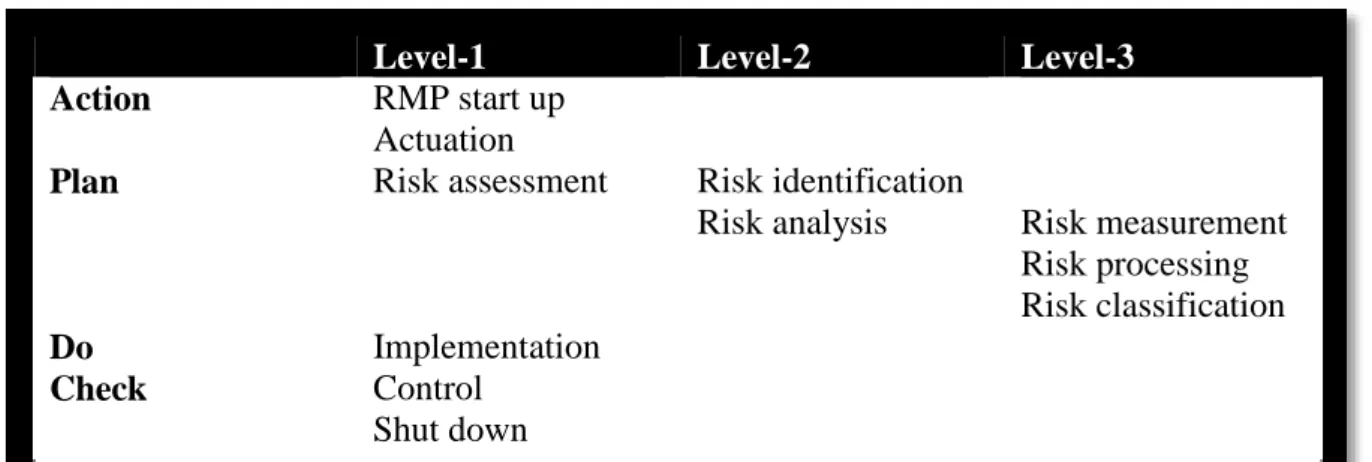
In 2008, Olson and Wu suggested two different phases for the risk management process ‘Risk Assessment’ and ‘Risk Response’. They created a ‘The two-polar perspective’ to express the fact that the risk management process ‘has two main equivalent poles or columns, including risk and response’ (Olson & Wu 2008).
13
Level-1 Level-2 Level-3
Action RMP start up
Actuation
Plan Risk assessment Risk identification
Risk analysis Risk measurement Risk processing Risk classification
Do Implementation
Check Control
Shut down
Figure 2.2: SCR process proposed by Olson and Wu. Based on Olson and Wu, 2008.
In addition, in 2008 was launched the fourth edition of the Project Management Body of Knowledge, usually referred as PMBoK. This book proposes to include in the ‘Project Risk Management’ the processes of ‘conducting risk management planning, identification, analysis, response planning, and monitoring and control on a project’. For the authors of the book, the objectives of Project Risk Management are ‘to increase the probability and impact of positive events’ and ‘decrease the probability and impact of negative events in the project’. The authors also distinguish in the book between ‘known risks (identified and analysed)’ and ‘specific unknown risks (which cannot be managed proactively and need from a contingency plan)’ (PMBoK 2008).
Figure 2.3: SCR process proposed by the PMBoK. Based on PMBoK, 2008
In 2009, Kleindorfer and Saad published their framework, labelled as ‘SAM-SAC’. Their framework denotes the three main tasks of risk: ‘Specification of sources and
14 vulnerabilities, Assessment, and Mitigation’ and the proposed ‘Strategies with dual dimensions: Actions and necessary Conditions for effective implementation’. In their paper, they also advise ‘not to manage supply chain risks in the traditional manner (based on measuring outcomes and translating these into process improvements) because disruption risks belong to the low-probability, high-consequence outcomes’. They recommend ‘the spirit of very high quality (Six Sigma) process management, in which the process itself is continually audited to assure a proper balance between risks and benefits of mitigation’ (Kleindorfer & Saad, 2009).
Figure 2.4: SCR process proposed by Kleindorfer and Saad. Based on Kleindorfer and Saad, 2009
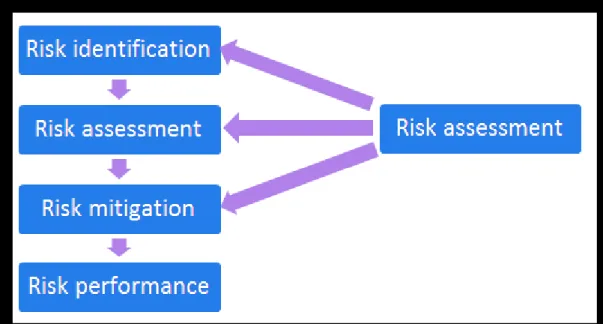
2009 was also the year when Oehmen et al. wrote their SC paper about their proposal of SCR process. Through a case study the authors wanted to validate their ‘Dynamics Model’, which is based on ‘the assumption that the final states of the system, from a risk perspective, are critical failures in one or more of the target areas’.
They condense the SCR process in three main steps: ‘Risk identification (or risk catalogue)’, ‘Risk assessment (or risk portfolio)’ and ‘Risk mitigation (or measures)’ (Oehmen et al., 2009).
15
Figure 2.5: SCR process proposed by Oehmen et al. Based on Oehmen et al., 2009
ISO 31000, created by the ISO committee of experts in 2009, is a standard which also addresses the SCR process. ISO 31000 aims to ‘evaluate an organization's effectiveness in managing risk’. This standard clearly reflects the high-value of supply chain risk management as it is written ‘The risk management process should be an integral part of management, embedded in the culture and practices, and tailored to the business processes of the organization’. ISO 31000 contemplate the supply chain risk process in three main steps: ‘Establishing the context’, ‘Risk assessment (which include three sub steps: risk identification, risk analysis and risk evaluation)’ and ‘risk treatment’ (ISO 31000, 2009).
16
Figure 2.6: SCR process proposed by the ISO 31000. Based on ISO 31000, 2009
In 2009, the fifth edition of Managing Successful Projects with PRINCE2 (PRINCE2, 2009) was launched. For the international organisation of PRINCE2, the supply chain risk process should contain 4 steps with the ‘railing’ of communication.
The first step is ’Identify context’ which aims to obtain information about the project in order to understand the specific objectives in risk and formulate the risk management strategy for the project.
The second step is ’Estimate’ which aims to assess the threats and opportunities for the project in terms of their probability and impact.
The third step is ’Plan’ which aims to prepare specific management responses to the threats and opportunities identified (ideally to remove or reduce the threats and to maximize the opportunities).
17 The last step is ’Implement’ which aims to ensure that the planned risk responses are actioned, their effectiveness monitored, and corrective action taken where responses do not match expectations.
Communication is a step that is carried out continually. The ’Communicate’ step should ensure that information related to the threats and opportunities faced by the project is communicated both within the project and externally to stakeholders.
Figure 2.7: SCR process proposed by PRINCE2. Based on PRINCE2, 2009
In 2011, Kern published a paper, certifying ‘the need for professional supply chain risk management activities along the risk management process: risk identification, risk assessment and risk mitigation’. They argue that companies with higher competencies in these three process steps of upstream supply chain risk management show ‘superior performance’ when it comes to the reduction of the frequency and impact of supply chain risks (Kern, 2011).
18
Figure 2.8: SCR process proposed by Kern. Based on Kern, 2011
In 2011, Christopher suggests a supply chain risk process considerably different from the one proposed by their supply chain colleagues, at least what refers to terminology (Christopher, 2011). He suggests a seven-step process which aims to understand, improve, control the supply chain and collaborate at the end with suppliers and customers to improve supply chain risk management procedures.
19 In 2012, the ISO organisation dedicated a new standard to SCRM what reinforces the statement that SCRM is becoming an essential player for enterprises. The authors in this occasion define the SCR process in four steps: ‘Identify’, ‘Assess’, ‘Treat’ and ‘Control’ risks.
The purpose of ‘Identify’ risks is to determine potential risk events and their characteristics that, if they occur, may have a positive or negative impact on the project objectives. The purpose of ‘Assess’ risk is to measure and prioritize the risks for further action. The purpose of ‘Treat’ risks is to develop options and determine actions to enhance opportunities and reduce threats to project objectives. The purpose of ‘Control’ risks is to minimize disruption to the project by determining whether the risk responses are executed and whether they have the desired effect (ISO 21500, 2012).
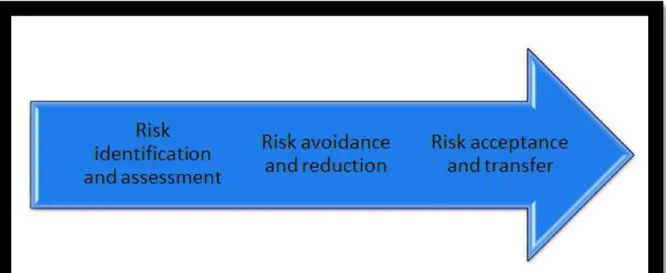
Nowadays, there is also an Enterprise called ‘FM Global’ whose products are specifically designed to support their clients in overall risk management objectives. Their task is helping their clients in ‘understanding the nature and reality of their specific risks’, ‘establishing sound loss prevention solutions that safeguard against loss’, ‘developing cost-effective insurance and risk transfer solutions backed by large, stable capacity’ and ‘providing the claims and loss mitigation support to minimize business disruption’.
They work with a three-phase SCR process: ‘Risk identification and assessment’, ‘risk avoidance and reduction’ and ‘risk acceptance and transfer’.
20
2.2- Supply Chain Risk classification
2.2.1- Overview
Risk in Supply Chain (SCR) can be defined as the potential deviation from the initial overall objective that, consequently, trigger the decrease of value-added activities at different levels (Kumar et al., 2010). Risk is always in the future and there is a thin line which separates an uncertain event or condition from a real risk. A risk must have an effect on at least one project objective (PMBoK, 2008) if not, it could not be considered as a risk.
Managing risk is a must for any organization (Ben-Daya et al., 2009). Given the high vulnerability of today’s supply chains to disruptions, measuring and managing supply chain vulnerability has become critical (Wagner & Neshat, 2012). Risks are inherent in every aspect of business, and the ability of manage risks is an important aspect that differentiates successful business leaders from others (Sodhi & Tang, 2012). For this reason, in the recent decades a new science has attracted the interest of both, enterprises and academic researchers. And this new science has been commonly known as Supply Chain Risk Management (SCRM), although some authors refer to it simply as Supply Chain Management or Risk Management.
A Supply Chain (SC) is a network of organizations possibly including suppliers, manufacturers, logistics providers, wholesalers/distributors, and retailers that aims to produce and deliver products or services for the end customer (Sodhi & Tang, 2012). When working effectively and efficiently, modern SC allow goods to be produced and delivered in the right quantities, to the right places at the right time in a cost-effective manner. The key point is that modern supply chains are not simply linear chains or processes, they are complex networks. The products and information flows travel within and between nodes in a variety of networks which link organisations, industries and economies (Cranfield 2003).
Once, the definition of SC and risk are clear, it is easier to give a meaning to SCRM. Nonetheless, there is a big discussion about which definition fits better to the concept. Tang refers to SCRM as the management of risk, material, information and financial flows through a network of organizations (i.e. suppliers, manufacturers, logistics providers, wholesalers/distributors and retailers) that aims to produce and deliver products or services for the consumers (Tang, 2006). The IPMA foundation denotes SCRM as an early warning system for the organisation to give it timely and accurate information to prepare risk management interventions when needed (IPMA, 2006). There are other authors who also address the definition of SCRM in their papers or books. For example, SCRM is for the ISO foundation a group of coordinated activities to direct and control an organization with regard to risk (ISO 31000, 2009). For Sodhi
21 and Tang, SCRM is the management of material, information and financial flows through the supply chain and includes the coordination and collaboration of processes and activities across different functions such as marketing, sales, production, product design, procurement, logistics, finance, and information technology within the supply chain (Sodhi & Tang, 2012). For Wieland, SCRM is defined as the implementation of strategies to manage both every day and exceptional risks along the supply chain based on continuous risk assessment with the objective of reducing vulnerability and ensuring continuity. Thus, SCRM extends traditional risk management approaches by integrating risks of partners upstream and downstream the supply chain (Wieland, 2012).
In this thesis, SCRM is going to be addressed as ‘a science which aims to identify, assess, mitigate and control SCR in order to increase the resilience of these enterprises who apply it meticulously’.
There is also a big discussion between SCRM authors regarding a possible classification of SCR. Table 2.1 summarise some of these SCR.
22
Author(s) Year Supply Chain Risk classification
Chopra & Sodhi 2004
System Forecast Intellectual property Receivable Inventory Capacity Kleindorfer & Saad 2005
Operational contingencies Natural hazards
Terrorism and political instability
Paulsson & Nilsson
2008
Product design Production process design
Product flow design Product flow supporting systems Risk management systems and actions
Human resources
Ritchie & Bob 2008
Supply Supply cost Supply commitment Supply continuity Process Demand Rare-but-severe disruption Other Intellectual property Behavioural Political Social
Wagner & Bode 2008
Demand side Supply side
Regulatory, legal and bureaucratic Infrastructure
Catastrophic
Hopkin 2010
Upside or opportunity (help an organization to achieve desired objectives)
Downside or hazard (inhibit achieving these objectives)
Other or control (create uncertainty about outcomes)
Kumar et al. 2010
Demand
Production and distribution Supply
23
Table 2.1: SCR classification through a literature review
Author(s) Year Supply Chain Risk classification
Christopher 2011 Supply Demand Process Risk Environmental
Wakolbinger & Cruz 2012 Supply–demand coordination Disruption Simangunsong et al. 2012 Product characteristics Process/manufacturing Control/chaos/response uncertainty Supplier Decision complexity
Organisation structure and human behaviour IT/IS complexity
End customer demand Demand amplification Parallel interaction
Order forecast horizon/ lead-time gap Chain configuration, infrastructure and
facilities Environment
Disruption/natural uncertainties
Sodhi & Tang
2012 Supply Supplier failure Supply commitment Supply cost Process Design Yield Inventory Capacity Demand Forecasting Change in technology or in consumer preference Receivable Corporate-level risks Financial SC visibility Political/Social IT systems Intellectual property Exchange rate Chen et al. 2013 Supply Demand Process
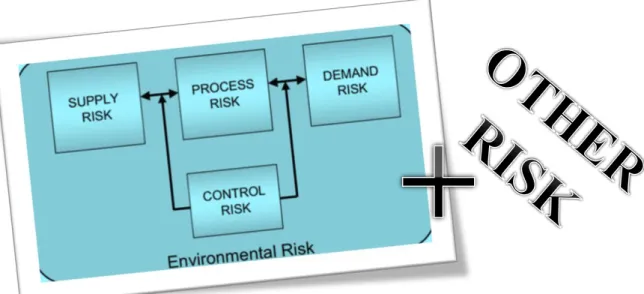
24 After considering the above mentions categories, in this thesis the SCR classification is based in six threats, the five proposed by Christopher (Christopher, 2011) plus an additional ‘Other risks’ which are not considered by him.
1. Demand risks 2. Supply risks 3. Process risks 4. Control risks 5. Environmental risks 6. Other risks
Figure 2.11: SCR classification proposed. Based on Christopher, 2011
There are two main reasons to consider Christopher as the main reference. Firstly, for his very deep knowledge and experience in the logistics area in which he has co-foundered the International Journal of Logistics Management, written several SC books and offered a large contribution in conferences and workshops around the world. And secondly, because Christopher’s categorisation is direct, instinctual and very suitable for the majority of SMEs.
Even though the six-risk classification covers all the potentially detectable SCR, there is always an additional threat of those risks that have not been detected yet. This risk is considered by Sodhi and Tang as ‘Residual risk’. Residual risk is the level of risk that remains after taking the company’s prevention and responsiveness efforts into account (Sodhi & Tang, 2012).
25
2.2.2- Demand risk
Demand risk is the potential deviation of the forecasted demand from the actual demand (Kumar et al., 2010). Demand risk occur here as a result of a mismatch between a company’s projections and actual demand as well as from poor supply chain coordination. The consequences of such disruptions are costly shortages, obsolescence, and inefficient capacity utilization (Wagner & Bode, 2008).
Tang summarises demand risk in three categories: shifting demand across time; shifting demand across markets; and shifting demand across products. For the first category, Tang suggests the mitigation action of offering different prices at different times. That enables the firm to increase the profit generated from a fixed supply capacity by capturing customers in different segments who are willing to pay different prices for the service offered in different times. For the second category, Tang calls for selling the new product in different markets with non-overlapping selling seasons. And for the third category, Tang suggests the product substitution (selling products with similar features increasing the product substitutability) or the product bundling (selling packs of computers and printers, for example) (Tang, 2006).
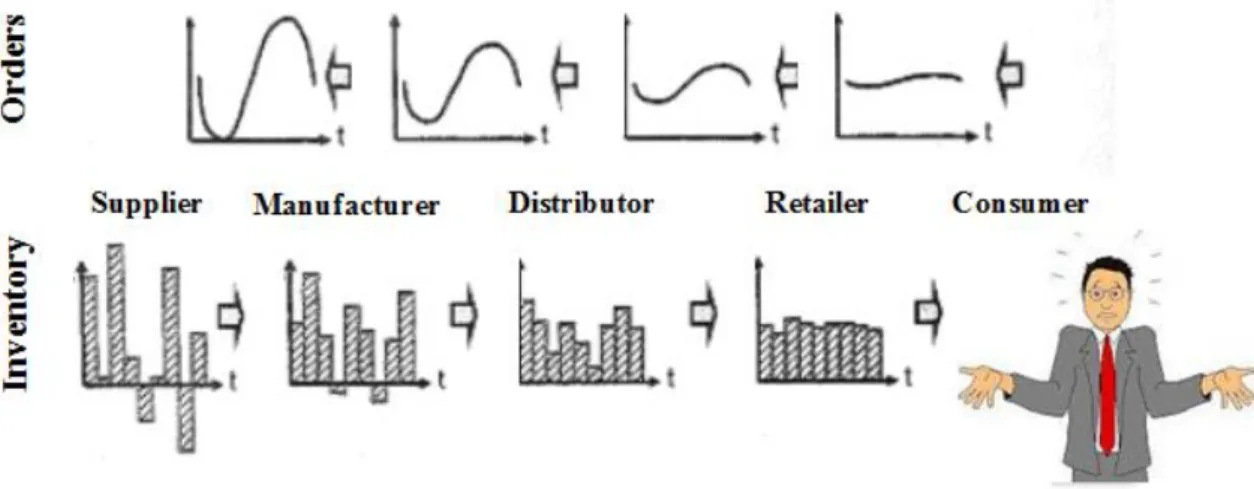
Nevertheless, other authors include in the demand category other SCRs. One of the most challenging demand risks for a few authors is the bullwhip effect. Bullwhip effect is the magnification of demand as orders move up the supply chain away from the original point of order. Small changes in demand can result in large variations in orders placed upstream. The bullwhip effect can result in increased cost and reduced service (Cranfield, 2003).
Figure 2.12: The bullwhip effect. Based on Sheffi, 2005
Other causes of demand risk correspond also with information distortion such as promotions or incentives that lead to forward buying batching of purchases that leads to
26 higher volatility in orders and lack of knowledge of end-customer demand at upstream locations (Sodhi & Tang, 2012).
More than a few SC experts have addressed the issue of how to mitigate demand SCR. Sodhi and Tang suggest three actions to mitigate inventory SCR: pooling inventory; creating common components across products and postponing or delaying until the receipt of orders the last stage of production from which emerges product variety (Sodhi & Tang, 2012). Chopra and Sodhi gives the Toyota example of how to cope with demand risks ‘By running plants at 80% utilization, Toyota can handle demand variation without having to hold inventory’ (Chopra & Sodhi, 2004). KPMG audit suggests turning to a scenario-based forecasting in which managers define alternative scenarios and identify a range of possible outcomes. Some of the key steps of the scenario-based they propose is to determine the focus of the evaluation and the key factors and events affecting the focal area; identify the driving forces behind the key factors; rank critical uncertainties and begin to develop different outcome scenarios; identify early indicators of a probable outcome and integrate the results of the developed scenario, which is currently evolving, into the planning cycle (KPMG Audit, 2009).
One demand SCR example occurred in 2003. Product shortages in Western Europe led Nokia customers to order more than they needed so they would be able to meet demand in case Nokia began rationing or allocations. These exaggerated figures distorted Nokia’s reading of the market, causing the company to inaccurately forecast sales (Sodhi & Tang, 2012).
2.2.3- Supply risk
Supply risk is the potential deviation in the inbound supply in terms of time, quality and quantity that may result in uncompleted orders (Kumar et al. 2010). Due to the practice of outsourcing, the capability of the suppliers to assure supply is critical for the buying companies (Chen et al., 2013).
Supply side risks reside most in purchasing, suppliers, supplier relationships, and supply networks (Wagner & Bode, 2008).
One of the topics which is more widely addressed by SC authors is the suitability of a single-or-several-source of supplied components to mitigate SCR. More than one supplier is a suggestion formulated by Sodhi and Tang about countering disruptions in material: ‘after all, it is unlikely that all suppliers would be disrupted at the same time’ (Sodhi & Tang, 2012). An example of how to use effectively two suppliers for one product is the example proposed by Kouvelis and Dong about Adidas. One of their suppliers is in East-Asia and another is in Germany. A large order is placed with the Asian supplier. In addition, if the demand is higher than expected, then Adidas places a
27 rush order with the local supplier, which is more expensive but allows the retailer to avoid stocking out (Kouvelis and Dong, 2012). There are also numerical studies which indicate that dual sourcing provides a higher service level and results in higher order quantities than single sourcing (Glock & Ries, 2013). However, according to Sheffi (Sheffi, 2005), a single supplier must be enough if there is a deep relationship with that specific supplier. A study proposed by Lockström has found that a close and intense collaboration and interaction between buyers and suppliers is required in order to cope with the challenges in the industry (Lockström et al., 2010). Trust, information and continuing profitability are the basic glue that makes supply chain partnerships a reality. Continuous coordination, cooperation, and collaboration among supply chain partners are needed for risk avoidance, reduction, and mitigation such that the value and benefits generated are maximized and shared fairly (Kleindofer & Saad, 2009).
Figure 2.13: Number of suppliers recommended based on the strength of the relationships. Based on Sheffi, 2005
An example of a supply risk is theCalifornia electricity crisis in 2000. This year, California had a shortage of electricity caused by market influences and illegal blackouts. Drought, delays in approval of new power plants, and market manipulation decreased supply resulting in very low electricity reserves. Some firms took advantage from it by closing their plants for "maintenance" and forcing California to purchase electricity on the spot market, thus causing an 800% increase in wholesale prices from April 2000 to December 2000 (Joskow, 2002).
Number of
suppliers
Supplier
relationship
Several Single Loose Close28 1999 2000 2001 January 21.6 31.8 260.2 February 19.6 18.8 363.0 March 24.0 29.3 313.5 April 24.7 27.4 370.0 May 24.7 50.4 274.7 June 25.8 132.4 103.8 July 31.5 115.3 62.6 August 34.7 175.2 September 35.2 119.6 October 49.0 103.2 November 38.3 179.4 December 30.2 385.6 Average 30 115.0
Figure 2.14: Electricity prices in $/MWh during the California electricity crisis. Based on Joskow, 2002
Graph 2.1: Electricity prices in $/MWh during the California electricity crisis. Based on data from Joskow, 2002
2.2.4- Process risk
Process risk is the potential deviation from producing the desired quality and quantity at the right time (Kumar et al., 2010). Process risk might be influenced by the design of a product, the variation of a process, the yield or the capacity constraints of a production plant and the inventory adopted by a firm (Sodhi & Tang, 2012).
0 50 100 150 200 250 300 350 400 450
Jan '99 Jul '99 Jan '00 Jul '00 Jan '01 Jul '01
29 A design which does not satisfy the customers’ expectation might mean a huge impact in an enterprise. For example, Samsung accepted the resignation of Chang Dong-hoon, head of design of their smartphones, in April 2014. That reason was none other than the poor reception of their new device design, the Galaxy S5. Although it seems that the Galaxy S5 is selling better than the previous S4, the critics for the texture points in the back of the phone and the resemblance between the S5 models with a plaster definitely meant the resignation of the responsible.
Variability is also a SCR to consider. There are two main types of variability in a manufacturing system and none of them is desirable. One is process variability which is mainly caused by various detractors such as machine downtime, setups or operator unavailability. The other is flow variability which is caused by the way the work is released to the system and the movement between stations (Chen et al., 2013).
One example of process SCR was the one faced by IBM in 2004. That year, IBM announced that yield problems in their East Fishkill plant (New York), contributed to the $150 million first-quarter loss by its microelectronics division. The lower-than- expected yields reduced the plant’s effective capacity and limited IBM’s ability to meet customer demand (Ritchie & Bob, 2008).
Singhal discusses in his paper the performance of an enterprise based on the SCR caused by a surplus of inventory. Based on an analysis of more than 900 excess inventory announcements made by publicly traded firms during 1990-2002, he documents that firms that experience excess inventory situations substantially underperform a sample of matched firms from the same industry and of similar size. He estimates that the mean abnormal return due to excess inventory is -37.22%. The evidence he presents in his paper highlights the need for firms to be fully aware of what is happening in their supply chain so that inventory build-ups can be avoided or dealt with earlier rather than later (Singhal, 2005).
2.2.5- Control risk
The control risk is the risk of bad products continuing to join the flow of goods in the supply chain (Bogataj & Bogataj, 2007). Control risks might also be understood as disturbances and distortions of real demand caused by own internal control systems such as safety stocks policies and batch sizes (Christopher, 2011). In both circumstances, it is worth to have a look at Six Sigma.
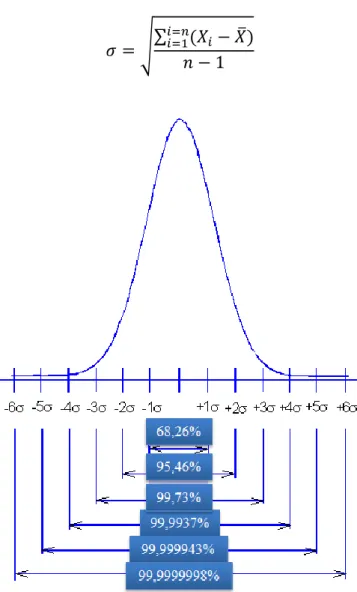
Six Sigma is a systematic and robust approach to improvement, based on a reduction of variability. Originally, six sigma meant producing no more than 2 defects per million (see figure). Sigma (or standard deviation) is in statistics a measure of the amount of variability from the average of a sample and six is the number of standard deviations where the 99,999998% of goods produced should be. To define the standard deviation, it should be applied the following formula:
30 √∑ ̅
Figure 2.15: Relationship between standard deviation and percentage of goods satisfying the requirements. Based on Morgan & Brenig-Jones, 2009
Nowadays, referring to Six Sigma is not only that measure of variability. Implementing Six Sigma is synonym of referring to a five-step process, known as the DMAIC cycle, which aims to improve quality.
31
Figure 2.16: DMAIC cycle
Define means understanding what the problem is. Measure means employing a quality tool to collect data. Analyse means finding the roots of the problem.
Improve means generating and implementing solutions
Control means ensuring a positive long-term effect of the solution
2.2.6- Environmental risk
Environmental SCR might be understood as a two-side term; a hazard caused to a firm due to a natural disaster or a threat instigated by the own activity of an enterprise to the environment.
In the first case, there are many regions of the world were tsunamis, droughts, earthquakes, hurricanes, and floods are a constant threat to their societies in general and to their firms in particular. The negative consequences on supply chains are obvious since production facilities and transportation systems are highly vulnerable to natural disasters. Due to the globalization of markets and a surge in globe-spanning supply chain operations, local catastrophes have increasingly indirect global repercussions. (Wagner & Bode, 2008)
In the second case, is the own firm the guilty of an environmental SCR due to a lack of responsibility when ensuring the firm’s safety and the social responsibility they have with the society. Polluting water, contaminating air or not taking measures to ensure the sustainability of a process can be considered as SCR or hazards.
32 A very frequent environmental risk is thunderstorms. Although there is not usually a critical impact in SCs, nearly every year there is a major tempest which can cause (at least) delays. For example, in October 2013 the northern Europe suffered very strong winds which forced to close airports (such as Heathrow, in London), prevent passage in international roads (e.g. Øresund Bridge which connects Sweden with Denmark), meant electrical shut downs and caused 13 deaths.
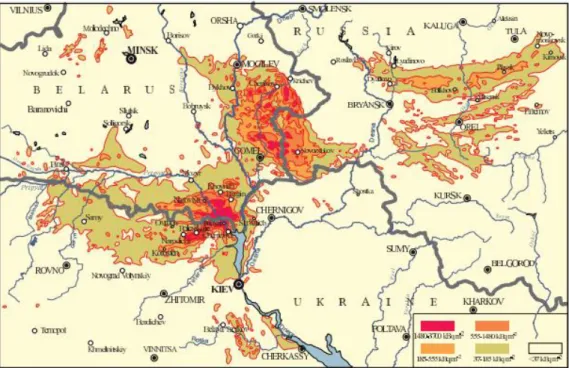
A less-frequent but widely-known example of environmental risk for its impact on population took place in Chernobyl, in 1996. That year, due to some electrical tests, the nuclear reactor overheated resulting in a hydrogen explosion. That meant the death of 31 people, over 600 thousand people with high rates of radioactivity and more than 5 million of inhabitants directly affected (IAEA, 2006).
Figure 2.17: Surface ground deposition of 137Cs after the Chernobyl accident. Based on IAEA, 2006
2.2.7- Other risk
There are other SCR which can damage an enterprise, depending very much in its activity. For example, Governmental instability, intellectual property, financial constraints, exchange rate risks or long bureaucratic procedures must be taken into account by worldwide-oriented firms.
One example of governmental risk was the YPF nationalisation, in May 2012. In that year, Argentina announced the nationalisation of an oil company, YPF, by the expropriation of a 51% of the shares belonging to the Spanish firm Repsol. That caused a huge impact not only in Repsol itself, but also in other international relationships
33 between Spain and Argentina such as cancelling the importation contracts of Argentinian lamb by the Spanish government as a response. A legal battle was then initiated and it was not until February 2014 when Argentina decided to pay USD5.000.000.000 in Argentinian bonds for the 51% of the YPF shares (REPSOL SA, 2014).
Figure 2.18: YPF ownership before (left) and after (right) the nationalisation. Based on Spanish press 2014
One example of intellectual property risk is the legal battle between Apple and Samsung regarding some patents of the Apple device, IPhone. A judge has condemned Samsung to pay USD199.600.000 for violating Apple patents in May 2014. Although, that is only a 5,5% of the USD2.200.000.000 Apple had asked for, the sentence means an impact on Samsung reputation (since that means the public recognition of copying Apple).
One example of financial and exchange SCR is offered by Weissensteiner regarding a Company called Toolco. Toolco, a machine tool manufacturer that produces and sells highly specialized equipment to customers who rely on the company to honour warranties, provide ongoing service, technical assistance and supply spare parts. Southeast Asia and Europe are both major markets for Toolco with German and South Korean manufacturing firms being major customers. Toolco prepares bids, quotes prices, and bills customers in local currency- German euros and South Korean won. In case the U.S. dollar appreciate substantially relative to the German mark and Korean won, Toolco's overall competitive position will weaken relative to its foreign competitors. The strengthening of the U.S. dollar will cause a substantial reduction in
Free float Free float
Free float
34 Toolco's profits and cash flows, a reduction that will affect its ability to service its debt. Toolco can use risk management strategies to mitigate the potential financial problems associated with currency risks. It can hedge its exchange rate exposures and adopt other exchange rate exposure strategies-such as currency swaps for financing its foreign operations-that reduce the likelihood of Toolco experiencing severe financial problems from unexpected exchange rate movements. Managing currency risk may also lead to an increased willingness of customers to buy from Toolco because of its ability to withstand financial difficulties (Weissensteiner, 2014).
2.2.8 – Supply Chain Risk impact of disruptions in enterprises
A SC disruption is the combination of (1) an unintended, anomalous triggering event that materializes somewhere in the supply chain or its environment, and (2) a consequential situation which significantly threatens normal business operations of the firms in the supply chain (Wagner & Bode, 2006).
The chances of experiencing disruptions are higher now, and in the future than in the past because of some recent trends and practices in managing SC (Gurnani et al., 2012):
Increased complexity: the complexity of supply chains has increased due to global sourcing, managing large number of supply chain partners, the need to co-ordinate across many tiers of supply chains, and dealing with long lead times. Outsourcing and partnerships: increased reliance on outsourcing and partnering has heightened interdependencies among different nodes of the global supply networks and increased the chances that a disruption or problem in one link of the supply chain can quickly ripple through the rest of the chain, bringing the whole supply chain to a quick halt.
Single sourcing: single sourcing strategies have reduced the purchase price and the administrative costs of managing the supplier base, but may have also increased the vulnerability of supply chains if the single-source supplier is unable to deliver on time.
Limited buffers: focus on reducing inventory and excess capacity and squeezing slack in supply chains has more tightly coupled the various links leaving little room for errors.
Focus on efficiency: supply chains have focused too much on improving efficiency (reducing costs) at the expense of increasing the risk of disruptions. Over-concentration of operations: in their drive to take advantage of economies
of scale, volume discounts, and lower transaction cost, firms have over-concentrated their operations at a particular location, thus reducing their flexibility.
35 Poor planning and execution: poor planning and execution capabilities result in
more incidents of demand-supply mismatches.
A survey carried on by Glendon and Lindon in 2013 (see figure 2.19), reinforces the Gurnani et al. statement about the increase in the number of disruptions in the recent years. According to that survey, 75% of organizations recognise to have suffered at least one disruption in their past 12 months and the 22% of them, claim to have suffered more than six disruptions.
Figure 2.19: Percentage of respondents which has suffered SC disruptions in the past 12 months. Based on the survey developed by Glendon and Lindon and included in the 5th annual Zurich Insurance survey for Supply Chain Resilience 2013 (Glendon & Lindon, 2013).
How the severity of disruptions in a SC is matched by the disruption probability is a topic discussed by Sheffi in his book (Sheffi, 2005). According to him, the most severe and frequent SC disruption is due to the loss of a key supplier.
25% 53% 13% 5% 1% 3% 0% 10% 20% 30% 40% 50% 60% 70% 80% 90% 100% Number of SC disruptions 51+ 21 to 50 11 to 20 6 to 10 1 to 5 0
36
Figure 2.20: Enterprise vulnerability to SC disruptions. Based on Sheffi, 2005
According to Tang, SC disruptions can have significant impact on a firm’s short-term performance (Tang, 2006). Nevertheless, disruptions can have also a huge impact in the long-term performance of an enterprise. Based on a sample of more than 800 supply chain disruption announcements, Gurnani et al. discuss in their paper the fact that firms which suffer supply chain disruptions experience 33–40% lower stock returns relative to their benchmarks, 13.5% increase in share price volatility, 107% drop in operating income, 7% lower sales growth, and 11% increase in costs in the following two years of a major disruption (Gurnani et al., 2012).
Under the above mentioned circumstances, new philosophies, tools and best practices have been introduced successfully to mitigate the effect of disruptions. In the following subchapter, Lean is presented as the most revolutionary and widespread philosophy introduced in the last 50 years between large enterprises.
2.3- Lean philosophy
In the early 1988, Toyota's Chief Engineer, Taiichi Ohno (Ohno, 1988) identified 7 ways of waste as part of the Toyota Production System (TPS):
Transportation Each time a product is moved it stands the risk of being damaged, lost or delayed what means a cost for no-added value. Transportation
37 does not make any transformation to the product that the consumer is willing to pay for.
Inventory Inventory, be it in the form of raw materials, work-in-progress or finished goods, represents a capital outlay that has not yet produced an income either by the producer or for the consumer. Any of these three items not being actively processed to add value is waste.
Motion Motion refers to the damage that the production process causes on the entity that creates the product, either over time (wear and tear for equipment and repetitive strain injuries for workers) or during discrete events (accidents that damage equipment and/or injure workers).
Waiting Whenever goods are not in transport or being processed, they are waiting.
Overprocessing Overprocessing occurs any time more work is done on a piece than is required by the customer. This also includes using components that are more precise, complex, higher quality or expensive than absolutely required. Overproduction Overproduction occurs when more products are produced
than is required at that time by your customers (e.g. larger batches than required). It leads to excess inventory, which then means expending resources on storage, space and preservation activities that do not benefit the customer. Defects Whenever defects occur, extra costs are incurred re-working the part,
re-scheduling production, etc. Defects in practice can sometimes double the cost of one single product. This should not be passed on to the consumer and should be taken as a loss.
It is easy not to forget that 7 kinds of waste by remembering ‘TIMWOOD’.
Several authors have later added an additional form of waste, connected with the suitability of an employee to his workplace.
Intellect/People Over use or under use of human resources, such as not having enough staff to carry out duties; using over qualified people to carry out certain works or using extra human resources to assist fully automated processes
38
Figure 2.21: 8 forms of waste. Based on Chiarini, 2013
One of the key steps in Lean and TPS is to identify which steps add value and which can be considered as a kind of waste. Much in Lean is about knowing how to look at processes and improve them (Lacey, 2007). In some way, popular initiatives like outsourcing, reduction of inventories, just-in-time concepts, and increasing inter-firm cooperation have helped to create much leaner SCs (Kern, 2011) although the person who was in charge might not be aware he was applying some Lean concepts. But there is still a huge margin for improvement through Lean, especially in SMEs and their production plants. But it is remarkable that the implementation of Lean concepts within SCs must be accompanied by SC risk management concepts (Kern, 2005; Wieland, 2012) and vice versa. There is no point in implementing a Lean tool without a clear SCR process giving a reason to do that. But there is neither a SCR process which aims not to increase productivity while reducing non-value activities, what in the end means ‘Leaner’.
2.3.1-Definition
According to Marchwinski, communication director of Lean Enterprise Institute, Inc., Lean management is a series of practices that develops people to understand and own their problems, and aligns resources to achieve the purpose of the organization. Lean management engages everyone in designing processes to continuously solve problems, improve performance, and achieve purpose while consuming the fewest possible resources (Marchwinki, 2014).
39 In a similar way, Ruffa describes Lean as a system of management that creates and sustains strong, steady bottom-line value for corporations and their customers even as they encounter severe, dynamic conditions (Ruffa, 2008)
In this thesis, Lean is defined as a ‘philosophy embracing the whole organisation which aims to reduce non-adding activities and waste, pursue perfection and guarantee the employees’ satisfaction in order to increase the overall production while decreasing the total cost’
2.3.2- Lean principles
The categorisation of Lean principles is slightly different according to the author you read. However, all of them pursue the same objective: be more cost-effective.
Womack and Jones (Womack & Jones, 2003), one of the reference books for Lean manufacturing, defines 5 principles: value, value stream, flow, pull and perfection. Oehmen (Oehmen, 2012) suggests adding one to the 5 principles of Womack and Jones,
respect for people. And Sayer and Williams (Sayer & Williams, 2012) proposed 6 principles: customer value, value-stream analysis, everyday improvement, flow, pull and perfection.
In this thesis, it is going to be adopted the six-principle Lean categorisation proposed by Oehmen. Especially for SMEs, the criticality of the satisfaction and the performance of every single employee is maximum and that is why I think that categorisation fits better than the given by Womack and Jones, for example.
Principle 1: Value
Capture the value defined by the customer stakeholders, who may be either external or internal. The external customer who pays for the system or service defines the final value for the deliverable. Internal customers receive the output of a task or activity and usually do not explicitly pay. In both cases, the customer stakeholder is the one who defines what constitutes value.
Principle 2: Value stream
Map the value stream (plan the program) and eliminate waste. Map all end to end linked tasks, control/decision nodes, and the interconnecting flows necessary to realize customer value. During the mapping process, identify and eliminate all non-value added activities, minimize all necessary non value activities, and enable the remaining activities to flow without rework, backflow, or stopping.
40
Principle 3: Flow
Flow the work through planned and streamlined value adding steps and processes, without stopping or idle time, unplanned rework, or backflow. To optimize flow, plan for the maximum concurrency of tasks up to near capacity of an enterprise.
Principle 4: Pull
Let customer stakeholders pull value. In manufacturing, the ideal pull principle is implemented as the Just in Time (JIT) delivery of parts and materials to the needing station and to the external customer.
Principle 5: Perfection
Pursue perfection in all processes. Global competition is a brutal ‘race without a finish line,’ requiring continuous improvements of processes and products.
Principle 6: Respect for People
A Lean enterprise is an organization that recognizes its people are the most important resource and is one that adopts high performance work practices. In Lean, people are encouraged to identify problems and imperfections honestly and openly in real time, and plan effective solutions together by consensus.
41
2.4- Resilience
The concept of business resilience is still relatively new. Except for those companies that have learned to expect continuous business disruptions, many are still struggling with the idea. There is a tendency to look for the cause of the disruption and tackle survival that way, which can be helpful. But it is not as important as other activities such as researching how companies with frequently disrupted SC plan ahead and recover without driving up costs. If your business is not prepared to handle disruption or disaster, then it will suffer. It may not even survive (Tompkins, 2007). Resilience of SC is therefore, critical for individual organisations, the economy and the wellbeing of society as a whole (Rural affairs, 2010). Each individual link of a SC is not likely to suffer a particular rare event, but the chances are that the chain as a whole will be disrupted somehow (Sheffi, 2005).
Resilience is more important today than ever. The pace of business has accelerated, and the velocity of events is greater. This makes organizations more vulnerable to disruptions, unexpected surges, and declines in demand (Sheffi, 2005; Tompkins, 2007; Pettit et al., 2013). Only by increasing their resilience, these enterprises are likely to continue with their activity in a long-term horizon.
Figure 2.23: Moving from high-vulnerabilities-low-capabilities to low-vulnerabilities-high-capacities. Based on Pettit et al., 2013
42
2.4.1- Definition
Numerous authors have addressed the question of how to define the concept of resilience within SC. And there is quite an agreement between them. Resilience, as a pure concept, is the capacity to recover quickly from difficulties; toughness (Oxford Dictionaries, 2010). Within the concept of SC, Ritchie and Bob say ‘resilience may be defined as a system’s ability to return to a new stable situation after an accidental event’ (Ritchie & Bob, 2008). For Ates and Bititci, resilience is ‘the capacity of an organisation to survive, adapt and sustain the business in the face of turbulent change’ (Ates & Bititci, 2011). For Christopher, resilience refers to the ability of the SC to cope with unexpected disturbances (Christopher, 2011). And very similarly, for Pettit et al. ‘resilience is the ability to survive, adapt, and grow in the face of turbulent change’ (Pettit et al., 2013).
In this thesis, resilience must be understood as the capacity of a firm to prevent and overcome SCR quickly, effectively and resourcefully, thus guaranteeing its existence in the long-term.
43
2.4.2- Key aspects of resilience
SME managers perceive their challenges as being different to those experienced by larger organisations, especially in the meaning of an extreme event. Sullivan-Taylor and Branicki collect some relevant managers’ impressions in their paper (Sullivan-Taylor & Branicki, 2011). For example,
‘An extreme event is anything which is particularly life threatening’ (Managing Director, Manufacturing).
‘An extreme event could be a major non-payment of an invoice, or flooding, or a failure in our electronic facilities in our workshop’ (Director, Manufacturing). ‘There are events that happen in small businesses that just totally challenge the
existence of the organisation, which you don’t get in big ones. For example, the death of a key person in the organisation, I’ve had that’ (Chairman, Enterprise Board)
There had been an implicit assumption that organisational theories, models and conceptual frameworks developed in large organisations were relevant and directly applicable to SMEs (Kumar et al., 2011). Sullivan-Taylor and Branicki (Sullivan-Taylor & Branicki, 2011) highpoint in their paper the fact that SMEs do not hold the resources and technical systems often equated with resilience capabilities. They also write an excerpt from a chairman interview: ‘We just ignore them (referring to resilience activities) because we don’t have the resources to do it. It’s the difference between a big business and a small business. Big business, you make a decision on the basis of what is value, the small business you make a business decision on the basis of what you can afford’.
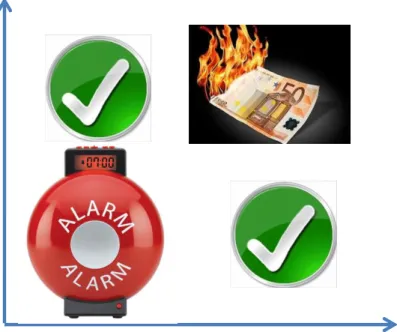
But even the obvious restrictions managers claim to have, managers’ concerns should desirably not cover the opportunities they have to increase their SMEs resilience. There are some cost-effective and potentially applicable concepts which can help to create resilience. Soft managerial practices such as effective communication and relationships within the organisation, with key customers and stakeholders are all fundamental to enabling firms to be resilient (Ates & Bititci, 2011). Resilience is dependent on a set of collaborative relationships with trading partners, since each enterprise is only as resilient as the weakest link in its supply chain (Sheffi, 2005). In addition, firms can inexpensively reduce their vulnerability by investing in training and culture, organizing for action, reducing the likelihood of disruptions, collaborating for security and building in redundancies (Sheffi, 2005). That last point is somehow controversial: redundancies clearly increase resilience by enhancing the SMEs performance in case of unexpected demand, but an excess of inventory can damage the profitability of the business. Petit et al. perfectly define the area in which SMEs should aim to be, the ‘zone of balanced resilience’ (Pettit et al., 2013). It is also remarkable that
44 once a disruption has happened, is important to give customers as much information as possible in order to help them to recover from it. Which customers should be supported first is a vital decision that can be based on costumer vulnerability or on more internally focused criteria such as how profitable the customer is (Sheffi, 2005).
Figure 2.25: The resilience fitness space. Based on Pettit et al., 2013
2.4.3- Nine principles to build a resilient SME
There have been detected nine main principles in the literature which definitely contribute to create resilience in a SME.
Principle 1 Create and maintain SC resilience is not a one-time event - it is a process (Pettit et al., 2013).
Principle 2 Standardize parts, processes and productions systems so that these elements are interchangeable. That creates options for using them when there is a shortfall (Sheffi, 2005).
Principle 3 Do not focus all the attention to operational, hard and internal aspects of change management with a short-term and reactive behaviour, whilst neglecting strategic, long-term and soft requirements of organisational change process (Ates & Bititci, 2011).
Principle 4 Increase your operational flexibility. That involves a close partnership with suppliers who can be called upon to help; flexible contracts allowing for changes in quantities and delivery time; flexible manufacturing